EP0207472A2 - Mikroprozessorunterstützte Datenblocktransfervorrichtung - Google Patents
Mikroprozessorunterstützte Datenblocktransfervorrichtung Download PDFInfo
- Publication number
- EP0207472A2 EP0207472A2 EP86108813A EP86108813A EP0207472A2 EP 0207472 A2 EP0207472 A2 EP 0207472A2 EP 86108813 A EP86108813 A EP 86108813A EP 86108813 A EP86108813 A EP 86108813A EP 0207472 A2 EP0207472 A2 EP 0207472A2
- Authority
- EP
- European Patent Office
- Prior art keywords
- memory
- data
- peripheral
- bus
- data bus
- Prior art date
- Legal status (The legal status is an assumption and is not a legal conclusion. Google has not performed a legal analysis and makes no representation as to the accuracy of the status listed.)
- Ceased
Links
Images

Classifications
-
- G—PHYSICS
- G06—COMPUTING OR CALCULATING; COUNTING
- G06F—ELECTRIC DIGITAL DATA PROCESSING
- G06F13/00—Interconnection of, or transfer of information or other signals between, memories, input/output devices or central processing units
- G06F13/14—Handling requests for interconnection or transfer
- G06F13/20—Handling requests for interconnection or transfer for access to input/output bus
- G06F13/28—Handling requests for interconnection or transfer for access to input/output bus using burst mode transfer, e.g. direct memory access DMA, cycle steal
-
- G—PHYSICS
- G06—COMPUTING OR CALCULATING; COUNTING
- G06F—ELECTRIC DIGITAL DATA PROCESSING
- G06F13/00—Interconnection of, or transfer of information or other signals between, memories, input/output devices or central processing units
- G06F13/10—Program control for peripheral devices
- G06F13/12—Program control for peripheral devices using hardware independent of the central processor, e.g. channel or peripheral processor
- G06F13/124—Program control for peripheral devices using hardware independent of the central processor, e.g. channel or peripheral processor where hardware is a sequential transfer control unit, e.g. microprocessor, peripheral processor or state-machine
- G06F13/128—Program control for peripheral devices using hardware independent of the central processor, e.g. channel or peripheral processor where hardware is a sequential transfer control unit, e.g. microprocessor, peripheral processor or state-machine for dedicated transfers to a network
-
- G—PHYSICS
- G06—COMPUTING OR CALCULATING; COUNTING
- G06F—ELECTRIC DIGITAL DATA PROCESSING
- G06F13/00—Interconnection of, or transfer of information or other signals between, memories, input/output devices or central processing units
- G06F13/38—Information transfer, e.g. on bus
- G06F13/40—Bus structure
- G06F13/4004—Coupling between buses
- G06F13/4027—Coupling between buses using bus bridges
- G06F13/404—Coupling between buses using bus bridges with address mapping
Definitions
- This invention relates to information movement within a data processing system generally between a memory unit of the data processing system and a peripheral, and more specifically, relates to a microprocessor based input/output (I/O) controller.
- I/O input/output
- Microprocessor based systems especially those used as intelligent peripheral controllers, are often faced with a time critical data movement problem.
- this problem is one of moving data from a buffer in a peripheral controller device to an ordered array of sequential locations in memory (RAM).
- data movement is handled by a method normally referred to as programmed I/O, wherein the microprocessor determines the peripheral has a word of data to be transferred via an interrupt or a read of some status.
- the microprocessor reads the data and stores it in a memory location of RAM. This method is relatively slow and an over-run may occur if the peripheral receives data faster than the microprocessor can remove it.
- the reverse process, memory to peripheral transfers, is handled similarly. An under-run condition occurs when the microprocessor cannot transfer data to the peripheral fast enough.
- a second method of data transfer between memory and a peripheral involves direct memory access (DMA) techniques.
- DMA direct memory access
- the microprocessor instructs a DMA controller to transfer a given block of data to or from a peripheral and the DMA controller transfers the data without further microprocessor intervention.
- the microprocessor can continue in its normal program execution. High data transfer rates can be attained with DMA techniques.
- the present invention allows data transfer rates faster than that attainable with programmed I/O without the expense of a DMA controller.
- Blocks of data are transferred between the peripheral (an interface to a local area network (LAN) in the preferred embodiment) and memory.
- the microprocessor is fully involved with the block transfer while it is in progress, i.e., the microprocessor is being single-stepped (made to execute a single instruction on demand) and its address lines used to point to the memory locations to be affected.
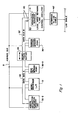
- a microprocessor (up) 10 is operatively connected to a data bus A 22.
- a memory 30, comprised of a random access memory (RAM) 30-1, a NOP, RTS instruction generation circuitry (IGC) 30-2, and a read only memory (ROM) 30-3, and a peripheral controller 40 are also operatively connected to a bus 20.
- the bus 20 includes an address- bus 21 and a data bus 22.
- IGC memory 30-2, and read only memory 30-3 are operatively connected to data bus A 22.
- the random access memory 30-1 and the peripheral controller 40 are operatively connected to data bus B 22'.
- the peripheral controller 40 is shown as the local area network (LAN) control circuitry which is used to interface the data processing system to a local area network cable via the interface to the LAN cable 40'.
- LAN local area network
- FIG. 1 specifically shows a local area network control circuitry 40, it will be understood by those skilled in the art that the present invention is applicable to a wide variety of peripheral controllers and peripheral devices.
- the utilization of the term peripheral controller is intended to include a wide variety of peripheral controllers which can include some type of input/output register or interface register, denoted herein as peripheral register 41, to interface with a data bus.
- the NOP, RTS instruction generation circuitry 30-2 was implemented with programmable array logic.
- the IGC 30-2 can be implemented with a programmable logic array, or ROM.
- the NO-operation (NOP) instruction can be any instruction of the microprocessor which has no significant result when executed and may or may not be the NOP instruction of the instruction set of the microprocessor, e.g., the "Load A Immediate” (LDAI) instruction was utilized in the preferred embodiment.
- the microprocessor 10 of the preferred embodiment of the present invention utilizes a 6502 microprocessor.
- the data bus 22 is divided into data bus A 22 and data bus B 22' by a bidirectional buffer 25.
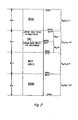
- FIG. 2 there is shown a memory map of the preferred embodiment of the present invention.
- the memory 30 (also referred to herein as memory modules) of the data processing system of the preferred embodiment of the present invention is mapped to four 16K segments, the four segments forming a total memory space. Sixteen address lines A 15 - A 0 , where A 0 is the least significant bit, are utilized in bus 20.
- the upper 16K (locations C000 - FFFF hexadecimal, all memory locations given herein are in hexadecimal) is mapped to include a 16K ROM from locations C000 - F FFF. For this defined upper 16K of memory, address bits A 15 and A 14 are both a logic one. This upper 16K of memory is also referred to herein as the first 16K of memory.
- the next, or second, 16K of the defined memory map from location 8000 to BFFF includes the IGC memory space, which is divided into two 8K memory areas.
- the memory space from 8000 - 9FFF defines the Read RAM routines in which A 13 is a logic zero, and the memory space from A000 - BFFF defines the WRITE RAM routines in which A 13 is a logic one.
- a 15 is a logic one and A 14 is a logic zero.
- the third 16K of the defined memory map from locations 4000 to 7FFF is not used in the preferred embodiment of the present invention.
- a 15 is a logic zero and A 14 is a logic one.
- the fourth (or lower) 16K of the defined memory map from locations 0000 to 3FFF defines the RAM memory space of the preferred embodiment of the present invention.
- the I/O routines within the second 16K of memory are addressed when a data movement is to be between the peripheral register 41 and RAM memory 30-1, the upper or lower 8K of memory within the IGC memory 30-2 defining the direction of the data movement. This operation will be described in further detail hereinunder.
- the addresses 0000-FFFF are the memory space addresses within the total memory Bpace; however each memory module 30 has 16K of addressable memory location, the upper two bits, i.e. A 15 and A 14 , being utilized as control bits to enable the memory module involved in the selected memory operation.
- Memory 30 of the preferred embodiment of the present invention includes a 16K ROM memory module 30-3 having real addresses 0000 - 3FFF, a 16K IGC memory module 30-2 having real addresses 0000 - 3FFF, and a 16K RAM memory module 30-1 having real addresses 0000 - 3FFF.
- Address lines 21, A 13 - A 0 of bus 20, are operatively connected to the corresponding 14 terminals of the ROM 30-3, RAM 30-1 and IGC 30-2. These 14 address lines which carry the corresponding address signals from microprocessor 10 are sufficient to address any location within a 16K area.
- a 15 , and A 14 are the upper bits utilized to select one of the 16K areas.
- an enable signal is coupled from control logic 50.
- the control logic 50 generates the proper enable signal by decoding address information contained on address lines A 15 - A 13 , the control logic 50 to be described in detail hereinunder.
- An enable signal from control logic 50 is also coupled to an enable terminal, E, of peripheral register 41 and a SWITCH CONTROL SIGNAL is also coupled to the bidirectional buffer 25, also denoted herein as a switch.
- Data lines of data bus A 22 of bus 20 are connected to the corresponding data terminals, D, of the ROM and IGC memory modules.
- Data lines of data bus B 22' of bus 20 are connected to the data terminals of the peripheral register 41 and the data terminals of the RAM memory module.
- peripheral register 41 if more than a single peripheral register 41 is utilized in the peripheral controller 40, address lines 21 can be coupled to corresponding address terminals of the peripheral registers (not shown) in order to address a single peripheral register.
- the peripheral register 41 also has control lines START I/O and DATA READY operatively connected to the interrupt request (IRQ) and ready (RDY) terminals of the microprocessor 10.
- the interrupt request interrupts the microprocessor and causes an interrupt routine to be performed which initiates and controls the input/output operation.
- the data ready signal is coupled to the microprocessor 10 each time the peripheral register 41 is full and ready to transfer data.
- the signal at the RDY terminal of the microprocessor causes the microprocessor to execute a single instruction and then pause (i.e., operates in a "step" mode).
- pause i.e., operates in a "step" mode.
- I/O input/output
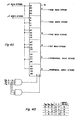
- FIG. 4A and 4B which together make up Figure 4, there is shown a block diagram of a multiplexer, MUX, 51 which switches the control signals of the control logic 50 to the appropriate memory module 30 and/or peripheral register 41, thereby achieving the desired read/write operation.
- the microprocessor read strobe signal is connected to input terminal A0, Cl, A2, B2, B3, C3, C4, and B5.
- the microprocessor write strobe signal is connected to input terminal Al.
- the output of MUX 51, outputs 0 - 5, are connected to the ROM read strobe terminal of the memory modules 30 i.e., ROM 30-3, RAM write strobe terminal of RAM 30-1, RAM read strobe terminal of RAM 30-1, read strobe terminal of IGC 30-2, peripheral read strobe terminal, and peripheral write strobe terminal, respectively.
- Address signals A 15 , A 14 , and A 13 are utilized to select between input terminals A, B, and C, in accordance with the table of Figure 4B.
- the microprocessor 10 In a normal operation by the microprocessor 10 in which the microprocessor is accessing the memory modules 30, the microprocessor is addressing the ROM memory space in which A 15 and A 14 are a logic one or is addressing the RAM memory space in which A 15 and A 14 are a logic 0.
- a 13 is a "don't care" term and is denoted as "X".
- the microprocessor read strobe signal is coupled to the ROM read strobe terminal and is also coupled to the RAM read strobe terminal via output terminal 2.
- normal reads are made from the ROM 30-3, or RAM 30-1, by the microprocessor 10.
- the microprocessor 10 When write operations are performed, the microprocessor 10 again addresses address space in which A 15 and A 14 are both a logic zero and the write strobe signal is coupled to the RAM write strobe terminal thereby performing normal write operations to the RAM 30-1.
- the microprocessor 10 In an I/O operation between RAM and the peripheral, the microprocessor 10 also acts as a controller. When the peripheral register 41 has data to be transferred, assuming a read operation of the peripheral, a start I/O signal is generated by the peripheral controller 40, thereby interrupting the microprocessor 10. The microprocessor 10 then causes the data stored in peripheral register 41 to be directly inputted into RAM memory, thereby bypassing the operation of reading the data into an internal register of the microprocessor 10 and then outputting the data into memory 30. The microprocessor performs "dummy operations" (i.e., the execution of NOP type instructions as discussed above) whereby RAM addresses are placed on the address lines 21 in which the data is to be stored.
- "dummy operations" i.e., the execution of NOP type instructions as discussed above
- the address space accessed by the microprocessor 10 is the upper 8K of the second 16K of the defined memory map in which A 15 , A14, and A 13 are a logic one, a logic zero, and a logic one, respectively. This causes the C input terminals of MUX51 to be selected.
- the "dummy operation" from the microprocessor causes the read strobe signal to be coupled via input Cl to the RAM write strobe terminal.
- the microprocessor *dummy operation also causes the read strobe signal to be coupled via input C4 to the peripheral read strobe terminal.
- the peripheral operation is a read, or output of the data, the data being placed on the data bus B 22' of the data lines and the RAM accepts the data that is present on the data bus B 22' of the data lines, and is written into the RAM at the address specified on the address lines 21, the address being the address of the "dummy operation".
- the "NOP" instruction causes the microprocessor 10 to execute "no operation", although a fetch is made by the microprocessor for this instruction. It is the fetch of an instruction from the IGC address space that causes the data movement.
- data is transferred directly from the peripheral register 41 into the RAM and bypasses the transfer of the data into the microprocessor 10. Since the microprocessor 10 is performing a dummy operation, i.e.
- the data bus A is separated from data bus B via switch 25.
- the address of the fetch is also the address of RAM being written into.
- the microprocessor performs a "dummy operation" causing the address of RAM memory to be read to be placed on address lines 21, the fetches of the NOP instructions to be in the lower 8K of the 16K IGC memory area, in which A 15 is a logic zero A 14 is a logic one, and A 13 is a logic zero, this area having been defined as the NOP area for data move from memory to the peripheral.
- input terminals B are selected.
- the microprocessor "dummy operation" causes the microprocessor read strobe signal to be coupled to the RAM read terminal via B2 and also causes the microprocessor read strobe signal to be coupled to the peripheral write terminal via B5.
- the data is placed on the data bus B 22' from the RAM 30-1, and the data present on the data bus B 22' is written into the peripheral register 41.
- the enable signals coupled to the memory modules 30 cause data from the RAM 30-1, to place data on the data bus B 22 1 . This operation again bypasses the microprocessor having to read the data into an internal register and then outputting the data to the peripheral controller 41.
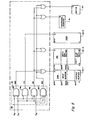
- enable logic 52 of the control logic 50 generates an enable signal for each of the memory modules 30-l, 30-2, 30-3, and for the peripheral register 41 and the switch 25, the corresponding enable signal being coupled to the corresponding enable terminal, E, of each module.
- the microprocessor 10 is accessing the ROM or RAM memory modules 30, the first 16K address space is utilized and A 15 and A 14 are both a logic one, or the last 16K address space is utilized and A 15 and A 14 are both a logic zero, respectively.
- a decoder 53 decodes the signals associated with address lines A 15 , A 14 , and A 13 .
- the microprocessor 10 when the microprocessor 10 is accessing ROM, the first 16K address space is being utilized, A 15 and A 14 are both a logic one, and AND gate 54 is enabled thereby providing an enable signal to ROM 30-3.
- the microprocessor is accessing RAM, the last 16K address space is being utilized, A 15 and A 14 are both a logic zero, and AND gate 55 is enabled thereby providing an enable signal to RAM 30-1.
- the second 16K address space is being utilized in which A 15 and A 14 are a logic one and a logic zero respectively.
- AND gate 56 is enabled providing an enable signal to RAM, providing an enable signal to the peripheral register 41, and providing an enable signal to the IGC memory module 30-2.
- an enable signal is provided to switch 25, such that when the enable signal is high the operation of the switch is such that data bus A 22 is disconnected from data bus B 22', i.e., the switch is opened.
- the addresses fetched from IGC memory are from the lower 8K of the second 16K memory area, i.e., the second 16K address area, and A 13 is a logic zero.
- AND gate 57 is enabled thereby providing an enable signal to the RAM 30-1 and to the peripheral register 41.
- the enable signal is also provided to the switch 25 and to the IGC memory module 30-2.
- the read and write control signals are provided to the respective modules as described above in conjunction with the multiplexer 51.
- a data block of 256 data words is transferred between the RAM 30-1 and the peripheral register 41.
- a fetch of the NOP instruction is made in response to a DATA READY signal which allows the microprocessor 10 to execute one instruction.
- 256 instruction fetches are made in the respective read-or-write RAM routines which are sequences of dummy instructions, also denoted herein as dummy routines.
- the area of memory of IGC memory 30-2 which contains the 256 instructions i.e., 255 NOP and one Return) are mirrored for buffer areas in the corresponding RAM buffer areas.
- the location which contains the write RAM routine has a corresponding input buffer in RAM 30-1, and the read RAM routine in IGC memory 30-2 has a corresponding output buffer in RAM memory module 30-1.
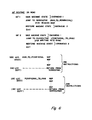
- interrupt routines of the microprocessor 10 When an I/O operation is to be initiated, the I/O start signal is transferred which invokes an interrupt routine INT1 within the microprocessor (or INT2 is initiated internally by the microprocessor 10), depending on whether the I/O transfer is to be from RAM to peripheral or from peripheral to RAM, respectively. Both interrupt routines, INT1 or INT2 save the machine state, jump to a subroutine, and subsequently restore the machine state and then exit. The difference between the two interrupt routines is the jump to a subroutine. I N T1 jumps to a subroutine which is in an IGC memory 30-2 area which generates the control signals and the enable signals for the RAM to peripheral transfer.
- the subroutine which is jumped to by the INT2 interrupt routine is in an area of IGC memory 30-2 which generates the control signals for performing the peripheral to RAM transfer, the generation of the control signals having been described above.
- the subroutine for the RAM to peripheral transfer contains 255 NOP instructions plus a return from subroutine instruction making a total of 256 instructions (for a 256 word block transfer). These instructions lie in an area of IGC memory from location 0000 to location OOFF. These locations are the areas addressed by the microprocessor in performing the fetch for the NOP instruction. While the fetch is being performed the address is placed on the address lines which are also coupled to the RAM. Thus, location 0000 through location OOFF has a corresponding output buffer within RAM.
- the 256 location assumes data block transfers being fixed at 256 words. If any error occurs in the transfer various techniques may be incorporated to get around the error.
- a timer is set such that if an I/O transfer hangs up, and the timer times out, the timer causes the interrupt routine to be exited to an error routine which can then reset the I/O and form a retry, or any other error processing may be performed.
- the subroutines are placed in locations within the second 16K address space to correspond to predetermined buffer areas.
- the multiplexer 51 of Figure 4 would be modified so that input terminals D are utilized and the select inputs X, Y would have coupled thereto the decoding of the A15 and A14 when these signals are a logic zero and a logic one, respectively.
- the related patent application entitled "Microprocessor Assisted Memory to Memory Move Apparatus", S/N assigned to the same assignee as the present application filed on even date herewith, said related application being incorporated by reference herein.
- the IGC memory 30-2 can be included in the ROM area of memory thereby requiring some modification of the control logic 50.
- the related patent which is incorporated by reference herein.
Landscapes
- Engineering & Computer Science (AREA)
- Theoretical Computer Science (AREA)
- General Engineering & Computer Science (AREA)
- Physics & Mathematics (AREA)
- General Physics & Mathematics (AREA)
- Computer Hardware Design (AREA)
- Microelectronics & Electronic Packaging (AREA)
- Bus Control (AREA)
- Iron Core Of Rotating Electric Machines (AREA)
- Microcomputers (AREA)
Applications Claiming Priority (2)
| Application Number | Priority Date | Filing Date | Title |
|---|---|---|---|
| US75043385A | 1985-07-01 | 1985-07-01 | |
| US750433 | 2000-12-28 |
Publications (2)
| Publication Number | Publication Date |
|---|---|
| EP0207472A2 true EP0207472A2 (de) | 1987-01-07 |
| EP0207472A3 EP0207472A3 (de) | 1988-08-31 |
Family
ID=25017855
Family Applications (1)
| Application Number | Title | Priority Date | Filing Date |
|---|---|---|---|
| EP86108813A Ceased EP0207472A3 (de) | 1985-07-01 | 1986-06-28 | Mikroprozessorunterstützte Datenblocktransfervorrichtung |
Country Status (7)
| Country | Link |
|---|---|
| EP (1) | EP0207472A3 (de) |
| JP (1) | JPS629455A (de) |
| AU (1) | AU589649B2 (de) |
| CA (1) | CA1259707A (de) |
| IN (1) | IN164933B (de) |
| NO (1) | NO173305C (de) |
| ZA (1) | ZA863643B (de) |
Cited By (5)
| Publication number | Priority date | Publication date | Assignee | Title |
|---|---|---|---|---|
| FR2669447A1 (fr) * | 1990-10-01 | 1992-05-22 | Motorola Inc | Procede et appareil de transfert de donnees en une seule instruction. |
| FR2689265A1 (fr) * | 1992-02-06 | 1993-10-01 | Mitsubishi Electric Corp | Système de communication entre des cartes de communication montées séparément dans des étagères. |
| EP0747830A1 (de) * | 1995-06-06 | 1996-12-11 | Hewlett-Packard Company | Hauptspeichersegmentierung, um Datenpfade in einem Rechnersystem leistungsfähiger zu machen |
| EP0747829A1 (de) * | 1995-06-06 | 1996-12-11 | Hewlett-Packard Company | Ein Ein-/Ausgabeprozessor der gemeinsame Betriebsmittel einem Ein-/Ausgabebus in einem Rechner zur Verfügung stellt |
| EP0898231A3 (de) * | 1997-08-15 | 2000-02-02 | Compaq Computer Corporation | Technik zur Reduzierung von Busrückspannung und Spannungsüberschwingung in einem unter Spannung einsteckbaren Rechnersystem |
Family Cites Families (2)
| Publication number | Priority date | Publication date | Assignee | Title |
|---|---|---|---|---|
| CA1148265A (en) * | 1979-07-30 | 1983-06-14 | John M. Dinwiddie, Jr. | High performance i/o controller for transferring data between a host processor and multiple i/o units |
| US4344130A (en) * | 1979-09-26 | 1982-08-10 | Sperry Corporation | Apparatus to execute DMA transfer between computing devices using a block move instruction |
-
1986
- 1986-05-07 NO NO861836A patent/NO173305C/no unknown
- 1986-05-12 CA CA000508902A patent/CA1259707A/en not_active Expired
- 1986-05-16 ZA ZA863643A patent/ZA863643B/xx unknown
- 1986-06-27 AU AU59412/86A patent/AU589649B2/en not_active Ceased
- 1986-06-28 EP EP86108813A patent/EP0207472A3/de not_active Ceased
- 1986-07-01 JP JP61154961A patent/JPS629455A/ja active Pending
- 1986-09-25 IN IN270/BOM/86A patent/IN164933B/en unknown
Cited By (7)
| Publication number | Priority date | Publication date | Assignee | Title |
|---|---|---|---|---|
| FR2669447A1 (fr) * | 1990-10-01 | 1992-05-22 | Motorola Inc | Procede et appareil de transfert de donnees en une seule instruction. |
| FR2689265A1 (fr) * | 1992-02-06 | 1993-10-01 | Mitsubishi Electric Corp | Système de communication entre des cartes de communication montées séparément dans des étagères. |
| US5400332A (en) * | 1992-02-06 | 1995-03-21 | Mitsubishi Denki Kabushiki Kaisha | Communication system between communication cards mounted separately in shelves |
| EP0747830A1 (de) * | 1995-06-06 | 1996-12-11 | Hewlett-Packard Company | Hauptspeichersegmentierung, um Datenpfade in einem Rechnersystem leistungsfähiger zu machen |
| EP0747829A1 (de) * | 1995-06-06 | 1996-12-11 | Hewlett-Packard Company | Ein Ein-/Ausgabeprozessor der gemeinsame Betriebsmittel einem Ein-/Ausgabebus in einem Rechner zur Verfügung stellt |
| US5664152A (en) * | 1995-06-06 | 1997-09-02 | Hewlett-Packard Company | Multiple segmenting of main memory to streamline data paths in a computing system |
| EP0898231A3 (de) * | 1997-08-15 | 2000-02-02 | Compaq Computer Corporation | Technik zur Reduzierung von Busrückspannung und Spannungsüberschwingung in einem unter Spannung einsteckbaren Rechnersystem |
Also Published As
| Publication number | Publication date |
|---|---|
| AU5941286A (en) | 1987-01-08 |
| NO861836L (no) | 1987-01-02 |
| NO173305B (no) | 1993-08-16 |
| JPS629455A (ja) | 1987-01-17 |
| NO173305C (no) | 1993-11-24 |
| CA1259707A (en) | 1989-09-19 |
| ZA863643B (en) | 1987-01-28 |
| EP0207472A3 (de) | 1988-08-31 |
| AU589649B2 (en) | 1989-10-19 |
| IN164933B (de) | 1989-07-08 |
Similar Documents
| Publication | Publication Date | Title |
|---|---|---|
| US4050058A (en) | Microprocessor with parallel operation | |
| US4688166A (en) | Direct memory access controller supporting multiple input/output controllers and memory units | |
| US4144562A (en) | System and method for increasing microprocessor output data rate | |
| US3943495A (en) | Microprocessor with immediate and indirect addressing | |
| EP0007028B1 (de) | Externe Speichereinrichtung mit Basisregister | |
| US4005391A (en) | Peripheral interrupt priority resolution in a micro program data processor having plural levels of subinstruction sets | |
| EP0330226B1 (de) | Vorrichtung und Verfahren zur Ausführung eines Unterprogramms in einem Datenverarbeitungssystem mit Blockumschaltung | |
| US4204252A (en) | Writeable control store for use in a data processing system | |
| US4491908A (en) | Microprogrammed control of extended integer and commercial instruction processor instructions through use of a data type field in a central processor unit | |
| US4764896A (en) | Microprocessor assisted memory to memory move apparatus | |
| US4855902A (en) | Microprocessor assisted data block transfer apparatus | |
| US3710349A (en) | Data transferring circuit arrangement for transferring data between memories of a computer system | |
| JP2718254B2 (ja) | ベクトル処理装置 | |
| GB2024475A (en) | Memory access controller | |
| JPH04363746A (ja) | Dma機能を有するマイクロコンピュータシステム | |
| JPH0332818B2 (de) | ||
| US3566364A (en) | Data processor having operator family controllers | |
| US4314332A (en) | Memory control system | |
| EP0338317B1 (de) | In Direktabbildung und in Bankabbildung wirksamer Informationsprozessor und Verfahren zum Schalten der Abbildungsschemas | |
| KR19990071464A (ko) | 범용멀티소스인터럽트구성을갖는고체데이터프로세서 | |
| CA1259707A (en) | Microprocessor assisted data block transfer apparatus | |
| EP0118669A2 (de) | Kanalsubsystem | |
| US4665481A (en) | Speeding up the response time of the direct multiplex control transfer facility | |
| US5050076A (en) | Prefetching queue control system | |
| JP2619425B2 (ja) | シーケンスコントローラ |
Legal Events
| Date | Code | Title | Description |
|---|---|---|---|
| PUAI | Public reference made under article 153(3) epc to a published international application that has entered the european phase |
Free format text: ORIGINAL CODE: 0009012 |
|
| AK | Designated contracting states |
Kind code of ref document: A2 Designated state(s): BE DE FR GB NL |
|
| PUAL | Search report despatched |
Free format text: ORIGINAL CODE: 0009013 |
|
| AK | Designated contracting states |
Kind code of ref document: A3 Designated state(s): BE DE FR GB NL |
|
| 17P | Request for examination filed |
Effective date: 19890228 |
|
| 17Q | First examination report despatched |
Effective date: 19890905 |
|
| STAA | Information on the status of an ep patent application or granted ep patent |
Free format text: STATUS: THE APPLICATION HAS BEEN REFUSED |
|
| 18R | Application refused |
Effective date: 19900402 |
|
| RIN1 | Information on inventor provided before grant (corrected) |
Inventor name: KOZLIK, TONY J. Inventor name: FREIMARK, RONALD J. |