EP0207626A2 - Récipient en matière plastique comportant une couche d'étanchéité pelable et son procédé de fabrication - Google Patents
Récipient en matière plastique comportant une couche d'étanchéité pelable et son procédé de fabrication Download PDFInfo
- Publication number
- EP0207626A2 EP0207626A2 EP86304091A EP86304091A EP0207626A2 EP 0207626 A2 EP0207626 A2 EP 0207626A2 EP 86304091 A EP86304091 A EP 86304091A EP 86304091 A EP86304091 A EP 86304091A EP 0207626 A2 EP0207626 A2 EP 0207626A2
- Authority
- EP
- European Patent Office
- Prior art keywords
- layer
- container
- flow rate
- melt flow
- polyolefin
- Prior art date
- Legal status (The legal status is an assumption and is not a legal conclusion. Google has not performed a legal analysis and makes no representation as to the accuracy of the status listed.)
- Granted
Links
Images
Classifications
-
- B—PERFORMING OPERATIONS; TRANSPORTING
- B32—LAYERED PRODUCTS
- B32B—LAYERED PRODUCTS, i.e. PRODUCTS BUILT-UP OF STRATA OF FLAT OR NON-FLAT, e.g. CELLULAR OR HONEYCOMB, FORM
- B32B27/00—Layered products comprising a layer of synthetic resin
- B32B27/32—Layered products comprising a layer of synthetic resin comprising polyolefins
-
- B—PERFORMING OPERATIONS; TRANSPORTING
- B65—CONVEYING; PACKING; STORING; HANDLING THIN OR FILAMENTARY MATERIAL
- B65D—CONTAINERS FOR STORAGE OR TRANSPORT OF ARTICLES OR MATERIALS, e.g. BAGS, BARRELS, BOTTLES, BOXES, CANS, CARTONS, CRATES, DRUMS, JARS, TANKS, HOPPERS, FORWARDING CONTAINERS; ACCESSORIES, CLOSURES, OR FITTINGS THEREFOR; PACKAGING ELEMENTS; PACKAGES
- B65D77/00—Packages formed by enclosing articles or materials in preformed containers, e.g. boxes, cartons, sacks or bags
- B65D77/10—Container closures formed after filling
- B65D77/20—Container closures formed after filling by applying separate lids or covers, i.e. flexible membrane or foil-like covers
- B65D77/2024—Container closures formed after filling by applying separate lids or covers, i.e. flexible membrane or foil-like covers the cover being welded or adhered to the container
- B65D77/2028—Means for opening the cover other than, or in addition to, a pull tab
- B65D77/2032—Means for opening the cover other than, or in addition to, a pull tab by peeling or tearing the cover from the container
-
- B—PERFORMING OPERATIONS; TRANSPORTING
- B65—CONVEYING; PACKING; STORING; HANDLING THIN OR FILAMENTARY MATERIAL
- B65D—CONTAINERS FOR STORAGE OR TRANSPORT OF ARTICLES OR MATERIALS, e.g. BAGS, BARRELS, BOTTLES, BOXES, CANS, CARTONS, CRATES, DRUMS, JARS, TANKS, HOPPERS, FORWARDING CONTAINERS; ACCESSORIES, CLOSURES, OR FITTINGS THEREFOR; PACKAGING ELEMENTS; PACKAGES
- B65D2577/00—Packages formed by enclosing articles or materials in preformed containers, e.g. boxes, cartons, sacks, bags
- B65D2577/10—Container closures formed after filling
- B65D2577/20—Container closures formed after filling by applying separate lids or covers
- B65D2577/2025—Multi-layered container, e.g. laminated, coated
-
- B—PERFORMING OPERATIONS; TRANSPORTING
- B65—CONVEYING; PACKING; STORING; HANDLING THIN OR FILAMENTARY MATERIAL
- B65D—CONTAINERS FOR STORAGE OR TRANSPORT OF ARTICLES OR MATERIALS, e.g. BAGS, BARRELS, BOTTLES, BOXES, CANS, CARTONS, CRATES, DRUMS, JARS, TANKS, HOPPERS, FORWARDING CONTAINERS; ACCESSORIES, CLOSURES, OR FITTINGS THEREFOR; PACKAGING ELEMENTS; PACKAGES
- B65D2577/00—Packages formed by enclosing articles or materials in preformed containers, e.g. boxes, cartons, sacks, bags
- B65D2577/10—Container closures formed after filling
- B65D2577/20—Container closures formed after filling by applying separate lids or covers
- B65D2577/2041—Pull tabs
- B65D2577/205—Pull tabs integral with the closure
Definitions
- This invention relates to a thermally processable plastic container for foodstuffs which are susceptible to oxidative deterioration and more particularly to such a container having a peelable, abuse resistant lid.
- laminated films of polyolefins such as polyethylene, polypropylene and copolymers thereof such as ethylene-propylene copolymers.
- the permeability of the laminated polyolefin films to gases is lowered by the incorporation in the laminated film structure of an inner layer of a gas barrier film such as a vinylidene chloride polymer (e.g. saran) or a hydrolyzed ethylene/vinyl acetate copolymer.
- Containers are manufactured from these laminated films, to which the desired shape is imparted, for example, by thermoforming.
- the container bodies generally possess a base and a sidewall which extends upwards from this base, thus forming a type of tray or tub of cylindrical, truncated-cone, square, rectangular or even polygonal shape, depending on the nature of the article to be packaged.
- the containers are hermetically sealed by means of a protective cover or lid.
- a protective cover or lid For this purpose, the sidewall of the container terminates at its upper end in a radially outwardly directed flat flange, the lid being placed flat on the polyolefin flange surface and sealed under high pressure (e.g. 60 psi) and high temperature (e.g. 300°C).
- aluminum foils of at least 0.10 mil thickness or laminates consisting of such an aluminum foil and one or more thermoplastic films such as polyethylene or polypropylene have been used as lid materials.
- the aluminum foil surface to be heat sealed to the polyolefin flange is provided with a heat activatable bond promoting layer which allows the foil to be heat sealed to the flange.
- Adhesive coating layer compositions which have been studied for bonding the aluminum foil layer to the polyolefin flange include epoxy resins, ethylene-vinyl acetate copolymer and a carboxyl modified polypropylene such as the maleic anhydride adduct of an ethylene-propylene copolymer, one of which, Morprime (Morton Chemical, Division of Morton Norwich Products, Inc.) has been cleared for use in food packaging by the Federal Drug Administration and is commercially available.
- Morprime Morprime
- Heating sealing of the adhesive coated aluminum foil lid to the polyolefin container flange is generally sufficient to ensure that the package remains hermetically sealed during normal handling and during transportation and storage.
- a method of manufacturing a polyolefin container which can be hermetically sealed with a lid which can be peeled open, which method comprises interposing between the lid and the container surface to be sealed an intermediate layer comprising a mixtue of a particulate filler and first and second polyolefin resins, the second polyolefin resin having a melt flow rate of at least 3 times greater than the melt flow rate of the first polyolefin resin and then applying heat and pressure to form a hermetic seal.
- the combination of particulate filler and polyolefin resin materials of different melt flow rates produces an intermediate heat seal layer in which the cohesive strength of the intermediate layer is less than bond strength of the heat seal so that when it is attempted to separate the lid from the container, the cohesive failure of the intermediate layer permits the lid to be readily peeled away from the container surface to which it had been originally heat sealed.
- containers hermetically heat sealed in accordance with the method of the present invention and then retort processed were found to withstand accidental opening under conditions which satisfy United States Department of Agriculture (USDA) mechanical abuse specifications for food containers.
- USDA United States Department of Agriculture
- the container may be fabricated from one or more polyolefin materials or multilayer sheet structures made by lamination of the individual layers utilizing one of the prior art methods of coextrusion or by laminating together separately formed sheets of the individual polyolefin layers.
- the outer polyolefin layers may be from about 10 to 60 mils thick and are preferably from about 15 to about 30 mils thick.
- polyolefin as used herein is meant polyethylene, polypropylene and random copolymers of ethylene and/or propylene with less than 50% by weight of other olefinically unsaturated monomer or block copolymers of ethylene and propylene with less than 50% by weight of the other copolymers.
- a layer of an extrudable gas barrier synthetic resin is incorporated in the laminated structure as an inner barrier layer.
- extrudable barrier resins may be employed as the inner barrier layer in accordance with the present invention.
- Particularly suited as gas barriers layers are extrudable vinylidene chloride polymers and ethylene vinyl alcohol copolymers.
- the requirement of the inner barrier layer is that the material be laminated to another polymer layer and that the laminate have the desired gas barrier characteristics.
- Particularly advantageous and beneficial are extrudable compositions of vinylidene chloride polymers, wherein the polymers contain at least 70 weight percent vinylidene chloride, the remainder being one or more olefinically unsaturated monomers copolymerizable therewith such as vinyl chloride.
- Ethylene vinyl alcohol acetate copolymers containing from 15 to 65 mole percent ethylene and 85 to 35 mole percent of vinyl acetate.
- the inner gas barrier layer of the laminate structure may be from about 0.2 to about 3.5 about mils in thickness and is most advantageously from about 1.0 to about 2.5 mils thick.
- the inner gas barrier layer is adhered to the outer polyolefin layers by an adhesive layer which may vary in thickness from about 0.2 to about 0.4 mils, however, generally the preferred adhesive layer thickness is about 0.25 to about 0.35 mils.
- Ethylene vinyl acetate copolymers are typically used as adhesive layers.
- the first polyolefin resin used to prepare the intermediate heat seal layer composition comprises about 45 to about 60 percent by weight of the intermediate layer composition and preferably about 40 to about 55% by weight of the composition.
- the first polyolefin resin has a melt flow rate in the range of about 3 to about 8 dg/min. at 230°C and preferably about 4 to 6 dg/min. at 230°C.
- the second polyolefin resin used to prepare the intermediate heat seal layer of the present invention comprises about 10 to about 40 percent by weight of the intermediate layer composition and preferably about 15 to about 30 percent by weight of the composition.
- the second polyolefin resin has a melt flow rate in the range of about 15 to about 50 dg/min at 230°C and preferably about 20 to about 30 dg/min at 230°C.
- melt flow rate is a term of the polymer art and is a measure of the rheological properties of the polymer. Melt flow rate characterizes the processability of the polymers and is also an approximate indication of polymer molecular weight, i.e., the higher the melt flow rate, the lower the molecular weight.
- melt flow rate of polyolefins such as polypropylene is measured normally according to ASTM Test D-1238 (Condition L). In this test, the rate of extrusion in grams per 10 minutes (through an orifice 0.0825 in diameter and 0.315 inch in length) is determined for the polymer at 230°C in a "dead weight piston plastometer", under the weight of a piston having a diameter of 0.373 inch and weighing in combination with its plunger 2160 grams.
- the resin composition of the intermediate heat seal layer is preferably composed of a first polypropylene resin having a melt flow rate of less than about 6 dg/min at 230°C and generally about 5.0 dg/min at 230°C and a second polypropylene resin having a melt flow rate of less than about 40 and preferably about 30 dg/min at 230°C.
- the intermediate layer be composed of a blend of polyolefin resins having widely different melt flow rates. If use is not made of polyolefin resins having differing melt flow rates in the concentrations above specified then the desired combination of peelability and mechanical abuse resistance is no longer obtained. As will hereinafter be illustrated, if the higher melt flow rate polyolefin resin is used in concentrations above those specified above for the preparation of the intermediate layer, the layer is too brittle for practical use. If a less than 40% of the lower melt flow rate resin is used in the preparation of the heat seal layer composition, the peel seal will not pass USDA mechanical abuse tests or will only marginally pass such tests.
- the filler incorporated in the intermediate heat seal layer generally comprises about 25 to about 40% of the layer composition and preferably about 30 to about 35 percent by weight.
- the filler has preferably a laminated structure and is preferably used in a finely divided form, a particle size in the order of 0.1 to 10.0 microns being preferred.
- Suitable filler materials include silica, talc and mica, with talc being preferred.
- Pigments and colorants may be incorporated in the polyolefin compositions to impart color and/or opacity. Pigments and colorants may be included in the polyolefin compositions at concentrations ranging from about 1 to about 10 percent by weight of the heat seal layer composition.
- the intermediate heat seal layer can be applied in the form of a thin strip to the lid or container flange or may be a dispersion which can be applied to either the lid surface containing a heat activatable layer or the flange surface of the container.
- the intermediate heat seal layer is coextruded as a layer of about 2 to about 10 mils thickness laminated to the polyolefin outer layer of the laminated sheet material from which the container is formed.
- any suitable form of sealing can be employed including ultrasonic sealing, induction heating or heat sealing jaws.
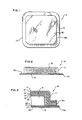
- the present invention is embodied very generally in a package 10 having an individual laminated container or cup 11 with a central chamber 12 and an outwardly turned horizontal flange 12a to which is heat sealed lid 13.
- FIG 3 a partial section of the package 10 is shown wherein the container 11 is molded from a multilayer film structure.
- Lid 13 hermetically seals the container 11. A portion of the lid extends beyond the flange 12a to form a gripping tab area 13a so that the tab can be gripped between the fingers and peeled away from the flange to open the package.
- the laminated structure of the container 11 is comprised of inner gas barrier core layer 14, thermoplastic adhesive layers 15, 16 juxtaposed on each side of the barrier layer 14, outer polyolefin layers 17 and 18 secured to each of the adhesive layers 15 and 16, and a continuous coherent heat seal layer 19 comprised of high and low melt flow rate polyolefin resins and a particulate filler of the present invention, the heat seal layer being bonded to the polyolefin outer layer 18, which forms the interior, food contact surface of the container 11.
- the total thickness of the multilayered structure from which the container 11 is molded ranges in thickness from about 10 to about 100 mils thickness and preferably about 10 to about 40 mils thickness.
- the heat seal layer 19 can be about 1 to 10 mils thick, the outer polyolefin layers 17, 18 about 10 to 60 mils thick, the gas barrier layer 14 about 0.2 to about 0.35 mils thick and the adhesive layers 15, 16 about 0.25 mils thick.
- lid 13 comprising an aluminum foil layer 21, inner and outer heat activatable thermoplastic adhesive layers 22 and 23 juxtaposed on each side of the aluminum foil layer 21 and a polyolefin layer 24 bonded to the outer adhesive layer 23.
- the total thickness of lid ranges from about 15 to about 40 mils thickness and preferably about 10 to about 30 mils thickness.
- the aluminum foil layer 21 can be about 1 to about 5 mils thick, the inner and outer adhesive layers 21 and 22 about 0.1 to about 0.5 mils thick and the other polyolefin layer about 25-30 mils thick.
- the lid 13 is placed over the exposed heat seal layer 19 on the flange 12a of the container 11, and heat and pressure are applied by the platens of a heat sealing device such as an induction heater, to form a hermetic seal.
- a heat sealing device such as an induction heater
- the polyolefin material of the heat seal layer 19 is bonded to the heat activatable surface layer 22 of the lid 13.
- the sealed container is sufficiently rigid to maintain its shape during normal handling.
- the lid 13 Even after exposure to thermal processing, can be readily and smoothly separated by hand without tearing of either the lid 13 or the flange 12a by grasping the lid 13 by tab 13a and peeling it off the flange.
- the heat seal layer 19 in the area of the heat seal is reduced in thickness as the lid 13 is peeled from the flange 12a, as a portion of the heat seal layer 19 is separated and removed from the flange surface as the lid 13 is peeled back.
- This ease of separation is obtained because the cohesive strength of the heat seal layer 19 is considerably less than the tensile strength of the bond between the surface of the heat seal layer 19 and the surface of the heat activatable layer 22 of the lid 13.
- Examination of the parted lid surface indicates a continuous bead of heat seal material 19 adhered to the heat activatable underside layer 22 of the lid 13.
- polyolefin containers which, although hermetically sealed, are easily peelable to open by hand by the user without recourse to scissors or other tools.
- the sealed containers although peelably openable may be retorted without premature opening, do not accidently open when dropped from a height two feet or more and do not accidently open when subjected to the normal mechanical abuse encountered during transportation and storage.
- a laminated sheet was prepared by coextrusion of a first heat sealable layer composed of a mixture of 55% by weight of a polypropylene having a melt flow rate of 5, 15% by weight of a polypropylene having a melt flow rate of 30, 25% by weight of talc having a particle size of 2 microns and 5% TiO2 having a particle size of 1 micron.
- the heat seal layer was bonded to one of the two outer layers of the sheet which were composed of propropylene.
- An inner barrier layer composed of 82 weight percent vinylidene chloride and 18 weight percent vinyl chloride was interposed between the outer polypropylene layers and bonded thereto by adhesive layers comprised of an ethylene-vinyl acetate copolymer containing 28 weight percent vinyl acetate.
- the outer polypropylene layer on one side of the laminated sheet was pigmented with 8% by weight brown pigment and the other outer polypropylene layer which formed the interior food contact surface was pigmented with 6% by weight TiO2.
- the heat seal layer was bonded to the TiO2 pigmented polypropylene layer.
- the heat seal layer was 5 mils thick.
- the outer layers were 20 mils thick, the inner gas barrier layer was 2.2 mils thick and the adhesive layers were each 0.25 mil thick.
- the individual layers were coextruded from a conventional extruder through a flat sheet die, the melt streams being combined in a coextrusion block prior to being extruded from the die.
- the multilayer coextrudate was thermoformed into 6.5" x 5.0" x 1.0" trays, with the heat seal layer forming the food contact side of the tray, using conventional thermoforming equipment.
- a complementary lid was prepared by coating opposite surfaces of a 1.5 mil thick film of a aluminum foil with a 0.2 mil thick coating of Morprime, a commercially available adhesive promoting dispersion containing a maleic anhydride modified polypropylene. After appli cation of the Morprime, the coated aluminum foil was baked at 180°C to volatilize the solvent and fused to coolesce the dispersed particles into a continuous film. Thereafter, a 23 mil thick film of TiO2 pigmented polypropylene was extrusion coated on one side of the Morprime coated aluminum foil.
- the lid was used to hermetically seal the thermoformed trays filled with water by heat sealing the Morprime coated surface of the lid to the flanged surface of the trays.
- the lid container assembly was placed between the jaws of an induction sealer and heat sealed at 300°C, 60 psi for 0.3 seconds using a TOCCO 50 KW/10 KHz induction heater.
- T-Peel value i.e., the force required to separate the heat sealed layers, was measured on an Instron tensile tester which applied a constant strain rate of 2.0 inches per minute on the assembly.
- the T-Peel value is recorded in the Table below.
- the sealed container is subjected to vibration on a test apparatus designed to simulate, over a short time period, vibrations which may be encountered by the packages in normal shipping operations.
- the packages were vibrated for 30 minutes in a vibrator at about 200 cycles per minute.
Landscapes
- Engineering & Computer Science (AREA)
- Mechanical Engineering (AREA)
- Laminated Bodies (AREA)
- Lining Or Joining Of Plastics Or The Like (AREA)
- Packages (AREA)
- Wrappers (AREA)
Priority Applications (1)
| Application Number | Priority Date | Filing Date | Title |
|---|---|---|---|
| AT86304091T ATE58699T1 (de) | 1985-07-03 | 1986-05-29 | Plastikbehaelter mit einer abreissbaren abdichtungsschicht und verfahren zu deren herstellung. |
Applications Claiming Priority (2)
| Application Number | Priority Date | Filing Date | Title |
|---|---|---|---|
| US75169385A | 1985-07-03 | 1985-07-03 | |
| US751693 | 1985-07-03 |
Publications (3)
| Publication Number | Publication Date |
|---|---|
| EP0207626A2 true EP0207626A2 (fr) | 1987-01-07 |
| EP0207626A3 EP0207626A3 (en) | 1988-01-13 |
| EP0207626B1 EP0207626B1 (fr) | 1990-11-28 |
Family
ID=25023084
Family Applications (1)
| Application Number | Title | Priority Date | Filing Date |
|---|---|---|---|
| EP86304091A Expired - Lifetime EP0207626B1 (fr) | 1985-07-03 | 1986-05-29 | Récipient en matière plastique comportant une couche d'étanchéité pelable et son procédé de fabrication |
Country Status (8)
| Country | Link |
|---|---|
| EP (1) | EP0207626B1 (fr) |
| JP (1) | JPS6216365A (fr) |
| KR (1) | KR920000008B1 (fr) |
| AT (1) | ATE58699T1 (fr) |
| AU (1) | AU592992B2 (fr) |
| CA (1) | CA1268130A (fr) |
| DE (1) | DE3675821D1 (fr) |
| DK (1) | DK254486A (fr) |
Cited By (11)
| Publication number | Priority date | Publication date | Assignee | Title |
|---|---|---|---|---|
| FR2628071A1 (fr) * | 1988-03-04 | 1989-09-08 | Alsacienne Aluminium | Opercule pour la fermeture de recipients tels que des pots et des barquettes |
| EP0358465A3 (fr) * | 1988-09-06 | 1991-03-27 | Exxon Chemical Patents Inc. | Emballage alimentaire, couvercle pouvant être chauffé et film coextrudé pour sa fabrication |
| FR2653097A1 (fr) * | 1989-10-18 | 1991-04-19 | Siamp Cedap Reunies | Feuille multicouche en matiere plastique pour constituer des recipients destines a etre fermes par un opercule soude, et recipients formes a partir de cette feuille. |
| EP0353613A3 (fr) * | 1988-08-01 | 1992-03-04 | Continental Can Company, Inc. | Emballages en matière plastique à scellement détachable et leur procédé de préparation |
| WO1995016743A1 (fr) * | 1993-12-16 | 1995-06-22 | Shell Oil Company | Melanges polyolefiniques destines a la fabrication de materiaux pour couvercles |
| US5451468A (en) * | 1992-09-16 | 1995-09-19 | Basf Aktiensgesellschaft | Packaging film comprising a sealing layer and a substrate layer |
| DE4410235A1 (de) * | 1994-03-25 | 1995-09-28 | Gizeh Werk Gmbh | Siegelfähige, peelbare Kunststoffolie auf Polypropylen-Basis |
| DE19859334A1 (de) * | 1998-12-22 | 2000-07-06 | Bp Chemicals Plastec Gmbh | Siegelbare Verbundfolie |
| WO2007051265A1 (fr) * | 2005-10-31 | 2007-05-10 | Barbosa Machado Neto Jose | Emballage sous forme de plateau destiné au conditionnement de produits alimentaires « prêts à consommer » |
| EP1512642A3 (fr) * | 2003-09-02 | 2008-02-27 | Sonoco Development, Inc. | Fermeture haute barrière en plastique à ouverture facile et procédé associé |
| US7798359B1 (en) * | 2004-08-17 | 2010-09-21 | Momar Industries LLC | Heat-sealed, peelable lidding membrane for retort packaging |
Families Citing this family (3)
| Publication number | Priority date | Publication date | Assignee | Title |
|---|---|---|---|---|
| DE3873265T2 (de) * | 1987-05-20 | 1993-03-11 | Toyo Seikan Kaisha Ltd | Leicht zu oeffnender behaelter mit abgedichtetem verschluss. |
| IT90021449A1 (it) * | 1990-09-12 | 1992-03-12 | Barilla Flli G & R | Confezione a cartuccia per fette biscottate e simili prodotti alimentari di conformazione appiattita |
| KR20010113592A (ko) * | 2001-11-17 | 2001-12-28 | 이정석 | 기능성합성수지의 제조방법 |
Family Cites Families (5)
| Publication number | Priority date | Publication date | Assignee | Title |
|---|---|---|---|---|
| DE1207868B (de) * | 1959-08-13 | 1965-12-23 | Unilever Nv | Behaelter aus durch Waerme und Druck hermetisch versiegelten, aus thermoplastischem Material bestehenden Teilen |
| US4046945A (en) * | 1974-01-18 | 1977-09-06 | Chemische Werke Huls Aktiengesellschaft | Process for the bonding of films and molded components |
| US4376845A (en) * | 1980-12-12 | 1983-03-15 | The Dow Chemical Company | Three-component polymer blends and adhesive films prepared therefrom |
| JPS58192551A (ja) * | 1982-05-06 | 1983-11-10 | テルモ株式会社 | 医療用容器の保存用包装容器 |
| DE3504463A1 (de) * | 1985-02-09 | 1986-08-14 | W.R. Grace & Co., New York, N.Y. | Leicht oeffenbare packung und verfahren zu deren herstellung |
-
1986
- 1986-05-26 CA CA000509992A patent/CA1268130A/fr not_active Expired - Lifetime
- 1986-05-29 AT AT86304091T patent/ATE58699T1/de not_active IP Right Cessation
- 1986-05-29 EP EP86304091A patent/EP0207626B1/fr not_active Expired - Lifetime
- 1986-05-29 DE DE8686304091T patent/DE3675821D1/de not_active Expired - Lifetime
- 1986-05-30 AU AU58239/86A patent/AU592992B2/en not_active Ceased
- 1986-05-30 JP JP61125579A patent/JPS6216365A/ja active Pending
- 1986-05-30 DK DK254486A patent/DK254486A/da not_active Application Discontinuation
- 1986-05-31 KR KR1019860004301A patent/KR920000008B1/ko not_active Expired
Cited By (17)
| Publication number | Priority date | Publication date | Assignee | Title |
|---|---|---|---|---|
| EP0334700A1 (fr) * | 1988-03-04 | 1989-09-27 | SOCIETE ALSACIENNE D'ALUMINIUM Société Anonyme | Procédé permettant la fermeture puis l'ouverture de récipients stérilisables, opercules permettant la mise en oeuvre dudit procédé et procédé de fabrication desdits opercules |
| FR2628071A1 (fr) * | 1988-03-04 | 1989-09-08 | Alsacienne Aluminium | Opercule pour la fermeture de recipients tels que des pots et des barquettes |
| US5145737A (en) * | 1988-03-04 | 1992-09-08 | Societe Alsacienne D'aluminium | System for closure and subsequent opening of sterilizable containers |
| EP0353613A3 (fr) * | 1988-08-01 | 1992-03-04 | Continental Can Company, Inc. | Emballages en matière plastique à scellement détachable et leur procédé de préparation |
| EP0358465A3 (fr) * | 1988-09-06 | 1991-03-27 | Exxon Chemical Patents Inc. | Emballage alimentaire, couvercle pouvant être chauffé et film coextrudé pour sa fabrication |
| AU637425B2 (en) * | 1989-10-18 | 1993-05-27 | Siamp-Cedap | Hot weldable multilayer plastic film |
| WO1991005656A1 (fr) * | 1989-10-18 | 1991-05-02 | Siamp-Cedap | Feuille multicouche en matiere plastique soudable a chaud |
| EP0424251A1 (fr) * | 1989-10-18 | 1991-04-24 | SIAMP-CEDAP (Société Anonyme Monégasque) | Feuille multicouche en matière plastique pour constituer des récipients destinés à être fermés par un opercule soudé, et récipients formés à partir de cette feuille |
| FR2653097A1 (fr) * | 1989-10-18 | 1991-04-19 | Siamp Cedap Reunies | Feuille multicouche en matiere plastique pour constituer des recipients destines a etre fermes par un opercule soude, et recipients formes a partir de cette feuille. |
| US5451468A (en) * | 1992-09-16 | 1995-09-19 | Basf Aktiensgesellschaft | Packaging film comprising a sealing layer and a substrate layer |
| WO1995016743A1 (fr) * | 1993-12-16 | 1995-06-22 | Shell Oil Company | Melanges polyolefiniques destines a la fabrication de materiaux pour couvercles |
| DE4410235A1 (de) * | 1994-03-25 | 1995-09-28 | Gizeh Werk Gmbh | Siegelfähige, peelbare Kunststoffolie auf Polypropylen-Basis |
| DE4410235C2 (de) * | 1994-03-25 | 1998-10-22 | Gizeh Verpackungen Gmbh & Co K | Siegelfähige, peelbare Kunststoffolie auf Polypropylen-Basis |
| DE19859334A1 (de) * | 1998-12-22 | 2000-07-06 | Bp Chemicals Plastec Gmbh | Siegelbare Verbundfolie |
| EP1512642A3 (fr) * | 2003-09-02 | 2008-02-27 | Sonoco Development, Inc. | Fermeture haute barrière en plastique à ouverture facile et procédé associé |
| US7798359B1 (en) * | 2004-08-17 | 2010-09-21 | Momar Industries LLC | Heat-sealed, peelable lidding membrane for retort packaging |
| WO2007051265A1 (fr) * | 2005-10-31 | 2007-05-10 | Barbosa Machado Neto Jose | Emballage sous forme de plateau destiné au conditionnement de produits alimentaires « prêts à consommer » |
Also Published As
| Publication number | Publication date |
|---|---|
| CA1268130A (fr) | 1990-04-24 |
| EP0207626A3 (en) | 1988-01-13 |
| DK254486A (da) | 1987-01-04 |
| AU592992B2 (en) | 1990-02-01 |
| EP0207626B1 (fr) | 1990-11-28 |
| ATE58699T1 (de) | 1990-12-15 |
| KR920000008B1 (ko) | 1992-01-06 |
| AU5823986A (en) | 1987-01-08 |
| DK254486D0 (da) | 1986-05-30 |
| DE3675821D1 (de) | 1991-01-10 |
| KR870001033A (ko) | 1987-03-11 |
| JPS6216365A (ja) | 1987-01-24 |
Similar Documents
| Publication | Publication Date | Title |
|---|---|---|
| US5062569A (en) | Peelably sealed plastic packages and method of preparing same | |
| US4771935A (en) | Plastic containers embodying a peel seal and method of preparing same | |
| US4810541A (en) | Plastic container having a surface to which a lid may be peelably sealed | |
| EP0207626B1 (fr) | Récipient en matière plastique comportant une couche d'étanchéité pelable et son procédé de fabrication | |
| CA1307240C (fr) | Emballage hermetique et mode de production connexe | |
| US3454210A (en) | Easy opening and reclosable package,film therefor and process | |
| US5626929A (en) | Peelable and heat sealable lidstock material for plastic containers | |
| AU624121B2 (en) | Process for the closure and subsequent opening of sterilizable containers, opercular covers used in carrying out said process and process for manufacturing said opercular covers | |
| KR0145517B1 (ko) | 탭 달린 용기용 내부시일 | |
| US5050736A (en) | Reclosable package | |
| US3335939A (en) | Resealable package closure | |
| US4782951A (en) | Reclosable package and method of making reclosable package | |
| US4823961A (en) | Reclosable package | |
| KR101563026B1 (ko) | 포장 필름용 박리가능 복합 열가소성 밀봉재 | |
| US20050208242A1 (en) | Container closure | |
| AU2007209816A1 (en) | Peelable composite thermoplastic sealants in packaging films | |
| US5014856A (en) | Reclosable package | |
| EP0687557B1 (fr) | Couvercle pour emballage et procédé pour sa fabrication | |
| US20050276940A1 (en) | Lidstock material having improved sealability and peelability to wide classes of materials | |
| JPH0494933A (ja) | 易剥離性フィルム | |
| WO2003053809A1 (fr) | Procede permettant de produire un emballage sous atmosphere modifiee | |
| US20040180160A1 (en) | Lidstock material having improved burst strength | |
| AU2021453586B2 (en) | Recyclable bag | |
| JP4152037B2 (ja) | 積層体及び密封容器 | |
| JPH04253656A (ja) | 密封容器 |
Legal Events
| Date | Code | Title | Description |
|---|---|---|---|
| PUAI | Public reference made under article 153(3) epc to a published international application that has entered the european phase |
Free format text: ORIGINAL CODE: 0009012 |
|
| AK | Designated contracting states |
Kind code of ref document: A2 Designated state(s): AT BE CH DE FR GB IT LI LU NL SE |
|
| PUAL | Search report despatched |
Free format text: ORIGINAL CODE: 0009013 |
|
| AK | Designated contracting states |
Kind code of ref document: A3 Designated state(s): AT BE CH DE FR GB IT LI LU NL SE |
|
| 17P | Request for examination filed |
Effective date: 19880502 |
|
| 17Q | First examination report despatched |
Effective date: 19890316 |
|
| GRAA | (expected) grant |
Free format text: ORIGINAL CODE: 0009210 |
|
| AK | Designated contracting states |
Kind code of ref document: B1 Designated state(s): AT BE CH DE FR GB IT LI LU NL SE |
|
| REF | Corresponds to: |
Ref document number: 58699 Country of ref document: AT Date of ref document: 19901215 Kind code of ref document: T |
|
| REF | Corresponds to: |
Ref document number: 3675821 Country of ref document: DE Date of ref document: 19910110 |
|
| ITF | It: translation for a ep patent filed | ||
| REG | Reference to a national code |
Ref country code: CH Ref legal event code: PUE Owner name: CONTINENTAL HOLDINGS INC. |
|
| ET | Fr: translation filed | ||
| RAP2 | Party data changed (patent owner data changed or rights of a patent transferred) |
Owner name: CONTINENTAL HOLDINGS INC. |
|
| ITTA | It: last paid annual fee | ||
| NLT2 | Nl: modifications (of names), taken from the european patent patent bulletin |
Owner name: CONTINENTAL HOLDINGS INC. TE OMAHA, NEBRASKA, VER. |
|
| REG | Reference to a national code |
Ref country code: FR Ref legal event code: TP |
|
| PLBE | No opposition filed within time limit |
Free format text: ORIGINAL CODE: 0009261 |
|
| 26N | No opposition filed | ||
| REG | Reference to a national code |
Ref country code: GB Ref legal event code: 732 |
|
| PGFP | Annual fee paid to national office [announced via postgrant information from national office to epo] |
Ref country code: GB Payment date: 19920508 Year of fee payment: 7 |
|
| PGFP | Annual fee paid to national office [announced via postgrant information from national office to epo] |
Ref country code: NL Payment date: 19920531 Year of fee payment: 7 |
|
| PGFP | Annual fee paid to national office [announced via postgrant information from national office to epo] |
Ref country code: FR Payment date: 19920601 Year of fee payment: 7 |
|
| PGFP | Annual fee paid to national office [announced via postgrant information from national office to epo] |
Ref country code: DE Payment date: 19920603 Year of fee payment: 7 Ref country code: CH Payment date: 19920603 Year of fee payment: 7 |
|
| PGFP | Annual fee paid to national office [announced via postgrant information from national office to epo] |
Ref country code: SE Payment date: 19920604 Year of fee payment: 7 |
|
| PGFP | Annual fee paid to national office [announced via postgrant information from national office to epo] |
Ref country code: AT Payment date: 19920615 Year of fee payment: 7 |
|
| PGFP | Annual fee paid to national office [announced via postgrant information from national office to epo] |
Ref country code: BE Payment date: 19920629 Year of fee payment: 7 |
|
| PGFP | Annual fee paid to national office [announced via postgrant information from national office to epo] |
Ref country code: LU Payment date: 19920701 Year of fee payment: 7 |
|
| ITPR | It: changes in ownership of a european patent |
Owner name: FUSIONI;CONTINENTAL HOLDINGS INC. |
|
| EPTA | Lu: last paid annual fee | ||
| PG25 | Lapsed in a contracting state [announced via postgrant information from national office to epo] |
Ref country code: LU Free format text: LAPSE BECAUSE OF NON-PAYMENT OF DUE FEES Effective date: 19930529 Ref country code: GB Effective date: 19930529 Ref country code: AT Effective date: 19930529 |
|
| PG25 | Lapsed in a contracting state [announced via postgrant information from national office to epo] |
Ref country code: SE Effective date: 19930530 |
|
| PG25 | Lapsed in a contracting state [announced via postgrant information from national office to epo] |
Ref country code: LI Effective date: 19930531 Ref country code: CH Effective date: 19930531 Ref country code: BE Effective date: 19930531 |
|
| BERE | Be: lapsed |
Owner name: CONTINENTAL HOLDINGS INC. Effective date: 19930531 |
|
| PG25 | Lapsed in a contracting state [announced via postgrant information from national office to epo] |
Ref country code: NL Effective date: 19931201 |
|
| NLV4 | Nl: lapsed or anulled due to non-payment of the annual fee | ||
| GBPC | Gb: european patent ceased through non-payment of renewal fee |
Effective date: 19930529 |
|
| PG25 | Lapsed in a contracting state [announced via postgrant information from national office to epo] |
Ref country code: FR Effective date: 19940131 |
|
| REG | Reference to a national code |
Ref country code: CH Ref legal event code: PL |
|
| PG25 | Lapsed in a contracting state [announced via postgrant information from national office to epo] |
Ref country code: DE Effective date: 19940201 |
|
| REG | Reference to a national code |
Ref country code: FR Ref legal event code: ST |
|
| EUG | Se: european patent has lapsed |
Ref document number: 86304091.1 Effective date: 19931210 |
|
| PG25 | Lapsed in a contracting state [announced via postgrant information from national office to epo] |
Ref country code: IT Free format text: LAPSE BECAUSE OF NON-PAYMENT OF DUE FEES Effective date: 20050529 |