EP0207666A2 - Verfahren und Mittel zum Transportieren von Bytes in einem Rechner mit reduziertem Befehlssatz - Google Patents
Verfahren und Mittel zum Transportieren von Bytes in einem Rechner mit reduziertem Befehlssatz Download PDFInfo
- Publication number
- EP0207666A2 EP0207666A2 EP86304501A EP86304501A EP0207666A2 EP 0207666 A2 EP0207666 A2 EP 0207666A2 EP 86304501 A EP86304501 A EP 86304501A EP 86304501 A EP86304501 A EP 86304501A EP 0207666 A2 EP0207666 A2 EP 0207666A2
- Authority
- EP
- European Patent Office
- Prior art keywords
- copying
- address
- instruction
- register
- word
- Prior art date
- Legal status (The legal status is an assumption and is not a legal conclusion. Google has not performed a legal analysis and makes no representation as to the accuracy of the status listed.)
- Granted
Links
Images

Classifications
-
- G—PHYSICS
- G06—COMPUTING OR CALCULATING; COUNTING
- G06F—ELECTRIC DIGITAL DATA PROCESSING
- G06F9/00—Arrangements for program control, e.g. control units
- G06F9/06—Arrangements for program control, e.g. control units using stored programs, i.e. using an internal store of processing equipment to receive or retain programs
- G06F9/22—Microcontrol or microprogram arrangements
-
- G—PHYSICS
- G06—COMPUTING OR CALCULATING; COUNTING
- G06F—ELECTRIC DIGITAL DATA PROCESSING
- G06F9/00—Arrangements for program control, e.g. control units
- G06F9/06—Arrangements for program control, e.g. control units using stored programs, i.e. using an internal store of processing equipment to receive or retain programs
- G06F9/30—Arrangements for executing machine instructions, e.g. instruction decode
- G06F9/30003—Arrangements for executing specific machine instructions
- G06F9/3004—Arrangements for executing specific machine instructions to perform operations on memory
- G06F9/30043—LOAD or STORE instructions; Clear instruction
-
- G—PHYSICS
- G06—COMPUTING OR CALCULATING; COUNTING
- G06F—ELECTRIC DIGITAL DATA PROCESSING
- G06F8/00—Arrangements for software engineering
- G06F8/40—Transformation of program code
- G06F8/41—Compilation
-
- G—PHYSICS
- G06—COMPUTING OR CALCULATING; COUNTING
- G06F—ELECTRIC DIGITAL DATA PROCESSING
- G06F9/00—Arrangements for program control, e.g. control units
- G06F9/06—Arrangements for program control, e.g. control units using stored programs, i.e. using an internal store of processing equipment to receive or retain programs
- G06F9/30—Arrangements for executing machine instructions, e.g. instruction decode
- G06F9/34—Addressing or accessing the instruction operand or the result ; Formation of operand address; Addressing modes
- G06F9/35—Indirect addressing
Definitions
- control section of such a computer generally is provided with an autonomous read-only storage.
- the control unit Each time a program instruction begins, the control unit generates an address to its read-only storage derived from the function or operation code of the instruction. This address locates what may be the first of a series of words which supply the control signals to the computer for carrying out the particular instruction being processed.
- Each instruction in effect generates a transfer to a microsubroutine associated with it, and the resultant step-by- step operation of the machine corresponds to the execution of a program on a very detailed level.
- program instructions generally comprise an operation code, i.e., the opcode, together with information relative to the location of the operands, that is, the data to be operated on. These operands sometimes may also have additional operational information.
- the length of the program instructions may be relatively long or relatively short depending on the quantity of data involved.
- the operating codes generally indicate the operation to be performed. Once the length of the operating code is established, it is possible to have only a certain fixed set of different operating codes and related program instructions. However, not all the operating codes which may theoretically be expressed with a certain number of bits, i.e., operating codes within the fixed set, are used to characterize program instructions for which the computer is provided with microprogramming resources. Generally, only a part or subset is used, and thus programming efficiency is degraded.
- one of the most common operations performed on a computer is moving a string of bytes, or words, from one address to another in memory. Because of the frequency of this operation, it is important to make it efficient. But because of the diversity in the exact form of the operation, diversity of fixed or variable lengths and addresses and diversity of lengths and alignments, it is difficult to find a uniform mechanism to perfom this operation efficiently, even though in practice very few of the variations may be used with any frequency.
- a basic instruction for moving a string of bytes has been devised to solve these problems. Because the operations in the instruction are basic, very few variations are necessary to accommodate diversity of lengths and variables. Instruction for these operations are imbedded in a code sequence; the compiler can therefore generate exactly the minimum sequence necessary to perform the operations and can precompute many of the operands at compile time. The control necessary to optimize the operations is then in the compiler instead of the hardware, thereby avoiding the above-enumerated disadvantage of a hardware approach solution. As a consequence of all these factors, the instruction is implemented as a single-cycle operation. In other words, another instruction can be initiated within one cycle of the previous instruction without any impediment or "lockout.”
- the operation of the instruction in accordance with the preferred embodiment of the invention is generated by a code sequence. Hence no special control is needed to handle I/o interrupts or page faults.
- the byte-move basic instruction requires very little hardware over and above that already necessary for other operations; it therefore will execute as fast or faster than hardware-assisted instructions for most frequent operations.
- the basic instruction is a store operation that stores corresponding bytes from a source register into memory, either storing the portion of the word starting at the instruction- specified byte address to the end of the word, or storing the portion of the word from the start to the specified byte address. All of the normal indexed store options, such as cache control, instruction modification, and the like, are available with the operation.
- the instruction handles the beginning and ending cases for byte moves, but does require an extra alignment instruction for each word moved in cases of unaligned moves.
- the operation of the store instruction follows.
- the instruction STORE BYTES (STBYS) 140 is described.
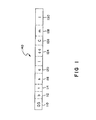
- the instruction STBYS 140 is denoted as follows: STBYS,ma,cc 7,i(s,b) and has the formatiillustrated in Figure 1, viz., 03 / b / t / s / a / 1 / cc / C / m / i, where:
- the instruction STBYS 140 is implemented as follows:
- Figure 2 shows a cache memory as part of a system in a computer device for implementing the instruction for moving bytes in accordance with the invention. But before proceeding, it should be understood what a cache memory is.
- a cache is basically a high-speed buffer that stores a limited amount of the information that is in the main memory.
- the cache memory typically is in an area close to the processing unit of the computer device where it can be accessed quickly. It is much smaller than the main memory and as such has only a very small protion of the data involved in the computer device.
- the cache is checked to see whether the data being referenced is actually there in the cache. It does this by comparing a portion of the address called a "tag" with the "tag" portion that is in the cache. If the two match, the data is actually present in the cache, and that constitutes a "cache hit". If the "tag" in the address does not compare with the "tag” that is in the cache, the data being referenced is not in the cache, and the reference must be accessed from the main memory. This situtation contitutes a "cache miss".
- data from a data register 221 goes to the byte inputs 223 of a cache 220.
- byte "0" 225 of the data register 221 goes to the data input port 224 of byte “0" 2 26 of the cache 220.
- byte "1" 227 of the data register 221 goes to the data input port 229 of byte “1” 228.
- byte "2" 230 goes to the input port 231 of byte “2” 233 of the cache 220; and byte “3” 234 goes to the input port 235 of byte “3” 236 of the cache 220.
- the address 236 that is generated within the instruction is divided up by the cache 220 into several parts 237-239.
- the portion 239 that accesses the byte within the word is directed to a write control unit 240.
- the next higher portion 238 of the address 236 towards a more significant end of the address 236 is an index for accessing the tags out of the tag portion 242 of the cache 220.
- This index portion 238 is also used to specify an address 243 to each of the bytes 226, 228, 233, 236 to result in a byte that will the one written if there is a write enable pulse.
- the highest portion 237 of the address 236 is the tag 246 from the address 236 which is compared with the tag 248 that comes out of the tag portion 242 of the cache 220.
- the bits taken from the byte within the word portion 239 of the address 236 is checked, then combined with the particular operation at hand, whether it be the "begin” copy case or the "end” copy case as described earlier, to determine which write enables 256 are sent to the various bytes 226, 228, 233, 236. In this manner, a portion of the word within the cache is written as a function of the address 236.
Landscapes
- Engineering & Computer Science (AREA)
- Theoretical Computer Science (AREA)
- Software Systems (AREA)
- General Engineering & Computer Science (AREA)
- Physics & Mathematics (AREA)
- General Physics & Mathematics (AREA)
- Memory System Of A Hierarchy Structure (AREA)
- Executing Machine-Instructions (AREA)
- Memory System (AREA)
Applications Claiming Priority (2)
| Application Number | Priority Date | Filing Date | Title |
|---|---|---|---|
| US06/750,701 US4739471A (en) | 1985-06-28 | 1985-06-28 | Method and means for moving bytes in a reduced instruction set computer |
| US750701 | 1985-06-28 |
Publications (3)
| Publication Number | Publication Date |
|---|---|
| EP0207666A2 true EP0207666A2 (de) | 1987-01-07 |
| EP0207666A3 EP0207666A3 (en) | 1988-10-26 |
| EP0207666B1 EP0207666B1 (de) | 1994-08-03 |
Family
ID=25018862
Family Applications (1)
| Application Number | Title | Priority Date | Filing Date |
|---|---|---|---|
| EP86304501A Expired - Lifetime EP0207666B1 (de) | 1985-06-28 | 1986-06-12 | Verfahren und Mittel zum Transportieren von Bytes in einem Rechner mit reduziertem Befehlssatz |
Country Status (8)
| Country | Link |
|---|---|
| US (1) | US4739471A (de) |
| EP (1) | EP0207666B1 (de) |
| JP (1) | JPH0769794B2 (de) |
| KR (1) | KR870000642A (de) |
| CN (1) | CN1009588B (de) |
| AU (1) | AU600442B2 (de) |
| CA (1) | CA1264861A (de) |
| DE (1) | DE3650006T2 (de) |
Families Citing this family (15)
| Publication number | Priority date | Publication date | Assignee | Title |
|---|---|---|---|---|
| US5133072A (en) * | 1986-11-13 | 1992-07-21 | Hewlett-Packard Company | Method for improved code generation in reduced instruction set computers |
| US4814976C1 (en) * | 1986-12-23 | 2002-06-04 | Mips Tech Inc | Risc computer with unaligned reference handling and method for the same |
| JP2655191B2 (ja) * | 1989-07-05 | 1997-09-17 | 三菱電機株式会社 | 演算処理装置 |
| AU7305491A (en) * | 1990-01-29 | 1991-08-21 | Teraplex, Inc. | Architecture for minimal instruction set computing system |
| US5442769A (en) * | 1990-03-13 | 1995-08-15 | At&T Corp. | Processor having general registers with subdivisions addressable in instructions by register number and subdivision type |
| CA2045705A1 (en) * | 1990-06-29 | 1991-12-30 | Richard Lee Sites | In-register data manipulation in reduced instruction set processor |
| CA2045735A1 (en) * | 1990-06-29 | 1991-12-30 | Richard Lee Sites | Computer performance by eliminating branches |
| US5706460A (en) * | 1991-03-19 | 1998-01-06 | The United States Of America As Represented By The Secretary Of The Navy | Variable architecture computer with vector parallel processor and using instructions with variable length fields |
| CN1045674C (zh) * | 1992-04-27 | 1999-10-13 | 北京市大兴县多思软件有限公司 | 一种宏指令集的指令体系 |
| US5438668A (en) * | 1992-03-31 | 1995-08-01 | Seiko Epson Corporation | System and method for extraction, alignment and decoding of CISC instructions into a nano-instruction bucket for execution by a RISC computer |
| US6735685B1 (en) * | 1992-09-29 | 2004-05-11 | Seiko Epson Corporation | System and method for handling load and/or store operations in a superscalar microprocessor |
| JP3644959B2 (ja) * | 1992-09-29 | 2005-05-11 | セイコーエプソン株式会社 | マイクロプロセッサシステム |
| EP1416374A3 (de) | 1993-05-27 | 2004-09-01 | Matsushita Electric Industrial Co., Ltd. | Programmumsetzungseinheit und verbesserter Prozessor für Adressierung |
| JP3637922B2 (ja) * | 1993-06-14 | 2005-04-13 | アップル コンピュータ インコーポレイテッド | プロセッサにおけるさまざまな長さの文字列中のターミネーション文字を発見する方法および装置 |
| US5815695A (en) * | 1993-10-28 | 1998-09-29 | Apple Computer, Inc. | Method and apparatus for using condition codes to nullify instructions based on results of previously-executed instructions on a computer processor |
Family Cites Families (4)
| Publication number | Priority date | Publication date | Assignee | Title |
|---|---|---|---|---|
| JPS5572267A (en) * | 1978-11-27 | 1980-05-30 | Hitachi Ltd | Data processor |
| JPS5798030A (en) * | 1980-12-12 | 1982-06-18 | Oki Electric Ind Co Ltd | Data processing system |
| JPS59221746A (ja) * | 1983-05-31 | 1984-12-13 | Citizen Watch Co Ltd | マイクロコンピユ−タ |
| US4569016A (en) * | 1983-06-30 | 1986-02-04 | International Business Machines Corporation | Mechanism for implementing one machine cycle executable mask and rotate instructions in a primitive instruction set computing system |
-
1985
- 1985-06-28 US US06/750,701 patent/US4739471A/en not_active Expired - Lifetime
-
1986
- 1986-06-02 CN CN86103694A patent/CN1009588B/zh not_active Expired
- 1986-06-12 DE DE3650006T patent/DE3650006T2/de not_active Expired - Lifetime
- 1986-06-12 EP EP86304501A patent/EP0207666B1/de not_active Expired - Lifetime
- 1986-06-20 CA CA000512068A patent/CA1264861A/en not_active Expired - Lifetime
- 1986-06-24 AU AU59166/86A patent/AU600442B2/en not_active Expired
- 1986-06-26 JP JP61150608A patent/JPH0769794B2/ja not_active Expired - Lifetime
- 1986-06-27 KR KR1019860005175A patent/KR870000642A/ko not_active Ceased
Non-Patent Citations (1)
| Title |
|---|
| T. L. HARMAN: "The Motorola MC 6800 Microprocessor Family", PRENTICE-HALL INC. |
Also Published As
| Publication number | Publication date |
|---|---|
| AU600442B2 (en) | 1990-08-16 |
| EP0207666A3 (en) | 1988-10-26 |
| CA1264861A (en) | 1990-01-23 |
| EP0207666B1 (de) | 1994-08-03 |
| CN86103694A (zh) | 1986-12-24 |
| CN1009588B (zh) | 1990-09-12 |
| JPS623337A (ja) | 1987-01-09 |
| US4739471A (en) | 1988-04-19 |
| DE3650006D1 (de) | 1994-09-08 |
| AU5916686A (en) | 1988-01-07 |
| DE3650006T2 (de) | 1994-11-17 |
| JPH0769794B2 (ja) | 1995-07-31 |
| KR870000642A (ko) | 1987-02-19 |
Similar Documents
| Publication | Publication Date | Title |
|---|---|---|
| US4449184A (en) | Extended address, single and multiple bit microprocessor | |
| TWI279715B (en) | Method, system and machine-readable medium of translating and executing binary of program code, and apparatus to process binaries | |
| US4739471A (en) | Method and means for moving bytes in a reduced instruction set computer | |
| US9495163B2 (en) | Address generation in a data processing apparatus | |
| JP3657949B2 (ja) | 拡張ワード寸法及びアドレス空間を有する逆互換性コンピュータアーキテクチュア | |
| CN101911013B (zh) | 计算机系统和操作计算机的方法 | |
| CN101911015B (zh) | 通过处理器指令减少对计算机体系结构依赖性的方法及装置 | |
| JP2616182B2 (ja) | データ処理装置 | |
| EP0415461B1 (de) | Zentrale Verarbeitungseinheit mit der Fähigkeit, Befehle mit variablen Längen zu unterstützen | |
| JPH0429093B2 (de) | ||
| JP2834292B2 (ja) | データ・プロセッサ | |
| JPH0743646B2 (ja) | 条件コ−ド発生装置 | |
| JP2000148472A (ja) | マイクロプロセッサ装置及びそのソフトウェア命令高速化方法並びにその制御プログラムを記録した記録媒体 | |
| JPS5811654B2 (ja) | デ−タシヨリシステム | |
| JP2011509474A (ja) | コンピュータを動作させる方法及びシステム | |
| JPH04260930A (ja) | データ処理装置 | |
| WO2021036173A1 (zh) | 解释执行字节码指令流的方法及装置 | |
| JPH04260927A (ja) | データ処理装置 | |
| KR100308512B1 (ko) | 편집 기능을 위한 전문 밀리코드 지시 | |
| US4812971A (en) | Central processing unit for a digital computer | |
| KR100317769B1 (ko) | 압축 기억된 십진수 나눗셈에 대한 전문 밀리코드 명령 | |
| JPH04260929A (ja) | データ処理装置 | |
| KR20100106436A (ko) | 선택된 비트를 회전 후 삽입하는 기능 및 그 기능을 위한 명령어 | |
| US5774694A (en) | Method and apparatus for emulating status flag | |
| JPS623336A (ja) | 条件付きブランチ方式 |
Legal Events
| Date | Code | Title | Description |
|---|---|---|---|
| PUAI | Public reference made under article 153(3) epc to a published international application that has entered the european phase |
Free format text: ORIGINAL CODE: 0009012 |
|
| AK | Designated contracting states |
Kind code of ref document: A2 Designated state(s): CH DE FR GB IT LI NL SE |
|
| PUAL | Search report despatched |
Free format text: ORIGINAL CODE: 0009013 |
|
| AK | Designated contracting states |
Kind code of ref document: A3 Designated state(s): CH DE FR GB IT LI NL SE |
|
| 17P | Request for examination filed |
Effective date: 19890407 |
|
| 17Q | First examination report despatched |
Effective date: 19901112 |
|
| GRAA | (expected) grant |
Free format text: ORIGINAL CODE: 0009210 |
|
| AK | Designated contracting states |
Kind code of ref document: B1 Designated state(s): CH DE FR GB IT LI NL SE |
|
| REF | Corresponds to: |
Ref document number: 3650006 Country of ref document: DE Date of ref document: 19940908 |
|
| ET | Fr: translation filed | ||
| ITF | It: translation for a ep patent filed | ||
| EAL | Se: european patent in force in sweden |
Ref document number: 86304501.9 |
|
| PLBE | No opposition filed within time limit |
Free format text: ORIGINAL CODE: 0009261 |
|
| STAA | Information on the status of an ep patent application or granted ep patent |
Free format text: STATUS: NO OPPOSITION FILED WITHIN TIME LIMIT |
|
| 26N | No opposition filed | ||
| NLS | Nl: assignments of ep-patents |
Owner name: HEWLETT-PACKARD COMPANY (A DELAWARE CORPORATION) |
|
| REG | Reference to a national code |
Ref country code: GB Ref legal event code: 732E |
|
| REG | Reference to a national code |
Ref country code: FR Ref legal event code: TP |
|
| REG | Reference to a national code |
Ref country code: CH Ref legal event code: PFA Free format text: HEWLETT-PACKARD COMPANY TRANSFER- HEWLETT-PACKARD COMPANY, A DELAWARE CORPORATION |
|
| REG | Reference to a national code |
Ref country code: GB Ref legal event code: IF02 |
|
| PGFP | Annual fee paid to national office [announced via postgrant information from national office to epo] |
Ref country code: NL Payment date: 20050516 Year of fee payment: 20 |
|
| PGFP | Annual fee paid to national office [announced via postgrant information from national office to epo] |
Ref country code: GB Payment date: 20050608 Year of fee payment: 20 |
|
| PGFP | Annual fee paid to national office [announced via postgrant information from national office to epo] |
Ref country code: FR Payment date: 20050617 Year of fee payment: 20 |
|
| PGFP | Annual fee paid to national office [announced via postgrant information from national office to epo] |
Ref country code: SE Payment date: 20050621 Year of fee payment: 20 |
|
| PGFP | Annual fee paid to national office [announced via postgrant information from national office to epo] |
Ref country code: CH Payment date: 20050622 Year of fee payment: 20 |
|
| PGFP | Annual fee paid to national office [announced via postgrant information from national office to epo] |
Ref country code: IT Payment date: 20050629 Year of fee payment: 20 |
|
| PGFP | Annual fee paid to national office [announced via postgrant information from national office to epo] |
Ref country code: DE Payment date: 20050801 Year of fee payment: 20 |
|
| PG25 | Lapsed in a contracting state [announced via postgrant information from national office to epo] |
Ref country code: GB Free format text: LAPSE BECAUSE OF EXPIRATION OF PROTECTION Effective date: 20060611 |
|
| PG25 | Lapsed in a contracting state [announced via postgrant information from national office to epo] |
Ref country code: NL Free format text: LAPSE BECAUSE OF EXPIRATION OF PROTECTION Effective date: 20060612 |
|
| REG | Reference to a national code |
Ref country code: GB Ref legal event code: PE20 |
|
| REG | Reference to a national code |
Ref country code: CH Ref legal event code: PL |
|
| NLV7 | Nl: ceased due to reaching the maximum lifetime of a patent |
Effective date: 20060612 |
|
| EUG | Se: european patent has lapsed |