EP0207794B1 - Matériau photographique à l'halogénure d'argent - Google Patents
Matériau photographique à l'halogénure d'argent Download PDFInfo
- Publication number
- EP0207794B1 EP0207794B1 EP86305155A EP86305155A EP0207794B1 EP 0207794 B1 EP0207794 B1 EP 0207794B1 EP 86305155 A EP86305155 A EP 86305155A EP 86305155 A EP86305155 A EP 86305155A EP 0207794 B1 EP0207794 B1 EP 0207794B1
- Authority
- EP
- European Patent Office
- Prior art keywords
- group
- formula
- silver halide
- coupler
- groups
- Prior art date
- Legal status (The legal status is an assumption and is not a legal conclusion. Google has not performed a legal analysis and makes no representation as to the accuracy of the status listed.)
- Expired - Lifetime
Links
- -1 Silver halide Chemical class 0.000 title claims description 284
- 229910052709 silver Inorganic materials 0.000 title claims description 85
- 239000004332 silver Substances 0.000 title claims description 85
- 239000000463 material Substances 0.000 title claims description 66
- 125000000217 alkyl group Chemical group 0.000 claims description 68
- 125000001424 substituent group Chemical group 0.000 claims description 67
- 125000003118 aryl group Chemical group 0.000 claims description 54
- 239000000839 emulsion Substances 0.000 claims description 51
- 125000000623 heterocyclic group Chemical group 0.000 claims description 29
- 150000001875 compounds Chemical class 0.000 claims description 25
- 125000003342 alkenyl group Chemical group 0.000 claims description 24
- 125000000753 cycloalkyl group Chemical group 0.000 claims description 22
- 125000001997 phenyl group Chemical group [H]C1=C([H])C([H])=C(*)C([H])=C1[H] 0.000 claims description 21
- 125000004435 hydrogen atom Chemical group [H]* 0.000 claims description 20
- 125000003545 alkoxy group Chemical group 0.000 claims description 17
- 125000004432 carbon atom Chemical group C* 0.000 claims description 15
- 239000003795 chemical substances by application Substances 0.000 claims description 12
- 125000002252 acyl group Chemical group 0.000 claims description 11
- 125000004397 aminosulfonyl group Chemical group NS(=O)(=O)* 0.000 claims description 11
- 125000004104 aryloxy group Chemical group 0.000 claims description 11
- 125000004453 alkoxycarbonyl group Chemical group 0.000 claims description 10
- 125000005161 aryl oxy carbonyl group Chemical group 0.000 claims description 10
- 125000005110 aryl thio group Chemical group 0.000 claims description 10
- 125000003917 carbamoyl group Chemical group [H]N([H])C(*)=O 0.000 claims description 10
- 125000000472 sulfonyl group Chemical group *S(*)(=O)=O 0.000 claims description 10
- 125000004414 alkyl thio group Chemical group 0.000 claims description 9
- 125000004423 acyloxy group Chemical group 0.000 claims description 8
- 125000004429 atom Chemical group 0.000 claims description 8
- 125000000392 cycloalkenyl group Chemical group 0.000 claims description 8
- 150000002430 hydrocarbons Chemical group 0.000 claims description 8
- 125000001624 naphthyl group Chemical group 0.000 claims description 8
- 125000004093 cyano group Chemical group *C#N 0.000 claims description 7
- 125000004466 alkoxycarbonylamino group Chemical group 0.000 claims description 6
- 125000000304 alkynyl group Chemical group 0.000 claims description 6
- 125000005162 aryl oxy carbonyl amino group Chemical group 0.000 claims description 6
- 125000001951 carbamoylamino group Chemical group C(N)(=O)N* 0.000 claims description 6
- 125000005843 halogen group Chemical group 0.000 claims description 6
- QJGQUHMNIGDVPM-UHFFFAOYSA-N nitrogen group Chemical group [N] QJGQUHMNIGDVPM-UHFFFAOYSA-N 0.000 claims description 6
- 230000003647 oxidation Effects 0.000 claims description 6
- 238000007254 oxidation reaction Methods 0.000 claims description 6
- 125000003277 amino group Chemical group 0.000 claims description 5
- 125000005499 phosphonyl group Chemical group 0.000 claims description 5
- 125000004469 siloxy group Chemical group [SiH3]O* 0.000 claims description 5
- 125000000475 sulfinyl group Chemical group [*:2]S([*:1])=O 0.000 claims description 5
- 238000006243 chemical reaction Methods 0.000 claims description 3
- 125000000565 sulfonamide group Chemical group 0.000 claims description 2
- 125000005462 imide group Chemical group 0.000 claims 1
- 239000010410 layer Substances 0.000 description 64
- 239000000975 dye Substances 0.000 description 36
- 238000000034 method Methods 0.000 description 34
- 0 Cc1n[n]2nc(*)[n]c2c1* Chemical compound Cc1n[n]2nc(*)[n]c2c1* 0.000 description 30
- 230000008569 process Effects 0.000 description 26
- ISWSIDIOOBJBQZ-UHFFFAOYSA-N Phenol Chemical compound OC1=CC=CC=C1 ISWSIDIOOBJBQZ-UHFFFAOYSA-N 0.000 description 14
- 238000002845 discoloration Methods 0.000 description 14
- 150000003839 salts Chemical class 0.000 description 14
- 108010010803 Gelatin Proteins 0.000 description 12
- 238000005562 fading Methods 0.000 description 12
- 229920000159 gelatin Polymers 0.000 description 12
- 239000008273 gelatin Substances 0.000 description 12
- 235000019322 gelatine Nutrition 0.000 description 12
- 235000011852 gelatine desserts Nutrition 0.000 description 12
- 238000012360 testing method Methods 0.000 description 12
- 239000003381 stabilizer Substances 0.000 description 11
- 125000004442 acylamino group Chemical group 0.000 description 10
- DOIRQSBPFJWKBE-UHFFFAOYSA-N dibutyl phthalate Chemical compound CCCCOC(=O)C1=CC=CC=C1C(=O)OCCCC DOIRQSBPFJWKBE-UHFFFAOYSA-N 0.000 description 10
- 125000001495 ethyl group Chemical group [H]C([H])([H])C([H])([H])* 0.000 description 9
- 238000009835 boiling Methods 0.000 description 8
- USIUVYZYUHIAEV-UHFFFAOYSA-N diphenyl ether Chemical class C=1C=CC=CC=1OC1=CC=CC=C1 USIUVYZYUHIAEV-UHFFFAOYSA-N 0.000 description 8
- 230000000694 effects Effects 0.000 description 8
- 125000002496 methyl group Chemical group [H]C([H])([H])* 0.000 description 8
- 238000012545 processing Methods 0.000 description 8
- 125000003903 2-propenyl group Chemical group [H]C([*])([H])C([H])=C([H])[H] 0.000 description 7
- 206010070834 Sensitisation Diseases 0.000 description 7
- 229910052799 carbon Inorganic materials 0.000 description 7
- 229910052736 halogen Inorganic materials 0.000 description 7
- 150000002367 halogens Chemical class 0.000 description 7
- 239000007788 liquid Substances 0.000 description 7
- 230000008313 sensitization Effects 0.000 description 7
- BQCADISMDOOEFD-UHFFFAOYSA-N Silver Chemical compound [Ag] BQCADISMDOOEFD-UHFFFAOYSA-N 0.000 description 6
- HEMHJVSKTPXQMS-UHFFFAOYSA-M Sodium hydroxide Chemical compound [OH-].[Na+] HEMHJVSKTPXQMS-UHFFFAOYSA-M 0.000 description 6
- 238000010521 absorption reaction Methods 0.000 description 6
- 239000002253 acid Substances 0.000 description 6
- 239000006185 dispersion Substances 0.000 description 6
- 238000011160 research Methods 0.000 description 6
- 239000000126 substance Substances 0.000 description 6
- CDAWCLOXVUBKRW-UHFFFAOYSA-N 2-aminophenol Chemical class NC1=CC=CC=C1O CDAWCLOXVUBKRW-UHFFFAOYSA-N 0.000 description 5
- ZAMOUSCENKQFHK-UHFFFAOYSA-N Chlorine atom Chemical compound [Cl] ZAMOUSCENKQFHK-UHFFFAOYSA-N 0.000 description 5
- NINIDFKCEFEMDL-UHFFFAOYSA-N Sulfur Chemical compound [S] NINIDFKCEFEMDL-UHFFFAOYSA-N 0.000 description 5
- 125000001797 benzyl group Chemical group [H]C1=C([H])C([H])=C(C([H])=C1[H])C([H])([H])* 0.000 description 5
- 150000001721 carbon Chemical group 0.000 description 5
- 239000000460 chlorine Substances 0.000 description 5
- 229910052801 chlorine Inorganic materials 0.000 description 5
- KRKNYBCHXYNGOX-UHFFFAOYSA-N citric acid Natural products OC(=O)CC(O)(C(O)=O)CC(O)=O KRKNYBCHXYNGOX-UHFFFAOYSA-N 0.000 description 5
- 239000013078 crystal Substances 0.000 description 5
- 238000011161 development Methods 0.000 description 5
- 125000002887 hydroxy group Chemical group [H]O* 0.000 description 5
- 150000002989 phenols Chemical class 0.000 description 5
- 230000001235 sensitizing effect Effects 0.000 description 5
- ADZWSOLPGZMUMY-UHFFFAOYSA-M silver bromide Chemical compound [Ag]Br ADZWSOLPGZMUMY-UHFFFAOYSA-M 0.000 description 5
- 229910052724 xenon Inorganic materials 0.000 description 5
- FHNFHKCVQCLJFQ-UHFFFAOYSA-N xenon atom Chemical compound [Xe] FHNFHKCVQCLJFQ-UHFFFAOYSA-N 0.000 description 5
- ZRHUHDUEXWHZMA-UHFFFAOYSA-N 1,4-dihydropyrazol-5-one Chemical compound O=C1CC=NN1 ZRHUHDUEXWHZMA-UHFFFAOYSA-N 0.000 description 4
- IJGRMHOSHXDMSA-UHFFFAOYSA-N Atomic nitrogen Chemical compound N#N IJGRMHOSHXDMSA-UHFFFAOYSA-N 0.000 description 4
- WKBOTKDWSSQWDR-UHFFFAOYSA-N Bromine atom Chemical compound [Br] WKBOTKDWSSQWDR-UHFFFAOYSA-N 0.000 description 4
- MUBZPKHOEPUJKR-UHFFFAOYSA-N Oxalic acid Chemical compound OC(=O)C(O)=O MUBZPKHOEPUJKR-UHFFFAOYSA-N 0.000 description 4
- CDBYLPFSWZWCQE-UHFFFAOYSA-L Sodium Carbonate Chemical compound [Na+].[Na+].[O-]C([O-])=O CDBYLPFSWZWCQE-UHFFFAOYSA-L 0.000 description 4
- SJOOOZPMQAWAOP-UHFFFAOYSA-N [Ag].BrCl Chemical compound [Ag].BrCl SJOOOZPMQAWAOP-UHFFFAOYSA-N 0.000 description 4
- 229910052783 alkali metal Inorganic materials 0.000 description 4
- 125000002947 alkylene group Chemical group 0.000 description 4
- QVGXLLKOCUKJST-UHFFFAOYSA-N atomic oxygen Chemical compound [O] QVGXLLKOCUKJST-UHFFFAOYSA-N 0.000 description 4
- GDTBXPJZTBHREO-UHFFFAOYSA-N bromine Substances BrBr GDTBXPJZTBHREO-UHFFFAOYSA-N 0.000 description 4
- 229910052794 bromium Inorganic materials 0.000 description 4
- 125000003178 carboxy group Chemical group [H]OC(*)=O 0.000 description 4
- 239000011248 coating agent Substances 0.000 description 4
- 238000000576 coating method Methods 0.000 description 4
- 238000005859 coupling reaction Methods 0.000 description 4
- 230000002209 hydrophobic effect Effects 0.000 description 4
- 239000011229 interlayer Substances 0.000 description 4
- 239000000203 mixture Substances 0.000 description 4
- 229910052757 nitrogen Inorganic materials 0.000 description 4
- 125000004365 octenyl group Chemical group C(=CCCCCCC)* 0.000 description 4
- 150000007524 organic acids Chemical class 0.000 description 4
- 239000003960 organic solvent Substances 0.000 description 4
- 229910052760 oxygen Inorganic materials 0.000 description 4
- 239000001301 oxygen Substances 0.000 description 4
- 239000004848 polyfunctional curative Substances 0.000 description 4
- BWHMMNNQKKPAPP-UHFFFAOYSA-L potassium carbonate Chemical compound [K+].[K+].[O-]C([O-])=O BWHMMNNQKKPAPP-UHFFFAOYSA-L 0.000 description 4
- 125000001436 propyl group Chemical group [H]C([*])([H])C([H])([H])C([H])([H])[H] 0.000 description 4
- 230000035945 sensitivity Effects 0.000 description 4
- 239000002904 solvent Substances 0.000 description 4
- 230000003595 spectral effect Effects 0.000 description 4
- 150000003413 spiro compounds Chemical class 0.000 description 4
- 238000010186 staining Methods 0.000 description 4
- 125000005420 sulfonamido group Chemical group S(=O)(=O)(N*)* 0.000 description 4
- XLYOFNOQVPJJNP-UHFFFAOYSA-N water Substances O XLYOFNOQVPJJNP-UHFFFAOYSA-N 0.000 description 4
- CLDZVCMRASJQFO-UHFFFAOYSA-N 2,5-bis(2,4,4-trimethylpentan-2-yl)benzene-1,4-diol Chemical compound CC(C)(C)CC(C)(C)C1=CC(O)=C(C(C)(C)CC(C)(C)C)C=C1O CLDZVCMRASJQFO-UHFFFAOYSA-N 0.000 description 3
- QTBSBXVTEAMEQO-UHFFFAOYSA-N Acetic acid Chemical compound CC(O)=O QTBSBXVTEAMEQO-UHFFFAOYSA-N 0.000 description 3
- PXGOKWXKJXAPGV-UHFFFAOYSA-N Fluorine Chemical compound FF PXGOKWXKJXAPGV-UHFFFAOYSA-N 0.000 description 3
- KWYUFKZDYYNOTN-UHFFFAOYSA-M Potassium hydroxide Chemical compound [OH-].[K+] KWYUFKZDYYNOTN-UHFFFAOYSA-M 0.000 description 3
- 239000006096 absorbing agent Substances 0.000 description 3
- 125000003282 alkyl amino group Chemical group 0.000 description 3
- 125000004390 alkyl sulfonyl group Chemical group 0.000 description 3
- 239000002216 antistatic agent Substances 0.000 description 3
- 125000004391 aryl sulfonyl group Chemical group 0.000 description 3
- 239000011230 binding agent Substances 0.000 description 3
- 238000004061 bleaching Methods 0.000 description 3
- 239000007844 bleaching agent Substances 0.000 description 3
- 239000000084 colloidal system Substances 0.000 description 3
- 230000008878 coupling Effects 0.000 description 3
- 238000010168 coupling process Methods 0.000 description 3
- 125000000113 cyclohexyl group Chemical group [H]C1([H])C([H])([H])C([H])([H])C([H])(*)C([H])([H])C1([H])[H] 0.000 description 3
- 229910052731 fluorine Inorganic materials 0.000 description 3
- 239000011737 fluorine Substances 0.000 description 3
- 125000006038 hexenyl group Chemical group 0.000 description 3
- 229910052739 hydrogen Inorganic materials 0.000 description 3
- 239000001257 hydrogen Substances 0.000 description 3
- PTFYQSWHBLOXRZ-UHFFFAOYSA-N imidazo[4,5-e]indazole Chemical compound C1=CC2=NC=NC2=C2C=NN=C21 PTFYQSWHBLOXRZ-UHFFFAOYSA-N 0.000 description 3
- RAXXELZNTBOGNW-UHFFFAOYSA-N imidazole Natural products C1=CNC=N1 RAXXELZNTBOGNW-UHFFFAOYSA-N 0.000 description 3
- LOCAIGRSOJUCTB-UHFFFAOYSA-N indazol-3-one Chemical compound C1=CC=C2C(=O)N=NC2=C1 LOCAIGRSOJUCTB-UHFFFAOYSA-N 0.000 description 3
- 125000001449 isopropyl group Chemical group [H]C([H])([H])C([H])(*)C([H])([H])[H] 0.000 description 3
- 125000004108 n-butyl group Chemical group [H]C([H])([H])C([H])([H])C([H])([H])C([H])([H])* 0.000 description 3
- 125000000913 palmityl group Chemical group [H]C([*])([H])C([H])([H])C([H])([H])C([H])([H])C([H])([H])C([H])([H])C([H])([H])C([H])([H])C([H])([H])C([H])([H])C([H])([H])C([H])([H])C([H])([H])C([H])([H])C([H])([H])C([H])([H])[H] 0.000 description 3
- 239000011241 protective layer Substances 0.000 description 3
- 125000000714 pyrimidinyl group Chemical group 0.000 description 3
- 230000009467 reduction Effects 0.000 description 3
- 230000003068 static effect Effects 0.000 description 3
- 229910052717 sulfur Inorganic materials 0.000 description 3
- 239000011593 sulfur Substances 0.000 description 3
- 239000004094 surface-active agent Substances 0.000 description 3
- 125000002941 2-furyl group Chemical group O1C([*])=C([H])C([H])=C1[H] 0.000 description 2
- PLIKAWJENQZMHA-UHFFFAOYSA-N 4-aminophenol Chemical compound NC1=CC=C(O)C=C1 PLIKAWJENQZMHA-UHFFFAOYSA-N 0.000 description 2
- MFGQIJCMHXZHHP-UHFFFAOYSA-N 5h-imidazo[1,2-b]pyrazole Chemical compound N1C=CC2=NC=CN21 MFGQIJCMHXZHHP-UHFFFAOYSA-N 0.000 description 2
- QGZKDVFQNNGYKY-UHFFFAOYSA-N Ammonia Chemical compound N QGZKDVFQNNGYKY-UHFFFAOYSA-N 0.000 description 2
- KXDHJXZQYSOELW-UHFFFAOYSA-N Carbamic acid Chemical compound NC(O)=O KXDHJXZQYSOELW-UHFFFAOYSA-N 0.000 description 2
- OKTJSMMVPCPJKN-UHFFFAOYSA-N Carbon Chemical compound [C] OKTJSMMVPCPJKN-UHFFFAOYSA-N 0.000 description 2
- SNRUBQQJIBEYMU-UHFFFAOYSA-N Dodecane Natural products CCCCCCCCCCCC SNRUBQQJIBEYMU-UHFFFAOYSA-N 0.000 description 2
- KCXVZYZYPLLWCC-UHFFFAOYSA-N EDTA Chemical compound OC(=O)CN(CC(O)=O)CCN(CC(O)=O)CC(O)=O KCXVZYZYPLLWCC-UHFFFAOYSA-N 0.000 description 2
- MHAJPDPJQMAIIY-UHFFFAOYSA-N Hydrogen peroxide Chemical compound OO MHAJPDPJQMAIIY-UHFFFAOYSA-N 0.000 description 2
- FZERHIULMFGESH-UHFFFAOYSA-N N-phenylacetamide Chemical compound CC(=O)NC1=CC=CC=C1 FZERHIULMFGESH-UHFFFAOYSA-N 0.000 description 2
- BXUURYQQDJGIGA-UHFFFAOYSA-N N1C=NN2N=CC=C21 Chemical compound N1C=NN2N=CC=C21 BXUURYQQDJGIGA-UHFFFAOYSA-N 0.000 description 2
- UDFSJHJKINSRFV-UHFFFAOYSA-N N1N=CN2N=CC=C21 Chemical compound N1N=CN2N=CC=C21 UDFSJHJKINSRFV-UHFFFAOYSA-N 0.000 description 2
- 229910019142 PO4 Inorganic materials 0.000 description 2
- OAICVXFJPJFONN-UHFFFAOYSA-N Phosphorus Chemical compound [P] OAICVXFJPJFONN-UHFFFAOYSA-N 0.000 description 2
- WTKZEGDFNFYCGP-UHFFFAOYSA-N Pyrazole Chemical compound C=1C=NNC=1 WTKZEGDFNFYCGP-UHFFFAOYSA-N 0.000 description 2
- DWAQJAXMDSEUJJ-UHFFFAOYSA-M Sodium bisulfite Chemical compound [Na+].OS([O-])=O DWAQJAXMDSEUJJ-UHFFFAOYSA-M 0.000 description 2
- FAPWRFPIFSIZLT-UHFFFAOYSA-M Sodium chloride Chemical compound [Na+].[Cl-] FAPWRFPIFSIZLT-UHFFFAOYSA-M 0.000 description 2
- QAOWNCQODCNURD-UHFFFAOYSA-L Sulfate Chemical compound [O-]S([O-])(=O)=O QAOWNCQODCNURD-UHFFFAOYSA-L 0.000 description 2
- LSNNMFCWUKXFEE-UHFFFAOYSA-N Sulfurous acid Chemical compound OS(O)=O LSNNMFCWUKXFEE-UHFFFAOYSA-N 0.000 description 2
- 239000005864 Sulphur Substances 0.000 description 2
- 125000002777 acetyl group Chemical group [H]C([H])([H])C(*)=O 0.000 description 2
- 125000003668 acetyloxy group Chemical group [H]C([H])([H])C(=O)O[*] 0.000 description 2
- 239000003513 alkali Substances 0.000 description 2
- 125000005194 alkoxycarbonyloxy group Chemical group 0.000 description 2
- 125000004448 alkyl carbonyl group Chemical group 0.000 description 2
- 125000005196 alkyl carbonyloxy group Chemical group 0.000 description 2
- 125000002490 anilino group Chemical group [H]N(*)C1=C([H])C([H])=C([H])C([H])=C1[H] 0.000 description 2
- 125000001769 aryl amino group Chemical group 0.000 description 2
- 125000005129 aryl carbonyl group Chemical group 0.000 description 2
- 125000005199 aryl carbonyloxy group Chemical group 0.000 description 2
- 125000003236 benzoyl group Chemical group [H]C1=C([H])C([H])=C(C([H])=C1[H])C(*)=O 0.000 description 2
- 125000001231 benzoyloxy group Chemical group C(C1=CC=CC=C1)(=O)O* 0.000 description 2
- 125000000051 benzyloxy group Chemical group [H]C1=C([H])C([H])=C(C([H])=C1[H])C([H])([H])O* 0.000 description 2
- 125000001584 benzyloxycarbonyl group Chemical group C(=O)(OCC1=CC=CC=C1)* 0.000 description 2
- 239000002738 chelating agent Substances 0.000 description 2
- 125000000068 chlorophenyl group Chemical group 0.000 description 2
- 230000000052 comparative effect Effects 0.000 description 2
- 150000001925 cycloalkenes Chemical class 0.000 description 2
- 125000001511 cyclopentyl group Chemical group [H]C1([H])C([H])([H])C([H])([H])C([H])(*)C1([H])[H] 0.000 description 2
- 230000006866 deterioration Effects 0.000 description 2
- 238000004649 discoloration prevention Methods 0.000 description 2
- 125000003438 dodecyl group Chemical group [H]C([H])([H])C([H])([H])C([H])([H])C([H])([H])C([H])([H])C([H])([H])C([H])([H])C([H])([H])C([H])([H])C([H])([H])C([H])([H])C([H])([H])* 0.000 description 2
- 150000004820 halides Chemical class 0.000 description 2
- ZMZDMBWJUHKJPS-UHFFFAOYSA-N hydrogen thiocyanate Natural products SC#N ZMZDMBWJUHKJPS-UHFFFAOYSA-N 0.000 description 2
- 125000004356 hydroxy functional group Chemical group O* 0.000 description 2
- 239000004816 latex Substances 0.000 description 2
- 229920000126 latex Polymers 0.000 description 2
- 229920002521 macromolecule Polymers 0.000 description 2
- 229910021645 metal ion Inorganic materials 0.000 description 2
- 125000001160 methoxycarbonyl group Chemical group [H]C([H])([H])OC(*)=O 0.000 description 2
- WEVYAHXRMPXWCK-UHFFFAOYSA-N methyl cyanide Natural products CC#N WEVYAHXRMPXWCK-UHFFFAOYSA-N 0.000 description 2
- 125000000449 nitro group Chemical group [O-][N+](*)=O 0.000 description 2
- 229910000510 noble metal Inorganic materials 0.000 description 2
- 125000001117 oleyl group Chemical group [H]C([*])([H])C([H])([H])C([H])([H])C([H])([H])C([H])([H])C([H])([H])C([H])([H])C([H])([H])/C([H])=C([H])\C([H])([H])C([H])([H])C([H])([H])C([H])([H])C([H])([H])C([H])([H])C([H])([H])C([H])([H])[H] 0.000 description 2
- 235000005985 organic acids Nutrition 0.000 description 2
- 150000004989 p-phenylenediamines Chemical class 0.000 description 2
- 239000006174 pH buffer Substances 0.000 description 2
- 125000000951 phenoxy group Chemical group [H]C1=C([H])C([H])=C(O*)C([H])=C1[H] 0.000 description 2
- 125000006678 phenoxycarbonyl group Chemical group 0.000 description 2
- 125000003170 phenylsulfonyl group Chemical group C1(=CC=CC=C1)S(=O)(=O)* 0.000 description 2
- 239000010452 phosphate Substances 0.000 description 2
- IOLCXVTUBQKXJR-UHFFFAOYSA-M potassium bromide Chemical compound [K+].[Br-] IOLCXVTUBQKXJR-UHFFFAOYSA-M 0.000 description 2
- 229910000027 potassium carbonate Inorganic materials 0.000 description 2
- 235000011181 potassium carbonates Nutrition 0.000 description 2
- JEXVQSWXXUJEMA-UHFFFAOYSA-N pyrazol-3-one Chemical compound O=C1C=CN=N1 JEXVQSWXXUJEMA-UHFFFAOYSA-N 0.000 description 2
- 229920006395 saturated elastomer Polymers 0.000 description 2
- JHJLBTNAGRQEKS-UHFFFAOYSA-M sodium bromide Chemical compound [Na+].[Br-] JHJLBTNAGRQEKS-UHFFFAOYSA-M 0.000 description 2
- 229910000029 sodium carbonate Inorganic materials 0.000 description 2
- 235000017550 sodium carbonate Nutrition 0.000 description 2
- 235000010267 sodium hydrogen sulphite Nutrition 0.000 description 2
- 235000011121 sodium hydroxide Nutrition 0.000 description 2
- 230000002195 synergetic effect Effects 0.000 description 2
- 125000000999 tert-butyl group Chemical group [H]C([H])([H])C(*)(C([H])([H])[H])C([H])([H])[H] 0.000 description 2
- 125000001412 tetrahydropyranyl group Chemical group 0.000 description 2
- 150000003536 tetrazoles Chemical class 0.000 description 2
- 239000002562 thickening agent Substances 0.000 description 2
- AOSFMYBATFLTAQ-UHFFFAOYSA-N 1-amino-3-(benzimidazol-1-yl)propan-2-ol Chemical compound C1=CC=C2N(CC(O)CN)C=NC2=C1 AOSFMYBATFLTAQ-UHFFFAOYSA-N 0.000 description 1
- HRBLHUVHOWWBEN-UHFFFAOYSA-N 1-n,4-n-diethylbenzene-1,4-diamine;hydrochloride Chemical compound Cl.CCNC1=CC=C(NCC)C=C1 HRBLHUVHOWWBEN-UHFFFAOYSA-N 0.000 description 1
- NEPWWHQLHRGVQL-UHFFFAOYSA-N 1-n,4-n-dimethylbenzene-1,4-diamine;hydron;chloride Chemical compound Cl.CNC1=CC=C(NC)C=C1 NEPWWHQLHRGVQL-UHFFFAOYSA-N 0.000 description 1
- KJCVRFUGPWSIIH-UHFFFAOYSA-N 1-naphthol Chemical compound C1=CC=C2C(O)=CC=CC2=C1 KJCVRFUGPWSIIH-UHFFFAOYSA-N 0.000 description 1
- 125000001637 1-naphthyl group Chemical group [H]C1=C([H])C([H])=C2C(*)=C([H])C([H])=C([H])C2=C1[H] 0.000 description 1
- 125000004214 1-pyrrolidinyl group Chemical group [H]C1([H])N(*)C([H])([H])C([H])([H])C1([H])[H] 0.000 description 1
- 125000001462 1-pyrrolyl group Chemical group [*]N1C([H])=C([H])C([H])=C1[H] 0.000 description 1
- VQKUGKZVMQAPFM-UHFFFAOYSA-N 1h-pyrazolo[1,5-b]pyrazole Chemical compound C1=CNN2N=CC=C21 VQKUGKZVMQAPFM-UHFFFAOYSA-N 0.000 description 1
- YQTCQNIPQMJNTI-UHFFFAOYSA-N 2,2-dimethylpropan-1-one Chemical group CC(C)(C)[C]=O YQTCQNIPQMJNTI-UHFFFAOYSA-N 0.000 description 1
- VEPOHXYIFQMVHW-XOZOLZJESA-N 2,3-dihydroxybutanedioic acid (2S,3S)-3,4-dimethyl-2-phenylmorpholine Chemical compound OC(C(O)C(O)=O)C(O)=O.C[C@H]1[C@@H](OCCN1C)c1ccccc1 VEPOHXYIFQMVHW-XOZOLZJESA-N 0.000 description 1
- RTNVDKBRTXEWQE-UHFFFAOYSA-N 2-(benzotriazol-2-yl)-6-butan-2-yl-4-tert-butylphenol Chemical compound CCC(C)C1=CC(C(C)(C)C)=CC(N2N=C3C=CC=CC3=N2)=C1O RTNVDKBRTXEWQE-UHFFFAOYSA-N 0.000 description 1
- PBOQQFUHXDBADX-UHFFFAOYSA-N 2-heptadecylbutanedioic acid Chemical compound CCCCCCCCCCCCCCCCCC(C(O)=O)CC(O)=O PBOQQFUHXDBADX-UHFFFAOYSA-N 0.000 description 1
- 125000004105 2-pyridyl group Chemical group N1=C([*])C([H])=C([H])C([H])=C1[H] 0.000 description 1
- 125000000175 2-thienyl group Chemical group S1C([*])=C([H])C([H])=C1[H] 0.000 description 1
- GPUWDUXYXXIUCI-UHFFFAOYSA-N 3-anilino-1,4-dihydropyrazol-5-one Chemical compound N1C(=O)CC(NC=2C=CC=CC=2)=N1 GPUWDUXYXXIUCI-UHFFFAOYSA-N 0.000 description 1
- XRZDIHADHZSFBB-UHFFFAOYSA-N 3-oxo-n,3-diphenylpropanamide Chemical compound C=1C=CC=CC=1NC(=O)CC(=O)C1=CC=CC=C1 XRZDIHADHZSFBB-UHFFFAOYSA-N 0.000 description 1
- KNPMOBYRBAKHIM-UHFFFAOYSA-N 3h-pyrazolo[5,1-e]tetrazole Chemical compound N1N=NN2N=CC=C21 KNPMOBYRBAKHIM-UHFFFAOYSA-N 0.000 description 1
- 125000000242 4-chlorobenzoyl group Chemical group ClC1=CC=C(C(=O)*)C=C1 0.000 description 1
- QZHXKQKKEBXYRG-UHFFFAOYSA-N 4-n-(4-aminophenyl)benzene-1,4-diamine Chemical compound C1=CC(N)=CC=C1NC1=CC=C(N)C=C1 QZHXKQKKEBXYRG-UHFFFAOYSA-N 0.000 description 1
- MTOCKMVNXPZCJW-UHFFFAOYSA-N 4-n-dodecyl-4-n-ethyl-2-methylbenzene-1,4-diamine Chemical compound CCCCCCCCCCCCN(CC)C1=CC=C(N)C(C)=C1 MTOCKMVNXPZCJW-UHFFFAOYSA-N 0.000 description 1
- QJNVAFZHBQNXJT-UHFFFAOYSA-N 4-n-ethyl-4-n-(2-methoxyethyl)-2-methylbenzene-1,4-diamine;4-methylbenzenesulfonic acid Chemical compound CC1=CC=C(S(O)(=O)=O)C=C1.COCCN(CC)C1=CC=C(N)C(C)=C1 QJNVAFZHBQNXJT-UHFFFAOYSA-N 0.000 description 1
- IJJSFSXLZYFTKV-UHFFFAOYSA-N 4-n-methylbenzene-1,4-diamine;hydrochloride Chemical compound Cl.CNC1=CC=C(N)C=C1 IJJSFSXLZYFTKV-UHFFFAOYSA-N 0.000 description 1
- 125000004070 6 membered heterocyclic group Chemical group 0.000 description 1
- 125000003341 7 membered heterocyclic group Chemical group 0.000 description 1
- QTBSBXVTEAMEQO-UHFFFAOYSA-M Acetate Chemical compound CC([O-])=O QTBSBXVTEAMEQO-UHFFFAOYSA-M 0.000 description 1
- VHUUQVKOLVNVRT-UHFFFAOYSA-N Ammonium hydroxide Chemical compound [NH4+].[OH-] VHUUQVKOLVNVRT-UHFFFAOYSA-N 0.000 description 1
- 239000005711 Benzoic acid Substances 0.000 description 1
- WPYMKLBDIGXBTP-UHFFFAOYSA-N Benzoic acid Natural products OC(=O)C1=CC=CC=C1 WPYMKLBDIGXBTP-UHFFFAOYSA-N 0.000 description 1
- BTBUEUYNUDRHOZ-UHFFFAOYSA-N Borate Chemical compound [O-]B([O-])[O-] BTBUEUYNUDRHOZ-UHFFFAOYSA-N 0.000 description 1
- UAEPNZWRGJTJPN-UHFFFAOYSA-N CC1CCCCC1 Chemical compound CC1CCCCC1 UAEPNZWRGJTJPN-UHFFFAOYSA-N 0.000 description 1
- CNJVWDMOROJUHE-UHFFFAOYSA-N COc(cccc1)c1Nc(ccc(C(F)(F)F)c1)c1[N+]([O-])=O Chemical compound COc(cccc1)c1Nc(ccc(C(F)(F)F)c1)c1[N+]([O-])=O CNJVWDMOROJUHE-UHFFFAOYSA-N 0.000 description 1
- BVKZGUZCCUSVTD-UHFFFAOYSA-L Carbonate Chemical compound [O-]C([O-])=O BVKZGUZCCUSVTD-UHFFFAOYSA-L 0.000 description 1
- VEXZGXHMUGYJMC-UHFFFAOYSA-M Chloride anion Chemical compound [Cl-] VEXZGXHMUGYJMC-UHFFFAOYSA-M 0.000 description 1
- RYGMFSIKBFXOCR-UHFFFAOYSA-N Copper Chemical compound [Cu] RYGMFSIKBFXOCR-UHFFFAOYSA-N 0.000 description 1
- PQUCIEFHOVEZAU-UHFFFAOYSA-N Diammonium sulfite Chemical compound [NH4+].[NH4+].[O-]S([O-])=O PQUCIEFHOVEZAU-UHFFFAOYSA-N 0.000 description 1
- QXNVGIXVLWOKEQ-UHFFFAOYSA-N Disodium Chemical compound [Na][Na] QXNVGIXVLWOKEQ-UHFFFAOYSA-N 0.000 description 1
- UFHFLCQGNIYNRP-UHFFFAOYSA-N Hydrogen Chemical compound [H][H] UFHFLCQGNIYNRP-UHFFFAOYSA-N 0.000 description 1
- 125000005118 N-alkylcarbamoyl group Chemical group 0.000 description 1
- RVCSFFIKVCKILV-UHFFFAOYSA-N Nc(cc1)ccc1Nc(cc1)ccc1[Ce] Chemical compound Nc(cc1)ccc1Nc(cc1)ccc1[Ce] RVCSFFIKVCKILV-UHFFFAOYSA-N 0.000 description 1
- 239000000020 Nitrocellulose Substances 0.000 description 1
- PCNDJXKNXGMECE-UHFFFAOYSA-N Phenazine Natural products C1=CC=CC2=NC3=CC=CC=C3N=C21 PCNDJXKNXGMECE-UHFFFAOYSA-N 0.000 description 1
- 229920003171 Poly (ethylene oxide) Polymers 0.000 description 1
- 239000004952 Polyamide Substances 0.000 description 1
- 239000004793 Polystyrene Substances 0.000 description 1
- BUGBHKTXTAQXES-UHFFFAOYSA-N Selenium Chemical compound [Se] BUGBHKTXTAQXES-UHFFFAOYSA-N 0.000 description 1
- 229910021607 Silver chloride Inorganic materials 0.000 description 1
- VMHLLURERBWHNL-UHFFFAOYSA-M Sodium acetate Chemical compound [Na+].CC([O-])=O VMHLLURERBWHNL-UHFFFAOYSA-M 0.000 description 1
- UIIMBOGNXHQVGW-DEQYMQKBSA-M Sodium bicarbonate-14C Chemical compound [Na+].O[14C]([O-])=O UIIMBOGNXHQVGW-DEQYMQKBSA-M 0.000 description 1
- 239000004902 Softening Agent Substances 0.000 description 1
- YSMRWXYRXBRSND-UHFFFAOYSA-N TOTP Chemical compound CC1=CC=CC=C1OP(=O)(OC=1C(=CC=CC=1)C)OC1=CC=CC=C1C YSMRWXYRXBRSND-UHFFFAOYSA-N 0.000 description 1
- ZMZDMBWJUHKJPS-UHFFFAOYSA-M Thiocyanate anion Chemical compound [S-]C#N ZMZDMBWJUHKJPS-UHFFFAOYSA-M 0.000 description 1
- FJWGYAHXMCUOOM-QHOUIDNNSA-N [(2s,3r,4s,5r,6r)-2-[(2r,3r,4s,5r,6s)-4,5-dinitrooxy-2-(nitrooxymethyl)-6-[(2r,3r,4s,5r,6s)-4,5,6-trinitrooxy-2-(nitrooxymethyl)oxan-3-yl]oxyoxan-3-yl]oxy-3,5-dinitrooxy-6-(nitrooxymethyl)oxan-4-yl] nitrate Chemical compound O([C@@H]1O[C@@H]([C@H]([C@H](O[N+]([O-])=O)[C@H]1O[N+]([O-])=O)O[C@H]1[C@@H]([C@@H](O[N+]([O-])=O)[C@H](O[N+]([O-])=O)[C@@H](CO[N+]([O-])=O)O1)O[N+]([O-])=O)CO[N+](=O)[O-])[C@@H]1[C@@H](CO[N+]([O-])=O)O[C@@H](O[N+]([O-])=O)[C@H](O[N+]([O-])=O)[C@H]1O[N+]([O-])=O FJWGYAHXMCUOOM-QHOUIDNNSA-N 0.000 description 1
- HOLVRJRSWZOAJU-UHFFFAOYSA-N [Ag].ICl Chemical compound [Ag].ICl HOLVRJRSWZOAJU-UHFFFAOYSA-N 0.000 description 1
- QVYYOKWPCQYKEY-UHFFFAOYSA-N [Fe].[Co] Chemical compound [Fe].[Co] QVYYOKWPCQYKEY-UHFFFAOYSA-N 0.000 description 1
- 238000005299 abrasion Methods 0.000 description 1
- 230000001133 acceleration Effects 0.000 description 1
- 125000000738 acetamido group Chemical group [H]C([H])([H])C(=O)N([H])[*] 0.000 description 1
- 229960001413 acetanilide Drugs 0.000 description 1
- 235000011054 acetic acid Nutrition 0.000 description 1
- 230000004913 activation Effects 0.000 description 1
- 239000000654 additive Substances 0.000 description 1
- 125000001931 aliphatic group Chemical group 0.000 description 1
- 229910001508 alkali metal halide Inorganic materials 0.000 description 1
- 150000008045 alkali metal halides Chemical class 0.000 description 1
- 150000001340 alkali metals Chemical group 0.000 description 1
- 125000005193 alkenylcarbonyloxy group Chemical group 0.000 description 1
- 150000003973 alkyl amines Chemical class 0.000 description 1
- 125000003806 alkyl carbonyl amino group Chemical group 0.000 description 1
- 125000004644 alkyl sulfinyl group Chemical group 0.000 description 1
- 125000004656 alkyl sulfonylamino group Chemical group 0.000 description 1
- 150000001412 amines Chemical class 0.000 description 1
- 229910021529 ammonia Inorganic materials 0.000 description 1
- SWLVFNYSXGMGBS-UHFFFAOYSA-N ammonium bromide Chemical compound [NH4+].[Br-] SWLVFNYSXGMGBS-UHFFFAOYSA-N 0.000 description 1
- 239000000908 ammonium hydroxide Substances 0.000 description 1
- 235000011114 ammonium hydroxide Nutrition 0.000 description 1
- 150000003863 ammonium salts Chemical class 0.000 description 1
- 125000000129 anionic group Chemical group 0.000 description 1
- 125000004658 aryl carbonyl amino group Chemical group 0.000 description 1
- 125000005135 aryl sulfinyl group Chemical group 0.000 description 1
- 125000004657 aryl sulfonyl amino group Chemical group 0.000 description 1
- 125000005200 aryloxy carbonyloxy group Chemical group 0.000 description 1
- 239000012298 atmosphere Substances 0.000 description 1
- QVQLCTNNEUAWMS-UHFFFAOYSA-N barium oxide Chemical compound [Ba]=O QVQLCTNNEUAWMS-UHFFFAOYSA-N 0.000 description 1
- 229910001864 baryta Inorganic materials 0.000 description 1
- 230000006399 behavior Effects 0.000 description 1
- 235000010233 benzoic acid Nutrition 0.000 description 1
- 125000006367 bivalent amino carbonyl group Chemical group [H]N([*:1])C([*:2])=O 0.000 description 1
- 229910021538 borax Inorganic materials 0.000 description 1
- KGBXLFKZBHKPEV-UHFFFAOYSA-N boric acid Chemical compound OB(O)O KGBXLFKZBHKPEV-UHFFFAOYSA-N 0.000 description 1
- 239000004327 boric acid Substances 0.000 description 1
- 235000010338 boric acid Nutrition 0.000 description 1
- SXDBWCPKPHAZSM-UHFFFAOYSA-M bromate Inorganic materials [O-]Br(=O)=O SXDBWCPKPHAZSM-UHFFFAOYSA-M 0.000 description 1
- SXDBWCPKPHAZSM-UHFFFAOYSA-N bromic acid Chemical compound OBr(=O)=O SXDBWCPKPHAZSM-UHFFFAOYSA-N 0.000 description 1
- 125000000484 butyl group Chemical group [H]C([*])([H])C([H])([H])C([H])([H])C([H])([H])[H] 0.000 description 1
- 125000004744 butyloxycarbonyl group Chemical group 0.000 description 1
- 150000001661 cadmium Chemical class 0.000 description 1
- 125000002915 carbonyl group Chemical group [*:2]C([*:1])=O 0.000 description 1
- 125000002091 cationic group Chemical group 0.000 description 1
- 239000001913 cellulose Substances 0.000 description 1
- 229920002678 cellulose Polymers 0.000 description 1
- 229920002301 cellulose acetate Polymers 0.000 description 1
- 239000000919 ceramic Substances 0.000 description 1
- 229920001577 copolymer Polymers 0.000 description 1
- 229910052802 copper Inorganic materials 0.000 description 1
- 239000010949 copper Substances 0.000 description 1
- 238000004132 cross linking Methods 0.000 description 1
- 238000007766 curtain coating Methods 0.000 description 1
- 125000004122 cyclic group Chemical group 0.000 description 1
- 150000001924 cycloalkanes Chemical class 0.000 description 1
- 125000004663 dialkyl amino group Chemical group 0.000 description 1
- 238000009826 distribution Methods 0.000 description 1
- PCAXGMRPPOMODZ-UHFFFAOYSA-N disulfurous acid, diammonium salt Chemical compound [NH4+].[NH4+].[O-]S(=O)S([O-])(=O)=O PCAXGMRPPOMODZ-UHFFFAOYSA-N 0.000 description 1
- 238000010894 electron beam technology Methods 0.000 description 1
- 150000002148 esters Chemical class 0.000 description 1
- 238000011156 evaluation Methods 0.000 description 1
- 238000007765 extrusion coating Methods 0.000 description 1
- 230000006870 function Effects 0.000 description 1
- 239000011521 glass Substances 0.000 description 1
- 150000002344 gold compounds Chemical class 0.000 description 1
- 229920000578 graft copolymer Polymers 0.000 description 1
- 125000005842 heteroatom Chemical group 0.000 description 1
- 125000001183 hydrocarbyl group Chemical group 0.000 description 1
- 125000004029 hydroxymethyl group Chemical group [H]OC([H])([H])* 0.000 description 1
- NBZBKCUXIYYUSX-UHFFFAOYSA-N iminodiacetic acid Chemical compound OC(=O)CNCC(O)=O NBZBKCUXIYYUSX-UHFFFAOYSA-N 0.000 description 1
- RSAZYXZUJROYKR-UHFFFAOYSA-N indophenol Chemical compound C1=CC(O)=CC=C1N=C1C=CC(=O)C=C1 RSAZYXZUJROYKR-UHFFFAOYSA-N 0.000 description 1
- 238000007689 inspection Methods 0.000 description 1
- 150000002503 iridium Chemical class 0.000 description 1
- 150000002505 iron Chemical class 0.000 description 1
- 230000001788 irregular Effects 0.000 description 1
- 125000000400 lauroyl group Chemical group O=C([*])C([H])([H])C([H])([H])C([H])([H])C([H])([H])C([H])([H])C([H])([H])C([H])([H])C([H])([H])C([H])([H])C([H])([H])C([H])([H])[H] 0.000 description 1
- 239000004611 light stabiliser Substances 0.000 description 1
- 238000004519 manufacturing process Methods 0.000 description 1
- 125000002960 margaryl group Chemical group [H]C([*])([H])C([H])([H])C([H])([H])C([H])([H])C([H])([H])C([H])([H])C([H])([H])C([H])([H])C([H])([H])C([H])([H])C([H])([H])C([H])([H])C([H])([H])C([H])([H])C([H])([H])C([H])([H])C([H])([H])[H] 0.000 description 1
- 239000006224 matting agent Substances 0.000 description 1
- QSHDDOUJBYECFT-UHFFFAOYSA-N mercury Chemical compound [Hg] QSHDDOUJBYECFT-UHFFFAOYSA-N 0.000 description 1
- 229910052753 mercury Inorganic materials 0.000 description 1
- 229910052751 metal Inorganic materials 0.000 description 1
- 239000002184 metal Substances 0.000 description 1
- 150000002736 metal compounds Chemical class 0.000 description 1
- 125000005948 methanesulfonyloxy group Chemical group 0.000 description 1
- 125000004170 methylsulfonyl group Chemical group [H]C([H])([H])S(*)(=O)=O 0.000 description 1
- 238000002156 mixing Methods 0.000 description 1
- 125000001421 myristyl group Chemical group [H]C([*])([H])C([H])([H])C([H])([H])C([H])([H])C([H])([H])C([H])([H])C([H])([H])C([H])([H])C([H])([H])C([H])([H])C([H])([H])C([H])([H])C([H])([H])C([H])([H])[H] 0.000 description 1
- AJDUTMFFZHIJEM-UHFFFAOYSA-N n-(9,10-dioxoanthracen-1-yl)-4-[4-[[4-[4-[(9,10-dioxoanthracen-1-yl)carbamoyl]phenyl]phenyl]diazenyl]phenyl]benzamide Chemical compound O=C1C2=CC=CC=C2C(=O)C2=C1C=CC=C2NC(=O)C(C=C1)=CC=C1C(C=C1)=CC=C1N=NC(C=C1)=CC=C1C(C=C1)=CC=C1C(=O)NC1=CC=CC2=C1C(=O)C1=CC=CC=C1C2=O AJDUTMFFZHIJEM-UHFFFAOYSA-N 0.000 description 1
- 125000004123 n-propyl group Chemical group [H]C([H])([H])C([H])([H])C([H])([H])* 0.000 description 1
- 125000001038 naphthoyl group Chemical group C1(=CC=CC2=CC=CC=C12)C(=O)* 0.000 description 1
- 230000007935 neutral effect Effects 0.000 description 1
- MGFYIUFZLHCRTH-UHFFFAOYSA-N nitrilotriacetic acid Chemical compound OC(=O)CN(CC(O)=O)CC(O)=O MGFYIUFZLHCRTH-UHFFFAOYSA-N 0.000 description 1
- 229920001220 nitrocellulos Polymers 0.000 description 1
- 125000004433 nitrogen atom Chemical group N* 0.000 description 1
- XNGIFLGASWRNHJ-UHFFFAOYSA-N o-dicarboxybenzene Natural products OC(=O)C1=CC=CC=C1C(O)=O XNGIFLGASWRNHJ-UHFFFAOYSA-N 0.000 description 1
- 125000002347 octyl group Chemical group [H]C([*])([H])C([H])([H])C([H])([H])C([H])([H])C([H])([H])C([H])([H])C([H])([H])C([H])([H])[H] 0.000 description 1
- 125000005069 octynyl group Chemical group [H]C([H])([H])C([H])([H])C([H])([H])C([H])([H])C([H])([H])C([H])([H])C#C* 0.000 description 1
- 230000003287 optical effect Effects 0.000 description 1
- 235000006408 oxalic acid Nutrition 0.000 description 1
- 239000007800 oxidant agent Substances 0.000 description 1
- 125000002958 pentadecyl group Chemical group [H]C([*])([H])C([H])([H])C([H])([H])C([H])([H])C([H])([H])C([H])([H])C([H])([H])C([H])([H])C([H])([H])C([H])([H])C([H])([H])C([H])([H])C([H])([H])C([H])([H])C([H])([H])[H] 0.000 description 1
- JRKICGRDRMAZLK-UHFFFAOYSA-L peroxydisulfate Chemical compound [O-]S(=O)(=O)OOS([O-])(=O)=O JRKICGRDRMAZLK-UHFFFAOYSA-L 0.000 description 1
- WVDDGKGOMKODPV-ZQBYOMGUSA-N phenyl(114C)methanol Chemical compound O[14CH2]C1=CC=CC=C1 WVDDGKGOMKODPV-ZQBYOMGUSA-N 0.000 description 1
- 125000003356 phenylsulfanyl group Chemical group [*]SC1=C([H])C([H])=C([H])C([H])=C1[H] 0.000 description 1
- NBIIXXVUZAFLBC-UHFFFAOYSA-K phosphate Chemical compound [O-]P([O-])([O-])=O NBIIXXVUZAFLBC-UHFFFAOYSA-K 0.000 description 1
- 150000003014 phosphoric acid esters Chemical class 0.000 description 1
- 229910052698 phosphorus Inorganic materials 0.000 description 1
- 239000011574 phosphorus Substances 0.000 description 1
- 125000000587 piperidin-1-yl group Chemical group [H]C1([H])N(*)C([H])([H])C([H])([H])C([H])([H])C1([H])[H] 0.000 description 1
- 239000004014 plasticizer Substances 0.000 description 1
- 229920002647 polyamide Polymers 0.000 description 1
- 239000004417 polycarbonate Substances 0.000 description 1
- 229920000515 polycarbonate Polymers 0.000 description 1
- 229920000139 polyethylene terephthalate Polymers 0.000 description 1
- 239000005020 polyethylene terephthalate Substances 0.000 description 1
- 229920000098 polyolefin Polymers 0.000 description 1
- 229920002223 polystyrene Polymers 0.000 description 1
- 229920000915 polyvinyl chloride Polymers 0.000 description 1
- 239000004800 polyvinyl chloride Substances 0.000 description 1
- 239000011736 potassium bicarbonate Substances 0.000 description 1
- 235000015497 potassium bicarbonate Nutrition 0.000 description 1
- 229910000028 potassium bicarbonate Inorganic materials 0.000 description 1
- DJEHXEMURTVAOE-UHFFFAOYSA-M potassium bisulfite Chemical compound [K+].OS([O-])=O DJEHXEMURTVAOE-UHFFFAOYSA-M 0.000 description 1
- 229940099427 potassium bisulfite Drugs 0.000 description 1
- 235000010259 potassium hydrogen sulphite Nutrition 0.000 description 1
- TYJJADVDDVDEDZ-UHFFFAOYSA-M potassium hydrogencarbonate Chemical compound [K+].OC([O-])=O TYJJADVDDVDEDZ-UHFFFAOYSA-M 0.000 description 1
- 235000011118 potassium hydroxide Nutrition 0.000 description 1
- RWPGFSMJFRPDDP-UHFFFAOYSA-L potassium metabisulfite Chemical compound [K+].[K+].[O-]S(=O)S([O-])(=O)=O RWPGFSMJFRPDDP-UHFFFAOYSA-L 0.000 description 1
- 229940043349 potassium metabisulfite Drugs 0.000 description 1
- 235000010263 potassium metabisulphite Nutrition 0.000 description 1
- BHZRJJOHZFYXTO-UHFFFAOYSA-L potassium sulfite Chemical compound [K+].[K+].[O-]S([O-])=O BHZRJJOHZFYXTO-UHFFFAOYSA-L 0.000 description 1
- 235000019252 potassium sulphite Nutrition 0.000 description 1
- 230000002265 prevention Effects 0.000 description 1
- 230000001681 protective effect Effects 0.000 description 1
- 108090000623 proteins and genes Proteins 0.000 description 1
- 102000004169 proteins and genes Human genes 0.000 description 1
- MCSKRVKAXABJLX-UHFFFAOYSA-N pyrazolo[3,4-d]triazole Chemical compound N1=NN=C2N=NC=C21 MCSKRVKAXABJLX-UHFFFAOYSA-N 0.000 description 1
- UBQKCCHYAOITMY-UHFFFAOYSA-N pyridin-2-ol Chemical compound OC1=CC=CC=N1 UBQKCCHYAOITMY-UHFFFAOYSA-N 0.000 description 1
- 125000004076 pyridyl group Chemical group 0.000 description 1
- 125000000246 pyrimidin-2-yl group Chemical group [H]C1=NC(*)=NC([H])=C1[H] 0.000 description 1
- 239000011369 resultant mixture Substances 0.000 description 1
- 150000003283 rhodium Chemical class 0.000 description 1
- 229910052711 selenium Inorganic materials 0.000 description 1
- 239000011669 selenium Substances 0.000 description 1
- 229940065287 selenium compound Drugs 0.000 description 1
- 150000003343 selenium compounds Chemical class 0.000 description 1
- ZUNKMNLKJXRCDM-UHFFFAOYSA-N silver bromoiodide Chemical compound [Ag].IBr ZUNKMNLKJXRCDM-UHFFFAOYSA-N 0.000 description 1
- HKZLPVFGJNLROG-UHFFFAOYSA-M silver monochloride Chemical compound [Cl-].[Ag+] HKZLPVFGJNLROG-UHFFFAOYSA-M 0.000 description 1
- 239000001632 sodium acetate Substances 0.000 description 1
- 235000017281 sodium acetate Nutrition 0.000 description 1
- 239000011780 sodium chloride Substances 0.000 description 1
- HRZFUMHJMZEROT-UHFFFAOYSA-L sodium disulfite Chemical compound [Na+].[Na+].[O-]S(=O)S([O-])(=O)=O HRZFUMHJMZEROT-UHFFFAOYSA-L 0.000 description 1
- 229940001584 sodium metabisulfite Drugs 0.000 description 1
- 235000010262 sodium metabisulphite Nutrition 0.000 description 1
- DZCAZXAJPZCSCU-UHFFFAOYSA-K sodium nitrilotriacetate Chemical compound [Na+].[Na+].[Na+].[O-]C(=O)CN(CC([O-])=O)CC([O-])=O DZCAZXAJPZCSCU-UHFFFAOYSA-K 0.000 description 1
- 235000010339 sodium tetraborate Nutrition 0.000 description 1
- 239000004328 sodium tetraborate Substances 0.000 description 1
- 239000007787 solid Substances 0.000 description 1
- 239000007962 solid dispersion Substances 0.000 description 1
- 238000001228 spectrum Methods 0.000 description 1
- 230000006641 stabilisation Effects 0.000 description 1
- 238000011105 stabilization Methods 0.000 description 1
- 230000000087 stabilizing effect Effects 0.000 description 1
- 125000004079 stearyl group Chemical group [H]C([*])([H])C([H])([H])C([H])([H])C([H])([H])C([H])([H])C([H])([H])C([H])([H])C([H])([H])C([H])([H])C([H])([H])C([H])([H])C([H])([H])C([H])([H])C([H])([H])C([H])([H])C([H])([H])C([H])([H])C([H])([H])[H] 0.000 description 1
- 239000001384 succinic acid Substances 0.000 description 1
- DHCDFWKWKRSZHF-UHFFFAOYSA-N sulfurothioic S-acid Chemical compound OS(O)(=O)=S DHCDFWKWKRSZHF-UHFFFAOYSA-N 0.000 description 1
- 229920001059 synthetic polymer Polymers 0.000 description 1
- UEUXEKPTXMALOB-UHFFFAOYSA-J tetrasodium;2-[2-[bis(carboxylatomethyl)amino]ethyl-(carboxylatomethyl)amino]acetate Chemical compound [Na+].[Na+].[Na+].[Na+].[O-]C(=O)CN(CC([O-])=O)CCN(CC([O-])=O)CC([O-])=O UEUXEKPTXMALOB-UHFFFAOYSA-J 0.000 description 1
- 150000003475 thallium Chemical class 0.000 description 1
- 150000003852 triazoles Chemical class 0.000 description 1
- 125000002023 trifluoromethyl group Chemical group FC(F)(F)* 0.000 description 1
- QMKYBPDZANOJGF-UHFFFAOYSA-N trimesic acid Natural products OC(=O)C1=CC(C(O)=O)=CC(C(O)=O)=C1 QMKYBPDZANOJGF-UHFFFAOYSA-N 0.000 description 1
- 125000002221 trityl group Chemical group [H]C1=C([H])C([H])=C([H])C([H])=C1C([*])(C1=C(C(=C(C(=C1[H])[H])[H])[H])[H])C1=C([H])C([H])=C([H])C([H])=C1[H] 0.000 description 1
- WFKWXMTUELFFGS-UHFFFAOYSA-N tungsten Chemical compound [W] WFKWXMTUELFFGS-UHFFFAOYSA-N 0.000 description 1
- 229910052721 tungsten Inorganic materials 0.000 description 1
- 239000010937 tungsten Substances 0.000 description 1
- 239000001043 yellow dye Substances 0.000 description 1
- 238000004383 yellowing Methods 0.000 description 1
- 150000003751 zinc Chemical class 0.000 description 1
Classifications
-
- G—PHYSICS
- G03—PHOTOGRAPHY; CINEMATOGRAPHY; ANALOGOUS TECHNIQUES USING WAVES OTHER THAN OPTICAL WAVES; ELECTROGRAPHY; HOLOGRAPHY
- G03C—PHOTOSENSITIVE MATERIALS FOR PHOTOGRAPHIC PURPOSES; PHOTOGRAPHIC PROCESSES, e.g. CINE, X-RAY, COLOUR, STEREO-PHOTOGRAPHIC PROCESSES; AUXILIARY PROCESSES IN PHOTOGRAPHY
- G03C7/00—Multicolour photographic processes or agents therefor; Regeneration of such processing agents; Photosensitive materials for multicolour processes
- G03C7/30—Colour processes using colour-coupling substances; Materials therefor; Preparing or processing such materials
- G03C7/3003—Materials characterised by the use of combinations of photographic compounds known as such, or by a particular location in the photographic element
- G03C7/3005—Combinations of couplers and photographic additives
- G03C7/3008—Combinations of couplers having the coupling site in rings of cyclic compounds and photographic additives
- G03C7/301—Combinations of couplers having the coupling site in pyrazoloazole rings and photographic additives
Definitions
- This invention relates to a silver halide photographic material, more particularly to a silver halide photographic material with a dye image stable against heat and light and prevention of staining.
- a silver halide color photographic material is exposed imagewise and color-developed whereby an oxidation product of a color developing agent and a color forming agent are coupled together to form a dye such as an indophenol, indoaniline, indamine, azomethine, phenoxadine or phenazine, so that a color image is produced.
- a color reproduction is normally carried out by a substractive color process using a silver halide color photographic material comprising blue-sensitive, green-sensitive and red-sensitive silver halide emulsion layers containing complementary-color forming agents, namely, yellow, magenta and cyan color forming couplers respectively.
- Couplers used for forming yellow color images include acylacetanilide-type couplers; known couplers for forming a magenta color image include pyrazolone-, pyrazolobenzimidazole-, pyrazolotriazole- and indazolone-type couplers; and couplers used for forming a cyan color image include phenol- or naphthol- type couplers.
- the dye image obtained should not be discolored or faded even if it is exposed to light for a long time or kept in high temperature and humidity conditions.
- a silver,halide color photographic material hereinafter called a color photographic material
- the color undeveloped areas should not be yellowed (hereinafter called Y-stain) by light, high humidity or temperature.
- a Y-stain is caused in color undeveloped areas by high humidity and temperature and discoloration is caused by light in dye-image areas. These are more serious than those caused when using a yellow or cyan coupler.
- the couplers popularly used to form a magenta dye include a 1,2-pyrazolo-5-one. It is a serious problem that dyes prepared from 1,2-pyrazolo-5-ones have a main absorption around 550 nm and a by-absorption around 430 nm. Therefore, various studies have been made to solve this problem.
- 1,2-pyrazolo-5-one type magenta couplers having an anilino group in the 3-position are especially useful for obtaining a color image for print use, because they have a smaller by-absorption.
- Such couplers are described in, for example, U.S. Patent No. 2,343,703 and British Patent No. 1,059,994.
- magenta couplers such as a pyrazolobenzimidazole described in British Patent No. 1,047,612; an indazolone described in U.S. Patent No. 3,770,447; a 1H-pyrazolo[5,1-c]-1,2,4-triazole type coupler described in U.S. Patent No. 3,725,067 and British Patent Nos. 1,252,418 and 1,334,515; a 1H-pyrazolo[1,5-b]-1,2,4-triazole type coupler described in Research Disclosure No.
- magenta couplers such as a pyrazolobenzimidazole described in British Patent No. 1,047,612; an indazolone described in U.S. Patent No. 3,770,447; a 1H-pyrazolo[5,1-c]-1,2,4-triazole type coupler described in U.S. Patent No. 3,725,067 and British Patent Nos. 1,252,418 and 1,334,515;
- Dyes prepared from a 1 1H-pyrazolo[5,1-c]-1,2,4-triazole type coupler, a 1H-pyrazolo[1,5-b]-1,2,4-triazole coupler, a 1H-pyrazoio[1,5-c]-1,2,3-triazoie type coupler, a 1H-imidazo[1,2-b]pyrazole type coupler, a 1H-pyrazolo[1,5-d]pyrazole type coupler and a 1H-pyrazolo[1,5-d]tetrazole type coupler have the advantages of better color reproduction because the by-absorption around 430 nm is remarkably less, and less Y-stain caused in color undeveloped areas by light or high temperature and humidity, as compared with dyes prepared from a 1,2-pyrazolo-5-one having an anilino group in the 3- position.
- the azomethine dyes prepared from these couplers have very poor fastness against light and in addition are apt to be faded by light, so that they worsen, to a marked degree, the characteristics of a color photographic material, especially those for print use. Therefore, they have not yet been put into practical use.
- Japanese Patent O.P.I. Publication No. 125732/1984 proposes a technique in which the light fastness of a magenta dye-image obtained from a H-pyrazolo[5,1-c]-1,2,4-triazole type magenta coupler is improved by attaching a phenol type compound or a phenylether type compound to a 1 H-pyrazolo[5,1-c]-1,2,4-triazole type magenta coupler. Even this technique is still not fully satisfactory to prevent the light fading of the magenta dye image. In addition, it was found that light discoloration prevention is nearly impossible.
- EP-A-201,033 discloses a method for processing a silver halide color photographic material in which the developer may contain a chelating agent such as an amine of formula R 28 -N(CH Z P0 3 M 2 ) 2 wherein R 28 is an alkyl, aryl or alalkyl group, a nitrogen-containing six membered heterocyclic group, -OH, -OR or -COOM and M is a hydrogen atom or an alkali metal atom.
- a chelating agent such as an amine of formula R 28 -N(CH Z P0 3 M 2 ) 2 wherein R 28 is an alkyl, aryl or alalkyl group, a nitrogen-containing six membered heterocyclic group, -OH, -OR or -COOM and M is a hydrogen atom or an alkali metal atom.
- DE-A-2,617,826 discloses a color photographic material which contains a magenta coupler, a light stabilizer and a synergistic light-stabilizing phenol.
- couplers include those of formula: in which X, T and Z can be various groups.
- synergistic light-stabilizing phenols include
- the present invention seeks to provide a color photographic material having excellent color reproducibility and improved, to a great extent, light-fastness of the magenta dye image, a color photographic material having a magenta dye image with substantially less discoloration caused by light, and a color photographic material capable of preventing Y-stain caused by light or high temperature and humidity conditions in the color undeveloped areas.
- the present invention provides a silver halide photographic material comprising at least one coupler represented by formula [I] characterised in that it also comprises at least one compound represented by formula [Xll]: wherein
- substituents represented by R are a halogen atom, an alkyl group, a cycloalkyl group, an alkenyl group, a cycloalkenyl group, an alkynyl group, an aryl group, a heterocyclic group, an acyl group, a sulfonyl group, a sulfinyl group, a phosphonyl group, a carbamoyl group, a sulfamoyl group, a cyano group, a spiro compound reside, a bridged hydrocarbon compound reside, an alkoxy group, an aryloxy group, a heterocyclicoxy group, a siloxy group, an acyloxy group, a carbamoyloxy group, an amino group, an acylamino group, a sulfonamido group, an imido group, an ureido group, a sulfamoylamino group, an alk
- a halogen includes, for example, chlorine and bromine, most preferably chlorine.
- the alkyl groups include those having from 1 to 32 carbon atoms; the alkenyl and alkynyl groups include those having from 2 to 32 carbon atoms; and the cycloalkyl and cycloalkenyl groups include those having from 3 to 12 carbon atoms, more preferably those having from 5 to 7 carbon atoms.
- the alkyl, alkenyl and alkynyl groups may have a straight or branched chain.
- the alkyl, alkenyl, alkynyl, cycloalkyl and cycloalkenyl groups may have a substituent such as an aryl group, a cyano group, a halogen, a heterocyclic group, a cycloalkyl group, a cycloalkenyl group, a spiro compound reside or a crosslinked hydrocarbon compound reside. Besides the above, they can also have a substituent substituted through a carbonyl group such as an acyl, carboxy, carbamoyl, alkoxycarbonyl or aryloxycarbonyl group.
- They may further have a substituent substituted through a hetero atom such as, typically, those substituted through oxygen such as a hydroxy, alkoxy, aryloxy, heterocyclicoxy, siloxy, acyloxy or carbamoyloxy group; those substituted through nitrogen such as a nitro, amino (including dialkylamino, sulfamoylamino, alkoxycarbonylamino, aryloxycarbonylamino, acylamino, sulfonamido, imidao or ureido group; those substituted through sulfur such as an alkylthio, arylthio, heterocyclicthio, sulfonyl, sulfinyl or sulfamoyl group; or those substituted through phosphorus such as a phosphonyl group.
- a substituent substituted through a hetero atom such as, typically, those substituted through oxygen such as a hydroxy, alkoxy, aryloxy, hetero
- substituents include a methyl, ethyl, isopropyl, t-butyl, pentadecyl, heptadecyl, 1-hexylnonyl, 1,1'-dipentyinonyi, 2-chloro-t-butyl, trifluoromethyl, 1-ethoxytridecyl, 1-methoxyisopropyl, methanesulfonylethyl, 2,4-di-t-amylphenoxymethyl, anilino, 1-phenylisopropyl, 3-m-butanesulfonamino- phenoxypropyl, 3-4'- ⁇ -[4"(p-hydroxybenzenesulfonyl)phenoxyldodecanoylamino)-phenylpropyl, 3- ⁇ 4'-[a-(2",4"-di-t-amyiphenoxy)butaneamido]phenyi ⁇ -propy
- the aryl groups represented by R include a phenyl group. They may have a substituent such as an alkyl, alkoxy or acylamino group. They include a phenyl, 4-t-butylphenyl, 2,4-di-t-amylphenyl, 4-tetra- decaneamidophenyl, hexadesiloxy phenyl or 4'-[a-(4"-t-butylphenoxy)tetradecaneamido]phenyl group.
- the heterocyclic groups represented by R preferably are 5 to 7 membered groups. They may be substituted or condensed, and include a 2-furyl, 2-thienyl, 2-pyrimidinyl, or 2-benzothiazolyl group.
- the acyl groups represented by R include an alkylcarbonyl group such as an acetyl, phenylacetyl, dodecanoyl or a-2,4-di-t-amylphenoxybutanoyl group; and an arylcarbonyl group such as a benzoyl, 3-pentadecyloxy benzoyl or p-chlorobenzoyl group.
- the sulfonyl groups represented by R include an alkylsulfonyl group such as methylsulfonyl and dodecylsulfonyl groups and an arylsulfonyl group such as benzenesulfonyl and p-toluenesulfonyl groups.
- the sulfinyl groups represented by R include an alkylsulfinyl group such as an ethylsulfinyl, octyl- sulfinyl or 3-phenoxybutylsulfinyl group; and an arylsulfinyl group such as a phenylsulfinyl or m-penta- decylphenylsulfinyl group.
- the phosphonyl groups represented by R include an alkylphosphonyl group such as a butyloctylphos- phonyl group, an alkoxyphosphonyl group such as an octyloxyphosphonyl group, an aryloxyphosphonyl group such as a phenoxyphosphonyl group and an arylphosphonyl group such as a phenylphosphonyl group.
- the alkyl, aryl, more preferably phenyl, groups may be substituted. They include a N-methylcarbamoyl group, a N,N-dibutylcarbamoyl group, a N-(2-pentadecyl- octylethyl)carbamoyl group, a N-ethyl-N-dodecylcarbamoyl group and a N- ⁇ 3-(2,4-di-t-amylphenoxy)-propyl ⁇ carbamoyl group.
- the alkyl, aryl, more preferably phenyl groups may be substituted. They include a N-propylsulfamoyl group, a N,N-diethylsulfamoyl group, a N-(2-pentadecyl- oxyethyl)sulfamoyl group, a N-ethyl-N-dodecylsulfamoyl group and a N-phenylsulfamoyl group.
- the spiro compound resides groups represented by R include spiro[3.3]heptane-1-yl.
- the bridged hydrocarbon compound resides include bicydo[2.2.1]heptane-1-yf, tricyclo[3.3.1.1 3.7 ]-decane-1-yl and 7,7-dimethy!-bicyc!o[2.2.1]heptane-1-yi.
- the alkoxy groups represented by R may act as substituents on the alkyl groups, and include a methoxy, propoxy, 2-ethoxyethoxy, pentadecyloxy, 2-dodecyloxyethoxy or phenethoxyethoxy group.
- the aryloxy groups represented by R include a phenyloxy group.
- the aryl nucleus may be substituted by the substituents indicated in respect of the above-mentioned aryl groups. They include, for example, a phenoxy, p-t-butylphenoxy or m-pentadecylphenoxy group.
- the heterocylicoxy groups represented by R include those having a 5 to 7 membered heterocyclic ring, which may be substituted. They include a 3,4,5,6-tetrahydropyranyl-2-oxy group and a 1-phenyltetrazole-5- oxy group.
- the siloxy groups represented by R may be substituted by, for example, an alkyl group. They include trimethylsiloxy, triethoylsiloxy and dimethylbutylsiloxy groups.
- the acyloxy groups represented by R include alkylcarbonyloxy and arylcarbonyloxy groups. They may have a substituent including an acetyloxy, a-chloracetyloxy or benzoyloxy groups.
- the carbamoyloxy groups represented by R may be substituted by, for example, an alkyl or aryl group. They include N-ethylcarbamoyloxy, N,N-diethylcarbamoyloxy and N-phenylcarbamoyloxy groups.
- the amino groups represented by R may also be substituted by, for example, an alkyl group or an aryl group, preferably a phenyl group. They include an ethylamino, anilino, m-chloranilino, 3-penta- decyloxycarbonylanilino or 2-chloro-5-hexadecaneamidoanilino group.
- the acylamino groups represented by R include an alkylcarbonylamino and arylcarbonylamino, preferably a phenylcarbonylamino, group. They may have a substituent, including an acetamido, a-ethyl- propaneamido, N-phenylacetamido, dodecaneamido, 2,4-di-t-amylphenoxyacetamido or a-3-t-butyl-4-hydroxyphenoxybutaneamido group.
- the sulfonamido groups represented by R include alkylsulfonylamino and arylsulfonylamino groups. They may have a substituent, including a methylsulfonylamino, pentadecylsulfonamino, benzenesulfonamido, p-toluenesulfonamido or 2-methoxy-5-t-amyl-benzenesulfonamido group.
- the imido groups represented by R may be open-chained or cyclic, and they may also have a substituent, including a succinic imido, 3-heptadecyl succinic acid imido, phthalic imido, or glutaric imido group.
- the ureido groups represented by R may be substituted by, for example, an alkyl or aryl, preferably phenyl, group. They include N-ethylureido, N-methyl-N-decylureido, N-phenylureido and N-p-tolylureido groups.
- the sulfamoylamino groups represented by R may be substituted by, for example, an alkyl or aryl, preferably phenyl, group. They include N,N-dibutylsulfamoylamino, N-methylsulfamoylamino and N-phenylsulfamoylamino groups.
- the alkoxycarbonylamino groups represented by R may further have a substituent, including a methoxycarbonylamino, methoxyethoxycarbonylamino or octadecyloxycarbonylamino group.
- the aryloxycarbonylamino groups represented by R may have a substituent, including a phenoxy- carbonylamino or 4-methylphenoxycarbonylamino group.
- the alkoxycarbonyl groups represented by R may further have a substituent, including a methoxycarbonyl, butyloxycarbonyl, dodecyloxycarbonyl, octadecyloxycarbony, ethoxymethoxycarbonyloxy or benzyloxycarbonyl group.
- the aryloxycarbonyl groups represented by R may further have a substituent, including a phenoxycarbonyl, p-chlorophenoxycarbonyl or m-pentadecyloxyphenoxycarbonyl group.
- the alkylthio groups represented by R may further have a substituent, including an ethylthio, dodecylthio, octadecylthio, phenethylthio or 3-phenoxypropylthio group.
- the arylthio group represented by R is preferably a phenylthio group.
- the arylthio groups may have a substituent, including a phenylthio, p-methoxyphenylthio, 2-t-octylphenylthio, 3-octadecylphenylthio, 2-carboxyphenylthio or p-acetaminophenylthio group.
- the heterocyclicthio group represented by R is preferably a 5 to 7 membered group; the group may have a condensed ring or a substituent, such as a 2-pyridylthio, 2-benzothiazolylthio or 2,4-diphenoxy-1,3,5-triazole-6-thio group.
- the substituents represented by X include groups substituted through a carbon, oxygen, sulphur or nitrogen atom, as well as atoms such as halogen, atoms, such as chlorine, bromine or fluorine.
- the groups substituted through a carbon atom include a carboxyl group and a group represented by the formula: wherein R,' is as defined for R; Z' is as defined for Z; and R 2 ' and R 3 ' each independently represents hydrogen, an aryl group, an alkyl group, a heterocyclic group, a hydroxymethyl group or a triphenylmethyl group.
- the groups substituted through oxygen include an alkoxy, aryloxy, heterocyclicoxy, acyloxy, sulfonyloxyl, alkoxycarbonyloxy, aryloxycarbonyloxy, alkyloxalyloxy or alkoxyoxalyloxy group.
- the alkoxy groups may have a substituent, including an ethoxy, 2-phenoxyethoxy, 2-cyanoethoxy, phenethyloxy or p-chlorobenzyloxy group.
- aryloxy groups a phenoxy group is preferred.
- Such aryloxy groups may have a substituent. They include phenoxy, 3-methylphenoxy, 3-dodecylphenoxy, 4-methanesulfonamidophenoxy, 4-[a-(3'-pentadecylphenoxy)butanamido]phenoxy, hexyldecylcarbamoylmethoxy, 4-cyanophenoxy, 4-methanesulfonylphenoxy, 1-naphthyloxy and p-methoxyphenoxy groups.
- the heterocyclicoxy group is preferably a 5 to 7 membered group.
- the group may be condensed or substituted, and includes a 1-phenyltetrazolyloxy or 2-benzothiazolyloxy group.
- the acyloxy groups include an alkylcarbonyloxy group such as an acetoxy or butanoloxy group; an alkenylcarbonyloxy group such as a cinnamoyloxy group; and an arylcarbonyloxy group such as a benzoyloxy group.
- the sulfonyloxy groups include a butanesulfonyloxy group or a methanesulfonyloxy group.
- the alkoxycarbonyloxy groups include an ethoxycarbonyloxy group or a benzyloxycarbonyloxy group.
- the aryloxycarbonyl groups include a phenoxycarbonyloxy group.
- the alkyloxalyloxy groups include a methyloxalyloxy group.
- the alkoxyoxalyloxy groups include an ethoxyoxalyloxy group.
- the groups substituted through sulphur include an alkylthio, arylthio, heterocyclicthio or alkoxythio- carbonylthio group.
- the alkylthio groups include a butylthio, 2-cyanoethylthio, phenethylthio or benzylthio group.
- the arylthio groups include a phenylthio, 4-methanesulfonamidophenylthio, 4-dodecylphenethylthio, 4-nonafluoropentanamidophenethylthio, 4-carboxyphenylthio or 2-ethoxy-5-t-butylphenylthio group.
- heterocyclicthio groups include, a 1-phenyl-1,2,3,4-tetrazolyl-5-thio or 2-benzothiazolylthio group.
- the alkyloxythiocarbonylthio groups include a dodecyloxythiocarbonylthio group.
- the groups substituted through nitrogen include those represented by the formula: wherein R 4 ' and R 5 ' each independently represent a hydrogen atom or an alkyl, aryl, heterocyclic, sulfamoyl, carbamoyl, acyl, sulfonyl, aryloxycarbonyl or alkoxycarbonyl group; or R 4 ' and R 5 ' together form a heterocyclic ring, provided that R 4 ' and R s ' are not hydrogen at the same time.
- the alkyl groups may be straight or branched chain and preferably have from 1 to 22 carbon atoms.
- the alkyl groups may have a substituent such as an aryl, alkoxy, aryloxy, alkylthio, arylthio, alkylamino, arylamino, acylamino, sulfonamido, imino, acyl, alkylsulfonyl, arylsulfonyl, carbamoyl, sulfamoyl, alkoxycarbonyl, aryloxycarbonyl, alkyloxycarbonylamino, aryloxycarbonylamino, hydroxyl, carboxyl or cyano group or a halogen.
- alkyl groups are ethyl, octhyl, 2-ethylhexyl and 2-chlorethyl groups.
- the aryl groups represented by R 4 ' and R s ' have from 6 to 32 carbon atoms, and in particular that they are a phenyl or naphthyl group. They may have substituents, including the substituents for the alkyl groups represented by the above-mentioned R 4 ' and R s ', or an alkyl group. Examples of aryl groups are a phenyl, 1-naphthyl or 4-methylsulfonylphenyl group.
- heterocyclic groups represented by R 4 ' and R 5 ' are 5 to 6 membered groups. They may have a condensed ring and a substituent. Examples are a 2-furyl, 2-quinolyl, 2-pyrimidyl, 2-benzothiazolyl or 2-pyridyl group.
- the sulfamoyl groups represented by R 4 ' and R 5 ' include N-alkylsulfamoyl, N,N-dialkylsulfamoyl, N-arylsulfamoyl and N,N-diarylsulfamoyl groups. These alkyl and aryl groups may have the same substituents as those given for the above-mentioned alkyl and aryl groups. Examples of the sulfamoyl groups are N,N-diethylsulfamoyl, N-methylsulfamoyl, N-dodecylsulfamoyl and N-p-tolylsulfamoyl groups.
- the carbamoyl groups represented by R 4 ' and R 5 ' include N-alkylcarbamoyl, N,N-dialkylcarbamoyl, N-arylcarbamoyl and N,N-diarylcarbamoyl groups. These alkyl and aryl groups may have the same substituents as those given for the above-mentioned alkyl and aryl groups. Examples of carbamoyl groups are N,N-diethylcarbamoyl, N-methylcarbamoyl, N-dodecylcarbamoyl, N-p-cyanophenylcarbamoyl and N-p-tolylcarbamoyl groups.
- the acyl groups represented by R 4 ' and R 5 ' include alkylcarbonyl, arylcarbonyl and heterocyclic- carbonyl groups. Such alkyl, aryl and heterocyclic groups may have a substituent. Examples of the acyl groups include hexafluorobutanoyl, 2,3,4,5,6-pentafluorobenzoyl, acetyl, benzoyl, naphthoyl and 2-furylcarbonyl groups.
- the sulfonyl groups represented by R 4 ' and R 5 ' include an alkylsulfonyl, arylsulfonyl or heterocyclicsulfonyl group. They may have a substituent. Examples of sulfonyl groups are ethanesulfonyl, benzenesulfonyl, octanesulfonyl, naphthalenesulfonyl and p-chlorobenzenesulfonyl groups.
- the aryloxycarbonyl groups represented by R 4 ' and R 5 ' may have the same substituents as those given for the above-mentioned aryl groups.
- An example is a phenoxycarbonyl group.
- alkoxycarbonyl groups represented by R 4 ' and R s ' may have the same substituents as those given for the above-mentioned alkyl groups. Examples thereof are methoxycarbonyl, dodecyloxycarbonyl and benzyloxycarbonyl groups.
- heterocyclic rings formed by coupling R 4 ' or R s ' thereto have 5 or 6 members. They may be saturated or unsaturated, aromatic or non-aromatic and may contain further condensed rings.
- heterocyclic rings include N-phthalimido, N-succinic acid imido, 4-N-urazolyl, 1-N-hydrantoinyl, 3-N-2,4-dioxooxazolidinyl, 2-N-1,1-dioxo-3-(2H)-oxo-1,2-benzothiazolyl, 1-pyrrolyl, 1-pyrrolidinyl, 1-pyrazolyl, 1-pyrazolidinyl, 1-piperidinyl, 1-pyrrolinyl, 1-imidazolyl, 1-imidazolinyl, 1-indolyl, 1-isoindolinyl, 2-isoindolyl, 2-isoindolinyl, 1-benzotriazolyl, 1-
- heterocyclic groups may be substituted by an alkyl, aryl, alkyloxy, aryloxy, acyl, sulfonyl, alkylamino, arylamino, acylamino, sulfonamino, carbamoyl, sulfamoyl, alkylthio, arylthio, ureido, alkoxycarbonyl, aryloxycarbonyl, imido, nitro, cyano or carboxyl group or by a halogen.
- the nitrogen-containing heterocyclic rings formed by the Z or Z' include a pyrazole, imidazole, triazole or tetrazole ring.
- the substituents which the above-mentioned rings may have include the same substituents as those given for R.
- a ring such as a 5 to 7 membered cycloalkene or benzene ring may be formed by coupling R 5 and R 6 to each other in formula (V) or by coupling R 7 and R 8 to each other in formula [VI].
- the magenta couplers represented by formula [I] may typically be represented by formulae [II] to [VII]:
- R 1 to R s and X are synonymous with the aforementioned R and X, respectively.
- the couplers represented by formula [VIII] are preferred: wherein R 1 and X are as defined for R and X respectively and Z, represents a group of nonmetallic atoms which completes an unsubstituted or substituted nitrogen-containing heterocyclic ring such as described above.
- the particularly preferred magenta couplers among those of formulae [II] to [VII] are those of formula [II].
- Preferred substituents on the heterocyclic rings in formulae [I] to [VIII] are those in which R in formula [I] or R 1 in formulae [II] to [VIII] satisfies the following requirement 1. More preferred substituents are those in which R or R 1 satisfies requirements 1 and 2. Particularly preferred substituents are those in which R or R 1 satisfies requirements 1, 2 and 3:
- Rg, R 10 and R 11 independently each represents a hydrogen atom, a halogen atom, an alkyl group, cycloalkyl group, alkenyl group, cycloalkenyl group, alkynyl group, aryl group, heterocyclic group, acyl group, sulfonyl group, sulfinyl group, phosphonyl group, carbamoyl group, sulfamoyl group, cyano group, spiro compound residue, bridged hydrocarbon compound residue, alkoxy group, aryloxy group, heterocyclicoxy group, siloxy group, acyloxy group, carbamoyloxy group, amino group, acylamino group, sulfonamido group, imido group, ureido grou, sulfamoylamino group, alkoxycarbonylamino group, aryloxycarbonylamino group, alkoxycarbonyl group
- R 9 , R 10 and R 11 may be attached to each other to form a saturated or unsaturated ring such as a cycloalkane, cycloalkene or heterocyclic ring, or further to produce a bridged hydrocarbon compound residue by attaching R 11 to the above-mentioned ring.
- R 9 , R 10 or R 11 may have a substituent.
- R 9 to R 11 and the substituents which these groups may have include are the examples of the groups represented by R in formula [I] and the substituents thereto.
- Examples of both the rings formed by attaching, for example, R 9 and R 10 to each other and the bridged hydrocarbon compounds formed by R 9 to R 11 , and examples of the substituents which R 9 to R 11 may have are the examples of a cycloalkyl group, a cycloalkenyl group, a heterocyclic group and a bridged hydrocarbon compound residue group represented by R in formula [I] and the substituents thereto.
- R 9 through R 11 are alkyl groups and the other is hydrogen or an alkyl group.
- alkyl and cycloalkyl groups may have a substituent.
- alkyl groups, cycloalkyl groups and substituents are the examples of the alkyl groups, cycloalkyl groups and substituents represented by R in formula [I].
- the alkylene group represented by R 1 preferably has not less than 2 carbon atoms and more preferably has from 3 to 6 carbon atoms in the chain thereof, regardless of whether it is straight or branched chained.
- the alkylene group may have a substituent.
- a preferred substituent is a phenyl group.
- alkylene groups represented by R 1 are:
- the alkyl groups represented by R 2 are straight or branch chained.
- alkyl groups include methyl, ethyl, propyl, isopropyl, butyl, 2-ethylhexyl, octyl, dodecyl, tetradecyl, hexadecyl, octadecyl and 2-hexyldecyl groups.
- the cycloalkyl groups represented by R 2 include 5 or 6 membered groups, for example a cyclohexyl group.
- the alkyl and cycloalkyl groups represented by R 2 may have a substituent, for example a substituent as for R 1 .
- Examples of the aryl groups represented by R 2 include a phenyl group and a naphthyl group.
- the aryl groups may have a substituent. These substituents include a straight or branch chained alkyl group and the substituents exemplified for the above-mentioned R 1.
- substituents When there are not less than two substituents, such substituents may be the same as or different from each other.
- the couplers offormula [I] may ordinarily be used in an amount of from 1 x 10- 3 mole to 1 mole, more preferably from 1 x 10 -2 mole to 8 x 10 -1 mole, per mole of silver halide.
- the couplers may also be used together with other magenta couplers.
- the compounds used in combination with the couplers of formula [I] are those of formula [XII] (hereinafter referred to as the amine compounds): wherein R 21 represents a hydrogen atom, an alkyl group, an alkenyl group, a cycloalkyl group or an aryl group; and R 22 and R 23 each independently represents an alkyl group, an alkenyl group, a cycloalkyl group or an aryl group.
- the alkyl groups represented by R 21 , R 22 and R 23 include a straight or branch chained alkyl group having from 1 to 24 carbon atoms such as a methyl, ethyl, isopropyl, t-butyl, 2-ethylhexyl, dodecyl or t-octyl group; a cycloalkyl group having from 5 to 24 carbon atoms such as a cyclopentyl or cyclohexyl group; an alkenyl group having from 3 to 24 carbon atoms such as an allyl or 2-4-pentadienyl group; or an aryl group such as a phenyl or naphtyl group.
- R 21 , R 22 and R 23 may be attached to each other to form a phosphate bond.
- R 21 , R 22 and R 23 may have a substituent.
- the substituents typically includes a hydroxy group, an alkoxy group, an aryl group, an acylamino group, a sulfonamide group, an aryloxy group, a carbamoyl group, a sulfamoyl group, a sulfonyl group, a vinylsulfonyl group, a nitro group, a cyano group, a halogen atom, a carboxyl group, an amino group, an alkylamino group, an alkoxycarbonyl group, an acyl group, an arylaminocarbonyloxy group, an acyloxy group or a heterocyclic group.
- the aryl groups may form a methylenedioxy ring in which two neighboring groups are attached each other.
- Preferred compounds represented by formula [XII] are those where R 21 , R 22 and R 23 satisfy the following conditions:
- the amine compounds can be synthesized by well-known methods such as that described in Methoden der organischen chemie, Band XI/1 by Houben-Weyl, E. Muller.
- the amine compounds are generally used in an amount of from 5 to 400 mole%, more preferably from 10 to 300 mole%, with respect to 100 mole% of the coupler represented by formula [I].
- the amine compounds are described in Japanese Patent Examined Publication No. 47245/1972, and Japanese Patent O.P.I. Publications Nos. 105147/1983 and 229557/1984.
- Japanese Patent Examined Publication No. 47245/1972 it is disclosed that the amine compounds prevent azomethine dyes and indoaniline dyes from light fading.
- these amine compounds have much less anti-fading effects against azomethine dyes formed from 5-pyrazolone as compared with other anti-fading agents such as those of the following formula [XIII].
- the amine compounds may be used in combination with phenol compounds and phenylether compounds represented by formula [XIII]:
- R 31 represents a hydrogen atom, an alkyl, alkenyl, aryl or heterocyclic group
- R 32 , R 33 , R 3s and R 36 each independently represent a hydrogen atom, a halogen, a hydroxy, alkyl, alkenyl, aryl, alkoxy or acylamino group
- R 34 represents an alkyl, hydroxy, aryl or alkoxy group.
- R 31 and R 32 may together form a 5- or 6-membered ring, and when this is the case R 34 represents a hydroxy or alkoxy group. R 31 and R 32 may also form a methylenedioxy ring. R 33 and R 34 may together form a 5-membered hydrocarbon ring, and when this is the case R 3 , represents an alkyl, aryl or heterocyclic ring, provided that R 31 is not a hydrogen atom and R 34 is not a hydroxy group.
- the alkyl groups may be straight or branch chained including methyl, ethyl, propyl, n-octyl, tert-octyl, benzyl or hexadecyl groups. These alkyl groups may have substituents.
- the alkenyl groups represented by R 31 include allyl, hexenyl or octenyl groups.
- the aryl groups represented by R 31 include a phenyl or naphthyl group. These aryl groups may have substituents such as a methoxyphenyl or chlorophenyl groups.
- the heterocyclic groups represented by R 31 typically include a tetrahydropyranyl or pyrimidyl group.
- the alkyl, alkenyl and aryl groups include the same as those alkyl, alkenyl and aryl groups represented by R 31 .
- the halogen atom includes fluorine, chlorine and bromine.
- the alkoxy groups include methoxy, ethoxy or benzyloxy groups.
- the acylamino groups are represented by R'NHCO-, wherein R' represents an alkyl group such as a methyl, ethyl, n-propyl, n-butyl, n-octyl, tert-octyl or benzyl group; an alkenyl group such as an allyl, octynyl or oleyl group; an aryl group such as a phenyl, methoxyphenyl or naphthyl group; or a heterocyclic group such as a pyridyl or pyrimidyl group.
- R' represents an alkyl group such as a methyl, ethyl, n-propyl, n-butyl, n-octyl, tert-octyl or benzyl group; an alkenyl group such as an allyl, octynyl or oleyl group; an aryl
- R 34 the alkyl and aryl groups include the same as those given for the alkyl and aryl groups represented by R 31 ; the alkenyl groups represented by R 34 include the same as those given for the alkoxy groups represented by R 32 , R 33 , R 35 and R 36 .
- Preferred phenol or phenylether compounds represented by formula [XIII] are tetraalkoxybiindone compounds represented by formula [XIV];
- the compounds represented by formula [XIII] include those described in U.S. Patent Nos. 3,935,016, 3,982,944 and 4,254,216; Japanese Patent O.P.I. Publications Nos. 21004/1980 and 145530/1979; British Patent Nos. 2,077,455, and 2,062,888; U.S. Patent Nos. 3,764,337, 3,432,330, 3,574,627 and 3,573,050; Japanese Patent O.P.I. Publication Nos. 152225/1977, 20327/1978, 17729/1978 and 6321/1977; British Patent No. 1,347,556; British Patent Open to Public Inspection No. 2,066,975; Japanese Patent Examined Publication Nos. 12337/1979 and 31625/1973; and U.S. Patent No. 3,700,455.
- the phenol or phenylether type compounds represented by formula [XIII] are preferably used in an amount of not more than 200 mol%, more preferably not more than 140 mol%, relative to 100 mol% of the amine compounds of formula [XII].
- magenta dye-images obtained from the above-mentioned magenta couplers show not only serious fading caused by light but also serious discoloration also caused by light, so that the color tone of the dye-image is changed from magenta to a yellowish tone.
- the amine compounds represented by formula [XII] can prevent the light fading and discoloration of a magenta dye-image obtained from the magenta couplers, they have an effect that conventional type phenol and phenylether compounds are unable to display.
- the couplers and the amine compounds are used in one and the same layer.
- the amine compounds may be used in a layer adjacent to the layer containing the couplers.
- the silver halide photographic materials of the invention may be, for example, a color-negative film, a color-positive film or a color-printing paper.
- the advantages of the invention can be displayed especially for a colour-printing paper exhibited for direct appreciation.
- the silver halide photographic material of the invention may be for either monochromatic or multichromatic use.
- monochromatic or multichromatic use to reproduce an image in a color substraction process, silver halide emulsion layers and non-light-sensitive layers containing magenta, yellow and cyan couplers are provided on the support in a suitable quantity and arrangement, which vary according to the priority properties and the purpose.
- any silver halide such as silver bromide, silver iodobromide, silver iodochloride, silver chlorobromide or silver chloride, which are commonly used in popular silver halide emulsions, may be used.
- the silver halide grains used in the silver halide emulsions may be those prepared by any one of the so-called acid process, neutral process and ammonia process. Such grains may be grown at one time or after seed grains have been grown. The processes of preparing such seed grains and the processes of growing them may be the same or different.
- halide ions and silver ions may be mixed at the same time, or one may be mixed in the other.
- Silver halide crystals may be grown by adding halide ions and silver ions little by little at the same time taking the critical crystal-growth rate of silver halide crystals into consideration and controlling the pH and pAg in a mixing tank.
- the halogen composition of grains may be charged in a conversion process after growth.
- the sizes, configurations, size distributions and growth rates of silver halide grains may be controlled by using a silver halide solvent when preparing a silver halide emulsion.
- metal ions are added therein using a cadmium salt, a zinc salt, a lead salt, a thallium salt, an iridium salt or complex salts thereof, a rhodium salt or complex salts thereof, or an iron salt or complex salts thereof, so that they may be held in the grains and/ or on the surfaces of the grains.
- reduction sensitization nuclei may be provided in such grains and/or on the surfaces thereof.
- the silver halide grains may comprise a layer of which the inside and the surface are uniform, or a layer of which the inside and the surface are different from each other.
- the silver halide grains may be those capable of forming a latent image on the surface, or those capable of forming a latent image mainly inside.
- the silver halide grains may be those having a regular crystal form, or those having an irregular form such as a spherical or plate form. In these grains, any ratio of ⁇ 100 ⁇ face to ⁇ 111 ⁇ face may be used. In addition, grains having a compound crystal form, or a mixture of variously crystallized grains, may be used.
- a mixture of not less than two kinds of silver halide emulsions each prepared separately may be used.
- Such silver halide emulsions are chemically sensitized in an ordinary process such as a sulfur sensitization process using a compound containing sulfur capable of reacting with silver ions and active gelatin; a selenium sensitization process using a selenium compound; a reduction sensitization process using a reducible substance; or a noble metal sensitization process using a gold compound or other noble metal compounds. These processes may be used independently or in combination.
- the silver halide emulsions may be optically sensitized to a desired wavelength region by a spectral sensitizing dye. Such spectral sensitizing dyes may be used independently or in combination.
- the emulsions may also contain a dye intrinsically incapable of sensitizing the emulsions or a supersensitizer which is a compound not substantially absorbing any visible light which strengthens the sensitizing characteristics of the spectral sensitizing dyes.
- An antifoggant or a stabilizer may be added to the silver halide emulsion to prevent fog caused during manufacture, preserving or processing a light-sensitive material and/or stabilizing the photographic characteristics of the emulsions, during, during and/or after completing a chemical sensitization before coating the silver halide emulsions on the light-sensitive material.
- a gelatin may advantageously be used.
- a hydrophilic colloid such as a synthetic hydrophilic macromolecular substance including a gelatin derivative , a graft polymer of gelatin and other macromolecular substance, protein, a sugar derivative and a cellulose derivative or mono- or copolymers thereof may also be used.
- the photographic emulsion layers and other hydrophilic colloidal layers are hardened with a hardener which is capable of cross-linking the binder molecules to each other to increase the strength of the layer surfaces.
- a hardener which is capable of cross-linking the binder molecules to each other to increase the strength of the layer surfaces.
- Such hardeners may be used independently or in combination. It is desired to add the hardeners in an amount such that it is not necessary to further add them in a processing liquid but still capable of hardening a light-sensitive material. However, such hardeners may also be added to the processing liquid.
- a plasticizer may further be added to the silver halide emulsion layers and/or the other hydrophilic colloidal layers of the silver halide photographic materials of the invention to increase the softness of the layers.
- the photographic emulsion layers and the other hydrophilic colloidal layers of the silver halide photographic materials of the invention may also contain a water-insoluble or barely soluble synthetic polymer dispersed matter (i.e., a so-called latex) to improve the dimensional stability.
- a water-insoluble or barely soluble synthetic polymer dispersed matter i.e., a so-called latex
- a dye-forming coupler for forming a dye through the coupling reaction thereof with the oxidation products of an aromatic primary amine developing agent such as a p-phenylenediamine derivative or an aminophenol derivative, in the course of a color development process, can be used.
- the dye-forming couplers are so selected as to form the respective dyes capable of absorbing the spectra with respect to each emulsion layer.
- a yellow dye-forming coupler is used in a blue light-sensitive emulsion layer, a magenta dye-forming coupler in a green light-sensitive emulsion layer and a cyan dye-forming coupler in a red light-sensitive emulsion layer, respectively.
- the silver halide photographic material may, however, be prepared in a different way from the above-mentioned coupler-and-layer combination, according to its purpose.
- the yellow dye forming couplers include an acylacetamido coupler such as a benzoylacetanilide and a pivaloyl aceanilide;
- the magenta dye forming couplers include besides the couplers of formula [I], a 5-pyrazolone coupler, a pyrazolobenzimidazole coupler, a pyrazolotirazole coupler and an open-chained acyl- acetonitrile coupler;
- the cyan dye forming couplers include a naphthol coupler and a phenol coupler.
- the above-mentioned dye forming couplers preferably have a so-called ballast group which has not less than 8 carbon atoms and is capable of non-dispersing a coupler.
- These dye forming couplers may be either the 4-equivalent type in which 4 silver ions are reduced to form a monomolecular dye or the 2- equivalent type in which the reduction of 2 silver ions is enough.
- Hydrophobic compounds such as the dye forming couplers are not necessarily adsorbed on the surface of silver halide crystals may be applied by various processes such as a solid dispersion process, a latex dispersion process or an oil-drop-in-water type emulsification-dispersion process. Such processes may suitably be selected according to the chemical structures of the hydrophobic compounds such as the couplers.
- the oil-drop-in-water type emulsification-dispersion processes include conventional processes for dispersing such a hydrophobic compound as the couplers.
- a high boiling organic solvent having a boiling point of not lower than 150°C and, if required, a low boiling and/or water-soluble organic solvent are dissolved in combination and are then added into a hydrophilic binder such as an aqueous gelatin solution.
- a hydrophilic binder such as an aqueous gelatin solution.
- the resultant solution is emulsified and dispersed with a surface active agent using dispersing means such as an agitator, homogenizer, colloid mill, flow-jet mixer or ultrasonic device.
- the emulsified-dispersed matter is added to a hydrophilic colloidal layer.
- the dispersion liquid or the low boiling solvent may be removed at the time the dispersion is made.
- the high boiling organic solvents include an organic solvent having a boiling point of not lower than 150°C such as a phenol derivative incapable of reacting with the oxidation products of a color developing agent, a phthalic acid ester, a phosphoric acid ester, a citric acid ester, a benzoic acid ester, an alkylamide, an aliphatic acid ester or a trimesic acid ester.
- an organic solvent having a boiling point of not lower than 150°C such as a phenol derivative incapable of reacting with the oxidation products of a color developing agent, a phthalic acid ester, a phosphoric acid ester, a citric acid ester, a benzoic acid ester, an alkylamide, an aliphatic acid ester or a trimesic acid ester.
- the dispersing aids to be used when a hydrophobic compound is dissolved in a single low boiling solvent or in a combination thereof with a high boiling solvent and the resulted solution is dispersed in water mechanically or ultrasonically include an anionic, nonionic or cationic surface active agent.
- an anticolor-foggant may be used.
- the anticolor-foggant may be used in an emulsion layer by itself or may be usaed in an interlayer interposed between adjacent emulsion layers thereto.
- the hydrophilic colloidal layers such as a protective layer and an interlayer of the silver halide photographic materials of the invention may contain an ultraviolet absorbing agent to prevent a fog caused by a static discharge generated by rubbing the light-sensitive materials and to avoid deterioration of the image caused by exposing the light-sensitive materials to ultraviolet rays.
- the silver halide photographic materials of the invention may be provided with supplementary layers such as a filter layer, an antihalation layer and/or an antiirradiation layer. These layers and/or emulsion layers may also contain a dyestuff such as that flowing out from the light-sensitive materials or bleached in a developing process.
- a matting agent to reduce the gloss of the light-sensitive materials and improve the retouchability and further avoid adhesion of the light-sensitive materials to each other.
- an antistatic agent to prevent a static charge.
- an antistatic agent is sometimes provided in an antistatic layer on the side of the support of the light-sensitive material where no emulsion is coated, or the antistatic agent may be provided as a protective layer other than the emulsion layers on the side of the emulsion layer and/or the support whereon the emulsion is coated.
- various surface active agents may be applied to improve coating behavior, prevent static charge, improve slidability, improve emulsification-dispersion property, prevent adhesion and improve photographic characteristics such as development acceleration, hardening and sensitization.
- the photographic emulsion layers and other layers of the silver halide photographic materials of the invention are coated on supports which include a reflection type flexible support such as a baryta paper or an a-olefin polymer coated paper or a synthetic paper; a semisynthetic or synthesized polymeric film such as those of cellulose acetate, cellulose nitrate, polystyrene, polyvinyl chloride, polyethyleneterephthalate, polycarbonate or polyamide; or a solid such as a glass, metal or ceramic plate.
- a reflection type flexible support such as a baryta paper or an a-olefin polymer coated paper or a synthetic paper
- a semisynthetic or synthesized polymeric film such as those of cellulose acetate, cellulose nitrate, polystyrene, polyvinyl chloride, polyethyleneterephthalate, polycarbonate or polyamide
- a solid such as a glass, metal or ceramic plate.
- the silver halide photographic materials of the invention may be coated on the surface of the support directly or with the interposition of one or not less than two subbing layers to improve the adhesion property, antistatic property, dimensional stability, abrasion resistance, hardness, antihalation property, friction property and/or other properties of the support, for example, after applying a corona discharge, ultraviolet ray irradiation, or flame treatment or to the surface of the support, if required.
- a thickening agent may be used to improve the coatability.
- An extrusion coating method and a curtain coating method are particularly useful for this purpose, because two or more layers may be coated at the same time.
- the silver halide photographic materials of the invention can be exposed to electromagnetic waves within a certain spectral region to which an emulsion layer forming the photographic material of the invention is sensitive.
- an emulsion layer forming the photographic material of the invention is sensitive.
- any well-known light source including light emitted from a phosphor excited by natural light (i.e., daylight), a tungsten lamp, a fluorescent lamp, a mercury lamp, a xenon arc lamp, a carbon arc lamp, a xenon flash lamp, a cathode-ray tube (CRT) flying spot, various laser- beams, a light-emitting diode (LED) light, an electron beam, an X-ray beam, a y-ray beam or an a-ray beam.
- LED light-emitting diode
- An exposure time from one millisecond to one second may be used, as well as an exposure time faster than one microsecond such as those from 100 microseconds to one microsecond made with a CRT or a xenon flash lamp, and a longer exposure not shorter than one second.
- Such exposures may be made continuously or intermittently.
- images may be reproduced by any color development well-known to the skilled in the art.
- the aromatic primary amine color developing agents to be used in a color developer include any well-known ones popularly used in various color photographic processes. These developers include an aminophenol derivative and a p-phenylenediamine derivative. These compounds are generally used in the form of the salts thereof, such as a chloride or sulfate, rather than in the free state, because the salts are more stable. Such compounds are generally used at a concentration of from 0.1 g to 30 g per liter of color developer used, more preferably from 1 g to 15 g per liter of the color developer.
- Such aminophenol developers include o-aminophenol, p-aminophenol, 5-amino-2-oxytoluene, 2-amino-3-oxytoluene and 2-oxy-3-amino-1,4-dimethylbenzene.
- Particularly useful aromatic primary amine color developers include a N,N'-dialkyl-p-phenylene diamine compound, and the alkyl and phenyl groups thereof may be substituted by any arbitrary substituents.
- Particularly useful compounds include a N,N'-diethyl-p-phenylenediamine chloride, a N-methyl-p-phenylenediamine chloride, a N,N'-dimethyl-p-phenylenediamine chloride, 2-amino-5-(N-ethyl-N-dodecylamino)-toluene, a N-ethyl-N-ß-methanesulfonamidoethyl-3-methyl-4-aminoaniline sulfate, N-ethyl-N-[i-hydroxyethylaminoaniline, 4-amino-3-methyl-N,N'-diethylaniline or 4-amino-N-(2-methoxyeth
- the color developers used contain the above-mentioned aromatic primary amine color developing chemicals and in addition they may contain any components which are normally added to color developers, including an alkalizer such as sodium hydroxide, sodium carbonate or potassium carbonate; an alkali metal sulfite, an alkali metal bisulfite, an alkali metal thiocyanate, an alkali metal halide, benzyl alcohol, a water softening agent or a thickening agent.
- the pH of the color developers is normally not lower than 7 and most popularly from 10 to 13.
- the silver halide photographic material is color-developed and processed with a processing liquid capable of fixing the light-sensitive material.
- a processing liquid capable of fixing is a fixer
- a bleaching step is required before the fixing step.
- the bleaching agents used in such a bleaching step are metallic complex salts of an organic acid.
- Such metallic complex salts have the function that metallic silver produced by the development is oxidized and restored to the silver halide and, at the same time, the undeveloped color portions of a color-developing chemical are color-developed.
- Such metal complex salts are, for example, composed of an aminopolycarboxylic acid or an organic acid such as oxalic acid or citric acid, with which metal ions such as iron cobalt or copper are coordinated.
- the organic acids most preferably used to form such a metal complex salt include a polycarboxylic acid or aminocarboxylic acid.
- the polycarboxylic acid or aminocarboxylic acid may alternatively be an alkali metallic salt, an ammonium salt or a water-soluble amine salt.
- the bleaching agents contain various additives as well as the metallic complex salts of the organic acids to serve as bleaching agents desirably an alkali halide or ammonium halide including a rehalogenater such as potassium bromide, sodium bromide, sodium chloride, or ammonium bromide, a metallic salt and a chelating agent.
- a rehalogenater such as potassium bromide, sodium bromide, sodium chloride, or ammonium bromide
- a metallic salt a chelating agent.
- a pH buffer such as a borate, oxalate, acetate, carbonate or phosphate components well known to be put into an ordinary type bleaching liquid such as an alkylamine or polyethylene oxide may be added.
- fixers and the bleach-fixers may also contain a single or not less than two pH buffers comprising a sulfite such as ammonium sulfite, potassium sulfite, ammonium bisulfite, potassium bisulfite, sodium bisulfite, ammonium metabisulfite, potassium metabisulfite or sodium metabisulfite, and various salts such as boric acid, borax, sodium hydroxide, potassium hydroxide, sodium carbonate, potassium carbonate, sodium bisulfite, sodium bicarbonate, potassium bicarbonate, acetic acid, sodium acetate or ammonium hydroxide.
- a sulfite such as ammonium sulfite, potassium sulfite, ammonium bisulfite, potassium bisulfite, sodium bisulfite, ammonium metabisulfite, potassium metabisulfite or sodium metabisulfite
- various salts such as boric acid, borax, sodium hydroxide, potassium hydroxide, sodium carbonate, potassium
- the bleach-fix solution (bath) may contain a thiosulfate, a thiocyanate or a sulfite, or the bleach-fix replenisher may contain the above-mentioned salts to be replenished to a processing bath.
- a bleach-fixer For a further activation of a bleach-fixer, air or oxygen may be blown, if desired, through one bleach- fixing bath and the reservoir of a bleach-fix replenisher, or a suitable oxidizer as hydrogen peroxide, a bromate or a persulfate may suitably be added thereto.
- the fastness of a magenta dye-image against light, heat or humidity can substantially be improved as compared with those having so far been poor and, more particularly, light discoloration, light fading and Y-stain caused by light, heat or humidity in color-undeveloped areas can be prevented excellently.
- the light-resistance of the magenta dye-image can further be improved by using a phenol type compound represented by Formula [XIII] and the phenylether type compounds.
- Sample 1 was prepared in such a manner that gelatin in an amount of 15.0 mg/100 cm 2 and the undermentioned comparative magneta coupler (1) in an amount of 6.0 mg/100 cm 2 were dissolved together with 2,5-di-tert-octyl hydroquinone in an amount of 0.8 mg/100 cm 2 in dibutyl phthalate in an amount of 5.0 mg/ 100 cm 2 , and the resulted solution was emulsified and dispersed and then mixed with a silver chlorobromide emulsion containing silver bromide in a proportion of 80 mol% in an amount of 3.8 mg/100 cm 2 in terms of the silver to be coated. The resultant mixture was coated onto a paper support which had been polyethylene-laminated on both sides, and dried.
- Samples 4, 7,10,13,16 and 19 were prepared respectively in a similar manner except that the magneta couplers used were comparative couplers (2), (3) and (4) and magneta couplers 5, 7 and 44.
- Samples 2, 5, 8, 11, 14, 17 and 20 were prepared in a similar manner as Samples 1, 4, 7, 10, 13, 16 and 19, except that the aforementioned PH-13 was added, in the same mol amount as the amount of the couplers used, to serve as a magenta dye-image stabilizer.
- Samples 3, 6, 9,12,15,18 and 21 were prepared respectively in a similar manner as the above, except that the amine compound HI-2 was added, in place of PH-13, in the same mol amount as that of the couplers used.
- the prepared samples were exposed to light through an optical wedge in an ordinary method and were then processed in the following steps, respectively.
- composition of each processing liquid is as follows:
- the density of each of the Samples 1 through 21 processed as above was measured under the following conditions using a densitometer (Model KD-7R manufactured by Konishiroku Photo Industry Co., Ltd., Japan).
- the evaluation of the light-resistance of the dye images is as follows:
- the value obtained by deducting the yellow density magenta density prior to a light-resistance test which is regarded as 1.0, from the yellow density/magenta density at the time of completing the light-resistance test.
- the greater this value is, the moro color tone is apt to be changed from magenta into a yellowish tone.
- Samples 13, 16 and 19 prepared with the magenta coupler of formula (I) having no secondary absorption have little Y-stain is light-resistance tests, as compared with Samples 1 and 4 prepared with the conventional 4-equivalent 3-anilino-5-pyrazolone type couplers and Sample 7 prepared with the conventional indazolone type couplers, but are readily discolored and faded by light, from the viewpoint of the dye residual rates and discoloration degree of the dye-image areas thereof obtained from the light-resistance tests.
- Samples 14, 17 and 20 are those prepared with the magenta coupler of formula (I). and the conventionally known magneta dye-image stabilizer PH-13. The light fading of dye-images is improved, but the discoloration thereof cannot be improved.
- Samples 22 through 30 were coated in the same manner as in Example 1, except that the couplers and the magenta dye-image stabilizers were used as shown in Table 2, they were processed in the steps described in Example 1, and the samples were subjected to the light-resistance tests in the same manner as in Example 1. The results are shown in Table 2.
- Sample 31 a multicolor silver halide photographic material, was prepared by coating the following layers on a paper support polyethylene-laminated on both sides thereof in the order from the support.
- the 1st layer was coated in the proportions of 68 mg/100 cm 2 of a ⁇ -pivaloyl- ⁇ -(2,4-dioxo-1-benzylimidazolidine-3-yl)-2-chloro-5-[y-(2,4-di-t-amylphenoxy)butylamido]acetanilide to serve as a yellow coupler; 3.2 mg/100 cm 2 in terms of silver of blue-sensitive silver chlorobromide emulsion containing silver bromide of 85 mol%; 3.5 mg/100 cm 2 of dibutyl phthalate; and 13.5 mg/100 cm 2 of gelatin.
- This layer was provided with 2,5-di-t-octyl hydroquinone in an amount of 0.5 mg/100 cm 2 ; dibutyl phthalate in an amount of 0.5 mg/100 cm 2 ; and gelatin in an amount of 9.0 mg/100 cm 2.
- 3rd Layer A Green-Sensitive Silver Halide Emulsion Layer
- This layer was provided with the aforementioned magenta coupler 36 in an amount of 3.5 mg/100 cm 2 ; a green-sensitive silver chlorobromide emulsion containing silver bromide of 80 mol%, in an amount of 2.5 mg/100 cm 2 in terms of silver; dibutyl phthalate in an amount of 3.0 mg/100 cm 2 ; and gelatin in an amount of 12.0 mg/100 cm 2 .
- This layer was provided with 2-(2-hydroxy-3-sec-butyl-5-t-butylphenyl)benzotriazole to serve as a UV absorber in an amount of 7.0 mg/100 cm 2 ; dibutyl phthalate in an amount of 6.0 mg/100 cm 2 ; 2,5-di-t-octyl hydroquinone in an amount of 0.5 mg/100 cm 2 ; and gelatin in an amount of 12.0 mg/100 cm 2 .
- This layer was provided with 2-[a-(2,4-di-t-pentylphenoxy)butanamido]-4,6-dichloro-5-ethylphenol to serve as the cyan coupler in an amount of 4.2 mg/100 cm 2 ; a red-sensitive silver halide emulsion containing silver bromide of 80 mol% in an amount of 3.0 mg/100 cm 2 in terms of silver; tricresyl phosphate in an amount of 3.5 mg/100 cm?; and gelatin in an amount of 11.5 mg/100 cm 2 .
- This layer was provided with gelatin in an amount of 8.0 mg/100 cm 2 .
- Multilayered Samples 32 through 40 were prepared by adding into the 3rd layer of Sample 31 the amine compound dye-image stabilizers of formula (XII) in the proportions indicated in Table 3 and were then exposed to light and processed in the same manner as in the Example 1, and were subjected to the light-resistance tests, (i.e., they were irradiated with a xenon fade-o-meter for 15 days). The results are also shown in the Table 3.
- the amine compounds dye-image stabilizers offormula (XII) are effective on the stabilization of dye-images formed by the magenta couplers of formula (I) and that the more added, the greater the effects become.
- Samples 32 through 40 have less discoloration of the dye-images when testing the light-resistance thereof.
- the samples of the invention have much less discoloration and fading of the magenta dyes and have excellent color balance between the yellow and cyan couplers, as a silver halide photographic material as a whole, so that they can be kept with excellent color reproducibility.
Landscapes
- Physics & Mathematics (AREA)
- General Physics & Mathematics (AREA)
- Silver Salt Photography Or Processing Solution Therefor (AREA)
- Nitrogen Condensed Heterocyclic Rings (AREA)
Claims (14)

Formule [XII]


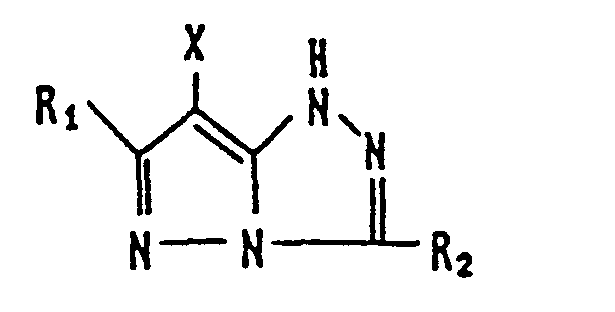
Applications Claiming Priority (2)
| Application Number | Priority Date | Filing Date | Title |
|---|---|---|---|
| JP60147456A JPS628148A (ja) | 1985-07-04 | 1985-07-04 | ハロゲン化銀写真感光材料 |
| JP147456/85 | 1985-07-04 |
Publications (3)
| Publication Number | Publication Date |
|---|---|
| EP0207794A2 EP0207794A2 (fr) | 1987-01-07 |
| EP0207794A3 EP0207794A3 (en) | 1987-11-04 |
| EP0207794B1 true EP0207794B1 (fr) | 1990-11-14 |
Family
ID=15430767
Family Applications (1)
| Application Number | Title | Priority Date | Filing Date |
|---|---|---|---|
| EP86305155A Expired - Lifetime EP0207794B1 (fr) | 1985-07-04 | 1986-07-03 | Matériau photographique à l'halogénure d'argent |
Country Status (4)
| Country | Link |
|---|---|
| US (1) | US4839264A (fr) |
| EP (1) | EP0207794B1 (fr) |
| JP (1) | JPS628148A (fr) |
| DE (1) | DE3675592D1 (fr) |
Families Citing this family (10)
| Publication number | Priority date | Publication date | Assignee | Title |
|---|---|---|---|---|
| JPS62157031A (ja) * | 1985-12-28 | 1987-07-13 | Konishiroku Photo Ind Co Ltd | ハロゲン化銀写真感光材料 |
| JPH07117731B2 (ja) * | 1987-03-20 | 1995-12-18 | コニカ株式会社 | 形成される色素の分光吸収特性が良好なハロゲン化銀写真感光材料 |
| US5242785A (en) * | 1987-06-25 | 1993-09-07 | Fuji Photo Film Co., Ltd. | Silver halide color photographic material containing color stain inhibitors and discoloring inhibitors |
| EP0355660B1 (fr) * | 1988-08-15 | 1995-11-02 | Fuji Photo Film Co., Ltd. | Materiau photographique couleur à l'halogénure d'argent |
| JPH0339956A (ja) * | 1989-01-04 | 1991-02-20 | Konica Corp | ハロゲン化銀カラー写真感光材料 |
| JP2879617B2 (ja) * | 1991-04-08 | 1999-04-05 | 富士写真フイルム株式会社 | ハロゲン化銀カラー写真感光材料 |
| US5200309A (en) * | 1991-08-29 | 1993-04-06 | Eastman Kodak Company | Color photographic materials including magenta coupler, carbonamide compound and aniline or amine compound, and methods |
| JPH0627615A (ja) * | 1992-07-06 | 1994-02-04 | Konica Corp | ハロゲン化銀カラー写真感光材料 |
| US5368998A (en) * | 1993-01-14 | 1994-11-29 | Konica Corporation | Silver halide color photographic light sensitive material |
| US6013429A (en) * | 1998-02-27 | 2000-01-11 | Eastman Kodak Company | Photographic element with new singlet oxygen quenchers |
Citations (1)
| Publication number | Priority date | Publication date | Assignee | Title |
|---|---|---|---|---|
| EP0201033A2 (fr) * | 1985-04-30 | 1986-11-12 | Konica Corporation | Procédé de traitement de matériaux photographiques couleurs à l'halogénure d'argent |
Family Cites Families (14)
| Publication number | Priority date | Publication date | Assignee | Title |
|---|---|---|---|---|
| GB1247493A (en) * | 1967-11-24 | 1971-09-22 | Kodak Ltd | Photographic colour processes |
| JPS5942300B2 (ja) * | 1975-04-24 | 1984-10-13 | 富士写真フイルム株式会社 | 色画像耐光堅牢化方法 |
| DE3002201A1 (de) * | 1980-01-22 | 1981-07-23 | Agfa-Gevaert Ag, 5090 Leverkusen | Farbfotografisches aufzeichnungsmaterial mit einer emulgierten hydrophilen farbgebenden verbindung |
| JPS58105147A (ja) * | 1981-12-16 | 1983-06-22 | Fuji Photo Film Co Ltd | カラ−写真感光材料 |
| JPS59229557A (ja) * | 1983-06-13 | 1984-12-24 | Fuji Photo Film Co Ltd | カラ−写真感光材料 |
| JPS60108847A (ja) * | 1983-11-18 | 1985-06-14 | Konishiroku Photo Ind Co Ltd | ハロゲン化銀カラ−写真感光材料 |
| US4559297A (en) * | 1984-02-07 | 1985-12-17 | Fuji Photo Film Co., Ltd. | Silver halide color photographic light-sensitive material containing stabilizer |
| JPS60222852A (ja) * | 1984-04-20 | 1985-11-07 | Fuji Photo Film Co Ltd | 多層ハロゲン化銀カラ−写真感光材料 |
| JPS60232550A (ja) * | 1984-05-02 | 1985-11-19 | Fuji Photo Film Co Ltd | ハロゲン化銀カラ−写真感光材料 |
| US4639415A (en) * | 1984-09-17 | 1987-01-27 | Konishiroku Photo Industry Co., Ltd. | Silver halide color photographic material containing a magenta color image-forming coupler |
| JPS61165756A (ja) * | 1985-01-17 | 1986-07-26 | Fuji Photo Film Co Ltd | ハロゲン化銀カラ−写真感光材料 |
| JPH0690472B2 (ja) * | 1985-05-22 | 1994-11-14 | 富士写真フイルム株式会社 | ハロゲン化銀カラ−写真感光材料 |
| JPS61282839A (ja) * | 1985-06-07 | 1986-12-13 | Fuji Photo Film Co Ltd | ハロゲン化銀カラ−写真材料 |
| JPH0638155B2 (ja) * | 1985-08-02 | 1994-05-18 | 富士写真フイルム株式会社 | ハロゲン化銀カラー写真感光材料 |
-
1985
- 1985-07-04 JP JP60147456A patent/JPS628148A/ja active Pending
-
1986
- 1986-07-03 DE DE8686305155T patent/DE3675592D1/de not_active Expired - Fee Related
- 1986-07-03 EP EP86305155A patent/EP0207794B1/fr not_active Expired - Lifetime
-
1987
- 1987-11-18 US US07/124,401 patent/US4839264A/en not_active Expired - Lifetime
Patent Citations (1)
| Publication number | Priority date | Publication date | Assignee | Title |
|---|---|---|---|---|
| EP0201033A2 (fr) * | 1985-04-30 | 1986-11-12 | Konica Corporation | Procédé de traitement de matériaux photographiques couleurs à l'halogénure d'argent |
Also Published As
| Publication number | Publication date |
|---|---|
| EP0207794A3 (en) | 1987-11-04 |
| JPS628148A (ja) | 1987-01-16 |
| US4839264A (en) | 1989-06-13 |
| DE3675592D1 (de) | 1990-12-20 |
| EP0207794A2 (fr) | 1987-01-07 |
Similar Documents
| Publication | Publication Date | Title |
|---|---|---|
| EP0178794B1 (fr) | Matériau photographique couleur à l'halogénure d'argent | |
| US4623617A (en) | Silver halide color photographic material | |
| EP0203746B1 (fr) | Matériau photographique à l'halogénure d'argent sensible à la lumière | |
| CA1267556A (fr) | Methode de traitement des materiaux photographiques polychromes a l'halogenure d'argent | |
| US4692399A (en) | Silver halide photographic light-sensitive material | |
| EP0244160B1 (fr) | Matériau photographique à l'halogénure d'argent sensible à la lumière à stabilité d'image de colorant | |
| JPH0614174B2 (ja) | ハロゲン化銀写真感光材料 | |
| US4839264A (en) | Silver halide photographic material | |
| EP0203465B1 (fr) | Matériau photographique à l'halogénure d'argent sensible à la lumière | |
| US4912027A (en) | Silver halide photographic light-sensitive material | |
| JPH07119945B2 (ja) | ハロゲン化銀写真感光材料 | |
| EP0207596B1 (fr) | Matériau photographique à l'halogénure d'argent sensible à la lumière | |
| JPH071387B2 (ja) | 色素画像の堅牢性が改良されたハロゲン化銀写真感光材料 | |
| JPH065371B2 (ja) | 色素画像の安定性を改良したハロゲン化銀写真感光材料 | |
| EP0182486A1 (fr) | Matériau photographique couleur à l'halogénure d'argent | |
| JPH07117730B2 (ja) | ハロゲン化銀写真感光材料 | |
| JPH0473939B2 (fr) | ||
| JPH0693104B2 (ja) | 色素画像の堅牢性が改良されたハロゲン化銀写真感光材料 | |
| JPH073565B2 (ja) | 色素画像の安定性を改良したハロゲン化銀写真感光材料 | |
| JP2511652B2 (ja) | 光堅牢性に優れた色素画像が得られるハロゲン化銀写真感光材料 | |
| JPH0715569B2 (ja) | 写真感光材料 | |
| JPH063535B2 (ja) | ハロゲン化銀写真感光材料 | |
| EP0235913A2 (fr) | Matériau photographique à l'halogénure d'argent sensible à la lumière | |
| JPH063536B2 (ja) | ハロゲン化銀写真感光材料 | |
| JPH0427535B2 (fr) |
Legal Events
| Date | Code | Title | Description |
|---|---|---|---|
| PUAI | Public reference made under article 153(3) epc to a published international application that has entered the european phase |
Free format text: ORIGINAL CODE: 0009012 |
|
| AK | Designated contracting states |
Kind code of ref document: A2 Designated state(s): DE FR GB |
|
| PUAL | Search report despatched |
Free format text: ORIGINAL CODE: 0009013 |
|
| AK | Designated contracting states |
Kind code of ref document: A3 Designated state(s): DE FR GB |
|
| 17P | Request for examination filed |
Effective date: 19880418 |
|
| 17Q | First examination report despatched |
Effective date: 19890118 |
|
| RAP3 | Party data changed (applicant data changed or rights of an application transferred) |
Owner name: KONICA CORPORATION |
|
| GRAA | (expected) grant |
Free format text: ORIGINAL CODE: 0009210 |
|
| AK | Designated contracting states |
Kind code of ref document: B1 Designated state(s): DE FR GB |
|
| PG25 | Lapsed in a contracting state [announced via postgrant information from national office to epo] |
Ref country code: FR Effective date: 19901114 |
|
| REF | Corresponds to: |
Ref document number: 3675592 Country of ref document: DE Date of ref document: 19901220 |
|
| EN | Fr: translation not filed | ||
| PG25 | Lapsed in a contracting state [announced via postgrant information from national office to epo] |
Ref country code: GB Effective date: 19910703 |
|
| PLBE | No opposition filed within time limit |
Free format text: ORIGINAL CODE: 0009261 |
|
| STAA | Information on the status of an ep patent application or granted ep patent |
Free format text: STATUS: NO OPPOSITION FILED WITHIN TIME LIMIT |
|
| 26N | No opposition filed | ||
| GBPC | Gb: european patent ceased through non-payment of renewal fee | ||
| PG25 | Lapsed in a contracting state [announced via postgrant information from national office to epo] |
Ref country code: DE Effective date: 19920401 |