EP0208105A2 - Verfahren zur Herstellung von Copolyphosphonaten mit hoher Zähigkeit - Google Patents
Verfahren zur Herstellung von Copolyphosphonaten mit hoher Zähigkeit Download PDFInfo
- Publication number
- EP0208105A2 EP0208105A2 EP86107104A EP86107104A EP0208105A2 EP 0208105 A2 EP0208105 A2 EP 0208105A2 EP 86107104 A EP86107104 A EP 86107104A EP 86107104 A EP86107104 A EP 86107104A EP 0208105 A2 EP0208105 A2 EP 0208105A2
- Authority
- EP
- European Patent Office
- Prior art keywords
- hydroxyphenyl
- phosphonates
- bis
- process according
- aromatic
- Prior art date
- Legal status (The legal status is an assumption and is not a legal conclusion. Google has not performed a legal analysis and makes no representation as to the accuracy of the status listed.)
- Granted
Links
Classifications
-
- C—CHEMISTRY; METALLURGY
- C08—ORGANIC MACROMOLECULAR COMPOUNDS; THEIR PREPARATION OR CHEMICAL WORKING-UP; COMPOSITIONS BASED THEREON
- C08G—MACROMOLECULAR COMPOUNDS OBTAINED OTHERWISE THAN BY REACTIONS ONLY INVOLVING UNSATURATED CARBON-TO-CARBON BONDS
- C08G64/00—Macromolecular compounds obtained by reactions forming a carbonic ester link in the main chain of the macromolecule
- C08G64/04—Aromatic polycarbonates
- C08G64/06—Aromatic polycarbonates not containing aliphatic unsaturation
- C08G64/08—Aromatic polycarbonates not containing aliphatic unsaturation containing atoms other than carbon, hydrogen or oxygen
- C08G64/083—Aromatic polycarbonates not containing aliphatic unsaturation containing atoms other than carbon, hydrogen or oxygen containing phosphorus
-
- C—CHEMISTRY; METALLURGY
- C08—ORGANIC MACROMOLECULAR COMPOUNDS; THEIR PREPARATION OR CHEMICAL WORKING-UP; COMPOSITIONS BASED THEREON
- C08G—MACROMOLECULAR COMPOUNDS OBTAINED OTHERWISE THAN BY REACTIONS ONLY INVOLVING UNSATURATED CARBON-TO-CARBON BONDS
- C08G63/00—Macromolecular compounds obtained by reactions forming a carboxylic ester link in the main chain of the macromolecule
- C08G63/68—Polyesters containing atoms other than carbon, hydrogen and oxygen
- C08G63/692—Polyesters containing atoms other than carbon, hydrogen and oxygen containing phosphorus
- C08G63/6924—Polyesters containing atoms other than carbon, hydrogen and oxygen containing phosphorus derived from polycarboxylic acids and polyhydroxy compounds
- C08G63/6926—Dicarboxylic acids and dihydroxy compounds
-
- C—CHEMISTRY; METALLURGY
- C08—ORGANIC MACROMOLECULAR COMPOUNDS; THEIR PREPARATION OR CHEMICAL WORKING-UP; COMPOSITIONS BASED THEREON
- C08G—MACROMOLECULAR COMPOUNDS OBTAINED OTHERWISE THAN BY REACTIONS ONLY INVOLVING UNSATURATED CARBON-TO-CARBON BONDS
- C08G79/00—Macromolecular compounds obtained by reactions forming a linkage containing atoms other than silicon, sulfur, nitrogen, oxygen, and carbon with or without the latter elements in the main chain of the macromolecule
- C08G79/02—Macromolecular compounds obtained by reactions forming a linkage containing atoms other than silicon, sulfur, nitrogen, oxygen, and carbon with or without the latter elements in the main chain of the macromolecule a linkage containing phosphorus
- C08G79/04—Phosphorus linked to oxygen or to oxygen and carbon
Definitions
- the invention relates to a two-stage process for the preparation of aromatic polyester phosphonates with improved impact and notched impact strength, according to which aromatic oligophosphonals having hydroxyl end groups are produced in a melt transesterification in the first stage and the oligophosphonates thus obtained are condensed to the polyester phosphonate in a phase interface reaction in a second stage.
- polyethylene phosphonates in the sense of the invention includes polycarbonate phosphonates and consequently also polyester carbonate phosphonates and mixtures of polyester phosphonates and polycarbonate phosphonates.
- Aromatic polyester phosphonates and aromatic polycarbonate phosphonates are known (DE-AS 11 99 499, 11 99 500). They are predominantly made according to the phase interface process from bisphenolate, phosphonic acid and dicarboxylic acid dichlorides or from bisphenol-bischlorocarbonic acid esters (or their starting products bisphenol and Phosgene) and phosphonic acid dichlorides. Because the use of phosphonic acid dichlorides in the interfacial process easily results in emulsions whose phase separation is difficult or even impossible, this production process has not been able to establish itself in practice.
- Polyester phosphonates and polycarbonate phosphonates can also be prepared by melt condensation from bisphenol, phosphonic acid esters and carboxylic acid esters or from bisphenol, phosphonic acid esters and diphenyl carbonate (see e.g. DE-OS 29 25 206, 29 25 208). They have a high heat resistance, but do not meet very high requirements for impact and notched impact strength.
- the object of the invention was therefore to provide polyester phosphonates with improved impact and notched impact strength compared to melt condensation products.
- oligophosphonates with hydroxyl end groups are prepared by melt transesterification and condensation of phosphonic acid esters and diphenols and in a second stage the oligophosphonates with aromatic dicarboxylic acid chlorides and / or phosgene and, if appropriate, further diphenol after Phase boundary process condensed to polyester phosphonates.
- the invention thus relates to a process for the preparation of aromatic polyester phosphonates with number average molecular weights M n from 5000 to 200,000, preferably from 10,000 to 150,000, in particular from 12,000 to 80,000, and with molar phosphonate groups / (carboxylate plus carbonate groups) ratios of 95: 5 to 5:95, preferably from 80:20 to 10:90, in particular from 65:35 to 10:90, from 1) diphenols, 2) phosphonic acid derivatives and 3) aromatic dicarboxylic acid derivatives and / or phosgene,
- diaryl phosphonate in a first stage diaryl phosphonate is reacted with diphenols in the melt until an oligomeric product with a number average molecular weight M n from 460 to 20,000, preferably from 800 to 10,000, and an OH number of 5 to 240, preferably from 10 to 140, and then in a second step the oligomeric product with aromatic dicarboxylic acid dichlorides and / or phosgene, if appropriate with further diphenols, condensed by the phase interface process until the phenolic OH content is less than 0.1, preferably less than 0.05% by weight, based on the resulting polyester phosphonate.
- Preferred diphenols for use in the first and optionally in the second stage of the process according to the invention are compounds of the formula in which Z is a divalent mono- or polynuclear aromatic radical having 6-30 C atoms, Z being constructed in such a way that the two OH groups are each bonded directly to one C atom of an aromatic system.
- the first stage of the process according to the invention can be accelerated by catalysts.
- Preferred catalysts are, for example, alcoholates and phenolates of alkali and alkaline earth metals such as sodium methylate, calcium methylate, sodium phenolate, potassium phenolate, sodium and potassium phenolates of the diphenols described above, hydrides such as lithium hydride, sodium borohydride, calcium hydride, oxides such as lithium oxide, sodium oxide, barium oxide, amides such as Sodium amide, calcium amide, aromatic nitrogen bases such as imidazole, tetraalkyl titanates such as titanium tetraethylate, tetraisopropylate, tetrabutylate, dialkyltin oxides such as dibutyltin oxide, dialkyldialkoxytin compounds such as dibutyldimethoxytin, alkyltin carboxylates such as tributylibutyltinate mixtures, such as dibutylzutyl
- the first process stage is generally carried out at temperatures from 80 to 340, preferably 100 to 320 ° C., optionally under reduced pressure, the phenols liberated being distilled off.
- trifunctional or tetrafunctional compounds such as triaryl phosphates, for example triphenyl phosphate, tri- or Tetraphenols with one or more aromatic rings, aryl esters of tri- or tetrabasic aromatic carboxylic acids, such as, for example, trimesic acid triphenyl ester or pyromellitic acid tetraphenyl ester.
- Aromatic dicarboxylic acid dichlorides preferred for the second process stage are the dichlorides of o-phthalic acid, iso-, terephthalic acid, diphenyl dicarboxylic acids, diphenyl ether dicarboxylic acids, naphthalenedicarboxylic acids and mixtures of these dicarboxylic acids.
- Particularly preferred dichlorides are iso- / terephthalic acid dichloride mixtures in a ratio of 3: 7 to 7: 3.
- Triphenylethylphosphoniumchlorid as quaternary ammonium compounds, for example trimethylbenzylammonium, triethylbenzylammonium chloride, tetrabutylammonium bromide as quaternary arsonium, eg Methyltriphenylarsoniumjodid, Benzyltriphenylarsoniumbromid, and tertiary amines such as triethylamine, tributylamine can be used as Katatalysatoren onium compounds such as quaternary phosphonium compounds, eg triphenylbenzylphosphonium, N-ethylpiperidine, N-ethylmorpholine can be used.
- the phase interface catalysts are generally used in amounts of 0.02 to 20, preferably 0.2 to 15, mol-X, based on phenolic OH groups to be reacted.
- a preferred pH range for the phase interface reaction is 8 to 13.
- Preferred solvents for the aromatic dicarboxylic acid dichlorides and for the polyester phosphonates formed during the reaction are water-immiscible halogenated hydrocarbons, e.g. Methylene chloride, chloroform, di-, tri- and tetrachloroethanes, chlorobenzene, dichlorobenzenes and mixtures of these solvents.
- water-immiscible halogenated hydrocarbons e.g. Methylene chloride, chloroform, di-, tri- and tetrachloroethanes, chlorobenzene, dichlorobenzenes and mixtures of these solvents.
- the oligophosphonate obtained in the first process stage is dissolved in the organic phase.
- the diphenols are optionally dissolved in the aqueous alkaline phase;
- small amounts of reducing agents e.g. Sodium borohydride or sodium sulfite.
- a solution of the aromatic dicarboxylic acid dichlorides and / or phosgene is added - simultaneously or in succession - with vigorous stirring.
- the temperature is preferably maintained in a range from 0 to 40 ° C.
- the end products can be isolated as is customary in phase interface processes: the organic phase is then separated off, washed free of salt and evaporated. The last stage of the workup can preferably take place in an evaporation extruder.
- copolyphosphonates produced according to the invention are used primarily for the production of moldings which are said to have high impact strength, e.g. Power strips, lamp holders, switch boxes.
- Processing is usually carried out by injection molding at melt temperatures of 280 to 360 ° C and at mold temperatures of 80 to 150 ° C, preferably 90 to 120 ° C.
- the relative viscosity ⁇ rel was determined on a solution of 0.5 g substance in 100 ml dichloromethane solution at 25 ° C.
- This mixture was combined with 1887 g of a 40% by weight solution of iso- / terephthalic acid dichloride (1: 1) in dichloromethane. Then 300 g of phosgene were introduced, the pH being kept at 9 to 11 by adding dilute sodium hydroxide solution. After phosgene on has ended conductive, 4.8 ml of N-ethylpiperidine were added and the mixture was left to react for a further 1 hour. The temperature of the reaction mixture was 20 to 25 ° C. during the entire reaction.
- the organic phase was washed first with dilute phosphoric acid and then with water until salt-free and about 50% of the dichloromethane was distilled off under atmospheric pressure.
- the remaining solution was diluted with 10 l of chlorobenzene and distillation of the dichloromethane was continued until the bottom temperature was approximately 80 ° C., the polyester phosphonate was then freed from chlorobenzene in a vacuum extruder at 320 ° C., drawn off as a strand and granulated.
- the granules had a relative solution viscosity ⁇ rel of 1.245 and a phenolic OH content of 0.01% by weight.
- Example 6 1430 g of bisphenol A were dissolved in 50 l of water and 1305 g of 45% by weight sodium hydroxide solution and with 1668 g of oligophosphonate from Example 1, dissolved in 25 l of dichloromethane, 1531 g of a 40% by weight solution of iso - / Terephthalic acid dichloride (1: 1) in dichloromethane and 900 g of phosgene. 10.2 g of phenol were used as chain terminators, 23.4 g of tetrabutylammonium bromide and 15.2 ml of N-ethylpiperidine were used as catalysts.
- Example 10 Analogously to Example 10, 3800 g of bisphenol A, 24 g of phenol and 54.7 g of tetrabutylammonium bromide were dissolved in 64.3 l of water and 3051 g of 45% strength by weight sodium hydroxide solution. 556 g of oligophosphonate from Example 1, dissolved in 33 l of dichloromethane, were added with stirring.
- ⁇ rel 1.315; Phenolic OH content: 0.01% by weight.
- the polyester phosphonate was allowed to settle for 1 hour at 300 ° C. while the stirrer was at a standstill and the cocondensate was then isolated by spinning under pressure (approx. 10 bar) and granulating the melt strand.
- the polyester phosphonate was allowed to settle for 1 hour at 300 ° C. while the stirrer was at a standstill and the cocondensate was then isolated by spinning under pressure (approx. 10 bar) and granulating the melt strand.
Landscapes
- Chemical & Material Sciences (AREA)
- Health & Medical Sciences (AREA)
- Chemical Kinetics & Catalysis (AREA)
- Medicinal Chemistry (AREA)
- Polymers & Plastics (AREA)
- Organic Chemistry (AREA)
- Polyesters Or Polycarbonates (AREA)
- Polymers With Sulfur, Phosphorus Or Metals In The Main Chain (AREA)
Abstract
Description
- Die Erfindung betrifft ein zweistufiges Verfahren zur Herstellung aromatischer Polyesterphosphonate mit verbesserter Schlag- und Kerbschlagzähigkeit, wonach in erster Stufe aromatische Oligophosphonale mit Hydroxylendgruppen in einer Schmelzumesterung hergestellt werden und in einer zweiten Stufe die so erhaltenen Oligophosphonate in einer Phasengrenzflächenreaktion zum Polyesterphosphonat kondensiert werden. Der Begriff "Polyesterphosphonate" im Sinne der Erfindung schließt Polycarbonatphosphonate und folglich auch Polyestercarbonatophosphonate sowie Mischungen von Polyesterphosphonaten und Polycarbonatophosphonaten ein.
- Aromatische Polyesterphosphonate und aromatische Polycarbonatophosphonate sind bekannt (DE-AS 11 99 499, 11 99 500). Sie werden vorwiegend nach dem Phasengrenzflächenverfahren aus Bisphenolat, Phosphonsäure- und Dicarbonsäuredichloriden oder aus Bisphenol-bischlorkohlensäureestern (oder deren Ausgangsprodukten Bisphenol und Phosgen) und Phosphonsäuredichloriden hergestellt. Weil der Einsatz von Phosphonsäuredichloriden im Phasengrenzflächenverfahren leicht Emulsionen entstehen läßt, deren Phasentrennung schwierig oder gar unmöglich ist, hat sich dieses Herstellungsverfahren in der Praxis nicht durchsetzen können.
- Polyesterphosphonate und Polycarbonatophosphonate können auch durch Schmelzkondensation aus Bisphenol, Phosphonsäureestern und Carbonsäureestern bzw. aus Bisphenol, Phosphonsäureestern und Diphenylcarbonat hergestellt werden (vgl. z.B. DE-OS 29 25 206, 29 25 208). Sie besitzen eine hohe Wärmeformbeständigkeit, erfüllen aber sehr hohe Anforderungen an die Schlag- und Kerbschlagzähigkeit nicht.
- Aufgabe der Erfindung war es daher, Polyesterphosphonate mit gegenüber Schmelzkondensationsprodukten verbesserter Schlag- und Kerbschlagzähigkeit bereitzustellen.
- Überraschenderweise wurde nun gefunden, daß eine Zweistufenreaktion zum Erfolg führt, wenn man in erster Stufe durch Schmelzumesterung und -kondensation von Phosphonsäureestern und Diphenolen Oligophosphonate mit Hydroxylendgruppen herstellt und in einer zweiten Stufe die Oligophosphonate mit aromatischen Dicarbonsäurechloriden und/oder Phosgen und gegebenenfalls weiterem Diphenol nach dem Phasengrenzflächenverfahren zu Polyesterphosphonaten kondensiert.
- Gegenstand der Erfindung ist also ein Verfahren zur Herstellung von aromatischen Polyesterphosphonaten mit als Zahlenmittel bestimmten Molekulargewichten
M n von 5000 bis 200 000, vorzugsweise von 10 000 bis 150 000, insbesondere von 12 000 bis 80 000, und mit molaren Phosphonatgruppen/ (Carboxylat-plus Carbonatgruppen)-Verhältnissen von 95:5 bis 5:95, vorzugsweise von 80:20 bis 10:90, insbesondere von 65:35 bis 10:90, aus 1) Diphenolen, 2) Phosphonsäurederivaten und 3) aromatischen Dicarbonsäurederivaten undloder Phosgen, - dadurch gekennzeichnet, daß man in einer ersten Stufe Phosphonsäurediarylester mit Diphenolen in der Schmelze umsetzt, bis ein oligomeres Produkt mit einem als Zahlenmittel bestimmten Molekulargewicht
M n von 460 bis 20 000, vorzugsweise von 800 bis 10 000, und einer OH-Zahl von 5 bis 240, vorzugweise von 10 bis 140, entstanden ist und dann in einer zweiten Stufe das oligomere Produkt mit aromatischen Dicarbonsäuredichloriden und/oder Phosgen, gegebenenfalls mit weiteren Diphenolen, nach dem Phasen grenzflächenverfahren kondensiert, bis der Gehalt an phenolischem OH weniger als 0,1, vorzugsweise weniger als 0,05 Gew.-%, bezogen auf resultierendes Polyesterphosphonat, beträgt. - Bevorzugte Diphenole für den Einsatz in der ersten und gegebenenfalls in der zweiten Stufe des erfindungsgemäßen Verfahrens sind Verbindungen der Formel

- Besonders bevorzugte Diphenole sind Verbindungen der Formel

- Y eine Einfachbindung, einen Alkylen- oder Alkylidenrest mit 1-7 C-Atomen, einen Cycloalkylen- oder Cycloalkylidenrest mit 5-12 C-Atomen, -O-, -S-,


- Hydrochinon,
- Resorcin,
- Dihydroxydiphenyle,
- Bis-(hydroxyphenyl)-alkane,
- Bis-(hydroxyphenyl)-cycloalkane,
- Bis-(hydroxyphenyl)-sulfide,
- Bis-(hydroxyphenyl)-elher,
- Bis-(hydroxyphenyl)-ketone,
- Bis-(hydroxyphenyl)-sulfoxide,
- Bis-(hydroxyphenyl)-sulfone und
- α,α'-Bis-(hydroxyphenyl)-diisopropylbenzole
- sowie deren kernalkylierte und kernhalogenierte Verbindungen, und die Mischungen solcher Diphenole.
- Die wichtigsten Diphenole seien nachfolgend aufgezählt:
- Bisphenol A, 2,2-Bis-(3-methyl-4-hydroxyphenyl)-propan,
- 2,2-Bis-(3.5-dimethyl-4-hydroxyphenyl)-propan,
- 1,1-Bis-(4-hydroxyphenyl)-isobutan,
- 2,4-Bis-(4-hydroxyphenyl)-2-methylbutan,
- 1,1-Bis-(4-hydroxyphenyl)-cyclohexan,
- 4,4'-Dihydroxydiphenylsulfid, 4,4'-Dihydroxydiphenyl,
- 4,4'-Dihydroxydiphenylsulfon sowie deren di- und tetra-
- halogenierte Derivate und beliebige Mischungen der genannten Diphenole.
- Bevorzugte Phosphonsäurediarylester, die für die Reaktion in der ersten Stufe des erfindungsgemäßen Verfahrens eingesetzt werden können, entsprechen der Formel

- R C1-C12-, vorzugsweise C1-C4-Alkyl, insbesondere Methyl, C2-C12-, vorzugsweise C2-C4-Alkenyl, C6-C30-, vorzugsweise C6-C12-Cycloalky, C6-C30-, vorzugsweise C6-C12-Cycloalkenyl, C6-C30-, vorzugsweise C6-C10-Aryl, insbesondere Phenyl, C7-C30-, vorzugsweise C7-C12-Aralkyl, C7-C30-, vorzugsweise C7-C12-Aralkenyl, wobei die aromatischen Kerne unsubstituiert oder durch 1 bis 5 C1-C4-, vorzugsweise Cl-C2-Alkylgruppen, durch 1 bis 5 Halogenatome (F, Cl oder Br) oder durch die genannten Alkylgruppen und Halogenatome substituiert sind, und
- Ar l, Ar2 unsubstituierte oder durch 1 bis 5 C1-C4-Alkylreste substituierte Phenylreste bedeuten. Bevorzugte Phosphonsäureester sind Phenylphosphonsäureester; die bevorzugtesten Phosphonsäureester sind jedoch die Methylphosphonsäureester. Normalerweise wird man aus Kostengründen die Phosphonsäurediphenylester einsetzen.
- Die erste Stufe des erfindungsgemäßen Verfahrens läßt sich durch Katalysatoren beschleunigen. Bevorzugte Katalysatoren sind beispielsweise Alkoholate und Phenolate der Alkali- und Erdalkalimetalle wie Natriummethylat, Calciummethylat, Natriumphenolat, Kaliumphenolat, Natrium- und Kalium-phenolate der oben beschriebenen Diphenole, Hydride wie Lithiumhydrid, Natriumborhydrid, Calciumhydrid, Oxide wie Lithiumoxid, Natriumoxid, Bariumoxid, Amide wie Natriumamid, Calciumamid, aromatische Stickstoffbasen wie Imidazol, Tetraalkyltitanate wie Titantetraethylat,-tetra- isopropylat, -tetrabutylat, Dialkylzinnoxide wie Dibutylzinnoxid, Dialkyldialkoxyzinnverbindungen wie Dibutyldimethoxy-zinn, Alkylzinncarboxylate wie Tributylzinnacetat, Dibutylzinndilaurat, und Mischungen dieser Verbindungen. Die Katalysatoren können in Mengen von 0,005 bis 5, vorzugsweise 0,05 bis 2 Gew.-X, bezogen auf eingesetzte Diphenole, verwendet werden.
- Die erste Verfahrensstufe wird im allgemeinen bei Temperaturen von 80 bis 340, vorzugsweise 100 bis 320°C, gegebenenfalls unter vermindertem Druck, durchgeführt, wobei die freiwerdenden Phenole abdestilliert werden. Will man die Oligophosphonate verzweigen, so setzt man als Verzweigungsmittel tri- oder tetrafunktionelle Verbindungen wie Triarylphosphate, z.B. Triphenylphosphat, Tri- oder Tetraphenole mit einem oder mehreren aromatischen Ringen, Arylester von tri- oder tetrabasischen aromatischen Carbonsäuren, wie z.B. Trimesinsäuretriphenylester oder Pyromellithsäuretetraphenylester, ein.
- Für die zweite Verfahrensstufe bevorzugte aromatische Dicarbonsäuredichloride sind die Dichloride der o-Phthalsäure, Iso-, Terephthalsäure, der Diphenyldicarbonsäuren, der Diphenyletherdicarbonsäuren, der Naphthalindicarbonsäuren und von Gemischen dieser Dicarbonsäuren. Besonders bevorzugte Dichloride sind Iso-/Terephthalsäuredichlorid-Mischungen im Verhältnis 3:7 bis 7:3.
- Für die Phasengrenzflächenreaktion können als Katatalysatoren Oniumverbindungen wie quatäre Phosphoniumverbindungen, z.B. Triphenylbenzylphosphoniumchlorid, Tri- phenylmethylphosphoniumjodidt Triphenylethylphosphoniumchlorid, wie quatäre Ammoniumverbindungen, z.B. Trimethylbenzylammoniumchlorid, Triethylbenzylammoniumbromid, Tetrabutylammoniumbromid, wie quatäre Arsoniumverbindungen, z.B. Methyltriphenylarsoniumjodid, Benzyltriphenylarsoniumbromid, und tertiäre Amine, wie z.B. Triethylamin, Tributylamin, N-Ethylpiperidin, N-Ethylmorpholin, eingesetzt werden. Die Phasengrenzflächen-Katalysatoren werden in der Regel in Mengen von 0,02 bis 20, vorzugsweise von 0,2 bis 15 Mol-X, bezogen auf zur Reaktion zu bringende phenolische OH-Gruppen, eingesetzt.
- Ein bevorzugter PH-Bereich für die Phasengrenzflächenreaktion liegt bei 8 bis 13.
- Bevorzugte Lösungsmittel für die aromatischen Dicarbonsäuredichloride und für die während der Reaktion entstehenden Polyesterphosphonate sind mit Wasser nichtmischbare halogenierte Kohlenwasserstoffe, wie z.B. Methylenchlorid, Chloroform, Di-, Tri- und Tetrachlorethane, Chlorbenzol, Dichlorbenzole und Gemische dieser Lösungsmittel.
- Als Verzweigungsmittel für die erfindungsgemäß herzustellenden Polyesterphosphonate können beispielsweise Phosphoroxytrichlorid, Phosphortrichlorid, drei- oder mehrfunktionelle Carbonsäurechloride, wie Trimesinsäuretrichlorid, Cyanursäuretrichlorid, 3,3',4,4'-Benzophenontetracarbonsäuretetrachlorid, 1,4,5,8-Naphthalintetracarbonsäuretetrachlorid oder Pyromellithsäuretetrachlorid, in Mengen von 0,01 bis 2,0 Mol-X (bezogen auf im Endprodukt vorhandene Diphenolreste) oder 3- oder mehrfunktionelle Phenole, wie Phloroglucin,
- 4,6-Dimethyl-2,4,6-tri-(4-hydroxyphenyl)-hepten-2,
- 4,6-Dimethyl-2,4,6-tri-(4-hydroxyphenyl)-heptan,
- 1,3,5-Tri-(4-hydroxyphenyl)-benzol,
- 1,1,1-Tri-(4-hydroxyphenyl)-ethan,
- Tri-(4-hydroxyphenyl)-phenylmethan,
- 2,2-Bis[4,4- bis (4-hydroxy-phenyl)-cyclohexyl]-propan,
- 2,4-Bis-(4-hydroxyphenyl-isopropyl)-phenol,
- Tetra-(4-hydroxyphenyl)-methan,
- 2,6-Bis-(2-hydroxy-5-methyl-benzyl)-4-methyl-phenol,
- 2-(4-Hydroxyphenyl)-2-(2,4-dihydroxyphenyl)-propan,
- Tetra-(4-[4-hydroxyphenyl-isopropyl]-phenoxy)-methan,
- 1,4-Bis-[(4,4"-dihydroxytriphenyl)-methyl)-benzol
- in Mengen von 0,01 bis 2,0 Mol-% (bezogen auf im Endprodukt vorhandene Diphenolreste) verwendet werden. Phenolische Verzweigungsmittel können mit den Diphenolen vorgelegt, Säurechlorid-Verzweigungsmittel können zusammen mit den Säuredichloriden eingetragen werden.
- Zur Begrenzung des Molekulargewichts der erfindungsgemäß herzustellenden Polyesterphosphonate können in der zweiten Verfahrensstufe Kettenabbrecher zugesetzt werden. Bevorzugte Kettenabbrecher entsprechen der Formel
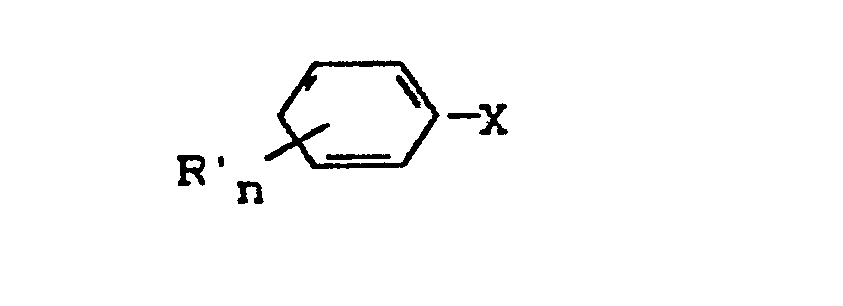
- R' ein aliphatischer oder aromatischer Kohlenwasserstoffrest mit 1 bis 18, vorzugsweise 6 bis 12, insbesondere 8 oder 9, Kohlenstoffatomen,
- n Null oder eine ganze Zahl von 1 bis 5 und
- X -OH, -

- Für die zweite Verfahrensstufe wird das in der ersten Verfahrensstufe erhaltene Oligophosphonat in der organischen Phase gelöst. In der wäßrig-alkalischen Phase werden gegebenenfalls die Diphenole gelöst; zur Vermeidung unerwünschter Verfärbungen der Endprodukte können der wäßrigen Phase geringe Mengen Reduktionsmittel, wie z.B. Natriumborhydrid oder Natriumsulfit, eingetragen werden. Unter heftigem Rühren wird eine Lösung der aromatischen Dicarbonsäuredichloride undloder Phosgen - gleichzeitig oder nacheinander - zugefügt. Die Temperatur hält man vorzugsweise in einem Bereich von 0 bis 40°C.
- Die Isolierung der Endprodukte kann wie bei Phasengrenzflächenverfahren üblich erfolgen: Danach wird die organische Phase abgetrennt, salzfrei gewaschen und eingedampft. Die letzte Stufe der Aufarbeitung kann vorzugsweise in einem Ausdampfextruder stattfinden.
- Die erfindungsgemäß hergestellten Copolyphosphonate finden vornehmlich zur Herstellung von Formkörpern Verwendung, die hohe Kerschlagzähigkeit aufweisen sollen, z.B. Steckerleisten, Lampenhalterungen, Schalterkästen.
- Die Verarbeitung erfolgt in der Regel durch Spritzguß bei Massetemperaturen von 280 bis 360°C und bei Formtemperaturen von 80 bis 150°C, vorzugsweise 90 bis 120°C.
- Die Bestimmung der relativen Viskosität ηrel erfolgte an einer Lösung von 0,5 g Substanz in 100 ml Dichlormethanlösung bei 25°C.
- Die Prüfung der Schlagzähigkeit an und der Kerbschlagzähigkeit ak erfolgte nach Charpy gemäß DIN 53 453.
- 5750 g Bisphenol A, 5180 g Methylphosphonsäurediphenylester und 36 g Natriumphenolat wurden unter Stickstoff bei 180°C vermischt. Im Laufe von 3 Stunden wurde unter einem von 450 auf 200 mbar absinkenden Druck Phenol über eine Kolonne abdestilliert. Anschließend wurde im Laufe von weiteren 2,5 Stunden der Druck auf 10 mbar gesenkt, die Temperatur auf 200°C erhöht und weiter Phenol abdestilliert. Restliches Phenol ging bei 200°C/0,5 mbar über. Das Reaktionsgefäß wurde mit Stickstoff belüftet, das Produkt auf Blech gegossen und abgekühlt.
- OH-Zahl: 66.
- 6840 g Bisphenol A, 4960 g Methylphosphonsäurediphenylester und 35 g Natriumphenolat wurden, wie im Beispiel 1 beschrieben, umgesetzt.
- OH-Zahl: 130.
- 6156 g Bisphenol A, 5952 g Methylphosphonsäurediphenylester und 35 g Natriumphenolat wurden, wie in Beispiel 1 beschrieben, umgesetzte OH-Zahl: 47.
- 5477 g Bisphenol A, 4464 g Methylphosphonsäurediphenylester und 34 g Natriumphenolat wurden, wie in Beispiel 1 beschrieben, umgesetzt.
- OH-Zahl: 105.
- 777,6 g Bisphenol A und 18 g Tetrabutylammoniumbromid wurden in 35,8 kg Wasser und 828 g 45 gew.-Xiger Natronlauge gelöst. Unter Rühren wurden 1310 g Oligophosphonat aus Beispiel 4, gelöst in 23,3 kg Dichlormethan, zugegeben.
- Dieses Gemisch wurde mit 1887 g einer 40 gew.-%igen Lösung von Iso-/Terephthalsäuredichlorid (1:1) in Dichlormethan vereinigt. Danach wurden 300 g Phosgen eingeleitet, wobei der pH-Wert durch Zugabe verdünnter Natronlauge bei 9 bis 11 gehalten wurde. Nach der Beendigung des Phosgen-Einleitens fügte man 4,8 ml N-Ethylpiperidin zu und ließ noch 1 Stunde nachreagieren. Die Temperatur des Reaktionsgemisches betrug während der gesamten Umsetzung 20 bis 25° C.
- Nach Abtrennung der wäßrig-alkalischen Phase wurde die organische Phase zunächst mit verdünnter Phosphorsäure, dann mit Wasser salzfrei gewaschen und ca. 50 % des Dichlormethans unter Normaldruck abdestilliert. Die verbleibende Lösung wurde mit 10 1 Chlorbenzol verdünnt und die Abdestillation des Dichlormethans forgesetzt, bis die Sumpftemperatur ca. 80°C betrug, das Polyesterphosphonat sodann im Vakuumextruder bei 320°C vom Chlorbenzol befreit, als Strang abgezogen und granuliert. Das Granulat besaß eine relative Lösungsviskosität ηrel von 1,245 und einem Gehalt an phenolischem OH von 0,01 Gew.-%.
- 1280 g Bisphenol A und 9 g Tetrabutylammoniumbromid wurden in 36 kg Wasser und 1272 g 45 gew.-Xiger Natronlauge gelöst. Unter Rühren wurden 655 g Oligophosphonat aus Beispiel 4, gelöst in 17,9 1 Dichlormethan, zugegeben.
- Dieses Gemisch wurde mit 2413 g einer 40 gew.-%igen Lösung von Iso-/Terephthalsäuredichlorid (1:1) in Chlorbenzol vereinigt. Danach wurden 350 g Phosgen eingeleitet, wobei der pH-Wert durch Zugabe verdünnter Natronlauge bei 9 bis 11 gehalten wurde. Nach der Beendigung des Phosgen-Einleitens gab man 12 g Phenol und 2,4 ml N-Ethylpiperidin zu und ließ 1 Stunde nachreagieren. Die Aufarbeitung erfolgte analog Beispiel 5.
- Nach der in Beispiel 5 beschriebenen Verfahrensweise wurden 913 g Bisphenol A in 32 1 Wasser und 907 g 45 gew.-Xiger Natronlauge gelöst und mit 875 g Oligophosphonat aus Beispiel 4, gelöst in 16 1 Dichlormethan, 1502 g einer 40 gew.-%igen Lösung von Iso-/Terephthalsäuredichlorid (1:1) in Dichlormethan und 260 g Phosgen umgesetzt. Als Katalysatoren wurden 12 g Tetrabutylammoniumbromid und 3,2 ml N-Ethylpiperidin verwendet.
- Nach der im Beispiel 6 beschriebenen Verfahrensweise wurden 2096 g Bisphenol A in 50 1 Wasser und 1740 g 45 gew.-%iger Natronlauge gelöst und mit 834 g Oligophosphonat aus Beispiel 1, gelöst in 25 1 Dichlormethan, 2041 g einer 40 gew.-%igen Lösung von Iso/Terephthalsäuredichlorid (1:1) in Dichlormethan und 1120 g Phosgen umgesetzt. Als Kettenabbrecher wurden 47,5 g Phenol, als Katalysatoren 31,2 g Tetrabutylammoniumbromid und 20,5 ml N-Ethylpiperidin eingesetzt.
- Analog Beispiel 6 wurden 1430 g Bisphenol A in 50 1 Wasser und 1305 g 45 gew.-%iger Natronlauge gelöst und mit 1668 g Oligophosphonat aus Beispiel 1, gelöst in 25 1 Dichlormethan, 1531 g einer 40 gew.-%igen Lösung von Iso-/Terephthalsäuredichlorid (1:1) in Dichlormethan und 900 g Phosgen umgesetzt. Als Kettenabbrecher wurden 10,2 g Phenol, als Katalysatoren 23,4 g Tetrabutylammoniumbromid und 15,2 ml N-Ethylpiperidin eingesetzt.
- 2788 g Bisphenol A, 18,9 g Phenol und 42,5 g Tetrabutylammoniumbromid wurden in 65 1 Wasser und 2373 g 45 gew.-%iger Natronlauge gelöst. Unter Rühren wurden 1668 g Oligophosphonat aus Beispiel 1, gelöst in 33 1 Dichlormethan, zugegeben. In dieses Gemisch wurden 1700 g Phosgen eingeleitet. Anschließend versetzte man mit 27,9 ml N-Ethylpiperidin, ließ 1 Stunde nachregieren und arbeitete analog Beispiel 5 auf.
- Analog Beispiel 10 wurden 3800 g Bisphenol A, 24 g Phenol und 54,7 g Tetrabutylammoniumbromid in 64,3 1 Wasser und 3051 g 45 gew.-%iger Natronlauge gelöst. Unter Rühren wurden 556 g Oligophosphonat aus Beispiel 1, gelöst in 33 1 Dichlormethan, zugegeben.
- In dieses Gemisch wurden 2400 g Phosgen eingeleitet. Anschließend versetzte man mit 36 ml N-Ethylpiperidin, ließ 1 Stunde nachreagieren und arbeitete analog Beispiel 5 auf.
- 2926 g Bisphenol A, 1378 g Methylphosphonsäurediphenylester, 1714 g Iso-/Terephthalsäurediphenylester (1:1), 541 g Diphenylcarbonat und 0,5 g Natriumphenolat wurden unter Stickstoff bei 250°C intensiv verrührt. Anschließend wurde innerhalb von 5 Stunden bei einer von 250°C auf 280°C ansteigenden Temperatur und einem von 250 mbar auf 10 mbar allmählich absinkenden Druck über eine auf 100°C beheizte Kolonne Phenol abdestilliert. Die Reaktion wurde anschließend 1,5 Stunden bei 290 bis 310°C und bei einem Druck von 0,3 mbar fortgesetzt, wobei die Umdrehungszahl des Rührers auf einen konstanten Wert absank. Nach Belüften des Rührautoklaven mit Stickstoff ließ man das Polyesterphosphonat bei 300°C unter Stillstand des Rührers 1 Stunde sich absetzen und isolierte das Cokondensat anschließend durch Abspinnen unter Druck (ca. 10 bar) und Granulieren des Schmelzstranges.
- 1420 g Bisphenol A, 344 g Methylphosphonsäurediphenylester, 1143 g Iso-/Terephthalsäurediphenylester (1:1), 339 g Diphenylcarbonat und 0,3 g Natriumphenolat wurden analog Vergleich 5a umgesetzt.
- 1445 g Bisphenol A, 517 g Methylphosphonsäurediphenylester, 1000 g Iso-/Terephthalsäurediphenylester (1:1), 304 g Diphenylcarbonat und 0,2 g Natriumphenolat wurden analog Vergleich 5a umgesetzt.
- 773,5 g Bisphenol A, 172 g Methylphosphonsäurediphenylester, 357 g Iso-/Terephthalsäurediphenylester (1:1), 373,5 g Diphenylcarbonat und 0,2 g Natriumphenolat wurden analog Vergleich 5a umgesetzt.
- 778 g Bisphenol A, 344,4 g Methylphosphonsäurediphenylester, 268 g Iso-/Terephthalsäurediphenylester (1:1), 289,2 g Diphenylcarbonat und 0,3 g Natriumphenolat wurden analog Vergleich 5a umgesetzt.
- 2503 g Bisphenol A, 2354 g Diphenylcarbonat, 243 g Methylphosphonsäurediphenylester und 0,1 g Natriumphenolat wurden unter Stickstoff bei 230°C intensiv verrührt. Anschließend wurde innerhalb von 5 Stunden bei einer von 230°C auf 280°C ansteigenden Temperatur und einem von 250 mbar auf 10 mbar allmählich absinkenden Druck über eine auf 100°C beheizte Kolonne Phenol abdestilliert. Die Reaktion wurde anschließend 1,5 Stunden bei 290 bis 310°C und bei einem Druck von 0,3 mbar fortgesetzt, wobei die Umdrehungszahl des Rührers auf einen konstanten Wert absank. Nach Belüften des Rührautoklaven mit Stickstoff ließ man das Polyesterphosphonat bei 300°C unter Stillstand des Rührers 1 Stunde sich absetzen und isolierte das Cokondensat anschließend durch Abspinnen unter Druck (ca. 10 bar) und Granulieren des Schmelzstranges.
- 3142 g Bisphenol A, 937 g Methylphosphonsäurediphehylester, 2354 g Diphenylcarbonat und 0,2 g Natriumphenolat wurden unter Stickstoff bei 230°C intensiv verrührt. Anschließend wurde innerhalb von 5 Stunden bei einer von 230°C auf 280°C ansteigenden Temperatur und einem von 250 mbar auf 10 mbar allmählich absinkenden Druck über eine auf 100°C beheizte Kolonne Phenol abdestilliert. Die Reaktion wurde anschließend 1,5 Stunden bei 290 bis 310°C und bei einem Druck von 0,3 mbar fortgesetzt., wobei die Umdrehungszahl des Rührers auf einen konstanten Wert absank. Nach Belüften des Rührautoklaven mit Stickstoff ließ man das Polyesterphosphonat bei 300°C unter Stillstand des Rührers 1 Stunde sich absetzen und isolierte das Cokondensat anschließend durch Abspinnen unter Druck (ca. 10 bar) und Granulieren des Schmelzstranges.
-

Claims (10)
dadurch gekennzeichent, daß man in einer ersten Stufe Phosphonsäurediarylester mit Diphenolen in der Schmelze umsetzt, bis ein oligomeres Produkt mit einem als Zahlenmittel bestimmten Molekulargewicht
Applications Claiming Priority (2)
| Application Number | Priority Date | Filing Date | Title |
|---|---|---|---|
| DE19853520296 DE3520296A1 (de) | 1985-06-07 | 1985-06-07 | Verfahren zur herstellung von copolyphosphonaten mit hoher zaehigkeit |
| DE3520296 | 1985-06-07 |
Publications (3)
| Publication Number | Publication Date |
|---|---|
| EP0208105A2 true EP0208105A2 (de) | 1987-01-14 |
| EP0208105A3 EP0208105A3 (en) | 1987-10-14 |
| EP0208105B1 EP0208105B1 (de) | 1988-07-13 |
Family
ID=6272582
Family Applications (1)
| Application Number | Title | Priority Date | Filing Date |
|---|---|---|---|
| EP86107104A Expired EP0208105B1 (de) | 1985-06-07 | 1986-05-26 | Verfahren zur Herstellung von Copolyphosphonaten mit hoher Zähigkeit |
Country Status (4)
| Country | Link |
|---|---|
| US (1) | US4719279A (de) |
| EP (1) | EP0208105B1 (de) |
| JP (1) | JPS61285225A (de) |
| DE (2) | DE3520296A1 (de) |
Families Citing this family (23)
| Publication number | Priority date | Publication date | Assignee | Title |
|---|---|---|---|---|
| DE8715431U1 (de) * | 1986-12-10 | 1988-04-07 | Fa. Herbert Happe, 5600 Wuppertal | Bohrvorrichtung zum Ausschneiden von Ringschlitzen |
| EP1270646B1 (de) * | 2000-09-22 | 2008-11-26 | Toray Industries, Inc. | Harzzusammensetzung und daraus geformte artikel |
| WO2003029258A1 (en) * | 2001-10-04 | 2003-04-10 | Akzo Nobel N.V. | Oligomeric, hydroxy-terminated phosphonates |
| JP3975793B2 (ja) * | 2002-03-20 | 2007-09-12 | 東レ株式会社 | 樹脂およびその成型体 |
| AU2003290646A1 (en) * | 2002-11-08 | 2004-06-03 | Akzo Nobel N.V. | Epoxy resin composition containing reactive flame retardant phosphonate oligomer and filler |
| US6861499B2 (en) * | 2003-02-24 | 2005-03-01 | Triton Systems, Inc. | Branched polyphosphonates that exhibit an advantageous combination of properties, and methods related thereto |
| US20040167283A1 (en) * | 2003-02-24 | 2004-08-26 | Michael Vinciguerra | Linear polyphosphonates that exhibit an advantageous combination of properties, and methods related thereto |
| WO2005121220A2 (en) * | 2004-06-04 | 2005-12-22 | Triton Systems, Inc. | Preparation of polyphosphonates via transesterification without a catalyst |
| US7645850B2 (en) * | 2005-08-11 | 2010-01-12 | Frx Polymers, Inc. | Poly(block-phosphonato-ester) and poly(block-phosphonato-carbonate) and methods of making same |
| US7666932B2 (en) * | 2005-10-17 | 2010-02-23 | Frx Polymers, Inc. | Compositions comprising polyphosphonates and additives that exhibit an advantageous combination of properties, and methods related thereto |
| US7888534B2 (en) * | 2005-10-18 | 2011-02-15 | Frx Polymers, Inc. | Diaryl alkylphosphonates and methods for preparing same |
| US7838604B2 (en) | 2005-12-01 | 2010-11-23 | Frx Polymers, Inc. | Method for the production of block copolycarbonate/phosphonates and compositions therefrom |
| US7863400B2 (en) * | 2006-08-01 | 2011-01-04 | University Of Massachusetts | Deoxybenzoin-based anti-flammable polyphosphonate and poly(arylate-phosphonate) copolymer compounds, compositions and related methods of use |
| US9745424B2 (en) * | 2007-07-30 | 2017-08-29 | Frx Polymers, Inc. | Insoluble and branched polyphosphonates and methods related thereto |
| US7928259B2 (en) | 2008-02-12 | 2011-04-19 | Frx Polymers, Inc. | Diaryl alkylphosphonates and methods for preparing same |
| US8389664B2 (en) * | 2010-09-16 | 2013-03-05 | Frx Polymers, Inc. | High molecular weight, random, bisphenol based copoly(phosphonate carbonate)s |
| WO2012068264A2 (en) | 2010-11-17 | 2012-05-24 | Frx Polymers, Inc. | Phosphonate polymers, copolymers, and their respective oligomers as flame retardants for polyester fibers |
| WO2012088406A2 (en) | 2010-12-22 | 2012-06-28 | Frx Polymers, Inc. | Oligomeric phosphonates and compositions including the same |
| JP6600440B2 (ja) * | 2012-06-29 | 2019-10-30 | エフアールエックス ポリマーズ、インク. | ポリエステルコ−ホスホネート |
| CN103059264A (zh) * | 2012-12-27 | 2013-04-24 | 北京德成嘉化工科技有限责任公司 | 含磷二缩水甘油醚、其制备方法及包含其的阻燃性环氧树脂固化物 |
| US10167377B2 (en) | 2013-01-22 | 2019-01-01 | Frx Polymers, Inc. | Phosphorus containing epoxy compounds and compositions therefrom |
| WO2020079588A1 (en) | 2018-10-16 | 2020-04-23 | 3M Innovative Properties Company | Flame-retardant non-woven fibrous webs |
| WO2021044272A1 (en) | 2019-09-03 | 2021-03-11 | 3M Innovative Properties Company | Assembly including acoustic baffles |
Family Cites Families (7)
| Publication number | Priority date | Publication date | Assignee | Title |
|---|---|---|---|---|
| US2682522A (en) * | 1952-09-10 | 1954-06-29 | Eastman Kodak Co | Process for preparing polymeric organo-phosphonates |
| DE1199499B (de) * | 1961-11-30 | 1965-08-26 | Gevaert Photo Prod Nv | Verfahren zur Herstellung von hochpolymeren Mischpolycarbonaten |
| DE1199500B (de) * | 1961-11-30 | 1965-08-26 | Gevaert Photo Prod Nv | Verfahren zur Herstellung von hochpolymeren linearen Polyestern |
| US4223104A (en) * | 1978-08-11 | 1980-09-16 | Stauffer Chemical Company | Copoly (carbonate/phosphonate) compositions |
| DE2925208A1 (de) * | 1979-06-22 | 1981-01-29 | Bayer Ag | Verfahren zur herstellung von aromatischen thermoplastischen polyphosphonatocarbonaten |
| DE2925206A1 (de) * | 1979-06-22 | 1981-01-29 | Bayer Ag | Aromatische polyesterphosphonate, verfahren zu ihrer herstellung und ihre verwendung zur herstellung thermoplastischer formkoerper |
| DE3001863A1 (de) * | 1980-01-19 | 1981-07-23 | Bayer Ag, 5090 Leverkusen | Verfahren zur herstellung von thermoplastischen aromatischen polyphosphonatocarbonaten verbesserter thermischer alterungsbestaendigkeit und deren verwendung |
-
1985
- 1985-06-07 DE DE19853520296 patent/DE3520296A1/de not_active Withdrawn
-
1986
- 1986-05-26 EP EP86107104A patent/EP0208105B1/de not_active Expired
- 1986-05-26 DE DE8686107104T patent/DE3660382D1/de not_active Expired
- 1986-05-30 US US06/869,085 patent/US4719279A/en not_active Expired - Fee Related
- 1986-06-04 JP JP61128260A patent/JPS61285225A/ja active Pending
Also Published As
| Publication number | Publication date |
|---|---|
| EP0208105A3 (en) | 1987-10-14 |
| DE3520296A1 (de) | 1986-12-11 |
| EP0208105B1 (de) | 1988-07-13 |
| DE3660382D1 (en) | 1988-08-18 |
| JPS61285225A (ja) | 1986-12-16 |
| US4719279A (en) | 1988-01-12 |
Similar Documents
| Publication | Publication Date | Title |
|---|---|---|
| EP0208105B1 (de) | Verfahren zur Herstellung von Copolyphosphonaten mit hoher Zähigkeit | |
| EP0036080B1 (de) | Aromatische Polyestercarbonate, Verfahren zu ihrer Herstellung und ihre Verwendung zur Herstellung von Spritzgussartikeln, Folien und Überzügen | |
| DE69022557T2 (de) | Verfahren zur Herstellung von Copolyestercarbonaten. | |
| EP0146827B1 (de) | Thermoplastische Polysiloxan-Polyester(carbonat)-Block-copolymere, ihre Herstellung und Verwendung | |
| EP0033826B1 (de) | Thermoplastische aromatische Polyphosphonatocarbonate mit verbesserter thermischer Alterungsbeständigkeit, ihre Herstellung und Verwendung | |
| EP0008724B1 (de) | Verfahren zur Herstellung von Polymeren mit Diphenolcarbonat-Endgruppen | |
| EP0146887B1 (de) | Verfahren zur Herstellung von aromatischen Polyestercarbonaten | |
| EP0021213A1 (de) | Aromatische Polyesterphosphonate und ihre Verwendung zur Herstellung thermoplastischer Formkörper | |
| EP0033089A2 (de) | Heterocyclisch-aromatische Oligocarbonate, ihre Herstellung, ihre Verwendung zur Herstellung von hochmolekularen, heterocyclisch-aromatischen Copolycarbonaten, diese Copolycarbonate sowie Abmischungen dieser Copolycarbonate mit anderen Thermoplasten | |
| EP0201830B1 (de) | Verfahren zur Herstellung von Copolyphosphonaten mit hoher Kerbschlagzähigkeit | |
| DE3887471T2 (de) | Polycarbonate mit endständigen Hydroxylgruppen. | |
| DE2633944A1 (de) | Massen aus aromatischen copolyestern | |
| EP0078943A1 (de) | Verfahren zur Herstellung von Polycarbonaten mit verbessertem Alterungsverhalten | |
| EP0481296A2 (de) | Herstellung von lösungsmittelfreiem Polycarbonat durch Festphasenpolykondensation von Oligomeren | |
| DE2254918A1 (de) | Verzweigte aromatische polycarbonate | |
| DE69419818T2 (de) | Bisphosphin-oxid Monomere und damit hergestellte Polycarbonate | |
| EP0119554B1 (de) | Aromatische Polyester und Polyestercarbonate mit verbesserter Verarbeitbarkeit, Verfahren zu ihrer Herstellung und ihre Verwendung als Formmassen | |
| US4308195A (en) | Epoxide resins containing phenol groups, their manufacture and their use | |
| EP0280153B1 (de) | Verfahren zur Herstellung von Polycarbonatlösungen | |
| US4323501A (en) | Esters of phosphorous acid | |
| EP0150497A2 (de) | Stabilisierte aromatische Polyester und Polyestercarbonate | |
| JPH0342289B2 (de) | ||
| EP0219708A1 (de) | Aromatische Polyestercarbonate, Verfahren zu ihrer Herstellung und ihre Verwendung zur Herstellung von Formkörpern, Folien und Überzügen | |
| DE4010029A1 (de) | Polyester und polyestercarbonate auf basis von 3,8-dihydroxy-5a,10b-diphenylcumarano -2',3',2,3-cumaran | |
| EP0138047B1 (de) | Phasengrenzflächenverfahren zur Herstellung voll-aromatischer Polyestercarbonate |
Legal Events
| Date | Code | Title | Description |
|---|---|---|---|
| PUAI | Public reference made under article 153(3) epc to a published international application that has entered the european phase |
Free format text: ORIGINAL CODE: 0009012 |
|
| 17P | Request for examination filed |
Effective date: 19860526 |
|
| AK | Designated contracting states |
Kind code of ref document: A2 Designated state(s): DE FR GB IT |
|
| PUAL | Search report despatched |
Free format text: ORIGINAL CODE: 0009013 |
|
| AK | Designated contracting states |
Kind code of ref document: A3 Designated state(s): DE FR GB IT |
|
| 17Q | First examination report despatched |
Effective date: 19871210 |
|
| GRAA | (expected) grant |
Free format text: ORIGINAL CODE: 0009210 |
|
| AK | Designated contracting states |
Kind code of ref document: B1 Designated state(s): DE FR GB IT |
|
| ITF | It: translation for a ep patent filed | ||
| GBT | Gb: translation of ep patent filed (gb section 77(6)(a)/1977) | ||
| REF | Corresponds to: |
Ref document number: 3660382 Country of ref document: DE Date of ref document: 19880818 |
|
| ET | Fr: translation filed | ||
| PLBE | No opposition filed within time limit |
Free format text: ORIGINAL CODE: 0009261 |
|
| STAA | Information on the status of an ep patent application or granted ep patent |
Free format text: STATUS: NO OPPOSITION FILED WITHIN TIME LIMIT |
|
| 26N | No opposition filed | ||
| PGFP | Annual fee paid to national office [announced via postgrant information from national office to epo] |
Ref country code: DE Payment date: 19910423 Year of fee payment: 6 |
|
| PGFP | Annual fee paid to national office [announced via postgrant information from national office to epo] |
Ref country code: GB Payment date: 19910514 Year of fee payment: 6 |
|
| PGFP | Annual fee paid to national office [announced via postgrant information from national office to epo] |
Ref country code: FR Payment date: 19910523 Year of fee payment: 6 |
|
| PG25 | Lapsed in a contracting state [announced via postgrant information from national office to epo] |
Ref country code: GB Effective date: 19920526 |
|
| GBPC | Gb: european patent ceased through non-payment of renewal fee |
Effective date: 19920526 |
|
| PG25 | Lapsed in a contracting state [announced via postgrant information from national office to epo] |
Ref country code: FR Effective date: 19930129 |
|
| PG25 | Lapsed in a contracting state [announced via postgrant information from national office to epo] |
Ref country code: DE Effective date: 19930202 |
|
| REG | Reference to a national code |
Ref country code: FR Ref legal event code: ST |
|
| PG25 | Lapsed in a contracting state [announced via postgrant information from national office to epo] |
Ref country code: IT Free format text: LAPSE BECAUSE OF NON-PAYMENT OF DUE FEES;WARNING: LAPSES OF ITALIAN PATENTS WITH EFFECTIVE DATE BEFORE 2007 MAY HAVE OCCURRED AT ANY TIME BEFORE 2007. THE CORRECT EFFECTIVE DATE MAY BE DIFFERENT FROM THE ONE RECORDED. Effective date: 20050526 |