EP0208200A1 - Phenylessigsäurederivate, diese Verbindungen enthaltende Arzneimittel und Verfahen zu ihrer Herstellung - Google Patents
Phenylessigsäurederivate, diese Verbindungen enthaltende Arzneimittel und Verfahen zu ihrer Herstellung Download PDFInfo
- Publication number
- EP0208200A1 EP0208200A1 EP86108640A EP86108640A EP0208200A1 EP 0208200 A1 EP0208200 A1 EP 0208200A1 EP 86108640 A EP86108640 A EP 86108640A EP 86108640 A EP86108640 A EP 86108640A EP 0208200 A1 EP0208200 A1 EP 0208200A1
- Authority
- EP
- European Patent Office
- Prior art keywords
- group
- carbon atoms
- piperidino
- carboxy
- phenyl
- Prior art date
- Legal status (The legal status is an assumption and is not a legal conclusion. Google has not performed a legal analysis and makes no representation as to the accuracy of the status listed.)
- Granted
Links
- WLJVXDMOQOGPHL-UHFFFAOYSA-N phenylacetic acid Chemical class OC(=O)CC1=CC=CC=C1 WLJVXDMOQOGPHL-UHFFFAOYSA-N 0.000 title claims abstract description 11
- 238000004519 manufacturing process Methods 0.000 title claims description 7
- 238000000034 method Methods 0.000 title claims description 6
- 239000008194 pharmaceutical composition Substances 0.000 title 1
- -1 pyrrolidino, piperidino, 4-methylpiperidino, 3-methyl-piperidino, 3,3-dimethyl-piperidino, 3,5-dimethyl-piperidino Chemical group 0.000 claims abstract description 426
- 125000004432 carbon atom Chemical group C* 0.000 claims abstract description 269
- 125000003545 alkoxy group Chemical group 0.000 claims abstract description 107
- 125000001997 phenyl group Chemical group [H]C1=C([H])C([H])=C(*)C([H])=C1[H] 0.000 claims abstract description 80
- 125000000217 alkyl group Chemical group 0.000 claims abstract description 70
- 125000000753 cycloalkyl group Chemical group 0.000 claims abstract description 66
- 125000004453 alkoxycarbonyl group Chemical group 0.000 claims abstract description 52
- 125000003178 carboxy group Chemical group [H]OC(*)=O 0.000 claims abstract description 52
- 125000002496 methyl group Chemical group [H]C([H])([H])* 0.000 claims abstract description 52
- 125000004435 hydrogen atom Chemical group [H]* 0.000 claims abstract description 49
- 125000001412 tetrahydropyranyl group Chemical group 0.000 claims abstract description 29
- 125000003342 alkenyl group Chemical group 0.000 claims abstract description 26
- 150000003839 salts Chemical class 0.000 claims abstract description 26
- 229910052739 hydrogen Inorganic materials 0.000 claims abstract description 25
- 239000001257 hydrogen Substances 0.000 claims abstract description 25
- 125000003718 tetrahydrofuranyl group Chemical group 0.000 claims abstract description 25
- 125000000956 methoxy group Chemical group [H]C([H])([H])O* 0.000 claims abstract description 23
- 125000000304 alkynyl group Chemical group 0.000 claims abstract description 22
- 125000004029 hydroxymethyl group Chemical group [H]OC([H])([H])* 0.000 claims abstract description 20
- 125000002485 formyl group Chemical group [H]C(*)=O 0.000 claims abstract description 17
- 125000003903 2-propenyl group Chemical group [H]C([*])([H])C([H])=C([H])[H] 0.000 claims abstract description 16
- HBAQYPYDRFILMT-UHFFFAOYSA-N 8-[3-(1-cyclopropylpyrazol-4-yl)-1H-pyrazolo[4,3-d]pyrimidin-5-yl]-3-methyl-3,8-diazabicyclo[3.2.1]octan-2-one Chemical class C1(CC1)N1N=CC(=C1)C1=NNC2=C1N=C(N=C2)N1C2C(N(CC1CC2)C)=O HBAQYPYDRFILMT-UHFFFAOYSA-N 0.000 claims abstract description 14
- 229910052801 chlorine Chemical group 0.000 claims abstract description 11
- 125000001309 chloro group Chemical group Cl* 0.000 claims abstract description 9
- PXGOKWXKJXAPGV-UHFFFAOYSA-N Fluorine Chemical group FF PXGOKWXKJXAPGV-UHFFFAOYSA-N 0.000 claims abstract description 8
- 229910052731 fluorine Inorganic materials 0.000 claims abstract description 8
- 239000011737 fluorine Chemical group 0.000 claims abstract description 8
- WPYMKLBDIGXBTP-UHFFFAOYSA-N benzoic acid Chemical compound OC(=O)C1=CC=CC=C1 WPYMKLBDIGXBTP-UHFFFAOYSA-N 0.000 claims description 150
- 150000001875 compounds Chemical class 0.000 claims description 97
- 239000005711 Benzoic acid Substances 0.000 claims description 61
- 125000001495 ethyl group Chemical group [H]C([H])([H])C([H])([H])* 0.000 claims description 59
- 235000010233 benzoic acid Nutrition 0.000 claims description 55
- 125000004423 acyloxy group Chemical group 0.000 claims description 46
- 125000000143 2-carboxyethyl group Chemical group [H]OC(=O)C([H])([H])C([H])([H])* 0.000 claims description 36
- 125000005843 halogen group Chemical group 0.000 claims description 34
- 125000001797 benzyl group Chemical group [H]C1=C([H])C([H])=C(C([H])=C1[H])C([H])([H])* 0.000 claims description 27
- 238000002360 preparation method Methods 0.000 claims description 25
- UFHFLCQGNIYNRP-UHFFFAOYSA-N Hydrogen Chemical compound [H][H] UFHFLCQGNIYNRP-UHFFFAOYSA-N 0.000 claims description 21
- 125000005079 alkoxycarbonylmethyl group Chemical group 0.000 claims description 20
- 125000002057 carboxymethyl group Chemical group [H]OC(=O)C([H])([H])[*] 0.000 claims description 19
- 230000007062 hydrolysis Effects 0.000 claims description 19
- 238000006460 hydrolysis reaction Methods 0.000 claims description 19
- 125000001731 2-cyanoethyl group Chemical group [H]C([H])(*)C([H])([H])C#N 0.000 claims description 15
- 239000002585 base Substances 0.000 claims description 15
- 125000002887 hydroxy group Chemical group [H]O* 0.000 claims description 12
- 230000001681 protective effect Effects 0.000 claims description 12
- 238000007327 hydrogenolysis reaction Methods 0.000 claims description 10
- 239000011541 reaction mixture Substances 0.000 claims description 10
- 125000003754 ethoxycarbonyl group Chemical group C(=O)(OCC)* 0.000 claims description 8
- 150000001412 amines Chemical class 0.000 claims description 7
- 125000001584 benzyloxycarbonyl group Chemical group C(=O)(OCC1=CC=CC=C1)* 0.000 claims description 7
- 125000001494 2-propynyl group Chemical group [H]C#CC([H])([H])* 0.000 claims description 6
- 125000001118 alkylidene group Chemical group 0.000 claims description 6
- 125000000664 diazo group Chemical group [N-]=[N+]=[*] 0.000 claims description 6
- 125000005745 ethoxymethyl group Chemical group [H]C([H])([H])C([H])([H])OC([H])([H])* 0.000 claims description 6
- 125000004356 hydroxy functional group Chemical group O* 0.000 claims description 6
- 229910052740 iodine Inorganic materials 0.000 claims description 6
- 239000000126 substance Substances 0.000 claims description 6
- 229910052799 carbon Inorganic materials 0.000 claims description 5
- 125000004093 cyano group Chemical group *C#N 0.000 claims description 5
- 150000007522 mineralic acids Chemical class 0.000 claims description 5
- 125000004123 n-propyl group Chemical group [H]C([H])([H])C([H])([H])C([H])([H])* 0.000 claims description 5
- 150000007524 organic acids Chemical class 0.000 claims description 5
- 235000005985 organic acids Nutrition 0.000 claims description 5
- XEEYBQQBJWHFJM-UHFFFAOYSA-N Iron Chemical compound [Fe] XEEYBQQBJWHFJM-UHFFFAOYSA-N 0.000 claims description 4
- 238000006136 alcoholysis reaction Methods 0.000 claims description 4
- IYABWNGZIDDRAK-UHFFFAOYSA-N allene Chemical group C=C=C IYABWNGZIDDRAK-UHFFFAOYSA-N 0.000 claims description 4
- 239000003814 drug Substances 0.000 claims description 4
- 125000000816 ethylene group Chemical group [H]C([H])([*:1])C([H])([H])[*:2] 0.000 claims description 4
- 125000005928 isopropyloxycarbonyl group Chemical group [H]C([H])([H])C([H])(OC(*)=O)C([H])([H])[H] 0.000 claims description 4
- NNFCIKHAZHQZJG-UHFFFAOYSA-N potassium cyanide Chemical compound [K+].N#[C-] NNFCIKHAZHQZJG-UHFFFAOYSA-N 0.000 claims description 4
- 125000006239 protecting group Chemical group 0.000 claims description 4
- 125000006223 tetrahydrofuranylmethyl group Chemical group 0.000 claims description 4
- 238000001149 thermolysis Methods 0.000 claims description 4
- CYRMSUTZVYGINF-UHFFFAOYSA-N trichlorofluoromethane Chemical compound FC(Cl)(Cl)Cl CYRMSUTZVYGINF-UHFFFAOYSA-N 0.000 claims description 4
- 239000003513 alkali Chemical group 0.000 claims description 3
- 125000004429 atom Chemical group 0.000 claims description 3
- 238000004587 chromatography analysis Methods 0.000 claims description 3
- 125000004981 cycloalkylmethyl group Chemical group 0.000 claims description 3
- 125000004210 cyclohexylmethyl group Chemical group [H]C([H])(*)C1([H])C([H])([H])C([H])([H])C([H])([H])C([H])([H])C1([H])[H] 0.000 claims description 3
- 125000004186 cyclopropylmethyl group Chemical group [H]C([H])(*)C1([H])C([H])([H])C1([H])[H] 0.000 claims description 3
- 125000000959 isobutyl group Chemical group [H]C([H])([H])C([H])(C([H])([H])[H])C([H])([H])* 0.000 claims description 3
- 125000005394 methallyl group Chemical group 0.000 claims description 3
- 125000004108 n-butyl group Chemical group [H]C([H])([H])C([H])([H])C([H])([H])C([H])([H])* 0.000 claims description 3
- 125000002560 nitrile group Chemical group 0.000 claims description 3
- 125000000587 piperidin-1-yl group Chemical group [H]C1([H])N(*)C([H])([H])C([H])([H])C([H])([H])C1([H])[H] 0.000 claims description 3
- DGAQECJNVWCQMB-PUAWFVPOSA-M Ilexoside XXIX Chemical compound C[C@@H]1CC[C@@]2(CC[C@@]3(C(=CC[C@H]4[C@]3(CC[C@@H]5[C@@]4(CC[C@@H](C5(C)C)OS(=O)(=O)[O-])C)C)[C@@H]2[C@]1(C)O)C)C(=O)O[C@H]6[C@@H]([C@H]([C@@H]([C@H](O6)CO)O)O)O.[Na+] DGAQECJNVWCQMB-PUAWFVPOSA-M 0.000 claims description 2
- 150000001242 acetic acid derivatives Chemical class 0.000 claims description 2
- 125000002777 acetyl group Chemical group [H]C([H])([H])C(*)=O 0.000 claims description 2
- 125000003668 acetyloxy group Chemical group [H]C([H])([H])C(=O)O[*] 0.000 claims description 2
- 125000004850 cyclobutylmethyl group Chemical group C1(CCC1)C* 0.000 claims description 2
- 125000004851 cyclopentylmethyl group Chemical group C1(CCCC1)C* 0.000 claims description 2
- 206010012601 diabetes mellitus Diseases 0.000 claims description 2
- 125000005678 ethenylene group Chemical group [H]C([*:1])=C([H])[*:2] 0.000 claims description 2
- 125000001160 methoxycarbonyl group Chemical group [H]C([H])([H])OC(*)=O 0.000 claims description 2
- 125000000325 methylidene group Chemical group [H]C([H])=* 0.000 claims description 2
- 125000001501 propionyl group Chemical group O=C([*])C([H])([H])C([H])([H])[H] 0.000 claims description 2
- 239000011734 sodium Substances 0.000 claims description 2
- 229910052708 sodium Inorganic materials 0.000 claims description 2
- 239000000969 carrier Substances 0.000 claims 2
- 239000003085 diluting agent Substances 0.000 claims 2
- 229910052783 alkali metal Inorganic materials 0.000 claims 1
- 150000001735 carboxylic acids Chemical class 0.000 claims 1
- 125000001301 ethoxy group Chemical group [H]C([H])([H])C([H])([H])O* 0.000 claims 1
- 125000000547 substituted alkyl group Chemical group 0.000 claims 1
- LFQSCWFLJHTTHZ-UHFFFAOYSA-N Ethanol Chemical compound CCO LFQSCWFLJHTTHZ-UHFFFAOYSA-N 0.000 description 130
- RTZKZFJDLAIYFH-UHFFFAOYSA-N Diethyl ether Chemical compound CCOCC RTZKZFJDLAIYFH-UHFFFAOYSA-N 0.000 description 91
- 238000002844 melting Methods 0.000 description 76
- 230000008018 melting Effects 0.000 description 76
- OKKJLVBELUTLKV-UHFFFAOYSA-N Methanol Chemical compound OC OKKJLVBELUTLKV-UHFFFAOYSA-N 0.000 description 75
- HEDRZPFGACZZDS-UHFFFAOYSA-N Chloroform Chemical compound ClC(Cl)Cl HEDRZPFGACZZDS-UHFFFAOYSA-N 0.000 description 70
- XLYOFNOQVPJJNP-UHFFFAOYSA-N water Substances O XLYOFNOQVPJJNP-UHFFFAOYSA-N 0.000 description 68
- XEKOWRVHYACXOJ-UHFFFAOYSA-N Ethyl acetate Chemical compound CCOC(C)=O XEKOWRVHYACXOJ-UHFFFAOYSA-N 0.000 description 59
- HEMHJVSKTPXQMS-UHFFFAOYSA-M Sodium hydroxide Chemical compound [OH-].[Na+] HEMHJVSKTPXQMS-UHFFFAOYSA-M 0.000 description 53
- KWYUFKZDYYNOTN-UHFFFAOYSA-M Potassium hydroxide Chemical compound [OH-].[K+] KWYUFKZDYYNOTN-UHFFFAOYSA-M 0.000 description 48
- YXFVVABEGXRONW-UHFFFAOYSA-N Toluene Chemical compound CC1=CC=CC=C1 YXFVVABEGXRONW-UHFFFAOYSA-N 0.000 description 42
- YMWUJEATGCHHMB-UHFFFAOYSA-N Dichloromethane Chemical compound ClCCl YMWUJEATGCHHMB-UHFFFAOYSA-N 0.000 description 41
- CSCPPACGZOOCGX-UHFFFAOYSA-N Acetone Chemical compound CC(C)=O CSCPPACGZOOCGX-UHFFFAOYSA-N 0.000 description 40
- ZMXDDKWLCZADIW-UHFFFAOYSA-N N,N-Dimethylformamide Chemical compound CN(C)C=O ZMXDDKWLCZADIW-UHFFFAOYSA-N 0.000 description 39
- WEVYAHXRMPXWCK-UHFFFAOYSA-N Acetonitrile Chemical compound CC#N WEVYAHXRMPXWCK-UHFFFAOYSA-N 0.000 description 37
- QTBSBXVTEAMEQO-UHFFFAOYSA-N Acetic acid Chemical compound CC(O)=O QTBSBXVTEAMEQO-UHFFFAOYSA-N 0.000 description 36
- 239000000203 mixture Substances 0.000 description 33
- 239000000243 solution Substances 0.000 description 33
- WYURNTSHIVDZCO-UHFFFAOYSA-N Tetrahydrofuran Chemical compound C1CCOC1 WYURNTSHIVDZCO-UHFFFAOYSA-N 0.000 description 30
- 239000002904 solvent Substances 0.000 description 29
- VEXZGXHMUGYJMC-UHFFFAOYSA-N Hydrochloric acid Chemical compound Cl VEXZGXHMUGYJMC-UHFFFAOYSA-N 0.000 description 25
- UHOVQNZJYSORNB-UHFFFAOYSA-N Benzene Chemical compound C1=CC=CC=C1 UHOVQNZJYSORNB-UHFFFAOYSA-N 0.000 description 24
- QAOWNCQODCNURD-UHFFFAOYSA-N Sulfuric acid Chemical compound OS(O)(=O)=O QAOWNCQODCNURD-UHFFFAOYSA-N 0.000 description 24
- 238000001704 evaporation Methods 0.000 description 24
- 230000008020 evaporation Effects 0.000 description 24
- RYHBNJHYFVUHQT-UHFFFAOYSA-N 1,4-Dioxane Chemical compound C1COCCO1 RYHBNJHYFVUHQT-UHFFFAOYSA-N 0.000 description 21
- VYPSYNLAJGMNEJ-UHFFFAOYSA-N Silicium dioxide Chemical compound O=[Si]=O VYPSYNLAJGMNEJ-UHFFFAOYSA-N 0.000 description 21
- ZMANZCXQSJIPKH-UHFFFAOYSA-N Triethylamine Chemical compound CCN(CC)CC ZMANZCXQSJIPKH-UHFFFAOYSA-N 0.000 description 21
- 238000004440 column chromatography Methods 0.000 description 21
- 238000007127 saponification reaction Methods 0.000 description 21
- 238000006243 chemical reaction Methods 0.000 description 20
- 239000000741 silica gel Substances 0.000 description 20
- 229910002027 silica gel Inorganic materials 0.000 description 20
- MTZQAGJQAFMTAQ-UHFFFAOYSA-N ethyl benzoate Chemical compound CCOC(=O)C1=CC=CC=C1 MTZQAGJQAFMTAQ-UHFFFAOYSA-N 0.000 description 18
- 239000003208 petroleum Substances 0.000 description 17
- KFZMGEQAYNKOFK-UHFFFAOYSA-N Isopropanol Chemical compound CC(C)O KFZMGEQAYNKOFK-UHFFFAOYSA-N 0.000 description 16
- NBIIXXVUZAFLBC-UHFFFAOYSA-N Phosphoric acid Chemical compound OP(O)(O)=O NBIIXXVUZAFLBC-UHFFFAOYSA-N 0.000 description 16
- OTGSESBEJUHCES-UHFFFAOYSA-N 2-(3-ethoxy-4-ethoxycarbonylphenyl)acetic acid Chemical compound CCOC(=O)C1=CC=C(CC(O)=O)C=C1OCC OTGSESBEJUHCES-UHFFFAOYSA-N 0.000 description 15
- 239000002253 acid Substances 0.000 description 15
- YLQBMQCUIZJEEH-UHFFFAOYSA-N tetrahydrofuran Natural products C=1C=COC=1 YLQBMQCUIZJEEH-UHFFFAOYSA-N 0.000 description 15
- 239000003826 tablet Substances 0.000 description 13
- 229960000583 acetic acid Drugs 0.000 description 12
- 238000009903 catalytic hydrogenation reaction Methods 0.000 description 12
- VZGDMQKNWNREIO-UHFFFAOYSA-N tetrachloromethane Chemical compound ClC(Cl)(Cl)Cl VZGDMQKNWNREIO-UHFFFAOYSA-N 0.000 description 12
- WBYWAXJHAXSJNI-VOTSOKGWSA-M .beta-Phenylacrylic acid Natural products [O-]C(=O)\C=C\C1=CC=CC=C1 WBYWAXJHAXSJNI-VOTSOKGWSA-M 0.000 description 11
- 238000006722 reduction reaction Methods 0.000 description 11
- JUJWROOIHBZHMG-UHFFFAOYSA-N Pyridine Chemical compound C1=CC=NC=C1 JUJWROOIHBZHMG-UHFFFAOYSA-N 0.000 description 10
- 238000009835 boiling Methods 0.000 description 10
- 150000003254 radicals Chemical class 0.000 description 10
- RIOQSEWOXXDEQQ-UHFFFAOYSA-N triphenylphosphine Chemical compound C1=CC=CC=C1P(C=1C=CC=CC=1)C1=CC=CC=C1 RIOQSEWOXXDEQQ-UHFFFAOYSA-N 0.000 description 10
- 239000003054 catalyst Substances 0.000 description 9
- 238000005984 hydrogenation reaction Methods 0.000 description 9
- KDLHZDBZIXYQEI-UHFFFAOYSA-N Palladium Chemical compound [Pd] KDLHZDBZIXYQEI-UHFFFAOYSA-N 0.000 description 8
- UIIMBOGNXHQVGW-UHFFFAOYSA-M Sodium bicarbonate Chemical compound [Na+].OC([O-])=O UIIMBOGNXHQVGW-UHFFFAOYSA-M 0.000 description 8
- 229910000147 aluminium phosphate Inorganic materials 0.000 description 8
- XBDQKXXYIPTUBI-UHFFFAOYSA-N dimethylselenoniopropionate Natural products CCC(O)=O XBDQKXXYIPTUBI-UHFFFAOYSA-N 0.000 description 8
- 239000000284 extract Substances 0.000 description 8
- 235000011007 phosphoric acid Nutrition 0.000 description 8
- BWHMMNNQKKPAPP-UHFFFAOYSA-L potassium carbonate Chemical compound [K+].[K+].[O-]C([O-])=O BWHMMNNQKKPAPP-UHFFFAOYSA-L 0.000 description 8
- WBYWAXJHAXSJNI-SREVYHEPSA-N Cinnamic acid Chemical compound OC(=O)\C=C/C1=CC=CC=C1 WBYWAXJHAXSJNI-SREVYHEPSA-N 0.000 description 7
- 125000004744 butyloxycarbonyl group Chemical group 0.000 description 7
- 235000013985 cinnamic acid Nutrition 0.000 description 7
- 229930016911 cinnamic acid Natural products 0.000 description 7
- WBYWAXJHAXSJNI-UHFFFAOYSA-N methyl p-hydroxycinnamate Natural products OC(=O)C=CC1=CC=CC=C1 WBYWAXJHAXSJNI-UHFFFAOYSA-N 0.000 description 7
- 0 CC(C1)C*1(CC1(CC1)C1)C1C1CC1 Chemical compound CC(C1)C*1(CC1(CC1)C1)C1C1CC1 0.000 description 6
- XDTMQSROBMDMFD-UHFFFAOYSA-N Cyclohexane Chemical compound C1CCCCC1 XDTMQSROBMDMFD-UHFFFAOYSA-N 0.000 description 6
- XTHFKEDIFFGKHM-UHFFFAOYSA-N Dimethoxyethane Chemical compound COCCOC XTHFKEDIFFGKHM-UHFFFAOYSA-N 0.000 description 6
- IAZDPXIOMUYVGZ-UHFFFAOYSA-N Dimethylsulphoxide Chemical compound CS(C)=O IAZDPXIOMUYVGZ-UHFFFAOYSA-N 0.000 description 6
- KEAYESYHFKHZAL-UHFFFAOYSA-N Sodium Chemical compound [Na] KEAYESYHFKHZAL-UHFFFAOYSA-N 0.000 description 6
- CDBYLPFSWZWCQE-UHFFFAOYSA-L Sodium Carbonate Chemical compound [Na+].[Na+].[O-]C([O-])=O CDBYLPFSWZWCQE-UHFFFAOYSA-L 0.000 description 6
- HUMNYLRZRPPJDN-UHFFFAOYSA-N benzaldehyde Chemical compound O=CC1=CC=CC=C1 HUMNYLRZRPPJDN-UHFFFAOYSA-N 0.000 description 6
- ILAHWRKJUDSMFH-UHFFFAOYSA-N boron tribromide Chemical compound BrB(Br)Br ILAHWRKJUDSMFH-UHFFFAOYSA-N 0.000 description 6
- PFKFTWBEEFSNDU-UHFFFAOYSA-N carbonyldiimidazole Chemical compound C1=CN=CN1C(=O)N1C=CN=C1 PFKFTWBEEFSNDU-UHFFFAOYSA-N 0.000 description 6
- 229940114081 cinnamate Drugs 0.000 description 6
- 238000003776 cleavage reaction Methods 0.000 description 6
- 230000000694 effects Effects 0.000 description 6
- FKRCODPIKNYEAC-UHFFFAOYSA-N ethyl propionate Chemical compound CCOC(=O)CC FKRCODPIKNYEAC-UHFFFAOYSA-N 0.000 description 6
- 239000012362 glacial acetic acid Substances 0.000 description 6
- WVDDGKGOMKODPV-UHFFFAOYSA-N hydroxymethyl benzene Natural products OCC1=CC=CC=C1 WVDDGKGOMKODPV-UHFFFAOYSA-N 0.000 description 6
- 150000004658 ketimines Chemical class 0.000 description 6
- 229910052757 nitrogen Inorganic materials 0.000 description 6
- 230000007017 scission Effects 0.000 description 6
- 239000012312 sodium hydride Substances 0.000 description 6
- 229910000104 sodium hydride Inorganic materials 0.000 description 6
- 238000003756 stirring Methods 0.000 description 6
- FYSNRJHAOHDILO-UHFFFAOYSA-N thionyl chloride Chemical compound ClS(Cl)=O FYSNRJHAOHDILO-UHFFFAOYSA-N 0.000 description 6
- RFFLAFLAYFXFSW-UHFFFAOYSA-N 1,2-dichlorobenzene Chemical compound ClC1=CC=CC=C1Cl RFFLAFLAYFXFSW-UHFFFAOYSA-N 0.000 description 5
- PMZURENOXWZQFD-UHFFFAOYSA-L Sodium Sulfate Chemical compound [Na+].[Na+].[O-]S([O-])(=O)=O PMZURENOXWZQFD-UHFFFAOYSA-L 0.000 description 5
- GSEJCLTVZPLZKY-UHFFFAOYSA-N Triethanolamine Chemical compound OCCN(CCO)CCO GSEJCLTVZPLZKY-UHFFFAOYSA-N 0.000 description 5
- 239000013543 active substance Substances 0.000 description 5
- KXZJHVJKXJLBKO-UHFFFAOYSA-N chembl1408157 Chemical compound N=1C2=CC=CC=C2C(C(=O)O)=CC=1C1=CC=C(O)C=C1 KXZJHVJKXJLBKO-UHFFFAOYSA-N 0.000 description 5
- 239000003795 chemical substances by application Substances 0.000 description 5
- 239000008298 dragée Substances 0.000 description 5
- 150000002148 esters Chemical class 0.000 description 5
- 239000002244 precipitate Substances 0.000 description 5
- UMJSCPRVCHMLSP-UHFFFAOYSA-N pyridine Natural products COC1=CC=CN=C1 UMJSCPRVCHMLSP-UHFFFAOYSA-N 0.000 description 5
- 229960004889 salicylic acid Drugs 0.000 description 5
- 229910052938 sodium sulfate Inorganic materials 0.000 description 5
- 235000011152 sodium sulphate Nutrition 0.000 description 5
- ONWDYLHSZOKCIQ-UHFFFAOYSA-N 2-(3-ethoxy-4-phenylmethoxycarbonylphenyl)acetic acid Chemical compound CCOC1=CC(CC(O)=O)=CC=C1C(=O)OCC1=CC=CC=C1 ONWDYLHSZOKCIQ-UHFFFAOYSA-N 0.000 description 4
- QGZKDVFQNNGYKY-UHFFFAOYSA-N Ammonia Chemical compound N QGZKDVFQNNGYKY-UHFFFAOYSA-N 0.000 description 4
- QOSSAOTZNIDXMA-UHFFFAOYSA-N Dicylcohexylcarbodiimide Chemical compound C1CCCCC1N=C=NC1CCCCC1 QOSSAOTZNIDXMA-UHFFFAOYSA-N 0.000 description 4
- 150000008064 anhydrides Chemical class 0.000 description 4
- SESFRYSPDFLNCH-UHFFFAOYSA-N benzyl benzoate Chemical compound C=1C=CC=CC=1C(=O)OCC1=CC=CC=C1 SESFRYSPDFLNCH-UHFFFAOYSA-N 0.000 description 4
- 125000001743 benzylic group Chemical group 0.000 description 4
- 239000008280 blood Substances 0.000 description 4
- 210000004369 blood Anatomy 0.000 description 4
- 230000003197 catalytic effect Effects 0.000 description 4
- 239000002026 chloroform extract Substances 0.000 description 4
- 239000008187 granular material Substances 0.000 description 4
- IXCSERBJSXMMFS-UHFFFAOYSA-N hydrogen chloride Substances Cl.Cl IXCSERBJSXMMFS-UHFFFAOYSA-N 0.000 description 4
- 229910000041 hydrogen chloride Inorganic materials 0.000 description 4
- 239000012280 lithium aluminium hydride Substances 0.000 description 4
- HQKMJHAJHXVSDF-UHFFFAOYSA-L magnesium stearate Chemical compound [Mg+2].CCCCCCCCCCCCCCCCCC([O-])=O.CCCCCCCCCCCCCCCCCC([O-])=O HQKMJHAJHXVSDF-UHFFFAOYSA-L 0.000 description 4
- 239000012074 organic phase Substances 0.000 description 4
- 239000012071 phase Substances 0.000 description 4
- 229910000027 potassium carbonate Inorganic materials 0.000 description 4
- 235000019260 propionic acid Nutrition 0.000 description 4
- IUVKMZGDUIUOCP-BTNSXGMBSA-N quinbolone Chemical compound O([C@H]1CC[C@H]2[C@H]3[C@@H]([C@]4(C=CC(=O)C=C4CC3)C)CC[C@@]21C)C1=CCCC1 IUVKMZGDUIUOCP-BTNSXGMBSA-N 0.000 description 4
- 229910000030 sodium bicarbonate Inorganic materials 0.000 description 4
- 235000017557 sodium bicarbonate Nutrition 0.000 description 4
- 239000007858 starting material Substances 0.000 description 4
- JOXIMZWYDAKGHI-UHFFFAOYSA-N toluene-4-sulfonic acid Chemical compound CC1=CC=C(S(O)(=O)=O)C=C1 JOXIMZWYDAKGHI-UHFFFAOYSA-N 0.000 description 4
- YNJBWRMUSHSURL-UHFFFAOYSA-N trichloroacetic acid Chemical compound OC(=O)C(Cl)(Cl)Cl YNJBWRMUSHSURL-UHFFFAOYSA-N 0.000 description 4
- ZMAHYLJOELFLDP-UHFFFAOYSA-N 2-[4-(2-cyanoethyl)-3-ethoxyphenyl]-n-[1-(2-piperidin-1-ylphenyl)butyl]acetamide Chemical compound C=1C=CC=C(N2CCCCC2)C=1C(CCC)NC(=O)CC1=CC=C(CCC#N)C(OCC)=C1 ZMAHYLJOELFLDP-UHFFFAOYSA-N 0.000 description 3
- WFDIJRYMOXRFFG-UHFFFAOYSA-N Acetic anhydride Chemical compound CC(=O)OC(C)=O WFDIJRYMOXRFFG-UHFFFAOYSA-N 0.000 description 3
- KBEBGUQPQBELIU-CMDGGOBGSA-N Ethyl cinnamate Chemical compound CCOC(=O)\C=C\C1=CC=CC=C1 KBEBGUQPQBELIU-CMDGGOBGSA-N 0.000 description 3
- YZCKVEUIGOORGS-UHFFFAOYSA-N Hydrogen atom Chemical compound [H] YZCKVEUIGOORGS-UHFFFAOYSA-N 0.000 description 3
- PXHVJJICTQNCMI-UHFFFAOYSA-N Nickel Chemical compound [Ni] PXHVJJICTQNCMI-UHFFFAOYSA-N 0.000 description 3
- WETWJCDKMRHUPV-UHFFFAOYSA-N acetyl chloride Chemical compound CC(Cl)=O WETWJCDKMRHUPV-UHFFFAOYSA-N 0.000 description 3
- 239000012346 acetyl chloride Substances 0.000 description 3
- 150000001732 carboxylic acid derivatives Chemical class 0.000 description 3
- KBEBGUQPQBELIU-UHFFFAOYSA-N cinnamic acid ethyl ester Natural products CCOC(=O)C=CC1=CC=CC=C1 KBEBGUQPQBELIU-UHFFFAOYSA-N 0.000 description 3
- KRKNYBCHXYNGOX-UHFFFAOYSA-N citric acid Chemical compound OC(=O)CC(O)(C(O)=O)CC(O)=O KRKNYBCHXYNGOX-UHFFFAOYSA-N 0.000 description 3
- 229940093915 gynecological organic acid Drugs 0.000 description 3
- 150000004820 halides Chemical class 0.000 description 3
- INQOMBQAUSQDDS-UHFFFAOYSA-N iodomethane Chemical compound IC INQOMBQAUSQDDS-UHFFFAOYSA-N 0.000 description 3
- 229910052987 metal hydride Inorganic materials 0.000 description 3
- 150000004681 metal hydrides Chemical class 0.000 description 3
- 150000002825 nitriles Chemical class 0.000 description 3
- QNGNSVIICDLXHT-UHFFFAOYSA-N para-ethylbenzaldehyde Natural products CCC1=CC=C(C=O)C=C1 QNGNSVIICDLXHT-UHFFFAOYSA-N 0.000 description 3
- 230000000144 pharmacologic effect Effects 0.000 description 3
- 239000003444 phase transfer catalyst Substances 0.000 description 3
- NLKNQRATVPKPDG-UHFFFAOYSA-M potassium iodide Chemical compound [K+].[I-] NLKNQRATVPKPDG-UHFFFAOYSA-M 0.000 description 3
- BDERNNFJNOPAEC-UHFFFAOYSA-N propan-1-ol Chemical compound CCCO BDERNNFJNOPAEC-UHFFFAOYSA-N 0.000 description 3
- 238000000746 purification Methods 0.000 description 3
- 229910000029 sodium carbonate Inorganic materials 0.000 description 3
- 239000000725 suspension Substances 0.000 description 3
- 125000000999 tert-butyl group Chemical group [H]C([H])([H])C(*)(C([H])([H])[H])C([H])([H])[H] 0.000 description 3
- HZAXFHJVJLSVMW-UHFFFAOYSA-N 2-Aminoethan-1-ol Chemical compound NCCO HZAXFHJVJLSVMW-UHFFFAOYSA-N 0.000 description 2
- QRKQFDJZPIMVOM-UHFFFAOYSA-N 2-[4-(2-cyanoethenyl)-3-ethoxyphenyl]-N-[1-(2-piperidin-1-ylphenyl)butyl]acetamide Chemical compound C=1C=CC=C(N2CCCCC2)C=1C(CCC)NC(=O)CC1=CC=C(C=CC#N)C(OCC)=C1 QRKQFDJZPIMVOM-UHFFFAOYSA-N 0.000 description 2
- PHLIHMXGWFAFFX-UHFFFAOYSA-N 2-[4-(cyanomethyl)-3-ethoxyphenyl]-n-[1-(2-piperidin-1-ylphenyl)butyl]acetamide Chemical compound C=1C=CC=C(N2CCCCC2)C=1C(CCC)NC(=O)CC1=CC=C(CC#N)C(OCC)=C1 PHLIHMXGWFAFFX-UHFFFAOYSA-N 0.000 description 2
- NAMYKGVDVNBCFQ-UHFFFAOYSA-N 2-bromopropane Chemical compound CC(C)Br NAMYKGVDVNBCFQ-UHFFFAOYSA-N 0.000 description 2
- ANBDSWDMWLLWAK-UHFFFAOYSA-N 2-ethoxy-4-[2-[[3-methyl-1-(2-piperidin-1-ylphenyl)but-3-enyl]amino]-2-oxoethyl]benzoic acid Chemical compound C1=C(C(O)=O)C(OCC)=CC(CC(=O)NC(CC(C)=C)C=2C(=CC=CC=2)N2CCCCC2)=C1 ANBDSWDMWLLWAK-UHFFFAOYSA-N 0.000 description 2
- FAEKWTJYAYMJKF-UHFFFAOYSA-N 2-ethoxy-4-[2-[[3-methyl-1-(2-piperidin-1-ylphenyl)butyl]amino]-2-oxoethyl]benzoic acid Chemical compound C1=C(C(O)=O)C(OCC)=CC(CC(=O)NC(CC(C)C)C=2C(=CC=CC=2)N2CCCCC2)=C1 FAEKWTJYAYMJKF-UHFFFAOYSA-N 0.000 description 2
- OTPJGBKNKXZKFP-UHFFFAOYSA-N 2-ethoxy-4-[2-[[4-methyl-1-(2-piperidin-1-ylphenyl)pent-3-enyl]amino]-2-oxoethyl]benzoic acid Chemical compound C1=C(C(O)=O)C(OCC)=CC(CC(=O)NC(CC=C(C)C)C=2C(=CC=CC=2)N2CCCCC2)=C1 OTPJGBKNKXZKFP-UHFFFAOYSA-N 0.000 description 2
- NOSRFMWBQAHXNJ-UHFFFAOYSA-N 2-ethoxy-4-[2-oxo-2-[1-(2-piperidin-1-ylphenyl)but-3-enylamino]ethyl]benzoic acid Chemical group C1=C(C(O)=O)C(OCC)=CC(CC(=O)NC(CC=C)C=2C(=CC=CC=2)N2CCCCC2)=C1 NOSRFMWBQAHXNJ-UHFFFAOYSA-N 0.000 description 2
- RNVKGUCENXSJRI-UHFFFAOYSA-N 2-ethoxy-4-[2-oxo-2-[1-(2-piperidin-1-ylphenyl)but-3-ynylamino]ethyl]benzoic acid Chemical compound C1=C(C(O)=O)C(OCC)=CC(CC(=O)NC(CC#C)C=2C(=CC=CC=2)N2CCCCC2)=C1 RNVKGUCENXSJRI-UHFFFAOYSA-N 0.000 description 2
- 125000004200 2-methoxyethyl group Chemical group [H]C([H])([H])OC([H])([H])C([H])([H])* 0.000 description 2
- HXMZMLDHJZBAPY-UHFFFAOYSA-N 3-[2-ethoxy-4-[2-oxo-2-[1-(2-piperidin-1-ylphenyl)butylamino]ethyl]phenyl]prop-2-enoic acid Chemical compound C=1C=CC=C(N2CCCCC2)C=1C(CCC)NC(=O)CC1=CC=C(C=CC(O)=O)C(OCC)=C1 HXMZMLDHJZBAPY-UHFFFAOYSA-N 0.000 description 2
- YYROPELSRYBVMQ-UHFFFAOYSA-N 4-toluenesulfonyl chloride Chemical compound CC1=CC=C(S(Cl)(=O)=O)C=C1 YYROPELSRYBVMQ-UHFFFAOYSA-N 0.000 description 2
- ZCYVEMRRCGMTRW-UHFFFAOYSA-N 7553-56-2 Chemical group [I] ZCYVEMRRCGMTRW-UHFFFAOYSA-N 0.000 description 2
- ZOXJGFHDIHLPTG-UHFFFAOYSA-N Boron Chemical compound [B] ZOXJGFHDIHLPTG-UHFFFAOYSA-N 0.000 description 2
- KZBUYRJDOAKODT-UHFFFAOYSA-N Chlorine Chemical compound ClCl KZBUYRJDOAKODT-UHFFFAOYSA-N 0.000 description 2
- 229920002261 Corn starch Polymers 0.000 description 2
- YXHKONLOYHBTNS-UHFFFAOYSA-N Diazomethane Chemical compound C=[N+]=[N-] YXHKONLOYHBTNS-UHFFFAOYSA-N 0.000 description 2
- VZCYOOQTPOCHFL-OWOJBTEDSA-N Fumaric acid Chemical compound OC(=O)\C=C\C(O)=O VZCYOOQTPOCHFL-OWOJBTEDSA-N 0.000 description 2
- CPELXLSAUQHCOX-UHFFFAOYSA-N Hydrogen bromide Chemical compound Br CPELXLSAUQHCOX-UHFFFAOYSA-N 0.000 description 2
- GUBGYTABKSRVRQ-QKKXKWKRSA-N Lactose Chemical compound OC[C@H]1O[C@@H](O[C@H]2[C@H](O)[C@@H](O)C(O)O[C@@H]2CO)[C@H](O)[C@@H](O)[C@H]1O GUBGYTABKSRVRQ-QKKXKWKRSA-N 0.000 description 2
- 239000002841 Lewis acid Substances 0.000 description 2
- FYYHWMGAXLPEAU-UHFFFAOYSA-N Magnesium Chemical compound [Mg] FYYHWMGAXLPEAU-UHFFFAOYSA-N 0.000 description 2
- CSNNHWWHGAXBCP-UHFFFAOYSA-L Magnesium sulfate Chemical compound [Mg+2].[O-][S+2]([O-])([O-])[O-] CSNNHWWHGAXBCP-UHFFFAOYSA-L 0.000 description 2
- NQRYJNQNLNOLGT-UHFFFAOYSA-N Piperidine Chemical compound C1CCNCC1 NQRYJNQNLNOLGT-UHFFFAOYSA-N 0.000 description 2
- 150000007513 acids Chemical class 0.000 description 2
- AZDRQVAHHNSJOQ-UHFFFAOYSA-N alumane Chemical class [AlH3] AZDRQVAHHNSJOQ-UHFFFAOYSA-N 0.000 description 2
- 229910021529 ammonia Inorganic materials 0.000 description 2
- 230000003276 anti-hypertensive effect Effects 0.000 description 2
- 125000003710 aryl alkyl group Chemical group 0.000 description 2
- 235000019445 benzyl alcohol Nutrition 0.000 description 2
- VJGNLOIQCWLBJR-UHFFFAOYSA-M benzyl(tributyl)azanium;chloride Chemical compound [Cl-].CCCC[N+](CCCC)(CCCC)CC1=CC=CC=C1 VJGNLOIQCWLBJR-UHFFFAOYSA-M 0.000 description 2
- 125000000051 benzyloxy group Chemical group [H]C1=C([H])C([H])=C(C([H])=C1[H])C([H])([H])O* 0.000 description 2
- 230000015572 biosynthetic process Effects 0.000 description 2
- 229910052796 boron Inorganic materials 0.000 description 2
- WTEOIRVLGSZEPR-UHFFFAOYSA-N boron trifluoride Chemical compound FB(F)F WTEOIRVLGSZEPR-UHFFFAOYSA-N 0.000 description 2
- GDTBXPJZTBHREO-UHFFFAOYSA-N bromine Chemical compound BrBr GDTBXPJZTBHREO-UHFFFAOYSA-N 0.000 description 2
- BTANRVKWQNVYAZ-UHFFFAOYSA-N butan-2-ol Chemical compound CCC(C)O BTANRVKWQNVYAZ-UHFFFAOYSA-N 0.000 description 2
- 125000000484 butyl group Chemical group [H]C([*])([H])C([H])([H])C([H])([H])C([H])([H])[H] 0.000 description 2
- 125000003917 carbamoyl group Chemical group [H]N([H])C(*)=O 0.000 description 2
- 150000001728 carbonyl compounds Chemical class 0.000 description 2
- 239000000460 chlorine Substances 0.000 description 2
- 239000008120 corn starch Substances 0.000 description 2
- PAFZNILMFXTMIY-UHFFFAOYSA-N cyclohexylamine Chemical compound NC1CCCCC1 PAFZNILMFXTMIY-UHFFFAOYSA-N 0.000 description 2
- 238000006114 decarboxylation reaction Methods 0.000 description 2
- 238000005661 deetherification reaction Methods 0.000 description 2
- 239000012024 dehydrating agents Substances 0.000 description 2
- 230000018044 dehydration Effects 0.000 description 2
- 238000006297 dehydration reaction Methods 0.000 description 2
- DENRZWYUOJLTMF-UHFFFAOYSA-N diethyl sulfate Chemical compound CCOS(=O)(=O)OCC DENRZWYUOJLTMF-UHFFFAOYSA-N 0.000 description 2
- 229940008406 diethyl sulfate Drugs 0.000 description 2
- VAYGXNSJCAHWJZ-UHFFFAOYSA-N dimethyl sulfate Chemical compound COS(=O)(=O)OC VAYGXNSJCAHWJZ-UHFFFAOYSA-N 0.000 description 2
- YWEUIGNSBFLMFL-UHFFFAOYSA-N diphosphonate Chemical compound O=P(=O)OP(=O)=O YWEUIGNSBFLMFL-UHFFFAOYSA-N 0.000 description 2
- 125000004185 ester group Chemical group 0.000 description 2
- 230000032050 esterification Effects 0.000 description 2
- 238000005886 esterification reaction Methods 0.000 description 2
- LEPAQKZAJTWCKQ-UHFFFAOYSA-N ethyl 2-(2-piperidin-1-ylanilino)acetate;dihydrochloride Chemical compound Cl.Cl.CCOC(=O)CNC1=CC=CC=C1N1CCCCC1 LEPAQKZAJTWCKQ-UHFFFAOYSA-N 0.000 description 2
- NIPSNHAHRZSLRY-UHFFFAOYSA-N ethyl 2-ethoxy-4-[2-oxo-2-[1-(2-piperidin-1-ylphenyl)but-3-enylamino]ethyl]benzoate Chemical compound C1=C(OCC)C(C(=O)OCC)=CC=C1CC(=O)NC(CC=C)C1=CC=CC=C1N1CCCCC1 NIPSNHAHRZSLRY-UHFFFAOYSA-N 0.000 description 2
- OCKYHSZVXWYGBB-UHFFFAOYSA-N ethyl 2-ethoxy-4-[2-oxo-2-[1-(2-piperidin-1-ylphenyl)but-3-ynylamino]ethyl]benzoate Chemical compound C1=C(OCC)C(C(=O)OCC)=CC=C1CC(=O)NC(CC#C)C1=CC=CC=C1N1CCCCC1 OCKYHSZVXWYGBB-UHFFFAOYSA-N 0.000 description 2
- LGJATOCKEGPQLB-UHFFFAOYSA-N ethyl 2-ethoxy-4-[2-oxo-2-[1-(2-piperidin-1-ylphenyl)pent-4-enylamino]ethyl]benzoate Chemical compound C1=C(OCC)C(C(=O)OCC)=CC=C1CC(=O)NC(CCC=C)C1=CC=CC=C1N1CCCCC1 LGJATOCKEGPQLB-UHFFFAOYSA-N 0.000 description 2
- RQJCPZNBRVJQIM-UHFFFAOYSA-N ethyl 3-[2-ethoxy-4-[2-oxo-2-[1-(2-piperidin-1-ylphenyl)butylamino]ethyl]phenyl]prop-2-enoate Chemical compound C=1C=CC=C(N2CCCCC2)C=1C(CCC)NC(=O)CC1=CC=C(C=CC(=O)OCC)C(OCC)=C1 RQJCPZNBRVJQIM-UHFFFAOYSA-N 0.000 description 2
- VRZVPALEJCLXPR-UHFFFAOYSA-N ethyl 4-methylbenzenesulfonate Chemical compound CCOS(=O)(=O)C1=CC=C(C)C=C1 VRZVPALEJCLXPR-UHFFFAOYSA-N 0.000 description 2
- RIFGWPKJUGCATF-UHFFFAOYSA-N ethyl chloroformate Chemical compound CCOC(Cl)=O RIFGWPKJUGCATF-UHFFFAOYSA-N 0.000 description 2
- 125000004494 ethyl ester group Chemical group 0.000 description 2
- 238000002474 experimental method Methods 0.000 description 2
- JEGUKCSWCFPDGT-UHFFFAOYSA-N h2o hydrate Chemical compound O.O JEGUKCSWCFPDGT-UHFFFAOYSA-N 0.000 description 2
- 150000002431 hydrogen Chemical class 0.000 description 2
- 239000012442 inert solvent Substances 0.000 description 2
- 229910052806 inorganic carbonate Inorganic materials 0.000 description 2
- HVTICUPFWKNHNG-UHFFFAOYSA-N iodoethane Chemical compound CCI HVTICUPFWKNHNG-UHFFFAOYSA-N 0.000 description 2
- 125000005929 isobutyloxycarbonyl group Chemical group [H]C([H])([H])C([H])(C([H])([H])[H])C([H])([H])OC(*)=O 0.000 description 2
- 125000001449 isopropyl group Chemical group [H]C([H])([H])C([H])(*)C([H])([H])[H] 0.000 description 2
- JVTAAEKCZFNVCJ-UHFFFAOYSA-N lactic acid Chemical compound CC(O)C(O)=O JVTAAEKCZFNVCJ-UHFFFAOYSA-N 0.000 description 2
- 150000007517 lewis acids Chemical class 0.000 description 2
- 150000002642 lithium compounds Chemical class 0.000 description 2
- ZCSHNCUQKCANBX-UHFFFAOYSA-N lithium diisopropylamide Chemical compound [Li+].CC(C)[N-]C(C)C ZCSHNCUQKCANBX-UHFFFAOYSA-N 0.000 description 2
- 239000011777 magnesium Substances 0.000 description 2
- 229910052749 magnesium Inorganic materials 0.000 description 2
- 235000019359 magnesium stearate Nutrition 0.000 description 2
- 230000004060 metabolic process Effects 0.000 description 2
- KXKVLQRXCPHEJC-UHFFFAOYSA-N methyl acetate Chemical compound COC(C)=O KXKVLQRXCPHEJC-UHFFFAOYSA-N 0.000 description 2
- 229920000609 methyl cellulose Polymers 0.000 description 2
- 239000001923 methylcellulose Substances 0.000 description 2
- 235000010981 methylcellulose Nutrition 0.000 description 2
- 238000002156 mixing Methods 0.000 description 2
- 125000004433 nitrogen atom Chemical group N* 0.000 description 2
- VLTRZXGMWDSKGL-UHFFFAOYSA-N perchloric acid Chemical compound OCl(=O)(=O)=O VLTRZXGMWDSKGL-UHFFFAOYSA-N 0.000 description 2
- DLYUQMMRRRQYAE-UHFFFAOYSA-N phosphorus pentoxide Inorganic materials O1P(O2)(=O)OP3(=O)OP1(=O)OP2(=O)O3 DLYUQMMRRRQYAE-UHFFFAOYSA-N 0.000 description 2
- XHXFXVLFKHQFAL-UHFFFAOYSA-N phosphoryl trichloride Chemical compound ClP(Cl)(Cl)=O XHXFXVLFKHQFAL-UHFFFAOYSA-N 0.000 description 2
- 229920000137 polyphosphoric acid Polymers 0.000 description 2
- 239000001267 polyvinylpyrrolidone Substances 0.000 description 2
- 229920000036 polyvinylpyrrolidone Polymers 0.000 description 2
- 235000013855 polyvinylpyrrolidone Nutrition 0.000 description 2
- LPNYRYFBWFDTMA-UHFFFAOYSA-N potassium tert-butoxide Chemical compound [K+].CC(C)(C)[O-] LPNYRYFBWFDTMA-UHFFFAOYSA-N 0.000 description 2
- SWWHCQCMVCPLEQ-UHFFFAOYSA-N propan-2-yl methanesulfonate Chemical compound CC(C)OS(C)(=O)=O SWWHCQCMVCPLEQ-UHFFFAOYSA-N 0.000 description 2
- RZWZRACFZGVKFM-UHFFFAOYSA-N propanoyl chloride Chemical compound CCC(Cl)=O RZWZRACFZGVKFM-UHFFFAOYSA-N 0.000 description 2
- 238000000425 proton nuclear magnetic resonance spectrum Methods 0.000 description 2
- AOJFQRQNPXYVLM-UHFFFAOYSA-N pyridin-1-ium;chloride Chemical compound [Cl-].C1=CC=[NH+]C=C1 AOJFQRQNPXYVLM-UHFFFAOYSA-N 0.000 description 2
- LEHBURLTIWGHEM-UHFFFAOYSA-N pyridinium chlorochromate Chemical compound [O-][Cr](Cl)(=O)=O.C1=CC=[NH+]C=C1 LEHBURLTIWGHEM-UHFFFAOYSA-N 0.000 description 2
- 238000010992 reflux Methods 0.000 description 2
- 238000005245 sintering Methods 0.000 description 2
- LPXPTNMVRIOKMN-UHFFFAOYSA-M sodium nitrite Chemical compound [Na+].[O-]N=O LPXPTNMVRIOKMN-UHFFFAOYSA-M 0.000 description 2
- 150000003459 sulfonic acid esters Chemical class 0.000 description 2
- 239000000454 talc Substances 0.000 description 2
- 229910052623 talc Inorganic materials 0.000 description 2
- 150000007970 thio esters Chemical class 0.000 description 2
- VZCYOOQTPOCHFL-UHFFFAOYSA-N trans-butenedioic acid Natural products OC(=O)C=CC(O)=O VZCYOOQTPOCHFL-UHFFFAOYSA-N 0.000 description 2
- GGUBFICZYGKNTD-UHFFFAOYSA-N triethyl phosphonoacetate Chemical compound CCOC(=O)CP(=O)(OCC)OCC GGUBFICZYGKNTD-UHFFFAOYSA-N 0.000 description 2
- WSLDOOZREJYCGB-UHFFFAOYSA-N 1,2-Dichloroethane Chemical compound ClCCCl WSLDOOZREJYCGB-UHFFFAOYSA-N 0.000 description 1
- QXDNKQOPOFZRIQ-UHFFFAOYSA-N 1-(2-piperidin-1-ylphenyl)but-3-en-1-amine Chemical compound C=CCC(N)C1=CC=CC=C1N1CCCCC1 QXDNKQOPOFZRIQ-UHFFFAOYSA-N 0.000 description 1
- CISLLEIJGREDBE-UHFFFAOYSA-N 1-(2-piperidin-1-ylphenyl)but-3-yn-1-amine Chemical compound C#CCC(N)C1=CC=CC=C1N1CCCCC1 CISLLEIJGREDBE-UHFFFAOYSA-N 0.000 description 1
- ZTFMZWGRODVBKA-UHFFFAOYSA-N 1-(2-piperidin-1-ylphenyl)pent-4-en-1-amine Chemical compound C=CCCC(N)C1=CC=CC=C1N1CCCCC1 ZTFMZWGRODVBKA-UHFFFAOYSA-N 0.000 description 1
- CYNYIHKIEHGYOZ-UHFFFAOYSA-N 1-bromopropane Chemical compound CCCBr CYNYIHKIEHGYOZ-UHFFFAOYSA-N 0.000 description 1
- 125000004066 1-hydroxyethyl group Chemical group [H]OC([H])([*])C([H])([H])[H] 0.000 description 1
- JQCSUVJDBHJKNG-UHFFFAOYSA-N 1-methoxy-ethyl Chemical group C[CH]OC JQCSUVJDBHJKNG-UHFFFAOYSA-N 0.000 description 1
- 125000004343 1-phenylethyl group Chemical group [H]C1=C([H])C([H])=C(C([H])=C1[H])C([H])(*)C([H])([H])[H] 0.000 description 1
- GQHTUMJGOHRCHB-UHFFFAOYSA-N 2,3,4,6,7,8,9,10-octahydropyrimido[1,2-a]azepine Chemical compound C1CCCCN2CCCN=C21 GQHTUMJGOHRCHB-UHFFFAOYSA-N 0.000 description 1
- FIZIOFRNPVCSBL-UHFFFAOYSA-N 2-(3-ethoxy-4-formylphenyl)-n-[1-(2-piperidin-1-ylphenyl)butyl]acetamide Chemical compound C=1C=CC=C(N2CCCCC2)C=1C(CCC)NC(=O)CC1=CC=C(C=O)C(OCC)=C1 FIZIOFRNPVCSBL-UHFFFAOYSA-N 0.000 description 1
- ILRWWRMCQDIMIP-UHFFFAOYSA-N 2-(4-ethoxycarbonyl-3-hydroxyphenyl)acetic acid Chemical compound CCOC(=O)C1=CC=C(CC(O)=O)C=C1O ILRWWRMCQDIMIP-UHFFFAOYSA-N 0.000 description 1
- NGNBDVOYPDDBFK-UHFFFAOYSA-N 2-[2,4-di(pentan-2-yl)phenoxy]acetyl chloride Chemical compound CCCC(C)C1=CC=C(OCC(Cl)=O)C(C(C)CCC)=C1 NGNBDVOYPDDBFK-UHFFFAOYSA-N 0.000 description 1
- RNWXYAXCNBEZNM-UHFFFAOYSA-N 2-[4-(chloromethyl)-3-ethoxyphenyl]-n-[1-(2-piperidin-1-ylphenyl)butyl]acetamide Chemical compound C=1C=CC=C(N2CCCCC2)C=1C(CCC)NC(=O)CC1=CC=C(CCl)C(OCC)=C1 RNWXYAXCNBEZNM-UHFFFAOYSA-N 0.000 description 1
- PHYARWPKHFPKSV-UHFFFAOYSA-N 2-[4-(chloromethyl)-3-ethoxyphenyl]-n-[3-methyl-1-(2-piperidin-1-ylphenyl)butyl]acetamide Chemical compound C1=C(CCl)C(OCC)=CC(CC(=O)NC(CC(C)C)C=2C(=CC=CC=2)N2CCCCC2)=C1 PHYARWPKHFPKSV-UHFFFAOYSA-N 0.000 description 1
- UFOGJLJSEVTDCN-UHFFFAOYSA-N 2-[4-(cyanomethyl)-3-ethoxyphenyl]-N-[1-(2-methyl-6-piperidin-1-ylphenyl)butyl]acetamide Chemical compound CCCC(C1=C(C=CC=C1N2CCCCC2)C)NC(=O)CC3=CC(=C(C=C3)CC#N)OCC UFOGJLJSEVTDCN-UHFFFAOYSA-N 0.000 description 1
- ZOELLMTVUKZQGI-UHFFFAOYSA-N 2-[4-(cyanomethyl)-3-ethoxyphenyl]-N-[1-(3-methyl-2-piperidin-1-ylphenyl)butyl]acetamide Chemical compound CCCC(C1=CC=CC(=C1N2CCCCC2)C)NC(=O)CC3=CC(=C(C=C3)CC#N)OCC ZOELLMTVUKZQGI-UHFFFAOYSA-N 0.000 description 1
- ROGWRILDBURRAS-UHFFFAOYSA-N 2-[4-(cyanomethyl)-3-ethoxyphenyl]-N-[1-(4-fluoro-2-piperidin-1-ylphenyl)butyl]acetamide Chemical compound C(C)OC1=C(C=CC(=C1)CC(=O)NC(CCC)C1=C(C=C(C=C1)F)N1CCCCC1)CC#N ROGWRILDBURRAS-UHFFFAOYSA-N 0.000 description 1
- VESNLZXUAAAEIT-UHFFFAOYSA-N 2-[4-(cyanomethyl)-3-ethoxyphenyl]-N-[1-(4-methoxy-2-piperidin-1-ylphenyl)butyl]acetamide Chemical compound CCCC(C1=C(C=C(C=C1)OC)N2CCCCC2)NC(=O)CC3=CC(=C(C=C3)CC#N)OCC VESNLZXUAAAEIT-UHFFFAOYSA-N 0.000 description 1
- LRYQKQSABFBNOF-UHFFFAOYSA-N 2-[4-(cyanomethyl)-3-ethoxyphenyl]-N-[1-(4-methyl-2-piperidin-1-ylphenyl)butyl]acetamide Chemical compound CCCC(C1=C(C=C(C=C1)C)N2CCCCC2)NC(=O)CC3=CC(=C(C=C3)CC#N)OCC LRYQKQSABFBNOF-UHFFFAOYSA-N 0.000 description 1
- APHWKYIBSAAXMY-UHFFFAOYSA-N 2-[4-(cyanomethyl)-3-ethoxyphenyl]-N-[1-[2-(4-methylpiperidin-1-yl)phenyl]butyl]acetamide Chemical compound CCCC(C1=CC=CC=C1N2CCC(CC2)C)NC(=O)CC3=CC(=C(C=C3)CC#N)OCC APHWKYIBSAAXMY-UHFFFAOYSA-N 0.000 description 1
- UOWYSYYYNZDRKS-UHFFFAOYSA-N 2-[4-(cyanomethyl)-3-ethoxyphenyl]-n-[3-methyl-1-(2-piperidin-1-ylphenyl)butyl]acetamide Chemical compound C1=C(CC#N)C(OCC)=CC(CC(=O)NC(CC(C)C)C=2C(=CC=CC=2)N2CCCCC2)=C1 UOWYSYYYNZDRKS-UHFFFAOYSA-N 0.000 description 1
- LDGIGRFDUCUJIQ-UHFFFAOYSA-N 2-[4-[2-[[2-cyclohexyl-1-(2-piperidin-1-ylphenyl)ethyl]amino]-2-oxoethyl]-2-ethoxyphenyl]acetic acid Chemical compound C(C)OC1=C(C=CC(=C1)CC(=O)NC(C1=C(C=CC=C1)N1CCCCC1)CC1CCCCC1)CC(=O)O LDGIGRFDUCUJIQ-UHFFFAOYSA-N 0.000 description 1
- WTLOPGCKZKOEIL-UHFFFAOYSA-N 2-amino-2-(2-piperidin-1-ylphenyl)ethanol Chemical compound OCC(N)C1=CC=CC=C1N1CCCCC1 WTLOPGCKZKOEIL-UHFFFAOYSA-N 0.000 description 1
- KWMBADTWRIGGGG-UHFFFAOYSA-N 2-diethoxyphosphorylacetonitrile Chemical compound CCOP(=O)(CC#N)OCC KWMBADTWRIGGGG-UHFFFAOYSA-N 0.000 description 1
- ZBPDJPVDTFDNJK-UHFFFAOYSA-N 2-ethoxy-4-[2-[[3-methyl-1-(2-piperidin-1-ylphenyl)but-2-enyl]amino]-2-oxoethyl]benzoic acid Chemical compound C1=C(C(O)=O)C(OCC)=CC(CC(=O)NC(C=C(C)C)C=2C(=CC=CC=2)N2CCCCC2)=C1 ZBPDJPVDTFDNJK-UHFFFAOYSA-N 0.000 description 1
- CDXWEIVZMIKTAX-UHFFFAOYSA-N 2-ethoxy-4-[2-oxo-2-[1-(2-piperidin-1-ylphenyl)but-2-enylamino]ethyl]benzoic acid Chemical compound C1=C(C(O)=O)C(OCC)=CC(CC(=O)NC(C=CC)C=2C(=CC=CC=2)N2CCCCC2)=C1 CDXWEIVZMIKTAX-UHFFFAOYSA-N 0.000 description 1
- BQSDVJKFONNTKT-UHFFFAOYSA-N 2-ethoxy-4-[2-oxo-2-[1-(2-piperidin-1-ylphenyl)pent-3-enylamino]ethyl]benzoic acid Chemical compound C1=C(C(O)=O)C(OCC)=CC(CC(=O)NC(CC=CC)C=2C(=CC=CC=2)N2CCCCC2)=C1 BQSDVJKFONNTKT-UHFFFAOYSA-N 0.000 description 1
- DKIBGJORBANJEL-UHFFFAOYSA-N 2-ethoxy-4-[2-oxo-2-[1-(2-piperidin-1-ylphenyl)pent-4-enylamino]ethyl]benzoic acid Chemical compound C1=C(C(O)=O)C(OCC)=CC(CC(=O)NC(CCC=C)C=2C(=CC=CC=2)N2CCCCC2)=C1 DKIBGJORBANJEL-UHFFFAOYSA-N 0.000 description 1
- MHMMEOVDUOZDJA-UHFFFAOYSA-N 2-ethoxy-4-[2-oxo-2-[[2-phenyl-1-(2-piperidin-1-ylphenyl)ethyl]amino]ethyl]benzoic acid Chemical compound C1=C(C(O)=O)C(OCC)=CC(CC(=O)NC(CC=2C=CC=CC=2)C=2C(=CC=CC=2)N2CCCCC2)=C1 MHMMEOVDUOZDJA-UHFFFAOYSA-N 0.000 description 1
- 125000000954 2-hydroxyethyl group Chemical group [H]C([*])([H])C([H])([H])O[H] 0.000 description 1
- IIVWHGMLFGNMOW-UHFFFAOYSA-N 2-methylpropane Chemical compound C[C](C)C IIVWHGMLFGNMOW-UHFFFAOYSA-N 0.000 description 1
- SLRMQYXOBQWXCR-UHFFFAOYSA-N 2154-56-5 Chemical compound [CH2]C1=CC=CC=C1 SLRMQYXOBQWXCR-UHFFFAOYSA-N 0.000 description 1
- NNJOGOXCCFJJOD-UHFFFAOYSA-N 3-[2-ethoxy-4-[2-oxo-2-[1-(2-piperidin-1-ylphenyl)butylamino]ethyl]phenyl]propanoic acid Chemical compound C=1C=CC=C(N2CCCCC2)C=1C(CCC)NC(=O)CC1=CC=C(CCC(O)=O)C(OCC)=C1 NNJOGOXCCFJJOD-UHFFFAOYSA-N 0.000 description 1
- BMYNFMYTOJXKLE-UHFFFAOYSA-N 3-azaniumyl-2-hydroxypropanoate Chemical compound NCC(O)C(O)=O BMYNFMYTOJXKLE-UHFFFAOYSA-N 0.000 description 1
- PGVYPMIJVPIHNM-UHFFFAOYSA-N 3-methyl-1-(2-piperidin-1-ylphenyl)but-2-en-1-amine Chemical compound CC(C)=CC(N)C1=CC=CC=C1N1CCCCC1 PGVYPMIJVPIHNM-UHFFFAOYSA-N 0.000 description 1
- CARYLRSDNWJCJV-UHFFFAOYSA-N 3-methyl-1-(2-piperidin-1-ylphenyl)butan-1-amine Chemical compound CC(C)CC(N)C1=CC=CC=C1N1CCCCC1 CARYLRSDNWJCJV-UHFFFAOYSA-N 0.000 description 1
- AWDSCPCHQFTJQT-UHFFFAOYSA-N 3-oxo-2-phenylprop-2-enoic acid Chemical compound OC(=O)C(=C=O)C1=CC=CC=C1 AWDSCPCHQFTJQT-UHFFFAOYSA-N 0.000 description 1
- MYLIJEWUONZYGI-UHFFFAOYSA-N 4-[2-[[2-acetyloxy-1-(2-piperidin-1-ylphenyl)ethyl]amino]-2-oxoethyl]-2-ethoxybenzoic acid Chemical compound C1=C(C(O)=O)C(OCC)=CC(CC(=O)NC(COC(C)=O)C=2C(=CC=CC=2)N2CCCCC2)=C1 MYLIJEWUONZYGI-UHFFFAOYSA-N 0.000 description 1
- ZKJHFYHKVSOUCZ-UHFFFAOYSA-N 4-[2-[[2-cyclohexyl-1-(2-piperidin-1-ylphenyl)ethyl]amino]-2-oxoethyl]-2-ethoxybenzoic acid Chemical compound C1=C(C(O)=O)C(OCC)=CC(CC(=O)NC(CC2CCCCC2)C=2C(=CC=CC=2)N2CCCCC2)=C1 ZKJHFYHKVSOUCZ-UHFFFAOYSA-N 0.000 description 1
- XVMSFILGAMDHEY-UHFFFAOYSA-N 6-(4-aminophenyl)sulfonylpyridin-3-amine Chemical compound C1=CC(N)=CC=C1S(=O)(=O)C1=CC=C(N)C=N1 XVMSFILGAMDHEY-UHFFFAOYSA-N 0.000 description 1
- ATRRKUHOCOJYRX-UHFFFAOYSA-N Ammonium bicarbonate Chemical compound [NH4+].OC([O-])=O ATRRKUHOCOJYRX-UHFFFAOYSA-N 0.000 description 1
- 229910015900 BF3 Inorganic materials 0.000 description 1
- WKBOTKDWSSQWDR-UHFFFAOYSA-N Bromine atom Chemical group [Br] WKBOTKDWSSQWDR-UHFFFAOYSA-N 0.000 description 1
- NQJFBFUYBJXGGW-UHFFFAOYSA-N C(C)OC1=C(C=CC(=C1)CC(=O)NC(C)C1=C(C=CC=C1)N1CCCCC1)CC(=O)OCC Chemical compound C(C)OC1=C(C=CC(=C1)CC(=O)NC(C)C1=C(C=CC=C1)N1CCCCC1)CC(=O)OCC NQJFBFUYBJXGGW-UHFFFAOYSA-N 0.000 description 1
- OSEQOUJFJPUJHL-UHFFFAOYSA-N C(C)OC1=C(C=CC(=C1)CC(=O)NC(C)C1=C(C=CC=C1)N1CCCCC1)CCC(=O)OCC Chemical compound C(C)OC1=C(C=CC(=C1)CC(=O)NC(C)C1=C(C=CC=C1)N1CCCCC1)CCC(=O)OCC OSEQOUJFJPUJHL-UHFFFAOYSA-N 0.000 description 1
- OQNFZFCWTQPGDG-UHFFFAOYSA-N C(CC)OC1=C(C=CC(=C1)CC(=O)NC(CCC)C1=C(C=CC=C1)N1CCCCC1)CC#N Chemical compound C(CC)OC1=C(C=CC(=C1)CC(=O)NC(CCC)C1=C(C=CC=C1)N1CCCCC1)CC#N OQNFZFCWTQPGDG-UHFFFAOYSA-N 0.000 description 1
- BJUJVTGLBFLRBM-UHFFFAOYSA-N CCC(C1=CC=CC=C1N2CCCCC2)NC(=O)CC3=CC(=C(C=C3)CCC(=O)OCC)OCC Chemical compound CCC(C1=CC=CC=C1N2CCCCC2)NC(=O)CC3=CC(=C(C=C3)CCC(=O)OCC)OCC BJUJVTGLBFLRBM-UHFFFAOYSA-N 0.000 description 1
- MMAWLPGVLOPFRO-UHFFFAOYSA-N CCCC(C1=CC=CC=C1N2CCCCCC2)NC(=O)CC3=CC(=C(C=C3)CC#N)OCC Chemical compound CCCC(C1=CC=CC=C1N2CCCCCC2)NC(=O)CC3=CC(=C(C=C3)CC#N)OCC MMAWLPGVLOPFRO-UHFFFAOYSA-N 0.000 description 1
- GZOSFIGDFMGBDZ-UHFFFAOYSA-N CCCOCC(C1=CC=CC=C1N2CCCCC2)NC(=O)CC3=CC(=C(C=C3)C(=O)O)OCC Chemical compound CCCOCC(C1=CC=CC=C1N2CCCCC2)NC(=O)CC3=CC(=C(C=C3)C(=O)O)OCC GZOSFIGDFMGBDZ-UHFFFAOYSA-N 0.000 description 1
- DQSSZKGEPYPSDV-UHFFFAOYSA-N CCOC1=C(C=CC(=C1)CC(=O)NC(C)C2=CC=CC=C2N3CCCCC3)CCC(=O)O Chemical compound CCOC1=C(C=CC(=C1)CC(=O)NC(C)C2=CC=CC=C2N3CCCCC3)CCC(=O)O DQSSZKGEPYPSDV-UHFFFAOYSA-N 0.000 description 1
- LIHQKMKGNUILEI-UHFFFAOYSA-N CCOC1=C(C=CC(=C1)CC(=O)NC(COC(C)C)C2=CC=CC=C2N3CCCCC3)C(=O)OCC Chemical compound CCOC1=C(C=CC(=C1)CC(=O)NC(COC(C)C)C2=CC=CC=C2N3CCCCC3)C(=O)OCC LIHQKMKGNUILEI-UHFFFAOYSA-N 0.000 description 1
- YVXWOQXRZVDPJW-UHFFFAOYSA-N CCOCCC(C1=CC=CC=C1N2CCCCC2)NC(=O)CC3=CC(=C(C=C3)C(=O)OCC)OCC Chemical compound CCOCCC(C1=CC=CC=C1N2CCCCC2)NC(=O)CC3=CC(=C(C=C3)C(=O)OCC)OCC YVXWOQXRZVDPJW-UHFFFAOYSA-N 0.000 description 1
- XFXPMWWXUTWYJX-UHFFFAOYSA-N Cyanide Chemical compound N#[C-] XFXPMWWXUTWYJX-UHFFFAOYSA-N 0.000 description 1
- FEWJPZIEWOKRBE-JCYAYHJZSA-N Dextrotartaric acid Chemical compound OC(=O)[C@H](O)[C@@H](O)C(O)=O FEWJPZIEWOKRBE-JCYAYHJZSA-N 0.000 description 1
- WQZGKKKJIJFFOK-GASJEMHNSA-N Glucose Natural products OC[C@H]1OC(O)[C@H](O)[C@@H](O)[C@@H]1O WQZGKKKJIJFFOK-GASJEMHNSA-N 0.000 description 1
- WHUUTDBJXJRKMK-UHFFFAOYSA-N Glutamic acid Natural products OC(=O)C(N)CCC(O)=O WHUUTDBJXJRKMK-UHFFFAOYSA-N 0.000 description 1
- 102000005548 Hexokinase Human genes 0.000 description 1
- 108700040460 Hexokinases Proteins 0.000 description 1
- 239000005909 Kieselgur Substances 0.000 description 1
- CKLJMWTZIZZHCS-REOHCLBHSA-N L-aspartic acid Chemical compound OC(=O)[C@@H](N)CC(O)=O CKLJMWTZIZZHCS-REOHCLBHSA-N 0.000 description 1
- WHUUTDBJXJRKMK-VKHMYHEASA-N L-glutamic acid Chemical compound OC(=O)[C@@H](N)CCC(O)=O WHUUTDBJXJRKMK-VKHMYHEASA-N 0.000 description 1
- WHXSMMKQMYFTQS-UHFFFAOYSA-N Lithium Chemical compound [Li] WHXSMMKQMYFTQS-UHFFFAOYSA-N 0.000 description 1
- 241001465754 Metazoa Species 0.000 description 1
- 241000699670 Mus sp. Species 0.000 description 1
- NQTADLQHYWFPDB-UHFFFAOYSA-N N-Hydroxysuccinimide Chemical compound ON1C(=O)CCC1=O NQTADLQHYWFPDB-UHFFFAOYSA-N 0.000 description 1
- ZZXQGUACQUXGPE-UHFFFAOYSA-N N[P](Cl)(Cl)Cl Chemical group N[P](Cl)(Cl)Cl ZZXQGUACQUXGPE-UHFFFAOYSA-N 0.000 description 1
- IOVCWXUNBOPUCH-UHFFFAOYSA-M Nitrite anion Chemical compound [O-]N=O IOVCWXUNBOPUCH-UHFFFAOYSA-M 0.000 description 1
- OFOBLEOULBTSOW-UHFFFAOYSA-N Propanedioic acid Natural products OC(=O)CC(O)=O OFOBLEOULBTSOW-UHFFFAOYSA-N 0.000 description 1
- 239000007868 Raney catalyst Substances 0.000 description 1
- 229910000564 Raney nickel Inorganic materials 0.000 description 1
- 241000700159 Rattus Species 0.000 description 1
- 238000006434 Ritter amidation reaction Methods 0.000 description 1
- 239000002262 Schiff base Substances 0.000 description 1
- 238000000692 Student's t-test Methods 0.000 description 1
- KDYFGRWQOYBRFD-UHFFFAOYSA-N Succinic acid Natural products OC(=O)CCC(O)=O KDYFGRWQOYBRFD-UHFFFAOYSA-N 0.000 description 1
- FEWJPZIEWOKRBE-UHFFFAOYSA-N Tartaric acid Natural products [H+].[H+].[O-]C(=O)C(O)C(O)C([O-])=O FEWJPZIEWOKRBE-UHFFFAOYSA-N 0.000 description 1
- FZNCGRZWXLXZSZ-CIQUZCHMSA-N Voglibose Chemical compound OCC(CO)N[C@H]1C[C@](O)(CO)[C@@H](O)[C@H](O)[C@H]1O FZNCGRZWXLXZSZ-CIQUZCHMSA-N 0.000 description 1
- JEDZLBFUGJTJGQ-UHFFFAOYSA-N [Na].COCCO[AlH]OCCOC Chemical compound [Na].COCCO[AlH]OCCOC JEDZLBFUGJTJGQ-UHFFFAOYSA-N 0.000 description 1
- 238000009825 accumulation Methods 0.000 description 1
- 125000002252 acyl group Chemical group 0.000 description 1
- 230000010933 acylation Effects 0.000 description 1
- 238000005917 acylation reaction Methods 0.000 description 1
- 150000004705 aldimines Chemical group 0.000 description 1
- BHELZAPQIKSEDF-UHFFFAOYSA-N allyl bromide Chemical compound BrCC=C BHELZAPQIKSEDF-UHFFFAOYSA-N 0.000 description 1
- VSCWAEJMTAWNJL-UHFFFAOYSA-K aluminium trichloride Chemical compound Cl[Al](Cl)Cl VSCWAEJMTAWNJL-UHFFFAOYSA-K 0.000 description 1
- 150000001408 amides Chemical class 0.000 description 1
- 150000001409 amidines Chemical class 0.000 description 1
- 239000001099 ammonium carbonate Substances 0.000 description 1
- 235000012501 ammonium carbonate Nutrition 0.000 description 1
- VZTDIZULWFCMLS-UHFFFAOYSA-N ammonium formate Chemical compound [NH4+].[O-]C=O VZTDIZULWFCMLS-UHFFFAOYSA-N 0.000 description 1
- 150000003863 ammonium salts Chemical class 0.000 description 1
- 235000003704 aspartic acid Nutrition 0.000 description 1
- 238000010533 azeotropic distillation Methods 0.000 description 1
- LSQSUEBACQXTRA-UHFFFAOYSA-N benzyl 2-ethoxy-4-[2-[[2-hydroxy-1-(2-piperidin-1-ylphenyl)ethyl]amino]-2-oxoethyl]benzoate Chemical compound C=1C=C(C(=O)OCC=2C=CC=CC=2)C(OCC)=CC=1CC(=O)NC(CO)C1=CC=CC=C1N1CCCCC1 LSQSUEBACQXTRA-UHFFFAOYSA-N 0.000 description 1
- QERMIBDQEOQPHC-UHFFFAOYSA-N benzyl 2-ethoxy-4-[2-oxo-2-[[2-oxo-1-(2-piperidin-1-ylphenyl)-2-propan-2-yloxyethyl]amino]ethyl]benzoate Chemical compound C=1C=C(C(=O)OCC=2C=CC=CC=2)C(OCC)=CC=1CC(=O)NC(C(=O)OC(C)C)C1=CC=CC=C1N1CCCCC1 QERMIBDQEOQPHC-UHFFFAOYSA-N 0.000 description 1
- KCXMKQUNVWSEMD-UHFFFAOYSA-N benzyl chloride Chemical compound ClCC1=CC=CC=C1 KCXMKQUNVWSEMD-UHFFFAOYSA-N 0.000 description 1
- 229940073608 benzyl chloride Drugs 0.000 description 1
- OQFSQFPPLPISGP-UHFFFAOYSA-N beta-carboxyaspartic acid Natural products OC(=O)C(N)C(C(O)=O)C(O)=O OQFSQFPPLPISGP-UHFFFAOYSA-N 0.000 description 1
- 238000009395 breeding Methods 0.000 description 1
- 230000001488 breeding effect Effects 0.000 description 1
- 229910052794 bromium Inorganic materials 0.000 description 1
- ODWXUNBKCRECNW-UHFFFAOYSA-M bromocopper(1+) Chemical compound Br[Cu+] ODWXUNBKCRECNW-UHFFFAOYSA-M 0.000 description 1
- RDHPKYGYEGBMSE-UHFFFAOYSA-N bromoethane Chemical compound CCBr RDHPKYGYEGBMSE-UHFFFAOYSA-N 0.000 description 1
- 125000004799 bromophenyl group Chemical group 0.000 description 1
- KDYFGRWQOYBRFD-NUQCWPJISA-N butanedioic acid Chemical compound O[14C](=O)CC[14C](O)=O KDYFGRWQOYBRFD-NUQCWPJISA-N 0.000 description 1
- AXCZMVOFGPJBDE-UHFFFAOYSA-L calcium dihydroxide Chemical compound [OH-].[OH-].[Ca+2] AXCZMVOFGPJBDE-UHFFFAOYSA-L 0.000 description 1
- 239000000920 calcium hydroxide Substances 0.000 description 1
- 229910001861 calcium hydroxide Inorganic materials 0.000 description 1
- 239000001506 calcium phosphate Substances 0.000 description 1
- 229910000389 calcium phosphate Inorganic materials 0.000 description 1
- 235000011010 calcium phosphates Nutrition 0.000 description 1
- 239000002775 capsule Substances 0.000 description 1
- 150000004650 carbonic acid diesters Chemical class 0.000 description 1
- 230000015556 catabolic process Effects 0.000 description 1
- 239000003153 chemical reaction reagent Substances 0.000 description 1
- 125000000068 chlorophenyl group Chemical group 0.000 description 1
- 235000015165 citric acid Nutrition 0.000 description 1
- 238000001816 cooling Methods 0.000 description 1
- LTYZGLKKXZXSEC-UHFFFAOYSA-N copper dihydride Chemical compound [CuH2] LTYZGLKKXZXSEC-UHFFFAOYSA-N 0.000 description 1
- 229910000050 copper hydride Inorganic materials 0.000 description 1
- ORTQZVOHEJQUHG-UHFFFAOYSA-L copper(II) chloride Chemical compound Cl[Cu]Cl ORTQZVOHEJQUHG-UHFFFAOYSA-L 0.000 description 1
- 238000000354 decomposition reaction Methods 0.000 description 1
- 238000006731 degradation reaction Methods 0.000 description 1
- 239000002274 desiccant Substances 0.000 description 1
- 238000010918 diastereoselective addition Methods 0.000 description 1
- 238000011917 diastereoselective reduction Methods 0.000 description 1
- ZBCBWPMODOFKDW-UHFFFAOYSA-N diethanolamine Chemical compound OCCNCCO ZBCBWPMODOFKDW-UHFFFAOYSA-N 0.000 description 1
- 230000008030 elimination Effects 0.000 description 1
- 238000003379 elimination reaction Methods 0.000 description 1
- 125000005610 enamide group Chemical group 0.000 description 1
- SXPXPKGFOHWGQG-UHFFFAOYSA-N ethyl 2-(2-piperidin-1-ylanilino)acetate Chemical compound CCOC(=O)CNC1=CC=CC=C1N1CCCCC1 SXPXPKGFOHWGQG-UHFFFAOYSA-N 0.000 description 1
- BCUOFLIIELXGBO-UHFFFAOYSA-N ethyl 2-[2-ethoxy-4-[2-oxo-2-[1-(2-piperidin-1-ylphenyl)butylamino]ethyl]phenyl]acetate Chemical compound C=1C=CC=C(N2CCCCC2)C=1C(CCC)NC(=O)CC1=CC=C(CC(=O)OCC)C(OCC)=C1 BCUOFLIIELXGBO-UHFFFAOYSA-N 0.000 description 1
- GZQXCEBOAXHBTF-UHFFFAOYSA-N ethyl 2-aminoacetate;dihydrochloride Chemical compound Cl.Cl.CCOC(=O)CN GZQXCEBOAXHBTF-UHFFFAOYSA-N 0.000 description 1
- GBJOURMBLDJTLM-UHFFFAOYSA-N ethyl 2-ethoxy-4-[2-[[3-methyl-1-(2-piperidin-1-ylphenyl)but-2-enyl]amino]-2-oxoethyl]benzoate Chemical compound C1=C(OCC)C(C(=O)OCC)=CC=C1CC(=O)NC(C=C(C)C)C1=CC=CC=C1N1CCCCC1 GBJOURMBLDJTLM-UHFFFAOYSA-N 0.000 description 1
- XHZZGHJTDKGNGK-UHFFFAOYSA-N ethyl 2-ethoxy-4-[2-[[3-methyl-1-(2-piperidin-1-ylphenyl)but-3-enyl]amino]-2-oxoethyl]benzoate Chemical compound C1=C(OCC)C(C(=O)OCC)=CC=C1CC(=O)NC(CC(C)=C)C1=CC=CC=C1N1CCCCC1 XHZZGHJTDKGNGK-UHFFFAOYSA-N 0.000 description 1
- XKWHGFAKIUSVJW-UHFFFAOYSA-N ethyl 2-ethoxy-4-[2-oxo-2-[[2-phenyl-1-(2-piperidin-1-ylphenyl)ethyl]amino]ethyl]benzoate Chemical compound C1=C(OCC)C(C(=O)OCC)=CC=C1CC(=O)NC(C=1C(=CC=CC=1)N1CCCCC1)CC1=CC=CC=C1 XKWHGFAKIUSVJW-UHFFFAOYSA-N 0.000 description 1
- INTMGSBIKPULOZ-UHFFFAOYSA-N ethyl 3-[2-ethoxy-4-[2-oxo-2-[1-(2-piperidin-1-ylphenyl)ethylamino]ethyl]phenyl]prop-2-enoate Chemical compound C(C)OC1=C(C=CC(=O)OCC)C=CC(=C1)CC(=O)NC(C)C1=C(C=CC=C1)N1CCCCC1 INTMGSBIKPULOZ-UHFFFAOYSA-N 0.000 description 1
- SWWOAPXYEOXWIA-UHFFFAOYSA-N ethyl 4-(cyanomethyl)-2-ethoxybenzoate Chemical compound CCOC(=O)C1=CC=C(CC#N)C=C1OCC SWWOAPXYEOXWIA-UHFFFAOYSA-N 0.000 description 1
- 230000007717 exclusion Effects 0.000 description 1
- 239000000706 filtrate Substances 0.000 description 1
- 125000001207 fluorophenyl group Chemical group 0.000 description 1
- 238000001640 fractional crystallisation Methods 0.000 description 1
- 239000001530 fumaric acid Substances 0.000 description 1
- 235000011087 fumaric acid Nutrition 0.000 description 1
- 238000003304 gavage Methods 0.000 description 1
- 239000008103 glucose Substances 0.000 description 1
- 239000004220 glutamic acid Substances 0.000 description 1
- 235000013922 glutamic acid Nutrition 0.000 description 1
- 150000002332 glycine derivatives Chemical class 0.000 description 1
- 229910052736 halogen Inorganic materials 0.000 description 1
- 150000002366 halogen compounds Chemical class 0.000 description 1
- 150000002367 halogens Chemical class 0.000 description 1
- 238000010438 heat treatment Methods 0.000 description 1
- 150000001469 hydantoins Chemical class 0.000 description 1
- 238000006698 hydrazinolysis reaction Methods 0.000 description 1
- 125000005597 hydrazone group Chemical group 0.000 description 1
- 150000004678 hydrides Chemical group 0.000 description 1
- 229910000042 hydrogen bromide Inorganic materials 0.000 description 1
- 230000002218 hypoglycaemic effect Effects 0.000 description 1
- 150000002463 imidates Chemical class 0.000 description 1
- JBFYUZGYRGXSFL-UHFFFAOYSA-N imidazolide Chemical compound C1=C[N-]C=N1 JBFYUZGYRGXSFL-UHFFFAOYSA-N 0.000 description 1
- 150000007928 imidazolide derivatives Chemical class 0.000 description 1
- 150000007529 inorganic bases Chemical class 0.000 description 1
- 150000002576 ketones Chemical class 0.000 description 1
- 239000004310 lactic acid Substances 0.000 description 1
- 235000014655 lactic acid Nutrition 0.000 description 1
- 239000003446 ligand Substances 0.000 description 1
- 238000006138 lithiation reaction Methods 0.000 description 1
- 229910052744 lithium Inorganic materials 0.000 description 1
- 229910052943 magnesium sulfate Inorganic materials 0.000 description 1
- 235000019341 magnesium sulphate Nutrition 0.000 description 1
- VZCYOOQTPOCHFL-UPHRSURJSA-N maleic acid Chemical compound OC(=O)\C=C/C(O)=O VZCYOOQTPOCHFL-UPHRSURJSA-N 0.000 description 1
- 239000011976 maleic acid Substances 0.000 description 1
- 229910052751 metal Inorganic materials 0.000 description 1
- 239000002184 metal Substances 0.000 description 1
- 125000005948 methanesulfonyloxy group Chemical group 0.000 description 1
- 125000004184 methoxymethyl group Chemical group [H]C([H])([H])OC([H])([H])* 0.000 description 1
- BRMNQXWXHVBGPI-UHFFFAOYSA-N methyl 2-(2-piperidin-1-ylanilino)acetate;dihydrochloride Chemical compound Cl.Cl.COC(=O)CNC1=CC=CC=C1N1CCCCC1 BRMNQXWXHVBGPI-UHFFFAOYSA-N 0.000 description 1
- 125000002816 methylsulfanyl group Chemical group [H]C([H])([H])S[*] 0.000 description 1
- 239000002808 molecular sieve Substances 0.000 description 1
- 125000000740 n-pentyl group Chemical group [H]C([H])([H])C([H])([H])C([H])([H])C([H])([H])C([H])([H])* 0.000 description 1
- PVWOIHVRPOBWPI-UHFFFAOYSA-N n-propyl iodide Chemical compound CCCI PVWOIHVRPOBWPI-UHFFFAOYSA-N 0.000 description 1
- 229910052759 nickel Inorganic materials 0.000 description 1
- 239000012299 nitrogen atmosphere Substances 0.000 description 1
- 231100000252 nontoxic Toxicity 0.000 description 1
- 230000003000 nontoxic effect Effects 0.000 description 1
- 150000007530 organic bases Chemical group 0.000 description 1
- 150000002902 organometallic compounds Chemical class 0.000 description 1
- 125000002524 organometallic group Chemical group 0.000 description 1
- 150000002905 orthoesters Chemical class 0.000 description 1
- 230000003647 oxidation Effects 0.000 description 1
- 238000007254 oxidation reaction Methods 0.000 description 1
- 150000002923 oximes Chemical class 0.000 description 1
- VLTRZXGMWDSKGL-UHFFFAOYSA-M perchlorate Inorganic materials [O-]Cl(=O)(=O)=O VLTRZXGMWDSKGL-UHFFFAOYSA-M 0.000 description 1
- ISWSIDIOOBJBQZ-UHFFFAOYSA-M phenolate Chemical compound [O-]C1=CC=CC=C1 ISWSIDIOOBJBQZ-UHFFFAOYSA-M 0.000 description 1
- 229940031826 phenolate Drugs 0.000 description 1
- UYWQUFXKFGHYNT-UHFFFAOYSA-N phenylmethyl ester of formic acid Natural products O=COCC1=CC=CC=C1 UYWQUFXKFGHYNT-UHFFFAOYSA-N 0.000 description 1
- FAIAAWCVCHQXDN-UHFFFAOYSA-N phosphorus trichloride Chemical compound ClP(Cl)Cl FAIAAWCVCHQXDN-UHFFFAOYSA-N 0.000 description 1
- 239000000843 powder Substances 0.000 description 1
- 125000002924 primary amino group Chemical group [H]N([H])* 0.000 description 1
- FKLSAIHZJMYHSU-UHFFFAOYSA-N propan-2-yl 2-(2-piperidin-1-ylanilino)acetate;dihydrochloride Chemical compound Cl.Cl.CC(C)OC(=O)CNC1=CC=CC=C1N1CCCCC1 FKLSAIHZJMYHSU-UHFFFAOYSA-N 0.000 description 1
- WYVAMUWZEOHJOQ-UHFFFAOYSA-N propionic anhydride Chemical compound CCC(=O)OC(=O)CC WYVAMUWZEOHJOQ-UHFFFAOYSA-N 0.000 description 1
- VOZBXVKDRTVABW-UHFFFAOYSA-N propyl 2-(2-piperidin-1-ylanilino)acetate;dihydrochloride Chemical compound Cl.Cl.CCCOC(=O)CNC1=CC=CC=C1N1CCCCC1 VOZBXVKDRTVABW-UHFFFAOYSA-N 0.000 description 1
- 125000001436 propyl group Chemical group [H]C([*])([H])C([H])([H])C([H])([H])[H] 0.000 description 1
- 230000036633 rest Effects 0.000 description 1
- QBERHIJABFXGRZ-UHFFFAOYSA-M rhodium;triphenylphosphane;chloride Chemical compound [Cl-].[Rh].C1=CC=CC=C1P(C=1C=CC=CC=1)C1=CC=CC=C1.C1=CC=CC=C1P(C=1C=CC=CC=1)C1=CC=CC=C1.C1=CC=CC=C1P(C=1C=CC=CC=1)C1=CC=CC=C1 QBERHIJABFXGRZ-UHFFFAOYSA-M 0.000 description 1
- DCKVNWZUADLDEH-UHFFFAOYSA-N sec-butyl acetate Chemical compound CCC(C)OC(C)=O DCKVNWZUADLDEH-UHFFFAOYSA-N 0.000 description 1
- 125000002914 sec-butyl group Chemical group [H]C([H])([H])C([H])([H])C([H])(*)C([H])([H])[H] 0.000 description 1
- 238000000926 separation method Methods 0.000 description 1
- URGAHOPLAPQHLN-UHFFFAOYSA-N sodium aluminosilicate Chemical compound [Na+].[Al+3].[O-][Si]([O-])=O.[O-][Si]([O-])=O URGAHOPLAPQHLN-UHFFFAOYSA-N 0.000 description 1
- 239000012419 sodium bis(2-methoxyethoxy)aluminum hydride Substances 0.000 description 1
- BEOOHQFXGBMRKU-UHFFFAOYSA-N sodium cyanoborohydride Chemical compound [Na+].[B-]C#N BEOOHQFXGBMRKU-UHFFFAOYSA-N 0.000 description 1
- 235000010288 sodium nitrite Nutrition 0.000 description 1
- 239000007787 solid Substances 0.000 description 1
- 238000010972 statistical evaluation Methods 0.000 description 1
- 150000003469 sulfuric acid diesters Chemical class 0.000 description 1
- 239000006228 supernatant Substances 0.000 description 1
- 239000011975 tartaric acid Substances 0.000 description 1
- 235000002906 tartaric acid Nutrition 0.000 description 1
- 238000003419 tautomerization reaction Methods 0.000 description 1
- 125000005931 tert-butyloxycarbonyl group Chemical group [H]C([H])([H])C(OC(*)=O)(C([H])([H])[H])C([H])([H])[H] 0.000 description 1
- 150000003509 tertiary alcohols Chemical class 0.000 description 1
- 238000012360 testing method Methods 0.000 description 1
- 125000003831 tetrazolyl group Chemical group 0.000 description 1
- 125000003944 tolyl group Chemical group 0.000 description 1
- 231100000331 toxic Toxicity 0.000 description 1
- 230000002588 toxic effect Effects 0.000 description 1
- 238000005809 transesterification reaction Methods 0.000 description 1
- 125000004665 trialkylsilyl group Chemical group 0.000 description 1
- QORWJWZARLRLPR-UHFFFAOYSA-H tricalcium bis(phosphate) Chemical compound [Ca+2].[Ca+2].[Ca+2].[O-]P([O-])([O-])=O.[O-]P([O-])([O-])=O QORWJWZARLRLPR-UHFFFAOYSA-H 0.000 description 1
- 125000000026 trimethylsilyl group Chemical group [H]C([H])([H])[Si]([*])(C([H])([H])[H])C([H])([H])[H] 0.000 description 1
Classifications
-
- C—CHEMISTRY; METALLURGY
- C07—ORGANIC CHEMISTRY
- C07D—HETEROCYCLIC COMPOUNDS
- C07D295/00—Heterocyclic compounds containing polymethylene-imine rings with at least five ring members, 3-azabicyclo [3.2.2] nonane, piperazine, morpholine or thiomorpholine rings, having only hydrogen atoms directly attached to the ring carbon atoms
- C07D295/04—Heterocyclic compounds containing polymethylene-imine rings with at least five ring members, 3-azabicyclo [3.2.2] nonane, piperazine, morpholine or thiomorpholine rings, having only hydrogen atoms directly attached to the ring carbon atoms with substituted hydrocarbon radicals attached to ring nitrogen atoms
- C07D295/12—Heterocyclic compounds containing polymethylene-imine rings with at least five ring members, 3-azabicyclo [3.2.2] nonane, piperazine, morpholine or thiomorpholine rings, having only hydrogen atoms directly attached to the ring carbon atoms with substituted hydrocarbon radicals attached to ring nitrogen atoms substituted by singly or doubly bound nitrogen atoms
- C07D295/135—Heterocyclic compounds containing polymethylene-imine rings with at least five ring members, 3-azabicyclo [3.2.2] nonane, piperazine, morpholine or thiomorpholine rings, having only hydrogen atoms directly attached to the ring carbon atoms with substituted hydrocarbon radicals attached to ring nitrogen atoms substituted by singly or doubly bound nitrogen atoms with the ring nitrogen atoms and the substituent nitrogen atoms separated by carbocyclic rings or by carbon chains interrupted by carbocyclic rings
-
- A—HUMAN NECESSITIES
- A61—MEDICAL OR VETERINARY SCIENCE; HYGIENE
- A61P—SPECIFIC THERAPEUTIC ACTIVITY OF CHEMICAL COMPOUNDS OR MEDICINAL PREPARATIONS
- A61P3/00—Drugs for disorders of the metabolism
- A61P3/08—Drugs for disorders of the metabolism for glucose homeostasis
-
- C—CHEMISTRY; METALLURGY
- C07—ORGANIC CHEMISTRY
- C07D—HETEROCYCLIC COMPOUNDS
- C07D295/00—Heterocyclic compounds containing polymethylene-imine rings with at least five ring members, 3-azabicyclo [3.2.2] nonane, piperazine, morpholine or thiomorpholine rings, having only hydrogen atoms directly attached to the ring carbon atoms
- C07D295/04—Heterocyclic compounds containing polymethylene-imine rings with at least five ring members, 3-azabicyclo [3.2.2] nonane, piperazine, morpholine or thiomorpholine rings, having only hydrogen atoms directly attached to the ring carbon atoms with substituted hydrocarbon radicals attached to ring nitrogen atoms
- C07D295/14—Heterocyclic compounds containing polymethylene-imine rings with at least five ring members, 3-azabicyclo [3.2.2] nonane, piperazine, morpholine or thiomorpholine rings, having only hydrogen atoms directly attached to the ring carbon atoms with substituted hydrocarbon radicals attached to ring nitrogen atoms substituted by carbon atoms having three bonds to hetero atoms with at the most one bond to halogen, e.g. ester or nitrile radicals
- C07D295/155—Heterocyclic compounds containing polymethylene-imine rings with at least five ring members, 3-azabicyclo [3.2.2] nonane, piperazine, morpholine or thiomorpholine rings, having only hydrogen atoms directly attached to the ring carbon atoms with substituted hydrocarbon radicals attached to ring nitrogen atoms substituted by carbon atoms having three bonds to hetero atoms with at the most one bond to halogen, e.g. ester or nitrile radicals with the ring nitrogen atoms and the carbon atoms with three bonds to hetero atoms separated by carbocyclic rings or by carbon chains interrupted by carbocyclic rings
-
- C—CHEMISTRY; METALLURGY
- C07—ORGANIC CHEMISTRY
- C07D—HETEROCYCLIC COMPOUNDS
- C07D307/00—Heterocyclic compounds containing five-membered rings having one oxygen atom as the only ring hetero atom
- C07D307/02—Heterocyclic compounds containing five-membered rings having one oxygen atom as the only ring hetero atom not condensed with other rings
- C07D307/04—Heterocyclic compounds containing five-membered rings having one oxygen atom as the only ring hetero atom not condensed with other rings having no double bonds between ring members or between ring members and non-ring members
- C07D307/10—Heterocyclic compounds containing five-membered rings having one oxygen atom as the only ring hetero atom not condensed with other rings having no double bonds between ring members or between ring members and non-ring members with substituted hydrocarbon radicals attached to ring carbon atoms
- C07D307/14—Radicals substituted by nitrogen atoms not forming part of a nitro radical
-
- C—CHEMISTRY; METALLURGY
- C07—ORGANIC CHEMISTRY
- C07D—HETEROCYCLIC COMPOUNDS
- C07D309/00—Heterocyclic compounds containing six-membered rings having one oxygen atom as the only ring hetero atom, not condensed with other rings
- C07D309/02—Heterocyclic compounds containing six-membered rings having one oxygen atom as the only ring hetero atom, not condensed with other rings having no double bonds between ring members or between ring members and non-ring members
- C07D309/04—Heterocyclic compounds containing six-membered rings having one oxygen atom as the only ring hetero atom, not condensed with other rings having no double bonds between ring members or between ring members and non-ring members with only hydrogen atoms, hydrocarbon or substituted hydrocarbon radicals, directly attached to ring carbon atoms
Definitions
- the present invention relates to new phenylacetic acid derivatives of the general formula their enantiomers and their salts, in particular their physiologically tolerable salts with inorganic or organic acids or bases, medicaments containing these compounds and processes for their preparation.
- the new compounds have valuable pharmacological properties, in particular an effect on the intermediate metabolism, but preferably an antihypertensive effect.
- Very particularly preferred compounds of the general formula I above are those in which W represents the carboxy group.
- Suitable reactive derivatives of a compound of the general formula III are their esters such as the methyl, ethyl or benzyl ester, their thioesters such as the methylthio or ethyl thioester, their halides such as the acid chloride, their anhydrides or imidazolides.
- the reaction is advantageously carried out in a solvent such as methylene chloride, chloroform, carbon tetrachloride, ether, tetrahydrofuran, dioxane, benzene, toluene, acetonitrile or dimethylformamide, optionally in the presence of an acid-activating agent or a dehydrating agent, for example in the presence of ethyl chloroformate, thionyl chloride, phosphorus trichloride , Phosphorus pentoxide, N, N i- dicyclohexylcarbodiimide, N, N'-dicyclohexylcarbodiimide / N-hydroxysuccinimide, N, N'-carbonyldiimidazole or N, N'-thionyldiimidazole or triphenylphosphine / carbon tetrachloride, for example, or one which activates aminogloride, or a aminoglorohydr
- the reaction can also be carried out without a solvent.
- water formed during the reaction can be separated off by azeotropic distillation, for example by heating with toluene on a water separator, or by adding a desiccant such as magnesium sulfate or molecular sieve.
- the subsequent removal of a protective residue is preferably carried out hydrolytically, advantageously either in the presence of an acid such as hydrochloric acid, sulfuric acid, phosphoric acid or trichloroacetic acid or in the presence of a base such as sodium hydroxide or potassium hydroxide in a suitable solvent such as water, methanol, methanol / water, ethanol, ethanol /Water water/ Isopropanol or water / dioxane at temperatures between -10 and 120 ° C, for example at temperatures between room temperature and the boiling point of the reaction mixture.
- an acid such as hydrochloric acid, sulfuric acid, phosphoric acid or trichloroacetic acid
- a base such as sodium hydroxide or potassium hydroxide
- a suitable solvent such as water, methanol, methanol / water, ethanol, ethanol /Water water/ Isopropanol or water / dioxane at temperatures between -10 and 120 ° C, for example at temperatures between room temperature and
- a tert-butyl radical used as a protective radical can also be split off thermally, if appropriate in an inert solvent such as methylene chloride, chloroform, benzene, toluene, tetrahydrofuran or dioxane and preferably in the presence of a catalytic amount of an acid such as p-toluenesulfonic acid, sulfuric acid, phosphoric acid or polyphosphoric acid.
- an inert solvent such as methylene chloride, chloroform, benzene, toluene, tetrahydrofuran or dioxane and preferably in the presence of a catalytic amount of an acid such as p-toluenesulfonic acid, sulfuric acid, phosphoric acid or polyphosphoric acid.
- a benzyl radical used as a protective radical can also be split off hydrogenolytically in the presence of a hydrogenation catalyst such as palladium / carbon in a suitable solvent such as methanol, ethanol, ethanol / water, glacial acetic acid, ethyl acetate, dioxane or dimethylformamide.
- a hydrogenation catalyst such as palladium / carbon
- a suitable solvent such as methanol, ethanol, ethanol / water, glacial acetic acid, ethyl acetate, dioxane or dimethylformamide.
- R 3 represents a carboxy or alkoxycarbonyl group and W has the meanings mentioned above or W is a carboxy, carboxymethyl, 2-carboxy-ethyl, 2-carboxy-ethenyl Represents alkoxycarbonyl, alkoxycarbonylmethyl, 2-alkoxycarbonyl-ethyl or 2-alkoxycarbonyl-ethenyl group and R 3 has the meanings mentioned above:
- the hydrolysis is conveniently carried out either in the presence of an acid such as hydrochloric acid, sulfuric acid, phosphoric acid or trichloroacetic acid or in the presence of a base such as sodium hydroxide or potassium hydroxide in a suitable solvent such as water, water / methanol, ethanol, water / ethanol, water / isopropanol or water / dioxane at temperatures between -10 and 120 ° C, e.g. at temperatures between room temperature and the boiling temperature of the reaction mixture, and the alcoholysis of a cyano group preferably in an excess of the corresponding alcohol such as methanol, ethanol or propanol and in the presence of an acid such as hydrogen chloride at elevated temperatures, e.g. at the boiling point of the reaction mixture.
- an acid such as hydrochloric acid, sulfuric acid, phosphoric acid or trichloroacetic acid
- a base such as sodium hydroxide or potassium hydroxide
- a suitable solvent such as water, water
- a and / or L in a compound of the general formula IV denotes a nitrile or aminocarbonyl group
- these groups can be formed using 100% phosphoric acid at temperatures between 100 and 180 ° C., preferably at temperatures between 120 and 160 ° C., or also with a nitrite, e.g. Sodium nitrite, in the presence of an acid such as sulfuric acid, which is expediently used at the same time as a solvent, is converted into a corresponding carboxy compound at temperatures between 0 and 50 ° C.
- a and / or L in a compound of the general formula IV means, for example, the tert-butyloxycarbonyl group
- the tert-butyl group can also be thermally optionally in an inert solvent such as methylene chloride, chloroform, benzene, toluene, tetrahydrofuran or dioxane and preferably in the presence of a catalytic one Amount of an acid such as p-toluenesulfonic acid, sulfuric acid, phosphoric acid or polyphosphoric acid, preferably at the boiling point of the solvent used, for example split off at temperatures between 40 and 100 ° C.
- an inert solvent such as methylene chloride, chloroform, benzene, toluene, tetrahydrofuran or dioxane
- a catalytic one Amount of an acid such as p-toluenesulfonic acid, sulfuric acid, phosphoric acid or polyphosphoric acid,
- the benzyl group can also be hydrogenolytically in the presence of a hydrogenation catalyst such as palladium / carbon in a suitable solvent such as methanol, ethanol, methanol / water, ethanol / water, glacial acetic acid, Ethyl acetate, dioxane or dimethylformamide preferably at temperatures between 0 and 50 ° C, for example be split off at room temperature and a hydrogen pressure of 1 to 5 bar.
- a halogen-containing compound can simultaneously be dehalogenated, an existing double or triple bond hydrated and an existing benzyloxycarbonyl group converted into a carboxy group.
- a protective group for R 5 is, for example, an alkyl, aralkyl or trialkylsilyl group, for example the methyl, ethyl, propyl, allyl, benzyl or trimethylsilyl group.
- the above-mentioned protective residues are split off, depending on the protective residue used, either by hydrolysis or by hydrogenolysis, if appropriate in a suitable solvent at temperatures between -78 and 250 ° C.
- the ether cleavage is advantageously carried out in the presence of an acid such as hydrogen chloride, hydrogen bromide, sulfuric acid, boron tribromide, aluminum trichloride or pyridine hydrochloride in a suitable solvent such as methylene chloride, glacial acetic acid or water or in mixtures thereof at temperatures between -78 and 250 ° C.
- an acid such as hydrogen chloride, hydrogen bromide, sulfuric acid, boron tribromide, aluminum trichloride or pyridine hydrochloride
- a suitable solvent such as methylene chloride, glacial acetic acid or water or in mixtures thereof at temperatures between -78 and 250 ° C.
- the ether cleavage is advantageously carried out in the presence of a protonic acid at temperatures between 0 and 150 ° C., preferably at temperatures between 50 and 150 ° C., or with a Lewis acid preferably in a solvent such as methylene chloride at temperatures between -78 and 20 ° C. carried out
- the hydrogenolytic cleavage of a protective group used, such as the benzyl group is carried out with hydrogen in the presence of a hydrogenation catalyst such as palladium / carbon in a suitable solvent such as methanol, ethanol, ethanol / water, glacial acetic acid, ethyl acetate, dioxane or dimethylformamide, preferably e.g. at room temperature and a hydrogen pressure of 1 to 5 bar.
- a hydrogenation catalyst such as palladium / carbon
- a suitable solvent such as methanol, ethanol, ethanol / water, glacial acetic acid, ethyl acetate, dioxane or dimethylformamide, preferably e.g. at room temperature and a hydrogen pressure of 1 to 5 bar.
- the reaction is conveniently carried out with a corresponding halide, sulfonic acid ester, Schwefelkladrediester or D iazoalkan, for example with methyl iodide, dimethyl sulfate, ethyl bromide, diethyl sulfate, propyl bromide, isopropyl bromide, allyl bromide, p-toluenesulfonic acid ethyl ester, methanesulfonic acid isopropyl ester or diazomethane, optionally in the presence of a base such as Sodium hydride, potassium carbonate, sodium hydroxide, potassium tert-butoxide or triethylamine in a suitable solvent such as acetone, diethyl ether, tetrahydrofuran, dioxane or dimethylformamide at temperatures between 0 and 100 ° C, preferably at temperatures between 20 and 50 ° C.
- a base such as Sodium
- R 3 is a carboxy group and / or W is a carboxy, carboxymethyl, 2-carboxy-ethyl or 2-carboxy-ethyl group
- this compound can be converted into the corresponding ester compound at the same time. If necessary, a compound obtained in this way is converted into the desired compound of the general formula I by cleaving the ester group.
- the ester group is advantageously hydrolytically cleaved either in the presence of an acid such as hydrochloric acid, sulfuric acid, phosphoric acid or trichloroacetic acid or in the presence of a base such as sodium hydroxide or potassium hydroxide in a suitable solvent such as water, methanol, methanol / water, ethanol, ethanol / water, water / Isopropanol or water / dioxane at temperatures between -10 and 120 ° C, e.g. at temperatures between room temperature and the boiling temperature of the reaction mixture.
- an acid such as hydrochloric acid, sulfuric acid, phosphoric acid or trichloroacetic acid
- a base such as sodium hydroxide or potassium hydroxide
- a suitable solvent such as water, methanol, methanol / water, ethanol, ethanol / water, water / Isopropanol or water / dioxane at temperatures between -10 and 120 ° C, e.g.
- the reaction is advantageously carried out in a suitable solvent such as dimethyl sulfoxide or dimethylformamide at temperatures between 0 and 100 ° C, preferably at temperatures between 20 and 50 ° C, or in a two-phase system such as methylene chloride / water in the presence of a phase transfer catalyst such as benzyl tributyl ammonium chloride at temperatures between 0 and 100 ° C, preferably at temperatures between 20 and 50 ° C.
- a suitable solvent such as dimethyl sulfoxide or dimethylformamide at temperatures between 0 and 100 ° C, preferably at temperatures between 20 and 50 ° C
- a phase transfer catalyst such as benzyl tributyl ammonium chloride
- the dehydration is carried out using a water-releasing agent such as phosphorus pentoxide, phosphorus oxychloride, triphenylphosphine / carbon tetrachloride or p-toluenesulfonic acid chloride, optionally in a solvent such as methylene chloride, acetonitrile or pyridine at temperatures between 0 and 100 ° C., preferably at temperatures between 20 ° C. and 80 ° C. carried out.
- a water-releasing agent such as phosphorus pentoxide, phosphorus oxychloride, triphenylphosphine / carbon tetrachloride or p-toluenesulfonic acid chloride
- a solvent such as methylene chloride, acetonitrile or pyridine
- reaction is advantageously carried out in a solvent such as diethyl ether, tetrahydrofuran, 1,2-dimethoxyethane, dioxane, dimethylformamide, toluene or pyridine in the presence of a base as a condensing agent such as sodium carbonate, sodium hydride, potassium tert-butylate or piperidine at temperatures between 0 and 100 ° C, preferably at temperatures between 20 and 80 ° C.
- a solvent such as diethyl ether, tetrahydrofuran, 1,2-dimethoxyethane, dioxane, dimethylformamide, toluene or pyridine
- a base as a condensing agent such as sodium carbonate, sodium hydride, potassium tert-butylate or piperidine at temperatures between 0 and 100 ° C, preferably at temperatures between 20 and 80 ° C.
- the subsequent hydrolysis and / or decarboxylation is advantageously carried out either in the presence of an acid such as hydrochloric acid, sulfuric acid, phosphoric acid or trichloroacetic acid or in the presence of a base such as sodium hydroxide or potassium hydroxide in a suitable solvent such as water, water / methanol, ethanol, water / ethanol, water / Isopropanol or water / dioxane at temperatures between -10 ° C and 120 ° C, e.g. at temperatures between room temperature and the boiling point of the reaction mixture.
- an acid such as hydrochloric acid, sulfuric acid, phosphoric acid or trichloroacetic acid
- a base such as sodium hydroxide or potassium hydroxide
- a suitable solvent such as water, water / methanol, ethanol, water / ethanol, water / Isopropanol or water / dioxane at temperatures between -10 ° C and 120 ° C, e.g
- the reduction is preferably carried out in a suitable solvent such as methanol, ethanol, isopropanol, ethyl acetate, dioxane, tetrahydrofuran, dimethylformamide, benzene or benzene / ethanol with hydrogen in the presence of a suitable hydrogenation catalyst such as palladium / carbon, Raney nickel or tris [triphenylphosphine] - rhodium (I) chloride at temperatures between 0 and 100 ° C, but preferably at temperatures between 20 ° C and 50 ° C, and a hydrogen pressure of 1 to 5 bar or, if W "contains a cyano group, with nascent hydrogen, for example with Magnesium / methanol, or with a copper hydride complex, for example with the complex made from copper bromide, sodium bis (2-methoxy-ethoxy) aluminum hydride and sec-butanol, at temperatures between -78 and 50 ° C.
- Groups for example a benzyloxy group to the hydroxyl group, an alkenyl or alkynyl group to the corresponding alkyl group or a formyl group to the hydroxymethyl group, are also reduced or d by hydrogen atoms, e.g. a halogen atom can be replaced by a hydrogen atom.
- the reaction is conveniently carried out with an appropriate halide, anhydride, sulfonic acid ester, sulfuric acid diester or diazoalkane, e.g. with methyl iodide, dimethyl sulfate, ethyl iodide, diethyl sulfate, n-propyl iodide, isopropyl bromide, acetyl chloride, acetic anhydride, propionic acid chloride, propionic anhydride, p-toluenesulfonic acid ethyl ester or methanesulfonic acid isopropyl ester, optionally in the presence of a base such as sodium hydride, potassium hydroxide, potassium hydroxide, potassium hydroxide, sodium hydroxide, potassium hydroxide, sodium hydroxide, potassium hydroxide, potassium hydroxide, sodium hydroxide, potassium hydroxide, potassium hydroxide, sodium hydroxide, potassium hydroxide, potassium hydroxide,
- a compound of the general formula XIII W denotes a carboxy, carboxymethyl, 2-carboxy-ethyl or 2-carboxy-ethyl group and / or R 4 is a hydrogen atom, this can be converted into the corresponding ester and / or ether compound at the same time will.
- Examples of suitable reactive derivatives of a compound of the general formula XV are their imidazolide.
- reaction is conveniently carried out in the corresponding alcohol as a solvent or in a suitable solvent such as methylene chloride, chloroform, ether, tetrahydrofuran, dioxane, dimethylformamide, benzene or toluene, optionally in the presence of an acid-activating agent or a dehydrating agent, e.g.
- the optionally subsequent hydrogenolysis is carried out in the presence of a hydrogenation catalyst such as palladium / carbon in a suitable solvent such as methanol, ethanol, ethanol / water, glacial acetic acid, ethyl acetate, dioxane or dimethylformamide.
- a hydrogenation catalyst such as palladium / carbon in a suitable solvent such as methanol, ethanol, ethanol / water, glacial acetic acid, ethyl acetate, dioxane or dimethylformamide.
- W contains a carboxy group in a compound of the general formula XV, this can be converted into the corresponding alkoxycarbonyl group during the reaction.
- the reaction is carried out in the presence of a strong acid, which can simultaneously serve as a solvent, preferably in concentrated sulfuric acid, at temperatures between 0 and 150 ° C., preferably at temperatures between 20 and 100 ° C.
- a strong acid which can simultaneously serve as a solvent, preferably in concentrated sulfuric acid, at temperatures between 0 and 150 ° C., preferably at temperatures between 20 and 100 ° C.
- a suitable solvent such as methanol, ethanol, isopropanol, ethyl acetate, dioxane, tetrahydrofuran, dimethylformamide, benzene or benzene / ethanol at temperatures between 0 and 100 ° C , preferably at temperatures between 20 and 50 ° C, and a hydrogen pressure of 1 to 5 bar.
- a suitable chiral hydrogenation catalyst such as a metal ligand complex
- a metal ligand complex for example [(2S), (4S) -l-tert-butoxycarbonyl-4-diphenylphosphino-2-diphenylphosphinomethyl-pyrrolidine-rhodium-cyclooctadiene (1,5)] - perchlorate
- the hydrogen accumulation takes place enantioselective.
- other groups for example a benzyloxy group to the hydroxyl group or a formyl group to the hydroxymethyl group, can be reduced in the catalytic hydrogenation or replaced by hydrogen atoms, for example a halogen atom by a hydrogen atom.
- racemates are preferably carried out by means of column or HPL chromatography by formation of diastereomeric adducts or complexes on a chiral phase.
- the compounds of general formula I obtained according to the invention can also be converted into their salts and for pharmaceutical use into their physiologically tolerable salts with inorganic or organic acids or also bases.
- the acids here include, for example, hydrochloric acid, hydrobromic acid, sulfuric acid, phosphoric acid, lactic acid, citric acid, tartaric acid, succinic acid, maleic acid, fumaric acid, aspartic acid or glutamic acid and as bases sodium hydroxide, potassium hydroxide, calcium hydroxide, cyclohexylamine, ethanolamine, diethanolamine, ethylenediaminamine, triethanolamine, triethanolamine, triethanolamine, triethanolamine, triethanolamine, triethylamineamine into consideration.
- a compound of general formula II is obtained by reduction of a corresponding nitrile with lithium aluminum hydride or with catalytically excited hydrogen, by reaction of a corresponding nitrile with a corresponding Grignard or lithium compound and subsequent lithium aluminum hydride reduction or subsequent hydrolysis to ketimine, which subsequently is reduced with catalytically excited hydrogen, with a complex metal hydride or with nascent hydrogen, by hydrolysis or by hydrazinolysis of a corresponding phthalimido compound, by reaction of a corresponding ketone with ammonium formate and subsequent hydrolysis or with an ammonium salt in the presence of sodium cyanoborohydride, by reduction of a corresponding one Oximes with lithium aluminum hydride, with catalytically excited or nascent hydrogen, by reduction of a corresponding N-benzyl or N-1-phenylethyl-Schiff base, for example with e in a complex metal hydride in ether or tetrahydrofuran at
- An amine of general formula II thus obtained with a chiral center can be obtained by resolution, e.g. by means of fractional crystallization of the diastereomeric salts with optically active acids and subsequent decomposition of the salts or by column or HPL chromatography, optionally in the form of its acyl derivative or by formation of diastereomeric compounds, their separation and subsequent cleavage are separated into its enantiomers.
- an optically active amine of the general formula II can also be obtained by diastereo-selective reduction of a corresponding ketimine or hydrazone substituted on the nitrogen atom with a chiral radical by means of complex or non-complex boron or aluminum hydrides, in which, if appropriate, some of the hydride hydrides by corresponding alcoholate, Phenolate or alkyl radicals is replaced, or by means of hydrogen in the presence of a suitable hydrogenation catalyst and, if appropriate, subsequent cleavage of the chiral auxiliary radical by catalytic hydrogenolysis or hydrolysis.
- an optically active amine of the general formula II can also be obtained by diastereo-selective addition of a corresponding organometallic compound, preferably a Grignard or a lithium compound, to a corresponding aldimine substituted with a chiral residue on the nitrogen atom, by subsequent hydrolysis and, if appropriate, subsequent cleavage of the chiral one
- a corresponding organometallic compound preferably a Grignard or a lithium compound
- the compounds of the general formulas IV, V, VI, VIII, IX, X, XII, XIII and XV used as starting materials are obtained by reacting an appropriate amine with a corresponding carboxylic acid or its reactive derivatives and, if appropriate, subsequently cleaving off a protective radical used.
- a compound of general formula XVII used as a starting material is obtained by reducing an appropriate carbonyl compound, by reacting an appropriate carbonyl compound with an appropriate Grignard or lithium reagent or by hydrolysis or alcoholysis of an appropriate cyanohydrin and, if necessary, subsequent esterification.
- a compound of the general formula XIX used as starting material is obtained by acylation of a corresponding ketimine or its organometallic complex with a corresponding carboxylic acid or its reactive derivatives, optionally with tautomerization.
- the new compounds of the general formula I and their physiologically tolerable salts have valuable pharmacological properties, namely an effect on the intermediate metabolism, but in particular an antihypertensive effect.
- the blood sugar-lowering effect of the substances to be examined was tested on female rats of their own breeding with the weight of 180-220 g, which were fasted 24 hours before the start of the experiment.
- the substances to be investigated were suspended in 1.5% methyl cellulose immediately before the start of the experiment and applied by gavage.
- the new compounds are practically non-toxic; for example, after a single dose of 500 mg / kg p.o. (Suspension in 1% methyl cellulose) of substances D and F in 3 male and 3 female mice each of none of the animals during the observation period of 14 days.
- the compounds of general formula I and their physiologically tolerable salts prepared according to the invention are suitable for the treatment of diabetes mellitus.
- they can be incorporated, if appropriate in combination with other active substances, into the usual galenical preparation forms such as tablets, dragées, capsules, powders or suspensions.
- the single dose for adults is 1-50 mg, but preferably 2.5-20 mg, once or twice a day.
- 1 coated tablet contains:
- the mixture of the active substance, milk sugar and corn starch is moistened with a 20% solution of polyvinylpyrrolidone in water.
- the moist mass is granulated through a sieve with a mesh size of 1.5 mm and dried at 45 ° C.
- the dried granulate is rubbed through a sieve with a mesh size of 1 mm and mixed homogeneously with magnesium stearate.
- 1 coated tablet contains:
- the mixture of the active substance, calcium phosphate and corn starch is moistened with a 15% solution of polyvinylpyrrolidone in water.
- the moist mass is passed through a sieve with a mesh size of 1 mm, dried at 45 ° C. and then rubbed through the same sieve. After mixing with the specified amount of magnesium stearate, dragee cores are pressed from it.
- a layer of sugar and talc is applied to the dragee cores thus produced in a known manner.
- the finished coated tablets are polished with wax.
Landscapes
- Chemical & Material Sciences (AREA)
- Organic Chemistry (AREA)
- Health & Medical Sciences (AREA)
- Diabetes (AREA)
- Pharmacology & Pharmacy (AREA)
- Life Sciences & Earth Sciences (AREA)
- Hematology (AREA)
- Obesity (AREA)
- Engineering & Computer Science (AREA)
- Chemical Kinetics & Catalysis (AREA)
- General Chemical & Material Sciences (AREA)
- Medicinal Chemistry (AREA)
- Nuclear Medicine, Radiotherapy & Molecular Imaging (AREA)
- Endocrinology (AREA)
- Emergency Medicine (AREA)
- Bioinformatics & Cheminformatics (AREA)
- Animal Behavior & Ethology (AREA)
- General Health & Medical Sciences (AREA)
- Public Health (AREA)
- Veterinary Medicine (AREA)
- Organic Low-Molecular-Weight Compounds And Preparation Thereof (AREA)
- Hydrogenated Pyridines (AREA)
- Acyclic And Carbocyclic Compounds In Medicinal Compositions (AREA)
- Pharmaceuticals Containing Other Organic And Inorganic Compounds (AREA)
- Furan Compounds (AREA)
- Pyrane Compounds (AREA)
- Pyrrole Compounds (AREA)
- Saccharide Compounds (AREA)
Abstract
Description
- Gegenstand der vorliegenden Erfindung sind neue Phenylessigsäurederivate der allgemeinen Formel

- Die neuen Verbindungen weisen wertvolle pharmakologische Eigenschaften auf, insbesondere eine Wirkung auf den Intermediärstoffwechsel, vorzugsweise jedoch eine blutzuckersenkende Wirkung.
- In der obigen allgemeinen Formel I bedeuten
- R1 eine gegebenenfalls durch eine oder zwei Alkylgruppen mit jeweils 1 bis 3 Kohlenstoffatomen substituierte unverzweigte Alkyleniminogruppe mit 4 bis 6 Kohlenstoffatomen,
- R2 ein Wasserstoff- oder Halogenatom, eine Methyl- oder Methoxygruppe,
- R4 ein Wasserstoffatom, eine Alkylgruppe mit 1 bis 3 Kohlenstoffatomen oder eine Allylgruppe,
- R3 ein Wasserstoffatom, eine Alkylgruppe mit 1 bis 7 Kohlenstoffatomen, eine gegebenenfalls durch ein Halogenatom oder eine Methyl- oder Methoxygruppe substituierte Phenylgruppe, eine durch eine Hydroxy-, Alkoxy-, Alkanoyloxy-, Tetrahydrofuranyl-, Tetrahydropyranyl-, Cycloalkyl- oder Phenylgruppe substituierte Alkylgruppe mit 1 oder 2 Kohlenstoffatomen, in der der Alkoxyteil 1 bis 3 Kohlenstoffatome, der Alkanoyloxyteil 2 oder 3 Kohlenstoffatome und der Cycloalkylteil 3 bis 7 Kohlenstoffatome enthalten kann, eine Alkenylgruppe mit 3 bis 6 Kohlenstoffatomen, eine Alkinylgruppe mit 3 bis 5 Kohlenstoffatomen, eine Carboxygruppe oder eine Alkoxycarbonylgruppe mit insgesamt 2 bis 5 Kohlenstoffatomen und
- W eine Cyanomethyl-, 2-Cyano-äthyl-, 2-Cyano-äthenyl-, Carboxymethyl-, 2-Carboxy-äthyl-, 2-Carboxy-äthenyl-, Alkoxycarbonylmethyl-, 2-Alkoxycarbonyl-äthyl- oder 2-Alkoxycarbonyl-äthenylgruppe, wobei der Alkoxyteil jeweils 1 bis 4 Kohlenstoffatomen enthalten und durch eine Phenylgruppe substituiert sein kann, oder
- R3 eine durch eine Hydroxy-, Alkoxy-, Alkanoyloxy-, Tetrahydrofuranyl-, Tetrahydropyranyl-, Cycloalkyl- oder Phenylgruppe substituierte Alkylgruppe mit 1 oder 2 Kohlenstoffatomen, in der der Alkoxyteil 1 bis 3 Kohlenstoffatome, der Alkanoyloxyteil 2 oder 3 Kohlenstoffatome und der Cycloalkylteil 3 bis 7 Kohlenstoffatome enthalten kann, eine Alkenylgruppe mit 3 bis 6 Kohlenstoffatomen, eine Alkinylgruppe mit 3 bis 5 Kohlenstoffatomen, eine Carboxygruppe oder eine Alkoxycarbonylgruppe mit insgesamt 2 bis 5 Kohlenstoffatomen und
- W eine Methyl-, Hydroxymethyl-, Formyl-, Carboxy- oder Alkoxycarbonylgruppe, wobei der Alkoxyteil 1 bis 4 Kohlenstoffatomen enthalten und durch eine Phenylgruppe substituiert sein kann.
- Für die bei der Definition der Reste R1 bis R4 und W eingangs erwähnten Bedeutungen kommen beispielsweise
- für R1 die Pyrrolidino-, Piperidino-, Hexamethylenimino-, Methyl-pyrrolidino-, Dimethyl-pyrrolidinö-, Äthyl-pyrrolidino-, 2-Methyl-piperidino-, 3-Methyl-piperidino-, 4-Methyl-piperidino-, 3,3-Dimethyl-piperidino-, cis-3,5-Dimethylpipe- ridino-, trans-3,5-Dimethyl-piperidino-, Äthyl-piperidino-, Diäthyl-piperidino-, Methyl-äthyl-piperidino-, Propyl-piperidino-, Methyl-propyl-piperidino- oder Isopropylpiperidinogruppe,
- für R2 die des Wasserstoff-, Fluor-, Chlor- oder Bromatoms, der Methyl- oder Methoxygruppe,
- für R4 die des Wasserstoffatoms, der Methyl-, Äthyl-, n-Propyl-, Isopropyl- oder Allylgruppe,
- für R3 die des Wasserstoffatoms, der Methyl-, Äthyl-, n-Propyl-, Isopropyl-, n-Butyl-, Isobutyl-, sec.Butyl-, tert.Butyl-, n-Pentyl-, 2-Methyl-n-butyl-, 3-Methyl-n-butyl-, 2,2-Dimethylpropyl-, n-Hexyl-, 4-Methyl-n-pentyl-, n-Heptyl-, 1-Propen-1-yl-, 2-Methyl-1-propen-1-yl-, 3-Methyl-2-buten-2-yl-, 2-Propen-l-yl-, 2-Methyl-2-propen-l-yl-, 2-Buten-l-yl-, 2-Methyl-2-buten-l-yl-, 3-Methyl-2-buten-1-yl-, 3-Buten-l-yl-, 2-Methyl-3-buten-l-yl-, 3-Methyl-3-buten-1-yl-, 2-Hexen-l-yl-, 1-Propin-1-yl-, 2-Propin-l-yl-, 2-Butin-l-yl-, 2-Pentin-l-yl-, Phenyl-, Fluorphenyl-, Chlorphenyl-, Bromphenyl-, Methylphenyl-, Methoxyphenyl-, Hydroxymethyl-, 1-Hydroxy-äthyl-, 2-Hydroxy-äthyl-, Methoxymethyl-, Äthoxymethyl-, n-Propoxymethyl-, Isopropoxymethyl-, 1-Methoxy-äthyl-, 2-Methoxy-äthyl-, 1-Äthoxy-äthyl-, 2-Äthoxy-äthyl-, 2-n-Propoxy-äthyl-, 2-Isopropoxy-äthyl-, Acetoxymethyl-, Propionyloxymethyl-, 1-Acetoxy-äthyl-, 2-Acetoxy-äthyl-, 1-Propionyloxy-äthyl-, 2-Propionyloxy-äthyl-, Tetrahydrofuran-2-yl-methyl-, 2-(Tetrahydrofuran-2-yl)-äthyl-, Tetrahydrofuran-3-yl-methyl-, Tetrahydropyran-2-yl-methyl-, 2-(Tetrahydropyran-2-yl)-äthyl-, Tetrahydropyran-3-yl- methyl-, Cyclopropylmethyl-, Cyclobutylmethyl-, Cyclopentylmethyl-, Cyclohexylmethyl-, Cycloheptylmethyl-, 2-Cyclopropyl-äthyl-, 2-Cyclobutyl-äthyl-, 2-Cyclopentyl-äthyl-, 2-Cyclohexyl-äthyl-, 2-Cycloheptyl-äthyl-, Benzyl-, 1-Phenyl-äthyl-, 2-Phenyl-äthyl-, Carboxy-, Methoxycarbonyl-, Äthoxycarbonyl-, n-Propoxycarbonyl-, Isopropoxycarbonyl-, n-Butoxycarbonyl-, sec.Butoxycarbonyl-, Isobutoxycarbonyl- oder tert.Butoxycarbonylgruppe und
- für W die der Methyl-, Hydroxymethyl-, Formyl-, Carboxy-, Methoxycarbonyl-, Äthoxycarbonyl-, n-Propoxycarbonyl-, Isopropoxycarbonyl-, n-Butoxycarbonyl-, sec.Butoxycarbonyl-, Isobutoxycarbonyl-, tert.Butoxycarbonyl-, Benzyloxycarbonyl-, 1-Phenyläthoxycarbonyl-, 2-Phenyläthoxycarbonyl-, 3-Phenylpropoxycarbonyl-, Cyanomethyl-, 2-Cyano-äthyl-, 2-Cyano-äthenyl-, Carboxymethyl-, Methoxycarbonylmethyl-, Äthoxycarbonylmethyl-, n-Propoxycarbonylmethyl-, n-Butoxycarbonylmethyl-, tert.Butoxycarbonylmethyl-, 2-Methoxycarbonyl-äthyl-, 2-Äthoxycarbonyl-äthyl-, 2-n-Propoxycarbonyl- äthyl-, 2-Isopropoxycarbonyl-äthyl-, 2-n-Butoxycarbonyl- äthyl-, 2-tert.Butoxycarbonyl-äthyl-, 2-Methoxycarbonyl- äthenyl-, 2-Äthoxycarbonyl-äthenyl-, 2-n-Propoxycarbonyl- äthenyl- oder 2-tert.Butoxycarbonyläthenyl-gruppe in Betracht.
- Bevorzugte Verbindungen der obigen allgemeinen Formel I sind diejenigen, in denen
- R1 eine Pyrrolidino-, Piperidino-, 4-Methyl-piperidino-, 3-Methyl-piperidino-, 3,3-Dimethyl-piperidino-, 3,5-Dimethyl-piperidino- oder Hexamethyleniminogruppe,
- R2 ein Wasserstoff-, Fluor- oder Chloratom, eine Methyl-oder Methoxygruppe,
- R4 ein Wasserstoffatom, eine Alkylgruppe mit 1 bis 3 Kohlenstoffatomen oder eine Allylgruppe,
- R3 ein Wasserstoffatom, eine Alkylgruppe mit 1 bis 6 Kohlenstoffatomen oder eine gegebenenfalls durch ein Chloratom, eine Methyl- oder Methoxygruppe substituierte Phenylgruppe, eine durch eine Hydroxy-, Alkoxy-, Acetoxy-, Propionyloxy-, Tetrahydrofuranyl-, Tetrahydropyranyl-, Cycloalkyl- oder Phenylgruppe substituierte Alkylgruppe mit 1 oder 2 Kohlenstoffatomen, in der der Alkoxyteil 1 bis 3 Kohlenstoffatome und der Cycloalkylteil 3 bis 7 Kohlenstoffatome enthalten kann, eine Alkenylgruppe mit 3 bis 5 Kohlenstoffatomen, eine Alkinylgruppe mit 3 oder 4 Kohlenstoffatomen, eine Carboxygruppe oder eine Alkoxycarbonylgruppe mit insgesamt 2 bis 5 Kohlenstoffatomen und
- W eine Cyanomethyl-, Carboxymethyl-, 2-Carboxy-äthyl-, 2-Carboxy-äthenyl-, Alkoxycarbonylmethyl-, 2-Alkoxycarbonyl-äthyl- oder 2-Alkoxycarbonyl-äthenylgruppe, wobei der Alkoxyteil jeweils l bis 4 Kohlenstoffatome enthalten und durch eine Phenylgruppe substituiert sein kann, oder
- R3 eine durch eine Hydroxy-, Alkoxy-, Acetoxy-, Propionyloxy-, Tetrahydrofuranyl-, Tetrahydropyranyl-, Cycloalkyl-oder Phenylgruppe substituierte Alkylgruppe mit 1 oder 2 Kohlenstoffatomen, in der der Alkoxyteil 1 bis 3 Kohlenstoffatome und der Cycloalkylteil 3 bis 7 Kohlenstoffatome enthalten kann, eine Alkenylgruppe mit 3 bis 5 Kohlenstoffatomen, eine Alkinylgruppe mit 3 oder 4 Kohlenstoffatomen, eine Carboxygruppe oder eine Alkoxycarbonylgruppe mit insgesamt 2 bis 5 Kohlenstoffatomen und
- W eine Methyl-, Hydroxymethyl-, Formyl-, Carboxy- oder Alkoxycarbonylgruppe, wobei der Alkoxyteil 1 bis 4 Kohlenstoffatome enthalten und durch eine Phenylgruppe substituiert sein kann, darstellen.
- Besonders bevorzugte Verbindungen der obigen allgemeinen Formel I sind jedoch diejenigen, in denen
- Rl eine Pyrrolidino-, Piperidino-, 4-Methyl-piperidino-, 3-Methyl-piperidino-, 3,3-Dimethyl-piperidino-, 3,5-Dimethyl-piperidino- oder Hexamethyleniminogruppe,
- R2 ein Wasserstoff-, Fluor- oder Chloratom, eine Methyl-oder Methoxygruppe,
- R4 ein Wasserstoffatom oder eine Alkylgruppe mit 1 bis 3 Kohlenstoffatomen,
- R3 ein Wasserstoffatom, eine Alkylgruppe mit 1 bis 5 Kohlenstoffatomen, eine Phenyl-, Hydroxymethyl-, Äthoxymethyl-, Acetoxymethyl-, Benzyl- oder Tetrahydrofuranylmethylgruppe, eine Cycloalkylmethylgruppe, in der der Cycloalkylteil 3 bis 7 Kohlenstoffatome enthalten kann, eine Alkenylgruppe mit 3 bis 5 Kohlenstoffatomen, eine Propargylgruppe oder eine Alkoxycarbonylgruppe mit insgesamt 2 bis 5 Kohlenstoffatomen und
- W eine Cyanomethyl-, Carboxymethyl-, 2-Carboxyäthyl- oder 2-Carboxy-äthenylgruppe oder
- R3 eine Cycloalkylmethylgruppe, in der der Cycloalkylteil 3 bis 7 Kohlenstoffatome enthalten kann, eine Alkenylgruppe mit 3 bis 5 Kohlenstoffatomen, eine Propargylgruppe, eine Alkoxycarbonylgruppe mit insgesamt 2 bis 5 Kohlenstoffatomen, eine Hydroxymethyl-, Äthoxymethyl-, Acetoxymethyl-, Benzyl-oder Tetrahydrofuranylmethylgruppe und
- W eine Carboxy-, Methoxycarbonyl-, Äthoxycarbonyl- oder Benzyloxycarbonylgruppe bedeuten,
- R1 eine Piperidinogruppe,
- R2 ein Wasserstoff-, Fluor- oder Chloratom,
- R4 eine Methyl- oder Äthylgruppe,
- R3 eine Methyl-, Äthyl-, n-Propyl-, n-Butyl-, Isobutyl- oder Phenylgruppe und
- W eine Cyanomethyl-, 2-Carboxy-äthenyl-, Carboxymethyl- oder 2-Carboxy-äthylgruppe oder
- R3 eine Cyclopropylmethyl-, Cyclobutylmethyl-, Cyclopentylmethyl-, Cyclohexylmethyl-, Tetrahydrofuran-2-yl- methyl-, Allyl-, Methallyl-, 2-Methyl-vinyl-, 2,2-Dimethylvinyl-, Propargyl-, Methoxycarbonyl-, Äthoxycarbonyl-, n-Propoxycarbonyl-, Isopropoxycarbonyl-, Hydroxymethyl-oder Äthoxymethylgruppe und
- W eine Carboxy-, Methoxycarbonyl- oder Äthoxycarbonylgruppe bedeuten,
- deren Enantiomere und deren Salze, insbesondere deren physiologisch verträgliche Salze mit anorganischen oder organischen Säuren oder Basen.
- Ganz besonders bevorzugte Verbindungen der obigen allgemeinen Formel I sind diejenigen, in denen W die Carboxygruppe darstellt.
- Erfindungsgemäß erhält man die neuen Verbindungen nach folgenden Verfahren:
- a) Umsetzung eines Amins der allgemeinen Formel

- R1 bis R3 wie eingangs definiert sind, mit einer Carbonsäure der allgemeinen Formel

- R4 wie eingangs definiert ist und
- W' die für W eingangs erwähnten Bedeutungen besitzt, wobei eine gegebenenfalls im Rest W enthaltene Carboxygruppe durch einen Schutzrest geschützt sein kann,
- oder mit deren gegebenenfalls im Reaktionsgemisch hergestellten reaktionsfähigen Derivaten und erforderlichenfalls anschließende Abspaltung eines verwendeten Schutzrestes.
- R1 bis R3 wie eingangs definiert sind, mit einer Carbonsäure der allgemeinen Formel
- Als reaktionsfähige Derivate einer Verbindung der allgemeinen Formel III kommen beispielsweise deren Ester wie der Methyl-, Äthyl- oder Benzylester, deren Thioester wie der Methylthio- oder Äthylthioester, deren Halogenide wie das Säurechlorid, deren Anhydride oder Imidazolide in Betracht.
- Die Umsetzung wird zweckmäßigerweise in einem Lösungsmittel wie Methylenchlorid, Chloroform, Tetrachlorkohlenstoff, Äther, Tetrahydrofuran, Dioxan, Benzol, Toluol, Acetonitril oder Dimethylformamid, gegebenenfalls in Gegenwart eines die Säure aktivierenden Mittels oder eines wasserentziehenden Mittels, z.B. in Gegenwart von Chlorameisensäureäthylester, Thionylchlorid, Phosphortrichlorid, Phosphorpentoxid, N,Ni- Dicyclohexylcarbodiimid, N,N'-Dicyclohexylcarbodiimid/N-Hydroxysuccinimid, N,N'-Carbonyldiimidazol oder N,N'-Thionyl- diimidazol oder Triphenylphosphin/Tetrachlorkohlenstoff, oder eines die Aminogruppe aktivierenden Mittels, z.B. Phosphortrichlorid, und gegebenenfalls in Gegenwart einer anorganischen Base wie Natriumcarbonat oder einer tertiären organischen Base wie Triäthylamin oder Pyridin, welche gleichzeitig als Lösungsmittel dienen können, bei Temperaturen zwischen -25 und 250°C, vorzugsweise jedoch bei Temperaturen zwischen -10°C und der Siedetemperatur des verwendeten Lösungsmittels, durchgeführt. Die Umsetzung kann auch ohne Lösungsmittel durchgeführt werden, desweiteren kann während der Umsetzung entstehendes Wasser durch azeotrope Destillation, z.B. durch Erhitzen mit Toluol am Wasserabscheider, oder durch Zugabe eines Trockenmittels wie Magnesiumsulfat oder Molekularsieb abgetrennt werden.
- Erforderlichenfalls wird die anschließende Abspaltung eines Schutzrestes vorzugsweise hydrolytisch durchgeführt, zweckmäßigerweise entweder in Gegenwart einer Säure wie Salzsäure, Schwefelsäure, Phosphorsäure oder Trichloressigsäure oder in Gegenwart einer Base wie Natriumhydroxid oder Kaliumhydroxid in einem geeigneten Lösungsmittel wie Wasser, Methanol, Methanol/Wasser, Äthanol, Äthanol/Wasser, Wasser/Isopropanol oder Wasser/Dioxan bei Temperaturen zwischen -10 und 120°C, z.B. bei Temperaturen zwischen Raumtemperatur und der Siedetemperatur des Reaktionsgemisches.
- Ein als Schutzrest verwendeter tert.Butylrest kann auch thermisch gegebenenfalls in einem inerten Lösungsmittel wie Methylenchlorid, Chloroform, Benzol, Toluol, Tetrahydrofuran oder Dioxan und vorzugsweise in Gegenwart einer katalytischen Menge einer Säure wie p-Toluolsulfonsäure, Schwefelsäure, Phosphorsäure oder Polyphosphorsäure abgespalten werden.
- Desweiteren kann ein als Schutzrest verwendeter Benzylrest auch hydrogenolytisch in Gegenwart eines Hydrierungskatalysators wie Palladium/Kohle in einem geeigneten Lösungsmittel wie Methanol, Äthanol, Äthanol/Wasser, Eisessig, Essigsäureäthylester, Dioxan oder Dimethylformamid abgespalten werden.
- Hydrolyse, Thermolyse, Hydrogenolyse oder Alkoholyse einer Verbindung der allgemeinen Formel

- R1, R2 und R4 wie eingangs definiert sind,
- B eine Bindung, eine Methylen-, Äthylen- oder Äthenylengruppe,
- A und L jeweils eine Nitrilgruppe oder eine durch Hydrolyse, Thermolyse oder Hydrogenolyse in eine Carboxygruppe überführbare Gruppe darstellen und
- L zusätzlich die für R3 eingangs erwähnten Bedeutungen besitzt.
- Als hydrolysierbare Gruppen kommen beispielsweise funktionelle Derivate der Carboxygruppe wie deren unsubstituierte oder substituierte Amide, Ester, Thioester, Orthoester, Iminoäther, Amidine oder Anhydride, die Nitrilgruppe, die Tetrazolylgruppe, eine gegebenenfalls substituierte 1,3-Oxazol-2-yl- oder 1,3-Oxazolin-2-yl-gruppe,
- als thermolytisch spaltbare Gruppen beispielsweise Ester mit tertiären Alkoholen, z.B. der tert.Butylester,
- als hydrogenolytisch spaltbare Gruppen beispielsweise Aralkylgruppen, z.B. die Benzylgruppe, und
- als alkoholytisch spaltbare Gruppe die Cyanogruppe in Betracht.
- Die Hydrolyse wird zweckmäßigerweise entweder in Gegenwart einer Säure wie Salzsäure, Schwefelsäure, Phosphorsäure oder Trichloressigsäure oder in Gegenwart einer Base wie Natriumhydroxid oder Kaliumhydroxid in einem geeigneten Lösungsmittel wie Wasser, Wasser/Methanol, Äthanol, Wasser/ Äthanol, Wasser/Isopropanol oder Wasser/Dioxan bei Temperaturen zwischen -10 und 120°C, z.B. bei Temperaturen zwischen Raumtemperatur und der Siedetemperatur des Reaktionsgemisches, und die Alkoholyse einer Cyangruppe vorzugsweise in einem Überschuß des entsprechenden Alkohols wie Methanol, Äthanol oder Propanol und in Gegenwart einer Säure wie Chlorwasserstoff bei erhöhten Temperaturen, z.B. bei der Siedetemperatur des Reaktionsgemisches, durchgeführt.
- Bedeutet A und/oder L in einer Verbindung der allgemeinen Formel IV eine Nitril- oder Aminocarbonylgruppe, so können diese Gruppen mittels 100%iger Phosphorsäure bei Temperaturen zwischen 100 und 180°C, vorzugsweise bei Temperaturen zwischen 120 und 160°C, oder auch mit einem Nitrit, z.B. Natriumnitrit, in Gegenwart einer Säure wie Schwefelsäure, wobei diese zweckmäßigerweise gleichzeitig als Lösungsmittel verwendet wird, bei Temperaturen zwischen 0 und 50°C in eine entsprechende Carboxyverbindung übergeführt werden.
- Bedeutet A und/oder L in einer Verbindung der allgemeinen Formel IV beispielsweise die tert.Butyloxycarbonylgruppe, so kann die tert.Butylgruppe auch thermisch gegebenenfalls in einem inerten Lösungmittel wie Methylenchlorid, Chloroform, Benzol, Toluol, Tetrahydrofuran oder Dioxan und vorzugsweise in Gegenwart einer katalytischen Menge einer Säure wie p-Toluolsulfonsäure, Schwefelsäure, Phosphorsäure oder Polyphosphorsäure vorzugsweise bei der Siedetemperatur des verwendeten Lösungsmittels, z.B. bei Temperaturen zwischen 40 und 100°C, abgespalten werden.
- Bedeutet A und/oder L in einer Verbindung der allgemeinen Formel IV beispielsweise die Benzyloxycarbonylgruppe, so kann die Benzylgruppe auch hydrogenolytisch in Gegenwart eines Hydrierungskatalysators wie Palladium/Kohle in einem geeigneten Lösungsmittel wie Methanol, Äthanol, Methanol/Wasser, Äthanol/Wasser, Eisessig, Essigsäureäthylester, Dioxan oder Dimethylformamid vorzugsweise bei Temperaturen zwischen 0 und 50°C, z.B. bei Raumtemperatur und einem Wasserstoffdruck von 1 bis 5 bar abgespalten werden. Bei der Hydrogenolyse kann gleichzeitig eine halogenhaltige Verbindung enthalogeniert, eine vorhandene Doppel- oder Dreifachbindung aufhydriert und eine vorhandene Benzyloxycarbonylgruppe in eine Carboxygruppe übergeführt werden.
- Abspaltung eines Schutzrestes von einer Verbindung der allgemeinen Formel

- R1 bis R3 und W wie eingangs definiert sind und
- R5 eine Schutzgruppe für eine Hydroxygruppe darstellt.
- Als Schutzgruppe für R5 kommt beispielsweise eine Alkyl-, Aralkyl- oder Trialkylsilylgruppe, z.B. die Methyl-, Äthyl-, Propyl-, Allyl-, Benzyl- oder Trimethylsilylgruppe, in Betracht.
- Die Abspaltung der oben genannten Schutzreste erfolgt je nach dem verwendeten Schutzrest entweder mittels Hydrolyse oder mittels Hydrogenolyse gegebenenfalls in einem geeigneten Lösungsmittel bei Temperaturen zwischen -78 und 250°C.
- Beispielsweise erfolgt die Ätherspaltung in Gegenwart einer Säure wie Chlorwasserstoff, Bromwasserstoff, Schwefelsäure, Bortribromid, Aluminiumtrichlorid oder Pyridinhydrochlorid zweckmäßigerweise in einem geeigneten Lösungsmittel wie Methylenchlorid, Eisessig oder Wasser oder in deren Gemischen bei Temperaturen zwischen -78 und 250°C. Hierbei wird die Ätherspaltung in Gegenwart einer Protonensäure zweckmäßigerweise bei Temperaturen zwischen 0 und 150°C, vorzugsweise bei Temperaturen zwischen 50 und 150°C, oder mit einer Lewis-Säure vorzugsweise in einem Lösungsmittel wie Methylenchlorid bei Temperaturen zwischen -78 und 20°C, durchgeführt.
- Beispielsweise erfolgt die hydrogenolytische Abspaltung einer verwendeten Schutzgruppe wie der Benzylgruppe mit Wasserstoff in Gegenwart eines Hydrierungskatalysators wie Palladium/Kohle in einem geeigneten Lösungsmittel wie Methanol, Äthanol, Äthanol/Wasser, Eisessig, Essigsäureäthylester, Dioxan oder Dimethylformamid, vorzugsweise z.B. bei Raumtemperatur, und einem Wasserstoffdruck von 1 bis 5 bar.
- Umsetzung einer Verbindung der allgemeinen Formel

- R1 bis R3 und W wie eingangs definiert sind, mit einer Verbindung der allgemeinen Formel

- R6 eine Alkylgruppe mit 1 bis 3 Kohlenstoffatomen oder eine Allylgruppe und
- X eine nukleophil austauschbare Gruppe wie ein Halogenatom, eine Sulfonyloxygruppe oder auch zusammen mit dem benachbarten Wasserstoffatom eine Diazogruppe, wenn R6 eine Alkylgruppe mit 1 bis 3 Kohlenstoffatomen darstellt, bedeuten und erforderlichenfalls anschließende Hydrolyse.
- Die Umsetzung wird zweckmäßigerweise mit einem entsprechenden Halogenid, Sulfonsäureester, Schwefelsäurediester oder Diazoalkan, z.B. mit Methyljodid, Dimethylsulfat, Äthylbromid, Diäthylsulfat, Propylbromid, Isopropylbromid, Allylbromid, p-Toluolsulfonsäure-äthylester, Methansulfonsäure-isopropylester oder Diazomethan, gegebenenfalls in Gegenwart einer Base wie Natriumhydrid, Kaliumcarbonat, Natriumhydroxid, Kalium-tert.butylat oder Triäthylamin in einem geeigneten Lösungsmittel wie Aceton, Diäthyläther, Tetrahydrofuran, Dioxan oder Dimethylformamid bei Temperaturen zwischen 0 und 100°C, vorzugsweise bei Temperaturen zwischen 20 und 50°C, durchgeführt.
- Bedeutet in einer Verbindung der allgemeinen Formel VI R3 eine Carboxygruppe und/oder W eine Carboxy-, Carboxymethyl-, 2-Carboxy-äthyl- oder 2-Carboxy-äthenylgruppe, so kann diese Verbindung gleichzeitig in die entsprechende Esterverbindung übergeführt werden. Eine so erhaltene Verbindung wird erforderlichenfalls durch Spaltung der Estergruppe in die gewünschte Verbindung der allgemeinen Formel I übergeführt.
- Die Spaltung der Estergruppe erfolgt hydrolytisch zweckmäßigerweise entweder in Gegenwart einer Säure wie Salzsäure, Schwefelsäure, Phosphorsäure oder Trichloressigsäure oder in Gegenwart einer Base wie Natriumhydroxid oder Kaliumhydroxid in einem geeigneten Lösungsmittel wie Wasser, Methanol, Methanol/Wasser, Äthanol, Äthanol/Wasser, Wasser/Isopropanol oder Wasser/Dioxan bei Temperaturen zwischen -10 und 120°C, z.B. bei Temperaturen zwischen Raumtemperatur und der Siedetemperatur des Reaktionsgemisches.
- Umsetzung einer Verbindung der allgemeinen Formel

- R1 bis R4 wie eingangs definiert sind,
- E eine Methylen- oder Äthylengruppe und
- Y eine nukleophil austauschbare Gruppe wie ein Halogenatom oder eine Sulfonyloxygruppe, z.B. ein Chlor-, Brom- oder Jodatom, eine Methansulfonyloxy- oder p-Toluolsulfonyloxygruppe, bedeuten,
- mit einem Alkalicyanid wie Natrium- oder Kaliumcyanid.
- Die Umsetzung wird zweckmäßigerweise in einem geeigneten Lösungsmittel wie Dimethylsulfoxid oder Dimethylformamid bei Temperaturen zwischen 0 und 100°C, vorzugsweise bei Temperaturen zwischen 20 und 50°C, oder auch in einem Zweiphasensystem wie Methylenchlorid/Wasser in Gegenwart eines Phasentransferkatalysators wie Benzyl-tributyl-ammoniumchlorid bei Temperaturen zwischen 0 und 100°C, vorzugsweise bei Temperaturen zwischen 20 und 50°C, durchgeführt.
- Dehydratisierung einer Verbindung der allgemeinen Formel

- R1 bis R4 wie eingangs definiert sind und
- G eine Methylen-, Äthylen- oder Äthenylengruppe darstellt.
- Die Dehydratisierung wird mit einem wasserabspaltenden Mittel wie Phosphorpentoxid, Phosphoroxichlorid, Triphenylphosphin/Tetrachlorkohlenstoff oder p-Toluolsulfonsäurechlorid gegebenenfalls in einem Lösungsmittel wie Methylenchlorid, Acetonitril oder Pyridin bei Temperaturen zwischen 0 und 100°C, vorzugsweise bei Temperaturen zwischen 20°C und 80°C, durchgeführt.
- Umsetzung einer Verbindung der allgemeinen Formel

- R1 bis R4 wie eingangs definiert sind, mit einem entsprechenden Essigsäurederivat der allgemeinen Formel

- Q eine Carboxy-, Alkoxycarbonyl- oder Cyanogruppe und
- Z ein Wasserstoffatom, eine Alkoxycarbonyl-, Dialkylphosphono- oder Triphenylphosphonium-halogenid-gruppe darstellt, und gegebenenfalls anschließende Hydrolyse und/oder Decarboxylierung.
- Die Umsetzung wird zweckmäßigerweise in einem Lösungsmittel wie Diäthyläther, Tetrahydrofuran, 1,2-Dimethoxyäthan, Dioxan, Dimethylformamid, Toluol oder Pyridin in Gegenwart einer Base als Kondensationsmittel wie Natriumcarbonat, Natriumhydrid, Kalium-tert.butylat oder Piperidin bei Temperaturen zwischen 0 und 100°C, vorzugsweise bei Temperaturen zwischen 20 und 80°C, durchgeführt.
- Die anschließende Hydrolyse und/oder Decarboxylierung wird zweckmäßigerweise entweder in Gegenwart einer Säure wie Salzsäure, Schwefelsäure, Phosphorsäure oder Trichloressigsäure oder in Gegenwart einer Base wie Natriumhydroxid oder Kaliumhydroxid in einem geeigneten Lösungsmittel wie Wasser, Wasser/Methanol, Äthanol, Wasser/Äthanol, Wasser/Isopropanol oder Wasser/Dioxan bei Temperaturen zwischen -10°C und 120°C, z.B. bei Temperaturen zwischen Raumtemperatur und der Siedetemperatur des Reaktionsgemisches, durchgeführt.
- Reduktion einer Verbindung der allgemeinen Formel

- Rl bis R4 wie eingangs definiert sind und
- W" eine 2-Carboxy-äthenyl-, 2-Alkoxycarbonyl-äthenyl- oder 2-Cyano-äthenylgruppe darstellt.
- Die Reduktion wird vorzugsweise in einem geeigneten Lösungsmittel wie Methanol, Äthanol, Isopropanol, Essigsäureäthylester, Dioxan, Tetrahydrofuran, Dimethylformamid, Benzol oder Benzol/Äthanol mit Wasserstoff in Gegenwart eines geeigneten Hydrierungskatalysators wie Palladium/Kohle, Raney-Nickel oder Tris-[triphenylphosphin]-rhodium(I)chlorid bei Temperaturen zwischen 0 und 100°C, vorzugsweise jedoch bei Temperaturen zwischen 20°C und 50°C, und einem Wasserstoffdruck von 1 bis 5 bar oder, wenn W" eine Cyanogruppe enthält, mit nascierendem Wasserstoff, z.B. mit Magnesium/Methanol, oder mit einem Kupferhydrid-Komplex, z.B. mit dem Komplex hergestellt aus Kupferbromid, Natrium-bis(2-methoxy- äthoxy)-aluminiumhydrid und sec.Butanol, bei Temperaturen zwischen -78 und 50°C durchgeführt. Hierbei können andere Gruppen, z.B. eine Benzyloxygruppe zur Hydroxygruppe, eine Alkenyl- oder Alkinylgruppe zur entsprechenden Alkylgruppe oder eine Formylgruppe zur Hydroxymethylgruppe, mitreduziert oder durch Wasserstoffatome, z.B. ein Halogenatom durch ein Wasserstoffatom, ersetzt werden.
- Umsetzung einer Verbindung der allgemeinen Formel

- R1, R2, R4 und W wie eingangs definiert sind und
- R3' eine durch eine Hydroxygruppe substituierte Alkylgruppe mit 1 oder 2 Kohlenstoffatom darstellt,
- mit einer Verbindung der allgemeinen Formel

- R7 eine Alkylgruppe mit 1 bis 3 Kohlenstoffatomen, die Acetyl- oder Propionylgruppe und
- U eine nukleophil austauschbare Gruppe wie ein Halogenatom, eine Sulfonyloxygruppe, eine Acetoxy- oder Propionyloxygruppe oder auch zusammen mit dem benachbarten Wasserstoffatom eine Diazogruppe, wenn R7 eine Alkylgruppe mit 1 bis 3 Kohlenstoffatomen darstellt, bedeuten und erforderlichenfalls anschließende Hydrolyse.
- Die Umsetzung wird zweckmäßigerweise mit einem entsprechenden Halogenid, Anhydrid, Sulfonsäureester, Schwefelsäurediester oder Diazoalkan, z.B. mit Methyljodid, Dimethylsulfat, Äthyljodid, Diäthylsulfat, n-Propyljodid, Isopropylbromid, Acetylchlorid, Acetanhydrid, Propionsäurechlorid, Propionsäureanhydrid, p-Toluolsulfonsäure-äthylester oder Methansulfonsäure-isopropylester, gegebenenfalls in Gegenwart einer Base wie Natriumhydrid, Kaliumcarbonat, Natriumhydroxid, Kalium-tert.butylat oder Triäthylamin, oder mit Diazomethan, gegebenenfalls in Gegenwart einer Lewis-Säure, z.B. Bortrifluorid, vorzugsweise in einem geeigneten Lösungsmittel wie Aceton, Diäthyläther, Tetrahydrofuran, Dioxan, Pyridin oder Dimethylformamid bei Temperaturen zwischen 0 und 100°C, vorzugsweise bei Temperaturen zwischen 20 und 50°C, durchgeführt, wobei ein als Acylierungsmittel verwendetes Anhydrid gleichzeitig auch als Lösungsmittel verwendet werden kann.
- Bedeutet in einer Verbindung der allgemeinen Formel XIII W eine Carboxy-, Carboxymethyl-, 2-Carboxy-äthyl- oder 2-Carboxy-äthenylgruppe und/oder R4 ein Wasserstoffatom, so kann diese gleichzeitig in die entsprechende Ester- und/oder Ätherverbindung übergeführt werden.
- I, in der R3 eine Alkoxycarbonylgruppe darstellt: Umsetzung einer Verbindung der allgemeinen Formel

- R1, R2, R4 und W wie eingangs definiert sind und
- R8 ein Wasserstoffatom oder Alkaliatom darstellt, oder deren gegebenenfalls im Reaktionsgemisch hergestellte reaktionsfähige Derivate,
- mit einer Verbindung der allgemeinen Formel

- Rg eine Alkylgruppe mit 1 bis 4 Kohlenstoffatomen und T eine Hydroxygruppe oder eine nukleophil austauschbare Gruppe, wie ein Halogenatom oder eine Sulfonyloxygruppe, oder auch zusammen mit dem benachbarten Wasserstoffatom des Restes Rg eine Diazogruppe bedeuten, und erforderlichenfalls anschließende Hydrogenolyse, falls W eine Benzyloxycarbonylgruppe enthält.
- Als reaktionsfähiges Derivat einer Verbindung der allgemeinen Formel XV kommt beispielsweise deren Imidazolid in Betracht.
- Die Umsetzung wird zweckmäßigerweise in dem entsprechenden Alkohol als Lösungsmittel oder in einem geeigneten Lösungsmittel wie Methylenchlorid, Chloroform, Äther, Tetrahydrofuran, Dioxan, Dimethylformamid, Benzol oder Toluol, gegebenenfalls in Gegenwart eines die Säure aktivierenden Mittels oder eines wasserentziehenden Mittels, z.B. in Gegenwart von Chlorwasserstoff, Schwefelsäure, Chlorameisensäureäthylester, Thionylchlorid, Tetrachlorkohlenstoff/Triphenylphosphin, Carbonyldiimidazol oder N,N'-Dicyclohexylcarbodiimid oder dessen Isoharnstoffäthern, gegebenenfalls in Gegenwart eines Reaktionsbeschleunigers wie Kupfer-chlorid, und gegebenenfalls in Gegenwart einer anorganischen Base wie Kaliumkarbonat oder einer tertiären organischen Base wie Triäthylamin, l,8-Diazabicyclo[5,4,0]undec-7-en oder Pyridin, oder durch Umesterung, z.B. mit einem entsprechenden Kohlensäurediester, bei Temperaturen zwischen -20°C und 100°C, vorzugsweise jedoch bei Temperaturen zwischen -10°C und der Siedetemperatur des verwendeten Lösungsmittels, durchgeführt.
- Die gegebenenfalls anschließende Hydrogenolyse wird in Gegenwart eines Hydrierungskatalysators wie Palladium/Kohle in einem geeigneten Lösungsmittel wie Methanol, Äthanol, Äthanol/Wasser, Eisessig, Essigsäureäthylester, Dioxan oder Dimethylformamid durchgeführt.
- Enthält W in einer Verbindung der allgemeinen Formel XV eine Carboxygruppe, so kann diese während der Umsetzung in die entsprechende Alkoxycarbonylgruppe übergeführt werden.
- l) Zur Herstellung von Verbindungen der allgemeinen Formel I, in der
- R4 ein Wasserstoffatom oder eine Alkylgruppe mit 1 bis 3 Kohlenstoffatomen,
- R3 ein Wasserstoffatom, eine Alkylgruppe mit 1 bis 7 Kohlenstoffatomen, eine gegebenenfalls durch ein Halogenatom oder eine Methyl- oder Methoxygruppe substituierte Phenylgruppe, eine durch eine Alkoxy-, Alkanoyloxy-, Tetrahydrofuranyl-, Tetrahydropyranyl-, Cycloalkyl- oder Phenylgruppe substituierte Alkylgruppe mit 1 oder 2 Kohlenstoffatomen, in der der Alkoxyteil 1 bis 3 Kohlenstoffatome, der Alkanoyloxyteil 2 oder 3 Kohlenstoffatome und der Cycloalkylteil 3 bis 7 Kohlenstoffatome enthalten kann, eine Alkenylgruppe mit 3 bis 6 Kohlenstoffatom, eine Alkinylgruppe mit 3 bis 5 Kohlenstoffatomen, eine Carboxygruppe oder eine Alkoxycarbonylgruppe mit insgesamt 2 bis 5 Kohlenstoffatomen und
- W eine Carboxymethyl-, 2-Carboxy-äthyl-, Alkoxycarbonylmethyl- oder 2-Alkoxycarbonyl-äthylgruppe, wobei der Alkoxyteil jeweils 1 bis 4 Kohlenstoffatomen enthalten kann, oder
- R3 eine durch eine Alkoxy-, Alkanoyloxy-, Tetrahydrofuranyl-, Tetrahydropyranyl-, Cycloalkyl- oder Phenylgruppe substituierte Alkylgruppe mit 1 oder 2 Kohlenstoffatomen, in der der Alkoxyteil 1 bis 3 Kohlenstoffatome, der Alkanoyloxyteil 2 oder 3 Kohlenstoffatome und der Cycloalkylteil 3 bis 7 Kohlenstoffatome enthalten kann, eine Alkenylgruppe mit 3 bis 6 Kohlenstoffatomen, eine Alkinylgruppe mit 3 bis 5 Kohlenstoffatomen, eine Carboxygruppe oder eine Alkoxycarbonylgruppe mit insgesamt 2 bis 5 Kohlenstoffatomen und
- W eine Methyl-, Formyl-, Carboxy- oder Alkoxycarbonylgruppe, wobei der Alkoxyteil 1 bis 4 Kohlenstoffatomen enthalten kann, bedeuten:
- Umsetzung einer Verbindung der allgemeinen Formel

- Rl und R2 wie eingangs definiert sind und
- R3"( wenn W eine Carboxymethyl-, 2-Carboxy-äthyl-, Alkoxycarbonylmethyl- oder 2-Alkoxycarbonyl-äthylgruppe, wobei der Alkoxyteil jeweils 1 bis 4 Kohlenstoffatomen enthalten kann, darstellt)
ein Wasserstoffatom, eine Alkylgruppe mit 1 bis 7 Kohlenstoffatomen, eine gegebenenfalls durch ein Halogenatom oder eine Methyl- oder Methoxygruppe substituierte Phenylgruppe, eine durch eine Alkoxy-, Alkanoyloxy-, Tetrahydrofuranyl-, Tetrahydropyranyl-, Cycloalkyl- oder Phenylgruppe substituierte Alkylgruppe mit 1 oder 2 Kohlenstoffatomen, in der der Alkoxyteil 1 bis 3 Kohlenstoffatome, der Alkanoyloxyteil 2 oder 3 Kohlenstoffatome und der Cycloalkylteil 3 bis 7 Kohlenstoffatome enthalten kann, eine Alkenylgruppe mit 3 bis 6 Kohlenstoffatomen, eine Alkinylgruppe mit 3 bis 5 Kohlenstoffatomen, eine Carboxygruppe oder eine Alkoxycarbonylgruppe mit insgesamt 2 bis 5 Kohlenstoffatomen bedeutet, oder - R3" (wenn W eine Methyl-, Formyl-, Carboxy- oder Alkoxycarbonylgruppe, wobei der Alkoxyteil 1 bis 4 Kohlenstoffatomen enthalten kann, darstellt)
eine durch eine Alkoxy-, Alkanoyloxy-, Tetrahydrofuranyl-, Tetrahydropyranyl-, Cycloalkyl- oder Phenylgruppe substituierte Alkylgruppe mit 1 oder 2 Kohlenstoffatomen, in der der Alkoxyteil 1 bis 3 Kohlenstoffatome, der Alkanoyloxyteil 2 oder 3 Kohlenstoffatome und der Cycloalkylteil 3 bis 7 Kohlenstoffatome enthalten kann, eine Alkenylgruppe mit 3 bis 6 Kohlenstoffatom, eine Alkinylgruppe mit 3 bis 5 Kohlenstoffatomen, eine Carboxygruppe oder eine Alkoxycarbonylgruppe mit insgesamt 2 bis 5 Kohlenstoffatomen bedeutet, mit einer Verbindung der allgemeinen Formel
- R4 wie eingangs definiert ist und
- W"' (wenn R3" ein Wasserstoffatom, eine Alkylgruppe mit 1 bis 7 Kohlenstoffatomen, eine gegebenenfalls durch ein Halogenatom oder eine Methyl- oder Methoxygruppe substituierte Phenylgruppe, eine durch eine Alkoxy-, Alkanoyloxy-, Tetrahydrofuranyl-, Tetrahydropyranyl-, Cycloalkyl- oder Phenylgruppe substituierte Alkylgruppe mit 1 oder 2 Kohlenstoffatomen, in der der Alkoxyteil 1 bis 3 Kohlenstoffatome, der Alkanoyloxyteil 2 oder 3 Kohlenstoffatome und der Cycloalkylteil 3 bis 7 Kohlenstoffatome enthalten kann, eine Alkenylgruppe mit 3 bis 6 Kohlenstoffatom, eine Alkinylgruppe mit 3 bis 5 Kohlenstoffatomen, eine Carboxygruppe oder eine Alkoxycarbonylgruppe mit insgesamt 2 bis 5 Kohlenstoffatomen bedeutet)
eine Carboxymethyl-, 2-Carboxy-äthyl-, Alkoxycarbonylmethyl-oder 2-Alkoxycarbonyl-äthylgruppe, wobei der Alkoxyteil jeweils 1 bis 4 Kohlenstoffatomen enthalten kann, oder - W"' (wenn R3" eine durch eine Alkoxy-, Alkanoyloxy-, Tetrahydrofuranyl-, Tetrahydropyranyl-, Cycloalkyl- oder Phenylgruppe substituierte Alkylgruppe mit 1 oder 2 Kohlenstoffatomen, in der der Alkoxyteil 1 bis 3 Kohlenstoffatome, der Alkanoyloxyteil 2 oder 3 Kohlenstoffatome und der Cycloalkylteil 3 bis 7 Kohlenstoffatome enthalten kann, eine Alkenylgruppe mit 3 bis 6 Kohlenstoffatom, eine Alkinylgruppe mit 3 bis 5 Kohlenstoffatomen, eine Carboxygruppe oder eine Alkoxycarbonylgruppe mit insgesamt 2 bis 5 Kohlenstoffatomen bedeutet)
eine Methyl-, Formyl-, Carboxy- oder Alkoxycarbonylgruppe, wobei der Alkoxyteil 1 bis 4 Kohlenstoffatomen enthalten kann, darstellt. - Die Umsetzung wird in Gegenwart einer starken Säure, welche gleichzeitig als Lösungsmittel dienen kann, vorzugsweise in konzentrierter Schwefelsäure, bei Temperaturen zwischen 0 und 150°C, vorzugsweise bei Temperaturen zwischen 20 und 100°C, durchgeführt.
- Bedeutet in einer Verbindung der allgemeinen Formel XVIII R4 eine Allylgruppe, so wird diese während der Umsetzung oder nach der Umsetzung bei Zugabe von Wasser abgespalten.
- m) Zur Herstellung von Verbindungen der allgemeinen Formel I, in der
- R4 ein Wasserstoffatom oder eine Alkylgruppe mit 1 bis 3 Kohlenstoffatomen,
- R3 eine Alkylgruppe mit 1 bis 7 Kohlenstoffatomen, eine gegebenenfalls durch eine Methyl- oder Methoxygruppe substituierte Phenylgruppe, eine durch eine Alkoxy-, Tetrahydrofuranyl-, Tetrahydropyranyl-, Cycloalkyl- oder Phenylgruppe substituierte Alkylgruppe mit 1 oder 2 Kohlenstoffatomen, in der der Alkoxyteil 1 bis 3 Kohlenstoffatome und der Cycloalkylteil 5 bis 7 Kohlenstoffatome enthalten kann und
- W eine Cyanomethyl-, 2-Cyano-äthyl-, Carboxy-methyl-, 2-Carboxy-äthyl-, Alkoxycarbonyl-methyl- oder 2-Alkoxycarbonyl-äthylgruppe, wobei der Alkoxyteil jeweils 1 bis 4 Kohlenstoffatome enthalten kann, oder R3 eine durch eine Alkoxy-, Tetrahydrofuranyl-, Tetrahydropyranyl-, Cycloalkyl- oder Phenylgruppe substituierte Alkylgruppe mit 1 oder 2 Kohlenstoffatomen, in der der Alkoxyteil 1 bis 3 Kohlenstoffatome und der Cycloalkylteil 5 bis 7 Kohlenstoffatome enthalten kann, und
- W eine Methyl-, Hydroxymethyl-, Carboxyl- oder Alkoxycarbonylgruppe, wobei der Alkoxyteil 1 bis 4 Kohlenstoffatome enthalten kann, bedeuten:
- Reduktion einer Verbindung der allgemeinen Formel

- R1, R2 und R4 wie eingangs definiert sind und D eine Gruppe der Formel

- R3"' eine gegebenenfalls durch ein Halogenatom oder eine Methyl- oder Methoxygruppe substituierte Phenylgruppe,
- R10 und R11 zusammen mit dem dazwischenliegenden Kohlenstoffatom eine Alkylidengruppe mit 1 bis 7 Kohlenstoffatomen, eine durch eine Alkoxy-, Tetrahydrofuranyl-, Tetrahydropyranyl-, Cycloalkyl- oder Phenylgruppe substituierte Alkylidengruppe mit 1 oder 2 Kohlenstoffatomen, in der der Alkoxyteil 1 bis 3 Kohlenstoffatome und der Cycloalkylteil 5 bis 7 Kohlenstoffatome enthalten kann, und
- W"" eine Cyanomethyl-, 2-Cyano-äthyl-, 2-Cyano-äthenyl-, Carboxymethyl-, 2-Carboxy-äthyl-, 2-Carboxy-äthenyl-, Alkoxycarbonylmethyl-, 2-Alkoxycarbonyl-äthyl- oder 2-Alkoxycarbonyl-äthenylgruppe, wobei der Alkoxyteil jeweils 1 bis 4 Kohlenstoffatome enthalten und durch eine Phenylgruppe substituiert sein kann, oder
- R10 und R11 zusammen mit dem dazwischenliegenden Kohlenstoffatom eine durch eine Alkoxy-, Tetrahydrofuranyl-, Tetrahydropyranyl-, Cycloalkyl- oder Phenylgruppe substituierte Alkylidengruppe mit 1 oder 2 Kohlenstoffatomen, in der der Alkoxyteil 1 bis 3 Kohlenstoffatome und der Cycloalkylteil 5 bis 7 Kohlenstoffatome enthalten kann, und
- W"" eine Methyl-, Hydroxymethyl-, Formyl-, Carboxy- oder Alkoxycarbonylgruppe, wobei der Alkoxyteil 1 bis 4 Kohlenstoffatome enthalten und durch eine Phenylgruppe substituiert sein kann, bedeuten.
- R1, R2 und R4 wie eingangs definiert sind und D eine Gruppe der Formel
- Reduktion einer Verbindung der allgemeinen Formel
- Die Reduktion wird vorzugsweise mit Wasserstoff in Gegenwart eines Hydrierungskatalysators wie Palladium/Kohle oder Raney=Nickel in einem geeigneten Lösungsmittel wie Methanol, Äthanol, Isopropanol, Essigsäureäthylester, Dioxan, Tetrahydrofuran, Dimethylformamid, Benzol oder Benzol/Äthanol bei Temperaturen zwischen 0 und 100°C, vorzugsweise bei Temperaturen zwischen 20 und 50°C, und einem Wasserstoffdruck von 1 bis 5 bar durchgeführt. Bei Verwendung eines geeigneten chiralen Hydrierungskatalysators wie einem Metalligandenkomplex, z.B. [(2S),(4S)-l-tert.Butoxycarbonyl-4-diphenylphos- phino-2-diphenylphosphinomethyl-pyrrolidin-rhodium-cyclooctadien(l,5)]-perchlorat, erfolgt die Wasserstoffanlagerung enantioselektiv. Desweiteren können bei der katalytischen Hydrierung andere Gruppen, z.B. eine Benzyloxygruppe zur Hydroxygruppe oder eine Formylgruppe- zur Hydroxymethylgruppe, mitreduziert oder durch Wasserstoffatome, z.B. ein Halogenatom durch ein Wasserstoffatom, ersetzt werden.
- Erhält man erfindungsgemäß
- eine racemische Verbindung der allgemeinen Formel I, in der R3 mit Ausnahme des Wasserstoffatoms wie eingangs definiert ist, so kann diese über ihre diastereomeren Addukte, Komplexe, Salze oder Derivate in die Enantiomeren aufgetrennt werden.
- Die nachträgliche Racematspaltung wird vorzugsweise mittels Säulen- oder HPL-Chromatographie durch Bildung diastereomerer Addukte oder Komplexe an einer chiralen Phase durchgeführt.
- Die erfindungsgemäß erhaltenen Verbindungen der allgemeinen Formel I lassen sich ferner in ihre Salze und zur pharmazeutischen Anwendung in ihre physiologisch verträglichen Salze mit anorganischen oder organischen Säuren oder auch Basen überführen. Als Säuren kommen hierbei beispielsweise Salzsäure, Bromwasserstoffsäure, Schwefelsäure, Phosphorsäure, Milchsäure, Zitronensäure, Weinsäure, Bernsteinsäure, Maleinsäure, Fumarsäure, Asparaginsäure oder Glutaminsäure und als Basen Natriumhydroxid, Kaliumhydroxid, Kalziumhydroxid, Cyclohexylamin, Äthanolamin, Diäthanolamin, Triäthanolamin, Äthylendiamin, Lysin oder Arginin in Betracht.
- Die als Ausgangsstoffe verwendeten Verbindungen der allgemeinen Formeln II bis XIX sind teilweise literaturbekannt bzw. erhält man nach an sich bekannten Verfahren.
- So erhält man beispielsweise eine Verbindung der allgemeinen Formel II durch Reduktion eines entsprechenden Nitrils mit Lithiumaluminiumhydrid oder mit katalytisch angeregtem Wasserstoff, durch Umsetzung eines entsprechenden Nitrils mit einer entsprechenden Grignard- oder Lithium-Verbindung und anschließender Lithiumaluminiumhydrid-Reduktion oder anschließender Hyrolyse zum Ketimin, welches anschließend mit katalytisch angeregtem Wasserstoff, mit einem komplexen Metallhydrid oder mit nascierendem Wasserstoff reduziert wird, durch Hydrolyse bzw. durch Hydrazinolyse einer entsprechenden Phthalimidoverbindung, durch Umsetzung eines entsprechenden Ketons mit Ammoniumformiat und anschließender Hydrolyse bzw. mit einem Ammoniumsalz in Gegenwart von Natriumcyanoborhydrid, durch Reduktion eines entsprechenden Oxims mit Lithiumaluminiumhydrid, mit katalytisch angeregtem oder nascierendem Wasserstoff, durch Reduktion einer entsprechenden N-Benzyl- oder N-1-Phenyläthyl-Schiff'schen Base, z.B. mit einem komplexen Metallhydrid in Äther oder Tetrahydrofuran bei Temperaturen zwischen -78°C und der Siedetemperatur des verwendeten Lösungsmittels und anschließender Abspaltung der Benzyl- oder 1-Phenyläthylgruppe mittels katalytischer Hydrierung, durch Lithiierung einer entsprechenden Benzylidenimino-benzyl-Verbindung, z.B. mittels Lithium-diisopropylamid bei Temperaturen zwischen -78 und 20°C, anschließende Umsetzung mit einer entsprechenden Halogenverbindung, z.B. mit einer entsprechenden Bromalkyl-, Bromalkenyl-oder Bromalkinylverbindung, und anschließende Hydrolyse, durch Ritter-Reaktion eines entsprechenden Alkohols mit Kaliumcyanid in Schwefelsäure, durch Hofmann-, Curtius-, Lossen- oder Schmidt-Abbau einer entsprechenden Verbindung oder durch Überführung eines entsprechenden Benzaldehydes in ein entsprechendes Glycin-Derivat, z.B. mittels Natriumcyanid/Ammoniumcarbonat in Äthanol/Wasser in ein entsprechendes Hydantoin-Derivat, dessen Hydrolyse sowie erforderlichenfalls anschließende Veresterung und erforderlichenfalls anschließende Reduktion, z.B. mit einem komplexen Metallhydrid in Äther oder Tetrahydrofuran.
- Ein so erhaltenes Amin der allgemeinen Formel II mit einem chiralen Zentrum kann durch Racematspaltung, z.B. mittels fraktionierter Kristallisation der diastereomeren Salze mit optisch aktiven Säuren und anschließender Zerlegung der Salze oder durch Säulen- oder HPL-Chromatographie gegebenenfalls in Form seines Acylderivates oder durch Bildung von diastereomeren Verbindungen, deren Trennung und anschließende Spaltung in dessen Enantiomeren aufgetrennt werden.
- Ferner kann ein optisch aktives Amin der allgemeinen Formel II auch durch enantio=selektive Reduktion eines entsprechenden Ketimins mittels komplexer Bor- oder Aluminiumhydride, in denen ein Teil der Hydridwasserstoffatome durch optisch aktive Alkoholatreste ersetzt ist, oder mittels Wasserstoff in Gegenwart eines geeigneten chiralen Hydrierungskatalysators bzw. analog ausgehend von einem entsprechenden N-Benzyl- oder N-(l-Phenäthyl)-ketimin oder von einem entsprechenden N-Acyl-ketimin bzw. Enamid und gegebenenfalls anschließende Abspaltung des Benzyl-, 1-Phenäthyl- oder Acylrestes hergestellt werden.
- Ferner kann ein optisch aktives Amin der allgemeinen Formel II auch durch diastereo-selektive Reduktion eines entsprechenden am Stickstoffatom mit einem chiralen Rest substituierten Ketimins oder Hydrazons mittels komplexer oder auch nichtkomplexer Bor- oder Aluminiumhydride, in denen gegebenenfalls ein Teil der Hydridwasserstoffe durch entsprechende Alkoholat-, Phenolat- oder auch Alkyl-Reste ersetzt ist, oder mittels Wasserstoff in Gegenwart eines geeigneten Hydrierungskatalysators und gegebenenfalls anschließende Abspaltung des chiralen Hilfsrestes durch katalytische Hydrogenolyse oder Hydrolyse hergestellt werden.
- Ferner kann ein optisch aktives Amin der allgemeinen Formel II auch durch diastereo-selektive Addition einer entsprechenden metallorganischen Verbindung, vorzugsweise einer Grignard- oder einer Lithiumverbindung, an ein entsprechendes am Stickstoffatom mit einem chiralen Rest substituiertes Aldimin, durch anschließende Hydrolyse und gegebenenfalls anschließende Abspaltung des chiralen Hilfsrestes durch katalytische Hydrogenolyse oder Hydrolyse hergestellt werden.
- Die als Ausgangsstoffe verwendeten Verbindungen der allgemeinen Formeln IV, V, VI, VIII, IX, X, XII, XIII und XV erhält man durch Umsetzung eines entsprechenden Amins mit einer entsprechenden Carbonsäure bzw. deren reaktiven Derivaten und gegebenenfalls anschließende Abspaltung eines verwendeten Schutzrestes.
- Eine als Ausgangsstoff verwendete Verbindung der allgemeinen Formel XVII erhält man durch Reduktion einer entsprechenden Carbonylverbindung, durch Umsetzung einer entsprechenden Carbonylverbindung mit einem entsprechenden Grignard- oder Lithiumreagens oder durch Hydrolyse bzw. Alkoholyse eines entsprechenden Cyanhydrins und erforderlichenfalls anschließende Veresterung.
- Eine als Ausgangsstoff verwendete Verbindung der allgemeinen Formel XIX erhält man durch Acylierung eines entsprechenden Ketimins oder dessen metallorganischen Komplex mit einer entsprechenden Carbonsäure oder deren reaktionsfähigen Derivaten gegebenenfalls unter Tautomerisierung.
- Wie bereits eingangs erwähnt, weisen die neuen Verbindungen der allgemeinen Formel I und deren physiologisch verträglichen Salze wertvolle pharmakologische Eigenschaften auf, nämlich eine Wirkung auf den Intermediärstoffwechsel, insbesondere jedoch eine blutzuckersenkende Wirkung.
- Beispielsweise wurden die Verbindungen
- A = [2-Äthoxy-4-[N-(1-(2-piperidino-phenyl)-1-butyl)-amino- carbonylmethyl]-phenyl]-acetonitril,
- B = [2-Äthoxy-4-[N-(a-phenyl-2-piperidino-benzyl)-amino- carbonylmethyl]-phenyl]-acetonitril,
- C = 2-Äthoxy-4-[N-(a-cyclohexylmethyl-2-piperidino-benzyl)-aminocarbonylmethyl]-benzoesäure-äthylester,
- D = 2-Äthoxy-4-[N-(a-cyclohexylmethyl-2-piperidino-benzyl)-aminocarbonylmethyl]-benzoesäure,
- E = 2-Äthoxy-4-[N-(a-äthoxycarbonyl-2-piperidino-benzyl)-aminocarbonylmethyl]-benzoesäure-äthylester,
- F = 2-Äthoxy-4-[N-(a-äthoxycarbonyl-2-piperidino-benzyl)-aminocarbonylmethyl]-benzoesäure,
- G = 2-Äthoxy-4-[N-(a-methoxycarbonyl-2-piperidino-benzyl)-aminocarbonylmethyl]-benzoesäure-benzylester,
- H = 2-Äthoxy-4-[N-(a-methoxycarbonyl-2-piperidino-benzyl)-aminocarbonylmethyl]-benzoesäure,
- I = 2-Äthoxy-4-[N-(a-isopropoxycarbonyl-2-piperidino-benzyl)-aminocarbonylmethyl]-benzoesäure,
- K = 2-Äthoxy-4-[N-(a-cyclopropylmethyl-2-piperidino-benzyl)-aminocarbonylmethyl]-benzoesäure,
- L = 2-Äthoxy-4-[N-(a-(tetrahydrofuran-2-yl-methyl)-2-piperidino-benzyl)-aminocarbonylmethyl]-benzoesäure,
- M = 2-Äthoxy-4-[N-(1-(2-piperidino-phenyl)-3-buten-l-yl)-aminocarbonylmethyl]-benzoesäure,
- N = 2-Äthoxy-4-[N-(l-(2-piperidino-phenyl)-3-methyl-3-buten-l-yl)-aminocarbonylmethyl]-benzoesäure und
- 0 = 2-Äthoxy-4-[N-(l-(2-piperidino-phenyl)-3-butin-l-yl)-aminocarbonylmethyl]-benzoesäure
- auf ihre blutzuckersenkende Eigenschaft wie folgt untersucht:
- Die blutzuckersenkende Wirkung der zu untersuchenden Substanzen wurde an weiblichen Ratten eigener Zucht mit dem Gewicht von 180-220 g geprüft, welche 24 Stunden vor Versuchsbeginn nüchtern gesetzt wurden. Die zu untersuchenden Substanzen wurden unmittelbar vor Versuchsbeginn in l,5%iger Methylcellulose suspendiert und per Schlundsonde appliziert.
- Die Blutentnahme erfolgte unmittelbar vor Substanzapplikation sowie 1, 2, 3 und 4 Stunden danach, jeweils aus dem retroorbitalen Venenplexus. Hiervon wurden jeweils 50 µl mit 0,5 ml 0,33 N Perchlorsäure enteiweißt und zentrifugiert. Im Überstand wurde Glukose nach der Hexokinase-Methode mit Hilfe eines Analysenphotometers bestimmt. Die statistische Auswertung erfolgte nach dem t-Test nach Student mit p = 0,05 als Signifikanzgrenze.
- Die nachfolgende Tabelle enthält die gefundenen Werte in Prozent gegenüber Kontrolle:

- Bei der Prüfung der Substanzen auf ihre blutzuckersenkende Wirkung konnten selbst bei einer Dosis von 10 mg/kg p.o. keine toxischen Nebenwirkungen beobachtet werden.
- Die neuen Verbindungen sind praktisch untoxisch; beispielsweise verstarben nach einer einmaligen Dosis von 500 mg/kg p.o. (Suspension in l%iger Methylcellulose) der Substanzen D und F an jeweils 3 männliche und 3 weibliche Mäuse keines der Tiere während der Nachbeobachtungszeit von 14 Tagen.
- Aufgrund ihrer pharmakologischen Eigenschaften eignen sich die erfindungsgemäß hergestellten Verbindungen der allgemeinen Formel I und deren physiologisch verträgliche Salze zur Behandlung des Diabetes mellitus. Hierzu lassen sie sich, gegebenenfalls in Kombination mit anderen Wirksubstanzen, in die üblichen galenischen Zubereitungsformen wie Tabletten, Dragees, Kapseln, Pulver oder Suspensionen einarbeiten. Die Einzeldosis am Erwachsenen beträgt hierbei 1-50 mg, vorzugsweise jedoch 2,5 - 20 mg, 1 oder 2 mal täglich.
- Die nachfolgenden Beispiele sollen die Erfindung näher erläutern:
- Zu einer Lösung von 2 g (4,5 mMol) 2-Äthoxy-4-[N-(1-(2-piperidino-phenyl)-l-butyl)-aminocarbonylmethyl]-benzylchlorid [hergestellt aus 2-Äthoxy-4-[N-(l-(2-piperidino-phenyl)-l-butyl)-aminocarbonylmethyl]-benzylalkohol mit Thionylchlorid in Chloroform] gibt man 0,255 g (5,2 mMol) Natriumcyanid, gelöst in 2,2 ml Wasser, sowie 0,069 g (0,22 mMol) des Phasentransferkatalysators Benzyl-tributylammoniumchlorid und rührt 5 Tage bei Raumtemperatur. Dann gibt man weitere 0,069 g des Phasentransferkatalysators, einige kleine Körnchen Kaliumjodid sowie 0,2 g Natriumcyanid in 1 ml Wasser zu und rührt weitere 24 Stunden; danach gibt man nochmals die gleichen Mengen dieser drei Komponenten zu und rührt weitere 12 Stunden. Man setzt 40 ml Methylenchlorid zu und schüttelt zweimal mit Wasser aus. Man trocknet die MethylenchloridPhase über Natriumsulfat/Kaliumcarbonat, filtriert und dampft im Vakuum ein. Den Eindampfrückstand reinigt man durch Säulenchromatographie an Kieselgel (Toluol/Äthylacetat = 5/1).
- Ausbeute: 1,53 g (78 % der Theorie),
- Schmelzpunkt: 116-118°C (Methylenchlorid/Äther)

- Zu 0,32 g (6,5 mMol) Natriumcyanid in 40 ml Dimethylsulfoxid tropft man bei 50-60°C eine Lösung von 2,6 g (5,45 mMol) 2-Äthoxy-4-[N-(a-phenyl-2-piperidino-benzyi)-aminocarbonyl- methyl]-benzylchlorid in 10 ml Dimethylsulfoxid. Anschließend rührt man 5 Stunden bei 60°C, gibt dann auf Wasser und extrahiert mit Chloroform. Den Extrakt dampft man im Vakuum ein. Den Rückstand reinigt man durch Säulenchromatographie an Kieselgel (Toluol/Äthylacetat = 5/1).
- Ausbeute: 1,2 g (47 % der Theorie),
- Schmelzpunkt: 145-148°C

- In die gerührte und zum Sieden erhitzte Lösung von 1,3 g (3 mMol) [2-Äthoxy-4-[N-(1-(2-piperidino-phenyl)-1-butyl)-aminocarbonylmethyl]-phenyl]-acetonitril in 30 ml absolutem Äthanol leitet man 3 Stunden lang trockenen Chlorwasserstoff ein. Dann dampft man im Vakuum ein, gibt 25 ml Wasser zum Eindampfrückstand und rührt 15 Minuten bei 50°C. Dann stellt man durch Zugabe von festem Natriumhydrogencarbonat einen pH-Wert von 7 ein und extrahiert dreimal mit Äthylacetat.
- Die vereinigten organischen Extrakte werden einmal mit Wasser geschüttelt, dann über Natriumsulfat/Kaliumcarbonat getrocknete filtriert und im Vakuum eingedampft. Den Eindampfrückstand reinigt man durch Säulenchromatographie an Kieselgel (Chloroform/Äthylacetat = 9/1).
- Ausbeute: 1,0 g (69 % der Theorie),
- Schmelzpunkt: 91-93°C (Petroläther)

- In die gerührte und auf Rückfluß erhitzte Lösung von 1,2 g (2,57 mMol) [2-Äthoxy-4-(N-(a-phenyl-2-piperidino-benzyl)-aminocarbonylmethyl]-phenyl]-acetonitril in 20 ml Methanol leitet man 4 Stunden lang trockenen Chlorwasserstoff ein. Anschließend wird eingeengt, auf Wasser gegeben und mit Chloroform extrahiert. Den Extrakt trocknet und filtriert man und dampft ihn im Vakuum ein. Den Eindampfrückstand reinigt man durch Säulenchromatographie an Kieselgel (Toluol/Äthylacetat = 4/1).
- Ausbeute: 340 mg (26 % der Theorie),
- Schmelzpunkt: 136-138°C (Acetonitril/Wasser)

- Zu 0,67 g (1,4 mMol) [2-Äthoxy-4-[N-(l-(2-piperidino-phenyl)-1-butyl-aminocarbonylmethyl]-phenyl]-essigsäure-äthylester in 10 ml Äthanol gibt man 2,8 ml 1N-Natronlauge und rührt 4 Stunden bei Raumtemperatur. Dann dampft man im Vakuum bei 50°C ein. Zum Eindampfrückstand gibt man Wasser sowie einige Tropfen Methanol und stellt mit 1N-Essigsäure auf pH 6 ein. Man kühlt in Eis ab, wobei ein Niederschlag ausfällt. Diesen filtriert man ab und kristallisiert ihn aus Äthanol um.
- Ausbeute: 0,47 g (74 % der Theorie),
- Schmelzpunkt: 158-159°C (Äthanol)

- Hergestellt analog Beispiel 5 durch alkalische Verseifung von [2-Äthoxy-4-[N-(a-phenyl-2-piperidino-benzyl)-aminocar- bonylmethyl]-phenyl]-essigsäure-methylester.
- Ausbeute: 45 % der Theorie,
- Schmelzpunkt: 146-148°C

- Zur Suspension von 0,327 g (7,5 mMol) 55%igem Natriumhydrid (in Öl) in 4 ml absolutem Dioxan tropft man langsam unter heftigem Rühren die Lösung von 1,68 g (7,5 mMol) Diäthylphosphono-essigsäure-äthylester in 3 ml absolutem Dioxan. Nach Abklingen der Reaktion erwärmt man noch 45 Minuten auf 80°C. Danach kühlt man auf Raumtemperatur ab, tropft dazu die Lösung von 2,11 g (5 mMol) 2-Äthoxy-4-[N-(1-(2-piperidino-phenyl)-1-butyl)-aminocarbonylmethyl]-benzaldehyd [hergestellt aus dem entsprechenden Benzylalkohol durch Oxidation mit Pyridinium-chlorchromat in Chloroform] in 4 ml absolutem Dioxan und erwärmt 2 Stunden bei 50°C. Man gießt das Reaktionsgemisch auf Eis/Wasser und extrahiert mit Chloroform. Den organischen Extrakt trocknet und filtriert man und dampft ihn im Vakuum ein. Den Eindampfrückstand reinigt man durch Säulenchromatographie an Kieselgel (Chloroform/Äthylacetat = 19/1).
- Ausbeute: 1,64 g (66,7 % der Theorie),
- Schmelzpunkt: 130-131°C (Äther)

- Hergestellt analog Beispiel 7 aus 2-Äthoxy-4-[N-(1-(2-piperidino-phenyl)-1-butyl)-aminocarbonylmethyl)-benzaldehyd mit Diäthylphosphono-acetonitril.
- Ausbeute: 61 % der Theorie,
- Schmelzpunkt: 125-128°C (Petroläther)

- Die gerührte Lösung von 1,8 g (8 mMol) Diäthylphosphonoessigsäure-äthylester in 10 ml absolutem 1,2-Dimethoxy-äthan wird unter Stickstoffatmosphäre mit 0,19 g (8 mMol) 50%igem Natriumhydrid versetzt. Anschließend gibt man eine Lösung von 2 g (4,4 mMol) 2-Äthoxy-4-[N-(a-phenyl-2-piperidino-benzyl)-aminocarbonylmethyl]-benzaldehyd in 15 ml absolutem 1,2-Dimethoxy-äthan zu und rührt 30 Minuten bei Raumtemperatur. Man dampft im Vakuum ein und verteilt den Eindampfrückstand zwischen Wasser und Chloroform. Den Chloroform-Extrakt trocknet und filtriert man und dampft ihn im Vakuum ein. Den Eindampfrückstand reinigt man durch Säulenchromatographie an Kieselgel (Toluol/Äthylacetat = 5/1).
- Ausbeute: 0,37 g (17 % der Theorie),
- Schmelzpunkt: 111-113°C (Cyclohexan)

- Man rührt die Lösung von 0,49 g (l mMol) 2-Äthoxy-4-[N-(1-(2-piperidino-phenyl)-l-butyl)-aminocarbonyl-methyl]-zimtsäure-äthylester in 10 ml Äthanol zusammen mit 2 ml 1N-Natronlauge drei Tage bei Raumtemperatur. Anschließend dampft man im Vakuum ein, gibt Wasser sowie einige Tropfen Methanol zum Eindampfrückstand und stellt mit IN-Essigsäure auf den pH-Wert 6 ein. Man filtriert vom Niederschlag ab, trocknet ihn und kristallisiert ihn aus Äthylacetat um.
- Ausbeute: 0,37 g (79,7 % der Theorie),
- Schmelzpunkt: 175-177°C (Zers.)

- 330 mg (0,62 mMol) 2-Äthoxy-4-[N-(a-phenyl-2-piperidino- benzyl)-aminocarbonylmethyl]-zimtsäure-äthylester werden in 10 ml Äthanol gelöst und nach Zugabe von 4 ml 4N-Natronlauge 3 Stunden bei 50°C gerührt. Dann wird mit 4 ml 4N-Salzsäure neutralisiert, mit Wasser verdünnt und vom Niederschlag abfiltriert. Anschließend wird aus wässrigem Äthanol umkristallisiert.
- Ausbeute: 210 mg (67 % der Theorie),
- Schmelzpunkt: 181°C

- Die Lösung von 0,54 g (1,1 mMol) 2-Äthoxy-4-[N-(1-(2-piperidino-phenyl)-l-butyl)-aminocarbonylmethyl]-zimtsäure-äthylester in 15 ml Äthanol hydriert man 1 Stunde lang bei Raumtemperatur und 3 bar Wasserstoff an 0,1 g Palladium/Kohle (10%ig). Man filtriert, dampft im Vakuum ein und kristallisiert den Eindampfrückstand aus Petroläther.
- Ausbeute: 0,30 g (55 % der Theorie),
- Schmelzpunkt: 71-73°C

- Hergestellt analog Beispiel 12 durch katalytische Hydrierung von 2-Äthoxy-4-[N-(a-phenyl-2-piperidino-benzyl)-aminocarbo- nylmethyl]-zimtsäure-äthylester und anschließende Reinigung durch Säulenchromatographie an Kieselgel (Cyclohexan/Äthylacetat/Methanol = 6/1/0,5).
- Ausbeute: 48 % der Theorie,
- Schmelzpunkt: 130°C (Äthanol/Wasser)

- Hergestellt analog Beispiel 12 durch katalytische Hydrierung von 2-Äthoxy-4-[N-(1-(2-piperidino-phenyl)-1-butyl)-aminocar- bonylmethyl]-zimtsäure.
- Ausbeute: 41 % der Theorie,
- Schmelzpunkt: 112-114°C

- Hergestellt analog Beispiel 12 durch katalytische Hydrierung von 2-Äthoxy-4-[N-(1-(2-piperidino-phenyl)-1-butyl)-amino- carbonylmethyl]-zimtsäurenitril.
- Ausbeute: 34 % der Theorie,
- Schmelzpunkt: 102-103°C (Petroläther)
- Ber.: Molpeak m/e = 447
- Gef.: Molpeak m/e = 447
- Hergestellt analog Beispiel 5 durch alkalische Verseifung von 3-[2-Äthoxy-4-[N-(1-(2-piperidino-phenyl)-1-butyl)rami- nocarbonylmethyl]-phenyl]-propionsäure-äthylester und anschließende säulenchromatographische Reinigung (Chloroform/Methanol = 9/1).
- Ausbeute: 80 % der Theorie,
- Schmelzpunkt: 112-115°C (Petroläther)

- Hergestellt analog Beispiel 5 durch alkalische Verseifung von 3-[2-Äthoxy-4-[N-(a-phenyl-2-piperidino-benzyl)-amino- carbonylmethyl]-propionsäure-äthylester.
- Ausbeute: 70 % der Theorie,
- Schmelzpunkt: 74°C

- Zu einem Gemisch von 56 mg (0,12 mmol) 3-[2-Äthoxy-4-[N-(1-(2-piperidino-phenyl)-1-butyly-aminocarbonylmethyl]-phe- nylj-propionsäureamid vom Schmelzpunkt 153-155°C [hergestellt aus der entsprechenden Propionsäure durch Umsetzung mit Carbonyldiimidazol und anschließend mit Ammoniak in Tetrahydrofuran] und 0,044 ml absolutem Pyridin gibt man bei Raumtemperatur 45,8 mg (0,24 mMol) p-Toluolsulfonsäurechlorid. Man rührt 45 Minuten bei 20°C und 2 Stunden bei 50 bis 60°C. Nach Abkühlen versetzt man mit Wasser, stellt mit konzentriertem Ammoniak alkalisch und extrahiert 3 mal mit Chloroform. Die vereinigten Chloroformextrakte werden mit Wasser gewaschen, über Natriumsulfat getrocknet, filtriert und im Vakuum eingedampft. Den Eindampfrückstand reinigt man durch'Säulenchromatographie an Kieselgel (Chloroform/Äthylacetat = 9/1).
- Ausbeute: 11 mg (20 % der Theorie),

- Zu einer Lösung von 1,13 g (3,96 mMol) a-Cyclohexylmethyl-2-piperidino-benzylamin in 11 ml Acetonitril gibt man nacheinander 1 g (3,96 mMol) 3-Äthoxy-4-äthoxycarbonyl-phenylessigsäure, 1,25 g (4,76 mMol) Triphenylphosphin, 1,11 ml (7,92 mMol) Triäthylamin und 0,38 ml (3,96 mMol) Tetrachlorkohlenstoff und rührt 15 Stunden bei Raumtemperatur. Anschließend dampft man im Vakuum ein und verteilt zwischen Äthylacetat und Wasser. Den organischen Extrakt trocknet und filtriert man und dampft ihn im Vakuum ein. Den Eindampfrückstand reinigt man durch Säulenchromatographie am Kieselgel (Toluol/Aceton = 10/1).
- Ausbeute: 1,4 g (68 % der Theorie),
- Schmelzpunkt: 95-97°C (Petroläther/Cyclohexan = 1/1)

- Hergestellt analog Beispiel 19 aus a-Benzyl-2-piperidino- benzylamin und 3-Äthoxy-4-äthoxycarbonyl-phenylessigsäure.
- Ausbeute: 72 % der Theorie,
- Schmelzpunkt: 102-105°C (Petroläther)

- Man rührt 1,15 g (2,21 mMol) 2-Äthoxy-4-[N-(a-cyclohexylmethyl-2-piperidino-benzyl)-aminocarbonylmethyl]-benzoesäure- äthylester in 12 ml Äthanol zusammen mit 3,3 ml 1N-Natronlauge 2 Stunden bei 50°C. Dann gibt man 3,3 ml IN-Salzsäure zu und kühlt in Eis ab. Den ausgefallenen Niederschlag filtriert man ab, wäscht ihn mit wenig eiskaltem Äthanol und trocknet ihn im Vakuum bei 100°C.
- Ausbeute: 0,9 g (82 % der Theorie),
- Schmelzpunkt: 153-156°C

- Hergestellt analog Beispiel 21 durch alkalische Verseifung von 2-Äthoxy-4-[N-(a-benzyl-2-piperidino-benzyl)-aminocarbo- nylmethyl]-benzoesäure-äthylester.
- Ausbeute: 90 % der Theorie,
- Schmelzpunkt: 100-105°C

- Zu einem Gemisch von 2 g (5,96 mMol) (2-Piperidino-phenyl)-glycin-äthylester-dihydrochlorid in 12 ml Acetonitril gibt man nacheinander 1,52 g (5,96 mMol) 3-Äthoxy-4-äthoxycarbonyl-phenylessigsäure, 1,77 g (6,75 mMol) Triphenylphosphin, 2,45 ml (17,9 mMol) Triäthylamin und 0,57 mml (5,96 mMol) Tetrachlorkohlenstoff und rührt über Nacht bei Raumtemperatur. Anschließend dampft man im Vakuum ein und verteilt zwischen Chloroform mit Wasser. Den organischen Extrakt trocknet und filtriert man und dampft ihn im Vakuum ein. Den Eindampfrückstand reinigt man durch Säulenchromatographie an Kieselgel (Toluol/Aceton = 4/1).
- Ausbeute: 1,2 g (41 % der Theorie),
- Schmelzpunkt: 100-103°C (Äther)

- Hergestellt analog Beispiel 23 aus (2-Piperidino-phenyl)-glycin-äthylester-dihydrochlorid und.3-Äthoxy-4-benzyloxycarbonyl-phenylessigsäure.
- Ausbeute: 30 % der Theorie,
- Schmelzpunkt: 90-93°C

- Hergestellt analog Beispiel 23 aus (2-Piperidino-phenyl)-glycin-methylester-dihydrochlorid und 3-Äthoxy-4-benzyloxycarbonyl-phanylessigsäure.
- Ausbeute: 40 % der Thaorie,
- Schmelzpunkt: 100-102°C (Äther)

- Hergestellt analog Beispiel 23 aus (2-Piperidino-phenyl)-glycin-n-propylester-dihydrochlorid und 3-Äthoxy-4-benzyloxycarbonyl-phenylessigsäure.
- Ausbeute: 65 % der Theorie,
- Schmelzpunkt: 100-102°C (Petroläther)

- Hergestellt analog Beispiel 23 aus (2-Piperidino-phenyl)-glycin-isopropylester-dihydrochlorid und 3-Äthoxy-4-benzyloxycarbonyl-phenylessigsäure.
- Ausbeute: 52 % der Theorie,
- Schmelzpunkt: 85-88°C (Aceton/Petroläther)

- Hergestellt analog Beispiel 23 aus (2-Piperidino-phenyl)-glycin-äthylester-dihydrochlorid und 4-Äthoxycarbonyl-3-hydroxy-phenylessigsäure.
- Ausbeute: 55 % der Theorie,
- Schmelzpunkt: 107-110°C (Petroläther)

- 2,52 g (10 mMol) 3-Äthoxy-4-äthoxycarbonyl-phenylessigsäure und 1,62 g (10 mMol) N,N'-Carbonyldiimidazol werden in 15 ml absolutem Tetrahydrofuran 45 Minuten auf 70°C erwärmt. Dazu gibt man dann die Lösung von 2,07 g (9,4 mMol) 2-Hydroxyl-(2-piperidino-phenyl)-l-äthylamin [hergestellt durch Reduktion von (2-Piperidino-phenyl)-glycin-äthylester mit Lithiumaluminiumhydrid in Äther] in 7 ml absolutem Tetrahydrofuran und erhitzt 1 Stunde unter Rückfluß. Nach Stehen über Nacht verdünnt man mit 50 ml Äthylacetat und schüttelt 2 mal mit je 30 ml Wasser. Die organische Phase trocknet und filtriert man und dampft sie im Vakuum ein. Den Eindampfrückstand reinigt man durch Säulenchromatographie an Kieselgel (Chloroform/Methanol = 19/1).
- Ausbeute: 2,4 g (56 % der Theorie),
- Schmelzpunkt: 127-128°C (Aceton)

- Hergestellt analog Beispiel 29 aus 3-Äthoxy-4-benzyloxycarbonyl-phenylessigsäure und 2-Hydroxy-l-(2-piperidino-phenyl)-1-äthylamin.
- Ausbeute: 52 % der Theorie,
- Schmelzpunkt: 89-91°C (Aceton/Äther)

- Man rührt 0,45 g (0,9 mMol) 2-Äthoxy-4-[N-(a-äthoxycarbonyl-2-piperidino-benzyl)-aminocarbonylmethyl]-benzoesäure-äthylester in 5 ml Äthanol zusammen mit 2,7 ml 1N-Natronlauge 2 Stunden bei 50°C. Dann gibt man 2,7 ml 1N-Salzsäure zu und dampft im Vakuum ein. Den Eindampfrückstand verteilt man zwischen Wasser und Chloroform. Die vereinigten Chloroformextrakte schüttelt man einmal mit Wasser, dann trocknet man die organische Phase, filtriert und dampft sie im Vakuum ein. Den Eindampfrückstand kristallisiert man mit Äther.
- Ausbeute: 0,27 g (69 % der Theorie),
- Schmelzpunkt: 222-225°C (Zers.)

- Hergestellt analog Beispiel 31 durch alkalische Verseifung von 4-[N-(a-Äthoxycarbonyl-2-piperidino-benzyl)-aminocarbo- nylmethyl]-2-hydroxy-benzoesäure-äthylester.
- Ausbeute: 82 % der Theorie,
- Schmelzpunkt: 220-228°C

- Hergestellt analog Beispiel 31 durch alkalische Verseifung von 2-Äthoxy-4-[N-(a-hydroxymethyl-2-piperidino-benzyl)-ami- nocarbonylmethyl]-benzoesäure-äthylester und säulenchromatographische Reinigung an Kieselgel (Chloroform/Äthanol = 95/5).
- Ausbeute: 66 % der Theorie,
- Schmelzpunkt: 80-81°C (Zers., Sintern ab 75°C)

- Man rührt 0,45 g (0,9 mMol) 2-Äthoxy-4-[N-(α-thoxycarbo- nyl-2-piperidino-benzyl)-aminocarbonylmethyl]-benzoesäure- äthylester in 5 ml Äthanol zusammen mit 0,90 ml lN-Natronlauge 4 Stunden bei Raumtemperatur. Dann gibt man 0,90 ml IN-Salzsäure zu und dampft im Vakuum ein. Man verteilt zwischen Wasser und Chloroform, trocknet und filtriert die Chloroform-Lösung und dampft sie im Vakuum ein. Den Eindampfrückstand reinigt man durch Säulenchromatographie an Kieselgel (Chloroform/Äthanol = 5/1).
- Ausbeute: 0,23 g (54 % der Theorie),
- Schmelzpunkt: 177-180°C (Äther)

- Hergestellt analog Beispiel 34 durch alkalische Verseifung von 4-[N-(a-Äthoxycarbonyl-2-piperidino-benzyl)-aminocarbo- nylmethyl]-2-hydroxy-benzoesäure-äthylester.
- Ausbeute: 58 % der Theorie,
- Schmelzpunkt: 156-159°C (Äther)

- Hergestellt analog Beispiel 34 durch alkalische Verseifung von 2-Äthoxy-4-[N-(a-methoxycarbonyl-2-piperidino-benzyl)-aminocarbonylmethyl]-benzoesäure-benzylester in Dioxan.
- Ausbeute: 48 % der Theorie,
- Schmelzpunkt: 140-142°C

- Zu einer Lösung von 0,227 g (0,5 mMol) 2-Äthoxy-4-[N-(a-hydroxymethyl-2-piperidino-benzyl)-aminocarbonylmethyl]-benzoesäure-äthylester und 0,126 ml (0,9 mMol) absolutem Triäthylamin in 3 ml absolutem Chloroform tropft man die Lösung von 0,063 ml (0,9 mMol) Acetylchlorid in 1 ml absolutem Chloroform. Nach 4-tägigem Rühren bei Raumtemperatur verdünnt man mit Chloroform, wäscht mit verdünnter wässriger Natriumbicarbonat-Lösung, trocknet und filtriert die Chloroform-Lösung und dampft sie im Vakuum ein. Den Eindampfrückstand reinigt man durch Säulenchromatographie an Kieselgel (Chloroform/Aceton = 4/1).
- Ausbeute: 0,17 g (68 % der Theorie),
- Schmelzpunkt: 107-109°C (Äther/Petroläther)

- Hergestellt analog Beispiel 37 aus 2-Äthoxy-4-[N-(α-hydroxymethyl-2-piperidino-benzyl)-aminocarbonylmethyl)-benzoesäure- benzylester mit Acetylchlorid.
- Ausbeute: 93 % der Theorie,

- Hergestellt analog Beispiel 37 aus 2-Äthoxy-4-[N-(α-hydroxymethyl-2-piperidino-benzyl)-aminocarbonylmethyl]-benzoesäure- benzylester mit Propionylchlorid.
- Ausbeute: 85 % der Theorie,
- Schmelzpunkt: 73-74°C

- Man hydriert die Lösung von 0,140 g (0,25 mMol) 2-Äthoxy-4-[N-(a-äthoxycarbonyl-2-piperidino-benzyl)-aminocarbonylme- thyl]-bonzoesäure-benzylester in 1,4 ml Äthanol an 0,03 g Palladium/Kohle (10%ig) 4,5 Stunden bei 50°C und 5 bar wasserstoff. Man filtriert, dampft im Vakuum ein und reinigt den Eindampfrückstand durch Säulenchromatographie an Kieselgel (Chloroform/Methanol = 10/1).
- Ausbeute: 0.041 g (35 % der Theorie),
- Schmelzpunkt: 115-118°C (Petroläther)

- Hergestellt analog Beispiel 40 durch katalytische Hydrierung von 2-Äthoxy-4-[N-(a-methoxycarbonyl-2-piperidino-benzyl)-aminocarbonylmethyl]-benzoesäure-benzylester in Methanol.
- Ausbeute: 69 % der Theorie,
- Schmelzpunkt: 147-150°C (Zers.) (Äther)

- Hergestellt analog Beispiel 40 durch katalytische Hydrierung von 2-Äthoxy-4-[N-(a-n-propoxycarbonyl-2-piperidino-benzyl)-aminocarbonylmethyl]-benzoesäure-benzylester in n-Propanol.
- Ausbeute: 74 % der Theorie,
- Schmelzpunkt: 122-125°C (Äther/Petroläther = 1/1)

- Hergestellt analog Beispiel 40 durch katalytische Hydrierung von 2-Äthoxy-4-[N-(a-isopropoxycarbonyl-2-piperidino-benzyl)-aminocarbonylmethyl]-benzoesäure-benzylester in Isopropanol.
- Ausbeute: 72 % der Theorie, .
- Schmelzpunkt: 149-151°C (Aceton/Petroläther)

- Hergestellt analog Beispiel 40 durch katalytische Hydrierung von 2-Äthoxy-4-[N-(a-acetoxymethyl-2-piperidino-benzyl)-ami- nocarbonylmethyl]-benzoesäure-benzylester in Äthanol. Ausbeute: 42 % der Theorie,
- Ber.: Molpeak m/e = 468
- Gef.: Molpeak m/e = 468
- Hergestellt analog Beispiel 40 durch katalytische Hydrierung von 2-Äthoxy-4-[N-(a-propionyloxymethyl-2-piperidino-benzyl)-aminocarbonylmethyl]-benzoesäure-benzylester in Äthanol.
- Ausbeute: 53 % der Theorie,
- Schmelzpunkt: 64-67°C (Äthanol/Wasser)

- Zu einer gerührten Lösung von 0,20 g (0,414 mMol) 2-Äthoxy-4-[N-(a-isopropoxycarbonyl-2-piperidino-benzyl)-aminocarbo- nylmethyl]-benzoesäure in 5 ml 1,2-Dichloräthan gibt man unter Feuchtigkeitsausschluß bei -20°C 0,04 ml (0,414 mMol) Bortribromid. Man läßt auf Raumtemperatur kommen und rührt noch 2 Stunden. Dann gießt man in Isopropanol ein, engt im Vakuum ein, setzt Wasser zu und extrahiert mit Chloroform. Den organischen Extrakt trocknet und filtriert man und dampft ihn im Vakuum ein. Den Eindampfrückstand reinigt man durch Säulenchromatographie an Kieselgel (Chloroform/Methanol/Eisessig = 5/1/0,01).
- Ausbeute: 0,14 g (74 % der Theorie),
- Schmelzpunkt: 190-200°C (Äther)

- Zu 0,061 g (1,4 mMol) Natriumhydrid (55%ig in Öl) in 6,4 ml absolutem Tetrahydrofuran gibt man unter Rühren bei Raumtemperatur 0,64 g (1,4 mMol) 2-Äthoxy-4-(N-(α-hydroxymethyl-2-piperidino-benzyl)-aminocarbonylmethyll-benzoesäure-äthylester. Man rührt 1 Stunde, gibt dann 0,113 ml (1,4 mMol) Äthyljodid zu und rührt weitere 16 Stunden bei Raumtemperatur. Dann setzt man 2 ml Äthanol zu und dampft im Vakuum ein. Den Eindampfrückstand verteilt man zwischen Chloroform und Wasser. Die organische Phase wäscht man zweimal mit Was- ser, trocknet, filtriert und dampft sie im Vakuum ein. Den Eindampfrückstand reinigt man durch Säulenchromatographie an Kieselgel (Chloroform/Aceton = 17/3).
- Ausbeute: 0,05 g (7 % der Theorie),
- Schmelzpunkt: 85-87°C (Petroläther)

- Hergestellt analog Beispiel 31 durch alkalische Verseifung von 2-Äthoxy-4-[N-(a-äthoxymethyl-2-piperidino-benzyl)-ami- nocarbonylmethyl]-benzoesäure-äthylester.
- Ausbeute: 47 % der Theorie,

- Hergestellt analog Beispiel 46 durch Reaktion von 2-Äthoxy-4-[N-(a-isopropoxycarbonyl-2-piperidino-benzyl)-aminocar- bonylmethyl]-benzoesäure mit 2,5 Äquivalenten Bortribromid in Methylenchlorid.
- Ausbeute: 70 % der Theorie,
- Schmelzpunkt: 220-230°C (Wasser)

- Zu 0,05 g (0,11 mMol) 2-Äthoxy-4-[N-(l-(2-piperidino-phenyl)-l-butyl)-aminocarbonylmethyl]-zimtsäurenitril in 1,1 ml Methanol gibt man 0,11 g (4,5 mMol) Magnesiumspäne und rührt 45 Minuten bei 25°C und eine Stunde bei 0°C. Dann wird auf 0°C abgekühlt und mit 4,5 ml 1 N-Salzsäure versetzt. Man verdünnt mit Wasser, filtriert über Kieselgur und extrahiert mit Chloroform. Den Chloroform-Extrakt wäscht man mit wäßriger Natriumbicarbonat-Lösung, trocknet und filtriert ihn und dampft ihn im Vakuum ein. Den Eindamprückstand reinigt man durch Säulenchromatographie an Kieselgel (Chloroform/Äthylacetat = 9/1).
- Ausbeute: 0,015 g (30 % der Theorie),
- Schmelzpunkt: 102-104°C (Petroläther)

- Hergestellt analog Beispiel 1 aus 2-Äthoxy-4-[N-(1-(2-piperidino-phenyl)-3-methyl-1-butyl)-aminocarbonylmethyl]-benzylchlorid mit Natriumcyanid.
- Ausbeute: 58 % der Theorie,
- Schmelzpunkt: 135-136°C

- Hergestellt analog Beispiel 19 aus a-Cyclopropylmethyl-2-piperidino-benzylamin und 3-Äthoxy-4-äthoxycarbonyl- phenylessigsäure.
- Ausbeute: 29,5 % der Theorie,
- Schmelzpunkt: 126-127°C

- Hergestellt analog Beispiel 21 durch alkalische Verseifung von 2-Äthoxy-4-[N-(α-cyclopropylmethyl-2-piperidino-berpl aminocarbonylmethyl]-benzoesäure-äthylester.
- Ausbeute: 88 % der Theorie,
- Schmelzpunkt: 103-104°C

- Hergestellt analog Beispiel 19 aus a-Cyclobutylmethyl-2-piperidino-benzylamin und 3-Äthoxy-4-äthoxycarbonyl-phenylessigsäure.
- Ausbeute: 14 % der Theorie,
- Schmelzpunkt: 116-118°C

- Hergestellt analog Beispiel 21 durch alkalische Verseifung von 2-Äthoxy-4-[N-(a-cyclobutylmethyl-2-piperidino-benzyl)-aminocarbonylmethyl]-benzoesäure-äthylester.
- Ausbeute: 33 % der Theorie,
- Schmelzpunkt: 140-142°C

- Hergestellt analog Beispiel 19 aus a-Cyclopentylmethyl-2-piperidino-benzylamin und 3-Äthoxy-4-äthoxycarbonyl-phenylessigsäure.
- Ausbeute: 36,8 % der Theorie,
- Schmelzpunkt: 120-121°C

- Hergestellt analog Beispiel 21 durch alkalische Verseifung von 2-Äthoxy-4-[N-(a-cyclopentylmethyl-2-piperidino-benzyl)-aminocarbonylmethyl]-benzoesäure-äthylester.
- Ausbeute: 75 % der Theorie,
- Schmelzpunkt: 85-88°C

- Hergestellt analog Beispiel 19 aus 2-Piperidino-a-(tetrahydrofuran-2-yl-methyl)-benzylamin und 3-Äthoxy-4-äthoxycar bonyl-phenylessigsäure.
- Ausbeute: 38 % der Theorie,
- Schmelzpunkt: 111-113°C

- Hergestellt analog Beispiel 21 durch alkalische Verseifung von 2-Äthoxy-4-[N-(2-piperidino-a-(tetrahydrofuran-2-yl- methyl)-benzyl)-aminocarbonylmethyl]-benzoesäure-äthylester.
- Ausbeute: 75 % der Theorie,
- Schmelzpunkt: 121-123°C

- Hergestellt analog Beispiel 19 aus a-Cycloheptylmethylbenzylamin und 3-Äthoxy-4-äthoxycarbonyl-phenylessigsäure.
- Ausbeute: 48 % der Theorie,
- Schmelzpunkt: 96-98°C


- Hergestellt analog Beispiel 21 durch alkalische Verseifung von 2-Äthoxy-4-[N-(a-cycloheptylmethyl-2-piperidino-benzyl)-aminocarbonylmethyl]-benzoesäure-äthylester.
- Ausbeute: 83 % der Theorie,
- Schmelzpunkt: 127-130°C

- Hergestellt analog Beispiel 19 aus a-Cyclohexylmethyl-(2-piperidino-phenyl)-ketimin und 3-Äthoxy-4-äthoxycarbonyl-phenylessigsäure.
- Ausbeute: 25 % der Theorie,
- Schmelzpunkt: 85-88°C

- Laut 80 MHz-1H-NMR-Spektrum (CDC13) liegt ein Gemisch E/Z = 1/2 vor. [Olefinisches H: (E) D 6,26, (Z) 5,42 ppm].
- Hergestellt analog Beispiel 12 durch katalytische Hydrierung von 2-Äthoxy-4-[N-(a-(cyclohexyl-methyliden)-2-piperidino- benzyl)-aminocarbonylmethyl]-benzoesäure-äthylester.
- Ausbeute: 61 % der Theorie,
- Schmelzpunkt: 95-97°C

- Hergestellt analog Beispiel 21 durch alkalische Verseifung von 2-Äthoxy-4-[N-(a-(cyclohexyl-methyliden)-2-piperidino-benzyl)-aminocarbonylmethyl]-benzoesäure-äthylester.
- Ausbeute: 87 % der Theorie,
- Schmelzpunkt: 95-100°C

- Hergestellt analog Beispiel 12 durch katalytische Hydrierung von 2-Äthoxy-4-[N-(a-(cyclohexyl-methyliden)-2-piperidino- benzyl)-aminocarbonylmethyll-benzoesäure.
- Ausbeute: 52 % der Theorie,
- Schmelzpunkt: 154-156°C

- Hergestellt analog Beispiel 19 aus l-(2-Piperidino-phenyl)-3-buten-l-yl-amin und 3-Äthoxy-4-äthoxycarbonyl-phenylessigsäure.
- Ausbeute: 32,7 % der Theorie,
- Schmelzpunkt: 110-112°C

- Hergestellt analog Beispiel 21 durch alkalische Verseifung von 2-Äthoxy-4-[N-(1-(2-piperidino-phenyl)-3-buten-1-yl)-aminocarbonylmethyl]-benzoesäure-äthylester.
- Ausbeute: 68 % der Theorie,
- Schmelzpunkt: 92-95°C

- Hergestellt analog Beispiel 19 aus 3-Methyl-l-(2-piperidino- phenyl)-3-buten-l-yl)-amin und 3-Äthoxy-4-äthoxycarbonyl- phenylessigsäure.
- Ausbeute: 33,6 % der Theorie,
- Schmelzpunkt: 126-128°C

- Hergestellt analog Beispiel 21 durch alkalische Verseifung von 2-Äthoxy-4-[N-(l-(2-piperidino-phenyl)-3-methyl-3-buten-1-yl)-aminocarbonylmethyl]-benzoesäure-äthylester.
- Ausbeute: 74 % der Theorie,
- Schmelzpunkt: 64-66°C

- Hergestellt analog Beispiel 19 aus 3-Methyl-l-(2-piperidino- phenyl)-2-buten-l-yl-amin [mit einem 25%igen Anteil an 3-Methyl-1-(2-piperidino-phenyl)-1-butylamin] und 3-Äthoxy-4- äthoxycarbonyl-phenylessigsäure.
- Ausbeute: 37 % der Theorie,
- Schmelzpunkt: 141-142°C

- Das Mischungsverhältnis 75/25 ergibt sich aus dem entsprechenden Verhältnis der Intensitäten der besonders charakteristischen Signale im 400 MHz-1H-NMR-Spektrum (CDC13). Die Lage der Signale ist: 3-Methyl-2-buten-l-yl-Verbindung: olefinisches H: 5,25 (d), CH3: 1,64 (s) und 1,77 (s), benzylischesCH- 6,00 (t), benzylisches -CH2-:

- 3,52 ppm (s).
- 3-Methyl-l-butyl-Verbindung: CH3: 0.,90 (d), benzylisches CH- 5,35 (m), benzylisches -CH2-: 3,54 ppm (s).

- Hergestellt analog Beispiel 21 durch alkalische Verseifung des entsprechenden Äthylester-Gemisches aus Beispiel 68
- Ausbeute: 91 % der Theorie,
- Schmelzpunkt: 154-156°C

- Hergestellt analog Beispiel 19 aus l-(2-Piperidino-phenyl)-3-butin-l-yl-amin und 3-Äthoxy-4-äthoxycarbonyl-phenylessigsäure.
- Ausbeute: 52 % der Theorie,
- Schmelzpunkt: 86-90°C

- Hergestellt analog Beispiel 21 durch alkalische Verseifung von 2-Äthoxy-4-[N-(1-(2-piperidino-phenyl)-3-butin-1-yl)-aminocarbonylmethyl]-benzoesäure-äthylester.
- Ausbeute: 68 % der Theorie,
- Schmelzpunkt: 66-69°C

- Hergestellt analog Beispiel 19 aus l-(2-Piperidino-phenyl)-4-penten-1-yl-amin und 3-Äthoxy-4-äthoxycarbonyl-phenylessigsäure.
- Ausbeute: 58 % der Theorie,
- Schmelzpunkt: 117-120°C

- Hergestellt analog Beispiel 21 durch alkalische Verseifung von 2-Äthoxy-4-[N-(1-(2-piperidino-phenyl)-4-penten-1-yl)-aminocarbonylmethyl]-benzoesäure-äthylester.
- Ausbeute: 61 % der Theorie,
- Schmelzpunkt: 82-85°C

- Hergestellt analog Beispiel 19 aus 2-Piperidino-a-(tetrahydropyran-2-yl-methyl)-benzylamin und 3-Äthoxy-4-äthoxycarbonyl-phenylessigsäure.
- Ausbeute: 29 % der Theorie,
- Schmelzpunkt: 82-85°C

- Hergestellt analog Beispiel 21 durch alkalische Verseifung von 2-Äthoxy-4-[N-(l-(2-piperidino-a-(tetrahydropyran-2-yl- methyl)-benzyl)-aminocarbonylmethyl]-benzoesäure-äthylester.
- Ausbeute: 85 % der Theorie,
- Schmelzpunkt: 140-142°C (sintern ab 70°C; Teilerweichung bei 105°C)

- Zu einem Gemisch von 15 ml konzentrierter Schwefelsäure und 15 ml o-Dichlorbenzol tropft man bei 23-25°C eine Lösung von 2,35 g (10 mMol) 2-Äthoxy-4-cyanomethyl-benzoesäure-äthylester und 2,88 g (10 mMol) a-Cyclohexylmethyl-2-piperidino- benzylalkohol in 15 ml o-Dichlorbenzol. Man rührt 2 Stunden bei Raumtemperatur nach. Anschließend trennt man die o-Di- chlorbenzol-Phase ab und gibt den Rückstand auf Eis. Nach Alkalisieren mit Sodalösung wird mit Chloroform extrahiert. Die Extrakte werden über Natriumsulfat getrocknet und eingeengt. Der Rückstand wird durch Säulenchromatographie an Kieselgel (Toluol/Aceton = 10/1) gereinigt.
- Ausbeute: 1,1 g (21 % der Theorie),
- Schmelzpunkt: 95-97°C

- Zu einer Lösung von 1,06 g (2 mMol) 2-Äthoxy-4-[N-(a-carboxy-2-piperidino-benzyl)-aminocarbonylmethyl]-benzoesäure-benzylester in 8 ml wasserfreiem Dimethylformamid gibt man 0,28 g (2 mMol) Kaliumcarbonat. Man rührt 10 Minuten bei Raumtemperatur, versetzt dann mit 0,125 ml (2 mMol) Methyljodid und rührt weiter über Nacht bei Raumtemperatur. Man filtriert und dampft das Filtrat im Vakuum zur Trockne ein. Den Eindampfrückstand verteilt man zwischen wäßriger Natriumbicarbonat-Lösung (pH = 9) und Methylenchlorid. Man trocknet die organische Phase über Natriumsulfat, filtriert und dampft im Vakuum ein. Den Eindampfrückstand reinigt man durch Säulenchromatographie an Kieselgel (Toluol/Aceton = 4/1) und kristalli- siert aus Äther/Petroläther.
- Ausbeute: 0,56 g (51 % der Theorie),
- Schmelzpunkt: 100-102°C

- Analog den vorstehenden Beispielen werden folgende Verbindungen erhalten:
- [2-Methoxy-4-[N-(l-(2-piperidino-phenyl)-l-butyl)-aminocar- bonylmethyl]-phenyl]-acetonitril
- [2-Propoxy-4-[N-(1-(2-piperidino-phenyl)-1-butyl)-aminocar- bonylmethyl]-phenyl]-acetonitril
- [2-Äthoxy-4-[N-(1-(4-fluor-2-piperidino-phenyl)-1-butyl)-aminocarbonylmethyl]-phenyl]-acetonitril
- [2-Äthoxy-4-[N-(1-(4-methoxy-2-piperidino-phenyl)-1-butyl)-aminocarbonylmethyl]-phenyl]-acetonitril
- [2-Äthoxy-4-[N-(1-(3-methyl-2-piperidino-phenyl)-1-butyl)-aminocarbonylmethyl]-phenyl]-acetonitril
- [2-Äthoxy-4-[N-(1-(4-methyl-2-piperidino-phenyl)-1-butyl)-aminocarbonylmethyl]-phenyl]-acetonitril
- [2-Äthoxy-4-[N-(1-(6-methyl-2-piperidino-phenyl)-1-butyl)-aminocarbonylmethyl]-phenyl]-acetonitril
- [2-Äthoxy-4-[N-(1-(2-piperidino-phenyl)-3-buten-l-yl)-aminocarbonylmethyl]-phenyl]-acetonitril
- [2-Äthoxy-4-[N-(1-(2-piperidino-phenyl)-2-buten-1-yl)-aminocarbonylmethyl]-phenyl]-acetonitril
- [2-Äthoxy-4-[N-(a-cyclopropylmethyl-2-piperidino-benzyl)-aminocarbonylmethyl]-phenyl]-acetonitril
- [2-Äthoxy-4-[N-(a-cyclohexylmethyl-2-piperidino-benzyl)-aminocarbonylmethyl]-phenyl]-acetonitril
- [2-Äthoxy-4-(N-(1-(2-gigeridino-phenyl)-1-äthyl)-aminocarbo- nylmethyl]-phenyl]-acetonitril
- [2-Äthoxy-4-[N-(1-(2-piperidino-phenyl)-1-propyl)-aminocarbo- nylmethyl]-phenyl]-acetonitril
- [2-Äthoxy-4-[N-(1-(2-pyrrolidino-phenyl)-1-butyl)-aminocarbo- nylmethyl]-phenyl]-acetonitril
- [2-Äthoxy-4-[N-(1-(2-hexamethylenimino-phenyl)-1-butyl)-amino- carbonylmethyl]-phenyl]-acetonitril
- [2-Äthoxy-4-[N-(1-(2-(4-methyl-piperidino)-phenyl)-1-butyl)-aminocarbonylmethyl]-phenyl]-acetonitril
- 2-Äthoxy-4-[N-(a-cyclopropylmethyl-2-pyrrolidino-benzyl)-aminocarbonylmethyl]-benzoesäure-äthylester
- 2-Äthoxy-4-[N-(a-cyclopropylmethyl-2-pyrrolidino-benzyl)-aminocarbonylmethyl]-benzoesäure
- 2-Äthoxy-4-[N-(a-cyclopropylmethyl-2-hexamethylenimino'benzyl)-aminocarbonylmethyl]-benzoesäure-äthylester
- 2-Äthoxy-4-[N-(a-cyclopropylmethyl-2-hexamethylenimino-benzyl)-aminocarbonylmethyl]-benzoesäure
- 2-Äthoxy-4-[N-(a-cyclopropylmethyl-2-(4-methyl-piperidino)-benzyl)-aminocarbonylmethyl]-benzoesäure-äthylester
- 2-Äthoxy-4-[N-(a-cyclopropylmethyl-2-(4-methyl-piperidino)-benzyl)-aminocarbonylmethyl]-benzoesäure
- 4-[N-(a-Cyclopropylmethyl-2-piperidino-benzyl)-aminocarbonyl- methyl]-2-methoxy-benzoesäure-äthylester
- 4-[N-(a-Cyclopropylmethyl-2-piperidino-benzyl)-aminocarbonyl- methyl]-2-methoxy-benzoesäure
- 2-Äthoxy-4-[N-(a-cyclohexylmethyl-2-pyrrolidino-benzyl)-amino- carbonylmethyl]-benzoesäure-äthylester
- 2-Äthoxy-4-[N-(a-cyclohexylmethyl-2-pyrrolidino-benzyl)-amino- carbonylmethyl]-benzoesäure
- 2-Äthoxy-4-[N-(a-cyclohexylmethyl-2-hexamethylenimino-benzyl)-aminocarbonylmethyl]-benzoesäure-äthylester
- 2-Äthoxy-4-[N-(a-cyclohexylmethyl-2-hexamethylenimino-benzyl)-aminocarbonylmethyl]-benzoesäure
- 2-Äthoxy-4-[N-(a-cyclohexylmethyl-2-(4-methyl-piperidino)-benzyl)-aminocarbonylmethyl]-benzoesäure-äthylester
- 2-Äthoxy-4-[N-(a-cyclohexylmethyl-2-(4-methyl-piperidino)-benzyl)-aminocarbonylmethyl]-benzoesäure
- 2-Äthdxy-4-[N-(a-cyclohexylmethyl-2-(3,5-dimethyl-piperidino)-benzyl)-aminocarbonylmethyl]-benzoesäure-äthylester
- 2-Äthoxy-4-[N-(a-cyclohexylmethyl-2-(3,5-dimethyl-piperidino)-benzyl)-aminocarbonylmethyl]-benzoesäure
- 2-Äthoxy-4-[N-(a-cyclohexylmethyl-2-(3,3-dimethyl-piperidino)-benzyl)-aminocarbonylmethyl]-benzoesäure-äthylester
- 2-Äthoxy-4-[N-(a-cyclohexylmethyl-2-(3,3-dimethyl-piperidino)-benzyl)-aminocarbonylmethyl]-benzoesäure
- 4-[N-(a-Cyclohexylmethyl-2-piperidino-benzyl)-aminocarbonyl- methyl]-2-hydroxy-benzoesäure-äthylester
- 4-[N-(a-Cyclohexylmethyl-2-piperidino-benzyl)-aminocarbonyl- methyl)-2-hydroxy-benzoesäure
- 4-[N-(a-Cyclohexylmethyl-2-piperidino-benzyl)-aminocarbonyl- methyl]-2-methoxy-benzoesäure-äthylester
- 4-[N-(a-Cyclohexylmethyl-2-piperidino-benzyl)-aminocarbonyl- methyl]-2-methoxy-benzoesäure
- 2-Allyloxy-4-[N-(a-cyclohexylmethyl-2-piperidino-benzyl)-aminocarbonylmethyl]-benzoesäure-äthylester
- 2-Allyloxy-4-[N-(a-cyclohexylmethyl-2-piperidino-benzyl)-aminocarbonylmethylj-benzoesäure
- 4-[N-(a-Cyclohexylmethyl-2-piperidino-benzyl)-aminocarbonyl- methyl]-2-n-propoxy-benzoesäure-äthylester
- 4-[N-(a-Cyclohexylmethyl-2-piperidino-benzyl)-aminocarbonyl- methyl]-2-n-propoxy-benzoesäure
- 2-Äthoxy-4-[N-(a-cyclohexylmethyl-4-fluor-2-piperidino- benzyl)-aminocarbonylmethyl]-benzoesäure-äthylester
- 2-Äthoxy-4-[N-(a-cyclohexylmethyl-4-fluor-2-piperidino- benzyl)-aminocarbonylmethyl]-benzoesäure
- 2-Äthoxy-4-[N-(a-cyclohexylmethyl-3-dhlor-2-piperidino- benzyl)-aminocarbonylmethyl]-benzoesäure-äthylester
- 2-Äthoxy-4-[N-(a-cyclohexylmethyl-3-chlor-2-piperidino- benzyl)-aminocarbonylmethyl]-benzoesäure
- 2-Äthoxy-4-[N-(a-cyclohexylmethyl-6-chlor-2-piperidino- benzyl)-aminocarbonylmethyl]-benzoesäure-äthylester
- 2-Äthoxy-4-[N-(a-cyclohexylmethyl-6-chlor-2-piperidino- benzyl)-aminocarbonylmethyl]-benzoesäure
- 2-Äthoxy-4-[N-(a-cyclohexylmethyl-3-methyl-2-piperidino- benzyl)-aminocarbonylmethyl]-benzoesäure-äthylester
- 2-Äthoxy-4-[N-(a-cyclohexylmethyl-3-methyl-2-piperidino- benzyl)-aminocarbonylmethyl]-benzoesäure
- 2-Äthoxy-4-[N-(a-cyclohexylmethyl-4-methyl-2-piperidino- benzyl)-aminocarbonylmethyl]-benzoesäure-äthylester
- 2-Äthoxy-4-[N-(a-cyclohexylmethyl-4-methyl-2-piperidino- benzyl)-aminocarbonylmethyl]-benzoesäure
- 2-Äthoxy-4-[N-(a-cyclohexylmethyl-6-methyl-2-piperidino- benzyl)-aminocarbonylmethyl]-benzoesäure-äthylester
- 2-Äthoxy-4-[N-(a-cyclohexylmethyl-6-methyl-2-piperidino- benzyl)-aminocarbonylmethyl]-benzoesäure
- 2-Äthoxy-4-[N-(a-cyclohexylmethyl-4-methoxy-2-piperidino- benzyl)-aminocarbonylmethyl]-benzoesäure-äthylester
- 2-Äthoxy-4-[N-(a-cyclohexylmethyl-4-methoxy-2-piperidino- benzyl)-aminocarbonylmethyl]-benzoesäure
- 2-Äthoxy-4-[N-(a-methoxymethyl-2-piperidino-benzyl)-amino- carbonylmethyll-benzoesäure-äthylester
- 2-Äthoxy-4-[N-(a-methoxymethyl-2-piperidino-benzyl)-amino- carbonylmethyl]-benzoesäure
- 2-Äthoxy-4-[N-(a-n-propoxymethyl-2-piperidino-benzyl)-amino- carbonylmethyl]-benzoesäure-äthylester
- 2-Äthoxy-4-[N-(α-n-propoxymethyl-2-piperidino-benzyl)-amino- carbonylmethyl]-benzoesäure
- 2-Äthoxy-4-[N-(α-isopropoxymethyl-2-piperidino-benzyl)-amino- carbonylmethyl]-benzoesäure-äthylester
- 2-Äthoxy-4-[N-(a-isopropoxymethyl-2-piperidino-benzyl)-amino- carbonylmethyl]-benzoesäure
- 2-Äthoxy-4-[N-(a-(1-methoxy-äthyl)-2-piperidino-benzyl)-amino- carbonylmethyl]-benzoesäure-äthylester
- 2-Äthoxy-4-[N-(a-(1-methoxy-äthyl)-2-piperidino-benzyl)-amino- carbonylmethyl]-benzoesäure
- 2-Äthoxy-4-[N-(a-(2-methoxy-äthyl)-2-piperidino-benzyl)-amino- carbonylmethyl]-benzoesäure-äthylester
- 2-Äthoxy-4-[N-(α-(2-methoxy-äthyl)-2-pigeridino-benzyl)-amino- carbonylmethyl]-benzoesäure
- 2-Äthoxy-4-[N-(α-(2-äthoxy-äthyl)-2-piperidino-benzyl)-amino- carbonylmethyl]-benzoesäure-äthylester
- 2-Äthoxy-4-[N-(a-(2-äthoxy-äthyl)-2-piperidino-benzyl)-amino- carbonylmethyl]-benzoesäure
- 2-Äthoxy-4-[N-(a-(2-cyclohexyl-äthyl)-2-piperidino-benzyl)-aminocarbonylmethyl]-benzoesäure-äthylester
- 2-Äthoxy-4-[N-(a-(2-cyclohexyl-äthyl)-2-piperidino-benzyl)-aminocarbonylmethyl]-benzoesäure
- 2-Äthoxy-4-[N-(a-(2-phenyl-äthyl)-2-piperidino-benzyl)-amino- carbonylmethyl]-benzoesäure-äthylester
- 2-Äthoxy-4-[N-(α-(2-phenyl-äthyl)-2-piperidino-benzyl)-amino- carbonylmethyl]-benzoesäure
- 2-Äthoxy-4-[N-(1-(2-piperidino-phenyl)-2-buten-1-yl)-amino- carbonylmethyl]-benzoesäure-äthylester
- 2-Äthoxy-4-[N-(1-(2-piperidino-phenyl)-2-buten-1-yl)-amino- carbonylmethyl]-benzoesäure
- 2-Äthoxy-4-[N-(1-(2-piperidino-phenyl)-4-methyl-3-penten- l-yl)-aminocarbonylmethyl]-benzoesäure-äthylester
- 2-Äthoxy-4-[N-(l-(2-piperidino-phenyl)-4-methyl-3-penten- l-yl)-aminocarbonylmethyl]-benzoesäure
- 2-Äthoxy-4-[N-(1-(2-piperidino-phenyl)-3-penten-1-yl)-amino- carbonylmethyl]-benzoesäure-äthylester
- 2-Äthoxy-4-[N-(1-(2-piperidino-phenyl)-3-penten-1-yl)-amino- carbonylmethyl]-benzoesäure
- [2-Äthoxy-4-[N-(1-(2-piperidino-phenyl)-3-buten-1-yl)-amino- carbonylmethyl]-phenyl]-essigsäure-äthylester
- [2-Äthoxy-4-[N-(1-(2-piperidino-phenyl)-3-buten-1-yl)-amino- carbonylmethyl]-phenyl]-essigsäure
- [2-Äthoxy-4-[N-(1-(2-piperidino-phenyl)-2-buten-1-yl)-amino- carbonylmethyl]-phenyl]-essigsäure-äthylester
- [2-Äthoxy-4-[N-(1-(2-piperidino-phenyl)-2-buten-1-yl)-amino- carbonylinethyl]-phenyl]-essigsäure
- [2-Äthoxy-4-(N-(α-cyclopropylmethyl-2-piperidino-benzyl)-aminocarbönylmethyl]-phenyl]-essigsäure-äthylester
- [2-Äthoxy-4-[N-(a-cyclopropylmethyl-2-piperidino-benzyl)-aminocarbonylmethyl]-phenyl]-essigsäure
- [2-Äthoxy-4-[N-(α-cyclohexylmethyl-2-piperidino-benzyl)-aminocarbonylmethyl]-ghenyl]-essigsäure-äthylester
- [2-Äthoxy-4-[N-(α-cyclohexylmethyl-2-piperidino-benzyl)-aminocarbonylmethyl]-phenyl]-essigsäure
- [2-Äthoxy-4-[N-(1-(2-piperidino-phenyl)-1-äthyl)-aminocarbo- nylmethyl]-phenyl]-essigsäure-äthylester
- [2-Äthoxy-4-[N-(1-(2-piperidino-phenyl)-1-äthyl)-aminocarbo- nylmethyl]-phenyl]-essigsäure
- [2-Äthoxy-4-[N-(l-(2-piperidino-phenyl)-l-propyl)-aminocarbo- nylmethyl]-phenyl]-essigsäure-äthylester
- [2-Äthoxy-4-[N-(1-(2-piperidino-phenyl)-1-propyl)-aminocarbo- nylmethyl]-phenyl]-essigsäure
- 2-Äthoxy-4-(N-[1-(2-piperidino-phenyl)-3-buten-1-yl]-amino- carbonylmethyl]-zimtsäure-äthylester
- 2-Äthoxy-4-[N-[1-(2-piperidino-phenyl)-3-buten-1-yl]-amino- carbonylmethyl]-zimtsäure
- 2-Äthoxy-4-[N-[1-(2-piperidino-phenyl)-2-buten-1-yl]-amino- carbonylmethyl]-zimtsäure-äthylester
- 2-Äthoxy-4-[N-[1-(2-piperidino-phenyl)-2-buten-1-yl]-amino- carbonylmethyl]-zimtsäure
- 2-Äthoxy-4-[N-(a-cyclopropylmethyl-2-piperidino-benzyl)-aminocarbonylmethyl]-zimtsäure-äthylester
- 2-Äthoxy-4-[N-(a-cyclopropylmethyl-2-piperidino-benzyl)-aminocarbonylmethyl]-zimtsäure
- 2-Äthoxy-4-[N-(a-cyclohexylmethyl-2-piperidino-benzyl)-aminocarbonylmethyl]-zimtsäure-äthylester
- 2-Äthoxy-4-[N-(a-cyclohexylmethyl-2-piperidino-benzyl)-aminocarbonylmethyl]-zimtsäure
- 2-Äthoxy-4-[N-(1-(2-piperidino-phenyl)-1-äthyl)-aminocarbo- nylmethyl]-zimtsäure-äthylester
- 2-Äthoxy-4-[N-(1-(2-piperidino-phenyl)-1-äthyl)-aminocarbo- nylmethyl]-zimtsäure
- 2-Äthoxy-4-[N-(1-(2-piperidino-phenyl)-1-propyl)-aminocarbo- nylmethyl]-zimtsäure-äthylester
- 2-Äthoxy-4-[N-(1-(2-piperidino-phenyl)-1-propyl)-aminocarbo- nylmethyl]-zimtsäure
- 3-[2-Äthoxy-4-[N-(a-cyclohexylmethyl-2-piperidino-benzyl)-aminocarbonylmethyl]-phenyl]-propionsäure-äthylester
- 3-[2-Äthoxy-4-[N-(a-cyclohexylmethyl-2-piperidino-benzyl)-aminocarbonylmethyl]-phenyl]-propionsäure
- 3-[2-Äthoxy-4-[N-(1-(2-piperidino-phenyl)-1-äthyl)-amino- carbonylmethyl]-phenyl]-propionsäure-äthylester
- 3-[2-Äthoxy-4-[N-(1-(2-piperidino-phenyl)-1-äthyl)-amino- carbonylmethyl]-phenyl]-propionsäure
- 3-[2-Äthoxy-4-[N-(1-(2-piperidino-phenyl)-1-propyl)-amino- carbonylmethyl]-phenyl]-propionsäure-äthylester
- 3-[2-Äthoxy-4-[N-(1-(2-piperidino-phenyl)-1-propyl)-amino- carbonylmethyl]-phenyl]-propionsäure
- 3-Äthoxy-4-[N-(a-cyclopropylmethyl-2-piperidino-benzyl)-aminocarbonylmethyl]-benzoesäure-äthylester
- 3-Äthoxy-4-[N-(a-cyclopropylmethyl-2-piperidino-benzyl)-aminocarbonylmethyl]-benzoesäure
- 3-Äthoxy-4-(N-(α-cyclohexylmethyl-2-piperidino-benzyl)-aminocarbonylmethyl]-benzoesäure-äthylester
- 3-Äthoxy-4-[N-(a-cyclohexylmethyl-2-piperidino-benzyl)-aminocarbonylmethyl]-benzoesäure
- 3-Äthoxy-4-[N-(α-methoxycarbonyl-2-piperidino-benzyl)-aminocarbonylmethyl]-benzoesäure-benzylester
- 3-Äthoxy-4-[N-(a-methoxycarbonyl-2-piperidino-benzyl)-aminocarbonylmethyl]-benzoesäure
- 2-Äthoxy-4-[N-(a-methoxycarbonyl-2-pyrrolidino-benzyl)-aminocarbonylmethyl]-benzoesäure-benzylester
- 2-Äthoxy-4-[N-(a-methoxycarbonyl-2-pyrrolidino-benzyl)-aminocarbonylmethyl]-benzoesäure
- 2-Äthoxy-4-[N-(2-hexamethylenimino-a-methoxycarbonyl-benzyl)-aminocarbonylmethyl]-benzoesäure-benzylester
- 2-Äthoxy-4-[N-(2-hexamethylenimino-a-methoxycarbonyl-benzyl)-aminocarbonylmethyl]-benzoesäure
- 2-Äthoxy-4-[N-(a-methoxycarbonyl-2-(4-methyl-piperidino)-benzyl)-aminocarbonylmethyl]-benzoesäure-benzylester
- 2-Äthoxy-4-[N-(a-methoxycarbonyl-2-(4-methyl-piperidino)-benzyl)-aminocarbonylmethyl]-benzoesäure
- Zusammensetzung:
- 1 Tablette enthält:

- l, 2, 3 und 4 werden gemischt und mit Wasser befeuchtet. Die feuchte Mischung wird durch ein Sieb mit 1,5 mm Maschenweite gedrückt und bei ca. 45°C getrocknet. Das trockene Granulat wird durch ein Sieb mit 1,0 mm Maschenweite geschlagen und mit 5 vermischt. Die fertige Mischung preßt man auf einer Tablettenpresse mit Stempeln von 7 mm Durchmesser, die mit einer Teilkerbe versehen sind, zu Tabletten.
- Tablettengewicht: 120 mg
- 1 Drageekern enthält:

- 1, 2, 3 und 4 werden gut gemischt und mit Wasser befeuchtet. Die feuchte Masse drückt man durch ein Sieb mit 1 mm Maschenweite, trocknet bei ca. 45°C und schlägt das Granulat anschließend durch dasselbe Sieb. Nach dem Zumischen von 5 werden auf einer Tablettiermaschine gewölbte Drageekerne mit einem Durchmesser von 6 mm gepreßt. Die so hergestellten Drageekerne werden auf bekannte Weise mit einer Schicht überzogen, die im wesentlichen aus Zucker und Talkum besteht. Die fertigen Dragees werden mit Wachs poliert.
- Drageegewicht: 120 mg
- Zusammensetzung:

- Die Mischung aus der Wirksubstanz, Milchzucker und Maisstärke wird mit einer 20 %igen Lösung von Polyvinylpyrrolidon in Wasser befeuchtet. Die feuchte Masse wird durch ein Sieb mit 1,5 mm Maschenweite granuliert und bei 45°C getrocknet. Das getrocknete Granulat wird durch ein Sieb mit 1 mm Maschenweite gerieben und mit Magnesiumstearat homogen vermischt.

- 1 Drageekern enthält:

- Die Mischung aus der Wirksubstanz, Calciumphosphat und Maisstärke wird mit einer 15 %igen Lösung von Polyvinylpyrrolidon in Wasser befeuchtet. Die feuchte Masse wird durch ein Sieb mit 1 mm Maschenweite geschlagen, bei 45°C getrocknet und anschließend durch dasselbe Sieb gerieben. Nach dem Vermischen mit der angegebenen Menge Magnesiumstearat werden daraus Drageekerne gepreßt.

- Auf die so hergestellten Drageekerne wird auf bekannte Art eine Schicht aus Zucker und Talkum aufgetragen. Die fertigen Dragees werden mit Wachs poliert.

insbesondere jedoch diejenigen Verbindungen, in denen
Claims (13)
- l. Neue Phenylessigsäurederivate der allgemeinen Formel
 Rl eine gegebenenfalls durch eine oder zwei Alkylgruppen mit jeweils 1 bis 3 Kohlenstoffatomen substituierte unverzweigte Alkyleniminogruppe mit 4 bis 6 Kohlenstoffatomen,R2 ein Wasserstoff- oder Halogenatom, eine Methyl- oder Methoxygruppe,R4 ein Wasserstoffatom, eine Alkylgruppe mit 1 bis 3 Kohlenstoffatomen oder eine Allylgruppe,R3 ein Wasserstoffatom, eine Alkylgruppe mit 1 bis 7 Kohlenstoffatomen, eine gegebenenfalls durch ein Halogenatom oder eine Methyl- oder Methoxygruppe substituierte Phenylgruppe, eine durch eine Hydroxy-, Alkoxy-, Alkanoyloxy-, Tetrahydrofuranyl-, Tetrahydropyranyl-, Cycloalkyl- oder Phenylgruppe substituierte Alkylgruppe mit 1 oder 2 Kohlenstoffatomen, in der der Alkoxyteil 1 bis 3 Kohlenstoffatome, der Alkanoyloxyteil 2 oder 3 Kohlenstoffatome und der Cycloalkylteil 3 bis 7 Kohlenstoffatome enthalten kann, eine Alkenylgruppe mit 3 bis 6 Kohlenstoffatomen, eine Alkinylgruppe mit 3 bis 5 Kohlenstoffatomen, eine Carboxygruppe oder eine Alkoxycarbonylgruppe mit insgesamt 2 bis 5 Kohlenstoffatomen undW eine Cyanomethyl-, 2-Cyano-äthyl-, 2-Cyano-äthenyl-, Carboxymethyl-, 2-Carboxy-äthyl-, 2-Carboxy-äthenyl-, Alkoxycarbonylmethyl-, 2-Alkoxycarbonyl-äthyl- oder 2-Alkoxycarbonyl-äthenylgruppe, wobei der Alkoxyteil jeweils 1 bis 4 Kohlenstoffatomen enthalten und durch eine Phenylgruppe substituiert sein kann, oderR3 eine durch eine Hydroxy-, Alkoxy-, Alkanoyloxy-, Tetrahydrofuranyl-, Tetrahydropyranyl-, Cycloalkyl- oder Phenylgruppe substituierte Alkylgruppe mit 1 oder 2 Kohlenstoffatomen, in der der Alkoxyteil 1 bis 3 Kohlenstoffatome, der Alkanoyloxyteil 2 oder 3 Kohlenstoffatome und der Cycloalkylteil 3 bis 7 Kohlenstoffatome enthalten kann, eine Alkenylgruppe mit 3 bis 6 Kohlenstoffatomen, eine Alkinylgruppe mit 3 bis 5 Kohlenstoffatomen, eine Carboxygruppe oder eine Alkoxycarbonylgruppe mit insgesamt 2 bis 5 Kohlenstoffatomen undW eine Methyl-, Hydroxymethyl-, Formyl-, Carboxy- oder Alkoxycarbonylgruppe, wobei der Alkoxyteil 1 bis 4 Kohlenstoffatomen enthalten und durch eine Phenylgruppe substituiert sein kann, bedeuten, deren Enantiomere und deren Salze.
 - 2. Neue Phenylessigsäurederivate der allgemeinen Formel I gemäß Anspruch l, in derRl eine gegebenenfalls durch eine oder zwei Alkylgruppen mit jeweils 1 bis 3 Kohlenstoffatomen substituierte unverzweigte Alkyleniminogruppe mit 4 bis 6 Kohlenstoffatomen,R2 ein Wasserstoff- oder Halogenatom, eine Methyl- oder Methoxygruppe,R4 ein Wasserstoffatom, eine Alkylgruppe mit l bis 3 Kohlenstoffatomen oder eine Allylgruppe, 4R3 ein Wasserstoffatom, eine Alkylgruppe mit 1 bis 7 Koh- lenstoffatomen, eine gegebenenfalls durch ein Halogenatom oder eine Methyl- oder Methoxygruppe substituierte Phenylgruppe, eine durch eine Hydroxy-, Alkoxy-, Alkanoyloxy-, Cycloalkyl- oder Phenylgruppe substituierte Alkylgruppe mit 1 oder 2 Kohlenstoffatomen, in der der Alkoxyteil 1 bis 3 Kohlenstoffatome, der Alkanoyloxyteil 2 oder 3 Kohlenstoffatome und der Cycloalkylteil 3 bis 7 Kohlenstoffatome enthalten kann, eine Carboxygruppe oder eine Alkoxycarbonylgruppe mit insgesamt 2 bis 5 Kohlenstoffatomen undW eine Cyanomethyl-, 2-Cyano-äthyl-, 2-Cyano-äthenyl-, Carboxymethyl-, 2-Carboxy-äthyl-, 2-Carboxy-äthenyl-, Alkoxycarbonylmethyl-, 2-Alkoxycarbonyl-äthyl- oder 2-Alkoxycarbonyl-äthenylgruppe, wobei der Alkoxyteil jeweils 1 bis 4 Kohlenstoffatomen enthalten und durch eine Phenylgruppe substituiert sein kann, oderR3 eine durch eine Hydroxy-, Alkoxy-, Alkanoyloxy-, Cycloalkyl- oder Phenylgruppe substituierte Alkylgruppe mit 1 oder 2 Kohlenstoffatomen, in der der Alkoxyteil 1 bis 3 Kohlenstoffatome, der Alkanoyloxyteil 2 oder 3 Kohlenstoffatome und der Cycloalkylteil 3 bis 7 Kohlenstoffatome enthalten kann, eine Carboxygruppe oder eine Alkoxycarbonylgruppe mit insgesamt 2 bis 5 Kohlenstoffatomen undW eine Methyl-, Hydroxymethyl-, Formyl-, Carboxy- oder Alkoxycarbonylgruppe, wobei der Alkoxyteil 1 bis 4 Kohlenstoffatomen enthalten und durch eine Phenylgruppe substituiert sein kann, bedeuten, deren Enantiomere und deren Salze.
- 3. Neue Phenylessigsäurederivate der allgemeinen Formel I gemäß Anspruch 1, in derR1 eine Pyrrolidino-, Piperidino-, 4-Methyl-piperidino-, 3-Methyl-piperidino-, 3,3-Dimethyl-piperidino-, 3,5-Dimethyl-piperidino- oder Hexamethyleniminogruppe,R2 ein Wasserstoff-, Fluor- oder Chloratom, eine Methyl-oder Methoxygruppe,R4 ein Wasserstoffatom, eine Alkylgruppe mit l bis 3 Kohlenstoffatomen oder eine Allylgruppe,R3 ein Wasserstoffatom, eine Alkylgruppe mit 1 bis 6 Kohlenstoffatomen oder eine gegebenenfalls durch ein Chloratom, eine Methyl- oder Methoxygruppe substituierte Phenylgruppe, eine durch eine Hydroxy-, Alkoxy-, Acetoxy-, Propionyloxy-, Tetrahydrofuranyl-, Tetrahydropyranyl-, Cycloalkyl- oder Phenylgruppe substituierte Alkylgruppe mit 1 oder 2 Kohlenstoffatomen, in der der Alkoxyteil 1 bis 3 Kohlenstoffatome und der Cycloalkylteil 3 bis 7 Kohlenstoffatome enthalten kann, eine Alkenylgruppe mit 3 bis 5 Kohlenstoffatomen, eine Alkinylgruppe mit 3 oder 4 Kohlenstoffatomen, eine Carboxygruppe oder eine Alkoxcarbonylgruppe mit insgesamt 2 bis 5 Kohlenstoffatomen undW eine Cyanomethyl-, Carboxymethyl-, 2-Carboxy-äthyl-, 2-Carboxy-äthenyl-, Alkoxycarbonylmethyl-, 2-Alkoxycarbonyl-äthyl- oder 2-Alkoxycarbonyl-äthenylgruppe, wobei der Alkoxyteil jeweils 1 bis 4 Kohlenstoffatome enthalten und durch eine Phenylgruppe substituiert sein kann, oderR3 eine durch eine Hydroxy-, Alkoxy-, Acetoxy-, Propionyloxy-, Tetrahydrofuranyl-, Tetrahydropyranyl-, Cycloalkyl-oder Phenylgruppe substituierte Alkylgruppe mit 1 oder 2 Kohlenstoffatomen, in der der Alkoxyteil 1 bis 3 Kohlenstoffatome und der Cycloalkylteil 3 bis 7 Kohlenstoffatome enthalten kann, eine Alkenylgruppe mit 3 bis 5 Kohlenstoffatomen, eine Alkinylgruppe mit 3 oder 4 Kohlenstoffatomen, eine Carboxygruppe oder eine Alkoxycarbonylgruppe mit insgesamt 2 bis 5 Kohlenstoffatomen undW eine Methyl-, Hydroxymethyl-, Formyl-, Carboxy- oder Alk- oxycarbonylgruppe, wobei der Alkoxyteil 1 bis 4 Kohlenstoffatome enthalten und durch eine Phenylgruppe substituiert sein kann, darstellen, deren Enantiomere und deren Salze.
- 4. Neue Phenylessigsäurederivate der allgemeinen Formel I gemäß Anspruch 1, in derR1 eine Pyrrolidino-, Piperidino-, 4-Methyl-piperidino-, 3-Methyl-piperidino-, 3,3-Dimethyl-piperidino-, 3,5-Dimethyl-piperidino- oder Hexamethyleniminogruppe,R2 ein Wasserstoff-, Fluor- oder Chloratom, eine Methyl-oder Methoxygruppe,R4 ein Wasserstoffatom oder eine Alkylgruppe mit 1 bis 3 Kohlenstoffatomen,R3 ein Wasserstoffatom, eine Alkylgruppe mit 1 bis 5 Kohlenstoffatomen, eine Phenyl-, Hydroxymethyl-, Äthoxymethyl-, Acetoxymethyl-, Benzyl- oder Tetrahydrofuranylmethylgruppe, eine Cycloalkylmethylgruppe, in der der Cycloalkylteil 3 bis 7 Kohlenstoffatome enthalten kann, eine Alkenylgruppe mit 3 bis 5 Kohlenstoffatomen, eine Propargylgruppe oder eine Alkoxycarbonylgruppe mit insgesamt 2 bis 5 Kohlenstoffatomen undW eine Cyanomethyl-, Carboxymethyl-, 2-Carboxyäthyl- oder 2-Carboxy-äthenylgruppe oderR3 eine Cycloalkylmethylgruppe, in der der Cycloalkylteil 3 bis 7 Kohlenstoffatome enthalten kann, eine Alkenylgruppe mit 3 bis 5 Kohlenstoffatomen, eine Propargylgruppe, eine Alkoxycarbonylgruppe mit insgesamt 2 bis 5 Kohlenstoffatomen, eine Hydroxymethyl-, Äthoxymethyl-, Acetoxymethyl-, Benzyl-oder Tetrahydrofuranylmethylgruppe undW eine Carboxy-, Methoxycarbonyl-, Äthoxycarbonyl- oder Benzyloxycarbonylgruppe bedeuten, deren Enantiomere und deren Salze.
- 5. Neue Phenylessigsäurederivate der allgemeinen Formel I gemäß Anspruch 1, in derRl eine Piperidinogruppe,R2 ein Wasserstoff-, Fluor- oder Chloratom,R4 eine Methyl- oder Äthylgruppe,R3 eine Methyl-, Äthyl-, n-Propyl-, n-Butyl-, Isobutyl- oder Phenylgruppe undW eine Cyanomethyl-, 2-Carboxy-äthenyl-, Carboxymethyl- oder 2-Carboxy-äthylgruppe oderR3 eine Cyclopropylmethyl-, Cyclobutylmethyl-, Cyclopentylmethyl-, Cyclohexylmethyl-, Tetrahydrofuran-2-yl- methyl-, Allyl-, Methallyl-, 2-Methyl-vinyl-, 2,2-Dimethylvinyl-, Propargyl-, Methoxycarbonyl-, Äthoxycarbonyl-, n-Propoxycarbonyl-, Isopropoxycarbonyl-, Hydroxymethyl- oder Äthoxymethylgruppe undW eine Carboxy-, Methoxycarbonyl- oder Äthoxycarbonylgruppe bedeuten, deren Enantiomere und deren Salze.
- 6. Neue Phenylessigsäurederivate der allgemeinen Formel I gemäß Anspruch 1, in derR1 eine Piperidinogruppe,R2 ein Wasserstoffatom,R40 in 2-Stellung eine Äthoxygruppe,R3 eine Cyclohexylmethyl- oder Cyclopropylmethylgruppe oder auch eine n-Propylgruppe, wenn W eine Cyanomethylgruppe darstellt, undW eine Carboxy-, Äthoxycarbonyl- oder Cyanomethylgruppe bedeuten, deren Enantiomere und deren Salze.
- 7. Neue Phenylessigsäurederivate der allgemeinen Formel I gemäß Anspruch l, in derR1 bis R4 wie in den Ansprüchen 1 bis 6 definiert sind undW eine Carboxygruppe darstellt, deren Enantiomere und deren Salze.
- 8. 2-Äthoxy-4-[N-(a-cyclohexylmethyl-2-piperidino-benzyl)-aminocarbonylmethyl]-benzoesäure, deren Enantiomere und deren Salze.
- 9. Physiologisch verträgliche Salze der Verbindungen gemäß den Ansprüchen 1 bis 8 mit anorganischen oder organischen Säuren oder auch Basen.
- 10. Arzneimittel, enthaltend eine Verbindung gemäß den Ansprüchen 1 bis 8 oder ein physiologisch verträgliches Salz gemäß Anspruch 9 neben gegebenenfalls einem oder mehreren inerten Trägerstoffen und/oder Verdünnungsmitteln.
- ll. Verwendung einer Verbindung gemäß den Ansprüchen 1 bis 8 oder deren physiologisch verträglichen Salze gemäß Anspruch 9 zur Herstellung eines Arzneimittels, welches zur Behandlung des Diabetes mellitus geeignet ist.
- 12. Verfahren zur Herstellung eines Arzneimittels gemäß Anspruch 10, dadurch gekennzeichnet, daß auf nichtchemischem Wege eine Verbindung gemäß den Ansprüchen 1 bis 8 oder ein physiologisch verträgliches Salz gemäß Anspruch 9 in einen oder mehrere inerte Trägerstoffe und/oder Verdünnungsmittel eingearbeitet wird.
- 13. Verfahren zur Herstellung der neuen Phenylessigsäurederivate gemäß den Ansprüchen 1 bis 9, dadurch gekennzeichnet, daßa) ein Amin der allgemeinen Formel
 R1 bis R3 wie in den Ansprüchen 1 bis 8 definiert sind, mit einer Carbonsäure der allgemeinen Formel
 R4 wie in den Ansprüchen 1 bis 8 definiert ist undW' die für W in den Ansprüchen 1 bis 8 erwähnten Bedeutungen besitzt, wobei eine gegebenenfalls im Rest W enthaltene Carboxygruppe durch einen Schutzrest geschützt sein kann, oder mit deren gegebenenfalls im Reaktionsgemisch hergestellten reaktionsfähigen Derivaten umgesetzt und erforderlichenfalls anschließend ein verwendeter Schutzrest abgespalten wird, oderb) zur Herstellung von Verbindungen der allgemeinen Formel I, in der R3 eine Carboxy- oder Alkoxycarbonylgruppe darstellt und W die eingangs erwähnten Bedeutungen besitzt oder W eine Carboxy-, Carboxymethyl-, 2-Carboxy-äthyl-, 2-Carboxy-äthenyl-, Alkoxycarbonyl-, Alkoxycarbonylmethyl-, 2-Alkoxycarbonyl-äthyl- oder 2-Alkoxycarbonyl-äthenylgruppe darstellt und R3 die eingangs erwähnten Bedeutungen besitzt, eine Verbindung der allgemeinen Formel
 R1, R2 und R4 wie in den Ansprüchen 1 bis 8 definiert sind,B eine Bindung, eine Methylen-, Äthylen- oder Äthenylengruppe,A und L jeweils eine Nitrilgruppe oder eine durch Hydrolyse, Thermolyse oder Hydrogenolyse in eine Carboxygruppe überführbare Gruppe darstellen undL zusätzlich die für R3 in den Ansprüchen 1 bis 8 erwähnten Bedeutungen besitzt, mittels Hydrolyse, Thermolyse, Hydrogenolyse oder Alkoholyse in eine entsprechende Verbindung übergeführt wird oderc) zur Herstellung von Verbindungen der allgemeinen Formel I, in der R4 ein Wasserstoffatom darstellt, ein Schutzrest von einer Verbindung der allgemeinen Formel
 R1 bis R3 und W wie in den Ansprüchen 1 bis 8 definiert sind undR5 eine Schutzgruppe für eine Hydroxygruppe darstellt, abgespalten wird, oderd) zur Herstellung von Verbindungen der allgemeinen Formel I, in der R4 eine Alkylgruppe mit 1 bis 3 Kohlenstoffatomen oder eine Allylgruppe darstellt, eine Verbindung der allgemeinen Formel
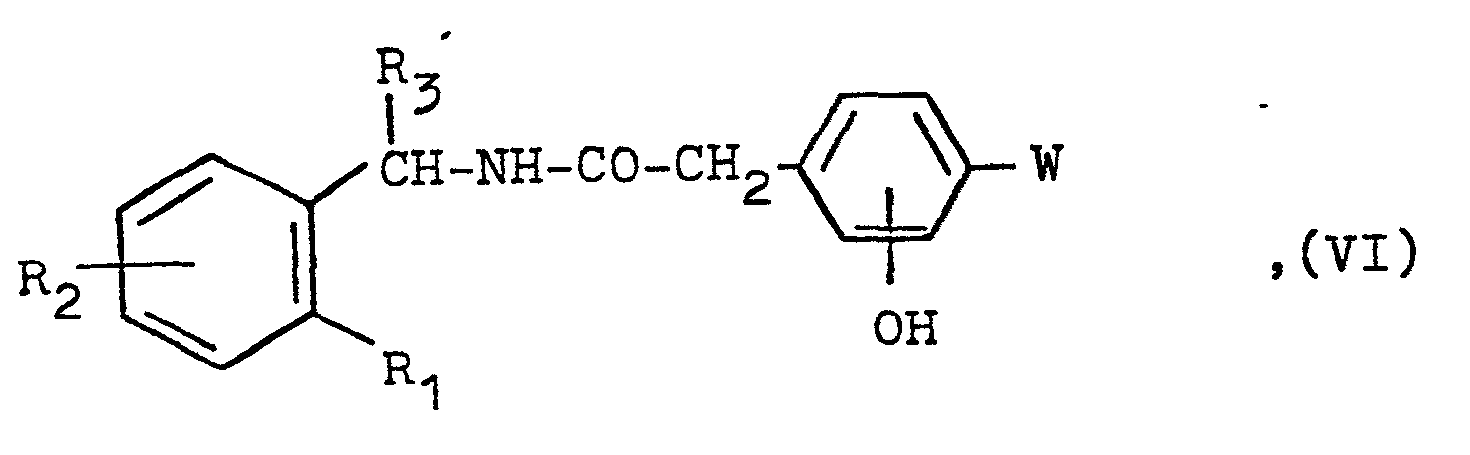 Rl bis R3 und W wie in den Ansprüchen 1 bis 8 definiert sind, mit einer Verbindung der allgemeinen Formel
 R6 eine Alkylgruppe mit 1 bis 3 Kohlenstoffatomen oder eine Allylgruppe undX eine nukleophil austauschbare Gruppe wie ein Halogenatom, eine Sulfonyloxygruppe oder auch zusammen mit dem benachbarten Wasserstoffatom eine Diazogruppe, wenn R6 eine Alkylgruppe mit 1 bis 3 Kohlenstoffatomen darstellt, bedeuten, umgesetzt und erforderlichenfalls eine so erhaltene Verbindung anschließend hydrolysiert wird, odere) zur Herstellung von Verbindungen der allgemeinen Formel I, in der W eine Cyanomethyl- oder 2-Cyano-äthylgruppe darstellt, eine Verbindung der allgemeinen Formel
 R1 bis R4 wie in den Ansprüchen 1 bis 8 definiert sind, E eine Methylen- oder Äthylengruppe undY eine nukleophil austauschbare Gruppe wie ein Halogenatom oder eine Sulfonyloxygruppe bedeuten,mit einem Alkalicyanid wie Natrium- oder Kaliumcyanid umgesetzt wird, oderf) zur Herstellung von Verbindungen der allgemeinen Formel I, in der W die Cyanomethyl-, 2-Cyano-äthyl- oder 2-Cyano-äthenylgruppe darstellt, eine Verbindung der allgemeinen Formel
 R1 bis R4 wie in den Ansprüchen 1 bis 8 definiert sind undG eine Methylen-, Äthylen- oder Äthenylengruppe darstellt, dehydratisiert wird, oderg) zur Herstellung von Verbindungen der allgemeinen Formel I, in der W eine 2-Cyano-äthenyl-, 2-Carboxy-äthenyl- oder 2-Alkoxycarbonyl-äthenylgruppe darstellt, eine Verbindung der allgemeinen Formel'
 R1 bis R4 wie in den Ansprüchen 1 bis 8 definiert sind, mit einem entsprechenden Essigsäurederivat der allgemeinen Formel
 Q eine Carboxy-, Alkoxycarbonyl- oder Cyanogruppe und Z ein Wasserstoffatom, eine Alkoxycarbonyl-, Dialkylphosphono- oder Triphenylphosphonium-halogenid-gruppe darstellt, umgesetzt und gegebenenfalls eine so erhaltene Verbindung anschließend hydrolysiert und/oder decarboxyliert wird, oderh) zur Herstellung von Verbindungen der allgemeinen Formel I, in der W eine 2-Carboxy-äthyl-, 2-Alkoxycarbonyl-äthyl-oder 2-Cyano-äthylgruppe darstellt, eine Verbindung der allgemeinen Formel
 R1 bis R4 wie in den Ansprüchen 1 bis 8 definiert sind undW" eine 2-Carboxy-äthenyl-, 2-Alkoxycarbonyl-äthenyl- oder 2-Cyano-äthenylgruppe darstellt, reduziert wird, oderi) zur Herstellung von Verbindungen der allgemeinen Formel I, in der R3 eine durch eine Alkoxy- oder Alkanoyloxygruppe substituierte Alkylgruppe mit 1 oder 2 Kohlenstoffatomen darstellt, eine Verbindung der allgemeinen Formel
 R1, R2, R4 und W wie in den Ansprüchen 1 bis 8 definiert sind undR3 1 eine durch eine Hydroxygruppe substituierte Alkylgruppe mit 1 oder 2 Kohlenstoffatom darstellt,mit einer Verbindung der allgemeinen Formel
 R7 eine Alkylgruppe mit 1 bis 3 Kohlenstoffatomen, die Acetyl- oder Propionylgruppe undU eine nukleophil austauschbare Gruppe wie ein Halogenatom, eine Sulfonyloxygruppe, eine Acetoxy- oder Propionyloxygruppe oder auch zusammen mit dem benachbarten Wasserstoffatom eine Diazogruppe, wenn R7 eine Alkylgruppe mit 1 bis 3 Kohlenstoffatomen darstellt, bedeuten,umgesetzt und erforderlichenfalls anschließend eine so erhaltene Verbindung hydrolysiert wird, oderk) zur Herstellung von Verbindungen der allgemeinen Formel I, in der R3 eine Alkoxycarbonylgruppe darstellt, eine Verbindung der allgemeinen Formel
 Rl, R21 R4 und W wie in den Ansprüchen 1 bis 8 definiert sind undRa ein Wasserstoffatom oder Alkaliatom darstellt, oder deren gegebenenfalls im Reaktionsgemisch hergestellte reaktionsfähige Derivate,mit einer Verbindung der allgemeinen Formel
 R9 eine Alkylgruppe mit 1 bis 4 Kohlenstoffatomen und T eine Hydroxygruppe oder eine nukleophil austauschbare Gruppe, wie ein Halogenatom oder eine Sulfonyloxygruppe, oder auch zusammen mit dem benachbarten Wasserstoffatom des Restes Rg eine Diazogruppe bedeuten,umgesetzt und erforderlichenfalls anschließend eine so erhaltene Verbindung, falls W eine Benzyloxycarbonylgruppe enthält, hydrogenolysiert wird, oder1) zur Herstellung von Verbindungen der allgemeinen Formel I, in derR4 ein Wasserstoffatom oder eine Alkylgruppe mit 1 bis 3 Kohlenstoffatomen,R3 ein Wasserstoffatom, eine Alkylgruppe mit 1 bis 7 Kohlenstoffatomen, eine gegebenenfalls durch ein Halogenatom oder eine Methyl- oder Methoxygruppe substituierte Phenylgruppe, eine durch eine Alkoxy-, Alkanoyloxy-, Tetrahydrofuranyl-, Tetrahydropyranyl-, Cycloalkyl- oder Phenylgruppe substituierte Alkylgruppe mit 1 oder 2 Kohlenstoffatomen, in der der Alkoxyteil 1 bis 3 Kohlenstoffatome, der Alkanoyloxyteil 2 oder 3 Kohlenstoffatome und der Cycloalkylteil 3 bis 7 Kohlenstoffatome enthalten kann, eine Alkenylgruppe mit 3 bis 6 Kohlenstoffatom, eine Alkinylgruppe mit 3 bis 5 Kohlenstoffatomen, eine Carboxygruppe oder eine Alkoxycarbonylgruppe mit insgesamt 2 bis 5 Kohlenstoffatomen undW eine Carboxymethyl-, 2-Carboxy-äthyl-, Alkoxycarbonylmethyl- oder 2-Alkoxycarbonyl-äthylgruppe, wobei der Alkoxyteil jeweils 1 bis 4 Kohlenstoffatomen enthalten kann, oderR3 eine durch eine Alkoxy-, Alkanoyloxy-, Tetrahydrofuranyl-, Tetrahydropyranyl-, Cycloalkyl- oder Phenylgruppe substituierte Alkylgruppe mit 1 oder 2 Kohlenstoffatomen, in der der Alkoxyteil 1 bis 3 Kohlenstoffatome, der Alkanoyloxyteil 2 oder 3 Kohlenstoffatome und der Cycloalkylteil 3 bis 7 Kohlenstoffatome enthalten kann, eine Alkenylgruppe mit 3 bis 6 Kohlenstoffatomen, eine Alkinylgruppe mit 3 bis 5 Kohlenstoffatomen, eine Carboxygruppe oder eine Alkoxycarbonylgruppe mit insgesamt 2 bis 5 Kohlenstoffatomen undW eine Methyl-, Formyl-, Carboxy- oder Alkoxycarbonylgruppe, wobei der Alkoxyteil 1 bis 4 Kohlenstoffatomen enthalten kann, bedeuten,eine Verbindung der allgemeinen Formel
 R1 und R2 wie in den Ansprüche 1 bis 8 definiert sind undR3" (wenn W eine Carboxymethyl-, 2-Carboxy-äthyl-, Alkoxycarbonylmethyl- oder 2-Alkoxycarbonyl-äthylgruppe, wobei der Alkoxyteil jeweils 1 bis 4 Kohlenstoffatomen enthalten kann, darstellt)
ein Wasserstoffatom, eine Alkylgruppe mit 1 bis 7 Kohlenstoffatomen, eine gegebenenfalls durch ein Halogenatom oder eine Methyl- oder Methoxygruppe substituierte Phenylgruppe, eine durch eine Alkoxy-, Alkanoyloxy-, Tetrahydrofuranyl-, Tetrahydropyranyl-, Cycloalkyl- oder Phenylgruppe substituierte Alkylgruppe mit 1 oder 2 Kohlenstoffatomen, in der der Alkoxyteil 1 bis 3 Kohlenstoffatome, der Alkanoyloxyteil 2 oder 3 Kohlenstoffatome und der Cycloalkylteil 3 bis 7 Kohlenstoffatome enthalten kann, eine Alkenylgruppe mit 3 bis 6 Kohlenstoffatom, eine Alkinylgruppe mit 3 bis 5 Kohlenstoffatomen, eine Carboxygruppe oder eine Alkoxycarbonylgruppe mit insgesamt 2 bis 5 Kohlenstoffatomen bedeutet, oderR3" (wenn W eine Methyl-, Formyl-, Carboxy- oder Alkoxycarbonylgruppe, wobei der Alkoxyteil 1 bis 4 Kohlenstoffatomen enthalten kann, darstellt)
eine durch eine Alkoxy-, Alkanoyloxy-, Tetrahydrofuranyl-, Tetrahydropyranyl-, Cycloalkyl- oder Phenylgruppe substituierte Alkylgruppe mit 1 oder 2 Kohlenstoffatomen, in der der Alkoxyteil l bis 3 Kohlenstoffatome, der Alkanoyloxyteil 2 oder 3 Kohlenstoffatome und der Cycloalkylteil 3 bis 7 Kohlenstoffatome enthalten kann, eine Alkenylgruppe mit 3 bis 6 Kohlenstoffatomen, eine Alkinylgruppe mit 3 bis 5 Kohlenstoffatomen, eine Carboxygruppe oder eine Alkoxycarbonylgruppe mit insgesamt 2 bis 5 Kohlenstoffatomen bedeutet,mit einer Verbindung der allgemeinen Formel R4 wie in den Ansprüchen 1 bis 8 definiert ist undW"' (wenn R3" ein Wasserstoffatom, eine Alkylgruppe mit 1 bis 7 Kohlenstoffatomen, eine gegebenenfalls durch ein Halogenatom oder eine Methyl- oder Methoxygruppe substituierte Phenylgruppe, eine durch eine Alkoxy-, Alkanoyloxy-, Tetrahydrofuranyl-, Tetrahydropyranyl-, Cycloalkyl- oder Phenylgruppe substituierte Alkylgruppe mit 1 oder 2 Kohlenstoffatomen, in der der Alkoxyteil 1 bis 3 Kohlenstoffatome, der Alkanoyloxyteil 2 oder 3 Kohlenstoffatome und der Cycloalkylteil 3 bis 7 Kohlenstoffatome enthalten kann, eine Alkenylgruppe mit 3 bis 6 Kohlenstoffatomen, eine Alkinylgruppe mit 3 bis 5 Kohlenstoffatomen, eine Carboxygruppe oder eine Alkoxycarbonylgruppe mit insgesamt 2 bis 5 Kohlenstoffatomen bedeutet)
eine Carboxymethyl-, 2-Carboxy-äthyl-, Alkoxycarbonylmethyl-oder 2-Alkoxycarbonyl-äthylgruppe, wobei der Alkoxyteil jeweils 1 bis 4 Kohlenstoffatomen enthalten kann, oderW"' (wenn R3" eine durch eine Alkoxy-, Alkanoyloxy-, Tetrahydrofuranyl-, Tetrahydropyranyl-, Cycloalkyl- oder Phenylgruppe substituierte Alkylgruppe mit 1 oder 2 Kohlenstoffatomen, in der der Alkoxyteil 1 bis 3 KOhlenstoffatome, der Alkanoyloxyteil 2 oder 3 Kohlenstoffatome und der Cycloalkylteil 3 bis 7 Kohlenstoffatome enthalten kann, eine Alkenylgruppe mit 3 bis 6 Kohlenstoffatomen, eine Alkinylgruppe mit 3 bis 5 Kohlenstoffatomen, eine Carboxygruppe oder eine Alkoxycarbonylgruppe mit insgesamt 2 bis 5 Kohlenstoffatomen bedeutet)
eine Methyl-, Formyl-, Carboxy- oder Alkoxycarbonylgruppe, wobei der Alkoxyteil 1 bis 4 Kohlenstoffatomen enthalten kann, darstellt, umgesetzt wird, oderm) zur Herstellung von Verbindungen der allgemeinen Formel I, in derR4 ein Wasserstoffatom oder eine Alkylgruppe mit 1 bis 3 Kohlenstoffatomen,R3 eine Alkylgruppe mit 1 bis 7 Kohlenstoffatomen, eine gegebenenfalls durch eine Methyl- oder Methoxygruppe substituierte Phenylgruppe, eine durch eine Alkoxy-, Tetrahydrofuranyl-, Tetrahydropyranyl-, Cycloalkyl- oder Phenylgruppe substituierte Alkylgruppe mit 1 oder 2 Kohlenstoffatomen, in der der Alkoxyteil 1 bis 3 Kohlenstoffatome und der Cycloalkylteil 5 bis 7 Kohlenstoffatome enthalten kann undW eine Cyanomethyl-, 2-Cyano-äthyl-, Carboxy-methyl-, 2-Carboxy-äthyl-, Alkoxycarbonyl-methyl- oder 2-Alkoxycarbonyl-äthylgruppe, wobei der Alkoxyteil jeweils 1 bis 4 Kohlenstoffatome enthalten kann, oderR3 eine durch eine Alkoxy-, Tetrahydrofuranyl-, Tetrahydropyranyl-, Cycloalkyl- oder Phenylgruppe substituierte Alkylgruppe mit 1 oder 2 Kohlenstoffatomen, in der der Alkoxyteil 1 bis 3 Kohlenstoffatome und der Cycloalkylteil 5 bis 7 Kohlenstoffatome enthalten kann, undW eine Methyl-, Hydroxymethyl-, Carboxyl- oder Alkoxycarbonylgruppe, wobei der Alkoxyteil 1 bis 4 Kohlenstoffatome enthalten kann, bedeuten, eine Verbindung der allgemeinen Formel R1, R2 und R4 wie in den Ansprüchen 1 bis 8 definiert sind undD eine Gruppe der Formel
 R3"' eine gegebenenfalls durch ein Halogenatom oder eine Methyl- oder Methoxygruppe substituierte Phenylgruppe,R10 und R11 zusammen mit dem dazwischenliegenden Kohlenstoffatom eine Alkylidengruppe mit 1 bis 7 Kohlenstoffatomen, eine durch eine Alkoxy-, Tetrahydrofuranyl-, Tetrahydropyranyl-, Cycloalkyl- oder Phenylgruppe substituierte Alkylidengruppe mit 1 oder 2 Kohlenstoffatomen, in der der Alkoxyteil 1 bis 3 Kohlenstoffatome und der Cycloalkylteil 5 bis 7 Kohlenstoffatome enthalten kann, undW"" eine Cyanomethyl-, 2-Cyano-lthyl-, 2-Cyano-äthenyl-, Carboxymethyl-, 2-Carboxy-äthyl-, 2-Carboxy-athenyl-, Alkoxycarbonylmethyl-, 2-Alkoxycarbonyl-äthyl- oder 2-Alkoxycarbonyl-äthenylgruppe, wobei der Alkoxyteil jeweils 1 bis 4 Kohlenstoffatome enthalten und durch eine Phenylgruppe substituiert sein kann, oderR10 und R11 zusammen mit dem dazwischenliegenden Kohlenstoffatom eine durch eine Alkoxy-, Tetrahydrofuranyl-, Tetrahydropyranyl-, Cycloalkyl- oder Phenylgruppe substituierte Alkylidengruppe mit 1 oder 2 Kohlenstoffatomen, in der der Alkoxyteil 1 bis 3 Kohlenstoffatome und der Cycloalkylteil 5 bis 7 Kohlenstoffatome enthalten kann, undW"" eine Methyl-, Hydroxymethyl-, Formyl-, Carboxy- oder Alkoxycarbonylgruppe, wobei der Alkoxyteil 1 bis.4 Kohlenstoffatome enthalten und durch eine Phenylgruppe substituiert sein kann, bedeuten, reduziert wird, undgewünschtenfalls anschließend eine so erhaltene racemische Verbindung der allgemeinen Formel I, in der R3 mit Ausnahme des Wasserstoffatoms wie in den Ansprüchen 1 bis 8 definiert ist, durch Chromatographie an chiralen Phasen in ihre Enantiomeren aufgetrennt wird, und/odereine so erhaltene Verbindung der allgemeinen Formel I in ihre Salze, insbesondere in ihre physiologisch verträglichen Salze mit anorganischen oder organischen Säuren oder Basen übergeführt wird.
Priority Applications (1)
| Application Number | Priority Date | Filing Date | Title |
|---|---|---|---|
| AT86108640T ATE52255T1 (de) | 1985-07-01 | 1986-06-25 | Phenylessigsaeurederivate, diese verbindungen enthaltende arzneimittel und verfahen zu ihrer herstellung. |
Applications Claiming Priority (2)
| Application Number | Priority Date | Filing Date | Title |
|---|---|---|---|
| DE3523466 | 1985-07-01 | ||
| DE19853523466 DE3523466A1 (de) | 1985-07-01 | 1985-07-01 | Neue phenylessigsaeurederivate, diese verbindungen enthaltende arzneimittel und verfahren zu ihrer herstellung |
Publications (2)
| Publication Number | Publication Date |
|---|---|
| EP0208200A1 true EP0208200A1 (de) | 1987-01-14 |
| EP0208200B1 EP0208200B1 (de) | 1990-04-25 |
Family
ID=6274655
Family Applications (1)
| Application Number | Title | Priority Date | Filing Date |
|---|---|---|---|
| EP86108640A Expired - Lifetime EP0208200B1 (de) | 1985-07-01 | 1986-06-25 | Phenylessigsäurederivate, diese Verbindungen enthaltende Arzneimittel und Verfahen zu ihrer Herstellung |
Country Status (16)
| Country | Link |
|---|---|
| EP (1) | EP0208200B1 (de) |
| JP (1) | JPH0739406B2 (de) |
| AT (1) | ATE52255T1 (de) |
| AU (1) | AU587263B2 (de) |
| CA (1) | CA1320723C (de) |
| DE (2) | DE3523466A1 (de) |
| DK (1) | DK168741B1 (de) |
| ES (3) | ES2000443A6 (de) |
| FI (1) | FI83417C (de) |
| GR (1) | GR861701B (de) |
| HU (1) | HU196193B (de) |
| IE (1) | IE59269B1 (de) |
| NO (1) | NO167736C (de) |
| NZ (1) | NZ216700A (de) |
| PT (1) | PT82879B (de) |
| ZA (1) | ZA864833B (de) |
Cited By (2)
| Publication number | Priority date | Publication date | Assignee | Title |
|---|---|---|---|---|
| FR2763590A1 (fr) * | 1997-05-22 | 1998-11-27 | Synthelabo | Derives d'acides[[[(arylmethyl)amino]carbonyl] alkyl]- aromatiques, leur preparation et leur application en therapeutique |
| EP2177221A1 (de) | 2008-10-20 | 2010-04-21 | Krka Tovarna Zdravil, D.D., Novo Mesto | Verfahren zur Erzeugung von weitgehend optisch reinem Repaglinid und seinen Vorläufern |
Families Citing this family (2)
| Publication number | Priority date | Publication date | Assignee | Title |
|---|---|---|---|---|
| DE3347565A1 (de) * | 1983-12-30 | 1985-07-11 | Thomae Gmbh Dr K | Neue phenylessigsaeurederivate, diese verbindungen enthaltende arzneimittel und verfahren zu ihrer herstellung |
| JPH0696391B2 (ja) * | 1987-11-20 | 1994-11-30 | マツダ株式会社 | 車両の後輪操舵装置 |
Citations (4)
| Publication number | Priority date | Publication date | Assignee | Title |
|---|---|---|---|---|
| DE3100575A1 (de) * | 1981-01-10 | 1982-09-02 | Dr. Karl Thomae Gmbh, 7950 Biberach | "neue benzoesaeuren, ihre herstellung und ihre verwendung als arzneimittel" |
| DE3225188A1 (de) * | 1982-07-06 | 1984-01-12 | Dr. Karl Thomae Gmbh, 7950 Biberach | Neue phenylessigsaeurederivate, ihre herstellung und diese verbindungen enthaltende arzneimittel |
| DE3225155A1 (de) * | 1982-07-06 | 1984-01-12 | Dr. Karl Thomae Gmbh, 7950 Biberach | Neue n-benzylamide und deren salze, ihre herstellung und diese verbindungen enthaltende arzneimittel |
| DE3347565A1 (de) * | 1983-12-30 | 1985-07-11 | Thomae Gmbh Dr K | Neue phenylessigsaeurederivate, diese verbindungen enthaltende arzneimittel und verfahren zu ihrer herstellung |
-
1985
- 1985-07-01 DE DE19853523466 patent/DE3523466A1/de not_active Withdrawn
-
1986
- 1986-06-25 EP EP86108640A patent/EP0208200B1/de not_active Expired - Lifetime
- 1986-06-25 AT AT86108640T patent/ATE52255T1/de not_active IP Right Cessation
- 1986-06-25 DE DE8686108640T patent/DE3670636D1/de not_active Expired - Lifetime
- 1986-06-27 CA CA000512614A patent/CA1320723C/en not_active Expired - Fee Related
- 1986-06-30 FI FI862764A patent/FI83417C/fi not_active IP Right Cessation
- 1986-06-30 AU AU59383/86A patent/AU587263B2/en not_active Ceased
- 1986-06-30 DK DK310986A patent/DK168741B1/da not_active IP Right Cessation
- 1986-06-30 IE IE175286A patent/IE59269B1/en not_active IP Right Cessation
- 1986-06-30 JP JP61151864A patent/JPH0739406B2/ja not_active Expired - Lifetime
- 1986-06-30 NZ NZ216700A patent/NZ216700A/xx unknown
- 1986-06-30 NO NO862631A patent/NO167736C/no unknown
- 1986-06-30 ZA ZA864833A patent/ZA864833B/xx unknown
- 1986-06-30 HU HU862724A patent/HU196193B/hu not_active IP Right Cessation
- 1986-06-30 GR GR861701A patent/GR861701B/el unknown
- 1986-06-30 ES ES8600056A patent/ES2000443A6/es not_active Expired
- 1986-07-01 PT PT82879A patent/PT82879B/pt not_active IP Right Cessation
- 1986-12-18 ES ES8603480A patent/ES2003629A6/es not_active Expired
- 1986-12-18 ES ES8603481A patent/ES2003758A6/es not_active Expired
Patent Citations (4)
| Publication number | Priority date | Publication date | Assignee | Title |
|---|---|---|---|---|
| DE3100575A1 (de) * | 1981-01-10 | 1982-09-02 | Dr. Karl Thomae Gmbh, 7950 Biberach | "neue benzoesaeuren, ihre herstellung und ihre verwendung als arzneimittel" |
| DE3225188A1 (de) * | 1982-07-06 | 1984-01-12 | Dr. Karl Thomae Gmbh, 7950 Biberach | Neue phenylessigsaeurederivate, ihre herstellung und diese verbindungen enthaltende arzneimittel |
| DE3225155A1 (de) * | 1982-07-06 | 1984-01-12 | Dr. Karl Thomae Gmbh, 7950 Biberach | Neue n-benzylamide und deren salze, ihre herstellung und diese verbindungen enthaltende arzneimittel |
| DE3347565A1 (de) * | 1983-12-30 | 1985-07-11 | Thomae Gmbh Dr K | Neue phenylessigsaeurederivate, diese verbindungen enthaltende arzneimittel und verfahren zu ihrer herstellung |
Cited By (2)
| Publication number | Priority date | Publication date | Assignee | Title |
|---|---|---|---|---|
| FR2763590A1 (fr) * | 1997-05-22 | 1998-11-27 | Synthelabo | Derives d'acides[[[(arylmethyl)amino]carbonyl] alkyl]- aromatiques, leur preparation et leur application en therapeutique |
| EP2177221A1 (de) | 2008-10-20 | 2010-04-21 | Krka Tovarna Zdravil, D.D., Novo Mesto | Verfahren zur Erzeugung von weitgehend optisch reinem Repaglinid und seinen Vorläufern |
Also Published As
| Publication number | Publication date |
|---|---|
| CA1320723C (en) | 1993-07-27 |
| PT82879B (pt) | 1989-01-17 |
| ZA864833B (en) | 1988-03-30 |
| ES2003758A6 (es) | 1988-11-16 |
| IE861752L (en) | 1987-01-01 |
| AU587263B2 (en) | 1989-08-10 |
| NZ216700A (en) | 1989-06-28 |
| HU196193B (en) | 1988-10-28 |
| NO862631L (no) | 1987-01-02 |
| DK168741B1 (da) | 1994-05-30 |
| HUT43030A (en) | 1987-09-28 |
| NO167736B (no) | 1991-08-26 |
| FI862764A0 (fi) | 1986-06-30 |
| PT82879A (de) | 1986-08-01 |
| FI83417C (fi) | 1991-07-10 |
| JPS625974A (ja) | 1987-01-12 |
| ES2000443A6 (es) | 1988-03-01 |
| GR861701B (en) | 1986-10-31 |
| NO167736C (no) | 1991-12-04 |
| ATE52255T1 (de) | 1990-05-15 |
| AU5938386A (en) | 1987-01-08 |
| DE3523466A1 (de) | 1987-01-08 |
| FI83417B (fi) | 1991-03-28 |
| IE59269B1 (en) | 1994-01-26 |
| DK310986D0 (da) | 1986-06-30 |
| NO862631D0 (no) | 1986-06-30 |
| DE3670636D1 (de) | 1990-05-31 |
| ES2003629A6 (es) | 1988-11-01 |
| JPH0739406B2 (ja) | 1995-05-01 |
| FI862764A7 (fi) | 1987-01-02 |
| DK310986A (da) | 1987-01-02 |
| EP0208200B1 (de) | 1990-04-25 |
Similar Documents
| Publication | Publication Date | Title |
|---|---|---|
| EP0147850B1 (de) | Neue Phenylessigsäurederivate, diese Verbindungen enthaltende Arzneimittel und Verfahren zu ihrer Herstellung | |
| EP1202969B1 (de) | Biphenylderivate, ihre herstellung und ihre verwendung als mtp-inhibitor | |
| DE4234295A1 (de) | Carbonsäurederivate, diese Verbindungen enthaltende Arzneimittel und Verfahren zu ihrer Herstellung | |
| EP0574808A1 (de) | Amidin-Biphenylderivate, diese Verbindungen enthaltende Arzneimittel und Verfahren zu ihrer Herstellung | |
| CH633515A5 (de) | Substituierte phenylessigsaeurederivate und verfahren zu ihrer herstellung. | |
| DE3047142A1 (de) | Basische 1,7,7-trimethylbicyclo(2,2,1)heptylaether, verfahren zur herstellung derselben und diese enthaltende arzneimittel | |
| EP0058779B1 (de) | Neue Carbonsäureamide, ihre Herstellung und ihre Verwendung als Arzneimittel | |
| DE2851028A1 (de) | Neue indolo eckige klammer auf 2.3-a eckige klammer zu chinolizidine, verfahren zu ihrer herstellung und sie enthaltende pharmazeutische zubereitung | |
| DE3030462C2 (de) | ||
| EP0008645B1 (de) | Alkoxyphenylpyrrolidone, Verfahren zu ihrer Herstellung und Arzneimittel auf Basis dieser Verbindungen | |
| EP0317845A2 (de) | Substituierte Hydroxylamine | |
| DE19963235A1 (de) | Substituierte Piperazinderivate, ihre Herstellung und ihre Verwendung als Arzneimittel | |
| DE19945594A1 (de) | Substituierte Piperazinderivate, ihre Herstellung und ihre Verwendung als Arzneimittel | |
| DE68903263T2 (de) | Substituierte aromatische verbindungen mit zentraler nervensystem-wirkung. | |
| EP0171645A1 (de) | Neue 2H-1-Benzopyran-2-on-Derivate, Verfahren zu ihrer Herstellung und Arzneimittel, die diese Verbindungen enthalten | |
| EP0099017B1 (de) | Neue Phenylessigsäure-Derivate, ihre Herstellung und diese Verbindungen enthaltende Arzneimittel | |
| EP0208200B1 (de) | Phenylessigsäurederivate, diese Verbindungen enthaltende Arzneimittel und Verfahen zu ihrer Herstellung | |
| DE2412520C2 (de) | Tricyclische Verbindungen, Verfahren zu deren Herstellung und diese enthaltende Präparate | |
| EP0401798B1 (de) | Substituierte Aminoalkylbenzolderivate | |
| EP0233483A2 (de) | Pyrrolo[1,2-a][4,1]benzoxazepine, Verfahren zur ihrer Herstellung, pharmazeutische Präparate enthaltend diese Verbindungen, sowie therapeutische Verwendung | |
| EP0088986B1 (de) | Bicyclische Phenolether, Verfahren zu deren Herstellung sowie diese Verbindungen enthaltende Arzneimittel | |
| EP0037990A1 (de) | Phenyl-chinolizidine, entsprechende pharmazeutische Präparate, die Herstellung der Wirkstoffe sowie entsprechende Ausgangsverbindungen | |
| DE2409313A1 (de) | Neue pyrrolyl-verbindungen und verfahren zu ihrer herstellung | |
| DE2107487A1 (de) | Neue Amine und Verfahren zu ihrer Herstellung | |
| EP0063826B1 (de) | 2-Amino-benzoesäure-Derivate, deren Herstellung und deren Verwendung als Arzneimittel oder Zwischenprodukte |
Legal Events
| Date | Code | Title | Description |
|---|---|---|---|
| PUAI | Public reference made under article 153(3) epc to a published international application that has entered the european phase |
Free format text: ORIGINAL CODE: 0009012 |
|
| AK | Designated contracting states |
Kind code of ref document: A1 Designated state(s): AT BE CH DE FR GB IT LI LU NL SE |
|
| 17P | Request for examination filed |
Effective date: 19870604 |
|
| 17Q | First examination report despatched |
Effective date: 19881118 |
|
| GRAA | (expected) grant |
Free format text: ORIGINAL CODE: 0009210 |
|
| AK | Designated contracting states |
Kind code of ref document: B1 Designated state(s): AT BE CH DE FR GB IT LI LU NL SE |
|
| REF | Corresponds to: |
Ref document number: 52255 Country of ref document: AT Date of ref document: 19900515 Kind code of ref document: T |
|
| REF | Corresponds to: |
Ref document number: 3670636 Country of ref document: DE Date of ref document: 19900531 |
|
| ITF | It: translation for a ep patent filed | ||
| ET | Fr: translation filed | ||
| GBT | Gb: translation of ep patent filed (gb section 77(6)(a)/1977) | ||
| PLBE | No opposition filed within time limit |
Free format text: ORIGINAL CODE: 0009261 |
|
| STAA | Information on the status of an ep patent application or granted ep patent |
Free format text: STATUS: NO OPPOSITION FILED WITHIN TIME LIMIT |
|
| 26N | No opposition filed | ||
| ITTA | It: last paid annual fee | ||
| EPTA | Lu: last paid annual fee | ||
| EAL | Se: european patent in force in sweden |
Ref document number: 86108640.3 |
|
| PGFP | Annual fee paid to national office [announced via postgrant information from national office to epo] |
Ref country code: GB Payment date: 19980514 Year of fee payment: 13 |
|
| PGFP | Annual fee paid to national office [announced via postgrant information from national office to epo] |
Ref country code: NL Payment date: 19980518 Year of fee payment: 13 Ref country code: FR Payment date: 19980518 Year of fee payment: 13 |
|
| PGFP | Annual fee paid to national office [announced via postgrant information from national office to epo] |
Ref country code: DE Payment date: 19980520 Year of fee payment: 13 |
|
| PGFP | Annual fee paid to national office [announced via postgrant information from national office to epo] |
Ref country code: SE Payment date: 19980525 Year of fee payment: 13 |
|
| PGFP | Annual fee paid to national office [announced via postgrant information from national office to epo] |
Ref country code: CH Payment date: 19980526 Year of fee payment: 13 |
|
| PGFP | Annual fee paid to national office [announced via postgrant information from national office to epo] |
Ref country code: AT Payment date: 19980527 Year of fee payment: 13 |
|
| PGFP | Annual fee paid to national office [announced via postgrant information from national office to epo] |
Ref country code: BE Payment date: 19980615 Year of fee payment: 13 |
|
| PGFP | Annual fee paid to national office [announced via postgrant information from national office to epo] |
Ref country code: LU Payment date: 19980922 Year of fee payment: 13 |
|
| PG25 | Lapsed in a contracting state [announced via postgrant information from national office to epo] |
Ref country code: LU Free format text: LAPSE BECAUSE OF NON-PAYMENT OF DUE FEES Effective date: 19990625 Ref country code: GB Free format text: LAPSE BECAUSE OF NON-PAYMENT OF DUE FEES Effective date: 19990625 Ref country code: AT Free format text: LAPSE BECAUSE OF NON-PAYMENT OF DUE FEES Effective date: 19990625 |
|
| PG25 | Lapsed in a contracting state [announced via postgrant information from national office to epo] |
Ref country code: SE Free format text: THE PATENT HAS BEEN ANNULLED BY A DECISION OF A NATIONAL AUTHORITY Effective date: 19990629 |
|
| PG25 | Lapsed in a contracting state [announced via postgrant information from national office to epo] |
Ref country code: LI Free format text: LAPSE BECAUSE OF NON-PAYMENT OF DUE FEES Effective date: 19990630 Ref country code: FR Free format text: THE PATENT HAS BEEN ANNULLED BY A DECISION OF A NATIONAL AUTHORITY Effective date: 19990630 Ref country code: CH Free format text: LAPSE BECAUSE OF NON-PAYMENT OF DUE FEES Effective date: 19990630 Ref country code: BE Free format text: LAPSE BECAUSE OF NON-PAYMENT OF DUE FEES Effective date: 19990630 |
|
| BERE | Be: lapsed |
Owner name: KARL THOMAE G.M.B.H. Effective date: 19990630 |
|
| PG25 | Lapsed in a contracting state [announced via postgrant information from national office to epo] |
Ref country code: NL Free format text: LAPSE BECAUSE OF NON-PAYMENT OF DUE FEES Effective date: 20000101 |
|
| REG | Reference to a national code |
Ref country code: CH Ref legal event code: PL |
|
| GBPC | Gb: european patent ceased through non-payment of renewal fee |
Effective date: 19990625 |
|
| EUG | Se: european patent has lapsed |
Ref document number: 86108640.3 |
|
| NLV4 | Nl: lapsed or anulled due to non-payment of the annual fee |
Effective date: 20000101 |
|
| PG25 | Lapsed in a contracting state [announced via postgrant information from national office to epo] |
Ref country code: DE Free format text: LAPSE BECAUSE OF NON-PAYMENT OF DUE FEES Effective date: 20000503 |
|
| REG | Reference to a national code |
Ref country code: FR Ref legal event code: ST |
|
| PG25 | Lapsed in a contracting state [announced via postgrant information from national office to epo] |
Ref country code: IT Free format text: LAPSE BECAUSE OF NON-PAYMENT OF DUE FEES;WARNING: LAPSES OF ITALIAN PATENTS WITH EFFECTIVE DATE BEFORE 2007 MAY HAVE OCCURRED AT ANY TIME BEFORE 2007. THE CORRECT EFFECTIVE DATE MAY BE DIFFERENT FROM THE ONE RECORDED. Effective date: 20050625 |