EP0208408A1 - Vanne en matière synthétique armée et son procédé de fabrication - Google Patents
Vanne en matière synthétique armée et son procédé de fabrication Download PDFInfo
- Publication number
- EP0208408A1 EP0208408A1 EP86304194A EP86304194A EP0208408A1 EP 0208408 A1 EP0208408 A1 EP 0208408A1 EP 86304194 A EP86304194 A EP 86304194A EP 86304194 A EP86304194 A EP 86304194A EP 0208408 A1 EP0208408 A1 EP 0208408A1
- Authority
- EP
- European Patent Office
- Prior art keywords
- sleeve
- valve
- body portion
- set forth
- flow
- Prior art date
- Legal status (The legal status is an assumption and is not a legal conclusion. Google has not performed a legal analysis and makes no representation as to the accuracy of the status listed.)
- Granted
Links
- 239000002990 reinforced plastic Substances 0.000 title claims abstract description 8
- 238000000034 method Methods 0.000 title claims description 14
- 239000004033 plastic Substances 0.000 claims abstract description 60
- 239000000463 material Substances 0.000 claims abstract description 47
- 230000003014 reinforcing effect Effects 0.000 claims abstract description 19
- 239000012530 fluid Substances 0.000 claims abstract description 13
- 239000002184 metal Substances 0.000 claims description 12
- 239000012779 reinforcing material Substances 0.000 claims description 12
- 238000002955 isolation Methods 0.000 claims description 9
- 230000013011 mating Effects 0.000 claims 1
- 240000007175 Datura inoxia Species 0.000 abstract 1
- 238000007789 sealing Methods 0.000 description 9
- 230000015572 biosynthetic process Effects 0.000 description 8
- 230000004075 alteration Effects 0.000 description 2
- 238000010276 construction Methods 0.000 description 2
- 238000009434 installation Methods 0.000 description 2
- 238000003754 machining Methods 0.000 description 2
- 230000000717 retained effect Effects 0.000 description 2
- 230000008901 benefit Effects 0.000 description 1
- 230000008859 change Effects 0.000 description 1
- 239000011248 coating agent Substances 0.000 description 1
- 238000000576 coating method Methods 0.000 description 1
- 239000002131 composite material Substances 0.000 description 1
- 238000005260 corrosion Methods 0.000 description 1
- 230000007797 corrosion Effects 0.000 description 1
- 230000008878 coupling Effects 0.000 description 1
- 238000010168 coupling process Methods 0.000 description 1
- 238000005859 coupling reaction Methods 0.000 description 1
- 230000007613 environmental effect Effects 0.000 description 1
- 230000003628 erosive effect Effects 0.000 description 1
- 238000001746 injection moulding Methods 0.000 description 1
- 230000002452 interceptive effect Effects 0.000 description 1
- 239000007788 liquid Substances 0.000 description 1
- 230000005012 migration Effects 0.000 description 1
- 238000013508 migration Methods 0.000 description 1
- 238000000465 moulding Methods 0.000 description 1
- 230000008569 process Effects 0.000 description 1
- 230000000750 progressive effect Effects 0.000 description 1
- 230000002787 reinforcement Effects 0.000 description 1
- 229920002994 synthetic fiber Polymers 0.000 description 1
Images

Classifications
-
- F—MECHANICAL ENGINEERING; LIGHTING; HEATING; WEAPONS; BLASTING
- F16—ENGINEERING ELEMENTS AND UNITS; GENERAL MEASURES FOR PRODUCING AND MAINTAINING EFFECTIVE FUNCTIONING OF MACHINES OR INSTALLATIONS; THERMAL INSULATION IN GENERAL
- F16K—VALVES; TAPS; COCKS; ACTUATING-FLOATS; DEVICES FOR VENTING OR AERATING
- F16K27/00—Construction of housing; Use of materials therefor
- F16K27/06—Construction of housing; Use of materials therefor of taps or cocks
- F16K27/065—Construction of housing; Use of materials therefor of taps or cocks with cylindrical plugs
-
- F—MECHANICAL ENGINEERING; LIGHTING; HEATING; WEAPONS; BLASTING
- F16—ENGINEERING ELEMENTS AND UNITS; GENERAL MEASURES FOR PRODUCING AND MAINTAINING EFFECTIVE FUNCTIONING OF MACHINES OR INSTALLATIONS; THERMAL INSULATION IN GENERAL
- F16K—VALVES; TAPS; COCKS; ACTUATING-FLOATS; DEVICES FOR VENTING OR AERATING
- F16K5/00—Plug valves; Taps or cocks comprising only cut-off apparatus having at least one of the sealing faces shaped as a more or less complete surface of a solid of revolution, the opening and closing movement being predominantly rotary
- F16K5/04—Plug valves; Taps or cocks comprising only cut-off apparatus having at least one of the sealing faces shaped as a more or less complete surface of a solid of revolution, the opening and closing movement being predominantly rotary with plugs having cylindrical surfaces; Packings therefor
- F16K5/045—Particular coverings and materials
Definitions
- This invention relates to a reinforced plastic valve and, more specifically, to such a plastic valve which should be capable of operating at higher pressure ratings for an extended period of time.
- Plastic valves such as those disclosed in U. S. Patent Nos. 4,014,513; 4,171,711; 4,234,011; and 4,488,741 have recently been satisfactorily and successfully employed for the flow control of numerous types of fluids in various piping systems and in a wide range of environmental conditions.
- plastic valves because of the nature of plastic, there have heretofore been some limitations on the amount of fluid pressure which should be allowed in systems which employ plastic valves.
- the valve plug and/or valve body can experience "creep" which alters the design dimensions of the valve and/or plug to decrease its overall efficiency and reliability.
- “Creep” can be defined as progressive strain without increased stress. If one is free to select alternative materials of construction, it is possible to eliminate any real concern for "creep". However, there are instances where the plastic body material must be identical to that of the piping system. For example, if the body is to be fused to the pipes in the system, the same material is required for a proper union. The piping could display high "creep” characteristics and still be reliable while the same "creep” in the body could alter its dimensions and reduce the reliability of sealing around the plug which prevents leakage and sealing at the valve seat which controls flow through the valve.
- U. S. Patent No. 3,092,365 discloses a rubber plug for a valve which is basically formed around and reinforced by an internal metal structure.
- Other types of valves have employed inserts in various types of closure members and in various areas of the valve body to generally solve different problems than that of "creep" as described hereinabove.
- U. S. Patent No. 3,133,722 discloses a sleeve liner which can be made of plastic material but is intended to serve as a backing material for a tapered plug member which is primarily intended to function as the closure device for the valve.
- U. S. Patent No. 4,303,223 discloses valve facing strips of a fire hydrant valve which are primarily intended to provide a reliable, low friction working surface for the axially movement of the valve disclosed therein.
- U. S. Patent No. 3,061,269 discloses an internal sleeve which can be made of numerous types of material but is primarily intended to provide a surface having a low-coefficient of friction for the rotation of the valve closure member disclosed therein.
- U. S. Patent Nos. 3,244,389 and 3,398,925 disclose ball valves which have annular reinforcing means at the edge seals thereof to insure that proper sealing is maintained against the surface of the ball to prevent the loss of fluid from the flow passages thereof.
- U. S. Patent No. 3,091,428 discloses a metallic ball valve and U. S. Patent Nos. 3,192,945 and 3,913,610 disclose metallic butterfly valves which are primarily intended for use in metal piping systems.
- the ball valve of U. S. Patent No. 3,091,428 includes a central cylindrical ring section which primarily supports the ball and to which identical cups are joined to form the composite valve.
- the butterfly valves of U. S. Patent Nos. 3,192,945 and 3,913,610 disclose cylindrical metallic sleeves or body portions which primarily rotatably support the butterfly closure members thereof. These valves include the provision of a lining or interior coating for the cylindrical metallic portion which is formed of resilient rubber-like, plastic, or synthetic material to provide the sleeve with erosion and/or corrosion protection.
- U. S. Patent No. 4,348,006 discloses a butterfly-type valve having a plastic body portion with a valve seat formed by a metal sleeve molded within and sealed to the plastic valve body portion with an annular rubber sleeve insert vulcanized to the metal sleeve.
- the metal sleeve is intended to prevent migration or "creep" of the elastomeric insert but additional sealing means between the metal sleeve and the plastic body portions is employed to insure that there ill be no fluid leakage therebetween.
- U. S. Patent No. 3,526,386 discloses a plastic valve having a metallic sleeve which is inserted in and embedded within the flow line thereof.
- the sleeve is said to "reinforce" the flow line but is primarily utilized to provide a stronger, reinforced coupling means for installing the plastic valve within a piping system.
- a reinforced plastic valve including a generally cylindrical major body portion at least partially formed of a plastic material and having an axially extending interior chamber.
- a pair of flow lines intersect the major body portion and the interior chamber thereof.
- a flow isolation member is mounted in the chamber and selectively movable to control the flow of fluid through the flow lines.
- the major body portion includes reinforcing means formed of a reinforcing material stronger than the plastic material at least partially surrounding the interior chamber.
- a reinforced plastic valve body including a generally cylindrical major body portion at least partially formed of a plastic material and having an axially extending interior chamber which is capable of receiving a movable flow isolation member therein.
- a pair of flow lines intersect the major body portion and the major body portion includes reinforcing means formed of a reinforcing material stronger than the plastic material at least partially surrounding the chamber.
- a method of forming a generally cylindrical valve body including the steps of forming a sleeve of reinforcing material into a generally cylindrical shape.
- the sleeve is installed within a valve body mold.
- Plastic material is injected into the mold to at least partially surround the sleeve.
- the plastic material is allowed to set to retain the sleeve within the valve body.
- a preferred valve 10 is primarily formed of plastic and includes a valve body 12 having a generally cylindrical major body portion 14 with an axially extending interior chamber 16.
- a pair of flow lines 18 of the body 12 are preferably integrally formed with and intersect the major body portion 14 and include flow passages 20 thereof which intersect the chamber 16.
- a rotatable flow isolation member in the form of a plug 22 is mounted within the chamber 16 to be capable of being selectively positioned to allow or prevent flow through the flow passages 20.
- the plug 22 includes a transverse opening 24 therethrough to allow flow through the flow passages 20 and opposing seats 26 which can be aligned with the passages 20 when the plug 22 is rotated to prevent the flow of liquid therethrough.
- the plug 22 includes a handle 28 and at least one radially extending rotational stop element 30 which will be discussed in detail hereinbelow.
- the lower end 32 of the plug 22 includes a groove and retaining means 34 for preventing withdrawal of the plug 22 from the chamber 16 after it has been installed within the major body portion 14.
- a sealed bottom 36 is added to the major body portion 14 after installation of the plug 22 therein to prevent dirt or ice from forming at the bottom of the valve 10 and interfering with the rotation of the plug 22.
- the preferred plug 22 is provided a plurality of O-ring seals 38 to primarily retain fluid within the flow passages 20 and the transverse opening 24 of the plug 22 and prevent leakage at the top or bottom of the plug 22 during normal use of the valve 10.
- a sealing ring 40 is also provided to the top of the valve 10 to prevent the ingress of fluid or contanimates into the chamber 16 around the top of the plug 22. If “creep" were allowed to occur to the body portion 14, proper sealing contact between the O-ring seals 38 and seats 26 and the chamber 16 could not be maintained and leakage through the valve 10 and to the atmosphere could occur.
- the preferred plug 22 includes two radially extending rotational stop elements 30 which are shown in a position for allowing flow through the valve 10.
- the rotational stop elements 30 are prevented from rotation in a clockwise direction by respective abutting contact with the ends 42 of a pair of axially extending sectors 44 of the major body portion 14. Rotation of the plug 22 in a counterclockwise direction would cause the rotational stop elements 30 to make contact with the other ends 46 of the axially extending sectors 44 of the major body portion 14 to insure that the seats 26 are properly aligned with the flow passages 20 when the valve 10 is closed.
- each of the sectors 44 extends less than ninety degrees to accommodate for the thickness of the stop elements 30 while allowing a full ninety degree rotation of the plug 22.
- the sectors 44 and stop elements 30 might be oriented to any circumferential location around the plug 22 and body portion 14 as long as the opening 24 and seats 26 will be properly alignable with the flow passages 20. It would also be obvious to alter the preferred valve 10 to include only one stop element and one sector of approximately two hundred- seventy degrees for similar limitations on the rotation of the plug.
- the preferred valve is similar to the valve disclosed in U. S. Patent Nos. 4,014,513; 4,171,711; 4,324,011; and 4,488,741.
- the preferred valve 10 includes features which could accommodate a higher pressure rating while being formed of a plastic material which is identical to that selected for the piping system in which it is to be employed.
- the body can experience "creep" where the design dimensions tend to change to interfere with the overall integrity of the plug as installed in the valve body and reduce the efficiency of the sealing of the valve.
- the preferred valve 10 includes a preferred major body portion 14 which includes reinforcing means formed of a reinforcing material which is stronger than the plastic material.
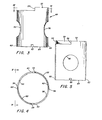
- the preferred reinforcing means is in the form of a sleeve 48 which extends around the major body portion 14. As best seen in Figures 3, 4, and 5, the preferred sleeve 48 is formed of metal and is generally cylindrical to completely encircle the major body portion 14. A pair of openings 50 are formed through the sleeve 48 and are to be aligned with the flow passages 20 of the flow lines 18.
- the preferred sleeve 48 includes axially extending portions 52 at the upper end thereof which portions 52 will lie within the pair of axially extending sectors 44 of the body portion 14.
- the axially extending portions 52 each include ends 54 which are aligned with the ends 42 of the sectors 44 and ends 56 which are aligned with the ends 46 of the sectors 44.
- the sleeve 48 will tend to reinforce the major body portion 14 and further insure that there is adequate strength in the axially extending sectors 44 for properly serving as a means to limit rotation of the plug 22 throughout the life of the valve 10.
- the sectors 44 be sufficiently stronger than the stop elements 30 to insure that the stop elements 30 will be cleanly severed from the plug 22 if one trys to force the rotation of the plug 22 by the sectors 44. It is better for the stop elements to be cleanly removed than to allow forced rotation of the plug 22 to result in its being directly damaged in a manner which would interfere with its ability to selectively control flow through the valve.
- the preferred sleeve 48 is at least partially encased within the plastic material of the major body portion 14.
- the sleeve 48 will properly add reinforcement to the major body portion 14 but will not generally be exposed to the environment or to the fluid within the flow passages 20 or the interior chamber 16. Since it is not exposed to the fluid in the valve 10, there is no need to be concerned with any leakage around the sleeve 48 which might otherwise occur. Further, since the preferred reinforcing sleeve 48 does not extend to the interior surface of the interior chamber 16, the preferred plug 22 will rotate and provide sealing as if it were installed within an entirely plastic major body portion 14.
- the reinforcing sleeve 48 will prevent creep which may otherwise have existed in the major body portion 14. It is also expected that the sleeve 48 will be properly retained within the major body portion 14 by the incasement of the sleeve 48 within the plastic material of the major body portion 14. However, should there turn out to be some localized movement of the plastic material of the major body portion 14, it would be possible to provide rounded edges for the openings 50 to insure that no cracks or other failure of the plastic material develops at the edges of the holes 50.
- an alternative configuration could include a plurality of radially extending holes at various locations around the sleeve 48 to cause the plastic material to flow therethrough when the major body portion 14 is being formed. Since the plastic material may not directly adhere to the metal of the sleeve 48, the additional holes would further insure that there is a complete incasement of the sleeve 48 within the plastic material. With the plastic material extending through such a plurality of holes in the sleeve 48, the sleeve 48 would be further secured within the major body portion 14 to resist any rotational forces created by the stop elements 30 during rotation of the plug 22.
- the preferred method of forming the valve body 12 includes means for insuring that the sleeve 48 is properly supported and oriented during the plastic valve molding process.
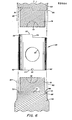
- a bottom core 58 and a top core 60 of the basic valve body mold are utilized to properly support and orient the preferred sleeve 48. Additional portions of the valve body mold have been eliminated from Figure 6 in order to be able to properly demonstrate those portions which are essential to an understanding of the overall method of forming the valve body 12.
- the valve body mold would preferably include a pair of passage cores for forming the flow passages 20 which passage cores would intersect with and join the bottom core 58 and top core 60.
- valve body mold would primarily include an external mold which would be formed of two halves for the formation of the exterior of the valve body 12.
- injection molding of plastic material of the type used to form the preferred valve body 12 is well known in the art. For example, if one were to provide any of the plastic valves mentioned as the prior art hereinabove, it would be quite common to inject plastic material into a valve body mold of the general type described and to allow the plastic material to set prior to disassembly of the mold and removal of the cores therefrom.
- the preferred sleeve 48 includes four evenly-spaced notches 62 in the lower edge surface 64 thereof.
- the bottom core 58 includes a shoulder 66 on an upwardly extending cylindrical portion 68 thereof for receipt of the lower edge surface 64 of the sleeve 48 thereon.
- the shoulder 66 has four evenly-spaced tabs 70 which are alignable with the notches 62 for respectively receiving them thereon. Consequently, with the sleeve 48 installed on the cylindrical portion 68 of the bottom core 58, the sleeve 48 is concentrically positioned on the core 58 and separated from a center portion 72 thereof which is intended to partially form the interior chamber 16. Further, because of the orientation of the notches 62 and the tabs 70, the sleeve 48 can be positioned on the bottom core 58 with the openings 50 properly aligned for the formation of the flow lines 18.
- the top core 60 can be joined to the bottom core 58 as the center portion 74 thereof combines with the center portion 72 of the bottom core 58 to complete the form needed for the interior chamber 16.
- the top core 6U includes circumferential recessed portions 76 for receipt of the axially extending portions 52 of the sleeve 48 for the eventual formation of the axially extending sectors 44 of the body portion 14.
- the openings 50 of the sleeve 48 are aligned with a pair of cavities 78 at opposite sides of the combined center portions 72, 74.
- the cavities 78 are intended to receive the interior end of the passage cores mentioned hereinabove. It should be clear that the passage cores could be formed as a single long core extending through the bottom core 58 and the top core 60 so that the cavities 78 would alternatively extend all the way therethrough. In either case, sleeve 48 is aligned with the passage cores to allow the formation of the flow passages 20 of the flow lines 18.
- the exterior walls of the major body portion 14 will be formed with an outside diameter larger than the exterior diameter of the sleeve 48. Accordingly, sufficient plastic material will be formed around the exterior of the sleeve 48 to primarily encase the sleeve 48 within the preferred major body portion 14. Since the passage core and the exterior halves of the valve body mold would not make any contact with the sleeve 48, the sleeve 48 would be surrounded by the plastic material at all locations other than those where there is direct contact with the cores 58, 60. Consequently, the sleeve 48 will be located radially within the cylindrical wall of the major body portion 14 to include the plastic material internally and externally thereof.
- plastic material can be injected into the mold to at least partially surround the sleeve 48. After the plastic material has been allowed to set and the exterior mold and interior cores are removed, the sleeve 48 will be retained within the valve body 12.
- the preferred sleeve 48 is primarily intended to reinforce the major body portion 14 throughout use of the valve 10, it is possible that the sleeve 48 may provide an added benefit during formation of the body portion 14. It has been found that when a body portion without an encased sleeve has been molded in the manner generally described hereinabove, it is not uncommon for the body portion to be slightly warped upon removal from the mold with the chamber thereof not having a truly cylindrical shape. As a result, the chamber must be machined to provide the required shape for proper receipt of a plug therein.
- the sleeve 48 being employed in the method of formation of the body portion 14 as described above could completely eliminate this required step and should, at the least, reduce the amount of machining that may be required. Further, if there is no need for such machining, it has been found that the interior surface of the chamber as formed by the body mold has excellent characteristics for direct installation of the plug therein.
- the method of providing the preferred valve body 12 is expected to properly encase the sleeve 48 within the plastic material, it should be recognized that the bottom core or the top core could be slightly altered to further surround the end edges of the sleeve 48 with plastic material.
- the shoulder 66 near each of the evenly spaced tabs 70 could be configured to discontinue a short distance from the tabs 70 to cause the lower edge surface 64 of the sleeve 48 to be separated from any portion of the bottom core 58. With the major circumference of the lower edge surface 64 being separated from any portion of the bottom core 58, the plastic material will primarily surround and encase the major circumference of the lower edge surface 64.
- the sleeve would still include a generally radially extending surface which would be installed on a sleeve supporting surface of the valve body mold even though the supporting surface would be circumferentially smaller.
- the preferred sleeve 48 is simply one embodiment which could be utilized to practice the invention as claimed. Specifically, it would be possible for the reinforcing sleeve 48 to be made of some other material while still satisifying the basic criteria of reinforcing the major body portion 14. Additionally, the sleeve need not be made to completely encircle the major body portion 14 and could alternatively be made of some sheet material which could be formed to only partially encircle the major body portion 14. For example, it might be desirable to form the reinforcing sleeve from some sheet metal and simply roll the pre-formed sheet material to only at least partially surround the chamber 16 above and below the flow lines 18.
Landscapes
- Engineering & Computer Science (AREA)
- General Engineering & Computer Science (AREA)
- Mechanical Engineering (AREA)
- Valve Housings (AREA)
- Taps Or Cocks (AREA)
Applications Claiming Priority (2)
| Application Number | Priority Date | Filing Date | Title |
|---|---|---|---|
| US74022885A | 1985-06-03 | 1985-06-03 | |
| US740228 | 1985-06-03 |
Publications (2)
| Publication Number | Publication Date |
|---|---|
| EP0208408A1 true EP0208408A1 (fr) | 1987-01-14 |
| EP0208408B1 EP0208408B1 (fr) | 1990-06-13 |
Family
ID=24975586
Family Applications (1)
| Application Number | Title | Priority Date | Filing Date |
|---|---|---|---|
| EP19860304194 Expired EP0208408B1 (fr) | 1985-06-03 | 1986-06-03 | Vanne en matière synthétique armée et son procédé de fabrication |
Country Status (4)
| Country | Link |
|---|---|
| EP (1) | EP0208408B1 (fr) |
| JP (1) | JPH0637940B2 (fr) |
| CA (1) | CA1291102C (fr) |
| DE (1) | DE3671954D1 (fr) |
Cited By (2)
| Publication number | Priority date | Publication date | Assignee | Title |
|---|---|---|---|---|
| EP0491203A1 (fr) * | 1990-12-05 | 1992-06-24 | American Meter Holdings Corporation | Vanne en polymère renforcée |
| WO2016122599A1 (fr) * | 2015-01-30 | 2016-08-04 | Hewlett-Packard Development Company, L.P. | Soupapes de sélection de systèmes d'alimentation en fluide |
Families Citing this family (1)
| Publication number | Priority date | Publication date | Assignee | Title |
|---|---|---|---|---|
| JP5514863B2 (ja) * | 2012-06-13 | 2014-06-04 | コヴィディエン・アクチェンゲゼルシャフト | 気管支吸引装置のための気管支気管アクセスバルブ |
Citations (5)
| Publication number | Priority date | Publication date | Assignee | Title |
|---|---|---|---|---|
| BE635934A (fr) * | 1962-08-22 | |||
| US3092365A (en) * | 1960-06-23 | 1963-06-04 | Cherry Burrell Corp | Plug valve |
| US3314644A (en) * | 1964-04-21 | 1967-04-18 | Dwyer Mfg Co F W | Rotary flow control valve and method of manufacture |
| FR1555545A (fr) * | 1967-06-30 | 1969-01-31 | ||
| US3825030A (en) * | 1973-03-20 | 1974-07-23 | Acf Ind Inc | Lined valves |
Family Cites Families (1)
| Publication number | Priority date | Publication date | Assignee | Title |
|---|---|---|---|---|
| JPS57101170A (en) * | 1980-12-16 | 1982-06-23 | Exxon Research Engineering Co | Cylinder valve |
-
1986
- 1986-05-26 CA CA 509950 patent/CA1291102C/fr not_active Expired - Fee Related
- 1986-06-02 JP JP61127850A patent/JPH0637940B2/ja not_active Expired - Lifetime
- 1986-06-03 DE DE8686304194T patent/DE3671954D1/de not_active Expired - Lifetime
- 1986-06-03 EP EP19860304194 patent/EP0208408B1/fr not_active Expired
Patent Citations (5)
| Publication number | Priority date | Publication date | Assignee | Title |
|---|---|---|---|---|
| US3092365A (en) * | 1960-06-23 | 1963-06-04 | Cherry Burrell Corp | Plug valve |
| BE635934A (fr) * | 1962-08-22 | |||
| US3314644A (en) * | 1964-04-21 | 1967-04-18 | Dwyer Mfg Co F W | Rotary flow control valve and method of manufacture |
| FR1555545A (fr) * | 1967-06-30 | 1969-01-31 | ||
| US3825030A (en) * | 1973-03-20 | 1974-07-23 | Acf Ind Inc | Lined valves |
Cited By (6)
| Publication number | Priority date | Publication date | Assignee | Title |
|---|---|---|---|---|
| EP0491203A1 (fr) * | 1990-12-05 | 1992-06-24 | American Meter Holdings Corporation | Vanne en polymère renforcée |
| WO2016122599A1 (fr) * | 2015-01-30 | 2016-08-04 | Hewlett-Packard Development Company, L.P. | Soupapes de sélection de systèmes d'alimentation en fluide |
| CN107206803A (zh) * | 2015-01-30 | 2017-09-26 | 惠普发展公司,有限责任合伙企业 | 流体供应系统的选择阀 |
| EP3250385A4 (fr) * | 2015-01-30 | 2018-09-26 | Hewlett-Packard Development Company, L.P. | Soupapes de sélection de systèmes d'alimentation en fluide |
| US10272690B2 (en) | 2015-01-30 | 2019-04-30 | Hewlett-Packard Development Company, L.P. | Selection valves of fluid supply systems |
| CN107206803B (zh) * | 2015-01-30 | 2019-07-19 | 惠普发展公司,有限责任合伙企业 | 流体供应系统的选择阀 |
Also Published As
| Publication number | Publication date |
|---|---|
| JPH0637940B2 (ja) | 1994-05-18 |
| DE3671954D1 (de) | 1990-07-19 |
| JPS61290278A (ja) | 1986-12-20 |
| CA1291102C (fr) | 1991-10-22 |
| EP0208408B1 (fr) | 1990-06-13 |
Similar Documents
| Publication | Publication Date | Title |
|---|---|---|
| US4988077A (en) | Reinforced plastic valve | |
| US4511120A (en) | Plastic service valve | |
| EP0757766B1 (fr) | Assemblage de vanne-papillon et procede de fabrication | |
| US4572239A (en) | High pressure ball valve | |
| EP0086832B1 (fr) | Robinet a tournant spherique pour hautes pressions | |
| US3241806A (en) | Disc valve having plastic layer on resilient seating surface | |
| US4685611A (en) | Butterfly valve construction having a composite seat | |
| US4257575A (en) | Rotary ball valve having seating rings | |
| US3662778A (en) | Gate valve structure | |
| US3825030A (en) | Lined valves | |
| US3990675A (en) | Butterfly valve | |
| US4465260A (en) | Plastic valve and improved actuator therefor | |
| EP0491203B1 (fr) | Vanne en polymère renforcée | |
| US5100103A (en) | Reinforced plastic valve | |
| US3376015A (en) | High pressure disc valve | |
| US3705707A (en) | Self-aligning trunnion ball valve | |
| US6494466B1 (en) | Valve seal construction with non-congruent side serrations | |
| US5154396A (en) | Reinforced plastic valve | |
| US3356337A (en) | Ball valve sealing element | |
| US4778152A (en) | Plug valve havig interchangeable plug member | |
| EP0144651B1 (fr) | Soupape sphérique et méthode de fabrication | |
| EP0023133B1 (fr) | Vanne papillon en plastique | |
| CA1094530A (fr) | Robinet vanne a siege elastique | |
| US5314165A (en) | Rotary valve | |
| US3843091A (en) | Ball valve for high temperatures |
Legal Events
| Date | Code | Title | Description |
|---|---|---|---|
| PUAI | Public reference made under article 153(3) epc to a published international application that has entered the european phase |
Free format text: ORIGINAL CODE: 0009012 |
|
| AK | Designated contracting states |
Kind code of ref document: A1 Designated state(s): AT BE CH DE FR GB IT LI LU NL SE |
|
| RBV | Designated contracting states (corrected) |
Designated state(s): DE FR GB IT |
|
| 17P | Request for examination filed |
Effective date: 19870606 |
|
| 17Q | First examination report despatched |
Effective date: 19880801 |
|
| GRAA | (expected) grant |
Free format text: ORIGINAL CODE: 0009210 |
|
| AK | Designated contracting states |
Kind code of ref document: B1 Designated state(s): DE FR GB IT |
|
| REF | Corresponds to: |
Ref document number: 3671954 Country of ref document: DE Date of ref document: 19900719 |
|
| ITF | It: translation for a ep patent filed | ||
| ET | Fr: translation filed | ||
| PLBE | No opposition filed within time limit |
Free format text: ORIGINAL CODE: 0009261 |
|
| STAA | Information on the status of an ep patent application or granted ep patent |
Free format text: STATUS: NO OPPOSITION FILED WITHIN TIME LIMIT |
|
| 26N | No opposition filed | ||
| ITTA | It: last paid annual fee | ||
| PGFP | Annual fee paid to national office [announced via postgrant information from national office to epo] |
Ref country code: FR Payment date: 19940525 Year of fee payment: 9 |
|
| PGFP | Annual fee paid to national office [announced via postgrant information from national office to epo] |
Ref country code: GB Payment date: 19940531 Year of fee payment: 9 |
|
| PGFP | Annual fee paid to national office [announced via postgrant information from national office to epo] |
Ref country code: DE Payment date: 19940812 Year of fee payment: 9 |
|
| PG25 | Lapsed in a contracting state [announced via postgrant information from national office to epo] |
Ref country code: GB Effective date: 19950603 |
|
| GBPC | Gb: european patent ceased through non-payment of renewal fee |
Effective date: 19950603 |
|
| PG25 | Lapsed in a contracting state [announced via postgrant information from national office to epo] |
Ref country code: FR Effective date: 19960229 |
|
| PG25 | Lapsed in a contracting state [announced via postgrant information from national office to epo] |
Ref country code: DE Effective date: 19960301 |
|
| REG | Reference to a national code |
Ref country code: FR Ref legal event code: ST |
|
| PG25 | Lapsed in a contracting state [announced via postgrant information from national office to epo] |
Ref country code: IT Free format text: LAPSE BECAUSE OF NON-PAYMENT OF DUE FEES;WARNING: LAPSES OF ITALIAN PATENTS WITH EFFECTIVE DATE BEFORE 2007 MAY HAVE OCCURRED AT ANY TIME BEFORE 2007. THE CORRECT EFFECTIVE DATE MAY BE DIFFERENT FROM THE ONE RECORDED. Effective date: 20050603 |