EP0209152B1 - Procédé de préexposition pour l'augmentation de la sensibilité dans le développement à haut contraste des photoréserves - Google Patents
Procédé de préexposition pour l'augmentation de la sensibilité dans le développement à haut contraste des photoréserves Download PDFInfo
- Publication number
- EP0209152B1 EP0209152B1 EP86109897A EP86109897A EP0209152B1 EP 0209152 B1 EP0209152 B1 EP 0209152B1 EP 86109897 A EP86109897 A EP 86109897A EP 86109897 A EP86109897 A EP 86109897A EP 0209152 B1 EP0209152 B1 EP 0209152B1
- Authority
- EP
- European Patent Office
- Prior art keywords
- photoresist
- radiation
- pattern
- exposure
- positive
- Prior art date
- Legal status (The legal status is an assumption and is not a legal conclusion. Google has not performed a legal analysis and makes no representation as to the accuracy of the status listed.)
- Expired - Lifetime
Links
- 238000000034 method Methods 0.000 title claims description 28
- 238000011161 development Methods 0.000 title claims description 10
- 230000035945 sensitivity Effects 0.000 title description 16
- 229920002120 photoresistant polymer Polymers 0.000 claims description 25
- 230000005855 radiation Effects 0.000 claims description 23
- KWYUFKZDYYNOTN-UHFFFAOYSA-M Potassium hydroxide Chemical compound [OH-].[K+] KWYUFKZDYYNOTN-UHFFFAOYSA-M 0.000 claims description 15
- 238000010894 electron beam technology Methods 0.000 claims description 14
- 230000008569 process Effects 0.000 claims description 11
- 239000000758 substrate Substances 0.000 claims description 7
- HEMHJVSKTPXQMS-UHFFFAOYSA-M Sodium hydroxide Chemical compound [OH-].[Na+] HEMHJVSKTPXQMS-UHFFFAOYSA-M 0.000 claims description 6
- 239000011248 coating agent Substances 0.000 claims description 4
- 238000000576 coating method Methods 0.000 claims description 4
- XXTZHYXQVWRADW-UHFFFAOYSA-N diazomethanone Chemical compound [N]N=C=O XXTZHYXQVWRADW-UHFFFAOYSA-N 0.000 claims description 3
- 229920003986 novolac Polymers 0.000 claims description 3
- 229920005989 resin Polymers 0.000 claims description 3
- 239000011347 resin Substances 0.000 claims description 3
- 239000004115 Sodium Silicate Substances 0.000 claims description 2
- NTHWMYGWWRZVTN-UHFFFAOYSA-N sodium silicate Chemical compound [Na+].[Na+].[O-][Si]([O-])=O NTHWMYGWWRZVTN-UHFFFAOYSA-N 0.000 claims description 2
- 229910052911 sodium silicate Inorganic materials 0.000 claims description 2
- 238000012545 processing Methods 0.000 description 12
- 238000004090 dissolution Methods 0.000 description 9
- 235000012431 wafers Nutrition 0.000 description 9
- 230000003287 optical effect Effects 0.000 description 6
- QSHDDOUJBYECFT-UHFFFAOYSA-N mercury Chemical compound [Hg] QSHDDOUJBYECFT-UHFFFAOYSA-N 0.000 description 5
- 229910052753 mercury Inorganic materials 0.000 description 5
- 238000002474 experimental method Methods 0.000 description 4
- 238000004519 manufacturing process Methods 0.000 description 4
- 239000002245 particle Substances 0.000 description 4
- 230000004044 response Effects 0.000 description 4
- 238000000609 electron-beam lithography Methods 0.000 description 3
- 238000000206 photolithography Methods 0.000 description 3
- 239000004065 semiconductor Substances 0.000 description 3
- XKRFYHLGVUSROY-UHFFFAOYSA-N Argon Chemical compound [Ar] XKRFYHLGVUSROY-UHFFFAOYSA-N 0.000 description 2
- 230000009286 beneficial effect Effects 0.000 description 2
- 230000008859 change Effects 0.000 description 2
- 230000000052 comparative effect Effects 0.000 description 2
- FFUAGWLWBBFQJT-UHFFFAOYSA-N hexamethyldisilazane Chemical compound C[Si](C)(C)N[Si](C)(C)C FFUAGWLWBBFQJT-UHFFFAOYSA-N 0.000 description 2
- 238000005286 illumination Methods 0.000 description 2
- 238000004528 spin coating Methods 0.000 description 2
- 230000003068 static effect Effects 0.000 description 2
- XUIMIQQOPSSXEZ-UHFFFAOYSA-N Silicon Chemical compound [Si] XUIMIQQOPSSXEZ-UHFFFAOYSA-N 0.000 description 1
- 238000010521 absorption reaction Methods 0.000 description 1
- 230000001133 acceleration Effects 0.000 description 1
- 230000004913 activation Effects 0.000 description 1
- 229910052783 alkali metal Inorganic materials 0.000 description 1
- 150000001340 alkali metals Chemical class 0.000 description 1
- 230000003466 anti-cipated effect Effects 0.000 description 1
- 229910052786 argon Inorganic materials 0.000 description 1
- 239000002585 base Substances 0.000 description 1
- 230000008901 benefit Effects 0.000 description 1
- 150000001875 compounds Chemical class 0.000 description 1
- 230000003247 decreasing effect Effects 0.000 description 1
- 125000000664 diazo group Chemical group [N-]=[N+]=[*] 0.000 description 1
- 230000000694 effects Effects 0.000 description 1
- 238000007654 immersion Methods 0.000 description 1
- 230000006872 improvement Effects 0.000 description 1
- 239000004615 ingredient Substances 0.000 description 1
- 238000005305 interferometry Methods 0.000 description 1
- 238000002164 ion-beam lithography Methods 0.000 description 1
- 150000002500 ions Chemical class 0.000 description 1
- 125000000468 ketone group Chemical group 0.000 description 1
- 238000012886 linear function Methods 0.000 description 1
- 238000001459 lithography Methods 0.000 description 1
- 239000000463 material Substances 0.000 description 1
- 238000012986 modification Methods 0.000 description 1
- 230000004048 modification Effects 0.000 description 1
- 229920000620 organic polymer Polymers 0.000 description 1
- 238000002360 preparation method Methods 0.000 description 1
- 230000000135 prohibitive effect Effects 0.000 description 1
- -1 quinone-diazide sulfonic acid derivatives Chemical class 0.000 description 1
- 238000011160 research Methods 0.000 description 1
- 239000013557 residual solvent Substances 0.000 description 1
- 229910052710 silicon Inorganic materials 0.000 description 1
- 239000010703 silicon Substances 0.000 description 1
- 239000002195 soluble material Substances 0.000 description 1
- 239000002904 solvent Substances 0.000 description 1
- 239000004094 surface-active agent Substances 0.000 description 1
- WFKWXMTUELFFGS-UHFFFAOYSA-N tungsten Chemical compound [W] WFKWXMTUELFFGS-UHFFFAOYSA-N 0.000 description 1
- 229910052721 tungsten Inorganic materials 0.000 description 1
- 239000010937 tungsten Substances 0.000 description 1
Images
Classifications
-
- G—PHYSICS
- G03—PHOTOGRAPHY; CINEMATOGRAPHY; ANALOGOUS TECHNIQUES USING WAVES OTHER THAN OPTICAL WAVES; ELECTROGRAPHY; HOLOGRAPHY
- G03C—PHOTOSENSITIVE MATERIALS FOR PHOTOGRAPHIC PURPOSES; PHOTOGRAPHIC PROCESSES, e.g. CINE, X-RAY, COLOUR, STEREO-PHOTOGRAPHIC PROCESSES; AUXILIARY PROCESSES IN PHOTOGRAPHY
- G03C5/00—Photographic processes or agents therefor; Regeneration of such processing agents
- G03C5/18—Diazo-type processes, e.g. thermal development, or agents therefor
-
- G—PHYSICS
- G03—PHOTOGRAPHY; CINEMATOGRAPHY; ANALOGOUS TECHNIQUES USING WAVES OTHER THAN OPTICAL WAVES; ELECTROGRAPHY; HOLOGRAPHY
- G03F—PHOTOMECHANICAL PRODUCTION OF TEXTURED OR PATTERNED SURFACES, e.g. FOR PRINTING, FOR PROCESSING OF SEMICONDUCTOR DEVICES; MATERIALS THEREFOR; ORIGINALS THEREFOR; APPARATUS SPECIALLY ADAPTED THEREFOR
- G03F7/00—Photomechanical, e.g. photolithographic, production of textured or patterned surfaces, e.g. printing surfaces; Materials therefor, e.g. comprising photoresists; Apparatus specially adapted therefor
- G03F7/20—Exposure; Apparatus therefor
- G03F7/2022—Multi-step exposure, e.g. hybrid; backside exposure; blanket exposure, e.g. for image reversal; edge exposure, e.g. for edge bead removal; corrective exposure
-
- G—PHYSICS
- G03—PHOTOGRAPHY; CINEMATOGRAPHY; ANALOGOUS TECHNIQUES USING WAVES OTHER THAN OPTICAL WAVES; ELECTROGRAPHY; HOLOGRAPHY
- G03F—PHOTOMECHANICAL PRODUCTION OF TEXTURED OR PATTERNED SURFACES, e.g. FOR PRINTING, FOR PROCESSING OF SEMICONDUCTOR DEVICES; MATERIALS THEREFOR; ORIGINALS THEREFOR; APPARATUS SPECIALLY ADAPTED THEREFOR
- G03F7/00—Photomechanical, e.g. photolithographic, production of textured or patterned surfaces, e.g. printing surfaces; Materials therefor, e.g. comprising photoresists; Apparatus specially adapted therefor
- G03F7/26—Processing photosensitive materials; Apparatus therefor
Definitions
- This invention relates to a developing process for high contrast resists and more particularly to the use of a high contrast resist developer after there has been a pre-exposure of the resist to UV-visible radiation, to produce increased sensitivity during lithographic processing of positive resist layers.
- sensitivity increases employing the method of the invention are 2-4 times higher.
- the photoresist and developer combination * provided the additional benefit of low film loss from unexposed resist.
- An illustrative photoresist system being, for example, a novolac type photoresist, available commercially as ACCULITHTM P-6010 with a potassium hydroxide type developer, available as Developer D-360, from Allied Corporation.
- This invention is applicable to lithographic exposures utilizing electrons, photons (eg. UV-visible, x-rays, etc.). Specifically, as a result of the increased sensitivity, higher throughput during lithographic processing for the fabrication of photomasks and semiconductor devices is realized.
- electrons, photons eg. UV-visible, x-rays, etc.
- Pattern definition for the production of semiconductor devices and photomasks is accomplished through the use of materials called resists.
- Resists which are typically organic polymers undergo a change in solubility response to a developer solution upon exposure to an irradiation source such as UV-visible light, x-rays or a beam of charged particles.
- an irradiation source such as UV-visible light, x-rays or a beam of charged particles.
- the resist is referred to as positive acting.
- a resin a photosensitive compound (sensitizer) and the solvent system. It is the role of the sensitizer to provide the resist its ability to withstand dissolution in the developer system. However, upon exposure to an irradiation source, the sensitizer is chemically transformed to a developer-soluble material. The net effect is that the dissolution rate of the exposed areas is greatly increased. However, the difference in dissolution rates between exposed and unexposed domains of the resist is only relative i.e. the unexposed resist may dissolve to some extent in the developer. For practical working resists, the differential solubility should be a factor of about 30 or greater i.e. film loss from unexposed resist should be less than 3%.
- the change in the differential solubility is not, however, a continuously linear function of exposure dose. Rather, at low exposures the dissolution rates between exposed and unexposed areas of a resist are not too dissimilar. As the dose is increased, a threshold value is reached where the dissolution rate increases sharply. Optimum exposure corresponds to the minimum dose which allows complete removal of exposed resist for a predetermined set of processing conditions. To quantify differences among resists, the term sensitivity may be defined as the minimum radiation dose which produces the desired ratio for the rate of dissolution between exposed and unexposed portions of the resist for a given set of parameters.
- a method which improves the sensitivity of positive resists for lithographic processing.
- the method utilizes initial pro-exposure of the resist to UV and/or visible light and subsequent development with a high contrast developer after lithographic exposure to form the desired image.
- film loss is negligible; enhancements in sensitivities were estimated for lithographies employing UV/visible and electrons as the irradiation source.
- Subject matter of the present invention is a process for developing a positive photoresist pattern according to claim 1. Embodiments of this process are subject matter of claims 2 to 7.
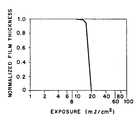
- the curve shown in the drawing illustrates the relationship between normalized film thickness of exposed resist as a function of UV/visible exposure dose for a given photoresist and developer system.
- a method that improves the sensitivity of resists to lithographic processing. Specifically, this improvement is derived from pre-exposure of the resist to UV and/or visible radiation from an appropriate source and development of the desired image using a high contrast developer.
- a significant feature of this invention is that film loss is reduced to a negligible value for unexposed resist.
- the resist must be photoactive to UV and/or visible radiation, i.e., an increase in solubility response must occur upon exposure. This requirement is characteristic of all known commercial positive photoresists although the feasibility as an electron beam resist for a given photoresist must be evaluated in the light of the task at hand. Additionally, the onset of this solubility response should be negligible at low exposure doses, desirably at zero, and should increase sharply at some threshold value. Of equal importance are the properties of the developer since it in combination with the resist, determines the sensitivity and contrast of the system.
- sensitizers of the diazo ketone type where the diazo and keto groups are at adjacent positions on the molecule have been found suitable for this invention.
- these sensitizers are quinone-diazide sulfonic acid derivatives as described, for example, in U.S. Patent Nos. 2,958,599; 3,046,110; 3,046,114; 3,046,116; 3,046,118; 3,046,119; 3,046,121; 3,046,122; 3,046,123; 3,106,465; 3,148,983; 3,635,709; 3,711,285; and 4,174,222 which the disclosed sensitizers are incorporated by reference in the present system.
- the developer of which potassium hydroxide, sodium hydroxide and sodium silicate are typical, must be capable of providing high contrast.
- aqueous alkali metal base such as those used in positive photoresist containing an alkali-soluble resin
- this is usually accomplished by the addition of a carboxylated surfactant to the developer as described in U.S. Patent Application Serial No. 660,600 filed on October 15, 1984 (P.D. 30-1834).
- contrast values of 3-7 are possible without the attendant film loss found in other systems.
- the resist may be applied to the substrate in the conventional manner as known by one skilled in the art. In most situations, this is accomplished by spin-coating to a desired thickness although other methods of application may be employed. Subsequent processing steps are generally identical to those used in the normal preparation of the coated substrate prior to lithographic exposure.
- Pre-exposure which immediately precedes lithographic exposure constitutes flooding of the coated substrate with UV and/or visible radiation from an appropriate source.
- the irradiation source should be capable of providing a stable and uniform illumination over the entire substrate surface. Additionally, it is desirable that the source be of sufficient intensity to minimize exposure time for a given radiation dose; hence, increasing throughput.
- Mercury arc lamps as found in most optical lithographic machines, are quite adequate for this purpose. Although a tungsten filament incandescent lamp may also be used, it is less desirable than the mercury arc lamp due to a lower efficiency in the production of UV radiation.
- Optimum pre-exposure dose will be dictated by the particular resist/developer combination to be used since the optical absorption characteristics and solubility responses will vary among different systems. Moreover, developing conditions (e.g. time and temperature) are additional factors to be considered in the selection of the irradiation dose. For one skilled in the art of lithographic processing, the determination of optimum pre-exposure dose of the film short of significant film loss for a given set of conditions is a relatively routine task.
- Film loss for a particular exposure dose is easily calculated by multiplying the original film thickness times the normalized film thickness. It is evident from the graph of the drawing that in order to completely remove the resist under the above conditions, a total exposure dose of 20 mJ/cm2 is necessary. Exposures up to ca. 10 mJ/cm2 result in no dissolution of the original film, i.e. zero film loss. The optimum pre-exposure dose would correspond to the maximum exposure before the film is solubilized by the exposure, i.e., before any significant film loss is encountered. The pre-exposure should not result in more than about 3-5 percent film loss and preferably substantially zero film loss. Therefore, lithographic exposure would be decreased by the amount equivalent to the pre-exposure dose for optical lithography.
- the resist/developer system used in the examples described below is AccuLithTM P-6010 photoresist which is a positive acting diazo ketone/novolac resin photoresist and AccuLithTM D-360 developer which is a KOH based developer. This system was chosen due to its high contrast which results in zero film loss under optimum processing conditions.
- the resist was applied to clean silicon wafer by spin-coating so as to produce a 1 micrometer thick film.
- the wafers were exposed to hexamethyldisilazane vapors for 10 minutes in a closed container prior to coating.
- the coated wafers were subsequently heated in a forced air convection oven for 30 minutes at 90°C to drive off residual solvents.
- the pre-exposure was effected by the illumination of the coated wafer surface with radiation from a mercury arc lamp for a preset duration corresponding to a known dose. This pre-exposure dose was measured by means of a UV light intensity meter manufactured by Optical Associates Incorporated. Lithographic exposure, both optical and electron beam, immediately followed. Development of the lithographic pattern was performed at 22°C for a desired length of time using the static immersion method. Film loss from unexposed resist was measured by interferometry.
- a coated substrate was prepared as described by the above procedure.
- the wafer was exposed to UV radiation through an Opto-Line step tablet resolution mask with windows of various exposure levels on the same wafer.
- a minimum exposure dose of 20 mJ/cm2 was required to completely develop the resist at 22°C and 1 minute development time.
- Film loss was determined to be zero with a contrast value (gamma) of 6.
- Example I The experiment of Example I was repeated but with pre-exposure included in the processing sequence. Prior to lithographic exposure, the coated wafer was flood exposed to 10 mJ/cm2 of UV/visible radiation as described above. Complete dissolution of the exposed resist required 10 mJ/cm2 of lithographic exposure with zero film loss and a gamma of 3.
- Electron beam exposure was performed with an unmodified Perkin-Elmer Autoscan microscope under manual control. An acceleration voltage of 20 KeV was employed at a beam current of 6nA.
- the raster pattern of the electron beam was roughly that of a square with a length of ca. 20 micrometers on each side at a magnification of 3000X and a working distance of 12mm; however, exposure across the rastered area was nonuniform. Relative changes in sensitivity were evaluated by comparison of the minimum exposure times required to completely clean the electron beam generated pattern.
- a coated wafer was prepared and exposed to the electron beam for 60 seconds. After a 60 second development in D-360, an underdeveloped pattern was generated as viewed through a scanning electron microscope. No film loss resulted from the unexposed resist.
- Example III The experiment described in Example III was repeated with the inclusion of pre-exposure. Immediately before electron beam processing, the coated wafer was flood exposed to a dose of 8.2 mJ/cm2 from a mercury arc lamp. A pattern similar to that produced in Example III was obtained after less than 30 seconds of electron beam exposure. No measurable film loss was observed illustrating the beneficial effect of the preexposure.
- Example III The experiment described in III was repeated but with the pre-exposure dose increased to 12.5 mJ/cm2. A pattern similar to that obtained in Example III resulted after exposure to the electron beam for 15 seconds. Film loss was ca. 1%. This run again illustrates the beneficial effect of pre-exposing the photosensitive film prior to the normal exposure.
- the invention may be applied in conjunction with various exposure systems known in the art, including exposure to electrons, photons, e.g., UV-visible radiation, ionic particles, i.e., atomic or molecular charged particles, and the like.
- exposure to electrons, photons e.g., UV-visible radiation
- ionic particles i.e., atomic or molecular charged particles, and the like.
Landscapes
- Physics & Mathematics (AREA)
- General Physics & Mathematics (AREA)
- Exposure And Positioning Against Photoresist Photosensitive Materials (AREA)
- Photosensitive Polymer And Photoresist Processing (AREA)
- Exposure Of Semiconductors, Excluding Electron Or Ion Beam Exposure (AREA)
Claims (7)
- Procédé pour développer une image de photoréserve positive dans une photoréserve à base de résine diazo cétone/novolaque sensible aux rayons ultraviolets (UV) ou à la radiation visible, dans un système à fort contraste, dans lequel la photoréserve comprend un revêtement continu sur la surface d'un substrat de support, le procédé comprenant les étapes suivantes :a) Exposition du revêtement sur la zone qui doit recevoir l'image de photoréserve positive avec une première quantité prédéterminée de radiation dans la plage des ultraviolets ou de la lumière visible ou leur combinaison, cette première quantité prédéterminée de radiation étant insuffisante à elle seule pour produire plus d'environ 5 % de perte de pellicule avec développement ultérieur de la photoréserve ;b) Exposition à l'image du revêtement sur la zone qui doit recevoir l'image de photoréserve positive avec une seconde quantité prédéterminée de radiation dans la plage des ultraviolets ou de la lumière visible ou par faisceaux d'électrons pour former une image latente du dessin dans la photoréserve, cette seconde quantité prédéterminée de radiation étant insuffisante à elle seule pour produire plus d'environ 5 % de perte de pellicule avec développement ultérieur de la photoréserve, à condition que les première et seconde quantités prédéterminées de radiation soient de façon cumulée suffisantes pour produire une perte de pellicule sensible et ainsi une image positive, dans les zones irradiées à la fois par les première et seconde quantités prédéterminées de radiation et ensuitec) Développement de la photoréserve pour enlever les zones exposées à la fois aux première et seconde quantités prédéterminées de radiation avec un révélateur alcalin aqueux à fort contraste pour produire ainsi une image de dessin positif.
- Procédé selon la revendication 1, dans lequel la photoréserve est exposée aux ultraviolets et à la radiation visible combinés.
- Procédé selon la revendication 1, dans lequel la photoréserve est d'abord exposée à la lumière, puis à l'image par radiation de faisceaux d'électrons.
- Procédé selon la revendication 1, dans lequel l'exposition à la lumière est effectuée par radiation aux rayons ultraviolets et/ou à la lumière visible et ensuite l'exposition au dessin est effectuée par radiation aux rayons ultraviolets/lumière visible, faisceaux d'électrons ou rayons X.
- Procédé selon la revendication 1, dans lequel le révélateur comprend de l'hydroxyde de potassium.
- Procédé selon la revendication 1, dans lequel le révélateur comprend de l'hydroxyde de sodium.
- Procédé selon la revendication 1, dans lequel le révélateur comprend du silicate de sodium.
Applications Claiming Priority (2)
| Application Number | Priority Date | Filing Date | Title |
|---|---|---|---|
| US75620585A | 1985-07-18 | 1985-07-18 | |
| US756205 | 1985-07-18 |
Publications (3)
| Publication Number | Publication Date |
|---|---|
| EP0209152A2 EP0209152A2 (fr) | 1987-01-21 |
| EP0209152A3 EP0209152A3 (en) | 1988-10-26 |
| EP0209152B1 true EP0209152B1 (fr) | 1992-03-25 |
Family
ID=25042461
Family Applications (1)
| Application Number | Title | Priority Date | Filing Date |
|---|---|---|---|
| EP86109897A Expired - Lifetime EP0209152B1 (fr) | 1985-07-18 | 1986-07-18 | Procédé de préexposition pour l'augmentation de la sensibilité dans le développement à haut contraste des photoréserves |
Country Status (5)
| Country | Link |
|---|---|
| EP (1) | EP0209152B1 (fr) |
| JP (1) | JPS6278550A (fr) |
| KR (1) | KR900006284B1 (fr) |
| CA (1) | CA1285418C (fr) |
| DE (1) | DE3684524D1 (fr) |
Families Citing this family (6)
| Publication number | Priority date | Publication date | Assignee | Title |
|---|---|---|---|---|
| JPS63185022A (ja) * | 1987-01-27 | 1988-07-30 | Fujitsu Ltd | パタ−ン形成方法 |
| JPH0353587A (ja) * | 1989-07-20 | 1991-03-07 | Nippon Paint Co Ltd | レジストパターンの形成方法 |
| GB9404301D0 (en) * | 1994-03-04 | 1994-04-20 | Atotech Uk Limited | Stripper compositions and their use |
| JPH09319097A (ja) * | 1996-01-16 | 1997-12-12 | Sumitomo Chem Co Ltd | レジストパターンの形成方法 |
| US6420101B1 (en) * | 2000-06-21 | 2002-07-16 | Infineon Technologies A G | Method of reducing post-development defects in and around openings formed in photoresist by use of non-patterned exposure |
| CN117092872A (zh) * | 2022-05-11 | 2023-11-21 | 源纳微光学科技(苏州)有限公司 | 一种投影成像系统 |
Family Cites Families (9)
| Publication number | Priority date | Publication date | Assignee | Title |
|---|---|---|---|---|
| US3859091A (en) * | 1971-09-08 | 1975-01-07 | Grace W R & Co | Preparation of printing or pattern plates |
| DE2534795C3 (de) * | 1975-08-04 | 1978-05-24 | Siemens Ag, 1000 Berlin Und 8000 Muenchen | Verfahren zur Herstellung von Strukturen aus Positiv-Fotolackschichten |
| US4250242A (en) * | 1978-10-31 | 1981-02-10 | American Hoechst Corporation | Uniform exposure of positive-acting diazo type materials through support |
| JPS5596942A (en) * | 1979-01-19 | 1980-07-23 | Matsushita Electric Ind Co Ltd | Method and apparatus for producing minute pattern |
| JPS55148423A (en) * | 1979-05-07 | 1980-11-19 | Chiyou Lsi Gijutsu Kenkyu Kumiai | Method of pattern formation |
| DE2927242A1 (de) * | 1979-07-05 | 1981-01-08 | Siemens Ag | Korpuskel- oder roentgenlithografisches verfahren zur strukturerzeugung |
| AU544060B2 (en) * | 1980-07-28 | 1985-05-16 | Polychrome Corp. | Accelerated diazo sensitised |
| JPS5917552A (ja) * | 1982-07-21 | 1984-01-28 | Toray Ind Inc | 画像形成用積層体の処理方法 |
| JPS60130828A (ja) * | 1983-12-19 | 1985-07-12 | Oki Electric Ind Co Ltd | レジストパタ−ンの形成方法 |
-
1986
- 1986-07-17 CA CA000514083A patent/CA1285418C/fr not_active Expired - Lifetime
- 1986-07-18 KR KR1019860005804A patent/KR900006284B1/ko not_active Expired
- 1986-07-18 JP JP61169670A patent/JPS6278550A/ja active Pending
- 1986-07-18 EP EP86109897A patent/EP0209152B1/fr not_active Expired - Lifetime
- 1986-07-18 DE DE8686109897T patent/DE3684524D1/de not_active Expired - Fee Related
Also Published As
| Publication number | Publication date |
|---|---|
| EP0209152A2 (fr) | 1987-01-21 |
| JPS6278550A (ja) | 1987-04-10 |
| CA1285418C (fr) | 1991-07-02 |
| EP0209152A3 (en) | 1988-10-26 |
| KR900006284B1 (ko) | 1990-08-27 |
| KR870001494A (ko) | 1987-03-14 |
| DE3684524D1 (de) | 1992-04-30 |
Similar Documents
| Publication | Publication Date | Title |
|---|---|---|
| US4931380A (en) | Pre-exposure method for increased sensitivity in high contrast resist development of positive working diazo ketone photoresist | |
| Wallraff et al. | Lithographic imaging techniques for the formation of nanoscopic features | |
| US6162577A (en) | Method for extreme ultraviolet lithography | |
| US7026099B2 (en) | Pattern forming method and method for manufacturing semiconductor device | |
| US4298803A (en) | Process and apparatus for making fine-scale patterns | |
| JP2007501431A (ja) | 基板にパターン形成するための改善された方法 | |
| EP0095212B1 (fr) | Procédé pour l'obention d'un masque résistant à l'attaque par plasma | |
| US4373018A (en) | Multiple exposure microlithography patterning method | |
| US4329410A (en) | Production of X-ray lithograph masks | |
| KR920005634B1 (ko) | 광전자 마스크 및 그것을 사용한 광전자 전사노광방법 | |
| JPH04251850A (ja) | 半導体素子の製造方法 | |
| EP0209152B1 (fr) | Procédé de préexposition pour l'augmentation de la sensibilité dans le développement à haut contraste des photoréserves | |
| US6420101B1 (en) | Method of reducing post-development defects in and around openings formed in photoresist by use of non-patterned exposure | |
| Chen et al. | Hybrid alkyl-ligand tin-oxo clusters for enhanced lithographic patterning performance via intramolecular interactions | |
| US6576405B1 (en) | High aspect ratio photolithographic method for high energy implantation | |
| US4268607A (en) | Method of patterning a resist layer for manufacture of a semiconductor element | |
| TW394980B (en) | Semiconductor device fabrication system and method of forming semiconductor device pattern using the same | |
| JP3563935B2 (ja) | 半導体製造用露光装置およびこれを用いた半導体デバイス製造プロセス | |
| US4555460A (en) | Mask for the formation of patterns in lacquer layers by means of X-ray lithography and method of manufacturing same | |
| JPS62129849A (ja) | ポジ型ホトレジストパタ−ンの安定化方法 | |
| WATTS et al. | X-ray lithography | |
| JPH03253858A (ja) | パターン形成材料及びパターン形成方法 | |
| JPH07106235A (ja) | パターン形成方法 | |
| JPS61173245A (ja) | ホトレジストパタ−ンの形成方法 | |
| Fukushima et al. | Development of low line edge roughness and highly sensitive resist for extreme ultraviolet lithography |
Legal Events
| Date | Code | Title | Description |
|---|---|---|---|
| PUAI | Public reference made under article 153(3) epc to a published international application that has entered the european phase |
Free format text: ORIGINAL CODE: 0009012 |
|
| AK | Designated contracting states |
Kind code of ref document: A2 Designated state(s): BE DE FR GB IT |
|
| RAP1 | Party data changed (applicant data changed or rights of an application transferred) |
Owner name: PETRARCH SYSTEMS, INC. |
|
| PUAL | Search report despatched |
Free format text: ORIGINAL CODE: 0009013 |
|
| AK | Designated contracting states |
Kind code of ref document: A3 Designated state(s): BE DE FR GB IT |
|
| 17P | Request for examination filed |
Effective date: 19890419 |
|
| 17Q | First examination report despatched |
Effective date: 19890907 |
|
| RAP1 | Party data changed (applicant data changed or rights of an application transferred) |
Owner name: HUELS AMERICA INC. |
|
| RAP1 | Party data changed (applicant data changed or rights of an application transferred) |
Owner name: MICROSI, INC. (A DELAWARE CORPORATION) |
|
| GRAA | (expected) grant |
Free format text: ORIGINAL CODE: 0009210 |
|
| AK | Designated contracting states |
Kind code of ref document: B1 Designated state(s): BE DE FR GB IT |
|
| ITF | It: translation for a ep patent filed | ||
| REF | Corresponds to: |
Ref document number: 3684524 Country of ref document: DE Date of ref document: 19920430 |
|
| ET | Fr: translation filed | ||
| ITTA | It: last paid annual fee | ||
| PLBE | No opposition filed within time limit |
Free format text: ORIGINAL CODE: 0009261 |
|
| STAA | Information on the status of an ep patent application or granted ep patent |
Free format text: STATUS: NO OPPOSITION FILED WITHIN TIME LIMIT |
|
| 26N | No opposition filed | ||
| PGFP | Annual fee paid to national office [announced via postgrant information from national office to epo] |
Ref country code: BE Payment date: 19930625 Year of fee payment: 8 |
|
| PG25 | Lapsed in a contracting state [announced via postgrant information from national office to epo] |
Ref country code: BE Effective date: 19940731 |
|
| BERE | Be: lapsed |
Owner name: MICROSI INC. (A DELAWARE CORP.) Effective date: 19940731 |
|
| PGFP | Annual fee paid to national office [announced via postgrant information from national office to epo] |
Ref country code: FR Payment date: 19960625 Year of fee payment: 11 |
|
| PGFP | Annual fee paid to national office [announced via postgrant information from national office to epo] |
Ref country code: GB Payment date: 19960627 Year of fee payment: 11 |
|
| PGFP | Annual fee paid to national office [announced via postgrant information from national office to epo] |
Ref country code: DE Payment date: 19960930 Year of fee payment: 11 |
|
| PG25 | Lapsed in a contracting state [announced via postgrant information from national office to epo] |
Ref country code: GB Free format text: LAPSE BECAUSE OF NON-PAYMENT OF DUE FEES Effective date: 19970718 |
|
| GBPC | Gb: european patent ceased through non-payment of renewal fee |
Effective date: 19970718 |
|
| PG25 | Lapsed in a contracting state [announced via postgrant information from national office to epo] |
Ref country code: FR Free format text: LAPSE BECAUSE OF NON-PAYMENT OF DUE FEES Effective date: 19980331 |
|
| PG25 | Lapsed in a contracting state [announced via postgrant information from national office to epo] |
Ref country code: DE Free format text: LAPSE BECAUSE OF NON-PAYMENT OF DUE FEES Effective date: 19980401 |
|
| REG | Reference to a national code |
Ref country code: FR Ref legal event code: ST |
|
| PG25 | Lapsed in a contracting state [announced via postgrant information from national office to epo] |
Ref country code: IT Free format text: LAPSE BECAUSE OF NON-PAYMENT OF DUE FEES;WARNING: LAPSES OF ITALIAN PATENTS WITH EFFECTIVE DATE BEFORE 2007 MAY HAVE OCCURRED AT ANY TIME BEFORE 2007. THE CORRECT EFFECTIVE DATE MAY BE DIFFERENT FROM THE ONE RECORDED. Effective date: 20050718 |