EP0209371A1 - Dispositif de serrage chirurgical à base de mélanges de polymères riches en glycolide - Google Patents
Dispositif de serrage chirurgical à base de mélanges de polymères riches en glycolide Download PDFInfo
- Publication number
- EP0209371A1 EP0209371A1 EP86305458A EP86305458A EP0209371A1 EP 0209371 A1 EP0209371 A1 EP 0209371A1 EP 86305458 A EP86305458 A EP 86305458A EP 86305458 A EP86305458 A EP 86305458A EP 0209371 A1 EP0209371 A1 EP 0209371A1
- Authority
- EP
- European Patent Office
- Prior art keywords
- glycolide
- surgical fastener
- blend
- staple
- polymers
- Prior art date
- Legal status (The legal status is an assumption and is not a legal conclusion. Google has not performed a legal analysis and makes no representation as to the accuracy of the status listed.)
- Granted
Links
- RKDVKSZUMVYZHH-UHFFFAOYSA-N 1,4-dioxane-2,5-dione Chemical compound O=C1COC(=O)CO1 RKDVKSZUMVYZHH-UHFFFAOYSA-N 0.000 title claims abstract description 28
- 229920002959 polymer blend Polymers 0.000 title 1
- 239000000203 mixture Substances 0.000 claims abstract description 42
- 229920000642 polymer Polymers 0.000 claims abstract description 35
- -1 poly(p-dioxanone) Polymers 0.000 claims description 19
- JJTUDXZGHPGLLC-UHFFFAOYSA-N lactide Chemical compound CC1OC(=O)C(C)OC1=O JJTUDXZGHPGLLC-UHFFFAOYSA-N 0.000 claims description 18
- 229920001519 homopolymer Polymers 0.000 claims description 16
- 229920001577 copolymer Polymers 0.000 claims description 13
- 229920002463 poly(p-dioxanone) polymer Polymers 0.000 claims description 11
- AEMRFAOFKBGASW-UHFFFAOYSA-N Glycolic acid Polymers OCC(O)=O AEMRFAOFKBGASW-UHFFFAOYSA-N 0.000 claims description 9
- 229920000954 Polyglycolide Polymers 0.000 claims description 8
- 229920000747 poly(lactic acid) Polymers 0.000 claims description 8
- 238000001727 in vivo Methods 0.000 claims description 7
- 238000000926 separation method Methods 0.000 claims description 5
- 230000002439 hemostatic effect Effects 0.000 claims description 4
- 238000002513 implantation Methods 0.000 claims description 4
- 210000003195 fascia Anatomy 0.000 claims description 3
- 210000001519 tissue Anatomy 0.000 description 18
- 238000001746 injection moulding Methods 0.000 description 9
- 229940090044 injection Drugs 0.000 description 7
- 238000002347 injection Methods 0.000 description 7
- 239000007924 injection Substances 0.000 description 7
- IJGRMHOSHXDMSA-UHFFFAOYSA-N Atomic nitrogen Chemical compound N#N IJGRMHOSHXDMSA-UHFFFAOYSA-N 0.000 description 6
- 239000002184 metal Substances 0.000 description 6
- 238000000465 moulding Methods 0.000 description 6
- 238000000034 method Methods 0.000 description 5
- 230000015556 catabolic process Effects 0.000 description 4
- 238000006731 degradation reaction Methods 0.000 description 4
- 238000013461 design Methods 0.000 description 4
- 239000000155 melt Substances 0.000 description 4
- 230000000149 penetrating effect Effects 0.000 description 4
- 229920003023 plastic Polymers 0.000 description 4
- 239000004033 plastic Substances 0.000 description 4
- 238000012360 testing method Methods 0.000 description 4
- 238000000137 annealing Methods 0.000 description 3
- 230000014759 maintenance of location Effects 0.000 description 3
- 239000000463 material Substances 0.000 description 3
- 229910052757 nitrogen Inorganic materials 0.000 description 3
- 239000008363 phosphate buffer Substances 0.000 description 3
- 238000002360 preparation method Methods 0.000 description 3
- VPVXHAANQNHFSF-UHFFFAOYSA-N 1,4-dioxan-2-one Chemical compound O=C1COCCO1 VPVXHAANQNHFSF-UHFFFAOYSA-N 0.000 description 2
- 210000002808 connective tissue Anatomy 0.000 description 2
- 230000003301 hydrolyzing effect Effects 0.000 description 2
- 238000000338 in vitro Methods 0.000 description 2
- 229920006267 polyester film Polymers 0.000 description 2
- 238000010926 purge Methods 0.000 description 2
- BYEAHWXPCBROCE-UHFFFAOYSA-N 1,1,1,3,3,3-hexafluoropropan-2-ol Chemical compound FC(F)(F)C(O)C(F)(F)F BYEAHWXPCBROCE-UHFFFAOYSA-N 0.000 description 1
- 241000283725 Bos Species 0.000 description 1
- 238000002441 X-ray diffraction Methods 0.000 description 1
- 238000010521 absorption reaction Methods 0.000 description 1
- 238000005452 bending Methods 0.000 description 1
- 210000004204 blood vessel Anatomy 0.000 description 1
- 230000000295 complement effect Effects 0.000 description 1
- 238000003780 insertion Methods 0.000 description 1
- 230000037431 insertion Effects 0.000 description 1
- 239000003960 organic solvent Substances 0.000 description 1
- 239000008188 pellet Substances 0.000 description 1
- 239000000622 polydioxanone Substances 0.000 description 1
- 239000004633 polyglycolic acid Substances 0.000 description 1
- 239000004626 polylactic acid Substances 0.000 description 1
- 230000002028 premature Effects 0.000 description 1
- 238000012545 processing Methods 0.000 description 1
- 230000002787 reinforcement Effects 0.000 description 1
- 238000007790 scraping Methods 0.000 description 1
- 238000004904 shortening Methods 0.000 description 1
- 238000003860 storage Methods 0.000 description 1
- 238000001356 surgical procedure Methods 0.000 description 1
- 230000029663 wound healing Effects 0.000 description 1
Images


Classifications
-
- A—HUMAN NECESSITIES
- A61—MEDICAL OR VETERINARY SCIENCE; HYGIENE
- A61L—METHODS OR APPARATUS FOR STERILISING MATERIALS OR OBJECTS IN GENERAL; DISINFECTION, STERILISATION OR DEODORISATION OF AIR; CHEMICAL ASPECTS OF BANDAGES, DRESSINGS, ABSORBENT PADS OR SURGICAL ARTICLES; MATERIALS FOR BANDAGES, DRESSINGS, ABSORBENT PADS OR SURGICAL ARTICLES
- A61L31/00—Materials for other surgical articles, e.g. stents, stent-grafts, shunts, surgical drapes, guide wires, materials for adhesion prevention, occluding devices, surgical gloves, tissue fixation devices
- A61L31/04—Macromolecular materials
- A61L31/041—Mixtures of macromolecular compounds
-
- A—HUMAN NECESSITIES
- A61—MEDICAL OR VETERINARY SCIENCE; HYGIENE
- A61B—DIAGNOSIS; SURGERY; IDENTIFICATION
- A61B17/00—Surgical instruments, devices or methods
- A61B17/064—Surgical staples, i.e. penetrating the tissue
- A61B17/0643—Surgical staples, i.e. penetrating the tissue with separate closing member, e.g. for interlocking with staple
Definitions
- the invention relates to an absorbable surgical fastener such as a ligating clip or a surgical staple of the staple/receiver type, made from glycolide-rich blends of polymers.
- Surgical staples and ligating clips are beginning to come into wide use in the surgical profession as an alternative to sutures and ligatures.
- One advantage of clips and staples in comparison with sutures and ligatures is that tissue fastening or ligating with a staple or clip, whether applied singly or as an array applied in a row or in a ring, is much simpler and faster than with a suture or a ligature.
- Surgical procedures can be speeded up, thereby reducing the length of time the patient must be anesthetized and shortening the operating room time.
- a staple member includes a cross-piece or base and one or more attached legs which are designed to pierce the tissue to be fastened and to enter receptacles in the receiver on the other side of the tissue.
- the receiver holds the legs tightly, with the tissue being held between the cross-piece or base and the receiving member.
- a later commercial surgical staple is made from either of two blends of lactide and glycolide polymers such that the blend has greater than 50 per cent lactide-based moieties. Specifically, it has an overall lactide/glycolide ratio of 71/29 or 64/36, by weight.
- This invention provides an absorbable surgical fastener, such as a surgical staple, a ligating clip, an anastomotic coupler, a fascia closure, or the like, that has an overall composition containing more than 50 per cent of polymerized glycolide, and provides, unexpectedly, a highly desirable combination of properties.
- a surgical fastener such as a surgical staple, a ligating clip, an anastomotic coupler, a fascia closure, or the like
- an overall composition containing more than 50 per cent of polymerized glycolide
- an overall composition containing more than 50 per cent of polymerized glycolide
- This invention provides a surgical fastener comprising a glycolide-rich blend of polymers.
- the invention provides a surgical staple comprising:
- the invention provides a hemostatic ligating clip comprising said glycolide-rich blend of polymers.
- Golden et al. in United States Patent application serial No. 359,443, filed March 18, 1982, discloses an absorbable staple in which the fastening member is made from "an absorbable polymer of glycolide and lactide" and the receiving member is made from polydioxanone.
- the said Golden et al. application is assigned to the same assignee as this application.
- World patent application WO8401-508-A describes absorbable surgical fasteners made from copolymers containing 70-85 mole per cent lactide and 15-30 mole per cent glycolide.
- the invention resides in the use in a surgical fastener of a blend of at least two polymers, the overall blend being rich in polymerized glycolide.
- the blend of polymers used in the invention is glycolide-rich, that is, the blend as a whole contains from about 65 to about 85 weight per cent polymerized glycolide, the remainder being polymerized lactide. At least one of the polymers in the blend is polyglycolide homopolymer or a predominantly glycolide copolymer containing, e.g., at least about 90 weight per cent glycolide, the remainder being lactide. Also, at least one of the polymers in the blend is polylactide homopolymer or a predominantly lactide copolymer containing, e.g., at least 85 weight per cent lactide, the remainder being glycolide. The two or more polymers used in the blend are used in such proportions that, overall, the blend contains from about 65 to about 85 weight per cent of polymerized glycolide, the remainder being polymerized lactide.
- the polymers used in the invention are known materials. For instance, they are disclosed in United States patents to Schneider (No. 3,797,499), Salzberg (No. 2,758,987), and Schmitt et al. (No. 3,739,773).
- the lactide hompolymers and lactide-rich copolymers will have molecular weights such that they have inherent viscosities of from about 1 to about 3 and preferably about 1.5 to 1.9, dl/gm, tested at 25°C. at a concentration of 0.1 gm/dl in hexafluoroisopropyl alcohol (“HFIP").
- glycolide homopolymers and glycolide-rich copolymers are easier to characterize by melt index than by inherent viscosity because of their poor solubility in organic solvents. They usually have melt index values of from about 0.1 to about 0.9, and preferably from about 0.2 to about 0.6, gram per 10 minutes.
- the melt index is determined by the procedure described in ASTM D-1238-73 (using a thoroughly dried sample of polymer), using a 26 mil die orifice, a weight of 3700 grams plus the 100-gram piston weight, at a temperature of 235°C.
- the melt index is the weight of polymer taken during the interval from 15 to 16 minutes after beginning the test, multiplied by 10.
- Poly(p-dioxanone) one preferred polymer for use in the receiver member of a surgical staple of the staple/receiver type, is also a known material. Its nature and preparation are described, for instance, in Doddi et al., U. S. Patent No. 4,052,988. Poly(p-dioxanone) having an inherent viscosity of from about 1.2 to about 2.2, and preferably about 1.6 to 1.9, dl/gm, tested at 25°C. and a concentration of 0.1 gm/dl in HFIP, is normally used in the invention. The blend of the invention may also be used as the receiver.
- the invention provides a surgical staple of the staple/receiver type wherein the staple member is the blend of the invention and the receiver is an absorbable polymer, such as poly(p-dioxanone) or a blend similar to or the same as that used in the staple member.
- the staple can be made by injection molding of the two parts.
- the staple member which is made of a blend of two or more polymers, can be injection molded at temperatures within the range of from about 215°C. to about 225°C. at an injection molding pressure of, for example, 1650 to 1750 psi. (These conditions are typical for the preferred 70/30 polyglycolide/polylactide blend disclosed in the Examples below.) These conditions are also used if the blend is used as the receiver.
- the feed for the injection molder will be a melt blend of the polymers in pellet form, although a dry blend of the polymers in finely divided form can be fed to the injection molding machine, provided sufficient mixing in the injection molding machine occurs.
- the receiver member when made of poly(p-dioxanone), can be injection molded at a temperature within the range of from about 105°C. to about 120°C., at a pressure of, for example, about 1350 to 1450 psi.
- the polymers should be quite dry when being injection molded in order to avoid hydrolytic degradation during processing. After molding, the staple can be packaged and sterilized by conventional procedures.
- the polymers be handled so as to minimize premature hydrolytic degradation or thermal degradation.
- the polymers should be stored dry before molding, the molding operation should be dry, and the molded parts should be stored dry. Also, residence time in the extruder should be kept to a minimum so as to minimize thermal and shear degradation.
- FIGS 1-3 show a typical surgical staple of the invention.
- the staple member 10 includes a base 12 and two legs 14,16 extending generally perpendicularly from the base 12. Each leg 14,16 has a pointed end 18,20 that is capable of piercing tissue.
- the legs 14,16 are arranged and constructed so as to snap fit into the receptacles 22,24 of a receiver 26.
- layers 28,30 of tissue to be fastened are positioned between the staple member 10 and the receiver 26.
- the legs 14,16 of the staple member 10 are driven through the layers 28,30 of tissue, as shown in Fig. 2, until the ends of the legs 14,16 snap fit in the receptacles 22,24 in the receiver 26, to thereby hold the tissue securely between the staple member 10 and receiver 26, as is shown in Fig. 3.
- the design of staple member and receiver shown in the figures is merely illustrative. Other designs can be used, if desired.
- a hemostatic ligating clip comprising the blend of the invention.
- the advantages of the clip comprising the blend of the invention compared to clips made wholly of poly(p-dioxanone) are the following:
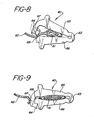
- the clip 40 that can be used in the invention.
- the clip comprises a pair of leg members 41 and 42 having opposed vessel clamping surfaces 43 and 44.
- the leg members are connected at their proximal ends by a resilient hinge portion 45.
- the distal end of one of the leg members terminates in a return bend hook portion 46.
- the opposite leg member is somewhat shorter and terminates at its distal end in a portion 47 which can grasped by the hook portion.
- the end of this leg member is angled at an obtuse angle to the vessel clamping surface. This angle aids in deflecting the hook portion as the two leg members are brought together about the hinge and allows the hook portion to deflect and then accept the leg member in the area between the inner surface 48 of the hook portion and the vessel clamping surface 43 of the opposite leg member.
- the hook portion includes a sharpened pointed end 49 extending from the hook portion and positioned to lead the hook portion or preceed the hook portion as the clip is being closed. As shown in Fig.
- the hook portion has a protrusion 50 dispersed from the central portion of its inner surface 40.
- This protrusion fits into the recess 51 (see Fig. 6) positioned in the outer surface 52 of the opposite leg member 42.
- the protrusion and recess interlock when the clip is closed to prevent lateral movement of the leg members.
- the outside surfaces of the leg members each include a cylindrical boss 53 and 54 for use in holding the clip in a suitable instrument and applying the clip from said instrument as will hereinafter be described.
- the penetrating means is a sharpened beveled end
- the penetrating means may have other configurations such as a pointed end tapered at a plurality of sides, a pointed end, a plurality of pointed ends, etc.
- FIG. 10 there is shown a simplified drawing of an instrument for applying the clip described above.
- This instrument 70 comprises a pair of handles 71 and 72 which are connected together at a hinge point 73.
- the handles are biased with respect to one another by a spring 74.
- One of the handles extends beyond the hinge point in a first jaw member 75 and the opposite handle extends beyond the hinge point in a complementary second jaw member 76.
- the instrument engaging means comprises cylindrical bosses (53, 54 in Fig. 4) extending from the back surfaces of the leg members of the clip 77. These bosses fit into recesses in the jaws of the instrument.
- the clip is placed in the jaws with the cylindrical boses in the appropriate recesses.
- the vessel clamping surfaces of the clip are then placed on opposite sides of the vessel to be closed and the instrument handles urged together closing and locking the clip about the vessel and shutting off the vessel.
- the clip can be injection molded by the procedure set forth above with respect to the staple member of the surgical staple of the invention.
- the parts made of the blend of the invention can be annealed to enhance dimensional stability at elevated temperature.
- the annealing usually increases the degree of crystallinity. Polyglycolide homopolymer and glycolide-rich copolymers often develop crystallinity in the mold, and this degree of crystallinity may be sufficient in some cases.
- the parts made from the blend of the invention usually exhibit about 15 to about 45 per cent crystallinity, measured by X-ray diffraction.
- the annealing which is preferably done in a vacuum or under an inert atmosphere such as dry nitrogen, can be carried out at about 50° to 140°C., and preferably at about 60°C. to 80°C., for at least an hour. An annealing time of about 2 to 20 hours is preferred.
- Surgical staples having the design shown in Figs. 1-3 were made by injection molding.
- the receivers were all made from poly(p-dioxanone) having an inherent viscosity of 1.6-1.8 in HFIP.
- the staple members were made from a blend of 70 parts by weight of polyglycolide homopolymer having a melt index 0.291, and 30 parts by weight of polylactide homopolymer having an inherent viscosity in HFIP of 1.78.
- the polymers Prior to injection molding, the polymers, in coarse ground form, were dried under vacuum for a period of two weeks. They were dry blended and fed to the injection molding machine as a dry blend. Dryness was maintained during molding by using a dry nitrogen purge in the hopper of the injection molding machine. After molding, the samples were maintained under vacuum or under a dry nitrogen purge until they were tested. The fasteners were annealed at 60°C. for 16 hours after molding.
- the staple members are inserted in the receivers, leaving a slight gap to simulate the space taken up by tissue, and are then placed in the phosphate buffer at 37°C.
- the samples are tested initially and after 7, 14, 21, and 28 days.
- the separation force is measured by engaging the cross piece (e.g., part 12 in Fig. 1) of the staple member with a tab of an Instron test fixture, and pulling against a strip of polyester film that has been bent around the receiver by passing it through the gap between cross-piece of the staple member and the receiver. (The polyester film is cut so that it is just narrow enough to fit through said gap.)
- Typical initial separation forces vary from about 8 to 9 pounds, and typical separation forces after 21 days in phosphate buffer at 37°C. are from one-half to one pound.
- the devices made from the blend described above are so soft that they would be expected to be non-palpable after 42 days in vivo . It is unusual and unexpected that an implanted device would have measurable strength after three weeks in vivo , but then after only another three weeks be so soft as to be non-palpable. In general, the fasteners of the invention will be non-palpable after six to ten weeks in vivo .
Landscapes
- Health & Medical Sciences (AREA)
- Heart & Thoracic Surgery (AREA)
- Surgery (AREA)
- Vascular Medicine (AREA)
- Epidemiology (AREA)
- Life Sciences & Earth Sciences (AREA)
- Animal Behavior & Ethology (AREA)
- General Health & Medical Sciences (AREA)
- Public Health (AREA)
- Veterinary Medicine (AREA)
- Materials For Medical Uses (AREA)
Applications Claiming Priority (2)
| Application Number | Priority Date | Filing Date | Title |
|---|---|---|---|
| US755888 | 1985-07-17 | ||
| US06/755,888 US4741337A (en) | 1985-07-17 | 1985-07-17 | Surgical fastener made from glycolide-rich polymer blends |
Publications (2)
| Publication Number | Publication Date |
|---|---|
| EP0209371A1 true EP0209371A1 (fr) | 1987-01-21 |
| EP0209371B1 EP0209371B1 (fr) | 1990-01-31 |
Family
ID=25041095
Family Applications (1)
| Application Number | Title | Priority Date | Filing Date |
|---|---|---|---|
| EP86305458A Expired - Lifetime EP0209371B1 (fr) | 1985-07-17 | 1986-07-16 | Dispositif de serrage chirurgical à base de mélanges de polymères riches en glycolide |
Country Status (7)
| Country | Link |
|---|---|
| US (1) | US4741337A (fr) |
| EP (1) | EP0209371B1 (fr) |
| JP (1) | JPH0793940B2 (fr) |
| AU (1) | AU585038B2 (fr) |
| CA (1) | CA1255044A (fr) |
| DE (1) | DE3668554D1 (fr) |
| ZA (1) | ZA865313B (fr) |
Cited By (2)
| Publication number | Priority date | Publication date | Assignee | Title |
|---|---|---|---|---|
| EP0401844A3 (fr) * | 1989-06-09 | 1992-05-06 | Boehringer Ingelheim Kg | Articles moulés résorbables et leur procédé de préparation |
| EP0533314A3 (en) * | 1991-09-17 | 1993-06-30 | Novacor Chemicals (International) S.A. | Biodegradable polyester compositions |
Families Citing this family (92)
| Publication number | Priority date | Publication date | Assignee | Title |
|---|---|---|---|---|
| ATE142236T1 (de) * | 1984-03-06 | 1996-09-15 | United States Surgical Corp | Ein verfahren zur herstellung von zwei-phasen- zusammensetzungen für absorbierbare chirurgische ausrüstungen |
| US4889119A (en) * | 1985-07-17 | 1989-12-26 | Ethicon, Inc. | Surgical fastener made from glycolide-rich polymer blends |
| US5032638A (en) * | 1986-09-05 | 1991-07-16 | American Cyanamid Company | Bioabsorbable coating for a surgical device |
| US5100418A (en) | 1987-05-14 | 1992-03-31 | Inbae Yoon | Suture tie device system and applicator therefor |
| DE3869343D1 (de) * | 1987-06-16 | 1992-04-23 | Boehringer Ingelheim Kg | Meso-lactid und verfahren zu seiner herstellung. |
| US5216050A (en) * | 1988-08-08 | 1993-06-01 | Biopak Technology, Ltd. | Blends of polyactic acid |
| US5252642A (en) * | 1989-03-01 | 1993-10-12 | Biopak Technology, Ltd. | Degradable impact modified polyactic acid |
| US4983176A (en) * | 1989-03-06 | 1991-01-08 | University Of New Mexico | Deformable plastic surgical clip |
| US5053047A (en) * | 1989-05-16 | 1991-10-01 | Inbae Yoon | Suture devices particularly useful in endoscopic surgery and methods of suturing |
| US4932962A (en) * | 1989-05-16 | 1990-06-12 | Inbae Yoon | Suture devices particularly useful in endoscopic surgery and methods of suturing |
| US5222976A (en) * | 1989-05-16 | 1993-06-29 | Inbae Yoon | Suture devices particularly useful in endoscopic surgery |
| US5626863A (en) * | 1992-02-28 | 1997-05-06 | Board Of Regents, The University Of Texas System | Photopolymerizable biodegradable hydrogels as tissue contacting materials and controlled-release carriers |
| US5462990A (en) * | 1990-10-15 | 1995-10-31 | Board Of Regents, The University Of Texas System | Multifunctional organic polymers |
| US5410016A (en) * | 1990-10-15 | 1995-04-25 | Board Of Regents, The University Of Texas System | Photopolymerizable biodegradable hydrogels as tissue contacting materials and controlled-release carriers |
| US5366458A (en) * | 1990-12-13 | 1994-11-22 | United States Surgical Corporation | Latchless surgical clip |
| USRE36720E (en) * | 1990-12-13 | 2000-05-30 | United States Surgical Corporation | Apparatus and method for applying latchless surgical clips |
| US6228954B1 (en) | 1991-02-12 | 2001-05-08 | United States Surgical Corporation | Blends of glycolide and/or lactide polymers and caprolactone and/or trimethylene carbonate polymers and absorabable surgical devices made therefrom |
| CA2060635A1 (fr) * | 1991-02-12 | 1992-08-13 | Keith D'alessio | Implants medicaux bioabsorbables |
| US5320624A (en) * | 1991-02-12 | 1994-06-14 | United States Surgical Corporation | Blends of glycolide and/or lactide polymers and caprolactone and/or trimethylene carbonate polymers and absorbable surgical devices made therefrom |
| US5242456A (en) * | 1991-11-21 | 1993-09-07 | Kensey Nash Corporation | Apparatus and methods for clamping tissue and reflecting the same |
| US5573934A (en) * | 1992-04-20 | 1996-11-12 | Board Of Regents, The University Of Texas System | Gels for encapsulation of biological materials |
| KR100266912B1 (ko) * | 1992-02-28 | 2000-12-01 | 파라비 레이 | 조직접촉물질이며 방출조절운반체인 광중합성 생분해성 하이드로겔 |
| US5342373A (en) * | 1992-09-14 | 1994-08-30 | Ethicon, Inc. | Sterile clips and instrument for their placement |
| US5397816A (en) * | 1992-11-17 | 1995-03-14 | Ethicon, Inc. | Reinforced absorbable polymers |
| US5858018A (en) | 1993-08-25 | 1999-01-12 | Apollo Camera, Llc | Low profile tool for applying spring action ligation clips |
| US6074840A (en) * | 1994-02-18 | 2000-06-13 | The Regents Of The University Of Michigan | Recombinant production of latent TGF-beta binding protein-3 (LTBP-3) |
| US5942496A (en) * | 1994-02-18 | 1999-08-24 | The Regent Of The University Of Michigan | Methods and compositions for multiple gene transfer into bone cells |
| US20020193338A1 (en) * | 1994-02-18 | 2002-12-19 | Goldstein Steven A. | In vivo gene transfer methods for wound healing |
| US5962427A (en) * | 1994-02-18 | 1999-10-05 | The Regent Of The University Of Michigan | In vivo gene transfer methods for wound healing |
| US5763416A (en) * | 1994-02-18 | 1998-06-09 | The Regent Of The University Of Michigan | Gene transfer into bone cells and tissues |
| US5833700A (en) * | 1995-03-15 | 1998-11-10 | Ethicon Endo-Surgery, Inc. | Sterile occlusion fasteners and instrument and method for their placement |
| US6551618B2 (en) * | 1994-03-15 | 2003-04-22 | University Of Birmingham | Compositions and methods for delivery of agents for neuronal regeneration and survival |
| JPH11510837A (ja) | 1995-07-28 | 1999-09-21 | フォーカル,インコーポレイテッド | 薬物送達のための制御された放出薬剤および組織処置薬剤としての使用のためのマルチブロック生分解性ヒドロゲル |
| US5756651A (en) * | 1996-07-17 | 1998-05-26 | Chronopol, Inc. | Impact modified polylactide |
| US7923250B2 (en) | 1997-07-30 | 2011-04-12 | Warsaw Orthopedic, Inc. | Methods of expressing LIM mineralization protein in non-osseous cells |
| ATE417927T1 (de) | 1997-07-30 | 2009-01-15 | Univ Emory | Neue knochenmineralisierungsproteine, dna, vektoren, expressionssysteme |
| EP0930498A3 (fr) | 1997-12-26 | 1999-11-17 | Nidek Co., Ltd. | Dispositif de contrÔle et procédé de détection de défauts |
| US6350269B1 (en) | 1999-03-01 | 2002-02-26 | Apollo Camera, L.L.C. | Ligation clip and clip applier |
| ES2525553T3 (es) | 1999-03-25 | 2014-12-26 | Metabolix, Inc. | Dispositivos y aplicaciones médicas de polímeros polihidroxialcanoato |
| US7279176B1 (en) | 1999-09-02 | 2007-10-09 | Rice University | Nitric oxide-producing hydrogel materials |
| US7052711B2 (en) * | 1999-09-02 | 2006-05-30 | Rice University | Nitric oxide-producing hydrogel materials |
| US7169187B2 (en) | 1999-12-22 | 2007-01-30 | Ethicon, Inc. | Biodegradable stent |
| US6338739B1 (en) | 1999-12-22 | 2002-01-15 | Ethicon, Inc. | Biodegradable stent |
| US6494908B1 (en) | 1999-12-22 | 2002-12-17 | Ethicon, Inc. | Removable stent for body lumens |
| US6981987B2 (en) | 1999-12-22 | 2006-01-03 | Ethicon, Inc. | Removable stent for body lumens |
| WO2001079315A1 (fr) * | 2000-04-18 | 2001-10-25 | Clemson University | Copolymeres greffes de polylactide/dextrane pour biomateriau et applications d'ingenierie tissulaire |
| IL155382A0 (en) * | 2000-11-01 | 2003-11-23 | Medi Physics Inc | Radioactive member and method of making |
| AU2003267309A1 (en) | 2000-11-16 | 2004-04-08 | Microspherix Llc | Flexible and/or elastic brachytherapy seed or strand |
| WO2003005911A1 (fr) * | 2001-07-09 | 2003-01-23 | Tyco Healthcare Group Lp | Appareil et procede pour l'application d'agrafes a angle droit |
| US7074291B2 (en) * | 2001-11-02 | 2006-07-11 | Worldwide Medical Technologies, L.L.C. | Delivery system and method for interstitial radiation therapy using strands constructed with extruded strand housings |
| US7060020B2 (en) | 2001-11-02 | 2006-06-13 | Ideamatrix, Inc. | Delivery system and method for interstitial radiation therapy |
| ES2451618T3 (es) | 2001-12-20 | 2014-03-28 | Biolactis Inc. | Matriz de proteína maleable y usos de estas |
| US7255874B1 (en) | 2001-12-21 | 2007-08-14 | Closure Medical Corporation | Biocompatible polymers and adhesives: compositions, methods of making and uses related thereto |
| US20070106371A1 (en) * | 2002-01-29 | 2007-05-10 | Arindam Datta | Biodegradable stent |
| US6869436B2 (en) * | 2002-02-07 | 2005-03-22 | Scimed Life Systems, Inc. | Surgical clip with a self-releasing fluid reservoir |
| US20030229368A1 (en) * | 2002-04-22 | 2003-12-11 | Viola Frank J. | Endoscopic surgical clip |
| WO2003088822A2 (fr) | 2002-04-22 | 2003-10-30 | Tyco Healthcare Group, Lp | Pince chirurgicale endoscopique |
| US6726705B2 (en) * | 2002-06-25 | 2004-04-27 | Incisive Surgical, Inc. | Mechanical method and apparatus for bilateral tissue fastening |
| US20120145765A1 (en) | 2002-06-25 | 2012-06-14 | Peterson James A | Mechanical method and apparatus for bilateral tissue fastening |
| US8074857B2 (en) * | 2002-06-25 | 2011-12-13 | Incisive Surgical, Inc. | Method and apparatus for tissue fastening with single translating trigger operation |
| US7112214B2 (en) * | 2002-06-25 | 2006-09-26 | Incisive Surgical, Inc. | Dynamic bioabsorbable fastener for use in wound closure |
| US7950559B2 (en) * | 2002-06-25 | 2011-05-31 | Incisive Surgical, Inc. | Mechanical method and apparatus for bilateral tissue fastening |
| US7407672B2 (en) * | 2002-11-04 | 2008-08-05 | National Heart Center | Composition derived from biological materials and method of use and preparation |
| US7678125B2 (en) * | 2002-11-12 | 2010-03-16 | Apollo Camera, L.L.C. | Surgical ligation clip |
| ATE510605T1 (de) * | 2003-03-14 | 2011-06-15 | Univ Columbia | Systeme und verfahren für auf blut basierende therapien mit einer membranlosen mikrofluid- austauschvorrichtung |
| US20060076295A1 (en) * | 2004-03-15 | 2006-04-13 | The Trustees Of Columbia University In The City Of New York | Systems and methods of blood-based therapies having a microfluidic membraneless exchange device |
| US7322928B2 (en) | 2003-03-17 | 2008-01-29 | Medi-Physics, Inc. | Products and methods for brachytherapy |
| US8172870B2 (en) * | 2003-06-09 | 2012-05-08 | Microline Surgical, Inc. | Ligation clip applier |
| USD532107S1 (en) | 2003-06-25 | 2006-11-14 | Incisive Surgical, Inc. | Tissue fastening instrument |
| US7309232B2 (en) * | 2003-10-10 | 2007-12-18 | Dentigenix Inc. | Methods for treating dental conditions using tissue scaffolds |
| US7572266B2 (en) * | 2003-10-21 | 2009-08-11 | Young Wayne P | Clip applier tool having a discharge configuration |
| US8100939B2 (en) | 2005-07-15 | 2012-01-24 | Incisive Surgical, Inc. | Mechanical method and apparatus for sequential tissue fastening |
| US7736293B2 (en) * | 2005-07-22 | 2010-06-15 | Biocompatibles Uk Limited | Implants for use in brachytherapy and other radiation therapy that resist migration and rotation |
| US8187159B2 (en) | 2005-07-22 | 2012-05-29 | Biocompatibles, UK | Therapeutic member including a rail used in brachytherapy and other radiation therapy |
| CA2641784A1 (fr) * | 2006-02-10 | 2007-08-16 | Sarkis Yeretsian | Collier d'excision chirurgicale comprenant des medicaments liberables |
| US7988611B2 (en) * | 2006-05-09 | 2011-08-02 | Biocompatibles Uk Limited | After-loader for positioning implants for needle delivery in brachytherapy and other radiation therapy |
| WO2007137245A2 (fr) * | 2006-05-22 | 2007-11-29 | Columbia University | Systèmes d'échange microfluidique sans membrane et procédé associé, dans lesquels les effluents d'un fluide d'extraction sont filtrés |
| US20090216063A1 (en) * | 2008-01-29 | 2009-08-27 | Biocompatibles Uk Limited | Bio-absorbable brachytherapy strands |
| US7878964B1 (en) | 2006-09-07 | 2011-02-01 | Biocompatibles Uk Limited | Echogenic spacers and strands |
| US7874976B1 (en) | 2006-09-07 | 2011-01-25 | Biocompatibles Uk Limited | Echogenic strands and spacers therein |
| US20080125796A1 (en) * | 2006-11-28 | 2008-05-29 | Stryker Development Llc | Gastrotomy closure device |
| US20080249563A1 (en) * | 2007-04-04 | 2008-10-09 | Peterson James A | Method and apparatus for tissue fastening |
| CN102065926A (zh) * | 2008-02-04 | 2011-05-18 | 纽约市哥伦比亚大学理事会 | 流体分离装置、系统和方法 |
| US8507614B2 (en) * | 2008-02-07 | 2013-08-13 | Poly-Med, Inc. | Multiphasic absorbable compositions of segmented l-lactide copolymers |
| AU2009277252B2 (en) | 2008-07-30 | 2014-01-16 | Mesynthes Limited | Tissue scaffolds derived from forestomach extracellular matrix |
| JP5612815B2 (ja) * | 2008-09-30 | 2014-10-22 | 株式会社クレハ | ポリグリコール酸系樹脂組成物及びその成形体、並びにポリグリコール酸系樹脂組成物の製造方法 |
| US8273369B2 (en) * | 2010-05-17 | 2012-09-25 | Ethicon, Inc. | Reinforced absorbable synthetic matrix for hemostatic applications |
| US9173978B2 (en) | 2010-09-22 | 2015-11-03 | Ethicon, Inc. | Bioabsorbable polymeric compositions, processing methods, and medical devices therefrom |
| US9265514B2 (en) | 2012-04-17 | 2016-02-23 | Miteas Ltd. | Manipulator for grasping tissue |
| US9844377B2 (en) | 2014-04-25 | 2017-12-19 | Incisive Surgical, Inc. | Method and apparatus for wound closure with sequential tissue positioning and retention |
| USD752219S1 (en) | 2015-01-02 | 2016-03-22 | Incisive Surgical, Inc. | Tissue fastening instrument |
| US10085747B2 (en) | 2015-09-11 | 2018-10-02 | Incisive Surgical, Inc. | Surgical fastening instrument |
Citations (5)
| Publication number | Priority date | Publication date | Assignee | Title |
|---|---|---|---|---|
| DE2827289A1 (de) * | 1977-06-24 | 1979-01-11 | Ethicon Inc | Mischpolymerisate aus lactiden und glykoliden und verfahren zu deren herstellung |
| GB2008135A (en) * | 1977-11-16 | 1979-05-31 | Ethicon Inc | Lactide-glycolide block copolymers |
| EP0050215A1 (fr) * | 1980-10-20 | 1982-04-28 | American Cyanamid Company | Modification de l'acide polyglycolique pour obtenir des propriétés physiques "in vivo" variables |
| EP0077262A2 (fr) * | 1981-10-09 | 1983-04-20 | United States Surgical Corporation | Dispositif de serrage chirurgical et moyens pour son application |
| EP0011528B1 (fr) * | 1978-10-20 | 1985-02-20 | Centre National De La Recherche Scientifique (Cnrs) | Pièces d'ostéosynthèse et leur préparation |
Family Cites Families (12)
| Publication number | Priority date | Publication date | Assignee | Title |
|---|---|---|---|---|
| US3892821A (en) * | 1971-05-06 | 1975-07-01 | Union Carbide Corp | Polyesters blended with cyclic ester polymers |
| US3839297A (en) * | 1971-11-22 | 1974-10-01 | Ethicon Inc | Use of stannous octoate catalyst in the manufacture of l(-)lactide-glycolide copolymer sutures |
| US4214586A (en) * | 1978-11-30 | 1980-07-29 | Ethicon, Inc. | Anastomotic coupling device |
| US4605730A (en) * | 1982-10-01 | 1986-08-12 | Ethicon, Inc. | Surgical articles of copolymers of glycolide and ε-caprolactone and methods of producing the same |
| JPS5991962A (ja) * | 1982-10-18 | 1984-05-26 | ジヨンソン・アンド・ジヨンソン・プロダクツ・インコ−ポレ−テツド | 吸収性止血材料 |
| US4523591A (en) * | 1982-10-22 | 1985-06-18 | Kaplan Donald S | Polymers for injection molding of absorbable surgical devices |
| US4579118A (en) * | 1983-06-01 | 1986-04-01 | Ethicon, Inc. | Hemostatic clip with penetration means |
| US4532926A (en) * | 1983-06-20 | 1985-08-06 | Ethicon, Inc. | Two-piece tissue fastener with ratchet leg staple and sealable latching receiver |
| US4534350A (en) * | 1983-06-20 | 1985-08-13 | Ethicon, Inc. | Two-piece tissue fastener with compressible leg staple and retaining receiver |
| US4646741A (en) * | 1984-11-09 | 1987-03-03 | Ethicon, Inc. | Surgical fastener made from polymeric blends |
| FI75493C (fi) * | 1985-05-08 | 1988-07-11 | Materials Consultants Oy | Sjaelvarmerat absorberbart osteosyntesmedel. |
| US4643191A (en) * | 1985-11-29 | 1987-02-17 | Ethicon, Inc. | Crystalline copolymers of p-dioxanone and lactide and surgical devices made therefrom |
-
1985
- 1985-07-17 US US06/755,888 patent/US4741337A/en not_active Expired - Lifetime
-
1986
- 1986-07-15 CA CA000513785A patent/CA1255044A/fr not_active Expired
- 1986-07-16 AU AU60244/86A patent/AU585038B2/en not_active Expired
- 1986-07-16 DE DE8686305458T patent/DE3668554D1/de not_active Expired - Lifetime
- 1986-07-16 EP EP86305458A patent/EP0209371B1/fr not_active Expired - Lifetime
- 1986-07-16 ZA ZA865313A patent/ZA865313B/xx unknown
- 1986-07-17 JP JP61166854A patent/JPH0793940B2/ja not_active Expired - Lifetime
Patent Citations (5)
| Publication number | Priority date | Publication date | Assignee | Title |
|---|---|---|---|---|
| DE2827289A1 (de) * | 1977-06-24 | 1979-01-11 | Ethicon Inc | Mischpolymerisate aus lactiden und glykoliden und verfahren zu deren herstellung |
| GB2008135A (en) * | 1977-11-16 | 1979-05-31 | Ethicon Inc | Lactide-glycolide block copolymers |
| EP0011528B1 (fr) * | 1978-10-20 | 1985-02-20 | Centre National De La Recherche Scientifique (Cnrs) | Pièces d'ostéosynthèse et leur préparation |
| EP0050215A1 (fr) * | 1980-10-20 | 1982-04-28 | American Cyanamid Company | Modification de l'acide polyglycolique pour obtenir des propriétés physiques "in vivo" variables |
| EP0077262A2 (fr) * | 1981-10-09 | 1983-04-20 | United States Surgical Corporation | Dispositif de serrage chirurgical et moyens pour son application |
Cited By (3)
| Publication number | Priority date | Publication date | Assignee | Title |
|---|---|---|---|---|
| EP0401844A3 (fr) * | 1989-06-09 | 1992-05-06 | Boehringer Ingelheim Kg | Articles moulés résorbables et leur procédé de préparation |
| US5700901A (en) * | 1989-06-09 | 1997-12-23 | Boehringer Ingelheim Kg | Resorbable mouldings and process for producing them |
| EP0533314A3 (en) * | 1991-09-17 | 1993-06-30 | Novacor Chemicals (International) S.A. | Biodegradable polyester compositions |
Also Published As
| Publication number | Publication date |
|---|---|
| AU585038B2 (en) | 1989-06-08 |
| JPS6219174A (ja) | 1987-01-27 |
| CA1255044A (fr) | 1989-05-30 |
| ZA865313B (en) | 1988-02-24 |
| AU6024486A (en) | 1987-01-22 |
| US4741337A (en) | 1988-05-03 |
| EP0209371B1 (fr) | 1990-01-31 |
| DE3668554D1 (de) | 1990-03-08 |
| JPH0793940B2 (ja) | 1995-10-11 |
Similar Documents
| Publication | Publication Date | Title |
|---|---|---|
| EP0209371B1 (fr) | Dispositif de serrage chirurgical à base de mélanges de polymères riches en glycolide | |
| EP0185453B1 (fr) | Agrafe chirurgicale constituée de mélanges de polymères | |
| US4889119A (en) | Surgical fastener made from glycolide-rich polymer blends | |
| US5540716A (en) | Surgical fastener | |
| US4890613A (en) | Two piece internal organ fastener | |
| JP2587851B2 (ja) | 外科用ステープルおよび哺乳動物組織の外科用ステープリング方法 | |
| EP0552433B1 (fr) | Agrafe chirurgicale en matériaux polymères | |
| EP0315465B1 (fr) | Dispositifs de serrage chirurgical en matériau polymère | |
| US4620541A (en) | Annealed polydioxanone surgical device having a resilient portion and an interlocking portion and method for producing the same | |
| EP0594002B1 (fr) | Pince du fil de suture | |
| CA1278485C (fr) | Agrafe chirurgicale et procede de production | |
| US5234449A (en) | Suture clip with reduced hinge mass | |
| US4317451A (en) | Plastic surgical staple | |
| US4527562A (en) | Non-metallic, bio-compatible hemostatic clips | |
| US4994073A (en) | Skin fastener | |
| EP0635241A2 (fr) | Clip biocompatible pour noeud de suture | |
| US4591630A (en) | Annealed polydioxanone surgical device and method for producing the same | |
| WO2000033742A1 (fr) | Agrafes bioabsorbables | |
| HK100286A (en) | Non-metallic, bio-compatible hemostatic clips with interlocking latch means | |
| CA2055985A1 (fr) | Agrafe a fascia | |
| EP0519703B1 (fr) | Clip de suture endoscopique |
Legal Events
| Date | Code | Title | Description |
|---|---|---|---|
| PUAI | Public reference made under article 153(3) epc to a published international application that has entered the european phase |
Free format text: ORIGINAL CODE: 0009012 |
|
| AK | Designated contracting states |
Kind code of ref document: A1 Designated state(s): DE FR GB IT SE |
|
| 17P | Request for examination filed |
Effective date: 19870702 |
|
| 17Q | First examination report despatched |
Effective date: 19881021 |
|
| GRAA | (expected) grant |
Free format text: ORIGINAL CODE: 0009210 |
|
| AK | Designated contracting states |
Kind code of ref document: B1 Designated state(s): DE FR GB IT SE |
|
| REF | Corresponds to: |
Ref document number: 3668554 Country of ref document: DE Date of ref document: 19900308 |
|
| ET | Fr: translation filed | ||
| ITF | It: translation for a ep patent filed | ||
| PLBE | No opposition filed within time limit |
Free format text: ORIGINAL CODE: 0009261 |
|
| STAA | Information on the status of an ep patent application or granted ep patent |
Free format text: STATUS: NO OPPOSITION FILED WITHIN TIME LIMIT |
|
| 26N | No opposition filed | ||
| ITTA | It: last paid annual fee | ||
| EAL | Se: european patent in force in sweden |
Ref document number: 86305458.1 |
|
| PGFP | Annual fee paid to national office [announced via postgrant information from national office to epo] |
Ref country code: SE Payment date: 19970716 Year of fee payment: 12 |
|
| PG25 | Lapsed in a contracting state [announced via postgrant information from national office to epo] |
Ref country code: SE Free format text: LAPSE BECAUSE OF NON-PAYMENT OF DUE FEES Effective date: 19980717 |
|
| EUG | Se: european patent has lapsed |
Ref document number: 86305458.1 |
|
| REG | Reference to a national code |
Ref country code: GB Ref legal event code: IF02 |
|
| PGFP | Annual fee paid to national office [announced via postgrant information from national office to epo] |
Ref country code: FR Payment date: 20050708 Year of fee payment: 20 |
|
| PGFP | Annual fee paid to national office [announced via postgrant information from national office to epo] |
Ref country code: GB Payment date: 20050713 Year of fee payment: 20 |
|
| PGFP | Annual fee paid to national office [announced via postgrant information from national office to epo] |
Ref country code: DE Payment date: 20050714 Year of fee payment: 20 |
|
| PGFP | Annual fee paid to national office [announced via postgrant information from national office to epo] |
Ref country code: IT Payment date: 20050728 Year of fee payment: 20 |
|
| PG25 | Lapsed in a contracting state [announced via postgrant information from national office to epo] |
Ref country code: GB Free format text: LAPSE BECAUSE OF EXPIRATION OF PROTECTION Effective date: 20060715 |
|
| REG | Reference to a national code |
Ref country code: GB Ref legal event code: PE20 |