EP0209632A2 - Herstellungsverfahren für ein langgestrecktes Produkt aus Wolframhartmetall - Google Patents
Herstellungsverfahren für ein langgestrecktes Produkt aus Wolframhartmetall Download PDFInfo
- Publication number
- EP0209632A2 EP0209632A2 EP86103186A EP86103186A EP0209632A2 EP 0209632 A2 EP0209632 A2 EP 0209632A2 EP 86103186 A EP86103186 A EP 86103186A EP 86103186 A EP86103186 A EP 86103186A EP 0209632 A2 EP0209632 A2 EP 0209632A2
- Authority
- EP
- European Patent Office
- Prior art keywords
- tungsten
- article
- alloy material
- nickel
- iron
- Prior art date
- Legal status (The legal status is an assumption and is not a legal conclusion. Google has not performed a legal analysis and makes no representation as to the accuracy of the status listed.)
- Granted
Links
Images
Classifications
-
- B—PERFORMING OPERATIONS; TRANSPORTING
- B22—CASTING; POWDER METALLURGY
- B22F—WORKING METALLIC POWDER; MANUFACTURE OF ARTICLES FROM METALLIC POWDER; MAKING METALLIC POWDER; APPARATUS OR DEVICES SPECIALLY ADAPTED FOR METALLIC POWDER
- B22F3/00—Manufacture of workpieces or articles from metallic powder characterised by the manner of compacting or sintering; Apparatus specially adapted therefor ; Presses and furnaces
- B22F3/18—Manufacture of workpieces or articles from metallic powder characterised by the manner of compacting or sintering; Apparatus specially adapted therefor ; Presses and furnaces by using pressure rollers
-
- C—CHEMISTRY; METALLURGY
- C22—METALLURGY; FERROUS OR NON-FERROUS ALLOYS; TREATMENT OF ALLOYS OR NON-FERROUS METALS
- C22C—ALLOYS
- C22C1/00—Making non-ferrous alloys
- C22C1/04—Making non-ferrous alloys by powder metallurgy
- C22C1/045—Alloys based on refractory metals
-
- B—PERFORMING OPERATIONS; TRANSPORTING
- B21—MECHANICAL METAL-WORKING WITHOUT ESSENTIALLY REMOVING MATERIAL; PUNCHING METAL
- B21B—ROLLING OF METAL
- B21B3/00—Rolling materials of special alloys so far as the composition of the alloy requires or permits special rolling methods or sequences ; Rolling of aluminium, copper, zinc or other non-ferrous metals
-
- C—CHEMISTRY; METALLURGY
- C22—METALLURGY; FERROUS OR NON-FERROUS ALLOYS; TREATMENT OF ALLOYS OR NON-FERROUS METALS
- C22F—CHANGING THE PHYSICAL STRUCTURE OF NON-FERROUS METALS AND NON-FERROUS ALLOYS
- C22F1/00—Changing the physical structure of non-ferrous metals or alloys by heat treatment or by hot or cold working
- C22F1/16—Changing the physical structure of non-ferrous metals or alloys by heat treatment or by hot or cold working of other metals or alloys based thereon
- C22F1/18—High-melting or refractory metals or alloys based thereon
-
- B—PERFORMING OPERATIONS; TRANSPORTING
- B21—MECHANICAL METAL-WORKING WITHOUT ESSENTIALLY REMOVING MATERIAL; PUNCHING METAL
- B21B—ROLLING OF METAL
- B21B1/00—Metal-rolling methods or mills for making semi-finished products of solid or profiled cross-section; Sequence of operations in milling trains; Layout of rolling-mill plant, e.g. grouping of stands; Succession of passes or of sectional pass alternations
- B21B1/16—Metal-rolling methods or mills for making semi-finished products of solid or profiled cross-section; Sequence of operations in milling trains; Layout of rolling-mill plant, e.g. grouping of stands; Succession of passes or of sectional pass alternations for rolling wire rods, bars, merchant bars, rounds wire or material of like small cross-section
- B21B1/20—Metal-rolling methods or mills for making semi-finished products of solid or profiled cross-section; Sequence of operations in milling trains; Layout of rolling-mill plant, e.g. grouping of stands; Succession of passes or of sectional pass alternations for rolling wire rods, bars, merchant bars, rounds wire or material of like small cross-section in a non-continuous process,(e.g. skew rolling, i.e. planetary cross rolling)
-
- B—PERFORMING OPERATIONS; TRANSPORTING
- B21—MECHANICAL METAL-WORKING WITHOUT ESSENTIALLY REMOVING MATERIAL; PUNCHING METAL
- B21B—ROLLING OF METAL
- B21B3/00—Rolling materials of special alloys so far as the composition of the alloy requires or permits special rolling methods or sequences ; Rolling of aluminium, copper, zinc or other non-ferrous metals
- B21B2003/006—Powder metal alloys
Definitions
- tungsten heavy alloys In the as-sintered condition, tungsten heavy alloys have isotropic properties, that is, the properties are equal in all directions, since they consist of nearly spherical tungsten grains in a matrix of the alloying elements as nickel and iron, copper or cobalt. In certain applications as in kinetic energy penetrators, it is desirable to have anisotropic or directional properties to allow for minimum of fracturing and crack propagation when the penetrator hits a target.
- the alloy material must be worked extensively. This is difficult to do with essentially spherical grain tungsten heavy alloys without crack propagation.
- an article of tungsten heavy alloy material having essentially elongated tungsten grains, the alloy material comprising tungsten, nickel, and iron, the elongated tungsten grains having a length to diameter ratio of at least about 2 to 1.
- a method for producing an essentially elongated article of tungsten heavy alloy material the material comprising tungsten, iron, and nickel.
- the method involves rolling a pressed and sintered body of the alloy material in a tandem rolling mill having a succession of roll stands, each stand consisting essentially of three rolls positioned at about 120° to each other so that the gap between the rolls is a triangle, each stand being rotated about 180° with respect to the adjacent stands, the rolling being done at a sufficient temperature to produce the article having essentially elongated tungsten grains.
- the article of this invention is made of tungsten heavy alloy material.
- the alloy material is essentially tungsten, nickel, and iron. Copper and cobalt can also be present. Generally the tungsten is present in from about 70% to about 98% by weight. It is preferred that the alloy material contain no greater than about 96% by weight TUNGSTEN and that the nickel and iron be present in a weight ratio of greater than about 1.5 to 1 of nickel to iron. It is especially preferred that the alloy material contain from about 90% to about 96% by weight tungsten and that the nickel and iron be present in a weight ratio of about 7 to 3 of nickel to iron.
- the article generally has A TUNGSTEN GRAIN DIAMETER OF ABOUT 20 TO 80 MICRONS.
- the tungsten grains have a length to diameter ratio of at least about 2 to 1, and preferably from about 4 to 1 to about 5 to 1.
- the advantage of this structure is that is is more resistant to fracturing than the more spherical structure.
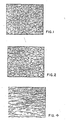
- Figures 1 and 2 are photomicrographs of the prior art material.
- Figure 1 is a photomicrograph taken at about 200x magnification of essentially spherical grain tungsten heavy alloy material in the as-sintered condition.
- Figure 2 is a photomicrograph taken at about 200x magnification of essentially spherical grain tungsten heavy alloy material in a slightly worked condition, that is, worked to about a 30% reduction in diameter, or a length to diameter ratio of about 1.5 to 1.
- Figure 2 shows that even with a slight amount of working, there are defects present.
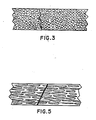
- Figure 3 is a schematic diagram showing how crack propagation occurs in spherical grain tungsten heavy alloy material. It can be seen from Figure 3 that the crack can follow a path around the tungsten particles, so that it is not necessary to fracture the tungsten particles to weaken the article.
- Figure 4 is a photomicrograph taken at about 200x magnification of the article of this invention, in which the tungsten grains are essentially elongated. In elongated tungsten grain articles, the crack cannot transverse the structure of the article without passing through the tungsten particles, and therefore a crack is difficult to propagate.
- Figure 5 is a schematic diagram showing where crack propagation would occur in such an article. When the article is a kinetic energy penetrator, the penetrator is strengthened as a result of the elongated tungsten grain structure.
- the preferred article of this invention is a kinetic energy penetrator.
- Kinetic energy penetrators must have the strength to resist cracking since high bending stresses which cause cracking are generated when the penetrator hits a target.
- the target is usually at high obliquity to the path of the penetrator.
- the penetrator strikes the target, the penetrator is deflected from its original path and this in effect bends the penetrator and when the length to diameter ratio of the tungsten grains is less than about 2 to 1, the penetrator fractures in a transverse manner. That fracturing reduces its ability to perforate the target.
- the penetrator With the elongated grain structure, that is, a length to diameter ratio of at least about 2 to 1, the penetrator is more able to resist fracturing and, therefore, gives better performance.
- the article can be produced by conventional methods such as swaging or hydrostatic extrusion.
- tungsten heavy metal alloy body In hydrostatic extrusion, a tungsten heavy metal alloy body is surrounded by fluid in the extrusion chamber. The ram comes in contact with the fluid creating pressure which forces the article out of the die.
- the preferred method of producing the article of this invention is by rolling the tungsten heavy alloy body in a tandem rolling mill.
- One advantage of this method is that the body can be heavily worked without introducing an excessive number of defects to obtain the critical length to diameter ratio.
- the body which has been previously pressed and sintered and which is of the material described previously is rolled in the tandem rolling mill which has a succession of rolling stands, each stand consisting essentially of three rolls positioned at about 120° to each other so that the gap between the rolls is a triangle, each stand being rotated about 180° with respect to the adjacent roll stands, so that the resulting rolled article has a hexagonal cross section.
- Each stand is calibrated to give a successive reduction in diameter of the body.
- the amount of reduction in diameter of the body corresponds to the length to diameter ratio of the tungsten grains in the article. Typically a 2.8 to 1 length to diameter ratio corresponds to about a 50% reduction.
- the three point loading of the body during loading creates a stress system which is not as likely tp cause fracture as the more common two point loading rolling mills.
- High rod rolling speeds such as in excess of about 2000 feet per minute can be attained.
- Tungsten has a very low specific heat and a high thermal conductivity and, therefore, cools very fast. The rolling speed is fast enough so that the cooling rate is balanced by the heat generated by the deformation process and constant OR slightly increasing temperature rolling results.
- the rolling is done at a sufficient temperature to produce the article having essentially elongated grains. Temperatures are no greater than about 1000°C and are preferably from about 650°C to about 800°C with about 700°C being especially preferred. If the temperature rises much above about 900°C, microcracking is noticed. If the temperature is lower than the ranges given, there is too much stress on the rolling mill.
- the preferred tandem rolling mill is manufactured by Friedrich Kocks and is sold under the name of Kocks Rolling Mill.
- tandem roll milling is that the article which is generally a long rod can be cut into many small parts. This is opposed to having to press, sinter, and work each individual part.
- the article can be annealed at from about 600°C to about 1400°C depending on the specific properties desired.
- the mill is set up to obtain the amount of rolling required.
- a typical mill has twelve stand positions. Each stand typically gives a reduction in area of about 18%.
- the stand calibration is expressed as a plug gauge size. That is, it is the diameter of a body, in particular, a rod that just fits into the gap between the rolls.
- Stands having plug sizes of about 0.480, 0.435, 0.394, and 0.357 inch are put into the first four stand positions. Bars having a diameter of about 0.526 inch are heated to temperatures of about 300°C, 700°C, and 900°C and fed into the mill. All the bars roll successfully. However, rolling at about 300°C places a high loading on the mill so that this temperature is not desirable. Rolling at about 900°C gives a large number of defects in the rolled rod. Those defects are microcracks which form at the tungsten/nickel alloy (matrix) interface. For these reasons rolling at about 700°C is preferred.
- Three additional stands are added to the above stands having plug gauge sizes of about 0.321, 0.281, and 0.300 inch.
- the latter stand is a finishing stand which has only a10% reduction so that a more uniform hexagon is produced. Bars are heated to about 700°C and fed into the mill and are again rolled successfully. The bars after rolling have a cross sectional area of about 0. 1030 sq. in. giving an overall reduction of about 53%.
- Two additional stands having plug gauge sizes of about 0.586 and about 0.530 inch are added to the front (larger diameter) end of the stand line giving a total of nine stands. Bars having a diameter of about 0.700 inch are rolled using a preheat temperature of about 700°C. A total reduction of about 73% is obtained. Therefore, the above three examples show that by increasing the number of stands, the amount of reduction is increased. The work described above is done at a rolling speed of about 300 RPM.
- Example 2 With seven stands in place as in Example 2, tests are run at several rolling speeds, that is, RPM's of the driving motors. At a rolling temperature of about 700°C and an RPM of about 300, the temperature of the bar exiting the mill is about 1000°C which is too high. The RPM is lowered to about 200, 250, and 150. At about 150 RPM, the bar is noticeably colder than at the higher RPM's and the mill becomes overloaded. It is believed that a rolling speed of about 250 RPM is satisfactory.
Landscapes
- Chemical & Material Sciences (AREA)
- Engineering & Computer Science (AREA)
- Mechanical Engineering (AREA)
- Materials Engineering (AREA)
- Metallurgy (AREA)
- Organic Chemistry (AREA)
- Physics & Mathematics (AREA)
- Thermal Sciences (AREA)
- Crystallography & Structural Chemistry (AREA)
- Manufacturing & Machinery (AREA)
- Catalysts (AREA)
- Carbon And Carbon Compounds (AREA)
- Reduction Rolling/Reduction Stand/Operation Of Reduction Machine (AREA)
- Metal Rolling (AREA)
- Powder Metallurgy (AREA)
Priority Applications (1)
| Application Number | Priority Date | Filing Date | Title |
|---|---|---|---|
| AT86103186T ATE54841T1 (de) | 1985-07-10 | 1986-03-10 | Herstellungsverfahren fuer ein langgestrecktes produkt aus wolframhartmetall. |
Applications Claiming Priority (2)
| Application Number | Priority Date | Filing Date | Title |
|---|---|---|---|
| US75384385A | 1985-07-10 | 1985-07-10 | |
| US753843 | 1996-12-02 |
Publications (3)
| Publication Number | Publication Date |
|---|---|
| EP0209632A2 true EP0209632A2 (de) | 1987-01-28 |
| EP0209632A3 EP0209632A3 (en) | 1987-07-22 |
| EP0209632B1 EP0209632B1 (de) | 1990-07-25 |
Family
ID=25032391
Family Applications (1)
| Application Number | Title | Priority Date | Filing Date |
|---|---|---|---|
| EP86103186A Expired - Lifetime EP0209632B1 (de) | 1985-07-10 | 1986-03-10 | Herstellungsverfahren für ein langgestrecktes Produkt aus Wolframhartmetall |
Country Status (3)
| Country | Link |
|---|---|
| EP (1) | EP0209632B1 (de) |
| AT (1) | ATE54841T1 (de) |
| DE (1) | DE3672915D1 (de) |
Cited By (3)
| Publication number | Priority date | Publication date | Assignee | Title |
|---|---|---|---|---|
| US4768365A (en) * | 1987-11-23 | 1988-09-06 | Gte Products Corporation | Process for producing tungsten heavy alloy sheet |
| EP0313484A1 (de) * | 1987-10-23 | 1989-04-26 | Cime Bocuze Sa | Wolfram-Nickel-Eisen-Schwermetallegierungen mit sehr hohen mechanischen Eigenschaften und Verfahren zur Herstellung dieser Legierungen |
| CN113263177A (zh) * | 2021-04-15 | 2021-08-17 | 成都虹波实业股份有限公司 | 一种改善钨合金棒材大小头的制备方法 |
Families Citing this family (1)
| Publication number | Priority date | Publication date | Assignee | Title |
|---|---|---|---|---|
| US11043352B1 (en) | 2019-12-20 | 2021-06-22 | Varex Imaging Corporation | Aligned grain structure targets, systems, and methods of forming |
Family Cites Families (7)
| Publication number | Priority date | Publication date | Assignee | Title |
|---|---|---|---|---|
| FR1330469A (fr) * | 1962-08-02 | 1963-06-21 | Plansee Metallwerk | Contacts pour interrupteurs à haute tension |
| US3859055A (en) * | 1966-10-27 | 1975-01-07 | Mallory & Co Inc P R | Tungsten-nickel-iron shaping members |
| DE1558821B2 (de) * | 1967-03-25 | 1975-10-02 | Veb Keramische Werke Hermsdorf, X 6530 Hermsdorf | Verfahren zur Erhöhung der Duktilität von aus Wolfram oder Wolframlegierungen bestehendem Halbzeug |
| DE2242760C3 (de) * | 1970-11-27 | 1975-02-20 | Patent-Treuhand-Gesellschaft Fuer Elektrische Gluehlampen Mbh, 8000 Muenchen | Walzgerüst zum Warmwalzen von Metalldraht |
| FR2125256B1 (de) * | 1971-02-20 | 1976-10-29 | Properzi Ilario | |
| FR2355922A1 (fr) * | 1976-06-23 | 1978-01-20 | Eurotungstene | Outil de travail a chaud des metaux |
| US4458599A (en) * | 1981-04-02 | 1984-07-10 | Gte Products Corporation | Frangible tungsten penetrator |
-
1986
- 1986-03-10 AT AT86103186T patent/ATE54841T1/de not_active IP Right Cessation
- 1986-03-10 DE DE8686103186T patent/DE3672915D1/de not_active Expired - Lifetime
- 1986-03-10 EP EP86103186A patent/EP0209632B1/de not_active Expired - Lifetime
Cited By (4)
| Publication number | Priority date | Publication date | Assignee | Title |
|---|---|---|---|---|
| EP0313484A1 (de) * | 1987-10-23 | 1989-04-26 | Cime Bocuze Sa | Wolfram-Nickel-Eisen-Schwermetallegierungen mit sehr hohen mechanischen Eigenschaften und Verfahren zur Herstellung dieser Legierungen |
| FR2622209A1 (fr) * | 1987-10-23 | 1989-04-28 | Cime Bocuze | Alliages lourds de tungstene-nickel-fer a tres hautes caracteristiques mecaniques et procede de fabrication desdits alliages |
| US4768365A (en) * | 1987-11-23 | 1988-09-06 | Gte Products Corporation | Process for producing tungsten heavy alloy sheet |
| CN113263177A (zh) * | 2021-04-15 | 2021-08-17 | 成都虹波实业股份有限公司 | 一种改善钨合金棒材大小头的制备方法 |
Also Published As
| Publication number | Publication date |
|---|---|
| EP0209632B1 (de) | 1990-07-25 |
| ATE54841T1 (de) | 1990-08-15 |
| EP0209632A3 (en) | 1987-07-22 |
| DE3672915D1 (de) | 1990-08-30 |
Similar Documents
| Publication | Publication Date | Title |
|---|---|---|
| Mao et al. | A review on mechanical properties and microstructure of ultrafine grained metals and alloys processed by rotary swaging | |
| Semiatin | Metalworking: bulk forming | |
| US5600989A (en) | Method of and apparatus for processing tungsten heavy alloys for kinetic energy penetrators | |
| US4066449A (en) | Method for processing and densifying metal powder | |
| Rosochowski | Processing metals by severe plastic deformation | |
| JPH0297652A (ja) | 侵徹式弾丸を成形する方法 | |
| Johnson et al. | A survey of some physical defects arising in metal working processes | |
| Wang et al. | Severe plastic deformation techniques for bulk ultrafine-grained materials | |
| AU575984B2 (en) | Dispersion strengthened extruded powder metal rod and die | |
| US4749410A (en) | Elongated tungsten heavy metal aritcle and method for producing same | |
| CN108453130B (zh) | 大尺寸铝合金超细晶棒材的螺线圆锥辊等辊距轧制方法 | |
| Gamin et al. | Prediction of billet fracture at two-high screw rolling piercing | |
| Ghadimi et al. | Experimental and numerical investigation of a Cu–Al bimetallic tube produced by ECAP | |
| Akbarzadeh et al. | Investigation of mechanical and microstructural properties of pure copper processed by combined extrusion-equal channel angular pressing (C-Ex-ECAP) | |
| US5154780A (en) | Metallurgical products improved by deformation processing and method thereof | |
| CN108405607A (zh) | 一种大尺寸铝合金超细晶棒材的等距螺旋轧制方法 | |
| CH675089A5 (de) | ||
| Furrer et al. | Fundamentals of Modeling for metals processing | |
| EP0209632B1 (de) | Herstellungsverfahren für ein langgestrecktes Produkt aus Wolframhartmetall | |
| EP0489106B1 (de) | Strangpressen von metallen | |
| Lipińska et al. | A new hybrid process to produce ultrafine grained aluminium plates | |
| CN101983252A (zh) | 镁合金原材料的制造方法 | |
| Lewandowska et al. | Grain refinement in aluminium and the aluminium Al-Cu-Mg-Mn alloy by hydrostatic extrusion | |
| Nagasekhar et al. | Equal channel angular extrusion of tubular aluminum alloy specimens—analysis of extrusion pressures and mechanical properties | |
| EP0356718A2 (de) | Verfahren zur Formgebung und Verbesserung der mechanischen Eigenschaften von pulvermetallurgisch hergestellten Rohlingen aus einer Legierung mit erhöhter Warmfestigkeit durch Strangpressen |
Legal Events
| Date | Code | Title | Description |
|---|---|---|---|
| PUAI | Public reference made under article 153(3) epc to a published international application that has entered the european phase |
Free format text: ORIGINAL CODE: 0009012 |
|
| 17P | Request for examination filed |
Effective date: 19860310 |
|
| AK | Designated contracting states |
Kind code of ref document: A2 Designated state(s): AT DE FR GB NL |
|
| PUAL | Search report despatched |
Free format text: ORIGINAL CODE: 0009013 |
|
| AK | Designated contracting states |
Kind code of ref document: A3 Designated state(s): AT DE FR GB NL |
|
| 17Q | First examination report despatched |
Effective date: 19880411 |
|
| GRAA | (expected) grant |
Free format text: ORIGINAL CODE: 0009210 |
|
| AK | Designated contracting states |
Kind code of ref document: B1 Designated state(s): AT DE FR GB NL |
|
| REF | Corresponds to: |
Ref document number: 54841 Country of ref document: AT Date of ref document: 19900815 Kind code of ref document: T |
|
| REF | Corresponds to: |
Ref document number: 3672915 Country of ref document: DE Date of ref document: 19900830 |
|
| ET | Fr: translation filed | ||
| PGFP | Annual fee paid to national office [announced via postgrant information from national office to epo] |
Ref country code: FR Payment date: 19910327 Year of fee payment: 6 |
|
| PLBE | No opposition filed within time limit |
Free format text: ORIGINAL CODE: 0009261 |
|
| STAA | Information on the status of an ep patent application or granted ep patent |
Free format text: STATUS: NO OPPOSITION FILED WITHIN TIME LIMIT |
|
| 26N | No opposition filed | ||
| PG25 | Lapsed in a contracting state [announced via postgrant information from national office to epo] |
Ref country code: FR Effective date: 19921130 |
|
| REG | Reference to a national code |
Ref country code: FR Ref legal event code: ST |
|
| PGFP | Annual fee paid to national office [announced via postgrant information from national office to epo] |
Ref country code: AT Payment date: 19940325 Year of fee payment: 9 |
|
| PGFP | Annual fee paid to national office [announced via postgrant information from national office to epo] |
Ref country code: NL Payment date: 19940331 Year of fee payment: 9 |
|
| PGFP | Annual fee paid to national office [announced via postgrant information from national office to epo] |
Ref country code: DE Payment date: 19940429 Year of fee payment: 9 |
|
| PGFP | Annual fee paid to national office [announced via postgrant information from national office to epo] |
Ref country code: GB Payment date: 19940902 Year of fee payment: 9 |
|
| PG25 | Lapsed in a contracting state [announced via postgrant information from national office to epo] |
Ref country code: GB Effective date: 19950310 Ref country code: AT Effective date: 19950310 |
|
| PG25 | Lapsed in a contracting state [announced via postgrant information from national office to epo] |
Ref country code: NL Effective date: 19951001 |
|
| GBPC | Gb: european patent ceased through non-payment of renewal fee |
Effective date: 19950310 |
|
| NLV4 | Nl: lapsed or anulled due to non-payment of the annual fee |
Effective date: 19951001 |
|
| PG25 | Lapsed in a contracting state [announced via postgrant information from national office to epo] |
Ref country code: DE Effective date: 19951201 |