EP0209676A2 - Wegmesseinrichtung - Google Patents
Wegmesseinrichtung Download PDFInfo
- Publication number
- EP0209676A2 EP0209676A2 EP86107165A EP86107165A EP0209676A2 EP 0209676 A2 EP0209676 A2 EP 0209676A2 EP 86107165 A EP86107165 A EP 86107165A EP 86107165 A EP86107165 A EP 86107165A EP 0209676 A2 EP0209676 A2 EP 0209676A2
- Authority
- EP
- European Patent Office
- Prior art keywords
- reference mark
- signal
- scanning device
- switching means
- scanning
- Prior art date
- Legal status (The legal status is an assumption and is not a legal conclusion. Google has not performed a legal analysis and makes no representation as to the accuracy of the status listed.)
- Granted
Links
- 238000011156 evaluation Methods 0.000 claims abstract description 4
- 238000006073 displacement reaction Methods 0.000 claims description 6
- 239000000463 material Substances 0.000 claims description 6
- 235000014676 Phragmites communis Nutrition 0.000 description 7
- 230000008901 benefit Effects 0.000 description 2
- 230000002745 absorbent Effects 0.000 description 1
- 239000002250 absorbent Substances 0.000 description 1
- 230000009471 action Effects 0.000 description 1
- 238000001514 detection method Methods 0.000 description 1
- 230000004907 flux Effects 0.000 description 1
- 238000005286 illumination Methods 0.000 description 1
- 230000003993 interaction Effects 0.000 description 1
- 239000002184 metal Substances 0.000 description 1
- 238000000034 method Methods 0.000 description 1
- 230000003287 optical effect Effects 0.000 description 1
- 230000000737 periodic effect Effects 0.000 description 1
- 230000008569 process Effects 0.000 description 1
- 230000005855 radiation Effects 0.000 description 1
Images

Classifications
-
- G—PHYSICS
- G01—MEASURING; TESTING
- G01D—MEASURING NOT SPECIALLY ADAPTED FOR A SPECIFIC VARIABLE; ARRANGEMENTS FOR MEASURING TWO OR MORE VARIABLES NOT COVERED IN A SINGLE OTHER SUBCLASS; TARIFF METERING APPARATUS; MEASURING OR TESTING NOT OTHERWISE PROVIDED FOR
- G01D5/00—Mechanical means for transferring the output of a sensing member; Means for converting the output of a sensing member to another variable where the form or nature of the sensing member does not constrain the means for converting; Transducers not specially adapted for a specific variable
- G01D5/26—Mechanical means for transferring the output of a sensing member; Means for converting the output of a sensing member to another variable where the form or nature of the sensing member does not constrain the means for converting; Transducers not specially adapted for a specific variable characterised by optical transfer means, i.e. using infrared, visible, or ultraviolet light
- G01D5/32—Mechanical means for transferring the output of a sensing member; Means for converting the output of a sensing member to another variable where the form or nature of the sensing member does not constrain the means for converting; Transducers not specially adapted for a specific variable characterised by optical transfer means, i.e. using infrared, visible, or ultraviolet light with attenuation or whole or partial obturation of beams of light
- G01D5/34—Mechanical means for transferring the output of a sensing member; Means for converting the output of a sensing member to another variable where the form or nature of the sensing member does not constrain the means for converting; Transducers not specially adapted for a specific variable characterised by optical transfer means, i.e. using infrared, visible, or ultraviolet light with attenuation or whole or partial obturation of beams of light the beams of light being detected by photocells
- G01D5/347—Mechanical means for transferring the output of a sensing member; Means for converting the output of a sensing member to another variable where the form or nature of the sensing member does not constrain the means for converting; Transducers not specially adapted for a specific variable characterised by optical transfer means, i.e. using infrared, visible, or ultraviolet light with attenuation or whole or partial obturation of beams of light the beams of light being detected by photocells using displacement encoding scales
-
- G—PHYSICS
- G01—MEASURING; TESTING
- G01D—MEASURING NOT SPECIALLY ADAPTED FOR A SPECIFIC VARIABLE; ARRANGEMENTS FOR MEASURING TWO OR MORE VARIABLES NOT COVERED IN A SINGLE OTHER SUBCLASS; TARIFF METERING APPARATUS; MEASURING OR TESTING NOT OTHERWISE PROVIDED FOR
- G01D5/00—Mechanical means for transferring the output of a sensing member; Means for converting the output of a sensing member to another variable where the form or nature of the sensing member does not constrain the means for converting; Transducers not specially adapted for a specific variable
- G01D5/26—Mechanical means for transferring the output of a sensing member; Means for converting the output of a sensing member to another variable where the form or nature of the sensing member does not constrain the means for converting; Transducers not specially adapted for a specific variable characterised by optical transfer means, i.e. using infrared, visible, or ultraviolet light
- G01D5/32—Mechanical means for transferring the output of a sensing member; Means for converting the output of a sensing member to another variable where the form or nature of the sensing member does not constrain the means for converting; Transducers not specially adapted for a specific variable characterised by optical transfer means, i.e. using infrared, visible, or ultraviolet light with attenuation or whole or partial obturation of beams of light
- G01D5/34—Mechanical means for transferring the output of a sensing member; Means for converting the output of a sensing member to another variable where the form or nature of the sensing member does not constrain the means for converting; Transducers not specially adapted for a specific variable characterised by optical transfer means, i.e. using infrared, visible, or ultraviolet light with attenuation or whole or partial obturation of beams of light the beams of light being detected by photocells
- G01D5/36—Forming the light into pulses
- G01D5/366—Particular pulse shapes
Definitions
- the invention relates to a displacement measuring device according to the preamble of claim 1.
- Such measuring devices are well known as length or angle measuring devices from the prior art.
- DE-AS 25 40 412 describes an incremental measuring system which has a number of reference marks. Any number can be selected from the large number of reference marks by means of a switching element.
- the invention is therefore based on the object of designing a displacement measuring device in such a way that the evaluation device can recognize whether the scanning device is to the left or right of a reference mark.
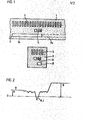
- FIG. 1 shows a section of an incremental material measure 1 and an associated scanning device 2 in a greatly simplified manner and arranged next to one another.
- the scanning device 2 is at a short distance above the material measure 1 and scans it by scanning the scanning fields 3 over the increments 4 in the measuring direction, whereby the radiation from a light source, not shown, is modulated and converted into periodic scanning signals by photo elements, not shown. This principle is well known, so we will not go into it here.
- the measuring standard 1 also carries a track (not designated in more detail) with a reference mark 5, to which a separate reference mark reading element 6 is assigned on the scanning device 2.
- a reference mark reading element 6 is also followed by a photo element which converts the modulated luminous flux into a reference pulse. This also does not have to be described in more detail here, because the generation of reference pulses is already known from DE-OS 18 14 785.
- a further track 7 is provided on the material measure 1, which is scanned by a separate scanning field 8 of the scanning device 2.
- the track 7 runs parallel to the scale track with the increments 4.
- a region of the track 7, here the translucent part, is designated 7a.
- an area is opaque and designated 7b.
- the scanning field 8 assigned to the track 7 is also followed by a photo element, not shown, which is illuminated by the design of the track 7 on one side of the reference mark 5 and is not illuminated on the other side of the reference mark 5.
- the interaction of the reference mark reading element 6 with the scanning field 8 results in a signal curve as shown in FIG. 2.
- the scanning field 8 is illuminated by the track 7a, and a reference signal R with the level A is accordingly generated.
- the reference mark 5 is completely run over by its reference mark reading field 6 and a reference pulse RJ arises.
- the scanning field 8 reaches the non-translucent area 7b of the track 7, so that the photo element assigned to the scanning field 8 is not illuminated, and a signal level B on the reference signal R is established.
- the evaluation device which can be part of a numerical position display or control, can therefore see whether the scanning device 2 is located to the right or left of the reference mark 5.
- This detection of the position of the scanning device 2 relative to the reference mark 5 can also be implemented by switching means other than the photoelectrically operating switching elements described.
- a length measuring device L shown in FIG. 3 carries a material measure 13 in a hollow profile 0.
- the scanning device 23 is arranged in a housing G and can be displaced in the measuring direction relative to the hollow profile 0.
- An indicated reference mark 53 is scanned by the reference mark reading element (not shown) in the manner described above.
- a microswitch 83 takes over the function of the scanning field 8 according to FIG. 1.
- a switching cam 73 with the areas 73a and 73b is arranged on the housing G of the scanning device 23.
- the microswitch 83 is open; if it is to the left of the reference mark 53, it is closed and a signal is connected to the reference signal, which is indicated by the cable connection 9 between the scanning device 23 and the microswitch 83.
- FIG. 1 Another variant of a length measuring device is shown in FIG.
- the structurally identical elements are marked with the index "4", only the different measures are to be explained here.
- a so-called reed switch 84 which can be magnetically influenced, is arranged in the housing G4 for the scanning device 24.
- a magnetic strip 74a is attached to the hollow profile 04 in the area of influence of the reed switch 84 as a switching element.
- the magnetic bar 74a extends on one side to the vicinity of the reference mark 54. If the scanning device 24 is now to the left of the reference mark 53, the reed switch 84 is closed by the action of the magnetic bar 74a and becomes the reference mark reading element described above but not shown here another signal switched on. On the other side of the reference mark 54, the reed switch 84 opens again, since no magnetic forces act on it in the region 74b. In this way, different signal levels are generated on both sides of the reference mark 54 in this embodiment as well.
- the track for illuminating the scanning field described for FIG. 1 can also be replaced by any illumination which is shaded by a diaphragm on one side of the reference mark. It is also possible to assign a magnet to the reed switch on the scanning device and to generate a magnetic short circuit through a metal sheet on one side of the reference mark, which engages between the magnet and the reed switch, so that the reed switch opens.
- the invention can be implemented with both length and angle measuring devices, it being irrelevant which physical scanning principle is used.
Landscapes
- Physics & Mathematics (AREA)
- General Physics & Mathematics (AREA)
- Length Measuring Devices By Optical Means (AREA)
- Length Measuring Devices With Unspecified Measuring Means (AREA)
- Transmission And Conversion Of Sensor Element Output (AREA)
- Measurement Of Radiation (AREA)
- Transplanting Machines (AREA)
- Investigating Or Analysing Biological Materials (AREA)
Abstract
Description
- Die Erfindung bezieht sich auf eine Wegmeßeinrichtung gemäß dem Oberbegriff des Anspruchs 1.
- Derartige Wegmeßeinrichtungen sind als Längen-oder Winkelmeßeinrichtungen aus dem Stand der Technik hinlänglich bekannt.
- So ist beispielsweise in der DE-AS 25 40 412 ein inkrementales Meßsystem beschrieben, das eine Reihe von Referenzmarken aufweist. Mittels eines Schaltelementes kann aus der Vielzahl von Referenzmarken eine beliebige Anzahl ausgewählt werden.
- Aus den DE-PS 31 44 334 und DE-PS 30 39 483 ist es darüber hinaus bekannt, den Referenzmarken eine individuelle Kodierung als Identifizierungsmerkmal zuzuordnen.
- Daß darüber hinaus in der Patentliteratur noch eine Reihe weiterer WegmeBeinrichtungen mit Referenzmarken beschrieben werden, sei hier nur der Vollständigkeit halber erwähnt.
- Alle diese Wegmeßeinrichtungen mit Referenzmarken ermöglichen es jedoch nicht,zu erkennen, ob sich die Abtasteinrichtung auf der einen oder der anderen Seite, d.h. links oder rechts von der jeweiligen Referenzmarke befindet.
- Der Erfindung liegt daher die Aufgabe zugrunde, eine Wegmeßeinrichtung so auszubilden, daß von der Auswerteeinrichtung erkannt werden kann, ob sich die Abtasteinrichtung links oder rechts von einer Referenzmarke befindet.
- Diese Aufgabe wird von einer Wegmeßeinrichtung mit den Merkmalen des Anspruchs 1 gelöst.
- Die besonderen Vorteile einer derart ausgestalteten Wegmeßeinrichtung liegen darin, daß zur Wiedergewinnung einer Bezugsposition nach beliebigen Unterbrechungen des Meß- bzw. Arbeitsvorganges die nächste Referenzmarke sofort in der richtigen Richtung angefahren werden kann, da ja bekannt ist, auf welcher Seite der Referenzmarke man sich befindet. Diese Kenntnis ist auch für die Sicherheit an der Maschine von sehr großem Vorteil, vor allem, wenn sich jeweils in den Endbereichen der Maßverkörperung Referenzmarken befinden, wie das sehr häufig der Fall ist. Nach Arbeitsunterbrechungen kann die Bedienungsperson oder auch die numerische Steuerung der Maschine sofort erkennen, in welche Richtung der Maschinenschlitten verfahren werden muß, um die nächste Referenzmarke zu überfahren und so die Bezugsposition zu reproduzieren.
- Mit Hilfe der Zeichnungen soll anhand von Ausführungsbeispielen die Erfindung noch näher erläutert werden.
-
- Figur 1 einen Maßverkörperungsausschnitt mit zugehöriger Abtasteinrichtung in der Draufsicht;
- Figur 2 einen typischen Verlauf eines Referenzsignals;
- Figur 3 eine schematisierte Wegme Beinrichtung in Seitenansicht;
- Figur 4 eine Variante einer Wegmeßeinrichtung in Seitenansicht.
- In Figur 1 ist aus Gründen der Übersichtlichkeit ein Ausschnitt einer inkrementalen Maßverkörperung 1 und eine zugehörige Abtasteinrichtung 2 stark vereinfacht und nebeneinander angeordnet dargestellt. Im praktischen Meßbetrieb liegt jedoch die Abtasteinrichtung 2 in geringem Abstand über der Maßverkörperung 1 und tastet diese ab, indem die Abtastfelder 3 die Inkremente 4 in Meßrichtung überstreichen, wodurch die Strahlung einer nicht gezeigten Lichtquelle moduliert und von nicht dargestellten Fotoelementen in periodische Abtastsignale umgewandelt wird. Dieses Prinzip ist hinreichend bekannt, hier soll daher nicht näher darauf eingegangen werden.
- Neben der Skalenspur mit den Inkrementen 4 trägt die Maßverkörperung 1 noch eine nicht näher bezeichnete Spur mit einer Referenzmarke 5, der auf der Abtasteinrichtung 2 ein eigenes Referenzmarken-Leseelement 6 zugeordnet ist. Selbstverständlich ist auch dem Referenzmarken-Leseelement 6 ein Fotoelement nachgeordnet, das den modulierten Lichtstrom in einen Referenzimpuls umwandelt. Auch das muß hier nicht mehr näher beschrieben werden, denn die Erzeugung von Referenzimpulsen ist bereits aus der DE-OS 18 14 785 bekannt.
- Auf der Maßverkörperung 1 ist jedoch noch eine weitere Spur 7 vorgesehen, die von einem separaten Abtastfeld 8 der Abtasteinrichtung 2 abgetastet wird. Die Spur 7 verläuft parallel zu der Skalenspur mit den Inkrementen 4. In der Nähe der Referenzmarke 5 wechselt ihr optisches Verhalten von transparent nach opak, oder von reflektierend nach absorbierend, oder aber auch von nichttransparent nach teildurchlässig. Ein Bereich der Spur 7, hier der lichtdurchlässige Teil, ist mit 7a bezeichnet. Rechts von der Referenzmarke 5 ist ein Bereich lichtundurchlässig und mit 7b bezeichnet. Dem der Spur 7 zugeordneten Abtastfeld 8 ist ebenfalls ein nicht dargestelltes Fotoelement nachgeordnet, das durch die Gestaltung der Spur 7 auf einer Seite der Referenzmarke 5 beleuchtet wird, und auf der anderen Seite der Referenzmarke 5 nicht beleuchtet wird.
- Da das Fotoelement für die Referenzmarke 5 und das Fotoelement für die Spur 7 elektrisch zusammengeschaltet sind, ergibt sich im Zusammenwirken des Referenzmarken-Leseelementes 6 mit dem Abtastfeld 8 ein-Signalverlauf, wie er in Figur 2 dargestellt ist. Solange sich das Referenzmarken-Leseelement 6 und das Abtastfeld 8 links von der Referenzmarke 5 befinden, wird durch die Spur 7a das Abtastfeld 8 beleuchtet, und es wird demgemäß ein Referenzsignal R mit dem Pegel A erzeugt. Im weiteren Verlauf der Abtastbewegung in Meßrichtung von links nach rechts wird die Referenzmarke 5 von ihrem Referenzmarken-Lesefeld 6 vollständig überfahren und es entsteht ein Referenzimpuls RJ. Anschließend gelangt das Abtastfeld 8 in den nicht lichtdurchlässigen Bereich 7b der Spur 7, so daß das dem Abtastfeld 8 zugeordnete Fotoelement nicht beleuchtet wird, und sich ein Signalpegel B am Referenzsignal R einstellt.
- Aus den unterschiedlichen Signalpegeln A und B des Referenzsignales R ist also für die Auswerteeinrichtung, die Teil einer numerischen Positionsanzeige oder Steuerung sein kann, erkennbar, ob die Abtasteinrichtung 2 sich rechts oder links von der Referenzmarke 5 befindet.
- Diese Erkennung der Position der Abtasteinrichtung 2 relativ zur Referenzmarke 5 ist auch durch andere Schaltmittel als die beschriebenen lichtelektrisch arbeitenden Schaltelemente realisierbar.
- Eine in Figur 3 gezeigte Längenmeßeinrichtung L trägt in einem Hohlprofil 0 eine Maßverkörperung 13. In einem Gehäuse G ist die Abtasteinrichtung 23 angeordnet und relativ zum Hohlprofil 0 in Meßrichtung verschiebbar. Eine angedeutete Referenzmarke 53 wird vom nicht dargestellten Referenzmarken-Leseelement in vorbeschriebener Weise abgetastet. Ein Mikroschalter 83 übernimmt bei dieser Ausführungsform die Funktion des Abtastfeldes 8 gemäß Figur 1. Dazu ist am Gehäuse G der Abtasteinrichtung 23 ein Schaltnocken 73 mit den Bereichen 73a und 73b angeordnet. Befindet sich die Abtasteinrichtung 23 rechts von der Referenzmarke 53, so ist der Mikroschalter 83 geöffnet; befindet sie sich links von der Referenzmarke 53, so ist er geschlossen, und dem Referenzsignal wird ein Signal zugeschaltet, was durch die Kabelverbindung 9 zwischen der Abtasteinrichtung 23 und dem Mikroschalter 83 angedeutet wird.
- In Figur 4 wird eine weitere Variante einer Längenmeßeinrichtung gezeigt. Die baugleichen Elemente sind mit dem Index "4" gekennzeichnet, es sollen hier nur die abweichenden Maßnahmen erläutert werden.
- Im Gehäuse G4 für die Abtasteinrichtung 24 ist ein sogenannter Reedschalter 84 angeordnet, der magnetisch beeinflußbar ist. Am Hohlprofil 04 ist im Einflußbereich des Reedschalters 84 als Schaltelement eine Magnetleiste 74a angebracht. Die Magnetleiste 74a reicht auf einer Seite bis in die Nähe der Referenzmarke 54. Befindet sich nun die Abtasteinrichtung 24 links von der Referenzmarke 53, so wird der Reedschalter 84 durch die Wirkung der Magnetleiste 74a geschlossen und dem vorbeschriebenen hier aber nicht gezeigten Referenzmarken-Leseelement wird wieder ein Signal zugeschaltet. Auf der anderen Seite der Referenzmarke 54 öffnet sich der Reedschalter 84 wieder, da im Bereich 74b keinerlei Magnetkräfte auf ihn einwirken. Auf diese Weise werden auch bei dieser Ausführungsform beiderseits der Referenzmarke 54 unterschiedliche Signalpegel erzeugt.
- Die zur Figur 1 beschriebene Spur zur Beleuchtung des Abtastfeldes kann auch durch eine beliebige Beleuchtung ersetzt werden, die auf einer Seite der Referenzmarke durch eine Blende abgeschattet wird. Ebenso ist es möglich, dem Reedschalter an der Abtasteinrichtung einen Magneten zuzuordnen, und durch ein Blech auf einer Seite der Referenzmarke, das zwischen Magnet und Reedschalter greift, einen magnetischen Kurzschluß zu erzeugen, so daß der Reedschalter öffnet.
- Der Vollständigkeit halber sei noch erwähnt, daß es völlig ins Belieben des Fachmannes gestellt bleibt, ob er rechts von der Referenzmarke einen niedrigen und links einen hohen Signalpegel vorsieht. Ebenso kann das ganze Referenzsignal invertiert werden. Diese Bedingungen richten sich nach dem gewünschten Anwendungsfall und demgemäß nach den Polaritäten der ausgewählten elektrischen Bauelemente, die zur Realisierung der Erfindung benutzt werden.
- Die Erfindung ist sowohl bei Längen- als auch bei WinkelmeBeinrichtungen realisierbar, wobei es gleichgültig ist, welches physikalische Abtastprinzip verwendet wird.
Claims (5)
Priority Applications (1)
| Application Number | Priority Date | Filing Date | Title |
|---|---|---|---|
| AT86107165T ATE56539T1 (de) | 1985-07-23 | 1986-05-27 | Wegmesseinrichtung. |
Applications Claiming Priority (2)
| Application Number | Priority Date | Filing Date | Title |
|---|---|---|---|
| DE19853526206 DE3526206A1 (de) | 1985-07-23 | 1985-07-23 | Wegmesseinrichtung |
| DE3526206 | 1985-07-23 |
Publications (3)
| Publication Number | Publication Date |
|---|---|
| EP0209676A2 true EP0209676A2 (de) | 1987-01-28 |
| EP0209676A3 EP0209676A3 (en) | 1988-08-03 |
| EP0209676B1 EP0209676B1 (de) | 1990-09-12 |
Family
ID=6276449
Family Applications (1)
| Application Number | Title | Priority Date | Filing Date |
|---|---|---|---|
| EP86107165A Expired - Lifetime EP0209676B1 (de) | 1985-07-23 | 1986-05-27 | Wegmesseinrichtung |
Country Status (3)
| Country | Link |
|---|---|
| EP (1) | EP0209676B1 (de) |
| AT (1) | ATE56539T1 (de) |
| DE (2) | DE3526206A1 (de) |
Cited By (5)
| Publication number | Priority date | Publication date | Assignee | Title |
|---|---|---|---|---|
| DE3809569A1 (de) * | 1988-03-22 | 1989-10-05 | Frankl & Kirchner | Positionsgeber |
| FR2686689A1 (fr) * | 1992-01-24 | 1993-07-30 | Paris Sud Universite | Capteur de position et jauge d'indication du niveau d'un liquide dans un reservoir comportant un tel capteur. |
| AT404191B (de) * | 1991-03-05 | 1998-09-25 | Rsf Elektronik Gmbh | Messsystem |
| WO2002065061A1 (en) * | 2001-02-14 | 2002-08-22 | Renishaw Plc | Position determination system |
| EP2878930A1 (de) * | 2013-11-28 | 2015-06-03 | Dr. Johannes Heidenhain GmbH | Positionsmesseinrichtung |
Families Citing this family (5)
| Publication number | Priority date | Publication date | Assignee | Title |
|---|---|---|---|---|
| AT395071B (de) * | 1989-02-09 | 1992-09-10 | Rieder & Schwaiger Sentop | Inkrementales messsystem |
| DD287774A5 (de) * | 1989-09-06 | 1991-03-07 | �@�@�����@���k�� | Inkrementales laengenmesssystem |
| EP0668486A3 (de) * | 1994-02-22 | 1997-07-30 | Heidenhain Gmbh Dr Johannes | Längen- oder Winkelmesseinrichtung. |
| AT410485B (de) * | 1997-07-30 | 2003-05-26 | Rsf Elektronik Gmbh | Positionsmesseinrichtung |
| DE102009028859A1 (de) * | 2009-08-25 | 2011-03-03 | Zf Friedrichshafen Ag | Vorrichtung zum Erfassen von zumindest einer Nulllage |
Family Cites Families (10)
| Publication number | Priority date | Publication date | Assignee | Title |
|---|---|---|---|---|
| DE1814785A1 (de) * | 1968-12-14 | 1970-06-25 | Johannes Heidenhain Feinmechan | Zaehlanordnung |
| BE756467A (fr) * | 1969-09-24 | 1971-03-22 | Philips Nv | Dispositif pour aligner des objets, comportant une source lumineuse, unsysteme de detection photosensible et deux porteurs pour configuration |
| DE2730715C2 (de) * | 1974-07-26 | 1991-08-29 | Heinz 5121 Ostermiething Rieder | Einrichtung zur Längenmessung |
| DE2540412C3 (de) * | 1975-09-11 | 1987-01-22 | Dr. Johannes Heidenhain Gmbh, 8225 Traunreut | Inkrementales Meßsystem |
| AT376298B (de) * | 1976-08-19 | 1984-10-25 | Rieder Heinz | Einrichtung zur laengenmessung |
| DE3039483C2 (de) * | 1980-10-18 | 1986-09-11 | Dr. Johannes Heidenhain Gmbh, 8225 Traunreut | Inkrementale Längen- oder Winkelmeßeinrichtung |
| JPS5829093A (ja) * | 1981-08-13 | 1983-02-21 | 株式会社トプコン | アブソリユ−トエンコ−ダ |
| DE3144334C2 (de) * | 1981-11-07 | 1985-06-13 | Dr. Johannes Heidenhain Gmbh, 8225 Traunreut | Wegmeßeinrichtung mit Referenzmarken |
| DE3204012C1 (de) * | 1982-02-05 | 1983-02-03 | Dr. Johannes Heidenhain Gmbh, 8225 Traunreut | Inkrementale Messeinrichtung |
| DD227844A1 (de) * | 1982-07-29 | 1985-09-25 | Naehmaschinenwerk Wittenberg V | Diskriminatorschaltung |
-
1985
- 1985-07-23 DE DE19853526206 patent/DE3526206A1/de active Granted
-
1986
- 1986-05-27 DE DE8686107165T patent/DE3674099D1/de not_active Expired - Fee Related
- 1986-05-27 EP EP86107165A patent/EP0209676B1/de not_active Expired - Lifetime
- 1986-05-27 AT AT86107165T patent/ATE56539T1/de not_active IP Right Cessation
Cited By (7)
| Publication number | Priority date | Publication date | Assignee | Title |
|---|---|---|---|---|
| DE3809569A1 (de) * | 1988-03-22 | 1989-10-05 | Frankl & Kirchner | Positionsgeber |
| AT404191B (de) * | 1991-03-05 | 1998-09-25 | Rsf Elektronik Gmbh | Messsystem |
| FR2686689A1 (fr) * | 1992-01-24 | 1993-07-30 | Paris Sud Universite | Capteur de position et jauge d'indication du niveau d'un liquide dans un reservoir comportant un tel capteur. |
| WO2002065061A1 (en) * | 2001-02-14 | 2002-08-22 | Renishaw Plc | Position determination system |
| US7141780B2 (en) | 2001-02-14 | 2006-11-28 | Renishaw Plc | Position determination system for determining the position of one relatively moveable part relative to another relatively movable part |
| EP2878930A1 (de) * | 2013-11-28 | 2015-06-03 | Dr. Johannes Heidenhain GmbH | Positionsmesseinrichtung |
| US9303981B2 (en) | 2013-11-28 | 2016-04-05 | Dr. Johannes Heidenhain Gmbh | Position-measuring device |
Also Published As
| Publication number | Publication date |
|---|---|
| ATE56539T1 (de) | 1990-09-15 |
| EP0209676B1 (de) | 1990-09-12 |
| DE3526206C2 (de) | 1989-03-23 |
| DE3526206A1 (de) | 1987-02-05 |
| DE3674099D1 (de) | 1990-10-18 |
| EP0209676A3 (en) | 1988-08-03 |
Similar Documents
| Publication | Publication Date | Title |
|---|---|---|
| DE3144334C2 (de) | Wegmeßeinrichtung mit Referenzmarken | |
| DE3910873C2 (de) | ||
| DE2730715C2 (de) | Einrichtung zur Längenmessung | |
| DE3204012C1 (de) | Inkrementale Messeinrichtung | |
| DE3308814C2 (de) | Meßeinrichtung | |
| DE3104972C2 (de) | Lichtelektrische inkrementale Positioniereinrichtung | |
| DE2501373C3 (de) | Anordnung zur Winkel- oder Längenmessung | |
| DE3526206C2 (de) | ||
| EP0395844B1 (de) | Positionsmesseinrichtung mit Referenzmarken | |
| AT410485B (de) | Positionsmesseinrichtung | |
| DE2723978C3 (de) | Vorrichtung zum Erfassen der Stellung mehrerer parallel bewegbarer Teile einer Frankiermaschine | |
| DE19726935B4 (de) | Optische Positionsmeßeinrichtung | |
| DE2934454A1 (de) | Verfahren und vorrichtung zum fotoelektrischen positionieren eines gegenstandes unter verwendung einer registermarke | |
| DE2911458A1 (de) | Vorrichtung zur erkennung von nicht praeparierten briefmarken | |
| EP0381658A2 (de) | Inkrementales Messsystem | |
| EP0115572B1 (de) | Inkrementale Messeinrichtung | |
| DE8521160U1 (de) | Wegmeßeinrichtung | |
| DE2436510C3 (de) | Vorrichtung zur Bestimmung der Lage eines gegenüber einer Skala beweglichen Bauteils | |
| CH617006A5 (en) | Device for length measurement. | |
| DE2618165C3 (de) | Elektrische Kopiersteuerungsvorrichtung für Bearbeitungsmaschinen | |
| EP4375621A1 (de) | Vorrichtung und verfahren zur positions-, längen- oder winkelbestimmung | |
| EP4537984A1 (de) | Greif- oder spannvorrichtung mit magnetischer positionserfassung | |
| DE2260064A1 (de) | Elektrische kopiersteuerungsvorrichtung fuer bearbeitungsmaschinen | |
| DE2505296B2 (de) | Elektrische Kopiersteuerungsvorrichtung für Bearbeitungsmaschinen | |
| DE2457409B1 (de) | Punktorthogonalplanimeter |
Legal Events
| Date | Code | Title | Description |
|---|---|---|---|
| PUAI | Public reference made under article 153(3) epc to a published international application that has entered the european phase |
Free format text: ORIGINAL CODE: 0009012 |
|
| 17P | Request for examination filed |
Effective date: 19860606 |
|
| AK | Designated contracting states |
Kind code of ref document: A2 Designated state(s): AT CH DE FR GB IT LI NL SE |
|
| PUAL | Search report despatched |
Free format text: ORIGINAL CODE: 0009013 |
|
| RHK1 | Main classification (correction) |
Ipc: G01D 5/34 |
|
| AK | Designated contracting states |
Kind code of ref document: A3 Designated state(s): AT CH DE FR GB IT LI NL SE |
|
| 17Q | First examination report despatched |
Effective date: 19890727 |
|
| RAP3 | Party data changed (applicant data changed or rights of an application transferred) |
Owner name: DR. JOHANNES HEIDENHAIN GMBH |
|
| ITF | It: translation for a ep patent filed | ||
| GRAA | (expected) grant |
Free format text: ORIGINAL CODE: 0009210 |
|
| AK | Designated contracting states |
Kind code of ref document: B1 Designated state(s): AT CH DE FR GB IT LI NL SE |
|
| REF | Corresponds to: |
Ref document number: 56539 Country of ref document: AT Date of ref document: 19900915 Kind code of ref document: T |
|
| ET | Fr: translation filed | ||
| GBT | Gb: translation of ep patent filed (gb section 77(6)(a)/1977) | ||
| REF | Corresponds to: |
Ref document number: 3674099 Country of ref document: DE Date of ref document: 19901018 |
|
| PGFP | Annual fee paid to national office [announced via postgrant information from national office to epo] |
Ref country code: SE Payment date: 19910425 Year of fee payment: 6 |
|
| PGFP | Annual fee paid to national office [announced via postgrant information from national office to epo] |
Ref country code: NL Payment date: 19910531 Year of fee payment: 6 |
|
| PLBE | No opposition filed within time limit |
Free format text: ORIGINAL CODE: 0009261 |
|
| STAA | Information on the status of an ep patent application or granted ep patent |
Free format text: STATUS: NO OPPOSITION FILED WITHIN TIME LIMIT |
|
| 26N | No opposition filed | ||
| PG25 | Lapsed in a contracting state [announced via postgrant information from national office to epo] |
Ref country code: SE Effective date: 19920528 |
|
| PG25 | Lapsed in a contracting state [announced via postgrant information from national office to epo] |
Ref country code: NL Effective date: 19921201 |
|
| NLV4 | Nl: lapsed or anulled due to non-payment of the annual fee | ||
| ITTA | It: last paid annual fee | ||
| EUG | Se: european patent has lapsed |
Ref document number: 86107165.2 Effective date: 19921204 |
|
| PGFP | Annual fee paid to national office [announced via postgrant information from national office to epo] |
Ref country code: AT Payment date: 19970422 Year of fee payment: 12 |
|
| PGFP | Annual fee paid to national office [announced via postgrant information from national office to epo] |
Ref country code: CH Payment date: 19970430 Year of fee payment: 12 |
|
| PG25 | Lapsed in a contracting state [announced via postgrant information from national office to epo] |
Ref country code: AT Free format text: LAPSE BECAUSE OF NON-PAYMENT OF DUE FEES Effective date: 19980527 |
|
| PG25 | Lapsed in a contracting state [announced via postgrant information from national office to epo] |
Ref country code: LI Free format text: LAPSE BECAUSE OF NON-PAYMENT OF DUE FEES Effective date: 19980531 Ref country code: CH Free format text: LAPSE BECAUSE OF NON-PAYMENT OF DUE FEES Effective date: 19980531 |
|
| REG | Reference to a national code |
Ref country code: CH Ref legal event code: PL |
|
| PGFP | Annual fee paid to national office [announced via postgrant information from national office to epo] |
Ref country code: GB Payment date: 19990413 Year of fee payment: 14 |
|
| PGFP | Annual fee paid to national office [announced via postgrant information from national office to epo] |
Ref country code: FR Payment date: 19990419 Year of fee payment: 14 |
|
| PG25 | Lapsed in a contracting state [announced via postgrant information from national office to epo] |
Ref country code: GB Free format text: LAPSE BECAUSE OF NON-PAYMENT OF DUE FEES Effective date: 20000527 |
|
| GBPC | Gb: european patent ceased through non-payment of renewal fee |
Effective date: 20000527 |
|
| PG25 | Lapsed in a contracting state [announced via postgrant information from national office to epo] |
Ref country code: FR Free format text: LAPSE BECAUSE OF NON-PAYMENT OF DUE FEES Effective date: 20010131 |
|
| REG | Reference to a national code |
Ref country code: FR Ref legal event code: ST |
|
| PGFP | Annual fee paid to national office [announced via postgrant information from national office to epo] |
Ref country code: DE Payment date: 20040510 Year of fee payment: 19 |
|
| PG25 | Lapsed in a contracting state [announced via postgrant information from national office to epo] |
Ref country code: IT Free format text: LAPSE BECAUSE OF NON-PAYMENT OF DUE FEES Effective date: 20050527 |
|
| PG25 | Lapsed in a contracting state [announced via postgrant information from national office to epo] |
Ref country code: DE Free format text: LAPSE BECAUSE OF NON-PAYMENT OF DUE FEES Effective date: 20051201 |