EP0210392A2 - Procédé pour éliminer des oxydes d'azote d'un gaz, particulièrement de fumées - Google Patents
Procédé pour éliminer des oxydes d'azote d'un gaz, particulièrement de fumées Download PDFInfo
- Publication number
- EP0210392A2 EP0210392A2 EP86107974A EP86107974A EP0210392A2 EP 0210392 A2 EP0210392 A2 EP 0210392A2 EP 86107974 A EP86107974 A EP 86107974A EP 86107974 A EP86107974 A EP 86107974A EP 0210392 A2 EP0210392 A2 EP 0210392A2
- Authority
- EP
- European Patent Office
- Prior art keywords
- adsorbent
- reducing agent
- reactor
- gas
- loading
- Prior art date
- Legal status (The legal status is an assumption and is not a legal conclusion. Google has not performed a legal analysis and makes no representation as to the accuracy of the status listed.)
- Withdrawn
Links
Images
Classifications
-
- B—PERFORMING OPERATIONS; TRANSPORTING
- B01—PHYSICAL OR CHEMICAL PROCESSES OR APPARATUS IN GENERAL
- B01D—SEPARATION
- B01D53/00—Separation of gases or vapours; Recovering vapours of volatile solvents from gases; Chemical or biological purification of waste gases, e.g. engine exhaust gases, smoke, fumes, flue gases, aerosols
- B01D53/34—Chemical or biological purification of waste gases
- B01D53/74—General processes for purification of waste gases; Apparatus or devices specially adapted therefor
- B01D53/86—Catalytic processes
- B01D53/8621—Removing nitrogen compounds
- B01D53/8625—Nitrogen oxides
-
- B—PERFORMING OPERATIONS; TRANSPORTING
- B01—PHYSICAL OR CHEMICAL PROCESSES OR APPARATUS IN GENERAL
- B01D—SEPARATION
- B01D2251/00—Reactants
- B01D2251/20—Reductants
- B01D2251/206—Ammonium compounds
- B01D2251/2062—Ammonia
-
- B—PERFORMING OPERATIONS; TRANSPORTING
- B01—PHYSICAL OR CHEMICAL PROCESSES OR APPARATUS IN GENERAL
- B01D—SEPARATION
- B01D2253/00—Adsorbents used in seperation treatment of gases and vapours
- B01D2253/10—Inorganic adsorbents
- B01D2253/102—Carbon
Definitions
- the invention relates to a method for separating NO from exhaust gases, in particular flue gases, of the type mentioned in the preamble of claim 1 above.
- Flue gases are understood to mean those flue gases which are produced during the combustion of low-sulfur fuels or whose sulfur dioxide proportions are reduced by an upstream desulfurization system based on, for example, a wet, semi-dry, dry process. Solutions or suspensions based on Ca, Mg, Na, NH 3 , for example, are used as absorbents for removing the sulfur dioxide components, as described, for example, in W. Kaminsky, Chem. Ing.-Technik 55 (1983), page 673 ff. In addition to a substantial reduction in sulfur oxides, a reduction in the nitrogen oxide content in the flue gases is required today.
- a method of the type mentioned in the preamble of claim 1 above is known, for example, from DE-OS 29 11 712, in which the nitrogen oxides are catalytically reduced to nitrogen to produce steam in a moving layer of carbon-containing adsorbents after metered addition of gaseous ammonia as reducing agent .
- This method has the disadvantage that the addition of the reducing agent into the flue gas alone before it enters the adsorbent bed achieves a sufficiently high degree of separation of greater than 60% only if the treated exhaust gas has a very high level R edutechnischsmittelschreibtechnikschuß based having on the nitrogen oxide content of the exhaust stream to be deposited.
- the invention is based on the knowledge that the reaction between the nitrogen oxides and the reducing agent takes place on the outer and inner surface of the adsorbent.
- the precharging according to the invention ensures that reducing agent is constantly stored on the outer and inner reaction surface of the solid adsorbent and is available for reaction with the nitrogen oxides contained in the exhaust gas.
- the reducing agent In comparison to a supply of the reducing agent into the gas stream before it is brought into contact with the adsorbent, the reducing agent does not have to reach the inner reaction surface of the adsorbent from the gas phase by film and / or pore diffusion, so that the pre-loading leads to a corresponding one, when the adsorbent is preloaded Leads to an increase in the reaction rate; consequently, each nitrogen oxide molecule that diffuses through the pores to the inner surface is immediately opposed to a molecule of the reducing agent as a reduction partner.
- the pre-loading is preferably carried out according to the features of claim 2. A guidance of the two material flows in countercurrent is preferred.
- the adsorbent can be transported in the direction of gravity (moving bed) or, for example, by fluidization via the reducing agent (e.g. swirl channel) or by mechanical installations within the pre-loading stage, which transfer the movement to the adsorbent bed.
- the reducing agent e.g. swirl channel
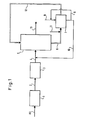
- the preloaded adsorbent is fed to a moving bed reactor.
- the preloaded adsorbent from the preloading stage is preferably fed in at its upper end and removed at its lower end, suitable feed and extraction locks being provided in each case.
- Abrasion and any solid reaction products formed between the reducing agent and the remaining sulfur oxides when desulfurization is added are removed from the adsorbent after exiting the reactor (e.g. sieving, sifting) in order to avoid loss of activity due to clogging of the pores of the solid adsorbent.
- the temperature range mentioned above, in which the preloaded adsorbent is brought into contact with the gas stream to be de-stiked, can be achieved by re-heating the preferably desulfurized exhaust gas by means of a heat exchanger (regenerative with flue gas or with external energy).
- the preloaded adsorbent can also be fed into a fixed bed reactor from a moving bed reactor. In these two cases, it is possible to abandon the entstickende flue gas and the reducing agent Adsorptionsmittelreaktoren two alternately with flue gas flows through b zw. Are loaded with the reducing agent, as claimed in claim 6.
- the reducing agent is used in a mixture with a diluent gas for pre-loading.
- excess reducing agent is added to the exhaust gas stream prior to its contact with the pre-loaded adsorbent, i.e. the remaining proportions of reducing agent, which are not absorbed by the adsorbent in the pre-loading stage, can be mixed into the exhaust gas from the gas phase of the pre-loading stage before entering the denitrification reactor. If the denitrification takes place in moving bed reactors, it is expedient to add fresh adsorbent to the adsorbent for pre-loading to compensate for the abrasion.
- the optimal rate of migration of the adsorbent through the adsorbent reactor is essentially determined by the denitrification parameters (primarily the degree of separation of the nitrogen oxides) and the change in pressure loss in the moving bed.
- the preloading of the adsorbent on the solids residence time of the adsorbent with the reducing agent, the concentration of the educts R tion by means of the charging gas and / or the temperature is in the pre-loading level.
- the nitrogen oxides to be separated are separated according to claim 11, but the aim is that a substantial proportion of the reducing agent is fed to the catalytic reaction via the pre-loading. It is therefore again preferred that 20% to 100% of the pre-charge be fed and only 80% to 0% be introduced into the exhaust gas before the catalytic reaction, preferably 50% to 100% or 50% to 0%.
- the reaction rate can be increased and the excess ammonia content can be reduced, as the following example shows, in which the excess ammonia content in purified gas is 6.0 mg / m 3 n compared to the excess of reducing agent in the known process in the amount of approximately 30 mg / m 3 n .
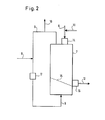
- FIG. 2 shows a preferred embodiment for the pre-loading stage 7.
- the preloading of the adsorbent supplied via line 6 with reducing agent was carried out in the example shown in a moving layer reactor 7, in the upper part of which the adsorbent is fed from the NO x separating stage 5 via a gas-tight lock 14 and during the migration through the reactor 7 with the Reducing agent 8 is loaded in countercurrent.
- a gas-permeable inclined distributor base 15 pre-loaded adsorbent is drawn off via a gas-tight lock 16 and fed to the adsorbent reactor 5 via line 12, for example pneumatically or mechanically via a bucket elevator.
- Fresh adsorbent is added via line 11, which replaces the abrasion in the NO separation stage 5.
- the x reducing agent is fed via a blower 17 and the line 8 to the cavity under the gas-permeable distributor floor 3, which ensures a uniform distribution of the reducing agent over the adsorbent migrating bed 7.
- a small proportion of reducing agent is drawn off via line 9.
- a partial stream of the excess of reducing agent withdrawn in this way can be mixed in via line 10 into the gas phase upstream of the adsorbent reactor 5.
- the required reducing agent for the respective NO separation is introduced in the manner shown via line 8, into which the blower 17 is switched on. Whereby - as already mentioned - the loading circuit can be circulated via lines 8 and 9.
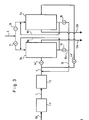
- two adsorbent reactors 5a and 5b are provided, which can be operated as fixed bed or moving bed reactors. These are acted upon by the flue gas in countercurrent or cocurrent, preferably crossflow.
- the reducing agent or reducing agent / diluent gas mixture is passed through the feed line 8 through the reactor 5a with the valves 17 and 18 or the valves 19 and 20 open.
- the proportions of the reducing agent which are not absorbed by the adsorbent can be circulated via line 9a or can be mixed into the flue gas via line 10a, 10.
- the flue gas is passed through the reactor 5a with the shutoff element 4a 'open or the shutoff element 4b' closed and leaves it cleaned of nitrogen oxides via line 13 &.
- reactor 5b With open valves 19 and 20 and closed valves 17 and 18, reactor 5b is supplied with reducing agent in a circulating manner via line 9b while valves 5 and 20 are open.
- Reactor 5a is now the operation described in connection with the reactor 5b with R educts analogously applied tion medium.
- the reactors 5a and 5b are thus used alternately for nitrogen oxide separation.
- the preloading of the adsorbent with the Reducing agents have to be carried out in such a way that the loading height to be achieved is reached within the time that the other reactor can be supplied with flue gas.
- the degree of loading of the adsorbent can be set, for example, via the volume flow of the reducing agent or its concentration in the reducing agent mixture.
- the flue gas from a dry-ashed coal-fired system shows the following data behind a lime-based flue gas desulfurization system and the reheating:
- the moving bed reactor is carried out in two stages in this example, so that in the first stage the SO z residues contained behind the flue gas desulfurization system are separated off on carbon-containing adsorbents by the known method.
- the adsorbent loaded with sulfuric acid is thermally regenerated according to the known method and added again at the top of the reactor.
- the flue gas cleaned in this way contains 195 mg / m 3 n of nitrogen oxides, calculated as N0 2 , after exiting the adsorbent reactor in both cases a) and b).
- the excess ammonia content in the cleaned exhaust gas is 6.0 mg / m and in case b) 10 mg / m 3 n .
Landscapes
- Engineering & Computer Science (AREA)
- Environmental & Geological Engineering (AREA)
- Chemical & Material Sciences (AREA)
- Health & Medical Sciences (AREA)
- Biomedical Technology (AREA)
- Analytical Chemistry (AREA)
- General Chemical & Material Sciences (AREA)
- Oil, Petroleum & Natural Gas (AREA)
- Chemical Kinetics & Catalysis (AREA)
- Treating Waste Gases (AREA)
Applications Claiming Priority (2)
| Application Number | Priority Date | Filing Date | Title |
|---|---|---|---|
| DE19853523326 DE3523326A1 (de) | 1985-06-29 | 1985-06-29 | Verfahren zur abscheidung von no(pfeil abwaerts)x(pfeil abwaerts) aus gasen, insbesondere rauchgasen |
| DE3523326 | 1985-06-29 |
Publications (2)
| Publication Number | Publication Date |
|---|---|
| EP0210392A2 true EP0210392A2 (fr) | 1987-02-04 |
| EP0210392A3 EP0210392A3 (fr) | 1989-03-15 |
Family
ID=6274547
Family Applications (1)
| Application Number | Title | Priority Date | Filing Date |
|---|---|---|---|
| EP86107974A Withdrawn EP0210392A3 (fr) | 1985-06-29 | 1986-06-11 | Procédé pour éliminer des oxydes d'azote d'un gaz, particulièrement de fumées |
Country Status (4)
| Country | Link |
|---|---|
| US (1) | US4789531A (fr) |
| EP (1) | EP0210392A3 (fr) |
| JP (1) | JPS6223424A (fr) |
| DE (1) | DE3523326A1 (fr) |
Cited By (15)
| Publication number | Priority date | Publication date | Assignee | Title |
|---|---|---|---|---|
| EP0362483A1 (fr) * | 1988-07-25 | 1990-04-11 | Degussa Aktiengesellschaft | Procédé pour l'élimination catalytique d'oxydes d'azote de gaz d'échappement au moyen d'un agent de réduction |
| WO1993000984A1 (fr) * | 1991-07-02 | 1993-01-21 | General Electric Company | AMELIORATION APPORTEE AUX SYSTEMES DE DESULFURATION PAR UNE VOIE HUMIDE DES GAZ DE COMBUSTION, SOUS FORME D'UN PROCEDE D'ELIMINATION CATALYTIQUE A BASSE TEMPERATURE DE NOx ET DE SOx PAR OXYDE METALLIQUE |
| WO1993000985A1 (fr) * | 1991-07-02 | 1993-01-21 | General Electric Company | CATALYSEURS A OXYDE METALLIQUE DEPOSES SUR DES SUBSTRATS PERMETTANT D'ELIMINER SIMULTANEMENT LE NOx ET LE SOx PRESENT DANS DES FLUX DE GAZ |
| WO1993002775A1 (fr) * | 1991-08-05 | 1993-02-18 | Bergwerksverband Gmbh | Procede de production d'un catalyseur utile pour eliminer les oxydes azotes contenus dans des gaz d'echappement |
| US5298230A (en) * | 1992-05-01 | 1994-03-29 | Nalco Fuel Tech | Process for the efficient catalytic reduction of nitrogen oxides |
| US5924280A (en) * | 1997-04-04 | 1999-07-20 | Clean Diesel Technologies, Inc. | Reducing NOx emissions from an engine while maximizing fuel economy |
| US5976475A (en) * | 1997-04-02 | 1999-11-02 | Clean Diesel Technologies, Inc. | Reducing NOx emissions from an engine by temperature-controlled urea injection for selective catalytic reduction |
| US6203770B1 (en) | 1997-05-12 | 2001-03-20 | Clean Diesel Technologies, Inc. | Urea pyrolysis chamber and process for reducing lean-burn engine NOx emissions by selective catalytic reduction |
| US7090810B2 (en) | 2000-12-01 | 2006-08-15 | Fuel Tech Inc. | Selective catalytic reduction of nox enabled by sidestream urea decomposition |
| US7682586B2 (en) | 2006-08-22 | 2010-03-23 | Babcock Power Environmental, Inc. | Thermal decomposition of urea in a side stream of combustion flue gas using a regenerative heat exchanger |
| US7815881B2 (en) | 2000-12-01 | 2010-10-19 | Fuel Tech, Inc. | Selective catalytic reduction of NOx enabled by urea decomposition heat-exchanger bypass |
| US7829033B2 (en) | 2003-07-03 | 2010-11-09 | Fuel Tech, Inc. | Selective catalytic reduction of NOx enabled by sidestream urea decomposition |
| US8017100B2 (en) | 2007-04-27 | 2011-09-13 | Babcock Power Environmental Inc. | Conversion of urea to reactants for NOx reduction |
| US8603804B2 (en) | 2010-01-15 | 2013-12-10 | Qbc Diagnostics, Inc. | Fluorescent marked microscope slide |
| CN103816803A (zh) * | 2014-02-19 | 2014-05-28 | 上海电力学院 | 一种失活的脱硝吸收液中丁二酮肟合三价钴离子再生的方法 |
Families Citing this family (17)
| Publication number | Priority date | Publication date | Assignee | Title |
|---|---|---|---|---|
| CA1295813C (fr) * | 1988-12-14 | 1992-02-18 | Karl T. Chuang | Reduction des oxydes nitriques |
| DE3843543C2 (de) * | 1988-12-23 | 2000-11-23 | Thyssen Gas | Verfahren zur Redukton von in Rauchgasen von Feuerungsanlagen enthaltenen Stickoxiden |
| US4988432A (en) * | 1989-12-28 | 1991-01-29 | Mobil Oil Corporation | Reducing NOx emissions with antimony additive |
| US5002654A (en) * | 1989-12-28 | 1991-03-26 | Mobil Oil Corporation | Reducing NOx emissions with zinc catalyst |
| US4986897A (en) * | 1989-12-28 | 1991-01-22 | Mobil Oil Corporation | Catalytic conversion of NOx with NH3 |
| US5015362A (en) * | 1989-12-28 | 1991-05-14 | Mobil Oil Corporation | Catalytic conversion of NOx over carbonaceous particles |
| US4980138A (en) * | 1990-05-14 | 1990-12-25 | Shell Oil Company | Removal of SOx and NOx gases from flue gas by dry absorption using an absorbent |
| US5165902A (en) * | 1991-07-31 | 1992-11-24 | Research Cottrell, Inc. | Method and apparatus for reducing nitrogen dioxide emissions in a dry sodium scrubbing process using humidification |
| JP3242443B2 (ja) * | 1991-09-18 | 2001-12-25 | 三井鉱山株式会社 | ハロゲン物質含有排ガスの脱硫脱硝方法 |
| US5552128A (en) * | 1993-08-03 | 1996-09-03 | Mobil Oil Corporation | Selective catalytic reduction of nitrogen oxides |
| US5401478A (en) * | 1993-08-03 | 1995-03-28 | Mobil Oil Corp. | Selective catalytic reduction of nitrogen oxides |
| US5599758A (en) * | 1994-12-23 | 1997-02-04 | Goal Line Environmental Technologies | Regeneration of catalyst/absorber |
| DE19744470A1 (de) * | 1996-10-12 | 2000-07-13 | Mayer Guenter | Verfahren und Rückgewinnung von gasförmigen Stoffen aus flüchtige polare Stoffe enthaltenden Prozeßgasen |
| US5953911A (en) * | 1998-02-04 | 1999-09-21 | Goal Line Environmental Technologies Llc | Regeneration of catalyst/absorber |
| FR3044934B1 (fr) * | 2015-12-10 | 2021-08-06 | Fives Solios Inc | Procede de traitement des fumees issues d'un four de combustion ou de calcination et installation pour la mise en oeuvre d'un tel procede |
| CN110898607B (zh) * | 2018-09-18 | 2021-07-23 | 中国石化工程建设有限公司 | 一种活性焦吸附塔及活性焦吸附净化烟气的方法 |
| AT522436B1 (de) | 2019-04-26 | 2020-11-15 | Integral Eng Und Umwelttechnik Gmbh | Behälter und Verfahren zum Beladen eines Adsorptions- und/oder Absorptionsmittels mit Ammoniak |
Family Cites Families (12)
| Publication number | Priority date | Publication date | Assignee | Title |
|---|---|---|---|---|
| JPS536099B2 (fr) * | 1974-12-28 | 1978-03-04 | ||
| DE2512410C3 (de) * | 1975-03-21 | 1985-04-18 | Didier Engineering Gmbh, 4300 Essen | Verfahren zur Entfernung von Stickoxiden und Anlage zur Durchführung des Verfahrens |
| JPS51147470A (en) * | 1975-06-12 | 1976-12-17 | Toa Nenryo Kogyo Kk | A process for catalytic reduction of nitrogen oxides |
| DE2911712C2 (de) * | 1979-03-24 | 1991-10-31 | Bergwerksverband Gmbh, 4300 Essen | Verfahren zur Entfernung von Schwefeloxiden und Stickstoffoxiden aus Abgasen |
| JPS562828A (en) * | 1979-06-21 | 1981-01-13 | Sumitomo Heavy Ind Ltd | Simultaneous removal of sulfur oxide and nitrogen oxide contained in waste gas |
| JPS5673526A (en) * | 1979-11-20 | 1981-06-18 | Sumitomo Heavy Ind Ltd | Exhaust smoke desulfurization and denitrification method |
| JPS5843224A (ja) * | 1981-09-10 | 1983-03-12 | Mitsui Mining Co Ltd | 乾式排煙脱硫脱硝方法 |
| JPS5843223A (ja) * | 1981-09-10 | 1983-03-12 | Mitsui Mining Co Ltd | 乾式脱硫脱硝方法 |
| JPS5843222A (ja) * | 1981-09-10 | 1983-03-12 | Mitsui Mining Co Ltd | 廃ガスより硫黄酸化物および窒素酸化物を除去する方法 |
| JPS6071029A (ja) * | 1983-09-28 | 1985-04-22 | Kawasaki Heavy Ind Ltd | 硫黄酸化物および窒素酸化物を同時に除去する方法 |
| DE3431730A1 (de) * | 1984-08-29 | 1986-03-06 | Kraftanlagen Ag, 6900 Heidelberg | Verfahren und vorrichtung zur selektiven katalytischen beseitigung von stickoxyden aus den abgasen von feuerungsanlagen |
| JP2755571B2 (ja) * | 1996-06-18 | 1998-05-20 | 利貞 道済 | ナイフ取付け用面取り補助具 |
-
1985
- 1985-06-29 DE DE19853523326 patent/DE3523326A1/de not_active Withdrawn
-
1986
- 1986-06-11 EP EP86107974A patent/EP0210392A3/fr not_active Withdrawn
- 1986-06-27 JP JP61149892A patent/JPS6223424A/ja active Pending
-
1987
- 1987-10-02 US US07/105,511 patent/US4789531A/en not_active Expired - Fee Related
Cited By (15)
| Publication number | Priority date | Publication date | Assignee | Title |
|---|---|---|---|---|
| EP0362483A1 (fr) * | 1988-07-25 | 1990-04-11 | Degussa Aktiengesellschaft | Procédé pour l'élimination catalytique d'oxydes d'azote de gaz d'échappement au moyen d'un agent de réduction |
| WO1993000984A1 (fr) * | 1991-07-02 | 1993-01-21 | General Electric Company | AMELIORATION APPORTEE AUX SYSTEMES DE DESULFURATION PAR UNE VOIE HUMIDE DES GAZ DE COMBUSTION, SOUS FORME D'UN PROCEDE D'ELIMINATION CATALYTIQUE A BASSE TEMPERATURE DE NOx ET DE SOx PAR OXYDE METALLIQUE |
| WO1993000985A1 (fr) * | 1991-07-02 | 1993-01-21 | General Electric Company | CATALYSEURS A OXYDE METALLIQUE DEPOSES SUR DES SUBSTRATS PERMETTANT D'ELIMINER SIMULTANEMENT LE NOx ET LE SOx PRESENT DANS DES FLUX DE GAZ |
| WO1993002775A1 (fr) * | 1991-08-05 | 1993-02-18 | Bergwerksverband Gmbh | Procede de production d'un catalyseur utile pour eliminer les oxydes azotes contenus dans des gaz d'echappement |
| US5298230A (en) * | 1992-05-01 | 1994-03-29 | Nalco Fuel Tech | Process for the efficient catalytic reduction of nitrogen oxides |
| US5976475A (en) * | 1997-04-02 | 1999-11-02 | Clean Diesel Technologies, Inc. | Reducing NOx emissions from an engine by temperature-controlled urea injection for selective catalytic reduction |
| US5924280A (en) * | 1997-04-04 | 1999-07-20 | Clean Diesel Technologies, Inc. | Reducing NOx emissions from an engine while maximizing fuel economy |
| US6203770B1 (en) | 1997-05-12 | 2001-03-20 | Clean Diesel Technologies, Inc. | Urea pyrolysis chamber and process for reducing lean-burn engine NOx emissions by selective catalytic reduction |
| US7090810B2 (en) | 2000-12-01 | 2006-08-15 | Fuel Tech Inc. | Selective catalytic reduction of nox enabled by sidestream urea decomposition |
| US7815881B2 (en) | 2000-12-01 | 2010-10-19 | Fuel Tech, Inc. | Selective catalytic reduction of NOx enabled by urea decomposition heat-exchanger bypass |
| US7829033B2 (en) | 2003-07-03 | 2010-11-09 | Fuel Tech, Inc. | Selective catalytic reduction of NOx enabled by sidestream urea decomposition |
| US7682586B2 (en) | 2006-08-22 | 2010-03-23 | Babcock Power Environmental, Inc. | Thermal decomposition of urea in a side stream of combustion flue gas using a regenerative heat exchanger |
| US8017100B2 (en) | 2007-04-27 | 2011-09-13 | Babcock Power Environmental Inc. | Conversion of urea to reactants for NOx reduction |
| US8603804B2 (en) | 2010-01-15 | 2013-12-10 | Qbc Diagnostics, Inc. | Fluorescent marked microscope slide |
| CN103816803A (zh) * | 2014-02-19 | 2014-05-28 | 上海电力学院 | 一种失活的脱硝吸收液中丁二酮肟合三价钴离子再生的方法 |
Also Published As
| Publication number | Publication date |
|---|---|
| EP0210392A3 (fr) | 1989-03-15 |
| DE3523326A1 (de) | 1987-01-08 |
| US4789531A (en) | 1988-12-06 |
| JPS6223424A (ja) | 1987-01-31 |
Similar Documents
| Publication | Publication Date | Title |
|---|---|---|
| EP0210392A2 (fr) | Procédé pour éliminer des oxydes d'azote d'un gaz, particulièrement de fumées | |
| AT522436B1 (de) | Behälter und Verfahren zum Beladen eines Adsorptions- und/oder Absorptionsmittels mit Ammoniak | |
| DE2421768C2 (de) | Verfahren zur Entfernung von Schwefeloxyden und Feststoffteilchen aus Abgasen und Vorrichtung zu seiner Durchführung | |
| EP0257024B1 (fr) | Procede d'elimination selective d'oxydes nitriques contenus dans des gaz d'echappement | |
| DE3220403C1 (de) | Verfahren zum Entfernen von sauren Komponenten und Stickoxyden aus Abgasen | |
| EP0232731B1 (fr) | Procédé et dispositif de purification de gaz, en particulier pour désulfurer et désazoturer des gaz de fumée | |
| DE3014934A1 (de) | Verfahren zur entfernung von schwefeloxiden und stickstoffoxiden aus abgasen | |
| DE69505959T2 (de) | Behandlung von abgas eines fliessbett-druckreaktionssystems | |
| DE3706131A1 (de) | Verfahren zur entfernung von schadstoffen aus rauchgas | |
| DE3443686C2 (fr) | ||
| DE3101053A1 (de) | Verfahren zur entfernung von schwefeloxiden und stickstoffoxiden aus abgasen sowie vorrichtung zum durchfuehren dieses verfahrens | |
| DE2839287A1 (de) | Verfahren zur entfernung von schwefeloxiden und vorrichtung zur verminderung der luftverschmutzung | |
| EP0193135A2 (fr) | Procédé pour enlever le dioxyde de soufre et les oxydes d'azote d'un gaz de rejet | |
| DD253944A5 (de) | Verfahren zum entfernen von stickstoffoxiden und schwefeloxiden aus einem abgas | |
| DE3605589C2 (de) | Verfahren und Vorrichtung zur Entfernung von Schwefeldioxid und Stickstoffoxiden aus Abgasen | |
| DE3232544A1 (de) | Verfahren zum entfernen von schwefel- und stickstoffoxiden aus einem abgas | |
| DE2252459A1 (de) | Abgasentschwefelung | |
| AT389652B (de) | Verfahren zur abscheidung von in rauchgasen enthaltenen gasfoermigen schadstoffen | |
| DE2710896A1 (de) | Verfahren zur entfernung von schwefeloxiden aus einer diese und sauerstoff enthaltenden gasmischung | |
| WO1986000243A1 (fr) | PROCEDE DE SEPARATION DE SO2 et NOx | |
| DE2141075C3 (de) | Verfahren zur adsorptiven Entfernung von Schwefeloxiden aus Abgasen | |
| DE3603447C2 (fr) | ||
| DD291936A5 (de) | Verfahren zur entfernung von schadgasen aus gasen und wanderschichtreaktor zur durchfuehrung des verfahrens | |
| DE19638584C2 (de) | Verfahren zur Abscheidung von Staub aus einem staubhaltigen und wasserdampfhaltigen Abgas in einem filtrierenden Abscheider | |
| DE3920146C2 (de) | Verfahren und Vorrichtung zum Veraschen und Entschwefeln von gasförmigen unverbrannte Gase und SO2, SO3 und/oder H2S enthaltenden Abströmen im zirkulierenden Bett |
Legal Events
| Date | Code | Title | Description |
|---|---|---|---|
| PUAI | Public reference made under article 153(3) epc to a published international application that has entered the european phase |
Free format text: ORIGINAL CODE: 0009012 |
|
| AK | Designated contracting states |
Kind code of ref document: A2 Designated state(s): AT BE CH DE FR GB IT LI LU NL SE |
|
| PUAL | Search report despatched |
Free format text: ORIGINAL CODE: 0009013 |
|
| AK | Designated contracting states |
Kind code of ref document: A3 Designated state(s): AT BE CH DE FR GB IT LI LU NL SE |
|
| 17P | Request for examination filed |
Effective date: 19890517 |
|
| 17Q | First examination report despatched |
Effective date: 19900105 |
|
| STAA | Information on the status of an ep patent application or granted ep patent |
Free format text: STATUS: THE APPLICATION IS DEEMED TO BE WITHDRAWN |
|
| 18D | Application deemed to be withdrawn |
Effective date: 19900717 |
|
| RIN1 | Information on inventor provided before grant (corrected) |
Inventor name: EICHHOLTZ, ANDREAS, DR.-ING. Inventor name: WEILER, HELMUT, ING. GRAD. |