EP0210532A2 - Verfahren zur Reinigung und gegebenenfalls Gewinnung von Formiat-Dehydrogenase (FDH) aus Candida boidinii und FDH-haltiges Produkt - Google Patents
Verfahren zur Reinigung und gegebenenfalls Gewinnung von Formiat-Dehydrogenase (FDH) aus Candida boidinii und FDH-haltiges Produkt Download PDFInfo
- Publication number
- EP0210532A2 EP0210532A2 EP86109675A EP86109675A EP0210532A2 EP 0210532 A2 EP0210532 A2 EP 0210532A2 EP 86109675 A EP86109675 A EP 86109675A EP 86109675 A EP86109675 A EP 86109675A EP 0210532 A2 EP0210532 A2 EP 0210532A2
- Authority
- EP
- European Patent Office
- Prior art keywords
- phase
- enzyme
- fdh
- cells
- aqueous
- Prior art date
- Legal status (The legal status is an assumption and is not a legal conclusion. Google has not performed a legal analysis and makes no representation as to the accuracy of the status listed.)
- Granted
Links
- 0 *c1c(*C(*2)=N*N=C2Cl)cccc1 Chemical compound *c1c(*C(*2)=N*N=C2Cl)cccc1 0.000 description 2
Classifications
-
- C—CHEMISTRY; METALLURGY
- C12—BIOCHEMISTRY; BEER; SPIRITS; WINE; VINEGAR; MICROBIOLOGY; ENZYMOLOGY; MUTATION OR GENETIC ENGINEERING
- C12N—MICROORGANISMS OR ENZYMES; COMPOSITIONS THEREOF; PROPAGATING, PRESERVING, OR MAINTAINING MICROORGANISMS; MUTATION OR GENETIC ENGINEERING; CULTURE MEDIA
- C12N9/00—Enzymes; Proenzymes; Compositions thereof; Processes for preparing, activating, inhibiting, separating or purifying enzymes
- C12N9/0004—Oxidoreductases (1.)
- C12N9/0008—Oxidoreductases (1.) acting on the aldehyde or oxo group of donors (1.2)
-
- C—CHEMISTRY; METALLURGY
- C12—BIOCHEMISTRY; BEER; SPIRITS; WINE; VINEGAR; MICROBIOLOGY; ENZYMOLOGY; MUTATION OR GENETIC ENGINEERING
- C12Y—ENZYMES
- C12Y102/00—Oxidoreductases acting on the aldehyde or oxo group of donors (1.2)
- C12Y102/01—Oxidoreductases acting on the aldehyde or oxo group of donors (1.2) with NAD+ or NADP+ as acceptor (1.2.1)
- C12Y102/01002—Formate dehydrogenase (1.2.1.2)
-
- C—CHEMISTRY; METALLURGY
- C12—BIOCHEMISTRY; BEER; SPIRITS; WINE; VINEGAR; MICROBIOLOGY; ENZYMOLOGY; MUTATION OR GENETIC ENGINEERING
- C12Y—ENZYMES
- C12Y102/00—Oxidoreductases acting on the aldehyde or oxo group of donors (1.2)
- C12Y102/02—Oxidoreductases acting on the aldehyde or oxo group of donors (1.2) with a cytochrome as acceptor (1.2.2)
- C12Y102/02001—Formate dehydrogenase (cytochrome) (1.2.2.1)
-
- Y—GENERAL TAGGING OF NEW TECHNOLOGICAL DEVELOPMENTS; GENERAL TAGGING OF CROSS-SECTIONAL TECHNOLOGIES SPANNING OVER SEVERAL SECTIONS OF THE IPC; TECHNICAL SUBJECTS COVERED BY FORMER USPC CROSS-REFERENCE ART COLLECTIONS [XRACs] AND DIGESTS
- Y10—TECHNICAL SUBJECTS COVERED BY FORMER USPC
- Y10S—TECHNICAL SUBJECTS COVERED BY FORMER USPC CROSS-REFERENCE ART COLLECTIONS [XRACs] AND DIGESTS
- Y10S435/00—Chemistry: molecular biology and microbiology
- Y10S435/8215—Microorganisms
- Y10S435/911—Microorganisms using fungi
- Y10S435/921—Candida
Definitions
- FDH Formate dehydrogenase
- Candida boidinii is cultivated, the harvested cells are mechanically comminuted, and the cell suspension obtained is subjected to heat denaturation and the resulting suspension is subjected to four successive phase distribution stages, aqueous 2-phase systems with polyethylene glycol and potassium phosphate being used as phase formers.
- Analytical Biochemistry, 124 (1982) 117 to 124 describes a process in which baker's yeast is used, phosphofructokinase as a non-intercellular enzyme is precipitated with polyethylene glycol and then in an aqueous 2- Phase system is subjected to a phase distribution, the system comprising dextran, polyethylene glycol and Cibacron-blue-S3G-A as a triazine dye which is bound to polyethylene glycol.
- FDH can be purified without prior separation of cell material and foreign protein if FDH is subjected to a phase distribution in an aqueous 2-phase system which comprises a triazine dye which is bound to an inert water-soluble polymer.
- the Candida boidinii cells are suspended in an aqueous phosphate-containing medium after prior freezing and left in the suspension until an enzyme exit of at most about 90, 85 or 75%, after which the suspension obtained is subjected to the phase distribution.
- the phosphate-containing medium may potassium phosphate and / or potassium hydrogen enphosphat g (K 2 HPO 4. And / or KH 2 PO 4) contained. It is not necessary to shred the Candida boidinii cells. This embodiment of the invention is based on the observation that FDH diffuses out first and almost completely after freezing the cells and suspending them in an aqueous phosphate-containing medium dated, while a large part of the residual protein remains in the cells.
- the medium obtained with an enzyme exit of at most about 95, 85 or 75% can also be the starting material for another FDH recovery process, so the medium does not have to be supplied to the phase distribution according to the invention.
- the digested cell suspension can be heated and then cooled again. This coagulates some proteins, which can then be easily separated with the cell material.
- heat-labile proteins such as dehydrogenases or kinases are deactivated so that they cannot bind to the ligand.
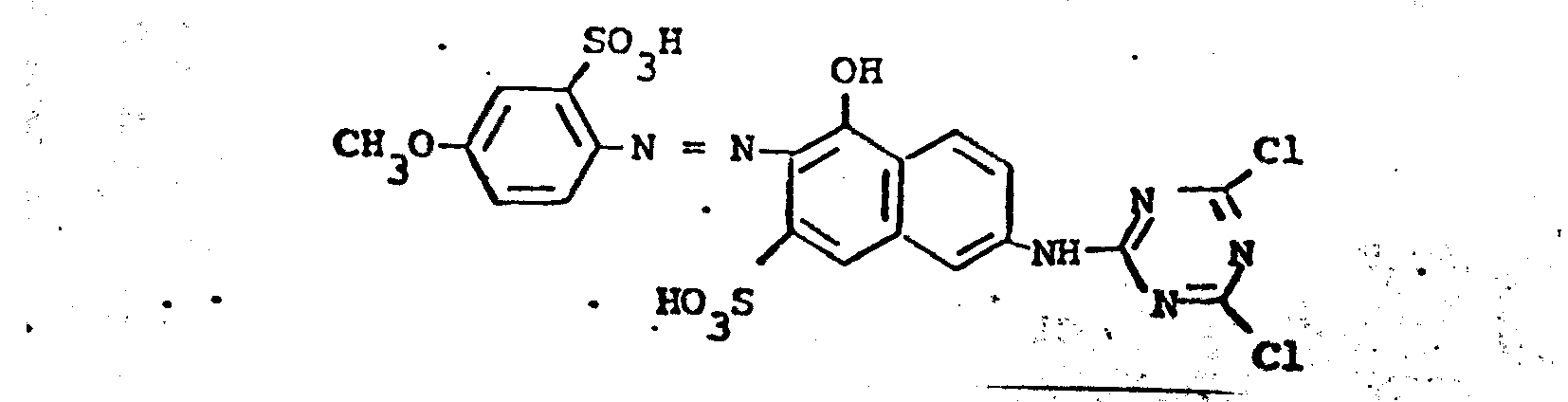
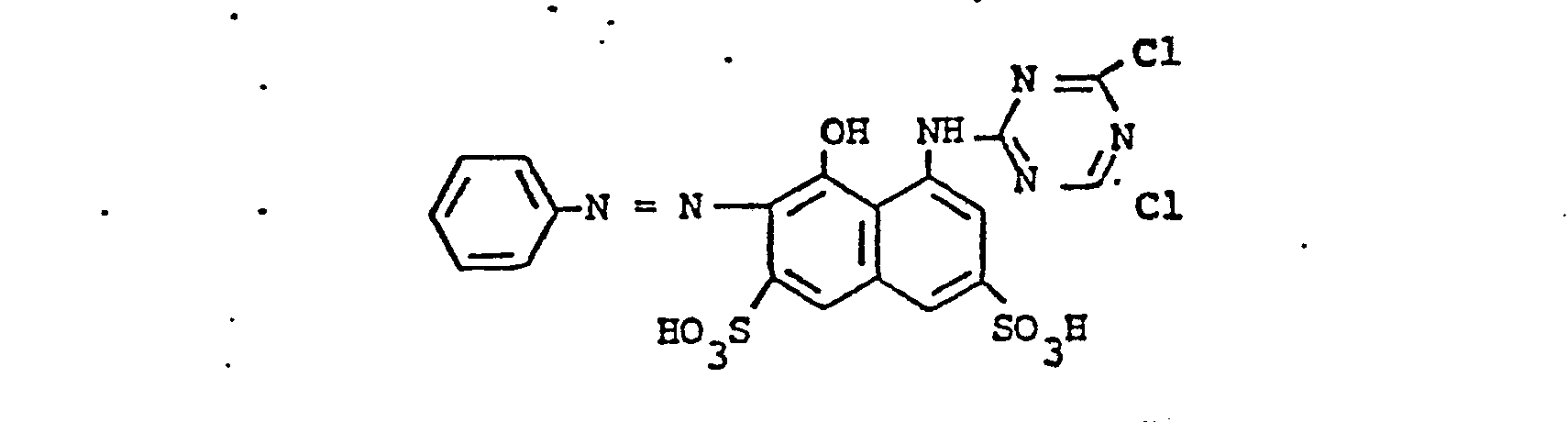
- triazine dyes examples are:
- R 1 H or SO 3 Na
- R 2 SO 3 Na or H
- Procion-red-HE3b is particularly suitable.
- To link the triazine dyes with an inert water-soluble polymer reference is made, for example, to Analytical Biochemistry, 124 (1982) 117 to 124 and the following method 1. The information found at the two points indicated can be transferred to other inert water-soluble polymers.
- the ligand-containing upper phase is reused, and preferably the lower phase into which the enzyme has been transferred is mixed with polyethylene glycol or polypropylene glycol and the upper phase of the resulting 2-phase system is combined with the previously separated upper phase and then reused.
- the invention relates to this formate dehydrogenase-containing solid product containing sucrose.
- Step 1 chlorination.
- Monomethoxy polyethylene glycol (MPEG) or polyethylene glycol (PEG) with, for example, a molecular weight of 400, 1,500, 5,000, 6,000 or 10,000 is assumed (hereinafter referred to as PEG for short).
- Solid PEG or MPEG is melted overnight in a drying cabinet at 70 ° C.
- the possibly melted PEG or MPEG is then dewatered under vacuum.
- the chlorination is carried out in a rotary evaporator with a 50 molar excess of thionyl chloride at 70 ° C. Since it is necessary to work absolutely water-free because of the risk of HCl formation, the reaction vessel is gassed with nitrogen and a drying tube is placed on the cooler. The reaction is complete after about 8 hours. The excess thionyl chloride is removed in vacuo.
- Step 2 amination.
- the chlorinated PEG or MPEG is dissolved in a large excess of aqueous ammonia (25%) in a glass autoclave (1.5 l).
- the reaction vessel should be about 3/4 full; it is then sealed airtight.
- the amination is then carried out in an oil bath at 110 ° C. for about 30 hours.
- the reaction product is concentrated in a rotary evaporator, excess ammonia being removed.
- Step 3 coupling. 1 mol of Procion-red-HE3b is added to 1 mol of NH 2 . The pH is then adjusted to 11 and the reaction is carried out at 60 ° C. for about 24 hours. The reaction product is subjected to gel filtration (Sephadex-G50) to separate the free dye and then dialyzed.
- Step 1 suspension. 10 kg of frozen yeast are suspended in a potassium phosphate buffer overnight using a propeller stirrer. The solution contains 40% cell mass, 10% ammonium formate and 0.1 M potassium phosphate. The volume is 25 1. The next morning the enzyme activity is measured.
- Step 2 heat denaturation.
- the cell suspension is heated in a water bath (75 ° C.) and kept at 60 ° C. with stirring. The temperature is checked with a thermometer in the reaction vessel. The heating-up time is about 15 minutes. After about 10 minutes at 60 ° C., the mixture is cooled to room temperature in ice water.
- Step 3 affinity distribution. To do this, weigh in: Remaining water to 50 kg
- the system is mixed with a blade stirrer for 30 minutes. It must be ensured that there is no strong foaming. Then the system is placed in a nozzle separator (4 nozzles with a diameter of 0.4 mm) a flow rate of 500 ml / min separated. The purity of the phases is 95% for the upper phase and 90% for the lower phase. The gel-like lower phase is discarded.
- Step 4 separation of enzyme / ligand.
- the upper phase (38.57 l) is mixed with 9% potassium phosphate (weight / volume; system: 10.5% PEGIO.000 / 9.9% potassium phosphate), stirred for a further 10 minutes after the salt has dissolved and then at a flow rate of 400 ml / min in a plate separator (nozzle length 14.5 mm) separated. The purity of both phases is 100%.
- the upper phase is saved for reuse at -20 ° C.
- the lower phase is mixed with 1% PEG10.000 and, after its dissolution, separated again at 400 ml / min in the separator.
- the upper phase is stored together with the upper phase of the first PEG / salt system.
- Step 5 ultrafiltration.
- the lower phase (27.3 l) is freed of salts and polyethylene glycol in a capillary membrane system (filtrate throughput 50 l / h) and concentrated to a volume of 5.28 l.
- the mixture is then concentrated further to a final volume of 1 l in a second capillary membrane system.
- Step 6 lyophilization. 171 g of sucrose are added to the ultrafiltration retentate. The freeze dryer is then lyophilized. 243 g of product with an activity of 0.23 U FDH / mg lyophilisate are obtained.
- Example 1 is repeated with the exception that an aqueous solution containing 400 mmol of MPEG-blue is used instead of 43 mmol of MPEG-red (Cibacron-blue-3G-A bound to monomethoxy polyethylene glycol). A lower spec. Get activity and yield.
Landscapes
- Chemical & Material Sciences (AREA)
- Organic Chemistry (AREA)
- Life Sciences & Earth Sciences (AREA)
- Health & Medical Sciences (AREA)
- Wood Science & Technology (AREA)
- Bioinformatics & Cheminformatics (AREA)
- Genetics & Genomics (AREA)
- Engineering & Computer Science (AREA)
- Zoology (AREA)
- General Engineering & Computer Science (AREA)
- General Health & Medical Sciences (AREA)
- Biochemistry (AREA)
- Molecular Biology (AREA)
- Medicinal Chemistry (AREA)
- Biomedical Technology (AREA)
- Biotechnology (AREA)
- Microbiology (AREA)
- Enzymes And Modification Thereof (AREA)
- Preparation Of Compounds By Using Micro-Organisms (AREA)
- Immobilizing And Processing Of Enzymes And Microorganisms (AREA)
- Micro-Organisms Or Cultivation Processes Thereof (AREA)
Abstract
Description
- Formiat-Dehydrogenase (FDH) liegt in Candida boidinii intrazellulär vor. Bisher geht man zur Gewinnung von FDH nach zwei verschiedenen Verfahren vor. So wird in Eur. J. Biochem., 62 (1976), 151 bis 160, ein Verfahren beschrieben, bei dem Candida boidinii kultiviert wird, die geernteten Zellen eingefroren, in einem wässerigen phosphathaltigen Medium stehengelassen und danach mechanisch zerkleinert werden, die Zelltrümmer abzentrifugiert werden, Restprotein mit Streptomycinsulfat ausgefällt und der Niederschlag abzentrifugiert wird, wonach die überstehende Lösung einer Ionenaustauschchromatographie an DEAE-Cellulose zur Gewinnung des Enzyms unterworfen wird. Aus J. Chem. Tech. Biotechnol., 32 (1982) 130 bis 137, ist ferner ein Verfahren bekannt, bei dem Candida boidinii kultiviert wird, die geernteten Zellen mechanisch zerkleinert werden, die erhaltene Zellsuspension einer Hitzedenaturierung unterworfen wird und die resultierende Suspension vier aufeinanderfolgenden Phasenverteilungsstufen unterworfen wird, wobei wässerige 2-Phasensysteme mit Polyethylenglykol und Kaliumphosphat als Phasenbildnern angewendet werden.
- Außerdem sind eine Reihe von Arbeiten über die Affinitätsverteilung nicht-intrazellulärer Enzyme in Phasensystemen mit einem Gehalt an Triazin-Farbstoffen bekanntgeworden, die an Polyethylenglykol gebunden sind; vol. beisoielsweise Kroner et al. in Gribnau et al., Affinity chromatography and related techniques, Seiten 491 bis 501, Elsevier, Amster- dam 1982; Cordes et al. in Publ. 3rd Eur. Congr. Biotechnology, Munich 1984, Bd. III, Seiten 557 bis 564; Eur. J. Biochem., 131 (1983) 589 bis 594; J. Chromatography, 259 (1983) 97 bis 105; Analytical Biochemistry, 136 (1984) 264 bis 271; und ,J. Chromatography, 298 (1984) 483 bis 493. Schließlich wird in Analytical Biochemistry, 124 (1982) 117 bis 124, ein Verfahren beschrieben, bei dem von Bäckerhefe ausgegangen, Phosphofruktokinase als nicht-interzelluläres Enzym mit Polyethylenglykol gefällt und danach in einem wässerigen 2-Phasensystem einer Phasenverteilung unterworfen wird, wobei das System Dextran, Polyethylenglykol und Cibacron-blue-S3G-A als Triazin-Farbstoff umfaßt, der an Polyethylenglykol gebunden ist.
- Bei den bekannten Verfahren zur Reinigung und gegebenenfalls Gewinnung von FDH besteht jedoch ein Bedürfnis, Reinigungsschritte einzusparen.
- Erfindungsgemäß wird dazu ein Verfahren zur Reinigung und gegebenenfalls Gewinnung von Formiat-Dehydrogenase (FDH) vorgesehen, bei dem man
- (a) das Enzym enthaltende Zellen aufschließt,
- (b) das Zellmaterial mit der Zellflüssigkeit einer Phasenverteilung (Affinitätsextraktion) unterwirft,
- (c) das Enzym gegebenenfalls von der enzymreichen Phase abtrennt und gegebenenfalls gewinnt, wobei dieses Verfahren dadurch gekennzeichnet ist, daß man bei der Stufe (b)
- - gegebenfalls ohne vorherige Abtrennung des Zellmaterials und
- - gegebenenfalls ohne vorherige Fremdproteinabtrennung
- - die Phasenverteilung mit einem wässerigen 2-Phasensystem durchführt, in dessen einer Phase ein an Polyethylenglykol oder Polypropylenglykol gebundener Triazin-Farbstoff angereichert ist.
- Erfindungsgemäß wurde also überraschenderweise festgestellt, daß man FDH ohne vorherige Abtrennung von Zellmaterial und Fremdprotein reinigen kann, wenn man FDH einer Phasenverteilung in einem wässerigen 2-Phasensystem unterwirft, das einen Triazin-Farbstoff umfaßt, der an ein inertes wasserlösliches Polymeres gebunden ist.
- Bei einer Ausführungsform des erfindungsgemäßen Verfahrens werden die Candida-boidinii-Zellen nach vorhergehendem Einfrieren in einem wässerigen phosphathaltigen Medium suspendiert und in der Suspension bis zu einem Enzymaustritt von maximal etwa 90, 85 oder 75 % belassen, wonach die erhaltene Suspension der Phasenverteilung unterworfen wird. Das phosphathaltige Medium kann Kaliumphosphat und/ oder Kaliumhydrogenphosphat (K2HPO4. und/oder KH2PO4) enthalten. Eine Zerkleinerung der Candida-boidinii-Zellen ist nicht erforderlich. Diese erfindungsgemäße Ausführungsform beruht auf der Beobachtung, daß FDH nach dem Einfrieren der Zellen und ihrer Suspendierung in einem wässerigen phosphathaltigen Medium zuerst und fast vollständig hinausdiffundiert, während ein großer Teil des Restproteins noch in den Zellen verbleibt.
- Das bei einem Enzymaustritt von maximal etwa 95, 85 oder 75 % anfallende Medium kann auch Ausgangsmaterial für ein anderes FDH-Gewinnungsverfahren sein, das Medium muß also nicht der erfindungsgemäßen Phasenverteilung zugeführt werden.
- Gemäß einer weiteren Ausführungsform des erfindungsgemäßen Verfahrens kann man die aufgeschlossene Zellsuspension erhitzen und danach wieder abkühlen. Dadurch werden einige Proteine koaguliert, die sich daraufhin leicht mit dem Zellmaterial abtrennen lassen. Außerdem werden hitzelabile Proteine, wie Dehydrogenasen oder Kinasen, desaktiviert, so daß sie keine Bindung mit dem Liganden eingehen können.
- Vorzugsweise verwendet man ein wässeriges 2-Phasensystem mit
- (a) Polyethylenglykol oder Polypropylenglykol und
- (b) Rohdextran, Dextran, Methylcellulose oder Ficoll
- Beispiele für Triazin-Farbstoffe sind:
-

-

-

-

-

-

-

-

-

-
-

-

-
-

-

-


- Strukturformel des farbstoffes Cibecron blue 36A

- Besonders geeignet ist Procion-red-HE3b. Zum Verknüpfen der Triazin-Farbstoffe mit einem inerten wasserlöslichen Polymeren sei beispielsweise auf Analytical Biochemistry, 124 (1982) 117 bis 124, und die folgende Methode 1 verwiesen. Die an den beiden angegebenen Stellen zu findenden Angaben lassen sich auf andere inerte wasserlösliche Polymere übertragen.
- Die Erfindung betrifft ferner ein Verfahren, bei dem man bei einem wässerigen 2-Phasensystem mit
- (a) Polyethylenglycol oder Polypropylenglykol und
- (b) Rohdextran, Dextran, Methylcellulose oder Ficoll als Phasenbildner und an Polyethylenglykol oder Polypropylenglykol gebundenem Triazinfarbstoff (wie Procion-red-HE 3b) als Ligand die Oberphase mit dem darin angereicherten Enzym von der Unterphase trennt und mit einem Salz, insbesondere Kaliumphosphat und/oder Kaliumhydrogenphosphat, versetzt und das Enzym in die Unterphase des resultierenden 2-Phasensystems überführt und gegebenenfalls (insbesondere durch Ultrafiltration) von Salzen und Phasenbildnern abtrennt.
- Vorzugsweise wird die ligandenhaltige Oberphase wiederverwendet und vorzugsweise wird die Unterphase, in die das Enzym übergeführt worden ist, mit Polyethylenglykol oder Polypropylenglykol versetzt und die Oberphase des resultierenden 2-Phasensystems mit zuvor abgetrennter Oberphase vereinigt und danach wiederverwendet.
- Es ist vorteilhaft, das in einem von Phasenbildnern und Salzen freien flüssigen Medium vorliegende Enzym in Gegenwart von Saccharose zu lyophilisieren, da das anfallende Produkt lagerbeständig ist. Die Erfindung betrifft schließlich dieses formiat-dehydrogenase-haltige feste Produkt mit einem Gehalt an Saccharose.
- Nachstehend wird die Erfindung näher erläutert.
- Schritt 1: Chlorierung. Es wird von Monomethoxy-polyethylenglykol (MPEG) oder Polyethylenglykol (PEG) mit beispielsweise einem Molekulargewicht von 400, 1.500, 5.000, 6.000 oder 10.000 ausgegangen (im folgenden kurz PEG). Festes PEG oder MPEG wird über Nacht im Trockenschrank bei 70 °C geschmolzen. Das gegebenenfalls geschmolzene PEG oder MPEG wird anschließend unter Vakuum entwässert. Die Chlorierung erfolgt im Rotationsverdampfer mit einem 50-molaren Überschuß an Thionylchlorid bei 70 °C. Da wegen der Gefahr der HCl-Bildung absolut wasserfrei gearbeitet werden muß, wird das Reaktionsgefäß mit Stickstoff begast und auf den Kühler ein Trockenrohr aufgesetzt. Nach etwa 8 h ist die Reaktion beendet. Das überschüssige Thionylchlorid wird im Vakuum abgezogen.
- Schritt 2: Aminierung. Das chlorierte PEG oder MPEG wird in einem großen Überschuß an wässerigem Ammoniak (25 %) in einem Glasautoklaven (1,5 1) gelöst. Das Reaktionsgefäß sollte etwa zu 3/4 gefüllt sein; es wird dann luftdicht verschlossen. Danach wird die Aminierung im Ölbad bei 110 °C etwa 30 h lang durchgeführt. Das Reaktionsprodukt wird im Rotationsverdampfer eingeengt, wobei überschüssiger Ammoniak entfernt wird.
- Schritt 3: Kopplung. Auf 1 Mol NH2 wird 1 Mol Procion-red-HE3b gegeben. Danach wird der pH auf 11 eingestellt und die Reaktion bei 60 °C etwa 24 h lang durchgeführt. Das Reaktionsprodukt wird einer Gelfiltration (Sephadex-G50) unterworfen, um den freien Farbstoff abzutrennen, und danach dialysiert.
- Schritt 1: Suspendierung. Es werden 10 kg gefrorene Hefe in einem Kaliumphosphat-Puffer über Nacht mit einem Propeller-Rührer suspendiert. Die Lösung enthält 40 % Zellmasse, 10 % Ammoniumformiat und 0,1 M Kaliumphosphat. Das Volumen beträgt 25 1. Am nächsten Morgen wird die Enzymaktivität gemessen.
- Schritt 2: Hitzedenaturierung. Die Zellsuspension wird im Wasserbad (75 °C) erhitzt und unter Rühren bei 60 C gehalten. Die Temperatur wird mit einem Thermometer im Reaktionsgefäß kontrolliert. Die Aufheizzeit beträgt etwa 15 min. Nach etwa 10 min bei 60 °C wird in Eiswasser auf Raumtemperatur abgekühlt.
- Schritt 3: Affinitätsverteilung. Dazu werden eingewogen:

- Das System wird 30 min lang mit einem Blattrührer durchmischt. Dabei muß darauf geachtet werden, daß keine starke Schaumbildung erfolgt. Dann wird das System in einem Düsenseparator (4 Düsen mit einem Durchmesser von 0,4 mm) bei einer Durchflußgeschwindigkeit von 500 ml/min getrennt. Die Reinheit der Phasen beträgt 95 % für die Oberphase und 90 % für die Unterphase. Die gelartige Unterphase wird verworfen.
- Schritt 4: Trennung Enzym/Ligand. Die Oberphase (38,57 1) wird mit 9 % Kaliumphosphat (Gewicht/Volumen; System: 10,5 % PEGIO.000/9,9 % Kaliumphosphat) gemischt, nach Auflösung des Salzes noch 10 min lang gerührt und dann bei einer Durchflußgeschwindigkeit von 400 ml/min in einem Tellerseparator (Düsenlänge 14,5 mm) getrennt. Die Reinheit beider Phasen liegt bei 100 %. Die Oberphase wird für die Wiederverwendung bei -20 C aufgehoben. Die Unterphase wird mit 1 % PEG10.000 vermischt und nach dessen Auflösung wieder mit 400 ml/min im Separator getrennt. Die Oberphase wird gemeinsam mit der Oberphase des ersten PEG/Salz-Systems gelagert.
- Schritt 5: Ultrafiltration. Die Unterphase (27,3 1) wird in einem Kapillarmembran-System (Filtratdurchsatz 50 1/h) von Salzen und Polyethylenglykol befreit und auf ein Volumen von 5,28 1 eingeengt. Danach wird in einer zweiten Kapillarmembran-Anlage weiter auf ein Endvolumen von 1 1 aufkonzentriert.
- Schritt 6: Lyophilisation. Zu dem Retentat der Ultrafiltration werden 171 g Saccharose gegeben. Danach wird im Gefriertrockner lyophilisiert. Man erhält 243 g Produkt einer Aktivität von 0,23 U FDH/mg Lyophilisat.
- Beispiel 1 wird mit der Ausnahme wiederholt, daß anstelle von 43 mmol MPEG-red eine wässerige Lösung mit einem Gehalt an 400 mmol MPEG-blue verwendet wird (Cibacron-blue-3G-A gebunden an Monomethoxy-polyethylenglykol). Es wurde eine gegenüber Beispiel 1 geringere spez. Aktivität und Ausbeute erhalten.
als Phasenbildner. Im übrigen ist der Fachmann mit der Wahl geeigneter 2-Phasensysteme vertraut, vgl. beispielsweise DE-C-26 39 129.7 und die darin angeführte Literatur.
Claims (11)
dadurch gekennzeichnet ,
daß man bei der Stufe (b)
als Phasenbildner verwendet.
Priority Applications (1)
| Application Number | Priority Date | Filing Date | Title |
|---|---|---|---|
| AT86109675T ATE70298T1 (de) | 1985-07-30 | 1986-07-15 | Verfahren zur reinigung und gegebenenfalls gewinnung von formiat-dehydrogenase (fdh) aus candida boidinii und fdh-haltiges produkt. |
Applications Claiming Priority (2)
| Application Number | Priority Date | Filing Date | Title |
|---|---|---|---|
| DE19853527268 DE3527268A1 (de) | 1985-07-30 | 1985-07-30 | Verfahren zur reinigung und gegebenenfalls gewinnung von formiat-dehydrogenase (fdh) aus candida boidinii und fdh-haltiges produkt |
| DE3527268 | 1985-07-30 |
Publications (3)
| Publication Number | Publication Date |
|---|---|
| EP0210532A2 true EP0210532A2 (de) | 1987-02-04 |
| EP0210532A3 EP0210532A3 (en) | 1988-09-21 |
| EP0210532B1 EP0210532B1 (de) | 1991-12-11 |
Family
ID=6277169
Family Applications (1)
| Application Number | Title | Priority Date | Filing Date |
|---|---|---|---|
| EP86109675A Expired - Lifetime EP0210532B1 (de) | 1985-07-30 | 1986-07-15 | Verfahren zur Reinigung und gegebenenfalls Gewinnung von Formiat-Dehydrogenase (FDH) aus Candida boidinii und FDH-haltiges Produkt |
Country Status (6)
| Country | Link |
|---|---|
| US (1) | US4879234A (de) |
| EP (1) | EP0210532B1 (de) |
| JP (1) | JPS6232881A (de) |
| AT (1) | ATE70298T1 (de) |
| DE (2) | DE3527268A1 (de) |
| DK (1) | DK360786A (de) |
Cited By (2)
| Publication number | Priority date | Publication date | Assignee | Title |
|---|---|---|---|---|
| EP0805208A4 (de) * | 1995-09-12 | 2000-12-13 | Kirin Brewery | Promotor/terminator des formatdehydrogenase-gens von candida boidinii |
| US7087418B2 (en) | 2001-12-19 | 2006-08-08 | Bristol-Myers Squibb Company | Pichia pastoris formate dehydrogenase and uses therefor |
Families Citing this family (4)
| Publication number | Priority date | Publication date | Assignee | Title |
|---|---|---|---|---|
| US5407810A (en) * | 1993-08-20 | 1995-04-18 | Genentech, Inc. | Aqueous multiple-phase isolation of polypeptide |
| US6020373A (en) * | 1995-10-20 | 2000-02-01 | Eastern Virginia Medical School | Chelate derivatives as protectors against tissue injury |
| DE102008013490A1 (de) * | 2008-03-10 | 2009-09-17 | Bayer Technology Services Gmbh | Verfahren zur Reinigung therapeutischer Proteine |
| EP2888571B1 (de) * | 2012-08-23 | 2022-12-21 | Stemcell Technologies Inc. | Verfahren und kits für schnelle und umkehrbare biomolekulare markierung |
Family Cites Families (4)
| Publication number | Priority date | Publication date | Assignee | Title |
|---|---|---|---|---|
| US3133001A (en) * | 1959-11-26 | 1964-05-12 | Muset Pedro Puig | Stabilization of enzymes |
| FR2252351A2 (en) * | 1973-11-28 | 1975-06-20 | Air Liquide | Isolation of enzymes by selective extraction - partition of polyinhibitor-enzyme complex between water and polyethylene glycol |
| DE2712004C2 (de) * | 1977-03-18 | 1979-05-23 | Boehringer Mannheim Gmbh, 6800 Mannheim | Verfahren zur Bestimmung von Formiat oder in Formiat überführbaren Verbindungen und hierfür geeignetes Reagens |
| SE8302483L (sv) * | 1983-05-02 | 1984-11-03 | Pharmacia Ind | Forfarande vid rening av biologiskt aktiva substanser |
-
1985
- 1985-07-30 DE DE19853527268 patent/DE3527268A1/de not_active Withdrawn
-
1986
- 1986-07-15 DE DE8686109675T patent/DE3682844D1/de not_active Expired - Lifetime
- 1986-07-15 AT AT86109675T patent/ATE70298T1/de active
- 1986-07-15 EP EP86109675A patent/EP0210532B1/de not_active Expired - Lifetime
- 1986-07-29 DK DK360786A patent/DK360786A/da not_active Application Discontinuation
- 1986-07-30 US US06/891,868 patent/US4879234A/en not_active Expired - Fee Related
- 1986-07-30 JP JP61177899A patent/JPS6232881A/ja active Pending
Cited By (2)
| Publication number | Priority date | Publication date | Assignee | Title |
|---|---|---|---|---|
| EP0805208A4 (de) * | 1995-09-12 | 2000-12-13 | Kirin Brewery | Promotor/terminator des formatdehydrogenase-gens von candida boidinii |
| US7087418B2 (en) | 2001-12-19 | 2006-08-08 | Bristol-Myers Squibb Company | Pichia pastoris formate dehydrogenase and uses therefor |
Also Published As
| Publication number | Publication date |
|---|---|
| EP0210532B1 (de) | 1991-12-11 |
| EP0210532A3 (en) | 1988-09-21 |
| DE3527268A1 (de) | 1987-02-05 |
| DE3682844D1 (de) | 1992-01-23 |
| ATE70298T1 (de) | 1991-12-15 |
| DK360786A (da) | 1987-01-31 |
| US4879234A (en) | 1989-11-07 |
| JPS6232881A (ja) | 1987-02-12 |
| DK360786D0 (da) | 1986-07-29 |
Similar Documents
| Publication | Publication Date | Title |
|---|---|---|
| EP0287961B1 (de) | Verfahren zur Isolierung von Nukleinsäuren | |
| EP0121778B1 (de) | Verfahren zur Abtrennung von Ribonukleinsäuren aus einer Lösung, die Desoxyribonukleinsäuren enthält | |
| DE68923115T2 (de) | Reinigung von Hepatitis-Proteinen. | |
| DE69305662T2 (de) | Brett-stabiles Produkt und Verfahren zur Isolierung der RNA, DNA und Proteine | |
| DE69828517T2 (de) | Methode zur dns-isolierung. | |
| DE202015009782U1 (de) | Trennung von 2'-O-Fucosyllactose aus Fermentationsbrühe | |
| DE3310337A1 (de) | Verfahren zur durchfuehrung von hybridisierungsreaktionen | |
| DE2333883B2 (de) | Verfahren zur Herstellung von hochgereinigtem Humanalbumin | |
| EP0347781A2 (de) | Mini-Proinsulin, seine Herstellung und Verwendung | |
| KR850002959A (ko) | 생물학적 활성 추출물의 제조방법 | |
| US4144130A (en) | Process for the separation of enzymes | |
| EP0210532B1 (de) | Verfahren zur Reinigung und gegebenenfalls Gewinnung von Formiat-Dehydrogenase (FDH) aus Candida boidinii und FDH-haltiges Produkt | |
| EP0511221B1 (de) | Verfahren zur anreicherung bzw. reinigung von hirudin | |
| DE69021729T2 (de) | Verfahren zur gewinnung von natürlich hergestelltem chymosin. | |
| DE3124228C2 (de) | Verfahren zur Isolierung von Superoxid-dismutase aus roten Blutzellen | |
| EP0065286B1 (de) | Verfahren zum Reinigen bzw. Anreichern von biologisch aktiven Proteinen und hierzu geeignetes Mittel | |
| DE3485923T2 (de) | Dna-gen, verfahren zu seiner herstellung und dieses gen enthaltendes plasmid. | |
| DE1966427A1 (de) | Verfahren zur Herstellung von 6-Aminopenicillansaeure | |
| DE1927517A1 (de) | Verfahren zur Gewinnung und Reinigung von L-Asparaginase | |
| DE3715033A1 (de) | Verfahren zur isolierung von fusionsproteinen | |
| DD287950A5 (de) | Verfahren zur kovalenten bindung von biologisch aktiven verbindungen an substituierte polyoxyalkylenglykole und ihre monoalkoxyderivate | |
| DE69027444T2 (de) | Verbessertes verfahren zur reinigung rekombinanter kupfer/zink (cu-zn) superoxiddismutase aus bakterien oder eukaryotischen zellen | |
| DE2016822A1 (de) | Enzymgemisch und Verfahren zu dessen Herstellung | |
| KR880001120B1 (ko) | 엘라스타제의 정제 방법(Elastase의 精製方法) | |
| SU1081171A1 (ru) | Способ выделени дезоксирибонуклеиновой кислоты |
Legal Events
| Date | Code | Title | Description |
|---|---|---|---|
| PUAI | Public reference made under article 153(3) epc to a published international application that has entered the european phase |
Free format text: ORIGINAL CODE: 0009012 |
|
| AK | Designated contracting states |
Kind code of ref document: A2 Designated state(s): AT CH DE FR GB IT LI NL SE |
|
| PUAL | Search report despatched |
Free format text: ORIGINAL CODE: 0009013 |
|
| AK | Designated contracting states |
Kind code of ref document: A3 Designated state(s): AT CH DE FR GB IT LI NL SE |
|
| 17P | Request for examination filed |
Effective date: 19881028 |
|
| 17Q | First examination report despatched |
Effective date: 19900719 |
|
| GRAA | (expected) grant |
Free format text: ORIGINAL CODE: 0009210 |
|
| AK | Designated contracting states |
Kind code of ref document: B1 Designated state(s): AT CH DE FR GB IT LI NL SE |
|
| PG25 | Lapsed in a contracting state [announced via postgrant information from national office to epo] |
Ref country code: IT Free format text: LAPSE BECAUSE OF FAILURE TO SUBMIT A TRANSLATION OF THE DESCRIPTION OR TO PAY THE FEE WITHIN THE PRE;WARNING: LAPSES OF ITALIAN PATENTS WITH EFFECTIVE DATE BEFORE 2007 MAY HAVE OCCURRED AT ANY TIME BEFORE 2007. THE CORRECT EFFECTIVE DATE MAY BE DIFFERENT FROM THE ONE RECORDED.SCRIBED TIME-LIMIT Effective date: 19911211 Ref country code: NL Effective date: 19911211 Ref country code: GB Effective date: 19911211 |
|
| REF | Corresponds to: |
Ref document number: 70298 Country of ref document: AT Date of ref document: 19911215 Kind code of ref document: T |
|
| ET | Fr: translation filed | ||
| PG25 | Lapsed in a contracting state [announced via postgrant information from national office to epo] |
Ref country code: DE Effective date: 19920116 |
|
| REF | Corresponds to: |
Ref document number: 3682844 Country of ref document: DE Date of ref document: 19920123 |
|
| NLV1 | Nl: lapsed or annulled due to failure to fulfill the requirements of art. 29p and 29m of the patents act | ||
| GBV | Gb: ep patent (uk) treated as always having been void in accordance with gb section 77(7)/1977 [no translation filed] | ||
| PG25 | Lapsed in a contracting state [announced via postgrant information from national office to epo] |
Ref country code: AT Effective date: 19920715 |
|
| PG25 | Lapsed in a contracting state [announced via postgrant information from national office to epo] |
Ref country code: SE Effective date: 19920716 |
|
| PG25 | Lapsed in a contracting state [announced via postgrant information from national office to epo] |
Ref country code: LI Effective date: 19920731 Ref country code: CH Effective date: 19920731 |
|
| PLBE | No opposition filed within time limit |
Free format text: ORIGINAL CODE: 0009261 |
|
| STAA | Information on the status of an ep patent application or granted ep patent |
Free format text: STATUS: NO OPPOSITION FILED WITHIN TIME LIMIT |
|
| 26N | No opposition filed | ||
| PG25 | Lapsed in a contracting state [announced via postgrant information from national office to epo] |
Ref country code: FR Effective date: 19930331 |
|
| REG | Reference to a national code |
Ref country code: CH Ref legal event code: PL |
|
| REG | Reference to a national code |
Ref country code: FR Ref legal event code: ST |
|
| EUG | Se: european patent has lapsed |
Ref document number: 86109675.8 Effective date: 19930204 |