EP0210574B1 - N-Substituierte 5-Nitroanthranilsäuren, Verfahren zu ihrer Herstellung, ihre Verwendung sowie pharmazeutische Präparate auf Basis dieser Verbindungen - Google Patents
N-Substituierte 5-Nitroanthranilsäuren, Verfahren zu ihrer Herstellung, ihre Verwendung sowie pharmazeutische Präparate auf Basis dieser Verbindungen Download PDFInfo
- Publication number
- EP0210574B1 EP0210574B1 EP86110027A EP86110027A EP0210574B1 EP 0210574 B1 EP0210574 B1 EP 0210574B1 EP 86110027 A EP86110027 A EP 86110027A EP 86110027 A EP86110027 A EP 86110027A EP 0210574 B1 EP0210574 B1 EP 0210574B1
- Authority
- EP
- European Patent Office
- Prior art keywords
- formula
- compound
- compounds
- substituted
- preparation
- Prior art date
- Legal status (The legal status is an assumption and is not a legal conclusion. Google has not performed a legal analysis and makes no representation as to the accuracy of the status listed.)
- Expired - Lifetime
Links
- 150000001875 compounds Chemical class 0.000 title claims abstract description 36
- 238000000034 method Methods 0.000 title claims description 13
- 238000002360 preparation method Methods 0.000 title claims description 5
- -1 N-substituted 5-nitro anthranilic acids Chemical class 0.000 title description 5
- 239000008194 pharmaceutical composition Substances 0.000 title 1
- 206010048962 Brain oedema Diseases 0.000 claims abstract description 9
- 208000006752 brain edema Diseases 0.000 claims abstract description 9
- 125000000217 alkyl group Chemical group 0.000 claims abstract description 6
- 239000001257 hydrogen Substances 0.000 claims abstract description 6
- 229910052739 hydrogen Inorganic materials 0.000 claims abstract description 6
- 150000003839 salts Chemical class 0.000 claims abstract description 5
- 125000003118 aryl group Chemical group 0.000 claims abstract description 4
- 125000001072 heteroaryl group Chemical group 0.000 claims abstract description 4
- 239000003814 drug Substances 0.000 claims abstract 3
- 125000004178 (C1-C4) alkyl group Chemical group 0.000 claims abstract 2
- 206010012735 Diarrhoea Diseases 0.000 claims abstract 2
- 238000006243 chemical reaction Methods 0.000 claims description 8
- 150000001412 amines Chemical class 0.000 claims description 7
- 229910052794 bromium Inorganic materials 0.000 claims description 4
- 125000004432 carbon atom Chemical group C* 0.000 claims description 4
- 229910052801 chlorine Inorganic materials 0.000 claims description 3
- 229910052731 fluorine Inorganic materials 0.000 claims description 3
- CIUQDSCDWFSTQR-UHFFFAOYSA-N [C]1=CC=CC=C1 Chemical class [C]1=CC=CC=C1 CIUQDSCDWFSTQR-UHFFFAOYSA-N 0.000 claims description 2
- 230000008030 elimination Effects 0.000 claims 2
- 238000003379 elimination reaction Methods 0.000 claims 2
- 125000004435 hydrogen atom Chemical group [H]* 0.000 claims 2
- 125000006526 (C1-C2) alkyl group Chemical group 0.000 claims 1
- 125000006536 (C1-C2)alkoxy group Chemical group 0.000 claims 1
- UFHFLCQGNIYNRP-UHFFFAOYSA-N Hydrogen Chemical compound [H][H] UFHFLCQGNIYNRP-UHFFFAOYSA-N 0.000 abstract description 4
- KFZMGEQAYNKOFK-UHFFFAOYSA-N Isopropanol Chemical compound CC(C)O KFZMGEQAYNKOFK-UHFFFAOYSA-N 0.000 description 8
- 239000002253 acid Substances 0.000 description 8
- 241001465754 Metazoa Species 0.000 description 6
- ZMANZCXQSJIPKH-UHFFFAOYSA-N Triethylamine Chemical compound CCN(CC)CC ZMANZCXQSJIPKH-UHFFFAOYSA-N 0.000 description 6
- 125000002924 primary amino group Chemical group [H]N([H])* 0.000 description 5
- XLYOFNOQVPJJNP-UHFFFAOYSA-N water Substances O XLYOFNOQVPJJNP-UHFFFAOYSA-N 0.000 description 5
- RYHBNJHYFVUHQT-UHFFFAOYSA-N 1,4-Dioxane Chemical compound C1COCCO1 RYHBNJHYFVUHQT-UHFFFAOYSA-N 0.000 description 4
- 206010002091 Anaesthesia Diseases 0.000 description 4
- LFQSCWFLJHTTHZ-UHFFFAOYSA-N Ethanol Chemical compound CCO LFQSCWFLJHTTHZ-UHFFFAOYSA-N 0.000 description 4
- 230000037005 anaesthesia Effects 0.000 description 4
- 229910052736 halogen Inorganic materials 0.000 description 4
- 150000002367 halogens Chemical class 0.000 description 4
- BWHMMNNQKKPAPP-UHFFFAOYSA-L potassium carbonate Chemical compound [K+].[K+].[O-]C([O-])=O BWHMMNNQKKPAPP-UHFFFAOYSA-L 0.000 description 4
- 239000000243 solution Substances 0.000 description 4
- 239000002904 solvent Substances 0.000 description 4
- 238000010561 standard procedure Methods 0.000 description 4
- ICXSHFWYCHJILC-UHFFFAOYSA-N 2-fluoro-5-nitrobenzoic acid Chemical compound OC(=O)C1=CC([N+]([O-])=O)=CC=C1F ICXSHFWYCHJILC-UHFFFAOYSA-N 0.000 description 3
- 0 C[C@](C(C1)C1(CC1)C2*)[C@](C3)C13CC2N* Chemical compound C[C@](C(C1)C1(CC1)C2*)[C@](C3)C13CC2N* 0.000 description 3
- XEKOWRVHYACXOJ-UHFFFAOYSA-N Ethyl acetate Chemical compound CCOC(C)=O XEKOWRVHYACXOJ-UHFFFAOYSA-N 0.000 description 3
- 241000699684 Meriones unguiculatus Species 0.000 description 3
- FXHOOIRPVKKKFG-UHFFFAOYSA-N N,N-Dimethylacetamide Chemical compound CN(C)C(C)=O FXHOOIRPVKKKFG-UHFFFAOYSA-N 0.000 description 3
- ZMXDDKWLCZADIW-UHFFFAOYSA-N N,N-Dimethylformamide Chemical compound CN(C)C=O ZMXDDKWLCZADIW-UHFFFAOYSA-N 0.000 description 3
- HEMHJVSKTPXQMS-UHFFFAOYSA-M Sodium hydroxide Chemical compound [OH-].[Na+] HEMHJVSKTPXQMS-UHFFFAOYSA-M 0.000 description 3
- 239000003795 chemical substances by application Substances 0.000 description 3
- 239000013078 crystal Substances 0.000 description 3
- BCQZXOMGPXTTIC-UHFFFAOYSA-N halothane Chemical compound FC(F)(F)C(Cl)Br BCQZXOMGPXTTIC-UHFFFAOYSA-N 0.000 description 3
- 229960003132 halothane Drugs 0.000 description 3
- 239000000203 mixture Substances 0.000 description 3
- 239000002244 precipitate Substances 0.000 description 3
- 239000000376 reactant Substances 0.000 description 3
- 239000000126 substance Substances 0.000 description 3
- SYDLDUFHNNMGLS-UHFFFAOYSA-N 2-(2,2-diphenylethylamino)-5-nitrobenzoic acid Chemical compound OC(=O)C1=CC([N+]([O-])=O)=CC=C1NCC(C=1C=CC=CC=1)C1=CC=CC=C1 SYDLDUFHNNMGLS-UHFFFAOYSA-N 0.000 description 2
- BBAAIOBQLQKIHU-UHFFFAOYSA-N 2-(3,3-diphenylpropylamino)-5-nitrobenzoic acid Chemical compound OC(=O)C1=CC([N+]([O-])=O)=CC=C1NCCC(C=1C=CC=CC=1)C1=CC=CC=C1 BBAAIOBQLQKIHU-UHFFFAOYSA-N 0.000 description 2
- UULLCLSXFSMKFE-UHFFFAOYSA-N 2-(furan-2-ylmethylamino)-5-nitrobenzoic acid Chemical compound OC(=O)C1=CC([N+]([O-])=O)=CC=C1NCC1=CC=CO1 UULLCLSXFSMKFE-UHFFFAOYSA-N 0.000 description 2
- QUEKGYQTRJVEQC-UHFFFAOYSA-N 2516-96-3 Chemical compound OC(=O)C1=CC([N+]([O-])=O)=CC=C1Cl QUEKGYQTRJVEQC-UHFFFAOYSA-N 0.000 description 2
- LCISCOFDYYKGLJ-UHFFFAOYSA-N 5-nitro-2-(1-phenylethylamino)benzoic acid Chemical compound C=1C=CC=CC=1C(C)NC1=CC=C([N+]([O-])=O)C=C1C(O)=O LCISCOFDYYKGLJ-UHFFFAOYSA-N 0.000 description 2
- KIGUIWNTUCFMDD-UHFFFAOYSA-N 5-nitro-2-(4-phenylbutan-2-ylamino)benzoic acid Chemical compound C=1C=C([N+]([O-])=O)C=C(C(O)=O)C=1NC(C)CCC1=CC=CC=C1 KIGUIWNTUCFMDD-UHFFFAOYSA-N 0.000 description 2
- HKSDETZINFJZPI-UHFFFAOYSA-N 5-nitro-2-(4-phenylbutylamino)benzoic acid Chemical compound OC(=O)C1=CC([N+]([O-])=O)=CC=C1NCCCCC1=CC=CC=C1 HKSDETZINFJZPI-UHFFFAOYSA-N 0.000 description 2
- QLBGMXGREZEPEW-UHFFFAOYSA-N 5-nitro-2-[(3,4,5-trimethoxyphenyl)methylamino]benzoic acid Chemical compound COC1=C(OC)C(OC)=CC(CNC=2C(=CC(=CC=2)[N+]([O-])=O)C(O)=O)=C1 QLBGMXGREZEPEW-UHFFFAOYSA-N 0.000 description 2
- RUCHWTKMOWXHLU-UHFFFAOYSA-N 5-nitroanthranilic acid Chemical class NC1=CC=C([N+]([O-])=O)C=C1C(O)=O RUCHWTKMOWXHLU-UHFFFAOYSA-N 0.000 description 2
- WKBOTKDWSSQWDR-UHFFFAOYSA-N Bromine atom Chemical compound [Br] WKBOTKDWSSQWDR-UHFFFAOYSA-N 0.000 description 2
- ZAMOUSCENKQFHK-UHFFFAOYSA-N Chlorine atom Chemical compound [Cl] ZAMOUSCENKQFHK-UHFFFAOYSA-N 0.000 description 2
- BHHGXPLMPWCGHP-UHFFFAOYSA-N Phenethylamine Chemical compound NCCC1=CC=CC=C1 BHHGXPLMPWCGHP-UHFFFAOYSA-N 0.000 description 2
- JUJWROOIHBZHMG-UHFFFAOYSA-N Pyridine Chemical compound C1=CC=NC=C1 JUJWROOIHBZHMG-UHFFFAOYSA-N 0.000 description 2
- UIIMBOGNXHQVGW-UHFFFAOYSA-M Sodium bicarbonate Chemical compound [Na+].OC([O-])=O UIIMBOGNXHQVGW-UHFFFAOYSA-M 0.000 description 2
- RWZYAGGXGHYGMB-UHFFFAOYSA-N anthranilic acid Chemical class NC1=CC=CC=C1C(O)=O RWZYAGGXGHYGMB-UHFFFAOYSA-N 0.000 description 2
- 230000037396 body weight Effects 0.000 description 2
- WTEOIRVLGSZEPR-UHFFFAOYSA-N boron trifluoride Chemical compound FB(F)F WTEOIRVLGSZEPR-UHFFFAOYSA-N 0.000 description 2
- 210000004556 brain Anatomy 0.000 description 2
- 239000000460 chlorine Substances 0.000 description 2
- 230000001882 diuretic effect Effects 0.000 description 2
- 238000001035 drying Methods 0.000 description 2
- 230000000694 effects Effects 0.000 description 2
- 239000011521 glass Substances 0.000 description 2
- 150000002431 hydrogen Chemical group 0.000 description 2
- 238000002347 injection Methods 0.000 description 2
- 239000007924 injection Substances 0.000 description 2
- 230000003287 optical effect Effects 0.000 description 2
- 230000000144 pharmacologic effect Effects 0.000 description 2
- 125000001997 phenyl group Chemical group [H]C1=C([H])C([H])=C(*)C([H])=C1[H] 0.000 description 2
- 229910000027 potassium carbonate Inorganic materials 0.000 description 2
- 239000002516 radical scavenger Substances 0.000 description 2
- 230000029058 respiratory gaseous exchange Effects 0.000 description 2
- 238000012360 testing method Methods 0.000 description 2
- 125000002023 trifluoromethyl group Chemical group FC(F)(F)* 0.000 description 2
- 125000003070 2-(2-chlorophenyl)ethyl group Chemical group [H]C1=C([H])C(Cl)=C(C([H])=C1[H])C([H])([H])C([H])([H])* 0.000 description 1
- YVJGCQAEHPDHCM-UHFFFAOYSA-N 2-(benzylamino)-5-nitrobenzoic acid Chemical compound OC(=O)C1=CC([N+]([O-])=O)=CC=C1NCC1=CC=CC=C1 YVJGCQAEHPDHCM-UHFFFAOYSA-N 0.000 description 1
- PBVUDNUBAMYAPE-UHFFFAOYSA-N 2-chloro-6-(2-phenylethylamino)benzoic acid Chemical compound OC(=O)C1=C(Cl)C=CC=C1NCCC1=CC=CC=C1 PBVUDNUBAMYAPE-UHFFFAOYSA-N 0.000 description 1
- 125000000940 2-methoxyphenyl ethyl group Chemical group [H]C1=C([H])C(OC([H])([H])[H])=C(C([H])=C1[H])C([H])([H])C([H])([H])* 0.000 description 1
- LYUQWQRTDLVQGA-UHFFFAOYSA-N 3-phenylpropylamine Chemical compound NCCCC1=CC=CC=C1 LYUQWQRTDLVQGA-UHFFFAOYSA-N 0.000 description 1
- BFNBBEIIKVTYBV-UHFFFAOYSA-N 4-benzyl-2-(2-phenylethylamino)-5-sulfamoylbenzoic acid Chemical compound C1=C(CC=2C=CC=CC=2)C(S(=O)(=O)N)=CC(C(O)=O)=C1NCCC1=CC=CC=C1 BFNBBEIIKVTYBV-UHFFFAOYSA-N 0.000 description 1
- WBSMIPAMAXNXFS-UHFFFAOYSA-N 5-Nitro-2-(3-phenylpropylamino)benzoic acid Chemical compound OC(=O)C1=CC([N+]([O-])=O)=CC=C1NCCCC1=CC=CC=C1 WBSMIPAMAXNXFS-UHFFFAOYSA-N 0.000 description 1
- IJRKLHTZAIFUTB-UHFFFAOYSA-N 5-nitro-2-(2-phenylethylamino)benzoic acid Chemical compound OC(=O)C1=CC([N+]([O-])=O)=CC=C1NCCC1=CC=CC=C1 IJRKLHTZAIFUTB-UHFFFAOYSA-N 0.000 description 1
- 229910015900 BF3 Inorganic materials 0.000 description 1
- 201000006474 Brain Ischemia Diseases 0.000 description 1
- 208000003174 Brain Neoplasms Diseases 0.000 description 1
- 229910000906 Bronze Inorganic materials 0.000 description 1
- 206010008190 Cerebrovascular accident Diseases 0.000 description 1
- 206010010904 Convulsion Diseases 0.000 description 1
- 241000699694 Gerbillinae Species 0.000 description 1
- 239000002841 Lewis acid Substances 0.000 description 1
- AFVFQIVMOAPDHO-UHFFFAOYSA-N Methanesulfonic acid Chemical compound CS(O)(=O)=O AFVFQIVMOAPDHO-UHFFFAOYSA-N 0.000 description 1
- 206010060860 Neurological symptom Diseases 0.000 description 1
- 208000009893 Nonpenetrating Wounds Diseases 0.000 description 1
- 206010030113 Oedema Diseases 0.000 description 1
- 208000004880 Polyuria Diseases 0.000 description 1
- 208000006011 Stroke Diseases 0.000 description 1
- 238000006887 Ullmann reaction Methods 0.000 description 1
- 206010053648 Vascular occlusion Diseases 0.000 description 1
- 125000003668 acetyloxy group Chemical group [H]C([H])([H])C(=O)O[*] 0.000 description 1
- 238000005903 acid hydrolysis reaction Methods 0.000 description 1
- 230000002378 acidificating effect Effects 0.000 description 1
- 150000007513 acids Chemical class 0.000 description 1
- 238000005917 acylation reaction Methods 0.000 description 1
- 239000000654 additive Substances 0.000 description 1
- 125000003545 alkoxy group Chemical group 0.000 description 1
- 239000002168 alkylating agent Substances 0.000 description 1
- 229940100198 alkylating agent Drugs 0.000 description 1
- 230000029936 alkylation Effects 0.000 description 1
- 238000005804 alkylation reaction Methods 0.000 description 1
- 150000001408 amides Chemical class 0.000 description 1
- 230000003444 anaesthetic effect Effects 0.000 description 1
- 239000003994 anesthetic gas Substances 0.000 description 1
- 230000001142 anti-diarrhea Effects 0.000 description 1
- 230000003110 anti-inflammatory effect Effects 0.000 description 1
- 239000000010 aprotic solvent Substances 0.000 description 1
- 150000004982 aromatic amines Chemical class 0.000 description 1
- 238000010945 base-catalyzed hydrolysis reactiony Methods 0.000 description 1
- 230000002146 bilateral effect Effects 0.000 description 1
- GDTBXPJZTBHREO-UHFFFAOYSA-N bromine Substances BrBr GDTBXPJZTBHREO-UHFFFAOYSA-N 0.000 description 1
- 239000010974 bronze Substances 0.000 description 1
- 244000309464 bull Species 0.000 description 1
- 239000002775 capsule Substances 0.000 description 1
- 210000001168 carotid artery common Anatomy 0.000 description 1
- 210000001638 cerebellum Anatomy 0.000 description 1
- 239000003638 chemical reducing agent Substances 0.000 description 1
- 238000001816 cooling Methods 0.000 description 1
- KUNSUQLRTQLHQQ-UHFFFAOYSA-N copper tin Chemical compound [Cu].[Sn] KUNSUQLRTQLHQQ-UHFFFAOYSA-N 0.000 description 1
- 239000000850 decongestant Substances 0.000 description 1
- 238000013461 design Methods 0.000 description 1
- 238000011161 development Methods 0.000 description 1
- 230000000741 diarrhetic effect Effects 0.000 description 1
- 239000002934 diuretic Substances 0.000 description 1
- 230000001490 effect on brain Effects 0.000 description 1
- HLNLBEFKHHCAMV-UHFFFAOYSA-N enfenamic acid Chemical compound OC(=O)C1=CC=CC=C1NCCC1=CC=CC=C1 HLNLBEFKHHCAMV-UHFFFAOYSA-N 0.000 description 1
- 125000000524 functional group Chemical group 0.000 description 1
- DDRPCXLAQZKBJP-UHFFFAOYSA-N furfurylamine Chemical compound NCC1=CC=CO1 DDRPCXLAQZKBJP-UHFFFAOYSA-N 0.000 description 1
- 125000002541 furyl group Chemical group 0.000 description 1
- 239000007789 gas Substances 0.000 description 1
- 150000004820 halides Chemical class 0.000 description 1
- 238000010438 heat treatment Methods 0.000 description 1
- 230000002218 hypoglycaemic effect Effects 0.000 description 1
- 125000002883 imidazolyl group Chemical group 0.000 description 1
- 239000012442 inert solvent Substances 0.000 description 1
- 208000014674 injury Diseases 0.000 description 1
- 230000000968 intestinal effect Effects 0.000 description 1
- 230000000302 ischemic effect Effects 0.000 description 1
- 125000001786 isothiazolyl group Chemical group 0.000 description 1
- 125000000842 isoxazolyl group Chemical group 0.000 description 1
- 150000007517 lewis acids Chemical class 0.000 description 1
- 239000007788 liquid Substances 0.000 description 1
- 210000004088 microvessel Anatomy 0.000 description 1
- 125000000896 monocarboxylic acid group Chemical group 0.000 description 1
- 230000007935 neutral effect Effects 0.000 description 1
- 125000002971 oxazolyl group Chemical group 0.000 description 1
- 230000008506 pathogenesis Effects 0.000 description 1
- 239000000843 powder Substances 0.000 description 1
- 125000003373 pyrazinyl group Chemical group 0.000 description 1
- 125000003226 pyrazolyl group Chemical group 0.000 description 1
- 125000002098 pyridazinyl group Chemical group 0.000 description 1
- UMJSCPRVCHMLSP-UHFFFAOYSA-N pyridine Natural products COC1=CC=CN=C1 UMJSCPRVCHMLSP-UHFFFAOYSA-N 0.000 description 1
- 125000004076 pyridyl group Chemical group 0.000 description 1
- 125000000714 pyrimidinyl group Chemical group 0.000 description 1
- 238000010992 reflux Methods 0.000 description 1
- 229910000030 sodium bicarbonate Inorganic materials 0.000 description 1
- 235000017557 sodium bicarbonate Nutrition 0.000 description 1
- 239000012279 sodium borohydride Substances 0.000 description 1
- 229910000033 sodium borohydride Inorganic materials 0.000 description 1
- 230000008961 swelling Effects 0.000 description 1
- 125000000335 thiazolyl group Chemical group 0.000 description 1
- 125000001544 thienyl group Chemical group 0.000 description 1
- JOXIMZWYDAKGHI-UHFFFAOYSA-N toluene-4-sulfonic acid Chemical compound CC1=CC=C(S(O)(=O)=O)C=C1 JOXIMZWYDAKGHI-UHFFFAOYSA-N 0.000 description 1
- 230000008733 trauma Effects 0.000 description 1
- 230000000472 traumatic effect Effects 0.000 description 1
- 125000004306 triazinyl group Chemical group 0.000 description 1
- ITMCEJHCFYSIIV-UHFFFAOYSA-M triflate Chemical compound [O-]S(=O)(=O)C(F)(F)F ITMCEJHCFYSIIV-UHFFFAOYSA-M 0.000 description 1
- 230000002792 vascular Effects 0.000 description 1
- 208000021331 vascular occlusion disease Diseases 0.000 description 1
- 238000005406 washing Methods 0.000 description 1
Classifications
-
- C—CHEMISTRY; METALLURGY
- C07—ORGANIC CHEMISTRY
- C07D—HETEROCYCLIC COMPOUNDS
- C07D307/00—Heterocyclic compounds containing five-membered rings having one oxygen atom as the only ring hetero atom
- C07D307/02—Heterocyclic compounds containing five-membered rings having one oxygen atom as the only ring hetero atom not condensed with other rings
- C07D307/34—Heterocyclic compounds containing five-membered rings having one oxygen atom as the only ring hetero atom not condensed with other rings having two or three double bonds between ring members or between ring members and non-ring members
- C07D307/38—Heterocyclic compounds containing five-membered rings having one oxygen atom as the only ring hetero atom not condensed with other rings having two or three double bonds between ring members or between ring members and non-ring members with substituted hydrocarbon radicals attached to ring carbon atoms
- C07D307/52—Radicals substituted by nitrogen atoms not forming part of a nitro radical
Definitions
- An aromatic system Ar is preferably understood to mean phenyl; a 5- or 6-membered heteroaromatic system Ar is preferably a residue of a 5- or 6-membered O-, N- and / or S-heterocyclic ring, in particular furyl, thienyl, Isothiazolyl, oxazolyl, isoxazolyl, pyrazolyl, imidazolyl, thiazolyl, pyridyl, pyrazinyl, pyrimidinyl, pyridazinyl, triazinyl.
- Halogen is understood to mean F, Cl, Br, or J, preferably CI or Br.
- both S-configured and R-configured compounds at the respective center are the subject of the invention.
- the compounds can then exist as optical isomers as diastereoisomers, as racemates or as mixtures thereof.
- Process variant B) comprises alkylation of the aromatic amines III with the alkylating agents ZX-Ar. This is carried out in a manner known per se so that the reactants are reacted in an inert solvent, if appropriate with the addition of an acid scavenger.
- Dipolar aprotic solvents such as dimethylformamide or dioxane have proven to be particularly suitable.
- Suitable acid scavengers are all basic substances which are able to bind the acid released during the reaction, for example the bases mentioned under process variant A).
- the use of potassium carbonate in dioxane has proven to be particularly advantageous.
- IA elevated reaction temperatures are advantageous for achieving satisfactory conversions, for example the reflux temperature of dioxane.
- Both Compounds of formula I obtained in this way, the COOH group is still esterified by R'-OH. These compounds can easily be converted into the free anthranilic acids by acid or base-catalyzed hydrolysis using standard methods.
- anthranilic acid esters of the formula III are first acylated by the acid halides Ar-X'-Hal.
- the design is based on standard methods for such acylation reactions, for example by using triethylamine or pyridine as acid scavengers and by the reactants with respect to neutral solvents such as ethyl acetate or dioxane.
- the subsequent reduction of the amides IV to the amines V can also be carried out using standard methods.
- the use of a reducing agent such as sodium borohydride in the presence of a Lewis acid such as boron trifluoride has proven to be particularly advantageous.
- the compounds V obtained in this way are saponified by standard methods to give the acids of the formula I.
- the compounds of the formula I according to the invention and their pharmaceutically acceptable salts are agents which counteract the development of brain edema or which can cause or accelerate its swelling. They are in doses of at least 0.01 mg / kg, preferably 0.05 mg / kg and in particular 0.5 mg / kg to a maximum of 100 mg / kg, preferably 50 mg / kg and in particular 20 mg / kg in capsules, coated tablets , Tablets or solutions with various enteral additives, e.g. administered orally or parenterally (such as injection into the vascular system, e.g. intravenously).
- cerebral edema of various pathogenesis for example those edema that arise from traumatic traumas as a result of blunt injuries, but also ischemic cerebral edema such as after apoplexy or after epileptic seizures or as accompanied by certain brain tumors can be treated.
- a solution of 15.3 g of 2-chloro-5-nitrobenzoic acid and 49 g of 3-phenylpropylamine in 60 ml of dimethylacetamide is heated to 145 ° C. over 2 hours. After cooling, 300 ml of water are added and the mixture is made acidic (pH 2 to 1) with 2N HCl. The yellow crystalline precipitate is filtered off, washed several times with water and, after drying, recrystallized from isopropanol. Yellow crystals, mp 178-180 C.
- the tests are carried out on male Mongolian gerbils (Meriones unguiculatus; strain: Kastengrund, Hoechst AG, Frankfurt am Main) with a body weight of 50 - 70 g under anesthesia.
- a portable Halothanvapor 19.1 anesthetic device (Drägerwerk AG, Lübeck-West-Germany) is used for anesthesia. Setting the anesthetic gases: 0 2 1.1 I / min + N 2 2.0 I / min + halothane 3.2 vol.% Until the tolerance stage is reached.
- the breathing gas halothane mixture is led into a small desiccator, in which the animals remain until the tolerance stage is reached.
- the animals are then removed from the desiccator, fixed on a rat operating table, and anesthesia is continued via a breathing mask at a halothane concentration of 1.2% by volume or less. Now the two common carotid arteries are exposed gently and with the microvessel clip for 20 min. locked. This is followed by a recirculation for 90 minutes. After the vessels have been closed, the animals are placed in observation glasses which are brought to a floor temperature of approximately 29 ° C. using heating pads. The observation of the animals in the glass vessels extends over 110 min., The neurological symptoms are recorded according to a classification. The test substances are administered orally before the vascular occlusion in an injection volume of 5 ml / kg body weight. The control animals receive the corresponding vehicle in the same volume. After an observation time of 110 min. the animals are decapitated under anesthesia and the brains removed. The cerebellum is discarded and the wet weight of the two hemispheres is determined.
- the weighed brains are dried in a drying cabinet at 95 ° C for 2 days. After determining the dry weight, the degree of cerebral edema is calculated as a percentage of the water content.
Landscapes
- Chemical & Material Sciences (AREA)
- Organic Chemistry (AREA)
- Acyclic And Carbocyclic Compounds In Medicinal Compositions (AREA)
- Pharmaceuticals Containing Other Organic And Inorganic Compounds (AREA)
- Organic Low-Molecular-Weight Compounds And Preparation Thereof (AREA)
Description
- Die Erfindung betrifft 5-Nitroanthranilsäuren der Formel I

- R für Wasserstoff steht
- X für eine Kette (CH2)n steht, wobei n=1,2,3 oder 4 ist und wobei die Kette unsubstituiert oder durch 1 bis 2n Alkylreste mit 1-2 C-Atomen oder zusätzlich durch den Rest Ar, wobei Ar wie unten definiert ist, substituiert ist,
- Ar für ein aromatisches oder heteroaromatisches System steht, das gegebenenfalls durch 1 bis 3 gleiche oder verschiedene Reste (C1 oder Cz)-Alkyl, (C1 oder C2)-Alkoxy, Halogen oder Trifluormethyl substituiert sein kann,
- Unter einem aromatischen System Ar wird vorzugsweise Phenyl verstanden, ein 5- oder 6-gliedriges heteroaromatisches System Ar ist vorzugsweise ein Rest eines 5- oder 6-gliedrigen O-, N-, und/oder S-heterocyclischen Ringes, insbesondere Furyl, Thienyl, Isothiazolyl, Oxazolyl, Isoxazolyl, Pyrazolyl, Imidazolyl, Thiazolyl, Pyridyl, Pyrazinyl,Pyrimidinyl, Pyridazinyl, Triazinyl. Unter Halogen wird F, Cl, Br, oder J vorzugsweise CI oder Br verstanden.
- Falls Verbindungen der Formel I chirale C-Atome aufweisen, so sind sowohl am jeweiligen Zentrum S-konfigurierte als auch R-konfigurierte Verbindungen Gegenstand der Erfindung. Die Verbindungen können dann als optische Isomere als Diastereoisomere, als Racemate oder als Gemische derselben vorliegen.
- Den Verbindungen der Formel I ähnliche Verbindungen, die anstelle der NOz-Gruppe andere funktionelle Gruppen in den verschiedenen Positionen des Benzolkerns tragen, sind bekannt. Pharmakologische Wirkungen wurden beispielsweise für die 2-Chlor-6-((2-Phenethyl)amino)-benzoesäure (hypoglykaemisch; Chem. Pharm. Bull., 27(2), 522-7, + 1468-72), die N-Phenethylanthranilsäure (antiphlogistisch; Indian J. Med. Res., 78(Juli), 147-50) sowie für die 5-(Aminosulfonyl)-2-((2-Phenylethyl)amino)-4-(Phenylmethyl)-benzoesäure (diuretisch, J. Med. Chem., 16(2), 127-30) berichtet.
- Es war daher äußerst überraschend, daß die Verbindungen der Formel 1 eine abschwellende Wirkung auf Gehirnoedeme aufweisen, ohne daß dies von einer diuretischen Wirkung begleitet wird.
- Weiterhin war es überraschend, daß einige der Verbindungen auch eine intestinale, insbesondere eine diarrhoische oder antidiarrhoische Wirkung aufweisen.
- Bevorzugt sind Verbindungen der Formel I, die dadurch gekennzeichnet sind, daß R für Wasserstoff, X für (CH2)n mit n = 2,3 und Ar für den unsubstituierten Phenylrest steht.
- Die Erfindung betrifft weiterhin ein Verfahren zur Herstellung von 5-Nitroanthranilsäuren der Formel I, das dadurch gekennzeichnet ist, daß man
- A) Verbindungen der Formel II,

- B) Verbindungen der Formel III,

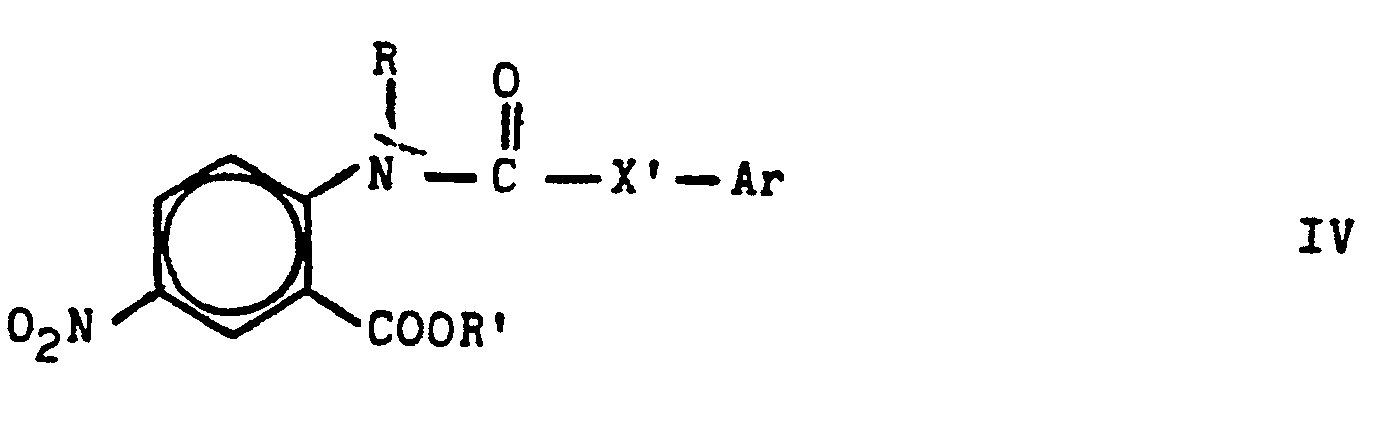
- C) Verbindungen der Formel 111, in der R und R' die oben genannten Bedeutungen haben, R' jedoch zusätzlich für Wasserstoff steht, umsetzt mit Verbindungen der Formel Ar-X'-COHaI, wobei Ar die oben genannte Bedeutung hat und X' für eine Kette (CH2)n-1 steht, die wie oben definiert durch 1 bis (2n-1) Alkylreste und/oder durch den Rest Ar substituiert sein kann und in der Hal für Chlor oder Brom steht, zu Verbindungen der Formel IV

- Die nach den Varianten A-C erhaltenen Verbindungen der Formel I werden gegebenenfalls in ihre pharmazeutisch verträglichen Salze überführt.
- Als Fluchtgruppe Z der Verfahrensvariante B) sind alle leicht nukleophil verdrängbaren Gruppen wie beispielsweise Halogen, Tosylat, Mesylat, Trifluormethansulfonat, Acetoxy oder Trifluoracetoxy geeignet.
- Werden Verbindungen der allgemeinen _Formel I nach Verfahrensvariante A) hergestellt, so geschieht dies vorteilhaft dadurch, daß man die Verbindungen der Formel 11 mit den Aminen RNH-X-Ar unter Zusatz eines Säurefängers umsetzt. Es kommen prinzipiell alle basischen Stoffe in Frage, die das bei der Reaktion entstehende HHal zu binden vermögen, beispielsweise Kaliumcarbonat, Natriumhydroxid, Natriumhydrogencarbonat, Triethylamin oder etwa ein Überschuß des Amins RNH-X-Ar. Unter Umständen kann es von Vorteil sein, die Reaktion zusätzlich nach Art der Ullmannreaktion durch den Zusatz von Cu-Pulver oder Cu-Bronze zu katalysieren. Als Lösungsmittel kommen dabei alle den Reaktionspartnern gegenüber inerte Lösemittel wie z.B. Dimethylacetamid oder Ethanol in Frage. Bei Verwendung flüssiger Amine RNH-X-Ar kann mitunter ganz auf ein Lösemittel verzichtet werden.
- Verfahrensvariante B) umfaßt Alkylierung der aromatischen Amine III mit den Alkylierungsmitteln Z-X-Ar. Dies wird in an sich bekannter Weise so durchgeführt, daß man die Reaktionspartner, gegebenenfalls unter Zusatz eines Säurefängers, in einem inerten Lösemittel zur Reaktion bringt. Als besonders geeignet haben sich dabei dipolar-aprotische Lösemittel erwiesen wie etwa Dimethylformamid oder Dioxan. Als Säurefänger kommen alle basischen Stoffe in Frage, die die bei der Reaktion freiwerdende Säure zu binden vermögen, beispielsweise die unter Verfahrensvariante A) genannten Basen. Als besonders vorteilhaft hat sich dabei die Verwendung von Kaliumkarbonat in Dioxan herausgestellt. I. A. sind erhöhte Reaktionstemperaturen zur Erzielung befriedigender Umsätze von Vorteil, beispielsweise Rückflußtemperatur von Dioxan. Bei den solchermassen erhaltenen Verbindungen der Formel I ist die COOH-Gruppe noch durch R'-OH verestert. Durch Säure- oder basenkatalysierte Hydrolyse lassen sich diese Verbindungen leicht nach Standardmethoden in die freien Anthranilsäuren umwandeln.
- Werden Verbindungen der Formel I nach Verfahrensvariante C) hergestellt, so werden zunächst Anthranilsäureester der Formel III acyliert durch die Säurehalogenide Ar-X'-Hal. Die Ausführung orientiert sich an Standardmethoden für derartige Acylierungsreaktionen, beispielsweise durch die Verwendung von Triethylamin oder Pyridin als Säurefänger und von den Reaktionspartnern gegenüber neutralen Lösemitteln wie Ethylacetat oder Dioxan. Die anschließende Reduktion der Amide IV zu den Aminen V kann ebenfalls nach Standardmethoden durchgeführt werden. Als besonders vorteilhaft hat sich dabei die Verwendung eines Reduktionsmittels wie etwa Natriumborhydrid in Gegenwart eine- Lewissäure wie Bortrifluorid erwiesen. Die dadurch erhaltenen Verbindungen V werden durch Standardmethoden verseift zu den Säuren der Formel I.
- Die erfindungsgemäßen Verbindungen der Formel I sowie deren pharmazeutisch verträgliche Salze sind Mittel, die der Entstehung eines Gehirnödems entgegenwirken oder dessen Abschwellung herbeiführen oder beschleunigen können. Sie werden in Dosierungen von mindestens 0,01 mg/kg, vorzugsweise 0,05 mg/kg und insbesondere 0,5 mg/kg bis maximal 100 mg/kg, vorzugsweise 50 mg/kg und insbesondere 20 mg/kg in Kapseln, Dragees, Tabletten oder Lösungen mit verschiedenen Zusätzen enteral z.B. oral oder parenteral (wie etwa Injektion in das Gefäßsystem, z.B. intravenös) verabfolgt. Sie eignen sich zur Behandlung von Hirnödemen unterschiedlicher Pathogenese, beispielsweise solcher Ödeme, die durch Schädeltraumen infolge stumpfer Verletzungen entstehen aber auch ischämisch bedingte Hirnödeme wie etwa nach Apoplex oder nach epileptischen Anfällen oder wie sie in Begleitung gewisser Gehirntumoren entstehen, können behandelt werden.
- Eine Lösung aus 15,3 g 2-Chlor-5-nitrobenzoesäure und 49 g 3-Phenylpropylamin in 60 ml Dimethylacetamid wird über 2 Stunden auf 145 ° C erhitzt. Nach dem Abkühlen versetzt man mit 300 ml Wasser und stellt mit 2 n HCI sauer (pH 2 bis 1).
Der gelbe kristalline Niederschlag wird abfiltriert, mehrmals mit Wasser gewaschen und nach dem Trocknen aus Isopropanol umkristallisiert.
Gelbe Kristalle, Schmp. 178 - 180 C. - Eine Lösung von 5,6 g 2-Fluor-5-nitrobenzoesäure und 14,5, g 2-Phenylethylamin in 20 ml Dimethylacetamid wird analog Beispiel 1 umgesetzt und aufgearbeitet. Gelbe Kristalle aus Isopropanol, Schmp. 116 - 118 ° C.
- Analog der in Beispiel 1 und 2 angegebenen Vorschrift lassen sich unter Verwendung von 2-Chlor- bzw. 2-Fluor-5-nitrobenzoesäure und des entsprechenden Amins die nachfolgend aufgeführten erfindungsgemäßen Verbindungen herstellen:
- Beispiel 3 2-(2,2-Diphenylethylamino)-5-nitrobenzoesäure, Schmp. 232 - 234 ° C.
- Beispiel 4 2-(4-Phenylbutylamino)-5-nitrobenzoesäure, Schmp. 180 - 182 C.
- Beispiel 5 2-(1-Methyl-3-phenylpropylamino)-5-nitrobenzoesäure, Schmp. 228 - 230 C.
- Beispiel 6 2-(3,3-Diphenylpropylamino)-5-nitrobenzoesäure, Schmp. 203 C.
- Beispiel 7 5-Nitro-2-(1-phenylethylamino)-benzoesäure (Racemat und optische Isomere)
- Beispiel 8 2-(3,4,5-Trimethoxybenzylamino)-5-nitrobenzoesäure,
- Beispiel 9 2-[2-(2-Methoxyphenyl-ethyl)-amino]-5-nitrobenzoesäure
- Beispiel 10 2-[2-(3,4-Dimethoxyphenyl-ethyl)-amino]-5-nitrobenzoesäure
- Beispiel 11 2-[2-(4-Methoxyphenyl-ethyl)-amino)-5-nitrobenzoesäure
-
Beispiel 12 2-[2-(2-Chlorphenyl-ethyl)-amino]-5-nitrobenzoesäure -
Beispiel 13 2-[2-(4-Chlorphenyl-ethyl)-amino]-5-nitrobenzoesäure - Beispiel 14 2-[2-(3-Trifluormethylphenyl-ethyl)-amino]-5-nitrobenzoesäure
- Beispiel 15 2-(2-Furylmethylamino)-5-nitrobenzoesäure
- Eine Lösung von 14,7 g 2-Fluor-5-nitrobenzoesäure und 23,1 g 2-Furylmethylamin in 250 ml Ethanol wird über 6 Stunden am Rückflußkühler gekocht. Nach Abdestillieren des Lösungsmittels unter vermindertem Druck löst man den Rückstand in 150 ml Wasser, stellt mit 2 n HCI auf etwa pH 2 und filtriert den Niederschlag ab. Nach mehrmaligem Waschen des Niederschlages mit Wasser trocknet man im Luftstrom. Hellgelbe Kristalle,
- Schmp. 190 -192 C (aus Isopropanol).
- (Bilaterale temporäre Gehirnischämie beim mongolischen Gerbil).
- Die Versuche werden an männlichen mongolischen Gerbils (Meriones unguiculatus; Stamm: Kastengrund, Hoechst AG, Frankfurt am Main) mit einem Körpergewicht von 50 - 70 g in Narkose durchgeführt. Für die Narkose wird ein tragbares Narkosegerät Halothanvapor 19.1 (Drägerwerk AG, Lübeck-West-Deutschland) verwendet. Einstellung der Narkosegase: 02 1.1 I/min + N2 2.0 I/min + Halothan 3.2 Vol.% bis zum Erreichen des Toleranzstadiums. Das Atemgas Halothangemisch wird in einen kleinen Exsikkator geleitet, in dem die Tiere bis zum Erreichen des Toleranzstadiums verbleiben. Anschließend werden die Tiere aus dem Exsikkator entfernt, auf einen Rattenoperationstisch fixiert und die Narkose über eine Atemmaske bei einer Halothankonzentration von 1.2 Vol.% oder geringer fortgesetzt. Nun werden die beiden A. carotides communes schonend freigelegt und mit dem Microgefäßclips für 20 min. verschlossen. Danach erfolgt eine Rezirkulation für 90 min. Nach Verschluß der Gefäße werden die Tiere in Beobachtungsgläser gesetzt, die mit Hilfe von Heizkissen auf eine Bodentemperatur von ca. 29 C gebracht werden. Die Beobachtung der Tiere in den Glasgefäßen erstreckt sich über 110 min., dabei werden die neurologischen Symptome entsprechend einer Klassifizierung festgehalten.
Die Testsubstanzen werden vor dem Gefäßverschluß in einem Injektionsvolumen von 5 ml/kg Körpergewicht oral verabreicht. Die Kontrolltiere erhalten das entsprechende Vehikel in gleichem Volumen. Nach einer Beobachtungszeit von 110 min. werden die Tiere in Narkose dekapitiert und die Gehirne entnommen. Das Kleinhirn wird verworfen und das Feuchtgewicht der beiden Gehirnhälften bestimmt. - Die gewogenen Gehirne werden in einem Trockenschrank bei 95° C 2 Tage getrocknet. Nach der Bestimmung des Trockengewichtes wird der Hirnödemgrad in Prozent des Wassergehaltes errechnet.
-
- 1. Levy, D.E. and T.E. Duffy: J. Neurochem. 28:63 , 1977
- 2. Welsh, F.A. and W. Rieder: J. Neurochem. 31:299, 1978
- 3. Cain, A.P. and M.E. Corcoran : Electroenceph. Clin. Neurophys. 49 : 360, 1980
- Wirkung in einer Dosis von 100 mg/kg oral auf Hirnödem am Gerbil.

sowie deren pharmazeutisch verträgliche Salze.
Claims (6)

sowie deren pharmazeutisch verträgliche Salze.


zu einer Verbindung der Formel IV


Priority Applications (1)
| Application Number | Priority Date | Filing Date | Title |
|---|---|---|---|
| AT86110027T ATE68785T1 (de) | 1985-07-31 | 1986-07-22 | N-substituierte 5-nitroanthranilsaeuren, verfahren zu ihrer herstellung, ihre verwendung sowie pharmazeutische praeparate auf basis dieser verbindungen. |
Applications Claiming Priority (4)
| Application Number | Priority Date | Filing Date | Title |
|---|---|---|---|
| DE3527409 | 1985-07-31 | ||
| DE19853527409 DE3527409A1 (de) | 1985-07-31 | 1985-07-31 | N-substituierte 5-nitroanthranilsaeuren, verfahren zu ihrer herstellung, ihre verwendung sowie pharmazeutische praeparate auf basis dieser verbindungen |
| DE19853528048 DE3528048A1 (de) | 1985-08-05 | 1985-08-05 | N-substituierte 5-nitroanthranilsaeuren, verfahren zu ihrer herstellung, ihre verwendung sowie pharmazeutische praeparate auf basis dieser verbindungen |
| DE3528048 | 1985-08-05 |
Publications (3)
| Publication Number | Publication Date |
|---|---|
| EP0210574A2 EP0210574A2 (de) | 1987-02-04 |
| EP0210574A3 EP0210574A3 (en) | 1988-07-20 |
| EP0210574B1 true EP0210574B1 (de) | 1991-10-23 |
Family
ID=25834571
Family Applications (1)
| Application Number | Title | Priority Date | Filing Date |
|---|---|---|---|
| EP86110027A Expired - Lifetime EP0210574B1 (de) | 1985-07-31 | 1986-07-22 | N-Substituierte 5-Nitroanthranilsäuren, Verfahren zu ihrer Herstellung, ihre Verwendung sowie pharmazeutische Präparate auf Basis dieser Verbindungen |
Country Status (4)
| Country | Link |
|---|---|
| US (1) | US4994493A (de) |
| EP (1) | EP0210574B1 (de) |
| AT (1) | ATE68785T1 (de) |
| DE (1) | DE3682136D1 (de) |
Families Citing this family (20)
| Publication number | Priority date | Publication date | Assignee | Title |
|---|---|---|---|---|
| US5559151A (en) * | 1994-11-30 | 1996-09-24 | Allergan | Method for reducing intraocular pressure in the mammalian eye by administration of chloride channel blockers |
| EP0906273B1 (de) * | 1996-05-24 | 2002-10-16 | Neurosearch A/S | Saure gruppen enthaltende phenylderivate, ihre herstellung und ihre verwendung als chloridkanalblocker |
| TR199902593T2 (xx) | 1997-04-22 | 2000-03-21 | Neurosearch A/S | �kame edilmi� fenil t�revleri, bunlar�n haz�rlanmas� ve kullan�m�. |
| US6696475B2 (en) | 1997-04-22 | 2004-02-24 | Neurosearch A/S | Substituted phenyl derivatives, their preparation and use |
| AU5727899A (en) | 1998-10-02 | 2000-04-26 | Neurosearch A/S | Diaminocyclobutene-3,4-dione derivatives, their preparation and use |
| EP1514867A3 (de) | 1998-10-22 | 2005-03-23 | NeuroSearch A/S | Substituierte Phenylderivate, ihre Herstellung und Verwendung |
| PT1255544E (pt) * | 2000-01-31 | 2007-06-15 | Genaera Corp | Inibidores da síntese da mucina. |
| US7345051B2 (en) | 2000-01-31 | 2008-03-18 | Genaera Corporation | Mucin synthesis inhibitors |
| AU5702201A (en) * | 2000-04-13 | 2001-10-30 | Mayo Foundation | Abeta<sub>42</sub> lowering agents |
| US20060004086A1 (en) * | 2000-04-13 | 2006-01-05 | Mayo Foundation For Medical Education And Research | Method of reducing Abeta42 and treating diseases |
| EP1603548A4 (de) * | 2003-02-05 | 2007-10-10 | Myriad Genetics Inc | Verfahren und zusammensetzung zur behandlung neurodegenerativer erkrankungen |
| US20050249675A1 (en) * | 2003-06-19 | 2005-11-10 | Hsiao-Ling Hung | Mucin synthesis inhibitors |
| WO2005065069A2 (en) * | 2003-07-11 | 2005-07-21 | Myriad Genetics, Inc. | Pharmaceutical methods, dosing regimes and dosage forms for the treatment of alzheimer's disease |
| WO2006001877A2 (en) * | 2004-04-13 | 2006-01-05 | Myriad Genetics, Inc. | Combination treatment for neurodegenerative disorders comprising r-flurbiprofen |
| WO2005108683A1 (en) * | 2004-04-29 | 2005-11-17 | Keystone Retaining Wall Systems, Inc. | Veneers for walls, retaining walls and the like |
| WO2006020850A2 (en) * | 2004-08-11 | 2006-02-23 | Myriad Genetics, Inc. | Pharmaceutical composition and method for treating neurodegenerative disorders |
| CA2618985A1 (en) * | 2004-08-11 | 2006-02-23 | Myriad Genetics, Inc. | Pharmaceutical composition and method for treating neurodegenerative disorders |
| WO2006020852A2 (en) * | 2004-08-11 | 2006-02-23 | Myriad Genetics, Inc. | Pharmaceutical composition and method for treating neurodegenerative disorders |
| CA2615063A1 (en) * | 2005-07-22 | 2007-02-01 | Myriad Genetics, Inc. | High drug load formulations and dosage forms |
| EP2046119A2 (de) * | 2006-07-07 | 2009-04-15 | Myriad Genetics, Inc. | Behandlung von psychiatrischen störungen |
Family Cites Families (2)
| Publication number | Priority date | Publication date | Assignee | Title |
|---|---|---|---|---|
| SE7903231L (sv) * | 1978-04-20 | 1979-10-21 | Sandoz Ag | Farmaceutisk komposition innehallande antranilsyraderivat som antidiabetikum |
| EP0023569B1 (de) * | 1979-07-13 | 1983-06-22 | Dr. Karl Thomae GmbH | Carbonsäure-Derivate, deren Herstellung und diese Verbindungen enthaltende Arzneimittel |
-
1986
- 1986-07-22 DE DE8686110027T patent/DE3682136D1/de not_active Expired - Fee Related
- 1986-07-22 EP EP86110027A patent/EP0210574B1/de not_active Expired - Lifetime
- 1986-07-22 AT AT86110027T patent/ATE68785T1/de not_active IP Right Cessation
- 1986-07-29 US US06/890,318 patent/US4994493A/en not_active Expired - Fee Related
Also Published As
| Publication number | Publication date |
|---|---|
| US4994493A (en) | 1991-02-19 |
| ATE68785T1 (de) | 1991-11-15 |
| EP0210574A2 (de) | 1987-02-04 |
| DE3682136D1 (de) | 1991-11-28 |
| EP0210574A3 (en) | 1988-07-20 |
Similar Documents
| Publication | Publication Date | Title |
|---|---|---|
| EP0210574A2 (de) | N-Substituierte 5-Nitroanthranilsäuren, Verfahren zu ihrer Herstellung, ihre Verwendung sowie pharmazeutische Präparate auf Basis dieser Verbindungen | |
| DE69202313T2 (de) | Naphthylethylharnstoff und Naphthylethylthioharnstoff Verbindungen, Verfahren zu ihrer Herstellung und pharmazeutische Zusammensetzungen, die sie enthalten. | |
| DE69132167T2 (de) | Kondensierte benzoxa-ringverbindung, deren herstellung sowie diese enthaltendes arzneimittel | |
| DE3249054T1 (de) | (1-(2-benzoxazolyl)-hydrazino)-alkylnitril-derivate | |
| DE69312567T2 (de) | 2-Formylpyridin-Thiosemicarbazonderivate, ihre Herstellung und ihre Verwendung als Antitumor Mittel | |
| EP0053767B1 (de) | Tricyclische Cytosinderivate zur Verwendung in Arzneimitteln und Verfahren zu ihrer Herstellung | |
| DE2847792C2 (de) | ||
| DE69810606T2 (de) | 2-phenoxyanilinderivate | |
| DE2143745A1 (de) | 3,4-dihydro-2h-isochinolin-1-thione und verfahren zu ihrer herstellung | |
| DE1445675C3 (de) | Pyridylharnstoffe und Verfahren zu ihrer Herstellung | |
| DE2446758A1 (de) | Neue 2,6-disubstituierte 2-phenylimino- imidazolidine, deren saeureadditionssalze, diese enthaltende arzneimittel und verfahren zu deren herstellung | |
| DE2257311A1 (de) | Benzimidazolyl-aminoimidazoline, verfahren zu ihrer herstellung und diese verbindungen enthaltende arzneipraeparate | |
| EP0799224B1 (de) | Chinoxaline und arzneimittel daraus | |
| DE3879378T2 (de) | Amid-verbindungen. | |
| EP0564499B1 (de) | Neue amine, verfahren zu ihrer herstellung, sowie diese verbindungen enthaltende arzneimittel | |
| DE3613065A1 (de) | Verwendung von 3-carbamoyl-4-hydroxy-cumarinen zur bekaempfung von parasitaeren helminthen, neue 3-carbamoyl-4-hydroxy-cumarine und ihre herstellung | |
| DE69713128T2 (de) | 4-(1-piperazinyl)benzosäurederivate, verfahren zu ihrer herstellung und ihre therapeutischen verwendungen | |
| DE2609574C3 (de) | 1 -^-Fluor-S-trifluormethylthiophenyD-piperazin, dessen Salze, Verfahren zu dessen Herstellung und Arzneimittel | |
| DE2147857A1 (de) | Substituierte 6-phenyl-imidazo eckige klammer auf 2,1-b eckige klammer zu -thiazole | |
| DE3527409A1 (de) | N-substituierte 5-nitroanthranilsaeuren, verfahren zu ihrer herstellung, ihre verwendung sowie pharmazeutische praeparate auf basis dieser verbindungen | |
| DE3528048A1 (de) | N-substituierte 5-nitroanthranilsaeuren, verfahren zu ihrer herstellung, ihre verwendung sowie pharmazeutische praeparate auf basis dieser verbindungen | |
| DE3726425A1 (de) | Basisch substituierte saccharine | |
| CH513848A (de) | Verfahren zur Herstellung von Pyrrolinverbindungen | |
| DE1153357B (de) | Verfahren zur Herstellung von Azidobenzolsulfonylharnstoffen | |
| DE738565C (de) | Verfahren zur Herstellung von Abkoemmlingen von Sulfonen |
Legal Events
| Date | Code | Title | Description |
|---|---|---|---|
| PUAI | Public reference made under article 153(3) epc to a published international application that has entered the european phase |
Free format text: ORIGINAL CODE: 0009012 |
|
| AK | Designated contracting states |
Kind code of ref document: A2 Designated state(s): AT BE CH DE FR GB IT LI LU NL SE |
|
| PUAL | Search report despatched |
Free format text: ORIGINAL CODE: 0009013 |
|
| AK | Designated contracting states |
Kind code of ref document: A3 Designated state(s): AT BE CH DE FR GB IT LI LU NL SE |
|
| 17P | Request for examination filed |
Effective date: 19890110 |
|
| 17Q | First examination report despatched |
Effective date: 19900727 |
|
| GRAA | (expected) grant |
Free format text: ORIGINAL CODE: 0009210 |
|
| AK | Designated contracting states |
Kind code of ref document: B1 Designated state(s): AT BE CH DE FR GB IT LI LU NL SE |
|
| REF | Corresponds to: |
Ref document number: 68785 Country of ref document: AT Date of ref document: 19911115 Kind code of ref document: T |
|
| ITF | It: translation for a ep patent filed | ||
| REF | Corresponds to: |
Ref document number: 3682136 Country of ref document: DE Date of ref document: 19911128 |
|
| ET | Fr: translation filed | ||
| GBT | Gb: translation of ep patent filed (gb section 77(6)(a)/1977) | ||
| PLBE | No opposition filed within time limit |
Free format text: ORIGINAL CODE: 0009261 |
|
| STAA | Information on the status of an ep patent application or granted ep patent |
Free format text: STATUS: NO OPPOSITION FILED WITHIN TIME LIMIT |
|
| 26N | No opposition filed | ||
| EPTA | Lu: last paid annual fee | ||
| EAL | Se: european patent in force in sweden |
Ref document number: 86110027.9 |
|
| PGFP | Annual fee paid to national office [announced via postgrant information from national office to epo] |
Ref country code: DE Payment date: 19950920 Year of fee payment: 10 |
|
| PGFP | Annual fee paid to national office [announced via postgrant information from national office to epo] |
Ref country code: FR Payment date: 19960613 Year of fee payment: 11 |
|
| PGFP | Annual fee paid to national office [announced via postgrant information from national office to epo] |
Ref country code: SE Payment date: 19960617 Year of fee payment: 11 Ref country code: CH Payment date: 19960617 Year of fee payment: 11 |
|
| PGFP | Annual fee paid to national office [announced via postgrant information from national office to epo] |
Ref country code: NL Payment date: 19960618 Year of fee payment: 11 |
|
| PGFP | Annual fee paid to national office [announced via postgrant information from national office to epo] |
Ref country code: GB Payment date: 19960620 Year of fee payment: 11 |
|
| PGFP | Annual fee paid to national office [announced via postgrant information from national office to epo] |
Ref country code: AT Payment date: 19960624 Year of fee payment: 11 |
|
| PGFP | Annual fee paid to national office [announced via postgrant information from national office to epo] |
Ref country code: LU Payment date: 19960701 Year of fee payment: 11 |
|
| PGFP | Annual fee paid to national office [announced via postgrant information from national office to epo] |
Ref country code: BE Payment date: 19960711 Year of fee payment: 11 |
|
| PG25 | Lapsed in a contracting state [announced via postgrant information from national office to epo] |
Ref country code: DE Effective date: 19970402 |
|
| PG25 | Lapsed in a contracting state [announced via postgrant information from national office to epo] |
Ref country code: LU Free format text: LAPSE BECAUSE OF NON-PAYMENT OF DUE FEES Effective date: 19970722 Ref country code: GB Free format text: LAPSE BECAUSE OF NON-PAYMENT OF DUE FEES Effective date: 19970722 Ref country code: AT Free format text: LAPSE BECAUSE OF NON-PAYMENT OF DUE FEES Effective date: 19970722 |
|
| PG25 | Lapsed in a contracting state [announced via postgrant information from national office to epo] |
Ref country code: SE Effective date: 19970723 |
|
| PG25 | Lapsed in a contracting state [announced via postgrant information from national office to epo] |
Ref country code: LI Free format text: LAPSE BECAUSE OF NON-PAYMENT OF DUE FEES Effective date: 19970731 Ref country code: CH Free format text: LAPSE BECAUSE OF NON-PAYMENT OF DUE FEES Effective date: 19970731 Ref country code: BE Free format text: LAPSE BECAUSE OF NON-PAYMENT OF DUE FEES Effective date: 19970731 |
|
| BERE | Be: lapsed |
Owner name: HOECHST A.G. Effective date: 19970731 |
|
| PG25 | Lapsed in a contracting state [announced via postgrant information from national office to epo] |
Ref country code: NL Free format text: LAPSE BECAUSE OF NON-PAYMENT OF DUE FEES Effective date: 19980201 |
|
| GBPC | Gb: european patent ceased through non-payment of renewal fee |
Effective date: 19970722 |
|
| REG | Reference to a national code |
Ref country code: CH Ref legal event code: PL |
|
| PG25 | Lapsed in a contracting state [announced via postgrant information from national office to epo] |
Ref country code: FR Free format text: LAPSE BECAUSE OF NON-PAYMENT OF DUE FEES Effective date: 19980331 |
|
| NLV4 | Nl: lapsed or anulled due to non-payment of the annual fee |
Effective date: 19980201 |
|
| EUG | Se: european patent has lapsed |
Ref document number: 86110027.9 |
|
| REG | Reference to a national code |
Ref country code: FR Ref legal event code: ST |
|
| PG25 | Lapsed in a contracting state [announced via postgrant information from national office to epo] |
Ref country code: IT Free format text: LAPSE BECAUSE OF NON-PAYMENT OF DUE FEES;WARNING: LAPSES OF ITALIAN PATENTS WITH EFFECTIVE DATE BEFORE 2007 MAY HAVE OCCURRED AT ANY TIME BEFORE 2007. THE CORRECT EFFECTIVE DATE MAY BE DIFFERENT FROM THE ONE RECORDED. Effective date: 20050722 |