EP0211350A2 - Photolackzusammensetzung und Anwendungsverfahren - Google Patents
Photolackzusammensetzung und Anwendungsverfahren Download PDFInfo
- Publication number
- EP0211350A2 EP0211350A2 EP86110277A EP86110277A EP0211350A2 EP 0211350 A2 EP0211350 A2 EP 0211350A2 EP 86110277 A EP86110277 A EP 86110277A EP 86110277 A EP86110277 A EP 86110277A EP 0211350 A2 EP0211350 A2 EP 0211350A2
- Authority
- EP
- European Patent Office
- Prior art keywords
- photoresist
- photoresist composition
- organic base
- nitrogen moiety
- composition according
- Prior art date
- Legal status (The legal status is an assumption and is not a legal conclusion. Google has not performed a legal analysis and makes no representation as to the accuracy of the status listed.)
- Withdrawn
Links
Images


Classifications
-
- G—PHYSICS
- G03—PHOTOGRAPHY; CINEMATOGRAPHY; ANALOGOUS TECHNIQUES USING WAVES OTHER THAN OPTICAL WAVES; ELECTROGRAPHY; HOLOGRAPHY
- G03F—PHOTOMECHANICAL PRODUCTION OF TEXTURED OR PATTERNED SURFACES, e.g. FOR PRINTING, FOR PROCESSING OF SEMICONDUCTOR DEVICES; MATERIALS THEREFOR; ORIGINALS THEREFOR; APPARATUS SPECIALLY ADAPTED THEREFOR
- G03F7/00—Photomechanical, e.g. photolithographic, production of textured or patterned surfaces, e.g. printing surfaces; Materials therefor, e.g. comprising photoresists; Apparatus specially adapted therefor
- G03F7/004—Photosensitive materials
- G03F7/022—Quinonediazides
- G03F7/0226—Quinonediazides characterised by the non-macromolecular additives
-
- G—PHYSICS
- G03—PHOTOGRAPHY; CINEMATOGRAPHY; ANALOGOUS TECHNIQUES USING WAVES OTHER THAN OPTICAL WAVES; ELECTROGRAPHY; HOLOGRAPHY
- G03F—PHOTOMECHANICAL PRODUCTION OF TEXTURED OR PATTERNED SURFACES, e.g. FOR PRINTING, FOR PROCESSING OF SEMICONDUCTOR DEVICES; MATERIALS THEREFOR; ORIGINALS THEREFOR; APPARATUS SPECIALLY ADAPTED THEREFOR
- G03F7/00—Photomechanical, e.g. photolithographic, production of textured or patterned surfaces, e.g. printing surfaces; Materials therefor, e.g. comprising photoresists; Apparatus specially adapted therefor
- G03F7/20—Exposure; Apparatus therefor
- G03F7/2022—Multi-step exposure, e.g. hybrid; backside exposure; blanket exposure, e.g. for image reversal; edge exposure, e.g. for edge bead removal; corrective exposure
Definitions
- Photosensitive materials play an important part in the fabrication of large scale integrated circuits. Such materials permit circuit designers to create patterns of micron and submicron dimensions upon substrate materials such as silicon and silicon oxides.
- the patterns are created by means of a photolithographic process, wherein a photoresist material is applied to the substrate, the photoresist is exposed to imaging radiation to create a latent image therein, and subsequently the latent image is developed into a patterned resist using either a wet or dry development process.
- the photoresist material itself may be the patterned material to be created upon the substrate, or it may provide a mask for subsequent processing such as the deposition of a different material upon exposed areas of the substrate not protected by the masking layer.
- the photoresist may be applied over a layer of a different material so that the photoresist can be used as a mask during a process which permits transfer of the pattern from the photoresist to the adjacent layer of the different material.
- positive tone photoresist is used to describe a material which upon exposure to a given radiation (such as actinic radiation, electron beam, ion beam, or X-ray) is chemically or structurally altered so that upon development of the latent image, the exposed areas of the photoresist are removed.
- a given radiation such as actinic radiation, electron beam, ion beam, or X-ray
- negative tone photoresist is used to describe a material which upon exposure to radiation is chemically or structurally altered so that upon develop ment of the latent image, the unexposed areas of the photoresist are removed.
- Patent 4,104,070 to Moritz et al. wherein a layer of positive photoresist is applied to a substrate (the positive photoresist is comprised of a phenolformaldehyde resin, a napthoquinone (1,2) diazide sulfonic acid ester sensitizer, and a hydroxyethyl-2-alkylimidazoline base); the photoresist layer is imagewise exposed to actinic radiation; the composite substrate and photoresist layer is subjected to heat for a sufficient period of time to react the indene carboxylic acid groups (created within the photoresist upon exposure to actinic radiation) with the imidazoline base, thus rendering the portion of the photoresist exposed to actinic radiation insoluble in alkaline developer; subsequently, the surface of the photoresist is exposed to blanket actinic radiation; and then the portions of the photoresist which were not imagewise exposed to actinic radiation (but which were exposed to the blanket actinic
- a disadvantage of using this process is the decreased shelf life of the positive photoresist material which results from the presence of the hydroxyethyl-2-alkylimidazoline base.
- This basic additive which is used to obtain image reversal, also catalyzes side reactions which increase the viscosity of the resist and can cause fairly severe degradation in photosensitivity of the resist.
- U.S. Patent 4,104,078 is hereby incorporated by reference, since the present invention is viewed as an improvement over the invention disclosed therein.
- the method disclosed in this publication utilizes the alkali-soluble novolak resins combined with o-quinone diazide sensitizers as the photoresist material; however, no base (such as the hydroxyethyl-2-alkylimidazoline described above) is used as a part of the photoresist composition.
- the photoresist is treated using an amine vapor to render the indene carboxylic acid, formed upon exposure of the photoresist to actinic radiation, insoluble to alkali solutions and insensitive to further ultraviolet exposure.
- Some of the disadvantanges of using the gaseous ammonia/amine vapor process include the time required for the vapor to diffuse into the photoresist and the corrosive effect of the vapor on process equipment.
- photoresist compositions as claimed in claims 1 and 8 and by a method as claimed in claim 9.
- the inventive photoresist composition not only provides an increased shelf life but also permits image reversal under typical process conditions. It is preferable to have the nitrogen moiety of the organic base be sterically protected as well as stable in terms of electronic configuration.
- organic bases of the type disclosed in the present invention which can be used in photoresist compositions to obtain image reversal, include (but are not limited to) 2,6-di-t-butylpyridine, benzimidazole, pyridine, quinoline, acridine, lutidine, and 1-methyl benzimidazole.
- Organic bases of this type can be substituted for the 1-hydroxyethyl-2-alkylimidazoline disclosed in the U.S. Patent to Moritz et.al. (Assigned to the assignee of the present invention) in order to obtain image reversal while providing increased shelf life for the photoresist composition.
- the photoresist comprised a mixture of a cresol formaldehyde novolak resin, a diazoquinone sensitizer and an organic base selected from those specified in the table below.
- the admixture was created by placing the photoresist ingredients into a casting solution using a mixture of ethyl cellosolve acetate: n-butylacetate (90:10 by weight) as the solvent.
- the concentrations of solution components were as follows: The cresol formaldehyde novolak resin comprised about 30% by weight of the solution; and The diazoquinone sensitizer comprised about 5% by weight of the solution; The organic base comprised about 1 mole% of the solution; and the ethyl cellosolve acetate: n-butylacetate (90:10) solvent comprised about 65% by weight of the solution.
- the casting solution solvent can be comprised of any of the individual or mixtures of solvents cited in the literature for use in combination with diazoquinone/novolak resists.
- the storage temperature was approximately 40°C, and the storage time period was as shown in Table I.
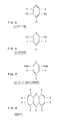
- FIGS. 1-11 show examples of the types of structures which provide an organic base which can be used within the image reversal process in order to obtain increased shelf life of the photoresist solution.
- the most preferred is that wherein the nitrogen moiety is sterically protected in order to reduce the degree of undesirable side reactions taking place.
- the structure of FIG. 7 is preferred over the structure of FIG. 10, and the structure of FIG. 6 is preferred over the structure of FIG. 5.
- the most preferred structure of those shown in FIGS. 4-11 is the benzimidazole of FIG.9.
- This material is relatively non-toxic and exhibits a sufficiently low vapor pressure to remain in the photoresist film at process temperatures.
- the benzimidazole provides a nice balance between the competing factors of longer shelf stability and the reactivity desired during the decarboxylation step required to achieve image reversal.
- the image-reversible photoresist solution comprised an admixture of about 30 weight % of a novolak_resin, about 5 weight % of a diazoquinone photosensitizer, about 2 weight % of about (1 mole %) benzimidazole organic base, and about 63 weight % of ethyl cellosolve acetate: n-butylacetate (90:10) solvent.
- a thin photoresist film was applied onto a silicon wafer covered with a thermally produced silicon dioxide layer, by means of a standard spin coating technique. The photoresist film was then dried for about 20 minutes at about 80°C.
- the photoresist film was then imagewise exposed to actinic radiation through a BLM mask, using a commercially available reflective scan projection exposure tool in order to create a latent image within the photoresist film.
- the image-wise exposed photoresist film was then heated to about 100°C for a period of about 30 minutes in order to react the organic base with the indene carboxylic acid groups which were formed within the irradiated portions of the photoresist upon irradiation.
- the photoresist film was blanket exposed to broadband actinic radiation in order to create the indene carboxylic acid groups within the previously unexposed portions of the photoresist. No major change occurred within the image-wise exposed and reacted areas of the photoresist.
- the photoresist material was developed using an alkaline developer to produce the desired negative pattern (the portions of the photoresist remaining after development were the image-wise irradiated and reacted portions).
- the developed patterns comprised line widths of about 2 micrometers at line spacings of about 2 micrometers, wherein the height of the wall of the photoresist above the substrate was about 3 micrometers, and the wall profile ranged from relatively straight to slightly undercut, depending on the length of the development time.
- the developed photoresist patterns comprised line widths of about 2 micrometers at line spacings of about 2 micrometers, wherein the height of the wall of the photoresist above the substrate was about 3 micrometers and the wall profile ranged from relatively straight to slightly undercut, depending on the length of the development time.
Landscapes
- Physics & Mathematics (AREA)
- General Physics & Mathematics (AREA)
- Spectroscopy & Molecular Physics (AREA)
- Materials For Photolithography (AREA)
- Exposure And Positioning Against Photoresist Photosensitive Materials (AREA)
- Photosensitive Polymer And Photoresist Processing (AREA)
Applications Claiming Priority (2)
| Application Number | Priority Date | Filing Date | Title |
|---|---|---|---|
| US76317685A | 1985-08-07 | 1985-08-07 | |
| US763176 | 1985-08-07 |
Publications (2)
| Publication Number | Publication Date |
|---|---|
| EP0211350A2 true EP0211350A2 (de) | 1987-02-25 |
| EP0211350A3 EP0211350A3 (de) | 1987-12-02 |
Family
ID=25067082
Family Applications (1)
| Application Number | Title | Priority Date | Filing Date |
|---|---|---|---|
| EP86110277A Withdrawn EP0211350A3 (de) | 1985-08-07 | 1986-07-25 | Photolackzusammensetzung und Anwendungsverfahren |
Country Status (2)
| Country | Link |
|---|---|
| EP (1) | EP0211350A3 (de) |
| JP (1) | JPS6235350A (de) |
Cited By (10)
| Publication number | Priority date | Publication date | Assignee | Title |
|---|---|---|---|---|
| WO1988002878A1 (en) * | 1986-10-20 | 1988-04-21 | Macdermid, Incorporated | Image reversal system and process |
| GB2210172A (en) * | 1987-09-18 | 1989-06-01 | Fuji Photo Film Co Ltd | Light-sensitive material and method for forming images |
| US4871644A (en) * | 1986-10-01 | 1989-10-03 | Ciba-Geigy Corporation | Photoresist compositions with a bis-benzotriazole |
| US4904564A (en) * | 1988-06-16 | 1990-02-27 | International Business Machines Corporation | Process for imaging multi-layer resist structure |
| EP0316667A3 (de) * | 1987-11-13 | 1990-06-20 | Ciba-Geigy Ag | Lagerstabile Positiv-Fotoresist-Zusammensetzungen |
| US5002858A (en) * | 1987-04-11 | 1991-03-26 | Ciba-Geigy Corporation | Process for the formation of an image |
| EP0446728A3 (en) * | 1990-03-02 | 1992-04-29 | Union Carbide Chemicals And Plastics Company, Inc. | Dual-tone imaging using novolac photoresists and carbodiimides |
| EP0537524A1 (de) * | 1991-10-17 | 1993-04-21 | Shipley Company Inc. | Strahlungsempfindliche Zusammensetzungen und Verfahren |
| US5320931A (en) * | 1990-07-23 | 1994-06-14 | Fuji Photo Film Co., Ltd. | Light-sensitive composition |
| WO2014204516A1 (en) * | 2013-02-04 | 2014-12-24 | International Business Machines Corporation | Method to improve resist performance for the negative tone develop organic development process |
Family Cites Families (8)
| Publication number | Priority date | Publication date | Assignee | Title |
|---|---|---|---|---|
| CA933791A (en) * | 1969-06-13 | 1973-09-18 | Broyde Barret | Additives to positive photoresists which increase the sensitivity thereof |
| DE2529054C2 (de) * | 1975-06-30 | 1982-04-29 | Ibm Deutschland Gmbh, 7000 Stuttgart | Verfahren zur Herstellung eines zur Vorlage negativen Resistbildes |
| JPS5559455A (en) * | 1978-10-25 | 1980-05-02 | Fuji Photo Film Co Ltd | Image formation method |
| JPS5636648A (en) * | 1979-09-03 | 1981-04-09 | Fuji Photo Film Co Ltd | Photosensitive material and pattern forming method using it |
| JPS58123536A (ja) * | 1982-01-19 | 1983-07-22 | Ricoh Co Ltd | 平版印刷用原板及びその製版方法 |
| JPS5917552A (ja) * | 1982-07-21 | 1984-01-28 | Toray Ind Inc | 画像形成用積層体の処理方法 |
| JPS59166948A (ja) * | 1983-03-12 | 1984-09-20 | Ricoh Co Ltd | 平版印刷用原版及びそれを用いた画像形成方法 |
| DE3325022A1 (de) * | 1983-07-11 | 1985-01-24 | Hoechst Ag, 6230 Frankfurt | Verfahren zur herstellung negativer kopien mittels eines materials auf basis von 1,2-chinondiaziden |
-
1986
- 1986-07-07 JP JP15811586A patent/JPS6235350A/ja active Pending
- 1986-07-25 EP EP86110277A patent/EP0211350A3/de not_active Withdrawn
Cited By (14)
| Publication number | Priority date | Publication date | Assignee | Title |
|---|---|---|---|---|
| US4871644A (en) * | 1986-10-01 | 1989-10-03 | Ciba-Geigy Corporation | Photoresist compositions with a bis-benzotriazole |
| WO1988002878A1 (en) * | 1986-10-20 | 1988-04-21 | Macdermid, Incorporated | Image reversal system and process |
| US5002858A (en) * | 1987-04-11 | 1991-03-26 | Ciba-Geigy Corporation | Process for the formation of an image |
| GB2210172A (en) * | 1987-09-18 | 1989-06-01 | Fuji Photo Film Co Ltd | Light-sensitive material and method for forming images |
| EP0316667A3 (de) * | 1987-11-13 | 1990-06-20 | Ciba-Geigy Ag | Lagerstabile Positiv-Fotoresist-Zusammensetzungen |
| US4904564A (en) * | 1988-06-16 | 1990-02-27 | International Business Machines Corporation | Process for imaging multi-layer resist structure |
| EP0446728A3 (en) * | 1990-03-02 | 1992-04-29 | Union Carbide Chemicals And Plastics Company, Inc. | Dual-tone imaging using novolac photoresists and carbodiimides |
| US5320931A (en) * | 1990-07-23 | 1994-06-14 | Fuji Photo Film Co., Ltd. | Light-sensitive composition |
| EP0537524A1 (de) * | 1991-10-17 | 1993-04-21 | Shipley Company Inc. | Strahlungsempfindliche Zusammensetzungen und Verfahren |
| US6727049B2 (en) | 1991-10-17 | 2004-04-27 | Shipley Company, L.L.C. | Radiation sensitive compositions and methods |
| US7060413B2 (en) | 1991-10-17 | 2006-06-13 | Shipley Company, Llc | Radiation sensitive compositions and methods |
| US7166414B2 (en) | 1991-10-17 | 2007-01-23 | Shipley Company, L.L.C. | Radiation sensitive compositions and methods |
| WO2014204516A1 (en) * | 2013-02-04 | 2014-12-24 | International Business Machines Corporation | Method to improve resist performance for the negative tone develop organic development process |
| US9057960B2 (en) | 2013-02-04 | 2015-06-16 | International Business Machines Corporation | Resist performance for the negative tone develop organic development process |
Also Published As
| Publication number | Publication date |
|---|---|
| JPS6235350A (ja) | 1987-02-16 |
| EP0211350A3 (de) | 1987-12-02 |
Similar Documents
| Publication | Publication Date | Title |
|---|---|---|
| US4104070A (en) | Method of making a negative photoresist image | |
| EP0186184B1 (de) | Positivfotolackentwickler und Verfahren zur Entwicklung eines Positivfotolacks | |
| US6723488B2 (en) | Photoresist composition for deep UV radiation containing an additive | |
| US4908298A (en) | Method of creating patterned multilayer films for use in production of semiconductor circuits and systems | |
| KR900005850B1 (ko) | 포지티브형(型) 포토레지스트 조성물용(用) 현상액 | |
| US6365322B1 (en) | Photoresist composition for deep UV radiation | |
| US4983490A (en) | Photoresist treating composition consisting of a mixture of propylene glycol alkyl ether and propylene glycol alkyl ether acetate | |
| US4007047A (en) | Modified processing of positive photoresists | |
| KR950000236B1 (ko) | 영상 반전 음화작업용 감광성 내식막 | |
| KR880005074A (ko) | 양성다층 감광성 내식막 | |
| JPS617837A (ja) | ポジ型の感放射被覆液 | |
| US5204218A (en) | Photosensitive resin composition | |
| EP0211350A2 (de) | Photolackzusammensetzung und Anwendungsverfahren | |
| US4931381A (en) | Image reversal negative working O-quinone diazide and cross-linking compound containing photoresist process with thermal curing treatment | |
| US4885232A (en) | High temperature post exposure baking treatment for positive photoresist compositions | |
| US4692398A (en) | Process of using photoresist treating composition containing a mixture of a hexa-alkyl disilazane, propylene glycol alkyl ether and propylene glycol alkyl ether acetate | |
| US4622283A (en) | Deep ultra-violet lithographic resist composition and process of using | |
| KR950001004B1 (ko) | 방사선 감응성 포지티브 작용성 감광성 내식막 조성물 및 감광성 내식막을 제조하는 방법 | |
| JPH07140674A (ja) | レジストリンス液、及びレジスト現像処理法 | |
| US5225312A (en) | Positive photoresist containing dyes | |
| JPH02217855A (ja) | ネガ型電子線レジスト組成物 | |
| EP0113033A2 (de) | Verfahren zur Herstellung von Schutzlackmaske | |
| US5273856A (en) | Positive working photoresist composition containing mid or near UV radiation sensitive quinone diazide and sulfonic acid ester of imide or oxime which does not absorb mid or near UV radiation | |
| US4142892A (en) | Method of reducing the defect density in a positive-working photoresist layer using a salt of imidazolinium | |
| US4806458A (en) | Composition containing a mixture of hexa-alkyl disilazane and propylene glycol alkyl ether and/or propylene glycol alkyl ether acetate |
Legal Events
| Date | Code | Title | Description |
|---|---|---|---|
| PUAI | Public reference made under article 153(3) epc to a published international application that has entered the european phase |
Free format text: ORIGINAL CODE: 0009012 |
|
| AK | Designated contracting states |
Kind code of ref document: A2 Designated state(s): DE FR GB IT |
|
| 17P | Request for examination filed |
Effective date: 19870623 |
|
| PUAL | Search report despatched |
Free format text: ORIGINAL CODE: 0009013 |
|
| AK | Designated contracting states |
Kind code of ref document: A3 Designated state(s): DE FR GB IT |
|
| 17Q | First examination report despatched |
Effective date: 19900601 |
|
| STAA | Information on the status of an ep patent application or granted ep patent |
Free format text: STATUS: THE APPLICATION IS DEEMED TO BE WITHDRAWN |
|
| 18D | Application deemed to be withdrawn |
Effective date: 19920507 |
|
| RIN1 | Information on inventor provided before grant (corrected) |
Inventor name: WILLSON, CARLTON GRANT Inventor name: CHOW, MING-FEA Inventor name: CHIONG, KAOLIN N. Inventor name: SKINNER, MICHAEL PATRICK Inventor name: MILLER, ROBERT DENNIS Inventor name: GREEN, DENNIS CLINTON |