EP0212224A2 - Rückstromsperre für eine Spritzeinheit für Spritzgiessmaschinen - Google Patents
Rückstromsperre für eine Spritzeinheit für Spritzgiessmaschinen Download PDFInfo
- Publication number
- EP0212224A2 EP0212224A2 EP86109537A EP86109537A EP0212224A2 EP 0212224 A2 EP0212224 A2 EP 0212224A2 EP 86109537 A EP86109537 A EP 86109537A EP 86109537 A EP86109537 A EP 86109537A EP 0212224 A2 EP0212224 A2 EP 0212224A2
- Authority
- EP
- European Patent Office
- Prior art keywords
- locking sleeve
- injection
- locking
- injection unit
- sleeve
- Prior art date
- Legal status (The legal status is an assumption and is not a legal conclusion. Google has not performed a legal analysis and makes no representation as to the accuracy of the status listed.)
- Granted
Links
Images


Classifications
-
- B—PERFORMING OPERATIONS; TRANSPORTING
- B29—WORKING OF PLASTICS; WORKING OF SUBSTANCES IN A PLASTIC STATE IN GENERAL
- B29C—SHAPING OR JOINING OF PLASTICS; SHAPING OF MATERIAL IN A PLASTIC STATE, NOT OTHERWISE PROVIDED FOR; AFTER-TREATMENT OF THE SHAPED PRODUCTS, e.g. REPAIRING
- B29C45/00—Injection moulding, i.e. forcing the required volume of moulding material through a nozzle into a closed mould; Apparatus therefor
- B29C45/17—Component parts, details or accessories; Auxiliary operations
- B29C45/46—Means for plasticising or homogenising the moulding material or forcing it into the mould
- B29C45/47—Means for plasticising or homogenising the moulding material or forcing it into the mould using screws
- B29C45/50—Axially movable screw
- B29C45/52—Non-return devices
Definitions
- the invention relates to a non-return valve for an injection unit of an injection molding machine, with a screw cylinder with plasticizing screw, at the tip of which a locking body and a locking sleeve is arranged, which rests with a pressure surface on a driver designed as a radial arm.
- the plasticizing screw is an important machine element.
- the spray material is fed from the inlet through the screw through the three screw functional zones, ie. H. from the feed zone through the conversion zone, and finally the metering zone forward to the spray nozzle while at the same time moving the screw back against a preset back pressure.
- the screw is pushed forward by a hydraulic cylinder like a piston.
- a non-return valve is therefore installed.
- the previously used non-return valves work in such a way that the sealing surfaces of the blocking body and the blocking sleeve meet due to the pushing movement of the plasticizing screw during the injection process and the moment of inertia of the blocking sleeve. Like a closed cone valve, these prevent the mass backflow during the injection process towards the screw.
- Non-return valve is known for example from DE-OS 29 46 683.
- DE-OS 32 03 724 shows a non-return valve, in which a radial Bolt on the screw tip takes a dosing body.
- the previous non-return valves have the error that the moment of inertia of the blocking sleeve is not always the same size, i. H. the moment of inertia changes with the injection speed, with the use of different materials and the material temperature with the associated changes in viscosity.
- Dimensional differences between the outer diameter of the locking sleeve and the inner cylinder diameter of the injection cylinder also have a strong effect on the moment of inertia of the locking sleeve and thus on the closing torque.
- Another disadvantage of known non-return valves is that there is heavy wear between the locking sleeve and the locking body. This is particularly the case if, in order to improve the closing torque, the gap between the locking sleeve and the cylinder wall of the injection cylinder is kept small. This largely prevents the locking sleeve from rotating with the plasticizing screw and leads to increased wear between the locking body and the locking sleeve.
- the object of the invention is to provide an injection unit to improve the type mentioned above in such a way that an absolutely safe function of the non-return valve is achieved, largely independently of the viscosity of the plastic material. Another object of the invention is to reduce the wear on the locking sleeve.
- the object of the invention is achieved in that the pressing surface is a curved surface that describes a curved line in the side view of the locking sleeve, such that the driver takes the locking sleeve with it in the direction of rotation.
- the locking sleeve is taken along by the driver, which is, for example, a pin, the curve line practically acting as a link control.
- the driver which is, for example, a pin
- the blocking sleeve is rotated with the plasticizing screw and, on the other hand, pressed onto the sealing surface of the blocking body, whereby the non-return valve is closed.
- the locking sleeve can move freely between the sealing surface of the locking body and the driver.
- An embodiment of the invention provides that a cam is provided at one end of the pressing surface.
- the pressing surface delimits a recess in the locking sleeve.
- the recess can for example be formed by a hole in the sleeve wall of the locking sleeve.
- Fig. 1 shows a schematic side view of a plasticizing screw according to the invention with locking sleeve and locking body
- Fig. 2 shows the same parts rotated by 90 ° and in section
- Figs. 3 to 5 show analogous views to Fig. 1, with different versions of the Blocking sleeve and the pressing surface are shown
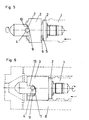
- Fig. 6 shows a schematic view of the plasticizing screw in the injection cylinder with the non-return valve closed.
- the injection unit according to the invention has a plasticizing screw 1, which is movable in a known manner in an injection cylinder 8, namely the plasticizing screw 1 exerts on the one hand a rotational movement and on the other hand an axial thrust movement.
- the locking body 2 and the locking sleeve 3 are arranged at the front end of the plasticizing screw 1.
- the locking body 2 is firmly connected to the plasticizing screw 1.
- the locking sleeve 3 is free to move in a certain area on the plasticizing screw 1 bar.
- the mobility of the locking sleeve 3 is limited by the driver formed by a pin 4.
- the locking body 2 has a sealing surface 5 and the locking sleeve 3 has a sealing surface 6, which lie against one another in the closed position.
- a pressure surface 7 for the pin 4 is formed on the locking sleeve 3.
- the pressing surface 7 is, as can be seen from the FIG. Of the drawings, a curved line in the side view of the locking sleeve 3 and effects a control of the locking sleeve 3 by the pin 4.
- cam 10 is arranged at the end of the pressing surface 7. These cams 10 form a final stop for the pin 4 and cause the locking sleeve 3 to close.
- the pressing surface 7 is defined by a recess 11, 12 in the locking sleeve 3.
- the stop edge 13 of the recess 11 corresponds functionally to the cam 10.
- the recess 12 is an opening in the sleeve wall of the locking sleeve 3.
- the upper edge 14 of the opening forms the stop for the pin 4 and corresponds functionally to the cam 10.
- the pin 4 presses the locking sleeve 3 corresponding to the pressing surface 7 shortly before the plasticizing screw 1 comes to a standstill through the sliding block, which is formed by the cam 10 of the edge 13 or the corner 14, against the sealing surface 5 on the blocking body 2.
- the non-return valve is closed before the plasticizing screw 1 initiates the injection process.
Landscapes
- Engineering & Computer Science (AREA)
- Manufacturing & Machinery (AREA)
- Mechanical Engineering (AREA)
- Injection Moulding Of Plastics Or The Like (AREA)
Abstract
Description
- Die Erfindung bezieht sich auf eine Rückstromsperre für eine Spritzeinheit einer Spritzgießmaschine, mit einem Schneckenzylinaer mit Plastifizierschnecke, bei deren Spitze ein Sperrkörper und eine Sperrhülse angeordnet ist, die mit einer Andrückfläche an einem als Radialarm ausgebildeten Mitnehmer anliegt.
- Bei der Verarbeitung von Kunststoffmassen, beispielsweise thermoplastischer Massen in Schneckenpressen, stellt die Plastifizierschnecke ein wichtiges Maschinenelement dar. Bei herkömmlichen Spritzeinheiten wird das Spritzmaterial vom Einlaß durch die Schnecke über die drei Schneckenfunktionszonen, d. h. von der Einzugszone über die Umwandlungszone, und schließlich die Meteringzone nach vorne an die Spritzdüse gefördert, während sie gleichzeitig die Schnecke entgegen einem voreingestellten Rückstaudruck zurückbewegt. Beim eigentlichen Einspritzvorgang wird die Schnecke von einem Hydraulikzylinder kolbenartig nach vorne gestoßen. Für einen einwandfreien Spritzgießvorgang ist es wichtig, daß ein Rückströmen eines Teiles der Kunststoffmasse verhindert wird.
- Es ist daher eine Rückstromsperre eingebaut. Die bisher üblichen Rückstromsperren arbeiten derart, daß durch die Schubbewegung der Plastifizierschnecke beim Einspritzvorgang und durch das Trägheitsmoment der Sperrhülse die Dichtflächen von Sperrkörper und Sperrhülse aufeinandertreffen. Diese verhindern, einem geschlossenen Kegelventil gleich, den Massenrückstrom beim Einspritzvorgang in Richtung Schnecke.
- Eine derartige Rückstromsperre ist beispielsweise aus der DE-OS 29 46 683 bekannt. Die DE-OS 32 03 724 zeigt eine Rückstromsperre, bei der ein radialer Bolzen an der Schneckenspitze einen Dosierkörper mitnimmt.
- Den bisherigen Rückstromsperren haftet der Fehler an, daß das Trägheitsmoment der Sperrhülse nicht immer gleich groß ist, d. h. das Trägheitsmoment ändert sich mit der Einspritzgeschwindigkeit, mit dem Einsatz verschiedener Materialien und der Materialtemperatur mit den damit verbundenen Viskositätsänderungen. Auch Maßunterschiede zwischen dem Außendurchmesser der Sperrhülse und dem Zylinderinnendurchmesser des Einspritzzylinders wirken sich stark auf das Trägheitsmoment der Sperrhülse und somit auf das Schließmoment aus.
- Durch die unterschiedlichen Schließmomente treten Fehler beim Einspritz- und Füllvorgang auf. Die Fehler sind manchmal so groß, daß dadurch in der Produktion eine erhöhte Ausschußquote besteht. Im besonderen kann es bei einem langsamen Einspritzvorgang eine Streuung von ca. 2 bis 5 mm im Schließmoment der Rückstromsperre geben. Das heißt, daß die Rückstromsperre einmal nach 2 mm und einmal erst nach 5 mm Schneckenhub schließt.
- Ein weiterer Nachteil bekannter Rückstromsperren ist, daß es zu einer starken Abnützung zwischen der Sperrhülse und dem Sperrkörper kommt. Dies ist besonders dann der Fall, wenn, um das Schließmoment zu verbessern, der Spalt zwischen der Sperrhülse und der Zylinderwand des Einspritzzylinders klein gehalten wird. Dadurch wird ein Mitdrehen der Sperrhülse mit der Plastifizierschnecke weitgehend verhindert und es kommt zu einem erhöhten Verschleiß zwischen dem Sperrkörper und der Sperrhülse.
- Aufgabe der Erfindung ist es, eine Spritzeinheit der eingangs erwähnten Art dahingehend zu verbessern, daß eine absolut sichere Funktion der Rückstromsperre erzielt wird, und zwar weitgehend unabhängig von der Viskosität des Kunststoffmaterials. Eine weitere Aufgabe der Erfindung ist es, die Verschleißerscheinungen bei der Sperrhülse herabzusetzen.
- Die erfindungsgemäße Aufgabe wird dadurch gelöst, daß die Andrückfläche eine Kurvenfläche ist, die eine Kurvenlinie in der Seitenansicht der Sperrhülse beschreibt, derart daß der Mitnehmer die Sperrhülse in Drehrichtung mitnimmt.
- Die Sperrhülse wird vom Mitnehmer, der beispielsweise ein Zapfen ist, mitgenommen, wobei die Kurvenlinie praktisch als Kulissensteuerung wirkt. Einerseits wird die Sperrhülse mit der Plastifizierschnecke gedreht und andererseits auf die Dichtfläche des Sperrkörpers gedrückt, wodurch die Rückstromsperre geschlossen wird.
- Wenn die Plastifizierschnecke nicht unter Druck vorwärtsgetrieben wird, ist die Sperrhülse zwischen der Dichtfläche des Sperrkörpers und dem Mitnehmer frei beweglich.
- Ein Ausführungsbeispiel der Erfindung sieht vor, daß an einem Ende der Andrückfläche eine Nocke vorgesehen ist.
- Ein weiteres Ausführungsbeispiel sieht vor, daß die Andrückfläche eine Ausnehmung in der Sperrhülse begrenzt. Die Ausnehmung kann beispielsweise von einem Loch in der Hülsenwand der Sperrhülse gebildet werden.
- Nachfolgend werden verschiedene Ausführungsbeispiele der Erfindung anhand der Figuren der beiliegenden Zeichnung eingehend beschrieben, ohne daß die Erfindung darauf eingeschränkt sein soll. Ebenso sollen die in den nachfolgenden Patentansprüchen angeführten Bezugszeichen keine Einschränkung bedeuten, sie dienen lediglich dem erleichterten Auffinden bezogener Teile in den Figuren der Zeichnung.
- Die Fig. 1 zeigt eine schematisch gehaltene Seitenansicht einer erfindungsgemäßen Plastifizierschnecke mit Sperrhülse und Sperrkörper, die Fig. 2 zeigt dieselben Teile um 90° verdreht und im Schnitt, die Fig. 3 bis 5 zeigen analoge Ansichten zur Fig. 1, wobei verschiedene Ausführungen der Sperrhülse und der Andrückfläche gezeigt sind, und die Fig. 6 zeigt eine schematische Ansicht der Plastifizierschnecke im Spritzzylinder bei geschlossener Rückstromsperre.
- In den Fig. der Zeichnungen wurden nur die erfindungswesentlichen Teile der Spritzeinheit, die die Rückstromsperre betreffen, gezeigt. Die anderen Teile der Spritzeinheit wurden der besseren Verständlichkeit halber weggelassen.
- Die erfindungsgemäße Spritzeinheit weist eine Plastifizierschnecke 1 auf, die in bekannter Weise in einem Spritzzylinder 8 bewegbar ist, und zwar übt die Plastifizierschnecke 1 einerseits eine Drehbewegung und andererseits eine axiale Vorstoßbewegung aus.
- Am vorderen Ende der Plastifizierschnecke 1 ist der Sperrkörper 2 und die Sperrhülse 3 angeordnet. Der Sperrkörper 2 ist fest mit der Plastifizierschnecke 1 verbunden. Die Sperrhülse 3 ist in einem gewissen Bereich auf der Plastifizierschnecke 1 frei bewegbar. Die Bewegbarkeit der Sperrhülse 3 wird durch den von einem Zapfen 4 gebildeten Mitnehmer begrenzt.
- Der Sperrkörper 2 weist eine Dichtfläche 5 und die Sperrhülse 3 eine Dichtfläche 6 auf, die in der Schließstellung aneinanderliegen.
- An der Sperrhülse 3 ist eine Andrückfläche 7 für den Zapfen 4 ausgebildet. Die Andrückfläche 7 ist, wie aus den Fig. der Zeichnungen ersichtlich, in der Seitenansicht der Sperrhülse 3 eine Kurvenlinie und bewirkt eine Kulissensteuerung der Sperrhülse 3 durch den Zapfen 4.
- In den Ausführungsbeispielen der Fig. 4 und 5 ist am Ende der Andrückfläche 7 jeweils eine Nocke 10 angeordnet. Diese Nocken 10 bilden einen endgültigen Anschlag für den Zapfen 4 und bewirken das Schließen der Sperrhülse 3.
- In den Ausführungsbeispielen der Fig. 1, 3 und 6 wird die Andrückfläche 7 von einer Ausnehmung 11, 12 in der Sperrhülse 3 definiert. Der Anschlagrand 13 der Ausnehmung 11 entspricht funktionsmäßig der Nocke 10.
- Die Ausnehmung 12 ist eine Durchbrechung in der Hülsenwand der Sperrhülse 3. Die obere Kante 14 der Durchbrechung bildet den Anschlag für den Zapfen 4 und entspricht funktionsmäßig der Nocke 10.
- Die Rückstromsperre bei der erfindungsgemäßen Spritzeinheit erfolgt folgendermaßen:
- Bei der Drehung der Plastifizierschnecke 1 wird die Sperrhülse 3 durch den Massestrom gegen den Haltestift 4 gedrückt, wobei der Zapfen 4 entsprechend
- der Massestrom- und Drehgeschwindigkeit mehr oder weniger in das Kulissental 9 gedrückt wird.
- Nähert sich die Massenstrom- oder Drehgeschwindigkeit dem Ende, drückt der Zapfen 4 entsprechend der Andrückfläche 7 kurz vor dem Stillstand der Plastifizierschnecke 1 die Sperrhülse 3 durch den Kulissenberg, der von der Nocke 10 der Kante 13 oder der Ecke 14 gebildet wird, gegen die Dichtfläche 5 am Sperrkörper 2. Somit ist die Rückstromsperre geschlossen, bevor die Plastifizierschnecke 1 den Einspritzvorgang einleitet.
- Durch die Zwangsführung zwischen Zapfen 4 und der Andrückfläche 7 werden Unterschiede im Schließmoment beim Einspritzvorgang an der Rückstromsperre ausgeschlossen.
Claims (5)
Applications Claiming Priority (2)
| Application Number | Priority Date | Filing Date | Title |
|---|---|---|---|
| AT2147/85 | 1985-07-19 | ||
| AT0214785A AT384577B (de) | 1985-07-19 | 1985-07-19 | Rueckstroemsperre fuer die plastifizierschnecke einer spritzgiessmaschine |
Publications (3)
| Publication Number | Publication Date |
|---|---|
| EP0212224A2 true EP0212224A2 (de) | 1987-03-04 |
| EP0212224A3 EP0212224A3 (en) | 1988-12-28 |
| EP0212224B1 EP0212224B1 (de) | 1991-09-04 |
Family
ID=3528776
Family Applications (1)
| Application Number | Title | Priority Date | Filing Date |
|---|---|---|---|
| EP86109537A Expired - Lifetime EP0212224B1 (de) | 1985-07-19 | 1986-07-11 | Rückstromsperre für eine Spritzeinheit für Spritzgiessmaschinen |
Country Status (5)
| Country | Link |
|---|---|
| EP (1) | EP0212224B1 (de) |
| AT (1) | AT384577B (de) |
| DE (1) | DE3681227D1 (de) |
| DK (1) | DK158777C (de) |
| FI (1) | FI80849C (de) |
Cited By (2)
| Publication number | Priority date | Publication date | Assignee | Title |
|---|---|---|---|---|
| EP0677371A1 (de) * | 1994-04-13 | 1995-10-18 | Alain Viron | Zusammenbau aus Ventil und Schneckenspitze mit Stift |
| DE10255951A1 (de) * | 2002-11-29 | 2004-06-17 | Battenfeld Gmbh | Vorrichtung zum Verhindern des Rückflusses von Kunststoffschmelze |
Families Citing this family (1)
| Publication number | Priority date | Publication date | Assignee | Title |
|---|---|---|---|---|
| AT522179B1 (de) | 2019-04-25 | 2020-09-15 | Engel Austria Gmbh | Plastifizierschnecke für eine Formgebungsmaschine |
Family Cites Families (6)
| Publication number | Priority date | Publication date | Assignee | Title |
|---|---|---|---|---|
| US3438393A (en) * | 1966-07-20 | 1969-04-15 | Improved Machinery Inc | Valve |
| US4105147A (en) * | 1977-02-07 | 1978-08-08 | Stubbe Paul L | Extruder screw valve |
| GB2050929A (en) * | 1979-05-23 | 1981-01-14 | Hpm Corp | Injection molding method utilizing a low shear screw |
| DE2942320A1 (de) * | 1979-10-19 | 1981-05-07 | Mannesmann Demag Kunstofftechnik Zweigniederlassung der Mannesmann Demag AG, 8500 Nürnberg | Rueckstroemsperre an schnecken-spritzgiessmaschinen |
| DE2946683A1 (de) * | 1979-11-20 | 1981-05-27 | Mannesmann Demag Kunstofftechnik Zweigniederlassung der Mannesmann Demag AG, 8500 Nürnberg | Rueckstroemsperre fuer schneckenspritzgiessmaschinen |
| DE3203724A1 (de) * | 1982-02-04 | 1983-08-11 | Krauss-Maffei AG, 8000 München | Rueckstroemsperre |
-
1985
- 1985-07-19 AT AT0214785A patent/AT384577B/de active
-
1986
- 1986-07-11 DE DE8686109537T patent/DE3681227D1/de not_active Expired - Lifetime
- 1986-07-11 EP EP86109537A patent/EP0212224B1/de not_active Expired - Lifetime
- 1986-07-18 DK DK342686A patent/DK158777C/da active
- 1986-07-18 FI FI862983A patent/FI80849C/fi not_active IP Right Cessation
Cited By (5)
| Publication number | Priority date | Publication date | Assignee | Title |
|---|---|---|---|---|
| EP0677371A1 (de) * | 1994-04-13 | 1995-10-18 | Alain Viron | Zusammenbau aus Ventil und Schneckenspitze mit Stift |
| FR2718800A1 (fr) * | 1994-04-13 | 1995-10-20 | Viron Alain Georges Rene | Clapet à goupille flottante et autocentrante à deux points d'appuis sur méplats usinés ou forgés suivant un angle donné. |
| US6227841B1 (en) | 1994-04-13 | 2001-05-08 | Nestal Machinery Ltd. | Valve and pinned screw point assembly |
| DE10255951A1 (de) * | 2002-11-29 | 2004-06-17 | Battenfeld Gmbh | Vorrichtung zum Verhindern des Rückflusses von Kunststoffschmelze |
| DE10255951B4 (de) * | 2002-11-29 | 2006-03-30 | Battenfeld Gmbh | Vorrichtung zum Verhindern des Rückflusses von Kunststoffschmelze |
Also Published As
| Publication number | Publication date |
|---|---|
| FI80849B (fi) | 1990-04-30 |
| FI862983L (fi) | 1987-01-20 |
| FI862983A0 (fi) | 1986-07-18 |
| DK158777B (da) | 1990-07-16 |
| DE3681227D1 (de) | 1991-10-10 |
| AT384577B (de) | 1987-12-10 |
| EP0212224A3 (en) | 1988-12-28 |
| EP0212224B1 (de) | 1991-09-04 |
| FI80849C (fi) | 1990-08-10 |
| DK342686D0 (da) | 1986-07-18 |
| DK158777C (da) | 1990-12-24 |
| ATA214785A (de) | 1987-05-15 |
| DK342686A (da) | 1987-01-20 |
Similar Documents
| Publication | Publication Date | Title |
|---|---|---|
| DE69920720T2 (de) | Betätigungsvorrichtung für die öffnung eines spritzgussventils | |
| DE69001591T2 (de) | Türschliesser. | |
| DE2948716C2 (de) | ||
| DE69706370T2 (de) | Bedruckte Behältertube und Scharnierkappe versehen mit Fingergreifaussparung | |
| DE2602669C3 (de) | Vorrichtung zum Erzeugen und Ausstoßen eines chemisch reaktionsfähigen Gemisches aus mindestens zwei Kunststoff-Komponenten | |
| DE3203763C2 (de) | Plastifizier- und Einspritzeinheit für Spritzgießmaschinen | |
| EP0763400A1 (de) | Spannelement | |
| DE4321997C2 (de) | Schneckenantriebsgetriebe für eine Spritzgußmaschine | |
| CH637449A5 (de) | Einrichtung zur einstellung der hublaenge eines hin- und herbeweglichen kolbenorgans. | |
| EP0212224B1 (de) | Rückstromsperre für eine Spritzeinheit für Spritzgiessmaschinen | |
| DE69520751T2 (de) | Verfahren zur fertigbearbeitung eines, auf eine platte, in situ extrudierten dichtungsprofils | |
| EP0027616A1 (de) | Rückströmsperre am Schneckenkopf von Schneckenspritzgiessmaschinen | |
| DE19544329C2 (de) | Einrichtung zum Spritzgießen von Kunststoffen | |
| DE69705533T2 (de) | Vorrichtung zum umhüllen von elektronischen komponenten und verfahren zum schliessen einer vorrichtung zum umhüllen von elektronischen komponenten | |
| EP0204133B1 (de) | Verfahren zum Herstellen von Gegenständen aus thermoplastischem Kunststoff durch Spritzgiessen | |
| DE1779239C3 (de) | Plastifiziert und Einspritzvorrichtung für plastische Massen mit einer einen axialen Schub auf eine Förderschnecke ausübenden Verschiebevorrichtung | |
| DE10059615B4 (de) | Rückstromsperre | |
| DE2719497C2 (de) | Druckkopf und Rückstromsperre an einer drehbaren und axial verschiebbaren Schnecke einer Kunststoff-Plastifiziereinheit | |
| EP0369181A2 (de) | Verfahren und Düse zum Versiegeln der Kanten von dünnen Werkstücken | |
| CH458716A (de) | Spritzeinheit für eine Kunststoffe verarbeitende Spritzgiessmaschine | |
| DE1960948A1 (de) | Maschine zum Formen von Kunststoffen und anderen verpressbaren Massen | |
| AT396902B (de) | Rückstromsperre für eine einspritzeinheit einer spritzgiessmaschine | |
| AT397229B (de) | Rückstromsperre für eine einspritzeinheit einer spritzgiessmaschine | |
| DE2336099A1 (de) | Spritzduese fuer kunststoffverarbeitende spritzgiessmaschine | |
| DE10255953B3 (de) | Vorrichtung zum Verhindern des Rückflusses von Kunstoffschmelze |
Legal Events
| Date | Code | Title | Description |
|---|---|---|---|
| PUAI | Public reference made under article 153(3) epc to a published international application that has entered the european phase |
Free format text: ORIGINAL CODE: 0009012 |
|
| AK | Designated contracting states |
Kind code of ref document: A2 Designated state(s): BE CH DE FR GB IT LI NL SE |
|
| PUAL | Search report despatched |
Free format text: ORIGINAL CODE: 0009013 |
|
| AK | Designated contracting states |
Kind code of ref document: A3 Designated state(s): BE CH DE FR GB IT LI NL SE |
|
| 17P | Request for examination filed |
Effective date: 19890408 |
|
| 17Q | First examination report despatched |
Effective date: 19900605 |
|
| GRAA | (expected) grant |
Free format text: ORIGINAL CODE: 0009210 |
|
| AK | Designated contracting states |
Kind code of ref document: B1 Designated state(s): BE CH DE FR GB IT LI NL SE |
|
| ITF | It: translation for a ep patent filed | ||
| REF | Corresponds to: |
Ref document number: 3681227 Country of ref document: DE Date of ref document: 19911010 |
|
| GBT | Gb: translation of ep patent filed (gb section 77(6)(a)/1977) | ||
| ET | Fr: translation filed | ||
| PGFP | Annual fee paid to national office [announced via postgrant information from national office to epo] |
Ref country code: CH Payment date: 19920604 Year of fee payment: 7 |
|
| PGFP | Annual fee paid to national office [announced via postgrant information from national office to epo] |
Ref country code: FR Payment date: 19920625 Year of fee payment: 7 |
|
| PLBE | No opposition filed within time limit |
Free format text: ORIGINAL CODE: 0009261 |
|
| STAA | Information on the status of an ep patent application or granted ep patent |
Free format text: STATUS: NO OPPOSITION FILED WITHIN TIME LIMIT |
|
| PG25 | Lapsed in a contracting state [announced via postgrant information from national office to epo] |
Ref country code: GB Effective date: 19920711 |
|
| PG25 | Lapsed in a contracting state [announced via postgrant information from national office to epo] |
Ref country code: SE Effective date: 19920712 |
|
| PG25 | Lapsed in a contracting state [announced via postgrant information from national office to epo] |
Ref country code: BE Effective date: 19920731 |
|
| 26N | No opposition filed | ||
| BERE | Be: lapsed |
Owner name: ENGEL MASCHINENBAU G.M.B.H. Effective date: 19920731 |
|
| PG25 | Lapsed in a contracting state [announced via postgrant information from national office to epo] |
Ref country code: NL Effective date: 19930201 |
|
| GBPC | Gb: european patent ceased through non-payment of renewal fee |
Effective date: 19920711 |
|
| NLV4 | Nl: lapsed or anulled due to non-payment of the annual fee | ||
| PG25 | Lapsed in a contracting state [announced via postgrant information from national office to epo] |
Ref country code: LI Effective date: 19930731 Ref country code: CH Effective date: 19930731 |
|
| PG25 | Lapsed in a contracting state [announced via postgrant information from national office to epo] |
Ref country code: FR Effective date: 19940331 |
|
| REG | Reference to a national code |
Ref country code: CH Ref legal event code: PL |
|
| REG | Reference to a national code |
Ref country code: FR Ref legal event code: ST |
|
| EUG | Se: european patent has lapsed |
Ref document number: 86109537.0 Effective date: 19930204 |
|
| PGFP | Annual fee paid to national office [announced via postgrant information from national office to epo] |
Ref country code: DE Payment date: 19950831 Year of fee payment: 10 |
|
| PG25 | Lapsed in a contracting state [announced via postgrant information from national office to epo] |
Ref country code: DE Effective date: 19970402 |
|
| PG25 | Lapsed in a contracting state [announced via postgrant information from national office to epo] |
Ref country code: IT Free format text: LAPSE BECAUSE OF NON-PAYMENT OF DUE FEES Effective date: 20050711 |