EP0213254A2 - Procédé de fabrication d'un article par emboutissage en un matériau partiellement cristallin - Google Patents
Procédé de fabrication d'un article par emboutissage en un matériau partiellement cristallin Download PDFInfo
- Publication number
- EP0213254A2 EP0213254A2 EP86100269A EP86100269A EP0213254A2 EP 0213254 A2 EP0213254 A2 EP 0213254A2 EP 86100269 A EP86100269 A EP 86100269A EP 86100269 A EP86100269 A EP 86100269A EP 0213254 A2 EP0213254 A2 EP 0213254A2
- Authority
- EP
- European Patent Office
- Prior art keywords
- deep
- drawn
- film
- melting point
- crosslinking
- Prior art date
- Legal status (The legal status is an assumption and is not a legal conclusion. Google has not performed a legal analysis and makes no representation as to the accuracy of the status listed.)
- Withdrawn
Links
Images
Classifications
-
- B—PERFORMING OPERATIONS; TRANSPORTING
- B29—WORKING OF PLASTICS; WORKING OF SUBSTANCES IN A PLASTIC STATE IN GENERAL
- B29C—SHAPING OR JOINING OF PLASTICS; SHAPING OF MATERIAL IN A PLASTIC STATE, NOT OTHERWISE PROVIDED FOR; AFTER-TREATMENT OF THE SHAPED PRODUCTS, e.g. REPAIRING
- B29C59/00—Surface shaping of articles, e.g. embossing; Apparatus therefor
- B29C59/02—Surface shaping of articles, e.g. embossing; Apparatus therefor by mechanical means, e.g. pressing
-
- B—PERFORMING OPERATIONS; TRANSPORTING
- B29—WORKING OF PLASTICS; WORKING OF SUBSTANCES IN A PLASTIC STATE IN GENERAL
- B29C—SHAPING OR JOINING OF PLASTICS; SHAPING OF MATERIAL IN A PLASTIC STATE, NOT OTHERWISE PROVIDED FOR; AFTER-TREATMENT OF THE SHAPED PRODUCTS, e.g. REPAIRING
- B29C51/00—Shaping by thermoforming, i.e. shaping sheets or sheet like preforms after heating, e.g. shaping sheets in matched moulds or by deep-drawing; Apparatus therefor
- B29C51/26—Component parts, details or accessories; Auxiliary operations
- B29C51/42—Heating or cooling
- B29C51/426—Producing specific thermal regimes during thermoforming to obtain particular properties
-
- B—PERFORMING OPERATIONS; TRANSPORTING
- B29—WORKING OF PLASTICS; WORKING OF SUBSTANCES IN A PLASTIC STATE IN GENERAL
- B29C—SHAPING OR JOINING OF PLASTICS; SHAPING OF MATERIAL IN A PLASTIC STATE, NOT OTHERWISE PROVIDED FOR; AFTER-TREATMENT OF THE SHAPED PRODUCTS, e.g. REPAIRING
- B29C69/00—Combinations of shaping techniques not provided for in a single one of main groups B29C39/00 - B29C67/00, e.g. associations of moulding and joining techniques; Apparatus therefore
- B29C69/02—Combinations of shaping techniques not provided for in a single one of main groups B29C39/00 - B29C67/00, e.g. associations of moulding and joining techniques; Apparatus therefore of moulding techniques only
-
- B—PERFORMING OPERATIONS; TRANSPORTING
- B29—WORKING OF PLASTICS; WORKING OF SUBSTANCES IN A PLASTIC STATE IN GENERAL
- B29C—SHAPING OR JOINING OF PLASTICS; SHAPING OF MATERIAL IN A PLASTIC STATE, NOT OTHERWISE PROVIDED FOR; AFTER-TREATMENT OF THE SHAPED PRODUCTS, e.g. REPAIRING
- B29C71/00—After-treatment of articles without altering their shape; Apparatus therefor
- B29C71/04—After-treatment of articles without altering their shape; Apparatus therefor by wave energy or particle radiation, e.g. for curing or vulcanising preformed articles
-
- B—PERFORMING OPERATIONS; TRANSPORTING
- B29—WORKING OF PLASTICS; WORKING OF SUBSTANCES IN A PLASTIC STATE IN GENERAL
- B29C—SHAPING OR JOINING OF PLASTICS; SHAPING OF MATERIAL IN A PLASTIC STATE, NOT OTHERWISE PROVIDED FOR; AFTER-TREATMENT OF THE SHAPED PRODUCTS, e.g. REPAIRING
- B29C51/00—Shaping by thermoforming, i.e. shaping sheets or sheet like preforms after heating, e.g. shaping sheets in matched moulds or by deep-drawing; Apparatus therefor
-
- B—PERFORMING OPERATIONS; TRANSPORTING
- B29—WORKING OF PLASTICS; WORKING OF SUBSTANCES IN A PLASTIC STATE IN GENERAL
- B29C—SHAPING OR JOINING OF PLASTICS; SHAPING OF MATERIAL IN A PLASTIC STATE, NOT OTHERWISE PROVIDED FOR; AFTER-TREATMENT OF THE SHAPED PRODUCTS, e.g. REPAIRING
- B29C59/00—Surface shaping of articles, e.g. embossing; Apparatus therefor
-
- B—PERFORMING OPERATIONS; TRANSPORTING
- B29—WORKING OF PLASTICS; WORKING OF SUBSTANCES IN A PLASTIC STATE IN GENERAL
- B29K—INDEXING SCHEME ASSOCIATED WITH SUBCLASSES B29B, B29C OR B29D, RELATING TO MOULDING MATERIALS OR TO MATERIALS FOR MOULDS, REINFORCEMENTS, FILLERS OR PREFORMED PARTS, e.g. INSERTS
- B29K2023/00—Use of polyalkenes or derivatives thereof as moulding material
- B29K2023/04—Polymers of ethylene
- B29K2023/06—PE, i.e. polyethylene
-
- B—PERFORMING OPERATIONS; TRANSPORTING
- B29—WORKING OF PLASTICS; WORKING OF SUBSTANCES IN A PLASTIC STATE IN GENERAL
- B29K—INDEXING SCHEME ASSOCIATED WITH SUBCLASSES B29B, B29C OR B29D, RELATING TO MOULDING MATERIALS OR TO MATERIALS FOR MOULDS, REINFORCEMENTS, FILLERS OR PREFORMED PARTS, e.g. INSERTS
- B29K2023/00—Use of polyalkenes or derivatives thereof as moulding material
- B29K2023/16—EPM, i.e. ethylene-propylene copolymers; EPDM, i.e. ethylene-propylene-diene copolymers; EPT, i.e. ethylene-propylene terpolymers
-
- B—PERFORMING OPERATIONS; TRANSPORTING
- B29—WORKING OF PLASTICS; WORKING OF SUBSTANCES IN A PLASTIC STATE IN GENERAL
- B29K—INDEXING SCHEME ASSOCIATED WITH SUBCLASSES B29B, B29C OR B29D, RELATING TO MOULDING MATERIALS OR TO MATERIALS FOR MOULDS, REINFORCEMENTS, FILLERS OR PREFORMED PARTS, e.g. INSERTS
- B29K2995/00—Properties of moulding materials, reinforcements, fillers, preformed parts or moulds
- B29K2995/0037—Other properties
- B29K2995/0041—Crystalline
-
- Y—GENERAL TAGGING OF NEW TECHNOLOGICAL DEVELOPMENTS; GENERAL TAGGING OF CROSS-SECTIONAL TECHNOLOGIES SPANNING OVER SEVERAL SECTIONS OF THE IPC; TECHNICAL SUBJECTS COVERED BY FORMER USPC CROSS-REFERENCE ART COLLECTIONS [XRACs] AND DIGESTS
- Y10—TECHNICAL SUBJECTS COVERED BY FORMER USPC
- Y10S—TECHNICAL SUBJECTS COVERED BY FORMER USPC CROSS-REFERENCE ART COLLECTIONS [XRACs] AND DIGESTS
- Y10S264/00—Plastic and nonmetallic article shaping or treating: processes
- Y10S264/65—Processes of preheating prior to molding
Definitions
- the invention relates to a method for producing a deep-drawn molded part from a semi-crystalline material, in which the material is converted into the shape of a film and, after heating to a temperature below the crystalline melting point, provided with a surface embossing and then deep-drawn.
- Deep-drawn molded parts of the type mentioned serve to design the vehicle interiors of motor vehicles and are predominantly produced from film webs.
- These consist essentially of polyvinyl chloride or of mixtures of acrylonitrile-butadiene-styrene copolymers (ABS) with polyvinyl chloride and are in the form of single-layer films or composite films in a thickness between 500 ⁇ m and 1,400 ⁇ m, preferably in a thickness of 600 ⁇ m up to 1,200 ⁇ m , in use.
- ABS acrylonitrile-butadiene-styrene copolymers
- Various modifications made of soft PVC or hard PVC are known.
- the foils have several disadvantages.
- Plasticizer-free films made of ABS and hard PVC have the disadvantage of being too rigid and not very flexible at low temperatures.
- thermoformable film which has improved properties, such as improved aging resistance, a higher degree of softness without the occurrence of fogging, none or only a reduced one Elimination of the elongation values over the entire service life, good light stability as well as high heat and ozone resistance with improved deep-drawing behavior.
- semi-crystalline polymeric materials such as e.g. Polypropylene, ethylene-propylene-diene copolymers (EPDM), ethylene-propylene copolymers (EPM) and polyamides can be used with good success in the automotive industry.
- EPDM ethylene-propylene-diene copolymers
- EPM ethylene-propylene copolymers
- polyamides polyamides
- unvulcanized products these materials are processed into molded parts by injection molding or blow molding, and in the case of vulcanized or crosslinked products using the press process. The temperatures are above the crystallite melting point.
- Films made of EPDM and EPM copolymers meet some of the existing requirements when crosslinked and uncrosslinked and have good stretchability, good aging resistance, good lightfastness, good low-temperature flexibility, low fogging behavior and good impact resistance. They are used in the packaging industry, and the deep-drawing process is also used.
- the material temperature during the deep-drawing process is always below the crystallite melting point in order to avoid dissolution of the film.
- the use of the deep-drawing process has hitherto not become known in the processing of these materials in relation to the production of embossed molded parts for lining motor vehicle interiors and is also extremely problematic for technical reasons.
- the invention is therefore based on the object of further developing the method described at the outset such that there is a reliable avoidance of the disadvantages mentioned.
- the method according to the invention should be simple to carry out and allow the production of a deep-drawn molded part from a semi-crystalline material which, when used as a dashboard cladding of a motor vehicle, can withstand all loads occurring there without disadvantageous change or fogging in the long term. This object is achieved with the characterizing features of the patent claim. Claims 2 to 3 refer to advantageous embodiments.
- a film is first produced from a partially crystalline material, preferably from EPDM or EPM. This is heated to a temperature just below the crystallite melting point and stamped with a surface structure, for example a leather grain. The film obtained in this way is cooled and then exposed to high-energy radiation in order to achieve crosslinking. After a subsequent heating to a temperature above the crystallite melting point of the polymeric material used, the forming is finally carried out using the deep-drawing process. It is surprisingly found that the previously embossed surfaces are retained in their structure, even though the material temperature during deep drawing is higher than the material temperature during the previous embossing process. In addition, there is the advantage that the deep-drawing process is much easier to control and to control, because the processing conditions remain almost constant in an enlarged temperature range.
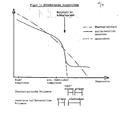
- the modulus of elasticity drops more or less constantly with increasing temperature.
- the material is deformed by deep drawing or embossing in a temperature range in which the material has a low modulus of elasticity and therefore easy deformability. This temperature is limited by the inherent strength of the material and its temperature resistance.
- Semi-crystalline polymers can only be embossed or deep-drawn in the uncrosslinked state below the crystallite melting point because the modulus of elasticity drops above this temperature on a steep characteristic curve until the insignificant value of the relatively low-viscosity melt is reached.
- Crosslinked semi-crystalline polymers on the other hand, surprisingly show a relatively constant value in a large temperature range above the crystallite melting point after an initially comparably steep drop in the elastic modulus, which is probably caused by the content of crosslinked molecular chains and the material being rubber-elastic at the temperatures in question , not meltable character.
- the level of the modulus of elasticity above the criticalite melting point depends on the level of crosslinking of the material used and can be influenced in a targeted manner by changing it.
- the temperature during embossing is lower and the modulus of elasticity is higher than during the subsequent deformation step, the deep-drawing process, the structuring of the surface of the film produced by the embossing surprisingly remains after the crosslinking and the subsequent deep-drawing. It is believed that the crosslinking of the macromolecules makes it difficult to reorient above the crystallite melting point, and that in the second deformation step, deep drawing, only the "framework" of the crosslinked polymer chains is stretched. This assumption is confirmed by test series in which the degree of crosslinking has been modified.
- the embossed film was treated with a dose rate between 20 and 100 kGy. In the former case, sufficient material strength was achieved above the crystallite melting point, which enables a second deformation.
- the material temperature during the stamping process still has an influence on the surface structure after deep drawing.
- a significantly deteriorated result is achieved with a decreasing embossing temperature, which should be due to the fact that the radiation treatment preferably, if not exclusively, leads to crosslinking of the parts of the molecule which have been thermoplastic modified by the previous embossing.
- the only thermoelastically deformed parts of the film have a different "memory", namely that of the non-embossed film.
- the mixture components are homogenized in an extruder, plasticized and discharged at temperatures above 170 ° C through a slot die onto a calender (Calandrette).
- the film had a thickness of about 0.9 mm and was then passed over cooling rolls and wound up.
- the film was heated in an IR emitter field and embossed with a leather-like embossing.
- the material surface temperature was approx. 155 ° C, embossing speed 5 m / min.
- embossing can be carried out in one operation with extrusion after the smoothing unit before cooling.
- the grained film thus produced was irradiated in an electron accelerator with a dose of 60 kGy.
- Suitable crosslinking initiators are essentially high-energy rays, in particular beta rays from electron accelerators.
Landscapes
- Engineering & Computer Science (AREA)
- Mechanical Engineering (AREA)
- Blow-Moulding Or Thermoforming Of Plastics Or The Like (AREA)
- Manufacture Of Macromolecular Shaped Articles (AREA)
- Heating, Cooling, Or Curing Plastics Or The Like In General (AREA)
- Treatments Of Macromolecular Shaped Articles (AREA)
- Shaping Of Tube Ends By Bending Or Straightening (AREA)
- Laminated Bodies (AREA)
- Steroid Compounds (AREA)
Applications Claiming Priority (2)
| Application Number | Priority Date | Filing Date | Title |
|---|---|---|---|
| DE3528810A DE3528810C1 (de) | 1985-08-10 | 1985-08-10 | Verfahren zum Herstellen eines tiefgezogenen Formteiles aus teilkristallinem Kunststoff |
| DE3528810 | 1985-08-10 |
Publications (2)
| Publication Number | Publication Date |
|---|---|
| EP0213254A2 true EP0213254A2 (fr) | 1987-03-11 |
| EP0213254A3 EP0213254A3 (fr) | 1987-07-29 |
Family
ID=6278264
Family Applications (1)
| Application Number | Title | Priority Date | Filing Date |
|---|---|---|---|
| EP86100269A Withdrawn EP0213254A3 (fr) | 1985-08-10 | 1986-01-10 | Procédé de fabrication d'un article par emboutissage en un matériau partiellement cristallin |
Country Status (6)
| Country | Link |
|---|---|
| US (1) | US4740335A (fr) |
| EP (1) | EP0213254A3 (fr) |
| JP (1) | JPS6239216A (fr) |
| DE (1) | DE3528810C1 (fr) |
| ES (1) | ES8704384A1 (fr) |
| NO (1) | NO860386L (fr) |
Cited By (2)
| Publication number | Priority date | Publication date | Assignee | Title |
|---|---|---|---|---|
| EP0568815A1 (fr) * | 1992-04-04 | 1993-11-10 | J.H. Benecke AG | Feuille ou objet formé à base d'une matière thermoplastique contenant un terpolymère |
| DE102005009408A1 (de) * | 2005-03-02 | 2006-09-14 | Bayerische Motoren Werke Ag | Kunststofffolie |
Families Citing this family (17)
| Publication number | Priority date | Publication date | Assignee | Title |
|---|---|---|---|---|
| US5260005A (en) * | 1988-03-15 | 1993-11-09 | Japan Atomic Energy Research Institute | Process for forming container of acrylonitrile polymers by biaxial-orientation blow-molding preform |
| US4876127A (en) * | 1988-11-09 | 1989-10-24 | Allied-Signal Inc. | Method of blow molding polyamides |
| JP2875278B2 (ja) * | 1989-04-14 | 1999-03-31 | 本田技研工業株式会社 | 繊維強化樹脂の成形方法 |
| DE4007877C2 (de) * | 1990-03-13 | 1998-02-26 | Alkor Gmbh | Verfahren zur Herstellung von geprägten, narbstabilen, thermoverformbaren, vorzugsweise tiefziehfähigen Kunststoffolien |
| DE4007878C2 (de) * | 1990-03-13 | 1998-02-26 | Alkor Gmbh | Verfahren zur Herstellung von geprägten, narbstabilen, thermoverformbaren, tiefziehfähigen Kunststoffolien |
| DE4007876C2 (de) * | 1990-03-13 | 1998-02-12 | Alkor Gmbh | Verfahren zur Herstellung von geprägten, narbstabilen, thermoverformbaren, tiefziehfähigen Kunststoffolien |
| US5131969A (en) * | 1990-08-27 | 1992-07-21 | The United States Of America As Represented By The Secretary Of The Army | Method of making a thin film optical quality aspheric surface generation using x-rays |
| JPH0498827U (fr) * | 1991-02-01 | 1992-08-26 | ||
| WO1995026367A1 (fr) * | 1994-03-29 | 1995-10-05 | The Government Of The United States Of America, Represented By The Secretary Of The Navy | Elastomeres a double reseau obtenus a partir de reseau d'elastomere oriente |
| DE10018196A1 (de) * | 2000-04-12 | 2001-11-22 | Benecke Kaliko Ag | Verfahren zur Herstellung einer Polyolefinfolie und deren Verwendung |
| WO2002083397A1 (fr) * | 2001-04-17 | 2002-10-24 | Allegheny Solid Surface Technologies | Procedes et agencements de texturation, de reproduction de motifs et de sertissage de feuilles polymeres |
| DE10202752B4 (de) * | 2002-01-25 | 2004-09-23 | Benecke-Kaliko Ag | Verfahren zur Herstellung eines aus einer thermoplastischen Folie tiefgezogenen Formteils sowie Prägewalze zum Prägen der Oberfläche einer für Tiefziehzwecke bestimmten thermoplastischen Folie |
| DE102005009415A1 (de) * | 2005-03-02 | 2006-09-14 | Bayerische Motoren Werke Ag | Tiefziehfolie |
| ITPD20050074A1 (it) * | 2005-03-11 | 2006-09-12 | Spac Spa | Processo per la fabbricazione di pelli sintetiche e pelli sintetiche cosi' ottenute |
| DE102005051392A1 (de) * | 2005-10-27 | 2007-05-03 | Benecke-Kaliko Ag | Verfahren zur Herstellung von genarbten Kunststoff-Formteilen sowie Kunststoff-Formteil |
| DE102006011159A1 (de) * | 2006-03-10 | 2007-09-13 | Benecke-Kaliko Ag | Verfahren zur Herstellung einer thermoplastischen Folie |
| DE102011000437A1 (de) * | 2011-02-01 | 2012-08-02 | Dr. Ing. H.C. F. Porsche Aktiengesellschaft | Herstellverfahren für einen flexiblen Verdeckbezug für ein Cabriolet |
Family Cites Families (16)
| Publication number | Priority date | Publication date | Assignee | Title |
|---|---|---|---|---|
| US2945792A (en) * | 1957-05-20 | 1960-07-19 | Gen Electric | Polyolefins |
| US3270104A (en) * | 1959-05-21 | 1966-08-30 | Grace W R & Co | Vacuum forming of plastic material |
| US3333032A (en) * | 1963-11-12 | 1967-07-25 | Union Carbide Corp | Treated polymer surfaces of shaped articles |
| US3563973A (en) * | 1965-03-04 | 1971-02-16 | Radiation Applic Inc | Articles with polymeric memory and method of constructing same |
| DE2026427A1 (en) * | 1970-05-30 | 1971-12-16 | Daimler Benz Ag | Decorative embossing process - for deep drawn sheet - material |
| US3872194A (en) * | 1970-09-30 | 1975-03-18 | Grace W R & Co | Process for producing a bulk cushioning material |
| GB1396573A (en) * | 1971-08-19 | 1975-06-04 | Saito T | Apparatus and method for embossing a pattern upon a sheet of imitation leather |
| US3932575A (en) * | 1972-04-06 | 1976-01-13 | Sven Ingemar Andersson | Method of making a multilayered packaging tray by deep-drawing |
| DE2455882A1 (de) * | 1973-11-27 | 1976-08-12 | Alkor Gmbh | Verfahren zur herstellung von gepraegten folien oder folienlaminaten |
| JPS5131750A (ja) * | 1974-09-12 | 1976-03-18 | Mitsubishi Monsanto Chem | Shinkuseikeiyohorienkabiniruenbosushiito no seizoho |
| US4122137A (en) * | 1975-12-15 | 1978-10-24 | The Firestone Tire & Rubber Company | Radiation cure of rubber sheets |
| JPS5914209B2 (ja) * | 1977-09-30 | 1984-04-03 | 日本原子力研究所 | 改良された絶縁体層を持つたゴムまたはプラスチツク絶縁電線またはケ−ブルの製造方法 |
| DE2844687A1 (de) * | 1978-10-13 | 1980-04-30 | Hoechst Ag | Formkoerper mit gleichmaessig matter oberflaeche |
| US4419320A (en) * | 1980-10-22 | 1983-12-06 | The Goodyear Tire & Rubber Company | Novel process for deep stretch forming of polyesters |
| JPS5784836A (en) * | 1980-11-18 | 1982-05-27 | Bridgestone Corp | Manufacture of pneumatic tire |
| US4489034A (en) * | 1982-08-25 | 1984-12-18 | Shell Oil Company | Thermoforming process using modified polymer blend |
-
1985
- 1985-08-10 DE DE3528810A patent/DE3528810C1/de not_active Expired
-
1986
- 1986-01-10 EP EP86100269A patent/EP0213254A3/fr not_active Withdrawn
- 1986-02-04 NO NO860386A patent/NO860386L/no unknown
- 1986-02-19 ES ES552165A patent/ES8704384A1/es not_active Expired
- 1986-08-04 US US06/892,942 patent/US4740335A/en not_active Expired - Fee Related
- 1986-08-08 JP JP61186686A patent/JPS6239216A/ja active Granted
Cited By (3)
| Publication number | Priority date | Publication date | Assignee | Title |
|---|---|---|---|---|
| EP0568815A1 (fr) * | 1992-04-04 | 1993-11-10 | J.H. Benecke AG | Feuille ou objet formé à base d'une matière thermoplastique contenant un terpolymère |
| US5717020A (en) * | 1992-04-04 | 1998-02-10 | J.H. Benecke Ag | Film or molded article of a thermoplastic with a terpolymer component |
| DE102005009408A1 (de) * | 2005-03-02 | 2006-09-14 | Bayerische Motoren Werke Ag | Kunststofffolie |
Also Published As
| Publication number | Publication date |
|---|---|
| ES552165A0 (es) | 1987-04-01 |
| EP0213254A3 (fr) | 1987-07-29 |
| JPH0150586B2 (fr) | 1989-10-30 |
| NO860386L (no) | 1987-02-11 |
| ES8704384A1 (es) | 1987-04-01 |
| JPS6239216A (ja) | 1987-02-20 |
| DE3528810C1 (de) | 1987-04-02 |
| US4740335A (en) | 1988-04-26 |
Similar Documents
| Publication | Publication Date | Title |
|---|---|---|
| DE3528810C1 (de) | Verfahren zum Herstellen eines tiefgezogenen Formteiles aus teilkristallinem Kunststoff | |
| EP0203399B1 (fr) | Feuille résistante aux intempéries sans plastifiant et son procédé de fabrication | |
| DE69308174T2 (de) | Polyolefin-Formmasse, Verfahren zu ihrer Herstellung und daraus hergestellte Formkörper | |
| DE68915817T2 (de) | Verfahren zunm Herstellen eines geformten laminierten Gegenstandes. | |
| DE4211416C2 (de) | Folie oder Formkörper aus einem thermoplastischen Kunststoff mit einem Terpolymergehalt sowie deren Verwendung | |
| EP3442788B1 (fr) | Stratifié de feuilles et partie d'habillage intérieur pour véhicules à moteur | |
| EP1149858B2 (fr) | Procédé de fabrication de films grainés de polyoléfines et leur utilisation | |
| WO2012100880A1 (fr) | Procédé de production d'un film plastique multicouche | |
| EP3169515B1 (fr) | Feuille pour application aux sacs gonflables | |
| DE69221590T2 (de) | Kunststoffolien | |
| EP2243618B1 (fr) | Procédé de fabrication d'un film thermoplastique doté d'une surface structurée tridimensionnelle | |
| EP0211154B1 (fr) | Articles réticulés résistant au choc de matière de moulage à base d'une composition polyoléfinique ternaire et leur préparation | |
| EP0134941A1 (fr) | Méthode de fabrication d'objets semi-finis en particulier moulages de polypropylène | |
| DE2927935A1 (de) | Vernetzte kraftfahrzeugteile sowie verfahren zu deren herstellung | |
| EP2263857B1 (fr) | Méthode de fabrication d'un corps moulé | |
| EP3362278B1 (fr) | Stratifié de feuilles et partie d'habillage intérieur pour véhicules automobiles | |
| DE10010533A1 (de) | Laminierte Folie aus Acrylharz und laminierter Gegenstand | |
| DE19607281A1 (de) | Verfahren zum werkstofflichen Recycling von Alt- und Abfallgummi durch dynamische Stabilisation von Gummimehl, Thermoplast und Vernetzungsmitteln zur Herstellung von TPE-ähnlichen Compounds | |
| DE69918837T2 (de) | Kunststoff-folien | |
| DE102021211290A1 (de) | Genarbte Folie mit Rezyklat zur Verarbeitung in Tiefziehverfahren | |
| WO2013029894A1 (fr) | Composition d'élastomère thermoplastique, feuille et utilisation | |
| DE3712973C2 (fr) | ||
| EP1688460A1 (fr) | Procédé pour la preparation d'un film gauffré et son utilisation | |
| EP2263856B1 (fr) | Procédé de fabrication d'un corps moulé | |
| EP3904041B1 (fr) | Procédé de fabrication d'un film grainé ou d'un film stratifié multicouche grainé |
Legal Events
| Date | Code | Title | Description |
|---|---|---|---|
| PUAI | Public reference made under article 153(3) epc to a published international application that has entered the european phase |
Free format text: ORIGINAL CODE: 0009012 |
|
| AK | Designated contracting states |
Kind code of ref document: A2 Designated state(s): AT BE CH DE FR GB IT LI LU NL SE |
|
| PUAL | Search report despatched |
Free format text: ORIGINAL CODE: 0009013 |
|
| AK | Designated contracting states |
Kind code of ref document: A3 Designated state(s): AT BE CH DE FR GB IT LI LU NL SE |
|
| 17P | Request for examination filed |
Effective date: 19870622 |
|
| 17Q | First examination report despatched |
Effective date: 19880129 |
|
| STAA | Information on the status of an ep patent application or granted ep patent |
Free format text: STATUS: THE APPLICATION HAS BEEN WITHDRAWN |
|
| 18W | Application withdrawn |
Withdrawal date: 19880728 |
|
| RIN1 | Information on inventor provided before grant (corrected) |
Inventor name: GRAAB, GERHARD, DR. Inventor name: SCHOLZ, HANS-GUENTER, DR. |