EP0213276A2 - Dynamische Datenbankinhaltsverzeichnisänderung - Google Patents
Dynamische Datenbankinhaltsverzeichnisänderung Download PDFInfo
- Publication number
- EP0213276A2 EP0213276A2 EP86106715A EP86106715A EP0213276A2 EP 0213276 A2 EP0213276 A2 EP 0213276A2 EP 86106715 A EP86106715 A EP 86106715A EP 86106715 A EP86106715 A EP 86106715A EP 0213276 A2 EP0213276 A2 EP 0213276A2
- Authority
- EP
- European Patent Office
- Prior art keywords
- dsu
- directory
- dsus
- update
- query
- Prior art date
- Legal status (The legal status is an assumption and is not a legal conclusion. Google has not performed a legal analysis and makes no representation as to the accuracy of the status listed.)
- Withdrawn
Links
Images









Classifications
-
- G—PHYSICS
- G06—COMPUTING OR CALCULATING; COUNTING
- G06F—ELECTRIC DIGITAL DATA PROCESSING
- G06F16/00—Information retrieval; Database structures therefor; File system structures therefor
- G06F16/20—Information retrieval; Database structures therefor; File system structures therefor of structured data, e.g. relational data
- G06F16/27—Replication, distribution or synchronisation of data between databases or within a distributed database system; Distributed database system architectures therefor
-
- G—PHYSICS
- G06—COMPUTING OR CALCULATING; COUNTING
- G06F—ELECTRIC DIGITAL DATA PROCESSING
- G06F16/00—Information retrieval; Database structures therefor; File system structures therefor
- G06F16/20—Information retrieval; Database structures therefor; File system structures therefor of structured data, e.g. relational data
- G06F16/25—Integrating or interfacing systems involving database management systems
Definitions
- directory means a table of names and corresponding items of data.
- Data in a directory is locational or directive in nature, e.g.
- the user of a directory knows the definition of the object references by a name, but needs the specific data value(s), e.g. phone number, in order to perform a specific activity.
- Distributed database management systems offer users the ability to distribute data and workload among multiple processing sites. Ideally, a distributed database management system should support growth while preserving local administrative autonomy and control of access to locally stored data. At the same time, the distributed database should provide its users with a single system image such that, although the data is distributed among several sites, the data distribution is transparent to the users who express their database accesses as though the data is at one place.
- the distributed database management system architecture should preserve local control and function when accessing local database objects.
- the fact that a site participates in the distributed database should not reduce that site's ability to perform local actions on local data by requiring the participation of other sites.
- data access availability should be a function only of the availability of the site(s) storing that data objects. The failure of one site should not impact sites which do not reference database objects stored (or controlled) by the failed site.
- U.S. Patent 4,468,728 discloses data structure and a search method for a database management system in which the data structure is arranged in a plurality of search trees.
- the initial search tree and an initial subset of trees are maintained in a main fast access memory, while the remaining trees are kept in mass memory.
- An input search parameter is partitioned into a plurality of subparameters, one for each search tree. The subparameters are used to search a tree in each level of the data structure until the location of a terminating file is determined.
- API Application Interface
- Directory Service Interface - The internal interface between directory service units and outside services, such as communication, user services, or user data areas.
- DSS Directory Service System
- DSU Directory Services Unit
- Subset-Ability This requirement states that the various DSUs participating in a DSS need not all implement the full function of the update mechanisms in order for the first requirement to be satisfied. For example, small work-stations in a DSS may not wish to act as intermediate nodes, but the users of the DSS may still require full accessibility. Implied in this requirement is the necessity for compatibility between different subsets operating within the same DSS.
- Performance can be measured in many different ways. The major performance criteria are :
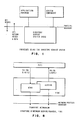
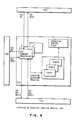
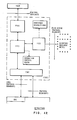
- Fig. 12 illustrates the different interfaces or protocol boundaries between the DSU shown in the dotted enclosure and other portions of the system. Theses boundaries include a user protocol boundary shown at the top of the figure, a data access protocol boundary at the right side of the figure representing the interface between the DSU and the database, and a communications protocol boundary illustrated at the bottom of the figure.
- the present structure and method is based on a distribution scheme where an instance of directory service may include one or more DSUs. Each DSU may perform one or more directory functions depending upon the product implementation.
- the directory service system (DSS) shown in Figure 1 is an installation of directory functions in a network of interconnected system.
- DSS provides the architectural directory services for the user at the API protocol boundary.
- the participating systems (products) in a DSS operate coherently under the architected rules such as data distribution schemes, naming schemes, search/update algorithms, error recovery, synchronization and the like.
- a DSS is comprised of a collection of directory service units distributed throughout the interconnected system network as shown in Figure 2.
- a DSU represents the directory service component of a system product implementing directory service functions. Although multiple DSUs may exist in the same system (product) for different directory applications, it is the intent that a single DSU can support many applications programs to eliminate duplication.
- a DSU is composed of a set of functional components called directory service processes (DSP) to provide the subsetting basis for implementation by products.
- DSP directory service processes
- every DSU in the system implement all DSPs.
- a work-station may implement only some of the functions and obtain full directory service through interaction with a larger system product.
- a DSU may contain all four DSPs or some of the DSPs as necessary to meet the functional needs of each product.
- Figure 3 shows an example of implementation options by products in a simple network.
- DSU A and DSU D represent the work-station which performs the query on an as needed basis and discards the results of the query without retaining it in the storage. This type of product may not have to implement P(D).
- DSU C represents another type of work-station which retains the results of a query in its local directory. This type of product needs to implement P(D).
- DSU B represents the file server which acts merely as a data repository to maintain the master directory for the network. This type of product may not have to implement P(U).
- the origin or source DSU receives a directory request from the user and originates the DSI request.
- the request is propagated through the intermediate DSUs as necessary to reach the target DSU which can service the request.
- a directory is a database that stores mappings from name to information related to name.
- the directory data base is the set of directories which contain information of a similar type. There is more than one member in the set if the directory data base is distributed across participating DSUs.
- the directory data base and all members which comprise it are named via a directory type ID (Directory Identifier). For example, a directory database with directory type_ID TELEPHONE may contain name to telephone number mappings.
- a single DSU may maintain directories of different directory type_DI's, but for any given type_ID, a DSU may contain at most one directory.
- Some examples of directory distribution schemes are as follows :
- each DSU In the local directory system, there is no master directory in the system and each DSU maintain its local directory data. When a DSU cannot satisfy the directory request from its local directory, it queries all other directories in the system until the requested data has been located.
- each DSU in the system has a master directory.
- the advantage of this system is its fast query response time.
- the disadvantage of this system is the cost of storing master directory information at each DSU, as well as the communication cost for updating all these directories.
- a single level (primitive) distribution scheme described above that is, centralized, localized and distributed
- hybrid systems combining various primitive distribution schemes in a hierarchical manner, as illustrated in Figure 4 may be attractive.
- the hybrid multiple level design can offer both types of performance improvements over a single level design.
- the hybrid directory system is logically divided in subsystems, or regions, made up of any number of distributed directory services. Each subsystem uses different (primitive) directory distribution schemes to fit into its regional environment. The hierarchical relationships between subsystems are independent of the actual topology of the physical network.
- a directory service can define the functional relationship among the DSUs distributed in the network due to the following aspects :
- the relationship provides a method or organizing the DSUs distributed in the network to allow the definition of simple and efficient protocols for the propagation of DSI commands such as query/update.
- the relationship can be used to constrain the set of DSUs to which a particular DSU can send a DSI command for query/update.
- the relationship is used to control how to distribute the directories, per directory type, among DSUs and how to maintain the respective directory.
- the relationship of a particular set of DSUs might reflect the organization structure of the enterprise owning the network, even though the network topology does not.
- the lines joining the DSUs in Figure 2 indicate the communication paths. Communication between DSUs may be accomplished through the use of any one of several different transport mechanisms. For example, DSUs may communicate with each other by running as a set of transaction models using IBM's System Network Architecture (SNA) or equivalent level of transport facilities. In this case, the lines represent sessions and may not resemble in any way the physical topology of the network. The only assumption that the directory service structure makes about the nature of the transport mechanism is that it provides guaranteed error-free delivery of data from source to destination.
- SNA System Network Architecture
- the user makes a directory function request by way of the API verbs to one of the DSUs.
- the requested DSU interacts with other remote DSUs, and then provides the appropriate response to the user.
- DSP DIRECTORY SERVICE PROCESS
- each DSP may be implemented either in programming or by a microprocessor.
- the P(U) basically manages the protocol boundary to service the end user request. Only P(U) interfaces with the API, thus shielding other DSPs from the end user. At the request of the end user, P(U) parses the received verbs and sends the directory request to P(F) for the information/response. When it receives the information/response from P(F), it returns it to the user to satisfy the original API verb.
- P(U) consists of a set of API verb processors, each of which has two components (API send processor and API receive processor).
- the API send processor is to parse the API verbs and its associated parameters from the user and construct the DSI request encoding to be sent to P(F) for specific directory tasks as requested in the API verbs.
- the API receive processor is to decode the received DSI replies and present the information:data (carried in the reply) to the user protocol boundary according to the defined API rules.
- the P(F) performs the essence of distributed directory functions such as search/update algorithms and naming algorithm.
- P(F) is knowledgeable of the existence of distributed directories and name database (if any), and it provides a focal point for maintaining currency among them in the system.
- the P(F) is responsible for providing the information response satisfying the request from P(U).
- P(F) maintains/manages the directory operation control block to be used by the directory algorithm facilities.
- the control block contains the algorithm control information such as affinity lists.
- P(F) uses this information to determine the best way to get information and respond to the requests from P(U).
- P(F) interacts with other remote P(F)s as necessary to locate the target P(F) (that is, the P(F) (that is, the P(F) that originally received a request from P(U)). Then the source P(F) passes the directory data to the P(U) that originated the request.
- P(F) is the bridge form of service interacting with both P(U) and P(D), as well as P(N).
- P(F) consists of a set of DSI command processors, each of which has two components (DSI request processor and DSI reply processor) to process the received requests and replies respectively.
- the format of the input to the P(F) should preserve the DSI command construct regardless of whether the command is received from the P(U) or the remote P(F)s through the communication network.
- the DSI request processor processes the DSI requests received from either P(U) or remote DSUs. It uses the directory algorithm facilities as the query/update propagation algorithm and the name assignment algorithm as appropriate. The directory algorithms determine the target DSU which can provide the requested information. If the receiving DSU is determined to be the target DSU, the DSI request processor fetches the requested information by way of P(D) and sends the DSI reply carrying that information to the origin DSU. Otherwise, the DSI request processor passes the received request to the other DSU as the algorithm determines, based on the affinity lists of the operation control block.
- the DSI reply processor processes the DSI replies which carry the information requested by the DSI requests. If the receiving DSU is the origin DSU (which originated the DSI request), the DSI reply processor passes it to the local P(U). Otherwise, it sends the received DSI reply toward the origin DSU.
- the P(D) manages the directory data access protocol boundary to access and maintain the directory data. Only P(D) has knowledge of the structure of the directory contents by way of the directory descriptors specified by the users, thus shielding other DSP's from the directory data structures.
- the P(D) receives the directory data request (query, update and so on) from P(F), performs the appropriate operation on the directory data by way of the data access protocol boundary and responds as appropriate to the P(F). It is the responsibility of P(F) to locate the target P(D) (that is, the P(D) maintaining the requested directory data) before sending a request to that P(D).
- the P(D) consists of two processors, Read and Write.
- the read processor services the DSI requests (for example, query), from P(F), which requires reading the directory data through the data access protocol boundary. It reads the requested directory data according to the directory descriptors and returns the retrieved data by way of the appropriate DSI reply to P(F).
- the write processor services the DSI requests (for example, update), from P(F), which requires writing the directory data through the data access protocol boundary. It performs the directory data update as requested, according to the directory descriptors, and returns the results, if necessary, via the appropriate DSI reply.
- the P(N) provides the ability to send and receive the DSI commands between DSUs. It interfaces with the transport mechanism used for DSU-DSU communication, thus shielding other DSP's from the networking function. P(N) controls the network protocol boundaries to achieve the P(F) to P(F) conversation between remote DSUs.
- the content of DSI request/replies are basically transparent to P(N), and the function of P(N) is merely to deliver the DSI requests/replies to the remote P(F)'s through the network. Also, the P(N) does not determine where to send queries or updates. This is determined by the propagation algorithm in the P(F).
- the P(N) consists of two processors, send and receive.
- the send processor is to control the sending of data in a DSU-DSU communication.
- the receive processor is to receive data from the DSU-DSU communication.
- the functions of these processors have direct dependencies on the protocol boundary of the network used for DSU-DSU communication.
- the directory structure describes the specific functions of P(N) required to use the DSU-DSU transport mechanisms.
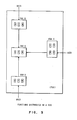
- a DSS can be viewed as a collection of an arbitrary number of P(U)s, P(F)s, P(D)s and P(N)s, ( Figure 9).
- a DSU must contain at least a P(F) and a P(N), although the levels of complexity of the functions to be performed vary depending on the roles of the DSU within a DSS.
- DSI commands are used as the message units to carry information from one DSP to another. There are two types of DSI commands, DSI request and DSI reply. The DSI request is used to carry the specific request information to the target DSP, and the DSI reply to carry the information/response to the origin DSP.
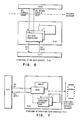
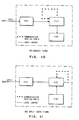
- Figure 10 shows the DSI request flows among DSPs.
- the possible flows are : (1) P(U)- P(F), (2) P(F)- P(F) by way of P(N)s, and (3) P(F)- P(D).
- Figure 11 shows the DSI reply flows among DSPs.
- the possible flows are : (1) P(D)- P(F), (2) P(F)- P(F), and (3) P(F)- P(U).
- the present system defines one protocol boundary for its users and uses three different protocol boundaries to formally describe the system structure.
- a DSU provides the protocol boundary for the user to send the directory requests to DSU and receive the directory information/response for DSU.
- DSU uses the protocol boundary of a communication network to communicate with another DSU in another system.
- Another protocol boundary is used by DSU to control accesses to and read and write the data in a directory data model.
- the functions of these verbs may be implemented in a product unique manner.
- This mechanism can be used where the user knows the target DSU, and the underlying transport provides a communication path to the target DSU. This mechanism cannot be used if either of the above conditions are not satisfied. While the second condition may be satisfied in many environments, it is probably unlikely that the user will know the identity of the target DSU. Special cases where the user has this information may include.
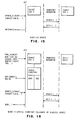
- the fact that the receiving DSU may propagate the message further creates two possible causes of incorrect operation. Firstly, there is the possibility that the update query sent to one DSU, (DSU B in the example), is not propagated while the update query sent to another DSU is propagated (DSU C), resulting in the response from one DSU arriving very much before the response from the other. Incorrect operation may result if the source DSU responds to the user and erases any memory of the query immediately after the first response.
- the following describes the processing of queries and updates, with or without propagation.
- the different cases involved in such processing include : Query Processing at the origin DSU without propagation - the origin DSU receiving the query request from the user satisfies the request from the locally residing directory without propagation.
- Query Processing at the origin DSU with propagation The origin DSU cannot locally satisfy the request from the user and, therefore, originates the query request for propagation to other remote DSUs.
- Query Processing at the intermediate DSU The intermediate DSU receiving a query request from the remote DSU cannot satisfy the request and, therefore, propagates the query request further to other DSUs.
- Query Processing at the target DSU - The target DSU receiving a query request retrieves the requested data and send the query reply toward the origin DSU.
- Update Processing at the origin DSU - The origin DSU receiving an update request from the user originates the update request for the propagation to the DSUs to be affected.
- Update Processing at the intermediate DSU - The intermediate DSU receiving an update request from the remote DSU propagates the update request further to other DSUs to be affected.
- the processing steps include :
- Control is eventually returned to the API_Query-Send.
- the API_Query_Send returns control with the return code ("successful") to the application program.
- the processing for the case where the target DSU receives a DSI query request from a remote DSU, retrieves the requested data from the local directory and sends the DSI query reply toward the origin DSU is as follows :
- the P-tables at the various DSUs define how the DSUs interact with one another in performing updates.
- Each DSU in the network contains a P-table for every directory type for which it may perform undirected updates.
- the P-table in a DSU contains the identities of some of the other DSUs in the network. It must be possible to establish a communication path with any DSU that appears in a P-table.
- the P-table consists of two parts, a query P-table or QP-table and an update P-table or UP-table.
- the QP-table defines the DSUs to which queries are sent and the UP-table defines the DSUs to which updates are sent.
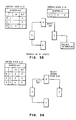
- the structure of the tables is shown in Figure 19. A more detailed description of the operation of the DSUs when working propagating queries is contained in the above identified copending application (A2)
- these tables also define the order in which the DSUs are queried or updated, by specifying a numeric parameter or priority associated with each DSU.
- the DSUs with the highest priority are sent the query or update message first.
- DSUs with equal priority receive the messages in parallel.
- Figure 19 also depicts, there is an extra algorithm control field associated with each DSU entry.
- each P-table may be created in several different ways. They may be linked directly to the way in which data is distributed through the system, something which may be specified in the form of an affinity table. Alternatively, the P-tables may be defined directly at system generation time and remain unchanged through the entire directory operation. They may also be dynamically created during operation or through other mechanisms such as updates to a "directory of directories" or through input from the network routing function.
- the user of the DSS defines some data description relationships between the DSUs in the network. Described here are the relationships, how they are used to set up a DSS, and how these relationships get translated into P-table entries. In understanding the factors affecting the translation, it is important to understand the "duality" between queries and updates. In particular, if DSU A always sends an update to DSU B whenever it changes it's directory, there is no necessity for DSU B ever to query DSUA. Conversely, if DSU B always queries DSU A, there is no necessity for DSU A ever to send updates to DSU B. The translation from data distribution to P-table entries is designed to take this duality into account and thus to conserve on the use of communication bandwidth.
- A is the Subordinate (SUB) and B is the Superior (SUP).
- SUP Superior
- the relationship is set-up by specifying at A that B is a SUP of A and by specifying at B that A is a SUB of B.
- This relationship implies that under "normal" conditions a communication path exists from the SUB to the SUP through the transport mechanism.
- X is the directory type ID from which this relationship has been defined, then B's directory of type ID X is a superset of A's directory of the same type ID.
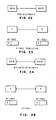
- This relationship is depicted pictorially in Figure 22 by an undirected arc between the PEERs.
- the relationship is set-up by specifying at A that B is a PEER OF A and by specifying at B that A is a PEER of B.
- This relationship implies that the PEERs can communicate with each other through the transport mechanism and that the user would like them to communicate directly in order to perform directory functions. It does not imply any relationship in terms of data distribution. It does not imply any relationship in terms of data distribution. Thus, in the translation to P-table entries, queries are exchanged between PEERs, but updates are not.
- Figure 23 shows the translation.
- This relationship is depicted pictorially in Figure 24 by a bidirected arc between the DSUs.
- the relationship is set up by specifying at A that B is a REPLICATE of A and by specifying at B that A is a REPLICATE of B.
- This relationship implies that the DSUs can communicate with each other through the transport mechanism.
- B is a superset of A and A is a superset of B. This can only be satisfied if A and B are identical.
- the translation to P-table entries is designed to preserve the replication by propagating updates between the DSUs.
- Figure 25 depicts the translation.
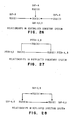
- the relationships between the DSUs in a network determines the data distribution. Some examples are shown in Figures 26-29. It will be seen that the relationships define a network over which updates are normally propagated. This network is usually a sub-network of the network formed by defining all possible communication paths. In other words, there may be communication paths available between DSUs which are not normally used in update propagation.
- the sequential propagation approach assigns priority numbers to the DSUs in ascending order, with the SUPs having the smaller numbers, (again chosen to be negative), and the PEERs the larger numbers (positive).
- Figure 32 depicts this through an example.
- the determination of whether parallel or sequential propagation is used is usually made at create-configuration time. It is important that all the DSUs that participate in a given update use the same mode of propagation. Thus, it is not permitted for the originating node to propagate an update in a sequential fashion and for intermediary nodes to relay that update in parallel fashion.
- the update messages that are propagated in the network contain a bit which indicates whether the DSU that initiated the update used sequential or parallel propagation.
- Intermediary nodes use the method of propagation indicated in the query message, thereby ignoring the priorities in the UP-table and creating a new set of priorities if the update query message specifies at different mode of propagation than the mode for which their UP-tables are set up.
- the relationships of the DSUs in the network for a given directory type ID should satisfy certain rules. These rules are important in order to maintain internal consistency of the P-table in a given DSU, as well as in the relationship between P-tables in different DSUs.
- the rules are as follows: If full accessibility is to be preserved, then for any two DSUs A and B, one of the following must hold.
- B is PEER(A)
- B cannot be SUP(A) or REPLICATE(A).
- B is SUP(A)
- B cannot be PEER(A) or REPLICATE(A).
- PEER relationships are always reciprocal.
- the update message sent between the DSUs contain all the information that initiated the update. In addition, it contains the source DSU ID and a correlation number chosen by the source. An update message is shown below in Table I. Update messages solicit update-acknowledgements. These acknowledgements are simply a means of indicating to the various DSUs that the update has propagated and that the control block can be brought down. The update messages are propagated to many DSUs in parallel, and there may be several update and update-acknowledgement messages in the network at any one time.
- SUBs or PEERs In order to maintain a high degree of consistency of information in the directory services system, it is sometimes desirable to send updates to SUBs or PEERs. This is particularly true in environments where query results are retained. it is, however, not desirable to send updates to all the SUBs and PEERs as this results in unnecessarily large use of bandwidth. Furthermore, the SUBs or PEERs that need to receive updates differs from element to element. For example, DSU(B) which is a SUB of A may be interested in updates on TOM, while DSU(C), also a SUB of A, may not care about TOM, but may wish to receive any updates on JACK.
- the mechanisms provide the option of maintaining special element level pointers which indicate, for each element, a list of DSUs that must be informed of updates on that element.
- This list is an addition to the list contained in the UP-table.
- the element level list would be added to the UP-table and the combined list would be used to create the control block for update propagation.
- control tables and the algorithms described above allow dynamic updates of directory elements without requiring the user to specify targets and still maintain the working criteria.
Landscapes
- Engineering & Computer Science (AREA)
- Databases & Information Systems (AREA)
- Theoretical Computer Science (AREA)
- Data Mining & Analysis (AREA)
- Physics & Mathematics (AREA)
- General Engineering & Computer Science (AREA)
- General Physics & Mathematics (AREA)
- Computing Systems (AREA)
- Information Retrieval, Db Structures And Fs Structures Therefor (AREA)
- Information Transfer Between Computers (AREA)
- Computer And Data Communications (AREA)
Applications Claiming Priority (2)
| Application Number | Priority Date | Filing Date | Title |
|---|---|---|---|
| US74356085A | 1985-06-11 | 1985-06-11 | |
| US743560 | 1985-06-11 |
Publications (2)
| Publication Number | Publication Date |
|---|---|
| EP0213276A2 true EP0213276A2 (de) | 1987-03-11 |
| EP0213276A3 EP0213276A3 (de) | 1990-08-22 |
Family
ID=24989264
Family Applications (1)
| Application Number | Title | Priority Date | Filing Date |
|---|---|---|---|
| EP86106715A Withdrawn EP0213276A3 (de) | 1985-06-11 | 1986-05-16 | Dynamische Datenbankinhaltsverzeichnisänderung |
Country Status (3)
| Country | Link |
|---|---|
| EP (1) | EP0213276A3 (de) |
| JP (1) | JPS61283943A (de) |
| CA (1) | CA1252903A (de) |
Cited By (14)
| Publication number | Priority date | Publication date | Assignee | Title |
|---|---|---|---|---|
| GB2203571A (en) * | 1986-11-08 | 1988-10-19 | Trident Trade And Management S | Data bank updating system |
| EP0358860A3 (de) * | 1988-07-14 | 1990-12-12 | Casio Computer Company Limited | Apparat und Verfahren zur Verarbeitung von Daten eines Kennsatzes |
| EP0426911A1 (de) * | 1989-11-06 | 1991-05-15 | Hewlett-Packard Company | Leitweglenkungsverwaltung für Computernetzwerke |
| AU629084B2 (en) * | 1987-06-30 | 1992-09-24 | Ngs American, Inc. | Insurance administration system |
| GB2263797A (en) * | 1992-01-31 | 1993-08-04 | Plessey Telecomm | Shared objects |
| US5283895A (en) * | 1988-07-14 | 1994-02-01 | Casio Computer Co., Ltd. | Apparatus and method for processing data corresponding to word labels |
| EP0663641A1 (de) * | 1994-01-14 | 1995-07-19 | Microsoft Corporation | Verzeichnisse von Zusammenfassungen |
| US5500932A (en) * | 1992-05-29 | 1996-03-19 | Casio Computer Co., Ltd. | Slip output apparatus |
| US5526518A (en) * | 1988-07-14 | 1996-06-11 | Casio Computer Co., Ltd. | Data processing apparatus |
| GB2277176B (en) * | 1993-04-14 | 1997-10-01 | Fujitsu Ltd | Information retrieval system with hierarchical data management |
| EP0817101A3 (de) * | 1996-07-01 | 1998-07-29 | Microsoft Corporation | Verfahren und System für gleichmässigen Zugriff auf mehrere Verzeichnisdienste |
| EP0806731A3 (de) * | 1996-01-18 | 1998-12-09 | Sun Microsystems, Inc. | Datennetzwerk |
| US6470357B1 (en) * | 1998-07-28 | 2002-10-22 | International Bussiness Machines Corp. | System and method of enhanced directory services for telecommunications management network applications |
| WO2025228027A1 (zh) * | 2024-04-30 | 2025-11-06 | 华为技术有限公司 | 文件管理方法、系统、设备、集群、产品及介质 |
Families Citing this family (5)
| Publication number | Priority date | Publication date | Assignee | Title |
|---|---|---|---|---|
| WO1989002631A1 (en) * | 1987-09-08 | 1989-03-23 | Digital Equipment Corporation | Naming service for networked digital data processing system |
| CA2042052A1 (en) * | 1989-09-14 | 1991-03-15 | Tadamitsu Ryu | Distributed database system and its data retrieval method |
| US5634048A (en) * | 1989-09-14 | 1997-05-27 | Fujitsu Limited | Distributed database system having a center system with a link file and a method for retrieving data from same |
| US5978813A (en) * | 1995-09-25 | 1999-11-02 | International Business Machines Corporation | System for providing synchronization between a local area network and a distributing computer environment |
| US9390120B1 (en) | 2013-12-31 | 2016-07-12 | Google Inc. | System and methods for organizing hierarchical database replication |
-
1986
- 1986-04-23 CA CA000507392A patent/CA1252903A/en not_active Expired
- 1986-05-09 JP JP61105072A patent/JPS61283943A/ja active Pending
- 1986-05-16 EP EP86106715A patent/EP0213276A3/de not_active Withdrawn
Non-Patent Citations (3)
| Title |
|---|
| 2ND INT. CONF. ON DISTRIBUTED COMPUTING SYSTEMS, Paris, 8th - 10th April 1981, pages 31-40, IEEE, New York, US; B. LINDSAY: "Object naming and catalog management for a distributed database management" * |
| 5TH INT. CONF. ON VERY LARGE DATA BASES, Rio de Janeiro, 3rd - 5th October 1979, pages 340-350, IEEE, New York, US; H. BREITWIESER et al.: "Transaction and catalog management of the distributed file management system disco" * |
| JOURNAL OF TELECOMMUNICATION NETWORKS, vol. 2, no. 3, 1983, pages 295-304, Computer Science Press, Inc., Rockville, Maryland, US; W.W. CHU et al.: "Design considerations for shared integrated database systems (SIDS)" * |
Cited By (21)
| Publication number | Priority date | Publication date | Assignee | Title |
|---|---|---|---|---|
| GB2203571A (en) * | 1986-11-08 | 1988-10-19 | Trident Trade And Management S | Data bank updating system |
| GB2203571B (en) * | 1986-11-08 | 1990-07-25 | Trident Trade And Management S | Data bank update system |
| AU629084B2 (en) * | 1987-06-30 | 1992-09-24 | Ngs American, Inc. | Insurance administration system |
| EP0358860A3 (de) * | 1988-07-14 | 1990-12-12 | Casio Computer Company Limited | Apparat und Verfahren zur Verarbeitung von Daten eines Kennsatzes |
| US5526518A (en) * | 1988-07-14 | 1996-06-11 | Casio Computer Co., Ltd. | Data processing apparatus |
| US5283895A (en) * | 1988-07-14 | 1994-02-01 | Casio Computer Co., Ltd. | Apparatus and method for processing data corresponding to word labels |
| EP0426911A1 (de) * | 1989-11-06 | 1991-05-15 | Hewlett-Packard Company | Leitweglenkungsverwaltung für Computernetzwerke |
| GB2263797B (en) * | 1992-01-31 | 1996-04-03 | Plessey Telecomm | Object orientated system |
| US5734902A (en) * | 1992-01-31 | 1998-03-31 | Gpt Limited | Communication system for maintaining data consistency among replicated shared objects |
| AU662784B2 (en) * | 1992-01-31 | 1995-09-14 | Marconi Communications Limited | Object oriented system |
| GB2263797A (en) * | 1992-01-31 | 1993-08-04 | Plessey Telecomm | Shared objects |
| US5500932A (en) * | 1992-05-29 | 1996-03-19 | Casio Computer Co., Ltd. | Slip output apparatus |
| GB2277176B (en) * | 1993-04-14 | 1997-10-01 | Fujitsu Ltd | Information retrieval system with hierarchical data management |
| US5519855A (en) * | 1994-01-14 | 1996-05-21 | Microsoft Corporation | Summary catalogs |
| EP0663641A1 (de) * | 1994-01-14 | 1995-07-19 | Microsoft Corporation | Verzeichnisse von Zusammenfassungen |
| EP0806731A3 (de) * | 1996-01-18 | 1998-12-09 | Sun Microsystems, Inc. | Datennetzwerk |
| EP0817101A3 (de) * | 1996-07-01 | 1998-07-29 | Microsoft Corporation | Verfahren und System für gleichmässigen Zugriff auf mehrere Verzeichnisdienste |
| US6360230B1 (en) | 1996-07-01 | 2002-03-19 | Microsoft Corporation | Method and system for uniformly accessing multiple directory services |
| EP1460565A1 (de) * | 1996-07-01 | 2004-09-22 | Microsoft Corporation | Verfahren und System für gleichmässigen Zugriff auf mehrere Verzeichnisdienste |
| US6470357B1 (en) * | 1998-07-28 | 2002-10-22 | International Bussiness Machines Corp. | System and method of enhanced directory services for telecommunications management network applications |
| WO2025228027A1 (zh) * | 2024-04-30 | 2025-11-06 | 华为技术有限公司 | 文件管理方法、系统、设备、集群、产品及介质 |
Also Published As
| Publication number | Publication date |
|---|---|
| CA1252903A (en) | 1989-04-18 |
| EP0213276A3 (de) | 1990-08-22 |
| JPS61283943A (ja) | 1986-12-13 |
Similar Documents
| Publication | Publication Date | Title |
|---|---|---|
| EP0213276A2 (de) | Dynamische Datenbankinhaltsverzeichnisänderung | |
| EP0850447B1 (de) | System und verfahren für eine verteilte objektverwaltungsumgebung an mehreren orten | |
| US7886039B2 (en) | Method and apparatus for providing dynamic group management for distributed interactive applications | |
| US5475819A (en) | Distributed configuration profile for computing system | |
| EP0520749B1 (de) | Verfahren und Gerät für Netzrechnersystemgruppenverwaltung | |
| US6370565B1 (en) | Method of sharing computation load within a distributed virtual environment system | |
| JPH0548647A (ja) | 電子メール文書分配方法及び装置 | |
| JPH1196102A (ja) | サーバ分散管理方法 | |
| US7590618B2 (en) | System and method for providing location profile data for network nodes | |
| CN100421078C (zh) | 用于相似性管理的方法和系统 | |
| EP0213277A2 (de) | Propagationssystem für Netzwerkabfragen durch verteilte Datenbank | |
| CA1244142A (en) | Distributed data management mechanism | |
| JPH11232201A (ja) | 通信資源制御装置 | |
| CN102316154A (zh) | 优化对基于联盟基础结构的资源的访问 | |
| EP0211162A2 (de) | Inhaltsverzeichnissystem für verteilte Datenbank mit Kontrollblöcken für sequentielle und parallele Abfrage | |
| EP0204993A2 (de) | Hybrides Datenverteilungssystem für Inhaltsverzeichnis | |
| KR100556716B1 (ko) | 네트워크를 통해 서로 연결된 복수개의 단말들 간의 분산정보 공유 방법 및 시스템 | |
| Antonopoulos et al. | An active organisation system for customised, secure agent discovery | |
| US20060117041A1 (en) | Connection of an application to a resource manager selected from a plurality of resource managers | |
| Olaifa et al. | An adaptive multi agent service discovery for peer to peer cloud services | |
| CA2258988C (en) | Methods and apparatus for managing objects in a distributed environment | |
| Pils et al. | The User Agent: An approach for service and profile management in wireless access systems | |
| JPH0546570A (ja) | 分散処理システム | |
| Saxena et al. | A heuristic approach to resource locations in broadband networks |
Legal Events
| Date | Code | Title | Description |
|---|---|---|---|
| PUAI | Public reference made under article 153(3) epc to a published international application that has entered the european phase |
Free format text: ORIGINAL CODE: 0009012 |
|
| AK | Designated contracting states |
Kind code of ref document: A2 Designated state(s): DE FR GB IT |
|
| 17P | Request for examination filed |
Effective date: 19870422 |
|
| PUAL | Search report despatched |
Free format text: ORIGINAL CODE: 0009013 |
|
| AK | Designated contracting states |
Kind code of ref document: A3 Designated state(s): DE FR GB IT |
|
| 17Q | First examination report despatched |
Effective date: 19920217 |
|
| STAA | Information on the status of an ep patent application or granted ep patent |
Free format text: STATUS: THE APPLICATION IS DEEMED TO BE WITHDRAWN |
|
| 18D | Application deemed to be withdrawn |
Effective date: 19920828 |
|
| RIN1 | Information on inventor provided before grant (corrected) |
Inventor name: SINGH, HARINDER S. Inventor name: BARTOCCI, FRANCIS DENNIS Inventor name: GOPAL, INDER Inventor name: WON, JOHA HYUN |