EP0213440A2 - Polymerisierbare Verbindungen und Verfahren zu ihrer Herstellung - Google Patents
Polymerisierbare Verbindungen und Verfahren zu ihrer Herstellung Download PDFInfo
- Publication number
- EP0213440A2 EP0213440A2 EP86110847A EP86110847A EP0213440A2 EP 0213440 A2 EP0213440 A2 EP 0213440A2 EP 86110847 A EP86110847 A EP 86110847A EP 86110847 A EP86110847 A EP 86110847A EP 0213440 A2 EP0213440 A2 EP 0213440A2
- Authority
- EP
- European Patent Office
- Prior art keywords
- formula
- compound
- compounds
- group
- halogen atom
- Prior art date
- Legal status (The legal status is an assumption and is not a legal conclusion. Google has not performed a legal analysis and makes no representation as to the accuracy of the status listed.)
- Granted
Links
Classifications
-
- C—CHEMISTRY; METALLURGY
- C07—ORGANIC CHEMISTRY
- C07D—HETEROCYCLIC COMPOUNDS
- C07D317/00—Heterocyclic compounds containing five-membered rings having two oxygen atoms as the only ring hetero atoms
- C07D317/08—Heterocyclic compounds containing five-membered rings having two oxygen atoms as the only ring hetero atoms having the hetero atoms in positions 1 and 3
- C07D317/44—Heterocyclic compounds containing five-membered rings having two oxygen atoms as the only ring hetero atoms having the hetero atoms in positions 1 and 3 ortho- or peri-condensed with carbocyclic rings or ring systems
- C07D317/46—Heterocyclic compounds containing five-membered rings having two oxygen atoms as the only ring hetero atoms having the hetero atoms in positions 1 and 3 ortho- or peri-condensed with carbocyclic rings or ring systems condensed with one six-membered ring
Definitions
- the invention relates to polymerizable esters of acrylic or methacrylic acid with polyhydric phenols and a process for their preparation.
- Monoacrylates and methacrylates of dihydric phenols are described in DE-A 19 33 657 and 26 59 809.
- dihydric phenols such.
- B. implemented with acrylic or methacrylic acid chloride.
- the resulting reaction mixtures contain, in addition to unreacted starting compounds, mono- and diacylated phenols, which can only be separated with difficulty and with losses in yield.
- the isolated monoesters generally still contain the specified impurities and are obtained in yields which are overall well below 50%, based on the starting materials.
- the object of the invention was to provide monoacrylates and methacrylates of polyhydric phenols in pure form and to propose a process according to which these compounds are available in pure form and in high yield.
- the invention relates to a compound of general formula I. wherein R is a hydrogen or halogen atom, a cyanide or an alkyl group with 1-4 carbon atoms and R1 is a hydrogen or halogen atom, a nitro, alkyl, alkoxy, aryl, aryloxy, acyl or alkoxycarbonyl group.
- a process for the preparation of compounds of formula I is further proposed, which consists in that a compound of formula II in which R1 has the meaning given above, with a compound of formula III wherein X represents a halogen atom, an alkoxy or aryloxy group, to a compound of formula IV converts the compound of formula IV obtained with a compound of formula V.
- Y represents a halogen atom, a hydroxy group, an alkoxy group or a radical of the formula R has the meaning given above, to a compound of formula VI reacted and the compound of formula VI obtained hydrolyzed to a compound of formula I.
- R 1 is a halogen atom, it may preferably be a fluorine, chlorine or bromine atom, especially a chlorine be atomic.
- R 1 is an alkyl or alkoxy group, it preferably has 1 to 6, in particular 1 to 3, carbon atoms; preferred acyl and alkoxycarbonyl groups are those having 2 to 15, in particular 2 to 10, carbon atoms.
- Aryl and aryloxy groups R1 generally have 6 to 10 carbon atoms.
- R1 can also be in the 3- or 4-position.
- Examples of compounds of formula II are hydroxyhydroquinone, 5-ethyl-pyrogallol, pyrogallol, methyl gallate, ethyl gallate, propyl gallate, octyl gallate and dodecyl gallate.
- Compounds of the formula II can also be easily converted into the corresponding mono-, di- or trisubstituted chlorine, bromine, iodine or nitro derivatives by conventional halogenation or nitration processes.
- Phosgene, diethyl carbonate or diphenyl carbonate can be mentioned as representatives of the compounds of the formula III. No solvent is required when using diphenyl carbonate. Heating to about 200-300 ° C forms 2 mol of phenol, which distill off under these reaction conditions. The remaining cyclic carbonates of the formula IV are first purified by vacuum distillation, then generally by recrystallization.
- phosgene When using phosgene, a non-polar solvent, e.g. B. toluene or xylene used. Phosgene is usually introduced while cooling with ice in the presence of 2 mol of a base such as pyridine, dimethylaniline or triethylamine. After the usual work-up with acid and water, compounds of the formula IV can likewise be obtained by removing the solvent and purified by recrystallization.
- a non-polar solvent e.g. B. toluene or xylene used.
- Phosgene is usually introduced while cooling with ice in the presence of 2 mol of a base such as pyridine, dimethylaniline or triethylamine.
- the compounds II and III are usually reacted with one another in a molar ratio of 0.8: 1.2 to 1.2: 0.8, preferably 0.9: 1.1 to 1.1: 0.9. If compounds of the formula II are reacted with carbonic acid derivatives of the formula III in a different molar ratio, the yields decrease since there is still unreacted starting material when the carbonic acid derivative used is deficient and the free hydroxyl group of reaction products of the formula IV with the excess reagent when there is an excess of carbonic acid derivative used reacted further to intra- or inter-molecular by-products.
- Preferred representatives of the compounds of formula V are acrylic acid chloride, methacrylic acid chloride or methacrylic acid anhydride.
- Other representatives are e.g. As acrylic acid, methacrylic acid, 2-ethyl acrylic acid and 2-butyl acrylic acid and their methyl or ethyl esters.
- the esterification of compound IV must be carried out in such a way that the carbonate group is retained as a protective group.
- aprotic solvents such as chlorinated hydrocarbons, e.g. B. methylene chloride, chloroform, carbon tetrachloride, or aromatic hydrocarbons, e.g. B. toluene or xylene, in the presence of bases such as triethylamine.
- bases such as triethylamine.
- acrylic acid and methacrylic acid or their methyl or ethyl esters direct esterification or transesterification can also be carried out under acidic or neutral conditions.
- reaction products of the formula VI prepared in this way are i. a. crystalline and can be easily cleaned by recrystallization. They are then preferably hydrolyzed in water in the temperature range of 50-100 ° C. The two hydroxy groups protected as cyclic carbonate are released.
- the carbonate protective group must be removed in such a way that the unsaturated ester grouping is retained. In a preferred variant, this is achieved in a neutral aqueous medium. It has proven advantageous to regulate the amount of water used for the hydrolysis in such a way that a clear solution is formed in the heat and the compounds of the formula I crystallize completely after cooling. According to this process, you will achieve a total yield of at least 50% receive.
- the described method can be applied to all trihydroxyaromatics which have two alpha-permanent hydroxyl groups.
- the new monomers can be used to prepare polymers in the usual manner using heat, radiation and catalysts, e.g. B. peroxides or azo compounds, either homopolymerized or mixed polymerized with other ethylenically unsaturated monomers.
- heat, radiation and catalysts e.g. B. peroxides or azo compounds, either homopolymerized or mixed polymerized with other ethylenically unsaturated monomers.
- the overall yield, based on pyrogallol, is 50% of theory. Th.
- the overall yield, based on pyrogallol, is 52% of theory. Th.
- the overall yield, based on ethyl gallic acid, is 55% of theory. Th.
Landscapes
- Chemical & Material Sciences (AREA)
- Organic Chemistry (AREA)
- Organic Low-Molecular-Weight Compounds And Preparation Thereof (AREA)
- Addition Polymer Or Copolymer, Post-Treatments, Or Chemical Modifications (AREA)
- Polyesters Or Polycarbonates (AREA)
- Heterocyclic Compounds That Contain Two Or More Ring Oxygen Atoms (AREA)
Abstract

R ein Wasserstoff- oder Halogenatom, eine Cyanid- oder ein Alkylgruppe mit 1-4 Kohlenstoffatomen und
R¹ ein Wasserstoff- oder Halogenatom, ein Nitro-, Alkyl-, Alkoxy-, Aryl-, Aryloxy-, Acyl- oder Alkoxycarbonylgruppe ist.
Description
- Die Erfindung betrifft polymerisierbare Ester der Acryl-oder Methacrylsäure mit mehrwertigen Phenolen sowie ein Verfahren zu ihrer Herstellung.
- Monoacrylate und -methacrylate von zweiwertigen Phenolen sind in den DE-A 19 33 657 und 26 59 809 beschrieben. Zu ihrer Herstellung werden zweiwertige Phenole z. B. mit Acryl- bzw. Methacrylsäurechlorid umgesetzt. Die dabei entstehenden Reaktionsgemische enthalten neben unumgesetzten Ausgangsverbindungen mono- und diacylierte Phenole, die sich nur schwierig und unter Ausbeuteverlusten trennen lassen. Die isolierten Monoester enthalten in der Regel noch die angegebenen Verunreinigungen und werden in Ausbeuten erhalten, die insgesamt deutlich unterhalb 50 %, bezogen auf die Ausgangsstoffe, liegen. Die Verunreinigungen durch Verbindungen mit mehr als einer polymerisierbaren Estergruppe im Molekül können bei der Weiterverarbeitung der Verbindungen zu Polymerisaten zu erheblichen Störungen führen, da durch sie verzweigte und ggf. vernetzte Polymerisate entstehen, die ganz andere Löslichkeits- und Viskositätseigenschaften aufweisen als lineare Polymerisate.
- Aufgabe der Erfindung war es, Monoacrylate und -methacrylate von mehrwertigen Phenolen in reiner Form bereitzustellen sowie ein Verfahren vorzuschlagen, nach dem diese Verbindungen in reiner Form und hoher Ausbeute erhältlich sind.
- Gegenstand der Erfindung ist eine Verbindung der allgemeinen Formel I

R ein Wasserstoff- oder Halogenatom, eine Cyanid- oder eine Alkylgruppe mit 1-4 Kohlenstoffatomen und
R¹ ein Wasserstoff- oder Halogenatom, eine Nitro-, Alkyl-, Alkoxy-, Aryl-, Aryloxy-, Acyl- oder Alkoxycarbonylgruppe ist. - Erfindungsgemäß wird weiterhin ein Verfahren zur Herstellung von Verbindungen der Formel I vorgeschlagen, das darin besteht, daß man eine Verbindung der Formel II


- Y ein Halogenatom, eine Hydroxygruppe, eine Alkoxygruppe oder ein Rest der Formel
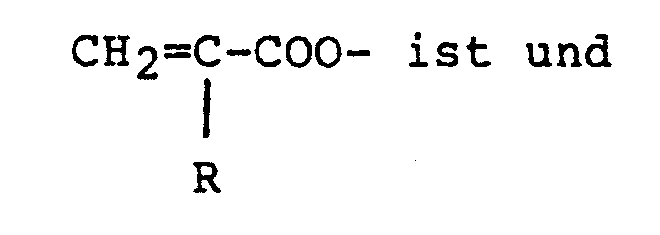
zu einer Verbindung der Formel VI
- Wenn in der Formel I R eine Alkylgruppe ist, hat diese vorzugsweise 1 oder 2 Kohlenstoffatome, besonders bevorzugt werden Verbindungen mit R = H oder Methyl.
- Wenn R¹ ein Halogenatom ist, kann es vorzugsweise ein Fluor-, Chlor- oder Bromatom, insbesondere ein Chlor atom sein. Wenn R¹ eine Alkyl- oder Alkoxygruppe ist, hat diese bevorzugt 1 bis 6, insbesondere 1 bis 3 Kohlenstoffatome; als Acyl- und Alkoxycarbonylgruppen werden solche mit 2 bis 15, insbesondere 2 bis 10 Kohlenstoffatomen bevorzugt. Aryl- und Aryloxygruppen R¹ haben im allgemeinen 6 bis 10 Kohlenstoffatome. Der Rest CH₂=C(R)-COO kann in 3- oder 4-Stellung zu den beiden phenolischen Hydroxygruppen stehen, besonders bevorzugt ist die 3-Stellung. R¹ kann ebenfalls in 3- oder 4-Stellung stehen.
- Beispiele für Verbindungen der Formel II sind Hydroxyhydrochinon, 5-Ethyl-pyrogallol, Pyrogallol, Gallussäuremethylester, Gallussäureethylester, Gallussäurepropylester, Gallussäureoctylester und Gallussäuredodecylester. Verbindungen der Formel II können durch übliche Halogenierungs- oder Nitrierungsverfahren außerdem leicht in die entsprechenden ein-, zwei- oder dreifach substituierten Chlor-, Brom-, Jod- oder Nitro-Derivate übergeführt werden.
- Als Vertreter der Verbindungen der Formel III sind Phosgen, Diethylcarbonat oder Diphenylcarbonat zu nennen. Beim Einsatz von Diphenylcarbonat ist kein Lösungsmittel erforderlich. Durch Erhitzen auf etwa 200-300°C bilden sich 2 mol Phenol, die bei diesen Reaktionsbedingungen abdestillieren. Die Reinigung der zurückbleibenden cyclischen Carbonate der Formel IV erfolgt zunächst durch Vakuumdestillation, anschließend i.a. durch Umkristallisation.
- Bei Einsatz von Phosgen wird bevorzugt ein unpolares Lösungsmittel, z. B. Toluol oder Xylol, verwendet. Phosgen wird üblicherweise unter Eiskühlung in Gegenwart von 2 mol einer Base wie Pyridin, Dimethylanilin oder Triethylamin eingeleitet. Nach der üblichen Aufarbeitung mit Säure und Wasser können ebenfalls Verbindungen der Formel IV durch Entfernen des Lösungsmittels erhalten und durch Umkristallisation gereinigt werden.
- Die Verbindungen II und III werden zumeist im Molverhältnis 0,8:1,2 bis 1,2:0,8, bevorzugt 0,9:1,1 bis 1,1:0,9 miteinander umgesetzt. Werden Verbindungen der Formel II mit Kohlensäurederivaten der Formel III in einem abweichenden Molverhältnis umgesetzt, so sinken die Ausbeuten, da bei Unterschuß an eingesetztem Kohlensäurederivat noch unumgesetztes Ausgangsmaterial vorhanden ist und bei Überschuß an eingesetztem Kohlensäurederivat die freie Hydroxygruppe von Reaktionsprodukten der Formel IV mit dem überschüssigen Reagens zu intra- oder inter-molekularen Nebenprodukten weiterreagiert.
- Bevorzugte Vertreter der Verbindungen der Formel V sind Acrylsäurechlorid, Methacrylsäurechlorid oder Methacryl säureanhydrid. Weitere Vertreter sind z. B. Acrylsäure, Methacrylsäure, 2-Ethylacrylsäure und 2-Butylacrylsäure sowie deren Methyl- oder Ethylester.
- Die Veresterung der Verbindung IV muß so durchgeführt werden, daß die Carbonatgruppierung als Schutzgruppe erhalten bleibt. Dies wird erreicht, wenn man z. B. Acryl- oder Methacrylsäurechlorid in aprotischen Lösungsmitteln wie Chlorkohlenwasserstoffen, z. B. Methylenchlorid, Chloroform, Tetrachlorkohlenstoff, oder aromatischen Kohlenwasserstoffen, z. B. Toluol oder Xylol, in Gegenwart von Basen wie Triethylamin umsetzt. Man kann auch vorteilhaft das billigere Methacrylsäureanhydrid an Stelle von Methacrylsäurechlorid verwenden. Dies kann in Gegenwart von Basen oder auch in Gegenwart von Säuren, z. B. von konzentrierter Schwefelsäure, erfolgen. Bei Verwendung von Acrylsäure und Methacrylsäure oder deren Methyl- bzw. Ethylestern können auch direkte Ver- oder Umesterungen unter sauren oder neutralen Bedingungen erfolgen.
- Die auf diese Weise hergestellten Reaktionsprodukte der Formel VI sind i. a. kristallin und können leicht durch Umkristallisieren gereinigt werden. Sie werden dann vorzugsweise in Wasser im Temperaturbereich von 50-100°C hydrolysiert. Dabei werden die beiden als cyclisches Carbonat geschützten Hydroxygruppen freigesetzt.
- Die Abspaltung der Carbonatschutzgruppe muß so erfolgen, daß die ungesättigte Estergruppierung erhalten bleibt. Dies wird in einer bevorzugten Variante in neutralem wäßrigem Medium erreicht. Dabei hat es sich als vorteilhaft erwiesen, die zur Hydrolyse eingesetzte Menge Wasser so zu regulieren, daß sich in der Hitze eine klare Lösung bildet und nach dem Abkühlen die Verbindungen der Formel I vollständig auskristallisieren. Sie werden nach diesem Verfahren mit einer Gesamtausbeute von wenigstens 50 % erhalten. Das beschriebene Verfahren kann auf alle Trihydroxyaromaten, die zwei alphaständige Hydroxygruppen aufweisen, angewendet werden.
- Die neuen Monomeren können zur Herstellung von Polymeren in der üblichen Weise mittels Wärme, Strahlung und Katalysatoren, z. B. Peroxiden oder Azoverbindungen, entweder homopolymerisiert oder auch mit anderen ethylenisch ungesättigten Monomeren mischpolymerisiert werden.
- Die Verarbeitung der erfindungsgemäßen Verbindungen zu Polymeren und deren Verwendung als Bindemittel in lichtempfindlichen Gemischen ist in der gleichzeitig eingereichten Patentanmeldung P .. .. ... (85/K050) beschrieben.
- Die folgenden Herstellungsbeispiele erläutern die Erfindung.
- In einem Kolben mit Destillationsaufsatz wurden 504 g Pyrogallol und 816 g Diphenylcarbonat gut vermischt und allmählich auf 250°C erhitzt. Nach der vollständigen Abdestillation des entstandenen Phenols wird der Rückstand im Vakuum destilliert und aus Toluol umkristallisiert. Man erhält 490 g 1-Hydroxy-2,3-carbonyldioxybenzol (81 % d. Th.).
- Diese werden in einem Gemisch von 25 ml konz. Schwefelsäure und 2,5 l Toluol gelöst. Bei Raumtemperatur wird diese Lösung innerhalb von 2 Stunden mit 496 g Methacrylsäureanhydrid versetzt und 12 Stunden lang bei Raumtemperatur gerührt. Die sich ergebende Mischung wird mehrere Male mit Wasser gewaschen. Die organische Phase wird vom Lösungsmittel befreit. Der verbliebene Rückstand wird nach Zugabe von Diisopropylether kristallin. Der kristalline Niederschlag wird abgesaugt und mit Diisopropylether gewaschen. Es verbleiben 475 g 1-Methacryloyloxy-2,3-carbonyldioxy-benzol (67 % d. Th.).
- Diese werden 2 Stunden lang in 3 l Wasser bei 65°C gerührt. Unter Entwicklung von CO₂ entsteht eine klare Lösung. Nach dem Abkühlen werden die entstandenen Kristalle abgesaugt und aus Toluol umkristallisiert. Man erhält 385 g analysenreines 1,2-Dihydroxy-3-methacryloyloxy-benzol (92 % d. Th.) mit dem Schmelzpunkt 100 - 102 °C.
- Die Gesamtausbeute, bezogen auf Pyrogallol, beträgt 50 % d. Th.
- In eine Mischung von 126 g Pyrogallol in 400 g Toluol und 160 g Pyridin leitet man unter Eiskühlung 99 g Phosgen ein. Nach 12 Stunden Rühren bei Raumtemperatur wird noch eine Stunde auf 100°C erwärmt. Nach dem Abkühlen wird das Reaktionsgemisch angesäuert und mit Wasser gewaschen. Das Lösungsmittel wird entfernt. Der Rückstand wird aus Toluol umkristallisiert. Man erhält 123 g 1-Hydroxy-2,3-carbonyldioxy-benzol (81 % d. Th.).
- Diese werden in einem Gemisch von 81 g Triethylamin und 0,7 l Toluol gelöst. Bei Eiskühlung wird diese Lösung innerhalb von 3 Stunden mit 73 g Acrylsäurechlorid versetzt und 12 Stunden lang bei Raumtemperatur gerührt. Die organische Phase wird zunächst mit Wasser gewaschen und anschließend vom Lösungsmittel befreit. Der verbliebene Rückstand wird aus Diisopropylether umkristallisiert. Man erhält 130 g 1-Acryloyloxy-2,3-carbonyldioxybenzol (78 % d. Th.).
- Diese werden 1,5 Stunden lang in 0,8 l Wasser bei 65°C gerührt. Unter CO₂-Entwicklung entsteht eine klare Lösung. Die nach dem Abkühlen ausgefallenen Kristalle werden abgesaugt und getrocknet. Man erhält 94 g 1,2-Dihydroxy-3-acryloyloxy-benzol (83 % d. Th.) mit dem Schmelzpunkt 92 - 94 °C.
- Die Gesamtausbeute, bezogen auf Pyrogallol, beträgt 52 % d. Th.
- In einem Kolben mit Destillationsaufsatz werden 198 g Gallussäureethylester und 204 g Diphenylcarbonat gut vermischt und allmählich auf 250°C erhitzt. Nach dem vollständigen Abdestillieren des entstandenen Phenols wird der Rückstand im Vakuum destilliert und aus Ethylacetat umkristallisiert. Man erhält 183 g 3-Hydroxy-4,5-carbonyldioxy-benzoesäureethylester (82 % d. Th.).
- Diese werden in einem Gemisch aus 82 g Triethylamin in 800 ml Toluol gelöst. Bei Eiskühlung wird diese Lösung innerhalb von 3 Stunden mit 86 g Methacrylsäurechlorid versetzt und 12 Stunden lang bei Raumtemperatur gerührt. Die organische Phase wird zunächt mit Wasser gewaschen und anschließend vom Lösungsmittel befreit. Der verbliebene Rückstand wird aus Diisopropylether umkristallisiert. Man erhält 191 g 3-Methacryloyloxy-4,5-carbonyldioxy-benzoesäureethylester (80 % d. Th.).
- Diese werden 5 Stunden lang in 1,2 l Wasser bei 65°C gerührt, bis eine klare Lösung entstanden ist. Nach dem Abkühlen werden die ausgefallenen Kristalle abgesaugt und aus Toluol umkristallisiert. Man erhält 146 g 3,4-Dihydroxy-5-methacryloyloxy-benzoesäureethylester (84 % d. Th.) mit dem Schmelzpunkt 106-108°C.
- Die Gesamtausbeute, bezogen auf Gallussäureethylester, beträgt 55 % d. Th.
Claims (3)

R ein Wasserstoff- oder Halogenatom, eine Cyanid- oder eine Alkylgruppe mit 1-4 Kohlenstoffatomen und
R¹ ein Wasserstoff- oder Halogenatom, eine Nitro-, Alkyl-, Alkoxy-, Aryl-, Aryloxy-, Acyl- oder Alkoxycarbonylgruppe ist.


Y ein Halogenatom, eine Hydroxygruppe, eine Alkoxygruppe oder ein Rest der Formel


Priority Applications (1)
| Application Number | Priority Date | Filing Date | Title |
|---|---|---|---|
| AT86110847T ATE56697T1 (de) | 1985-08-13 | 1986-08-05 | Polymerisierbare verbindungen und verfahren zu ihrer herstellung. |
Applications Claiming Priority (2)
| Application Number | Priority Date | Filing Date | Title |
|---|---|---|---|
| DE19853528928 DE3528928A1 (de) | 1985-08-13 | 1985-08-13 | Polymerisierbare verbindungen und verfahren zu ihrer herstellung |
| DE3528928 | 1985-08-13 |
Publications (3)
| Publication Number | Publication Date |
|---|---|
| EP0213440A2 true EP0213440A2 (de) | 1987-03-11 |
| EP0213440A3 EP0213440A3 (en) | 1988-06-08 |
| EP0213440B1 EP0213440B1 (de) | 1990-09-19 |
Family
ID=6278337
Family Applications (1)
| Application Number | Title | Priority Date | Filing Date |
|---|---|---|---|
| EP86110847A Expired - Lifetime EP0213440B1 (de) | 1985-08-13 | 1986-08-05 | Polymerisierbare Verbindungen und Verfahren zu ihrer Herstellung |
Country Status (5)
| Country | Link |
|---|---|
| US (1) | US4739097A (de) |
| EP (1) | EP0213440B1 (de) |
| JP (1) | JPS6239545A (de) |
| AT (1) | ATE56697T1 (de) |
| DE (2) | DE3528928A1 (de) |
Families Citing this family (7)
| Publication number | Priority date | Publication date | Assignee | Title |
|---|---|---|---|---|
| JP4832019B2 (ja) * | 2005-07-27 | 2011-12-07 | 株式会社ダイセル | 環状カーボネート骨格を含む多環式エステル |
| JP4955276B2 (ja) * | 2006-02-03 | 2012-06-20 | 昭和電工株式会社 | ヒドロキシフェニル(メタ)アクリレート組成物、その製造方法及びポリマーの製造方法 |
| FR2927074B1 (fr) * | 2008-01-31 | 2011-01-07 | Arkema France | Procede de synthese de (meth)acrylate de naphtyle |
| CN105246879A (zh) | 2013-05-28 | 2016-01-13 | 英派尔科技开发有限公司 | 腐植酸衍生物以及制备的方法和用途 |
| EP3004070B1 (de) | 2013-05-28 | 2017-10-11 | Empire Technology Development LLC | Antioxidative huminsäurederivate sowie verfahren zur herstellung und verwendung |
| WO2014209369A1 (en) * | 2013-06-28 | 2014-12-31 | Empire Technology Development Llc | Edible plasticizers for food and food packaging films |
| KR101898362B1 (ko) * | 2014-06-12 | 2018-09-12 | 미쯔비시 케미컬 주식회사 | (메트)아크릴산 에스터의 제조 방법 및 카복실산 방향족 에스터의 제조 방법 |
Family Cites Families (5)
| Publication number | Priority date | Publication date | Assignee | Title |
|---|---|---|---|---|
| NL219220A (de) * | 1956-07-25 | |||
| US3152146A (en) * | 1963-05-08 | 1964-10-06 | Monsanto Co | Halogenated omicron-phenylene carbonates |
| US3629197A (en) * | 1969-04-01 | 1971-12-21 | Du Pont | Monomers and polymers of acryloyloxyphenol and derivatives thereof |
| JPS5283725A (en) * | 1976-01-01 | 1977-07-12 | Toyo Contact Lens Co Ltd | 22hydroxyy33methacryloyl oxynaphthalene and polymer thereof |
| JPS5463002A (en) * | 1977-10-28 | 1979-05-21 | Mitsubishi Gas Chem Co Inc | Preparation of carboxylic acids and phenol carboxylic acid esters |
-
1985
- 1985-08-13 DE DE19853528928 patent/DE3528928A1/de not_active Withdrawn
-
1986
- 1986-08-05 EP EP86110847A patent/EP0213440B1/de not_active Expired - Lifetime
- 1986-08-05 AT AT86110847T patent/ATE56697T1/de active
- 1986-08-05 DE DE8686110847T patent/DE3674295D1/de not_active Expired - Fee Related
- 1986-08-12 JP JP61187949A patent/JPS6239545A/ja active Pending
- 1986-08-13 US US06/896,110 patent/US4739097A/en not_active Expired - Fee Related
Also Published As
| Publication number | Publication date |
|---|---|
| DE3528928A1 (de) | 1987-02-26 |
| EP0213440B1 (de) | 1990-09-19 |
| US4739097A (en) | 1988-04-19 |
| ATE56697T1 (de) | 1990-10-15 |
| DE3674295D1 (de) | 1990-10-25 |
| JPS6239545A (ja) | 1987-02-20 |
| EP0213440A3 (en) | 1988-06-08 |
Similar Documents
| Publication | Publication Date | Title |
|---|---|---|
| DE69414516T2 (de) | Organozinnkatalysierte Transesterifikation | |
| EP0712833B1 (de) | Verfahren zur Herstellung von 2-Phenoxymethylbenzoesäuren | |
| DE2612843B2 (de) | Bis-acrylester und Bis-methacrylester, Verfahren zur Herstellung dieser Verbindungen und deren Verwendung | |
| EP0213440B1 (de) | Polymerisierbare Verbindungen und Verfahren zu ihrer Herstellung | |
| EP0082413B1 (de) | Verfahren zur Herstellung von 2-(Hydroxyphenoxy)-carbonsäureestern | |
| EP0122426B1 (de) | Neue optisch aktive Chromanderivate, Verfahren zu deren Herstellung sowie neue Zwischenprodukte | |
| EP0000542B1 (de) | Verfahren zur Herstellung von Trifluormethylphenolen | |
| EP0086324A2 (de) | Verfahren zur Herstellung von Ascorbinsäure | |
| DE2533396C2 (de) | 3-Methyl-3-aryl-brenztraubensäureester und Verfahren zu ihrer Herstellung | |
| DE1670711C3 (de) | Verfahren zur Herstellung von Thionothiolphosphor-(-phosphon-, phosphin-)säuree stern | |
| EP0950653B1 (de) | Verfahren zur Herstellung von Kaliummonoethylmalonat | |
| DE2404159C2 (de) | Verfahren zur Herstellung von 2-(4-Alkylphenyl)-propionsäuren und ihren Natrium-oder Kaliumsalzen | |
| DE3940572A1 (de) | Verfahren zur herstellung eines bis(3,3-bis(4-hydroxy-alkylphenyl)-butansaeure) diolesters | |
| WO2005023749A2 (de) | Verfahren zur herstellung unsymmetrischer kohlensäureester | |
| DE19532815A1 (de) | Verfahren zur Herstellung von 2-(4-Hydroxyphenoxy)-propionsäureestern | |
| EP0245792A2 (de) | Verfahren zur Herstellung von Carbonsäureestern | |
| WO1991006524A1 (de) | Verfahren zur herstellung von 1,4-bis-(4-hydroxybenzoyl)-benzol | |
| EP0773213A2 (de) | Verfahren zur Herstellung von (2RS,3RS)-3-(2'-Aminophenylthio)-2-hydroxy-3-(4"-methoxyphenyl)-propionsäuremethylester | |
| CH650488A5 (de) | Verfahren zur herstellung des m-phenoxy-benzyl-alkohols. | |
| EP0304784A2 (de) | Verfahren zur Herstellung von Bisphenol-bisacrylaten | |
| EP0591799B1 (de) | Oxidation von Hydroxybenzaldehyden zur Herstellung von Dihydroxybenzol Verbindungen | |
| EP0879815B1 (de) | Verfahren zur Herstellung von 5-Nitro-isophthalsäuredi-c1-c4-alkylestern | |
| DE3590057C1 (de) | Verfahren zur Herstellung von Diacyldianhydrohexiten | |
| EP0847382B1 (de) | Monoester der carboxymethylenanthranilsäuren und verfahren zu ihrer herstellung | |
| DE19853401C1 (de) | Verfahren zur Herstellung eines Iodalkinylcarbamates |
Legal Events
| Date | Code | Title | Description |
|---|---|---|---|
| PUAI | Public reference made under article 153(3) epc to a published international application that has entered the european phase |
Free format text: ORIGINAL CODE: 0009012 |
|
| AK | Designated contracting states |
Kind code of ref document: A2 Designated state(s): AT BE CH DE FR GB IT LI NL SE |
|
| PUAL | Search report despatched |
Free format text: ORIGINAL CODE: 0009013 |
|
| RHK1 | Main classification (correction) |
Ipc: C07C 69/00 |
|
| AK | Designated contracting states |
Kind code of ref document: A3 Designated state(s): AT BE CH DE FR GB IT LI NL SE |
|
| 17P | Request for examination filed |
Effective date: 19881128 |
|
| 17Q | First examination report despatched |
Effective date: 19891031 |
|
| GRAA | (expected) grant |
Free format text: ORIGINAL CODE: 0009210 |
|
| AK | Designated contracting states |
Kind code of ref document: B1 Designated state(s): AT BE CH DE FR GB IT LI NL SE |
|
| REF | Corresponds to: |
Ref document number: 56697 Country of ref document: AT Date of ref document: 19901015 Kind code of ref document: T |
|
| REF | Corresponds to: |
Ref document number: 3674295 Country of ref document: DE Date of ref document: 19901025 |
|
| ET | Fr: translation filed | ||
| ITF | It: translation for a ep patent filed | ||
| GBT | Gb: translation of ep patent filed (gb section 77(6)(a)/1977) | ||
| PLBE | No opposition filed within time limit |
Free format text: ORIGINAL CODE: 0009261 |
|
| STAA | Information on the status of an ep patent application or granted ep patent |
Free format text: STATUS: NO OPPOSITION FILED WITHIN TIME LIMIT |
|
| ITTA | It: last paid annual fee | ||
| 26N | No opposition filed | ||
| PGFP | Annual fee paid to national office [announced via postgrant information from national office to epo] |
Ref country code: FR Payment date: 19920713 Year of fee payment: 7 |
|
| PGFP | Annual fee paid to national office [announced via postgrant information from national office to epo] |
Ref country code: CH Payment date: 19920715 Year of fee payment: 7 |
|
| PGFP | Annual fee paid to national office [announced via postgrant information from national office to epo] |
Ref country code: SE Payment date: 19920720 Year of fee payment: 7 Ref country code: GB Payment date: 19920720 Year of fee payment: 7 |
|
| PGFP | Annual fee paid to national office [announced via postgrant information from national office to epo] |
Ref country code: AT Payment date: 19920722 Year of fee payment: 7 |
|
| PGFP | Annual fee paid to national office [announced via postgrant information from national office to epo] |
Ref country code: BE Payment date: 19920807 Year of fee payment: 7 |
|
| PGFP | Annual fee paid to national office [announced via postgrant information from national office to epo] |
Ref country code: NL Payment date: 19920831 Year of fee payment: 7 |
|
| PGFP | Annual fee paid to national office [announced via postgrant information from national office to epo] |
Ref country code: DE Payment date: 19921015 Year of fee payment: 7 |
|
| PG25 | Lapsed in a contracting state [announced via postgrant information from national office to epo] |
Ref country code: GB Effective date: 19930805 Ref country code: AT Effective date: 19930805 |
|
| PG25 | Lapsed in a contracting state [announced via postgrant information from national office to epo] |
Ref country code: SE Effective date: 19930806 |
|
| PG25 | Lapsed in a contracting state [announced via postgrant information from national office to epo] |
Ref country code: LI Effective date: 19930831 Ref country code: CH Effective date: 19930831 Ref country code: BE Effective date: 19930831 |
|
| BERE | Be: lapsed |
Owner name: HOECHST A.G. Effective date: 19930831 |
|
| PG25 | Lapsed in a contracting state [announced via postgrant information from national office to epo] |
Ref country code: NL Effective date: 19940301 |
|
| GBPC | Gb: european patent ceased through non-payment of renewal fee |
Effective date: 19930805 |
|
| NLV4 | Nl: lapsed or anulled due to non-payment of the annual fee | ||
| PG25 | Lapsed in a contracting state [announced via postgrant information from national office to epo] |
Ref country code: FR Effective date: 19940429 |
|
| REG | Reference to a national code |
Ref country code: CH Ref legal event code: PL |
|
| PG25 | Lapsed in a contracting state [announced via postgrant information from national office to epo] |
Ref country code: DE Effective date: 19940503 |
|
| REG | Reference to a national code |
Ref country code: FR Ref legal event code: ST |
|
| EUG | Se: european patent has lapsed |
Ref document number: 86110847.0 Effective date: 19940310 |
|
| PG25 | Lapsed in a contracting state [announced via postgrant information from national office to epo] |
Ref country code: IT Free format text: LAPSE BECAUSE OF NON-PAYMENT OF DUE FEES;WARNING: LAPSES OF ITALIAN PATENTS WITH EFFECTIVE DATE BEFORE 2007 MAY HAVE OCCURRED AT ANY TIME BEFORE 2007. THE CORRECT EFFECTIVE DATE MAY BE DIFFERENT FROM THE ONE RECORDED. Effective date: 20050805 |