EP0213945A2 - Carboxy, Carbalkoxy und Carbamyl substituierte Isonitril-Radionukleid-Komplexe - Google Patents
Carboxy, Carbalkoxy und Carbamyl substituierte Isonitril-Radionukleid-Komplexe Download PDFInfo
- Publication number
- EP0213945A2 EP0213945A2 EP86306694A EP86306694A EP0213945A2 EP 0213945 A2 EP0213945 A2 EP 0213945A2 EP 86306694 A EP86306694 A EP 86306694A EP 86306694 A EP86306694 A EP 86306694A EP 0213945 A2 EP0213945 A2 EP 0213945A2
- Authority
- EP
- European Patent Office
- Prior art keywords
- complex
- carbon atoms
- cnc
- isonitrile
- ligand
- Prior art date
- Legal status (The legal status is an assumption and is not a legal conclusion. Google has not performed a legal analysis and makes no representation as to the accuracy of the status listed.)
- Granted
Links
Images





Classifications
-
- C—CHEMISTRY; METALLURGY
- C07—ORGANIC CHEMISTRY
- C07F—ACYCLIC, CARBOCYCLIC OR HETEROCYCLIC COMPOUNDS CONTAINING ELEMENTS OTHER THAN CARBON, HYDROGEN, HALOGEN, OXYGEN, NITROGEN, SULFUR, SELENIUM OR TELLURIUM
- C07F13/00—Compounds containing elements of Groups 7 or 17 of the Periodic Table
- C07F13/005—Compounds without a metal-carbon linkage
-
- A—HUMAN NECESSITIES
- A61—MEDICAL OR VETERINARY SCIENCE; HYGIENE
- A61K—PREPARATIONS FOR MEDICAL, DENTAL OR TOILETRY PURPOSES
- A61K51/00—Preparations containing radioactive substances for use in therapy or testing in vivo
- A61K51/02—Preparations containing radioactive substances for use in therapy or testing in vivo characterised by the carrier, i.e. characterised by the agent or material covalently linked or complexing the radioactive nucleus
- A61K51/04—Organic compounds
- A61K51/0474—Organic compounds complexes or complex-forming compounds, i.e. wherein a radioactive metal (e.g. 111In3+) is complexed or chelated by, e.g. a N2S2, N3S, NS3, N4 chelating group
- A61K51/0476—Organic compounds complexes or complex-forming compounds, i.e. wherein a radioactive metal (e.g. 111In3+) is complexed or chelated by, e.g. a N2S2, N3S, NS3, N4 chelating group complexes from monodendate ligands, e.g. sestamibi
-
- C—CHEMISTRY; METALLURGY
- C07—ORGANIC CHEMISTRY
- C07C—ACYCLIC OR CARBOCYCLIC COMPOUNDS
- C07C251/00—Compounds containing nitrogen atoms doubly-bound to a carbon skeleton
-
- A—HUMAN NECESSITIES
- A61—MEDICAL OR VETERINARY SCIENCE; HYGIENE
- A61K—PREPARATIONS FOR MEDICAL, DENTAL OR TOILETRY PURPOSES
- A61K2123/00—Preparations for testing in vivo
Definitions
- U.S. Patent No. 4,452,774 issued June 5, 1984 to Jones et al. discloses coordination complexes of isonitrile ligands and radioactive metals, and is incorporated herein by reference.
- the coordination complexes described therein are useful in visualizing cardiac tissue studying lung function, studying renal excretion, and for imaging bone marrow and the hepatobiliary system. These complexes are useful as diagnostic agents for labelling liposomes or vesicles and selected living cells.
- the present invention provides coordination complexes of Tc, Ru, Co, Pt or Re with the above isonitrile ligands of formula I. Brief Description of the Drawinzs
- the present invention is directed to complexes of a radioactive metal (radionuclide) selected from the class consisting of Tc, Ru, Co, Pt and Re and a carboxylic acid, ester or amide derivative of a lower alkyl isonitrile ligand (also herein referred to as a derived alkyl isonitrile ligand).
- a radioactive metal radioactive metal selected from the class consisting of Tc, Ru, Co, Pt and Re
- a carboxylic acid, ester or amide derivative of a lower alkyl isonitrile ligand also herein referred to as a derived alkyl isonitrile ligand.
- the isonitrile ligands useful in the present invention disclosed herein have the following general formula: where X is a lower alkyl group having 1 to 4 carbon atoms, and R is selected from the group consisting of COOR 1 and CO N R 2 R 3 , where R can be H, a pharmaceutically acceptable cation, such as Na + , or a substituted or unsubstituted alkyl group having 1 to 4 carbon atoms, R 2 and R 3 can be H, or a substituted or unsubstituted alkyl group having 1 to 4 carbon atoms, and R 2 and R 3 can be the same or different.
- X is a lower aklyl group having 1 to 3 carbons atoms.
- Complexes using the present derived alkyl isonitrile ligands typically illustrate faster liver clearance or faster lung clearance when compared to the corresponding parent isonitrile ligand. This generally enables complexes of the present invention to provide better and/or earlier images than the corresponding parent isonitrile ligand. For example, with a heart agent, rapid liver clearance is desirable because it will increase the contrast between the heart and the adjacent liver. Similarly, rapid lung clearance is desirable to improve the contrast between the heart and the lungs by reducing background "noise”. Analogously, this rapid clearance enables earlier and/or better images of other tissues and/or organs which are blocked by background noise from the liver and/or lungs. Preferred complexes of the present invention provide optimal tissue uptake as well as faster liver and lung clearance.
- complexes of this invention can be neutral or positively or negatively charged, the class of lipophilic cationic complexes is presently preferred. However, the complex cannot be too lipophilic and still provide rapid liver and/or lung clearance. Therefore, it is preferred that the total number of carbon atoms in each isonitrile ligand is 12 or less. More preferably, the total number of carbon atoms in each ligand is 10 or less. Most preferably, the total number of carbon atoms in each ligand is 8 or less. When there are 4 carbon atoms in X, it is preferred that R has 5 or less carbon atoms, most preferably, R has 3 or less carbons atoms.
- the complexes of the present invention preferably contain 99m Tc. Additionally, this above-described general availability of supplies of pertechnetate make it convenient to use kits for preparation of various complexes of 99m Tc .
- the invention further comprises a kit for using a predetermined quantity of a radionuclide, e.g. 99m Tc-pertechnetate to prepare a complex as stated above, said kit comprising the isonitrile ligand of the formula (CNX)R and a reducing agent capable of reducing the radioactive metal to form the coordination complex.
- a radionuclide e.g. 99m Tc-pertechnetate
- kit comprising the isonitrile ligand of the formula (CNX)R and a reducing agent capable of reducing the radioactive metal to form the coordination complex.
- the components of this kit are sterile and are packaged in a sterile, non-pyrogenic container. Thus, they are ready for admixture with, for example, 99M T C pertechnetate to prepare complexes of the present invention.
- useful radionuclides are radioactive metals having decay properties that are amenable for use as a tracer.
- Counterions that maybe used in the invention include, for example, in the case of cationic complexes, chloride, fluoride, bromide, iodide, hydroxide, sulfate or bisulfate, dihydrogen phosphate, fluoroborate, hexafluorophosphate, etc.
- a particular radioactive metal can have from one to eight isonitrile ligands bonded thereto.
- each isonitrile ligand is bonded to the radionuclide through the isonitrile carbon atom.
- the complexes of this invention are kinetically inert, and hence stable products, However, the complexes need only be sufficiently stable for the intended use.
- the complexes of the present invention include mixed ligand complexes wherein at least one ligand is a derived alkyl isonitrile.
- the mixture can include a mixture of isonitrile ligands, as well as other ligands well known to those skilled in the art.
- the complex of the present invention which is a homoleptic six coordinate (hexakis) cationic complex having the formula: in which A is a monovalent radionuclide selected from Tc, or Re, and [(CNX)R] is a monodentate isonitrile ligand, is the most preferred.
- a suitable counterion such as described above is also present.
- the complexes of the present invention can easily be prepared by admixing a salt of the radioactive metal and the isonitrile ligand of the present invention in the presence of a suitable reducing agent, if required, in aqueous media at temperatures from room temperature to reflux temperature or even higher, and are obtainable and isolatable in high yield at both macro (carrier added, e.g. 99 Tc) concentrations and at tracer (no carried added, e.g. 99m Tc) concentrations of less than 10 -6 molar.
- the isonitrile ligand can itself act as the reducing agent thus eliminating the need for an additional reducing agent.
- Suitable reducing agents when required or desired, are well known to those skilled in the art.
- the reaction is generally complete within 2 hours, depending upon the identity of the particular reagents employed.
- the radiolabelled complex is made in the same way as the corresponding non-radioactive isonitrile complex by simply substituting the desired radionuclide for the corresponding non-radioactive element in the starting materials, except in the case of technetium because all technetium isotopes are radioactive.
- a complex in accord with this invention is preferably made by mixing pertechnetate (Tc +7 ) with the desired isonitrile in an aqueous medium, then adding to the reaction mixture an appropriate reducing agent capable of reducing the technetium.
- Suitable reducing agents include alkali metal dithionites, stannous salts, sodium borohydride, and others well known to the skilled artisan.
- the derived alkyl isonitrile technetium complexes of this invention can also be prepared from preformed technetium complexes having oxidation states for technetium of, for instance, +3, +4, or +5, by treating these preformed complexes with an excess of derived alkyl isonitrile ligands under suitable conditions.
- the technetium-derived alkyl isonitrile complex can also be prepared by reacting the desired isonitrile ligand with the hexakis-thiourea complex of Tc +3 or with a technetium-glucoheptonate complex, or the like.
- Kits in accord with the present invention comprise a quantity of a reducing agent for reducing a preselected radionuclide.
- a reducing agent for reducing a preselected radionuclide Preferably, such kits contain a predetermined quantity of a derived alkyl isonitrile ligand and a predetermined quantity of a reducing agent capable of reducing a predetermined quantity of a preselected radionuclide.
- the isonitrile ligand and reducing agent are generally provided in sealed, sterilized containers.
- a kit for use in making the complexes of the present invention from a supply of 99m Tc such as the pertechnetate solution in isotonic saline available in most clinical laboratories includes the desired quantity of a selected derived alkyl isonitrile ligand to react with a selected quantity of pertechnetate, and a reducing agent such as sodium dithionite or stannous chloride in an amount sufficient to reduce the selected quantity of pertechnetate to form the desired complex.
- a molar excess of the derived alkyl isonitrile ligand, typically 600% molar excess or more, and an excess of reducing agent, can be used in the complexing reaction to ensure maximum yield of the desired complex from the technetium.
- the desired complex can be separated from the reaction mixture, if required, by crystallization or precipitation or by conventional chromatography or ion exchange chromatography.
- the formamide, vide supra, (7.11 g, 0.06 mol) was dissolved in CH 2 C1 2 (100 ml) and placed in a 500 ml triple-necked round-bottomed flask. The solution was purged with argon and cooled to -30°C. To the flask was added Me 3 N (Me-methyl) (35 ml) dissolved in CH 2 C1 2 (75ml). The mixture was cooled and stirred while adding dropwise a solution of trichloromethyl chloroformate (diphosgene) (6.01 g .030 moles) in CH 2 C1 2 (50 ml). The solution turned color from tan to brown.
- trichloromethyl chloroformate diphosgene
- Hexakis(thiourea-S)technetium (III) (Abrams, M.J., et al, Inorg. Chem. 23:3284-3288 (1984); Abrams, M.J., et a1,J Lab. Comp. Radiopharm., 14:1596 (1982)) tetrafluoroborate (0.42 g) was dissolved in MeOH (50 ml), the system purged with argon, and methylisocyanoacetate (150 ul) was added to the clear red solution. The mixture was heated to reflux (30 minutes), and the volume reduced to ca. 10 ml in vacuo. The residue was titrated with a solution of NH 4 PF 6 in MeOH (5 ml). Addition of Et 2 0 (Et-ethyl) (10 ml) caused the crude solid to separate.
- Et 2 0 Et-ethyl
- This ester was prepared similarly to the methylisocyanoacetate.
- the glycine t-butylesterhydrochloride was prepared from glycine suspended in t-ButOH (But-butyl) and treated with anhydrous HC1.
- the amine esterhydrochloride was recrystallized from methylethyl ketone/hexane.
- the intermediate t-butylformamide acetate was distilled at 115-120°C, 1 mm of Hg.
- the kit for the NCA preparation of 99m Tc-hexakis carbo-t-butoxymethylisonitrile technetium was similar to that for hexakis carbomethoxymethylisonitrile technetium except that the vial contents were heated at 45 0 C for 75 minutes for >95% yield (HPLC and TLC).
- the methyl ester hydrochloride was made by the treatment of 2 aminobutyric acid with anhydrous HCl in MeOH.
- the methyl-2-aminoisobutyrate hydrochloride was converted by N-formylation using the formic acid, acetic anhydride procedure in 60% yield.
- Methyl-2-isocyanoisobutyrate was obtained by dehydration of the formamide with diphosgene.
- the ethyl-3-aminopropanoate hydrochloride was made by the treatment of 3 aminopropanic acid with anhydrous HCl in EtOH.
- Ethyl-3-isocyanopropanoate was obtained by dehydration of the formamide with diphosgene. The yield was 65%.
- This step may be used with the above syntheses to provide a pure sample of the isonitrile complex freed from the other materials in the syntheses.
- the solution was transferred to a separatory funnel (50 ml) and twice extracted with methylene chloride (3 ml).
- the organic phase was twice washed with isotonic saline (5 ml) and then transferred to a siliconized round-bottomed flask (50 ml) fitted with a vacuum adaptor.
- the solvent was removed in vacuo, aided by heating with an infra-red lamp.
- the flask was washed first by addition of ethanol (100 ul) followed by saline (1 ml).
- the solution was then ready for administration to animals after assay by HPLC, the complex being in the form of a solution in a physiologically acceptable non-toxic carrier.
- Two rabbits were anesthetized with sodium pentobarbital and injected via an ear vein with 3-8 mCi of 99m Tc-isonitrile complex.
- One rabbit was imaged using a gamma camera equipped with a pinhole collimator positioned directly over the chest. Three minute static images were acquired at 5, 10, 20, 20, 40, 50 and 60 minutes post injection.
- a second rabbit was used to investigate the relative whole body distribution of activity for 60 mintues post-injection.
- 300 thousand count images were acquired in the following sequence of projections: chest, anterior heart, whole body, anterior heart, left lateral whole body, anterior heart, lateral heart, anterior heart.
- Swine were sedated with intramuscular injections of Ketamine and acepromazine, and anesthetized with sodium pentobarbital.
- the animals were positioned for anterior image acquisition over the chest under a low energy, high resolution collimator and injected with 10-12 mCi 99m Tc-isonitrile complex via a leg vein.
- the liver was covered with a lead shield, and three minute images were acquired at 5, 10, 20, 30, 40, 50 and 60 minutes post-injection.
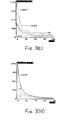
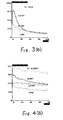
- Rabbits were anesthetized with Ketamine and NembutalTM and positioned beneath a gamma camera to allow continuous collection of data including a chest and abdomen view. 1 mCi of the test agent as specified below was injected via an ear vein and data collected continuously at 60 second intervals for 60 minutes. Curves were generated by drawing regions of interest over selected tissues and normalizing to counts per minute per pixel.
- liver activity for ethyl isonitrile and some of its derivatives are described in Table 2. While Table 3 shows the liver activity for isopropylisonitrile and some of its derivatives.
- liver activity for ethyl isonitrile and some of its derivatives are described in Table 2. While Table 3 shows the liver activity for isopropylisonitrile and some of its derivatives.
- Figure 3 is a comparison of counts per minute per pixel (pix) over time in minutes for complexes of 99m Tc with isonitrile ligands of the formula CN(CH 2 )R, where R is: and The complexes were prepared, injected and imaged as described above.
- Figure 4 is a comparison of counts per minute per pixel over time (minutes) for complexes of 99m Tc with isonitrile ligands of the formula:
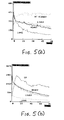
- Figure 5 is a comparison of counts per minute per pixel over time (minutes) for complexes of 99m Tc with isonitrile ligands of the formula CNC(CH 3 ) 2 R, where R is: and
- coordination complexes of the present invention containing ligands of carbomethoxyisopropylisonitrile or 2-carboethoxyethylisonitrile appear to be particularly useful for imaging the heart. Because of rapid lung clearance there is very good to excellent resolution of the myocardium at five minutes after injection of complexes containing ligands of carbomethoxyisopropylisonitrile in rabbits when imaged. Although the liver uptake results in background noise that initially prevents clear visualization of the apex of the heart, by 20 minutes after injection, there has been sufficient liver clearance to allow excellent resolution of the apex.
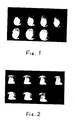
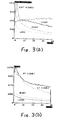
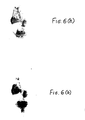
- Figure 6(a) is a scintigraphic image of a rabbit injected with a complex of 99m T c-carboethoxyisopropylisonitrile at 5 minutes after injection
- Figure 6(b) is a scintigraphic image of the same rabbit at 15 minutes after injection
- Figure 7(a) is a scintigraphic image with a complex of 99m T c-2-carboethoxyethylisonitrile at 1, 10, 15 and 20 minutes post injection
- Figure 7(b) is a scintigraphic image of a rabbit injected with the above complex at 31 minutes post-injection.
- the heart is at (A), the gall bladder at (B) and the site of injection at (C). The interpretation of these images is known to the person of ordinary skill in this field. While reading of these images is somewhat qualitative, the above described compound has resulted in excellent images in both animal and human tests.
Landscapes
- Chemical & Material Sciences (AREA)
- Organic Chemistry (AREA)
- Health & Medical Sciences (AREA)
- Life Sciences & Earth Sciences (AREA)
- Animal Behavior & Ethology (AREA)
- Veterinary Medicine (AREA)
- Medicinal Chemistry (AREA)
- Optics & Photonics (AREA)
- Pharmacology & Pharmacy (AREA)
- Epidemiology (AREA)
- Proteomics, Peptides & Aminoacids (AREA)
- General Health & Medical Sciences (AREA)
- Public Health (AREA)
- Physics & Mathematics (AREA)
- Medicines Containing Antibodies Or Antigens For Use As Internal Diagnostic Agents (AREA)
- Nitrogen Condensed Heterocyclic Rings (AREA)
- Organic Low-Molecular-Weight Compounds And Preparation Thereof (AREA)
- Medicines That Contain Protein Lipid Enzymes And Other Medicines (AREA)
- Steroid Compounds (AREA)
- Input Circuits Of Receivers And Coupling Of Receivers And Audio Equipment (AREA)
- Pharmaceuticals Containing Other Organic And Inorganic Compounds (AREA)
- Acyclic And Carbocyclic Compounds In Medicinal Compositions (AREA)
Priority Applications (1)
| Application Number | Priority Date | Filing Date | Title |
|---|---|---|---|
| AT86306694T ATE56949T1 (de) | 1985-08-30 | 1986-08-29 | Carboxy, carbalkoxy und carbamyl substituierte isonitril-radionukleid-komplexe. |
Applications Claiming Priority (2)
| Application Number | Priority Date | Filing Date | Title |
|---|---|---|---|
| US771284 | 1985-08-30 | ||
| US06/771,284 US4735793A (en) | 1985-08-30 | 1985-08-30 | Carboxy, carboalkoxy and carbamile substituted isonitrile radionuclide complexes |
Publications (3)
| Publication Number | Publication Date |
|---|---|
| EP0213945A2 true EP0213945A2 (de) | 1987-03-11 |
| EP0213945A3 EP0213945A3 (en) | 1987-05-20 |
| EP0213945B1 EP0213945B1 (de) | 1990-09-26 |
Family
ID=25091322
Family Applications (1)
| Application Number | Title | Priority Date | Filing Date |
|---|---|---|---|
| EP86306694A Expired - Lifetime EP0213945B1 (de) | 1985-08-30 | 1986-08-29 | Carboxy, Carbalkoxy und Carbamyl substituierte Isonitril-Radionukleid-Komplexe |
Country Status (11)
| Country | Link |
|---|---|
| US (1) | US4735793A (de) |
| EP (1) | EP0213945B1 (de) |
| JP (2) | JP2504750B2 (de) |
| AT (1) | ATE56949T1 (de) |
| AU (1) | AU587637B2 (de) |
| CA (1) | CA1254901A (de) |
| DE (1) | DE3674515D1 (de) |
| DK (1) | DK174682B1 (de) |
| GR (1) | GR862179B (de) |
| IE (1) | IE58816B1 (de) |
| WO (1) | WO1987001290A1 (de) |
Cited By (1)
| Publication number | Priority date | Publication date | Assignee | Title |
|---|---|---|---|---|
| CN111138504A (zh) * | 2020-01-13 | 2020-05-12 | 北京师范大学 | 一种99mTc-CNPEDG配合物及其制备方法和应用 |
Families Citing this family (18)
| Publication number | Priority date | Publication date | Assignee | Title |
|---|---|---|---|---|
| US4894445A (en) * | 1985-08-05 | 1990-01-16 | E. I. Du Pont De Nemours And Company | Metal-isonitrile adducts for preparing radionuclide complexes |
| US5324824A (en) * | 1985-08-05 | 1994-06-28 | The Dupont Merck Pharmaceutical Co. | Metal-isonitrile adducts for preparing radionuclide complexes |
| CA1305160C (en) * | 1985-12-23 | 1992-07-14 | Paul Louis Bergstein | Ether isonitriles and radiolabeled complexes thereof |
| DE3684711D1 (de) * | 1986-04-07 | 1992-05-07 | Francois Dietlin | In der tomo-densitometrie zu verwendende zusammensetzungen. |
| US4826774A (en) * | 1987-01-30 | 1989-05-02 | Minnesota Mining And Manufacturing Company | Vapocheromic double-complex salts |
| US4971725A (en) * | 1987-01-30 | 1990-11-20 | Minnesota Mining And Manufacturing Company | Thermochromic double-complex salts |
| US4834909A (en) * | 1987-01-30 | 1989-05-30 | Minnesota Mining And Manufacturing Company | Thermochromic double-complex salts |
| US5158760A (en) * | 1990-05-30 | 1992-10-27 | Board Of Regents, The University Of Texas System | 99m TC labeled liposomes |
| US5143713A (en) * | 1990-05-30 | 1992-09-01 | Board Of Regents, The University Of Texas System | 99m Tc labeled liposomes |
| US5210270A (en) * | 1991-11-25 | 1993-05-11 | Institute Of Nuclear Energy Research | Method for synthesis and 99m C labelling of 2-alkoxyisobutylisonitrile |
| US5420321A (en) * | 1993-08-03 | 1995-05-30 | The Du Pont Merck Pharmaceutical Company | Tris(isonitrile)copper(i) sulfates for preparing radionuclide complexes |
| JP4657718B2 (ja) * | 2002-09-06 | 2011-03-23 | シー・アール・バード・インク | 内視鏡の外部にある内視鏡付属品制御システム |
| US7229603B2 (en) * | 2004-06-17 | 2007-06-12 | Anazaohealth Corporation | Stablilized and lyophilized radiopharmaceutical agents |
| US20070189965A1 (en) * | 2004-06-17 | 2007-08-16 | Kuperus John H | Copper-complex isonitrile positron emission tomography (pet) imaging agent and method |
| CN107245087B (zh) | 2017-06-15 | 2019-08-23 | 北京师宏药物研制中心 | 99mTc标记含异腈的葡萄糖衍生物及制备方法和应用 |
| CN110698515B (zh) * | 2018-07-31 | 2021-03-26 | 北京师范大学 | 一种标记的含异氰基的脂肪酸类衍生物及其应用 |
| CN109320557B (zh) * | 2018-10-26 | 2020-10-02 | 北京师范大学 | 99mTc(CO)3核标记的含异腈的帕博西尼衍生物及制备方法和应用 |
| CN117304230A (zh) * | 2022-06-20 | 2023-12-29 | 北京师范大学 | 一种标记的脂肪酸类衍生物、其前体化合物及其在显像剂中的应用 |
Family Cites Families (4)
| Publication number | Priority date | Publication date | Assignee | Title |
|---|---|---|---|---|
| DE2751782A1 (de) * | 1977-11-19 | 1979-05-23 | Bayer Ag | Mittel zur regulierung des pflanzenwachstums |
| DE2842639A1 (de) * | 1978-09-29 | 1980-04-10 | Bayer Ag | Alpha -isocyano-carbonsaeureamide, verfahren zu ihrer herstellung und ihre verwendung als pflanzenwachstumsregulatoren |
| US4452774A (en) * | 1982-04-30 | 1984-06-05 | President And Fellows Of Harvard College | Isonitrile radionuclide complexes for labelling and imaging agents |
| CA1293729C (en) * | 1985-08-05 | 1991-12-31 | Alan Purdom Carpenter Jr | Metal-isonitrile adducts for preparing radionuclide complexes |
-
1985
- 1985-08-30 US US06/771,284 patent/US4735793A/en not_active Expired - Lifetime
-
1986
- 1986-08-22 GR GR862179A patent/GR862179B/el unknown
- 1986-08-27 AU AU63305/86A patent/AU587637B2/en not_active Expired
- 1986-08-27 WO PCT/US1986/001773 patent/WO1987001290A1/en not_active Ceased
- 1986-08-28 IE IE229686A patent/IE58816B1/en not_active IP Right Cessation
- 1986-08-29 JP JP61203573A patent/JP2504750B2/ja not_active Expired - Fee Related
- 1986-08-29 AT AT86306694T patent/ATE56949T1/de not_active IP Right Cessation
- 1986-08-29 DK DK198604126A patent/DK174682B1/da not_active IP Right Cessation
- 1986-08-29 EP EP86306694A patent/EP0213945B1/de not_active Expired - Lifetime
- 1986-08-29 CA CA000517219A patent/CA1254901A/en not_active Expired
- 1986-08-29 DE DE8686306694T patent/DE3674515D1/de not_active Expired - Lifetime
-
1994
- 1994-11-24 JP JP6290091A patent/JPH07206884A/ja active Pending
Cited By (2)
| Publication number | Priority date | Publication date | Assignee | Title |
|---|---|---|---|---|
| CN111138504A (zh) * | 2020-01-13 | 2020-05-12 | 北京师范大学 | 一种99mTc-CNPEDG配合物及其制备方法和应用 |
| CN111138504B (zh) * | 2020-01-13 | 2021-03-30 | 北京师范大学 | 一种99mTc-CNPEDG配合物及其制备方法和应用 |
Also Published As
| Publication number | Publication date |
|---|---|
| DK174682B1 (da) | 2003-09-08 |
| AU6330586A (en) | 1987-03-24 |
| US4735793A (en) | 1988-04-05 |
| JP2504750B2 (ja) | 1996-06-05 |
| JPH07206884A (ja) | 1995-08-08 |
| DE3674515D1 (en) | 1990-10-31 |
| IE58816B1 (en) | 1993-11-17 |
| ATE56949T1 (de) | 1990-10-15 |
| EP0213945B1 (de) | 1990-09-26 |
| DK412686D0 (da) | 1986-08-29 |
| EP0213945A3 (en) | 1987-05-20 |
| IE862296L (en) | 1987-02-28 |
| JPS62265260A (ja) | 1987-11-18 |
| WO1987001290A1 (en) | 1987-03-12 |
| DK412686A (da) | 1987-03-01 |
| AU587637B2 (en) | 1989-08-24 |
| GR862179B (en) | 1987-01-02 |
| CA1254901A (en) | 1989-05-30 |
Similar Documents
| Publication | Publication Date | Title |
|---|---|---|
| EP0213945B1 (de) | Carboxy, Carbalkoxy und Carbamyl substituierte Isonitril-Radionukleid-Komplexe | |
| DK172154B1 (da) | Isonitrilkompleks omfattende et radionuclid, middel til anvendelse ved mærkning, afbildning eller detektering og indeholdende et sådant kompleks, kit til fremstilling af et sådant kompleks, og fremgangsmåde til mærkning af en celle eller et liposom in vitro | |
| CA1231715A (en) | Complexes of technetium-99m with alkylene amine oximes | |
| US5279811A (en) | Ester-substituted diaminedithiols and radiolabeled complexes thereof | |
| US4673562A (en) | Bisamide bisthiol compounds useful for making technetium radiodiagnostic renal agents | |
| EP0426759B1 (de) | Tc-99-m-komplexe | |
| US5538712A (en) | Cyclopentadienylcarbonyl 99MTC complexes, process for their production as well as their use in diagnostics | |
| EP0119733A1 (de) | Kationische Technetium (I)-Komplexe | |
| EP0472665B1 (de) | 99 m Tc (III) herzmuskelbildende Mittel, wirksam beim Menschen | |
| US4418208A (en) | N-Substituted iminodiacetic acids | |
| US4872561A (en) | Carboxy, carboalkoxy and carbamile substituted isonitrile radionuclide complexes | |
| CA1204766A (en) | Cationic technetium complexes useful as radiodiagnostic agents | |
| US5688485A (en) | Radiolabelled complexes of ester-substituted diaminethiols | |
| WO2006080993A1 (en) | Novel cationic metal complex radiopharmaceuticals | |
| EP0515670B1 (de) | Sechsbindige liganden für radiographische abbildungsagenzien | |
| US4957728A (en) | Kit for preparing Tc (III)-99m myocardial imaging agents that are effective in humans | |
| US4193979A (en) | Sodium 3-[[[2-(2-methyl-5-nitro-1H-imidazol-1-yl)ethyl]-amino]carbonyl]-2-pyridinecarboxylic acid and related compounds labeled with technetium-99m | |
| WO1991017168A1 (en) | Gallium-labelled imaging agents | |
| GB2128612A (en) | Improvements in or relating to imaging agents | |
| US4350674A (en) | Substituted acetanilidoiminodiacetic acid compounds, diagnostic agents containing such compounds labeled with technetium-99m, and methods for making and using such compounds and agents | |
| EP0515638B1 (de) | Neue vorangeordnete sechszähnige liganden verwendbar in röntgenologischen bildformenden wirkstoffen | |
| GB2090252A (en) | N-substituted Iminodiacetic Acids | |
| JPH0339515B2 (de) | ||
| IE55024B1 (en) | Isonitrile radionuclide complexes for labelling and imaging agents |
Legal Events
| Date | Code | Title | Description |
|---|---|---|---|
| PUAI | Public reference made under article 153(3) epc to a published international application that has entered the european phase |
Free format text: ORIGINAL CODE: 0009012 |
|
| AK | Designated contracting states |
Kind code of ref document: A2 Designated state(s): AT BE CH DE FR GB IT LI LU NL SE |
|
| PUAL | Search report despatched |
Free format text: ORIGINAL CODE: 0009013 |
|
| AK | Designated contracting states |
Kind code of ref document: A3 Designated state(s): AT BE CH DE FR GB IT LI LU NL SE |
|
| 17P | Request for examination filed |
Effective date: 19870811 |
|
| 17Q | First examination report despatched |
Effective date: 19880314 |
|
| GRAA | (expected) grant |
Free format text: ORIGINAL CODE: 0009210 |
|
| AK | Designated contracting states |
Kind code of ref document: B1 Designated state(s): AT BE CH DE FR GB IT LI LU NL SE |
|
| REF | Corresponds to: |
Ref document number: 56949 Country of ref document: AT Date of ref document: 19901015 Kind code of ref document: T |
|
| REF | Corresponds to: |
Ref document number: 3674515 Country of ref document: DE Date of ref document: 19901031 |
|
| ET | Fr: translation filed | ||
| ITF | It: translation for a ep patent filed | ||
| PLBE | No opposition filed within time limit |
Free format text: ORIGINAL CODE: 0009261 |
|
| STAA | Information on the status of an ep patent application or granted ep patent |
Free format text: STATUS: NO OPPOSITION FILED WITHIN TIME LIMIT |
|
| ITTA | It: last paid annual fee | ||
| 26N | No opposition filed | ||
| EPTA | Lu: last paid annual fee | ||
| EAL | Se: european patent in force in sweden |
Ref document number: 86306694.0 |
|
| REG | Reference to a national code |
Ref country code: GB Ref legal event code: IF02 |
|
| PGFP | Annual fee paid to national office [announced via postgrant information from national office to epo] |
Ref country code: NL Payment date: 20050729 Year of fee payment: 20 |
|
| PGFP | Annual fee paid to national office [announced via postgrant information from national office to epo] |
Ref country code: AT Payment date: 20050803 Year of fee payment: 20 |
|
| PGFP | Annual fee paid to national office [announced via postgrant information from national office to epo] |
Ref country code: FR Payment date: 20050817 Year of fee payment: 20 |
|
| PGFP | Annual fee paid to national office [announced via postgrant information from national office to epo] |
Ref country code: SE Payment date: 20050819 Year of fee payment: 20 Ref country code: CH Payment date: 20050819 Year of fee payment: 20 |
|
| PGFP | Annual fee paid to national office [announced via postgrant information from national office to epo] |
Ref country code: GB Payment date: 20050824 Year of fee payment: 20 |
|
| PGFP | Annual fee paid to national office [announced via postgrant information from national office to epo] |
Ref country code: IT Payment date: 20050829 Year of fee payment: 20 |
|
| PGFP | Annual fee paid to national office [announced via postgrant information from national office to epo] |
Ref country code: BE Payment date: 20050902 Year of fee payment: 20 |
|
| PGFP | Annual fee paid to national office [announced via postgrant information from national office to epo] |
Ref country code: DE Payment date: 20050930 Year of fee payment: 20 |
|
| PGFP | Annual fee paid to national office [announced via postgrant information from national office to epo] |
Ref country code: LU Payment date: 20051005 Year of fee payment: 20 |
|
| PG25 | Lapsed in a contracting state [announced via postgrant information from national office to epo] |
Ref country code: GB Free format text: LAPSE BECAUSE OF EXPIRATION OF PROTECTION Effective date: 20060828 |
|
| PG25 | Lapsed in a contracting state [announced via postgrant information from national office to epo] |
Ref country code: NL Free format text: LAPSE BECAUSE OF EXPIRATION OF PROTECTION Effective date: 20060829 |
|
| REG | Reference to a national code |
Ref country code: GB Ref legal event code: PE20 |
|
| REG | Reference to a national code |
Ref country code: CH Ref legal event code: PL |
|
| EUG | Se: european patent has lapsed | ||
| NLV7 | Nl: ceased due to reaching the maximum lifetime of a patent |
Effective date: 20060829 |
|
| BE20 | Be: patent expired |
Owner name: *MASSACHUSETTS INSTITUTE OF TECHNOLOGY Effective date: 20060829 Owner name: THE *PRESIDENT AND FELLOWS OF HARVARD COLLEGE Effective date: 20060829 |