EP0214030A2 - Système de réparation automatisé pour la technologie de montage en surface - Google Patents
Système de réparation automatisé pour la technologie de montage en surface Download PDFInfo
- Publication number
- EP0214030A2 EP0214030A2 EP86401783A EP86401783A EP0214030A2 EP 0214030 A2 EP0214030 A2 EP 0214030A2 EP 86401783 A EP86401783 A EP 86401783A EP 86401783 A EP86401783 A EP 86401783A EP 0214030 A2 EP0214030 A2 EP 0214030A2
- Authority
- EP
- European Patent Office
- Prior art keywords
- board
- component
- heat
- manipulating
- repair apparatus
- Prior art date
- Legal status (The legal status is an assumption and is not a legal conclusion. Google has not performed a legal analysis and makes no representation as to the accuracy of the status listed.)
- Withdrawn
Links
- 230000008439 repair process Effects 0.000 title claims abstract description 57
- 238000005516 engineering process Methods 0.000 title claims description 9
- 230000000694 effects Effects 0.000 claims abstract 2
- 229910000679 solder Inorganic materials 0.000 claims description 20
- 238000010438 heat treatment Methods 0.000 claims description 10
- 230000000712 assembly Effects 0.000 claims description 9
- 238000000429 assembly Methods 0.000 claims description 9
- 230000004913 activation Effects 0.000 claims 1
- 230000001276 controlling effect Effects 0.000 abstract 1
- 238000000034 method Methods 0.000 description 12
- XEEYBQQBJWHFJM-UHFFFAOYSA-N Iron Chemical compound [Fe] XEEYBQQBJWHFJM-UHFFFAOYSA-N 0.000 description 10
- 229910052742 iron Inorganic materials 0.000 description 5
- 230000004048 modification Effects 0.000 description 5
- 238000012986 modification Methods 0.000 description 5
- 238000012360 testing method Methods 0.000 description 4
- 230000008901 benefit Effects 0.000 description 3
- 238000004519 manufacturing process Methods 0.000 description 3
- 238000004891 communication Methods 0.000 description 2
- 238000010276 construction Methods 0.000 description 2
- 238000005476 soldering Methods 0.000 description 2
- 238000007792 addition Methods 0.000 description 1
- 230000008878 coupling Effects 0.000 description 1
- 238000010168 coupling process Methods 0.000 description 1
- 238000005859 coupling reaction Methods 0.000 description 1
- 238000013461 design Methods 0.000 description 1
- 230000005496 eutectics Effects 0.000 description 1
- 230000006870 function Effects 0.000 description 1
- LQBJWKCYZGMFEV-UHFFFAOYSA-N lead tin Chemical compound [Sn].[Pb] LQBJWKCYZGMFEV-UHFFFAOYSA-N 0.000 description 1
- 230000007246 mechanism Effects 0.000 description 1
- 238000013021 overheating Methods 0.000 description 1
- 238000003908 quality control method Methods 0.000 description 1
- 230000009467 reduction Effects 0.000 description 1
Images

Classifications
-
- H—ELECTRICITY
- H05—ELECTRIC TECHNIQUES NOT OTHERWISE PROVIDED FOR
- H05K—PRINTED CIRCUITS; CASINGS OR CONSTRUCTIONAL DETAILS OF ELECTRIC APPARATUS; MANUFACTURE OF ASSEMBLAGES OF ELECTRICAL COMPONENTS
- H05K3/00—Apparatus or processes for manufacturing printed circuits
-
- B—PERFORMING OPERATIONS; TRANSPORTING
- B23—MACHINE TOOLS; METAL-WORKING NOT OTHERWISE PROVIDED FOR
- B23K—SOLDERING OR UNSOLDERING; WELDING; CLADDING OR PLATING BY SOLDERING OR WELDING; CUTTING BY APPLYING HEAT LOCALLY, e.g. FLAME CUTTING; WORKING BY LASER BEAM
- B23K1/00—Soldering, e.g. brazing, or unsoldering
- B23K1/012—Soldering with the use of hot gas
-
- H—ELECTRICITY
- H05—ELECTRIC TECHNIQUES NOT OTHERWISE PROVIDED FOR
- H05K—PRINTED CIRCUITS; CASINGS OR CONSTRUCTIONAL DETAILS OF ELECTRIC APPARATUS; MANUFACTURE OF ASSEMBLAGES OF ELECTRICAL COMPONENTS
- H05K13/00—Apparatus or processes specially adapted for manufacturing or adjusting assemblages of electric components
- H05K13/04—Mounting of components, e.g. of leadless components
- H05K13/0486—Replacement and removal of components
-
- B—PERFORMING OPERATIONS; TRANSPORTING
- B23—MACHINE TOOLS; METAL-WORKING NOT OTHERWISE PROVIDED FOR
- B23K—SOLDERING OR UNSOLDERING; WELDING; CLADDING OR PLATING BY SOLDERING OR WELDING; CUTTING BY APPLYING HEAT LOCALLY, e.g. FLAME CUTTING; WORKING BY LASER BEAM
- B23K2101/00—Articles made by soldering, welding or cutting
- B23K2101/36—Electric or electronic devices
- B23K2101/42—Printed circuits
Definitions
- This invention relates generally to electronic circuit board assembly, and more particularly, to the repair of surface mount technology electronic printed circuit boards.
- Electronic circuit assemblies which include a plurality of different electronic components mounted together on a single board are common in computers and other such electronic equipment.
- the different electronic components have leads which are electrically interconnected by conductive circuit paths plated directly on the board.
- SMT Surface mount technology
- SMT board assembly procedures are generally simpler and more economical to implement than conventional board assembly procedures. Moreover, they permit significant reductions in individual component and board sizes, as well as component mounting on both surfaces of the board, making denser assemblies with increased computational capacities available.
- plated boards are first passed through a screen print solder paste applicator, which applies solder paste to the conductive pads of the board. This is typically accomplished by forcing the solder paste onto the board through a screen or stencil, the openings in which are etched to match the shape and location of the conductive pads on the board which are to receive the solder.
- the onsertion station includes a table for holding the board, and a head which carries a component grappling chuck and which is moveable about X, Y, Z and ⁇ (rotational) axes under control of a processor.
- the onsertion station can be programmed so that the chuck picks up an individual component from a feeder location, positions the component above the appropriate conductive pads on the board, moves the component downwardly to position its leads in the solder paste, releases the component, and then repeats the procedure for another component until the board is fully populated.
- the populated boards are then passed through equipment to harden and fuse the solder, thus securing the components in place.
- the first repair method involves the use of a hand-held soldering iron, which functions much like a pair of tweezers.
- the tips of the iron when squeezed together, have a shape matching the perimeter of the component to be removed.
- the tips of the iron are positioned about the leads of the faulty component and the iron is heated until the operator observes that the solder has reflowed so as to permit the component to be lifted from the board.
- This method of repair is not only slow and tedious, but requires a different soldering iron for each component size or type on the board. In the case of relatively small components, this method is extremely difficult to perform.
- the second repair method involves the use of a hot air station.
- the hot air station includes a holder for the board to be repaired, an air blower, a heater for heating the air from the blower, and a conduit for directing the hot air through an interchangeable orifice onto the component to be removed from the board.
- the orifice size is selected to match the perimeter of the component to be removed.
- SMT surface mount technology
- Another object of this invention is to provide an SMT circuit board repair system which is automated, requiring little or no operator involvement.
- Still another object of the invention is to provide an SMT circuit board repair system which can be implemented with relatively simple and straightforward modification of existing equipment utilized in the assembly of such boards.
- Still yet another object of the invention is to provide an SMT circuit board repair system which minimizes the likelihood of damage to the board and to other "good" components on the board by enabling precise, careful control of the repair procedure.
- repair of surface mount technology (SMT) circuit boards is effected by taking advantage of the manipulative capabilities of automated equipment conventionally used in the assembly of such boards.
- automated onsertion equipment used in mounting SMT components to boards is modified to add a localized and controllable heating feature to the component grappling mechanism therein.
- the onsertion equipment through appropriate programming, can be used in a repair mode in which the heating feature is activated to reflow lead solder whenever end-of-line testing indicates that a given component is faulty and must be removed and replaced on a given board.
- a commercially available programmable onsertion station is provided with a source of hot air which is conducted through air passages to nozzles formed in the component-engaging face of a grappling chuck.
- the onsertion station is programmed to operate in a repair mode by inputting data identifying the component or components which are faulty on a given board.
- the repair program is run, causing the chuck to engage a component to be removed, discharge hot air for a predetermined period of time sufficient to reflow the solder securing its leads, lift and carry the component to a disposal tray, pick-up a replacement component from a feeder, place the replacement component in position, and then discharge hot air again to secure the replacement component in position on the board.
- the optimum hot air discharge time periods will vary depending upon component type and size, and can be stored in the onsertion station memory in advance so that they are automatically selected and implemented during the repair procedure. This reduces the likelihood of damage to the board due to overheating as a result of error in operator judgement. Operator involvement in the repair procedure can be further minimized by inputting faulty component identifying data directly from an end-of-line test station to the modified onsertion station.
- FIGS. 1 and 2 there is shown an automated onsertion station 10 which has been modified in accordance with the invention to operate in a repair mode.
- the onsertion station 10 is for the most part of conventional construction, illustratively comprising a Model QS-34 SMT assembler available commercially from Quad Systems Corporation, 2 Electronic Drive, Horsham, Pennsylvania.
- the station 10 includes a base cabinet 12 which houses various equipment including a motor/driver unit 14, a vacuum pump 16 and a processor 20.
- a work surface mounting plate 24 is supported on top of the base cabinet 12.
- Mounted on the mounting plate 24 are a pair of Y-axis drive units 26A and 26B, and an X-axis drive unit 28.
- a Z-axis and theta ( ⁇ ) or rotational drive unit 30 is carried by the X-axis drive unit 28 and coupled to a chuck-engaging head 32.
- the drive units 26A, 26B, 28 and 30 are capable of moving the head 32 in any selected sequence of movements along X, Y, Z and ⁇ axes, as shown in FIGS. 1 and 2.
- a component feeder 36 Also mounted on the mounting plate 24 are a component feeder 36, a board holder 38, and a grappling chuck holder 40.
- Electronic components of different types and sizes, indicated collectively by the reference numeral 42, are fed from magazines 44 to pick-up trays 46 on the feeder 36.
- the board holder 38 holds an SMT printed circuit board 50 to which solder paste has been applied and on which the various electronic components 42 are to be mounted in predetermined sequence at predetermined locations.
- the grappling chuck holder 40 holds a plurality of different component grappling chucks 54. Each grappling chuck 54 varies in size depending upon the type and size of electronic component 42 it is intended to handle. Each chuck 54 can be gripped by the head 32, and manipulated under vacuum control between a component holding position and a component releasing position.
- the processor 20 is programmable via hand-held keypad programmer 60. Using the programmer 60, a user enters instructions corresponding to each operation in sequence to be performed by the head 32 in fully populating the board 50 with components 42.
- the sequence of instructions, or assembly program is stored in memory built in the processor 20, and can be rerun each time a board of the same type as the board 50 is mounted in the holder 38 for assembly.
- the programs stored in the processor 20 vary for different types of boards to be assembled. Additional programming capability and memory capacity can be provided through the use of a compatible off-line processor (not shown) which communicates with the on-board processor 20 through an RS-232C communication port 64.
- the station 10 is provided with a source of hot air 70, illustratively shown mounted to the rear of base cabinet 12.
- the air emitted by source 70 is preferably deionized so as to avoid electrostatic charge build-up and discharge damage to "good" components 42 on a board during a repair operation.
- the temperature of the air emitted by the source 70 should be sufficiently high to reflow the solder used in securing components 42 to the board 50 so that the components can be readily lifted from the board.
- hot air temperatures in the range of about 425 to 450 °F are generally sufficient.
- the hot air from hot air source 70 is conducted via flexible tubing 72 to the upper surface of the Z/ ⁇ axes drive unit 30.
- the hot air is conducted by suitable passages to the head 32, and from the head 32, to a specially designed component grappling chuck 74 adapted for use in a repair mode.
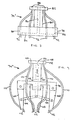
- FIGS. 3 and 4 illustrate two alternative embodiments of the repair chuck 74.
- Chuck 74' shown in FIG. 3 is a vacuum type chuck modified for use in a repair mode.
- the chuck 74' includes a disc-shaped base 78, an upstanding neck 80 protruding from the top of the base 78, and a flange 82 on the top end of the neck 80.
- the bottom surface of the base 78 is provided with a recess 84 which more or less matches the shape of the electronic component to be held with the chuck 74'.
- a vacuum passage 86 extends from the recess 84 up through the neck 80 and through the flange 82.
- the flange 82 of the chuck 74' is grippable by the head 32 in the onsertion station 10 of FIGS. 1 and 2.
- vacuum created in the vacuum pump 16 of the station 10 can be applied through the head 32 to the vacuum passage 86 in the chuck 74' when a component is to be picked up and held in the chuck 74'.
- Release of the vacuum causes the chuck 74' to release the component.
- the flange 82 and base 78 of the chuck 74' are provided with a plurality of hot air passages 88 disposed radially outwardly of the vacuum passage 86.
- the passages 88 in the flange 82 are connected to the passages 88 in the base 78 by hot air lines 90.
- the passages 88 in the base 78 open into nozzles 92 which are adapted to direct hot air toward the area of the leads of a component which is engaged by the chuck 74'.
- the chuck 74' When the chuck 74' is gripped by the head 32 in the onsertion station 10 of FIGS. 1 and 2, hot air generated in the hot air source 70 can be applied through the head 32 to the hot air passages 88 in the flange 82 and ultimately discharged from the nozzles 92.
- the chuck 74' in addition to providing the conventional component manipulating capabilities utilized in board assembly, combines these capabilities with a hot air discharge feature to enable its use in the repair of assemblied boards.
- Chuck 74" shown in FIG. 4 is a mechanical chuck modified for use in board repairs. Like chuck 74' of FIG. 3, chuck 74" of FIG. 4 includes a base 98, an upstanding neck 100, and a flange 102 on the top end of the neck 100. A plurality of component gripping legs 103 are pivotally connected to an extended below the bottom of the base 98. The legs 103 are connected by pivotal mechanical linkages 104 to a piston member 105 movably disposed in a vertical channel 106 that extends upwardly from the base 98 through the neck 100 and through the flange 102.
- the flange 102 of the chuck 74" is grippable by the head 32 of the onsertion station 10 of FIGS. 1 and 2.
- the head 32 can draw the piston member 105 upwardly in the channel 106 so that the legs 103 are pivoted radially inwardly, thereby to pick-up and hold a component.
- the head 32 can move the piston member 105 downwardly in the channel 106 to cause the legs 103 to be pivoted radially outwardly to release the component.
- the flange 102 of the chuck 74" is provided with a plurality of hot air passages 108 disposed radially outwardly of the vertical channel 106.
- the passages 108 in the flange 102 are connected to the passages 108 in the base 98 of the chuck 74" by hot air lines 110.
- These hot air lines 110 are preferably flexible so as not to interfere with the pivotal motion of the legs 103.
- the hot air lines 110 form nozzles 112 which, like the nozzles 92 in the chuck 74', discharge hot air to the area of the leads of a component which is engaged by the chuck 74".
- the station 10 can be programmed to operate in a repair mode via the hand-held programmer 60 in essentially the same manner that it is programmed for the assembly of such boards, namely, by entering instructions corresponding to each operation in sequence to be performed by the station 10 in removing faulty components from a board and replacing them with "good" components.
- a generalized repair program can be stored in the memory of the processor 20 for each particular type of board. In such a case, the user is simply required to enter data identifying the component or components to be replaced on the board before running the repair program.
- Optimum hot air discharge time periods which provide sufficient solder reflow to permit easy removal of components by the chuck 74' or 74" but which avoid damage to the board itself as well as adjacent components, can be determined by trial and error in advance of actual production runs and stored in the memory for automatic implementation during the repair operation. Further automation of the repair operations can be achieved by coupling faulty component identifying data directly from an end-of-line board test station back to the onsertion station 10 through the RS-232C communication port 64 conventionally provided therein. Specific implementations of these and other such repair operations will be readily apparent to those skilled in the art who have a working familiarity with the Model QS-34 assembler and/or other such automated assembly equipment.
- hot air has been described as the means for providing the necessary solder heating during board repair, other heating means, such as electrically energized heating elements, infrared emmitters, and laser heaters, could also be used.
- the hot air source 70 would typically be mounted internally of the base cabinet 12, and the flexible conduit 72 would typically be run internally of the various drive units therein to the head 32, in much the same way that the vacuum lines are run internally from the vacuum pump 16 to the head 32 in the commercially available station 10.
Landscapes
- Engineering & Computer Science (AREA)
- Manufacturing & Machinery (AREA)
- Microelectronics & Electronic Packaging (AREA)
- Mechanical Engineering (AREA)
- Electric Connection Of Electric Components To Printed Circuits (AREA)
- Supply And Installment Of Electrical Components (AREA)
Applications Claiming Priority (2)
| Application Number | Priority Date | Filing Date | Title |
|---|---|---|---|
| US76453485A | 1985-08-12 | 1985-08-12 | |
| US764534 | 1985-08-12 |
Publications (2)
| Publication Number | Publication Date |
|---|---|
| EP0214030A2 true EP0214030A2 (fr) | 1987-03-11 |
| EP0214030A3 EP0214030A3 (fr) | 1987-05-13 |
Family
ID=25070987
Family Applications (1)
| Application Number | Title | Priority Date | Filing Date |
|---|---|---|---|
| EP86401783A Withdrawn EP0214030A3 (fr) | 1985-08-12 | 1986-08-08 | Système de réparation automatisé pour la technologie de montage en surface |
Country Status (4)
| Country | Link |
|---|---|
| EP (1) | EP0214030A3 (fr) |
| JP (1) | JPS6297400A (fr) |
| KR (1) | KR870002753A (fr) |
| AU (1) | AU6107986A (fr) |
Cited By (4)
| Publication number | Priority date | Publication date | Assignee | Title |
|---|---|---|---|---|
| WO1991018490A1 (fr) * | 1990-05-23 | 1991-11-28 | Siemens Nixdorf Informationssysteme Aktiengesellschaft | Procede et dispositif de soudage de pieces a souder dans des positions precises sur un support |
| EP0233125B1 (fr) * | 1986-02-13 | 1993-10-06 | Digital Equipment Corporation | Station et méthode de réparation des plaques de câblage à composants de la technologie de montage en surface |
| EP0723390A3 (fr) * | 1995-01-17 | 1996-08-14 | Omron Corporation | Méthode et appareil pour soutenir la réparation de substrats défectueux |
| ES2308888A1 (es) * | 2006-05-03 | 2008-12-01 | Fundacion Gaiker | Maquina y metodo de desensamblado de componentes electronicos de tarjetas de circuitos impresos. |
Families Citing this family (1)
| Publication number | Priority date | Publication date | Assignee | Title |
|---|---|---|---|---|
| US6688335B2 (en) | 2000-07-14 | 2004-02-10 | Suzuki Sogyo Co., Ltd. | Liquid hammer prevention device |
Family Cites Families (4)
| Publication number | Priority date | Publication date | Assignee | Title |
|---|---|---|---|---|
| DE2529554A1 (de) * | 1975-07-02 | 1977-01-20 | Siemens Ag | Verfahren und vorrichtung zum abloeten von halbleiterbausteinen in flip- chip-technik |
| FR2458977A1 (fr) * | 1979-06-13 | 1981-01-02 | Cii Honeywell Bull | Dispositif de demontage non destructif d'un composant electronique modulaire soude par une pluralite de cosses de raccordement sur un substrat |
| US4295596A (en) * | 1979-12-19 | 1981-10-20 | Western Electric Company, Inc. | Methods and apparatus for bonding an article to a metallized substrate |
| JPS60142600A (ja) * | 1983-12-29 | 1985-07-27 | 富士通株式会社 | Ic自動装着システム |
-
1986
- 1986-08-08 EP EP86401783A patent/EP0214030A3/fr not_active Withdrawn
- 1986-08-11 KR KR1019860006580A patent/KR870002753A/ko not_active Withdrawn
- 1986-08-12 AU AU61079/86A patent/AU6107986A/en not_active Abandoned
- 1986-08-12 JP JP61189472A patent/JPS6297400A/ja active Pending
Cited By (6)
| Publication number | Priority date | Publication date | Assignee | Title |
|---|---|---|---|---|
| EP0233125B1 (fr) * | 1986-02-13 | 1993-10-06 | Digital Equipment Corporation | Station et méthode de réparation des plaques de câblage à composants de la technologie de montage en surface |
| WO1991018490A1 (fr) * | 1990-05-23 | 1991-11-28 | Siemens Nixdorf Informationssysteme Aktiengesellschaft | Procede et dispositif de soudage de pieces a souder dans des positions precises sur un support |
| EP0723390A3 (fr) * | 1995-01-17 | 1996-08-14 | Omron Corporation | Méthode et appareil pour soutenir la réparation de substrats défectueux |
| US5831854A (en) * | 1995-01-17 | 1998-11-03 | Omron Corporation | Method and device for supporting the repair of defective substrates |
| ES2308888A1 (es) * | 2006-05-03 | 2008-12-01 | Fundacion Gaiker | Maquina y metodo de desensamblado de componentes electronicos de tarjetas de circuitos impresos. |
| ES2308888B1 (es) * | 2006-05-03 | 2009-10-23 | Fundacion Gaiker | Maquina y metodo de desensamblado de componentes electronicos de tarjetas de circuitos impresos. |
Also Published As
| Publication number | Publication date |
|---|---|
| EP0214030A3 (fr) | 1987-05-13 |
| AU6107986A (en) | 1987-02-19 |
| KR870002753A (ko) | 1987-04-06 |
| JPS6297400A (ja) | 1987-05-06 |
Similar Documents
| Publication | Publication Date | Title |
|---|---|---|
| US4813589A (en) | Surface mounted device rework heat guide | |
| US11623291B2 (en) | Selective soldering system for selective wave soldering of circuit boards comprising gripping unit for exchanging solder nozzles | |
| CN111659968B (zh) | 进行锡焊的机器人装置 | |
| EP0214030A2 (fr) | Système de réparation automatisé pour la technologie de montage en surface | |
| US5590455A (en) | Apparatus for manufacturing a printed circuit board | |
| EP0233125B1 (fr) | Station et méthode de réparation des plaques de câblage à composants de la technologie de montage en surface | |
| US6471117B1 (en) | Transfer fluxing method and apparatus for component placement on substrate | |
| CN114632989A (zh) | 一种活动感应加热的电路板返修机 | |
| US4511421A (en) | Component-insertion table for manually equipping circuit carriers | |
| WO2022168145A1 (fr) | Dispositif d'impression, système d'impression et unité d'échange de cadre | |
| CN109128420B (zh) | 一种全自动返修拆焊方法 | |
| JP3295967B2 (ja) | 電子部品接合方法 | |
| CN217509149U (zh) | 一种定点感应加热的电路板返修机 | |
| JP2003092466A (ja) | 電子部品取り外し装置及び電子部品取り外し方法 | |
| Geren et al. | Computer‐Integrated Automatic PCBA Rework | |
| CN114615821A (zh) | 一种定点感应加热的电路板返修机 | |
| CN114260535B (zh) | 包括用于更换焊料喷嘴的夹持单元在内的用于电路板选择性波峰焊接的选择性焊接系统 | |
| JP3125903U (ja) | はんだ加熱器具用先端チップ及びそれを装着したはんだ加熱器具 | |
| JP2001274542A (ja) | 半田付け装置 | |
| Fidan et al. | Automation issues of SMD automated rework cell | |
| JPH0720941Y2 (ja) | 半田除去装置 | |
| Geren et al. | Automated removal and replacement of through-hole components in robotic rework | |
| JPS6120790Y2 (fr) | ||
| US6116494A (en) | Method for re-attachment of a SMT component using a heated air jet | |
| JPH01286387A (ja) | 電子部品のリプレース方法 |
Legal Events
| Date | Code | Title | Description |
|---|---|---|---|
| PUAI | Public reference made under article 153(3) epc to a published international application that has entered the european phase |
Free format text: ORIGINAL CODE: 0009012 |
|
| AK | Designated contracting states |
Kind code of ref document: A2 Designated state(s): AT BE CH DE FR GB IT LI LU NL SE |
|
| PUAL | Search report despatched |
Free format text: ORIGINAL CODE: 0009013 |
|
| AK | Designated contracting states |
Kind code of ref document: A3 Designated state(s): AT BE CH DE FR GB IT LI LU NL SE |
|
| 17P | Request for examination filed |
Effective date: 19871002 |
|
| 17Q | First examination report despatched |
Effective date: 19891030 |
|
| STAA | Information on the status of an ep patent application or granted ep patent |
Free format text: STATUS: THE APPLICATION IS DEEMED TO BE WITHDRAWN |
|
| 18D | Application deemed to be withdrawn |
Effective date: 19900510 |
|
| RIN1 | Information on inventor provided before grant (corrected) |
Inventor name: KOLESAR, MICHAEL J. |