EP0214302A1 - Gasphaseverfahren zur herstellung von kohlenstoffasern - Google Patents
Gasphaseverfahren zur herstellung von kohlenstoffasern Download PDFInfo
- Publication number
- EP0214302A1 EP0214302A1 EP86901499A EP86901499A EP0214302A1 EP 0214302 A1 EP0214302 A1 EP 0214302A1 EP 86901499 A EP86901499 A EP 86901499A EP 86901499 A EP86901499 A EP 86901499A EP 0214302 A1 EP0214302 A1 EP 0214302A1
- Authority
- EP
- European Patent Office
- Prior art keywords
- furnace
- gas
- hydrocarbon
- carbon fiber
- compound
- Prior art date
- Legal status (The legal status is an assumption and is not a legal conclusion. Google has not performed a legal analysis and makes no representation as to the accuracy of the status listed.)
- Withdrawn
Links
Images


Classifications
-
- B—PERFORMING OPERATIONS; TRANSPORTING
- B82—NANOTECHNOLOGY
- B82Y—SPECIFIC USES OR APPLICATIONS OF NANOSTRUCTURES; MEASUREMENT OR ANALYSIS OF NANOSTRUCTURES; MANUFACTURE OR TREATMENT OF NANOSTRUCTURES
- B82Y30/00—Nanotechnology for materials or surface science, e.g. nanocomposites
-
- D—TEXTILES; PAPER
- D01—NATURAL OR MAN-MADE THREADS OR FIBRES; SPINNING
- D01F—CHEMICAL FEATURES IN THE MANUFACTURE OF ARTIFICIAL FILAMENTS, THREADS, FIBRES, BRISTLES OR RIBBONS; APPARATUS SPECIALLY ADAPTED FOR THE MANUFACTURE OF CARBON FILAMENTS
- D01F9/00—Artificial filaments or the like of other substances; Manufacture thereof; Apparatus specially adapted for the manufacture of carbon filaments
- D01F9/08—Artificial filaments or the like of other substances; Manufacture thereof; Apparatus specially adapted for the manufacture of carbon filaments of inorganic material
- D01F9/12—Carbon filaments; Apparatus specially adapted for the manufacture thereof
-
- D—TEXTILES; PAPER
- D01—NATURAL OR MAN-MADE THREADS OR FIBRES; SPINNING
- D01F—CHEMICAL FEATURES IN THE MANUFACTURE OF ARTIFICIAL FILAMENTS, THREADS, FIBRES, BRISTLES OR RIBBONS; APPARATUS SPECIALLY ADAPTED FOR THE MANUFACTURE OF CARBON FILAMENTS
- D01F9/00—Artificial filaments or the like of other substances; Manufacture thereof; Apparatus specially adapted for the manufacture of carbon filaments
- D01F9/08—Artificial filaments or the like of other substances; Manufacture thereof; Apparatus specially adapted for the manufacture of carbon filaments of inorganic material
- D01F9/12—Carbon filaments; Apparatus specially adapted for the manufacture thereof
- D01F9/127—Carbon filaments; Apparatus specially adapted for the manufacture thereof by thermal decomposition of hydrocarbon gases or vapours or other carbon-containing compounds in the form of gas or vapour, e.g. carbon monoxide, alcohols
- D01F9/1271—Alkanes or cycloalkanes
-
- D—TEXTILES; PAPER
- D01—NATURAL OR MAN-MADE THREADS OR FIBRES; SPINNING
- D01F—CHEMICAL FEATURES IN THE MANUFACTURE OF ARTIFICIAL FILAMENTS, THREADS, FIBRES, BRISTLES OR RIBBONS; APPARATUS SPECIALLY ADAPTED FOR THE MANUFACTURE OF CARBON FILAMENTS
- D01F9/00—Artificial filaments or the like of other substances; Manufacture thereof; Apparatus specially adapted for the manufacture of carbon filaments
- D01F9/08—Artificial filaments or the like of other substances; Manufacture thereof; Apparatus specially adapted for the manufacture of carbon filaments of inorganic material
- D01F9/12—Carbon filaments; Apparatus specially adapted for the manufacture thereof
- D01F9/127—Carbon filaments; Apparatus specially adapted for the manufacture thereof by thermal decomposition of hydrocarbon gases or vapours or other carbon-containing compounds in the form of gas or vapour, e.g. carbon monoxide, alcohols
- D01F9/1271—Alkanes or cycloalkanes
- D01F9/1272—Methane
-
- D—TEXTILES; PAPER
- D01—NATURAL OR MAN-MADE THREADS OR FIBRES; SPINNING
- D01F—CHEMICAL FEATURES IN THE MANUFACTURE OF ARTIFICIAL FILAMENTS, THREADS, FIBRES, BRISTLES OR RIBBONS; APPARATUS SPECIALLY ADAPTED FOR THE MANUFACTURE OF CARBON FILAMENTS
- D01F9/00—Artificial filaments or the like of other substances; Manufacture thereof; Apparatus specially adapted for the manufacture of carbon filaments
- D01F9/08—Artificial filaments or the like of other substances; Manufacture thereof; Apparatus specially adapted for the manufacture of carbon filaments of inorganic material
- D01F9/12—Carbon filaments; Apparatus specially adapted for the manufacture thereof
- D01F9/127—Carbon filaments; Apparatus specially adapted for the manufacture thereof by thermal decomposition of hydrocarbon gases or vapours or other carbon-containing compounds in the form of gas or vapour, e.g. carbon monoxide, alcohols
- D01F9/1273—Alkenes, alkynes
- D01F9/1275—Acetylene
-
- D—TEXTILES; PAPER
- D01—NATURAL OR MAN-MADE THREADS OR FIBRES; SPINNING
- D01F—CHEMICAL FEATURES IN THE MANUFACTURE OF ARTIFICIAL FILAMENTS, THREADS, FIBRES, BRISTLES OR RIBBONS; APPARATUS SPECIALLY ADAPTED FOR THE MANUFACTURE OF CARBON FILAMENTS
- D01F9/00—Artificial filaments or the like of other substances; Manufacture thereof; Apparatus specially adapted for the manufacture of carbon filaments
- D01F9/08—Artificial filaments or the like of other substances; Manufacture thereof; Apparatus specially adapted for the manufacture of carbon filaments of inorganic material
- D01F9/12—Carbon filaments; Apparatus specially adapted for the manufacture thereof
- D01F9/127—Carbon filaments; Apparatus specially adapted for the manufacture thereof by thermal decomposition of hydrocarbon gases or vapours or other carbon-containing compounds in the form of gas or vapour, e.g. carbon monoxide, alcohols
- D01F9/1276—Aromatics, e.g. toluene
-
- D—TEXTILES; PAPER
- D01—NATURAL OR MAN-MADE THREADS OR FIBRES; SPINNING
- D01F—CHEMICAL FEATURES IN THE MANUFACTURE OF ARTIFICIAL FILAMENTS, THREADS, FIBRES, BRISTLES OR RIBBONS; APPARATUS SPECIALLY ADAPTED FOR THE MANUFACTURE OF CARBON FILAMENTS
- D01F9/00—Artificial filaments or the like of other substances; Manufacture thereof; Apparatus specially adapted for the manufacture of carbon filaments
- D01F9/08—Artificial filaments or the like of other substances; Manufacture thereof; Apparatus specially adapted for the manufacture of carbon filaments of inorganic material
- D01F9/12—Carbon filaments; Apparatus specially adapted for the manufacture thereof
- D01F9/127—Carbon filaments; Apparatus specially adapted for the manufacture thereof by thermal decomposition of hydrocarbon gases or vapours or other carbon-containing compounds in the form of gas or vapour, e.g. carbon monoxide, alcohols
- D01F9/133—Apparatus therefor
Definitions
- the present invention relates to a method of producing a carbon fiber by a gas-phase method, and more particularly, to a method which is appropriate for continuously producing a fine carbon fiber including a whisker.
- the present invention is a method for depositing a carbon fiber, in which the furnace interior is maintained at a temperature required for the deposition of a carbon fiber by, for example, directly introducing the combustion gas of a fuel into the furnace interior, generating the combustion gas in the furnace interior, and at the same time, copresenting a hydrocarbon compound and fine particles of a transition metal or compound of the transition metal.
- the carbon fiber produced by a gas phase method has generally been produced by mixing a carrier gas of hydrogen gas with the hydrocarbon gas. According to research by the present inventors, however, it was found that the carbon fiber produced by a gas phase method can be produced even in the further presence of an N 2 gas, CO gas, C0 2 , gas, and H 2 0 gas. This fact, that the fiborous carbon is deposited even in those gas mixture, leads to a production of the fiber in the presence of a fuel -combustion gases.
- the copresence of hydrogen has been allegedly advantageous for depositing a carbon fiber from the hydrocarbon gas, but this hydrogen was generated due to decomposition of the hydrocarbon.
- a hydrocarbon having a high H/C such as CH 4 or the like
- the production of a carbon fiber by the gas phase method is possible without introducing hydrogen from the outside.
- the addition of a hydrogen gas can be carried out, which is preferred when using a hydrocarbon gas having a low H/C.
- sulfur or a sulfur compound is supplied into a reaction furnace, the thermal decomposition of hydrocarbon can be controlled so as to stably deposit a carbon fiber.
- a heat- resistant reaction furnace which is provided with an introduction port of combustion flame as the heating source, a gas-exhaust port, and an inlet port for feeding a hydrocarbon-series compound as the raw material of a fiber and a powder of a transition metal or a compound thereof, and if necessary, a carrier gas.
- This reaction furnace is preferably covered with heat- insulation material having a good heat insulating property, such as silica wool, alumina fiber, or the like.
- the combustion fuel gas may be generated by a Bunsen burner.
- the ratio of incorporation of soot in the fiber can be reduced under a combustion condition using a smaller amount of air, in place of the ordinary combustion condition for burning the fuel used only as a heating source.
- the fuel may be any combustible material, such as methane, propane, kerosine, and the like.
- the hydrocarbon-bearing compounds used as the raw material for the carbon fiber are a gas or a volatile liquid. Methane, propane, benzene, toluene, and the like are industrially utilizable. These compounds not only comprise hydrocarbon but also may contain N, S, 0, and the like.
- hydrocarbon bearing compounds utilizable in the present invention are alkane compounds other than methane and ethane, alkene compounds such as ethylene and butadiene, alkyne compounds such as acetylene, aryl hydrocarbon compounds such as stylene, aromatic hydrocarbons having a fused ring such as indene, naphthalene, phenanthrene, and the like, cyclo- paraffin compounds such as cyclopropane, cyclohexane, and the like, cycloolefin compounds such as cyclopentene, cyclohexene, and the like, aliphatic hydrocarbons having a fused ring such as steroid, and the like, sulfur-containing aliphatic compounds such as methylthiole, methylethyl sulfide, dimethyl thioketone, and the like, and sulfur-containing heterocyclic compounds such as phenylthiole and diphenyl sulfide, such as benzo
- the hydrocarbon series compounds may be used identically for the raw material of the carbon fiber and for the fuel.
- an aromatic compound such as benzene
- a carrier gas such as hydrogen
- a region of the reaction furnace for forming the carbon fiber must be under a reducing atmosphere and have a partial presence of unburnt hydrocarbon compound (the description hereinafter is made with regard to hydrocarbon as representative).
- hydrocarbon gas When because of an incomplete combustion of a burner a part of the hydrocarbon of a fuel remains in the combustion product, a hydrocarbon other than the fuel need not be added to the reaction furnace.
- hydrocarbon gas When the combustion in the burner is complete, hydrocarbon gas must be added and, if necessary, hydrogen gas. These gases may be partly burnt, but the unburnt hydrocarbon gas must remain as described above.
- Iron fine powder is frequently used as the additive transition-metal compound, but Ni, Co or an alloy thereof, and an organic metal compound, such as ferrocene, nickelocene, and the like can be added.
- an organic metal compound such as ferrocene, nickelocene, and the like can be added.
- As the 0 fine powder a 300 A or less ultrafine powder is preferred.
- the metal fine powder may be thrown into the furnace through a port thereof, thereby dispersing it over a certain entire surface in the furnace, or it may be put in through a port of the furnace and dispersed by a gas stream in the furnace. Where a volatile compound is used, it is thrown into the furnace as it is or is dissolved in a solvent and is dropped or injected therein.
- Throwing, dropping, or injecting is preferably carried out consecutively, because the stream in the reaction furnace is strong and thus the volatile compound is liable to be scattered, which will necessitate a constant feeding thereof into the furnace.
- the solvent to be used is soluble in the hydrocarbon bearing compounds as the raw material, the former is preferably dissolved in the latter, thereby using the transition metal compound and hydrocarbon bearing compound together.
- the carbon fiber formed is blown out and deposited on the exhaust port or outside thereof, thus the exhaust port should be thick and be equipped with a collector in the form of a net.
- the heating temperature of a furnace may be from 500°C to 2000°C.
- the preferred temperature varies depending upon the kinds of raw material and additive metal used (the above mentioned transition metal and a compound thereof). For example, when the iron-series metal or compound thereof is added, a temperature of 800°C ⁇ 1300°C is preferred, and if a nickel series is used, a temperature of 900°C to 1400°C is preferred.
- hydrocarbon gas as the raw material, the additive metal compound, and, if necessary, a carrier gas are injected into the furnace separately or together. If the additive metal compound is preliminarily present in the furnace, a further additive metal compound is necessarily not injected.
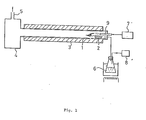
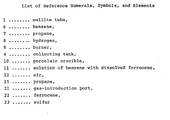
- the heat insulating material 3 is wound around a mullite tube 1 having an inner diameter of 80 mm.
- a porcelain boat in which 0.5 g of iron fine ° powder having a particle diameter of 300 A was held, was deposited within that tube.
- propane 7 was used as the fuel and was ignited and burnt by a burner 9 with the aid of air in an approximately theoretical amount.
- the hydrogen gas 8 which flew over the liquid level of benzene 6 maintained at 40°C, was introduced at a rate of 20 1/minute into the mullite tube 1.
- fibourous carbon and carbon black were copresent.
- the fiborous carbon has various shapes and sizes, having typical diameter of from 0.05 to 0.1 p and assumed length of from 10 ⁇ to 5 mm.
- Silica wool as the heat insulating material 3 was wound around a crucible 10 made of alumina ceramic and. having an inner diameter of 100 mm. While air was introduced into the bottom of the crucible 10 by a compressor, a solution 11 of benzene saturated with ferrocene at 25°C was dropped at approximately one drop per second and was ignited.
- the heat insulating material 3 was wound around the mullite tube 1 having an inner diameter of 100 mm.
- a ring-type burner 9 was installed in the conduit.
- propane 7 was used as the fuel and was ignited and burnt by the burner 9 with the aid of air in an approximately theoretical amount.
- the hydrogen gas 8 which had passed over benzene, ferrocene, and sulfur, was introduced into the tube at a rate of 20 1/minute.
- the gas-introduction port 21 was positioned at the center of the ring-type burner 9.
- Hydrogen gas saturated with benzene vapor at 25°C was introduced into the furnace, which was maintained at 1050°C by external electric heating, at 0.5 i per minute.
- the reaction was carried out for 5 hours, followed by allowing the apparatus to cool.
- the weight of carbon fiber formed was 6.5 g, which corresponds to a productivity of 0.5 g per liter of furnace volume, per hour.
- the present invention greatly contributes to a reduction of the volume of a furnace and, hence, saves energy.
- the fiber obtained by the method according to the present invention can be dispersed, for example, in an epoxy resin, and injection molded to yield a highly elastic body which can be used for sport goods and the like.
Landscapes
- Chemical & Material Sciences (AREA)
- Engineering & Computer Science (AREA)
- Physics & Mathematics (AREA)
- Textile Engineering (AREA)
- General Chemical & Material Sciences (AREA)
- Chemical Kinetics & Catalysis (AREA)
- Thermal Sciences (AREA)
- Nanotechnology (AREA)
- Composite Materials (AREA)
- Crystallography & Structural Chemistry (AREA)
- Materials Engineering (AREA)
- General Physics & Mathematics (AREA)
- Condensed Matter Physics & Semiconductors (AREA)
- Inorganic Fibers (AREA)
- Crystals, And After-Treatments Of Crystals (AREA)
Applications Claiming Priority (2)
| Application Number | Priority Date | Filing Date | Title |
|---|---|---|---|
| JP32818/85 | 1985-02-22 | ||
| JP3281885 | 1985-02-22 |
Publications (2)
| Publication Number | Publication Date |
|---|---|
| EP0214302A1 true EP0214302A1 (de) | 1987-03-18 |
| EP0214302A4 EP0214302A4 (de) | 1989-04-24 |
Family
ID=12369410
Family Applications (1)
| Application Number | Title | Priority Date | Filing Date |
|---|---|---|---|
| EP19860901499 Withdrawn EP0214302A4 (de) | 1985-02-22 | 1986-02-21 | Gasphaseverfahren zur herstellung von kohlenstoffasern. |
Country Status (2)
| Country | Link |
|---|---|
| EP (1) | EP0214302A4 (de) |
| WO (1) | WO1986004937A1 (de) |
Cited By (3)
| Publication number | Priority date | Publication date | Assignee | Title |
|---|---|---|---|---|
| FR2667329A1 (fr) * | 1990-09-29 | 1992-04-03 | Central Glass Co Ltd | Procede de production de fibres de carbone ayant des filaments en forme de serpentin. |
| US5639429A (en) * | 1992-02-24 | 1997-06-17 | Consejo Superior Investigaciones Cientificas | Reactor for the production of short ceramic fibers from gas |
| US7390475B2 (en) | 2002-05-22 | 2008-06-24 | Showa Denko K.K. | Process for producing vapor-grown carbon fibers |
Families Citing this family (3)
| Publication number | Priority date | Publication date | Assignee | Title |
|---|---|---|---|---|
| US5413773A (en) * | 1990-10-09 | 1995-05-09 | General Motors Corporation | Method for forming carbon filters |
| US5024818A (en) * | 1990-10-09 | 1991-06-18 | General Motors Corporation | Apparatus for forming carbon fibers |
| JP4972490B2 (ja) * | 2007-08-10 | 2012-07-11 | 昭和電工株式会社 | 燃焼法による炭素繊維の製造方法 |
Family Cites Families (4)
| Publication number | Priority date | Publication date | Assignee | Title |
|---|---|---|---|---|
| JPS5822571B2 (ja) * | 1976-02-25 | 1983-05-10 | 昭和電工株式会社 | 気相法による炭素繊維の製造法 |
| JPS56118913A (en) * | 1980-02-26 | 1981-09-18 | Shohachi Kawakado | Preparation of carbon fiber growing in vapor phase in high yield |
| JPS59116422A (ja) * | 1982-12-22 | 1984-07-05 | Toray Ind Inc | 炭素繊維製造における耐炎化排ガスの処理法 |
| US4572813A (en) * | 1983-09-06 | 1986-02-25 | Nikkiso Co., Ltd. | Process for preparing fine carbon fibers in a gaseous phase reaction |
-
1986
- 1986-02-21 WO PCT/JP1986/000082 patent/WO1986004937A1/ja not_active Ceased
- 1986-02-21 EP EP19860901499 patent/EP0214302A4/de not_active Withdrawn
Cited By (3)
| Publication number | Priority date | Publication date | Assignee | Title |
|---|---|---|---|---|
| FR2667329A1 (fr) * | 1990-09-29 | 1992-04-03 | Central Glass Co Ltd | Procede de production de fibres de carbone ayant des filaments en forme de serpentin. |
| US5639429A (en) * | 1992-02-24 | 1997-06-17 | Consejo Superior Investigaciones Cientificas | Reactor for the production of short ceramic fibers from gas |
| US7390475B2 (en) | 2002-05-22 | 2008-06-24 | Showa Denko K.K. | Process for producing vapor-grown carbon fibers |
Also Published As
| Publication number | Publication date |
|---|---|
| WO1986004937A1 (fr) | 1986-08-28 |
| EP0214302A4 (de) | 1989-04-24 |
Similar Documents
| Publication | Publication Date | Title |
|---|---|---|
| EP0158853B1 (de) | Verfahren zum Herstellen von Kohlenstoffasern durch Wachsen in der Gasphase | |
| EP1277858B1 (de) | Kohlenstofffasermaterial, verfahren und vorrichtung zu dessen herstellung und vorrichtung zur ablagerungsverhinderung von diesem material | |
| JPS62242B2 (de) | ||
| JPS6249363B2 (de) | ||
| US20090275696A1 (en) | Vapor Grown Carbon Fiber, and Production Method and Use Thereof | |
| KR100376202B1 (ko) | 탄소나노튜브 또는 탄소나노섬유 합성용 기상합성 장치 및이를 사용한 합성방법 | |
| EP0214302A1 (de) | Gasphaseverfahren zur herstellung von kohlenstoffasern | |
| KR20020009875A (ko) | 탄소나노튜브 또는 탄소나노섬유 합성용 기상합성장치 및이를 사용한 합성 방법 | |
| US7524479B2 (en) | Method for producing vapor grown carbon fiber | |
| JPS5822571B2 (ja) | 気相法による炭素繊維の製造法 | |
| JPH0640711A (ja) | 含炭素組成物の製造方法 | |
| JPH0621377B2 (ja) | 気相法炭素繊維の製造法 | |
| JPH0665765B2 (ja) | 炭素繊維の製造方法 | |
| JPWO1986004937A1 (ja) | 気相法炭素繊維の製造法 | |
| JPH09324325A (ja) | 気相成長炭素繊維製造装置 | |
| JPH089808B2 (ja) | 気相法による微細炭素繊維の製造方法 | |
| JPH11124740A (ja) | カーボンマイクロコイル及びその製造方法 | |
| JPH0280619A (ja) | 炭素繊維の製造方法 | |
| JP2531739B2 (ja) | 気相法炭素繊維の製造方法 | |
| JP2001207342A (ja) | 気相法炭素繊維の製造方法 | |
| JPS6262914A (ja) | 炭素質繊維の製造方法 | |
| JPS62238826A (ja) | 炭素繊維の製造方法 | |
| JPS61225329A (ja) | 炭素質短繊維の製造法 | |
| JPH0813254A (ja) | 流動気相成長法による中空炭素繊維 | |
| JPH02127523A (ja) | 気相成長炭素繊維 |
Legal Events
| Date | Code | Title | Description |
|---|---|---|---|
| PUAI | Public reference made under article 153(3) epc to a published international application that has entered the european phase |
Free format text: ORIGINAL CODE: 0009012 |
|
| 17P | Request for examination filed |
Effective date: 19861121 |
|
| AK | Designated contracting states |
Kind code of ref document: A1 Designated state(s): DE FR GB |
|
| A4 | Supplementary search report drawn up and despatched |
Effective date: 19890424 |
|
| 17Q | First examination report despatched |
Effective date: 19900709 |
|
| STAA | Information on the status of an ep patent application or granted ep patent |
Free format text: STATUS: THE APPLICATION IS DEEMED TO BE WITHDRAWN |
|
| 18D | Application deemed to be withdrawn |
Effective date: 19901120 |
|
| RIN1 | Information on inventor provided before grant (corrected) |
Inventor name: ENDO, MORINOBU Inventor name: KOMATSU, YASUTO |