EP0214877A1 - Führungsvorrichtung, insbesondere für Selbstfahrfahrzeug mit Rädern - Google Patents
Führungsvorrichtung, insbesondere für Selbstfahrfahrzeug mit Rädern Download PDFInfo
- Publication number
- EP0214877A1 EP0214877A1 EP86401556A EP86401556A EP0214877A1 EP 0214877 A1 EP0214877 A1 EP 0214877A1 EP 86401556 A EP86401556 A EP 86401556A EP 86401556 A EP86401556 A EP 86401556A EP 0214877 A1 EP0214877 A1 EP 0214877A1
- Authority
- EP
- European Patent Office
- Prior art keywords
- axis
- sector
- fact
- support
- caster
- Prior art date
- Legal status (The legal status is an assumption and is not a legal conclusion. Google has not performed a legal analysis and makes no representation as to the accuracy of the status listed.)
- Withdrawn
Links
Images


Classifications
-
- B—PERFORMING OPERATIONS; TRANSPORTING
- B60—VEHICLES IN GENERAL
- B60B—VEHICLE WHEELS; CASTORS; AXLES FOR WHEELS OR CASTORS; INCREASING WHEEL ADHESION
- B60B33/00—Castors in general ; Anti-clogging castors
-
- B—PERFORMING OPERATIONS; TRANSPORTING
- B25—HAND TOOLS; PORTABLE POWER-DRIVEN TOOLS; MANIPULATORS
- B25J—MANIPULATORS; CHAMBERS PROVIDED WITH MANIPULATION DEVICES
- B25J5/00—Manipulators mounted on wheels or on carriages
- B25J5/007—Manipulators mounted on wheels or on carriages mounted on wheels
-
- G—PHYSICS
- G05—CONTROLLING; REGULATING
- G05D—SYSTEMS FOR CONTROLLING OR REGULATING NON-ELECTRIC VARIABLES
- G05D1/00—Control of position, course, altitude or attitude of land, water, air or space vehicles, e.g. using automatic pilots
- G05D1/02—Control of position or course in two dimensions
- G05D1/021—Control of position or course in two dimensions specially adapted to land vehicles
- G05D1/0227—Control of position or course in two dimensions specially adapted to land vehicles using mechanical sensing means, e.g. for sensing treated area
Definitions
- the present invention relates to devices for guiding and rolling vehicles such as a robotic or non-robotic platform.
- these machines In order to be able to move, and to avoid obstacles, these machines have sensors, for example ultrasonic, which make it possible to determine the obstacles which they may encounter in their movement.
- the object of the present invention is to overcome, at least within a certain limit, the drawback mentioned above, by proposing to produce a guide wheel, in particular for a machine of the robot type, which makes it possible to overcome obstacles as defined above, without resorting to complicated or expensive techniques.
- this represents in relatively simplified form a robot 1, for example of cleaning, consisting of a box 2 in which is disposed a whole set of means allowing, for example, driving the robot , cleaning control, detection of high obstacles, etc ...
- This box 2 supports, for example, a suction mouth 3 for cleaning, for example the floor.
- This box 2 To this box 2 are associated means to allow it to move and move on the ground 4. These means consist essentially for example of two large wheels 5 and 6 secured to a rolling axle 7 which is generally coupled with a drive motor, for example electric powered by batteries, the latter two elements being enclosed in the box.
- the two wheels 5 and 6 having a large diameter, they are generally located on each side of the box to spare their passage, on the one hand, and ensure good robot stability, on the other hand.
- These two wheels 5 and 6 are located at the rear 8 of the box 2, to ensure two points of contact 9 and 10 with the ground 4.
- At the front 11 of the box 2 is located a guide and bearing device 12 bearing on the ground 4 at a point 13, this point 13 defining with the other two 9 and 10 a lifting triangle at the center of which is the suction mouth 3.
- This guiding and rolling device 12 is illustrated in FIG. 2.
- This device comprises a support 20 on which is mounted a rotation shaft 21 able to pivot about an axis of rotation 22 which has a direction perpendicular to the general direction of the ground 4 which is defined visually as substantially horizontal, although this may include obstacles, such as steps, or the like, of low height.
- This T-shaped support supports a roller 23 which is mounted on a rotation shaft 24 along an axis of rotation 25 which has a direction perpendicular to the first direction 22 of the shaft 21.
- the position of the axis 25 is offset from the axis 22, so that, under the various forces, the support 20 with the roller 23 can pivot around the axis 22, while remaining in contact at point 13 with the ground 4.
- the wheel 23 has the shape of a cylinder of revolution 26 of radius r.
- the device further comprises at least one sector 27 rotatably mounted on the support 20 by a shaft 28 along an axis 29 substantially parallel to the axis 25.
- This sector is positioned parallel and close to the plane of the wheel 23.
- the sector 27 is advantageously circular in shape and of radius R.
- the sector 27 is advantageously chosen so that it has a value of angle at the center 33 so that the sector has a corner 34 outside of the enveloping cylindrical surface 26 of the caster, the corner 34 being the intersection of the cylindrical surface 35 of the sector and of the side 16.
- the two corners that is to say the corner 34 and the other corner 36 defined in the same way as for the corner 34, are located outside of the cylindrical surface 26 , the corner 34 situated towards the front (11 for the robot) being at a level substantially the same as that of the plane 31 defined above, and preferably above this plane 31.
- the circular sector 27 is associated with means forming an elastic force tending to maintain the wedge 34 at a highest level with respect to this plane 31.
- These means consist of a spring 37, one end 38 of which is fixed to the support 20, while the other end 39 is fixed to the sector 27, the highest position of the corner 34 being obtained by a stop 40 integral with the support 20 against which the side 16 abuts under the action of the spring 37 if , of course, sector 27 is not subject to other forces, as will be explained below.
- the three axes 22, 25 and 29 belong respectively to three planes 122, 125 and 128 not merged perpendicular to the general surface of the ground 4 on which the caster is made to move.
- the plane 125 passing through the axis 25 of the wheel is situated between the two other planes 122 and 128 and the two planes 122 and 128 are sufficiently distant from each other on the support 20.
- a guidance and rolling system as described above in association with a machine such as a robot 1, makes it possible to overcome obstacles such as steps of low height relative to the ground, maximum height of the order of the radius r of the caster.
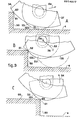
- the device therefore operates in the following manner and this operation will be explained with reference to FIGS. 3A, B and C, in the case where the wheel 23 has to go up one step, and from Figures 4A and B, in the case where it has to go down one market.
- FIGS. 3A, B and C in the case where the wheel 23 has to go up one step
- Figures 4A and B in the case where it has to go down one market.
- the same references will designate the same means.
- this represents the different phases and positions of the guiding and rolling device 12 , when the caster 23 must climb a step 50 having a height substantially equal to the value of the radius r of the caster 23.
- the robot 1 is driven by an electric motor coupled to the wheels 5 and 6, the caster 23 being there only to guide and direct the robot 1.
- the circular sector 27 abuts by its cylindrical surface 35 on the edge 51 of the step 50.
- the force exerted on the circular section 35 of the sector 27 essentially breaks down into two forces, an axial force passing through the axis 29 defined above, and a second force tangent to the section of the sector 35 which, for its part, is not very intense , due to the value R of the radius of this sector 27.
- the sector, against the force exerted by the spring 37 starts to undergo a senestrorsum 54 rotation under the action of the thrust of the driving wheels 5 and 6.
- FIG. 3A represents the instant when the sector 27 abuts against the edge 51 of the step 50.
- FIG. 3B represents the vertical displacement of the caster when, under the action of the force provided by the two wheels 5 and 6, it undergoes a rise due to the rotation of the sector around the point 52, of course against the force exerted by the spring 37.
- the tread 123 of the caster 23 itself abuts against the edge 51 of the step 50. But, in this case, the contact point of the wheel 23 with the edge 51 of the step 50 is at a position relatively close to the lowest point of the caster 23. Then, in this case, the problem is reduced to the fact that a caster of small diameter can climb a step of very small height with respect to its radius r. Under the action of the force exerted by the driving wheels 5 and 6, the caster can take over from the sector 27 and itself move by its point of contact 55 on the edge 51 of the step 50, so that , in its movement of rotation senestrorsum 54, it can come on the top 56 of the step.
- the circular sector 27 has the corner 36 outside the cylindrical surface enveloping the roller 23.
- this represents the rolling device 12 when it approaches a downhill step 60 whose height is, for example, close to the value of the radius r of the caster 23.
- the caster 23 driven in rotation in particular by the force exerted by the driving wheels 5 and 6, arrives in the vicinity of the edge 61 of the step 60, it envelops this edge 61 until, under the action of its rotation senestrorsum 62, the edge 61, in a relative movement, comes into contact with the cylindrical surface 35 of the sector 27 at a point 63.
- This point represents, in space, the intersection of the cylindrical surface 26 of the caster 23 and the cylindrical surface 35 of the sector 27, this intersection being situated at the rear of the caster 23 relative to the direction of advance 64 of the caster 23 in its senestrorsum 62 rotational movement.
- the edge 61 of the step comes to bear on the edge of the cylindrical surface 35 and the latter, in contact with this edge 61 and under the action of the thrust of the driving wheels 5 and 6, drives the sector 27 in the same senestrorsum rotational movement, against the force exerted by the tension spring 37 connecting the circular sector 27 to the support 20, as shown in Figure 4B.
- the robot 1 continuing to advance, the wheel moves away from the edge 61 of the step 60, the edge 35 of the sector 27 remains in contact with this edge 61 of the step 60 and the axis of rotation 29 of this sector undergoes a rotation which tends to cause it to descend towards the surface of the ground 4, driving the roller 23 secured to the support 20.
- a robot can climb or descend steps of a height close to the radius of the caster, and thus can move on surfaces on which it could not perform , so far, its service.
- a guiding device may comprise, for example, two sectors 27 on each side of a single roller 23, or else a sector between two rollers, etc.
- edge 35 of the sector 27 is circular. But, it is understood that, by “circular”, we qualify the general shape of this edge, it can be smooth or even slightly notched, to be able to hang on the edges or edges of obstacles such as steps.
- the sector has a lever function to lift the caster, and therefore also the robot, to make it pass the step. It is therefore advantageous that the lever arm is the most important.
- the position of the axis 29 is as far back as possible relative to the front 11 of the robot, that is to say that the distance separating two vertical planes passing respectively through the two axes 25 and 29 is as large as possible, respecting, of course, the structural characteristics set out above.
Landscapes
- Engineering & Computer Science (AREA)
- Mechanical Engineering (AREA)
- Robotics (AREA)
- Aviation & Aerospace Engineering (AREA)
- Radar, Positioning & Navigation (AREA)
- Remote Sensing (AREA)
- Physics & Mathematics (AREA)
- General Physics & Mathematics (AREA)
- Automation & Control Theory (AREA)
- Manipulator (AREA)
- Control Of Position, Course, Altitude, Or Attitude Of Moving Bodies (AREA)
Applications Claiming Priority (2)
| Application Number | Priority Date | Filing Date | Title |
|---|---|---|---|
| FR8511125 | 1985-07-12 | ||
| FR8511125A FR2584648B1 (fr) | 1985-07-12 | 1985-07-12 | Dispositif de guidage notamment pour engin du type robot |
Publications (1)
| Publication Number | Publication Date |
|---|---|
| EP0214877A1 true EP0214877A1 (de) | 1987-03-18 |
Family
ID=9321482
Family Applications (1)
| Application Number | Title | Priority Date | Filing Date |
|---|---|---|---|
| EP86401556A Withdrawn EP0214877A1 (de) | 1985-07-12 | 1986-07-11 | Führungsvorrichtung, insbesondere für Selbstfahrfahrzeug mit Rädern |
Country Status (2)
| Country | Link |
|---|---|
| EP (1) | EP0214877A1 (de) |
| FR (1) | FR2584648B1 (de) |
Cited By (4)
| Publication number | Priority date | Publication date | Assignee | Title |
|---|---|---|---|---|
| US7004269B2 (en) | 2003-04-04 | 2006-02-28 | Samsung Gwangju Electronics Co. Ltd. | Driving apparatus for a robot cleaner |
| CN102397967A (zh) * | 2011-11-15 | 2012-04-04 | 中冶陕压重工设备有限公司 | 一种扇形板的锻造制备方法 |
| CN105365483A (zh) * | 2015-12-23 | 2016-03-02 | 联想(北京)有限公司 | 越障脚轮组件及包括该越障脚轮组件的移动式装置 |
| CN112716146A (zh) * | 2020-12-24 | 2021-04-30 | 湖南城建职业技术学院 | 一种用于室内设计的辅助绘图装置 |
Families Citing this family (2)
| Publication number | Priority date | Publication date | Assignee | Title |
|---|---|---|---|---|
| AUPQ316799A0 (en) * | 1999-09-28 | 1999-10-21 | Liu, Jilly | Improved drive system and vehicles incorporating the drive system |
| CN102991265A (zh) * | 2012-12-19 | 2013-03-27 | 武汉科技大学 | 一种摆轮式无障碍车轮 |
Citations (4)
| Publication number | Priority date | Publication date | Assignee | Title |
|---|---|---|---|---|
| CH223517A (de) * | 1941-04-08 | 1942-09-30 | Reens Van Der Hoeff Johanna Wi | Vorrichtung an auf Rollen oder Rädern gelagerten Möbeln zum Erleichtern des Überfahrens von Bodenhindernissen. |
| US3239872A (en) * | 1963-04-08 | 1966-03-15 | Lincoln Carriage Corp | Caster-wheel elevator mechanism |
| US3891269A (en) * | 1973-03-16 | 1975-06-24 | Denis S Moeser | Seat mounting mechanism |
| US4494464A (en) * | 1981-10-13 | 1985-01-22 | Kazuo Fujita | Castor wheel carriage |
-
1985
- 1985-07-12 FR FR8511125A patent/FR2584648B1/fr not_active Expired - Fee Related
-
1986
- 1986-07-11 EP EP86401556A patent/EP0214877A1/de not_active Withdrawn
Patent Citations (4)
| Publication number | Priority date | Publication date | Assignee | Title |
|---|---|---|---|---|
| CH223517A (de) * | 1941-04-08 | 1942-09-30 | Reens Van Der Hoeff Johanna Wi | Vorrichtung an auf Rollen oder Rädern gelagerten Möbeln zum Erleichtern des Überfahrens von Bodenhindernissen. |
| US3239872A (en) * | 1963-04-08 | 1966-03-15 | Lincoln Carriage Corp | Caster-wheel elevator mechanism |
| US3891269A (en) * | 1973-03-16 | 1975-06-24 | Denis S Moeser | Seat mounting mechanism |
| US4494464A (en) * | 1981-10-13 | 1985-01-22 | Kazuo Fujita | Castor wheel carriage |
Cited By (5)
| Publication number | Priority date | Publication date | Assignee | Title |
|---|---|---|---|---|
| US7004269B2 (en) | 2003-04-04 | 2006-02-28 | Samsung Gwangju Electronics Co. Ltd. | Driving apparatus for a robot cleaner |
| CN102397967A (zh) * | 2011-11-15 | 2012-04-04 | 中冶陕压重工设备有限公司 | 一种扇形板的锻造制备方法 |
| CN105365483A (zh) * | 2015-12-23 | 2016-03-02 | 联想(北京)有限公司 | 越障脚轮组件及包括该越障脚轮组件的移动式装置 |
| CN112716146A (zh) * | 2020-12-24 | 2021-04-30 | 湖南城建职业技术学院 | 一种用于室内设计的辅助绘图装置 |
| CN112716146B (zh) * | 2020-12-24 | 2022-10-14 | 湖南城建职业技术学院 | 一种用于室内设计的辅助绘图装置 |
Also Published As
| Publication number | Publication date |
|---|---|
| FR2584648B1 (fr) | 1991-03-15 |
| FR2584648A1 (fr) | 1987-01-16 |
Similar Documents
| Publication | Publication Date | Title |
|---|---|---|
| EP2763859B1 (de) | Multidirectionales antreibbares rad und damit ausgerüstetes fahrzeug | |
| EP0193473B1 (de) | Motorgetriebene Transporteinrichtung, z.B. für Auf- und Absteigen von Treppen | |
| EP2537684B1 (de) | Halbachse und Fahrzeug, das mit mindestens einer solchen Halbachse ausgestattet ist | |
| EP2844498B1 (de) | Kugelförmiges rad und fahrzeug mit diesem rad | |
| EP3365514B1 (de) | Schwimmbeckenreiniger mit hindernisbeseitigungsvorrichtung | |
| EP2374635B1 (de) | Achssystem, Achsmodul, das mindestens ein solches Achssytem umfasst und Fahrzeug, das mindestens ein solches Modul umfasst | |
| EP1118531A1 (de) | Fahrzeug für unebenes Gelände | |
| CA2670672C (fr) | Sabot de calage d'une roue et installation de calage motorisee | |
| EP0277447A1 (de) | System zur Ermittlung der Bewegung eines Raupenfahrzeuges | |
| EP3994012B1 (de) | Umwandelbares rad zum überqueren jeglicher art von gelände und autonomer roboter mit mindestens einem solchen rad | |
| EP3512398B1 (de) | Robot mobil de nettoyage de sol | |
| EP0214877A1 (de) | Führungsvorrichtung, insbesondere für Selbstfahrfahrzeug mit Rädern | |
| FR2610885A1 (fr) | Vehicule motorise a chenilles avec bras articules pour franchissement d'obstacles | |
| EP0023462A1 (de) | Stauförderer | |
| EP3173150B1 (de) | System zur aufbringung eines fluids auf eine oberfläche | |
| FR2959473A1 (fr) | Vehicule automobile comportant des moyens aerodynamiques positionnes en avant d'une roue et de son dispositif de freinage | |
| EP0041901B1 (de) | Vorrichtung zum Greifen eines Containers oder dgl. mit Niveaudetektoren | |
| CA2457257C (fr) | Dispositif de transfert perfectionne pour systeme de transport, tel que trottoir roulant | |
| EP0223683B1 (de) | Vorrichtung zum Zusammenbau und/oder Gebrauch von Teilen, die von Paletten getragen werden sowie Palette für eine solche Vorrichtung | |
| FR2856647A1 (fr) | Dispositif de manutention de poubelle pour ordures menageres | |
| FR2836945A1 (fr) | Appareil de nettoyage automatique du fond d'un bassin rempli de liquide | |
| FR2519915A1 (fr) | Vehicule roulant a grande mobilite | |
| FR2937124A1 (fr) | Procede de stabilisation d'un mobile roulant,notamment un robot mono-roue et dispositif associe. | |
| FR2875207A1 (fr) | Dispositif d'articulation pour l'amelioration de la directivite des chariots et mobiles divers | |
| WO1993002953A1 (fr) | Machine de traitement d'objets plats |
Legal Events
| Date | Code | Title | Description |
|---|---|---|---|
| PUAI | Public reference made under article 153(3) epc to a published international application that has entered the european phase |
Free format text: ORIGINAL CODE: 0009012 |
|
| AK | Designated contracting states |
Kind code of ref document: A1 Designated state(s): AT BE CH DE GB IT LI LU NL SE |
|
| STAA | Information on the status of an ep patent application or granted ep patent |
Free format text: STATUS: THE APPLICATION IS DEEMED TO BE WITHDRAWN |
|
| 18D | Application deemed to be withdrawn |
Effective date: 19870919 |
|
| RIN1 | Information on inventor provided before grant (corrected) |
Inventor name: WALLART, JEAN-PIERRE |