EP0214939A2 - Padding material for use in clothing or furnishings - Google Patents
Padding material for use in clothing or furnishings Download PDFInfo
- Publication number
- EP0214939A2 EP0214939A2 EP86830232A EP86830232A EP0214939A2 EP 0214939 A2 EP0214939 A2 EP 0214939A2 EP 86830232 A EP86830232 A EP 86830232A EP 86830232 A EP86830232 A EP 86830232A EP 0214939 A2 EP0214939 A2 EP 0214939A2
- Authority
- EP
- European Patent Office
- Prior art keywords
- layer
- padding material
- fact
- material according
- cladding
- Prior art date
- Legal status (The legal status is an assumption and is not a legal conclusion. Google has not performed a legal analysis and makes no representation as to the accuracy of the status listed.)
- Withdrawn
Links
- 239000000463 material Substances 0.000 title claims abstract description 22
- 238000005253 cladding Methods 0.000 claims abstract description 21
- 238000009413 insulation Methods 0.000 claims abstract description 11
- 239000000203 mixture Substances 0.000 claims abstract description 10
- 229920005989 resin Polymers 0.000 claims abstract description 10
- 239000011347 resin Substances 0.000 claims abstract description 10
- 229920000728 polyester Polymers 0.000 claims abstract description 8
- 239000002904 solvent Substances 0.000 claims abstract description 6
- 125000003118 aryl group Chemical group 0.000 claims abstract description 5
- 239000000126 substance Substances 0.000 claims abstract description 5
- 229920006243 acrylic copolymer Polymers 0.000 claims abstract description 4
- 230000000903 blocking effect Effects 0.000 claims abstract description 4
- 238000003490 calendering Methods 0.000 claims abstract description 4
- 238000009960 carding Methods 0.000 claims abstract description 4
- 239000003960 organic solvent Substances 0.000 claims abstract description 4
- 229920000058 polyacrylate Polymers 0.000 claims abstract description 4
- 239000012748 slip agent Substances 0.000 claims abstract description 4
- 239000004840 adhesive resin Substances 0.000 claims abstract description 3
- 229920006223 adhesive resin Polymers 0.000 claims abstract description 3
- 229920003023 plastic Polymers 0.000 claims abstract description 3
- 239000004033 plastic Substances 0.000 claims abstract description 3
- 229920002635 polyurethane Polymers 0.000 claims abstract description 3
- 239000004814 polyurethane Substances 0.000 claims abstract description 3
- 230000007480 spreading Effects 0.000 claims description 5
- 238000003892 spreading Methods 0.000 claims description 5
- 238000000034 method Methods 0.000 claims description 4
- 229920005749 polyurethane resin Polymers 0.000 claims description 2
- 229920002678 cellulose Polymers 0.000 abstract description 3
- 239000001913 cellulose Substances 0.000 abstract description 3
- 229920002994 synthetic fiber Polymers 0.000 abstract description 3
- BVQHHUQLZPXYAQ-UHFFFAOYSA-N acetyl butanoate Chemical compound CCCC(=O)OC(C)=O BVQHHUQLZPXYAQ-UHFFFAOYSA-N 0.000 abstract description 2
- 230000005068 transpiration Effects 0.000 description 3
- 230000008569 process Effects 0.000 description 2
- 238000005299 abrasion Methods 0.000 description 1
- 230000004888 barrier function Effects 0.000 description 1
- 230000008901 benefit Effects 0.000 description 1
- 230000005494 condensation Effects 0.000 description 1
- 238000009833 condensation Methods 0.000 description 1
- 230000006872 improvement Effects 0.000 description 1
- 239000011810 insulating material Substances 0.000 description 1
- 238000004519 manufacturing process Methods 0.000 description 1
- 229920001296 polysiloxane Polymers 0.000 description 1
- 238000005406 washing Methods 0.000 description 1
Images
Classifications
-
- A—HUMAN NECESSITIES
- A41—WEARING APPAREL
- A41D—OUTERWEAR; PROTECTIVE GARMENTS; ACCESSORIES
- A41D27/00—Details of garments or of their making
- A41D27/02—Linings
-
- A—HUMAN NECESSITIES
- A41—WEARING APPAREL
- A41D—OUTERWEAR; PROTECTIVE GARMENTS; ACCESSORIES
- A41D31/00—Materials specially adapted for outerwear
- A41D31/04—Materials specially adapted for outerwear characterised by special function or use
- A41D31/18—Elastic
- A41D31/185—Elastic using layered materials
-
- D—TEXTILES; PAPER
- D04—BRAIDING; LACE-MAKING; KNITTING; TRIMMINGS; NON-WOVEN FABRICS
- D04H—MAKING TEXTILE FABRICS, e.g. FROM FIBRES OR FILAMENTARY MATERIAL; FABRICS MADE BY SUCH PROCESSES OR APPARATUS, e.g. FELTS, NON-WOVEN FABRICS; COTTON-WOOL; WADDING ; NON-WOVEN FABRICS FROM STAPLE FIBRES, FILAMENTS OR YARNS, BONDED WITH AT LEAST ONE WEB-LIKE MATERIAL DURING THEIR CONSOLIDATION
- D04H1/00—Non-woven fabrics formed wholly or mainly of staple fibres or like relatively short fibres
- D04H1/02—Cotton wool; Wadding
-
- D—TEXTILES; PAPER
- D06—TREATMENT OF TEXTILES OR THE LIKE; LAUNDERING; FLEXIBLE MATERIALS NOT OTHERWISE PROVIDED FOR
- D06N—WALL, FLOOR, OR LIKE COVERING MATERIALS, e.g. LINOLEUM, OILCLOTH, ARTIFICIAL LEATHER, ROOFING FELT, CONSISTING OF A FIBROUS WEB COATED WITH A LAYER OF MACROMOLECULAR MATERIAL; FLEXIBLE SHEET MATERIAL NOT OTHERWISE PROVIDED FOR
- D06N7/00—Flexible sheet materials not otherwise provided for, e.g. textile threads, filaments, yarns or tow, glued on macromolecular material
Definitions
- the present invention relates to a padding material composed of synthetic fibres which padding material can be formed into relatively thin layers whilst retaining a high degree of thermal insulation.
- Such padding is of particular utility in the fields of clothing and furnishings.
- paddings based on layers of wadding generally made of synthetic fibres, and used as insulating materials. It is known that padding materials utilised for clothing and furnishings and the like must preferably have a limited thickness for aesthetic reasons, but must retain a high degree of thermal insulation.
- the present invention seeks therefore to provide a padding material having significantly improved thermal insulation characteristics in a product which will be more compact and manageable, and thus more easily used in the field of clothing and furnishings and the like.
- a padding material having such qualities should, as well as having high thermal insulation, also have qualities of softness, elasticity and pleasantness to the touch, which are typical of padding materials generally.
- a padding material with high degree of thermal insulation for use in clothing, furnishing or the like, comprising a base layer obtained by carding a mixture of fibres, including polyester fibres, with siliconised fibres which have been treated with a mixture of adhesive resins of sticky, plastic consistency, which are then polymerised to create a soft, elastic film, this base layer being subsequently subjected to calendering in such a way as to reduce its initial thickness, characterised by the fact that a layer of cladding materials is applied to one or both sides of the said resin treated base layer.
- An advantage of the padding material of the present invention is that as well as presenting characteristics of significantly improved insulation, it is more easily workable than similar commercially available paddings, and still has aesthetically desirable properties of handle and flexibility.
- the cladding layer is preferably a polyurethane based on aromatic polyesters dissolved in a solvent.
- finishing layer may be applied over the said cladding layer.
- the said finishing layer is preferably based on acrylic polymers or copolymers in organic solvents modified with cellulosic resins - (cellulose acetyl butyrate) - and having additional slip agents and anti blocking substances.
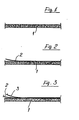
- the padding shown comprises a layer 1 formed by a mixture of fibres of polyester, or of other nature (including natural fibres), which may be treated with silicone, and subjected to carding and subsequent calendering processes.
- a cladding layer 2 the thickness of which lies between 5 and 20 microns.
- This cladding layer 2 is made of a material having a high degree of thermal insulation and significant elasticity in such a way as not to prejudice the characteristics of elasticity and softness of the padding layer itself and its properties of insulation and transpiration, but at the same time improving the characteristics of workability in the manufacturing stages of the finished products.
- the said cladding layer 2 is constituted by a polyurethane resin based on aromatic polyesters dissolved in a solvent or solvents.
- the choice of the type of resin is related to the properties required by the conditions of use of the finished product. In fact, its mechanical properties must include good elasticity, resistance to tension, and resistance to abrasion, and its chemical properties must include resistance to light and resistance to washing among others.
- a typical example of a composition for a cladding layer 2 is as follows:
- a further very light finishing layer 3 the presence of which improves the properties of the padding, namely the presentation, handle, workability and the like, as well as its characteristics of insulation and impermeability, without, however, detrimentally affecting the transpiration ability of the padding layer as a whole.
- composition of this finishing layer 3 is in general based on acrylic polymers or copolymers in organic solvents, modified with cellulosic resins (cellulose - acetyl butyrate) with the addition of slip agents and anti blocking substances.
- the said cladding layer 2 and finishing layer 3 are applied to the layer 1 generally by means of spreading or preferably, by means of so-called "transfer"
- transfer spreading is used as this permits more brilliant results to be obtained and has more controllable and reproduceable operating conditions.
- the said finishing layer 3 can be applied subsequently to the product by means of rotographic or flexographic printing, starting from a suitably adapted solution.
- the application onto the base layer 1 of the said cladding layer 2 and the said surface finish layers 3 forms a barrier layer which is effectively impermeable to air from the outside, but such as not to impede transpiration.
- These cladding layers 2, 3 are conveniently elastic and soft and are able to permit any condensation which forms inside the padding layer to escape thus contributing to an improvement in the hygiene characteristics of the product.
Landscapes
- Engineering & Computer Science (AREA)
- Textile Engineering (AREA)
- Laminated Bodies (AREA)
- Treatments For Attaching Organic Compounds To Fibrous Goods (AREA)
- Manufacturing Of Multi-Layer Textile Fabrics (AREA)
Abstract
Description
- The present invention relates to a padding material composed of synthetic fibres which padding material can be formed into relatively thin layers whilst retaining a high degree of thermal insulation. Such padding is of particular utility in the fields of clothing and furnishings.
- There are at present commercially available paddings based on layers of wadding, generally made of synthetic fibres, and used as insulating materials. It is known that padding materials utilised for clothing and furnishings and the like must preferably have a limited thickness for aesthetic reasons, but must retain a high degree of thermal insulation.
- The present invention seeks therefore to provide a padding material having significantly improved thermal insulation characteristics in a product which will be more compact and manageable, and thus more easily used in the field of clothing and furnishings and the like.
- It is important, however, that a padding material having such qualities should, as well as having high thermal insulation, also have qualities of softness, elasticity and pleasantness to the touch, which are typical of padding materials generally.
- According to the present invention, there is provided a padding material with high degree of thermal insulation, for use in clothing, furnishing or the like, comprising a base layer obtained by carding a mixture of fibres, including polyester fibres, with siliconised fibres which have been treated with a mixture of adhesive resins of sticky, plastic consistency, which are then polymerised to create a soft, elastic film, this base layer being subsequently subjected to calendering in such a way as to reduce its initial thickness, characterised by the fact that a layer of cladding materials is applied to one or both sides of the said resin treated base layer.
- An advantage of the padding material of the present invention is that as well as presenting characteristics of significantly improved insulation, it is more easily workable than similar commercially available paddings, and still has aesthetically desirable properties of handle and flexibility.
- The cladding layer is preferably a polyurethane based on aromatic polyesters dissolved in a solvent.
- Furthermore, a very light, thin finishing layer may be applied over the said cladding layer. The said finishing layer is preferably based on acrylic polymers or copolymers in organic solvents modified with cellulosic resins - (cellulose acetyl butyrate) - and having additional slip agents and anti blocking substances.
- One embodiment of the present invention will now be more particularly described by way of example, with reference to the accompanying drawings, in which:
- Figure 1 is a sectional side view of a starting layer;
- Figure 2 is a sectional side view of the same layer after the application to one of its faces of a cladding layer; and
- Figure 3 is a sectional side view of the same layer carrying a finishing layer on one of the said cladding layers.
- With reference now to the attached drawing, the padding shown comprises a
layer 1 formed by a mixture of fibres of polyester, or of other nature (including natural fibres), which may be treated with silicone, and subjected to carding and subsequent calendering processes. - Onto one or both sides of the layer thus obtained there is applied a
cladding layer 2 the thickness of which lies between 5 and 20 microns. Thiscladding layer 2 is made of a material having a high degree of thermal insulation and significant elasticity in such a way as not to prejudice the characteristics of elasticity and softness of the padding layer itself and its properties of insulation and transpiration, but at the same time improving the characteristics of workability in the manufacturing stages of the finished products. - Preferably the said
cladding layer 2 is constituted by a polyurethane resin based on aromatic polyesters dissolved in a solvent or solvents. In particular, the choice of the type of resin is related to the properties required by the conditions of use of the finished product. In fact, its mechanical properties must include good elasticity, resistance to tension, and resistance to abrasion, and its chemical properties must include resistance to light and resistance to washing among others. - The preferred characteristics of the said cladding layer, in practice, can be listed as follows:-Mechanical characteristics:

- General characteristics:

- A typical example of a composition for a
cladding layer 2 is as follows:
- Over the said cladding layer there may be applied a further very light finishing layer 3 the presence of which improves the properties of the padding, namely the presentation, handle, workability and the like, as well as its characteristics of insulation and impermeability, without, however, detrimentally affecting the transpiration ability of the padding layer as a whole.
- The composition of this finishing layer 3 is in general based on acrylic polymers or copolymers in organic solvents, modified with cellulosic resins (cellulose - acetyl butyrate) with the addition of slip agents and anti blocking substances.
- Hereinbelow is given a typical example, purely by way of indication, of a suitable composition for the said finish layer 3.

- The said
cladding layer 2 and finishing layer 3 are applied to thelayer 1 generally by means of spreading or preferably, by means of so-called "transfer" - spreading techniques, which are processes of known type. Preferably "transfer" spreading is used as this permits more brilliant results to be obtained and has more controllable and reproduceable operating conditions.
- In particular, in dependence on the availability of the equipment, the said finishing layer 3 can be applied subsequently to the product by means of rotographic or flexographic printing, starting from a suitably adapted solution. In practice, the application onto the
base layer 1 of the saidcladding layer 2 and the said surface finish layers 3 forms a barrier layer which is effectively impermeable to air from the outside, but such as not to impede transpiration. Thesecladding layers 2, 3 are conveniently elastic and soft and are able to permit any condensation which forms inside the padding layer to escape thus contributing to an improvement in the hygiene characteristics of the product.
Claims (9)


Applications Claiming Priority (2)
| Application Number | Priority Date | Filing Date | Title |
|---|---|---|---|
| IT22154/85A IT1185917B (en) | 1985-09-13 | 1985-09-13 | PADDING IN SYNTHETIC FIBERS, OF LIMITED THICKNESS AND HIGH DEGREE OF THERMAL INSULATION, USABLE IN THE FIELD OF CLOTHING AND FURNITURE |
| IT2215485 | 1985-09-13 |
Publications (2)
| Publication Number | Publication Date |
|---|---|
| EP0214939A2 true EP0214939A2 (en) | 1987-03-18 |
| EP0214939A3 EP0214939A3 (en) | 1988-09-21 |
Family
ID=11192299
Family Applications (1)
| Application Number | Title | Priority Date | Filing Date |
|---|---|---|---|
| EP86830232A Withdrawn EP0214939A3 (en) | 1985-09-13 | 1986-08-25 | Padding material for use in clothing or furnishings |
Country Status (3)
| Country | Link |
|---|---|
| EP (1) | EP0214939A3 (en) |
| JP (1) | JPS6262748A (en) |
| IT (1) | IT1185917B (en) |
Cited By (3)
| Publication number | Priority date | Publication date | Assignee | Title |
|---|---|---|---|---|
| EP0365491A3 (en) * | 1988-10-20 | 1990-08-22 | FISI FIBRE SINTETICHE S.p.A. | Soft thermally insulating water proofing and perspiring wadding for cloth articles, in particular sports cloth articles |
| US6083630A (en) * | 1999-10-04 | 2000-07-04 | Eastman Chemical Company | Anti-blocking coating for pressure sensitive adhesives using cellulose acetate butyrate |
| IT201600082894A1 (en) * | 2016-08-05 | 2018-02-05 | Fisi Fibre Sintetiche Spa | PROCEDURE FOR MANUFACTURING AN ABSTRACT RETAINER INCLUDING AT LEAST ONE SURFACE TO RECEIVE PRINTING AND THE RELEVANT COMPREHENSIVE PART OF THE PROCEDURE, IN PARTICULAR FOR THE USE IN PADDING OF CLOTHING ARTICLES AS WIND JACKETS AND SHOES |
Family Cites Families (2)
| Publication number | Priority date | Publication date | Assignee | Title |
|---|---|---|---|---|
| DE1059278B (en) * | 1952-04-29 | 1959-06-11 | Schickedanz Ver Papierwerk | Method of making resilient structures for upholstery purposes |
| JPS6012095A (en) * | 1983-06-30 | 1985-01-22 | 株式会社高木化学研究所 | Cushion member |
-
1985
- 1985-09-13 IT IT22154/85A patent/IT1185917B/en active
-
1986
- 1986-08-25 EP EP86830232A patent/EP0214939A3/en not_active Withdrawn
- 1986-09-13 JP JP61216954A patent/JPS6262748A/en active Pending
Cited By (7)
| Publication number | Priority date | Publication date | Assignee | Title |
|---|---|---|---|---|
| EP0365491A3 (en) * | 1988-10-20 | 1990-08-22 | FISI FIBRE SINTETICHE S.p.A. | Soft thermally insulating water proofing and perspiring wadding for cloth articles, in particular sports cloth articles |
| US6083630A (en) * | 1999-10-04 | 2000-07-04 | Eastman Chemical Company | Anti-blocking coating for pressure sensitive adhesives using cellulose acetate butyrate |
| IT201600082894A1 (en) * | 2016-08-05 | 2018-02-05 | Fisi Fibre Sintetiche Spa | PROCEDURE FOR MANUFACTURING AN ABSTRACT RETAINER INCLUDING AT LEAST ONE SURFACE TO RECEIVE PRINTING AND THE RELEVANT COMPREHENSIVE PART OF THE PROCEDURE, IN PARTICULAR FOR THE USE IN PADDING OF CLOTHING ARTICLES AS WIND JACKETS AND SHOES |
| EP3279380A1 (en) * | 2016-08-05 | 2018-02-07 | Fisi Fibre Sintetiche S.p.A. | Method for making a wadding strip element comprising at least a surface adapted to receive print, and the wadding strip element made thereby, for use in paddings of clothing articles such as windcheaters and shoes |
| CN107685457A (en) * | 2016-08-05 | 2018-02-13 | 菲西纤维合成有限公司 | Filling tape element and its manufacture method |
| US10542789B2 (en) | 2016-08-05 | 2020-01-28 | Fisi Fibre Sintetiche S.P.A. | Method for making a wadding strip element comprising at least a surface adapted to receive print, and the wadding strip element made thereby, for us in paddings of clothing articles such as windcheaters and shoes |
| CN107685457B (en) * | 2016-08-05 | 2020-07-17 | 菲西纤维合成有限公司 | Filler tape element and method of making the same |
Also Published As
| Publication number | Publication date |
|---|---|
| EP0214939A3 (en) | 1988-09-21 |
| JPS6262748A (en) | 1987-03-19 |
| IT8522154A0 (en) | 1985-09-13 |
| IT1185917B (en) | 1987-11-18 |
Similar Documents
| Publication | Publication Date | Title |
|---|---|---|
| BR9612144A (en) | Non-woven laminates with improved peel resistance | |
| US6136730A (en) | Fluid shield fabric | |
| KR930011366B1 (en) | Polyetheresteramide-Based Water Vapor Permeable Thermoplastic Elastic Film, Method for Making It, and Products Containing This Type of Film | |
| CA2332139A1 (en) | Articles having elevated temperature elasticity made from irradiated and crosslinked ethylene polymers and method for making the same | |
| KR940702573A (en) | STRETCHABLE NONWOVEN WEBS BASED ON MULTILAYER BLOWN MICROFIBERS | |
| BR9612770A (en) | Reticulated biologically based material compositions, method of obtaining it and structure made from such materials | |
| EP0815880A3 (en) | Elastomeric flexible articles and their method of manufacture | |
| ATE182066T1 (en) | GARMENT, PARTICULARLY DISPOSABLE GARMENT FOR SINGLE USE | |
| KR890006385A (en) | Protective garment fabric | |
| DE69527048D1 (en) | SPREADING GOODS INCLUDED IN ELASTIC LAMINATED, WATERPROOF AND WATERPROOF ALLERGY CABINETS | |
| KR960700085A (en) | FLEXIBLE ELASTOMERIC ARTICLE WITH ENHANCED LUBRICITY | |
| US6245959B1 (en) | Substrate for adhesive dressing, and medical adhesive dressing and adhesive tape using the same | |
| EP0252022A2 (en) | A tape for use in the protection and water proofing of stitch lines in padding and padded garments | |
| EP0214939A2 (en) | Padding material for use in clothing or furnishings | |
| CN114829517A (en) | Adhesive primers and articles comprising adhesive primers | |
| CA2007161A1 (en) | Metal fiber mat/polymer composite | |
| KR900005000B1 (en) | Improved Polyester Fiber Filler | |
| KR100665070B1 (en) | Sheet with high antifouling effect coated with silicone compound and its manufacturing method | |
| ATE276878T1 (en) | HIGH TEMPERATURE SEPARATION FILM | |
| EP1183056B1 (en) | Polyurethane support film provided with hydrophobic agents for film plasters | |
| CA1332219C (en) | Method for making an improved thermal insulation characteristic wadding, particularly for making cloth articles | |
| JP2000345474A (en) | Sheet having high preventing effect on stain adhesion and coated with silicone-based compound and its production | |
| WO1994027648A1 (en) | Water repellent orthopedic dressing | |
| JP4065649B2 (en) | Leather-like sheet and method for producing the same | |
| EP0110860A3 (en) | Thermoplastic textile material |
Legal Events
| Date | Code | Title | Description |
|---|---|---|---|
| PUAI | Public reference made under article 153(3) epc to a published international application that has entered the european phase |
Free format text: ORIGINAL CODE: 0009012 |
|
| AK | Designated contracting states |
Kind code of ref document: A2 Designated state(s): AT BE CH DE FR GB LI NL SE |
|
| PUAL | Search report despatched |
Free format text: ORIGINAL CODE: 0009013 |
|
| AK | Designated contracting states |
Kind code of ref document: A3 Designated state(s): AT BE CH DE FR GB LI NL SE |
|
| RHK1 | Main classification (correction) |
Ipc: B32B 27/02 |
|
| STAA | Information on the status of an ep patent application or granted ep patent |
Free format text: STATUS: THE APPLICATION HAS BEEN WITHDRAWN |
|
| 18W | Application withdrawn |
Withdrawal date: 19890228 |
|
| RIN1 | Information on inventor provided before grant (corrected) |
Inventor name: SINISCALCHI, LUCIO |