EP0215280B1 - Circuit de conversion de signaux - Google Patents
Circuit de conversion de signaux Download PDFInfo
- Publication number
- EP0215280B1 EP0215280B1 EP86110999A EP86110999A EP0215280B1 EP 0215280 B1 EP0215280 B1 EP 0215280B1 EP 86110999 A EP86110999 A EP 86110999A EP 86110999 A EP86110999 A EP 86110999A EP 0215280 B1 EP0215280 B1 EP 0215280B1
- Authority
- EP
- European Patent Office
- Prior art keywords
- circuit
- signal
- tnü
- output
- input
- Prior art date
- Legal status (The legal status is an assumption and is not a legal conclusion. Google has not performed a legal analysis and makes no representation as to the accuracy of the status listed.)
- Expired - Lifetime
Links
- 230000000295 complement effect Effects 0.000 claims description 9
- 238000006243 chemical reaction Methods 0.000 description 8
- 230000035945 sensitivity Effects 0.000 description 3
- 230000015572 biosynthetic process Effects 0.000 description 1
- 230000000630 rising effect Effects 0.000 description 1
- 230000003068 static effect Effects 0.000 description 1
- 230000007704 transition Effects 0.000 description 1
Images

Classifications
-
- H—ELECTRICITY
- H03—ELECTRONIC CIRCUITRY
- H03K—PULSE TECHNIQUE
- H03K19/00—Logic circuits, i.e. having at least two inputs acting on one output; Inverting circuits
- H03K19/01—Modifications for accelerating switching
- H03K19/017—Modifications for accelerating switching in field-effect transistor circuits
- H03K19/01707—Modifications for accelerating switching in field-effect transistor circuits in asynchronous circuits
- H03K19/01721—Modifications for accelerating switching in field-effect transistor circuits in asynchronous circuits by means of a pull-up or down element
-
- H—ELECTRICITY
- H03—ELECTRONIC CIRCUITRY
- H03K—PULSE TECHNIQUE
- H03K19/00—Logic circuits, i.e. having at least two inputs acting on one output; Inverting circuits
- H03K19/01—Modifications for accelerating switching
- H03K19/017—Modifications for accelerating switching in field-effect transistor circuits
- H03K19/01728—Modifications for accelerating switching in field-effect transistor circuits in synchronous circuits, i.e. by using clock signals
- H03K19/01742—Modifications for accelerating switching in field-effect transistor circuits in synchronous circuits, i.e. by using clock signals by means of a pull-up or down element
-
- H—ELECTRICITY
- H03—ELECTRONIC CIRCUITRY
- H03K—PULSE TECHNIQUE
- H03K19/00—Logic circuits, i.e. having at least two inputs acting on one output; Inverting circuits
- H03K19/0175—Coupling arrangements; Interface arrangements
- H03K19/0185—Coupling arrangements; Interface arrangements using field effect transistors only
- H03K19/018507—Interface arrangements
- H03K19/01855—Interface arrangements synchronous, i.e. using clock signals
Definitions
- VLSI highly and highly integrated
- a clock conversion circuit To convert a TTL clock signal into a MOS clock signal, a clock conversion circuit is known (from DE-A 1 32 20 063), which has a TTL input inverter stage, a reset clock stage with three inverters and a power clock stage, which in turn comprises a switching stage, a delay stage with two inverters and a power stage with two inverters, the reset clock stage and the power stage being activated directly by the input inverter stage and the reset clock stage delivering two reset signals to the power stage.
- This known signal conversion circuit which in itself enables a relatively low-power clock conversion into large-stroke clock signals with steep signal edges at high load, is limited in its sensitivity and thus in its speed in that it only reacts to changes in the input signal when it changes with its respective one Signal edge has exceeded or fallen below a response threshold in the amount of half the drain-source supply voltage (usually 2.5 volts).
- the object of the invention is to provide a noticeably more sensitive and thus faster signal conversion circuit.
- the invention is based on the fact that (from JP-A 56-34233, FIG. 2) already a circuit arrangement for converting small-stroke input signals into long-stroke output signals with a C-MOS inverter circuit to which a clock signal is applied at its input and one between the MOS -Transistor of a channel type and the associated supply potential source inserted MOS transistor of the same channel type is known, which is acted upon by the input signal at its control electrode.
- This known circuit arrangement does not provide for the simultaneous formation of two complementary output signals. In practice, however, signals of the same time position that are complementary to one another are often required, and the invention shows a way of converting small-stroke input signals into mutually complementary large-stroke output signals of the same time position.
- the invention relates to a circuit arrangement for converting small-stroke input signals into long-stroke output signals, in particular for driving C-MOS components with TTL or ECL signals, with a signal takeover circuit with a C-MOS inverter circuit to which a clock signal is applied at its input, and one inserted between the MOS transistor of the one channel type and the associated supply potential source is the MOS transistor of the same channel type, to which the input signal is applied at its control electrode.
- this circuit arrangement is characterized in that the signal transfer circuit has a further C-MOS inverter circuit to which the clock signal is applied at its input and a MOS transistor of the same channel type inserted between its MOS transistor of one channel type and the associated supply potential source, which has its control electrode is connected to the output electrode of said MOS transistor, which has the input signal applied to its control electrode, and that a power stage connected downstream of the signal acquisition circuit is connected to the outputs of the two aforementioned C-MOS inverter circuits by two C-MOS inverter circuits.
- a similar circuit structure also has a circuit arrangement for voltage level conversion (known from Patent Abstract JP-A-58-157 224).
- the invention which, in addition to the advantage of a small space requirement corresponding to the small number of transistors required, the further advantages associated with the design of the signal transfer stage as a dynamically operated circuit stage of a high threshold voltage of only the (approximately at 0.5 to 1.2 volts) brings with the input signal applied MOS inverters certain sensitivity and a high setting speed based thereon, which may vary depending on the dimensioning in the range of a few up to about 10 nanoseconds, advantageously enables the simultaneous, ie in phase, obtaining two complementary large-stroke output signals from a small-stroke input signal.
- the power stage can have an output stage with two Einka connected to said two further C-MOS inverter circuits nal-MOS push-pull output circuits; alternatively, it is also possible for the power stage to be followed by an output stage with two single-channel MOS source follower output circuits connected to the two further C-MOS inverter circuits mentioned, with flip-flop feedback of their driver transistors.
- the circuit arrangement can be designed in a further embodiment of the invention in such a way that its two complementary outputs simultaneously do one Output state corresponding signal can be impressed via two switching transistors controlled with the negated clock signal.
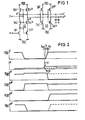
- the signal conversion circuit outlined in FIG. 1 initially has a signal takeover circuit US, which is formed with a p-channel MOS (depletion) transistor Tpü 'and an n-channel MOS (enhancement) transistor Tnü' its input t with a clock signal (t in FIG 2) acted on C-MOS inverter circuit and a MOS transistor Tn 'of the same type inserted between its one MOS transistor Tnü' and the associated supply potential source Uss (ground), which has at its control electrode is acted upon by the small-stroke input signal to be implemented (e in FIG. 2).
- a signal takeover circuit US which is formed with a p-channel MOS (depletion) transistor Tpü 'and an n-channel MOS (enhancement) transistor Tnü' its input t with a clock signal (t in FIG 2) acted on C-MOS inverter circuit and a MOS transistor Tn 'of the same type inserted between its one MOS transistor Tnü' and
- the signal transfer circuit ÜS is followed by a power stage LS with a further C-MOS inverter circuit Tpl ', Tnl' connected to the output e 'of the C-MOS inverter circuit Tpü', Tnü '.
- the signal transfer circuit US also contains a signal t formed with a p-channel MOS (depletion) transistor Tpü "and an n-channel MOS (enhancement) transistor Tnü” at its input t with the clock signal (t in FIG 2) acted upon C-MOS inverter circuit and between the one MOS transistor Tnü “and the associated supply potential source Uss (ground) inserted MOS transistor Tn” of the same type, which with its control electrode to the output electrode, in turn, to its control electrode with the Input signal (e in FIG 2) acted upon MOS transistor Tn 'of the same type is connected.
- a signal t formed with a p-channel MOS (depletion) transistor Tpü "and an n-channel MOS (enhancement) transistor Tnü” at its input t with the clock signal (t in FIG 2) acted upon C-MOS inverter circuit and between the one MOS transistor Tnü "and the associated supply potential source Uss (ground) inserted MOS transistor T
- a further C-MOS inverter circuit Tpl ", Tnl” connected to the output e "of the C-MOS inverter circuit Tpü", Tnü " is provided in the power stage LS connected downstream of the signal transfer circuit US.
- a "0" output signal according to FIG. 2a 'of 0 volts (ground) then appears at output a' of the circuit arrangement and the U DD potential of +5 volts occurs at complementary output a "according to FIG. 2a".
- an input signal "1" of approximately 2.0 volts is present at the circuit input e (FIG. 1) at this time, due to which the n-channel transistor Tn 'of the signal transfer circuit US is conductive, then when the n-channel transistor Tnü 'of the C-MOS inverter circuit Tpü', Tnü 'causes the clock signal to become conductive, its output e' reaches the (ground) potential of 0 volt; on the other hand, the n-channel transistor Tn "becomes non-conductive, so that despite the n-channel transistor Tnü” becoming conductive, the potential at the inverter output e "of the C-MOS inverter circuit Tpü", Tnü "is only un changes substantially, from 5 volts to 4.6 volts.
- the "1" signal potential of 5 volts in the example then appears at the output a 'of the circuit arrangement and the (ground) potential of 0 volts occurs at the output a ".
- the transistors Tpl "and Tnl ' are conductive in the power stage LS and the transistors Tpl' and Tnl" are non-conductive, so that the "0" signal potential of 0 volts at the circuit output a and that at the circuit output a " U DD potential of 5 volts occurs.
- the dynamic signal takeover circuit ÜS permits the signal takeover, which takes place with one clock edge of a single clock signal, even of small strokes, with their level slightly above the threshold voltage of the n-channel driver transistor Tn, which is approximately 0.5 to 1.2 volts 'lying "1" input signals and thus has a high sensitivity; at the same time, the signal transfer circuit US also has a high setting speed: after a short setting time tsu + t F + t E (see FIG.
- the input signal can return to the "O" signal state in a so-called return-to-zero operation.
- Such an output stage like the output stage AS3 outlined in FIG. two single-channel MOS push-pull outputs connected to the two C-MOS inverter circuits Tpl ', Tnl' and Tpl ", Tnl" (in FIG. 1) Have circuits T31, T33 and T32, T34.
- FIG. 4 shows another possibility with an output stage AS4, the two single-channel MOS source follower output circuits T41, T43 and T42, T44 with flip-flop feedback connected to the two C-MOS inverter circuits of the power stage LS (in FIG. 1) of their driver transistors T43 and T44.
- an output signal (ground potential) corresponding to one signal state can be connected to two complementary outputs (A ', A "in FIG. 3 and FIG 4; a ', a "in FIG 1) are impressed.
- the invention which can always be used where small-stroke input signals have to be converted into large-stroke signals with high load capacity, as can be the case, for example, when controlling C-MOS modules with TTL or ECL signals, was based on the foregoing of an embodiment explained, which provides an n-channel transistor in the signal transfer circuit between the .n-channel transistor of the respective C-MOS inverter circuit and the associated supply potential source Uss. It should be noted, however, that, in deviation from this, a signal takeover circuit with a p-channel transistor inserted between the p-channel transistor of the respective C-MOS inverter circuit and the associated supply potential source U DD (in FIG. 1) can also be provided in which then takes over the acceptance of an input signal with the falling clock signal edge, without this having to be explained in greater detail here, however.
Landscapes
- Engineering & Computer Science (AREA)
- Computer Hardware Design (AREA)
- Physics & Mathematics (AREA)
- Computing Systems (AREA)
- General Engineering & Computer Science (AREA)
- Mathematical Physics (AREA)
- Logic Circuits (AREA)
- Transmission And Conversion Of Sensor Element Output (AREA)
- Amplifiers (AREA)
Claims (4)
caractérisé par le fait
Priority Applications (1)
| Application Number | Priority Date | Filing Date | Title |
|---|---|---|---|
| AT86110999T ATE58035T1 (de) | 1985-08-09 | 1986-08-08 | Signalumsetzschaltung. |
Applications Claiming Priority (2)
| Application Number | Priority Date | Filing Date | Title |
|---|---|---|---|
| DE3528722 | 1985-08-09 | ||
| DE3528722 | 1985-08-09 |
Publications (2)
| Publication Number | Publication Date |
|---|---|
| EP0215280A1 EP0215280A1 (fr) | 1987-03-25 |
| EP0215280B1 true EP0215280B1 (fr) | 1990-10-31 |
Family
ID=6278192
Family Applications (1)
| Application Number | Title | Priority Date | Filing Date |
|---|---|---|---|
| EP86110999A Expired - Lifetime EP0215280B1 (fr) | 1985-08-09 | 1986-08-08 | Circuit de conversion de signaux |
Country Status (3)
| Country | Link |
|---|---|
| EP (1) | EP0215280B1 (fr) |
| AT (1) | ATE58035T1 (fr) |
| DE (1) | DE3675306D1 (fr) |
Families Citing this family (4)
| Publication number | Priority date | Publication date | Assignee | Title |
|---|---|---|---|---|
| DE3854155T2 (de) * | 1988-04-29 | 1996-02-29 | Ibm | GaAs-Mesfet-Logik-Schaltungen mit Gegentakt-Ausgangspufferschaltungen. |
| GB9805882D0 (en) | 1998-03-20 | 1998-05-13 | Sharp Kk | Voltage level converters |
| US7719313B2 (en) | 2006-06-28 | 2010-05-18 | Qualcomm Incorporated | Versatile and compact DC-coupled CML buffer |
| DE102022108397A1 (de) | 2022-04-07 | 2023-10-12 | Herrmann Ultraschalltechnik Gmbh & Co. Kg | Vorrichtung zum Ultraschallschweißen eines Werkstücks und Verfahren zum Betreiben einer solchen Vorrichtung |
Citations (2)
| Publication number | Priority date | Publication date | Assignee | Title |
|---|---|---|---|---|
| JPS58157224A (ja) * | 1982-03-13 | 1983-09-19 | Toshiba Corp | レベルシフト回路 |
| JPS58186227A (ja) * | 1982-04-24 | 1983-10-31 | Toshiba Corp | プリチヤ−ジ式ダイナミツク論理回路 |
Family Cites Families (5)
| Publication number | Priority date | Publication date | Assignee | Title |
|---|---|---|---|---|
| US3659118A (en) * | 1970-03-27 | 1972-04-25 | Rca Corp | Decoder circuit employing switches such as field-effect devices |
| US4185209A (en) * | 1978-02-02 | 1980-01-22 | Rockwell International Corporation | CMOS boolean logic circuit |
| DE2840329C2 (de) * | 1978-09-15 | 1981-10-15 | Siemens AG, 1000 Berlin und 8000 München | Adreßpuffer in MOS-Technik |
| DE3220063A1 (de) * | 1982-05-27 | 1983-12-01 | Siemens AG, 1000 Berlin und 8000 München | Taktumsetzschaltung |
| DE3324030A1 (de) * | 1983-07-04 | 1985-01-17 | Siemens AG, 1000 Berlin und 8000 München | Eingangssignalpegelwandler fuer eine integrierte cmos-digitalschaltung |
-
1986
- 1986-08-08 DE DE8686110999T patent/DE3675306D1/de not_active Expired - Lifetime
- 1986-08-08 EP EP86110999A patent/EP0215280B1/fr not_active Expired - Lifetime
- 1986-08-08 AT AT86110999T patent/ATE58035T1/de not_active IP Right Cessation
Patent Citations (2)
| Publication number | Priority date | Publication date | Assignee | Title |
|---|---|---|---|---|
| JPS58157224A (ja) * | 1982-03-13 | 1983-09-19 | Toshiba Corp | レベルシフト回路 |
| JPS58186227A (ja) * | 1982-04-24 | 1983-10-31 | Toshiba Corp | プリチヤ−ジ式ダイナミツク論理回路 |
Non-Patent Citations (1)
| Title |
|---|
| IBM-Technical Disclosure Bulletin, Band 27, No.10B, März 1986, Seiten 6023-6024 * |
Also Published As
| Publication number | Publication date |
|---|---|
| EP0215280A1 (fr) | 1987-03-25 |
| DE3675306D1 (de) | 1990-12-06 |
| ATE58035T1 (de) | 1990-11-15 |
Similar Documents
| Publication | Publication Date | Title |
|---|---|---|
| DE69216142T2 (de) | Vereinfachte Ausgangspufferschaltung mit niedriger Störspannung | |
| DE69924173T2 (de) | Integrierte Halbleiterschaltung mit Schlafmodus mit geringem Stromverbrauch und geringem Flächenbedarf | |
| DE60003998T2 (de) | Bus-Treiberschaltung und Verfahren zu deren Betrieb | |
| EP0504470B1 (fr) | Circuit translateurs de niveau | |
| DE2625007B2 (de) | Adressenpufferschaltung für Halbleiterspeicher | |
| DE68922240T2 (de) | Komplementärausgangsschaltung für eine logische Schaltung. | |
| DE69218746T2 (de) | Einschalt-Rücksetzschaltung | |
| DE68908280T2 (de) | Analogschalter. | |
| DE10223763B4 (de) | Halbleitervorrichtung | |
| EP0215280B1 (fr) | Circuit de conversion de signaux | |
| DE69830561T2 (de) | Integrierte Halbleiterschaltung | |
| EP1188237B1 (fr) | Circuiterie a bascule | |
| DE2802595A1 (de) | Schaltungsanordnung mit feldeffekttransistoren zur spannungspegelumsetzung | |
| DE69503205T2 (de) | Cmos eingang mit vcc-kompensierter dynamischer schwelle | |
| EP0363985B1 (fr) | Amplificateur de puissance pour circuits intégrés numériques | |
| DE60309386T2 (de) | Pegelschieber zum Aufrechterhalten der Integrität des Gate-Oxids von Halbleiterelemente in kleinem Massstab | |
| DE69426720T2 (de) | Halbleiterschaltungsanordnung mit einer Kombination von CMOS- und bipolaren Schaltungen | |
| DE3854155T2 (de) | GaAs-Mesfet-Logik-Schaltungen mit Gegentakt-Ausgangspufferschaltungen. | |
| EP0022931A1 (fr) | Circuit pour convertir des niveaux de tension et procédé à cet effet | |
| DE3108342A1 (de) | Dynamische schieberegisterschaltung | |
| DE69630427T2 (de) | Bus-Halteschaltung | |
| EP0823148A1 (fr) | Amplificateur de sortie gtl pour injecter un signal d'entree se trouvant a une entree dans une ligne de transmission situee a la sortie | |
| DE2165160C2 (de) | CMOS-Schaltung als exklusives ODER-Glied | |
| EP0009085B1 (fr) | Circuit de verrouillage pour séparation des phases et changement de niveau d'un signal d'entrée TTL comportant des transistors à effet de champ et méthode de mise en oeuvre | |
| EP0215288B1 (fr) | Circuit de conversion de signaux |
Legal Events
| Date | Code | Title | Description |
|---|---|---|---|
| PUAI | Public reference made under article 153(3) epc to a published international application that has entered the european phase |
Free format text: ORIGINAL CODE: 0009012 |
|
| AK | Designated contracting states |
Kind code of ref document: A1 Designated state(s): AT BE CH DE FR GB IT LI NL SE |
|
| 17P | Request for examination filed |
Effective date: 19870826 |
|
| 17Q | First examination report despatched |
Effective date: 19890403 |
|
| GRAA | (expected) grant |
Free format text: ORIGINAL CODE: 0009210 |
|
| AK | Designated contracting states |
Kind code of ref document: B1 Designated state(s): AT BE CH DE FR GB IT LI NL SE |
|
| PG25 | Lapsed in a contracting state [announced via postgrant information from national office to epo] |
Ref country code: IT Free format text: LAPSE BECAUSE OF FAILURE TO SUBMIT A TRANSLATION OF THE DESCRIPTION OR TO PAY THE FEE WITHIN THE PRE;WARNING: LAPSES OF ITALIAN PATENTS WITH EFFECTIVE DATE BEFORE 2007 MAY HAVE OCCURRED AT ANY TIME BEFORE 2007. THE CORRECT EFFECTIVE DATE MAY BE DIFFERENT FROM THE ONE RECORDED.SCRIBED TIME-LIMIT Effective date: 19901031 Ref country code: SE Effective date: 19901031 Ref country code: NL Effective date: 19901031 |
|
| REF | Corresponds to: |
Ref document number: 58035 Country of ref document: AT Date of ref document: 19901115 Kind code of ref document: T |
|
| REF | Corresponds to: |
Ref document number: 3675306 Country of ref document: DE Date of ref document: 19901206 |
|
| ET | Fr: translation filed | ||
| GBT | Gb: translation of ep patent filed (gb section 77(6)(a)/1977) | ||
| NLV1 | Nl: lapsed or annulled due to failure to fulfill the requirements of art. 29p and 29m of the patents act | ||
| PGFP | Annual fee paid to national office [announced via postgrant information from national office to epo] |
Ref country code: FR Payment date: 19910823 Year of fee payment: 6 |
|
| PGFP | Annual fee paid to national office [announced via postgrant information from national office to epo] |
Ref country code: BE Payment date: 19910828 Year of fee payment: 6 |
|
| PLBE | No opposition filed within time limit |
Free format text: ORIGINAL CODE: 0009261 |
|
| STAA | Information on the status of an ep patent application or granted ep patent |
Free format text: STATUS: NO OPPOSITION FILED WITHIN TIME LIMIT |
|
| 26N | No opposition filed | ||
| PGFP | Annual fee paid to national office [announced via postgrant information from national office to epo] |
Ref country code: CH Payment date: 19911122 Year of fee payment: 6 |
|
| PGFP | Annual fee paid to national office [announced via postgrant information from national office to epo] |
Ref country code: GB Payment date: 19920717 Year of fee payment: 7 |
|
| PGFP | Annual fee paid to national office [announced via postgrant information from national office to epo] |
Ref country code: AT Payment date: 19920722 Year of fee payment: 7 |
|
| PG25 | Lapsed in a contracting state [announced via postgrant information from national office to epo] |
Ref country code: LI Effective date: 19920831 Ref country code: CH Effective date: 19920831 Ref country code: BE Effective date: 19920831 |
|
| BERE | Be: lapsed |
Owner name: SIEMENS A.G. Effective date: 19920831 |
|
| PG25 | Lapsed in a contracting state [announced via postgrant information from national office to epo] |
Ref country code: FR Effective date: 19930430 |
|
| REG | Reference to a national code |
Ref country code: CH Ref legal event code: PL |
|
| REG | Reference to a national code |
Ref country code: FR Ref legal event code: ST |
|
| PG25 | Lapsed in a contracting state [announced via postgrant information from national office to epo] |
Ref country code: GB Effective date: 19930808 Ref country code: AT Effective date: 19930808 |
|
| GBPC | Gb: european patent ceased through non-payment of renewal fee |
Effective date: 19930808 |
|
| PGFP | Annual fee paid to national office [announced via postgrant information from national office to epo] |
Ref country code: DE Payment date: 19961022 Year of fee payment: 11 |
|
| PG25 | Lapsed in a contracting state [announced via postgrant information from national office to epo] |
Ref country code: DE Free format text: LAPSE BECAUSE OF NON-PAYMENT OF DUE FEES Effective date: 19980501 |