EP0215351A2 - Verfahren zur Herstellung einer acetylsubstituierten aromatischen Verbindung - Google Patents
Verfahren zur Herstellung einer acetylsubstituierten aromatischen Verbindung Download PDFInfo
- Publication number
- EP0215351A2 EP0215351A2 EP86111905A EP86111905A EP0215351A2 EP 0215351 A2 EP0215351 A2 EP 0215351A2 EP 86111905 A EP86111905 A EP 86111905A EP 86111905 A EP86111905 A EP 86111905A EP 0215351 A2 EP0215351 A2 EP 0215351A2
- Authority
- EP
- European Patent Office
- Prior art keywords
- acetyl
- aromatic compound
- fluoride
- hydrogen fluoride
- substituted aromatic
- Prior art date
- Legal status (The legal status is an assumption and is not a legal conclusion. Google has not performed a legal analysis and makes no representation as to the accuracy of the status listed.)
- Granted
Links
Images
Classifications
-
- C—CHEMISTRY; METALLURGY
- C07—ORGANIC CHEMISTRY
- C07C—ACYCLIC OR CARBOCYCLIC COMPOUNDS
- C07C45/00—Preparation of compounds having >C = O groups bound only to carbon or hydrogen atoms; Preparation of chelates of such compounds
- C07C45/78—Separation; Purification; Stabilisation; Use of additives
- C07C45/81—Separation; Purification; Stabilisation; Use of additives by change in the physical state, e.g. crystallisation
- C07C45/82—Separation; Purification; Stabilisation; Use of additives by change in the physical state, e.g. crystallisation by distillation
- C07C45/83—Separation; Purification; Stabilisation; Use of additives by change in the physical state, e.g. crystallisation by distillation by extractive distillation
-
- C—CHEMISTRY; METALLURGY
- C07—ORGANIC CHEMISTRY
- C07C—ACYCLIC OR CARBOCYCLIC COMPOUNDS
- C07C45/00—Preparation of compounds having >C = O groups bound only to carbon or hydrogen atoms; Preparation of chelates of such compounds
- C07C45/45—Preparation of compounds having >C = O groups bound only to carbon or hydrogen atoms; Preparation of chelates of such compounds by condensation
- C07C45/46—Friedel-Crafts reactions
-
- C—CHEMISTRY; METALLURGY
- C07—ORGANIC CHEMISTRY
- C07C—ACYCLIC OR CARBOCYCLIC COMPOUNDS
- C07C45/00—Preparation of compounds having >C = O groups bound only to carbon or hydrogen atoms; Preparation of chelates of such compounds
- C07C45/78—Separation; Purification; Stabilisation; Use of additives
- C07C45/81—Separation; Purification; Stabilisation; Use of additives by change in the physical state, e.g. crystallisation
- C07C45/82—Separation; Purification; Stabilisation; Use of additives by change in the physical state, e.g. crystallisation by distillation
-
- C—CHEMISTRY; METALLURGY
- C07—ORGANIC CHEMISTRY
- C07C—ACYCLIC OR CARBOCYCLIC COMPOUNDS
- C07C45/00—Preparation of compounds having >C = O groups bound only to carbon or hydrogen atoms; Preparation of chelates of such compounds
- C07C45/78—Separation; Purification; Stabilisation; Use of additives
- C07C45/85—Separation; Purification; Stabilisation; Use of additives by treatment giving rise to a chemical modification
-
- Y—GENERAL TAGGING OF NEW TECHNOLOGICAL DEVELOPMENTS; GENERAL TAGGING OF CROSS-SECTIONAL TECHNOLOGIES SPANNING OVER SEVERAL SECTIONS OF THE IPC; TECHNICAL SUBJECTS COVERED BY FORMER USPC CROSS-REFERENCE ART COLLECTIONS [XRACs] AND DIGESTS
- Y02—TECHNOLOGIES OR APPLICATIONS FOR MITIGATION OR ADAPTATION AGAINST CLIMATE CHANGE
- Y02P—CLIMATE CHANGE MITIGATION TECHNOLOGIES IN THE PRODUCTION OR PROCESSING OF GOODS
- Y02P20/00—Technologies relating to chemical industry
- Y02P20/50—Improvements relating to the production of bulk chemicals
- Y02P20/584—Recycling of catalysts
Definitions
- the present inventors have made extensive studies to attain a process for producing an acetyl-substituted aromatic compound with higher efficiency including the steps of the decomposition of the complex compound and the recovery of the catalyst component. Consequently, it has been found that, in the reaction of an aromatic compound with acetyl fluoride, even when hydrogen fluoride alone is used as a catalyst the intended acetyl-substituted aromatic compound can be obtained in excellent yield and further the complex compound formed can be readily decomposed and the hydrogen fluoride catalyst can be easily recovered.
- This invention has been accomplished on the basis of above findings.
- this invention provides a process for producing an acetyl-substituted aromatic compound which comprises making an aromatic compound including an 2-alkylnaphthalene react with acetyl fluoride in the presence of substantially anhydrous hydrogen fluoride as a catalyst.
- the aromatic compounds used as the starting material in this invention include alkylbenzenes such as toluene, xylene, trimethylbenzene, ethylbenzene, cumene, and butylbenzene; naphthalene and alkylanphthalenes such as methylnaphthalene; phenols and naphthols; and further aromatic ethers such as anisole and phenyl ether.
- alkylbenzenes such as toluene, xylene, trimethylbenzene, ethylbenzene, cumene, and butylbenzene
- naphthalene and alkylanphthalenes such as methylnaphthalene
- phenols and naphthols and further aromatic ethers
- Particularly preferred are compounds in which the para position to the substituent in the aromatic ring is vacant and naphthalenes having a substituent in the 2-position.
- Acetyl fluoride as the other starting material can be obtained by mixing acetic anhydride or acetyl chloride with hydrogen fluoride to produce acetyl fluoride according to the following equation (l) or (2) and separating the free acid simultaneously formed.
- reaction (2) mentioned above should be carried out at a slight excess of acetic anhydride.
- the maximum azeotropic mixture combined hydrogen fluoride with the acid which leads to the loss of hydrogen fluoride, is formed to become inseparable and further the acid formed is contaminated with fluorine, so that special treatments are required to remove it.
- acetic anhydride is in excess, such difficulties do not occur and hydrogen fluoride can be quantitatively recovered as acetyl fluoride.
- the ratio of excess acetic anhydride to hydrogen fluoride may be 5 mol% or below.
- the apparatus used for generating acetyl fluoride may be a conventional distillation column having a number of plates necessary for fractionating acetyl fluoride and the free acid.
- Acetic anhydride and hydrogen fluoride are fed to the appropriate plate of the distillation column as a mixture or separately, the column bottom is heated up to the boiling point of the acid and the column top is given an appropriate reflux.
- Such a conventional distillation operation makes it possible to recover pure acetyl fluoride from the column top and an acid containing no fluorine from the column bottom.
- the reaction proceeds at a high rate, virtually no residence time is necessary.
- the reaction can be conducted under an ordinary or an applied pressure, for example l kg/cm2G, and either flow operation or batchwise operation may be used.
- the difference of boiling point between acetyl fluoride and the acid formed is so large that the two can be easily separated.
- a substantially anhydrous hydrogen fluoride is used as the catalyst. Its water content is preferably 5% or below because the presence of water in hydrogen fluoride causes the rapid decrease of catalytic activity.
- the molar ratio of hydrogen fluoride to be used relative to the acetylating agent is 5 or above, preferably in the range of l0 to 20. Hydrogen fluoride used in a molar ratio of 20 or above gives little additional effect and hence is not advantageous from the economical viewpoint of the process.
- the reaction temperature of acetylation is 0 to 70°C, preferably l0 to 50°C. Since the reaction rate increases as the temperature is increased but also the side reaction increases, an optimum temperature is selected from the above-mentioned range depending upon the starting material used.
- the starting compound has a high melting point and further is insoluble in hydrogen fluoride as in the case of aromatic hydrocarbons, it is effective to use a suitable solvent in order to make the reaction proceed smoothly.
- a suitable solvents are those which can dissolve the starting compound well, are chemically inert under reaction conditions, and have a good compatibility also with the reaction liquid formed.
- benzene or halogenated hydrocarbons such as chlorobenzene, dichloromethane, dichloroethane and freon.
- benzene is the most suitable solvent in the present process because it is not only substantially inert under the present reaction conditions but also favorable as the solvent in the step of recovering the catalyst from the reaction mixture.
- the amount of the solvent to be used in the reaction is not specifically limited.
- the amount of 0.5 mole or below per mole of the starting compound is usually sufficient.
- reaction pressure is varied depending on the reaction temperature, usually it ranges from an ordinary pressure to a slightly elevated pressure of up to 2 kg/cm2G.
- the reaction proceeds in a homogeneous liquid phase or, according to circumstances, in two-liquid phases consisting of a starting aromatic compound phase and a catalyst phase, so that there is no need of vigorous stirring. Since the reaction is slightly exothermic, a reactor provided with heat removal equipment is used as required.
- the acetylation reaction liquid thus obtained is a solution of an aromatic ketone, the acetylation product, in hydrogen fluoride.
- the affinity between the reaction product and hydrogen fluoride is broken and hydrogen fluoride can be easily vaporized and separated.
- the catalyst recovery operation is preferably conducted in a flow operation using a multistage gas-liquid contact apparatus (i.e. a distillation column).
- a multistage gas-liquid contact apparatus i.e. a distillation column.
- heating at a temperature of 40°C or higher, particularly 40 to l00°C is necessary.
- the decomposition column is preferably fed with an amount of heat which is in excess of that necessary for vaporizing hydrogen fluoride fed to the column. It is advantageous in the process to conduct the catalyst recovery operation under atmospheric pressure or a slightly increased pressure of 2 kg/cm2G or below.
- the decomposition is preferably conducted by heating the complex compound under reflux using as a diluent a substance which has a boiling point such that it is easily separable from hydrogen fluoride, has a good compatibility with the reaction product, namely the acetyl-substituted aromatic compound, and with hydrogen fluoride, and is inert to hydrogen fluoride.
- a diluent a substance which has a boiling point such that it is easily separable from hydrogen fluoride, has a good compatibility with the reaction product, namely the acetyl-substituted aromatic compound, and with hydrogen fluoride, and is inert to hydrogen fluoride.
- diluent include aromatic compounds such as benzene and chlorobenzene. Particularly, benzene is the most preferable.
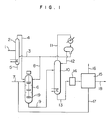
- the accompanying drawing is a flow diagram showing the acetylation process of this invention.
- acetic anhydride is fed to the middle plate of an acetyl fluoride generating apparatus 2 through pipe l and contacted there with heating with hydrogen fluoride introduced through a pipe 3.
- the acetyl fluoride formed is distilled out through an outlet pipe 4 and acetic acid is withdrawn through a pipe 5.
- the acetyl fluoride is fed to an acetylation reactor 6 equipped with a stirrer l9 and is contacted there with stirring with the starting aromatic compound fed through a pipe 7 and with hydrogen fluoride fed through a pipe 8.
- the reaction begins in two liquid phases of the hydrogen fluoride phase and the starting material oil phase, which then change into a homogeneous liquid phase as the reaction proceeds.
- reaction liquid is drawn out through a pipe 9, led to a hydrogen fluoride recovery column l0, and contacted there with a diluent such as benzene which is being refluxed and recycled.
- Hydrogen fluoride is separated by vaporization and drawn out through a pipe ll.
- the column top vapor is condensed by cooling and separated into layers.
- the benzene phase is refluxed from a pipe l2 to the recovery column l0; hydrogen fluoride is recycled to the acetyl fluoride generating apparatus and the acetylation reactor (not shown in the Figure).
- Fig. l shows a case where the solvent and the diluent for decomposition are the same. But, in the case where both are different, further a process for recovering the solvent is added to it.
- a stainless steel packed column having a diameter of 50 mm and a height of l000 mm provided with a top reflux apparatus and a bottom reboiler was used as the acetyl fluoride synthesizer.
- Acetic anhydride (22.0 moles per hour) and hydrogen fluoride (2l.0 moles per hour) were mixed and fed continuously to the middle plate of the packed column, and heat was supplied to the reboiler with an electric heater at a rate of 260 Kcal per hour.
- the synthesizer was operated under a pressure of l.0 kg/cm2G.
- the reaction temperature was adjusted to 25°C by passing cooling water through the jacket of the reactor.
- the pressure in the reaction was l kg/cm2G.
- the reaction mixture was continuously withdrawn from the second reactor to be fed to the subsequent hydrogen fluoride recovery column.
- the packed column used in acetyl fluoride synthesis was employed as the hydrogen fluoride recovery column.
- the hydrogen fluoride recovery column was charged with benzene, and heat was supplied at a rate of 300 Kcal per hour to the reboiler under a pressure of l kg/cm2G to keep the benzene refluxing.
- reaction mixture was continuously fed to the upper part of the column at a rate of l kg per hour, and the hydrogen fluoride recovery column was continuously operated while being replenished with benzene.
- Toluene was acetylated by using the same apparatus and the same operation as in Example l.
- a stainless steel autoclave of 500 ml volume equipped with a jacket and a stirrer was used as the acetylation reactor.
Landscapes
- Chemical & Material Sciences (AREA)
- Organic Chemistry (AREA)
- Crystallography & Structural Chemistry (AREA)
- Chemical Kinetics & Catalysis (AREA)
- General Chemical & Material Sciences (AREA)
- Organic Low-Molecular-Weight Compounds And Preparation Thereof (AREA)
- Catalysts (AREA)
- Low-Molecular Organic Synthesis Reactions Using Catalysts (AREA)
Applications Claiming Priority (2)
| Application Number | Priority Date | Filing Date | Title |
|---|---|---|---|
| JP191521/85 | 1985-08-31 | ||
| JP60191521A JPH0684328B2 (ja) | 1985-08-31 | 1985-08-31 | 芳香族ケトンの製造方法 |
Publications (3)
| Publication Number | Publication Date |
|---|---|
| EP0215351A2 true EP0215351A2 (de) | 1987-03-25 |
| EP0215351A3 EP0215351A3 (en) | 1987-07-15 |
| EP0215351B1 EP0215351B1 (de) | 1991-04-10 |
Family
ID=16276040
Family Applications (1)
| Application Number | Title | Priority Date | Filing Date |
|---|---|---|---|
| EP86111905A Expired - Lifetime EP0215351B1 (de) | 1985-08-31 | 1986-08-28 | Verfahren zur Herstellung einer acetylsubstituierten aromatischen Verbindung |
Country Status (5)
| Country | Link |
|---|---|
| EP (1) | EP0215351B1 (de) |
| JP (1) | JPH0684328B2 (de) |
| AU (1) | AU595523B2 (de) |
| CA (1) | CA1289972C (de) |
| DE (1) | DE3678653D1 (de) |
Cited By (9)
| Publication number | Priority date | Publication date | Assignee | Title |
|---|---|---|---|---|
| US4506224A (en) * | 1981-08-24 | 1985-03-19 | Siemens Aktiengsellschaft | High-frequency field system for nuclear magnetic resonance apparatus |
| US4967011A (en) * | 1988-09-30 | 1990-10-30 | Mitsubishi Gas Chemical Co., Inc. | Process for decomposing aromatic acylated compound.HF-BF3 complex |
| EP0431869A3 (en) * | 1989-12-04 | 1992-01-02 | Hoechst Celanese Corporation | Method for removing hydrogen fluoride from mixtures comprising aromatic ketones |
| EP0517979A1 (de) * | 1991-06-14 | 1992-12-16 | Mitsubishi Gas Chemical Company, Inc. | Herstellung von aromatischen Acylverbindungen |
| US5208383A (en) * | 1991-06-14 | 1993-05-04 | Mitsubishi Gas Chemical Company, Inc. | Process for producing aromatic acylation product |
| US5365001A (en) * | 1991-08-08 | 1994-11-15 | Teijin Limited | Method for preparing dialkylnaphthalene |
| US5411892A (en) * | 1993-08-13 | 1995-05-02 | University Of Washington | Method and apparatus for carbohydrate analysis |
| CN114349621A (zh) * | 2021-12-29 | 2022-04-15 | 煤炭科学技术研究院有限公司 | 一种适用小型连续精馏酰化反应液的方法 |
| CN114369018A (zh) * | 2021-12-29 | 2022-04-19 | 煤炭科学技术研究院有限公司 | 一种连续同步精馏酰化反应液的方法 |
Families Citing this family (2)
| Publication number | Priority date | Publication date | Assignee | Title |
|---|---|---|---|---|
| JPH0414812A (ja) * | 1990-05-08 | 1992-01-20 | Fujitsu Ltd | パターン形成方法 |
| JPH0635990U (ja) * | 1992-10-13 | 1994-05-13 | 秀彦 村松 | 拡大鏡付腕時計 |
Family Cites Families (8)
| Publication number | Priority date | Publication date | Assignee | Title |
|---|---|---|---|---|
| US3234286A (en) * | 1961-10-27 | 1966-02-08 | Du Pont | Acetylation of naphthalenes |
| DE2653601A1 (de) * | 1976-11-25 | 1978-06-01 | Bayer Ag | Perfluoralkylgruppen enthaltende hydroxyketone |
| NL7704101A (nl) * | 1976-04-17 | 1977-10-19 | Bayer Ag | Werkwijze voor het bereiden van hydroxyketonen. |
| BE893791A (fr) * | 1981-07-08 | 1983-01-07 | Raychem Corp | Preparation de derives de p-phenoxybenzoyle |
| CA1255327A (en) * | 1984-07-24 | 1989-06-06 | Celanese Corporation | Process for producing acyloxy aromatic carboxylic acid |
| US4593125A (en) * | 1985-03-13 | 1986-06-03 | Celanese Corporation | Acylation of naphthalenes |
| MX162086A (es) * | 1985-03-21 | 1991-03-25 | Celanese Corp | Procedimiento para producir 4-hidroxiacetofenona |
| DE3519009A1 (de) * | 1985-05-25 | 1986-11-27 | Rütgerswerke AG, 6000 Frankfurt | Verfahren zur selektiven acylierung aromatischer verbindungen |
-
1985
- 1985-08-31 JP JP60191521A patent/JPH0684328B2/ja not_active Expired - Lifetime
-
1986
- 1986-07-30 CA CA000514934A patent/CA1289972C/en not_active Expired - Fee Related
- 1986-07-30 AU AU60713/86A patent/AU595523B2/en not_active Ceased
- 1986-08-28 EP EP86111905A patent/EP0215351B1/de not_active Expired - Lifetime
- 1986-08-28 DE DE8686111905T patent/DE3678653D1/de not_active Expired - Fee Related
Cited By (13)
| Publication number | Priority date | Publication date | Assignee | Title |
|---|---|---|---|---|
| US4506224A (en) * | 1981-08-24 | 1985-03-19 | Siemens Aktiengsellschaft | High-frequency field system for nuclear magnetic resonance apparatus |
| US4967011A (en) * | 1988-09-30 | 1990-10-30 | Mitsubishi Gas Chemical Co., Inc. | Process for decomposing aromatic acylated compound.HF-BF3 complex |
| EP0361479A3 (de) * | 1988-09-30 | 1991-03-20 | Mitsubishi Gas Chemical Company, Inc. | Verfahren zur Zerlegung einer aromatischen acylierten Verbindung.HF-BF3 Komplex |
| EP0431869A3 (en) * | 1989-12-04 | 1992-01-02 | Hoechst Celanese Corporation | Method for removing hydrogen fluoride from mixtures comprising aromatic ketones |
| TR25017A (tr) * | 1989-12-04 | 1992-09-01 | Hoechst Celanese Corp | Aromatik ketonlari ihtiva eden karisimlardan hidrojen fluorid in cikarilmasi icin usul |
| EP0517979A1 (de) * | 1991-06-14 | 1992-12-16 | Mitsubishi Gas Chemical Company, Inc. | Herstellung von aromatischen Acylverbindungen |
| US5208383A (en) * | 1991-06-14 | 1993-05-04 | Mitsubishi Gas Chemical Company, Inc. | Process for producing aromatic acylation product |
| US5365001A (en) * | 1991-08-08 | 1994-11-15 | Teijin Limited | Method for preparing dialkylnaphthalene |
| US5411892A (en) * | 1993-08-13 | 1995-05-02 | University Of Washington | Method and apparatus for carbohydrate analysis |
| CN114349621A (zh) * | 2021-12-29 | 2022-04-15 | 煤炭科学技术研究院有限公司 | 一种适用小型连续精馏酰化反应液的方法 |
| CN114369018A (zh) * | 2021-12-29 | 2022-04-19 | 煤炭科学技术研究院有限公司 | 一种连续同步精馏酰化反应液的方法 |
| CN114349621B (zh) * | 2021-12-29 | 2024-04-02 | 煤炭科学技术研究院有限公司 | 一种适用小型连续精馏酰化反应液的方法 |
| CN114369018B (zh) * | 2021-12-29 | 2024-04-19 | 煤炭科学技术研究院有限公司 | 一种连续同步精馏酰化反应液的方法 |
Also Published As
| Publication number | Publication date |
|---|---|
| AU6071386A (en) | 1987-03-05 |
| DE3678653D1 (de) | 1991-05-16 |
| EP0215351A3 (en) | 1987-07-15 |
| AU595523B2 (en) | 1990-04-05 |
| JPH0684328B2 (ja) | 1994-10-26 |
| JPS6253937A (ja) | 1987-03-09 |
| CA1289972C (en) | 1991-10-01 |
| EP0215351B1 (de) | 1991-04-10 |
Similar Documents
| Publication | Publication Date | Title |
|---|---|---|
| EP0209768A1 (de) | Flüssigphasechlorierung von Chlormethanen | |
| CA1289972C (en) | Process for producing acetyl-substituted aromatic compound | |
| JPH0320372B2 (de) | ||
| EP0431869B1 (de) | Verfahren zur Trennung von Fluorwasserstoffsäure von aromatische Ketone enthaltenden Gemischen | |
| JPS6234024B2 (de) | ||
| EP0501374B1 (de) | Verfahren zur Reinigung von Dimethylcarbonat | |
| US5386064A (en) | Production of bis(fluoromethyl) ether and difluoromethane | |
| US4179473A (en) | Production of monoalkyl aromatics | |
| JPH0412254B2 (de) | ||
| US5185469A (en) | Process for acylation or alkylation of aromatic compounds in hydrogen fluoride | |
| KR20080112348A (ko) | 메타크릴산메틸의 제조방법 | |
| US3988424A (en) | Method for decomposing an aromatic aldehyde-hydrogen fluoride-boron trifluoride complex | |
| EP0361479A2 (de) | Verfahren zur Zerlegung einer aromatischen acylierten Verbindung.HF-BF3 Komplex | |
| JP2001139500A (ja) | ノルボルネンおよび高純度テトラシクロドデセンの同時製造方法 | |
| US5208383A (en) | Process for producing aromatic acylation product | |
| JP2004175782A (ja) | 芳香族ヒドロキシ化合物の製造方法 | |
| CA1178619A (en) | Process for the preparation of 2,3-dimethylbutane-2,3- diol | |
| CA1231351A (en) | Production of aryl alcohols | |
| JP2511264B2 (ja) | m−エチルジフエニル類の製造方法 | |
| JP3937012B2 (ja) | 芳香族ヒドロキシ化合物の製造方法 | |
| JP3042366B2 (ja) | メタジイソプロピルベンゼンの製造方法 | |
| IE902116A1 (en) | Process for the separation of two isomers especially 1-phenyl-2-bromoethane | |
| EP0517979B1 (de) | Herstellung von aromatischen Acylverbindungen | |
| JPH029830A (ja) | p−体を高含量とするジアルキルベンゼンの製造法 | |
| RU2150454C1 (ru) | Способ получения фторированных углеводородов |
Legal Events
| Date | Code | Title | Description |
|---|---|---|---|
| PUAI | Public reference made under article 153(3) epc to a published international application that has entered the european phase |
Free format text: ORIGINAL CODE: 0009012 |
|
| AK | Designated contracting states |
Kind code of ref document: A2 Designated state(s): DE FR GB IT NL |
|
| PUAL | Search report despatched |
Free format text: ORIGINAL CODE: 0009013 |
|
| AK | Designated contracting states |
Kind code of ref document: A3 Designated state(s): DE FR GB IT NL |
|
| 17P | Request for examination filed |
Effective date: 19871202 |
|
| 17Q | First examination report despatched |
Effective date: 19880801 |
|
| GRAA | (expected) grant |
Free format text: ORIGINAL CODE: 0009210 |
|
| AK | Designated contracting states |
Kind code of ref document: B1 Designated state(s): DE FR GB IT NL |
|
| PG25 | Lapsed in a contracting state [announced via postgrant information from national office to epo] |
Ref country code: IT Free format text: LAPSE BECAUSE OF FAILURE TO SUBMIT A TRANSLATION OF THE DESCRIPTION OR TO PAY THE FEE WITHIN THE PRE;WARNING: LAPSES OF ITALIAN PATENTS WITH EFFECTIVE DATE BEFORE 2007 MAY HAVE OCCURRED AT ANY TIME BEFORE 2007. THE CORRECT EFFECTIVE DATE MAY BE DIFFERENT FROM THE ONE RECORDED.SCRIBED TIME-LIMIT Effective date: 19910410 Ref country code: NL Effective date: 19910410 |
|
| REF | Corresponds to: |
Ref document number: 3678653 Country of ref document: DE Date of ref document: 19910516 |
|
| ET | Fr: translation filed | ||
| NLV1 | Nl: lapsed or annulled due to failure to fulfill the requirements of art. 29p and 29m of the patents act | ||
| PLBE | No opposition filed within time limit |
Free format text: ORIGINAL CODE: 0009261 |
|
| STAA | Information on the status of an ep patent application or granted ep patent |
Free format text: STATUS: NO OPPOSITION FILED WITHIN TIME LIMIT |
|
| 26N | No opposition filed | ||
| PGFP | Annual fee paid to national office [announced via postgrant information from national office to epo] |
Ref country code: FR Payment date: 19980814 Year of fee payment: 13 |
|
| PGFP | Annual fee paid to national office [announced via postgrant information from national office to epo] |
Ref country code: GB Payment date: 19980819 Year of fee payment: 13 |
|
| PGFP | Annual fee paid to national office [announced via postgrant information from national office to epo] |
Ref country code: DE Payment date: 19980907 Year of fee payment: 13 |
|
| PG25 | Lapsed in a contracting state [announced via postgrant information from national office to epo] |
Ref country code: GB Free format text: LAPSE BECAUSE OF NON-PAYMENT OF DUE FEES Effective date: 19990828 |
|
| GBPC | Gb: european patent ceased through non-payment of renewal fee |
Effective date: 19990828 |
|
| PG25 | Lapsed in a contracting state [announced via postgrant information from national office to epo] |
Ref country code: FR Free format text: LAPSE BECAUSE OF NON-PAYMENT OF DUE FEES Effective date: 20000428 |
|
| PG25 | Lapsed in a contracting state [announced via postgrant information from national office to epo] |
Ref country code: DE Free format text: LAPSE BECAUSE OF NON-PAYMENT OF DUE FEES Effective date: 20000601 |
|
| REG | Reference to a national code |
Ref country code: FR Ref legal event code: ST |