EP0216388A2 - Procédé de lavage du NO et/ou SO2 de mélanges gazeux - Google Patents
Procédé de lavage du NO et/ou SO2 de mélanges gazeux Download PDFInfo
- Publication number
- EP0216388A2 EP0216388A2 EP86113256A EP86113256A EP0216388A2 EP 0216388 A2 EP0216388 A2 EP 0216388A2 EP 86113256 A EP86113256 A EP 86113256A EP 86113256 A EP86113256 A EP 86113256A EP 0216388 A2 EP0216388 A2 EP 0216388A2
- Authority
- EP
- European Patent Office
- Prior art keywords
- detergent
- solvent
- regeneration
- alkyl
- solvents
- Prior art date
- Legal status (The legal status is an assumption and is not a legal conclusion. Google has not performed a legal analysis and makes no representation as to the accuracy of the status listed.)
- Withdrawn
Links
- 238000000034 method Methods 0.000 title claims abstract description 73
- 239000000203 mixture Substances 0.000 title claims abstract description 24
- 238000005406 washing Methods 0.000 title claims description 20
- 230000008569 process Effects 0.000 title claims description 18
- 239000003599 detergent Substances 0.000 claims abstract description 90
- 239000007789 gas Substances 0.000 claims abstract description 42
- 150000003839 salts Chemical class 0.000 claims abstract description 8
- 239000003125 aqueous solvent Substances 0.000 claims abstract description 7
- 230000003647 oxidation Effects 0.000 claims abstract description 7
- 238000007254 oxidation reaction Methods 0.000 claims abstract description 7
- 238000010438 heat treatment Methods 0.000 claims abstract description 6
- 230000009467 reduction Effects 0.000 claims abstract description 5
- 230000008929 regeneration Effects 0.000 claims description 34
- 238000011069 regeneration method Methods 0.000 claims description 34
- 239000002904 solvent Substances 0.000 claims description 32
- XEEYBQQBJWHFJM-UHFFFAOYSA-N Iron Chemical compound [Fe] XEEYBQQBJWHFJM-UHFFFAOYSA-N 0.000 claims description 30
- XLYOFNOQVPJJNP-UHFFFAOYSA-N water Substances O XLYOFNOQVPJJNP-UHFFFAOYSA-N 0.000 claims description 27
- HEMHJVSKTPXQMS-UHFFFAOYSA-M Sodium hydroxide Chemical compound [OH-].[Na+] HEMHJVSKTPXQMS-UHFFFAOYSA-M 0.000 claims description 24
- ZUHZGEOKBKGPSW-UHFFFAOYSA-N tetraglyme Chemical compound COCCOCCOCCOCCOC ZUHZGEOKBKGPSW-UHFFFAOYSA-N 0.000 claims description 18
- QAOWNCQODCNURD-UHFFFAOYSA-N Sulfuric acid Chemical compound OS(O)(=O)=O QAOWNCQODCNURD-UHFFFAOYSA-N 0.000 claims description 12
- GRYLNZFGIOXLOG-UHFFFAOYSA-N Nitric acid Chemical compound O[N+]([O-])=O GRYLNZFGIOXLOG-UHFFFAOYSA-N 0.000 claims description 10
- 229910052742 iron Inorganic materials 0.000 claims description 9
- 229910017604 nitric acid Inorganic materials 0.000 claims description 9
- 125000004185 ester group Chemical group 0.000 claims description 8
- 125000000468 ketone group Chemical group 0.000 claims description 8
- 235000011149 sulphuric acid Nutrition 0.000 claims description 7
- ASLNDVUAZOHADR-UHFFFAOYSA-N 2-butyl-3-methylphenol Chemical compound CCCCC1=C(C)C=CC=C1O ASLNDVUAZOHADR-UHFFFAOYSA-N 0.000 claims description 6
- -1 halide ions Chemical class 0.000 claims description 6
- OJVAMHKKJGICOG-UHFFFAOYSA-N 2,5-hexanedione Chemical compound CC(=O)CCC(C)=O OJVAMHKKJGICOG-UHFFFAOYSA-N 0.000 claims description 4
- IAZDPXIOMUYVGZ-UHFFFAOYSA-N Dimethylsulphoxide Chemical compound CS(C)=O IAZDPXIOMUYVGZ-UHFFFAOYSA-N 0.000 claims description 4
- CWYNVVGOOAEACU-UHFFFAOYSA-N Fe2+ Chemical class [Fe+2] CWYNVVGOOAEACU-UHFFFAOYSA-N 0.000 claims description 4
- WTDHULULXKLSOZ-UHFFFAOYSA-N Hydroxylamine hydrochloride Chemical compound Cl.ON WTDHULULXKLSOZ-UHFFFAOYSA-N 0.000 claims description 4
- 239000002253 acid Substances 0.000 claims description 4
- 238000011068 loading method Methods 0.000 claims description 4
- 238000005292 vacuum distillation Methods 0.000 claims description 4
- VEXZGXHMUGYJMC-UHFFFAOYSA-M Chloride anion Chemical compound [Cl-] VEXZGXHMUGYJMC-UHFFFAOYSA-M 0.000 claims description 3
- 150000005690 diesters Chemical class 0.000 claims description 3
- 238000006386 neutralization reaction Methods 0.000 claims description 3
- 238000000926 separation method Methods 0.000 claims description 3
- 239000001089 [(2R)-oxolan-2-yl]methanol Substances 0.000 claims description 2
- 125000004122 cyclic group Chemical group 0.000 claims description 2
- CBOIHMRHGLHBPB-UHFFFAOYSA-N hydroxymethyl Chemical group O[CH2] CBOIHMRHGLHBPB-UHFFFAOYSA-N 0.000 claims description 2
- 239000003112 inhibitor Substances 0.000 claims description 2
- 150000003008 phosphonic acid esters Chemical class 0.000 claims description 2
- 150000003014 phosphoric acid esters Chemical class 0.000 claims description 2
- 125000004437 phosphorous atom Chemical group 0.000 claims description 2
- 229910052698 phosphorus Inorganic materials 0.000 claims description 2
- BSYVTEYKTMYBMK-UHFFFAOYSA-N tetrahydrofurfuryl alcohol Chemical compound OCC1CCCO1 BSYVTEYKTMYBMK-UHFFFAOYSA-N 0.000 claims description 2
- 150000005691 triesters Chemical class 0.000 claims description 2
- NBIIXXVUZAFLBC-UHFFFAOYSA-N Phosphoric acid Chemical compound OP(O)(O)=O NBIIXXVUZAFLBC-UHFFFAOYSA-N 0.000 claims 3
- 229910000147 aluminium phosphate Inorganic materials 0.000 claims 2
- 150000001875 compounds Chemical class 0.000 claims 2
- 150000002334 glycols Chemical class 0.000 claims 2
- 238000007664 blowing Methods 0.000 claims 1
- 239000011261 inert gas Substances 0.000 claims 1
- 150000003016 phosphoric acids Chemical class 0.000 claims 1
- 239000003546 flue gas Substances 0.000 abstract description 34
- 238000005201 scrubbing Methods 0.000 abstract description 3
- UGFAIRIUMAVXCW-UHFFFAOYSA-N Carbon monoxide Chemical compound [O+]#[C-] UGFAIRIUMAVXCW-UHFFFAOYSA-N 0.000 description 29
- 150000002500 ions Chemical class 0.000 description 20
- VEXZGXHMUGYJMC-UHFFFAOYSA-N Hydrochloric acid Chemical compound Cl VEXZGXHMUGYJMC-UHFFFAOYSA-N 0.000 description 16
- 239000000243 solution Substances 0.000 description 16
- SLNYBUIEAMRFSZ-UHFFFAOYSA-N 2-(2-{2-[2-(2-methoxy-ethoxy)-ethoxy]-ethoxy}-ethoxy)-ethanol Chemical compound COCCOCCOCCOCCOCCO SLNYBUIEAMRFSZ-UHFFFAOYSA-N 0.000 description 7
- 238000006243 chemical reaction Methods 0.000 description 7
- DMDPGPKXQDIQQG-UHFFFAOYSA-N pentaglyme Chemical compound COCCOCCOCCOCCOCCOC DMDPGPKXQDIQQG-UHFFFAOYSA-N 0.000 description 7
- YFNKIDBQEZZDLK-UHFFFAOYSA-N triglyme Chemical compound COCCOCCOCCOC YFNKIDBQEZZDLK-UHFFFAOYSA-N 0.000 description 7
- OKKJLVBELUTLKV-UHFFFAOYSA-N Methanol Chemical compound OC OKKJLVBELUTLKV-UHFFFAOYSA-N 0.000 description 6
- FAPWRFPIFSIZLT-UHFFFAOYSA-M Sodium chloride Chemical compound [Na+].[Cl-] FAPWRFPIFSIZLT-UHFFFAOYSA-M 0.000 description 6
- 238000010521 absorption reaction Methods 0.000 description 6
- 238000004140 cleaning Methods 0.000 description 6
- 238000011049 filling Methods 0.000 description 6
- 238000002386 leaching Methods 0.000 description 6
- 230000002378 acidificating effect Effects 0.000 description 5
- 239000000047 product Substances 0.000 description 5
- 239000010802 sludge Substances 0.000 description 5
- 239000000126 substance Substances 0.000 description 5
- 238000003915 air pollution Methods 0.000 description 4
- 230000008901 benefit Effects 0.000 description 4
- 238000009835 boiling Methods 0.000 description 3
- 238000004519 manufacturing process Methods 0.000 description 3
- 239000000463 material Substances 0.000 description 3
- MWUXSHHQAYIFBG-UHFFFAOYSA-N nitrogen oxide Inorganic materials O=[N] MWUXSHHQAYIFBG-UHFFFAOYSA-N 0.000 description 3
- 238000012856 packing Methods 0.000 description 3
- 239000011780 sodium chloride Substances 0.000 description 3
- OKTJSMMVPCPJKN-UHFFFAOYSA-N Carbon Chemical compound [C] OKTJSMMVPCPJKN-UHFFFAOYSA-N 0.000 description 2
- LYCAIKOWRPUZTN-UHFFFAOYSA-N Ethylene glycol Chemical compound OCCO LYCAIKOWRPUZTN-UHFFFAOYSA-N 0.000 description 2
- PXHVJJICTQNCMI-UHFFFAOYSA-N Nickel Chemical compound [Ni] PXHVJJICTQNCMI-UHFFFAOYSA-N 0.000 description 2
- KFSLWBXXFJQRDL-UHFFFAOYSA-N Peracetic acid Chemical compound CC(=O)OO KFSLWBXXFJQRDL-UHFFFAOYSA-N 0.000 description 2
- QVGXLLKOCUKJST-UHFFFAOYSA-N atomic oxygen Chemical compound [O] QVGXLLKOCUKJST-UHFFFAOYSA-N 0.000 description 2
- 230000015572 biosynthetic process Effects 0.000 description 2
- 239000011575 calcium Substances 0.000 description 2
- 229910052791 calcium Inorganic materials 0.000 description 2
- 150000004649 carbonic acid derivatives Chemical class 0.000 description 2
- 239000003054 catalyst Substances 0.000 description 2
- 238000002485 combustion reaction Methods 0.000 description 2
- 239000000470 constituent Substances 0.000 description 2
- 238000010612 desalination reaction Methods 0.000 description 2
- 238000005868 electrolysis reaction Methods 0.000 description 2
- 239000000945 filler Substances 0.000 description 2
- 229930195733 hydrocarbon Natural products 0.000 description 2
- 150000002430 hydrocarbons Chemical class 0.000 description 2
- 150000004679 hydroxides Chemical class 0.000 description 2
- 230000000622 irritating effect Effects 0.000 description 2
- 239000011777 magnesium Substances 0.000 description 2
- 229910052749 magnesium Inorganic materials 0.000 description 2
- 229910052760 oxygen Inorganic materials 0.000 description 2
- 239000001301 oxygen Substances 0.000 description 2
- 229910052700 potassium Inorganic materials 0.000 description 2
- 238000001556 precipitation Methods 0.000 description 2
- 239000012266 salt solution Substances 0.000 description 2
- 238000004062 sedimentation Methods 0.000 description 2
- OYPRJOBELJOOCE-UHFFFAOYSA-N Calcium Chemical compound [Ca] OYPRJOBELJOOCE-UHFFFAOYSA-N 0.000 description 1
- 235000008733 Citrus aurantifolia Nutrition 0.000 description 1
- DGAQECJNVWCQMB-PUAWFVPOSA-M Ilexoside XXIX Chemical compound C[C@@H]1CC[C@@]2(CC[C@@]3(C(=CC[C@H]4[C@]3(CC[C@@H]5[C@@]4(CC[C@@H](C5(C)C)OS(=O)(=O)[O-])C)C)[C@@H]2[C@]1(C)O)C)C(=O)O[C@H]6[C@@H]([C@H]([C@@H]([C@H](O6)CO)O)O)O.[Na+] DGAQECJNVWCQMB-PUAWFVPOSA-M 0.000 description 1
- 229910021577 Iron(II) chloride Inorganic materials 0.000 description 1
- 229910021578 Iron(III) chloride Inorganic materials 0.000 description 1
- FYYHWMGAXLPEAU-UHFFFAOYSA-N Magnesium Chemical compound [Mg] FYYHWMGAXLPEAU-UHFFFAOYSA-N 0.000 description 1
- IOVCWXUNBOPUCH-UHFFFAOYSA-N Nitrous acid Chemical compound ON=O IOVCWXUNBOPUCH-UHFFFAOYSA-N 0.000 description 1
- CBENFWSGALASAD-UHFFFAOYSA-N Ozone Chemical compound [O-][O+]=O CBENFWSGALASAD-UHFFFAOYSA-N 0.000 description 1
- ZLMJMSJWJFRBEC-UHFFFAOYSA-N Potassium Chemical compound [K] ZLMJMSJWJFRBEC-UHFFFAOYSA-N 0.000 description 1
- DNIAPMSPPWPWGF-UHFFFAOYSA-N Propylene glycol Chemical class CC(O)CO DNIAPMSPPWPWGF-UHFFFAOYSA-N 0.000 description 1
- 229910000831 Steel Inorganic materials 0.000 description 1
- NINIDFKCEFEMDL-UHFFFAOYSA-N Sulfur Chemical compound [S] NINIDFKCEFEMDL-UHFFFAOYSA-N 0.000 description 1
- 235000011941 Tilia x europaea Nutrition 0.000 description 1
- 238000006887 Ullmann reaction Methods 0.000 description 1
- 238000009825 accumulation Methods 0.000 description 1
- 230000009471 action Effects 0.000 description 1
- 150000003863 ammonium salts Chemical class 0.000 description 1
- 239000010405 anode material Substances 0.000 description 1
- 239000007864 aqueous solution Substances 0.000 description 1
- 229910052799 carbon Inorganic materials 0.000 description 1
- 239000010406 cathode material Substances 0.000 description 1
- 230000008859 change Effects 0.000 description 1
- 239000007795 chemical reaction product Substances 0.000 description 1
- 239000003638 chemical reducing agent Substances 0.000 description 1
- 150000001805 chlorine compounds Chemical class 0.000 description 1
- 238000009833 condensation Methods 0.000 description 1
- 230000005494 condensation Effects 0.000 description 1
- 238000001816 cooling Methods 0.000 description 1
- 230000007423 decrease Effects 0.000 description 1
- 238000007791 dehumidification Methods 0.000 description 1
- 238000004821 distillation Methods 0.000 description 1
- 239000000428 dust Substances 0.000 description 1
- 238000000605 extraction Methods 0.000 description 1
- 230000002349 favourable effect Effects 0.000 description 1
- 239000003337 fertilizer Substances 0.000 description 1
- 238000001914 filtration Methods 0.000 description 1
- 239000002803 fossil fuel Substances 0.000 description 1
- 229910002804 graphite Inorganic materials 0.000 description 1
- 239000010439 graphite Substances 0.000 description 1
- 150000004820 halides Chemical class 0.000 description 1
- IXCSERBJSXMMFS-UHFFFAOYSA-N hydrogen chloride Substances Cl.Cl IXCSERBJSXMMFS-UHFFFAOYSA-N 0.000 description 1
- 125000002887 hydroxy group Chemical group [H]O* 0.000 description 1
- WGCNASOHLSPBMP-UHFFFAOYSA-N hydroxyacetaldehyde Natural products OCC=O WGCNASOHLSPBMP-UHFFFAOYSA-N 0.000 description 1
- 238000009776 industrial production Methods 0.000 description 1
- 238000009434 installation Methods 0.000 description 1
- NMCUIPGRVMDVDB-UHFFFAOYSA-L iron dichloride Chemical compound Cl[Fe]Cl NMCUIPGRVMDVDB-UHFFFAOYSA-L 0.000 description 1
- RBTARNINKXHZNM-UHFFFAOYSA-K iron trichloride Chemical compound Cl[Fe](Cl)Cl RBTARNINKXHZNM-UHFFFAOYSA-K 0.000 description 1
- 239000004571 lime Substances 0.000 description 1
- 239000007788 liquid Substances 0.000 description 1
- 238000002844 melting Methods 0.000 description 1
- 230000008018 melting Effects 0.000 description 1
- 229910052751 metal Inorganic materials 0.000 description 1
- 239000002184 metal Substances 0.000 description 1
- 239000008267 milk Substances 0.000 description 1
- 210000004080 milk Anatomy 0.000 description 1
- 235000013336 milk Nutrition 0.000 description 1
- 210000004400 mucous membrane Anatomy 0.000 description 1
- 229910052759 nickel Inorganic materials 0.000 description 1
- 150000002894 organic compounds Chemical class 0.000 description 1
- 150000001451 organic peroxides Chemical class 0.000 description 1
- 239000003960 organic solvent Substances 0.000 description 1
- 239000002245 particle Substances 0.000 description 1
- 239000013618 particulate matter Substances 0.000 description 1
- 238000006552 photochemical reaction Methods 0.000 description 1
- 238000005293 physical law Methods 0.000 description 1
- 239000011591 potassium Substances 0.000 description 1
- 239000000843 powder Substances 0.000 description 1
- 239000012256 powdered iron Substances 0.000 description 1
- 239000002244 precipitate Substances 0.000 description 1
- 235000013772 propylene glycol Nutrition 0.000 description 1
- 210000003456 pulmonary alveoli Anatomy 0.000 description 1
- 239000011541 reaction mixture Substances 0.000 description 1
- 238000007670 refining Methods 0.000 description 1
- 210000002345 respiratory system Anatomy 0.000 description 1
- 239000000779 smoke Substances 0.000 description 1
- 239000011734 sodium Substances 0.000 description 1
- 229910052708 sodium Inorganic materials 0.000 description 1
- 239000011877 solvent mixture Substances 0.000 description 1
- 239000004071 soot Substances 0.000 description 1
- 239000010959 steel Substances 0.000 description 1
- 239000011593 sulfur Substances 0.000 description 1
- 229910052717 sulfur Inorganic materials 0.000 description 1
- 150000003467 sulfuric acid derivatives Chemical class 0.000 description 1
- 230000001988 toxicity Effects 0.000 description 1
- 231100000419 toxicity Toxicity 0.000 description 1
- STCOOQWBFONSKY-UHFFFAOYSA-N tributyl phosphate Chemical compound CCCCOP(=O)(OCCCC)OCCCC STCOOQWBFONSKY-UHFFFAOYSA-N 0.000 description 1
- 239000002351 wastewater Substances 0.000 description 1
Images
Classifications
-
- B—PERFORMING OPERATIONS; TRANSPORTING
- B01—PHYSICAL OR CHEMICAL PROCESSES OR APPARATUS IN GENERAL
- B01D—SEPARATION
- B01D53/00—Separation of gases or vapours; Recovering vapours of volatile solvents from gases; Chemical or biological purification of waste gases, e.g. engine exhaust gases, smoke, fumes, flue gases, aerosols
- B01D53/34—Chemical or biological purification of waste gases
- B01D53/46—Removing components of defined structure
- B01D53/48—Sulfur compounds
- B01D53/50—Sulfur oxides
- B01D53/507—Sulfur oxides by treating the gases with other liquids
-
- B—PERFORMING OPERATIONS; TRANSPORTING
- B01—PHYSICAL OR CHEMICAL PROCESSES OR APPARATUS IN GENERAL
- B01D—SEPARATION
- B01D53/00—Separation of gases or vapours; Recovering vapours of volatile solvents from gases; Chemical or biological purification of waste gases, e.g. engine exhaust gases, smoke, fumes, flue gases, aerosols
- B01D53/34—Chemical or biological purification of waste gases
- B01D53/46—Removing components of defined structure
- B01D53/54—Nitrogen compounds
- B01D53/56—Nitrogen oxides
-
- B—PERFORMING OPERATIONS; TRANSPORTING
- B01—PHYSICAL OR CHEMICAL PROCESSES OR APPARATUS IN GENERAL
- B01D—SEPARATION
- B01D53/00—Separation of gases or vapours; Recovering vapours of volatile solvents from gases; Chemical or biological purification of waste gases, e.g. engine exhaust gases, smoke, fumes, flue gases, aerosols
- B01D53/34—Chemical or biological purification of waste gases
- B01D53/46—Removing components of defined structure
- B01D53/60—Simultaneously removing sulfur oxides and nitrogen oxides
-
- Y—GENERAL TAGGING OF NEW TECHNOLOGICAL DEVELOPMENTS; GENERAL TAGGING OF CROSS-SECTIONAL TECHNOLOGIES SPANNING OVER SEVERAL SECTIONS OF THE IPC; TECHNICAL SUBJECTS COVERED BY FORMER USPC CROSS-REFERENCE ART COLLECTIONS [XRACs] AND DIGESTS
- Y02—TECHNOLOGIES OR APPLICATIONS FOR MITIGATION OR ADAPTATION AGAINST CLIMATE CHANGE
- Y02A—TECHNOLOGIES FOR ADAPTATION TO CLIMATE CHANGE
- Y02A50/00—TECHNOLOGIES FOR ADAPTATION TO CLIMATE CHANGE in human health protection, e.g. against extreme weather
- Y02A50/20—Air quality improvement or preservation, e.g. vehicle emission control or emission reduction by using catalytic converters
Definitions
- the invention relates to a method for washing out NO and / or SO2 from NO- and / or SO2-containing gas mixtures with a detergent containing iron (II) salts and solvents.
- Air pollution which is particularly dramatic in smog episodes, is mainly due to large-scale industrial energy production and other large-scale industrial production (iron and steel production, oil refining) and car emissions.
- the main components that constitute the air pollution are ,, CO, SO2, hydrocarbons, NOx and particulate matter.
- SO2 is often viewed together with suspended particles as an indicator of all air pollution. Its emissions from the combustion of sulfur-containing fossil fuels in the Federal Republic of Germany are estimated at several million tons annually. SO2 is easily water-soluble and is particularly irritating to the mucous membranes of the upper and middle airways and the eye.
- NO x owe their origin to the formation of the elements during combustion processes, whereby the primary NO in the air is immediately oxidized to NO2, which due to its low water solubility is absorbed primarily in the pulmonary alveoli and exerts an irritant effect there.
- the main reason why NO is considered to be extremely harmful air pollution is that under the action of ultraviolet rays it can react with hydrocarbons, CO and water vapor, such as those found in car exhaust gases, to form photochemical oxidation products and especially ozone.
- organic peroxides and nitric acid compounds of peracetic acid are to be mentioned in particular, which have considerable toxicity to the respiratory tract and damage material goods and vegetation.
- a method has recently become known (US Pat. No. 4,418,044) which allows NO x and SO 2 to be removed from exhaust gases, flue gases etc. at the same time.
- solutions of iron II ions and S2O3 ions are used.
- the Fe-II ions are usually added in the form of the sulfates, the S2O3 ions in the form of the potassium or ammonium salts.
- Water is primarily used as the solvent for these substances, but certain amounts of non-aqueous solvents, for example methanol or glycol, are added. In one example it is stated that a solution comprising a total of 200 moles contains 40 moles of methanol.
- a molar ratio S2O3 ⁇ / Fe++ of at least 5.0 is prescribed in this known method, since it had been found that the absorption of NO in the detergent drops sharply at a lower molar ratio.
- This object is achieved in that a practically anhydrous non-aqueous solvent is used as the solvent and the detergent is freed from it by regeneration after loading with NO and / or SO2 and used again.
- the method according to the invention therefore works with a detergent which for the most part consists of a non-aqueous solvent.
- the method according to the invention could also be operated with an anhydrous, non-aqueous solvent.
- the detergent according to the invention unfolds its greatest solvency for NO and / or SO2.
- flue gases are always moist, so that the detergent always absorbs certain amounts of water during operation.
- the gas constituents also remove water, but complete dehumidification would require very long regeneration times and / or high regeneration temperatures. In terms of energy, both are so complex that, for economic reasons, the detergent will be completely water-free.
- the uppermost limit for the water content of the detergent is 20% by weight, since the absorption of the NO drops sharply at higher water contents.
- the mono- and diethers of the oligoethylene and propylene glycols are also suitable for the purposes of the process according to the invention.
- tetrahydrofurfuryl alcohol, acetonylacetone and in particular tetraethylene glycol dimethyl ether have proven to be very particularly suitable according to the invention, the latter being extremely stable, especially against flue gas.
- Dimethyl sulfoxide is also a solvent which is very suitable according to the invention.
- phosphoric acid esters are very suitable because, in addition to having a very good dissolving power for NO, they also have the advantages of very low viscosity and very high boiling points.
- mono-, di- and triesters are suitable, the mono- and diesters being substituted on the phosphorus atom, that is to say also in the form of phosphonic acid esters. If there are special requirements with regard to the melting point, boiling point, viscosity, etc. of the detergent, it is also possible according to the invention to use solvent mixtures.
- the divalent iron is used in the form of sine halides, especially in the form of the chloride. It seems to be irrelevant whether FeCl2 is added to the detergent from the start or whether chloride ions are offered in the form of another chlorine compound, eg HCl, to the solution of the Fe-II ions.
- the last-mentioned hydrochloric acid is also advantageous because, as was also found according to the invention, a small amount of acid in the detergent, about 0.1 to 1% by weight, has a favorable effect on the absorption process and the stability of the Fe-II ions.
- the method according to the invention it is possible to remove both NO / NO x alone and NO / NO x together with SO2 from technical gas mixtures, such as flue gas, since, for example, the NO2, if present in the gas, is washed out simultaneously with the NO due to physical laws.
- the detergent can be regenerated with steam in the usual way.
- the condensate from the regeneration steam has an extremely low solubility for NO, so that during regeneration, if the detergent was loaded with NO / NO x alone, a highly concentrated NO rich gas can be obtained, which can be easily oxidized with air (without a catalyst ) can be converted to NO2 and then to concentrated nitric acid.
- SO2 is also to be removed at the same time, then this can be accomplished in one step with the removal of the NO without the aid of further process steps or chemicals, because the solvents proposed according to the invention have demonstrated very good solubility in relation to SO2.
- the SO2 does not react with the iron-II ions, but is physically dissolved from the non-aqueous solvent. Both dissolved components, like the NO alone, can then be stripped from the detergent with steam.
- the first way is to condense the SO2, which is not difficult because of the high boiling point difference to the NO.
- the largely SO2-free NO-rich flue gas is then oxidized by adding air or oxygen, whereby NO2 is formed in a known manner (pressureless, without catalyst, 20 to 30 ° C), which is dissolved in water to nitric acid. Residual gases can then be run in front of the laundry again.
- the second way is to oxidize the SO2-NO rich gas directly with air or oxygen and to bring it into contact with water, creating a mixture of sulfuric and nitric acid.
- the reactions here are similar to the known lead chamber process.
- This acid mixture can be used directly for fertilizer production (neutralization with Mg, Ca or K carbonates or hydroxides or with NH3). Alternatively, the mixture can also be separated by distillation to give sulfuric acid and nitric acid using known methods. The residual gases can then either be returned to the laundry or processed in separate steps.
- the detergent according to the invention be circulated in the first detergent circuit without the addition of FE-II salts, but in the second with Fe-II salts. This has the advantage that in the same solvent circulates in both washing circuits so that a transfer from one to the other does not interfere.
- any other laundry e.g. a known lime milk wash
- the invention therefore makes it possible to equip existing flue gas cleaning systems which are already equipped with SO2 scrubbing, but which only allow the NO to be removed unsatisfactorily or not at all, with a post-cleaning or fine cleaning stage which ensures virtually complete NO removal.
- Fe III salts considerably reduces the rate of oxidation. It has proven expedient to add Fe III ions to the detergent according to the invention in an amount which corresponds to 1 to 6 times, preferably 2 to 3 times the amount of the dissolved Fe II ions.
- the process A) has the advantage that no products are formed during the reaction which could interfere with the washing process or the further processing of the gases.
- the reaction takes place in a yield of 60 to 95% and in a very short time (10 to 60 sec).
- Method B is linked to the presence of electrical current.
- this is usually cheaply available, especially of course for flue gas cleaning in power plants.
- the shape and arrangement of the electrodes and the diaphragm play a role in the economy of the electrolytic reduction, but not in its functionality. It is only necessary to ensure that the wash liquors flow through the reaction spaces as evenly as possible.
- the temperature of the electrolysis cell can be in the range from 0 to 100 ° C. The cheapest current yields are, however, achieved in the range of 10 to 30 ° C.
- method C) according to the invention has proven to be most useful for reducing excess Fe III ions.
- the washing medium is usually weakly acidic, either through acidic components contained in the flue gas or through an acid addition, the conversion takes place between the elemental Fe and the Fe-III ions to form Fe-II ions smooth.
- the elementary iron can be applied to the top of the washing column in the form of powder, chips, sheet metal pieces, etc. This type of reduction of excess Fe-III ions according to the invention has the outstanding advantage that the reaction does not produce products of any other type than are present in the detergent anyway.
- this can be done with ion exchangers.
- a branched-off partial stream of the detergent loaded with salts is subjected to a total of vacuum distillation.
- the organic solvent can easily be distilled off from the other constituents. As could be determined, it goes in the detergent dissolved hydrochloric acid in the distillate and can therefore be used again in the wash, which helps to reduce operating costs.
- the remaining swamp remains pumpable and can be brought to a landfill.
- the invention it is advantageous to use a 50% NaOH solution in order to introduce as little water as possible into the detergent. It has been shown that concentrated NaOH solution is practically insoluble in the solvents according to the invention. Since NaCl is surprisingly slightly soluble in the solvents according to the invention, the neutralization products of the above reaction are all precipitated together and can easily be separated from the solvent by sedimentation or filtration.
- the absorption speed for the components to be removed is an important parameter.
- the solvent according to the invention is far superior to the known one.
- solutions 1) and 3) reach 80 to 90% of their saturation load in 70 sec, while solution 4) has only reached about 5% of their saturation load after this time.
- tetraethylene glycol dimethyl ether 15-25% by weight triethylene glycol dimethyl ether 2.5-7.5% by weight of pentaethylene glycol dimethyl ether 2.5-7.5 wt% pentaethylene glycol monomethyl ether with 2% by weight FeCl2-4H2O 1% by weight of 4,4'-butylidene-bis- (6-tert.butyl-m-cresol) 0.1% by weight of H2SO4 0.5% HCl by weight.
- the SO2 content of the cleaned gas had dropped to 3 Vppm and the NO to less than 5 Vppm.
- the regeneration was carried out at 80 to 90 ° C in a vacuum, whereby a SO2 and NO-rich gas of the following composition was obtained (based on anhydrous gas): NO 40.2 vol% SO2 40.1 vol% N2, CO2 rest.
- tetraethylene glycol dimethyl ether 15-25% by weight triethylene glycol dimethyl ether 2.5-7.5% by weight of pentaethylene glycol dimethyl ether 2.5-7.5 wt% pentaethylene glycol monomethyl ether with 2.6% by weight FeCl2-4H2O 1% by weight of 4,4'-butylidene-bis- (6-tert.butyl-m-cresol) 0.1% by weight of H2SO4 0.5% HCl by weight.
- the regeneration was carried out at 80 to 90 ° C in a vacuum, an NO-rich gas of the following composition being obtained (based on anhydrous gas): NO 85 vol% N2, CO2 rest.
- tetraethylene glycol dimethyl ether 15-25% by weight triethylene glycol dimethyl ether 2.5-7.5% by weight of pentaethylene glycol dimethyl ether 2.5-7.5 wt% pentaethylene glycol monomethyl ether with 3.7% by weight FeCl2-4H2O 0.9% by weight 4,4'-butylidene-bis- (6-tert.butyl-m-cresol) 0.45 wt% HCl 1.5% by weight H2O.
- the regeneration was carried out in a regeneration column of the same nature as the washing column at about 80 ° C with 230 l / h N2 as the regeneration gas.
- the regeneration was carried out in a regeneration column of the same nature as the washing column at about 80 ° C with 100 l / h N2 as the regeneration gas.
- tetraethylene glycol dimethyl ether 15-25% by weight triethylene glycol dimethyl ether 2.5-7.5% by weight of pentaethylene glycol dimethyl ether 2.5-7.5 wt% pentaethylene glycol monomethyl ether with 2.0% by weight FeCl2-4H2O 4.9% by weight FeCl3-6H2O 1.0% by weight of 4,4'-butylidene-bis- (6-tert.butyl-m-cresol) 0.5% HCl by weight.
- the regeneration was carried out in a regeneration column at about 80 ° C with 230 l / h N2 as the regeneration gas.
- Detergent filling 160 m3
- Detergent circulation 800 m3 / h
- Temperature 25-30 ° C.
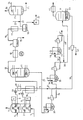
- the embodiment shows a simultaneous NO and SO2 leaching from flue gas, the wash column from time to time small amounts of elemental iron are added.
- the washing column 2 consists of a lower, a middle and an upper section.
- the flue gas is washed with water to remove dust, soot, HCl and HF.
- the treatment of the water carrying the dirt load is only represented schematically by block 3.
- a further water washing circuit is installed, the treatment of which is also only schematically represented by block 4, which has the task of washing back detergent droplets entrained in the middle section of the washing column 2 in order to keep the detergent losses to a minimum.
- the flue gas thus comes pre-cleaned from the lower into the middle section of the washing column 2, where it is sprinkled with detergent added at 800 m3 / h through line 5 (for components see Example VI).
- the detergent absorbs the NO and SO2 contained in the flue gas.
- powdered iron can be introduced into the wash column through line 6 from time to time. The washed flue gas then enters the upper section of the washing column 2, is freed of entrained detergent and leaves the system through line 7.
- Loaded detergent is drawn off by means of a pump 8 through line 9, heated in the heat exchanger 10 and fed into the upper part of a regeneration column 11 which is equipped with bottom heating and head cooling.
- this regeneration column 11 the loaded detergent is freed by heating of the dissolved gas components NO and SO2, which leave the column as rich gas through line 12.
- the rich gas is cooled in the air cooler 13 and condensing water is separated in the separator 14 and removed through line 15. This is a maximum of 5 t / h. About 700 m3 / h rich gas then pass through line 16 into the cooler 17, in which the condensation temperature of the SO2 is not reached.
- the condensing SO2 (860 kg / h) is separated from the gas in the separator 18 and worked up in a system shown only as block 19 to sulfuric acid.
- the system delivers through line 20 about 1310 kg / h H2SO4.
- the NO-rich gas escaping through the line 21 from the separator 18 is mixed with air through line 22 and fed to a trickle tower 23, in which it is sprinkled with water (line 24) and with the formation of nitrous acid in 40 to 50% Nitric acid is converted.
- Line 25 can be taken from the system 440 kg / h HNO3. Unreacted gas from line 26 is usually fed back to the flue gas to be processed.
- the regenerated detergent flows out through line 27.
- a part is pumped through line 5 via the heat exchanger 10 and a water cooler 28 with the aid of a pump 29 to the central section of the washing column 2, while the rest, namely 340 l / h, is transferred to a stirred tank 30.
- the stirred tank 30 is fed through line 31 an appropriate amount of 50% aqueous NaOH solution to precipitate the Fe III ions contained in the detergent as Fe (OH) 3.
- the reaction mixture then passes into a decanter 32.
- Detergent with a reduced content of Fe-III ions is fed via line 33 to line 5, while Fe (OH) 3 sludge via line 34 enters a second stirred tank 35, where it is mixed with water (Line 36) is diluted.
- the mixture then comes into a decanter 37.
- excess detergent is fed through line 38 to a stripping column 39, where heat is supplied to the detergent by heating by means of a steam spiral 40, which causes water to evaporate, which is drawn off overhead and into a water cooler 41 is liquefied.
- the bottom liquid flows into a decanter 42, where NaCl settles, which is transferred to a landfill via line 43, while desalinated detergent reaches line 5 via line 33.
- Sludge from the decanter 37 is transferred through line 44 into a third stirred tank 45 and water (line 46) is added there again.
- a separation into detergent and sludge takes place in a decanter 47.
- the detergent passes through line 48 to line 38, while the sludge is brought through line 49 to a landfill.
Landscapes
- Engineering & Computer Science (AREA)
- Chemical & Material Sciences (AREA)
- Health & Medical Sciences (AREA)
- Biomedical Technology (AREA)
- Environmental & Geological Engineering (AREA)
- Analytical Chemistry (AREA)
- General Chemical & Material Sciences (AREA)
- Oil, Petroleum & Natural Gas (AREA)
- Chemical Kinetics & Catalysis (AREA)
- Treating Waste Gases (AREA)
Applications Claiming Priority (4)
| Application Number | Priority Date | Filing Date | Title |
|---|---|---|---|
| DE3534526 | 1985-09-27 | ||
| DE3534526 | 1985-09-27 | ||
| DE19863612123 DE3612123A1 (de) | 1985-09-27 | 1986-04-10 | Verfahren zum auswaschen von no und/oder so(pfeil abwaerts)2(pfeil abwaerts) aus gasgemischen |
| DE3612123 | 1986-04-10 |
Publications (2)
| Publication Number | Publication Date |
|---|---|
| EP0216388A2 true EP0216388A2 (fr) | 1987-04-01 |
| EP0216388A3 EP0216388A3 (fr) | 1988-01-20 |
Family
ID=25836457
Family Applications (1)
| Application Number | Title | Priority Date | Filing Date |
|---|---|---|---|
| EP86113256A Withdrawn EP0216388A3 (fr) | 1985-09-27 | 1986-09-26 | Procédé de lavage du NO et/ou SO2 de mélanges gazeux |
Country Status (3)
| Country | Link |
|---|---|
| US (1) | US4885146A (fr) |
| EP (1) | EP0216388A3 (fr) |
| DE (1) | DE3612123A1 (fr) |
Cited By (8)
| Publication number | Priority date | Publication date | Assignee | Title |
|---|---|---|---|---|
| WO1993008121A1 (fr) * | 1991-10-21 | 1993-04-29 | Europäische Atomgemeinschaft (Euratom) | PROCEDE DE PREPARATION D'HYDROXYLAMINE A PARTIR DE GAZ DE FUMEE CONTENANT DU NO¿x? |
| FR2709678A1 (fr) * | 1993-09-09 | 1995-03-17 | David Philippe Marie | Procédé d'épuration d'effluents gazeux ou liquides contenant des dérivés soufrés. |
| WO1996028239A1 (fr) * | 1993-09-09 | 1996-09-19 | David Philippe Marie | Procede d'epuration d'effluents gazeux ou liquides contenant des derives soufres |
| WO1998009713A1 (fr) * | 1996-09-03 | 1998-03-12 | Monsanto Company | Elimination et recuperation selective de l'anhydride sulfureux dans des effluents gazeux au moyen de solvants organophosphores |
| US7264763B2 (en) | 2003-05-18 | 2007-09-04 | Dieffenbacher Gmbh + Co. Kg | Method and apparatus for the manufacture of compacts |
| FR2937248A1 (fr) * | 2008-10-20 | 2010-04-23 | Microcapsules Technologies | Microcapsules ayant une enveloppe composee essentiellement d'homopolymeres ou de copolymeres silsesquioxane |
| EP3153224A4 (fr) * | 2014-06-05 | 2018-01-24 | Wei, Xionghui | Procédé et dispositif pour la désulfuration et la dénitration de gaz de combustion |
| CN109701388A (zh) * | 2019-02-26 | 2019-05-03 | 江西鹏凯环保工程设备有限公司 | 一种废气净化系统和废气净化方法 |
Families Citing this family (8)
| Publication number | Priority date | Publication date | Assignee | Title |
|---|---|---|---|---|
| FI79657C (fi) * | 1988-04-26 | 1990-02-12 | Outokumpu Oy | Foerfarande foer avlaegsnande av svavel- och kvaevefoereningar fraon gas. |
| US5785888A (en) * | 1995-03-24 | 1998-07-28 | Milmac Operating Company | Method for removal of sulfur dioxide |
| JP2000300938A (ja) * | 1999-02-18 | 2000-10-31 | Yasuo Fukutani | 排ガスおよび焼却灰浄化剤とそれを用いた浄化方法 |
| IL132347A (en) | 1999-10-12 | 2005-11-20 | Lextran Ltd | Method for removing acidic gases from waste gas |
| US20050214193A1 (en) * | 2004-03-25 | 2005-09-29 | D Ottone Luca | Nitric oxide purification method and apparatus |
| CN101502741B (zh) * | 2009-02-16 | 2011-01-05 | 北京博源恒升高科技有限公司 | 聚乙二醇脱除气体中SOx的方法 |
| CN103432890B (zh) | 2013-09-10 | 2015-12-09 | 北京博源恒升高科技有限公司 | 改性聚乙二醇脱除气体中SOx的方法 |
| CN110448994B (zh) * | 2019-08-16 | 2022-08-05 | 北京化工大学 | 一种可再生胺基功能化低共熔溶剂捕集no的工艺方法 |
Family Cites Families (7)
| Publication number | Priority date | Publication date | Assignee | Title |
|---|---|---|---|---|
| US3538631A (en) * | 1968-07-23 | 1970-11-10 | Edward Hammond Boatner | Variable format restaurant menu |
| US3681015A (en) * | 1970-01-21 | 1972-08-01 | Lummus Co | Purification of gases |
| US3767777A (en) * | 1972-02-23 | 1973-10-23 | Trentham Corp | Method of separating sulfur dioxide from gaseous mixtures |
| US4418044A (en) * | 1982-01-15 | 1983-11-29 | Conoco Inc. | Nitric oxide and sulfur oxide absorption by scrubbing with Fe++ /S.sub. O3- |
| WO1985003238A2 (fr) * | 1984-01-25 | 1985-08-01 | Hoelter Heinz | Procede d'extraction des oxydes d'azote et des oxydes de soufre, ainsi que, le cas echeant, d'autres elements nocifs des gaz de fumees provenant d'installations de combustion |
| DE3502207A1 (de) * | 1984-12-24 | 1986-07-24 | Hölter, Heinz, Dipl.-Ing., 4390 Gladbeck | Elektrochemisches verfahren zur reinigung von abgasen in verbindung mit einem eisenreaktor |
| DE3501118A1 (de) * | 1985-01-15 | 1986-07-17 | Linde Ag, 6200 Wiesbaden | Verfahren zur entfernung von so(pfeil abwaerts)2(pfeil abwaerts) und no(pfeil abwaerts)x(pfeil abwaerts) aus gasen |
-
1986
- 1986-04-10 DE DE19863612123 patent/DE3612123A1/de not_active Withdrawn
- 1986-09-26 EP EP86113256A patent/EP0216388A3/fr not_active Withdrawn
-
1988
- 1988-03-28 US US07/174,474 patent/US4885146A/en not_active Expired - Fee Related
Cited By (13)
| Publication number | Priority date | Publication date | Assignee | Title |
|---|---|---|---|---|
| WO1993008121A1 (fr) * | 1991-10-21 | 1993-04-29 | Europäische Atomgemeinschaft (Euratom) | PROCEDE DE PREPARATION D'HYDROXYLAMINE A PARTIR DE GAZ DE FUMEE CONTENANT DU NO¿x? |
| FR2709678A1 (fr) * | 1993-09-09 | 1995-03-17 | David Philippe Marie | Procédé d'épuration d'effluents gazeux ou liquides contenant des dérivés soufrés. |
| EP0730899A1 (fr) * | 1993-09-09 | 1996-09-11 | Philippe-Marie David | Procédé d'épuration d'effluents gazeux ou liquides contenant des dérivés soufrés |
| WO1996028239A1 (fr) * | 1993-09-09 | 1996-09-19 | David Philippe Marie | Procede d'epuration d'effluents gazeux ou liquides contenant des derives soufres |
| WO1998009713A1 (fr) * | 1996-09-03 | 1998-03-12 | Monsanto Company | Elimination et recuperation selective de l'anhydride sulfureux dans des effluents gazeux au moyen de solvants organophosphores |
| US5851265A (en) * | 1996-09-03 | 1998-12-22 | Monsanto Company | Selective removal and recovery of sulfur dioxide from effluent gases using organic phosphorous solvents |
| AU716416B2 (en) * | 1996-09-03 | 2000-02-24 | Monsanto Company | Selective removal and recovery of sulfur dioxide from effluent gases using organic phosphorous solvents |
| US7264763B2 (en) | 2003-05-18 | 2007-09-04 | Dieffenbacher Gmbh + Co. Kg | Method and apparatus for the manufacture of compacts |
| FR2937248A1 (fr) * | 2008-10-20 | 2010-04-23 | Microcapsules Technologies | Microcapsules ayant une enveloppe composee essentiellement d'homopolymeres ou de copolymeres silsesquioxane |
| WO2010046583A1 (fr) * | 2008-10-20 | 2010-04-29 | Microcapsules Technologies | Microcapsules ayant une enveloppe composée essentiellement d'homopolymères ou de copolymères silsesquioxane |
| EP3153224A4 (fr) * | 2014-06-05 | 2018-01-24 | Wei, Xionghui | Procédé et dispositif pour la désulfuration et la dénitration de gaz de combustion |
| US9895661B2 (en) | 2014-06-05 | 2018-02-20 | Xionghui Wei | Process and device for desulphurization and denitration of flue gas |
| CN109701388A (zh) * | 2019-02-26 | 2019-05-03 | 江西鹏凯环保工程设备有限公司 | 一种废气净化系统和废气净化方法 |
Also Published As
| Publication number | Publication date |
|---|---|
| US4885146A (en) | 1989-12-05 |
| DE3612123A1 (de) | 1987-04-09 |
| EP0216388A3 (fr) | 1988-01-20 |
Similar Documents
| Publication | Publication Date | Title |
|---|---|---|
| DE2641230C2 (de) | Verfahren zur Abscheidung und Gewinnung von Quecksilber aus Gasen | |
| EP0216388A2 (fr) | Procédé de lavage du NO et/ou SO2 de mélanges gazeux | |
| DE2148244C2 (de) | Verfahren zur Reinigung von Schwefeldioxid enthaltenden Abgasen | |
| DE2812980B2 (de) | Wiedergewinnung von Schwefel aus Schwefelwasserstoffhaitigen Gasströmen | |
| DE2554584A1 (de) | Verfahren zum regenerieren einer absorptionsloesung, die zum reinigen von abgas verwendet wurde | |
| DE2404019A1 (de) | Verfahren zum reinigen metallurgischer schwefelsaeureanhydrid enthaltender gase durch extraktion von quecksilber | |
| DE2946193C2 (fr) | ||
| DE3626370A1 (de) | Entschwefelung/denitrifikation von rauchgas unter verwendung von metall-chelatadditiven | |
| DE2833440A1 (de) | Verfahren zur gleichzeitigen entfernung von schwefeldioxyd und stickstoffoxyden aus abgasen und rauchgasen | |
| DE2630175B2 (de) | Verfahren zur Reinigung von Stickstoffoxide und Schwefeloxide enthaltenden Industrieabgasen | |
| DE2251787C2 (de) | Verfahren zur Gewinnung von hochaktivem Siliciumdioxid und reinem Fluorwasserstoff aus Siliciumtetrafluorid und Fluorwasserstoff enthaltenden Abgasen | |
| DE3525241A1 (de) | Verfahren zur entfernung von organischen schwefelverbindungen oder schwefeloxiden und stickoxiden aus solche enthaltenden gasen | |
| DE2429994A1 (de) | Verfahren zur behandlung von abwaessern, die schwefelsaeure und/oder ammoniumsulfat enthalten | |
| DE19800699A1 (de) | Entfernung von Schwermetallionen aus wäßrigen Medien | |
| DE2423815A1 (de) | Verfahren zum reinigen von quecksilber enthaltender schwefelsaeure | |
| DE1247283B (de) | Verfahren zur Entfernung von Schwefeloxyden aus Abgasen unter Gewinnung von Schwefelsaeure | |
| DD249856A5 (de) | Verfahren zum auswaschen von no und/oder so tief 2 aus gasgemischen | |
| DE2455694A1 (de) | Verfahren zur herstellung eines wasserstoff und kohlenmonoxid enthaltenden gases | |
| DE3718457A1 (de) | Verfahren zum auswaschen von no und/oder so(pfeil abwaerts)2(pfeil abwaerts) aus gasgemischen | |
| DE2907600C2 (fr) | ||
| DE2443153A1 (de) | Regenerierung alkalischer waschfluessigkeit | |
| DE2529708A1 (de) | Verfahren zur herstellung von schwefelsaeure | |
| DE2926107C2 (de) | Verfahren zum Abtrennen von Stickstoffoxiden aus Gasen | |
| DE2210759A1 (de) | Verfahren zur Wiedergewinnung von Quecksilber | |
| DE3640119C1 (en) | Process for treating a gas stream containing nitrogen oxides |
Legal Events
| Date | Code | Title | Description |
|---|---|---|---|
| PUAI | Public reference made under article 153(3) epc to a published international application that has entered the european phase |
Free format text: ORIGINAL CODE: 0009012 |
|
| AK | Designated contracting states |
Kind code of ref document: A2 Designated state(s): AT BE CH DE FR GB LI NL |
|
| PUAL | Search report despatched |
Free format text: ORIGINAL CODE: 0009013 |
|
| AK | Designated contracting states |
Kind code of ref document: A3 Designated state(s): AT BE CH DE FR GB LI NL |
|
| 17P | Request for examination filed |
Effective date: 19880414 |
|
| STAA | Information on the status of an ep patent application or granted ep patent |
Free format text: STATUS: THE APPLICATION IS DEEMED TO BE WITHDRAWN |
|
| 18D | Application deemed to be withdrawn |
Effective date: 19890331 |
|
| RIN1 | Information on inventor provided before grant (corrected) |
Inventor name: BERAN, FRANZ Inventor name: LASSMANN, EBERHARD, DR. RER. NAT. Inventor name: HELMLING, ROBERT |