EP0217052A1 - Glasartiger Kohlewerkstoff, Verfahren zu seiner Herstellung und Gleiter für Aufnahmemedium - Google Patents
Glasartiger Kohlewerkstoff, Verfahren zu seiner Herstellung und Gleiter für Aufnahmemedium Download PDFInfo
- Publication number
- EP0217052A1 EP0217052A1 EP86110506A EP86110506A EP0217052A1 EP 0217052 A1 EP0217052 A1 EP 0217052A1 EP 86110506 A EP86110506 A EP 86110506A EP 86110506 A EP86110506 A EP 86110506A EP 0217052 A1 EP0217052 A1 EP 0217052A1
- Authority
- EP
- European Patent Office
- Prior art keywords
- glass
- carbon material
- thermal expansion
- magnetic head
- carbon
- Prior art date
- Legal status (The legal status is an assumption and is not a legal conclusion. Google has not performed a legal analysis and makes no representation as to the accuracy of the status listed.)
- Granted
Links
- 239000003575 carbonaceous material Substances 0.000 title claims abstract description 55
- 238000004519 manufacturing process Methods 0.000 title claims description 6
- 238000000034 method Methods 0.000 title description 8
- 229920005989 resin Polymers 0.000 claims abstract description 26
- 239000011347 resin Substances 0.000 claims abstract description 26
- 239000012298 atmosphere Substances 0.000 claims description 7
- 239000000463 material Substances 0.000 abstract description 28
- 239000011162 core material Substances 0.000 description 28
- HEMHJVSKTPXQMS-UHFFFAOYSA-M Sodium hydroxide Chemical compound [OH-].[Na+] HEMHJVSKTPXQMS-UHFFFAOYSA-M 0.000 description 12
- OKTJSMMVPCPJKN-UHFFFAOYSA-N Carbon Chemical compound [C] OKTJSMMVPCPJKN-UHFFFAOYSA-N 0.000 description 10
- 229910052799 carbon Inorganic materials 0.000 description 10
- 230000000052 comparative effect Effects 0.000 description 9
- XPFVYQJUAUNWIW-UHFFFAOYSA-N furfuryl alcohol Chemical compound OCC1=CC=CO1 XPFVYQJUAUNWIW-UHFFFAOYSA-N 0.000 description 9
- 239000011521 glass Substances 0.000 description 8
- 239000000758 substrate Substances 0.000 description 8
- 238000012545 processing Methods 0.000 description 7
- 229910000808 amorphous metal alloy Inorganic materials 0.000 description 6
- 239000007864 aqueous solution Substances 0.000 description 6
- 239000010408 film Substances 0.000 description 6
- 229910000859 α-Fe Inorganic materials 0.000 description 6
- ISWSIDIOOBJBQZ-UHFFFAOYSA-N Phenol Chemical compound OC1=CC=CC=C1 ISWSIDIOOBJBQZ-UHFFFAOYSA-N 0.000 description 5
- 229910045601 alloy Inorganic materials 0.000 description 5
- 239000000956 alloy Substances 0.000 description 5
- 239000007833 carbon precursor Substances 0.000 description 5
- 238000002844 melting Methods 0.000 description 5
- 230000008018 melting Effects 0.000 description 5
- 238000002360 preparation method Methods 0.000 description 5
- 239000011369 resultant mixture Substances 0.000 description 5
- XKRFYHLGVUSROY-UHFFFAOYSA-N Argon Chemical compound [Ar] XKRFYHLGVUSROY-UHFFFAOYSA-N 0.000 description 4
- IJGRMHOSHXDMSA-UHFFFAOYSA-N Atomic nitrogen Chemical compound N#N IJGRMHOSHXDMSA-UHFFFAOYSA-N 0.000 description 4
- YLQBMQCUIZJEEH-UHFFFAOYSA-N Furan Chemical compound C=1C=COC=1 YLQBMQCUIZJEEH-UHFFFAOYSA-N 0.000 description 4
- 238000005299 abrasion Methods 0.000 description 4
- 239000007789 gas Substances 0.000 description 4
- 238000010438 heat treatment Methods 0.000 description 4
- 239000000203 mixture Substances 0.000 description 4
- 239000000047 product Substances 0.000 description 4
- JOXIMZWYDAKGHI-UHFFFAOYSA-N toluene-4-sulfonic acid Chemical compound CC1=CC=C(S(O)(=O)=O)C=C1 JOXIMZWYDAKGHI-UHFFFAOYSA-N 0.000 description 4
- XLYOFNOQVPJJNP-UHFFFAOYSA-N water Substances O XLYOFNOQVPJJNP-UHFFFAOYSA-N 0.000 description 4
- LFQSCWFLJHTTHZ-UHFFFAOYSA-N Ethanol Chemical compound CCO LFQSCWFLJHTTHZ-UHFFFAOYSA-N 0.000 description 3
- WSFSSNUMVMOOMR-UHFFFAOYSA-N Formaldehyde Chemical compound O=C WSFSSNUMVMOOMR-UHFFFAOYSA-N 0.000 description 3
- 229910018605 Ni—Zn Inorganic materials 0.000 description 3
- 238000003763 carbonization Methods 0.000 description 3
- 238000010000 carbonizing Methods 0.000 description 3
- 239000003054 catalyst Substances 0.000 description 3
- 239000000919 ceramic Substances 0.000 description 3
- 239000011248 coating agent Substances 0.000 description 3
- 238000000576 coating method Methods 0.000 description 3
- 239000000945 filler Substances 0.000 description 3
- 230000005484 gravity Effects 0.000 description 3
- 229920005610 lignin Polymers 0.000 description 3
- 238000004544 sputter deposition Methods 0.000 description 3
- VEXZGXHMUGYJMC-UHFFFAOYSA-N Hydrochloric acid Chemical compound Cl VEXZGXHMUGYJMC-UHFFFAOYSA-N 0.000 description 2
- CTQNGGLPUBDAKN-UHFFFAOYSA-N O-Xylene Chemical compound CC1=CC=CC=C1C CTQNGGLPUBDAKN-UHFFFAOYSA-N 0.000 description 2
- 229930040373 Paraformaldehyde Natural products 0.000 description 2
- 239000000853 adhesive Substances 0.000 description 2
- 230000001070 adhesive effect Effects 0.000 description 2
- 229910052786 argon Inorganic materials 0.000 description 2
- 229910002113 barium titanate Inorganic materials 0.000 description 2
- 239000001913 cellulose Substances 0.000 description 2
- 229920002678 cellulose Polymers 0.000 description 2
- 235000010980 cellulose Nutrition 0.000 description 2
- 239000000470 constituent Substances 0.000 description 2
- 230000007797 corrosion Effects 0.000 description 2
- 238000005260 corrosion Methods 0.000 description 2
- 230000006866 deterioration Effects 0.000 description 2
- 238000011161 development Methods 0.000 description 2
- 229920006332 epoxy adhesive Polymers 0.000 description 2
- 238000000227 grinding Methods 0.000 description 2
- 238000001513 hot isostatic pressing Methods 0.000 description 2
- 239000011261 inert gas Substances 0.000 description 2
- JVTAAEKCZFNVCJ-UHFFFAOYSA-N lactic acid Chemical compound CC(O)C(O)=O JVTAAEKCZFNVCJ-UHFFFAOYSA-N 0.000 description 2
- 238000000465 moulding Methods 0.000 description 2
- 229910052757 nitrogen Inorganic materials 0.000 description 2
- TWNQGVIAIRXVLR-UHFFFAOYSA-N oxo(oxoalumanyloxy)alumane Chemical compound O=[Al]O[Al]=O TWNQGVIAIRXVLR-UHFFFAOYSA-N 0.000 description 2
- 229920002866 paraformaldehyde Polymers 0.000 description 2
- 238000003756 stirring Methods 0.000 description 2
- 239000000126 substance Substances 0.000 description 2
- 230000003746 surface roughness Effects 0.000 description 2
- 238000005979 thermal decomposition reaction Methods 0.000 description 2
- 229920006305 unsaturated polyester Polymers 0.000 description 2
- 238000001771 vacuum deposition Methods 0.000 description 2
- 239000008096 xylene Substances 0.000 description 2
- KXGFMDJXCMQABM-UHFFFAOYSA-N 2-methoxy-6-methylphenol Chemical compound [CH]OC1=CC=CC([CH])=C1O KXGFMDJXCMQABM-UHFFFAOYSA-N 0.000 description 1
- QJZYHAIUNVAGQP-UHFFFAOYSA-N 3-nitrobicyclo[2.2.1]hept-5-ene-2,3-dicarboxylic acid Chemical compound C1C2C=CC1C(C(=O)O)C2(C(O)=O)[N+]([O-])=O QJZYHAIUNVAGQP-UHFFFAOYSA-N 0.000 description 1
- 229920003319 Araldite® Polymers 0.000 description 1
- 241000416162 Astragalus gummifer Species 0.000 description 1
- RYGMFSIKBFXOCR-UHFFFAOYSA-N Copper Chemical compound [Cu] RYGMFSIKBFXOCR-UHFFFAOYSA-N 0.000 description 1
- 239000004593 Epoxy Substances 0.000 description 1
- 229920000084 Gum arabic Polymers 0.000 description 1
- UFHFLCQGNIYNRP-UHFFFAOYSA-N Hydrogen Chemical compound [H][H] UFHFLCQGNIYNRP-UHFFFAOYSA-N 0.000 description 1
- OWYWGLHRNBIFJP-UHFFFAOYSA-N Ipazine Chemical compound CCN(CC)C1=NC(Cl)=NC(NC(C)C)=N1 OWYWGLHRNBIFJP-UHFFFAOYSA-N 0.000 description 1
- 229910021578 Iron(III) chloride Inorganic materials 0.000 description 1
- 229920000877 Melamine resin Polymers 0.000 description 1
- 238000001069 Raman spectroscopy Methods 0.000 description 1
- 241000978776 Senegalia senegal Species 0.000 description 1
- 206010040844 Skin exfoliation Diseases 0.000 description 1
- 229910001035 Soft ferrite Inorganic materials 0.000 description 1
- 239000004830 Super Glue Substances 0.000 description 1
- 229920001615 Tragacanth Polymers 0.000 description 1
- XSQUKJJJFZCRTK-UHFFFAOYSA-N Urea Chemical compound NC(N)=O XSQUKJJJFZCRTK-UHFFFAOYSA-N 0.000 description 1
- 238000002441 X-ray diffraction Methods 0.000 description 1
- 239000000205 acacia gum Substances 0.000 description 1
- 235000010489 acacia gum Nutrition 0.000 description 1
- 239000002253 acid Substances 0.000 description 1
- 229920000180 alkyd Polymers 0.000 description 1
- 229910052782 aluminium Inorganic materials 0.000 description 1
- XAGFODPZIPBFFR-UHFFFAOYSA-N aluminium Chemical compound [Al] XAGFODPZIPBFFR-UHFFFAOYSA-N 0.000 description 1
- 239000010426 asphalt Substances 0.000 description 1
- QVGXLLKOCUKJST-UHFFFAOYSA-N atomic oxygen Chemical compound [O] QVGXLLKOCUKJST-UHFFFAOYSA-N 0.000 description 1
- JRPBQTZRNDNNOP-UHFFFAOYSA-N barium titanate Chemical compound [Ba+2].[Ba+2].[O-][Ti]([O-])([O-])[O-] JRPBQTZRNDNNOP-UHFFFAOYSA-N 0.000 description 1
- 230000015572 biosynthetic process Effects 0.000 description 1
- AOWKSNWVBZGMTJ-UHFFFAOYSA-N calcium titanate Chemical compound [Ca+2].[O-][Ti]([O-])=O AOWKSNWVBZGMTJ-UHFFFAOYSA-N 0.000 description 1
- 239000004202 carbamide Substances 0.000 description 1
- 239000006229 carbon black Substances 0.000 description 1
- 235000019241 carbon black Nutrition 0.000 description 1
- 239000007795 chemical reaction product Substances 0.000 description 1
- 150000001875 compounds Chemical class 0.000 description 1
- 239000013078 crystal Substances 0.000 description 1
- 230000007547 defect Effects 0.000 description 1
- 230000002950 deficient Effects 0.000 description 1
- 239000000428 dust Substances 0.000 description 1
- 239000012776 electronic material Substances 0.000 description 1
- 239000003822 epoxy resin Substances 0.000 description 1
- 238000005530 etching Methods 0.000 description 1
- FGBJXOREULPLGL-UHFFFAOYSA-N ethyl cyanoacrylate Chemical compound CCOC(=O)C(=C)C#N FGBJXOREULPLGL-UHFFFAOYSA-N 0.000 description 1
- 238000004299 exfoliation Methods 0.000 description 1
- 238000007572 expansion measurement Methods 0.000 description 1
- 239000004744 fabric Substances 0.000 description 1
- -1 ferrite Chemical class 0.000 description 1
- 239000012467 final product Substances 0.000 description 1
- 230000004907 flux Effects 0.000 description 1
- 239000008187 granular material Substances 0.000 description 1
- 239000001307 helium Substances 0.000 description 1
- 229910052734 helium Inorganic materials 0.000 description 1
- SWQJXJOGLNCZEY-UHFFFAOYSA-N helium atom Chemical compound [He] SWQJXJOGLNCZEY-UHFFFAOYSA-N 0.000 description 1
- 239000004021 humic acid Substances 0.000 description 1
- 239000001257 hydrogen Substances 0.000 description 1
- 229910052739 hydrogen Inorganic materials 0.000 description 1
- 239000012535 impurity Substances 0.000 description 1
- 239000004615 ingredient Substances 0.000 description 1
- RBTARNINKXHZNM-UHFFFAOYSA-K iron trichloride Chemical compound Cl[Fe](Cl)Cl RBTARNINKXHZNM-UHFFFAOYSA-K 0.000 description 1
- 239000004310 lactic acid Substances 0.000 description 1
- 235000014655 lactic acid Nutrition 0.000 description 1
- 230000001050 lubricating effect Effects 0.000 description 1
- 239000000696 magnetic material Substances 0.000 description 1
- 239000008204 material by function Substances 0.000 description 1
- JDSHMPZPIAZGSV-UHFFFAOYSA-N melamine Chemical compound NC1=NC(N)=NC(N)=N1 JDSHMPZPIAZGSV-UHFFFAOYSA-N 0.000 description 1
- 229910052751 metal Inorganic materials 0.000 description 1
- 239000002184 metal Substances 0.000 description 1
- 150000002739 metals Chemical class 0.000 description 1
- 238000002156 mixing Methods 0.000 description 1
- 239000000178 monomer Substances 0.000 description 1
- 150000002894 organic compounds Chemical class 0.000 description 1
- 239000001301 oxygen Substances 0.000 description 1
- 229910052760 oxygen Inorganic materials 0.000 description 1
- 238000009931 pascalization Methods 0.000 description 1
- 229920001568 phenolic resin Polymers 0.000 description 1
- 239000005011 phenolic resin Substances 0.000 description 1
- 238000005498 polishing Methods 0.000 description 1
- 229920002239 polyacrylonitrile Polymers 0.000 description 1
- 229920000647 polyepoxide Polymers 0.000 description 1
- 230000001681 protective effect Effects 0.000 description 1
- 150000003839 salts Chemical class 0.000 description 1
- 229920006395 saturated elastomer Polymers 0.000 description 1
- 239000000243 solution Substances 0.000 description 1
- 235000000346 sugar Nutrition 0.000 description 1
- 150000008163 sugars Chemical class 0.000 description 1
- 238000012360 testing method Methods 0.000 description 1
- 239000010409 thin film Substances 0.000 description 1
- 239000000196 tragacanth Substances 0.000 description 1
- 235000010487 tragacanth Nutrition 0.000 description 1
- 229940116362 tragacanth Drugs 0.000 description 1
- 239000011800 void material Substances 0.000 description 1
Images
Classifications
-
- G—PHYSICS
- G11—INFORMATION STORAGE
- G11B—INFORMATION STORAGE BASED ON RELATIVE MOVEMENT BETWEEN RECORD CARRIER AND TRANSDUCER
- G11B5/00—Recording by magnetisation or demagnetisation of a record carrier; Reproducing by magnetic means; Record carriers therefor
- G11B5/10—Structure or manufacture of housings or shields for heads
-
- C—CHEMISTRY; METALLURGY
- C04—CEMENTS; CONCRETE; ARTIFICIAL STONE; CERAMICS; REFRACTORIES
- C04B—LIME, MAGNESIA; SLAG; CEMENTS; COMPOSITIONS THEREOF, e.g. MORTARS, CONCRETE OR LIKE BUILDING MATERIALS; ARTIFICIAL STONE; CERAMICS; REFRACTORIES; TREATMENT OF NATURAL STONE
- C04B35/00—Shaped ceramic products characterised by their composition; Ceramics compositions; Processing powders of inorganic compounds preparatory to the manufacturing of ceramic products
- C04B35/515—Shaped ceramic products characterised by their composition; Ceramics compositions; Processing powders of inorganic compounds preparatory to the manufacturing of ceramic products based on non-oxide ceramics
- C04B35/52—Shaped ceramic products characterised by their composition; Ceramics compositions; Processing powders of inorganic compounds preparatory to the manufacturing of ceramic products based on non-oxide ceramics based on carbon, e.g. graphite
- C04B35/524—Shaped ceramic products characterised by their composition; Ceramics compositions; Processing powders of inorganic compounds preparatory to the manufacturing of ceramic products based on non-oxide ceramics based on carbon, e.g. graphite obtained from polymer precursors, e.g. glass-like carbon material
-
- G—PHYSICS
- G11—INFORMATION STORAGE
- G11B—INFORMATION STORAGE BASED ON RELATIVE MOVEMENT BETWEEN RECORD CARRIER AND TRANSDUCER
- G11B5/00—Recording by magnetisation or demagnetisation of a record carrier; Reproducing by magnetic means; Record carriers therefor
- G11B5/10—Structure or manufacture of housings or shields for heads
- G11B5/105—Mounting of head within housing or assembling of head and housing
-
- G—PHYSICS
- G11—INFORMATION STORAGE
- G11B—INFORMATION STORAGE BASED ON RELATIVE MOVEMENT BETWEEN RECORD CARRIER AND TRANSDUCER
- G11B5/00—Recording by magnetisation or demagnetisation of a record carrier; Reproducing by magnetic means; Record carriers therefor
- G11B5/127—Structure or manufacture of heads, e.g. inductive
- G11B5/187—Structure or manufacture of the surface of the head in physical contact with, or immediately adjacent to the recording medium; Pole pieces; Gap features
- G11B5/255—Structure or manufacture of the surface of the head in physical contact with, or immediately adjacent to the recording medium; Pole pieces; Gap features comprising means for protection against wear
-
- G—PHYSICS
- G11—INFORMATION STORAGE
- G11B—INFORMATION STORAGE BASED ON RELATIVE MOVEMENT BETWEEN RECORD CARRIER AND TRANSDUCER
- G11B5/00—Recording by magnetisation or demagnetisation of a record carrier; Reproducing by magnetic means; Record carriers therefor
- G11B5/127—Structure or manufacture of heads, e.g. inductive
- G11B5/31—Structure or manufacture of heads, e.g. inductive using thin films
- G11B5/3103—Structure or manufacture of integrated heads or heads mechanically assembled and electrically connected to a support or housing
- G11B5/3106—Structure or manufacture of integrated heads or heads mechanically assembled and electrically connected to a support or housing where the integrated or assembled structure comprises means for conditioning against physical detrimental influence, e.g. wear, contamination
-
- Y—GENERAL TAGGING OF NEW TECHNOLOGICAL DEVELOPMENTS; GENERAL TAGGING OF CROSS-SECTIONAL TECHNOLOGIES SPANNING OVER SEVERAL SECTIONS OF THE IPC; TECHNICAL SUBJECTS COVERED BY FORMER USPC CROSS-REFERENCE ART COLLECTIONS [XRACs] AND DIGESTS
- Y10—TECHNICAL SUBJECTS COVERED BY FORMER USPC
- Y10T—TECHNICAL SUBJECTS COVERED BY FORMER US CLASSIFICATION
- Y10T428/00—Stock material or miscellaneous articles
- Y10T428/30—Self-sustaining carbon mass or layer with impregnant or other layer
Definitions
- the present invention concerns glass-like carbon materials, a method for manufacturing the same, and a slider part for recording medium.
- a glass-like carbon material having excellent gas impermeability, hardness and isotropic structure is obtained.
- Such glass-like carbon materials are light in weight and excellent in heat resistance, corrosion resistance and lubricating property similarly to general carbon materials.
- they demonstrate excellent electric and thermal conduction and good mechanical strength, such glass-like materials are homogeneous and do not generate carbon dust when used for sliding members.
- an extensive range of use is expected for this material in various fields including electronics, atomic power and space industries.
- this material is homogenous and is easy to precision-process. Even an extremely small parts can be finished with excellent precision.
- a head for floppy discs is made by assembling, for instance, a magnetic core made of soft ferrite, etc. and a structural part of a non-magnetic material.
- Such non-magnetic structural parts must be ground to achieve mirror-like finish in addition to meeting the requirements for lubricity and abrasion resistance.
- the slider material used for the composite- type magnetic head and thin film type magnetic head used for hard discs must also be light in weight in addition to the above mentioned lubricity, corrosion resistance and smoothness of the ground surface.
- Ceramics of calcium titanate type (CaTi0 3 ), barium titanate type (BaTi0 3 ) and aluminum oxide-titan carbide type (A1 2 0 3 -TiC) were used as the substrate for magnetic head. These ceramics had some iisadvantages in that their processing property was very bad and they tended to easily generate chips and cracks.
- the material used for a magnetic head substrate needs to be subjected to extremely fine processing in order to be made into a magnetic head, and is required to have a small grinding resistance and superior processing property.
- the material is also required to have improved abrasion against the recording medium, and reduced grinding resistance and denser crystalline structure when assembled as a magnetic head. The material is ideal if the friction coefficient against the recording material could further be lowered.
- the glass-like carbon is an excellent material satisfying all these requirements, and the studies on its use as a substrate for a magnetic head are being conducted.
- disclosures on its excellent performance as a slider material for a magnetic head by taking advantage of its excellent abrasion are made in Japanese Patent Application No.194013 of 1982(Disclosure No. 84325 of 1984)entitled "Magnetic Head of Vertical Magnetic Recording Type” and Japanese Patent Application No. 192931 of 1983 (Disclosure No.144019 of 1984) entitled "Substrate for Magnetic Head”.
- Organic epoxy adhesives are generally employed for bonding a support, a structural part or a slider material with the core material for the magnetic head.
- Organic epoxy resin becomes expanded by the humidity in the air, causes changes to the shape thereof and deteriorates the dimensional precision of the magnetic head. Thus, it becomes difficult to maintain the required precision for the magnetic head of high density recording type, and its dynamic reliability tends to become lowered.
- the present invention aims at offering glass-like carbon materials with an extremely large thermal expansion ratio, and also at offering a sliding part for recording medium using the same.
- the first aspect according to the present invention concerns a glass-like carbon material characterized by an extremely large thermal expansion ratio compared to the conventional glass-like carbon materials.
- the glass-like carbon material according to the present invention has the mean thermal expansion coefficient at 25°C ⁇ 400°C of 60 x 10 -7 /°C ⁇ 110 x 10 -7 /°C.
- the glass-like carbon material according to the present invention is non-graphitized carbon which has isotropic structure and its fractured section is glass-like and gas impermeable. These properties can be confirmed by such known methods as X-ray defraction and Raman spectroscopy.
- Thermal expansion coefficient of the glass-like carbon material may be determined by measuring specimens of a prescribed size with Thermal Mechanical Analyzer (TMA) and thermal expansion measurement using lasers.
- TMA Thermal Mechanical Analyzer
- the second aspect of this invention concerns a method of manufacturing the above mentioned glass-like carbon material, and is characterized in that a thermo-setting resin is heat-processed at the temperature range of 300°C through 750°C, and then heat processed at a temperature above 800°C in inert atmosphere by applying the 1000 atmosphenes of pressure or more.
- a thermo-setting resin is heat-processed at the temperature range of 300°C through 750°C, and then heat processed at a temperature above 800°C in inert atmosphere by applying the 1000 atmosphenes of pressure or more.
- (1) non-uniform constituents in the material thermo-setting resin must be eliminated, and (2) carbonization for a prescribed period of time must be performed under pressurized conditions. It is also necessary (3) to perform thermal decomposition under pressurized conditions for a prescribed period of time so that microstructure of the glass-like carbon will contain strains.
- Carbonization is conducted at above 800°C or more, and preferably at above 1000°C in inert atmosphere.
- Thermo-setting resin as used herein means an organic compound in which cross-linkage proceeds by heating alone, by heating in the presence of a catalyst, or by addition of a catalyst, and which becomes hardened and not melt.
- Inert atmosphere as used herein means an atmosphere comprising at least one gas selected from the group usually consisting of helium, argon, nitrogen, and hydrogen and not containing oxygen, or an atmosphere under reduced pressure or vacuum.
- Non-uniform constituents mean catalysts usually present as impurities, inorganic salts, monomers which are non-uniformly present, and volatile substances which are present in addition to principal ingredients of a thermo-setting resin. They create non-uniform portions inside the carbon materials when carbonized. Pressurizing used herein means to apply mechanical force such as hydraulic pressure on a sealed container from outside, and to apply pressure directly or indirectly on the material which is being processed. It also means to apply isotropic pressure with the gaseous pressure inside the sealed container.
- HIP processing hot isostatic pressing
- HIP processing applies pressure of inert gas on the subject being processed at a high temperature in order to carbonize the object by taking synergestic advantages of high isotropic pressure and high temperature.
- the conditions for increasing the thermal expansion coefficient of the above range or the temperature for carbonizing thermo-setting resins is above 300°C, or preferably above 500°C. More preferably, the temperature may be 600°C or higher but below 750 * C.
- the carbonizing at 1000 atmospheres pressure or higher, or more preferably at 1500 atmospheres pressure or higher, and at the temperature of 800°C or higher, or more preferably at 900°C or higher, and ideally at 1000°C or higher will obtain desired glass-like carbon material.
- Thermo-setting resins used in the present invention are phenol, epoxy, unsaturated polyester, furan, urea, melamine, alkyd, xylene, etc. and they may be used singly or blended or copolymerized.
- thermo-setting resins Those which can be denatured to thermo-setting resins are phenol and furan mentioned above, naturally produced substances with high carbon yield such as asphalt or pitch, and hydrophilic materials with a comparatively high carbon yield such as lignin, cellulose, tragacanth, gum arabic, humic acid, or sugars.
- Fillers may be mixed in during production of glass-like carbon materials.
- Such fillers include carbon materials containing the thermo-setting resins such as polyacrylonitrile carbons, cellulose carbons, lignin carbons, phenolic resin carbons, alkid resin carbons, unsaturated polyester carbons, xylene resin carbons, various graphites, carbon blacks, etc. in all forms such as fibrous, particulate, powdered, or lumpy. It is necessary, however, to caution against generation of non-uniform portions by thermal decomposition when mixing in the fillers as mentioned above.
- thermo-settting resins used in the present invention may be processed to desired glass-like carbon materials by molding the resins into prescribed shapes by the prescribed molding methods depending on the intended use of the hardened resins, and the heat processing under normal pressure, followed by high temperature high pressure processing.
- the glass-like carbon material according to the present invention may have its thermal expansion coefficient adjusted arbitrarily up to 110 x 10 -7 /°C.
- the glass-like carbon material to be bonded to such core material should have the thermal expansion ratio of 60 x 10 7 /°C or more, and more preferably that of 70 x 10 -7 /°C or more.
- the third aspect according to the present invention concerns a sliding member for a recording medium which contacts the recording medium and slides in relation therewith, and is characterized in that it is formed with glass-like carbon having a mean thermal expansion coefficient of between 60 x 10 -7 /°C and 110 x 10 -7 /°C at a temperature between 25°C and 400°C.
- Sliding parts are concretely exemplified by a structural part of a magnetic head or a slider.
- the glass-like carbon material according to the present invention can be finished to have an extremely smooth mirror-like surface.
- coating is given on thus finished surface with vacuum deposition or sputtering, the coating on a conventional type glass-like material becomes easily peeled off when subjected to subsequent heat treatment. But the coating on the present invention glass-like carbon material does not peel away.
- the present invention glass-like material is bonded with a material with a high thermal expansion coefficient, no strains generate, particularly in glass bonding, so long as thermal expansion coefficients are equal between the two materials, and fine mechanical bonding can also be obtained.
- the glass-like carbon material accor ng to the present invention has excellent properties not evident in the conventional glass-like carbon material.
- the glass-like carbon material according to the present invention is characterized by its large thermal expansion coefficient or 110 x 10 /°C at maximum. Such coefficient for conventional glass-like carbon material is only 50 x 10 -7 /°C at maximum. Although the thermal expansion coefficient of other graphites and carbon materials are known to exceed this value, they are defective in uniformity and fine processing property.
- Thermal expansion coefficient of the glass-like carbon materials according to the present invention may be set at an arbitrary value by suitably selecting the method of preparation, and the original objective of the present invention is to match the thermal expansion coefficient with that of the material to be bonded.
- the glass-like carbon material according to the present invention may be bonded without causing internal strains to many materials, particularly those having the thermal expansion coefficient within the range of 60 x 10 to 110 x 10 -7 /°C or proximate thereto.
- the thermal expansion coefficient of the glass-like carbon material according to the present invention can be completely or substantially completely matched with thermal expansion coefficients of metals, alloys and metallic compounds such as ferrite, and other materials.
- the present invention enables glass bonding of a high reliability, and forming of a functional film without strains on a smooth surface. This in turn enables development of electronic parts provided with the properties of such glass-like carbon material and other functional materials.
- the present invention is therefore advantageous for development of multi-functional parts.
- the glass-like carbon material according to the present invention can be ground to a mirror-finish, and therefore it is possible to set the thermal expansion coefficient at a suitable value and to form an excellent film on its surface by vacuum deposition or sputtering.
- These may be used for a magnetic head substrate, magnetic head slider, or non-magnetic protective member of a slider part for floppy discs or VTR, and extremely thin substrate such as a film support for magnetic head of a magnetic disc. It may also be used for abrasion resistant slider parts used in general precision/electronic parts or electronic material in highly integrated or highly dense parts.
- Parts as used hereunder means “parts by weight”.
- fulfuryl alcohol available from KAO Quaker
- aqueous solution of 0.011N-HCt aqueous solution of 0.011N-HCt
- initial condensate resin 1.5 parts of aqueous solution of 70% p-toluenesulfonic acid and the resultant mixture is stirred well, poured into a rectangular mould having 3 mm thickness, and then defoamed under reduced pressure.
- the product was then heated for 3 hours at 50 ⁇ 60°C and for 5 hours at 90°C.
- the rectangular hard resin obtained is placed in a tubular furnace, heated to 600°C in nitrogen current at 10°C/hour, maintained for 2 hours at 600°C, and then cooled to obtain glass-like carbon precursor.
- the glass-like carbon precursor is inserted into a specimen chamber of a hot isostatic pressing device(generally called "HIP device"), and treated for 2 hours at 1,200°C and under 1,500 atmospheres pressure.
- the glass-like carbon material obtained in the above mentioned step is then ground with aluminum oxide of 0.5 to 1.0 ⁇ m granule diameter, and the final product is obtained in a thin sheet form of 0.1 mm tickness and surface roughness Ra of 0.05 ⁇ m.
- the glass-like carbon sheet is used as a support for a core which is a structural member of a magnetic head.
- the alloy containing Co, Fe, Mn, Si and B at the ratio by weight of 71.5 : 2.5 : 3.0 : 8.0 : 15.0 were rolled into a thin sheet. Diffraction pattern of this alloy by an X-ray diffraction device revealed that the alloy did not contain sharp peaks unique to crystals and confirmed that the alloy was amorphous.
- the amorphous alloy sheet was then ground with aluminum oxide of 1 ⁇ 3 ⁇ m grain diameter, corroded in an etching solution containing 60 g FeCl 3 ⁇ 6H 2 O, 40 ml of C 2 H 5 OH and 2 mg of CuCl 3 dissolved in 40 ml of water, and ground with polishing cloth to achieve the final thickness of 30 ⁇ m.
- This amorphous alloy film is used as a core for a magnetic head.
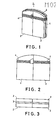
- FIGs. 1 to 3 respectively show the perspective view, the front view and the plan view thereof.
- the core support 2 is formed of glass-like carbon material, the core 3 of amorphous alloy and wound with coil 4.
- the core 3 was made from thin amorphous alloy sheet, but it is also possible to laminate amorphous alloy film on the glass-like carbon substrate by sputtering, to bond and wire the same to obtain a magnetic head.
- the glass-like carbon precursor prepared similarly to Embodiment 1 is inserted into a specimen chamber of HIP device, and treated for 2 hours at 1100°C under 2000 atmospheres pressure.
- the glass-like carbon material obtained had the apparent specific gravity of 1.54 and the thermal expansion coefficient 90 x 10 -7 /°C.
- a magnetic head was prepared from this material in a manner similar to Embodiment 1.
- the surface roughness Ra of the ground surface of the glass-like carbon material is 0.05 ⁇ m, and low melting point glass was used for bonding (bonding temperature: 300°C).
- Embodiment 2 Using the same glass-like carbon material as in Embodiment 2, a magnetic head similar to that of Embodiment 1 was prepared using Ni-Zn ferrite as a core. Low melting point glass used for Embodiment 2 was used for bonding.
- Embodiment 2 Using low melting point glass used for Embodiment 2 as an adhesive, a magnetic head similar to that of Embodiment 1 was prepared.
- a magnetic head similar to that of Comparative embodiemnt 1 was prepared using Ni-Zn ferrite as a core.
- thermo-setting resin obtained in Embodiment 1 was treated by heating up to 1100°C without using HIP device to obtain a glass-like carbon material of apparent specific gravity of 1.49 and thermal expansion coefficient of 40 x 10 -7 /°C.
- a magnetic head similar to that of Embodiment 1 was prepared.
- a magnetic head similar to that of Comparative embodiment 4 was prepared using Ni-Zn ferrite as a core.
- the core and the core support became peeled and it was not usable as a magnetic head.
- inductance L of the magnetic head coil 4 prepared in Embodiments 1 to 3 and Comparative embodiments 1 to 4 was measured. Cores of Comparative embodiments 1 and 3 were considered not to have deteriorated as they were bonded at room temperature, but they were used as references in learning the original characteristics of the cores. The result is shown in the table as the ratio L/L lk wherein L is inductance and L lk inductance at k kHz.
- the glass-like carbon material according to the present invention does not deteriorate the core characteristics when used as a core support.
- the product was cooled to 30°C, and neutralized with aqueous solution of 0.01N hydrochloric acid
- the neutralized product was then dehydrated under reduced pressure to remove 150 parts of water, and then added with 500 parts of furfuryl alcohol.
- To 100 parts of resin thus obtained was added 2.4 parts of 70% p-toluenesulfonic acid aqueous solution, and the resultant mixture was stirred well, poured into a rectangular sheet-shaped mould of 3 mm thickness, and defoamed under reduced pressure.
- the mixture was then heated for 3 hours at 50 ⁇ 60°C and for 5 days at 90°C.
- a rectangular sheet of hardened resin thus obtained was placed in a tubular furnace, heated to 700°C at 10°Clhour in argon gas current, maintained for 2 hours at 700°C, and then cooled to obtain glass-like carbon precursor.
- the glass-like carbon precursor was treated at 1200°C under 2000 atmospheres pressure using HIP device to obtain a glass-like carbon material with a thermal expansion coefficient of 102 x 10 -7 /°C.
- the glass-like carbon material thus obtained was used to form a core support and made into a magnetic head similar to that of the Embodiment 3.
- the impedance of the magnetic head measured did not reveal any deterioration of the core characteristics.
- the resin thus obtained was hardened similarly as in Embodiment 1, and the hardened resin was cut out, heated up to 600°C in a tubular furnace, and treated at 1200°C and under 2000 atmospheres pressure using HIP device.
- the thermal expansion coefficient of thus obtained glass-like carbon material was 85 x 10 -7 /°C.
- the resin thus obtained was hardened similarly as in Embodiment 1. Hardened resin was cut out, heated to 650°C in a tubular furnace, and processed at 1200°C under 2000 atmospheres pressure using HIP device. The glass-like carbon material thus obtained had the thermal expansion coefficient of 97 x 10 7 /°C.
Landscapes
- Engineering & Computer Science (AREA)
- Manufacturing & Machinery (AREA)
- Chemical & Material Sciences (AREA)
- Ceramic Engineering (AREA)
- Materials Engineering (AREA)
- Structural Engineering (AREA)
- Organic Chemistry (AREA)
- Ceramic Products (AREA)
- Magnetic Heads (AREA)
- Adjustment Of The Magnetic Head Position Track Following On Tapes (AREA)
- Thin Magnetic Films (AREA)
- Carbon And Carbon Compounds (AREA)
- Glass Compositions (AREA)
Applications Claiming Priority (2)
| Application Number | Priority Date | Filing Date | Title |
|---|---|---|---|
| JP60173748A JPH0725526B2 (ja) | 1985-08-06 | 1985-08-06 | ガラス状カ−ボン材料、その製造方法およびそれを用いた記録媒体の摺接部品 |
| JP173748/85 | 1985-08-06 |
Publications (2)
| Publication Number | Publication Date |
|---|---|
| EP0217052A1 true EP0217052A1 (de) | 1987-04-08 |
| EP0217052B1 EP0217052B1 (de) | 1989-09-20 |
Family
ID=15966399
Family Applications (1)
| Application Number | Title | Priority Date | Filing Date |
|---|---|---|---|
| EP86110506A Expired EP0217052B1 (de) | 1985-08-06 | 1986-07-30 | Glasartiger Kohlewerkstoff, Verfahren zu seiner Herstellung und Gleiter für Aufnahmemedium |
Country Status (4)
| Country | Link |
|---|---|
| US (1) | US4774140A (de) |
| EP (1) | EP0217052B1 (de) |
| JP (1) | JPH0725526B2 (de) |
| DE (1) | DE3665703D1 (de) |
Families Citing this family (9)
| Publication number | Priority date | Publication date | Assignee | Title |
|---|---|---|---|---|
| EP0267476B1 (de) * | 1986-11-10 | 1992-08-05 | Kao Corporation | Verbundwerkstoff aus glasartigem Kohlenstoff und Verfahren zu seiner Herstellung |
| JP2614081B2 (ja) * | 1988-05-27 | 1997-05-28 | 大塚化学株式会社 | 光学活性β−ラクタム誘導体の製造法 |
| JP2747699B2 (ja) * | 1988-08-26 | 1998-05-06 | 花王株式会社 | 摺動装置 |
| DE4109939C2 (de) * | 1990-03-29 | 1994-10-06 | Kobe Steel Ltd | Amorphes Kohlenstoffsubstrat für eine Magnetplatte und Verfahren zur Herstellung desselben |
| US5567523A (en) * | 1994-10-19 | 1996-10-22 | Kobe Steel Research Laboratories, Usa, Applied Electronics Center | Magnetic recording medium comprising a carbon substrate, a silicon or aluminum nitride sub layer, and a barium hexaferrite magnetic layer |
| JP3580879B2 (ja) * | 1995-01-19 | 2004-10-27 | 浜松ホトニクス株式会社 | 電子管デバイス |
| FR2746309B1 (fr) | 1996-03-22 | 1998-04-17 | Oreal | Composition de teinture des fibres keratiniques contenant des pyrazolopyrimidineoxo ; leur utilisation pour la teinture comme coupleurs, procedes de teinture |
| FR2746306B1 (fr) | 1996-03-22 | 1998-04-30 | Oreal | Compositions de teinture des fibres keratiniques contenant des pyrazolo-azoles ; leur utilisation pour la teinture comme coupleurs, procede de teinture |
| US10450641B2 (en) * | 2015-07-28 | 2019-10-22 | Florida State University Research Foundation, Inc. | Densified superconductor materials and methods |
Citations (3)
| Publication number | Priority date | Publication date | Assignee | Title |
|---|---|---|---|---|
| GB1122326A (en) * | 1966-02-17 | 1968-08-07 | Lorraine Carbone | Method of manufacturing wear-resistant pieces of vitreous carbon |
| EP0108355A1 (de) * | 1982-11-04 | 1984-05-16 | Kao Corporation | Magnetkopf |
| EP0121781A2 (de) * | 1983-03-09 | 1984-10-17 | Kao Corporation | Verfahren zur Herstellung von glasartigem Kohlenstoffmaterial |
Family Cites Families (6)
| Publication number | Priority date | Publication date | Assignee | Title |
|---|---|---|---|---|
| US4166145A (en) * | 1975-03-10 | 1979-08-28 | Hitco | High temperature consolidation process for the production of a substantially all carbon composite |
| US4435511A (en) * | 1982-09-13 | 1984-03-06 | Owens-Illinois, Inc. | Glasses suitable for sealing ferrites |
| JPS59144019A (ja) * | 1983-02-08 | 1984-08-17 | Kao Corp | 磁気ヘッド用基体 |
| JPS5984325A (ja) * | 1982-11-04 | 1984-05-16 | Kao Corp | 垂直磁気記録方式の磁気ヘツド |
| JPS60119609A (ja) * | 1983-11-30 | 1985-06-27 | Kao Corp | 垂直磁気記録方式の磁気ヘツド |
| US4536203A (en) * | 1984-04-19 | 1985-08-20 | The United States Of America As Represented By The Department Of Energy | Pressurized heat treatment of glass-ceramic to control thermal expansion |
-
1985
- 1985-08-06 JP JP60173748A patent/JPH0725526B2/ja not_active Expired - Lifetime
-
1986
- 1986-07-30 EP EP86110506A patent/EP0217052B1/de not_active Expired
- 1986-07-30 DE DE8686110506T patent/DE3665703D1/de not_active Expired
- 1986-08-06 US US06/893,714 patent/US4774140A/en not_active Expired - Fee Related
Patent Citations (3)
| Publication number | Priority date | Publication date | Assignee | Title |
|---|---|---|---|---|
| GB1122326A (en) * | 1966-02-17 | 1968-08-07 | Lorraine Carbone | Method of manufacturing wear-resistant pieces of vitreous carbon |
| EP0108355A1 (de) * | 1982-11-04 | 1984-05-16 | Kao Corporation | Magnetkopf |
| EP0121781A2 (de) * | 1983-03-09 | 1984-10-17 | Kao Corporation | Verfahren zur Herstellung von glasartigem Kohlenstoffmaterial |
Non-Patent Citations (4)
| Title |
|---|
| CHEMICAL ABSTRACTS, vol. 104, no. 10, 10th March 1986, page 781, abstract no. 80763e, Columbus, Ohio, US; & JP-A-60 131 816 (KAO CORP.) 13-07-1985 * |
| CHEMICAL ABSTRACTS, vol. 78, no. 26, 22nd July 1973, page 363, abstract no. 165052s, Columbus, Ohio, US; P.S. GAAL: "Thermal expansion of glassy carbon", & HIGH TEMP.-HIGH PRESSURES 1972, 4(5), 551-7 * |
| PATENTS ABSTRACTS OF JAPAN, vol. 7, no. 260 (P-237)[1405], 18th November 1983; & JP-A-58 141 422 (HITACHI KINZOKU K.K.) 22-08-1983 * |
| PATENTS ABSTRACTS OF JAPAN, vol. 9, no. 292 (P-406)[2015], 19th November 1985; & JP-A-60 129 912 (KIYANON DENSHI K.K.) 11-07-1985 * |
Also Published As
| Publication number | Publication date |
|---|---|
| DE3665703D1 (en) | 1989-10-26 |
| JPS6236011A (ja) | 1987-02-17 |
| US4774140A (en) | 1988-09-27 |
| JPH0725526B2 (ja) | 1995-03-22 |
| EP0217052B1 (de) | 1989-09-20 |
Similar Documents
| Publication | Publication Date | Title |
|---|---|---|
| US4738885A (en) | Magnetic disk, substrate therefor and process for preparation thereof | |
| US5741403A (en) | Ceramic substrates and magnetic data storage components prepared therefrom | |
| US4717622A (en) | Magnetic recording media | |
| EP0267476B1 (de) | Verbundwerkstoff aus glasartigem Kohlenstoff und Verfahren zu seiner Herstellung | |
| EP0406580A1 (de) | Verbundmaterial sowie Verfahren zu seiner Herstellung | |
| EP0217052B1 (de) | Glasartiger Kohlewerkstoff, Verfahren zu seiner Herstellung und Gleiter für Aufnahmemedium | |
| CN1006831B (zh) | 铁硅铝合金磁膜及其制造方法和用途 | |
| KR100616001B1 (ko) | 머시너블 세라믹 | |
| JP2950912B2 (ja) | 軟磁性薄膜 | |
| JPH028998B2 (de) | ||
| EP0133684A1 (de) | Substrat für eine Magnetplatte und Verfahren zu seiner Herstellung | |
| EP0216079B1 (de) | Herstellung eines Kohlenstoffüberzuges und dessen Verwendung | |
| EP0766272B1 (de) | Dünne magnetische Filme und ihre Verwendungen in Magnetdünnschichtelementen | |
| US4981741A (en) | Coating alloy | |
| US20060293166A1 (en) | Material for magnetic head slider, magnetic head slider, and method of producing material for magnetic head slider | |
| JPH0660061B2 (ja) | 簿膜磁気ヘツド用スライダおよびその製造方法 | |
| JP5093948B2 (ja) | 磁気ヘッド用基板及びその製造方法 | |
| JP5037798B2 (ja) | セラミック焼結体及び磁気ヘッド用基板 | |
| JPS62234232A (ja) | 磁気デイスク基板およびその製造方法 | |
| JPH01230471A (ja) | 炭素材及びそ製造方法 | |
| CA2098950A1 (en) | Magneto-optical layer and magneto-optical recording medium | |
| JPS6278156A (ja) | ガラス状カ−ボン複合体およびその製造方法 | |
| JPS6150906B2 (de) | ||
| JPH06282810A (ja) | 磁気ヘッド用非磁性基板材料 | |
| JPH0546973A (ja) | 磁気デイスク用基板 |
Legal Events
| Date | Code | Title | Description |
|---|---|---|---|
| PUAI | Public reference made under article 153(3) epc to a published international application that has entered the european phase |
Free format text: ORIGINAL CODE: 0009012 |
|
| AK | Designated contracting states |
Kind code of ref document: A1 Designated state(s): DE FR GB NL |
|
| 17P | Request for examination filed |
Effective date: 19870915 |
|
| 17Q | First examination report despatched |
Effective date: 19890222 |
|
| GRAA | (expected) grant |
Free format text: ORIGINAL CODE: 0009210 |
|
| AK | Designated contracting states |
Kind code of ref document: B1 Designated state(s): DE FR GB NL |
|
| REF | Corresponds to: |
Ref document number: 3665703 Country of ref document: DE Date of ref document: 19891026 |
|
| ET | Fr: translation filed | ||
| PLBE | No opposition filed within time limit |
Free format text: ORIGINAL CODE: 0009261 |
|
| STAA | Information on the status of an ep patent application or granted ep patent |
Free format text: STATUS: NO OPPOSITION FILED WITHIN TIME LIMIT |
|
| 26N | No opposition filed | ||
| PGFP | Annual fee paid to national office [announced via postgrant information from national office to epo] |
Ref country code: FR Payment date: 19960709 Year of fee payment: 11 |
|
| PGFP | Annual fee paid to national office [announced via postgrant information from national office to epo] |
Ref country code: NL Payment date: 19960729 Year of fee payment: 11 |
|
| PGFP | Annual fee paid to national office [announced via postgrant information from national office to epo] |
Ref country code: DE Payment date: 19960802 Year of fee payment: 11 |
|
| PGFP | Annual fee paid to national office [announced via postgrant information from national office to epo] |
Ref country code: GB Payment date: 19970721 Year of fee payment: 12 |
|
| PG25 | Lapsed in a contracting state [announced via postgrant information from national office to epo] |
Ref country code: NL Free format text: LAPSE BECAUSE OF NON-PAYMENT OF DUE FEES Effective date: 19980201 |
|
| PG25 | Lapsed in a contracting state [announced via postgrant information from national office to epo] |
Ref country code: FR Free format text: LAPSE BECAUSE OF NON-PAYMENT OF DUE FEES Effective date: 19980331 |
|
| NLV4 | Nl: lapsed or anulled due to non-payment of the annual fee |
Effective date: 19980201 |
|
| PG25 | Lapsed in a contracting state [announced via postgrant information from national office to epo] |
Ref country code: DE Free format text: LAPSE BECAUSE OF NON-PAYMENT OF DUE FEES Effective date: 19980401 |
|
| REG | Reference to a national code |
Ref country code: FR Ref legal event code: ST |
|
| PG25 | Lapsed in a contracting state [announced via postgrant information from national office to epo] |
Ref country code: GB Free format text: LAPSE BECAUSE OF NON-PAYMENT OF DUE FEES Effective date: 19980730 |
|
| GBPC | Gb: european patent ceased through non-payment of renewal fee |
Effective date: 19980730 |