EP0217557A2 - Bohrlochdurchlöcherungsvorrichtung - Google Patents
Bohrlochdurchlöcherungsvorrichtung Download PDFInfo
- Publication number
- EP0217557A2 EP0217557A2 EP86306841A EP86306841A EP0217557A2 EP 0217557 A2 EP0217557 A2 EP 0217557A2 EP 86306841 A EP86306841 A EP 86306841A EP 86306841 A EP86306841 A EP 86306841A EP 0217557 A2 EP0217557 A2 EP 0217557A2
- Authority
- EP
- European Patent Office
- Prior art keywords
- tubing string
- section
- annulus
- tubing
- sleeve
- Prior art date
- Legal status (The legal status is an assumption and is not a legal conclusion. Google has not performed a legal analysis and makes no representation as to the accuracy of the status listed.)
- Ceased
Links
Images


Classifications
-
- E—FIXED CONSTRUCTIONS
- E21—EARTH OR ROCK DRILLING; MINING
- E21B—EARTH OR ROCK DRILLING; OBTAINING OIL, GAS, WATER, SOLUBLE OR MELTABLE MATERIALS OR A SLURRY OF MINERALS FROM WELLS
- E21B43/00—Methods or apparatus for obtaining oil, gas, water, soluble or meltable materials or a slurry of minerals from wells
- E21B43/11—Perforators; Permeators
- E21B43/116—Gun or shaped-charge perforators
- E21B43/1185—Ignition systems
- E21B43/11852—Ignition systems hydraulically actuated
-
- E—FIXED CONSTRUCTIONS
- E21—EARTH OR ROCK DRILLING; MINING
- E21B—EARTH OR ROCK DRILLING; OBTAINING OIL, GAS, WATER, SOLUBLE OR MELTABLE MATERIALS OR A SLURRY OF MINERALS FROM WELLS
- E21B43/00—Methods or apparatus for obtaining oil, gas, water, soluble or meltable materials or a slurry of minerals from wells
- E21B43/11—Perforators; Permeators
- E21B43/116—Gun or shaped-charge perforators
-
- E—FIXED CONSTRUCTIONS
- E21—EARTH OR ROCK DRILLING; MINING
- E21B—EARTH OR ROCK DRILLING; OBTAINING OIL, GAS, WATER, SOLUBLE OR MELTABLE MATERIALS OR A SLURRY OF MINERALS FROM WELLS
- E21B43/00—Methods or apparatus for obtaining oil, gas, water, soluble or meltable materials or a slurry of minerals from wells
- E21B43/11—Perforators; Permeators
- E21B43/119—Details, e.g. for locating perforating place or direction
- E21B43/1193—Dropping perforation guns after gun actuation
Definitions
- the present invention relates to a well perforating system and particularly but not exclusively to annulus pressure fire mechanisms for perforating guns.
- Oil and gas wells are generally completed by lowering a perforating gun into a cased borehole to perforate the well by shooting perforations through the casing and the cement into the hydrocarbon formation to permit the hydrocarbons to flow into the cased borehole and up to the surface.
- U.S. patents nos. 3,706,344 and 4,484,632 to Vann disclose suspending a packer and perforating gun on a tubing string, setting the packer to isolate the production zone, releasing the trapped pressure below the packer by opening the tubing string to fluid flow, actuating the perforating gun through the tubing string, and immediately producing the well through the tubing string upon perforation.
- One means for actuating the perforating gun includes dropping a bar through the tubing string to impact the firing head of the perforating gun.
- annulus pressure fire mechanism was an advancement over many of the previous designs, it still possessed certain problems still evident today.
- the cable or tubing connecting the pressure responsive means above the packer with the firing head often prevents the lowering of other tools and equipment such as logging tools down the tubing to the top of the firing head.
- these tools can generally only be lowered as far as the pressure responsive means which is located above the packer.
- an annulus pressure firer mechanism which allows the tubing to remain opened such that other tools can be lowered down to the firing head.
- the present invention provides apparatus and methods which can accomplish these functions.
- the present invention provides an annulus pressure firer mechanism for use in a system for perforating a well.
- the system includes a tubing string which is suspended within a well bore with a perforating gun suspended on the end thereof.
- a firing head is positioned on the tubing string immediately above the perforating gun.
- a packer on the tubing string divides the annulus formed between the well bore and the tubing string into upper and lower sections with the perforating gun being located in the lower section.
- the system includes a means for communicating the interior of the tubing with the lower annulus section.
- a pressure responsive means is included in the tubing above the packer and is operable in response to a pressure differential created between the upper annulus and the interior of the tubing.
- the pressure in the interior of the tubing is equal to the lower annulus pressure.
- the pressure responsive means comprises a slidable piston positioned within a chamber formed in the first tubing string.
- the pressure responsive means is connected by means of a second inner tubing string, concentric with the first tubing string, to the firing head on top of the perforating gun.
- the second tubing string transmits the force from the pressure responsive means to the firing head for activating the perforating gun.
- the present invention also includes a system for simultaneously detaching the first and second concentric tubing strings above the perforating gun such that the gun can be dropped to the bottom of the well.
- the first and second tubing strings include detachable couplings dividing the tubing into upper and lower sections.
- a movable sleeve is positioned between the first and second tubing strings adjacent the couplings for releasing the lower sections.
- the movable sleeve includes a plurality of lugs which extend through the second tubing string towards the center of the tubing. These lugs can be engaged by a positioning tool lowered on a wireline or slickline into the well. The slickline can then be raised causing the sleeve to shift and detach the tubing.
- the present invention provides a novel apparatus and method for completing a well using an annulus pressure firer system.
- the invention is best understood by reference to the accompanying drawings in which like parts are designated with like numerals throughout.
- FIG. 1 an annulus pressure firer system according to the teachings of the present invention is generally designated at 10.
- Firer system 10 is suspended on a tubing string 12 within a well 14.
- Firer system 10 includes a packer 16 which divides the annulus formed between tubing string 12 and casing 18 into an upper annulus section 20 and a lower annulus section 22.
- the interior of tubing string 12 is in fluid communication with lower annulus section 22. Accordingly, a pressure differential can be created between upper annulus section 20 and the interior of tubing string 12.
- a pressure responsive means 24 is positioned in tubing string 12 above packer 16. As discussed further below, pressure responsive means 24 is actuated in response to a pressure differential created between upper annulus section 20 and the interior of tubing string 12 to actuate the firing mechanism.
- a firing head 26 is positioned on top of a perforating gun 28 which is suspended on the bottom of tubing string 12. Firing head 26 is connected to pressure responsive means 24 by means of an inner tubing string 30 (see FIG. 2) which is concentric with and positioned within tubing string 12. As pressure responsive means 24 is activated in response to a pressure differential, it raises inner tubing string 30 within tubing string 12 causing firing head 26 to actuate perforating gun 28 to form perforations through casing 18 and into the hydrocarbon containing formation 19.
- a detachable coupling section 32 is positioned in tubing string 12 above firing head 26. Coupling section 32 can be operated to separate the lower portion of tubing string 12 along with firing head 26 and perforating gun 28 from the remainder of tubing string 12. This allows perforating gun 28 to be dropped to the bottom of the well to open the bottom of tubing string 12. This can be desirable for any one of a number of reasons.
- Coupling section 32 is designed such that it will release both inner tubing string 30 and tubing string 12 in a single continuous step.
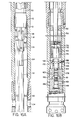
- FIG. 2 illustrates a preferred embodiment of pressure responsive means 24.
- Pressure responsive means 24 is formed in tubing string 12 and includes an upper section 34 and a lower section 36 which are threadably connected at 38.
- Upper section 34 includes threads 40 such that it can be connected to additional sections of tubing string 12.
- Lower section 36 includes threads 42 on its downhole end so that it can be connected to additional sections of tubing string 12.
- An axial chamber 44 is formed in pressure responsive means 24.
- the diameter of the portion of axial chamber 44 in upper section 34 is slightly greater than the diameter of chamber 44 in lower section 36.
- a piston 46 is positioned within axial chamber 44.
- Piston 46 includes an enlarged head 48 which is equal in diameter to the portion of axial chamber 44 located in upper section 34.
- O-rings 50 are placed in annular grooves 52 formed in head 48 to seal head 48 against the sides of axial chamber 44.
- 0-rings 54 are placed in annular grooves 56 formed in the downhole portion of piston 46 to seal the lower end of piston 46 against the walls of chamber 44 formed in lower section 36.
- Annular chamber 44 is enlarged below head 48 of piston 46 to form an annular chamber 58.
- Annular chamber 58 is connected by means of ports 60 and 62 to upper annulus section 20. Accordingly, fluid within annulus section 20 can freely flow into and out of annular chamber 58.
- annular chamber 58 The fluid and pressure in annular chamber 58 is isolated from the fluid and pressure in axial chamber 44 by O-rings 50 and 54. If the pressure in annular chamber 58 exceeds that in axial chamber 44, the fluid will act upon shoulders 62 and 64 to cause piston 46 to move upward within axial chamber 44.
- a ring 66 is positioned around intermediate portion 68 of head 48. Ring 66 is connected to intermediate portion 68 by shear pins 70 and 72 which extend through ring 66 and into recesses 74 and 76 in intermediate portion 68. Accordingly, when the pressure in upper annulus section 20 exceeds the pressure within tubing string 12 by a predetermined amount, it will act upon shoulders '62 and 64 to cause piston 46 to sever shear pins 70 and 72 and rise within axial chamber 44.
- Ring 66 abuts shoulder 78 formed in the top of annular chamber 58 to keep it from rising and thus allow pins 70 and 72 to hold piston 46 in place until the predetermined pressure differential is reached.
- Inner tubing string 30 includes a mandrel 80 on the upper portion thereof.
- the outer surface of mandrel 80 is threaded at 82 along essentially the entire length thereof. Threads 82 engage threads 84 formed on the interior downhole surface of piston 46. Accordingly, piston 46 is connected to inner tubing string 30 through mandrel 80. Additionally, since mandrel 80 is threaded along essentially the length thereof, its position within piston 46 can be adjusted during assembly such that inner tubing string 30 is in the correct position to engage the firing head as discussed further below.
- tubing string 12 is shown in partial longitudinal section and has a packer 16.
- Packer 16 has a packing element 86 and slips 88 for engaging the sides of casing 18.
- packer 16 is a setdown-type packer, many suitable embodiments of which are well known in the art.
- Inner tubing string 30 extends down through tubing string 12 past packer 16.
- Firing head 26 is illustrated in vertical cross-section.
- Firing head 26 includes upper and lower housing members 90 and 92.
- Upper housing member 90 is coupled directly to tubing string 12 by threads 94.
- Housing members 90 and 92 are held together by threads 96 and secured in place by a setscrew 98.
- Upper housing member 90 includes an inner chamber 100 which is in fluid communication with the interior 102 of tubing string 12. Ports 104 formed in housing member 90 communicate inner chamber 100 with lower annulus section 22 (see FIG. 1) formed between the well casing 18 and tubing string 12.
- the downhole end of inner tubing string 30 includes a plurality of ports 106 which place the interior lJ2 of inner tubing string 30 in fluid ccmmunica- tion with the interior of tubing string 12. It is through inner tubing sting 30 that the upper portion of tubing string 12 above pressure responsive means 24 is in fluid communication with the lower portion of tubing string 12.
- Coupler 110 connects inner tubing string 30 with pull rod 112 which activates firing head 26.
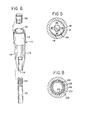
- Coupler 110 is illustrated more clearly in an exploded perspective view in FIG. 6.
- Coupler 110 includes an upper collar 114 and a lower collar 116. Collars 114 and 116 are connected by a plurality of fingers 118. The interior of upper collar 114 includes threads 120 such that it can be connected to inner tubing string 30 at 108.
- the upper portion of pull rod 112 is tapered at 122 to form a section 124 of reduced diameter.
- the uphole end of section 124 is threaded at 126 to receive a cap 128.
- the interior surface of lower collar 116 is smooth such that it can freely slide over section 124.
- collar 116 is placed over section 124 and coupler 110 is slid down until it engages taper 122. This exposes threads 126 such that cap 128 can be attached to the top of pull rod'112.
- inner tubing string 30 is raised, it pulls coupler 110 upward until lower collar 116 engages cap 128 which then causes pull rod 112 to be lifted upward activating firing head 26.
- FIG. 5 illustrates tubing string 12 and coupler 110 shown in cross-section as taken along lines 5-5 of FIG. 4A.
- Fluids which are contained within interior 102 of tubing string 12 can flow into inner tubing string 30 through the openings between fingers 118 of coupler 10 as well as through ports 106 which are formed in inner tubing string 30.
- the size and number of parts 106 and the openings between fingers 118 are designed such that the sum of their areas is approximately equal to the cross-sectional area of inner tubing string 30.
- lower housing member 92 of firing head 26 includes an inner chamber 130.
- Inner chamber 130 is filled with a substantially noncompressible fluid and is sealed at the top by a piston 132.
- Piston 132 includes O-rings 134 which seal piston 132 against inner surface 136 of lower housing member 92.
- O-rings 138 seal piston 132 against pull rod 112. The upward movement of piston 132 is limited by shoulder 140 formed in the lower end of upper housing member 90.
- well fluids enter through ports 104 into upper housing member 90 such that they fill inner chamber 100. These fluids then exert a pressure against piston 132 which transmits that pressure to the fluid in inner chamber 130 in lower housing member 92.
- a retaining cap 142 is threadably secured at'144 to the downhole end of pull rod 112.
- a set screw 146 retains cap 142 on pull rode 112.
- a charge retainer 152 is positioned in the lower end of housing member 92.
- a detonating charge 148 is located in an axial bore 150 in charge retainer 152 and is scaled in place by a-rings 149. Detonating charge 148 is held within retainer 152 by a stop nut 154.
- a shock absorber 156 is threadably secured in retainer 152 above detonating charge 148.
- 0-rings 158 provide a seal between charge retainer 152 and the sides of lower housing member 92.
- a firing pin retainer 160 is positioned in lower housing member 92 immediately above charge retainer 152.
- a firing pin 164 is positioned within a central bore 162 formed in retainer 160.
- the upper portion 166 of firing pin retainer 160 has a reduced outside diameter. Firing pin 164 is held within upper portion 166 by a plurality of steel balls 168 which are positioned within ports 170 in upper section 166 and engage peripheral recess 172 formed in firing pin 164.
- Retaining cap 142 fits over upper portion 166 and holds steel balls 168 within ports 170. Retaining cap 142 is held in position over upper portion 166 by a plurality of shear pins 174.
- a plurality of ports 176 are formed in retaining cap 142 and connect with an axial bore 178 formed therein. Bore 178 opens directly on top of firing pin 164. Accordingly, the pressurized fluid contained in inner chamber 130 can enter through ports 176 and exert a force upon the top of firing pin 164 urging it downward toward detonating charge 148. However, steel balls 168 prevent the downward movement of firing pin 164 as long as retaining cap 142 is in place.
- a plug 180 is positioned in lower housing member 92 and includes a rupture disk 182. If it becomes necessary to remove firing head 26 from a well without the perforating gun having been fired, rupture disk 182 helps prevent any misfiring from occurring. For example, if piston 132 becomes stuck causing a high pressure to be maintained within inner chamber 130, this pressure will be released through rupture disk 182 as firing head 26 is removed so that pressure will not be exerted on top.of firing pin 164.
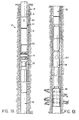
- FIGS. 7A and 7B illustrate detachable coupling section 32 in a partial cross-section.
- Detachable coupling section 32 is designed such that both tubing string 12 and inner tubing string 30 can be divided to uphole and downhole sections such that the downhole section can be dropped to the bottom of the well along with the perforating gun and firing head.
- Tubing string 12 includes an uphole section 184 and a downhole section 186.
- Uphole section 184 is threadably secured to additional lengths of outer tubing 12.
- Downhole section 186 is connected by means of sub 188 to a piece of tubing 190 which is connected to the upper portion of firing head assembly 26.
- Downhole section 186 is sealingly engaged with sub 188 by O-rings 192.
- uphole section 184 ir-cludes a portion of reduced diameter 194 having an annular groove 196 formed therein.
- a split-ring 198 is positioned within annular groove 196 to act as a retainer as more fully described hereinafter.
- the inner surface of uphole section 184 includes a serrated surface 200.
- Downhole section 186 includes a plurality of collet fingers 202 which include serrated surfaces 204 for engaging serrated surface 200 in uphole portion 184. Collet fingers 202 are connected to lower section 186 at 206.
- uphole section 184 abuts shoulder 208 of downhole section 186.
- An 0-ring 210 seals the joint between uphold section 184 and downhole section 186.
- Inner tubing string 30 also includes an uphole section 212 and a downhole section 214 within detachable coupling section 32.
- Uphole section 212 includes a collar 216 which is threadably connected to inner tubing string 30 at 218.
- a plurality of collet fingers 220 extend downwardly from collar 216 and terminate in inwardly extending lugs 222. Inwardly extending lugs 222 engage an outwardly extending rim 224 on downhole section 214 at 226.
- Collet fingers 220 are normally biased outward but are prevented from flaring out by a sleeve 228 which is positioned between inner tubing string 30 and tubing string 12.
- Sleeve 228 also prevents collet fingers 202 on tubing string 12 from springing inward towards their normally biased position.
- Sleeve 228 includes a plurality of lugs 230 which extend inward between collet fingers 220.
- a ring 232 is positioned on the bottom of lugs 230 on the inside of collet fingers 220. This arrangement is shown in'greater detail in FIG. 8 which is a cross-sectional view taken along line 8-8 of FIG. 7B.
- Sleeve 228 is held in position by a plurality of shear pins 234 which extend through sleeve 228 and into lugs 222 on the end of collet fingers 220.
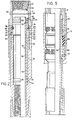
- FIGS. 9A and 9B illustrate a second preferred embodiment of pressure responsive means 24.
- the pressure responsive means 24 is formed in three sections in tubing string 12. These include an upper section 236, a middle section 238, and a lower section 240.
- Upper section 236 includes threads 242 for connection to the remainder of tubing string 12. The lower end of upper section 236 is threaded such that it engages a threaded portion of middle section 238 at 244.
- Upper section 236 includes an interior chamber 246.
- a piston 248 is positioned within chamber 248.
- Piston 248 includes a head portion 250 which engages the walls of upper section 236.
- O-rings 252 form a seal between head portion 250 and upper section 236.
- upper section 236 has an enlarged bore 254.
- a ring 256 is placed in enlarged bore 254 such that it abuts shoulder 258. Ring 256 is secured to piston 248 by shear pins 260.
- a plurality of ports 262 are formed in upper section 236 such that they place enlarged bore 254 in fluid communication with upper annulus section 20 formed between tubing string 12 and casing 18.
- the fluid which is in upper annulus section 20 can pass through ports 262 and into enlarged bore 254. At this point, the fluid can b'pass ring 256 and engage shoulder 264 formed on the bottom of head portion 250 of piston 248. When this pressure exceeds the pressure inside tubing string 12 by a predetermined amount, it will cause piston 246 to rise severing shear pins 260.
- pistion 248 is threaded at the bottom end at 266 such that inner tubing string 30 can be attached thereto.
- Middle section 238 of pressure responsive means 24 includes an interior shoulder 268 which engages the bottom of piston 248 to prevent it from falling down in tubing string 12.
- Two O-rings 270 provide a seal between the outer surface of the lower end of piston 248 and the inner surface of middle section 238.
- a wiper ring 272 is formed in piston 248 just below the top of middle section 238.
- Middle section 238 has a central, tubular portion 274 which extends down into lower section 240.
- the bottom end of middle section 238 is threaded at 276 to engage threads 278 formed on the interior surface of lower section 240.
- Threads 278 extend substantially along the entire length of the interior of lower section 240.
- a sleeve 280 is positioned within lower section 240 in such a manner that it leaves a space for the tubular portion of 278 to extend down between sleeve 280 and lower section 240.
- Sleeve 280 is threaded onto lower portion 240 at 282. It is held in this position by set screw 284 and a seal is formed between sleeve 280 and lower section 240 by O-ring 286.
- 0-rings 288 are positioned in annular grooves formed in the lower end of tubular portion 274 to form a seal between middle section 238 and sleeve 280.
- joint 290 between lower section 240 and the remainder of tubing string 12.
- This embodiment of the present invention is designed to prevent the turning of the interior components as joint 290 is assembled.
- Lower section 240 is first screwed up onto threads 276 of tubular portion 274 until tubular portion 274 abuts shoulder 292 in lower section 240.
- Lower section 240 is then screwed into tubing string 12 at joint 290.
- the threads of joint 290 and the threads 276 and 278 are formed in opposite directions. Accordingly, as joint 290 is formed, lower section 240 and sleeve 280 which is attached thereto, are partially unscrewed from tubular portion 274 until it reaches the position illustrated in FIG. 9B.
- Locking means 294 is illustrated in greater detail in FIG. 10.
- Locking means 294 includes a plurality of lugs 296 which are inserted through slots 298 formed in lower section 240. Lugs 296 extend into slots 300 formed in tubular portion 274. A ring 302 is then placed around lower section 240 above slots 298 to prevent lugs 296 from falling out. Ring 302 is held in place by a set screw 304.
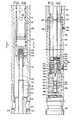
- FIG. 11 illustrates a second preferred embodiment of detachable coupling section 32 in vertical cross-section.
- This coupling section is designed such that the collet fingers on both the inner and outer tubing strings are on the downhole sections such that the fall to the bottom of the well when the coupling is released. This prevents the collet fingers from becoming entangled with any equipment which is lowered through the tubing strings after the couplings have been detached.
- tubing string 12 includes an uphole section 306 and a downhole section 308.
- Uphole section 306 has a bore running therethrough which includes a portion of reduced diameter 310.
- An annular group 312 is formed in portion 310 and holds a split ring 314.
- uphole section 306 is serrated at 316 for engaging collet fingers 318 formed on the top of downhole section 308. Collet fingers 318 are joined to downhole section 308 at 320. A seal is formed between uphole section 306 and downhole section 308 by O-ring 322.
- Inner tubing member 30 is also formed from an uphole section 324 and a downhole section 326.
- Uphole section 324 has a lower portion of reduced diameter 328 with an annular groove 330 formed therein.
- Collet fingers 332 are formed on the top of downhole section 326 and are joined to downhole section 326 at 334.
- Collet fingers 332 include lugs 336 which engage annular groove 330 formed in upper section 324.
- a slidable sleeve 338 is positioned between tubing string 12 and inner tubing string 30.
- Sleeve 338 is shown in greater detail in a perspective view in FIG. 12.
- Sleeve 338 includes an upper collar 340 and a plurality of downwardly extending fingers 342.
- Lugs 344 extend inwardly from the lower end of fingers 342 and are joined at the bottom by a ring 346.
- Sleeve 338 is designed such that collet fingers 332 of downhole section 326 can fit within collar 340 with ring 346 being positioned within the collet fingers. This arrangement is illustrated in greater detail in FIG. 13 which is a cross-sectional view taken along line 13-13 of FIG. 11.
- FIG. 14 illustrates the pressure responsive means 24 of FIG. 2 in the activated position.
- a pressure differential is created between the interior of tubing string 12 and the upper annulus section 20. This can be accomplished either by pressurizing upper annulus section 20 or by reducing the pressure within tubing string 12.
- the pressure in upper annulus section 20 is greater than the pressure in tubing string 12, it enters through ports 60 and exerts a force upon shoulders 62 and 64 of piston 46.
- piston 46 severs shear pins 70 and 72 and rises within axial chamber 44 until it abuts shoulder 45.
- ring 66 can drop down until it rests on top of lower section 36.
- O-rings 54 still provide a seal between piston 46 and lower section 36 to isolate the interior of tubing string 12 from upper annulus section 20.
- piston 46 As piston 46 rises within chamber 44, it pulls inner tubing string 30 upward to activate the firing head as discussed further below.
- FIG. 15 illustrates packer 16 in the engaged position such that packing element 86 creates a seal dividing the annulus into upper annulus section 20 and lower annulus section 22.
- packer 16 will depend on the type of packer selected. Suitable packers and their mode of operation are well known to those skilled in the art.
- FIGS. 16A and 16B illustrate firing head 26 in the engaged position.
- inner tubing string 30 is raised by piston 46, it pulls coupler 110 upward until lower collar 116 engages cap 128. Further upward movement then causes pull rod 112 to be pulled upward.
- shear pins 174 are severed.
- shear pins 174 are designed to break at a force much less than the shear pins which retain the piston 46 in pressure responsive means 24. Accordingly, once piston 46 begins to rise, shear pins 174 will be severed.
- Piston 132 which surrounds pull rod 112 is shown depressed from its static position. As firing head 26 is lowered into a well, the pressure in the lower annulus section 22 and in the interior of tubing string 12 increases causing piston 132 to slide downward and compress the fluid contained in inner chamber 130. This causes the pressure necessary to actuate firing pin 164.
- An atmospheric chamber 161 is formed in the lower portion of firing pin retainer 160 and receives the compressed air created as firing pin 164 decends. Atmospheric chamber 161 is isolated from the other pressures in the bottom of the system by the O-rings 158 in charge retainer 152 and O-rings 149 in detonating charge 148. Chamber 161 .is isolated on the top by O-rings 163 on firing pin 164 and O-rings 159 on firing pin retainer 160.
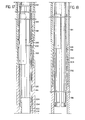
- FIG. 17 illustrates the method of activation of detachable coupling section 32 of FIGS. 7A and 7B.
- a positioning tool such as an Otis Model B Positioning Tool (not shown) is lowered down through tubing string 12 and inner tubing string 30 until it engages ring 232 positioned on the bottom of lugs 230 of sleeve 228.
- the positioning tool is then pulled uphole on the slickline. As it is pulled upward, it causes sleeve 228 to slide upward between tubing string 12 and inner tubing string 30.
- collet fingers 220 can spring outward until inwardly extending rim 222 disengage from outwardly extending lugs 224. Downhole section 214 is then free to drop downward within tubing string 12. This downward movement is allowed as coupler 110 (see FIG. 4A) slides down on the section 124 of pull rod 112 having a reduced diameter.
- split ring 198 returns to its normal position to prevent sleeve 228 from falling downhole.
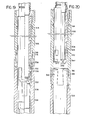
- FIGS. 19 and 20 illustrate the operation of the detachable coupling section 32 illustrated in FIG. 11.
- a positioning tool is lowered on a wireline through tubing string 12 and inner tubing string 30 until it engages ring 346 on sleeve 338.
- Sleeve 338 can then be pulled upward between tubing string 12 and inner tubing string 30.
- collet fingers 332 When collar 338 is raised to the position illustrated in FIG. 19, collet fingers 332 can spring outward through the apertures formed between fingers 342 in sleeve 338. At this point, lugs 336 on collet fingers 332 disengage from annular groove 330 and allow downhole section 326 to fall down within tubing string 12.
- collet fingers 318 on downhole section 308 of tubing string 12 can spring inwardly to disengage the serrated surface 316 and allow downhole section 308 to fall to the bottom of the well along with the perforating gun and firing head.
- Sleeve 338 can then be pulled further upward until it passes split ring 314 which prevents sleeve 338 from falling down in the hole.
Landscapes
- Life Sciences & Earth Sciences (AREA)
- Engineering & Computer Science (AREA)
- Geology (AREA)
- Mining & Mineral Resources (AREA)
- Physics & Mathematics (AREA)
- Environmental & Geological Engineering (AREA)
- Fluid Mechanics (AREA)
- General Life Sciences & Earth Sciences (AREA)
- Geochemistry & Mineralogy (AREA)
- Earth Drilling (AREA)
- Physical Or Chemical Processes And Apparatus (AREA)
- Coating Apparatus (AREA)
Applications Claiming Priority (2)
| Application Number | Priority Date | Filing Date | Title |
|---|---|---|---|
| US06/773,773 US4655298A (en) | 1985-09-05 | 1985-09-05 | Annulus pressure firer mechanism with releasable fluid conduit force transmission means |
| US773773 | 1985-09-05 |
Publications (2)
| Publication Number | Publication Date |
|---|---|
| EP0217557A2 true EP0217557A2 (de) | 1987-04-08 |
| EP0217557A3 EP0217557A3 (de) | 1988-02-24 |
Family
ID=25099270
Family Applications (1)
| Application Number | Title | Priority Date | Filing Date |
|---|---|---|---|
| EP86306841A Ceased EP0217557A3 (de) | 1985-09-05 | 1986-09-04 | Bohrlochdurchlöcherungsvorrichtung |
Country Status (6)
| Country | Link |
|---|---|
| US (1) | US4655298A (de) |
| EP (1) | EP0217557A3 (de) |
| AU (1) | AU579260B2 (de) |
| CA (1) | CA1259560A (de) |
| MY (1) | MY101605A (de) |
| NO (1) | NO863544L (de) |
Cited By (2)
| Publication number | Priority date | Publication date | Assignee | Title |
|---|---|---|---|---|
| EP0262822A3 (en) * | 1986-09-16 | 1989-04-19 | Halliburton Company | Releasable connection for conduit string |
| GB2230805A (en) * | 1989-04-28 | 1990-10-31 | Baker Hughes Inc | Method and apparatus for completion of a well |
Families Citing this family (16)
| Publication number | Priority date | Publication date | Assignee | Title |
|---|---|---|---|---|
| US4732211A (en) * | 1986-08-07 | 1988-03-22 | Halliburton Company | Annulus pressure operated vent assembly |
| US4800958A (en) * | 1986-08-07 | 1989-01-31 | Halliburton Company | Annulus pressure operated vent assembly |
| US4804044A (en) * | 1987-04-20 | 1989-02-14 | Halliburton Services | Perforating gun firing tool and method of operation |
| US4901802A (en) * | 1987-04-20 | 1990-02-20 | George Flint R | Method and apparatus for perforating formations in response to tubing pressure |
| US4911251A (en) * | 1987-12-03 | 1990-03-27 | Halliburton Company | Method and apparatus for actuating a tubing conveyed perforating gun |
| US4917189A (en) * | 1988-01-25 | 1990-04-17 | Halliburton Company | Method and apparatus for perforating a well |
| US4836109A (en) * | 1988-09-20 | 1989-06-06 | Halliburton Company | Control line differential firing head |
| US4883123A (en) * | 1988-11-23 | 1989-11-28 | Halliburton Company | Above packer perforate, test and sample tool and method of use |
| US4915171A (en) * | 1988-11-23 | 1990-04-10 | Halliburton Company | Above packer perforate test and sample tool and method of use |
| US4936387A (en) * | 1989-04-28 | 1990-06-26 | Baker Hughes Incorporated | Method and apparatus for completion of a horizontal well |
| US5161616A (en) * | 1991-05-22 | 1992-11-10 | Dresser Industries, Inc. | Differential firing head and method of operation thereof |
| US5505261A (en) * | 1994-06-07 | 1996-04-09 | Schlumberger Technology Corporation | Firing head connected between a coiled tubing and a perforating gun adapted to move freely within a tubing string and actuated by fluid pressure in the coiled tubing |
| US5791417A (en) * | 1995-09-22 | 1998-08-11 | Weatherford/Lamb, Inc. | Tubular window formation |
| US5709265A (en) * | 1995-12-11 | 1998-01-20 | Weatherford/Lamb, Inc. | Wellbore window formation |
| US5636692A (en) * | 1995-12-11 | 1997-06-10 | Weatherford Enterra U.S., Inc. | Casing window formation |
| US5954133A (en) * | 1996-09-12 | 1999-09-21 | Halliburton Energy Services, Inc. | Methods of completing wells utilizing wellbore equipment positioning apparatus |
Family Cites Families (6)
| Publication number | Priority date | Publication date | Assignee | Title |
|---|---|---|---|---|
| US4560000A (en) * | 1982-04-16 | 1985-12-24 | Schlumberger Technology Corporation | Pressure-activated well perforating apparatus |
| US4509604A (en) * | 1982-04-16 | 1985-04-09 | Schlumberger Technology Corporation | Pressure responsive perforating and testing system |
| US4484632A (en) * | 1982-08-30 | 1984-11-27 | Geo Vann, Inc. | Well completion method and apparatus |
| GB2138925B (en) * | 1983-03-31 | 1988-02-24 | Vann Inc Geo | Firing of well perforation guns |
| US4544034A (en) * | 1983-03-31 | 1985-10-01 | Geo Vann, Inc. | Actuation of a gun firing head |
| US4526233A (en) * | 1984-01-20 | 1985-07-02 | Baker Oil Tools, Inc. | Releasable coupling for tubing conveyed subterranean well perforating gun |
-
1985
- 1985-09-05 US US06/773,773 patent/US4655298A/en not_active Expired - Fee Related
-
1986
- 1986-08-25 AU AU61811/86A patent/AU579260B2/en not_active Ceased
- 1986-09-04 EP EP86306841A patent/EP0217557A3/de not_active Ceased
- 1986-09-04 NO NO863544A patent/NO863544L/no unknown
- 1986-09-05 CA CA000517587A patent/CA1259560A/en not_active Expired
-
1987
- 1987-09-18 MY MYPI87001745A patent/MY101605A/en unknown
Cited By (3)
| Publication number | Priority date | Publication date | Assignee | Title |
|---|---|---|---|---|
| EP0262822A3 (en) * | 1986-09-16 | 1989-04-19 | Halliburton Company | Releasable connection for conduit string |
| GB2230805A (en) * | 1989-04-28 | 1990-10-31 | Baker Hughes Inc | Method and apparatus for completion of a well |
| GB2230805B (en) * | 1989-04-28 | 1992-08-26 | Baker Hughes Inc | Method and apparatus for completion of a well |
Also Published As
| Publication number | Publication date |
|---|---|
| AU579260B2 (en) | 1988-11-17 |
| NO863544D0 (no) | 1986-09-04 |
| NO863544L (no) | 1987-03-06 |
| MY101605A (en) | 1991-12-17 |
| US4655298A (en) | 1987-04-07 |
| CA1259560A (en) | 1989-09-19 |
| AU6181186A (en) | 1987-03-12 |
| EP0217557A3 (de) | 1988-02-24 |
Similar Documents
| Publication | Publication Date | Title |
|---|---|---|
| US4655298A (en) | Annulus pressure firer mechanism with releasable fluid conduit force transmission means | |
| EP0968353B1 (de) | Geschosslöchersystem für vollbohrungen | |
| US4509604A (en) | Pressure responsive perforating and testing system | |
| US5398760A (en) | Methods of perforating a well using coiled tubing | |
| US6173779B1 (en) | Collapsible well perforating apparatus | |
| AU755995B2 (en) | Full bore gun system | |
| US4619333A (en) | Detonation of tandem guns | |
| US4560000A (en) | Pressure-activated well perforating apparatus | |
| US4969525A (en) | Firing head for a perforating gun assembly | |
| AU647709B2 (en) | Well completion method and apparatus | |
| US4566538A (en) | Fail-safe one trip perforating and gravel pack system | |
| US8302693B2 (en) | Wireless downhole tool positioning system | |
| US5174379A (en) | Gravel packing and perforating a well in a single trip | |
| CA1233407A (en) | Firing system for tubing conveyed perforating gun | |
| US4564076A (en) | Well completion method and apparatus | |
| US11708731B2 (en) | Plugging assemblies for plugging cased wellbores | |
| CA1201379A (en) | Ball actuated releasable coupling | |
| US4815540A (en) | Method and apparatus for releasing a well perforating gun from a supporting tubing string | |
| US4523643A (en) | Well perforating and completion apparatus and associated method | |
| US4726610A (en) | Annulus pressure firer mechanism with releasable fluid conduit force transmission means | |
| CA1211043A (en) | Differential vent and bar actuated circulating valve and method | |
| CA2300331C (en) | Pressure-actuated running tool | |
| EP0325848A1 (de) | Vorrichtung und Verfahren zum Perforieren eines Bohrloches | |
| CA1289466C (en) | Air chamber actuated dual tubing release assembly | |
| CA1204053A (en) | Drill stem test and perforating system |
Legal Events
| Date | Code | Title | Description |
|---|---|---|---|
| PUAI | Public reference made under article 153(3) epc to a published international application that has entered the european phase |
Free format text: ORIGINAL CODE: 0009012 |
|
| AK | Designated contracting states |
Kind code of ref document: A2 Designated state(s): AT DE FR GB IT NL |
|
| PUAL | Search report despatched |
Free format text: ORIGINAL CODE: 0009013 |
|
| AK | Designated contracting states |
Kind code of ref document: A3 Designated state(s): AT DE FR GB IT NL |
|
| 17P | Request for examination filed |
Effective date: 19880405 |
|
| 17Q | First examination report despatched |
Effective date: 19890419 |
|
| STAA | Information on the status of an ep patent application or granted ep patent |
Free format text: STATUS: THE APPLICATION HAS BEEN REFUSED |
|
| 18R | Application refused |
Effective date: 19900705 |
|
| RIN1 | Information on inventor provided before grant (corrected) |
Inventor name: GEORGE, FLINT R. Inventor name: HAUGEN, DAVID M. |