EP0218143A2 - Aufzeichnungsflüssigkeit für die Verwendung in Tintenstrahl-Aufzeichnungssystemen - Google Patents
Aufzeichnungsflüssigkeit für die Verwendung in Tintenstrahl-Aufzeichnungssystemen Download PDFInfo
- Publication number
- EP0218143A2 EP0218143A2 EP86113137A EP86113137A EP0218143A2 EP 0218143 A2 EP0218143 A2 EP 0218143A2 EP 86113137 A EP86113137 A EP 86113137A EP 86113137 A EP86113137 A EP 86113137A EP 0218143 A2 EP0218143 A2 EP 0218143A2
- Authority
- EP
- European Patent Office
- Prior art keywords
- recording
- formula
- dye
- recording liquid
- cooh
- Prior art date
- Legal status (The legal status is an assumption and is not a legal conclusion. Google has not performed a legal analysis and makes no representation as to the accuracy of the status listed.)
- Withdrawn
Links
Classifications
-
- C—CHEMISTRY; METALLURGY
- C09—DYES; PAINTS; POLISHES; NATURAL RESINS; ADHESIVES; COMPOSITIONS NOT OTHERWISE PROVIDED FOR; APPLICATIONS OF MATERIALS NOT OTHERWISE PROVIDED FOR
- C09D—COATING COMPOSITIONS, e.g. PAINTS, VARNISHES OR LACQUERS; FILLING PASTES; CHEMICAL PAINT OR INK REMOVERS; INKS; CORRECTING FLUIDS; WOODSTAINS; PASTES OR SOLIDS FOR COLOURING OR PRINTING; USE OF MATERIALS THEREFOR
- C09D11/00—Inks
- C09D11/30—Inkjet printing inks
- C09D11/32—Inkjet printing inks characterised by colouring agents
- C09D11/328—Inkjet printing inks characterised by colouring agents characterised by dyes
-
- C—CHEMISTRY; METALLURGY
- C09—DYES; PAINTS; POLISHES; NATURAL RESINS; ADHESIVES; COMPOSITIONS NOT OTHERWISE PROVIDED FOR; APPLICATIONS OF MATERIALS NOT OTHERWISE PROVIDED FOR
- C09B—ORGANIC DYES OR CLOSELY-RELATED COMPOUNDS FOR PRODUCING DYES, e.g. PIGMENTS; MORDANTS; LAKES
- C09B35/00—Disazo and polyazo dyes of the type A<-D->B prepared by diazotising and coupling
- C09B35/50—Tetrazo dyes
- C09B35/56—Tetrazo dyes of the type
Definitions
- the invention also relates to the use of such recording liquids in ink jet recording systems.
- Preferred dyes I - III are those in which K 1 , K 2 , K ' 1 and K' 2 represent residues of coupling components of the formulas IV - XII.
- the recording liquid can contain one or more dyes (I).
- the dyes are generally used in the form of their salts, in particular the alkali salts (Li, Na, K), the ammonium salts, mono-, di- or tris-C 1 -C 4 -alkylammonium salts, in particular also the C 1 -C 4 -alkanolammonium salts.
- alkali salts Li, Na, K
- ammonium salts mono-, di- or tris-C 1 -C 4 -alkylammonium salts, in particular also the C 1 -C 4 -alkanolammonium salts.
- the dyes I are prepared in a manner known per se by tetrazotation of diamines of the formula and coupling with coupling components K 1 -H and K 2 -H.
- the recording liquids according to the invention generally contain about 1-20% by weight of one or more dyes (I), 80-99% by weight of water and / or polar protic or dipolar aprotic solvents and optionally other conventional constituents.
- Preferred solvents are polyhydric alcohols and their ethers or esters, carboxamides, sulfoxides and sulfones, especially those with molecular weights ⁇ 200.
- Particularly suitable solvents are, for example: ethylene glycol, diethylene glycol, triethylene glycol, 2-hydroxyethyl acetate, 2- (2'-hydroxy) ethyl acetate, glycerol, 1,2-dihydroxypropane , 1-methoxy-2-propanol, 2-methoxy-1-propanol, N, N-dimethylformamide, N, N-dimethylacetamide, formamide, N-methylpyrrolidone, ⁇ -caprolactam, N-methyl- ⁇ -caprolactam, tetramethylurea , 1,3-dimethyl-2-imidazolidinone, N, N'-dimethylpropyleneurea, dimethyl sulfoxide, dimethyl sulfone, sulfolane.
- the inks of the invention are e.g. B. by dissolving aer dyes (I) in water and / or one or more of the above organic solvents, optionally at elevated temperatures and with the addition of inorganic or organic bases; if necessary, conventional ionic or nonionic additives can also be used, for. B. those with which the viscosity can be lowered and / or the surface tension can be increased.
- lithium hydroxide, sodium hydroxide, potassium hydroxide, lithium carbonate, sodium carbonate, potassium carbonate can be used as inorganic bases such.
- organic bases z.
- B ethanolamine, diethanolamine, triethanolamine, N-methylethanolamine, N, N-dimethylethanolamine, N-methyldiethanolamine, 1-amino-2-propanol, 2-amino-1-propanol, di-isopropanolamine, N-2-hydroxyethyl-diisopropanolamine, Tris-N, N, N- [2- (2'-hydroxyethoxy-) ethyl] amine or sodium methylate, lithium ethylate, potassium tert-butoxide are used.
- the inks according to the invention are stable in storage and use, their viscosity and their surface tension can be adapted to the different requirements; they have good recordability and beam stability.
- 3 g of the dye of formula (i) are dissolved at room temperature in 30 g of dimethyl sulfoxide and 67 g of ethylene glycol; the solution is filtered through a 1-p filter and then degassed in vacuo. A black ink is obtained which provides light, rubbing and water-correct records.
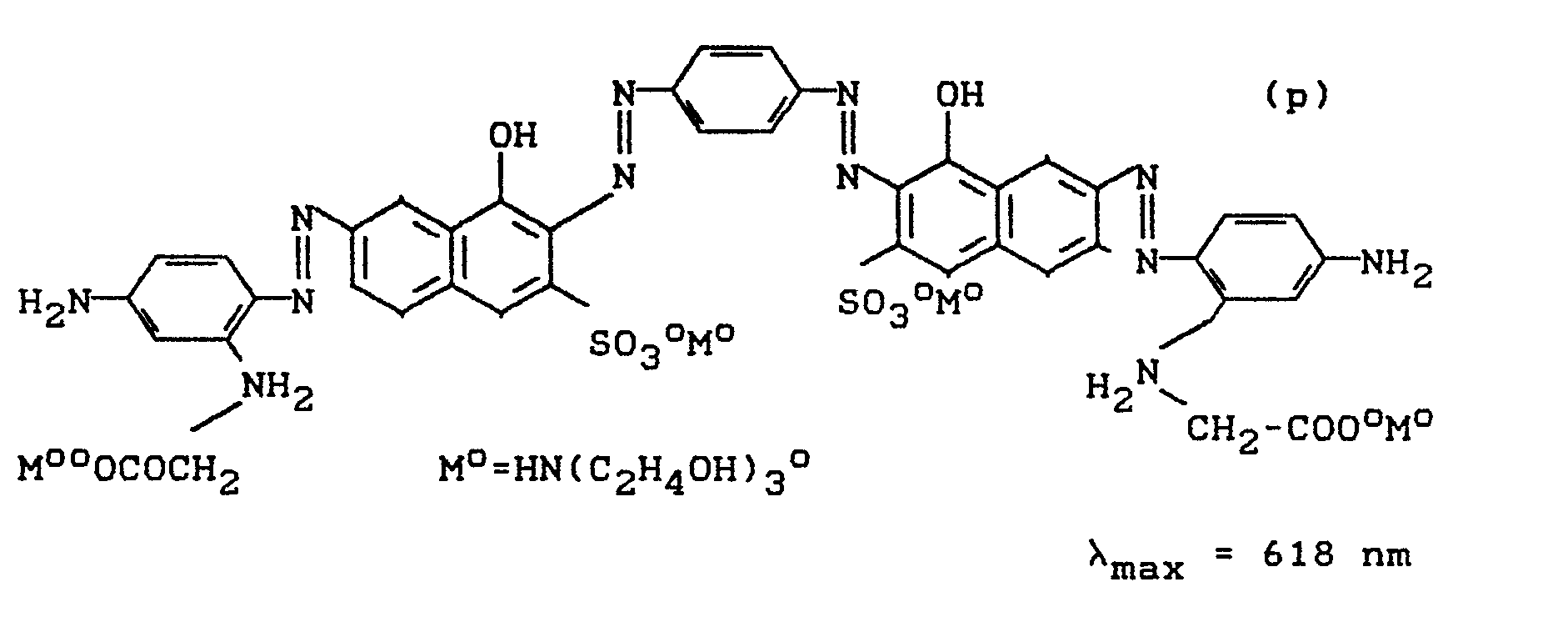
- 3 g of the dye of the formula (p) are dissolved at room temperature in 20 g of ⁇ -caprolactam, 60 g of water and 17 g of glycerol; the solution is filtered through a 1-p filter and then degassed in vacuo. A black ink is obtained which provides light, rubbing and water-correct records.
Landscapes
- Chemical & Material Sciences (AREA)
- Organic Chemistry (AREA)
- Life Sciences & Earth Sciences (AREA)
- Engineering & Computer Science (AREA)
- Materials Engineering (AREA)
- Wood Science & Technology (AREA)
- Inks, Pencil-Leads, Or Crayons (AREA)
Abstract
Description
- Gegenstand der vorliegenden Erfindung ist eine Aufzeichnungsflüssigkeit für Tintenstrahl-Aufzeichnungssysteme, dadurch gekennzeichnet, daß sie einen Farbstoff der Formel

- K1, K2 = Rest einer Kupplungskomponente aus der Reihe der Benzol-, Naphthalin- oder ß-Dicarbonylverbindungen oder der 5- oder 6-gliedrigen Stickstoff-Heterocyclen, welche höchstens eine Sulfogruppe enthält,
- R 1, R2 = H, Cl, CH3, OCH3, COOH,
- n, m, p = 0 - 2, wobei die Gesamtzahl der Sulfogruppen im Molekül 2 - 6 beträgt.
- Gegenstand der Erfindung ist auch die Verwendung derartiger Aufzeichnungsflüssigkeiten in Tintenstrahl-Aufzeichnungssystemen.
- Bevorzugte Farbstoffe (I) sind dabei solche der Formel
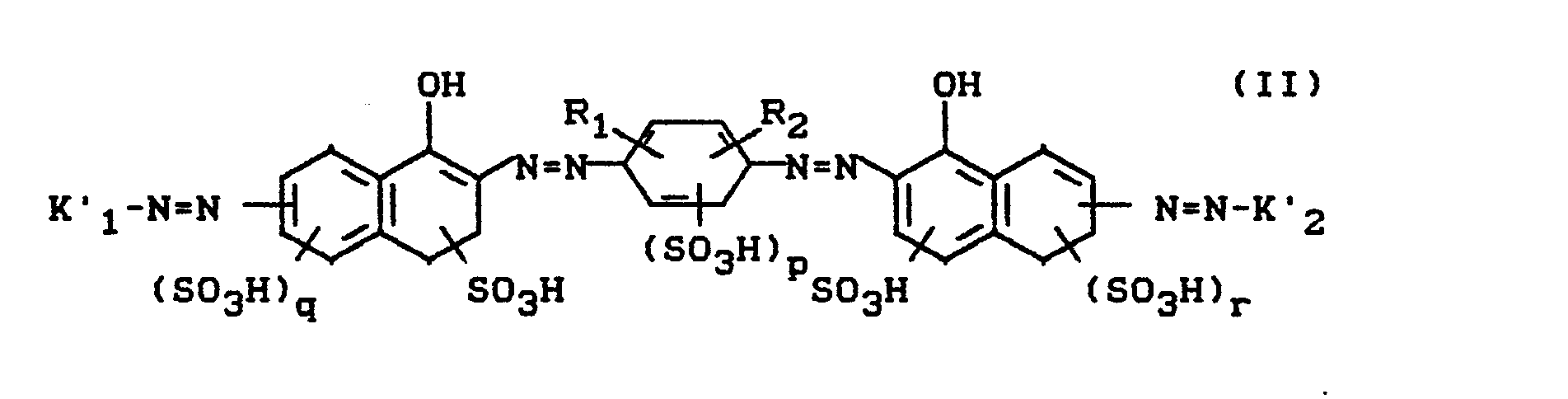
- K'1,K'2 = Rest einer Kupplungskomponente aus der Benzol-, Naphthalin-, Pyrazolon-, Pyridin-, Pyrimidin-oder Acetessigarylid-Reihe, die höchstens eine Sulfogruppe enthält,
- q, r = 0 oder 1
- p',q', = 0 oder 1.
- Bevorzugte Farbstoffe I - III sind solche, in denen K1, K2, K'1 und K'2 Reste von Kupplungs-Komponenten der Formeln IV - XII darstellen.
- Die Reste K1 und K2 können gleich oder verschieden sein.


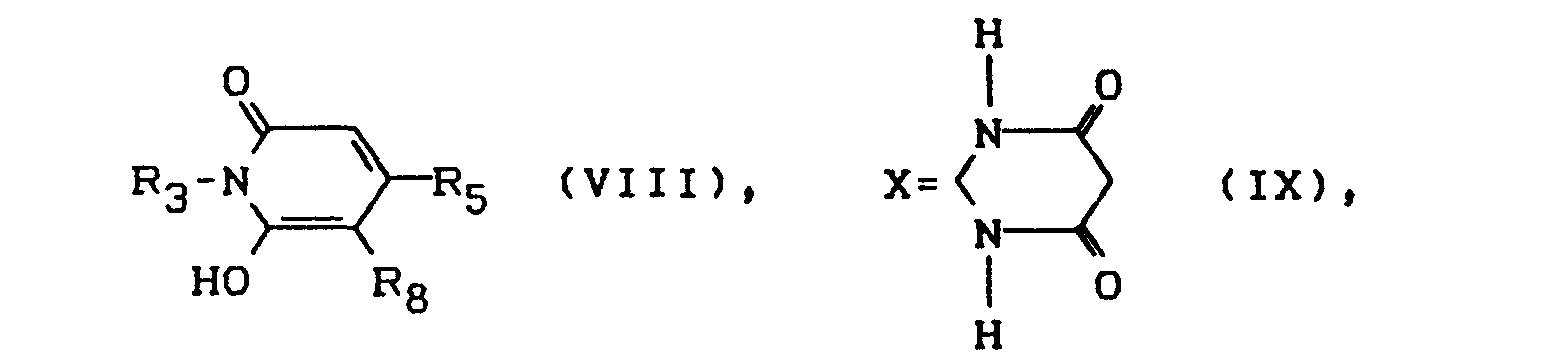


- R3 = H, Cl, CH3, OCH3, COOH, S03H
- R4 = OH, NH2
- R5 = OH, NH2, NHCH2COOH, NHCONH2, NHCOCH3 oder NHCOCH2OH
- R6 = H, CH3, COOH, COOCH3, COOC2H5
- R7 = H, Phenyl, 2-, 3- oder 4-Sulfophenyl
- R8 = H, CN, CONH2, COOH, S03H
- R9 = H, CH3
- X = 0, S, NH, NCN
- s = 1 oder 2
- t = 0 oder 1
- Die Aufzeichnungsflüssigkeit kann einen oder mehrere Farbstoffe (I) enthalten.
- Die Farbstoffe werden im allgemeinen in Form ihrer Salze eingesetzt, insbesondere der Alkalisalze (Li, Na, K), der Ammoniumsalze, Mono-, Di- oder Tris-C1-C4-alkyl-ammoniumsalze, insbesondere auch der C1-C4-Alkanolammoniumsalze.
- Bevorzugte Ammoniumsalze sind dabei solche mit dem Kation

- R9 = H, C1-C4-Alkyl, gegebenenfalls substituiert durch OH oder Hydroxy-Cl-C4-alkoxy-Cl-C4-alkyl, insbesondere CH3, C2H5, CH2CH2OH, CH2CHOHCH3, C3H6OC2H4OH
- R10 = C1-C4-Hydroxyalkyl, C1-C4-Hydroxyalkoxy-C1-C4- alkyl, insbesondere CH2CH2OH, CH2CHOHCH3, C3H6OC2H4O4.
- Die Herstellung der Farbstoffe I erfolgt in an sich bekannter Weise durch Tetrazotierung von Diaminen der Formel

- Die erfindungsgemäßen Aufzeichnungsflüssigkeiten enthalten im allgemeinen etwa 1-20 Gew.-X eines oder mehrerer Farbstoffe (I), 80-99 Gew.-X Wasser und/oder polare protische oder dipolare aprotische Lösungsmittel sowie gegebenenfalls weitere übliche Bestandteile.
- Bevorzugte Lösungsmittel sind dabei mehrwertige Alkohole und deren Äther oder Ester, Carbonsäureamide, Sulfoxide und Sulfone, insbesondere solche mit Molekulargewichten < 200. Besonders geeignete Lösungsmittel sind beispielsweise: Ethylenglykol, Diethylenglykol, Triethylenglykol, Essigsäure-2-hydroxyethylester, Essigsäure-2-(2'-hydro- droxy)-ethylester, Glycerin, 1,2-Dihydroxypropan, 1-Me- thoxy-2-propanol, 2-Methoxy-1-propanol, N,N-Dimethylformamid, N,N-Dimethylacetamid, Formamid, N-Methylpyrrolidon, ε-Caprolactam, N-Methyl-ε-caprolactam, Tetramethylharnstoff, 1,3-Dimethyl-2-imidazolidinon, N,N'-Dimethylpropylenharnstoff, Dimethylsulfoxid, Dimethylsulfon, Sulfolan.
- Die erfindungsgemäßen Tinten werden z. B. durch Auflösen aer Farbstoffe (I) in Wasser und/oder einem oder mehreren der oben genannten organischen Lösungsmitteln, gegebenenfalls bei erhöhten Temperaturen und unter Zusatz von anorganischen oder organischen Basen hergestellt; gegebenenfalls können zusätzlich noch übliche ionische oder nichtionische Zusatzstoffe verwendet werden, z. B. solche mit denen die Viskosität erniedrigt und/oder die Oberflächenspannung erhöht werden können.
- Als anorganische Basen können z. B. Lithiumhydroxid, Natriumhydroxid, Kaliumhydroxid, Lithiumcarbonat, Natriumcarbonat, Kaliumcarbonat eingesetzt werden.
- Als organische Basen können z. B. Ethanolamin, Diethanolamin, Triethanolamin, N-Methylethanolamin, N,N-Dimethylethanolamin, N-Methyldiethanolamin, 1-Amino-2-propanol, 2-Amino-1-propanol, Di-isopropanolamin, N-2-Hydroxyethyl- diisopropanolamin, Tris-N,N,N-[2-(2'-Hydroxyethoxy-) ethyl]-amin oder Natriummethylat, Lithiumethylat, Kalium- tert.-butylat dienen.
- Bei der Verwendung der erfindungsgemäßen Farbstoffe in Ink-Jet-Tinten erhält man kontrastreiche, scharfe Bilder mit hoher Wasser-, Licht- und Abriebechtheit.
- Die erfindungsgemäßen Tinten sind lager- und gebrauchsstabil, ihre Viskosität und ihre Oberflächenspannung sind den unterschiedlichen Erfordernissen anpassbar; sie besitzen gute Aufzeichnungsfähigkeit und Strahlstabilitäten.
- 3 g des Farbstoffes der Formel (a)

- Verwendet man statt des in Beispiel 1 eingesetzten Farbstoffes einen der Formel (b) - (h), so erhält man ebenfalls schwarze Tinten, die licht-, reib- und wasserechte Aufzeichnungen liefern.


- 3 g des Farbstoffes der Formel (i) werden bei Raumtemperatur in 30 g Dimethylsulfoxid und 67 g Ethylenglykol gelöst; die Lösung wird durch ein 1-p-Filter filtriert und anschließend im Vakuum entgast. Man erhält eine schwarze Tinte, die licht-, reib- und wasserechte Aufzeichnungen liefert.

- Verwendet man statt des in Beispiel 9 eingesetzten Farbstoffes einen der Formeln (k) - (o), so erhält man ebenfalls schwarze Tinten, die licht-, reib- und wasserechte Aufzeichnungen liefern.


- 3 g des Farbstoffes der Formel (p) werden bei Raumtemperatur in 20 g ε-Caprolactam, 60 g Wasser und 17 g Glycerin gelöst; die Lösung wird durch ein 1-p-Filter filtriert und anschließend im Vakuum entgast. Man erhält eine schwarze Tinte, die licht-, reib- und wasserechte Aufzeichnungen liefert.
- Verwendet man statt des in Beispiel 16 eingesetzten Farbstoffes einen der Formeln (q) - (v), so erhält man ebenfalls schwarze Tinten, die licht-, reib- und wasserechte Aufzeichnungen liefern.


Claims (4)
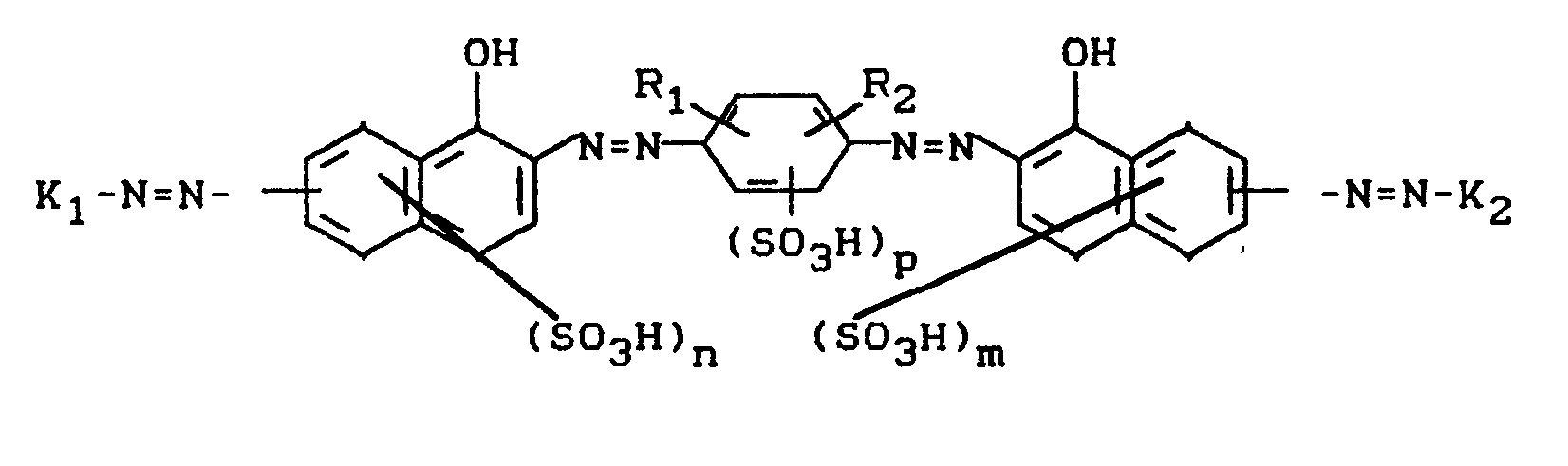
wobei die Gesamtzahl der Sulfogruppen im Molekül 2-6 beträgt.


Applications Claiming Priority (2)
| Application Number | Priority Date | Filing Date | Title |
|---|---|---|---|
| DE19853535661 DE3535661A1 (de) | 1985-10-05 | 1985-10-05 | Aufzeichnungsfluessigkeit fuer die verwendung in tintenstrahl-aufzeichnungssystemen |
| DE3535661 | 1985-10-05 |
Publications (2)
| Publication Number | Publication Date |
|---|---|
| EP0218143A2 true EP0218143A2 (de) | 1987-04-15 |
| EP0218143A3 EP0218143A3 (de) | 1988-03-02 |
Family
ID=6282894
Family Applications (1)
| Application Number | Title | Priority Date | Filing Date |
|---|---|---|---|
| EP86113137A Withdrawn EP0218143A3 (de) | 1985-10-05 | 1986-09-24 | Aufzeichnungsflüssigkeit für die Verwendung in Tintenstrahl-Aufzeichnungssystemen |
Country Status (3)
| Country | Link |
|---|---|
| EP (1) | EP0218143A3 (de) |
| JP (1) | JPH0742427B2 (de) |
| DE (1) | DE3535661A1 (de) |
Cited By (4)
| Publication number | Priority date | Publication date | Assignee | Title |
|---|---|---|---|---|
| EP0381229A1 (de) * | 1989-02-02 | 1990-08-08 | Canon Kabushiki Kaisha | Tinte und Aufzeichnungsverfahren unter Verwendung derselben |
| US5216437A (en) * | 1989-02-02 | 1993-06-01 | Canon Kabushiki Kaisha | Ink, and recording method making use of same |
| EP0712903A1 (de) * | 1994-11-19 | 1996-05-22 | Hoechst Aktiengesellschaft | Wasserlösliche Polyazofarbstoffe |
| US5883234A (en) * | 1996-09-23 | 1999-03-16 | Bayer Aktiengesellschaft | Process for dyeing cellulosic materials with disazo dyestuffs |
Families Citing this family (1)
| Publication number | Priority date | Publication date | Assignee | Title |
|---|---|---|---|---|
| DE4424484A1 (de) * | 1994-07-12 | 1996-01-18 | Bayer Ag | Azofarbstoffe, deren Herstellung und Verwendung |
Family Cites Families (1)
| Publication number | Priority date | Publication date | Assignee | Title |
|---|---|---|---|---|
| US4399443A (en) * | 1981-01-14 | 1983-08-16 | Konishiroku Photo Industry Co., Ltd. | Ink composition and method for ink jet recording |
-
1985
- 1985-10-05 DE DE19853535661 patent/DE3535661A1/de not_active Withdrawn
-
1986
- 1986-09-24 EP EP86113137A patent/EP0218143A3/de not_active Withdrawn
- 1986-09-30 JP JP61230197A patent/JPH0742427B2/ja not_active Expired - Lifetime
Cited By (6)
| Publication number | Priority date | Publication date | Assignee | Title |
|---|---|---|---|---|
| EP0381229A1 (de) * | 1989-02-02 | 1990-08-08 | Canon Kabushiki Kaisha | Tinte und Aufzeichnungsverfahren unter Verwendung derselben |
| US5139573A (en) * | 1989-02-02 | 1992-08-18 | Canon Kabushiki Kaisha | Ink, and recording method making use of same |
| US5216437A (en) * | 1989-02-02 | 1993-06-01 | Canon Kabushiki Kaisha | Ink, and recording method making use of same |
| EP0712903A1 (de) * | 1994-11-19 | 1996-05-22 | Hoechst Aktiengesellschaft | Wasserlösliche Polyazofarbstoffe |
| US5597387A (en) * | 1994-11-19 | 1997-01-28 | Hoechst Ag | Water-soluble polyazo dyestuffs |
| US5883234A (en) * | 1996-09-23 | 1999-03-16 | Bayer Aktiengesellschaft | Process for dyeing cellulosic materials with disazo dyestuffs |
Also Published As
| Publication number | Publication date |
|---|---|
| JPH0742427B2 (ja) | 1995-05-10 |
| JPS62124168A (ja) | 1987-06-05 |
| DE3535661A1 (de) | 1987-04-09 |
| EP0218143A3 (de) | 1988-03-02 |
Similar Documents
| Publication | Publication Date | Title |
|---|---|---|
| DE3537725C2 (de) | ||
| DE69003260T2 (de) | Aufzeichnungsflüssigkeit und Tintenstrahl-Aufzeichnungsverfahren unter Verwendung derselben. | |
| DE3613009C2 (de) | ||
| DE69528094T2 (de) | Farbstoff, diesen enthaltende Druckfarbe und Tintenstrahlaufzeichnungsverfahren und Gerät die Druckfarbe verwendend | |
| DE69129578T2 (de) | Tinte, Tintenstrahlaufzeichnungsverfahren und diese Tinte verwendendes Instrument | |
| DE3537724C2 (de) | Wässrige Strahldrucktinte | |
| EP0755984B1 (de) | Farbstoffe für den Tintenstrahldruck | |
| DE69021306T2 (de) | Tinte, Tintenstrahl-Aufzeichnungsverfahren unter Verwendung dieses Materials, Verfahren zur Herstellung der Tinte und Verwendung der Tinte zum Aufzeichnen auf ein Substrat. | |
| DE3438421C2 (de) | ||
| DE69008553T2 (de) | Tinte und Aufzeichnungsverfahren unter Verwendung derselben. | |
| DE69634108T2 (de) | Tinte, Tintenstrahlaufzeichnungsverfahren und Geräte | |
| EP0249127B1 (de) | Aufzeichnungsflüssigkeit für Tintenstrahl-Aufzeichnungssysteme | |
| DE69817790T2 (de) | Tintenzusatzmittel | |
| DE69233532T2 (de) | Aufzeichnungsflüssigkeit | |
| EP0585659B1 (de) | Verwendung von flüssigen Farbstoffpräparationen, enthaltend einen Disazofarbstoff, im Ink-Jet-Verfahren | |
| DE60002693T2 (de) | Farbstoffzusammensetzung mit hoher lichtechtheit | |
| DE60010653T2 (de) | Disazofarbstoffe und diese enthaltende tinte | |
| DE60022119T2 (de) | Farbstoff für Tintenstrahldrucktinte | |
| DE69409478T2 (de) | Wässrige Tinte für Tintenstrahl-Aufzeichnung | |
| DE3535661A1 (de) | Aufzeichnungsfluessigkeit fuer die verwendung in tintenstrahl-aufzeichnungssystemen | |
| DE60308404T2 (de) | Farben für tintenstrahldrucker auf basis eines tris-azo farbstoffes | |
| EP0992545B1 (de) | Azofarbstoffe und diese enthaltende Drucktinten | |
| EP1219682A1 (de) | Monoazorfarbstoffe, deren Herstellung und Verwendung | |
| DE3329081C2 (de) | Aufzeichnungsflüssigkeit | |
| DE69311420T2 (de) | Salzbildender Farbstoff sowie diesen enthaltende Tinte |
Legal Events
| Date | Code | Title | Description |
|---|---|---|---|
| PUAI | Public reference made under article 153(3) epc to a published international application that has entered the european phase |
Free format text: ORIGINAL CODE: 0009012 |
|
| 17P | Request for examination filed |
Effective date: 19860924 |
|
| AK | Designated contracting states |
Kind code of ref document: A2 Designated state(s): CH DE FR GB IT LI |
|
| PUAL | Search report despatched |
Free format text: ORIGINAL CODE: 0009013 |
|
| AK | Designated contracting states |
Kind code of ref document: A3 Designated state(s): CH DE FR GB IT LI |
|
| 17Q | First examination report despatched |
Effective date: 19890330 |
|
| STAA | Information on the status of an ep patent application or granted ep patent |
Free format text: STATUS: THE APPLICATION HAS BEEN WITHDRAWN |
|
| 18W | Application withdrawn |
Withdrawal date: 19890614 |
|
| RIN1 | Information on inventor provided before grant (corrected) |
Inventor name: KUNDE, KLAUS, DR. |