EP0712903A1 - Wasserlösliche Polyazofarbstoffe - Google Patents
Wasserlösliche Polyazofarbstoffe Download PDFInfo
- Publication number
- EP0712903A1 EP0712903A1 EP95117104A EP95117104A EP0712903A1 EP 0712903 A1 EP0712903 A1 EP 0712903A1 EP 95117104 A EP95117104 A EP 95117104A EP 95117104 A EP95117104 A EP 95117104A EP 0712903 A1 EP0712903 A1 EP 0712903A1
- Authority
- EP
- European Patent Office
- Prior art keywords
- general formula
- water
- alkyl
- weight
- hydrogen
- Prior art date
- Legal status (The legal status is an assumption and is not a legal conclusion. Google has not performed a legal analysis and makes no representation as to the accuracy of the status listed.)
- Granted
Links
- 239000000975 dye Substances 0.000 title claims abstract description 38
- -1 polyazo Polymers 0.000 title claims abstract description 28
- 229910052736 halogen Inorganic materials 0.000 claims abstract description 5
- 150000002367 halogens Chemical class 0.000 claims abstract description 5
- 150000001768 cations Chemical class 0.000 claims abstract description 4
- XLYOFNOQVPJJNP-UHFFFAOYSA-N water Substances O XLYOFNOQVPJJNP-UHFFFAOYSA-N 0.000 claims description 28
- 239000007788 liquid Substances 0.000 claims description 20
- 150000001875 compounds Chemical class 0.000 claims description 18
- 125000004178 (C1-C4) alkyl group Chemical group 0.000 claims description 15
- 229910052739 hydrogen Inorganic materials 0.000 claims description 15
- 239000001257 hydrogen Substances 0.000 claims description 15
- UFHFLCQGNIYNRP-UHFFFAOYSA-N Hydrogen Chemical compound [H][H] UFHFLCQGNIYNRP-UHFFFAOYSA-N 0.000 claims description 12
- 239000000976 ink Substances 0.000 claims description 10
- 238000000034 method Methods 0.000 claims description 9
- 239000002904 solvent Substances 0.000 claims description 8
- 238000002360 preparation method Methods 0.000 claims description 7
- 239000003906 humectant Substances 0.000 claims description 5
- 238000004519 manufacturing process Methods 0.000 claims description 5
- 238000004043 dyeing Methods 0.000 claims description 4
- 239000010985 leather Substances 0.000 claims description 4
- 150000003839 salts Chemical group 0.000 claims description 4
- 239000011734 sodium Substances 0.000 claims description 4
- QGZKDVFQNNGYKY-UHFFFAOYSA-O Ammonium Chemical compound [NH4+] QGZKDVFQNNGYKY-UHFFFAOYSA-O 0.000 claims description 3
- 125000002496 methyl group Chemical group [H]C([H])([H])* 0.000 claims description 3
- 125000004435 hydrogen atom Chemical group [H]* 0.000 claims 4
- HBBGRARXTFLTSG-UHFFFAOYSA-N Lithium ion Chemical compound [Li+] HBBGRARXTFLTSG-UHFFFAOYSA-N 0.000 claims 1
- FKNQFGJONOIPTF-UHFFFAOYSA-N Sodium cation Chemical compound [Na+] FKNQFGJONOIPTF-UHFFFAOYSA-N 0.000 claims 1
- 229940006487 lithium cation Drugs 0.000 claims 1
- 125000000217 alkyl group Chemical group 0.000 abstract 1
- 239000000243 solution Substances 0.000 description 9
- 239000000203 mixture Substances 0.000 description 7
- VEXZGXHMUGYJMC-UHFFFAOYSA-N Hydrochloric acid Chemical compound Cl VEXZGXHMUGYJMC-UHFFFAOYSA-N 0.000 description 6
- CDBYLPFSWZWCQE-UHFFFAOYSA-L Sodium Carbonate Chemical compound [Na+].[Na+].[O-]C([O-])=O CDBYLPFSWZWCQE-UHFFFAOYSA-L 0.000 description 6
- HEMHJVSKTPXQMS-UHFFFAOYSA-M Sodium hydroxide Chemical compound [OH-].[Na+] HEMHJVSKTPXQMS-UHFFFAOYSA-M 0.000 description 6
- 238000005859 coupling reaction Methods 0.000 description 6
- MTHSVFCYNBDYFN-UHFFFAOYSA-N diethylene glycol Chemical compound OCCOCCO MTHSVFCYNBDYFN-UHFFFAOYSA-N 0.000 description 6
- LPXPTNMVRIOKMN-UHFFFAOYSA-M sodium nitrite Chemical compound [Na+].[O-]N=O LPXPTNMVRIOKMN-UHFFFAOYSA-M 0.000 description 6
- RTZKZFJDLAIYFH-UHFFFAOYSA-N Diethyl ether Chemical compound CCOCC RTZKZFJDLAIYFH-UHFFFAOYSA-N 0.000 description 5
- XEKOWRVHYACXOJ-UHFFFAOYSA-N Ethyl acetate Chemical compound CCOC(C)=O XEKOWRVHYACXOJ-UHFFFAOYSA-N 0.000 description 5
- LYCAIKOWRPUZTN-UHFFFAOYSA-N Ethylene glycol Chemical compound OCCO LYCAIKOWRPUZTN-UHFFFAOYSA-N 0.000 description 5
- WMFOQBRAJBCJND-UHFFFAOYSA-M Lithium hydroxide Chemical compound [Li+].[OH-] WMFOQBRAJBCJND-UHFFFAOYSA-M 0.000 description 5
- HZAXFHJVJLSVMW-UHFFFAOYSA-N 2-Aminoethan-1-ol Chemical compound NCCO HZAXFHJVJLSVMW-UHFFFAOYSA-N 0.000 description 4
- 239000007864 aqueous solution Substances 0.000 description 4
- 238000007641 inkjet printing Methods 0.000 description 4
- XIGKMJZUKYNDCM-UHFFFAOYSA-N 2-(carboxymethylamino)-2-(3-hydroxyphenyl)acetic acid Chemical compound OC(=O)CNC(C(O)=O)C1=CC=CC(O)=C1 XIGKMJZUKYNDCM-UHFFFAOYSA-N 0.000 description 3
- ZWEHNKRNPOVVGH-UHFFFAOYSA-N 2-Butanone Chemical compound CCC(C)=O ZWEHNKRNPOVVGH-UHFFFAOYSA-N 0.000 description 3
- CWLKGDAVCFYWJK-UHFFFAOYSA-N 3-aminophenol Chemical compound NC1=CC=CC(O)=C1 CWLKGDAVCFYWJK-UHFFFAOYSA-N 0.000 description 3
- 229940018563 3-aminophenol Drugs 0.000 description 3
- VKURVCNKVWKGLX-UHFFFAOYSA-N 5-amino-2-(4-aminoanilino)benzenesulfonic acid Chemical compound C1=CC(N)=CC=C1NC1=CC=C(N)C=C1S(O)(=O)=O VKURVCNKVWKGLX-UHFFFAOYSA-N 0.000 description 3
- HBZVNWNSRNTWPS-UHFFFAOYSA-N 6-amino-4-hydroxynaphthalene-2-sulfonic acid Chemical compound C1=C(S(O)(=O)=O)C=C(O)C2=CC(N)=CC=C21 HBZVNWNSRNTWPS-UHFFFAOYSA-N 0.000 description 3
- CSCPPACGZOOCGX-UHFFFAOYSA-N Acetone Chemical compound CC(C)=O CSCPPACGZOOCGX-UHFFFAOYSA-N 0.000 description 3
- WKBOTKDWSSQWDR-UHFFFAOYSA-N Bromine atom Chemical compound [Br] WKBOTKDWSSQWDR-UHFFFAOYSA-N 0.000 description 3
- OKKJLVBELUTLKV-UHFFFAOYSA-N Methanol Chemical compound OC OKKJLVBELUTLKV-UHFFFAOYSA-N 0.000 description 3
- ZMXDDKWLCZADIW-UHFFFAOYSA-N N,N-Dimethylformamide Chemical compound CN(C)C=O ZMXDDKWLCZADIW-UHFFFAOYSA-N 0.000 description 3
- DNIAPMSPPWPWGF-UHFFFAOYSA-N Propylene glycol Chemical compound CC(O)CO DNIAPMSPPWPWGF-UHFFFAOYSA-N 0.000 description 3
- GSEJCLTVZPLZKY-UHFFFAOYSA-N Triethanolamine Chemical compound OCCN(CCO)CCO GSEJCLTVZPLZKY-UHFFFAOYSA-N 0.000 description 3
- 239000002253 acid Substances 0.000 description 3
- 150000001412 amines Chemical class 0.000 description 3
- GDTBXPJZTBHREO-UHFFFAOYSA-N bromine Substances BrBr GDTBXPJZTBHREO-UHFFFAOYSA-N 0.000 description 3
- 229910052794 bromium Inorganic materials 0.000 description 3
- 125000004432 carbon atom Chemical group C* 0.000 description 3
- 229910052801 chlorine Inorganic materials 0.000 description 3
- 239000000460 chlorine Substances 0.000 description 3
- UAOMVDZJSHZZME-UHFFFAOYSA-N diisopropylamine Chemical compound CC(C)NC(C)C UAOMVDZJSHZZME-UHFFFAOYSA-N 0.000 description 3
- 239000000123 paper Substances 0.000 description 3
- 238000007639 printing Methods 0.000 description 3
- 229910000029 sodium carbonate Inorganic materials 0.000 description 3
- 235000017550 sodium carbonate Nutrition 0.000 description 3
- 235000010288 sodium nitrite Nutrition 0.000 description 3
- 238000003756 stirring Methods 0.000 description 3
- 150000005846 sugar alcohols Polymers 0.000 description 3
- 239000000725 suspension Substances 0.000 description 3
- DURPTKYDGMDSBL-UHFFFAOYSA-N 1-butoxybutane Chemical compound CCCCOCCCC DURPTKYDGMDSBL-UHFFFAOYSA-N 0.000 description 2
- QGZKDVFQNNGYKY-UHFFFAOYSA-N Ammonia Chemical compound N QGZKDVFQNNGYKY-UHFFFAOYSA-N 0.000 description 2
- ZAMOUSCENKQFHK-UHFFFAOYSA-N Chlorine atom Chemical compound [Cl] ZAMOUSCENKQFHK-UHFFFAOYSA-N 0.000 description 2
- QXNVGIXVLWOKEQ-UHFFFAOYSA-N Disodium Chemical class [Na][Na] QXNVGIXVLWOKEQ-UHFFFAOYSA-N 0.000 description 2
- LFQSCWFLJHTTHZ-UHFFFAOYSA-N Ethanol Chemical compound CCO LFQSCWFLJHTTHZ-UHFFFAOYSA-N 0.000 description 2
- PEDCQBHIVMGVHV-UHFFFAOYSA-N Glycerine Chemical compound OCC(O)CO PEDCQBHIVMGVHV-UHFFFAOYSA-N 0.000 description 2
- DGAQECJNVWCQMB-PUAWFVPOSA-M Ilexoside XXIX Chemical compound C[C@@H]1CC[C@@]2(CC[C@@]3(C(=CC[C@H]4[C@]3(CC[C@@H]5[C@@]4(CC[C@@H](C5(C)C)OS(=O)(=O)[O-])C)C)[C@@H]2[C@]1(C)O)C)C(=O)O[C@H]6[C@@H]([C@H]([C@@H]([C@H](O6)CO)O)O)O.[Na+] DGAQECJNVWCQMB-PUAWFVPOSA-M 0.000 description 2
- KFZMGEQAYNKOFK-UHFFFAOYSA-N Isopropanol Chemical compound CC(C)O KFZMGEQAYNKOFK-UHFFFAOYSA-N 0.000 description 2
- LRHPLDYGYMQRHN-UHFFFAOYSA-N N-Butanol Chemical compound CCCCO LRHPLDYGYMQRHN-UHFFFAOYSA-N 0.000 description 2
- IOVCWXUNBOPUCH-UHFFFAOYSA-N Nitrous acid Chemical compound ON=O IOVCWXUNBOPUCH-UHFFFAOYSA-N 0.000 description 2
- XBDQKXXYIPTUBI-UHFFFAOYSA-M Propionate Chemical compound CCC([O-])=O XBDQKXXYIPTUBI-UHFFFAOYSA-M 0.000 description 2
- UIIMBOGNXHQVGW-UHFFFAOYSA-M Sodium bicarbonate Chemical compound [Na+].OC([O-])=O UIIMBOGNXHQVGW-UHFFFAOYSA-M 0.000 description 2
- DKGAVHZHDRPRBM-UHFFFAOYSA-N Tert-Butanol Chemical compound CC(C)(C)O DKGAVHZHDRPRBM-UHFFFAOYSA-N 0.000 description 2
- WYURNTSHIVDZCO-UHFFFAOYSA-N Tetrahydrofuran Chemical compound C1CCOC1 WYURNTSHIVDZCO-UHFFFAOYSA-N 0.000 description 2
- 238000005299 abrasion Methods 0.000 description 2
- 239000000654 additive Substances 0.000 description 2
- 229910052784 alkaline earth metal Inorganic materials 0.000 description 2
- 238000005804 alkylation reaction Methods 0.000 description 2
- WERYXYBDKMZEQL-UHFFFAOYSA-N butane-1,4-diol Chemical compound OCCCCO WERYXYBDKMZEQL-UHFFFAOYSA-N 0.000 description 2
- 150000001767 cationic compounds Chemical class 0.000 description 2
- FOCAUTSVDIKZOP-UHFFFAOYSA-N chloroacetic acid Chemical compound OC(=O)CCl FOCAUTSVDIKZOP-UHFFFAOYSA-N 0.000 description 2
- JHIVVAPYMSGYDF-UHFFFAOYSA-N cyclohexanone Chemical compound O=C1CCCCC1 JHIVVAPYMSGYDF-UHFFFAOYSA-N 0.000 description 2
- BGTOWKSIORTVQH-UHFFFAOYSA-N cyclopentanone Chemical compound O=C1CCCC1 BGTOWKSIORTVQH-UHFFFAOYSA-N 0.000 description 2
- SWXVUIWOUIDPGS-UHFFFAOYSA-N diacetone alcohol Chemical compound CC(=O)CC(C)(C)O SWXVUIWOUIDPGS-UHFFFAOYSA-N 0.000 description 2
- 239000012954 diazonium Substances 0.000 description 2
- ZBCBWPMODOFKDW-UHFFFAOYSA-N diethanolamine Chemical compound OCCNCCO ZBCBWPMODOFKDW-UHFFFAOYSA-N 0.000 description 2
- 239000012153 distilled water Substances 0.000 description 2
- 238000001035 drying Methods 0.000 description 2
- 150000002148 esters Chemical class 0.000 description 2
- 150000002170 ethers Chemical class 0.000 description 2
- 125000001495 ethyl group Chemical group [H]C([H])([H])C([H])([H])* 0.000 description 2
- CATSNJVOTSVZJV-UHFFFAOYSA-N heptan-2-one Chemical compound CCCCCC(C)=O CATSNJVOTSVZJV-UHFFFAOYSA-N 0.000 description 2
- 229910001411 inorganic cation Inorganic materials 0.000 description 2
- ZXEKIIBDNHEJCQ-UHFFFAOYSA-N isobutanol Chemical compound CC(C)CO ZXEKIIBDNHEJCQ-UHFFFAOYSA-N 0.000 description 2
- 238000002955 isolation Methods 0.000 description 2
- 239000000463 material Substances 0.000 description 2
- TZIHFWKZFHZASV-UHFFFAOYSA-N methyl formate Chemical compound COC=O TZIHFWKZFHZASV-UHFFFAOYSA-N 0.000 description 2
- 238000002156 mixing Methods 0.000 description 2
- 125000001624 naphthyl group Chemical group 0.000 description 2
- FDPIMTJIUBPUKL-UHFFFAOYSA-N pentan-3-one Chemical compound CCC(=O)CC FDPIMTJIUBPUKL-UHFFFAOYSA-N 0.000 description 2
- BWHMMNNQKKPAPP-UHFFFAOYSA-L potassium carbonate Chemical compound [K+].[K+].[O-]C([O-])=O BWHMMNNQKKPAPP-UHFFFAOYSA-L 0.000 description 2
- 229910052708 sodium Inorganic materials 0.000 description 2
- 235000011121 sodium hydroxide Nutrition 0.000 description 2
- 239000012209 synthetic fiber Substances 0.000 description 2
- 229920002994 synthetic fiber Polymers 0.000 description 2
- DNIAPMSPPWPWGF-VKHMYHEASA-N (+)-propylene glycol Chemical compound C[C@H](O)CO DNIAPMSPPWPWGF-VKHMYHEASA-N 0.000 description 1
- AVQQQNCBBIEMEU-UHFFFAOYSA-N 1,1,3,3-tetramethylurea Chemical compound CN(C)C(=O)N(C)C AVQQQNCBBIEMEU-UHFFFAOYSA-N 0.000 description 1
- ZWVMLYRJXORSEP-UHFFFAOYSA-N 1,2,6-Hexanetriol Chemical compound OCCCCC(O)CO ZWVMLYRJXORSEP-UHFFFAOYSA-N 0.000 description 1
- YPFDHNVEDLHUCE-UHFFFAOYSA-N 1,3-propanediol Substances OCCCO YPFDHNVEDLHUCE-UHFFFAOYSA-N 0.000 description 1
- RYHBNJHYFVUHQT-UHFFFAOYSA-N 1,4-Dioxane Chemical compound C1COCCO1 RYHBNJHYFVUHQT-UHFFFAOYSA-N 0.000 description 1
- CBCKQZAAMUWICA-UHFFFAOYSA-N 1,4-phenylenediamine Chemical compound NC1=CC=C(N)C=C1 CBCKQZAAMUWICA-UHFFFAOYSA-N 0.000 description 1
- HEAHMJLHQCESBZ-UHFFFAOYSA-N 2,5-diaminobenzenesulfonic acid Chemical compound NC1=CC=C(N)C(S(O)(=O)=O)=C1 HEAHMJLHQCESBZ-UHFFFAOYSA-N 0.000 description 1
- GIAFURWZWWWBQT-UHFFFAOYSA-N 2-(2-aminoethoxy)ethanol Chemical compound NCCOCCO GIAFURWZWWWBQT-UHFFFAOYSA-N 0.000 description 1
- SBASXUCJHJRPEV-UHFFFAOYSA-N 2-(2-methoxyethoxy)ethanol Chemical group COCCOCCO SBASXUCJHJRPEV-UHFFFAOYSA-N 0.000 description 1
- LCZVSXRMYJUNFX-UHFFFAOYSA-N 2-[2-(2-hydroxypropoxy)propoxy]propan-1-ol Chemical compound CC(O)COC(C)COC(C)CO LCZVSXRMYJUNFX-UHFFFAOYSA-N 0.000 description 1
- MONMFXREYOKQTI-UHFFFAOYSA-N 2-bromopropanoic acid Chemical compound CC(Br)C(O)=O MONMFXREYOKQTI-UHFFFAOYSA-N 0.000 description 1
- GAWAYYRQGQZKCR-UHFFFAOYSA-N 2-chloropropionic acid Chemical compound CC(Cl)C(O)=O GAWAYYRQGQZKCR-UHFFFAOYSA-N 0.000 description 1
- ZNQVEEAIQZEUHB-UHFFFAOYSA-N 2-ethoxyethanol Chemical compound CCOCCO ZNQVEEAIQZEUHB-UHFFFAOYSA-N 0.000 description 1
- FWUALUHYKLDYAN-UHFFFAOYSA-N 3-amino-4-chlorophenol Chemical compound NC1=CC(O)=CC=C1Cl FWUALUHYKLDYAN-UHFFFAOYSA-N 0.000 description 1
- LZZLHTLIUKXAPH-UHFFFAOYSA-N 3-amino-4-ethylphenol Chemical compound CCC1=CC=C(O)C=C1N LZZLHTLIUKXAPH-UHFFFAOYSA-N 0.000 description 1
- NUNAWQZKZVVELQ-UHFFFAOYSA-N 3-amino-4-methylphenol Chemical compound CC1=CC=C(O)C=C1N NUNAWQZKZVVELQ-UHFFFAOYSA-N 0.000 description 1
- VNWVMZDJPMCAKD-UHFFFAOYSA-N 3-amino-5-hydroxynaphthalene-2,7-disulfonic acid Chemical compound C1=C(S(O)(=O)=O)C=C2C=C(S(O)(=O)=O)C(N)=CC2=C1O VNWVMZDJPMCAKD-UHFFFAOYSA-N 0.000 description 1
- DHXNZYCXMFBMHE-UHFFFAOYSA-N 3-bromopropanoic acid Chemical compound OC(=O)CCBr DHXNZYCXMFBMHE-UHFFFAOYSA-N 0.000 description 1
- QEYMMOKECZBKAC-UHFFFAOYSA-N 3-chloropropanoic acid Chemical compound OC(=O)CCCl QEYMMOKECZBKAC-UHFFFAOYSA-N 0.000 description 1
- ZUQOBHTUMCEQBG-UHFFFAOYSA-N 4-amino-5-hydroxynaphthalene-1,7-disulfonic acid Chemical compound OS(=O)(=O)C1=CC(O)=C2C(N)=CC=C(S(O)(=O)=O)C2=C1 ZUQOBHTUMCEQBG-UHFFFAOYSA-N 0.000 description 1
- APRRQJCCBSJQOQ-UHFFFAOYSA-N 4-amino-5-hydroxynaphthalene-2,7-disulfonic acid Chemical compound OS(=O)(=O)C1=CC(O)=C2C(N)=CC(S(O)(=O)=O)=CC2=C1 APRRQJCCBSJQOQ-UHFFFAOYSA-N 0.000 description 1
- QZHXKQKKEBXYRG-UHFFFAOYSA-N 4-n-(4-aminophenyl)benzene-1,4-diamine Chemical compound C1=CC(N)=CC=C1NC1=CC=C(N)C=C1 QZHXKQKKEBXYRG-UHFFFAOYSA-N 0.000 description 1
- DBFYESDCPWWCHN-UHFFFAOYSA-N 5-amino-2-methylphenol Chemical compound CC1=CC=C(N)C=C1O DBFYESDCPWWCHN-UHFFFAOYSA-N 0.000 description 1
- KYARBIJYVGJZLB-UHFFFAOYSA-N 7-amino-4-hydroxy-2-naphthalenesulfonic acid Chemical compound OC1=CC(S(O)(=O)=O)=CC2=CC(N)=CC=C21 KYARBIJYVGJZLB-UHFFFAOYSA-N 0.000 description 1
- ZCYVEMRRCGMTRW-UHFFFAOYSA-N 7553-56-2 Chemical group [I] ZCYVEMRRCGMTRW-UHFFFAOYSA-N 0.000 description 1
- DKPFZGUDAPQIHT-UHFFFAOYSA-N Butyl acetate Natural products CCCCOC(C)=O DKPFZGUDAPQIHT-UHFFFAOYSA-N 0.000 description 1
- 229920000742 Cotton Polymers 0.000 description 1
- PXGOKWXKJXAPGV-UHFFFAOYSA-N Fluorine Chemical compound FF PXGOKWXKJXAPGV-UHFFFAOYSA-N 0.000 description 1
- 229930194542 Keto Natural products 0.000 description 1
- WHXSMMKQMYFTQS-UHFFFAOYSA-N Lithium Chemical compound [Li] WHXSMMKQMYFTQS-UHFFFAOYSA-N 0.000 description 1
- NTIZESTWPVYFNL-UHFFFAOYSA-N Methyl isobutyl ketone Chemical compound CC(C)CC(C)=O NTIZESTWPVYFNL-UHFFFAOYSA-N 0.000 description 1
- UIHCLUNTQKBZGK-UHFFFAOYSA-N Methyl isobutyl ketone Natural products CCC(C)C(C)=O UIHCLUNTQKBZGK-UHFFFAOYSA-N 0.000 description 1
- FXHOOIRPVKKKFG-UHFFFAOYSA-N N,N-Dimethylacetamide Chemical compound CN(C)C(C)=O FXHOOIRPVKKKFG-UHFFFAOYSA-N 0.000 description 1
- SECXISVLQFMRJM-UHFFFAOYSA-N N-Methylpyrrolidone Chemical compound CN1CCCC1=O SECXISVLQFMRJM-UHFFFAOYSA-N 0.000 description 1
- UEEJHVSXFDXPFK-UHFFFAOYSA-N N-dimethylaminoethanol Chemical compound CN(C)CCO UEEJHVSXFDXPFK-UHFFFAOYSA-N 0.000 description 1
- ALQSHHUCVQOPAS-UHFFFAOYSA-N Pentane-1,5-diol Chemical compound OCCCCCO ALQSHHUCVQOPAS-UHFFFAOYSA-N 0.000 description 1
- 239000004952 Polyamide Substances 0.000 description 1
- 239000002202 Polyethylene glycol Substances 0.000 description 1
- 239000004372 Polyvinyl alcohol Substances 0.000 description 1
- MLHOXUWWKVQEJB-UHFFFAOYSA-N Propyleneglycol diacetate Chemical compound CC(=O)OC(C)COC(C)=O MLHOXUWWKVQEJB-UHFFFAOYSA-N 0.000 description 1
- XSQUKJJJFZCRTK-UHFFFAOYSA-N Urea Chemical compound NC(N)=O XSQUKJJJFZCRTK-UHFFFAOYSA-N 0.000 description 1
- 238000000862 absorption spectrum Methods 0.000 description 1
- IPBVNPXQWQGGJP-UHFFFAOYSA-N acetic acid phenyl ester Natural products CC(=O)OC1=CC=CC=C1 IPBVNPXQWQGGJP-UHFFFAOYSA-N 0.000 description 1
- KXKVLQRXCPHEJC-UHFFFAOYSA-N acetic acid trimethyl ester Natural products COC(C)=O KXKVLQRXCPHEJC-UHFFFAOYSA-N 0.000 description 1
- 230000002378 acidificating effect Effects 0.000 description 1
- 150000007513 acids Chemical class 0.000 description 1
- 239000013543 active substance Substances 0.000 description 1
- 239000000853 adhesive Substances 0.000 description 1
- 230000001070 adhesive effect Effects 0.000 description 1
- 150000001298 alcohols Chemical class 0.000 description 1
- 239000003513 alkali Substances 0.000 description 1
- 229910001420 alkaline earth metal ion Inorganic materials 0.000 description 1
- 150000005215 alkyl ethers Chemical class 0.000 description 1
- 230000029936 alkylation Effects 0.000 description 1
- 150000001408 amides Chemical class 0.000 description 1
- 229910021529 ammonia Inorganic materials 0.000 description 1
- 125000000129 anionic group Chemical group 0.000 description 1
- 239000012736 aqueous medium Substances 0.000 description 1
- 239000012431 aqueous reaction media Substances 0.000 description 1
- 239000011230 binding agent Substances 0.000 description 1
- KDPAWGWELVVRCH-UHFFFAOYSA-N bromoacetic acid Chemical compound OC(=O)CBr KDPAWGWELVVRCH-UHFFFAOYSA-N 0.000 description 1
- 230000003139 buffering effect Effects 0.000 description 1
- 239000004202 carbamide Substances 0.000 description 1
- 150000004649 carbonic acid derivatives Chemical class 0.000 description 1
- 125000003178 carboxy group Chemical group [H]OC(*)=O 0.000 description 1
- 125000002091 cationic group Chemical group 0.000 description 1
- 239000001913 cellulose Substances 0.000 description 1
- 229920002678 cellulose Polymers 0.000 description 1
- 238000006243 chemical reaction Methods 0.000 description 1
- 239000003795 chemical substances by application Substances 0.000 description 1
- 125000001309 chloro group Chemical group Cl* 0.000 description 1
- 230000008878 coupling Effects 0.000 description 1
- 238000010168 coupling process Methods 0.000 description 1
- 239000008367 deionised water Substances 0.000 description 1
- 229910021641 deionized water Inorganic materials 0.000 description 1
- 150000004985 diamines Chemical class 0.000 description 1
- 125000000664 diazo group Chemical group [N-]=[N+]=[*] 0.000 description 1
- 238000006193 diazotization reaction Methods 0.000 description 1
- 229940043279 diisopropylamine Drugs 0.000 description 1
- SZXQTJUDPRGNJN-UHFFFAOYSA-N dipropylene glycol Chemical compound OCCCOCCCO SZXQTJUDPRGNJN-UHFFFAOYSA-N 0.000 description 1
- 239000003792 electrolyte Substances 0.000 description 1
- 229910052731 fluorine Inorganic materials 0.000 description 1
- 239000011737 fluorine Substances 0.000 description 1
- WBJINCZRORDGAQ-UHFFFAOYSA-N formic acid ethyl ester Natural products CCOC=O WBJINCZRORDGAQ-UHFFFAOYSA-N 0.000 description 1
- 235000011187 glycerol Nutrition 0.000 description 1
- XXMIOPMDWAUFGU-UHFFFAOYSA-N hexane-1,6-diol Chemical compound OCCCCCCO XXMIOPMDWAUFGU-UHFFFAOYSA-N 0.000 description 1
- FUZZWVXGSFPDMH-UHFFFAOYSA-N hexanoic acid Chemical compound CCCCCC(O)=O FUZZWVXGSFPDMH-UHFFFAOYSA-N 0.000 description 1
- 150000002431 hydrogen Chemical class 0.000 description 1
- 150000004679 hydroxides Chemical class 0.000 description 1
- 235000015243 ice cream Nutrition 0.000 description 1
- 229910052500 inorganic mineral Inorganic materials 0.000 description 1
- PNDPGZBMCMUPRI-UHFFFAOYSA-N iodine Chemical compound II PNDPGZBMCMUPRI-UHFFFAOYSA-N 0.000 description 1
- 229910052740 iodine Chemical group 0.000 description 1
- 239000011630 iodine Chemical group 0.000 description 1
- 125000000959 isobutyl group Chemical group [H]C([H])([H])C([H])(C([H])([H])[H])C([H])([H])* 0.000 description 1
- 125000001449 isopropyl group Chemical group [H]C([H])([H])C([H])(*)C([H])([H])[H] 0.000 description 1
- 150000002576 ketones Chemical class 0.000 description 1
- 229910052744 lithium Inorganic materials 0.000 description 1
- XGZVUEUWXADBQD-UHFFFAOYSA-L lithium carbonate Chemical compound [Li+].[Li+].[O-]C([O-])=O XGZVUEUWXADBQD-UHFFFAOYSA-L 0.000 description 1
- 229910052808 lithium carbonate Inorganic materials 0.000 description 1
- 239000011707 mineral Substances 0.000 description 1
- 235000010755 mineral Nutrition 0.000 description 1
- LNOPIUAQISRISI-UHFFFAOYSA-N n'-hydroxy-2-propan-2-ylsulfonylethanimidamide Chemical compound CC(C)S(=O)(=O)CC(N)=NO LNOPIUAQISRISI-UHFFFAOYSA-N 0.000 description 1
- 125000004108 n-butyl group Chemical group [H]C([H])([H])C([H])([H])C([H])([H])C([H])([H])* 0.000 description 1
- 125000004123 n-propyl group Chemical group [H]C([H])([H])C([H])([H])C([H])([H])* 0.000 description 1
- 230000003472 neutralizing effect Effects 0.000 description 1
- 150000002892 organic cations Chemical class 0.000 description 1
- 229910052760 oxygen Inorganic materials 0.000 description 1
- 150000002989 phenols Chemical class 0.000 description 1
- 229940049953 phenylacetate Drugs 0.000 description 1
- WLJVXDMOQOGPHL-UHFFFAOYSA-N phenylacetic acid Chemical compound OC(=O)CC1=CC=CC=C1 WLJVXDMOQOGPHL-UHFFFAOYSA-N 0.000 description 1
- 230000000704 physical effect Effects 0.000 description 1
- 229920001515 polyalkylene glycol Polymers 0.000 description 1
- 229920002647 polyamide Polymers 0.000 description 1
- 229920001223 polyethylene glycol Polymers 0.000 description 1
- 229920001451 polypropylene glycol Polymers 0.000 description 1
- 229920000166 polytrimethylene carbonate Polymers 0.000 description 1
- 229920002451 polyvinyl alcohol Polymers 0.000 description 1
- 229910000027 potassium carbonate Inorganic materials 0.000 description 1
- 235000015320 potassium carbonate Nutrition 0.000 description 1
- 238000001556 precipitation Methods 0.000 description 1
- 239000003755 preservative agent Substances 0.000 description 1
- BDERNNFJNOPAEC-UHFFFAOYSA-N propan-1-ol Chemical compound CCCO BDERNNFJNOPAEC-UHFFFAOYSA-N 0.000 description 1
- 125000001436 propyl group Chemical group [H]C([*])([H])C([H])([H])C([H])([H])[H] 0.000 description 1
- 150000003254 radicals Chemical class 0.000 description 1
- 239000011541 reaction mixture Substances 0.000 description 1
- 239000004627 regenerated cellulose Substances 0.000 description 1
- 230000001105 regulatory effect Effects 0.000 description 1
- 229920005989 resin Polymers 0.000 description 1
- 239000011347 resin Substances 0.000 description 1
- 125000002914 sec-butyl group Chemical group [H]C([H])([H])C([H])([H])C([H])(*)C([H])([H])[H] 0.000 description 1
- 235000017557 sodium bicarbonate Nutrition 0.000 description 1
- 229910000030 sodium bicarbonate Inorganic materials 0.000 description 1
- FDRCDNZGSXJAFP-UHFFFAOYSA-M sodium chloroacetate Chemical compound [Na+].[O-]C(=O)CCl FDRCDNZGSXJAFP-UHFFFAOYSA-M 0.000 description 1
- 238000001694 spray drying Methods 0.000 description 1
- 238000003860 storage Methods 0.000 description 1
- 239000000126 substance Substances 0.000 description 1
- IIACRCGMVDHOTQ-UHFFFAOYSA-N sulfamic acid Chemical compound NS(O)(=O)=O IIACRCGMVDHOTQ-UHFFFAOYSA-N 0.000 description 1
- 125000000999 tert-butyl group Chemical group [H]C([H])([H])C(*)(C([H])([H])[H])C([H])([H])[H] 0.000 description 1
- YLQBMQCUIZJEEH-UHFFFAOYSA-N tetrahydrofuran Natural products C=1C=COC=1 YLQBMQCUIZJEEH-UHFFFAOYSA-N 0.000 description 1
- YODZTKMDCQEPHD-UHFFFAOYSA-N thiodiglycol Chemical compound OCCSCCO YODZTKMDCQEPHD-UHFFFAOYSA-N 0.000 description 1
- 229950006389 thiodiglycol Drugs 0.000 description 1
- 230000002110 toxicologic effect Effects 0.000 description 1
- 231100000027 toxicology Toxicity 0.000 description 1
- ZIBGPFATKBEMQZ-UHFFFAOYSA-N triethylene glycol Chemical compound OCCOCCOCCO ZIBGPFATKBEMQZ-UHFFFAOYSA-N 0.000 description 1
- JLGLQAWTXXGVEM-UHFFFAOYSA-N triethylene glycol monomethyl ether Chemical group COCCOCCOCCO JLGLQAWTXXGVEM-UHFFFAOYSA-N 0.000 description 1
- 238000005406 washing Methods 0.000 description 1
- 239000003021 water soluble solvent Substances 0.000 description 1
- 239000000080 wetting agent Substances 0.000 description 1
- 210000002268 wool Anatomy 0.000 description 1
Classifications
-
- C—CHEMISTRY; METALLURGY
- C09—DYES; PAINTS; POLISHES; NATURAL RESINS; ADHESIVES; COMPOSITIONS NOT OTHERWISE PROVIDED FOR; APPLICATIONS OF MATERIALS NOT OTHERWISE PROVIDED FOR
- C09D—COATING COMPOSITIONS, e.g. PAINTS, VARNISHES OR LACQUERS; FILLING PASTES; CHEMICAL PAINT OR INK REMOVERS; INKS; CORRECTING FLUIDS; WOODSTAINS; PASTES OR SOLIDS FOR COLOURING OR PRINTING; USE OF MATERIALS THEREFOR
- C09D11/00—Inks
- C09D11/16—Writing inks
- C09D11/17—Writing inks characterised by colouring agents
-
- C—CHEMISTRY; METALLURGY
- C09—DYES; PAINTS; POLISHES; NATURAL RESINS; ADHESIVES; COMPOSITIONS NOT OTHERWISE PROVIDED FOR; APPLICATIONS OF MATERIALS NOT OTHERWISE PROVIDED FOR
- C09B—ORGANIC DYES OR CLOSELY-RELATED COMPOUNDS FOR PRODUCING DYES, e.g. PIGMENTS; MORDANTS; LAKES
- C09B35/00—Disazo and polyazo dyes of the type A<-D->B prepared by diazotising and coupling
- C09B35/50—Tetrazo dyes
- C09B35/56—Tetrazo dyes of the type
-
- C—CHEMISTRY; METALLURGY
- C09—DYES; PAINTS; POLISHES; NATURAL RESINS; ADHESIVES; COMPOSITIONS NOT OTHERWISE PROVIDED FOR; APPLICATIONS OF MATERIALS NOT OTHERWISE PROVIDED FOR
- C09D—COATING COMPOSITIONS, e.g. PAINTS, VARNISHES OR LACQUERS; FILLING PASTES; CHEMICAL PAINT OR INK REMOVERS; INKS; CORRECTING FLUIDS; WOODSTAINS; PASTES OR SOLIDS FOR COLOURING OR PRINTING; USE OF MATERIALS THEREFOR
- C09D11/00—Inks
- C09D11/30—Inkjet printing inks
- C09D11/32—Inkjet printing inks characterised by colouring agents
- C09D11/328—Inkjet printing inks characterised by colouring agents characterised by dyes
-
- D—TEXTILES; PAPER
- D06—TREATMENT OF TEXTILES OR THE LIKE; LAUNDERING; FLEXIBLE MATERIALS NOT OTHERWISE PROVIDED FOR
- D06P—DYEING OR PRINTING TEXTILES; DYEING LEATHER, FURS OR SOLID MACROMOLECULAR SUBSTANCES IN ANY FORM
- D06P3/00—Special processes of dyeing or printing textiles, or dyeing leather, furs, or solid macromolecular substances in any form, classified according to the material treated
- D06P3/02—Material containing basic nitrogen
- D06P3/04—Material containing basic nitrogen containing amide groups
- D06P3/32—Material containing basic nitrogen containing amide groups leather skins
- D06P3/3206—Material containing basic nitrogen containing amide groups leather skins using acid dyes
- D06P3/3226—Material containing basic nitrogen containing amide groups leather skins using acid dyes dis-polyazo
Definitions
- the present invention relates to water-soluble polyazo dyes, processes for their preparation and their use.
- Polyazo dyes are already known and are described, for example, in FR-A 1 379 229, DE-A 29 14 002, C.A.107, 156638n, C.A.94, 158524 or C.A.108, 7635t. They can be used to dye natural and synthetic fiber materials such as cotton, regenerated cellulose, paper, polyamide or wool, and also to dye leather.
- the polyazo dyes according to the invention have clear advantages in terms of their dyeing properties in comparison with the prior art, which is particularly evident when dyeing leather and paper. In addition, they are also ideal for the production of writing inks and recording liquids for the ink-jet printing process.
- (C1-C4) alkyl means in particular methyl, ethyl, n-propyl, i-propyl, n-butyl, i-butyl, sec-butyl or tert-butyl.
- Halogen means in particular fluorine, chlorine, bromine or iodine, chlorine and bromine being preferred.
- a cation representing one of the radicals M ⁇ can be inorganic or organic.
- Suitable inorganic cations are, in particular, alkali and alkaline earth metal cations. Because of With their double positive charge, alkaline earth metal ions each represent two residues M ⁇ .
- Preferred inorganic cations are very particularly preferably those of lithium and sodium.
- Suitable organic cations are in particular ammonium ions of the general formula II wherein R3 to R6 are independently hydrogen, (C1-C4) alkyl, hydroxy- (C1-C4) alkyl or hydroxyethoxy- (C1-C4) alkyl.
- the group Y preferably substitutes positions 1, 2 or 3 of the naphthalene skeleton, position 2 being particularly preferred.
- the groups - (SO3 ⁇ M ⁇ 1 ) m and - (SO3 ⁇ M ⁇ 4 ) m preferably substitute positions 3 and 4 of the naphthalene skeleton.
- m is O, R 1 is hydrogen and R 2 is hydrogen or methyl.
- R1 and R2 are hydrogen; m for O; n, o and p for 1 and M ⁇ 1 to M ⁇ 7 independently of one another for Li ⁇ , Na ⁇ or an ammonium ion of the general formula II, in which R3 to R6 independently of one another are hydrogen or hydroxy- (C1-C4) alkyl.
- the polyazo dyes of the general formula I according to the invention can be prepared in a manner known per se.
- This coupling reaction is preferably carried out at pH values from 7 to 12, particularly preferably 7.5 to 9.5.
- the compounds of general formula III can be prepared, for example, by using a diamine of general formula V H2N-Z-NH2 (V) wherein Z is as defined above, bis-diazotized and with a compound of general formula VI wherein m is defined as indicated above, is coupled.
- This coupling reaction is also preferably carried out at pH values from 7 to 12, particularly preferably 7.5 to 9.5.
- the compounds of general formula IV can by alkylation of compounds of general formula VII wherein R1 is as defined above, with compounds of general formula VIII X- (CHR2) n -COOH (VIII) wherein R2 and n are as defined above and X represents chlorine, bromine or iodine can be obtained.
- This implementation is preferably carried out in aqueous reaction medium at pH values from 3 to 8, particularly preferably 5 to 8, and at temperatures from 40 to 140 ° C, particularly preferably 80 to 120 ° C.
- the compounds of the general formula IV obtained are preferably used as an aqueous solution in the reaction with the compounds of the general formula III without intermediate isolation.
- Suitable compounds of the general formula VII are, for example, 3-aminophenol, 4-methyl-3-aminophenol, 5-amino-2-methylphenol, 4-chloro-3-aminophenol and 4-ethyl-3-aminophenol. 3-Aminophenol is particularly preferred.
- Suitable compounds of the general formula VIII are, for example, monochloroacetic acid, monobromacetic acid, 2-chloropropionic acid, 2-bromopropionic acid, 3-chloropropionic acid, 3-bromopropionic acid and salts thereof, monochloroacetic acid and sodium monochloroacetate being preferred.
- Suitable compounds of the general formula V are, for example, 1,4-phenylenediamine, 1,4-phenylenediamine-2-sulfonic acid, 4,4'-diaminodiphenylamine, 4,4'-diaminodiphenylamine-2-sulfonic acid. 4,4'-diaminodiphenylamine-2-sulfonic acid is particularly preferred.
- Suitable compounds of the general formula VI are, for example, 2-amino-8-hydroxynaphthalene-6-sulfonic acid, 2-amino-8-hydroxynaphthalene-3,6-disulfonic acid, 3-amino-8-hydroxynaphthalene-6-sulfonic acid, 1-amino- 8-hydroxynaphthalene-4,6-disulfonic acid and 1-amino-8-hydroxynaphthalene-3,6-disulfonic acid, of which 2-amino-8-hydroxynaphthalene-6-sulfonic acid is particularly preferred.
- the low-salt color acid thus obtained can then be neutralized in an aqueous medium with hydroxides and / or carbonates, for example LiOH, Li2CO3, NaOH, Na2CO3 or K2CO3 or with amines.
- Preferred amines are, in particular ammonia, ethanolamine, diethanolamine, triethanolamine, N-methyl-N-ethanolamine, N-methyl-N, N-diethanolamine, 2- (2-hydroxyethoxy) ethanamine, di-2- (2-hydroxy -ethoxy) -ethanamine and tri-2- (2-hydroxyethoxy) -ethanamine.
- the polyazo dyes of the general formula I according to the invention are outstandingly suitable for dyeing natural and synthetic fiber materials, in particular they are also notable for the color strength on leather.
- aqueous solutions of the polyazo dyes of the general formula I described above can be used directly for the preparation of recording liquids. However, it is also possible to isolate them first by drying, for example spray drying, and then further processed into recording liquids.
- the finished recording liquids generally contain 0.5 to 15% by weight of dye (calculated dry), 0 to 99% by weight of water and 0.5 to 99.5% by weight of solvent and / or humectant.
- the finished recording liquids contain 0.5 to 15% by weight of dye (calculated dry), 40 to 85% by weight of water and 15 to 50% by weight of solvent and / or humectant.
- the finished recording liquids usually contain other additives mentioned below.
- the water used to prepare the recording liquids is preferably used in the form of distilled or deionized water.
- an organic water-soluble solvent or a mixture of such solvents can also be present in the recording liquids.
- Suitable solvents are, for example, monohydric and polyhydric alcohols, their ethers and esters, such as alkanols, in particular with 1 to 4 carbon atoms, such as methanol, ethanol, propanol, isopropanol, butanol, isobutanol, tert-butanol; di- and trihydric alcohols, especially those with 2 to 6 carbon atoms, for example ethylene glycol, propylene glycol, 1,3-propanediol, 1,4-butanediol, 1,5-pentanediol, 1,6-hexanediol, 1,2,6 -Hexantriol, glycerin, diethylene glycol, dipropylene glycol; Polyalkylene glycol
- Some of the aforementioned substances not only act as solvents, but also develop other properties.
- the polyhydric alcohols also as humectants.
- preservatives such as e.g. Phenol derivatives, cationic, anionic or nonionic surface-active substances (wetting agents), as well as agents for regulating the viscosity, e.g. Polyvinyl alcohol, cellulose derivatives, or water-soluble natural or artificial resins as film formers or binders to increase the adhesive and abrasion resistance.
- Amines such as Ethanolamine, diethanolamine, triethanolamine, N, N-dimethylethanolamine, diisopropylamine are mainly used to increase the pH of the recording liquid. They are usually present in the recording liquid in an amount of 0 to 10% by weight, preferably 0.5 to 5% by weight.
- compositions of inks in particular also those for the jet printing process, can be found, for example, in DE-A-2 132 324, DE-A-2 160 475, USP 4 024 096, USP 4 024 397 and USP 4 070 322.
- the exact composition the recording liquid is of course adapted to the intended use.
- the recording liquids can be easily prepared by mixing the components, which e.g. can be carried out in such a way that a dye of the general formula I is dissolved in water or an aqueous solution obtained in the preparation of the dye of the general formula I is optionally further diluted with water and the other additional components, such as solvents etc., are then mixed in.
- the recording liquids containing one or more dyes of the general formula I are eminently suitable for use in printing, duplication, marking, writing, drawing, stamping or registration processes, but in particular also in the ink jet printing process. Black prints of high quality are obtained, which have high sharpness and brilliance as well as good water, light and abrasion resistance.
- the polyazo dyes of the general formula I according to the invention have a higher water solubility and better water fastness, in particular on weakly acidic types of paper. They are also advantageous for toxicological reasons.
- inks according to the invention During the storage of inks according to the invention, no precipitation occurs; furthermore, nozzle clogging does not occur in ink jet printing when the inks according to the invention are used. There are also no changes in the physical properties of inks according to the invention if they are used in an ink jet printer for a long time with constant recirculation or intermittently with the ink jet printer being switched off in the meantime.
- the solution of the bis-diazonium salt obtained is then a mixture of 47.8 g of 2-amino-8-hydroxynaphthalene-6-sulfonic acid, 300 ml of water, 16.0 g of 50% sodium hydroxide solution, 46.8 g of sodium carbonate and 150 g Given ice cream.
- the suspension of the disazo dye obtained is then mixed with 120 g of 30% hydrochloric acid and 150 g of ice and diazotized by adding a solution of 13.8 g of sodium nitrite in 50 ml of water. The mixture is stirred for 2 hours at 0 to 5 ° C and then excess nitrous acid is removed with sulfamic acid.
- the suspension of the bis-diazonium salt obtained is added over the course of 1 hour to a mixture of the aqueous solution of 3-hydroxyphenyliminodiacetic acid, disodium salt, 27.4 g sodium carbonate and 150 g ice prepared according to a).
- the precipitated dye is filtered and washed with water until it is free from electrolytes.
- a recording liquid of the following recipe is produced by mixing the components: 4% by weight of dye according to Example 1, 4% by weight of triethanolamine, 77% by weight of distilled water, 15% by weight of diethylene glycol
Landscapes
- Chemical & Material Sciences (AREA)
- Organic Chemistry (AREA)
- Engineering & Computer Science (AREA)
- Life Sciences & Earth Sciences (AREA)
- Materials Engineering (AREA)
- Wood Science & Technology (AREA)
- Textile Engineering (AREA)
- Inks, Pencil-Leads, Or Crayons (AREA)
- Coloring (AREA)
Abstract
Description
- Die vorliegende Erfindung betrifft wasserlösliche Polyazofarbstoffe, Verfahren zu ihrer Herstellung und ihre Verwendung.
- Polyazofarbstoffe sind bereits bekannt und beispielsweise in FR-A 1 379 229, DE-A 29 14 002, C.A.107, 156638n, C.A.94, 158524, oder C.A.108, 7635t, beschrieben. Sie können zum Färben von natürlichen und synthetischen Fasermaterialien, wie Baumwolle, Regeneratcellulose, Papier, Polyamid oder Wolle, und auch zum Färben von Leder verwendet werden.
- Darüberhinaus ist es bekannt, daß bestimmte Trisazofarbstoffe zur Herstellung von Schreibtinten und Aufzeichnungsflüssigkeiten verwendet werden können (siehe beispielsweise EP-A 212 345, DE-A 37 43 527 oder DE-A 40 25 611).
- Es wurde nun überraschend gefunden, daß die erfindungsgemäßen Polyazofarbstoffe hinsichtlich ihrer Färbeeigenschaften deutliche Vorteile im Vergleich zum Stand der Technik aufweisen, was besonders beim Färben von Leder und Papier zu Tage tritt. Darüberhinaus eignen sie sich auch hervorragend zur Herstellung von Schreibtinten und Aufzeichnungsflüssigkeiten für das Ink-jet-Druckverfahren.
- Die vorliegende Erfindung betrifft somit wasserlösliche Polyazofarbstoffe der allgemeinen Formel I

worin - Y
-
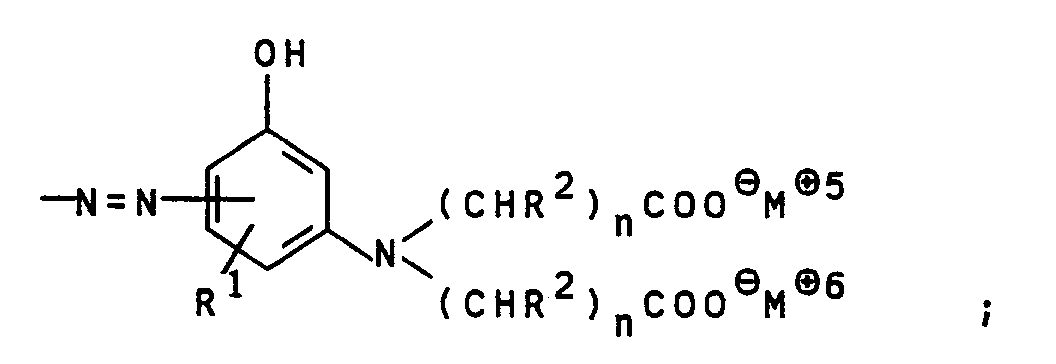
- Z
-

- R¹
- Wasserstoff, (C₁-C₄)-Alkyl oder Halogen;
- R²
- Wasserstoff oder (C₁-C₄)-Alkyl;
- M⊕1 bis M⊕7
- unabhängig voneinander ein Kation;
- m, o und p
- unabhängig voneinander 0 oder 1; und
- n 1 oder 2
- bedeutet.
- (C₁-C₄)-Alkyl bedeutet insbesondere Methyl, Ethyl, n-Propyl, i-Propyl, n-Butyl, i-Butyl, sek-Butyl oder tert-Butyl.
- Halogen bedeutet insbesondere Fluor, Chlor, Brom oder Iod, wobei Chlor und Brom bevorzugt sind.
- Ein für einen der Reste M⊕ stehendes Kation kann anorganisch oder organisch sein. Geeignete anorganische Kationen sind insbesondere Alkali- und Erdalkalikationen. Aufgrund ihrer zweifach positiven Ladung stehen Erdalkalikationen dabei jeweils für zwei Reste M⊕.
- Bevorzugte anorganische Kationen sind ganz besonders bevorzugt diejenigen von Lithium und Natrium.
- Geeignete organische Kationen sind inbesondere Ammoniumionen der allgemeinen Formel II

worin
R³ bis R⁶ unabhängig voneinander Wasserstoff, (C₁-C₄)-Alkyl, Hydroxy-(C₁-C₄)-alkyl oder Hydroxyethoxy-(C₁-C₄)-alkyl bedeuten. - Die Gruppe Y substituiert bevorzugt die Positionen 1, 2 oder 3 des Naphthalingerüstes, wobei Position 2 besonders bevorzugt ist. Die Gruppen -(SO₃⊖M⊕1)m und -(SO₃⊖M⊕4)m substituieren bevorzugt die Positionen 3 und 4 des Naphthalingerüstes.
- In bevorzugten Polyazofarbstoffen der allgemeinen Formel I stehen m für O, R¹ für Wasserstoff und R² für Wasserstoff oder Methyl.
- In besonders bevorzugten Polyazofarbstoffen der allgemeinen Formel I stehen R¹ und R² für Wasserstoff; m für O; n, o und p für 1 und M⊕1 bis M⊕7 unabhängig voneinander für Li⊕, Na⊕ oder ein Ammoniumion der allgemeinen Formel II, worin R³ bis R⁶ unabhängig voneinander Wasserstoff oder Hydroxy-(C₁-C₄)-alkyl bedeuten.
- Die erfindungsgemäßen Polyazofarbstoffe der allgemeinen Formel I können in an sich bekannter Weise hergestellt werden. Beispielsweise wird eine Verbindung der allgemeinen Formel III

worin
Z, m und M⊕ bis M⊕4 wie oben angegeben definiert sind, bis-diazotiert und mit einer Verbindung der allgemeinen Formel IV
worin
R¹, R² und n wie oben angegeben definiert sind, gekuppelt und gegebenenfalls in die gewünschte Salzform überführt. Bevorzugt wird diese Kupplungsreaktion bei pH-Werten von 7 bis 12, besonders bevorzugt 7,5 bis 9,5, durchgeführt. - Die Verbindungen der allgemeinen Formel III können zum Beispiel dadurch hergestellt werden, daß ein Diamin der allgemeinen Formel V
H₂N-Z-NH₂ (V)
worin
Z wie oben angegeben definiert ist, bis-diazotiert und mit einer Verbindung der allgemeinen Formel VI
worin
m wie oben angegeben definiert ist, gekuppelt wird. Auch diese Kupplungsreaktion wird bevorzugt bei pH-Werten von 7 bis 12, besonders bevorzugt 7,5 bis 9,5 durchgeführt. - Es ist bevorzugt, die Verbindungen der allgemeinen Formel III nicht zu isolieren, sondern an deren Herstellung direkt die oben beschriebene weitere Bis-Diazotierung und Kupplung anzuschließen.
- Die Verbindungen der allgemeinen Formel IV können durch Alkylierung von Verbindungen der allgemeinen Formel VII

worin
R¹ wie oben angegeben definiert ist, mit Verbindungen der allgemeinen Formel VIII
X-(CHR²)n-COOH (VIII)
worin
R² und n wie oben angegeben definiert sind und X für Chlor, Brom oder Iod steht, erhalten werden. Diese Umsetzung wird vorzugsweise in wäßrigem Reaktionsmedium bei pH-Werten von 3 bis 8, besonders bevorzugt 5 bis 8, und bei Temperaturen von 40 bis 140°C, besonders bevorzugt 80 bis 120°C, durchgeführt. Die erhaltenen Verbindungen der allgemeinen Formel IV werden vorzugsweise ohne Zwischenisolierung als wäßrige Lösung in die Umsetzung mit den Verbindungen der allgemeinen Formel III eingesetzt. - Geeignete Verbindungen der allgemeinen Formel VII sind beispielsweise 3-Aminophenol, 4-Methyl-3-aminophenol, 5-Amino-2-methyl-phenol, 4-Chlor-3-aminophenol und 4-Ethyl-3-aminophenol. Besonders bevorzugt ist 3-Aminophenol.
- Geeignete Verbindungen der allgemeinen Formel VIII sind beispielsweise Monochloressigsäure, Monobromessigsäure, 2-Chlorpropionsäure, 2-Brompropionsäure, 3-Chlorpropionsäure, 3-Brompropionsäure und deren Salze, wobei Monochloressigsäure und Natrium-monochloracetat bevorzugt sind.
- Geeignete Verbindungen der allgemeinen Formel V sind beispielsweise 1,4-Phenylendiamin, 1,4-Phenylendiamin-2-sulfonsäure, 4,4'-Diaminodiphenylamin, 4,4'-Diaminodiphenylamin-2-sulfonsäure. 4,4'-Diaminodiphenylamin-2-sulfonsäure ist besonders bevorzugt.
- Geeignete Verbindungen der allgemeinen Formel VI sind beispielsweise 2-Amino-8-hydroxynaphthalin-6-sulfonsäure, 2-Amino-8-hydroxynaphthalin-3,6-disulfonsäure, 3-Amino-8-hydroxynaphthalin-6-sulfonsäure, 1-Amino-8-hydroxynaphthalin-4,6-disulfonsäure und 1-Amino-8-hydroxynaphthalin-3,6-disulfonsäure, von denen 2-Amino-8-hydroxynaphthalin-6-sulfonsäure besonders bevorzugt ist.
- Die Verbindungen der allgemeinen Formeln V, VI, VII und VIII sind bekannt und käuflich zu erwerben und/oder nach bekannten Herstellungsverfahren erhältlich.
- Die erfindungsgemäßen Polyazofarbstoffe der allgemeinen Formel I können nach der Kupplungsreaktion durch Zusatz von Mineralsäuren in Form der freien Säure (M⊕1 bis M⊕7 = H⊕) isoliert werden, die durch Waschen mit Wasser oder angesäuertem Wasser von anorganischen Salzen befreit werden kann. Die so erhaltene salzarme Farbsäure kann dann in wäßrigem Medium mit Hydroxiden und/oder Carbonaten, beispielsweise LiOH, Li₂CO₃, NaOH, Na₂CO₃ oder K₂CO₃ oder mit Aminen neutralisiert werden. Dabei sind bevorzugte Amine, insbesondere Ammoniak, Ethanolamin, Diethanolamin, Triethanolamin, N-Methyl-N-ethanolamin, N-Methyl-N,N-diethanolamin, 2-(2-Hydroxyethoxy)-ethanamin, Di-2-(2-hydroxy-ethoxy)-ethanamin und Tri-2-(2-hydroxyethoxy)-ethanamin.
- Die erfindungsgemäßen Polyazofarbstoffe der allgemeinen Formel I eignen sich in hervorragender Weise zum Färben von natürlichen und synthetischen Fasermaterialien, insbesondere zeichnen sie sich auch in der Farbstärke auf Leder aus.
- Außerdem eignen sie sich in ausgezeichneter Weise zur Herstellung von Schreibtinten und Aufzeichnungsflüssigkeiten.
- Die oben beschriebenen wäßrigen Lösungen der erfindungsgemäßen Polyazofarbstoffe der allgemeinen Formel I können direkt für die Herstellung von Aufzeichnungsflüssigkeiten verwendet werden. Es ist aber auch möglich, sie zunächst durch Trocknung, z.B. Sprühtrocknung, zu isolieren und anschließend zu Aufzeichnungsflüssigkeiten weiterzuverarbeiten.
- Die fertigen Aufzeichnungsflüssigkeiten enthalten im allgemeinen 0,5 bis 15 Gew.% Farbstoff (trocken gerechnet), 0 bis 99 Gew.% Wasser und 0,5 bis 99,5 Gew.% Lösungsmittel und/oder Feuchthaltemittel. Insbesondere enthalten die fertigen Aufzeichnungsflüssigkeiten 0,5 bis 15 Gew.% Farbstoff (trocken gerechnet), 40 bis 85 Gew.% Wasser und 15 bis 50 Gew.% Lösungsmittel und/oder Feuchthaltemittel. Die fertigen Aufzeichnungsflüssigkeiten enthalten in der Regel noch weitere, nachstehend erwähnte Zusätze.
- Das zur Herstellung der Aufzeichnungsflüssigkeiten benutzte Wasser wird vorzugsweise in Form von destilliertem oder entsalztem Wasser eingesetzt. Neben Wasser kann in den Aufzeichnungsflüssigkeiten auch noch ein organisches wasserlösliches Lösungsmittel oder ein Gemisch derartiger Lösungsmittel vorhanden sein. Geeignete Lösungsmittel sind z.B. ein- und mehrwertige Alkohole, deren Ether und Ester, so z.B. Alkanole, insbesondere mit 1 bis 4 C-Atomen, wie z.B. Methanol, Ethanol, Propanol, Isopropanol, Butanol, Isobutanol, tert.-Butanol; zwei- und dreiwertige Alkohole, insbesondere solche mit 2 bis 6 C-Atomen, z.B. Ethylenglykol, Propylenglykol, 1,3-Propandiol, 1,4-Butandiol, 1,5-Pentandiol, 1,6-Hexandiol, 1,2,6-Hexantriol, Glyzerin, Diethylenglykol, Dipropylenglykol; Polyalkylenglykole, wie z.B. Triethylenglykol, Polyethylenglykol, Tripropylenglykol, Polypropylenglykol; niedere Alkylether von mehrwertigen Alkoholen, wie z.B Ethylenglykol-monomethyl-oder -ethyl- oder -propyl- oder -butyl-ether, Diethylenglykol-mono-methyl- oder -ethyl-ether, Triethylenglykol-mono-methyl- oder -ethyl-ether; Ketone und Ketoalkohole, insbesondere solche mit 3 bis 7 C-Atomen, wie z.B. Aceton, Methylethyl-keton, Diethyl-keton, Methyl-isobutyl-keton, Methylpentyl-keton, Cyclopentanon, Cyclohexanon, Diacetonalkohol; Ether, wie z.B. Dibutylether, Tetrahydrofuran, Dioxan; Ester, wie z.B. Ethylformiat, Methylformiat, Methylacetat, Ethylacetat, Propylenacetat, Butylacetat, Phenylacetat, Ethylglykolmono-ethylether-acetat, Essigsäure-2-hydroxy-ethylester; Amide, wie z.B. Dimethylformamid, Dimethylacetamid, N-Methylpyrrolidon; ferner Harnstoff, Tetramethylharnstoff, Thiodiglykol.
- Von den vorgenannten Substanzen wirken einige nicht nur als Lösungsmittel, sondern entfalten auch noch andere Eigenschaften. So wirken z.B. die mehrwertigen Alkohole auch als Feuchthaltemittel.
- Weiter können den Aufzeichnungsmitteln zugesetzt sein: Konservierungsmittel, wie z.B. Phenol-Derivate, kationische, anionische oder nichtionische oberflächenaktive Substanzen (Netzmittel), sowie Mittel zur Regulierung der Viskosität, z.B. Polyvinylalkohol, Cellulosederivate, oder wasserlösliche natürliche oder künstliche Harze als Filmbildner bzw. Bindemittel zur Erhöhung der Haft- und Abriebfestigkeit.
- Amine, wie z.B. Ethanolamin, Diethanolamin, Triethanolamin, N,N-Dimethylethanolamin, Diisopropylamin dienen hauptsächlich zur Erhöhung des pH-Wertes der Aufzeichnungsflüssigkeit. Sie sind in der Regel zu 0 bis 10 Gew.%, vorzugsweise 0,5 bis 5 Gew.% in der Aufzeichnungsflüssigkeit vorhanden.
- Angaben über Zusammensetzungen von Tinten, insbesondere auch solchen für das Strahldruckverfahren, finden sich z.B. in DE-A-2 132 324, DE-A-2 160 475, USP 4 024 096, USP 4 024 397 und USP 4 070 322. Die genaue Zusammensetzung der Aufzeichnungsflüssigkeit wird selbstverständlich dem beabsichtigten Verwendungszweck angepaßt.
- Bei Aufzeichnungsflüssigkeiten für das Tintenstrahl-Druckverfahren können je nach der Ausführungsform dieses Druckverfahrens, z.B. als Continuous-jet-, Intermittent-jet-, Impulse-jet- oder Compound-jet-Verfahren gegebenenfalls noch weitere Additive, z.B. zur Pufferung des pH-Wertes, zur Einstellung der elektrischen Leitfähigkeit, der spezifischen Wärme, des thermischen Expansionskoeffizienten und der Leitfähigkeit zugesetzt werden.
- Die Aufzeichnungsflüssigkeiten lassen sich in einfacher Weise durch Vermischen der Komponenten herstellen, was z.B. so erfolgen kann, daß ein Farbstoff der allgemeinen Formel I in Wasser gelöst oder eine bei der Herstellung des Farbstoffs der allgemeinen Formel I anfallende wäßrige Lösung gegebenenfalls weiter mit Wasser verdünnt wird und daß dann die übrigen Zusatzkomponenten, wie Lösungsmittel etc., zugemischt werden.
- Die einen oder mehrere Farbstoffe der allgemeinen Formel I enthaltenden Aufzeichnungsflüssigkeiten eignen sich hervorragend zum Einsatz bei Druck-, Vervielfältigungs-, Markierungs-, Schreib-, Zeichen-, Stempel- oder Registrierverfahren, insbesondere aber auch bei dem Tintenstrahl-Druckverfahren. Dabei werden schwarze Drucke von hoher Qualität erhalten, die eine hohe Schärfe und Brillianz sowie gute Wasser-, Licht-und Abriebfestigkeit besitzen. Gegenüber vergleichbaren Farbstoffen weisen die erfindungsgemäßen Polyazofarbstoffe der allgemeinen Formel I eine höhere Wasserlöslichkeit sowie eine bessere Wasserechtheit, insbesondere auf schwach sauren Papierarten auf. Ferner sind sie aus toxikologischen Gründen vorteilhaft.
- Bei der Lagerung erfindungsgemäßer Tinten tritt keine Abscheidung von Niederschlägen auf; ferner tritt beim Tintenstrahldruck beim Einsatz der erfindungsgemäßen Tinten keine Verstopfung der Düsen auf. Es treten auch keine Änderungen der physikalischen Eigenschaften erfindungsgemäßer Tinten ein, wenn sie in einem Tintenstrahldrucker längere Zeit unter ständiger Rezirkulation oder intermittierend unter zwischenzeitiger Abschaltung des Tintenstrahldruckers angewandt werden.
- 21,8 g 3-Aminophenol werden in 50 ml Wasser eingetragen und auf 90°C geheizt. Anschließend gibt man eine Lösung von 47,7 g Natrium-monochloracetet in 75 ml Wasser zu, wobei der pH-Wert des Reaktionsgemischs durch Zugabe von 28,5 g Natriumhydrogencarbonat bei pH: 6,5 bis 7 gehalten wird. Zur Vervollständigung der Alkylierungsreaktion rührt man 4 Stunden bei 90 bis 95°C nach. Die erhaltene Lösung kann ohne Zwischenisolierung der erhaltenen 3-Hydroxyphenylimino-diessigsäure weiterverarbeitet werden.
- 27,9 g 4,4'-Diaminodiphenylamin-2-sulfonsäure werden in einem Gemisch aus 200 ml Wasser und 50 g 30%iger Salzsäure unter Zugabe von Eis bei 0 bis 5°C mit einer Lösung von 13,8 g Natriumnitrit in 50 ml Wasser bis-diazotiert. Nach Zugabe der Natriumnitritlösung rührt man 1,5 Stunden bei 0 bis 5°C nach und beseitigt dann überschüssige salpetrige Säure mit Amidosulfonsäure.
- Die erhaltene Lösung des Bis-Diazoniumsalzes wird anschließend zu einer Mischung von 47,8 g 2-Amino-8-hydroxynaphthalin-6-sulfonsäure, 300 ml Wasser, 16,0 g 50%ige Natronlauge, 46,8 g Natriumcarbonat und 150 g Eis gegeben.
- Zur Vervollständigung der Kupplungsreaktion rührt man 2 Stunden bei pH 9 bis 9,5 nach.
- Anschließend versetzt man die Suspension des erhaltenen Disazofarbstoffs mit 120 g 30%iger Salzsäure sowie 150 g Eis und diazotiert durch Zugabe einer Lösung von 13,8 g Natriumnitrit in 50 ml Wasser. Man rührt 2 Stunden bei 0 bis 5°C nach und entfernt dann überschüssige salpetrige Säure mit Amidosulfonsäure.
- Die Suspension des erhaltenen Bis-Diazoniumsalzes wird im Verlauf von 1 Stunde zu einer Mischung der nach a) hergestellten wäßrigen Lösung von 3-Hydroxyphenyliminodiessigsäure, Dinatriumsalz, 27,4 g Natriumcarbonat und 150 g Eis gegeben.
- Nach Vervollständigung der Kupplungsreaktion und Zugabe von 90 g 30%iger Salzsäure wird der ausgefallene Farbstoff filtriert und mit Wasser elektrolytfrei gewaschen.
- Durch Neutralisation einer Suspension der erhaltenen Farbstoffpaste in 500 ml Wasser mit 70 ml 5 N Lithiumhydroxidlösung und anschließender Trocknung der erhaltenen Farbstofflösung erhält man 123,5 g des schwarzen Polyazofarbstoffs der allgemeinen Formel I mit R¹, R² = Wasserstoff, m = O, n, o und p = 1 und M⊕1 bis M⊕7 = Li⊕.
- Das Absorptionsspektrum dieses Farbstoffs in Wasser beträgt λmax = 596nm.
- Gemäß Angaben in folgender Tabelle können weitere erfindungsgemäße schwarze Farbstoffe hergestellt werden.


- Durch Mischen der Komponenten wird eine Aufzeichnungsflüssigkeit folgender Rezeptur hergestellt:
4 Gew.% Farbstoff gemäß Beispiel 1,
4 Gew.% Triethanolamin,
77 Gew.% destilliertes Wasser,
15 Gew.% Diethylenglykol
Claims (9)
- Wasserlösliche Polyazofarbstoffe der allgemeinen Formel I
 Y
Y Z
Z R¹ Wasserstoff, (C₁-C₄)-Alkyl oder Halogen;R² Wasserstoff oder (C₁-C₄)-Alkyl;M⊕1 bis M⊕7 unabhängig voneinander ein Kation;m, o und p unabhängig voneinander 0 oder 1; undn 1 oder 2 bedeutet.
 - Polyazofarbstoffe gemäß Anspruch 1, dadurch gekennzeichnet, daß M⊕1 bis M⊕7 unabhängig voneinander für das Lithiumkation, das Natriumkation oder für ein Ammoniumkation der allgemeinen Formel II

R³ bis R⁶ unabhängig voneinander Wasserstoff, (C₁-C₄)-Alkyl, Hydroxy-(C₁-C₄)-alkyl oder Hydroxyethoxy-(C₁-C₄)-alkyl bedeuten, stehen. - Polyazofarbstoffe gemäß Anspruch 1 und/oder 2, dadurch gekennzeichnet, daß m für O, R¹ für Wasserstoff und R² für Wasserstoff oder Methyl stehen.
- Polyazofarbstoffe gemäß einem oder mehreren der Ansprüche 1 bis 3, dadurch gekennzeichnet, daß R¹ und R² für Wasserstoff; m für O; n, o und p für 1 und M⊕1 bis M⊕7 unabhängig voneinander für Li⊕, Na⊕ oder ein Ammoniumion der allgemeinen Formel II gemäß Anspruch 2, worin R³ bis R⁶ unabhängig voneinander Wasserstoff oder Hydroxy-(C₁-C₄)-alkyl bedeuten, stehen.
- Verfahren zur Herstellung von Polyazofarbstoffen gemäß einem oder mehreren der Ansprüche 1 bis 4, dadurch gekennzeichnet, daß eine Verbindung der allgemeinen Formel III

Z, m und M⊕ bis M⊕4 wie oben angegeben definiert sind, bis-diazotiert und mit einer Verbindung der allgemeinen Formel IV
R¹, R² und n wie in Anspruch 1 angegeben definiert sind, gekuppelt und gegebenenfalls in die gewünschte Salzform überführt wird. - Verwendung von Polyazofarbstoffen gemäß einem oder mehreren der Ansprüche 1 bis 4 zum Färben von Leder.
- Verwendung von Polyazofarbstoffen gemäß einem oder mehreren der Ansprüche 1 bis 4 zur Herstellung von Schreibtinten und Aufzeichnungsflüssigkeiten.
- Aufzeichnungsflüssigkeit, enthaltend 0,5 bis 15 Gew.% Farbstoff der in einem oder mehreren der Ansprüche 1 bis 4 angegebenen allgemeinen Formel I, 0 bis 99 gew.% Wasser, 0,5 bis 99,5 Gew.% Lösungsmittel und/oder Feuchthaltemittel.
- Aufzeichnungsflüssigkeit nach Anspruch 8, enthaltend 0,5 bis 15 Gew.% Farbstoff, 40 bis 85 Gew.% Wasser, 15 bis 50 Gew.% Lösungsmittel und/oder Feuchthaltemittel.
Applications Claiming Priority (2)
| Application Number | Priority Date | Filing Date | Title |
|---|---|---|---|
| DE4441232A DE4441232A1 (de) | 1994-11-19 | 1994-11-19 | Wasserlösliche Polyazofarbstoffe |
| DE4441232 | 1994-11-19 |
Publications (2)
| Publication Number | Publication Date |
|---|---|
| EP0712903A1 true EP0712903A1 (de) | 1996-05-22 |
| EP0712903B1 EP0712903B1 (de) | 2001-01-03 |
Family
ID=6533663
Family Applications (1)
| Application Number | Title | Priority Date | Filing Date |
|---|---|---|---|
| EP95117104A Expired - Lifetime EP0712903B1 (de) | 1994-11-19 | 1995-10-31 | Wasserlösliche Polyazofarbstoffe |
Country Status (4)
| Country | Link |
|---|---|
| US (1) | US5597387A (de) |
| EP (1) | EP0712903B1 (de) |
| JP (1) | JPH08245894A (de) |
| DE (2) | DE4441232A1 (de) |
Cited By (1)
| Publication number | Priority date | Publication date | Assignee | Title |
|---|---|---|---|---|
| WO1998050470A1 (de) * | 1997-05-02 | 1998-11-12 | Basf Aktiengesellschaft | Oligomere azofarbstoffe |
Families Citing this family (6)
| Publication number | Priority date | Publication date | Assignee | Title |
|---|---|---|---|---|
| JPH10279824A (ja) * | 1997-03-31 | 1998-10-20 | Nippon Kayaku Co Ltd | 水溶性ジスアゾ化合物、水性インク組成物および着色体 |
| US6200355B1 (en) | 1999-12-21 | 2001-03-13 | Basf Corporation | Methods for deep shade dyeing of textile articles containing melamine fibers |
| US7727253B2 (en) * | 2000-11-03 | 2010-06-01 | Cook Incorporated | Medical grasping device having embolic protection |
| DE60123990T2 (de) | 2000-11-03 | 2007-05-10 | Cook Inc., Bloomington | Medizinische greifvorrichtung |
| US7713275B2 (en) * | 2000-11-03 | 2010-05-11 | Cook Incorporated | Medical grasping device |
| US7753917B2 (en) | 2000-11-03 | 2010-07-13 | Cook Incorporated | Medical grasping device |
Citations (13)
| Publication number | Priority date | Publication date | Assignee | Title |
|---|---|---|---|---|
| FR1379229A (fr) | 1963-12-20 | 1964-11-20 | Cassella Farbwerke Mainkur Ag | Nouveaux colorants tétrakisazoïques et leur préparation |
| DE2132324A1 (de) | 1970-06-29 | 1972-01-05 | Beckman Instruments Inc | Schreib- und Farbwerke fuer einen Registrierschreiber sowie Schreibfarbe bzw.-tinte hierfuer |
| DE2160475A1 (de) | 1970-12-07 | 1972-06-15 | A.B. Dick Co., Niles, 111. (V.StA.) | Tinte für das Strahldruckverfahren |
| US4024397A (en) | 1970-09-28 | 1977-05-17 | Barnes Engineering Company | Shock resistant encapsulated infrared detector |
| US4024096A (en) | 1975-07-07 | 1977-05-17 | A. B. Dick Company | Jet printing ink composition for glass |
| US4070322A (en) | 1976-02-02 | 1978-01-24 | A. B. Dick Company | Ink composition for jet printing onto non-absorbent surfaces |
| DE2914002A1 (de) | 1979-04-06 | 1980-10-16 | Bayer Ag | Fluessige farbstoffzubereitung |
| JPS55151071A (en) * | 1979-05-15 | 1980-11-25 | Canon Inc | Recording liquid |
| EP0212345A2 (de) | 1985-08-17 | 1987-03-04 | CASSELLA Aktiengesellschaft | Wässrige Farbstoffzubereitung, ihre Herstellung und Verwendung |
| EP0218143A2 (de) * | 1985-10-05 | 1987-04-15 | Bayer Ag | Aufzeichnungsflüssigkeit für die Verwendung in Tintenstrahl-Aufzeichnungssystemen |
| JPS62156177A (ja) * | 1985-12-28 | 1987-07-11 | Ricoh Co Ltd | インクジエツト記録用水性インク |
| DE3743527A1 (de) | 1987-12-22 | 1989-07-06 | Cassella Ag | Wasserloesliche schwarze trisazofarbstoffe |
| DE4025611A1 (de) | 1990-08-13 | 1992-02-20 | Cassella Ag | Wasserloesliche trisazofarbstoffe |
-
1994
- 1994-11-19 DE DE4441232A patent/DE4441232A1/de not_active Withdrawn
-
1995
- 1995-10-31 DE DE59508938T patent/DE59508938D1/de not_active Expired - Fee Related
- 1995-10-31 EP EP95117104A patent/EP0712903B1/de not_active Expired - Lifetime
- 1995-11-09 US US08/555,388 patent/US5597387A/en not_active Expired - Fee Related
- 1995-11-16 JP JP7298571A patent/JPH08245894A/ja not_active Withdrawn
Patent Citations (13)
| Publication number | Priority date | Publication date | Assignee | Title |
|---|---|---|---|---|
| FR1379229A (fr) | 1963-12-20 | 1964-11-20 | Cassella Farbwerke Mainkur Ag | Nouveaux colorants tétrakisazoïques et leur préparation |
| DE2132324A1 (de) | 1970-06-29 | 1972-01-05 | Beckman Instruments Inc | Schreib- und Farbwerke fuer einen Registrierschreiber sowie Schreibfarbe bzw.-tinte hierfuer |
| US4024397A (en) | 1970-09-28 | 1977-05-17 | Barnes Engineering Company | Shock resistant encapsulated infrared detector |
| DE2160475A1 (de) | 1970-12-07 | 1972-06-15 | A.B. Dick Co., Niles, 111. (V.StA.) | Tinte für das Strahldruckverfahren |
| US4024096A (en) | 1975-07-07 | 1977-05-17 | A. B. Dick Company | Jet printing ink composition for glass |
| US4070322A (en) | 1976-02-02 | 1978-01-24 | A. B. Dick Company | Ink composition for jet printing onto non-absorbent surfaces |
| DE2914002A1 (de) | 1979-04-06 | 1980-10-16 | Bayer Ag | Fluessige farbstoffzubereitung |
| JPS55151071A (en) * | 1979-05-15 | 1980-11-25 | Canon Inc | Recording liquid |
| EP0212345A2 (de) | 1985-08-17 | 1987-03-04 | CASSELLA Aktiengesellschaft | Wässrige Farbstoffzubereitung, ihre Herstellung und Verwendung |
| EP0218143A2 (de) * | 1985-10-05 | 1987-04-15 | Bayer Ag | Aufzeichnungsflüssigkeit für die Verwendung in Tintenstrahl-Aufzeichnungssystemen |
| JPS62156177A (ja) * | 1985-12-28 | 1987-07-11 | Ricoh Co Ltd | インクジエツト記録用水性インク |
| DE3743527A1 (de) | 1987-12-22 | 1989-07-06 | Cassella Ag | Wasserloesliche schwarze trisazofarbstoffe |
| DE4025611A1 (de) | 1990-08-13 | 1992-02-20 | Cassella Ag | Wasserloesliche trisazofarbstoffe |
Non-Patent Citations (5)
| Title |
|---|
| CHEMICAL ABSTRACTS, vol. 107, Columbus, Ohio, US; abstract no. 156638N |
| CHEMICAL ABSTRACTS, vol. 108, Columbus, Ohio, US; abstract no. 7635T |
| CHEMICAL ABSTRACTS, vol. 108, no. 2, 11 January 1988, Columbus, Ohio, US; abstract no. 7635t, H.KAMIMURA ET AL.: "Water-thinned jet-printing inks" page 87; * |
| CHEMICAL ABSTRACTS, vol. 94, Columbus, Ohio, US; abstract no. 158524 |
| CHEMICAL ABSTRACTS, vol. 94, no. 20, 18 May 1981, Columbus, Ohio, US; abstract no. 158524z, CANON K.K.: "Jet-printing inks" page 94; * |
Cited By (2)
| Publication number | Priority date | Publication date | Assignee | Title |
|---|---|---|---|---|
| WO1998050470A1 (de) * | 1997-05-02 | 1998-11-12 | Basf Aktiengesellschaft | Oligomere azofarbstoffe |
| US6153734A (en) * | 1997-05-02 | 2000-11-28 | Basf Aktiengesellschaft | Oligomer azo colorants |
Also Published As
| Publication number | Publication date |
|---|---|
| JPH08245894A (ja) | 1996-09-24 |
| EP0712903B1 (de) | 2001-01-03 |
| US5597387A (en) | 1997-01-28 |
| DE59508938D1 (de) | 2001-02-08 |
| DE4441232A1 (de) | 1996-05-23 |
Similar Documents
| Publication | Publication Date | Title |
|---|---|---|
| EP0592838B1 (de) | Wasserlösliche Schwefelfarbstoffe, ihre Herstellung und Verwendung | |
| DE69001489T2 (de) | Tinte und Aufzeichnungsverfahren unter Verwendung derselben. | |
| DE69008553T2 (de) | Tinte und Aufzeichnungsverfahren unter Verwendung derselben. | |
| EP0585659B2 (de) | Verwendung von flüssigen Farbstoffpräparationen, enthaltend einen Disazofarbstoff, im Ink-Jet-Verfahren | |
| EP0827985B1 (de) | Wasserlösliche Kupferphthalocyanin-Farbstoffe, ihre Herstellung und Verwendung | |
| DE2451257C3 (de) | Verfahren zur Herstellung von konzentrierten Farbstofflösungen und Verfahren zum Färben | |
| EP0971003B1 (de) | Wasserlösliche schwarze Stilbenfarbstoffe, ihre Herstellung und Verwendung | |
| EP0712903B1 (de) | Wasserlösliche Polyazofarbstoffe | |
| DE69215214T2 (de) | Anionische disazofarbstoffe | |
| EP1036823B1 (de) | Rote Säurefarbstoffe für den Tintenstrahldruck und Papiereinfärbung | |
| EP0311949B1 (de) | Wasserlösliche gelbe Monoazofarbstoffe | |
| EP0471233B1 (de) | Wasserlösliche Trisazofarbstoffe | |
| EP0324943B1 (de) | Wasserlösliche schwarze Trisazofarbstoffe | |
| WO2003068139A2 (de) | Wasserlösliche gelbe azo-farbstoffe | |
| EP0832937B1 (de) | Wasserlösliche Perylen-Farbstoffe, ihre Herstellung und Verwendung | |
| EP0738764B1 (de) | Tetrakisazoverbindungen, ihre Herstellung und ihre Verwendung als Farbstoffe | |
| DE69001494T2 (de) | Tinte und Aufzeichnungsverfahren unter Verwendung der Tinte. | |
| EP0735106A2 (de) | Disazofarbstoffe | |
| EP1036822B1 (de) | Wasserlösliche rote Säurefarbstoffe, ihre Herstellung und Verwendung | |
| DE2504082A1 (de) | Polyazofarbstoffe |
Legal Events
| Date | Code | Title | Description |
|---|---|---|---|
| PUAI | Public reference made under article 153(3) epc to a published international application that has entered the european phase |
Free format text: ORIGINAL CODE: 0009012 |
|
| AK | Designated contracting states |
Kind code of ref document: A1 Designated state(s): CH DE GB LI |
|
| 17P | Request for examination filed |
Effective date: 19961122 |
|
| RAP1 | Party data changed (applicant data changed or rights of an application transferred) |
Owner name: CLARIANT GMBH |
|
| 17Q | First examination report despatched |
Effective date: 19990712 |
|
| GRAG | Despatch of communication of intention to grant |
Free format text: ORIGINAL CODE: EPIDOS AGRA |
|
| 17Q | First examination report despatched |
Effective date: 19990712 |
|
| GRAG | Despatch of communication of intention to grant |
Free format text: ORIGINAL CODE: EPIDOS AGRA |
|
| GRAH | Despatch of communication of intention to grant a patent |
Free format text: ORIGINAL CODE: EPIDOS IGRA |
|
| RBV | Designated contracting states (corrected) |
Designated state(s): CH DE GB LI |
|
| GRAH | Despatch of communication of intention to grant a patent |
Free format text: ORIGINAL CODE: EPIDOS IGRA |
|
| GRAA | (expected) grant |
Free format text: ORIGINAL CODE: 0009210 |
|
| AK | Designated contracting states |
Kind code of ref document: B1 Designated state(s): CH DE GB LI |
|
| REG | Reference to a national code |
Ref country code: CH Ref legal event code: EP |
|
| REF | Corresponds to: |
Ref document number: 59508938 Country of ref document: DE Date of ref document: 20010208 |
|
| GBT | Gb: translation of ep patent filed (gb section 77(6)(a)/1977) |
Effective date: 20010308 |
|
| EN | Fr: translation not filed | ||
| PG25 | Lapsed in a contracting state [announced via postgrant information from national office to epo] |
Ref country code: LI Free format text: LAPSE BECAUSE OF NON-PAYMENT OF DUE FEES Effective date: 20011031 Ref country code: GB Free format text: LAPSE BECAUSE OF NON-PAYMENT OF DUE FEES Effective date: 20011031 Ref country code: CH Free format text: LAPSE BECAUSE OF NON-PAYMENT OF DUE FEES Effective date: 20011031 |
|
| PLBE | No opposition filed within time limit |
Free format text: ORIGINAL CODE: 0009261 |
|
| STAA | Information on the status of an ep patent application or granted ep patent |
Free format text: STATUS: NO OPPOSITION FILED WITHIN TIME LIMIT |
|
| REG | Reference to a national code |
Ref country code: GB Ref legal event code: IF02 |
|
| 26N | No opposition filed | ||
| REG | Reference to a national code |
Ref country code: CH Ref legal event code: PL |
|
| GBPC | Gb: european patent ceased through non-payment of renewal fee |
Effective date: 20011031 |
|
| PGFP | Annual fee paid to national office [announced via postgrant information from national office to epo] |
Ref country code: DE Payment date: 20060816 Year of fee payment: 12 |
|
| PG25 | Lapsed in a contracting state [announced via postgrant information from national office to epo] |
Ref country code: DE Free format text: LAPSE BECAUSE OF NON-PAYMENT OF DUE FEES Effective date: 20080501 |