EP0218331A2 - Traitement anaérobie de liquides fortement pollués - Google Patents
Traitement anaérobie de liquides fortement pollués Download PDFInfo
- Publication number
- EP0218331A2 EP0218331A2 EP86306183A EP86306183A EP0218331A2 EP 0218331 A2 EP0218331 A2 EP 0218331A2 EP 86306183 A EP86306183 A EP 86306183A EP 86306183 A EP86306183 A EP 86306183A EP 0218331 A2 EP0218331 A2 EP 0218331A2
- Authority
- EP
- European Patent Office
- Prior art keywords
- adsorbent
- colour
- liquor
- process according
- support medium
- Prior art date
- Legal status (The legal status is an assumption and is not a legal conclusion. Google has not performed a legal analysis and makes no representation as to the accuracy of the status listed.)
- Granted
Links
Images



Classifications
-
- C—CHEMISTRY; METALLURGY
- C02—TREATMENT OF WATER, WASTE WATER, SEWAGE, OR SLUDGE
- C02F—TREATMENT OF WATER, WASTE WATER, SEWAGE, OR SLUDGE
- C02F3/00—Biological treatment of water, waste water, or sewage
- C02F3/28—Anaerobic digestion processes
-
- C—CHEMISTRY; METALLURGY
- C02—TREATMENT OF WATER, WASTE WATER, SEWAGE, OR SLUDGE
- C02F—TREATMENT OF WATER, WASTE WATER, SEWAGE, OR SLUDGE
- C02F3/00—Biological treatment of water, waste water, or sewage
- C02F3/02—Aerobic processes
- C02F3/10—Packings; Fillings; Grids
-
- C—CHEMISTRY; METALLURGY
- C02—TREATMENT OF WATER, WASTE WATER, SEWAGE, OR SLUDGE
- C02F—TREATMENT OF WATER, WASTE WATER, SEWAGE, OR SLUDGE
- C02F1/00—Treatment of water, waste water, or sewage
- C02F1/28—Treatment of water, waste water, or sewage by sorption
-
- C—CHEMISTRY; METALLURGY
- C02—TREATMENT OF WATER, WASTE WATER, SEWAGE, OR SLUDGE
- C02F—TREATMENT OF WATER, WASTE WATER, SEWAGE, OR SLUDGE
- C02F3/00—Biological treatment of water, waste water, or sewage
- C02F3/28—Anaerobic digestion processes
- C02F3/2806—Anaerobic processes using solid supports for microorganisms
-
- Y—GENERAL TAGGING OF NEW TECHNOLOGICAL DEVELOPMENTS; GENERAL TAGGING OF CROSS-SECTIONAL TECHNOLOGIES SPANNING OVER SEVERAL SECTIONS OF THE IPC; TECHNICAL SUBJECTS COVERED BY FORMER USPC CROSS-REFERENCE ART COLLECTIONS [XRACs] AND DIGESTS
- Y02—TECHNOLOGIES OR APPLICATIONS FOR MITIGATION OR ADAPTATION AGAINST CLIMATE CHANGE
- Y02E—REDUCTION OF GREENHOUSE GAS [GHG] EMISSIONS, RELATED TO ENERGY GENERATION, TRANSMISSION OR DISTRIBUTION
- Y02E50/00—Technologies for the production of fuel of non-fossil origin
- Y02E50/30—Fuel from waste, e.g. synthetic alcohol or diesel
-
- Y—GENERAL TAGGING OF NEW TECHNOLOGICAL DEVELOPMENTS; GENERAL TAGGING OF CROSS-SECTIONAL TECHNOLOGIES SPANNING OVER SEVERAL SECTIONS OF THE IPC; TECHNICAL SUBJECTS COVERED BY FORMER USPC CROSS-REFERENCE ART COLLECTIONS [XRACs] AND DIGESTS
- Y02—TECHNOLOGIES OR APPLICATIONS FOR MITIGATION OR ADAPTATION AGAINST CLIMATE CHANGE
- Y02W—CLIMATE CHANGE MITIGATION TECHNOLOGIES RELATED TO WASTEWATER TREATMENT OR WASTE MANAGEMENT
- Y02W10/00—Technologies for wastewater treatment
- Y02W10/10—Biological treatment of water, waste water, or sewage
-
- Y—GENERAL TAGGING OF NEW TECHNOLOGICAL DEVELOPMENTS; GENERAL TAGGING OF CROSS-SECTIONAL TECHNOLOGIES SPANNING OVER SEVERAL SECTIONS OF THE IPC; TECHNICAL SUBJECTS COVERED BY FORMER USPC CROSS-REFERENCE ART COLLECTIONS [XRACs] AND DIGESTS
- Y10—TECHNICAL SUBJECTS COVERED BY FORMER USPC
- Y10S—TECHNICAL SUBJECTS COVERED BY FORMER USPC CROSS-REFERENCE ART COLLECTIONS [XRACs] AND DIGESTS
- Y10S210/00—Liquid purification or separation
- Y10S210/902—Materials removed
- Y10S210/917—Color
Definitions
- This invention relates to an improvement in the treatment of high strength liquors and wastewaters by anaerobic digestion for the removal of organic matter and color.
- anaerobic digestion When compared to aerobic treatment processes, anaerobic digestion has several disadvantages. First, anaerobic digestion generally results in a considerably lower degree of organic matter removal. Secondly, the activity of anaerobic bacteria has proven to be very sensitive to pH, temperature, and toxic materials such as ammonia, pyridine, and heavy metals. The methanogenic bacteria reproduce at a low rate, so full recovery of a digester following an upset condition usually takes several weeks, and often several months.
- the anaerobic treatment process is more energy efficient than aerobic processes, since (a) transfer of large quantities of air or oxygen to the waste is not required, (b) a significant portion of the organic matter is converted to methane, a useful combustible fuel gas, and (c) anaerobic treatment results in a markedly lower production of new bacterial cells, biomass that must ultimately be disposed of.
- Anaerobic treatment processes have required longer treatment residence times than aerobic processes. Anaerobic digestion of sewage sludges for 10-30 days is commonly practiced.
- Thermal treatment of sludges i.e., wet oxidation or "heat treatment" produces high strength liquors which are often highly colored. Neither aerobic or anaerobic treatment results in significant color removal from such high strength liquors; the color level may actually increase as a result of biological treatment.
- Statham U.S. Patent No. 2,059,286 discloses the use of small amounts (about 3-10 ppm) of activated carbon to sewage sludge undergoing anaerobic digestion. The patent claims that digestion time was thus reduced from six months to about three months.
- Anaerobic treatment of wastewater with a fluidized bed of particle support media in the size range of 0.2 to 0.3 mm was disclosed by Juris, U.S. Patent No. 4,182,675 and Barnes et al., U.S. Patent No. 4,505,819. Wastewater feed BOD 5 ranged from 50 to 50,000 mg/1. Both inventions require substantial energy to suspend the relatively large particles in the fluidized bed.
- the anaerobic digester of Rovel et al., U.S. Patent No. 4,482,458 contains similar granular support media of less than 1 mm size. Recirculation of digester contents is accomplished by pressurizing the methane-CO 2 biogas to a high overpressure and injecting the gas into a draft tube within the digester. This also requires considerable energy.
- the invention comprises a process for treatment of high strength BOD containing liquors, comprising the steps of:
- An embodiment of the invention encompasses the enhanced removal of both organic matter and color from high strength liquors by anaerobic treatment according to the above steps (a) through (f), followed by the steps of:
- Either or both of the powdered adsorbent support medium and color adsorbent may be regenerated and re-used in the process to treat further portions of liquor.
- This invention is a new method for treating high strength liquors, i.e., wastewaters containing high concentrations of dissolved organic matter and low concentrations of suspended solids. Such liquors are often highly colored.
- This invention is applicable to liquors containing 500 to 100,000 mg/l 5-day biochemical oxygen demand, denoted as BOD 5 or more simply BOD in this application. Where the liquor is not readily biodegradable, resulting in a low BOD measurenent, chemical oxygen demand (COD) may be a better measure of liquor strength.
- high strength liquors containing 700 to 160,000 mg/l COD are considered to be equivalent to high strength BOD containing liquors.
- this invention does not require prior dilution of the liquor to achieve a lower initial BOD or COD concentration.
- certain high strength liquors may require dilution to reduce viscosity, for example, to enable proper flow, mixing and contact in this invention.
- Anaerobic digestion of high strength liquors containing little or no suspended solids presents particular problems. Methanogenic bacteria are not only slow to reproduce, but they are difficult to separate from the treated liquor by commonly used separation methods. Thus, treated liquors may carry the needed bacteria out of the system, severely hampering its operation. A high BOD removal from high strength liquors is difficult to achieve and maintain in a conventionally operatea anaerobic digester.
- the digestion time is 4-72 hours, and preferably between 4 and 48 hours.
- This invention encompasses the removal of at least 50 percent of the high strength liquor BOD.
- the preferred BOD removal exceeds 80 percent, and the most preferred BOD removal exceeds 90 percent.
- the degree of organic matter removal from a liquor is a function of loading rate, concentration of powdered adsorbent support medium, and other factors.
- the preferred loading rate to digester 2 is 0.1 - 4.5 kg BOD per kg bianass per day. When the measured component is COD, rather than BOD, the preferred loading rate is 0.1 - 11.8 kg. ODD per kg. biomass per day.
- the powdered adsorbent support medium used in this invention is a material capable of adsorbing dissolved material from aqueous solutions. It also serves as a support medium to which methanogenic and facultative acid-forming bacteria inherent to the process become physically attached.
- Typical powdered adsorbent support medium materials are fly ash, fuller's earth, diatomaceous earth, polymeric material and charcoal. Powdered activated carbon is a preferred material because of its high adsorptive capacity and for other reasons noted herein.
- the powdered adsorbent support medium is also an agglomeration and weighting agent, enabling the mixture of bacteria, support medium and other suspended solids present in liquor 1 to be cleanly separated from the anaerobically digested liquor by gravitational force, e.g., settling or centrifugation.
- FIG. 1 of the drawings shows the steps of this invention.
- High strength BOD containing liquors 1 are introduced into an anaerobic digestion atmosphere within anaerobic digester 2.
- Fresh powdered adsorbent support medium is initially added to the high strength liquors in digester to achieve the desired adsorbent support medium concentration. Further adsorbent support medium is subsequently added continuously or intermittently as needed to maintain the desired concentration, i.e., to ccmpensate for adsorbent support medium losses in the process. It is understood that said support medium may be added to incoming liquor 1 or other stream passing to digester 2.
- the digester 2 is initially "seeded", for example with anaerobically digested or fresh sewage, sewage sludge or high strength liquors to supply the facultative acid-forming bacteria and methanogenic bacteria.
- the bacteria comprising the biomass may be provided by inoculation with cultures specially prepared for this purpose. Some of the bacteria become attached to the powdered adsorbent support medium, while others remain free-floating.
- the high-strength liquors 1 are continuously mixed and contacted with the biomass and support medium in anaerobic digester 2 for a period of 4 to 72 hours, depending upon the BOD or COD concentration in liquor 1 and the degree of treatment desired.
- the relatively mild mixing is preferably accomplished by recirculating produced gases and/or digester contents, using a compressor or pump, respectively.
- the mixture 5 of treated liquor, biomass and adsorbent support medium is directed to a separation step 6, where the suspended solids comprising a mixture of biomass and adsorbent support medium are separated from the liquor by gravitational force to form a clarified liquor 7 and a sludge of biomass and support medium.
- Clarified digested liquor 7 is discharged to the environment or to a further step of reuse or treatment. For example, it may be desirable to further treat the clarified liquor to remove nitrogen, color, and/or small quantities of finely divided solids which may be present.
- a portion 9 or all of sluage 8 comprising biomass and adsorbent support maximn is continuously or intermittently recycled to the mixing and contact step in digester 2 to treat additional quantities of liquor 1.
- a quantity of sludge is recycled to maintain a relatively constant biomass concentration in digester 2.
- the small remaining fraction 10 of sludge 8 may be regenerated, as illustrated in Figures 2, 4 and 5, or treated further, e.g., incinerated, or discharged to the environment for final disposal.
- the particular method of handling the excess sludge 10 depends upon the quantity of sludge to be handled, cost of fresh adsorbent support median, expense of regeneration and cost of alternate disposal means.
- additional powdered adsorbent support medium 4 is provided to offset losses of support medium in the process and maintain the desired concentration in digester 2.
- this invention requires use of a powdered adsorbent material as the support medium.
- At least 25 percent of the support medium comprises powder-sized particles of 0.01 to 0.3 mm diameter.
- at least 25 percent of adsorbent material 4 is of 0.01 - 0.2 mm diameter.
- the use of more coarse materials, commonly termed granular adsorbents is unsatisfactory, because (a) larger sized materials have a much lower surface area per unit weight, and (b) larger particles settle much more rapidly, requiring increased energy expenditures to keep the particles suspended.
- the smaller particle size results in greater surface area for adsorption of liquor constituents and for attachment of the biomass. Over extended periods of time, attrition of the particles gradually results in an increased number of particles less than 0.01 mm diameter. These smaller particles are not deleterious as long as the required fraction of ⁇ . ⁇ 1 - 8.3 mm particles is present.
- Fuel gas 3 containing primarily methane and carbon dioxide is generated through breakdown of organic matter contained in the liquor, by action of the facultative acid-forming bacteria and methanogenic bacteria. This gas mixture is separated from the mixture of liquor, biomass and adsorbent support medium within the anaerobic digester. The fuel gas mixture 3 is discharged from the anaerobic digestion step and recovered for use or disposal.
- this invention operates best at a digester temperature between 25 and 5 ⁇ °C, and most optimally at a temperature of about 35°C.
- the temperature can be regulated by conventional digester heaters.
- the outlet liquor temperature is often controlled at a somewhat elevated level.
- Such liquors may supply part or all of the thermal energy required to maintain the desired digester temperature, reducing or eliminating the need for an external heat source.
- the liquors may be heated by indirect heat exchange with hot sewage sludge or industrial waste which has undergone wet oxidation or thermal conditioning.
- the embodiment shown in Figure 2 includes treatment of the biomass - support medium sludge 8 to destroy the biomass and regenerate the adsorbance properties of the support medium.
- high-strength BOD containing liquors 1 are mixed and contacted with biomass and powdered adsorbent support medium 4 for 4-72 hours in an anaerobic digester, as previously shown in Figure 1.
- Fuel gas 3 is separated and recovered from the mixture of liquor, biomass and adsorbent support medium in digester 2.
- the latter mixture 5 passes to separation step 6, where the suspended solids are separated from the liquor by gravitational force, forming a clarified digested liquor and a sludge of bianass and support medium. Clarified digested liquor is discharged to the environment or to a further step of reuse or treatment.
- a portion 9 of sludge 8 comprising bianass and adsorbent support maximn is continuously or intermittently recycled to the mixing and contact step in digester 2 to treat additional high strength liquor 1.
- sludge 8 Another portion 11 of sludge 8 is directed to regeneration process 12 in which biomass in the sludge is destroyed and adsorbent support medium is regenerated.
- the regenerated adsorbent support medium 13 is returned to digester 2 to be mixed with and contact additional quantities of liquor.
- support medium in digester 2 comes from three sources during continuous operation:
- Regeneration process 12 may be a controlled-atmosphere furnace combustion, wet oxidation, or other process which will destroy the biomass and regenerate the adsorptive property of the support medium.
- Figure 3 illustrates an embodiment of the invention which is particularly advantageous for treating high strength liquors which are colored.
- Soluble color matter is usually present in such liquors, often in concentrations which produce color analyses of several thousand APHA (American Public Health Association) units.
- APHA American Public Health Association
- thermal conditioning or wet oxidation of municipal sewage sludges or industrial wastes at some conditions results in liquor color values of 5000 - 20,000 AP H A units.
- the color of such high strength liquors is not significantly reduced by aerobic processes (e.g., activated sludge) or anaerobic processes. Such biological treatment may even increase the color value.
- the first steps of this embodiment are identical to the steps of Figure 1, already described.
- high strength BO D containing colored liquors 1 are mixed and contacted with biomass and powdered adsorbent support medium 4 in an anaerobic digester 2 for a period of 4-72 hours.
- the environment within digester 2 is maintained in an anaerobic state.
- the biomass comprises a mixture of viable facultative acid-forming bacteria and methanogenic bacteria, both common to well-operated anaerobic digestion systems. A substantial portion of the BOD is removed by the anaerobic digestion, and partially converted to fuel gas
- the mixture 5 of treated liquor, biomass and support medium from digester 2 is directed to a separation step 6 where the suspended solids are separated from the liquor to form a clarified digested liquor 7 and a sludge 8.
- a portion of sludge 8 is recycled to digester 2 while the remaining fraction may be regenerated, incinerated or discharged to the natural environment for final disposal.
- clarified liquor 7 is decolorized by contact with color adsorbent 15.
- the decolorization step may comprise passage through a bed or filter of fixed adsorbent particles
- the preferred process comprises contacting the clarified liquor 7 with color adsorbent 15 in a contact step 14 to remove color, directing adsorbent - liquor mixture 16 to separator 17, and separating spent color adsorbent 19 from the decolorized clarified liquor 18.
- the color adsorbent not only removes color but also removes organic matter, measured as COD, BOD and/or DOC.
- the clarified liquor containing only a small fraction of its original BOD, COD, DOC and color is discharged to the natural environment or to a further step of reuse or treatment e.g. nitrogen removal.
- Separation 17 may be a gravity settling vessel, centrifuge, filter or other device for separating the color adsorbent from the decolorized liquor.
- color adsorbents which may be used are fly ash, fuller's earth, diatomaceous earth, polymeric material, charcoal and activated carbon.
- the preferred material is activated carbon.
- the color adsorbent 15 need not be the same material as powdered adsorbent support medium 4. However, as shown in Figures 4 and 5, there are advantages in using the same material. When adsorbent 15 is a different material than support medium 4, the optimum regeneration conditions, or even the method, may differ for each material. Thus, if a single regeneration is used, certain compromises are required, and some advantages of the process may be lost. In the preferred process, a single adsorbent material is used for both the digestion and decolorization steps.
- powdered activated carbon is used for both steps.
- powdered activated carbon is used as the powdered adsorbent support medium 4, and additional portions of powdered activated carbon are used as the color adsorbent.
- different adsorbents, each requiring its own regeneration, may sometimes be used to advantage.
- the preferred particle size is between ⁇ . ⁇ 1 and about 0.3 mm diameter to provide an optimal balance between adsorption surface area and ease of separation from the decolorized liquors.
- at least 25 percent of the color adsorbent in the decolorization step is ⁇ . ⁇ 1- ⁇ .3 m diameter.
- the dosage of color adsorbent to the liquors varies from ⁇ .1 to 20 g/1, depending on the type and strength of liquor, the desired degree of color removal and activity of the adsorbent.
- the contact time between liquor and color adsorbent may vary from a few minutes to several days, the optimum contact time is 0.2 to 4 hours to maximize adsorption and minimize possible desorption.
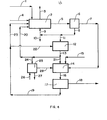
- FIG 4 elements 1 through 19, and limitations thereof, are as previously described in Figures 1, 2 and 3.
- a portion 11 of sludge 8 is directed to regeneration process 12 in which biomass is destroyed and adsorbent support medium is regenerated.
- a portion 20 or all of regenerated support medium 13 is directed to digester 2 to treat additional quantities of high strength liquor 1.
- spent color adsorbent 19 is also directed as stream 23 to digester 2 where it supplies additional surface area for attachment of bacteria and adsorption of B O D -producing materials.
- Spent color adsorbent provides approximately the same surface area as fresh adsorbent for biomass attachment, because color is nearly completely adsorbed in tiny pores. These pores are too small for passage of bacterial cells into the adsorbent.
- recycle of spent color adsorbent to digester 2 may fully replace the need for fresh adsorbent support medium 4. All fresh adsorbent will then be added as stream 15 to the color adsorption step 14.
- a portion 21 of regenerated support medium 13 may alternatively be directed to decolorization contact step to act as a color adsorbent.
- a portion of adsorbent 15 is replaced by the regenerated support medium.
- the adsorbent stream 13 may contain colored matter.
- regeneration of sludges containing adsorbent and biomass may be accomplished by the well-known wet air oxidation process.
- the regeneration process is operated to yield a less-than-complete regeneration of the adsorbent, the resulting water phase contains color which is not readily adsorbable but can be made so by the anaerobic treatment of this invention. This color results from incomplete combustion of the biomass associated with the adsorbent.
- regenerated adsorbent 24 may be washed with water 26 to remove color in washing step before addition as stream 28 to contact step 14.
- the small stream of used color containing wash water 27 is preferably recycled to digester 2 to undergo anaerobic conversion of the color to a more adsorbable form.
- a portion 22 of spent color adsorbent 19 is directed to regeneration step to be regenerated together with sludge .
- a portion or all of regenerated material 13 is recycled to digester 2.
- a portion 21 or 28 may also be directed to contact step 14 as already described.
- Spent color adsorbent differs from sludge in that it has very little associated biomass, only that which carries over from separation step 6 and passes through decolorization step 14. Thus, the concentration of organic matter associated with spent adsorbent is very small compared to that of sludge .
- Decolorization step is one of adsorption, while anaerobic contact step in digester is biological or biochemical in nature.
- Decolorization step removes preferably in excess of 50 percent of the color in liquor 7. More preferably, in excess of 80 percent, and most preferably, in excess of 90 percent of the color is removed. The step also removes a considerable portion of the BOD, COD and DOC remaining after the anaerobic digestion step.
- FIG. 5 incorporates the anaerobic digestion step and decolorizing step of Figure 3, together with separate regeneration steps and respectively for each of sludge 11 and spent color adsorbent . Elements through are as previously described.
- a portion 11 of sludge 8 from anaerobic digestion of high strength liquor 1 is regenerated and recycled to digester 2 as stream 13.
- a portion or all of spent color adsorbent 19 is directed to regeneration step 3 ⁇ , where contaminants including color, organic matter and microorganisms are removed from the adsorbent surface and the adsorbency is renewed.
- Regenerated adsorbent is recycled to decolorization step 14 as stream 31 to adsorb color and organic matter from further portions of clarified liquor .
- the regeneration step may be any process which accomplishes the desired rejuvenation of the adsorbent, and may differ from regeneration step 12 because the functions of support medium 4 and color adsorbent 15 differ.
- the optimum conditions for the two regeneration steps may differ even when support medium 4 and adsorbent 15 are the same material, e.g., the same grade of powdered activated carbon.
- a small amount of soluble color may be produced.
- a portion 32 of regenerated color adsorbent may be directed to a washing step 33 before recycling to decolorization step 14 as stream 34.
- the wash water 35 containing the color is then passed as stream 36 to digester 2 where the color is anaerobically treated to increase its adsorbability.
- a portion of spent color adsorbent 19 may be recycled to digester 2 for treatment of additional liquor quantities.
- a portion 38 of regenerated color adsorbent 37 is directed to digester 2 for treatment of incoming high strength liquor 1.
- digester 2 differs from that used in fluidized beds or expanded beds of the prior art.
- Fluidized beds utilize relatively large size particles of uniform size and shape so that a uniform settling rate results.
- An upward flow of liquid, uniform in velocity over the cross-section of the apparatus, is established to equal the downward velocity of the solid particles.
- an enlarged portion results in reduced liquid velocity for clarification.
- the solids particles do not leave the fluidized bed.
- Introduction of gas into the fluidized bed produces vertical mixing from bottom to top, and solids particles overflow with the liquid. Also, it is often necessary to recycle clarified liquid from the top of the apparatus to the distributor at the bottom to achieve the required upward velocity.
- expansion bed has been applied to fluidized beds, but is generally limited to beds which expand upward from the quiescent state as the upward liquid velocity increases, but are operated so that little mixing of solids occurs within the bed. The upward liquid velocity is maintained uniformly over the bed cross-section.
- Fluidized beds and expanded beds require considerable energy to keep the large particles in suspension.
- the present invention using small powder particles, requires little energy for mixing. It has been found that simple recycle of a small stream of liquor solids from the bottom of the digester to the upper portion of the digester is sufficient to create the mild mixing. Alternatively, a small stream of fuel gas produced in the digester may be circulated to the lower portion of the digester.
- the process may be operated batch-wise.
- the preferred mode of operation is as a semi-continuous or continuous process.
- a continuous operation is defined as one in which the stream of liquor through the system is continuous, even though one or more streams of adsorbent, sludge, or other material may be intermittent.
- a semi-continuous process is one in which the flow of liquor itself through the system is seni-continuous in nature.
- the preferred mode of operation may be semi-continuous.
- a mixture of primary and activated sludge from a municipal wastewater treatment plant was subjected to wet air oxidation at 177° C and 21.1 kg/an 2 pressure for a period of 72 minutes in which 5% of the organic matter was oxidized. After allowing the mixture to cool and settle for 4 hours, the supernatant was separated. The thickened settled solids were filtered. The supernatant and filtrate were combined to give a high strength BOD containing liquor visually free of suspended solids and having the following analyses:
- the liquor was fed continuously to an anaerobic digestion vessel maintained at a temperature of 35°C. Liquor residence time in the digester was 24 hours. Continuous recirculation and mild mixing of the digester contents was accomplished by pumping the mixed liquor of support medium, biomass and liquor from the bottom of the digester to an inlet just below the liquid surface.
- the digester and subsequent settling vessel clarifier were connected at mid-depth allowing the contents of the digester to flow into the clarifier. Suspended solids which settled in the clarifier were periodically pumped back to the digester while the clarified liquor was collected for sampling and/or further treatment.
- the digester was previously seeded with actively digesting sludge acclimated to the liquor.
- a powdered adsorbent support medium was added to the digester at a concentration of 6900 mg/l.
- the support medium was powdered activated carbon of which at least 60 percent was -325 mesh (0.0017 inches diameter or 0.044 mm diameter).
- the specific surface area of the carbon was 475 m 2 /g.
- a mixture of primary and activated sludge from a municipal wastewater treatment installation was subjected to wet air oxidation at 205°C and 28.1 kg/cm 2 pressure for a period of 15 minutes in which 9% of the organic matter was oxidized. After allowing the mixture to cool and settle for 24 hours, the supernatant, a high strength BOD containing liquor, virtually free of suspended solids, was separated.
- the liquor analyses were determined as follows.
- the liquor was fed continuously at a controlled rate to a digestion vessel maintained at a temperature of 35°C. Liquor residence time in the digestor was 47 hours. Continuous recirculation and mild mixing of the digester contents was accomplished by pumping the mixed liquor of biomass, support medium and liquor from the bottom of the digester to an inlet just below the liquid surface.
- the digester and settling vessel clarifier were connected at mid-depth allowing the contents of the digester to flow into the clarifier. Suspended solids which settled in the clarifier were periodically pumped back to the digester while the clarified liquor was collected for sampling and/or further treatment.
- the digester was previously seeded with actively digesting sludge acclimated to the liquor.
- Activated carbon as in Example I was added to the digester at a concentration of 4000 milligrams per liter of mixed liquor. By removing a portion of the mixed liquor daily, the digester biomass concentration was maintained at 10800 milligrams per liter. Activated carbon was added daily to replace the removed activated carbon.
- the digester loading rate was 0.29 kilograms BOD 5 per day per kilogram of mixed liquor biomass.
- Liquor BODe was reduced by 85.0%, COD was reduced 60.1%, and color was increased 5%.
- Biological sludge was produced at the rate of 0.07 kilogram biomass per kilogram of BOD removed from the liquors.
- a mixture of primary and activated sludge from a municipal wastewater treatment plant was subjected to heat treatment (no oxidation) at 210°C and 21.1 kg/cm 2 pressure for a period of 30 minutes. After allowing the mixture to cool and settle for 24 hours, the supernatant was separated. The thickened solids were filtered. The supernatant and filtrate were combined to give a high strength BOD containing liquor which was visually free of suspended solids and had the following analyses:
- the liquor was fed continuously to a digestion vessel maintained at a temperature of 35°C. Liquid residence time in the digester was 23 hours.
- the digester was previously seeded with actively digesting sludge acclimated to the liquor.
- Activated carbon as in prior examples was added to the digester at a concentration of 1900 milligrams per liter of mixed liquor. By removing a portion of the mixed liquor daily, the digester biomass concentration was maintained at 7300 mg/l. Activated carbon was added daily to replace the removed activated carbon.
- the digester loading rate was 0.78 kilogram BOD 5 per kilogram of biomass per day.
- the analyses of the treated liquors were:
- the overall removals of COD, dissolved organic carbon (DOC) and color from the high strength liquor were:
- the anaerobic digestion step of this invention actually increased the color value of the liquor. Nevertheless, the digestion step resulted in increased efficiency of color adsorption in the subsequent decolorization step.
- the units of color removed per gram of activated carbon adsorbent was almost doubled, when compared to simple adsorption of the high strength liquor.
- the overall removals of COD, DOC and color from the high strength liquor were as follows:
- the anaerobic digestion step increased the color removal per gram of activated carbon adsorbent by 33 percent.
Landscapes
- Life Sciences & Earth Sciences (AREA)
- Microbiology (AREA)
- Hydrology & Water Resources (AREA)
- Engineering & Computer Science (AREA)
- Environmental & Geological Engineering (AREA)
- Water Supply & Treatment (AREA)
- Chemical & Material Sciences (AREA)
- Organic Chemistry (AREA)
- Biodiversity & Conservation Biology (AREA)
- Purification Treatments By Anaerobic Or Anaerobic And Aerobic Bacteria Or Animals (AREA)
- Water Treatment By Sorption (AREA)
- Solid-Sorbent Or Filter-Aiding Compositions (AREA)
- Treatment Of Sludge (AREA)
- Biological Treatment Of Waste Water (AREA)
- Removal Of Specific Substances (AREA)
- Soy Sauces And Products Related Thereto (AREA)
Priority Applications (1)
| Application Number | Priority Date | Filing Date | Title |
|---|---|---|---|
| AT86306183T ATE57900T1 (de) | 1985-09-30 | 1986-08-11 | Anaerobe behandlung von stark verschmutzten fluessigkeiten. |
Applications Claiming Priority (2)
| Application Number | Priority Date | Filing Date | Title |
|---|---|---|---|
| US06/782,256 US4626354A (en) | 1985-09-30 | 1985-09-30 | Method for anaerobic treatment of high strength liquors |
| US782256 | 1985-09-30 |
Publications (3)
| Publication Number | Publication Date |
|---|---|
| EP0218331A2 true EP0218331A2 (fr) | 1987-04-15 |
| EP0218331A3 EP0218331A3 (en) | 1988-03-02 |
| EP0218331B1 EP0218331B1 (fr) | 1990-10-31 |
Family
ID=25125498
Family Applications (1)
| Application Number | Title | Priority Date | Filing Date |
|---|---|---|---|
| EP19860306183 Expired - Lifetime EP0218331B1 (fr) | 1985-09-30 | 1986-08-11 | Traitement anaérobie de liquides fortement pollués |
Country Status (10)
| Country | Link |
|---|---|
| US (1) | US4626354A (fr) |
| EP (1) | EP0218331B1 (fr) |
| JP (1) | JPH0767560B2 (fr) |
| KR (1) | KR930001605B1 (fr) |
| AT (1) | ATE57900T1 (fr) |
| AU (1) | AU581333B2 (fr) |
| CA (1) | CA1289275C (fr) |
| DE (1) | DE3675318D1 (fr) |
| MX (1) | MX164059B (fr) |
| ZA (1) | ZA865873B (fr) |
Cited By (1)
| Publication number | Priority date | Publication date | Assignee | Title |
|---|---|---|---|---|
| EP0382340A1 (fr) * | 1989-02-06 | 1990-08-16 | Zimpro Environmental, Inc. | Procédé anaérobie/aérobie à deux étages pour le traitement d'eau usée |
Families Citing this family (45)
| Publication number | Priority date | Publication date | Assignee | Title |
|---|---|---|---|---|
| ATE33619T1 (de) * | 1984-02-14 | 1988-05-15 | Noebl Ernst | Verfahren und vorrichtung zur anaeroben behandlung von organischen substraten. |
| US6319873B1 (en) * | 1986-05-30 | 2001-11-20 | Eparco | Biological activator for a septic tank |
| US4981593A (en) * | 1986-09-16 | 1991-01-01 | Commonwealth Scientific And Industrial Research Organisation | Sewage treatment |
| US4857198A (en) * | 1988-07-29 | 1989-08-15 | Zimpro/Passavant Inc. | Process for treatment of water containing volatile and toxic compounds |
| US5068036A (en) * | 1988-12-28 | 1991-11-26 | Chemical Waste Management, Inc. | Activated sludge process with in situ recovery of powdered adsorbent |
| US5075015A (en) * | 1991-05-01 | 1991-12-24 | Zimpro Passavant Environmental Systems, Inc. | Method for color removal from thermally conditioned sludge liquors |
| US5356537A (en) * | 1992-05-28 | 1994-10-18 | No Sludge, Inc. | Method and apparatus for treating waste water |
| US5352335A (en) * | 1992-11-09 | 1994-10-04 | Albemarle Corporation | Groundwater treatment process |
| US5302288A (en) * | 1993-03-19 | 1994-04-12 | Zimpro Environmental, Inc. | Treatment of highly colored wastewaters |
| US5854173A (en) * | 1996-05-31 | 1998-12-29 | Electric Power Research Institute, Inc. | Flake shaped sorbent particle for removing vapor phase contaminants from a gas stream and method for manufacturing same |
| DE19648860C1 (de) * | 1996-11-26 | 1998-02-05 | Jan Kai Dobelmann | Verfahren zur Reinigung von Abwasser |
| DE19828175A1 (de) * | 1997-10-30 | 1999-12-30 | Sued Chemie Ag | Verfahren zur Behandlung von mit Ammonium hochbelasteten Prozeßabwässern auf dem Abwassergebiet |
| DE19804007A1 (de) * | 1998-02-02 | 1999-08-05 | Nordenskjoeld Reinhart Von | Verfahren und Vorrichtung zur biologischen Behandlung eines organisch belasteten Fluids unter Biogasgenerierung |
| FR2781785B1 (fr) * | 1998-02-16 | 2000-09-29 | Omnium Traitement Valorisa | Procede de traitement biologique d'effluents ne produisant pas ou peu de boues en exces incluant une etape de traitement par biomasse fixee |
| US20030062305A1 (en) * | 2001-09-29 | 2003-04-03 | Khudenko Boris M. | Biological processes |
| SG125919A1 (en) * | 2002-06-24 | 2006-10-30 | Kuraray Co | Apparatus and method for treating wastewater containing nitrogen-containing dyes |
| US7850822B2 (en) * | 2003-10-29 | 2010-12-14 | Siemens Water Technologies Holding Corp. | System and method of wet oxidation of a viscose process stream |
| US20050171390A1 (en) * | 2003-12-17 | 2005-08-04 | Usfilter Corporation | Wet oxidation process and system |
| US7309435B2 (en) * | 2004-03-02 | 2007-12-18 | Rozich Alan F | Biological process for waste treatment and energy production |
| US7402247B2 (en) * | 2004-12-14 | 2008-07-22 | Shaw Intellectual Property Holdings, Inc. | System for wastewater treatment and digestion having aerobic and anaerobic treatment zones |
| MX2008011466A (es) * | 2006-03-08 | 2008-11-18 | Siemens Water Tech Corp | Sistema y metodo de tratamiento de aguas residuales. |
| US8114297B2 (en) * | 2006-10-03 | 2012-02-14 | Siemens Industry, Inc. | Wet oxidation of soot |
| US9193613B2 (en) | 2006-10-03 | 2015-11-24 | Siemens Energy, Inc. | pH control to enable homogeneous catalytic wet air oxidation |
| US20110036771A1 (en) * | 2007-01-09 | 2011-02-17 | Steven Woodard | Ballasted anaerobic system and method for treating wastewater |
| US20100213123A1 (en) | 2007-01-09 | 2010-08-26 | Marston Peter G | Ballasted sequencing batch reactor system and method for treating wastewater |
| AU2008205247B2 (en) | 2007-01-09 | 2010-07-01 | Evoqua Water Technologies Llc | A system and method for removing dissolved contaminants, particulate contaminants, and oil contaminants from industrial waste water |
| US9315401B2 (en) | 2007-01-22 | 2016-04-19 | Siemens Energy, Inc. | Wet air oxidation process using recycled copper catalyst |
| JP4124477B1 (ja) * | 2007-03-20 | 2008-07-23 | 誠助 田邊 | 着色廃水の脱色処理方法 |
| CN101952209A (zh) * | 2007-12-19 | 2011-01-19 | 沙特阿拉伯石油公司 | 悬浮介质颗粒状活性炭膜生物反应器系统及方法 |
| WO2009123755A1 (fr) * | 2008-04-03 | 2009-10-08 | Siemens Water Technologies Corp. | Systèmes et procédés d'oxydation par voie humide catalytique |
| US8357297B2 (en) * | 2008-08-19 | 2013-01-22 | Miller Iii Herman P | Anaerobic wastewater treatment system and process utilizing solids based bacterial colonization (SBBC) |
| CA2752747C (fr) | 2009-02-18 | 2019-05-07 | Anaergia Inc. | Fermentation anaerobique pour production de biogaz |
| TWI568687B (zh) * | 2009-06-15 | 2017-02-01 | 沙烏地阿拉伯油品公司 | 包含懸浮系統與多重生物反應器區域的經懸浮介質膜生物反應器系統及方法 |
| AU2010271392C1 (en) | 2009-07-08 | 2016-06-30 | Saudi Arabian Oil Company | Wastewater treatment system and process including irradiation of primary solids |
| MY156850A (en) | 2009-07-08 | 2016-04-15 | Saudi Arabian Oil Co | Low concentration wastewater treatment system and process |
| WO2011037819A1 (fr) | 2009-09-22 | 2011-03-31 | Sonoco Development, Inc. | Carton contenant un biocide et son procédé de production |
| AU2011288881A1 (en) | 2010-08-13 | 2013-02-28 | Anaergia Inc. | Treatment of municipal wastewater with anaerobic digestion |
| WO2012103629A1 (fr) | 2011-02-03 | 2012-08-09 | Anaergia Inc. | Traitement de déchets par digestion anaérobie |
| CA2828949A1 (fr) | 2011-02-18 | 2012-08-23 | Siemens Energy, Inc. | Conversion du h2s en soufre au moyen d'une solution d'iode regenere |
| PL2641877T3 (pl) * | 2012-03-20 | 2017-02-28 | Veolia Water Solutions & Technologies Support | Sposób oczyszczania strumienia ścieków za pomocą bioreaktora i membranowego filtra |
| US9540270B2 (en) * | 2012-04-20 | 2017-01-10 | Anaergia Inc. | Anaerobic treatment of industrial wastewater |
| AU2013274900A1 (en) | 2012-06-11 | 2014-11-27 | Evoqua Water Technologies Llc | Treatment using fixed film processes and ballasted settling |
| EP2900352A1 (fr) | 2012-09-26 | 2015-08-05 | Evoqua Water Technologies LLC | Système permettant de mesurer la concentration de ballast magnétique dans une boue |
| US9809481B2 (en) | 2015-01-27 | 2017-11-07 | Anaergia Inc. | Treatment of waste products with anaerobic digestion |
| EP4034506A4 (fr) | 2019-11-08 | 2023-07-26 | Evoqua Water Technologies LLC | Sédimentation accélérée de flocs après électrocoagulation/processus électrochimique à l'aide d'une floculation lestée |
Family Cites Families (12)
| Publication number | Priority date | Publication date | Assignee | Title |
|---|---|---|---|---|
| US2059286A (en) * | 1935-01-26 | 1936-11-03 | Statham Noel | Method of sewage disposal |
| US4182675A (en) * | 1974-07-12 | 1980-01-08 | Ecolotrol, Inc. | Waste treatment process |
| JPS5362357A (en) * | 1976-11-16 | 1978-06-03 | Niigata Eng Co Ltd | Method of treating waste water |
| CA1115434A (fr) * | 1977-11-10 | 1981-12-29 | Sterling Drug Inc. | Epuration des eaux usees |
| GB2033366A (en) * | 1978-10-12 | 1980-05-21 | Sterling Drug Inc | Process for Producing Energy from Low Grade Fuels |
| JPS55132699A (en) * | 1979-04-05 | 1980-10-15 | Hitachi Plant Eng & Constr Co Ltd | Method for treatment of organic waste |
| NZ197992A (en) * | 1980-08-18 | 1984-07-31 | Unisearch Ltd | Anaerobic bacterial degradation of organic materials |
| JPS58196897A (ja) * | 1982-05-10 | 1983-11-16 | Toshiba Corp | 有機性汚泥の嫌気性消化処理方法 |
| JPS58196896A (ja) * | 1982-05-10 | 1983-11-16 | Toshiba Corp | 有機性汚泥の嫌気性消化処理方法 |
| FR2533548B1 (fr) * | 1982-09-28 | 1985-07-26 | Degremont | Procede et appareil de traitement anaerobie d'eaux residuaires dans un filtre a remplissage de materiau granulaire |
| FR2543129B1 (fr) * | 1983-03-24 | 1986-05-23 | Bertin & Cie | Perfectionnements apportes aux installations et aux procedes d'epuration biologique et de preparation des gaz combustibles par fermentation anaerobie en deux phases |
| JPS624499A (ja) * | 1985-06-28 | 1987-01-10 | Hitachi Plant Eng & Constr Co Ltd | 有機性廃液の嫌気性消化方法 |
-
1985
- 1985-09-30 US US06/782,256 patent/US4626354A/en not_active Expired - Lifetime
-
1986
- 1986-08-04 AU AU60837/86A patent/AU581333B2/en not_active Ceased
- 1986-08-04 CA CA 515266 patent/CA1289275C/fr not_active Expired - Lifetime
- 1986-08-05 ZA ZA865873A patent/ZA865873B/xx unknown
- 1986-08-11 AT AT86306183T patent/ATE57900T1/de not_active IP Right Cessation
- 1986-08-11 EP EP19860306183 patent/EP0218331B1/fr not_active Expired - Lifetime
- 1986-08-11 DE DE8686306183T patent/DE3675318D1/de not_active Expired - Fee Related
- 1986-08-25 KR KR1019860007029A patent/KR930001605B1/ko not_active Expired - Fee Related
- 1986-09-01 JP JP20574286A patent/JPH0767560B2/ja not_active Expired - Lifetime
- 1986-09-29 MX MX386686A patent/MX164059B/es unknown
Cited By (1)
| Publication number | Priority date | Publication date | Assignee | Title |
|---|---|---|---|---|
| EP0382340A1 (fr) * | 1989-02-06 | 1990-08-16 | Zimpro Environmental, Inc. | Procédé anaérobie/aérobie à deux étages pour le traitement d'eau usée |
Also Published As
| Publication number | Publication date |
|---|---|
| EP0218331B1 (fr) | 1990-10-31 |
| AU6083786A (en) | 1987-04-02 |
| DE3675318D1 (de) | 1990-12-06 |
| ATE57900T1 (de) | 1990-11-15 |
| EP0218331A3 (en) | 1988-03-02 |
| KR930001605B1 (ko) | 1993-03-06 |
| MX164059B (es) | 1992-07-13 |
| JPS62117697A (ja) | 1987-05-29 |
| ZA865873B (en) | 1987-04-29 |
| JPH0767560B2 (ja) | 1995-07-26 |
| AU581333B2 (en) | 1989-02-16 |
| US4626354A (en) | 1986-12-02 |
| CA1289275C (fr) | 1991-09-17 |
| KR870003015A (ko) | 1987-04-14 |
Similar Documents
| Publication | Publication Date | Title |
|---|---|---|
| EP0218331B1 (fr) | Traitement anaérobie de liquides fortement pollués | |
| KR0126670B1 (ko) | 폐수의 처리 방법 | |
| US7481934B2 (en) | Methods for treatment of wastewater with powdered natural lignocellulosic material | |
| CA1120618A (fr) | Methode de separation bio-surfacique | |
| CN100344557C (zh) | 污水处理系统 | |
| US5068036A (en) | Activated sludge process with in situ recovery of powdered adsorbent | |
| US4443337A (en) | Biological treatment of waste water | |
| US6355172B1 (en) | Method and plant for purification of metals from water | |
| JP2004501739A (ja) | オゾン処理による追加のスラッジ処理を有する廃水処理方法及びそのプラント | |
| Wang et al. | Performance of expanded-bed methanogenic reactor | |
| EP0053772B1 (fr) | Procédé de traitement d'eaux usées | |
| JPH03238098A (ja) | し尿系汚水の処理方法 | |
| CA1115434A (fr) | Epuration des eaux usees | |
| US4735729A (en) | Ash concentration and disposal method | |
| JP3303906B2 (ja) | 生ごみと有機性廃水の生物学的処理法 | |
| AU4588193A (en) | Treatment installation and method for treating water and/or gases | |
| JP4302786B2 (ja) | 高ss廃液や汚泥の浄化処理法 | |
| JPS61167496A (ja) | 排水処理方法 | |
| JP2001070999A (ja) | 廃水の処理方法および処理装置 | |
| JPS61185394A (ja) | 有機系高濃度廃液の処理方法 | |
| CA1098224A (fr) | Traduction non-disponible | |
| JPH10328693A (ja) | 有機性固形分を含む排液の生物処理方法 | |
| SU722852A1 (ru) | Способ очистки сточных вод от трудоокисл емых органических веществ | |
| JPH03232595A (ja) | 下水エネルギーの回収方法 | |
| EP0318098A1 (fr) | Procédé et appareil de purification anaérobie d'eau usée |
Legal Events
| Date | Code | Title | Description |
|---|---|---|---|
| PUAI | Public reference made under article 153(3) epc to a published international application that has entered the european phase |
Free format text: ORIGINAL CODE: 0009012 |
|
| AK | Designated contracting states |
Kind code of ref document: A2 Designated state(s): AT BE CH DE FR GB IT LI LU NL SE |
|
| PUAL | Search report despatched |
Free format text: ORIGINAL CODE: 0009013 |
|
| AK | Designated contracting states |
Kind code of ref document: A3 Designated state(s): AT BE CH DE FR GB IT LI LU NL SE |
|
| 17P | Request for examination filed |
Effective date: 19880510 |
|
| 17Q | First examination report despatched |
Effective date: 19890424 |
|
| ITF | It: translation for a ep patent filed | ||
| GRAA | (expected) grant |
Free format text: ORIGINAL CODE: 0009210 |
|
| AK | Designated contracting states |
Kind code of ref document: B1 Designated state(s): AT BE CH DE FR GB IT LI LU NL SE |
|
| REF | Corresponds to: |
Ref document number: 57900 Country of ref document: AT Date of ref document: 19901115 Kind code of ref document: T |
|
| REF | Corresponds to: |
Ref document number: 3675318 Country of ref document: DE Date of ref document: 19901206 |
|
| ET | Fr: translation filed | ||
| RAP2 | Party data changed (patent owner data changed or rights of a patent transferred) |
Owner name: ZIMPRO PASSAVANT ENVIRONMENTAL SYSTEMS, INC. |
|
| ITTA | It: last paid annual fee | ||
| PLBE | No opposition filed within time limit |
Free format text: ORIGINAL CODE: 0009261 |
|
| STAA | Information on the status of an ep patent application or granted ep patent |
Free format text: STATUS: NO OPPOSITION FILED WITHIN TIME LIMIT |
|
| NLT2 | Nl: modifications (of names), taken from the european patent patent bulletin |
Owner name: ZIMPRO PASSAVANT ENVIRONMENTAL SYSTEMS, INC. TE RO |
|
| 26N | No opposition filed | ||
| PG25 | Lapsed in a contracting state [announced via postgrant information from national office to epo] |
Ref country code: LU Free format text: LAPSE BECAUSE OF NON-PAYMENT OF DUE FEES Effective date: 19930811 |
|
| PGFP | Annual fee paid to national office [announced via postgrant information from national office to epo] |
Ref country code: LU Payment date: 19930928 Year of fee payment: 8 |
|
| EPTA | Lu: last paid annual fee | ||
| PGFP | Annual fee paid to national office [announced via postgrant information from national office to epo] |
Ref country code: AT Payment date: 19940812 Year of fee payment: 9 |
|
| PGFP | Annual fee paid to national office [announced via postgrant information from national office to epo] |
Ref country code: CH Payment date: 19940815 Year of fee payment: 9 |
|
| PGFP | Annual fee paid to national office [announced via postgrant information from national office to epo] |
Ref country code: SE Payment date: 19940817 Year of fee payment: 9 |
|
| EAL | Se: european patent in force in sweden |
Ref document number: 86306183.4 |
|
| PG25 | Lapsed in a contracting state [announced via postgrant information from national office to epo] |
Ref country code: AT Effective date: 19950811 |
|
| PG25 | Lapsed in a contracting state [announced via postgrant information from national office to epo] |
Ref country code: SE Effective date: 19950812 |
|
| PG25 | Lapsed in a contracting state [announced via postgrant information from national office to epo] |
Ref country code: LI Effective date: 19950831 Ref country code: CH Effective date: 19950831 |
|
| REG | Reference to a national code |
Ref country code: CH Ref legal event code: PL |
|
| EUG | Se: european patent has lapsed |
Ref document number: 86306183.4 |
|
| PGFP | Annual fee paid to national office [announced via postgrant information from national office to epo] |
Ref country code: FR Payment date: 19960809 Year of fee payment: 11 |
|
| PGFP | Annual fee paid to national office [announced via postgrant information from national office to epo] |
Ref country code: DE Payment date: 19960816 Year of fee payment: 11 |
|
| PGFP | Annual fee paid to national office [announced via postgrant information from national office to epo] |
Ref country code: NL Payment date: 19960828 Year of fee payment: 11 |
|
| PGFP | Annual fee paid to national office [announced via postgrant information from national office to epo] |
Ref country code: BE Payment date: 19961003 Year of fee payment: 11 |
|
| PGFP | Annual fee paid to national office [announced via postgrant information from national office to epo] |
Ref country code: GB Payment date: 19970702 Year of fee payment: 12 |
|
| PG25 | Lapsed in a contracting state [announced via postgrant information from national office to epo] |
Ref country code: BE Free format text: LAPSE BECAUSE OF NON-PAYMENT OF DUE FEES Effective date: 19970831 |
|
| BERE | Be: lapsed |
Owner name: ZIMPRO PASSAVANT ENVIRONMENTAL SYSTEMS INC. Effective date: 19970831 |
|
| PG25 | Lapsed in a contracting state [announced via postgrant information from national office to epo] |
Ref country code: NL Free format text: LAPSE BECAUSE OF NON-PAYMENT OF DUE FEES Effective date: 19980301 |
|
| PG25 | Lapsed in a contracting state [announced via postgrant information from national office to epo] |
Ref country code: FR Free format text: LAPSE BECAUSE OF NON-PAYMENT OF DUE FEES Effective date: 19980430 |
|
| PG25 | Lapsed in a contracting state [announced via postgrant information from national office to epo] |
Ref country code: DE Free format text: LAPSE BECAUSE OF NON-PAYMENT OF DUE FEES Effective date: 19980501 |
|
| NLV4 | Nl: lapsed or anulled due to non-payment of the annual fee |
Effective date: 19980301 |
|
| REG | Reference to a national code |
Ref country code: FR Ref legal event code: ST |
|
| PG25 | Lapsed in a contracting state [announced via postgrant information from national office to epo] |
Ref country code: GB Free format text: LAPSE BECAUSE OF NON-PAYMENT OF DUE FEES Effective date: 19980811 |
|
| GBPC | Gb: european patent ceased through non-payment of renewal fee |
Effective date: 19980811 |
|
| PG25 | Lapsed in a contracting state [announced via postgrant information from national office to epo] |
Ref country code: IT Free format text: LAPSE BECAUSE OF NON-PAYMENT OF DUE FEES;WARNING: LAPSES OF ITALIAN PATENTS WITH EFFECTIVE DATE BEFORE 2007 MAY HAVE OCCURRED AT ANY TIME BEFORE 2007. THE CORRECT EFFECTIVE DATE MAY BE DIFFERENT FROM THE ONE RECORDED. Effective date: 20050811 |