EP0219073A2 - Stabilisierung von Interferonen - Google Patents
Stabilisierung von Interferonen Download PDFInfo
- Publication number
- EP0219073A2 EP0219073A2 EP86114047A EP86114047A EP0219073A2 EP 0219073 A2 EP0219073 A2 EP 0219073A2 EP 86114047 A EP86114047 A EP 86114047A EP 86114047 A EP86114047 A EP 86114047A EP 0219073 A2 EP0219073 A2 EP 0219073A2
- Authority
- EP
- European Patent Office
- Prior art keywords
- ifn
- polyphosphate
- phosphate
- mmol
- buffer system
- Prior art date
- Legal status (The legal status is an assumption and is not a legal conclusion. Google has not performed a legal analysis and makes no representation as to the accuracy of the status listed.)
- Granted
Links
Images



Classifications
-
- A—HUMAN NECESSITIES
- A61—MEDICAL OR VETERINARY SCIENCE; HYGIENE
- A61K—PREPARATIONS FOR MEDICAL, DENTAL OR TOILETRY PURPOSES
- A61K47/00—Medicinal preparations characterised by the non-active ingredients used, e.g. carriers or inert additives; Targeting or modifying agents chemically bound to the active ingredient
- A61K47/02—Inorganic compounds
-
- A—HUMAN NECESSITIES
- A61—MEDICAL OR VETERINARY SCIENCE; HYGIENE
- A61K—PREPARATIONS FOR MEDICAL, DENTAL OR TOILETRY PURPOSES
- A61K38/00—Medicinal preparations containing peptides
- A61K38/16—Peptides having more than 20 amino acids; Gastrins; Somatostatins; Melanotropins; Derivatives thereof
- A61K38/17—Peptides having more than 20 amino acids; Gastrins; Somatostatins; Melanotropins; Derivatives thereof from animals; from humans
- A61K38/19—Cytokines; Lymphokines; Interferons
- A61K38/21—Interferons [IFN]
- A61K38/217—IFN-gamma
-
- A—HUMAN NECESSITIES
- A61—MEDICAL OR VETERINARY SCIENCE; HYGIENE
- A61P—SPECIFIC THERAPEUTIC ACTIVITY OF CHEMICAL COMPOUNDS OR MEDICINAL PREPARATIONS
- A61P31/00—Antiinfectives, i.e. antibiotics, antiseptics, chemotherapeutics
- A61P31/12—Antivirals
-
- A—HUMAN NECESSITIES
- A61—MEDICAL OR VETERINARY SCIENCE; HYGIENE
- A61P—SPECIFIC THERAPEUTIC ACTIVITY OF CHEMICAL COMPOUNDS OR MEDICINAL PREPARATIONS
- A61P35/00—Antineoplastic agents
-
- A—HUMAN NECESSITIES
- A61—MEDICAL OR VETERINARY SCIENCE; HYGIENE
- A61P—SPECIFIC THERAPEUTIC ACTIVITY OF CHEMICAL COMPOUNDS OR MEDICINAL PREPARATIONS
- A61P37/00—Drugs for immunological or allergic disorders
Definitions
- the present invention relates to interferon compositions with improved stability of the biological and immunological interferon activity and methods for their production.
- Interferons are a group of endogenous proteins with antiviral and immunoregulatory effects.
- the antiviral effect is not achieved by directly influencing the viruses themselves, but rather by acting on their target cells in the sense of protection against the virus infection.
- the interferons can have objectifiable effects on cancerous tumors that make them suitable for use in cancer therapy and they influence the body's immune system, e.g. by Activate macrophages and NK cells and increase the expression of various immunologically important components of the cell membrane.
- interferons IFN-a, -ß and -y
- IFN-a, -ß and -y interferons
- IFN-y is the most unstable protein among human interferons, the biological activity of which is quickly lost through storage, freezing or lyophilization. This instability significantly complicates the manufacture, cleaning, storage and therapeutic use of the IFN-y. The stabilization of its biological activity therefore plays a particularly important role.
- human interferons a and ⁇ are relatively stable proteins and can be cleaned, stored and used for therapy without any significant loss of biological activity.
- auxiliary substances have hitherto been used to stabilize interferons, in particular IFN-y.
- propylene glycol cannot be used efficiently to stabilize recombinant IFN-y.
- the stabilization of IFN-y using bovine serum albumin was also examined and found to be inefficient.
- Stabilization of IFN-y using 0.1% BSA and 0.5% gelatin (Devos et al., J. Interferon Res. 4, 461-468 [1984]) is also known. To avoid loss of activity, such preparations must still be kept at -70 ° C.
- interferons have excellent stability in the presence of a high concentration of phosphate and / or polyphosphate, so that the interferons can be stored in solutions at 2-8 ° C. without any appreciable loss of biological and immunological activity.
- the present invention therefore relates to compositions containing interferon, a phosphate buffer system and / or polyphosphate, and to a process for their preparation which consists in adding an interferon solution with phosphate and / or polyphosphate.
- the present invention also relates to pharmaceutical preparations based on the composition according to the invention, and to a method for producing such pharmaceutical preparations, which is characterized in that a composition according to the invention and, if desired, one or more other therapeutically valuable substances are mixed together with a pharmaceutically acceptable carrier and the resulting mixture is brought into a suitable dosage form.
- the stabilization according to the invention can be applied to all interferons or polypeptides with interferon-like biological properties and to mixtures which contain an interferon or such a polypeptide. It will preferably be used in human interferon.
- the human interferon can be a natural or recombinant leukocyte interferon (IFN-a), fibroblast interferon (IFN-ß) or immune interferon (IFN-y). So-called hybrid interferons, in which fragments of two or more native interferon species are linked, can also be stabilized according to the invention.
- a particularly preferred human interferon in connection with the present invention is IFN-y, preferably recombinant IFN-y, especially IFN-y DO or IFN-y D3.
- D0 and D3 serve to differentiate the latter interferons, where DO denotes the rIFN- ⁇ whose N-terminal amino acid sequence begins with Cys-Tyr-Cys or Met-Cys-Tyr-Cys, while under D3 a um Cys-Tyr-Cys shortened r) FN - y is to be understood, the N-terminal amino acid sequence of which begins with Gln or Met-Gin.
- the interferon content of the compositions according to the invention is not critical.
- the concentration range extends over several powers of ten and is essentially limited by the solubility of the interferon in question.
- concentrations of up to 10 'units (U) / ml are possible, a preferred range being 4 ⁇ 10 3 -about 10' U / ml.
- compositions according to the invention can be used to produce a pharmaceutical preparation for the therapy or prophylaxis of viral infections and immunoregulatory abnormalities, in particular neoplasms.
- the phosphate buffer system of the present invention is designed to maintain a pH of about 6.0-9.0, preferably 7.5, and has a phosphate concentration of 500-1000 mmol / I, preferably 1000 mmol / I.
- Potassium phosphates and sodium phosphates preferably disodium hydrogen phosphate and monosodium hydrogen phosphate, are suitable as the source of phosphate.
- a particularly preferred phosphate buffer system of the present invention is set up in such a way that it ensures a pH of about 7.5 and a phosphate concentration of 500-1000 mmol / l, preferably 1000 mmol / l, and 25-100 g / l, preferably 50 g / I, polyphosphate, especially potassium polyphosphate, contains.
- the pH 7.5 polyphosphate solutions of the present invention are used in a concentration of 25-100 g / l, preferably 50 g / l polyphosphate, especially potassium polyphosphate.
- IFN-y-EIA enzyme immunological test
- Fig. 1 shows the stability of the immunological activity of the IFN-y depending on the buffer system and pH.
- 6000 U / ml IFN-y were in 0.1 mol / I sodium acetate of pH 2.0-6.0 - ( ), Sodium phosphate with pH 5.5-8.0 ( ) and in TRIS / acetate from pH 7.2-9.0 - ) recorded and incubated for 2 days in sealed glass ampoules at 37 ° C.
- the immunological activity of the IFN-y was determined before the incubation and one and 2 days after the incubation with the IFN- ⁇ -EIA.
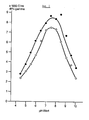
- Fig. 2 shows the stability of the immunological activity of the IFN-y in 500 mmol / l sodium phosphate as a function of the pH. 10000 U / ml IFN-y were taken up in 500 mmol / I sodium phosphate buffer with a pH of 4.5-10 and incubated in glass ampoules at 37 ° C. for 7 days. After 3 days ( ) and after days of incubation (oo) the immunological activity was determined with the IFN-y-EIA.
- Fig.3 shows the stability of the immunological activity of the IFN-y at pH 7.5 as a function of the sodium phosphate concentration.
- 6000 U / ml IFN-y were taken up in solutions which were buffered with different sodium phosphate concentrations and adjusted to pH 7.5.
- the IFN-y solutions were incubated in glass ampoules at 37 ° C for 7 days. After this incubation, the immunological activity in the IFN- ⁇ solutions was determined with the IFN-y-EIA.
- Fig. 4 shows the stability of the immunological activity of the IFN-y as a function of the polyphosphate concentration in the solution. 4500 U / ml IFN-y was taken up in solutions containing different concentrations of potassium polyphosphate, pH 7.5. These IFN-y solutions were incubated in glass ampoules at 37 ° C for 16 days. After 3 days ( ) and after 16 days of incubation - (oo) the immunological activity of the IFN-y in the relevant solutions was determined with the IFN- ⁇ -EIA.
- Fig. 5 shows the stability of the immunological activity of the IFN-y as a function of the polyphosphate concentration in the presence and in the absence of sodium phosphate.
- 8000 U / ml IFN-y were taken up in solutions containing different concentrations of potassium polyphosphate of pH 7.5 (oo).
- some of the solutions were buffered with 1000 mmol / I] sodium phosphate of pH 7.5 - ( ).
- the IFN- ⁇ activities plotted in this figure were measured after a 20-day incubation at 37 ° C with the IFN- ⁇ -EIA.
- IFN-y solutions were incubated in glass ampoules for 8 days at 2-8 ° C, 22 ° C and + 37 ° C. After certain time intervals, the immunological activity of the IFN-y was determined with the IFN-y-EIA.
- IFN-y stability was investigated in different buffer systems and at different pH values. 6000 U / ml IFN-y were in 0.1 mol / l sodium acetate of pH 2.0-6.0, sodium phosphate of pH 5.5-8.0 and in TRIS / acetate of pH 7.2-9, 0 recorded and incubated for 2 days in sealed glass ampoules at 37 ° C.
- the immunological activity of the IFN-y was determined before the incubation and one and 2 days after the incubation with the IFN-y-EIA.
- the results shown in Fig. 1 generally show poor stability of the immunological activity of the IFN-y in 0.1 mol / l of the buffer systems investigated. The best results are achieved with the phosphate buffer system.
- the IFN-y stability in 500 mmol / l sodium phosphate depending on the pH (4.5-10) was examined.
- 10,000 U / ml IFN-y were taken up in 500 mmol / l sodium phosphate buffer with a pH of 4.5-10 and incubated in glass ampoules at 37 ° C. for 7 days.
- the immunological activity was determined with the IFN-y-EIA. It was found that, on the one hand, the increased phosphate concentration can generally achieve much better stability and, on the other hand, that the IFN-y is most stable at pH 7.5 within the investigated pH range of 4.5-10 (Fig. 2) . After a 7-day incubation at 37 ° C., 70% of the original immunological activity of the IFN-y used could still be found in a solution of pH 7.5 buffered with 500 mmol / l sodium phosphate.
- Example 2 On the basis of the surprising results from Example 2, the influence of the sodium phosphate concentration at pH 7.5 on the IFN-y stability was investigated at an incubation temperature of +37 ° C. 6000 U / ml IFN-y were taken up in solutions that were buffered with different sodium phosphate concentrations and adjusted to pH 7.5. The IFN-y solutions were incubated in glass ampoules at 37 ° C for 7 days. After this incubation period, the immunological activity in the IFN- ⁇ solutions was determined with the IFN-y-EIA. The results, which are summarized in Fig. 3, confirm the findings shown in Fig. 1 and 2 and show a significant improvement in IFN- ⁇ stability with increasing phosphate concentration.
- IFN-y solutions were incubated in glass ampoules for 8 days at 2-8 ° C, 22 ° C and + 37 ° C.
- the immunological activity of the IFN-y was determined after certain time intervals.
- Fig. 6 the comparison of the storage stabilities of IFN-y in PBS, in PBS-BSA and in 1000 mmol / l sodium phosphate / 50 g / l sodium polyphosphate with pH 7.5 shows that the immunological activity of IFN-y in PBS and in PBS-BSA at an incubation temperature of 22 ° C is almost completely lost after 1 day, while in the phosphate-polyphosphate solution it is almost completely lost after 8 days of incubation at 4 ° C, 22 ° C and 37 ° C preserved.
Landscapes
- Health & Medical Sciences (AREA)
- Life Sciences & Earth Sciences (AREA)
- Chemical & Material Sciences (AREA)
- Pharmacology & Pharmacy (AREA)
- Veterinary Medicine (AREA)
- Public Health (AREA)
- General Health & Medical Sciences (AREA)
- Animal Behavior & Ethology (AREA)
- Medicinal Chemistry (AREA)
- General Chemical & Material Sciences (AREA)
- Organic Chemistry (AREA)
- Nuclear Medicine, Radiotherapy & Molecular Imaging (AREA)
- Chemical Kinetics & Catalysis (AREA)
- Epidemiology (AREA)
- Bioinformatics & Cheminformatics (AREA)
- Engineering & Computer Science (AREA)
- Immunology (AREA)
- Gastroenterology & Hepatology (AREA)
- Oncology (AREA)
- Zoology (AREA)
- Communicable Diseases (AREA)
- Proteomics, Peptides & Aminoacids (AREA)
- Virology (AREA)
- Inorganic Chemistry (AREA)
- Medicines That Contain Protein Lipid Enzymes And Other Medicines (AREA)
- Medicinal Preparation (AREA)
- Peptides Or Proteins (AREA)
Abstract
Description
- Die vorliegende Erfindung betrifft Interferon-Zusammensetzungen mit verbesserter Stabilität der biologischen und immunologischen Interferon-Aktivität sowie Verfahren zu deren Herstellung.
- Unter Interferonen versteht man eine Gruppe körpereigener Proteine mit antiviraler und immunregulatorischer Wirkung. Der antivirale Effekt wird dabei nicht durch eine direkte Beeinflussung der Viren selbst erzielt sondern durch eine Wirkung auf deren Zielzellen im Sinne eines Schutzes gegen die Virusinfektion. Neben der antiviralen Aktivität können die Interferone objektivierbare Effekte auf Krebsgeschwülste ausüben, die sie für den Einsatz in der Krebstherapie geeignet machen und sie beeinflussen das körpereigene Immunsystem, indem sie z.B. Makrophagen und NK-Zellen aktivieren und die Expression verschiedener immunologisch bedeutsamer Bestandteile der Zellmembran verstärken.
- Interferone (IFN-a, -ß und -y) können heute dank rekombinanter DNA-Technologie auf mikrobiellem Wege in Mengen hergestellt werden, die früher trotz grösster An strengungen durch Isolierung aus natürlichem Material (Leukocyten, Fibroblasten, Lymphocyten) und Reinigung nicht zur Verfügung gestellt werden konnten.
- Erst diese neue Technologie hat daher einen Weg für die intensive klinische Erprobung und allfällige breite therapeutische Anwendung der Interferone geöffnet und macht eine hinreichende Versorgung der für eine Behandlung infrage kommenden Personen mit den Wirksubstanzen möglich.
- Unter den Human-Interferonen ist das IFN-y das instabilste Protein, dessen biologische Aktivität durch Lagerung, Einfrieren oder Lyophilisation - schnell verloren geht. Diese Instabilität erschwert in erheblichem Masse die Herstellung, Reinigung, Lagerung und therapeutische Anwendung des IFN-y. Die Stabilisierung seiner biologischen Aktivität spielt daher eine besonders wichtige Rolle. Im Vergleich zum IFN-y sind die Human-Interferone a und β relativ stabile Proteine und können ohne nennenswerten Verlust an biologischer Aktivität gereinigt, gelagert und zur Therapie verwendet werden.
- Zur Stabilisierung von Interferonen, insbesondere IFN-y wurden bisher verschiedene Hilfsstoffe herangezogen. So wurde die Stabilisierung von Interferonen mittels Propylenglycol im U.S. Patent Nr. 4 483 849 beschrieben. Es stellte sich jedoch heraus, dass Propylenglycol zur Stabilisierung von rekombinantem IFN-y nicht effizient eingesetzt werden kann. Auch die Stabilisierung von IFN-y mittels Rinderserumalbumin (Rinderknecht et al., J. Biol. Chem. 259, 6790-6797 [1984]) wurde geprüft und für nicht effizient befunden. Die Stabilisierung von IFN-y mittels 0,1% BSA und 0,5% Gelatine (Devos et al., J. Interferon Res. 4, 461-468 [1984]) ist ebenfalls bekannt. Um einen Aktivitätsverlust zu vermeiden, müssen derartige Präparate aber immer noch bei -70°C aufbewahrt werden.
- Erfindungsgemäss wurde nun gefunden, dass Interferone in Gegenwart einer hohen Konzentration an Phosphat und/oder Polyphosphat eine ausgezeichnete Stabilität aufweisen, so dass die Interferone in Lösungen ohne nennenswerten Verlust an biologischer und immunologischer Aktivität bei 2-8°C gelagert werden können.
- Die vorliegende Erfindung betrifft daher Zusammensetzungen, enthaltend Interferon, ein Phosphatpuffersystem und/oder Polyphosphat, sowie ein Verfahren zu deren Herstellung, das darin besteht, dass man eine Interferon-Lösung mit Phosphat und/oder Polyphosphat versetzt.
- Die vorliegende Erfindung betrifft ausserdem pharmazeutische Präparate auf der Basis der erfindungsgemässen Zusammensetzung, sowie ein Verfahren zur Herstellung derartiger pharmazeutischer Präparate, welches dadurch gekennzeichnet ist, dass man eine erfindungsgemässe Zusammensetzung und, erwünschtenfalls, einen oder mehrere andere therapeutisch wertvolle Stoffe mit einem pharmazeutisch annehmbaren Träger zusammenmischt und das anfallende Gemisch in eine geeignete Dosierungsform gebracht wird.
- Die erfindungsgemässe Stabilisierung kann auf alle Interferone oder Polypeptide mit Interferon- ähnlichen biologischen Eigenschaften sowie auf Gemische, die ein Interferon oder ein solches Polypeptid enthalten, angewendet werden. Vorzugsweise wird sie bei Human-Interferon angewendet werden. Das Human-Interferon kann ein natürliches oder rekombinantes Leukozyten-Interferon (IFN-a), Fibroblasten-Interferon (IFN-ß) oder Immun-Interferon (IFN-y) sein. Auch sogennante hybride Interferone, bei denen Fragmente von zwei oder mehreren nativen Interferon-Species verknüpft werden, können erfindungsgemäss stabilisiert werden. Ein besonders bevorzugtes Human-Interferon im Zusammenhang mit der vorliegenden Erfindung ist IFN-y, vorzugsweise rekombinantes IFN-y, speziell IFN-y DO oder IFN-y D3. Die Bezeich nungen D0 und D3 dienen zur Unterscheidung der letztgenannten Interferone, wobei mit DO dasjenige rIFN-γ bezeichnet wird, dessen N-terminale Aminosäuresequenz mit Cys-Tyr-Cys bzw. Met-Cys-Tyr-Cys beginnt, während unter D3 ein um Cys-Tyr-Cys verkürztes r)FN--y zu verstehen ist, dessen N-terminale Aminosäuresequenz mit Gln bzw. Met-Gin beginnt.
- Der Gehalt der erfindungsgemässen Zusammensetzungen an Interferon ist nicht kritisch. Der Konzentrationsbereich erstreckt sich über mehrere Zehnerpotenzen und wird nach oben im wesentlichen nur durch die Löslichkeit des betreffenden Interferons beschränkt. Für Human-IFN-y kommen biespielsweise Konzentrationen biz zu 10' Einheiten (E)/ml in Frage, wobei ein bevorzugter Bereich 4·103 -etwa 10' E/ml beträgt.
- Die erfindungsgemässen Zusammensetzungen können zur Herstellung eines pharmazeutischen Präparates zur Therapie bzw. Prophylaxe von viralen Infektionen und immunregulatorischer Anomalien, insbesondere Neoplasmen verwendet werden.
- Das Phosphatpuffersystem der vorliegenden Erfindung ist so eingerichtet, dass es ein pH von etwa 6,0-9,0, vorzugsweise von 7,5 aufrechterhält und eine Phosphatkonzentration von 500-1000 mMol/I, vorzugsweise 1000 mMol/I, aufweist. Als Phosphatquelle kommen Kaliumphosphate und Natriumphosphate, vorzugsweise Dinatriumhydrogenphosphat und Mononatriumhydrogenphosphat, in Frage. Ein besonders bevorzugtes Phosphatpuffersystem der vorliegenden Erfindung ist so eingerichtet, dass es ein pH von etwa 7,5 gewährleistet und eine Phosphatkonzentration von 500-1000 mMol/I, vorzugsweise 1000 mMol/l, sowie 25-100 g/l, vorzugsweise 50 g/I, Polyphosphat, speziell Kaliumpolyphosphat, enthält.
- Die Polyphosphat-Lösungen vom pH 7,5 der vorliegenden Erfindung, werden in einer Konzentration von 25-100 g/I, vorzugsweise 50 g/l Polyphosphat, speziell Kaliumpolyphos phat eingesetzt.
- In den folgenden Beispielen werden Einzelheiten der Erfindung beschrieben.
- Die in den Beispielen verwendeten Chemikalien waren p.a. oder von höchster Reinheit.
- Alle erfindungsgemäss stabilisierbaren Interferone, insbesondere das in den Beispielen verwendete rekombinante IFN-y D3 können in reiner Form nach bekannten, in der Literatur beschriebenen Verfahren oder nach für den Fachmann naheliegenden Verfahren erhalten werden.
- Zur Bestimmung der immunologischen Aktivität des rekombinanten IFN-y D3 wurde ein Enzymimmunologischer Test (IFN-y-EIA) eingesetzt, der dem Enzym-immunologischen Test von H. Gallati zur Bestimmung des Human-Leukozyten-Interferons, der im J. Clin. Chem. Clin. Biochem. 20, 907-914 (1982) beschrieben ist, entspricht.
- Für die Stabilitätsprüfung des IFN-y wurden Lösungen mit 4000-10000 E/ml IFN-y und den zu untersuchenden Zusätzen in Glasampullen bei +37°C inkubiert und nach gewissen Zeitintervallen, die in der inkubierten IFN-y-Lösung noch vorhandene immunologische Aktivität des IFN-y mit dem IFN-γ-EIA bestimmt.
- Abb. 1 zeigt die Stabilität der immunologischen Aktivität des IFN-y in Abhängigkeit vom Puffersystem und pH-Wert. 6000 E/ml IFN-y wurden in je 0,1 Mol/I Natriumacetat vom pH 2,0-6,0 - (), Natriumphosphat vom pH 5,5-8,0 (
 ) und in TRIS/Acetat vom pH 7,2-9,0 -
 ) aufgenommen und während 2 Tagen in verschlossenen Glasampullen bei 37°C inkubiert. Die immunologische Aktivität des IFN-y wurde vor der Inkubation sowie einen und 2 Tage nach Inkubation mit dem IFN-γ-EIA bestimmt.
- Abb. 2 zeigt die Stabilität der immunologischen Aktivität des IFN-y in 500 mMole/I Natriumphosphat in Abhängigkeit vom pH-Wert. 10000 E/ml IFN-y wurden in 500 mMol/I Natriumphosphatpuffer vom pH 4,5-10 aufgenommen und in Glasampullen während 7 Tagen bei 37°C inkubiert. Nach 3 Tagen () und nach Tagen Inkubation (o o) wurde die immunologische Aktivität mit dem IFN-y-EIA bestimmt.

- Abb.3 zeigt die Stabilität der immunologischen Aktivität des IFN-y beim pH-Wert 7,5 in Abhängigkeit von der Natriumphosphatkonzentration. 6000 E/ml IFN-y wurden in Lösungen aufgenommen, die mit unterschiedlicher Natriumphosphatkonzentration gepuffert und auf den pH-Wert 7,5 eingestellt wurden. Die IFN-y-Lösungen wurden in Glasampullen während 7 Tagen bei 37°C inkubiert. Nach dieser Inkubation wurde die immunologische Aktivität in den IFN-γ-Lösungen mit dem IFN-y-EIA bestimmt.
- Abb. 4 zeigt die Stabilität der immunologischen Aktivität des IFN-y in Abhängigkeit von der Polyphosphat-Konzentration in der Lösung. 4500 E/ml IFN-y wurden in Lösungen aufgenommen, die verschiedene Konzentrationen von Kaliumpolyphosphat, pH 7,5, enthielten. Diese IFN-y-Lösungen wurden in Glasampullen während 16 Tagen bei 37°C inkubiert. Nach 3 Tagen () und nach 16 Tagen Inkubation - (o o) wurde die immunologische Aktivität des IFN-y in den betreffenden Lösungen mit dem IFN-γ-EIA bestimmt.

- Abb. 5 zeigt die Stabilität der immunologischen Aktivität des IFN-y in Abhängigkeit von der Polyphosphatkonzentration bei Anwesenheit und bei Abwesenheit von Natriumphosphat. 8000 E/ml IFN-y wurden in Lösungen aufgenommen, die unterschiedliche Konzentrationen an Kaliumpolyphosphat vom pH 7,5 enthielten (o o). Zusätzlich wurde ein Teil der Lösungen mit 1000 mMol/I] Natriumphosphat vom pH 7,5 gepuffert - (). Die in dieser Abbildung aufgetragenen IFN-γ-Aktivitäten wurden nach einer 20- tägigen Inkubation bei 37°C mit dem IFN-γ-EIA gemessen.

- Abb. 6 zeigt vergleichende Stabilitätstests mit IFN-y in verschiedenen Lösungsmitteln und bei verschiedenen Temperaturen. Je 4000 E/ml IFN-y wurden aufgenommen in
- a) 20 mMol/I Natriumphosphat mit 9 g/I NaCl und 0,25 g/I Thimerosal (Natrium-Ethylmercurithiosalicylat, Fa. Fluka), pH 7,5 (),

- b) 20 mMol/l Natriumphosphat mit 9 g/l NaCI, 5 g/I BSA und 0,25 g/l "Thimerosal", pH 7,5 , und

- c) 1000 mMol/I Natriumphosphat, 50 g/I Kaliumpolyphosphat und 0,25 g/l "Thimerosal", pH 7,5 (,

 ).
).
- Diese IFN-y-Lösungen wurden in Glasampullen während 8 Tagen bei 2-8°C, 22°C und +37°C inkubiert. Nach bestimmten Zeitintervallen wurde die immunologische Aktivität des IFN-y mit dem IFN-y-EIA bestimmt.
- In einer ersten Versuchsserie wurde die IFN-y-Stabili-tät in verschiedenen Puffersystemen und bei verschiedenen pH-Werten untersucht. 6000 E/ml IFN-y wurden in je 0,1 Mol/l Natriumacetat vom pH 2,0-6,0, Natriumphosphat vom pH 5,5-8,0 und in TRIS/Acetat vom pH 7,2-9,0 aufgenommen und während 2 Tagen in verschlossenen Glasampullen bei 37°C inkubiert. Die immunologische Aktivität des IFN-y wurde vor der Inkubation sowie einen und 2 Tage nach Inkubation mit dem IFN-y-EIA bestimmt. Die in Abb. 1 dargestellten Resultate zeigen generell eine schlechte Stabilität der immunologischen Aktivität des IFN-y in 0,1 Mol/l der untersuchten Puffersysteme. Die besten Ergebnisse werden mit dem Phosphatpuffersystem erreicht.
- In einer weiteren Serie wurde die IFN-y-Stabilität in 500 mMol/I Natriumphosphat in Abhängigkeit zum pH-Wert (4,5-10) untersucht. Jeweils 10'000 E/ml IFN-y wurden in 500 mMol/I Natriumphosphatpuffer vom pH 4,5-10 aufgenommen und in Glasampullen während 7 Tagen bei 37°C inkubiert. Nach 3 Tagen und nach 7 Tagen Inkubation wurde die immunologische Aktivität mit dem IFN-y-EIA bestimmt. Es wurde festgestellt, dass einerseits mit der erhöhten Phosphatkonzentration generell eine wesentlich bessere Stabilität erreicht werden kann und dass andererseits innerhalb des untersuchten pH-Bereichs von 4,5-10 das IFN-y beim pH 7,5 am stabilsten ist (Abb. 2). So konnten nach einer 7-tägigen Inkubation bei 37°C in einer mit 500 mMol/I Natriumphosphat-gepufferten Lösung vom pH 7,5 noch 70% der ursprünglichen immunologischen Aktivität des eingesetzten IFN-y gefunden werden.
- Auf Grund der überraschenden Resultate aus Beispiel 2 wurde der Einfluss der Natriumphosphatkonzentration beim pH 7,5 auf die IFN-y-Stabilität bei einer Inkubationstemperatur von +37°C untersucht. 6000 E/ml IFN-y wurden in Lösungen aufgenommen, die mit unterschiedlicher Natriumphosphatkonzentration gepuffert und auf den pH-Wert 7,5 eingestellt waren. Die IFN-y-Lösungen wurden in Glasampullen während 7 Tagen bei 37°C inkubiert. Nach dieser Inkubationsdauer wurde die immunologische Aktivität in den IFN-γ-Lösungen mit dem IFN-y-EIA bestimmt. Die Resultate, die in der Abb. 3 zusammengestellt sind, bestätigen die in Abb. 1 und 2 dargestellten Befunde und zeigen mit zunehmender Phosphatkonzentration eine wesentliche Verbesserung der IFN-γ-Stabilität.
- Da die Natriumphosphatkonzentration aus Löslichkeitsgründen nicht wesentlich über 1000 mMol/I gesteigert werden kann (Auskristallisation bei 4°C), wurde in einer weiteren Versuchsserie der Einfluss von Polyphosphat auf die IFN-y-Stabilität bei 37°C untersucht. 4500 E/ml IFN-γ wurde in Lösungen aufgenommen, die verschiedene Konzentrationen von Kaliumpolyphosphat, pH 7,5, enthielten. Diese IFN-γ-Lösungen wurden in Glasampullen während 16 Tagen bei 37°C inkubiert. Nach 3 und nach 16 Tagen wurde die immunologische Aktivität des IFN-y in den betreffenden Lösungen mit dem IFN-γ-EIA bestimmt. Die Resultate (Abb. 4) zeigen einen ähnlich guten Effekt wie mit hohen Konzentration an Natriumphosphat.
- Um den Einfluss einer Kombination von Kaliumpolyphosphat und von Natriumphosphat auf die Stabilität des IFN-y abzuklären, wurden 8000 E/ml IFN-γ in Lösungen aufgenommen, die unterschiedliche Konzentrationen an Kaliumpolyphosphat vom pH 7,5 enthielten. Zusätzlich wurde ein Teil der Lösungen mit 1000 mMol/l Natriumphosphat vom pH 7,5 gepuffert. Die Resultate (Abb. 5) zeigen eine optimale Stabilisierung von IFN-y mit einer Kombination von 1000 mMol/I Natriumphosphat vom pH 7,5 und 25-100 g/l, vorzugsweise 50 g/l Polyphosphat.
- Abschliessend wurde die Stabilität des IFN-y in diversen Lösungsmitteln untersucht. So wurden je 4000 E/ml IFN-y aufgenommen in (a) 20 mMol/I Natriumphosphat mit 9 g/I NaCl und 0,25 g/l Thimerosal, pH 7,5 (b) 20 mMol/I Natriumphosphat mit 9 g/l NaCl, 5 g/l BSA und 0,25 g/l Thimerosal, pH 7,5, und (c) 1000 mMol/I Natriumphosphat, 50 g/I Kaliumpolyphosphat und 0,25 g/I Thimerosal, pH 7,5. Diese IFN-y-Lösungen wurden in Glasampullen während 8 Tagen bei 2-8°C, 22°C und +37°C inkubiert. Nach bestimmten Zeitintervallen wurde die immunologische Aktivität des IFN-y bestimmt. Wie aus Abb. 6 hervorgeht, zeigt der Vergleich der Lagerstabilitäten des IFN-y in PBS, in PBS-BSA sowie in 1000 mMol/I Natriumphosphat/50 g/I Natriumpolyphosphat vom pH 7,5, dass die immunologische Aktivität des IFN-y in PBS und in PBS-BSA bei einer Inkubationstemperatur von 22°C schon nach 1 Tag praktisch vollständig verloren geht, während sie in der Phosphat-Polyphosphatlösung nach 8 Tagen Inkubation bei 4°C, bei 22°C und bei 37°C fast vollständig erhalten bleibt.
Claims (25)
Priority Applications (1)
| Application Number | Priority Date | Filing Date | Title |
|---|---|---|---|
| AT86114047T ATE50694T1 (de) | 1985-10-15 | 1986-10-10 | Stabilisierung von interferonen. |
Applications Claiming Priority (2)
| Application Number | Priority Date | Filing Date | Title |
|---|---|---|---|
| CH4433/85 | 1985-10-15 | ||
| CH443385 | 1985-10-15 |
Publications (3)
| Publication Number | Publication Date |
|---|---|
| EP0219073A2 true EP0219073A2 (de) | 1987-04-22 |
| EP0219073A3 EP0219073A3 (en) | 1987-09-23 |
| EP0219073B1 EP0219073B1 (de) | 1990-03-07 |
Family
ID=4276045
Family Applications (1)
| Application Number | Title | Priority Date | Filing Date |
|---|---|---|---|
| EP86114047A Expired - Lifetime EP0219073B1 (de) | 1985-10-15 | 1986-10-10 | Stabilisierung von Interferonen |
Country Status (10)
| Country | Link |
|---|---|
| EP (1) | EP0219073B1 (de) |
| JP (1) | JPS6293300A (de) |
| AT (1) | ATE50694T1 (de) |
| AU (1) | AU591525B2 (de) |
| DE (1) | DE3669263D1 (de) |
| DK (1) | DK163280C (de) |
| IL (1) | IL80288A0 (de) |
| NZ (1) | NZ217885A (de) |
| PH (1) | PH22805A (de) |
| ZA (1) | ZA867747B (de) |
Cited By (2)
| Publication number | Priority date | Publication date | Assignee | Title |
|---|---|---|---|---|
| US5151265A (en) * | 1987-11-03 | 1992-09-29 | Genentech, Inc. | Gamma interferon formulation |
| US5318685A (en) * | 1987-08-18 | 1994-06-07 | Cardinal Ig Company | Method of making metal oxide films having barrier properties |
Families Citing this family (2)
| Publication number | Priority date | Publication date | Assignee | Title |
|---|---|---|---|---|
| FR2654343B1 (fr) * | 1989-11-10 | 1994-08-05 | Roussel Uclaf | Utilisation d'un polypeptide ayant l'activite de l'interferon gamma pour la preparation de compositions pharmaceutiques destinees au traitement de cancers primitifs de la plevre. |
| JPH0771459B2 (ja) * | 1991-05-15 | 1995-08-02 | 三協食品工業株式会社 | 機能性食品素材とその製造方法 |
Family Cites Families (3)
| Publication number | Priority date | Publication date | Assignee | Title |
|---|---|---|---|---|
| ZA828580B (en) * | 1981-12-23 | 1983-10-26 | Schering Corp | Interferon formulations |
| JPS6034919A (ja) * | 1983-08-04 | 1985-02-22 | Green Cross Corp:The | ガンマ・インタ−フェロン組成物 |
| JPS61221129A (ja) * | 1985-03-25 | 1986-10-01 | シエリング・コーポレーシヨン | 安定なγ‐インターフエロン製剤 |
-
1986
- 1986-10-10 DE DE8686114047T patent/DE3669263D1/de not_active Expired - Lifetime
- 1986-10-10 EP EP86114047A patent/EP0219073B1/de not_active Expired - Lifetime
- 1986-10-10 IL IL80288A patent/IL80288A0/xx not_active IP Right Cessation
- 1986-10-10 NZ NZ217885A patent/NZ217885A/xx unknown
- 1986-10-10 AT AT86114047T patent/ATE50694T1/de active
- 1986-10-13 DK DK488586A patent/DK163280C/da active
- 1986-10-13 JP JP61241588A patent/JPS6293300A/ja active Pending
- 1986-10-13 PH PH34356A patent/PH22805A/en unknown
- 1986-10-13 ZA ZA867747A patent/ZA867747B/xx unknown
- 1986-10-14 AU AU63872/86A patent/AU591525B2/en not_active Ceased
Non-Patent Citations (1)
| Title |
|---|
| EXCERPTA MEDICA, vol. 80, no. 14733; P.JAMESON et al.: "Thermal stability of freeze-dried mammalian interferons. Analysis of freeze-drying conditions and accelerated storage tests for murine interferon" & CRYOBIOLOGY (U.S.A.) 1979, 16/4 (301-314) * |
Cited By (2)
| Publication number | Priority date | Publication date | Assignee | Title |
|---|---|---|---|---|
| US5318685A (en) * | 1987-08-18 | 1994-06-07 | Cardinal Ig Company | Method of making metal oxide films having barrier properties |
| US5151265A (en) * | 1987-11-03 | 1992-09-29 | Genentech, Inc. | Gamma interferon formulation |
Also Published As
| Publication number | Publication date |
|---|---|
| EP0219073B1 (de) | 1990-03-07 |
| ATE50694T1 (de) | 1990-03-15 |
| DK163280C (da) | 1992-07-06 |
| DE3669263D1 (de) | 1990-04-12 |
| EP0219073A3 (en) | 1987-09-23 |
| ZA867747B (en) | 1988-02-24 |
| PH22805A (en) | 1988-12-27 |
| DK488586A (da) | 1987-04-16 |
| DK488586D0 (da) | 1986-10-13 |
| AU591525B2 (en) | 1989-12-07 |
| NZ217885A (en) | 1989-06-28 |
| IL80288A0 (en) | 1987-01-30 |
| DK163280B (da) | 1992-02-17 |
| JPS6293300A (ja) | 1987-04-28 |
| AU6387286A (en) | 1987-04-16 |
Similar Documents
| Publication | Publication Date | Title |
|---|---|---|
| DE3520228C2 (de) | Wasserlösliche bioaktive Trockenfeststoffzusammensetzung, Verfahren zu ihrer Herstellung und sie enthaltende pharmazeutische Präparate | |
| DE3689246T2 (de) | Physiologisch aktives Polypeptid BUF-3. | |
| DE68916385T2 (de) | Stabilisierte Formulierungen mit hydrohoben Proteinen. | |
| EP0170843B1 (de) | Synergistische Mischungen von Interferonen und Tumor-Nekrose-Faktor | |
| DE3781204T2 (de) | Verfahren zur herstellung von lymphokinaktivierten toetenden zellen. | |
| DE69020573T2 (de) | Verfahren zur wachstumshemmung von stammzellen. | |
| DE69620877T2 (de) | Arzneimittelformulierungen für il-12 | |
| DE4434629C1 (de) | Zusammensetzungen zur Behandlung von IRDS und ARDS | |
| EP0181455B2 (de) | Verwendung von Interferon-gamma (IFN-gamma) enthaltenden Präparationen zur systemischen Behandlung von verschiedenen Erkrankungen des Menschen in niedriger Dosierung | |
| DE3787020T2 (de) | Herstellung von m-csf. | |
| DE69333724T2 (de) | Hybrider menschlich-schweinlicher faktor viii | |
| DE68918853T2 (de) | Formulierung von menschlichen wachstumshormonen. | |
| DE3686794T2 (de) | Reinigung des natuerlichen kolonie-stimulierenden faktors-1. | |
| DE69635079T2 (de) | Verwendung von il-11 zur behandlung von entzündung | |
| DE3686410T2 (de) | Stabilisierte zusammensetzungen von menschlichen aktivatoren des gewebeplasminogens. | |
| DE69630291T2 (de) | Proteinformulierung, die koajulationsfehler viii oder ix in einer saccharose wässriger lösung enthält | |
| EP0508194A1 (de) | Stabilisierte Faktor VIII-Präparationen | |
| DE2628914A1 (de) | Thymusdruesenhormon, dessen herstellung und thymusdruesenhormon enthaltende praeparate | |
| DE69622854T2 (de) | Arzneimittel zur Heilung von Thrombozytopenie | |
| EP0219073B1 (de) | Stabilisierung von Interferonen | |
| DE69527145T2 (de) | Verfahren zur behandlung von blutungsstorungen | |
| EP0420049B1 (de) | Stabilisierte Leukocyten-Interferone | |
| DE3515336C2 (de) | Verfahren zur Herstellung und Reinigung von â-Interferon | |
| DE60128399T2 (de) | Verwendung von thrombomodulinanaloga zur regenerierung von rückenmarkverletzungen | |
| DE69330960T2 (de) | Normalisierer der blutkoagulation enthaltend tcf-ii als aktiven bestandteil |
Legal Events
| Date | Code | Title | Description |
|---|---|---|---|
| PUAI | Public reference made under article 153(3) epc to a published international application that has entered the european phase |
Free format text: ORIGINAL CODE: 0009012 |
|
| 17P | Request for examination filed |
Effective date: 19861010 |
|
| AK | Designated contracting states |
Kind code of ref document: A2 Designated state(s): AT BE CH DE FR GB IT LI LU NL SE |
|
| PUAL | Search report despatched |
Free format text: ORIGINAL CODE: 0009013 |
|
| AK | Designated contracting states |
Kind code of ref document: A3 Designated state(s): AT BE CH DE FR GB IT LI LU NL SE |
|
| 17Q | First examination report despatched |
Effective date: 19880725 |
|
| RAP1 | Party data changed (applicant data changed or rights of an application transferred) |
Owner name: F. HOFFMANN-LA ROCHE AG |
|
| GRAA | (expected) grant |
Free format text: ORIGINAL CODE: 0009210 |
|
| AK | Designated contracting states |
Kind code of ref document: B1 Designated state(s): AT BE CH DE FR GB IT LI LU NL SE |
|
| REF | Corresponds to: |
Ref document number: 50694 Country of ref document: AT Date of ref document: 19900315 Kind code of ref document: T |
|
| REF | Corresponds to: |
Ref document number: 3669263 Country of ref document: DE Date of ref document: 19900412 |
|
| ITF | It: translation for a ep patent filed | ||
| ET | Fr: translation filed | ||
| GBT | Gb: translation of ep patent filed (gb section 77(6)(a)/1977) | ||
| PLBE | No opposition filed within time limit |
Free format text: ORIGINAL CODE: 0009261 |
|
| STAA | Information on the status of an ep patent application or granted ep patent |
Free format text: STATUS: NO OPPOSITION FILED WITHIN TIME LIMIT |
|
| 26N | No opposition filed | ||
| ITTA | It: last paid annual fee | ||
| PGFP | Annual fee paid to national office [announced via postgrant information from national office to epo] |
Ref country code: SE Payment date: 19930915 Year of fee payment: 8 |
|
| PGFP | Annual fee paid to national office [announced via postgrant information from national office to epo] |
Ref country code: GB Payment date: 19930916 Year of fee payment: 8 |
|
| PGFP | Annual fee paid to national office [announced via postgrant information from national office to epo] |
Ref country code: BE Payment date: 19930924 Year of fee payment: 8 |
|
| PGFP | Annual fee paid to national office [announced via postgrant information from national office to epo] |
Ref country code: LU Payment date: 19931001 Year of fee payment: 8 |
|
| PGFP | Annual fee paid to national office [announced via postgrant information from national office to epo] |
Ref country code: CH Payment date: 19931013 Year of fee payment: 8 |
|
| PGFP | Annual fee paid to national office [announced via postgrant information from national office to epo] |
Ref country code: FR Payment date: 19931014 Year of fee payment: 8 |
|
| PGFP | Annual fee paid to national office [announced via postgrant information from national office to epo] |
Ref country code: DE Payment date: 19931018 Year of fee payment: 8 |
|
| PGFP | Annual fee paid to national office [announced via postgrant information from national office to epo] |
Ref country code: NL Payment date: 19931031 Year of fee payment: 8 Ref country code: AT Payment date: 19931031 Year of fee payment: 8 |
|
| EPTA | Lu: last paid annual fee | ||
| PG25 | Lapsed in a contracting state [announced via postgrant information from national office to epo] |
Ref country code: LU Free format text: LAPSE BECAUSE OF NON-PAYMENT OF DUE FEES Effective date: 19941010 Ref country code: GB Effective date: 19941010 Ref country code: AT Effective date: 19941010 |
|
| PG25 | Lapsed in a contracting state [announced via postgrant information from national office to epo] |
Ref country code: SE Effective date: 19941011 |
|
| PG25 | Lapsed in a contracting state [announced via postgrant information from national office to epo] |
Ref country code: LI Effective date: 19941031 Ref country code: CH Effective date: 19941031 Ref country code: BE Effective date: 19941031 |
|
| EAL | Se: european patent in force in sweden |
Ref document number: 86114047.3 |
|
| BERE | Be: lapsed |
Owner name: F. HOFFMANN-LA ROCHE A.G. Effective date: 19941031 |
|
| PG25 | Lapsed in a contracting state [announced via postgrant information from national office to epo] |
Ref country code: NL Effective date: 19950501 |
|
| GBPC | Gb: european patent ceased through non-payment of renewal fee |
Effective date: 19941010 |
|
| NLV4 | Nl: lapsed or anulled due to non-payment of the annual fee | ||
| PG25 | Lapsed in a contracting state [announced via postgrant information from national office to epo] |
Ref country code: FR Effective date: 19950630 |
|
| REG | Reference to a national code |
Ref country code: CH Ref legal event code: PL |
|
| PG25 | Lapsed in a contracting state [announced via postgrant information from national office to epo] |
Ref country code: DE Effective date: 19950701 |
|
| EUG | Se: european patent has lapsed |
Ref document number: 86114047.3 |
|
| REG | Reference to a national code |
Ref country code: FR Ref legal event code: ST |
|
| PG25 | Lapsed in a contracting state [announced via postgrant information from national office to epo] |
Ref country code: IT Free format text: LAPSE BECAUSE OF NON-PAYMENT OF DUE FEES;WARNING: LAPSES OF ITALIAN PATENTS WITH EFFECTIVE DATE BEFORE 2007 MAY HAVE OCCURRED AT ANY TIME BEFORE 2007. THE CORRECT EFFECTIVE DATE MAY BE DIFFERENT FROM THE ONE RECORDED. Effective date: 20051010 |