EP0219206A2 - Phasenempfindliche Detektion in Vielschichtsystemen mit magnetischer Kernresonanz - Google Patents
Phasenempfindliche Detektion in Vielschichtsystemen mit magnetischer Kernresonanz Download PDFInfo
- Publication number
- EP0219206A2 EP0219206A2 EP86306320A EP86306320A EP0219206A2 EP 0219206 A2 EP0219206 A2 EP 0219206A2 EP 86306320 A EP86306320 A EP 86306320A EP 86306320 A EP86306320 A EP 86306320A EP 0219206 A2 EP0219206 A2 EP 0219206A2
- Authority
- EP
- European Patent Office
- Prior art keywords
- frequency
- gradient
- signal
- field
- slice
- Prior art date
- Legal status (The legal status is an assumption and is not a legal conclusion. Google has not performed a legal analysis and makes no representation as to the accuracy of the status listed.)
- Granted
Links
- 238000002595 magnetic resonance imaging Methods 0.000 title claims abstract description 15
- 238000011896 sensitive detection Methods 0.000 title abstract description 5
- 238000001914 filtration Methods 0.000 claims abstract description 8
- 230000003068 static effect Effects 0.000 claims description 12
- 238000003384 imaging method Methods 0.000 claims description 5
- 238000000034 method Methods 0.000 abstract description 13
- 230000005540 biological transmission Effects 0.000 abstract description 12
- 238000005481 NMR spectroscopy Methods 0.000 description 30
- 238000005070 sampling Methods 0.000 description 12
- 230000005284 excitation Effects 0.000 description 7
- 238000012545 processing Methods 0.000 description 6
- 230000006870 function Effects 0.000 description 5
- 238000004364 calculation method Methods 0.000 description 4
- 230000003595 spectral effect Effects 0.000 description 4
- 230000015572 biosynthetic process Effects 0.000 description 2
- 230000000875 corresponding effect Effects 0.000 description 2
- 230000004044 response Effects 0.000 description 2
- 230000000717 retained effect Effects 0.000 description 2
- 238000000926 separation method Methods 0.000 description 2
- 238000012565 NMR experiment Methods 0.000 description 1
- 238000013459 approach Methods 0.000 description 1
- 230000001427 coherent effect Effects 0.000 description 1
- 238000012937 correction Methods 0.000 description 1
- 230000002596 correlated effect Effects 0.000 description 1
- 230000003247 decreasing effect Effects 0.000 description 1
- 238000001514 detection method Methods 0.000 description 1
- 238000011161 development Methods 0.000 description 1
- 238000010586 diagram Methods 0.000 description 1
- 230000000694 effects Effects 0.000 description 1
- 238000004519 manufacturing process Methods 0.000 description 1
- 238000013421 nuclear magnetic resonance imaging Methods 0.000 description 1
- 238000002360 preparation method Methods 0.000 description 1
- 230000002250 progressing effect Effects 0.000 description 1
- 230000000087 stabilizing effect Effects 0.000 description 1
Images



Classifications
-
- G—PHYSICS
- G01—MEASURING; TESTING
- G01R—MEASURING ELECTRIC VARIABLES; MEASURING MAGNETIC VARIABLES
- G01R33/00—Arrangements or instruments for measuring magnetic variables
- G01R33/20—Arrangements or instruments for measuring magnetic variables involving magnetic resonance
- G01R33/44—Arrangements or instruments for measuring magnetic variables involving magnetic resonance using nuclear magnetic resonance [NMR]
- G01R33/48—NMR imaging systems
- G01R33/58—Calibration of imaging systems, e.g. using test probes, Phantoms; Calibration objects or fiducial markers such as active or passive RF coils surrounding an MR active material
- G01R33/583—Calibration of signal excitation or detection systems, e.g. for optimal RF excitation power or frequency
Definitions
- This invention relates to magnetic resonance imaging (MRI) systems and, in particular to the phase sensitive detection of nuclear magnetic resonance (NMR) signals in such systems.
- MRI magnetic resonance imaging
- NMR nuclear magnetic resonance
- MRI Magnetic resonance Imaging
- a common imaging technique is the formation of images of selected planes, or slices, of the subject being imaged.
- the subject is located in the static magnetic field with the physical region of the slice at the geometric center of the gradient field.
- the field center is the point where the gradients of the x, y and z dimensions all have nominal zero values.
- each gradient will exhibit an increasing field strength on one side of the field center, and a decreasing field strength on the other side, both variations progressing in the direction of the particular gradient.
- the field strength at the field center will thus correspond to a nominal Larmor frequency for the MRI system, usually equal to that of the static magnetic field.
- the radio frequency (RF) coils which transmit RF excitation pulses to the subject and receive NMR signals in return are normally tuned about the nominal Larmor frequency.
- the RF transmitters and receivers are similarly adjusted with bandwidths centered about this frequency. With the region of the slice located at the field center, the transmitted and received signals will be in a range about-the nominal frequency.
- Multiple slice imaging presents a particular problem in that slices located at other than the field center will respond to and emit signals of different frequencies and frequency bands during excitation and NMR signal emission.
- An off-center slice will be selected by an excitation signal of a frequency other than the nominal system center frequency, but reception in the presence of a frequency-encoding "read" gradient may still be over a frequency band centered about the nominal center frequency,
- the problem that develops is that frequencies and bandwidths must then be changed between excitation and NMR signal reception.
- a straightforward approach to the above problem is to transmit at a selected, narrow frequency band to excite the desired slice, then receive signals over a broad band, with a center frequency that is always the same as the nominal center frequency, thereby aligning the receiver band with the read gradient field.
- the slice will be excited in relation to both the frequency and phase characteristics of the transmitted excitation signals.
- Subsequence encoding of the NMR spin systems proceeds from the phase reference of the transmitted signal.
- the phase reference of the transmitted signal must be utilized during NMR signal reception. But if the frequency is changed in preparation for reception the phase reference may be lost: the phase may become " unlocked". Thus, some technique is necessary to maintain the phase lock between transmission and reception when the frequency is changed.
- a second technique is to use a multiple frequency reference source that provides separate, phase-locked signals for transmission and reception.
- One such system would derive the two signals from a high frequency master reference signal which is divided down in frequency.
- this arrangement restricts both the spacing of the slices and signal timing to predetermined choices, a penalty in system flexibility.
- the multiple frequency source may attempt to phase-align two completely variable frequency signals. This too, presents a problem in that signals of different frequencies may be phase-compared only when they momentarily achieve phase alignment, which happens only once every inverse difference frequency. The closer the frequencies of the signals, the less often they are in alignment, and hence the less often a phase correction can be made.
- a final technique is to employ a stabilizing circuit for the reference frequency source which will set the phase to a particular value each time the frequency is changed.
- Such a circuit is difficult to produce, and can suffer from instability which makes it no more reliable than the first technique.
- each spatially different image slice is interrogated at its own particular frequency.
- a selected common frequency is used for excitation and for reception of NMR signal information from each particular slice. Since the frequency is not changed between the transmit and receive cycles the phase reference is not unlocked between the two cycles.
- the use of a different frequency reference for each slice causes an apparent left/right frequency shift in the demodulated information signals. This undesired shift is corrected by modulating the received signals with the trigonometric function of the difference frequency of the demodulating signal and a given reference frequency.
- FIGURE 1 a block of material 70 containing slices A and B is shown.
- the block is oriented with respect to the x, y and z axes drawn next to the block, with the null point of the gradient fields centered with respect to slice B.
- An x-directed gradient G x is drawn to show the variation of the gradient field for the x-direction. Its degree of variation is indicated with respect to an x-axis line 74 drawn in the plane of and through the center of the slice.
- a z-directed gradient G z is also shown, and for clarity of illustration the G gradient is drawn in the plane of the forward face 72 of the block.
- the G z gradient field has its null point coincident with the x-axis line 74.
- the center of the slice B at the center of the gradient field thus has a coordinate value with respect to the gradients of (X . Y o , Z o ).
- the slice B is excited by a radio frequency (RF) signal having a narrow frequency band centered around frequency F Zo , as indicated by the arrow below the slice B.
- the frequency F Zo is the characteristic frequency at the null point of the G gradient field.
- RF radio frequency
- the acquired signals are spatially encoded by frequency variation along the x-direction in a band of frequencies BW x .
- the center of the BW x band is indicated by a frequency F Xo , which is the characteristic frequency at the null point of the G z gradient field.
- both center frequencies F Zo and F Xo are at field null points where the field is equal to the static magnetic field, the two center frequencies are equal.
- F Zo F Xo .
- the use of a common reference frequency for both the transmitter and receiver, equal to F Zo and F Xo may be used to generate and demodulate signals from slice B. Since the reference frequency does not have to be changed, there will be no loss of the phase reference, or "unlock", when the received signals are demodulated.
- the slice A is also shown with respect to the G x gradient, which is drawn with reference to an x-axis line 76 passing through the center of slice A and in the plane of the slice.
- the center of slice A is also located at the null point of the G gradient field.
- the G z gradient in the plane of the face 72 of block 70 is seen to be below the x-axis line 76, because the slice A is in a field location of the G z gradient field which differs from that at the null point.
- the center of the slice A has a coordinate value with respect to the gradients of (X . Y o , Z L ).
- the slice A is excited with respect to the G z gradient field by an RF signal having a frequency band centered around frequency F ZL , as indicated by the arrow below the slice A.
- the frequency F ZL is the characteristic frequency of the G z gradient field in the plane of the x-axis line 76, the slice A plane.
- the frequency F Xo is the characteristic frequency at the null point of the G x gradient field, while the frequency F ZL is characteristic of an off-null point of the G z gradient field, such as the point indicated by arrow F XL .
- F ZL is not equal to F Xo .
- the phase unlock problem is overcome by using the same reference signal for both RF transmission and NMR signal reception and demodulation.
- an off-center slice such as slice A of FIGURE 1.
- FZL frequency equal to FZL
- the F ZL frequency will be at a point on the x-axis reference line 76 which is other than the center point, since F Xo is not equal to F ZL .
- This new band of demodulated frequencies will be offset from the desired frequency-encoded band of BW. This condition of frequency band offset will be discussed further below.
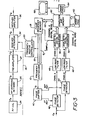
- the NMR techniques of the present invention may be performed by an MRI system such as that shown in block diagram form in FIGURES 2 and 3. Referring to FIGURE 2. the transmission portion of an MRI system is shown.
- a pulse sequencer and memory 18 applies a control signal V c to a frequency synthesizer 10.
- the frequency synthesizer 10 applies an f transmit reference signal to a transmitter 12.
- F s is the center frequency of a transmitted radio frequency signal.
- the transmitter 12 produces a timed transmit F s signal, which is coupled by way of a controlled transmitter attenuator 14 to a transmitter amplifier 16.
- the transmitter 12 and attenuator 14 are controlled by control signals provided by a transmit/receive controller 20, which is under control of the pulse sequencer 18.
- the F s signal is amplified by the amplifier 16 and applied to the RF coil 24 in the magnet 30 in the form of a sequence of pulses formed under control of the transmit/receive controller 20.
- the RF coil 24 applies the F 6 pulses to the subject being imaged.
- timing control signals are also produced by the frequency synthesizer 10 and coupled to the transmit/receive controller and the pulse sequencer on line 19.
- x, y, and z gradient coils 26, 28, and 29 are also located within the field of the magnet 30. These coils receive gradient control signals G x , G y , and G from gradient signal amplifier 22. The control signals are provided by the transmit/receive controller 20.
- the NMR signals emitted by the nuclei of the material being imaged induce F R return signals in the RF coil 24. These return signals are coupled by way of an RF matching network 25 to a pre-amplifier 27, and on to a receiver attenuator 34.
- the receiver attenuator is controlled by the transmit/receive controller 20.
- the received F i signals are amplified by an amplifier 36 and applied to quadrature phase detectors 42 and 44.
- the phase detectors receive two phase demodulating signals at respective 0° and 90° phase angles from a phase shifter 40, which receives reference signal f R from the frequency synthesizer 10.
- the phase detectors 42 and 44 produce a channel A and a channel B signal, respectively.
- the baseband channel A and B signals are filtered by respective low pass filters 46 and 48. and the filtered signals are then sampled by respective analog to digital converters 50 and 52 in response to a sampling signal f sam p le produced by the pulse sequencer 18.
- the resultant channel A and channel B digital words are stored in the memory of a computer 60.
- the computer and memory 60 also exchanges information with the pulse sequencer and memory 18 by way of a data link 68.
- the channel A and B digital words are processed. combined and transformed to the frequency domain by a Fourier transform array processor 62.
- the resultant image signals are assembled in an image format by an image processor 64, and the processed image is displayed on a video monitor 66.
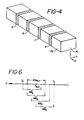
- FIGURE 4 a rectangular block of material 70 which is to be imaged by the system of FIGURES 3 and 4 is shown.
- Four slices. A, B, C, and D, of the block are to be imaged using a multi-slice, multi-echo format.
- the coordinates of the block are as indicated by the x, y and z coordinate axes shown adjacent the block 70.
- One face 172 of the block 70 is specifically indicated.
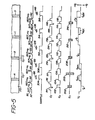
- FIGURE 5 shows waveforms for imaging the four slices of block 170.
- the face 172 of the block is partially shown with reference to a z-directed gradient G z .
- Slice B of the block is centered at the center, or null point of the G z gradient field.
- the null point is the point at which the G gradient makes substantially no contribution to the static magnetic field (G z -O). On either side of the null point the gradient field increases relatively positively or negatively.
- Slice A is scanned first by applying a frequency selective 90° RF pulse 80 together with a slice selecting G z gradient 84.
- the 90° pulse 80 exhibits a frequency characteristic ⁇ A for spatial selection of slice A.
- a preconditioning G gradient 102 is applied to the slice and one level of a level variable phase encoding G y gradient 202 is applied to spatially encode the slice in the y direction.
- a frequency selective 180° RF pulse 82 is then applied to the block together with a G z gradient 8 6, resulting in the later formation of a spin echo signal 88.
- the spin echo signal 88 is sampled during a sampling interval 304 in the presence of a frequency-encoding read gradient 104 for the x direction. G .
- a second spin echo signal is acquired from slice A by applying one level of a second phase-encoding G y gradient 205 to the block 170, followed by a second 18 0 ° RF pulse 85 in the presence of G z gradient 87.
- a second spin echo signal 89 develops and is sampled during a sampling period 306 in the presence of a G x gradient 10 6 .
- the second G y gradient 205 has a level chosen to provide twice the phase-encoding effect as the first G y gradient 202, but in an opposite sense. This compensates for the phase reversal caused by the two 180° RF pulses 82 and 85 and causes the phases of the spin echo signal 89 to be of the same sense for processing.
- the G y gradient 205 eliminates ghosts in the second echo image by causing them to superimpose and cancel.
- the frequency synthesizer of FIGURE 2 is receiving a V control signal from the pulse sequencer 18 as indicated at the bottom of FIGURE 5.
- This control voltage causes the reference frequency produced by the frequency synthesizer 10, f s , to be equal to a frequency f A as indicated in FIGURE 5.
- This demodulating signal determines the spatial representation of the frequency-encoded signal information.
- the receiver reference signal was frequency shifted for reception to the nominal reference frequency f REF , as indicated by the broken lines beneath the frequency encoding gradients 104 and 106.
- this change in frequency would disturb the phase lock of the reference signals applied to phase detectors 42 and 44, which unlock is indicated by the arrows on the broken lines at the bottom of FIGURE 5.
- the phase unlock results in erroneous phase-sensitive detection of the received NMR signals, and would also unlock the phase reference of the individual RF pulses in the multi-echo sequence.
- phase unlocking is prevented in apparatus of the present invention by maintaining the same control signal V c for the frequency synthesizer 10 during the entire transmit and receive cycle, as indicated by solid line f A in FIGURE 5.
- the phase-encoded NMR signal information is thus accurately detected for precise image reconstruction.
- a G x gradient 108 and one level of the amplitude variable G y gradient 208 are applied to the block for spatial encoding.
- a 180° RF pulse 122 with frequency spectral content u B is applied in the presence of G z gradient 126, which results in the development of a spin echo signal 128.
- This signal is sampled during sampling interval 310 in the presence of a G x frequency encoding gradient 110. Since the slice selection and sampling of the frequency encoded spin echo signal are both done at the nominal center frequency of f REF' this slice is effectively interrogated in the same manner as was done in the prior apparatus.
- the frequencies f s , f R and f B are all equal to f REF .
- Slice C is selected next by applying a 90° RF pulse 130 with a frequency spectral content of ⁇ C to the block in the presence of a G z gradient 134.
- the fourth slice D is the slice most distant from the null point of the gradient field. Accordingly, the V c control signal is switched to an even greater offset level as shown by the V c line of FIGURE 5, causing the frequency synthesizer signal f to be offset to a frequency f D .
- the slice D is selected by applying a 90° R F pulse 140 with a frequency spectral content ⁇ D and centered about frequency f D to the block 170 in the presence of G z gradient 144.
- a G gradient 116 and one level of G y gradient 216 are applied to the block. followed by a frequency selective 180° RF pulse 142 which is applied in the presence of G z gradient 146.
- the resulting spin echo signal 148 is sampled during an interval 318 in the presence of frequency encoding G x gradient 118 without switching the demodulating reference frequency to the f REF frequency as indicated by the dashed lines in the V c signal line.
- the offsets caused by the changing V c control signal and attendant frequency changes are illustrated in FIGURE 6.
- the nominal bandwidth of the received NMR signals when the demodulating reference frequency is reset to f REF during each sampling interval is indicated as BW REF , with a center frequency of f REF .
- the detected NMR signals from the four slices occupy different bands as shown in the FIGURE.
- the bandwidth of the slice A signals is offset above the nominal band, as indicated by bandwidth BW A .
- Slice B. which is centered in the gradient field, has a bandwidth BW B which is aligned with the nominal band.
- the bands for slices C and D are offset below the nominal band, as indicated by bandwidths BW C and BW D .
- the four frequency bands are seen to occupy a total band extending from f L to f H , instead of the single, narrower BW REF band of the prior apparatus.
- the bandwidth from f L to f H is determined by the relative strengths (slopes) of the G and the G gradient fields for a given spacing of slices.
- sampling frequency is the frequency of the f sample signal used for the analog to digital converters in FIGURE 3.
- this problem is overcome by filtering the NMR signal information prior to reconstruction.
- the filter function used is a function of the frequency offset used to establish the reference frequency for each slice.
- the filter function is embodied in software used to process the NMR signal information.
- a measure of the frequency offset is retained in the computer and memory 60 of FIGURE 3.
- the offset representative information is of the form (V REF -V c ), where V REF represents the control signal for the center frequency of the nominal frequency band BW REF , and V c is the control signal used for acquisition of information from a particular slice .
- the offset representative signal information is used to digitally filter the NMR signal information as illustrated by the flowchart of FIGURE 7.
- the flowcharted routine is executed by the computer and memory 60 in processing the channel A and channel B NMR signal information.
- Retained in memory are parameters ZR. AC. NSL. GZ and ⁇ t, where ZR 1 is the separation range between the two end slices of the slices which are to be imaged: ZC is the location of the center slice along the slice separation direction with respect to the gradient null: N S L is the number of slices: GZ represents the strength of the slice selection gradient, in this example.
- G : and At is the time interval between sampling points of the analog to digital converters.
- the center of the group of slices with respect to center of the z-gradient field is then used to determine the offset of the initial slice in the z-direction.
- the results of the two previous calculations are used to determine the frequency offset for a given slice i, which is the difference between the f R reference frequency for slice i and f REF .
- This frequency offset calculation is communicated to the pulse sequencer and memory 18 over data link 68 where it translates directly into a value for V.
- the frequency offset is also used to correct the apparent left/right shift of the NMR signal information by digitally filtering the acquired data by sine and cosine terms of the frequency offset.
- the NMR signal information in the form of the digitally detected A and B data values of the channel A and B lines is modified by calculating and where n/2 is equal to half the maximum value attained by n (i.e., is a constant).
- the A' and B' n signal information is then stored in memory for subsequent combination.
- Fourier transform processing and image reconstruction In the form of A' n and B' n values, the acquired signal information is effectively frequency shifted as if it had been demodulated by an f REF reference signal.
- the frequency offset is expressed in radians as ⁇
- the A and B data values are modified by trigonometric function of the frequency offset cos ⁇ t and sin(- ⁇ )t.
- the reconstructed slice images will now be identically oriented on the display 66.
Landscapes
- Physics & Mathematics (AREA)
- High Energy & Nuclear Physics (AREA)
- Condensed Matter Physics & Semiconductors (AREA)
- General Physics & Mathematics (AREA)
- Magnetic Resonance Imaging Apparatus (AREA)
- Hall/Mr Elements (AREA)
Priority Applications (1)
| Application Number | Priority Date | Filing Date | Title |
|---|---|---|---|
| AT86306320T ATE66075T1 (de) | 1985-08-16 | 1986-08-15 | Phasenempfindliche detektion in vielschichtsystemen mit magnetischer kernresonanz. |
Applications Claiming Priority (2)
| Application Number | Priority Date | Filing Date | Title |
|---|---|---|---|
| US766617 | 1985-08-16 | ||
| US06/766,617 US4673880A (en) | 1985-08-16 | 1985-08-16 | Phase sensitive detection in multislice magnetic resonance imaging systems |
Publications (3)
| Publication Number | Publication Date |
|---|---|
| EP0219206A2 true EP0219206A2 (de) | 1987-04-22 |
| EP0219206A3 EP0219206A3 (en) | 1987-09-16 |
| EP0219206B1 EP0219206B1 (de) | 1991-08-07 |
Family
ID=25076989
Family Applications (1)
| Application Number | Title | Priority Date | Filing Date |
|---|---|---|---|
| EP86306320A Expired EP0219206B1 (de) | 1985-08-16 | 1986-08-15 | Phasenempfindliche Detektion in Vielschichtsystemen mit magnetischer Kernresonanz |
Country Status (5)
| Country | Link |
|---|---|
| US (1) | US4673880A (de) |
| EP (1) | EP0219206B1 (de) |
| JP (1) | JP2608274B2 (de) |
| AT (1) | ATE66075T1 (de) |
| DE (1) | DE3680742D1 (de) |
Cited By (4)
| Publication number | Priority date | Publication date | Assignee | Title |
|---|---|---|---|---|
| EP0292064A1 (de) * | 1987-05-19 | 1988-11-23 | Koninklijke Philips Electronics N.V. | Kernspintomographie-Anlage mit digitalem Sender/Empfänger |
| US4951688A (en) * | 1988-09-01 | 1990-08-28 | Elscint Ltd. | Hyperthermic power delivery system |
| EP0336479A3 (de) * | 1988-03-31 | 1991-01-02 | Philips Patentverwaltung GmbH | Kernresonanz-Spektrometer |
| US6853190B2 (en) | 2001-10-25 | 2005-02-08 | Siemens Aktiengesellschaft | Method and apparatus for magnetic resonance imaging with simultaneous measurement of two neighboring slices |
Families Citing this family (15)
| Publication number | Priority date | Publication date | Assignee | Title |
|---|---|---|---|---|
| JPS62197048A (ja) * | 1986-02-26 | 1987-08-31 | 横河メディカルシステム株式会社 | 核磁気共鳴断層撮像装置 |
| US4847560A (en) * | 1986-08-15 | 1989-07-11 | Picker International, Inc. | Simultaneous multislice-multiangle images without saturation bands |
| DE3631039A1 (de) * | 1986-09-12 | 1988-03-24 | Philips Patentverwaltung | Kernspintomographieverfahren und kernspintomograph zur durchfuehrung des verfahrens |
| JPH02501033A (ja) * | 1986-11-14 | 1990-04-12 | フォナル・コーポレイション | 多角傾斜磁気共鳴像形成装置および方法 |
| US4871966A (en) * | 1986-11-14 | 1989-10-03 | Fonar Corporation | Apparatus and method for multiple angle oblique magnetic resonance imaging |
| NL8700266A (nl) * | 1987-02-04 | 1988-09-01 | Philips Nv | Werkwijze en inrichting voor het onderdrukken van coherente storingen bij magnetische resonantiesignalen. |
| GB8702951D0 (en) * | 1987-02-10 | 1987-03-18 | Surrey Medical Imaging Systems | Nmr imaging |
| US4978918A (en) * | 1988-04-24 | 1990-12-18 | Mitsubishi Denki Kabushiki Kaisha | Magnetic resonance imaging method |
| US5560361A (en) * | 1994-01-31 | 1996-10-01 | General Electric Company | MRI system with time varying gradient during signal acquisition |
| US5529068A (en) * | 1994-06-16 | 1996-06-25 | The Regents Of The University Of California | Synchronized digital signal processor for MRI reception |
| US5739691A (en) * | 1995-11-28 | 1998-04-14 | The Regents Of The University Of California | Multi-frequency digital low pass filter for magnetic resonance imaging |
| CN100346171C (zh) * | 2004-07-23 | 2007-10-31 | 华东师范大学 | 一种核磁共振成像信号的接收方法 |
| US7557575B2 (en) * | 2006-04-04 | 2009-07-07 | Kabushiki Kaisha Toshiba | Magnetic resonance imaging apparatus and magnetic resonance imaging method |
| DE102011080604B4 (de) * | 2011-08-08 | 2013-03-28 | Siemens Aktiengesellschaft | Betriebsverfahren, Computerprogramm und Steuereinrichtung für eine Magnetresonanzanlage mit frequenzvariablen Sendepulsen und Magnetresonanzanlage |
| CN110873856B (zh) * | 2018-08-29 | 2022-08-09 | 西门子(深圳)磁共振有限公司 | 确定最佳磁共振成像扫描嵌套方式的方法及装置 |
Citations (2)
| Publication number | Priority date | Publication date | Assignee | Title |
|---|---|---|---|---|
| US766613A (en) | 1904-05-10 | 1904-08-02 | Isabel Greene | Theatrical appliance. |
| EP0134701A2 (de) | 1983-08-05 | 1985-03-20 | Technicare Corporation | Gradientenfelder mit Offset-Kompensation für mit magnetischer Kernresonanz arbeitende Bilderzeugungssysteme |
Family Cites Families (7)
| Publication number | Priority date | Publication date | Assignee | Title |
|---|---|---|---|---|
| US4015196A (en) * | 1974-04-05 | 1977-03-29 | National Research Development Corporation | Analysis of materials |
| US4297637A (en) * | 1978-07-20 | 1981-10-27 | The Regents Of The University Of California | Method and apparatus for mapping lines of nuclear density within an object using nuclear magnetic resonance |
| US4318043A (en) * | 1978-07-20 | 1982-03-02 | The Regents Of The University Of California | Method and apparatus for rapid NMR imaging of nuclear densities within an object |
| DE2951537A1 (de) * | 1979-12-20 | 1981-07-02 | Siemens AG, 1000 Berlin und 8000 München | Zeugmatografieverfahren |
| US4558278A (en) * | 1982-12-17 | 1985-12-10 | Picker International, Limited | Nuclear magnetic resonance methods and apparatus |
| DE3340523A1 (de) * | 1983-11-09 | 1985-05-15 | Siemens AG, 1000 Berlin und 8000 München | Kernspin-tomographiegeraet |
| JPS60128339A (ja) * | 1983-12-15 | 1985-07-09 | Mitsubishi Electric Corp | Νmr−ct用磁界コイル |
-
1985
- 1985-08-16 US US06/766,617 patent/US4673880A/en not_active Expired - Fee Related
-
1986
- 1986-08-15 EP EP86306320A patent/EP0219206B1/de not_active Expired
- 1986-08-15 AT AT86306320T patent/ATE66075T1/de active
- 1986-08-15 DE DE8686306320T patent/DE3680742D1/de not_active Expired - Lifetime
- 1986-08-15 JP JP61190712A patent/JP2608274B2/ja not_active Expired - Lifetime
Patent Citations (2)
| Publication number | Priority date | Publication date | Assignee | Title |
|---|---|---|---|---|
| US766613A (en) | 1904-05-10 | 1904-08-02 | Isabel Greene | Theatrical appliance. |
| EP0134701A2 (de) | 1983-08-05 | 1985-03-20 | Technicare Corporation | Gradientenfelder mit Offset-Kompensation für mit magnetischer Kernresonanz arbeitende Bilderzeugungssysteme |
Cited By (5)
| Publication number | Priority date | Publication date | Assignee | Title |
|---|---|---|---|---|
| EP0292064A1 (de) * | 1987-05-19 | 1988-11-23 | Koninklijke Philips Electronics N.V. | Kernspintomographie-Anlage mit digitalem Sender/Empfänger |
| EP0336479A3 (de) * | 1988-03-31 | 1991-01-02 | Philips Patentverwaltung GmbH | Kernresonanz-Spektrometer |
| US4951688A (en) * | 1988-09-01 | 1990-08-28 | Elscint Ltd. | Hyperthermic power delivery system |
| US6853190B2 (en) | 2001-10-25 | 2005-02-08 | Siemens Aktiengesellschaft | Method and apparatus for magnetic resonance imaging with simultaneous measurement of two neighboring slices |
| DE10152734B4 (de) * | 2001-10-25 | 2005-12-29 | Siemens Ag | Gerät und Verfahren zur Magnet-Resonanz-Bildgebung bei gleichzeitiger Messung zweier benachbarter Schichten |
Also Published As
| Publication number | Publication date |
|---|---|
| ATE66075T1 (de) | 1991-08-15 |
| JP2608274B2 (ja) | 1997-05-07 |
| EP0219206B1 (de) | 1991-08-07 |
| JPS6243549A (ja) | 1987-02-25 |
| US4673880A (en) | 1987-06-16 |
| DE3680742D1 (de) | 1991-09-12 |
| EP0219206A3 (en) | 1987-09-16 |
Similar Documents
| Publication | Publication Date | Title |
|---|---|---|
| US4673880A (en) | Phase sensitive detection in multislice magnetic resonance imaging systems | |
| US5825185A (en) | Method for magnetic resonance spin echo scan calibration and reconstruction | |
| US4843322A (en) | Method for producing multi-slice NMR images | |
| Weaver | Simultaneous multislice acquisition of MR images | |
| EP0445151B1 (de) | Verminderung von bewegungsartefakten bei der bilderzeugung mittels magnetischer kernresonanz | |
| US6043651A (en) | Method for the phase correction of nuclear magnetic resonance signals | |
| JP3529446B2 (ja) | Epi及びgrase mriにおける読み出し傾斜磁界極性の補正方法 | |
| US5617028A (en) | Magnetic field inhomogeneity correction in MRI using estimated linear magnetic field map | |
| US4859945A (en) | Optimized signal to noise ratio | |
| US5652516A (en) | Spectroscopic magnetic resonance imaging using spiral trajectories | |
| EP0144026A2 (de) | Einrichtung und Verfahren zur Bilderzeugung mittels magnetischer Kernresonanz mit aussermittigem Zoom-Abtasten | |
| US20020193680A1 (en) | Magnetic resonance method and apparatus for generating respective images from spin ensembles exhibiting different chemical shift | |
| JP3970371B2 (ja) | Mriシーケンス | |
| CN111133327B (zh) | Dixon型水/脂肪分离MR成像 | |
| EP0293085B1 (de) | Apparat zur Magnet-Resonanz-Abbildung | |
| US5701074A (en) | Spectral component separation including unwrapping of the phase via a poisson equation utilizing a weighting map | |
| US4616182A (en) | Nuclear magnetic resonance signal artifact removal | |
| US5627469A (en) | Separation of fat and water magnetic resonance images | |
| EP0182267B1 (de) | Verfahren zur Beseitigung des Einflusses der Fehlerkomponenten auf die Grundlinie bei Anwendungen der Bilddarstellung mittels magnetischer Kernresonanz | |
| US4616183A (en) | Method for reducing baseline error components in NMR signals | |
| US4706027A (en) | Method for correcting phase errors in magnetic resonance imaging data | |
| WO2000002059A2 (en) | Method to reduce artefacts in the magnetic resonance image due to spurios magnetic signals | |
| US6853190B2 (en) | Method and apparatus for magnetic resonance imaging with simultaneous measurement of two neighboring slices | |
| US4855679A (en) | Magnetic resonance studies of restricted volumes | |
| EP0204569A2 (de) | Nichtharmonische NMR-Spin-Echo-Bildgebung |
Legal Events
| Date | Code | Title | Description |
|---|---|---|---|
| PUAI | Public reference made under article 153(3) epc to a published international application that has entered the european phase |
Free format text: ORIGINAL CODE: 0009012 |
|
| AK | Designated contracting states |
Kind code of ref document: A2 Designated state(s): AT BE CH DE FR GB IT LI LU NL SE |
|
| PUAL | Search report despatched |
Free format text: ORIGINAL CODE: 0009013 |
|
| AK | Designated contracting states |
Kind code of ref document: A3 Designated state(s): AT BE CH DE FR GB IT LI LU NL SE |
|
| 17P | Request for examination filed |
Effective date: 19880219 |
|
| 17Q | First examination report despatched |
Effective date: 19900425 |
|
| GRAA | (expected) grant |
Free format text: ORIGINAL CODE: 0009210 |
|
| RAP1 | Party data changed (applicant data changed or rights of an application transferred) |
Owner name: SIEMENS AKTIENGESELLSCHAFT |
|
| AK | Designated contracting states |
Kind code of ref document: B1 Designated state(s): AT BE CH DE FR GB IT LI LU NL SE |
|
| PG25 | Lapsed in a contracting state [announced via postgrant information from national office to epo] |
Ref country code: SE Effective date: 19910807 Ref country code: LI Effective date: 19910807 Ref country code: CH Effective date: 19910807 Ref country code: BE Effective date: 19910807 Ref country code: AT Effective date: 19910807 |
|
| REF | Corresponds to: |
Ref document number: 66075 Country of ref document: AT Date of ref document: 19910815 Kind code of ref document: T |
|
| PG25 | Lapsed in a contracting state [announced via postgrant information from national office to epo] |
Ref country code: LU Free format text: LAPSE BECAUSE OF NON-PAYMENT OF DUE FEES Effective date: 19910831 |
|
| PGFP | Annual fee paid to national office [announced via postgrant information from national office to epo] |
Ref country code: NL Payment date: 19910831 Year of fee payment: 6 |
|
| REF | Corresponds to: |
Ref document number: 3680742 Country of ref document: DE Date of ref document: 19910912 |
|
| ET | Fr: translation filed | ||
| ITF | It: translation for a ep patent filed | ||
| REG | Reference to a national code |
Ref country code: CH Ref legal event code: PL |
|
| PLBE | No opposition filed within time limit |
Free format text: ORIGINAL CODE: 0009261 |
|
| STAA | Information on the status of an ep patent application or granted ep patent |
Free format text: STATUS: NO OPPOSITION FILED WITHIN TIME LIMIT |
|
| 26N | No opposition filed | ||
| PGFP | Annual fee paid to national office [announced via postgrant information from national office to epo] |
Ref country code: FR Payment date: 19920821 Year of fee payment: 7 |
|
| PG25 | Lapsed in a contracting state [announced via postgrant information from national office to epo] |
Ref country code: NL Effective date: 19930301 |
|
| NLV4 | Nl: lapsed or anulled due to non-payment of the annual fee | ||
| PG25 | Lapsed in a contracting state [announced via postgrant information from national office to epo] |
Ref country code: FR Effective date: 19940429 |
|
| REG | Reference to a national code |
Ref country code: FR Ref legal event code: ST |
|
| PGFP | Annual fee paid to national office [announced via postgrant information from national office to epo] |
Ref country code: GB Payment date: 19940718 Year of fee payment: 9 |
|
| PG25 | Lapsed in a contracting state [announced via postgrant information from national office to epo] |
Ref country code: GB Effective date: 19950815 |
|
| GBPC | Gb: european patent ceased through non-payment of renewal fee |
Effective date: 19950815 |
|
| PGFP | Annual fee paid to national office [announced via postgrant information from national office to epo] |
Ref country code: DE Payment date: 19971022 Year of fee payment: 12 |
|
| PG25 | Lapsed in a contracting state [announced via postgrant information from national office to epo] |
Ref country code: DE Free format text: LAPSE BECAUSE OF NON-PAYMENT OF DUE FEES Effective date: 19990601 |
|
| PG25 | Lapsed in a contracting state [announced via postgrant information from national office to epo] |
Ref country code: IT Free format text: LAPSE BECAUSE OF NON-PAYMENT OF DUE FEES;WARNING: LAPSES OF ITALIAN PATENTS WITH EFFECTIVE DATE BEFORE 2007 MAY HAVE OCCURRED AT ANY TIME BEFORE 2007. THE CORRECT EFFECTIVE DATE MAY BE DIFFERENT FROM THE ONE RECORDED. Effective date: 20050815 |