EP0219319A2 - Verfahren zur Herstellung von Keramikkörpern - Google Patents
Verfahren zur Herstellung von Keramikkörpern Download PDFInfo
- Publication number
- EP0219319A2 EP0219319A2 EP86307826A EP86307826A EP0219319A2 EP 0219319 A2 EP0219319 A2 EP 0219319A2 EP 86307826 A EP86307826 A EP 86307826A EP 86307826 A EP86307826 A EP 86307826A EP 0219319 A2 EP0219319 A2 EP 0219319A2
- Authority
- EP
- European Patent Office
- Prior art keywords
- ceramic particles
- gas
- ceramic
- ion
- ions
- Prior art date
- Legal status (The legal status is an assumption and is not a legal conclusion. Google has not performed a legal analysis and makes no representation as to the accuracy of the status listed.)
- Granted
Links
Images
Classifications
-
- C—CHEMISTRY; METALLURGY
- C04—CEMENTS; CONCRETE; ARTIFICIAL STONE; CERAMICS; REFRACTORIES
- C04B—LIME, MAGNESIA; SLAG; CEMENTS; COMPOSITIONS THEREOF, e.g. MORTARS, CONCRETE OR LIKE BUILDING MATERIALS; ARTIFICIAL STONE; CERAMICS; REFRACTORIES; TREATMENT OF NATURAL STONE
- C04B35/00—Shaped ceramic products characterised by their composition; Ceramics compositions; Processing powders of inorganic compounds preparatory to the manufacturing of ceramic products
- C04B35/622—Forming processes; Processing powders of inorganic compounds preparatory to the manufacturing of ceramic products
- C04B35/626—Preparing or treating the powders individually or as batches ; preparing or treating macroscopic reinforcing agents for ceramic products, e.g. fibres; mechanical aspects section B
-
- C—CHEMISTRY; METALLURGY
- C04—CEMENTS; CONCRETE; ARTIFICIAL STONE; CERAMICS; REFRACTORIES
- C04B—LIME, MAGNESIA; SLAG; CEMENTS; COMPOSITIONS THEREOF, e.g. MORTARS, CONCRETE OR LIKE BUILDING MATERIALS; ARTIFICIAL STONE; CERAMICS; REFRACTORIES; TREATMENT OF NATURAL STONE
- C04B35/00—Shaped ceramic products characterised by their composition; Ceramics compositions; Processing powders of inorganic compounds preparatory to the manufacturing of ceramic products
- C04B35/622—Forming processes; Processing powders of inorganic compounds preparatory to the manufacturing of ceramic products
- C04B35/64—Burning or sintering processes
-
- C—CHEMISTRY; METALLURGY
- C04—CEMENTS; CONCRETE; ARTIFICIAL STONE; CERAMICS; REFRACTORIES
- C04B—LIME, MAGNESIA; SLAG; CEMENTS; COMPOSITIONS THEREOF, e.g. MORTARS, CONCRETE OR LIKE BUILDING MATERIALS; ARTIFICIAL STONE; CERAMICS; REFRACTORIES; TREATMENT OF NATURAL STONE
- C04B35/00—Shaped ceramic products characterised by their composition; Ceramics compositions; Processing powders of inorganic compounds preparatory to the manufacturing of ceramic products
- C04B35/622—Forming processes; Processing powders of inorganic compounds preparatory to the manufacturing of ceramic products
- C04B35/64—Burning or sintering processes
- C04B35/645—Pressure sintering
-
- C—CHEMISTRY; METALLURGY
- C04—CEMENTS; CONCRETE; ARTIFICIAL STONE; CERAMICS; REFRACTORIES
- C04B—LIME, MAGNESIA; SLAG; CEMENTS; COMPOSITIONS THEREOF, e.g. MORTARS, CONCRETE OR LIKE BUILDING MATERIALS; ARTIFICIAL STONE; CERAMICS; REFRACTORIES; TREATMENT OF NATURAL STONE
- C04B38/00—Porous mortars, concrete, artificial stone or ceramic ware; Preparation thereof
Definitions
- This invention relates to a method or producing ceramic articles, having improved fracture toughness properties, by powder metallurgical techniques.
- Structural ceramics such as silicon nitride, silicon carbide, partially stabilized zirconia and partially stabilized alumina are being developed for high temperature applications in heat engines of various types (automotive, gas turbine), tools and dies, and other components because of their high strength at elevated temperatures, and erosion and corrosion resistance.
- heat engines of various types (automotive, gas turbine), tools and dies, and other components because of their high strength at elevated temperatures, and erosion and corrosion resistance.
- brittleness low fracture toughness
- the present invention resides in a method of producing ceramic articles having improved fracture toughness properties by a powder metallurgical process characterized by providing a supply of ceramic particles having a particle size of between 0.5-5 micrometers in diameter; injecting gas ions into the ceramic particles of said supply of particles by impingement therewith of a beam of accelerated said gas ions to produce a supply of gas ion-containing ceramic particles; compacting said gas ion-containing ceramic particles into a form by applying pressure thereabout; and heating said form at a temperature of at least 800°C, whereby said gas ions form gas bubbles, to produce a ceramic article having gas bubbles substantially uniformly disposed throughout.
- the gas ions are preferably inert gas ions, such as helium ions, which are impinged onto and impregnated into ceramic particles, such as silicon carbide, silicon nitride stabilized zirconia or alumina.
- inert gas ions such as helium ions
- ceramic particles such as silicon carbide, silicon nitride stabilized zirconia or alumina.
- cold isostatic pressing produces a stabilized form which is then sintered or hot isostatically pressed into the ceramic article.
- the ceramic particles are oxides, nitrides, borides and carbides of silicon, zirconium, aluminum, magnesium, yttrium, and other complex ceramic compounds such as SiAlON.
- ceramic compositions are silicon nitride, silicon carbide, partially stabilized zirconia, alumina, SiAlON, and the like.
- the ceramic compositions are provided in a finely divided powdered state with particles in a size of between 0.5-5 micrometers ( ⁇ m) in diameter.
- the small solid particles are of a size which enables impregnation thereof with gas ions at reasonable ion energies.
- the gas ions used for impregnation may vary depending upon the ceramic particles, although inert gases, such as helium, argon, neon or krypton are preferred so as to preclude chemical reaction with these particles. In instances where a ceramic nitride is used, however, nitrogen might be used as the source of gas ions, while where a ceramic oxide is used, oxygen might be used as the source of gas ions.
- the impregnation of the ceramic particles with gas ions is conveniently effected by impingement of the particles with a high energy beam of accelerated gas ions, under vacuum, at ambient temperatures, and preferably with tumbling of the particles.
- an ion impingement of the ceramic powder will be effected with a few hundred KeV accelerated beam of gas ions.
- a 150 KeV beam of ions is used, although the energy of the beam may be varied depending upon the particle size of the ceramic material and the accelerated gas specie used.
- the particles are continuously tumbled during impingement to uniformly expose all of the powder particles to the ion beam using known accelerators and vacuum tumbling systems, such as a rotating cup, for example as described by L. R. Fleischer, J. S. Spitznagel and W. J. Choyke, "Helium Embrittlement of CRT Materials Simulated by Ion Implantation and Hot Isostatic Pressing of Metal Powders", CONF-750989, Vol. II, 1976, pp. 372-386.
- the impingement of the ceramic particles with gas ions is carried out for a period of time sufficient to provide the quantity of ions in the particles that will result in the desired quantity of gas bubbles in the ceramic article produced.
- the gas ion-containing particles are then compacted into ceramic articles by, desirably, first cold compacting to stabilize the same and then hot compacting or sintering.
- the gas ion-containing particles are compacted at ambient temperature by the application of pressure equally about the supply of gas ion-containing particles.
- Cold isostatically pressing of the gas ion-containing particles forms a monolithic shape or form which can be subsequently hot compacted.
- the cold compacting is effected at pressures sufficient to compress the particles to a density of from 65 to 80 per cent of theoretical density to provide a form for subsequent hot pressing.
- Hot compacting of the gas ion-containing ceramic particles is then carried out with or without pressure to achieve substantially maximum density of the particles.
- Hot isostatic pressing, at super-atmospheric pressure, or sintering at atmospheric pressure is effected at an elevated temperature, namely, a temperature of at least 800°C.
- Heating and compacting of the form of gas ion-containing particles causes the gas ions to form gas bubbles throughout the article formed, with the gas bubbles substantially uniformly distributed throughout the ceramic article.
- the inert gas bubbles formed homogeneously throughout the ceramic article should have a low c/r o ratio, where 2c is equal to interbubble spacing and 2r o is the bubble diameter. It is preferred that the c/r o ratio be between 0.1 and 5.
- Bubble size during the formation of the ceramic articles can be controlled by process parameters such as time, temperature and amount of gas ions present in the ceramic particles.
- the size of the gas bubbles dispersed throughout the ceramic article must be less than about 1 micrometer in diameter, with much smaller bubbles preferred, such as bubbles of a size of from 100-400 angstroms in diameter.
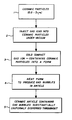
- the process is schematically illustrated in the accompanying flow chart which illustrates a supply of ceramic particles (Step 1) of a diameter of 0.5-5 micrometers, into which gas ions are injected (Step 2) under vacuum.
- the supply of gas ion-containing ceramic particles are cold compacted (Step 3) into a form that stabilizes the particles, and the form is then heated with or without pressure (Step 4) to produce a ceramic article containing gas bubbles.
- the finished article (Step 5) comprises a ceramic article containing inert gas bubbles substantially uniformly dispersed throughout the article which induces increased fracture toughness.
Landscapes
- Chemical & Material Sciences (AREA)
- Engineering & Computer Science (AREA)
- Ceramic Engineering (AREA)
- Manufacturing & Machinery (AREA)
- Materials Engineering (AREA)
- Structural Engineering (AREA)
- Organic Chemistry (AREA)
- Inorganic Chemistry (AREA)
- Compositions Of Oxide Ceramics (AREA)
- Ceramic Products (AREA)
Applications Claiming Priority (2)
| Application Number | Priority Date | Filing Date | Title |
|---|---|---|---|
| US06/785,811 US4707312A (en) | 1985-10-09 | 1985-10-09 | Method for producing ceramic articles of increased fracture toughness |
| US785811 | 1985-10-09 |
Publications (3)
| Publication Number | Publication Date |
|---|---|
| EP0219319A2 true EP0219319A2 (de) | 1987-04-22 |
| EP0219319A3 EP0219319A3 (en) | 1988-06-01 |
| EP0219319B1 EP0219319B1 (de) | 1991-10-02 |
Family
ID=25136694
Family Applications (1)
| Application Number | Title | Priority Date | Filing Date |
|---|---|---|---|
| EP86307826A Expired - Lifetime EP0219319B1 (de) | 1985-10-09 | 1986-10-09 | Verfahren zur Herstellung von Keramikkörpern |
Country Status (5)
| Country | Link |
|---|---|
| US (1) | US4707312A (de) |
| EP (1) | EP0219319B1 (de) |
| JP (1) | JPS6287471A (de) |
| KR (1) | KR870003954A (de) |
| DE (1) | DE3681777D1 (de) |
Cited By (4)
| Publication number | Priority date | Publication date | Assignee | Title |
|---|---|---|---|---|
| EP0240731A3 (de) * | 1986-03-15 | 1989-08-02 | Nukem GmbH | Verfahren zur Herstellung von keramischen Formkörpern |
| GB2217317A (en) * | 1987-11-18 | 1989-10-25 | British Glass Mfg | Strengthened glass |
| EP0308708A3 (de) * | 1987-09-23 | 1990-06-13 | Westinghouse Electric Corporation | Verfahren zur Verbesserung der Bruchzähigkeit und Festigkeit von keramischen Materialien |
| EP3470384A1 (de) * | 2017-10-12 | 2019-04-17 | The Swatch Group Research and Development Ltd | Oberflächenbehandlungsverfahren von partikeln eines keramikpulvers, und nach diesem verfahren hergestellte keramikpulverpartikel |
Families Citing this family (8)
| Publication number | Priority date | Publication date | Assignee | Title |
|---|---|---|---|---|
| GB2199822B (en) * | 1987-01-17 | 1990-10-10 | Rolls Royce Plc | Ceramic core material and method of enhancing its leaching rate. |
| US4921554A (en) * | 1988-09-27 | 1990-05-01 | Norton Company | Joining of porous silicon carbide bodies |
| US5206083A (en) * | 1989-09-18 | 1993-04-27 | Cornell Research Foundation, Inc. | Diamond and diamond-like films and coatings prepared by deposition on substrate that contain a dispersion of diamond particles |
| US5183602A (en) * | 1989-09-18 | 1993-02-02 | Cornell Research Foundation, Inc. | Infra red diamond composites |
| US5181549A (en) * | 1991-04-29 | 1993-01-26 | Dmk Tek, Inc. | Method for manufacturing porous articles |
| US5563106A (en) * | 1991-08-12 | 1996-10-08 | Dytech Corporation Limited | Porous Articles |
| FR2756973B1 (fr) * | 1996-12-09 | 1999-01-08 | Commissariat Energie Atomique | Procede d'introduction d'une phase gazeuse dans une cavite fermee |
| WO2011082102A1 (en) | 2009-12-31 | 2011-07-07 | Oxane Materials, Inc. | Ceramic particles with controlled pore and/or microsphere placement and/or size and method of making same |
Family Cites Families (3)
| Publication number | Priority date | Publication date | Assignee | Title |
|---|---|---|---|---|
| JPS57149867A (en) * | 1981-03-12 | 1982-09-16 | Asahi Glass Co Ltd | Treatment of ceramic sintering raw material |
| JPS57149866A (en) * | 1981-03-12 | 1982-09-16 | Asahi Glass Co Ltd | Treatment of ceramic sintering raw material |
| DE3239033A1 (de) * | 1982-10-21 | 1984-04-26 | Dr. C. Otto & Co Gmbh, 4630 Bochum | Porosiertes, insbesonder feuerfestes keramisches erzeugnis sowie verfahren zu seiner herstellung |
-
1985
- 1985-10-09 US US06/785,811 patent/US4707312A/en not_active Expired - Fee Related
-
1986
- 1986-10-08 KR KR1019860008511A patent/KR870003954A/ko not_active Withdrawn
- 1986-10-09 JP JP61241192A patent/JPS6287471A/ja active Pending
- 1986-10-09 EP EP86307826A patent/EP0219319B1/de not_active Expired - Lifetime
- 1986-10-09 DE DE8686307826T patent/DE3681777D1/de not_active Expired - Lifetime
Cited By (5)
| Publication number | Priority date | Publication date | Assignee | Title |
|---|---|---|---|---|
| EP0240731A3 (de) * | 1986-03-15 | 1989-08-02 | Nukem GmbH | Verfahren zur Herstellung von keramischen Formkörpern |
| EP0308708A3 (de) * | 1987-09-23 | 1990-06-13 | Westinghouse Electric Corporation | Verfahren zur Verbesserung der Bruchzähigkeit und Festigkeit von keramischen Materialien |
| GB2217317A (en) * | 1987-11-18 | 1989-10-25 | British Glass Mfg | Strengthened glass |
| EP3470384A1 (de) * | 2017-10-12 | 2019-04-17 | The Swatch Group Research and Development Ltd | Oberflächenbehandlungsverfahren von partikeln eines keramikpulvers, und nach diesem verfahren hergestellte keramikpulverpartikel |
| EP3632876A1 (de) * | 2017-10-12 | 2020-04-08 | The Swatch Group Research and Development Ltd | Beschichtete keramikpulverpartikel |
Also Published As
| Publication number | Publication date |
|---|---|
| US4707312A (en) | 1987-11-17 |
| JPS6287471A (ja) | 1987-04-21 |
| DE3681777D1 (de) | 1991-11-07 |
| KR870003954A (ko) | 1987-05-06 |
| EP0219319A3 (en) | 1988-06-01 |
| EP0219319B1 (de) | 1991-10-02 |
Similar Documents
| Publication | Publication Date | Title |
|---|---|---|
| US3969125A (en) | Heat resistive and reinforced composite material | |
| US4707312A (en) | Method for producing ceramic articles of increased fracture toughness | |
| Greil et al. | Sintering and HIPping of silicon nitride-silicon carbide composite materials | |
| US3749571A (en) | Cold-pressed compositions | |
| ATE38374T1 (de) | Feuerfeste, elektrisch leitfaehige mischwerkstoffe und verfahren zu ihrer herstellung durch isostatisches heisspressen. | |
| US3770487A (en) | Refractory composites | |
| US4416840A (en) | Al2 O3 Ceramic composite | |
| WO1990015785A1 (fr) | Methode de frittage d'une ceramique | |
| TWI801404B (zh) | 陶瓷粉末之粒子表面處理方法及由該方法得到之陶瓷粉末粒子 | |
| US3676079A (en) | Pressure calcintering | |
| US5071473A (en) | Uniform coarse tungsten carbide powder and cemented tungsten carbide article and process for producing same | |
| US4983354A (en) | Uniform coarse tungsten carbide powder and cemented tungsten carbide article and process for producing same | |
| JPH05506066A (ja) | 耐熱性金属物品の窒化方法 | |
| US4407968A (en) | Ceramic Al2 O3 substoichiometric TiC body | |
| US5145504A (en) | Boron carbide-copper cermets and method for making same | |
| US3175903A (en) | Process for forming porous tungsten | |
| Kardashova | Technology of spark plasma sintering as an innovative solution of synthesis high-density of SiC ceramics | |
| US2936250A (en) | Cemented zirconium boride material having a protective chromium containing coating | |
| US5772922A (en) | Neutron- absorbing composite material and its production process | |
| US3529046A (en) | Utilizing lithium oxide and precursors as sintering aid for hot pressing beryllium oxide | |
| US4892581A (en) | Dispersion strengthened copper | |
| JPH0770610A (ja) | 射出成形品の焼結方法 | |
| EP0308708A2 (de) | Verfahren zur Verbesserung der Bruchzähigkeit und Festigkeit von keramischen Materialien | |
| JPH0224789B2 (de) | ||
| Kimura et al. | Effects of nondensifying inclusions on the densification and microstructure of zinc oxide matrix composites |
Legal Events
| Date | Code | Title | Description |
|---|---|---|---|
| PUAI | Public reference made under article 153(3) epc to a published international application that has entered the european phase |
Free format text: ORIGINAL CODE: 0009012 |
|
| AK | Designated contracting states |
Kind code of ref document: A2 Designated state(s): BE DE FR GB NL SE |
|
| PUAL | Search report despatched |
Free format text: ORIGINAL CODE: 0009013 |
|
| AK | Designated contracting states |
Kind code of ref document: A3 Designated state(s): BE DE FR GB NL SE |
|
| 17P | Request for examination filed |
Effective date: 19881118 |
|
| 17Q | First examination report despatched |
Effective date: 19900223 |
|
| GRAA | (expected) grant |
Free format text: ORIGINAL CODE: 0009210 |
|
| PGFP | Annual fee paid to national office [announced via postgrant information from national office to epo] |
Ref country code: FR Payment date: 19910920 Year of fee payment: 6 |
|
| AK | Designated contracting states |
Kind code of ref document: B1 Designated state(s): BE DE FR GB NL SE |
|
| PG25 | Lapsed in a contracting state [announced via postgrant information from national office to epo] |
Ref country code: BE Effective date: 19911002 |
|
| ET | Fr: translation filed | ||
| REF | Corresponds to: |
Ref document number: 3681777 Country of ref document: DE Date of ref document: 19911107 |
|
| PG25 | Lapsed in a contracting state [announced via postgrant information from national office to epo] |
Ref country code: SE Effective date: 19911210 |
|
| PG25 | Lapsed in a contracting state [announced via postgrant information from national office to epo] |
Ref country code: GB Effective date: 19920102 |
|
| PG25 | Lapsed in a contracting state [announced via postgrant information from national office to epo] |
Ref country code: NL Effective date: 19920501 |
|
| NLV4 | Nl: lapsed or anulled due to non-payment of the annual fee | ||
| PG25 | Lapsed in a contracting state [announced via postgrant information from national office to epo] |
Ref country code: DE Effective date: 19920701 |
|
| PLBE | No opposition filed within time limit |
Free format text: ORIGINAL CODE: 0009261 |
|
| STAA | Information on the status of an ep patent application or granted ep patent |
Free format text: STATUS: NO OPPOSITION FILED WITHIN TIME LIMIT |
|
| GBPC | Gb: european patent ceased through non-payment of renewal fee | ||
| 26N | No opposition filed | ||
| PG25 | Lapsed in a contracting state [announced via postgrant information from national office to epo] |
Ref country code: FR Effective date: 19930630 |
|
| REG | Reference to a national code |
Ref country code: FR Ref legal event code: ST |
|
| EUG | Se: european patent has lapsed |
Ref document number: 86307826.7 Effective date: 19920704 |