EP0219431A1 - Procédé de fabrication d'une composition propulsive double-base à faible émission de lueur de flamme, et composition propulsive ainsi obtenue - Google Patents
Procédé de fabrication d'une composition propulsive double-base à faible émission de lueur de flamme, et composition propulsive ainsi obtenue Download PDFInfo
- Publication number
- EP0219431A1 EP0219431A1 EP86402235A EP86402235A EP0219431A1 EP 0219431 A1 EP0219431 A1 EP 0219431A1 EP 86402235 A EP86402235 A EP 86402235A EP 86402235 A EP86402235 A EP 86402235A EP 0219431 A1 EP0219431 A1 EP 0219431A1
- Authority
- EP
- European Patent Office
- Prior art keywords
- powder
- molding
- propellant
- glare
- agents
- Prior art date
- Legal status (The legal status is an assumption and is not a legal conclusion. Google has not performed a legal analysis and makes no representation as to the accuracy of the status listed.)
- Withdrawn
Links
- 239000003380 propellant Substances 0.000 title claims abstract description 34
- 239000000203 mixture Substances 0.000 title claims abstract description 30
- 238000000034 method Methods 0.000 title claims abstract description 24
- 239000000843 powder Substances 0.000 claims abstract description 56
- 238000000465 moulding Methods 0.000 claims abstract description 34
- 239000003795 chemical substances by application Substances 0.000 claims abstract description 28
- 239000000020 Nitrocellulose Substances 0.000 claims abstract description 10
- 229920001220 nitrocellulos Polymers 0.000 claims abstract description 10
- 239000002904 solvent Substances 0.000 claims abstract description 10
- 238000004519 manufacturing process Methods 0.000 claims abstract description 7
- 238000002485 combustion reaction Methods 0.000 claims description 25
- 239000000654 additive Substances 0.000 claims description 14
- 239000003054 catalyst Substances 0.000 claims description 10
- NROKBHXJSPEDAR-UHFFFAOYSA-M potassium fluoride Chemical compound [F-].[K+] NROKBHXJSPEDAR-UHFFFAOYSA-M 0.000 claims description 4
- FGIUAXJPYTZDNR-UHFFFAOYSA-N potassium nitrate Chemical compound [K+].[O-][N+]([O-])=O FGIUAXJPYTZDNR-UHFFFAOYSA-N 0.000 claims description 4
- 235000016337 monopotassium tartrate Nutrition 0.000 claims description 3
- KYKNRZGSIGMXFH-ZVGUSBNCSA-M potassium bitartrate Chemical compound [K+].OC(=O)[C@H](O)[C@@H](O)C([O-])=O KYKNRZGSIGMXFH-ZVGUSBNCSA-M 0.000 claims description 3
- 229940086065 potassium hydrogentartrate Drugs 0.000 claims description 3
- KLZUFWVZNOTSEM-UHFFFAOYSA-K Aluminum fluoride Inorganic materials F[Al](F)F KLZUFWVZNOTSEM-UHFFFAOYSA-K 0.000 claims description 2
- XAGFODPZIPBFFR-UHFFFAOYSA-N aluminium Chemical compound [Al] XAGFODPZIPBFFR-UHFFFAOYSA-N 0.000 claims description 2
- 235000010210 aluminium Nutrition 0.000 claims description 2
- 235000003270 potassium fluoride Nutrition 0.000 claims description 2
- 239000011698 potassium fluoride Substances 0.000 claims description 2
- 235000010333 potassium nitrate Nutrition 0.000 claims description 2
- 239000004323 potassium nitrate Substances 0.000 claims description 2
- OTYBMLCTZGSZBG-UHFFFAOYSA-L potassium sulfate Chemical compound [K+].[K+].[O-]S([O-])(=O)=O OTYBMLCTZGSZBG-UHFFFAOYSA-L 0.000 claims description 2
- 229910052939 potassium sulfate Inorganic materials 0.000 claims description 2
- 239000001120 potassium sulphate Substances 0.000 claims description 2
- 235000011151 potassium sulphates Nutrition 0.000 claims description 2
- 230000000996 additive effect Effects 0.000 claims 1
- SNIOPGDIGTZGOP-UHFFFAOYSA-N Nitroglycerin Chemical compound [O-][N+](=O)OCC(O[N+]([O-])=O)CO[N+]([O-])=O SNIOPGDIGTZGOP-UHFFFAOYSA-N 0.000 abstract description 5
- 239000000006 Nitroglycerin Substances 0.000 abstract description 5
- 229960003711 glyceryl trinitrate Drugs 0.000 abstract description 5
- 230000000694 effects Effects 0.000 abstract description 3
- 239000004482 other powder Substances 0.000 abstract 1
- 230000003014 reinforcing effect Effects 0.000 abstract 1
- 239000004449 solid propellant Substances 0.000 abstract 1
- FJWGYAHXMCUOOM-QHOUIDNNSA-N [(2s,3r,4s,5r,6r)-2-[(2r,3r,4s,5r,6s)-4,5-dinitrooxy-2-(nitrooxymethyl)-6-[(2r,3r,4s,5r,6s)-4,5,6-trinitrooxy-2-(nitrooxymethyl)oxan-3-yl]oxyoxan-3-yl]oxy-3,5-dinitrooxy-6-(nitrooxymethyl)oxan-4-yl] nitrate Chemical compound O([C@@H]1O[C@@H]([C@H]([C@H](O[N+]([O-])=O)[C@H]1O[N+]([O-])=O)O[C@H]1[C@@H]([C@@H](O[N+]([O-])=O)[C@H](O[N+]([O-])=O)[C@@H](CO[N+]([O-])=O)O1)O[N+]([O-])=O)CO[N+](=O)[O-])[C@@H]1[C@@H](CO[N+]([O-])=O)O[C@@H](O[N+]([O-])=O)[C@H](O[N+]([O-])=O)[C@H]1O[N+]([O-])=O FJWGYAHXMCUOOM-QHOUIDNNSA-N 0.000 description 9
- 239000004014 plasticizer Substances 0.000 description 4
- 150000003839 salts Chemical class 0.000 description 4
- IJGRMHOSHXDMSA-UHFFFAOYSA-N Atomic nitrogen Chemical compound N#N IJGRMHOSHXDMSA-UHFFFAOYSA-N 0.000 description 3
- OKTJSMMVPCPJKN-UHFFFAOYSA-N Carbon Chemical compound [C] OKTJSMMVPCPJKN-UHFFFAOYSA-N 0.000 description 3
- ZLMJMSJWJFRBEC-UHFFFAOYSA-N Potassium Chemical compound [K] ZLMJMSJWJFRBEC-UHFFFAOYSA-N 0.000 description 3
- 239000006230 acetylene black Substances 0.000 description 3
- BJQHLKABXJIVAM-UHFFFAOYSA-N bis(2-ethylhexyl) phthalate Chemical compound CCCCC(CC)COC(=O)C1=CC=CC=C1C(=O)OCC(CC)CCCC BJQHLKABXJIVAM-UHFFFAOYSA-N 0.000 description 3
- 239000000567 combustion gas Substances 0.000 description 3
- -1 for example Chemical compound 0.000 description 3
- 229960003975 potassium Drugs 0.000 description 3
- 229910052700 potassium Inorganic materials 0.000 description 3
- 239000011591 potassium Substances 0.000 description 3
- UVGUPMLLGBCFEJ-SWTLDUCYSA-N sucrose acetate isobutyrate Chemical compound CC(C)C(=O)O[C@H]1[C@H](OC(=O)C(C)C)[C@@H](COC(=O)C(C)C)O[C@@]1(COC(C)=O)O[C@@H]1[C@H](OC(=O)C(C)C)[C@@H](OC(=O)C(C)C)[C@H](OC(=O)C(C)C)[C@@H](COC(C)=O)O1 UVGUPMLLGBCFEJ-SWTLDUCYSA-N 0.000 description 3
- CZMRCDWAGMRECN-UGDNZRGBSA-N Sucrose Chemical compound O[C@H]1[C@H](O)[C@@H](CO)O[C@@]1(CO)O[C@@H]1[C@H](O)[C@@H](O)[C@H](O)[C@@H](CO)O1 CZMRCDWAGMRECN-UGDNZRGBSA-N 0.000 description 2
- 229930006000 Sucrose Natural products 0.000 description 2
- 150000001875 compounds Chemical class 0.000 description 2
- 150000001879 copper Chemical class 0.000 description 2
- 229910001610 cryolite Inorganic materials 0.000 description 2
- 239000007789 gas Substances 0.000 description 2
- 238000010438 heat treatment Methods 0.000 description 2
- 229960004793 sucrose Drugs 0.000 description 2
- URAYPUMNDPQOKB-UHFFFAOYSA-N triacetin Chemical compound CC(=O)OCC(OC(C)=O)COC(C)=O URAYPUMNDPQOKB-UHFFFAOYSA-N 0.000 description 2
- UHBVTTDRNVAOJD-UHFFFAOYSA-N 1-nitropropane-1,2,3-triol Chemical compound OCC(O)C(O)[N+]([O-])=O UHBVTTDRNVAOJD-UHFFFAOYSA-N 0.000 description 1
- POAOYUHQDCAZBD-UHFFFAOYSA-N 2-butoxyethanol Chemical compound CCCCOCCO POAOYUHQDCAZBD-UHFFFAOYSA-N 0.000 description 1
- HSFWRNGVRCDJHI-UHFFFAOYSA-N Acetylene Chemical compound C#C HSFWRNGVRCDJHI-UHFFFAOYSA-N 0.000 description 1
- RYGMFSIKBFXOCR-UHFFFAOYSA-N Copper Chemical compound [Cu] RYGMFSIKBFXOCR-UHFFFAOYSA-N 0.000 description 1
- QPLDLSVMHZLSFG-UHFFFAOYSA-N Copper oxide Chemical class [Cu]=O QPLDLSVMHZLSFG-UHFFFAOYSA-N 0.000 description 1
- MQIUGAXCHLFZKX-UHFFFAOYSA-N Di-n-octyl phthalate Natural products CCCCCCCCOC(=O)C1=CC=CC=C1C(=O)OCCCCCCCC MQIUGAXCHLFZKX-UHFFFAOYSA-N 0.000 description 1
- QVGXLLKOCUKJST-UHFFFAOYSA-N atomic oxygen Chemical compound [O] QVGXLLKOCUKJST-UHFFFAOYSA-N 0.000 description 1
- PZIMIYVOZBTARW-UHFFFAOYSA-N centralite Chemical compound C=1C=CC=CC=1N(CC)C(=O)N(CC)C1=CC=CC=C1 PZIMIYVOZBTARW-UHFFFAOYSA-N 0.000 description 1
- 230000000052 comparative effect Effects 0.000 description 1
- 239000000470 constituent Substances 0.000 description 1
- 238000007796 conventional method Methods 0.000 description 1
- 229910052802 copper Inorganic materials 0.000 description 1
- 239000010949 copper Substances 0.000 description 1
- SWXVUIWOUIDPGS-UHFFFAOYSA-N diacetone alcohol Natural products CC(=O)CC(C)(C)O SWXVUIWOUIDPGS-UHFFFAOYSA-N 0.000 description 1
- 235000013681 dietary sucrose Nutrition 0.000 description 1
- 230000001747 exhibiting effect Effects 0.000 description 1
- 238000001125 extrusion Methods 0.000 description 1
- 235000013773 glyceryl triacetate Nutrition 0.000 description 1
- 239000001087 glyceryl triacetate Substances 0.000 description 1
- XLSMFKSTNGKWQX-UHFFFAOYSA-N hydroxyacetone Chemical compound CC(=O)CO XLSMFKSTNGKWQX-UHFFFAOYSA-N 0.000 description 1
- 239000012442 inert solvent Substances 0.000 description 1
- 238000004898 kneading Methods 0.000 description 1
- 229910000464 lead oxide Inorganic materials 0.000 description 1
- 238000002156 mixing Methods 0.000 description 1
- 239000003607 modifier Substances 0.000 description 1
- 229910052757 nitrogen Inorganic materials 0.000 description 1
- 125000005474 octanoate group Chemical group 0.000 description 1
- 239000001301 oxygen Substances 0.000 description 1
- 229910052760 oxygen Inorganic materials 0.000 description 1
- 125000005498 phthalate group Chemical group 0.000 description 1
- XNGIFLGASWRNHJ-UHFFFAOYSA-L phthalate(2-) Chemical compound [O-]C(=O)C1=CC=CC=C1C([O-])=O XNGIFLGASWRNHJ-UHFFFAOYSA-L 0.000 description 1
- 230000005855 radiation Effects 0.000 description 1
- 150000003873 salicylate salts Chemical class 0.000 description 1
- 239000003381 stabilizer Substances 0.000 description 1
- 239000005720 sucrose Substances 0.000 description 1
- 229960002622 triacetin Drugs 0.000 description 1
- 239000010913 used oil Substances 0.000 description 1
- XOOUIPVCVHRTMJ-UHFFFAOYSA-L zinc stearate Chemical class [Zn+2].CCCCCCCCCCCCCCCCCC([O-])=O.CCCCCCCCCCCCCCCCCC([O-])=O XOOUIPVCVHRTMJ-UHFFFAOYSA-L 0.000 description 1
Classifications
-
- C—CHEMISTRY; METALLURGY
- C06—EXPLOSIVES; MATCHES
- C06B—EXPLOSIVES OR THERMIC COMPOSITIONS; MANUFACTURE THEREOF; USE OF SINGLE SUBSTANCES AS EXPLOSIVES
- C06B23/00—Compositions characterised by non-explosive or non-thermic constituents
- C06B23/04—Compositions characterised by non-explosive or non-thermic constituents for cooling the explosion gases including antifouling and flash suppressing agents
-
- C—CHEMISTRY; METALLURGY
- C06—EXPLOSIVES; MATCHES
- C06B—EXPLOSIVES OR THERMIC COMPOSITIONS; MANUFACTURE THEREOF; USE OF SINGLE SUBSTANCES AS EXPLOSIVES
- C06B25/00—Compositions containing a nitrated organic compound
- C06B25/18—Compositions containing a nitrated organic compound the compound being nitrocellulose present as 10% or more by weight of the total composition
- C06B25/24—Compositions containing a nitrated organic compound the compound being nitrocellulose present as 10% or more by weight of the total composition with nitroglycerine
Definitions
- the present invention relates to a method for manufacturing a propellant or double-base propellant by the molding method, and to a composition obtained by this method.
- It relates more particularly to a process for manufacturing a double-base propellant with a low temperature coefficient and low emission of flame glow.
- a double-base propellant essentially comprises two energetic constituents, namely a cellulose nitrate, such as, for example, nitrocellulose, and a nitrated oil, such as, for example, nitroglycerin.
- compositions can be manufactured by various processes, such as the process without dissolving with extrusion of the composition, or the so-called molding process.
- This latter process consists in producing a molding powder containing nitrocellulose to which ballistic additives, plasticizers and possibly a small proportion of nitrated oil are added, then in gelatinizing this powder with a molding solvent, consisting of nitrated oil. and an inert solvent such as triacetin having as a function of phlegmatizing the nitrated oil.
- a molding solvent consisting of nitrated oil.
- an inert solvent such as triacetin having as a function of phlegmatizing the nitrated oil.
- the molding powder is placed in a mold, then the molding solvent is fed into it until the powder is completely submerged.
- the molded propellant block is then subjected to a heat treatment to complete the gelatinization of the nitrocellulose.
- combustion catalysts which accelerate the rate of combustion of the propellant.
- These catalysts are generally lead or copper salts, and acetylene black.
- ballistic modifiers which do not act on the combustion speed, but on the operating conditions of the propellant and in particular, the composition and the temperature of the combustion gases.
- these additives can in particular be anti-glare agents attenuating flame glows.
- combustion gases can contain compounds which are not fully oxidized and which, in contact with the oxygen in the air at the outlet of the propellant nozzle, can ignite. This phenomenon is generally called post-combustion.
- salts are added which prevent them from re-igniting. These salts are generally incorporated into the propellant and entrained in the gases during of its combustion.
- the propellants thus obtained have satisfactory ballistic properties.
- temperature coefficient of a propellant means the rate of change of the combustion speed for a temperature rise of 1 ° C. This value is one of the characteristics of a propellant composition.
- a propellant with a low temperature coefficient can be used in any temperature condition, its combustion rate remaining substantially constant.
- a nozzle is said to be suitable if its shape and its dimensions make it possible to obtain a pressure of the combustion gases at the outlet of the nozzle substantially equal to the ambient pressure.
- the object of the present invention is in particular to propose a process for manufacturing a double-base propellant having a low and even negative temperature coefficient, while not exhibiting a flame glow and retaining a level of ballistic properties similar to that equivalent propellants that do not contain anti-glare agents.
- the invention provides a method of manufacturing, by the so-called molding method, a double-base propellant composition containing ballistic additives and consisting in molding a nitrocellulose-based molding powder with a solvent for molding.
- base of a nitrated oil in which the molding powder consists of a mixture of at least two powders, one of which, the first, contains anti-glare agents, characterized in that said first powder contains at most 25 % by weight of anti-glare agents, the weight ratio between said first and said second powder in the molding powder being between 15/85 and 50/50.
- the first powder comprises at least 5% by weight of anti-glare agents, advantageously between 5 and 20% by weight.
- the first and said second powder also contain, as ballistic additives, combustion catalysts.
- combustion catalysts can be contained only in the second powder.
- the aforementioned second powder has a low and preferably negative temperature coefficient.
- the use of a powder not loaded with anti-glare agents, called the second powder, and a powder loaded at a low rate with anti-glare agents called the first powder makes it possible to obtain a propellant composition having a coefficient of temperature substantially close to that of the second powder.
- the level of combustion speed of the propellant composition according to the invention is substantially equal to that of an equivalent composition not containing anti-glare agents.
- the anti-glare effect is reinforced, since there is no longer any post-combustion phenomenon during the combustion of the propellant, even under severe operating conditions, and in particular during combustion with an unsuitable nozzle, or presenting obstacles in its divergent.
- Both the first and the second powder may contain other ballistic additives, such as anti-instability agents, energetic agents such as nitramines.
- ballistic additives we generally mean all the compounds added to a propellant and influencing either the combustion of the latter, these additives are called combustion catalysts, either the flame or the properties of gases such as anti-instability agents, energetic agents, anti-glare agents, these additives are called agents which do not catalyze combustion.
- combustion catalysts commonly used in double-base propellants and already known to those skilled in the art are suitable for the invention.
- combustion accelerator of acetylene black, lead salts, copper salts such as lead oxides, copper oxides, salicylates, octoates, stearates and resorcylates. lead or copper.
- SAIB sucrose acetoisobutyrate
- OAS sucrose octoacetate
- anti-glare agents suitable for the invention there may be mentioned, by way of example, potassium sulphate, potassium nitrate, potassium hydrogen tartrate or aluminum and potassium fluoride also called cryolite. This list is not exhaustive and is given for information only.
- the molding powder in other words the first and / or second powders constituting it, also contains a nitrated oil, nitroglycerin being the most used oil. It can also contain a plasticizer such as dioctyl phthalate, for example.
- the content by weight of anti-glare agent is preferably less than or equal to 20% in the first powder.
- powders A to L are prepared, according to a conventional method, consisting in dissolving dehydrated nitrocellulose in an ether-alcohol or acetone-alcohol solvent. Then during the kneading phase, a plasticizer, ballistic additives and possibly a nitrated oil and a stabilizer are added. The dough thus obtained is then stretched, extruded in the form of grains allowing good filling of the mold, then wrung and possibly soaked, dried, and mixed.
- molding powders are prepared by mixing two or more of the powders A to J above, for example in a bezel for 15 minutes.
- each molding powder thus obtained is then placed in a mold and then gelatinized with a molding solvent of the following composition: the filling rate, for each composition prepared is 60%.
- filling rate is meant the ratio of the mass of powder supplied to the mold to the mass of the finished propellant.
- composition obtained is then subjected to a usual heat treatment.
- compositions are tested in bench shooting with unsuitable nozzles and containing a jet interceptor located in the exit plane.
- the jet interceptor closes approximately 30% of the nozzle divergent outlet area.
- compositions tested have a potential of approximately 3553 joules / g and burn at a combustion rate of approximately 9 mm / s at a pressure of approximately 8 MPa.
- Tests 1,2,3 are comparative tests and correspond to the process described in American patent n ° 3960621. The results show that the afterburner phenomenon is not eliminated, even in test 3, the molding powder of which has was obtained with a high proportion of powder (C) loaded with an anti-glare agent.
- the invention is not limited to the examples.
- the contents of nitrocellulose, nitroglycerin, plasticizer or combustion catalysts in the molding powder are not critical, it is the same for the filling rate and the composition of the molding solvent.
Landscapes
- Chemical & Material Sciences (AREA)
- Organic Chemistry (AREA)
- Health & Medical Sciences (AREA)
- Emergency Medicine (AREA)
- Medicinal Preparation (AREA)
- Air Bags (AREA)
- Cosmetics (AREA)
- Lubricants (AREA)
- Compositions Of Macromolecular Compounds (AREA)
- Feeding, Discharge, Calcimining, Fusing, And Gas-Generation Devices (AREA)
Abstract
Description
- La présente invention concerne un procédé de fabrication d'une composition propulsive ou propergol double-base par la méthode de moulage, et une composition obtenue par ce procédé.
- Elle a plus particulièrement pour objet un procédé de fabrication d'un propergol double-base à faible coefficient de température et à faible émission de lueur de flamme.
- Un propergol double-base comprend essentiellement deux constituants énergétiques, à savoir un nitrate de cellulose, tel que, par exemple, la nitrocellulose, et une huile nitrée, telle que, par exemple, la nitroglycérine.
- Ces compositions peuvent être fabriquées par différents procédés, tels que le procédé sans dissolvant avec extrusion de la composition, ou le procédé dit de moulage. Ce dernier procédé consiste à réaliser une poudre à mouler contenant la nitrocellulose à laquelle sont ajoutés des additifs balistiques, des plastifiants et éventuellement une faible proportion d'huile nitrée, puis à gélatiniser cette poudre avec un solvent de moulage, constitué par l'huile nitrée et un solvant inerte tel que la triacétine ayant comme fonction de flegmatiser l'huile nitrée. Pour cette étape, la poudre à mouler est disposée dans un moule, puis le solvant de moulage est alimenté dans celui-ci jusqu'à ce que la poudre soit entièrement submergée. Le bloc de propergol moulé subit ensuite un traitement thermique pour terminer la gélatinisation de la nitrocellulose.
- Pour obtenir des propriétés balistiques élevées, il est souvent nécessaire d'ajouter des catalyseurs de combustion qui accélèrent la vitesse de combustion du propergol. Ces catalyseurs sont généralement des sels de plomb ou de cuivre, et du noir d'acétylène.
- En outre, il est également souhaitable d'additionner des modificateurs balistiques qui n'agissent pas sur la vitesse de combustion, mais sur les conditions de fonctionnement du propulseur et notamment, la composition et la température des gaz de combustion. Ainsi, ces additifs peuvent être notamment des agents anti-lueur atténuant les lueurs de flamme.
- En effet, les gaz de combustion peuvent contenir des composés non entièrement oxydés et qui au contact de l'oxygène de l'air en sortie de la tuyère du propulseur, peuvent s'enflammer. Ce phénomène est généralement appelé la postcombustion.
- Ces lueurs de flamme sont gênantes car elles nuisent à la discrétion de l'engin propulsé et peuvent perturber fortement le guidage de l'engin, notamment quand celui-ci est assuré par radar ou rayonnement infra-rouge.
- Pour atténuer et même supprimer ces lueurs, on ajoute des sels qui empêchent la réinflammation de ceux-ci. Ces sels sont généralement incorporés dans le propergol et entraînés dans les gaz lors de sa combustion.
- On s'est aperçu que l'addition de ces sels avait une influence néfaste sur la vitesse de combustion du propergol.
- Il a alors été proposé, notamment dans le brevet américain n° 3.960.621, de fabriquer un propergol par la méthode de moulage en utilisant comme poudre à mouler, un mélange de poudres dont l'une, la première, contient comme additifs balistiques uniquement les agents anti-lueur, et l'autre, la seconde, contient les autres additifs balistiques et notamment les catalyseurs de combustion. La teneur en agent anti-lueur dans la première poudre est élevée, comprise entre 20 et 70 % en poids, et la proportion entre la première et la seconde poudre dans la poudre à mouler est de l'ordre de 5/95.
- Les propergols ainsi obtenus présentent des propriétés balistiques satisfaisantes.
- Toutefois, ce procédé ne permet pas d'obtenir des propergols à coefficient de température faible, et l'effet d'atténuation des lueurs de flamme ne se produit pas quand le propergol est utilisé dans des conditions sévères de fonctionnement, notamment lorsque la tuyère du propulseur n'est pas adaptée ou que des obstacles se trouvent dans le divergent de celle-ci.
- Par coefficient de température d'un propergol on entend le taux de variation de la vitesse de combustion pour une élévation de température de 1°C. Cette valeur est une des caractéristiques d'une composition propulsive. Ainsi, un propergol à faible coefficient de température pourra être utilisé dans n'importe quelle condition de température, sa vitesse de combustion restant sensiblement constante.
- Par ailleurs, une tuyère est dite adaptée si sa forme et ses dimensions permettent d'obtenir une pression des gaz de combustion en sortie de tuyère sensiblement égale à la pression ambiante.
- La présente invention a notamment pour but de proposer un procédé de fabrication d'un propergol double-base ayant un coefficient de température faible et même négatif, tout en ne présentant pas de lueur de flamme et en conservant un niveau de propriétés balistiques semblable à celui des propergols équivalents ne contenant pas d'agents anti-lueur.
- A cet effet, l'invention propose un procédé de fabrication, par la méthode dite de moulage, d'une composition propulsive double-base contenant des additifs balistiques et consistant à mouler une poudre à mouler à base de nitrocellulose avec un solvent de moulage à base d'une huile nitrée, dans lequel la poudre à mouler est constituée par un mélange d'au moins deux poudres dont l'une, la première, contient des agents anti-lueur, caractérisé en ce que ladite première poudre contient au plus 25 % en poids d'agents anti-lueur, le rapport pondéral entre ladite première et ladite seconde poudre dans la poudre à mouler étant compris entre 15/85 et 50/50.
- De préférence, la première poudre comprend au minimum 5 % en poids d'agents anti-lueur, avantageusement entre 5 et 20 % en poids.
- Selon une autre caractéristique de l'invention, la première et ladite seconde poudre contiennent également, comme additifs balistiques des catalyseurs de combustion.
- Toutefois, les catalyseurs de combustion peuvent être contenues uniquement dans la seconde poudre.
- En outre, la seconde poudre précitée a un coefficient de température faible et de préférence négatif.
- Ainsi, l'utilisation d'une poudre non chargée en agents anti-lueur, appelée seconde poudre, et d'une poudre chargée à un taux faible en agents anti-lueur appelée première poudre, permet d'obtenir une composition propulsive ayant un coefficient de température sensiblement voisin de celui de la seconde poudre.
- En outre, le niveau de vitesse de combustion de la composition propulsive conforme à l'invention est sensiblement égal à celui d'une composition équivalente ne contenant pas d'agents anti-lueur.
- De plus, l'effet anti-lueur est renforcé, car on n'observe plus de phénomène de postcombustion lors de la combustion du propergol, même dans des conditions sévères de fonctionnement, et notamment lors de la combustion avec une tuyère non adaptée, ou présentant des obstacles dans son divergent.
- Aussi bien la première que la seconde poudre, peuvent contenir d'autres additifs balistiques, tels que des agents anti-instabilité, des agents énergétiques comme des nitramines.
- Par le terme additifs balistiques, on entend généralement tous les composés ajoutés dans un propergol et influençant soit la combustion de celui-ci, ces additifs sont appelés catalyseurs de combustion, soit la flamme ou les propriétés des gaz comme les agents anti-instabilité, les agents énergétiques, les agents anti-lueurs, ces additifs sont dits agents ne catalysant pas la combustion.
- Les catalyseurs de combustion utilisés usuellement dans les propergols double-base et déjà connus de l'homme du métier sont convenables pour l'invention. On peut citer, à titre d'exemple, comme accélérateur de combustion, le noir d'acétylène, les sels de plomb, les sels de cuivre tels que les oxydes de plomb, les oxydes de cuivre, les salicylates, octoates, stéarates et résorcylates de plomb ou de cuivre.
- On peut également utiliser des ralentisseurs de combustion tels que par exemple l'acétoisobutyrate de saccharose (SAIB) ou l'octoacétate de saccharose (OAS).
- Comme agents anti-lueur convenables pour l'invention, on peut citer, à titre d'exemple, le sulfate de potassium, le nitrate de potassium, l'hydrogénotartrate de potassium ou le fluorure d'aluminium et de potassium appelé également cryolithe. Cette liste n'est pas limitative et est donnée uniquement à titre indicatif.
- Par ailleurs, comme il est connu de l'homme du métier, la poudre à mouler, en d'autres termes les première et/ou seconde poudres la constituant, contient également une huile nitrée, la nitroglycérine étant l'huile la plus utilisée. Elle peut également contenir un plastifiant tel que le dioctyle phtalate, par exemple.
- Selon l'invention, la teneur pondérale en agent anti-lueur est, de préférence, inférieure ou égale à 20 % dans la première poudre.
- D'autres détails et caractéristiques seront mieux compris et illustrés au vu des exemples non limitatifs donnés ci-dessous à titre indicatif uniquement.
- On prépare plusieurs poudres A à L, selon un procédé classique, consistant à dissoudre de la nitrocellulose déshydratée dans un solvant éther-alcool ou acétone-alcool. Puis pendant la phase de malaxage, on ajoute un plastifiant, des additifs balistiques et éventuellement une huile nitrée et un stabilisant. La pâte ainsi obtenue est alors étirée, extrudée en forme de grains permettant un bon remplissage du moule, puis essorée et éventuellement trempée, sèchée, et mélangeé.
- Les compositions des différentes poudres préparées sont répertoriées dans le tableau I ci-dessous.
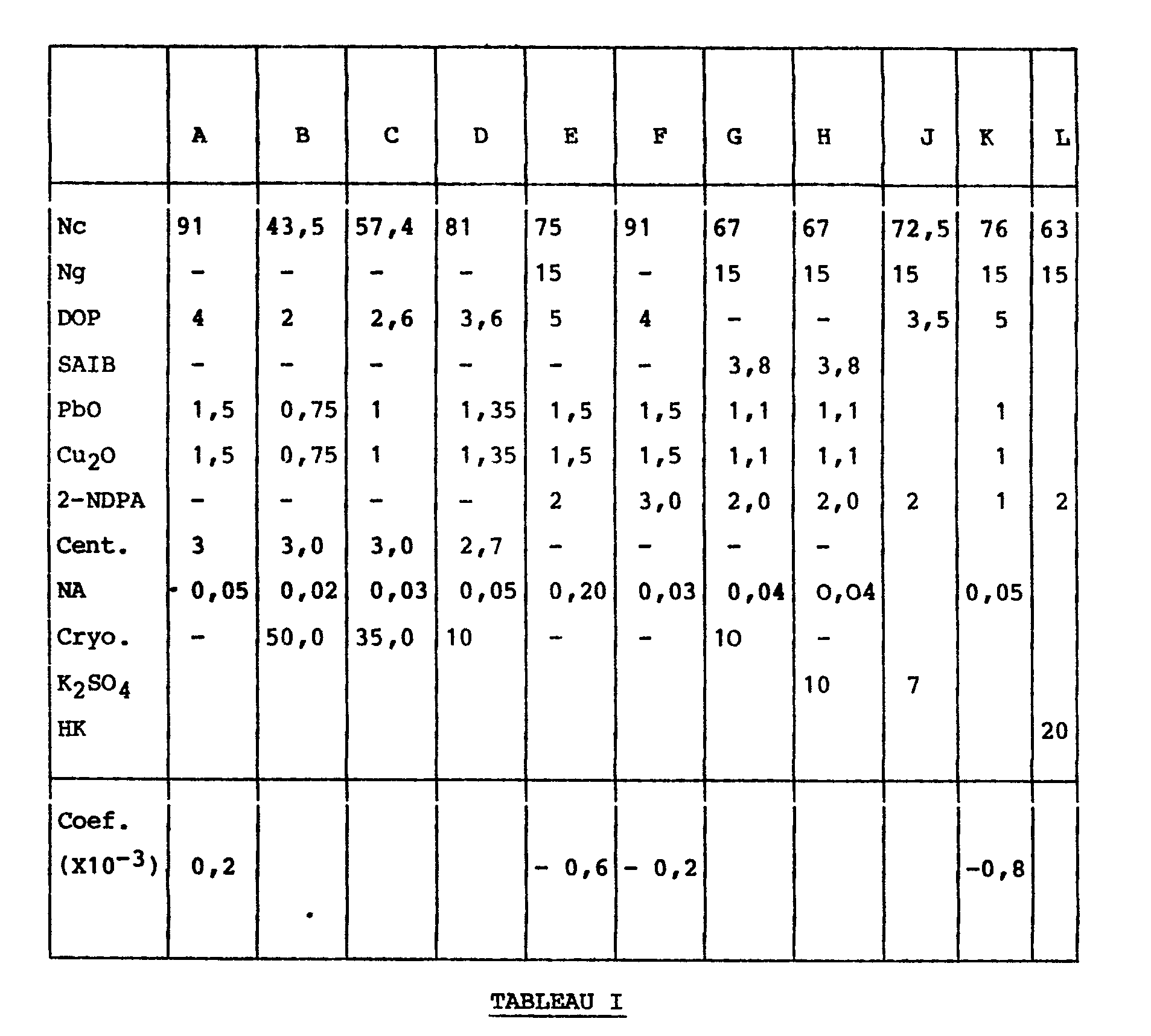
- - Nc : nitrocellulose contenant 12,6 % d'azote
- - Ng : nitroglycérine
- - DOP : dioctyle phtalate
- - SAIB : acétoisobutyrate de saccharose
- - 2-NDPA : 2 N-diphénylamine
- - N.A. : noir d'acétylène
- - Cent. : centralite
- _ Cryo. : cryolithe de potassium à 1 % de DOP
- - HK : Hydrogénotartrate de potassium
- - Coef. : coefficient de température
- On prépare plusieurs poudres à mouler par mélange de deux ou plusieurs des poudres A à J ci-dessus, par exemple dans un drageoir pendant 15 minutes.
- Chaque poudre à mouler ainsi obtenue est ensuite disposée dans un moule puis gélatinisée avec un solvent de moulage de composition suivante :

- La composition obtenue est ensuite soumise à un traitement thermique usuel.
- Les compositions sont testées en tir au banc avec des tuyères désadaptées et contenant un intercepteur de jet situé dans le plan de sortie. Dans le banc utilisé, l'intercepteur de jet obture 30 % environ de l'aire de sortie du divergent de la tuyère.
- Les compositions testées ont un potential de 3553 joules/g environ et brûlent à une vitesse de combustion de 9 mm/s environ à une pression d'environ 8 MPa.
- Les résultats obtenus pour chaque composition sont rassemblés dans le tableau II ci-dessous. Les proportions de chaque poudre A à L dans la poudre à mouler sont données en pourcentage pondéral. Les compositions des essais 1 à 4 sont obtenus avec le solvent de moulage A, tandis que celles des essais 5 à 12, ont été obtenues avec le solvent B.

- Les essais 1,2,3 sont des essais comparatifs et correspondent au procédé décrit dans le brevet américain n° 3960621. Les résultats montrent que le phénomène de postcombustion n'est pas supprimé, même dans l'essai 3 dont la poudre à mouler a été obtenue avec une proportion élevée de poudre (C) chargée avec un agent anti-lueur.
- Dans tous les autres essais conformes à l'invention, le phénomène de postcombustion ne se produit pas et on peut obtenir des compositions à coefficient de température faible et même négatif (essais 8 à 12).
- L'invention n'est pas limitée aux exemples. Ainsi, les teneurs en nitrocellulose, nitroglycérine, plastifiant ou catalyseurs de combustion dans la poudre à mouler ne sont pas critiques, il en est de même pour le taux de remplissage et la composition du solvant de moulage.
Claims (8)
Applications Claiming Priority (2)
| Application Number | Priority Date | Filing Date | Title |
|---|---|---|---|
| FR8515170 | 1985-10-14 | ||
| FR8515170A FR2588551B1 (fr) | 1985-10-14 | 1985-10-14 | Procede de fabrication d'une composition propulsive double-base a faible emission de lueur de flamme, et composition propulsive ainsi obtenue |
Publications (1)
| Publication Number | Publication Date |
|---|---|
| EP0219431A1 true EP0219431A1 (fr) | 1987-04-22 |
Family
ID=9323784
Family Applications (1)
| Application Number | Title | Priority Date | Filing Date |
|---|---|---|---|
| EP86402235A Withdrawn EP0219431A1 (fr) | 1985-10-14 | 1986-10-09 | Procédé de fabrication d'une composition propulsive double-base à faible émission de lueur de flamme, et composition propulsive ainsi obtenue |
Country Status (8)
| Country | Link |
|---|---|
| US (1) | US4701228A (fr) |
| EP (1) | EP0219431A1 (fr) |
| JP (1) | JPS6287476A (fr) |
| CA (1) | CA1288950C (fr) |
| EG (1) | EG19988A (fr) |
| FR (1) | FR2588551B1 (fr) |
| GR (1) | GR862532B (fr) |
| IL (1) | IL80259A (fr) |
Cited By (3)
| Publication number | Priority date | Publication date | Assignee | Title |
|---|---|---|---|---|
| RU2458896C1 (ru) * | 2011-03-17 | 2012-08-20 | Федеральное государственное унитарное предприятие "Научно-исследовательский институт полимерных материалов" | Способ изготовления порохов и топлив баллиститного типа |
| WO2018055312A1 (fr) | 2016-09-26 | 2018-03-29 | Arianegroup Sas | Produit pyrotechnique composite renfermant un agent anti-lueur de type sel de potassium. |
| WO2018178584A1 (fr) | 2017-03-30 | 2018-10-04 | Eurenco | Films d'ethylcellulose, leur préparation et blocs de propergol double-base inhibes en combustion avec de tels films |
Families Citing this family (12)
| Publication number | Priority date | Publication date | Assignee | Title |
|---|---|---|---|---|
| US5254186A (en) * | 1986-07-15 | 1993-10-19 | Royal Ordnance Plc | Nitrocellulose propellant composition |
| US5218166A (en) * | 1991-09-20 | 1993-06-08 | Mei Corporation | Modified nitrocellulose based propellant composition |
| ES2244368T3 (es) | 1999-02-23 | 2005-12-16 | General Dynamics Ordnance And Tactical Systems, Inc. | Propulsor perforado y metodo para fabricarlo. |
| US6230626B1 (en) | 2000-02-23 | 2001-05-15 | The United States Of America As Represented By The Secretary Of The Navy | Flashless MK 66 rocket motor |
| RU2179165C2 (ru) * | 2000-04-06 | 2002-02-10 | Федеральный центр двойных технологий "Союз" | Баллиститное топливо |
| RU2175957C1 (ru) * | 2000-06-01 | 2001-11-20 | Федеральный центр двойных технологий "Союз" | Баллиститное топливо |
| RU2207330C2 (ru) * | 2001-04-23 | 2003-06-27 | Пермский государственный технический университет | Твердое ракетное топливо |
| RU2189371C1 (ru) * | 2001-05-04 | 2002-09-20 | Федеральное государственное унитарное предприятие "Научно-исследовательский институт полимерных материалов" | Баллиститное топливо |
| RU2242449C2 (ru) * | 2002-12-23 | 2004-12-20 | ФГУП "Государственный научно-исследовательский институт химических продуктов" | Способ получения двухосновного пироксилинового пороха |
| US7344610B2 (en) | 2003-01-28 | 2008-03-18 | Hodgdon Powder Company, Inc. | Sulfur-free propellant compositions |
| US7842144B1 (en) | 2007-06-01 | 2010-11-30 | The United States Of America As Represented By The Secretary Of The Navy | Methods of making double base casting powder |
| RU2360894C1 (ru) * | 2008-01-22 | 2009-07-10 | Федеральное государственное унитарное предпритие "Научно-исследовательский институт полимерных материалов" | Способ изготовления заряда из баллиститного твердого ракетного топлива |
Citations (3)
| Publication number | Priority date | Publication date | Assignee | Title |
|---|---|---|---|---|
| FR2214672A1 (fr) * | 1973-01-18 | 1974-08-19 | Olin Corp | |
| US3960621A (en) * | 1957-03-12 | 1976-06-01 | Imperial Chemical Industries Limited | Propellents |
| US3979486A (en) * | 1973-07-27 | 1976-09-07 | Societe Nationale Des Poudres Et Explosifs | Process for controlling the ballistic characteristics of double-base propellants |
Family Cites Families (4)
| Publication number | Priority date | Publication date | Assignee | Title |
|---|---|---|---|---|
| US3867214A (en) * | 1967-09-18 | 1975-02-18 | Us Army | Nitrocellulose doublebase propellant containing ternary mixture of nitrate esters |
| US3867215A (en) * | 1968-03-26 | 1975-02-18 | Us Army | Nitrocellulose double-base propellant containing butanetrioltrinitrate |
| SE384201B (sv) * | 1974-07-09 | 1976-04-26 | Bofors Ab | Sett att dempa mynningsflamma vid eldvapen genom tillsats av kemisk forening innehallande natrium, antimon, syre och vete |
| SE437511B (sv) * | 1979-04-24 | 1985-03-04 | Bofors Ab | Sett att framstella sammanhengande kroppar av dubbelbasraketkrut |
-
1985
- 1985-10-14 FR FR8515170A patent/FR2588551B1/fr not_active Expired
-
1986
- 1986-10-07 US US06/916,308 patent/US4701228A/en not_active Expired - Lifetime
- 1986-10-08 IL IL80259A patent/IL80259A/xx not_active IP Right Cessation
- 1986-10-09 GR GR862532A patent/GR862532B/el unknown
- 1986-10-09 EP EP86402235A patent/EP0219431A1/fr not_active Withdrawn
- 1986-10-10 CA CA000520299A patent/CA1288950C/fr not_active Expired - Lifetime
- 1986-10-12 EG EG63886A patent/EG19988A/xx active
- 1986-10-14 JP JP61242179A patent/JPS6287476A/ja active Pending
Patent Citations (3)
| Publication number | Priority date | Publication date | Assignee | Title |
|---|---|---|---|---|
| US3960621A (en) * | 1957-03-12 | 1976-06-01 | Imperial Chemical Industries Limited | Propellents |
| FR2214672A1 (fr) * | 1973-01-18 | 1974-08-19 | Olin Corp | |
| US3979486A (en) * | 1973-07-27 | 1976-09-07 | Societe Nationale Des Poudres Et Explosifs | Process for controlling the ballistic characteristics of double-base propellants |
Cited By (4)
| Publication number | Priority date | Publication date | Assignee | Title |
|---|---|---|---|---|
| RU2458896C1 (ru) * | 2011-03-17 | 2012-08-20 | Федеральное государственное унитарное предприятие "Научно-исследовательский институт полимерных материалов" | Способ изготовления порохов и топлив баллиститного типа |
| WO2018055312A1 (fr) | 2016-09-26 | 2018-03-29 | Arianegroup Sas | Produit pyrotechnique composite renfermant un agent anti-lueur de type sel de potassium. |
| FR3056583A1 (fr) * | 2016-09-26 | 2018-03-30 | Airbus Safran Launchers Sas | Produit pyrotechnique composite renfermant un agent anti-lueur de type sel de potassium |
| WO2018178584A1 (fr) | 2017-03-30 | 2018-10-04 | Eurenco | Films d'ethylcellulose, leur préparation et blocs de propergol double-base inhibes en combustion avec de tels films |
Also Published As
| Publication number | Publication date |
|---|---|
| FR2588551B1 (fr) | 1987-11-20 |
| JPS6287476A (ja) | 1987-04-21 |
| FR2588551A1 (fr) | 1987-04-17 |
| CA1288950C (fr) | 1991-09-17 |
| IL80259A (en) | 1990-09-17 |
| GR862532B (en) | 1987-03-04 |
| EG19988A (en) | 1997-01-31 |
| US4701228A (en) | 1987-10-20 |
Similar Documents
| Publication | Publication Date | Title |
|---|---|---|
| EP0219431A1 (fr) | Procédé de fabrication d'une composition propulsive double-base à faible émission de lueur de flamme, et composition propulsive ainsi obtenue | |
| FR2523954A1 (fr) | Composition de propergol apte a etre coulee et contenant du magnesium comme combustible | |
| FR2714374A1 (fr) | Compositions pyrotechniques solides à liant thermoplastique et plastifiant polybutadiène silylferrocénique. | |
| FR2526418A1 (fr) | Composition propulsive contenant de la nitrocellulose, de la nitroglycerine, du benzoate de cuivre et du plomb ou ses derives, notamment pour fusees | |
| FR2669626A1 (fr) | Composition de propergol a base de nitrocellulose. | |
| RU2288207C1 (ru) | Композиция твердого горючего | |
| WO2010061127A2 (fr) | Composition composite pour propergol solide comprenant un derive ferrocenique et une charge d'aluminium submicronique, propergol solide et chargement | |
| CA1302712C (fr) | Compositions autopyrolysable pour la propulsion aerobie dont l'oxydant est un explosif | |
| WO2005077862A2 (fr) | Compositions pyrotechniques generatrices de gaz et composes pyrotechniques, notamment destines a la securite automobile | |
| EP3515881B1 (fr) | Produit pyrotechnique composite renfermant un agent anti-lueur de type sel de potassium. | |
| FR2930548A1 (fr) | Composition propulsive double-base a forte impulsion specifique et vitesse de combustion elevee et procede de fabrication | |
| US5254186A (en) | Nitrocellulose propellant composition | |
| BE902208A (fr) | Composition propulsive a base de nitrocellulose. | |
| EP4590649A1 (fr) | Propergol composite a vitesse de combustion reduite | |
| EP0013850B1 (fr) | Nouvelles poudres propulsives en grains à base de nitrocellulose, d'huile nitrée et de nitrate de polyvinyle et leur procédé de fabrication | |
| EP1364931B1 (fr) | Poudres propulsives pour armes à tube à force élevée et effet érosif réduit | |
| FR2857359A1 (fr) | Composition pyrotechnique generatrice de gaz destinee a la securite automobile et brulant a des temperatures de combustion inferieures a 2200 k | |
| US6607617B1 (en) | Double-base rocket propellants, and rocket assemblies comprising the same | |
| EP0924177A1 (fr) | Composition pyrotechnique génératrice de gaz propres à faible teneur en oxydes d'azote, et pastilles d'une telle composition | |
| FR2904625A1 (fr) | Charge amelioree de propergol a double base. | |
| WO2026083033A1 (fr) | Propergol composite à vitesse de combustion réduite | |
| FR2850376A1 (fr) | Plastifiant pour une poudre propulsive a combustion independante de la temperature ambiante | |
| FR2621911A1 (fr) | Poudre propulsive a base de nitrocellulose et de dinitroglycolurile et son procede de fabrication | |
| FR2681065A2 (fr) | Procede de moulage pour la fabrication d'un bloc de propergol double base a taux eleve de nitramine et bloc de propergol obtenu par ce procede. | |
| FR2751323A1 (fr) | Procede de moulage pour realiser un bloc de propergol double base a taux eleve de nitramine et bloc de propergol obtenu par ce procede |
Legal Events
| Date | Code | Title | Description |
|---|---|---|---|
| PUAI | Public reference made under article 153(3) epc to a published international application that has entered the european phase |
Free format text: ORIGINAL CODE: 0009012 |
|
| AK | Designated contracting states |
Kind code of ref document: A1 Designated state(s): BE DE ES FR GB IT NL |
|
| 17P | Request for examination filed |
Effective date: 19870822 |
|
| 17Q | First examination report despatched |
Effective date: 19881220 |
|
| STAA | Information on the status of an ep patent application or granted ep patent |
Free format text: STATUS: THE APPLICATION HAS BEEN WITHDRAWN |
|
| 18W | Application withdrawn |
Withdrawal date: 19891201 |
|
| R18W | Application withdrawn (corrected) |
Effective date: 19891201 |
|
| RIN1 | Information on inventor provided before grant (corrected) |
Inventor name: MALESCOT, GEORGES Inventor name: LAGREZE, RICHARD |