EP0219894A1 - Spannelemente mit zurückgestellter Haftung und Verfahren zum Spannen von Beton sowie vorgespannten Betonelementen - Google Patents
Spannelemente mit zurückgestellter Haftung und Verfahren zum Spannen von Beton sowie vorgespannten Betonelementen Download PDFInfo
- Publication number
- EP0219894A1 EP0219894A1 EP86201601A EP86201601A EP0219894A1 EP 0219894 A1 EP0219894 A1 EP 0219894A1 EP 86201601 A EP86201601 A EP 86201601A EP 86201601 A EP86201601 A EP 86201601A EP 0219894 A1 EP0219894 A1 EP 0219894A1
- Authority
- EP
- European Patent Office
- Prior art keywords
- hardenable composition
- tendon
- layer
- tendon according
- barrier layer
- Prior art date
- Legal status (The legal status is an assumption and is not a legal conclusion. Google has not performed a legal analysis and makes no representation as to the accuracy of the status listed.)
- Granted
Links
- 210000002435 tendon Anatomy 0.000 title claims abstract description 50
- 239000004567 concrete Substances 0.000 title claims description 27
- 238000000034 method Methods 0.000 title claims description 20
- 239000011513 prestressed concrete Substances 0.000 title claims description 3
- 239000000203 mixture Substances 0.000 claims abstract description 48
- 230000004888 barrier function Effects 0.000 claims abstract description 34
- 230000001050 lubricating effect Effects 0.000 claims abstract description 9
- 238000006243 chemical reaction Methods 0.000 claims abstract description 7
- 230000001105 regulatory effect Effects 0.000 claims abstract description 4
- 239000003822 epoxy resin Substances 0.000 claims description 16
- 229920000647 polyepoxide Polymers 0.000 claims description 16
- 239000005056 polyisocyanate Substances 0.000 claims description 13
- 229920001228 polyisocyanate Polymers 0.000 claims description 13
- 229920002994 synthetic fiber Polymers 0.000 claims description 13
- -1 amine compound Chemical class 0.000 claims description 8
- 229920002689 polyvinyl acetate Polymers 0.000 claims description 5
- 239000011118 polyvinyl acetate Substances 0.000 claims description 5
- 229920003171 Poly (ethylene oxide) Polymers 0.000 claims description 4
- 239000000945 filler Substances 0.000 claims description 4
- 238000002156 mixing Methods 0.000 claims description 4
- 239000003638 chemical reducing agent Substances 0.000 claims description 3
- 238000009792 diffusion process Methods 0.000 claims description 3
- 239000000314 lubricant Substances 0.000 claims description 3
- 239000000463 material Substances 0.000 claims description 3
- 150000005846 sugar alcohols Polymers 0.000 claims description 3
- XUIMIQQOPSSXEZ-UHFFFAOYSA-N Silicon Chemical compound [Si] XUIMIQQOPSSXEZ-UHFFFAOYSA-N 0.000 claims description 2
- 229920001343 polytetrafluoroethylene Polymers 0.000 claims description 2
- 239000010703 silicon Substances 0.000 claims description 2
- 229910052710 silicon Inorganic materials 0.000 claims description 2
- 239000002904 solvent Substances 0.000 claims description 2
- 239000001993 wax Substances 0.000 claims description 2
- 239000007788 liquid Substances 0.000 claims 1
- 230000008569 process Effects 0.000 description 10
- 239000004570 mortar (masonry) Substances 0.000 description 9
- XLYOFNOQVPJJNP-UHFFFAOYSA-N water Substances O XLYOFNOQVPJJNP-UHFFFAOYSA-N 0.000 description 8
- 150000001412 amines Chemical class 0.000 description 6
- 229940075065 polyvinyl acetate Drugs 0.000 description 4
- 230000009471 action Effects 0.000 description 3
- 239000011083 cement mortar Substances 0.000 description 3
- 150000001875 compounds Chemical class 0.000 description 3
- 230000007062 hydrolysis Effects 0.000 description 3
- 238000006460 hydrolysis reaction Methods 0.000 description 3
- 238000004519 manufacturing process Methods 0.000 description 3
- VTYYLEPIZMXCLO-UHFFFAOYSA-L Calcium carbonate Chemical compound [Ca+2].[O-]C([O-])=O VTYYLEPIZMXCLO-UHFFFAOYSA-L 0.000 description 2
- CURLTUGMZLYLDI-UHFFFAOYSA-N Carbon dioxide Chemical compound O=C=O CURLTUGMZLYLDI-UHFFFAOYSA-N 0.000 description 2
- 238000010438 heat treatment Methods 0.000 description 2
- 239000004814 polyurethane Substances 0.000 description 2
- 229920002635 polyurethane Polymers 0.000 description 2
- 230000009467 reduction Effects 0.000 description 2
- OKTJSMMVPCPJKN-UHFFFAOYSA-N Carbon Chemical compound [C] OKTJSMMVPCPJKN-UHFFFAOYSA-N 0.000 description 1
- 239000004593 Epoxy Substances 0.000 description 1
- 239000004698 Polyethylene Substances 0.000 description 1
- 239000004743 Polypropylene Substances 0.000 description 1
- 230000001133 acceleration Effects 0.000 description 1
- 230000004913 activation Effects 0.000 description 1
- 239000003513 alkali Substances 0.000 description 1
- 229910001413 alkali metal ion Inorganic materials 0.000 description 1
- 125000003277 amino group Chemical group 0.000 description 1
- 238000005452 bending Methods 0.000 description 1
- 230000008901 benefit Effects 0.000 description 1
- 230000015572 biosynthetic process Effects 0.000 description 1
- 229910000019 calcium carbonate Inorganic materials 0.000 description 1
- 229910052799 carbon Inorganic materials 0.000 description 1
- 229910002092 carbon dioxide Inorganic materials 0.000 description 1
- 239000001569 carbon dioxide Substances 0.000 description 1
- 230000003197 catalytic effect Effects 0.000 description 1
- 239000004927 clay Substances 0.000 description 1
- 238000010276 construction Methods 0.000 description 1
- 238000007796 conventional method Methods 0.000 description 1
- 238000005260 corrosion Methods 0.000 description 1
- 230000007797 corrosion Effects 0.000 description 1
- 229910052602 gypsum Inorganic materials 0.000 description 1
- 239000010440 gypsum Substances 0.000 description 1
- 125000002887 hydroxy group Chemical group [H]O* 0.000 description 1
- 230000006872 improvement Effects 0.000 description 1
- 239000012948 isocyanate Substances 0.000 description 1
- IQPQWNKOIGAROB-UHFFFAOYSA-N isocyanate group Chemical group [N-]=C=O IQPQWNKOIGAROB-UHFFFAOYSA-N 0.000 description 1
- 150000002513 isocyanates Chemical class 0.000 description 1
- 229920000573 polyethylene Polymers 0.000 description 1
- 229920001155 polypropylene Polymers 0.000 description 1
- 239000000843 powder Substances 0.000 description 1
- 238000010944 pre-mature reactiony Methods 0.000 description 1
- 230000002028 premature Effects 0.000 description 1
- 125000002924 primary amino group Chemical class [H]N([H])* 0.000 description 1
- 230000005855 radiation Effects 0.000 description 1
- 230000002787 reinforcement Effects 0.000 description 1
- 239000007787 solid Substances 0.000 description 1
Images
Classifications
-
- E—FIXED CONSTRUCTIONS
- E04—BUILDING
- E04C—STRUCTURAL ELEMENTS; BUILDING MATERIALS
- E04C5/00—Reinforcing elements, e.g. for concrete; Auxiliary elements therefor
- E04C5/08—Members specially adapted to be used in prestressed constructions
Definitions
- the invention relates to a tendon comprising a tensionable core, an envelope formed of a hardenable composition, and a shield, whereby the hardenable composition has a lubricating action and hardens after that the core has been tensioned.
- Such tendons are generally known.
- European Patent Application No. 83 810 431.3 (publication number 0105 839) describes such tendons which are composed of a core around which a hardenable composition is applied, which, in turn, is encased in a synthetic material layer hardened by radiation. When the tendon has been put in its place, the core is tensioned, and subsequently heated by passing an electric current through it so as to harden the hardenable layer around the core.
- Such tendons are used for making, e.g. concrete structures.
- a strand, rope or rod is tensioned on a drawing bench ; subsequently, concrete mortar is applied around this tensioned strand, rope or rod, and the concrete is allowed to harden.
- the hardened concrete then contains a stressed tendon so that the resistance against bending of e.g. the so manufactured beam, is considerably improved.
- Another method deals with the so-called posttensioning of tendons.
- a rope encased in a shield is placed in a mould to be filed with concrete mortar. Subsequently, the rope is tensioned up to the required stress.
- cement mortar is injected between the rope and the shield so as to obtain a bond between the shield and the central rope as soon as the mortar is hardened.
- Such a method is particularly suitable for on-site jobs.
- the inside of the shield will preferably be profiled in order to enhance anchorage between the rope and the shield. As soon as the concrete mortar around the shield and the cement mortar inside the shield are hardened, the anchors used for stressing the rope can be removed.
- Another method of prestressing consists in using a stressing rope encased in a shield or sheath, whereby the stressing rope is frequently movable inside the sheath (unbonded tendons).
- the tendons are placed in a mould to be filled with concrete mortar and subsequently tensioned.
- the concrete mortar is then cast and allowed to harden.
- the tensioning anchors remain in position and provide the required stress in the tendons throughout the life of the structure.
- This method offers the advantage that in certain cases the stress can be adjusted afterwards when this should be desirable.
- An obvious disadvantage is that, in the case an anchor breaks, the entire stress may disappear with all its consequences.
- the hardenable composition is a hardenable material which does not require the supply of heat and of which the components or preproducts are distributed over various distinct phases ; that at least one continuous phase of the hardenable composition is provided with lubricanting action which after the hardening process substantially disappears and that there also is provided a barrier layer which regulates the speed of the hardening reaction of the hardenable composition.
- a stressing rope according to the invention may be submitted to considerable elongation of the core during stressing ; e.g. 5 % elongation.
- the rope is tensioned not before the concrete is hard so that during this process the core moves relative to the surrounding concrete.
- the degree of blending of the phases of the hardenable composition during the tensioning process may be influenced by the nature of the core in terms of elongation and surface profile.
- barrier layer By the choice of the barrier layer, it is possible to regulate accurately the speed of the hardening reaction of the hardenable composition, which is distributed over several phases.
- the sheath constitutes the barrier layer which consists of a hydrolizable synthetic material.
- this layer consists of a synthetic material that is hydrolizable in an alkaline aqueous environment, e.g. 100 % esterified polyvinyl acetate.
- said material is as thin as possible to prevent lubricating action after hydrolysis, but, on the other hand, it must be sufficiently thick to serve as a barrier layer during the desired period of time.
- the hardenable composition is formed by a layer adjacent to the core which contains a suitable epoxy resin and an adjacent layer containing polyisocyanate.
- the tendon is placed in a casing, the concrete mortar is poured in the casing and the concrete is allowed to harden.
- the tensionable core is tensioned by means of jacks and anchors.
- the concrete contains, an amount of strongly alkaline water ; a pH value of 13 is a normal value.
- the sheath which is composed of a layer based on, say, polyvinylacetate, will, in the coarse of time, hydrolyse in the alkaline water present in the concrete. Subsequently the alkaline water comes into contact with the polyisocyanate-epoxy resin system lying directly beneath the barrier layer.
- the polyisocyanate Under the influence of alkali and water, the polyisocyanate will be converted into a compound containing amino-groups such as, for example, the corresponding primary amine.
- this amine In combination with the epoxy resin in the system, this amine will now form an epoxy resin-hardening system, whereby the duration of the hardening will depend on the thickness of the polyvinyl-acetate layer and on the concentration of the polyisocyanate in the polyisocyanate-containing layer.
- the epoxy resin contained in the epoxy-resin-containing layer around the core must have a hydroxyl number 0 in order to avoid premature reaction between the polyisocyanate component of the top layer and the epoxy resin.
- the anchors will not be removed after the hardening process, although this would be possible. It is, however, important to note that the anchors are no longer essential for the action of the tendon. This means that, should the anchors be put out of service owing to e.g. corrosion, the tendon would maintains its normal function thanks to the presence of the hardened bonding synthetic material between the core of the tendon and the hard concrete.
- This measure makes it possible to prevent premature reation between the polyisocyanate layer with, for example, water vapour from the atmosphere.
- the barrier layer is located between the phases of the hardenable composition and the shield or sheath is formed by an impenetrable inert profiled synthetic material layer.
- the barrier layer regulates the diffusion speed of one or more components of the hardenable composition.
- one of the phases contains an epoxy resin, while another phase may contain an amine compound.
- a suitable barrier layer may then be composed of polyethylene oxide.
- the barrier layer may be composed, instead of of polyethylene oxide, of another amine diffusible layer ; however, a requirement is that the barrier layer contains no groups that trigger off a reaction between the barrier layer and the epoxy resin.
- At least one of the phases of the hardenable composition has lubricating action. This can be achieved by adding one or more lubricants or viscocity-reducing agents, such as inert waxes, solvents, silicon products or polytetrafluorethylene products, to the phase concerned.
- lubricants or viscocity-reducing agents such as inert waxes, solvents, silicon products or polytetrafluorethylene products
- adding fillers shall not be required.
- the hardenable composition is formed by a polyisocyanate and an epoxy resin.
- the polyisocyanate whereby as already said an amine is formed, a molecule of carbon dioxyde per isocyanate group is liberated.
- carbon dioxide may remain trapped in the hardenable composition and so lead to an increase in volume during the hardening process. In this way, it is evident that an excellent filling of the cavity inside the sheath is obtained.
- the invention also relates to a method for tensioning concrete under the application of a tendon according to the invention. It is evident that the tendons according to the invention can also be used for making a prestressed concrete element made in a conventional manner in a workshop.
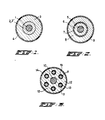
- reference number (1) represents the first phase of the hardenable composition around the core, while reference number (3) represents a second phase of the hardenable composition.
- Reference number (4) refers to a barrier layer applied around both phases of the hardenable composition, which layer (4), in this case, also has the function of a sheath or a shield. Preferably, a very thin, additional jacket is applied on this barrier layer (4).
- reference number (5) designates a tensionable core ; a first phase (6) of the hardenable composition is applied around this core ; a barrier layer (7) is applied around this first phase and a second phase (8) of a hardenable composition is applied around this barrier layer (1) ; a shield (9) is applied at the outside.
- reference number (10) again shows the tensionable core ;
- reference number (11) refers to a first phase of the hardenable composition and reference number (12) to the second phase of the hardenable composition.
- Reference number (13) refers to the barrier layer located between both phases of the hardenable composition.
- the tendon is applied as follows. After having been freed from the outermost thin inert jacket, if any, the tendon is placed in a mould to be filled with concrete ; the concrete mortar is cast around the tendon and starts to harden ; after complete hardening of the concrete the core is tensioned. During the hardening process of the system, the latter possibly being mixed due to the tensioning, the concrete mortar contains water with a high pH-value, e.g. a pH of about 13. At these high pH-values the barrier layer 4, e.g. polyvinyl acetate, will hydrolyze.
- a high pH-value e.g. a pH of about 13.
- the barrier layer 4 e.g. polyvinyl acetate
- the alkaline water of the concrete comes into contact with a polyisocyanate from the layer 3 so that the polyisocyanate is converted into a mixture of amine compounds.
- these compounds can react with the epoxy resin from the layer 2, so that, together with the amine formed from the isocyanate, the epoxy resin forms a solid hard synthetic material.
- a core 5 is enveloped by, for example, an amine-containing layer 6, which, in turn, is enveloped in a barrier layer 7 consisting substantially of polyethylene oxide.
- an epoxy resin layer 8 is applied ; finally at the outer side of the element there is an inpenetrable inert synthetic material layer 9 with profiled surface.
- the diffusion process of the amine over the barrier layer 7 will start and continue until all epoxy resin has been converted.
- Figure 3 shows that the phase 12 of the hardenable composition is a continuous phase, while the phase 11 is a discontinuous phase, which is distributed in the continuous phase 12. Between both phases there always is a barrier layer in the form of a jacket 13. As concerns the period of time between the hardening of the so formed hardenable system and the manufacturing of the tendon, the same time control is required as described for Figure 2.
Landscapes
- Engineering & Computer Science (AREA)
- Architecture (AREA)
- Civil Engineering (AREA)
- Structural Engineering (AREA)
- On-Site Construction Work That Accompanies The Preparation And Application Of Concrete (AREA)
- Clamps And Clips (AREA)
- Reinforcement Elements For Buildings (AREA)
- Manufacturing Of Tubular Articles Or Embedded Moulded Articles (AREA)
- Sealing Material Composition (AREA)
- Bridges Or Land Bridges (AREA)
- Ropes Or Cables (AREA)
Priority Applications (1)
| Application Number | Priority Date | Filing Date | Title |
|---|---|---|---|
| AT86201601T ATE48459T1 (de) | 1985-09-20 | 1986-09-18 | Spannelemente mit zurueckgestellter haftung und verfahren zum spannen von beton sowie vorgespannten betonelementen. |
Applications Claiming Priority (2)
| Application Number | Priority Date | Filing Date | Title |
|---|---|---|---|
| NL8502588 | 1985-09-20 | ||
| NL8502588A NL8502588A (nl) | 1985-09-20 | 1985-09-20 | Voorspanelement met uitgestelde hechting en werkwijze voor het spannen van beton alsmede voorgespannen betonelement. |
Publications (2)
| Publication Number | Publication Date |
|---|---|
| EP0219894A1 true EP0219894A1 (de) | 1987-04-29 |
| EP0219894B1 EP0219894B1 (de) | 1989-12-06 |
Family
ID=19846594
Family Applications (1)
| Application Number | Title | Priority Date | Filing Date |
|---|---|---|---|
| EP86201601A Expired EP0219894B1 (de) | 1985-09-20 | 1986-09-18 | Spannelemente mit zurückgestellter Haftung und Verfahren zum Spannen von Beton sowie vorgespannten Betonelementen |
Country Status (5)
| Country | Link |
|---|---|
| EP (1) | EP0219894B1 (de) |
| AT (1) | ATE48459T1 (de) |
| DE (1) | DE3667313D1 (de) |
| NL (1) | NL8502588A (de) |
| NO (1) | NO863749L (de) |
Cited By (6)
| Publication number | Priority date | Publication date | Assignee | Title |
|---|---|---|---|---|
| EP0273564A1 (de) * | 1986-12-28 | 1988-07-06 | SHINKO KOSEN KOGYO KABUSHIKI KAISHA also known as SHINKO WIRE CO.LTD. | Vorspannglied für vorgespannte Betonbauwerke und Verfahren zu seiner Verwendung |
| EP0302649A3 (en) * | 1987-07-27 | 1989-11-02 | Shinko Kosen Kogyo Kabushiki Kaisha | Coating material for tendon for prestressed concrete, and method of making prestressed concrete articles |
| EP0441029A1 (de) * | 1990-02-08 | 1991-08-14 | SHINKO KOSEN KOGYO KABUSHIKI KAISHA also known as SHINKO WIRE CO.LTD. | Herstellungsverfahren für Spannglieder für Spannbetonbauwerke |
| US5254190A (en) * | 1986-12-28 | 1993-10-19 | Shinko Kosen Kogyo Kabushiki Kaisha | Tendons for prestressed concrete structures and method of using such tendons |
| WO1996024476A1 (de) * | 1995-02-09 | 1996-08-15 | Ipa-Isorast International S.A. | Verfahren zur herstellung von wärmeisolierten tafeln für die grosstafelbauweise |
| WO1998041708A1 (de) * | 1997-03-17 | 1998-09-24 | Suspa Spannbeton Gmbh | Vorgefertigtes zugglied, insbesondere als umfangsspannglied für grossbehälter aus beton |
Citations (4)
| Publication number | Priority date | Publication date | Assignee | Title |
|---|---|---|---|---|
| US3060640A (en) * | 1959-06-11 | 1962-10-30 | Span Tendons Ltd | Cables for prestressing concrete |
| GB935557A (en) * | 1959-01-26 | 1963-08-28 | Jack Vernon Welborn | Improvements in or relating to stressing concrete |
| US3111569A (en) * | 1958-06-20 | 1963-11-19 | Rubenstein David | Packaged laminated constructions |
| GB2140480A (en) * | 1983-05-25 | 1984-11-28 | Psc Freyssinet Ltd | Bonded tendons |
Family Cites Families (1)
| Publication number | Priority date | Publication date | Assignee | Title |
|---|---|---|---|---|
| US3646748A (en) * | 1970-03-24 | 1972-03-07 | Frederic A Lang | Tendons for prestressed concrete and process for making such tendons |
-
1985
- 1985-09-20 NL NL8502588A patent/NL8502588A/nl not_active Application Discontinuation
-
1986
- 1986-09-18 EP EP86201601A patent/EP0219894B1/de not_active Expired
- 1986-09-18 AT AT86201601T patent/ATE48459T1/de not_active IP Right Cessation
- 1986-09-18 DE DE8686201601T patent/DE3667313D1/de not_active Expired - Fee Related
- 1986-09-19 NO NO863749A patent/NO863749L/no unknown
Patent Citations (4)
| Publication number | Priority date | Publication date | Assignee | Title |
|---|---|---|---|---|
| US3111569A (en) * | 1958-06-20 | 1963-11-19 | Rubenstein David | Packaged laminated constructions |
| GB935557A (en) * | 1959-01-26 | 1963-08-28 | Jack Vernon Welborn | Improvements in or relating to stressing concrete |
| US3060640A (en) * | 1959-06-11 | 1962-10-30 | Span Tendons Ltd | Cables for prestressing concrete |
| GB2140480A (en) * | 1983-05-25 | 1984-11-28 | Psc Freyssinet Ltd | Bonded tendons |
Cited By (10)
| Publication number | Priority date | Publication date | Assignee | Title |
|---|---|---|---|---|
| EP0273564A1 (de) * | 1986-12-28 | 1988-07-06 | SHINKO KOSEN KOGYO KABUSHIKI KAISHA also known as SHINKO WIRE CO.LTD. | Vorspannglied für vorgespannte Betonbauwerke und Verfahren zu seiner Verwendung |
| AU590453B2 (en) * | 1986-12-28 | 1989-11-02 | Shinko Kosen Kogyo Kabushiki Kaisha | Tendons for prestressed concrete structures and method of using such tendons |
| US5149385A (en) * | 1986-12-28 | 1992-09-22 | Shinko Kosen Kogyo Kabushiki Kaisha | Tendons for prestressed concrete structures and method of using such tendons |
| US5254190A (en) * | 1986-12-28 | 1993-10-19 | Shinko Kosen Kogyo Kabushiki Kaisha | Tendons for prestressed concrete structures and method of using such tendons |
| EP0302649A3 (en) * | 1987-07-27 | 1989-11-02 | Shinko Kosen Kogyo Kabushiki Kaisha | Coating material for tendon for prestressed concrete, and method of making prestressed concrete articles |
| US4929650A (en) * | 1987-07-27 | 1990-05-29 | Mitsui Sekiyu Kagaku Kogyo Kabushiki Kaisha | Coating material for tendon for prestressed concrete |
| AU598144B2 (en) * | 1987-07-27 | 1990-06-14 | Mitsui Sekiyu Kagaku Kogyo Kabushiki Kaisha | Coating material for tendon for prestressed concrete |
| EP0441029A1 (de) * | 1990-02-08 | 1991-08-14 | SHINKO KOSEN KOGYO KABUSHIKI KAISHA also known as SHINKO WIRE CO.LTD. | Herstellungsverfahren für Spannglieder für Spannbetonbauwerke |
| WO1996024476A1 (de) * | 1995-02-09 | 1996-08-15 | Ipa-Isorast International S.A. | Verfahren zur herstellung von wärmeisolierten tafeln für die grosstafelbauweise |
| WO1998041708A1 (de) * | 1997-03-17 | 1998-09-24 | Suspa Spannbeton Gmbh | Vorgefertigtes zugglied, insbesondere als umfangsspannglied für grossbehälter aus beton |
Also Published As
| Publication number | Publication date |
|---|---|
| DE3667313D1 (de) | 1990-01-11 |
| EP0219894B1 (de) | 1989-12-06 |
| NO863749L (no) | 1987-03-23 |
| NO863749D0 (no) | 1986-09-19 |
| ATE48459T1 (de) | 1989-12-15 |
| NL8502588A (nl) | 1987-04-16 |
Similar Documents
| Publication | Publication Date | Title |
|---|---|---|
| US4773198A (en) | Post-tensioning anchorages for aggressive environments | |
| US6655104B2 (en) | PC steel stranded wire connection structure and construction method thereof | |
| Gerwick Jr | Construction of prestressed concrete structures | |
| US3468090A (en) | Constructional element and method of making the same | |
| EP0219894B1 (de) | Spannelemente mit zurückgestellter Haftung und Verfahren zum Spannen von Beton sowie vorgespannten Betonelementen | |
| US3060640A (en) | Cables for prestressing concrete | |
| CA1280909C (en) | Prestressing steel material | |
| US5149385A (en) | Tendons for prestressed concrete structures and method of using such tendons | |
| CA2071606C (en) | Process for manufacturing a spacer for reinforcements, and spacer | |
| EP0441029B1 (de) | Herstellungsverfahren für Spannglieder für Spannbetonbauwerke | |
| JP3884118B2 (ja) | コンクリート補修液内包骨材及びそれを配合したコンクリート並びにその製造方法 | |
| EP0428304B1 (de) | Verankerung für Spannglied und Verfahren zu seiner Herstellung | |
| US4407770A (en) | Cable anchorage | |
| EP0845063B1 (de) | Verstärkung von mauerwerkstrukturen | |
| KR102238476B1 (ko) | 프리그라우트 pc강재 및 그 프리그라우트층의 경화 방법 | |
| JP3815641B2 (ja) | アフターボンド工法 | |
| JP2559802B2 (ja) | 緊張用ケーブル | |
| EP3951066B1 (de) | Verfahren zum testen einer struktur, anordnung zum testen einer struktur und verwendung einer anordnung zum testen einer struktur | |
| GB2140480A (en) | Bonded tendons | |
| US5254190A (en) | Tendons for prestressed concrete structures and method of using such tendons | |
| JP2024130398A (ja) | PCaPC床版の接合構造、PCaPC床版の接合方法、及び複合床版 | |
| JPH0489950A (ja) | 付着性に優れた被覆pc鋼より線 | |
| JPS63277350A (ja) | プレストレスコンクリ−ト用繊維強化プラスチック緊張材 | |
| JP2509159B2 (ja) | 盛土アンカ― | |
| JP2007211486A (ja) | プレグラウトpc鋼材及びその製造方法 |
Legal Events
| Date | Code | Title | Description |
|---|---|---|---|
| PUAI | Public reference made under article 153(3) epc to a published international application that has entered the european phase |
Free format text: ORIGINAL CODE: 0009012 |
|
| AK | Designated contracting states |
Kind code of ref document: A1 Designated state(s): AT BE CH DE FR GB IT LI LU NL SE |
|
| 17P | Request for examination filed |
Effective date: 19870616 |
|
| 17Q | First examination report despatched |
Effective date: 19880518 |
|
| GRAA | (expected) grant |
Free format text: ORIGINAL CODE: 0009210 |
|
| AK | Designated contracting states |
Kind code of ref document: B1 Designated state(s): AT BE CH DE FR GB IT LI LU NL SE |
|
| REF | Corresponds to: |
Ref document number: 48459 Country of ref document: AT Date of ref document: 19891215 Kind code of ref document: T |
|
| REF | Corresponds to: |
Ref document number: 3667313 Country of ref document: DE Date of ref document: 19900111 |
|
| ET | Fr: translation filed | ||
| ITF | It: translation for a ep patent filed | ||
| PGFP | Annual fee paid to national office [announced via postgrant information from national office to epo] |
Ref country code: CH Payment date: 19900813 Year of fee payment: 5 |
|
| PGFP | Annual fee paid to national office [announced via postgrant information from national office to epo] |
Ref country code: LU Payment date: 19900823 Year of fee payment: 5 |
|
| PGFP | Annual fee paid to national office [announced via postgrant information from national office to epo] |
Ref country code: AT Payment date: 19900824 Year of fee payment: 5 |
|
| PGFP | Annual fee paid to national office [announced via postgrant information from national office to epo] |
Ref country code: DE Payment date: 19900830 Year of fee payment: 5 |
|
| PGFP | Annual fee paid to national office [announced via postgrant information from national office to epo] |
Ref country code: GB Payment date: 19900907 Year of fee payment: 5 |
|
| PGFP | Annual fee paid to national office [announced via postgrant information from national office to epo] |
Ref country code: FR Payment date: 19900927 Year of fee payment: 5 |
|
| PGFP | Annual fee paid to national office [announced via postgrant information from national office to epo] |
Ref country code: SE Payment date: 19900928 Year of fee payment: 5 |
|
| PLBE | No opposition filed within time limit |
Free format text: ORIGINAL CODE: 0009261 |
|
| STAA | Information on the status of an ep patent application or granted ep patent |
Free format text: STATUS: NO OPPOSITION FILED WITHIN TIME LIMIT |
|
| ITTA | It: last paid annual fee | ||
| PG25 | Lapsed in a contracting state [announced via postgrant information from national office to epo] |
Ref country code: LU Free format text: LAPSE BECAUSE OF NON-PAYMENT OF DUE FEES Effective date: 19900930 |
|
| PGFP | Annual fee paid to national office [announced via postgrant information from national office to epo] |
Ref country code: NL Payment date: 19900930 Year of fee payment: 5 |
|
| PGFP | Annual fee paid to national office [announced via postgrant information from national office to epo] |
Ref country code: BE Payment date: 19901010 Year of fee payment: 5 |
|
| 26N | No opposition filed | ||
| PG25 | Lapsed in a contracting state [announced via postgrant information from national office to epo] |
Ref country code: GB Effective date: 19910918 Ref country code: AT Effective date: 19910918 |
|
| PG25 | Lapsed in a contracting state [announced via postgrant information from national office to epo] |
Ref country code: SE Effective date: 19910919 |
|
| PG25 | Lapsed in a contracting state [announced via postgrant information from national office to epo] |
Ref country code: LI Effective date: 19910930 Ref country code: CH Effective date: 19910930 Ref country code: BE Effective date: 19910930 |
|
| BERE | Be: lapsed |
Owner name: BEKAERT-COCKERILL Effective date: 19910930 |
|
| PG25 | Lapsed in a contracting state [announced via postgrant information from national office to epo] |
Ref country code: NL Effective date: 19920401 |
|
| GBPC | Gb: european patent ceased through non-payment of renewal fee | ||
| NLV4 | Nl: lapsed or anulled due to non-payment of the annual fee | ||
| PG25 | Lapsed in a contracting state [announced via postgrant information from national office to epo] |
Ref country code: FR Effective date: 19920529 |
|
| REG | Reference to a national code |
Ref country code: CH Ref legal event code: PL |
|
| PG25 | Lapsed in a contracting state [announced via postgrant information from national office to epo] |
Ref country code: DE Effective date: 19920602 |
|
| REG | Reference to a national code |
Ref country code: FR Ref legal event code: ST |
|
| EUG | Se: european patent has lapsed |
Ref document number: 86201601.1 Effective date: 19920408 |
|
| PG25 | Lapsed in a contracting state [announced via postgrant information from national office to epo] |
Ref country code: IT Free format text: LAPSE BECAUSE OF NON-PAYMENT OF DUE FEES;WARNING: LAPSES OF ITALIAN PATENTS WITH EFFECTIVE DATE BEFORE 2007 MAY HAVE OCCURRED AT ANY TIME BEFORE 2007. THE CORRECT EFFECTIVE DATE MAY BE DIFFERENT FROM THE ONE RECORDED. Effective date: 20050918 |