EP0219973B1 - Schlagzähe Polyamidzusammensetzungen - Google Patents
Schlagzähe Polyamidzusammensetzungen Download PDFInfo
- Publication number
- EP0219973B1 EP0219973B1 EP86307121A EP86307121A EP0219973B1 EP 0219973 B1 EP0219973 B1 EP 0219973B1 EP 86307121 A EP86307121 A EP 86307121A EP 86307121 A EP86307121 A EP 86307121A EP 0219973 B1 EP0219973 B1 EP 0219973B1
- Authority
- EP
- European Patent Office
- Prior art keywords
- weight
- block copolymer
- parts
- modified block
- polymer
- Prior art date
- Legal status (The legal status is an assumption and is not a legal conclusion. Google has not performed a legal analysis and makes no representation as to the accuracy of the status listed.)
- Expired - Lifetime
Links
- 239000000203 mixture Substances 0.000 title claims description 120
- 239000004952 Polyamide Substances 0.000 title claims description 88
- 229920002647 polyamide Polymers 0.000 title claims description 88
- 229920001400 block copolymer Polymers 0.000 claims description 233
- 229920000642 polymer Polymers 0.000 claims description 93
- VGGSQFUCUMXWEO-UHFFFAOYSA-N Ethene Chemical compound C=C VGGSQFUCUMXWEO-UHFFFAOYSA-N 0.000 claims description 62
- 239000005977 Ethylene Substances 0.000 claims description 62
- 238000013329 compounding Methods 0.000 claims description 38
- 238000012986 modification Methods 0.000 claims description 28
- 230000004048 modification Effects 0.000 claims description 28
- 229920002554 vinyl polymer Polymers 0.000 claims description 16
- 150000001993 dienes Chemical class 0.000 claims description 15
- FPYJFEHAWHCUMM-UHFFFAOYSA-N maleic anhydride Chemical compound O=C1OC(=O)C=C1 FPYJFEHAWHCUMM-UHFFFAOYSA-N 0.000 claims description 15
- 230000014509 gene expression Effects 0.000 claims description 8
- 229920002302 Nylon 6,6 Polymers 0.000 claims description 7
- 239000004711 α-olefin Substances 0.000 claims description 7
- 125000002843 carboxylic acid group Chemical group 0.000 claims description 5
- 229920000089 Cyclic olefin copolymer Polymers 0.000 claims description 4
- 229920002292 Nylon 6 Polymers 0.000 claims description 4
- 238000005984 hydrogenation reaction Methods 0.000 claims description 4
- 229920000098 polyolefin Polymers 0.000 claims description 3
- 230000000704 physical effect Effects 0.000 description 65
- 239000011342 resin composition Substances 0.000 description 63
- 230000000052 comparative effect Effects 0.000 description 28
- 238000012360 testing method Methods 0.000 description 17
- KAKZBPTYRLMSJV-UHFFFAOYSA-N Butadiene Chemical compound C=CC=C KAKZBPTYRLMSJV-UHFFFAOYSA-N 0.000 description 16
- PPBRXRYQALVLMV-UHFFFAOYSA-N Styrene Chemical compound C=CC1=CC=CC=C1 PPBRXRYQALVLMV-UHFFFAOYSA-N 0.000 description 16
- 229920001577 copolymer Polymers 0.000 description 15
- 238000002360 preparation method Methods 0.000 description 14
- 239000008188 pellet Substances 0.000 description 13
- -1 vinyl aromatic hydrocarbon Chemical class 0.000 description 12
- 229920001971 elastomer Polymers 0.000 description 10
- 239000000806 elastomer Substances 0.000 description 10
- 230000007423 decrease Effects 0.000 description 9
- QAOWNCQODCNURD-UHFFFAOYSA-N Sulfuric acid Chemical compound OS(O)(=O)=O QAOWNCQODCNURD-UHFFFAOYSA-N 0.000 description 6
- 150000001732 carboxylic acid derivatives Chemical class 0.000 description 6
- 238000002347 injection Methods 0.000 description 6
- 239000007924 injection Substances 0.000 description 6
- 238000000034 method Methods 0.000 description 6
- 238000002156 mixing Methods 0.000 description 6
- 230000003247 decreasing effect Effects 0.000 description 5
- 238000001746 injection moulding Methods 0.000 description 5
- 239000002245 particle Substances 0.000 description 5
- 239000000126 substance Substances 0.000 description 5
- RRHGJUQNOFWUDK-UHFFFAOYSA-N Isoprene Chemical compound CC(=C)C=C RRHGJUQNOFWUDK-UHFFFAOYSA-N 0.000 description 4
- 229920002633 Kraton (polymer) Polymers 0.000 description 4
- MZRVEZGGRBJDDB-UHFFFAOYSA-N N-Butyllithium Chemical compound [Li]CCCC MZRVEZGGRBJDDB-UHFFFAOYSA-N 0.000 description 4
- 229920003189 Nylon 4,6 Polymers 0.000 description 4
- KKEYFWRCBNTPAC-UHFFFAOYSA-N Terephthalic acid Chemical compound OC(=O)C1=CC=C(C(O)=O)C=C1 KKEYFWRCBNTPAC-UHFFFAOYSA-N 0.000 description 4
- YXFVVABEGXRONW-UHFFFAOYSA-N Toluene Chemical compound CC1=CC=CC=C1 YXFVVABEGXRONW-UHFFFAOYSA-N 0.000 description 4
- 238000005452 bending Methods 0.000 description 4
- QQVIHTHCMHWDBS-UHFFFAOYSA-N isophthalic acid Chemical compound OC(=O)C1=CC=CC(C(O)=O)=C1 QQVIHTHCMHWDBS-UHFFFAOYSA-N 0.000 description 4
- VLKZOEOYAKHREP-UHFFFAOYSA-N n-Hexane Chemical compound CCCCCC VLKZOEOYAKHREP-UHFFFAOYSA-N 0.000 description 4
- 239000000243 solution Substances 0.000 description 4
- 229920001169 thermoplastic Polymers 0.000 description 4
- 125000000391 vinyl group Chemical group [H]C([*])=C([H])[H] 0.000 description 4
- 238000005299 abrasion Methods 0.000 description 3
- 229920003233 aromatic nylon Polymers 0.000 description 3
- 239000003054 catalyst Substances 0.000 description 3
- 238000005516 engineering process Methods 0.000 description 3
- 239000003999 initiator Substances 0.000 description 3
- 239000003921 oil Substances 0.000 description 3
- 229920005989 resin Polymers 0.000 description 3
- 239000011347 resin Substances 0.000 description 3
- PMJHHCWVYXUKFD-SNAWJCMRSA-N (E)-1,3-pentadiene Chemical compound C\C=C\C=C PMJHHCWVYXUKFD-SNAWJCMRSA-N 0.000 description 2
- VXNZUUAINFGPBY-UHFFFAOYSA-N 1-Butene Chemical compound CCC=C VXNZUUAINFGPBY-UHFFFAOYSA-N 0.000 description 2
- AFFLGGQVNFXPEV-UHFFFAOYSA-N 1-decene Chemical compound CCCCCCCCC=C AFFLGGQVNFXPEV-UHFFFAOYSA-N 0.000 description 2
- CRSBERNSMYQZNG-UHFFFAOYSA-N 1-dodecene Chemical compound CCCCCCCCCCC=C CRSBERNSMYQZNG-UHFFFAOYSA-N 0.000 description 2
- LIKMAJRDDDTEIG-UHFFFAOYSA-N 1-hexene Chemical compound CCCCC=C LIKMAJRDDDTEIG-UHFFFAOYSA-N 0.000 description 2
- KWKAKUADMBZCLK-UHFFFAOYSA-N 1-octene Chemical compound CCCCCCC=C KWKAKUADMBZCLK-UHFFFAOYSA-N 0.000 description 2
- SDJHPPZKZZWAKF-UHFFFAOYSA-N 2,3-dimethylbuta-1,3-diene Chemical compound CC(=C)C(C)=C SDJHPPZKZZWAKF-UHFFFAOYSA-N 0.000 description 2
- VXEGSRKPIUDPQT-UHFFFAOYSA-N 4-[4-(4-methoxyphenyl)piperazin-1-yl]aniline Chemical compound C1=CC(OC)=CC=C1N1CCN(C=2C=CC(N)=CC=2)CC1 VXEGSRKPIUDPQT-UHFFFAOYSA-N 0.000 description 2
- WSSSPWUEQFSQQG-UHFFFAOYSA-N 4-methyl-1-pentene Chemical compound CC(C)CC=C WSSSPWUEQFSQQG-UHFFFAOYSA-N 0.000 description 2
- GVNWZKBFMFUVNX-UHFFFAOYSA-N Adipamide Chemical compound NC(=O)CCCCC(N)=O GVNWZKBFMFUVNX-UHFFFAOYSA-N 0.000 description 2
- IJGRMHOSHXDMSA-UHFFFAOYSA-N Atomic nitrogen Chemical compound N#N IJGRMHOSHXDMSA-UHFFFAOYSA-N 0.000 description 2
- SOGAXMICEFXMKE-UHFFFAOYSA-N Butylmethacrylate Chemical compound CCCCOC(=O)C(C)=C SOGAXMICEFXMKE-UHFFFAOYSA-N 0.000 description 2
- XDTMQSROBMDMFD-UHFFFAOYSA-N Cyclohexane Chemical compound C1CCCCC1 XDTMQSROBMDMFD-UHFFFAOYSA-N 0.000 description 2
- JIGUQPWFLRLWPJ-UHFFFAOYSA-N Ethyl acrylate Chemical compound CCOC(=O)C=C JIGUQPWFLRLWPJ-UHFFFAOYSA-N 0.000 description 2
- VZCYOOQTPOCHFL-OWOJBTEDSA-N Fumaric acid Chemical compound OC(=O)\C=C\C(O)=O VZCYOOQTPOCHFL-OWOJBTEDSA-N 0.000 description 2
- 238000004566 IR spectroscopy Methods 0.000 description 2
- BAPJBEWLBFYGME-UHFFFAOYSA-N Methyl acrylate Chemical compound COC(=O)C=C BAPJBEWLBFYGME-UHFFFAOYSA-N 0.000 description 2
- WQDUMFSSJAZKTM-UHFFFAOYSA-N Sodium methoxide Chemical compound [Na+].[O-]C WQDUMFSSJAZKTM-UHFFFAOYSA-N 0.000 description 2
- WYURNTSHIVDZCO-UHFFFAOYSA-N Tetrahydrofuran Chemical compound C1CCOC1 WYURNTSHIVDZCO-UHFFFAOYSA-N 0.000 description 2
- XTXRWKRVRITETP-UHFFFAOYSA-N Vinyl acetate Chemical compound CC(=O)OC=C XTXRWKRVRITETP-UHFFFAOYSA-N 0.000 description 2
- NIXOWILDQLNWCW-UHFFFAOYSA-N acrylic acid group Chemical group C(C=C)(=O)O NIXOWILDQLNWCW-UHFFFAOYSA-N 0.000 description 2
- WNLRTRBMVRJNCN-UHFFFAOYSA-N adipic acid Chemical compound OC(=O)CCCCC(O)=O WNLRTRBMVRJNCN-UHFFFAOYSA-N 0.000 description 2
- 238000004458 analytical method Methods 0.000 description 2
- 150000008064 anhydrides Chemical class 0.000 description 2
- 239000007864 aqueous solution Substances 0.000 description 2
- 238000009833 condensation Methods 0.000 description 2
- 230000005494 condensation Effects 0.000 description 2
- 229910001873 dinitrogen Inorganic materials 0.000 description 2
- 239000006185 dispersion Substances 0.000 description 2
- 230000000694 effects Effects 0.000 description 2
- NAQMVNRVTILPCV-UHFFFAOYSA-N hexane-1,6-diamine Chemical compound NCCCCCCN NAQMVNRVTILPCV-UHFFFAOYSA-N 0.000 description 2
- 238000010348 incorporation Methods 0.000 description 2
- 239000004615 ingredient Substances 0.000 description 2
- 239000011159 matrix material Substances 0.000 description 2
- 239000000155 melt Substances 0.000 description 2
- 239000000178 monomer Substances 0.000 description 2
- YWAKXRMUMFPDSH-UHFFFAOYSA-N pentene Chemical compound CCCC=C YWAKXRMUMFPDSH-UHFFFAOYSA-N 0.000 description 2
- PNJWIWWMYCMZRO-UHFFFAOYSA-N pent‐4‐en‐2‐one Natural products CC(=O)CC=C PNJWIWWMYCMZRO-UHFFFAOYSA-N 0.000 description 2
- PMJHHCWVYXUKFD-UHFFFAOYSA-N piperylene Natural products CC=CC=C PMJHHCWVYXUKFD-UHFFFAOYSA-N 0.000 description 2
- 229920000573 polyethylene Polymers 0.000 description 2
- 239000005049 silicon tetrachloride Substances 0.000 description 2
- 238000003756 stirring Methods 0.000 description 2
- 235000011149 sulphuric acid Nutrition 0.000 description 2
- 238000004448 titration Methods 0.000 description 2
- VZCYOOQTPOCHFL-UHFFFAOYSA-N trans-butenedioic acid Natural products OC(=O)C=CC(O)=O VZCYOOQTPOCHFL-UHFFFAOYSA-N 0.000 description 2
- XLYOFNOQVPJJNP-UHFFFAOYSA-N water Substances O XLYOFNOQVPJJNP-UHFFFAOYSA-N 0.000 description 2
- OJOWICOBYCXEKR-APPZFPTMSA-N (1S,4R)-5-ethylidenebicyclo[2.2.1]hept-2-ene Chemical compound CC=C1C[C@@H]2C[C@@H]1C=C2 OJOWICOBYCXEKR-APPZFPTMSA-N 0.000 description 1
- PRBHEGAFLDMLAL-GQCTYLIASA-N (4e)-hexa-1,4-diene Chemical compound C\C=C\CC=C PRBHEGAFLDMLAL-GQCTYLIASA-N 0.000 description 1
- PRBHEGAFLDMLAL-UHFFFAOYSA-N 1,5-Hexadiene Natural products CC=CCC=C PRBHEGAFLDMLAL-UHFFFAOYSA-N 0.000 description 1
- GWWBILGABMLVTN-UHFFFAOYSA-N 1-but-1-enyl-2,3-dimethylbenzene Chemical group CCC=CC1=CC=CC(C)=C1C GWWBILGABMLVTN-UHFFFAOYSA-N 0.000 description 1
- WAEOXIOXMKNFLQ-UHFFFAOYSA-N 1-methyl-4-prop-2-enylbenzene Chemical group CC1=CC=C(CC=C)C=C1 WAEOXIOXMKNFLQ-UHFFFAOYSA-N 0.000 description 1
- IGGDKDTUCAWDAN-UHFFFAOYSA-N 1-vinylnaphthalene Chemical compound C1=CC=C2C(C=C)=CC=CC2=C1 IGGDKDTUCAWDAN-UHFFFAOYSA-N 0.000 description 1
- DMWVYCCGCQPJEA-UHFFFAOYSA-N 2,5-bis(tert-butylperoxy)-2,5-dimethylhexane Chemical compound CC(C)(C)OOC(C)(C)CCC(C)(C)OOC(C)(C)C DMWVYCCGCQPJEA-UHFFFAOYSA-N 0.000 description 1
- SMZOUWXMTYCWNB-UHFFFAOYSA-N 2-(2-methoxy-5-methylphenyl)ethanamine Chemical compound COC1=CC=C(C)C=C1CCN SMZOUWXMTYCWNB-UHFFFAOYSA-N 0.000 description 1
- JAHNSTQSQJOJLO-UHFFFAOYSA-N 2-(3-fluorophenyl)-1h-imidazole Chemical compound FC1=CC=CC(C=2NC=CN=2)=C1 JAHNSTQSQJOJLO-UHFFFAOYSA-N 0.000 description 1
- FQLAJSQGBDYBAL-UHFFFAOYSA-N 3-(azepane-1-carbonyl)benzamide Chemical compound NC(=O)C1=CC=CC(C(=O)N2CCCCCC2)=C1 FQLAJSQGBDYBAL-UHFFFAOYSA-N 0.000 description 1
- NJMDZFXEEZYNBU-UHFFFAOYSA-N 3-(pyrrolidine-1-carbonyl)benzamide Chemical compound NC(=O)C1=CC=CC(C(=O)N2CCCC2)=C1 NJMDZFXEEZYNBU-UHFFFAOYSA-N 0.000 description 1
- PGGROMGHWHXWJL-UHFFFAOYSA-N 4-(azepane-1-carbonyl)benzamide Chemical compound C1=CC(C(=O)N)=CC=C1C(=O)N1CCCCCC1 PGGROMGHWHXWJL-UHFFFAOYSA-N 0.000 description 1
- INYHZQLKOKTDAI-UHFFFAOYSA-N 5-ethenylbicyclo[2.2.1]hept-2-ene Chemical compound C1C2C(C=C)CC1C=C2 INYHZQLKOKTDAI-UHFFFAOYSA-N 0.000 description 1
- 239000004953 Aliphatic polyamide Substances 0.000 description 1
- UFHFLCQGNIYNRP-UHFFFAOYSA-N Hydrogen Chemical compound [H][H] UFHFLCQGNIYNRP-UHFFFAOYSA-N 0.000 description 1
- JHWNWJKBPDFINM-UHFFFAOYSA-N Laurolactam Chemical compound O=C1CCCCCCCCCCCN1 JHWNWJKBPDFINM-UHFFFAOYSA-N 0.000 description 1
- PEEHTFAAVSWFBL-UHFFFAOYSA-N Maleimide Chemical compound O=C1NC(=O)C=C1 PEEHTFAAVSWFBL-UHFFFAOYSA-N 0.000 description 1
- VVQNEPGJFQJSBK-UHFFFAOYSA-N Methyl methacrylate Chemical compound COC(=O)C(C)=C VVQNEPGJFQJSBK-UHFFFAOYSA-N 0.000 description 1
- 229920000571 Nylon 11 Polymers 0.000 description 1
- 229920000299 Nylon 12 Polymers 0.000 description 1
- 229920000305 Nylon 6,10 Polymers 0.000 description 1
- 239000005062 Polybutadiene Substances 0.000 description 1
- 239000004698 Polyethylene Substances 0.000 description 1
- 239000004793 Polystyrene Substances 0.000 description 1
- OFOBLEOULBTSOW-UHFFFAOYSA-N Propanedioic acid Natural products OC(=O)CC(O)=O OFOBLEOULBTSOW-UHFFFAOYSA-N 0.000 description 1
- 238000003917 TEM image Methods 0.000 description 1
- 229910021627 Tin(IV) chloride Inorganic materials 0.000 description 1
- 229910021552 Vanadium(IV) chloride Inorganic materials 0.000 description 1
- 239000011954 Ziegler–Natta catalyst Substances 0.000 description 1
- 239000001361 adipic acid Substances 0.000 description 1
- 235000011037 adipic acid Nutrition 0.000 description 1
- 229920003231 aliphatic polyamide Polymers 0.000 description 1
- XYLMUPLGERFSHI-UHFFFAOYSA-N alpha-Methylstyrene Chemical compound CC(=C)C1=CC=CC=C1 XYLMUPLGERFSHI-UHFFFAOYSA-N 0.000 description 1
- 229910052782 aluminium Inorganic materials 0.000 description 1
- 125000000129 anionic group Chemical group 0.000 description 1
- 239000003963 antioxidant agent Substances 0.000 description 1
- 239000002216 antistatic agent Substances 0.000 description 1
- 239000004760 aramid Substances 0.000 description 1
- 229920003235 aromatic polyamide Polymers 0.000 description 1
- 125000003118 aryl group Chemical group 0.000 description 1
- 230000005540 biological transmission Effects 0.000 description 1
- 238000012661 block copolymerization Methods 0.000 description 1
- GHWVXCQZPNWFRO-UHFFFAOYSA-N butane-2,3-diamine Chemical compound CC(N)C(C)N GHWVXCQZPNWFRO-UHFFFAOYSA-N 0.000 description 1
- CQEYYJKEWSMYFG-UHFFFAOYSA-N butyl acrylate Chemical compound CCCCOC(=O)C=C CQEYYJKEWSMYFG-UHFFFAOYSA-N 0.000 description 1
- 239000011203 carbon fibre reinforced carbon Substances 0.000 description 1
- 239000003795 chemical substances by application Substances 0.000 description 1
- 238000007796 conventional method Methods 0.000 description 1
- 238000001816 cooling Methods 0.000 description 1
- 239000007822 coupling agent Substances 0.000 description 1
- 238000005859 coupling reaction Methods 0.000 description 1
- LDHQCZJRKDOVOX-NSCUHMNNSA-N crotonic acid Chemical compound C\C=C\C(O)=O LDHQCZJRKDOVOX-NSCUHMNNSA-N 0.000 description 1
- ILUAAIDVFMVTAU-UHFFFAOYSA-N cyclohex-4-ene-1,2-dicarboxylic acid Chemical compound OC(=O)C1CC=CCC1C(O)=O ILUAAIDVFMVTAU-UHFFFAOYSA-N 0.000 description 1
- 230000009849 deactivation Effects 0.000 description 1
- 230000001627 detrimental effect Effects 0.000 description 1
- 229940069096 dodecene Drugs 0.000 description 1
- 238000001035 drying Methods 0.000 description 1
- 239000000975 dye Substances 0.000 description 1
- 238000004043 dyeing Methods 0.000 description 1
- 229920006351 engineering plastic Polymers 0.000 description 1
- HQQADJVZYDDRJT-UHFFFAOYSA-N ethene;prop-1-ene Chemical group C=C.CC=C HQQADJVZYDDRJT-UHFFFAOYSA-N 0.000 description 1
- UIWXSTHGICQLQT-UHFFFAOYSA-N ethenyl propanoate Chemical compound CCC(=O)OC=C UIWXSTHGICQLQT-UHFFFAOYSA-N 0.000 description 1
- SUPCQIBBMFXVTL-UHFFFAOYSA-N ethyl 2-methylprop-2-enoate Chemical compound CCOC(=O)C(C)=C SUPCQIBBMFXVTL-UHFFFAOYSA-N 0.000 description 1
- 239000005038 ethylene vinyl acetate Substances 0.000 description 1
- 229920006244 ethylene-ethyl acrylate Polymers 0.000 description 1
- 238000011156 evaluation Methods 0.000 description 1
- 238000001125 extrusion Methods 0.000 description 1
- 238000010101 extrusion blow moulding Methods 0.000 description 1
- 239000000945 filler Substances 0.000 description 1
- 239000001530 fumaric acid Substances 0.000 description 1
- 125000000524 functional group Chemical group 0.000 description 1
- 239000000499 gel Substances 0.000 description 1
- 230000009477 glass transition Effects 0.000 description 1
- 229920000578 graft copolymer Polymers 0.000 description 1
- 238000010438 heat treatment Methods 0.000 description 1
- PYGSKMBEVAICCR-UHFFFAOYSA-N hexa-1,5-diene Chemical compound C=CCCC=C PYGSKMBEVAICCR-UHFFFAOYSA-N 0.000 description 1
- 239000001257 hydrogen Substances 0.000 description 1
- 229910052739 hydrogen Inorganic materials 0.000 description 1
- FUKUFMFMCZIRNT-UHFFFAOYSA-N hydron;methanol;chloride Chemical compound Cl.OC FUKUFMFMCZIRNT-UHFFFAOYSA-N 0.000 description 1
- 238000004898 kneading Methods 0.000 description 1
- 150000002642 lithium compounds Chemical class 0.000 description 1
- 239000000314 lubricant Substances 0.000 description 1
- VZCYOOQTPOCHFL-UPHRSURJSA-N maleic acid Chemical compound OC(=O)\C=C/C(O)=O VZCYOOQTPOCHFL-UPHRSURJSA-N 0.000 description 1
- 239000011976 maleic acid Substances 0.000 description 1
- 229910052751 metal Inorganic materials 0.000 description 1
- 239000002184 metal Substances 0.000 description 1
- 150000002739 metals Chemical class 0.000 description 1
- 125000005395 methacrylic acid group Chemical group 0.000 description 1
- LVHBHZANLOWSRM-UHFFFAOYSA-N methylenebutanedioic acid Natural products OC(=O)CC(=C)C(O)=O LVHBHZANLOWSRM-UHFFFAOYSA-N 0.000 description 1
- 239000003607 modifier Substances 0.000 description 1
- 239000012778 molding material Substances 0.000 description 1
- 238000000465 moulding Methods 0.000 description 1
- GEMHFKXPOCTAIP-UHFFFAOYSA-N n,n-dimethyl-n'-phenylcarbamimidoyl chloride Chemical compound CN(C)C(Cl)=NC1=CC=CC=C1 GEMHFKXPOCTAIP-UHFFFAOYSA-N 0.000 description 1
- TVMXDCGIABBOFY-UHFFFAOYSA-N n-Octanol Natural products CCCCCCCC TVMXDCGIABBOFY-UHFFFAOYSA-N 0.000 description 1
- 239000002667 nucleating agent Substances 0.000 description 1
- JRZJOMJEPLMPRA-UHFFFAOYSA-N olefin Natural products CCCCCCCC=C JRZJOMJEPLMPRA-UHFFFAOYSA-N 0.000 description 1
- 229910000489 osmium tetroxide Inorganic materials 0.000 description 1
- 125000001997 phenyl group Chemical group [H]C1=C([H])C([H])=C(*)C([H])=C1[H] 0.000 description 1
- 239000000049 pigment Substances 0.000 description 1
- 239000004014 plasticizer Substances 0.000 description 1
- 229920001200 poly(ethylene-vinyl acetate) Polymers 0.000 description 1
- 229920002857 polybutadiene Polymers 0.000 description 1
- 239000002685 polymerization catalyst Substances 0.000 description 1
- 238000006116 polymerization reaction Methods 0.000 description 1
- 229920001155 polypropylene Polymers 0.000 description 1
- 229920002223 polystyrene Polymers 0.000 description 1
- NHARPDSAXCBDDR-UHFFFAOYSA-N propyl 2-methylprop-2-enoate Chemical compound CCCOC(=O)C(C)=C NHARPDSAXCBDDR-UHFFFAOYSA-N 0.000 description 1
- PNXMTCDJUBJHQJ-UHFFFAOYSA-N propyl prop-2-enoate Chemical compound CCCOC(=O)C=C PNXMTCDJUBJHQJ-UHFFFAOYSA-N 0.000 description 1
- QQONPFPTGQHPMA-UHFFFAOYSA-N propylene Natural products CC=C QQONPFPTGQHPMA-UHFFFAOYSA-N 0.000 description 1
- 125000004805 propylene group Chemical group [H]C([H])([H])C([H])([*:1])C([H])([H])[*:2] 0.000 description 1
- 239000011541 reaction mixture Substances 0.000 description 1
- 230000002787 reinforcement Effects 0.000 description 1
- 229910052710 silicon Inorganic materials 0.000 description 1
- 239000010703 silicon Substances 0.000 description 1
- 239000002904 solvent Substances 0.000 description 1
- 239000011877 solvent mixture Substances 0.000 description 1
- 238000004611 spectroscopical analysis Methods 0.000 description 1
- 229920003048 styrene butadiene rubber Polymers 0.000 description 1
- 238000010998 test method Methods 0.000 description 1
- YLQBMQCUIZJEEH-UHFFFAOYSA-N tetrahydrofuran Natural products C=1C=COC=1 YLQBMQCUIZJEEH-UHFFFAOYSA-N 0.000 description 1
- 239000003017 thermal stabilizer Substances 0.000 description 1
- 229920005992 thermoplastic resin Polymers 0.000 description 1
- 239000004416 thermosoftening plastic Substances 0.000 description 1
- HPGGPRDJHPYFRM-UHFFFAOYSA-J tin(iv) chloride Chemical compound Cl[Sn](Cl)(Cl)Cl HPGGPRDJHPYFRM-UHFFFAOYSA-J 0.000 description 1
- LDHQCZJRKDOVOX-UHFFFAOYSA-N trans-crotonic acid Natural products CC=CC(O)=O LDHQCZJRKDOVOX-UHFFFAOYSA-N 0.000 description 1
- VOITXYVAKOUIBA-UHFFFAOYSA-N triethylaluminium Chemical compound CC[Al](CC)CC VOITXYVAKOUIBA-UHFFFAOYSA-N 0.000 description 1
- 238000001291 vacuum drying Methods 0.000 description 1
- 238000007666 vacuum forming Methods 0.000 description 1
- 150000003682 vanadium compounds Chemical class 0.000 description 1
- JBIQAPKSNFTACH-UHFFFAOYSA-K vanadium oxytrichloride Chemical compound Cl[V](Cl)(Cl)=O JBIQAPKSNFTACH-UHFFFAOYSA-K 0.000 description 1
- JTJFQBNJBPPZRI-UHFFFAOYSA-J vanadium tetrachloride Chemical compound Cl[V](Cl)(Cl)Cl JTJFQBNJBPPZRI-UHFFFAOYSA-J 0.000 description 1
- 229920001567 vinyl ester resin Polymers 0.000 description 1
- 238000005406 washing Methods 0.000 description 1
Images






Classifications
-
- C—CHEMISTRY; METALLURGY
- C08—ORGANIC MACROMOLECULAR COMPOUNDS; THEIR PREPARATION OR CHEMICAL WORKING-UP; COMPOSITIONS BASED THEREON
- C08L—COMPOSITIONS OF MACROMOLECULAR COMPOUNDS
- C08L77/00—Compositions of polyamides obtained by reactions forming a carboxylic amide link in the main chain; Compositions of derivatives of such polymers
-
- Y—GENERAL TAGGING OF NEW TECHNOLOGICAL DEVELOPMENTS; GENERAL TAGGING OF CROSS-SECTIONAL TECHNOLOGIES SPANNING OVER SEVERAL SECTIONS OF THE IPC; TECHNICAL SUBJECTS COVERED BY FORMER USPC CROSS-REFERENCE ART COLLECTIONS [XRACs] AND DIGESTS
- Y10—TECHNICAL SUBJECTS COVERED BY FORMER USPC
- Y10S—TECHNICAL SUBJECTS COVERED BY FORMER USPC CROSS-REFERENCE ART COLLECTIONS [XRACs] AND DIGESTS
- Y10S525/00—Synthetic resins or natural rubbers -- part of the class 520 series
- Y10S525/94—Hydrogenation of a polymer
Definitions
- This invention relates to a polyamide composition which shows an extremely excellent impact resistance, good balance among such physical properties as stiffness, heat resistance and weld zone strength, and improved moldability and appearance of molded articles. More particularly, it relates to a polyamide composition which shows an excellent impact resistance, good balance among such physical properties as flexural modulus, heat resistance and weld zone strength, and improved moldability and appearance of molded articles which composition comprise (a) polyamide, (b) at least one polymer selected from the group consisting of (i) a block copolymer comprising a vinyl aromatic polymer block A and an olefin polymer block B, the degree of unsaturation of said block B not exceeding 20% (said block copolymer being hereinafter referred to as hydrogenated block copolymer); and (ii) an ethylene-containing polymer, and (c) a modified block copolymer formed by addition of a carboxylic acid or its derivative group to said hydrogenated block copolymer (hereinafter referred to simply as modified block copoly
- Polyamide is a useful engineering plastic characterized by its excellent mechanical strength, dyeing property, chemical resistance, abrasion resistance, etc. Further, a number of technologies are known which improve the impact strength of polyamide to widen its field of application. Among such prior art technologies, it has been known to improve the impact strength of polyamide by adding modified block copolymer thereto.
- Japanese Patent Application Kokai (Laid-Open) No. 7,443/83 discloses a thermoplastic polymer composition comprising a polar thermoplastic polymer having polar functional groups and a modified block copolymer, and describes polyamide as an example of the polar thermoplastic polymer.
- the composition disclosed in said Japanese Patent Application Kokai (Laid-Open) No. 7,443/83 gives molded articles of an excellent impact resistance, it shows low heat resistance, low weld zone strength and poor moldability, and hence inevitably gives molded articles of poor gloss and appearance.
- Japanese Patent Application Kokai (Laid-Open) No. 56,451/84 discloses an impact-resistant polymer composition which comprises (a) polyamide having a number average molecular weight of at least 10,000 and (b) a maleic anhydride adduct of a hydrogenated polymer of one or more conjugated dienes or a hydrogenated copolymer of a conjugated diene and a vinyl aromatic hydrocarbon, at least 5% by weight of said components (a) and (b) being present in the form of a graft copolymer. It describes, as one example, the use of maleic anhydride adduct of block copolymer in its Example 6. However, this composition shows low heat resistance and weld zone strength and also poor moldability, and hence cannot give molded articles of good appearance.
- a technology is also known in which block copolymer is added to polyamide.
- U.S. Pat. No. 4,041,103 discloses a composition which comprises (a) 100 parts by weight of partially hydrogenated block copolymer and (b) 5 to 200 parts by weight of polyamide. However, it gives only a product of extremely low flexural modulus or of low impact strength, and yet cannot give molded articles of good appearance.
- U.S. Pat. No. 4,174,358 discloses a toughened multiphase thermoplastic composition which consists essentially of one phase containing 60 to 99% by weight of a polyamide matrix resin having a number average molecular weight of at least 5,000, and of 1 to 40% of at least one other phase containing particles of at least one polymer having a particle size in the range between 0.01 and 1.0 ⁇ m and having sites capable of adhering to said polyamide matrix resin.
- a very wide range of polymers are described therein as being usable as said at least one polymer contained in said at least one other phase.
- the object of this invention is to provide a polyamide composition which shows excellent impact resistance and at the same time good balance of properties among stiffness, heat resistance and weld zone strength and further shows good moldability and good appearance of molded articles.
- this invention provides a polyamide composition which shows excellent impact resistance and at the same time good balance of properties among stiffness, heat resistance and weld zone strength, and further shows good moldability and good appearance of molded articles, which composition comprises, based on the combined amounts of components (a), (b) and (c), (a) 60 to 90% by weight, preferably 65 to 85% by weight, of polyamide, (b) 2 to 36% by weight, preferably 3 to 30% by weight, of at least one polymer selected from (i) a hydrogenated block copolymer having a number average molecular weight of 10,000 to 800,000 and comprising a vinyl aromatic compound polymer block A and an olefin compound polymer block B, said hydrogenated block copolymer being obtained by selective hydrogenation of the conjugated diene portion of a block copolymer comprising a vinyl aromatic polymer block and conjugated diene polymer block, the degree of unsaturation of said block B not exceeding 20%, and (ii) an ethylene containing polymer, and (c) 2 to
- the resin composition of this invention is an excellent molding material which, in addition to the above-mentioned characteristic properties, retains excellent chemical resistance and abrasion resistance characteristic of polyamide.
- the compsoition of this invention which comprises polyamide incorporated with at least one polymer selected from the group consisting of hydrogenated block copolymer and ethylene-containing polymer and with a specified modified block copolymer each in a specified ratio and amount, shows excellent impact resistance and at the same time good balance of properties among stiffness, heat resistance and weld zone strength, further shows good moldability and excellent appearance of molded articles, and retains excellent chemical resistance and abrasion resistance characteristic of polyamide. Accordingly, it can be used in a wide field of application including automobile parts, electric appliance parts, and electronic parts.
- Fig. 1 is a graph showing the relationship between the modification amount of modified block copolymer, x, and the compounding ratio thereof, y, and shows that the hatched portion indicates the claimed range of the present invention, which is given by said three expressions.
- Fig. 2 is a plan view of a molded article
- Fig. 3 is a side view of the same.
- A indicates the position of the gate and B indicates that of notch.
- Fig. 4 is a graph showing the relationship between the modification amount of modified block copolymer and heat distortion temperature for a composition comprising polyamide, hydrogenated block copolymer and modified block copolymer (hereinafter referred to as hydrogenated block copolymer-type composition) wherein the compounding ratio of the modified block copolymer is 0.8.
- Fig. 5 is a graph showing the relationship between the compounding ratio of modified block copolymer and heat distortion temperature for a hydrogenated block copolymer-type composition wherein the modification amount of modified block copolymer is 1.8 phr.
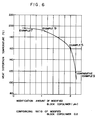
- Fig. 6 is a graph showing the relationship between the modification amount of modified block copolymer and heat distortion temperature for a hydrogenated block copolymer-type composition wherein the compounding ratio of modified block copolymer is 0.2.
- Fig. 7 is a graph showing the relationship between the compounding ratio of modified block copolymer and Izod impact strength for a hydrogenated block copolymer-type composition wherein the modification amount of modified block copolymer is 0.2 phr and 1.1 phr.
- Fig. 8 is a graph showing the relationship between the compounding ratio of modified block copolymer and heat distortion temperature for a hydrogenated block copolymer-type composition wherein the modification amount of modified block copolymer is 0.2 phr.
- Fig. 9 is a graph showing the relationship between the compounding ratio of modified block copolymer and weld zone strength for a composition comprising polyamide, ethylene-containing polymer and modified block copolymer (hereinafter referred to as ethylene-containing polymer-type composition).
- Fig. 10 is a graph showing the relationship between the modification amount of modified block copolymer and Izod impact strength for an ethylene-containing polymer-type composition wherein the compounding ratio of modified block copolymer is 0.25.
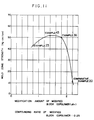
- Fig. 11 is a graph showing the relationship between the modification amount of modified block copolymer and weld zone strength for an ethylene-containing polymer-type composition wherein the compounding ratio of modified block copolymer is 0.25.
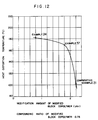
- Fig. 12 is a graph showing the relationship between the modification amount of modified block copolymer and heat distortion temperature for an ethylene-containing polymer-type composition wherein the compounding ratio of modified block copolymer is 0.75.
- Fig. 13 is a graph showing the relationship between the modification amount of modified block copolymer and weld zone strength for an ethylene-containing polymer-type composition wherein the compounding ratio of modified block copolymer is 0.25.
- Fig. 14 is a transmission electron microphotograph showing the state of dispersion of a test piece injection-molded from the composition of Example 46.
- the polyamide used in this invention include aliphatic polyamide such as nylon 46, nylon 6, nylon 66, nylon 610, nylon 11 and nylon 12, aromatic polyamide containing an aromatic component such as terephthalic acid and isophthalic acid, for example hexamethylene terephthalamide, tetramethylene isophthalamide and hexamethylene isophthalamide, and copolyamide and mixed polyamide which consist principally of these components.
- nylon 6 and nylon 66 may be mentioned.
- the hydrogenated block copolymer comprising a vinyl aromatic polymer block A and an olefin polymer block B used in this invention are obtained by selective hydrogenation of the conjugated diene portion of a block copolymer comprising a vinyl aromatic polymer block and a conjugated diene polymer block.
- the above-mentioned block copolymer comprising a vinyl aromatic polymer block and a conjugated diene polymer block is a block copolymer comprising vinyl aromatic polymer blocks (X) and (X') and a conjugated diene polymer block (Y) (X and X' may be the same or different).
- linear block copolymers represented by the formulas (X-Y) n , X-Y-X', and (wherein n is an integer of 1 to 10) and radial block copolymers represented by the formulas (wherein m is an integer of 1 to 4, and Z is the residue of a coupling agent such as silicon tetrachloride and tin tetrachloride or the residue of an initiator such as polyfunctional organic lithium compounds).
- Typical examples of vinyl aromatic compounds which can be used here include styrene, ⁇ -methylstyrene, vinylxylene, ethylvinylxylene, vinylnaphthalene and the mixtures thereof.
- Examples of conjugated diene compounds include butadiene, isoprene, 1,3-pentadiene, 2,3-dimethylbutadiene, and the mixtures thereof.
- the terminal blocks of these block copolymers may be either the same or different.
- the number average molecular weight of these block copolymers is 10,000 to 800,000, preferably 20,000 to 500,000.
- the content of vinyl aromatic compounds in the block copolymer is preferably 10 to 70% by weight, more preferably 10 to 55% by weight.
- the hydrogenated block copolymer to be used in this invention is obtained by selective hydrogenation of the conjugated diene portion of above-mentioned block copolymer.
- a hydrogenated block copolymer wherein not more than 20% of the aromatic double bonds of said vinyl aromatic block thereof and at least 80% of the aliphatic double bonds of said conjugated diene polymer block thereof are hydrogenated can be prepared by hydrogenating the above-mentioned block copolymer according to the method described in Japanese Patent Application Kokoku (Post-Exam. Publn.) No. 8704/67.
- the degree of unsaturation of "block B" referred to in this invention means the proportion of carbon-carbon double bonds contained in said block B, and is usually in the range not exceeding 20%. It can be determined by means of instrumental analysis such as nuclear magnetic resonauce spectrometry (NMR) and infrared absorption spectrometry (IR), and chemical analysis such as iodometric titration.
- instrumental analysis such as nuclear magnetic resonauce spectrometry (NMR) and infrared absorption spectrometry (IR), and chemical analysis such as iodometric titration.
- These hydrogenated block copolymers may be used not only singly but also as a mixture of two or more thereof.
- the ethylene-containing polymer used in this invention includes a copolymer of ethylene with an ⁇ -olefin other than ethylene and has a degree of crystallinity in the range of usually not more than 40%, preferably not more than 30%.
- the ethylene-containing polymer of the present invention includes ethylene polymer, copolymer of ethylene with a copolymerizable monomer other than ethylene, or a mixture thereof, and has a glass transition temperature in the range of usually not higher than -10°C, preferably not higher than -20°C.
- ⁇ -olefins such as propylene, 1-butene, 1-pentene, 4-methyl-1-pentene, 1-hexene, 1-octene, 1-decene, and 1-dodecene
- vinyl esters such as vinyl acetate and vinyl propionate
- acrylic esters such as methyl acrylate, ethyl acrylate, propyl acrylate, and butyl acrylate
- methacrylic esters such as methyl methacrylate, ethyl methacrylate, propyl methacrylate, and butyl methacrylate
- unconjugated dienes such as 1,4-hexadiene, 1,5-hexadiene, dicylcopentadiene, 5-ethylidene-2-norbornene, and 5-vinyl-2-norbornene
- conjugated dienes such as butylene, 1-butene, 1-pentene, 4-methyl-1-pentene, 1-hexene,
- the ethylene-containing polymer has a melt flow index in the range of preferably 0.01 to 100 g/10 min, more preferably 0.1 to 50 g/10 min.
- a preferred example of the ethylene-containing polymer is ethylene- ⁇ -olefin copolymer. It has a degree of crystallinity of usually not more than 40%, preferably not more than 30%.
- the ethylene- ⁇ -olefin copolymer favorably used in this invention are obtained by copolymerizing ethylene and ⁇ -olefin by use of, for example, Ziegler-Natta catalyst, particularly a vanadium compound such as vanadium oxytrichloride and vanadium tetrachloride together with an organic aluminum compound.
- Ziegler-Natta catalyst particularly a vanadium compound such as vanadium oxytrichloride and vanadium tetrachloride together with an organic aluminum compound.
- ethylene- ⁇ -olefin copolymer As particularly preferable ethylene- ⁇ -olefin copolymer, mention may be made of a series of polymers marketed under the trade mark Toughmer® by Mitsui Petrochemical Industries, Ltd., for example Toughmer® A series (ethylene-butene-1 copolymer) including Toughmer® A 4085, Toughmer® A 4090, and Toughmer® A 20090; and Toughmer® P series (ethylene-propylene copolymer) including Toughmer® P 0180, Toughmer® P 0280, Toughmer® P 0480, Toughmer® P 0680, and Toughmer® P 0880.
- Toughmer® A series ethylene-butene-1 copolymer
- Toughmer® P series ethylene-propylene copolymer
- the modified block copolymer to be used in this invention may be obtained by addition of an unsaturated carboxylic acid or a derivative thereof to said hydrogenated block copolymer.
- unsaturated carboxylic acid or the derivative thereof to be added to hydrogenated block copolymer include maleic acid, maleic anhydride, fumaric acid, itaconic acid, acrylic acid, crotonic acid, cis-4-cyclohexene-1,2-dicarboxylic acid and its anhydride, endo-cis-bicyclo[2,2,1]-5-heptene-2,3-dicarboxylic acid and its anhydride, and maleimide.
- Maleic anhydride is particularly preferable of these.
- modified block copolymer may be obtained, for example, by addition of an unsaturated carboxylic acid or a derivative thereof to hydrogenated block copolymer, in a solution state or a molten state with or without the use of a radical initiator.
- a radical initiator for example, those methods are not preferable which will give modified block copolymers that contain undesirable components such as gels or that show an extremely increased melt viscosity and hence a poor processability.
- a preferred method comprises allowing the hydrogenated block copolymer to react with an unsaturated carboxylic acid or a derivative thereof in an extruder in the presence of a radical initiator.
- the modification amount of modified block copolymer must be 0.1 to 2 parts by weight, preferably 0.15 to 1.8 parts by weight, per 100 parts by weight of the hydrogenated block copolymer before modification.
- the unsaturated carboxylic acid or its derivative may be used not only singly but also as a mixture of two or more thereof.
- the amount of polyamide of the principal component must be in the range of 60 to 90% by weight based on the total amount of the composition.
- the amount of polyamide is less than 60% by weight, the flexural modulus and the heat resistance are extremely low; whereas when it exceeds 90% by weight, the impact strength becomes unsatisfactory.
- the amount of at least one polymer selected from the group consisting of hydrogenated block polymer and ethylene-containing polymer and that of the modified block copolymer must be in the range of 2 to 36 percent by weight.
- the amount of said at least one polymer is less than 2 percent by weight the weld zone strength is decreased and the moldability and appearance of molded articles are also deteriorated and when that of the modified copolymer is less than 2 percent by weight, the impact strength is unsatisfactory: whereas when any of both components exceeds 36 percent by weight, the flexural modulus and heat resistance are decreased.
- the compounding ratio y of modified block copolymer must be in the range of 0.1 to 0.9. When the compounding ratio is less than 0.1, the impact resistance is decreased; whereas when it exceeds 0.9, the heat resistance and weld zone strength are decreased and moldability and the appearance of molded articles are deteriorated. More preferable compounding ratio is 0.15 to 0.85.
- the modification amount of modified block copolymer, x, and the compounding ratio, y must be within a range satisfying the expression y ⁇ -x + 0.5 .
- x and y are in the range of y ⁇ -x + 0.5 , the impact strength is markedly low.
- Preferable range is indicated by the expression y ⁇ -x + 0.6 .
- the resin composition of this invention can be prepared by use of conventional apparatuses employed for blending high molecular substances.
- Preferable blending apparatuses are those in which blending can be effected so as to attain a particle size of the dispersed phase of 3 ⁇ m or less and include, for example, a extruder, Banbury mixer, and kneader.
- Melt-blending can be conducted either by melt-blending all the components simultaneously or by melt-blending two components beforehand. It is sometimes advantageous from the viewpoint of the property of product to melt-blend the components other than polyamide beforehand and then melt-blend the resulting mixture with polyamide.
- ingredients may be incorporated into the resin composition of this invention so far as the incorporation is not detrimental to the moldability and properties of the product.
- ingredients include, for example, pigments, dyes, reinforcements, fillers, thermal stabilizers, antioxidants, weather-proofing agents, nucleating agents, lubricants, plasticizers, antistatic agents, and other polymers.
- the resin composition of this invention can be processed by conventional methods used for molding thermoplastic resins, for example injection molding, extrusion molding, blow molding and vacuum forming. Particularly useful are various molded articles obtained by injection molding.
- test methods used in evaluation in Examples and Comparative Examples are as follows.
- Izod impact strength was determined according to ASTM D-256 with a notched test piece of 3.175 mm (1/8 inch) thickness.
- the molded article When the gloss is 50% or less, the molded article has a poor appearance and low marketability.
- a molded article as shown in Figs. 2 and 3 was prepared, and a test piece of 3.175 mm (1/8 inch) thickness was cut out of the portion shown in the Figures according to ASTM D-256. The test piece was notched along the weld line and tested for its Izod impact strength.
- Injection test was conducted by use of a injection molding machine and a mold specified below, the cylinder temperature and injection speed being each set at a fixed level and injection pressure alone being varied. Moldability was evaluated from the injection pressure necessary for the resin to fill the mold completely (said pressure being hereinafter referred to as Short Shot Point (S.S.P.)).
- S.S.P. Short Shot Point
- Short Shot Point is 45 kg/cm2G or more
- the composition has a poor moldability and hence give products of low marketability.
- test conditions are as follows: Injection molding machine: Toshiba-IS-90B Mold employed: a mold capable of giving a molded article shown in Figs. 2 and 3. Pellet drying conditions: vacuum drying overnight at 80°C, Cylinder temperature: setting Nozzle Top Center Rear 280°C 280°C 270°C 260°C Injection speed setting: 70 mm/sec Cycle time: injection time 20 sec, cooling time 20 sec, mold opening time 5 sec.
- a styrene-butadiene block copolymer of SBS-type having a styrene content of 30%, vinyl content of butadiene portion of 38% and number average molecular weight of 50,000 was obtained by anionic block copolymerization of butadiene and styrene using n-butyllithium as catalyst, n-hexane or cyclohexane as solvent and tetrahydrofuran as vinyl content modifier.
- the vinyl content of diene portion was determined by the Hampton method.
- the block copolymer obtained above was then hydrogenated in a solvent mixture of n-hexane and cyclohexane by use of cobalt naphthenate and triethylaluminum as catalyst at a hydrogen pressure of 7 kg/cm2 and a temperature of 50°C for 5 hours.
- a selectively hydrogenated block copolymer (A) was thus prepared, in which about 90% of the double bonds in the butadiene block portion were hydrogenated and the benzene rings in the styrene block portion remained virtually not hydrogenated.
- the metals of catalyst residue were removed by washing with aqueous hydrochloric acid-methanol.
- One hundred parts by weight of the hydrogenated block copolymer (A) prepared in Reference Example 1 was uniformly mixed with 1.2 parts by weight of maleic anhydride and 0.3 parts by weight of Perhexa 2.5B (mfd. by Nippon Oil & Fats Co., Ltd.). The mixture was supplied to a twin screw extruder (screw diameter: 45 mm, L/D: 33, equipped with a vent) to conduct the maleic anhydride addition at a cylinder temperature of 260°C while unreacted maleic anhydride being removed by suction through a vent hole. The modified block copolymer (A) thus obtained was dried by heating it under reduced pressure and then analyzed. The addition amount of maleic anhydride was found to be 0.6 phr. The addition amount of maleic anhydride was determined by titration with sodium methylate.
- the resin composition thus obtained was injection-molded to obtain test pieces for determination of physical properties.
- the composition showed excellent properties of an Izod impact strength of 120 kg ⁇ cm/cm, weld zone strength of 52 kg ⁇ cm/cm, flexural modulus of 17,900 kg/cm2, tensile strength of 510 kg/cm2, tensile elongation of 75%, and heat distortion temperature of 196°C.
- the appearance of molded articles were also good, the gloss being 65%, and the moldability was also good.
- a resin composition was obtained and its physical properties were determined in the same manner as in Example 1 except that the amounts of compounded polyamide and modified copolymer, used in Example 1, were altered to 85 and 5 parts by weight, respectively. It showed excellent properties of an Izod impact strength of 58 kg ⁇ cm/cm, weld zone strength of 25 kg ⁇ cm/cm, flexural modulus of 21,500 kg/cm2, and heat distortion temperature of 212°C. The appearance of molded articles was also good, the gloss being 83%, and the moldability was also excellent.
- a resin composition was prepared and its physical properties were determined in the same manner as in Example 1 except that the amounts of compounded polyamide, hydrogenated block copolymer and modified block copolymer, used in Example 1, were altered to 65, 27 and 8 parts by weight, respectively. It showed good properties of an Izod impact strength of 122 kg ⁇ cm/cm, weld zone strength of 61 kg ⁇ cm/cm, flexural modulus of 15,400 kg/cm2, and heat distortion temperature of 151°C. The appearance of molded articles was also good, the gloss being 62%, and the moldability was also excellent.
- a resin composition was prepared and its physical properties were determined by using the polyamide, hydrogenated block copolymer (A) and modified block copolymer (G), employed in Example 4, in the same manner as in Example 4 except that the amounts of compounded hydrogenated block copolymer and modified block copolymer were altered to 3 and 17 parts by weight, respectively. It showed good properties of an Izod impact strength of 105 kg ⁇ cm/cm, weld zone strength of 40 kg ⁇ cm/cm, flexural modulus of 19,200 kg/cm2, tensile strength of 565 kg/cm2, tensile elongation of 70%, and heat distortion temperature of 192°C. The appearance of molded articles was good, the gloss being 70%, and the moldability was also excellent.
- a resin composition was prepared and its physical properties were determined by using the polyamide, hydrogenated block copolymer and modified block copolymer, each employed in Example 4, in the same manner as in Example 4 except that the amounts of compounded hydrogenated block copolymer and modified block copolymer were altered to 3 and 17 parts by weight, respectively. It showed good properties of an Izod impact strength of 81 kg ⁇ cm/cm, weld zone strength of 28 kg ⁇ cm/cm, flexural modulus of 20,100 kg/cm2, tensile strength of 540 kg/cm2, tensile elongation of 50%, and heat distortion temperature of 210°C. The appearance of molded articles was also good, the gloss being 82%, and the moldability was also excellent.
- a resin composition was prepared by kneading 65 parts by weight of polyamide, 8 parts by weight of hydrogenated block copolymer and 27 parts by weight of modified block copolymer in the same manner as in Example 4, and its physical properties were determined. It showed good properties of an Izod impact strength of 125 kg ⁇ cm/cm, weld zone strength of 55 kg ⁇ cm/cm, flexural modulus of 15,200 kg/cm2 and heat distortion temperature of 150°C. The appearance of molded articles was also good, the gloss being 58%, and the moldability was also excellent.
- Example 1 A mixture of 75 parts by weight of the polyamide used in Example 1 and 25 parts by weight of the modified block copolymer (A) used in Example 1 was kneaded in the same manner as in Example 4, and the properties of the resulting composition were determined. It showed a low heat distortion temperature of 102°C. The appearance of molded articles was also poor, the gloss being 46%, and the moldability was also poor.
- Example 1 A mixture of 75 parts by weight of the polyamide used in Example 1 and 25 parts by weight of the hydrogenated block copolymer (A) used in Example 1 was kneaded in the same manner as in Example 4, and the properties of the resulting composition were determined. It showed a low Izod impact strength of 8 kg ⁇ cm/cm and also low weld zone strength of 4 kg ⁇ cm/cm. The appearance of molded articles was also poor, the gloss being 35%.
- Example 4 A mixture of 55 parts by weight of the polyamide used in Example 1, 20 parts by weight of the hydrogenated block copolymer (B) and 25 parts by weight of the modified block copolymer (G), each used in Example 4, was kneaded in the same manner as in Example 1, and the properties of the resulting composition were determined. Its flexural modulus of 11,000 kg/cm2 and heat distortion temperature of 75°C were both unsatisfactory. The appearance of molded articles was poor, the gloss being 40%.
- Example 2 A mixture of 92 parts by weight of the polyamide used in Example 1, and 4 parts by weight of the hydrogenated block copolymer (B) and 4 parts by weight of the modified block copolymer (G) each used in Example 4, was kneaded in the same manner as in Example 1 to determine the properties of the resulting composition. It showed a poor Izod impact strength of 14 kg ⁇ cm/cm.
- Example 1 A mixture of 55 parts by weight of the polyamide, 37 parts by weight of the hydrogenated block copolymer (A) and 8 parts by weight of the modified block copolymer (A) each used in Example 1, was kneaded in the same manner as in Example 1 to determine the properties of the resulting composition. It showed unsatisfactory flexural modulus of 11,500 kg/cm2 and heat distortion temperature of 85°C. The appearance of molded articles was also poor, the gloss being 36%.
- Styrene was polymerized in toluene solvent by use of n-butyllithium as polymerization catalyst, and then a toluene solution containing 1,3-butadiene was further added thereto. After 99% or more of the added 1,3-butadiene had been polymerized, with no deactivation being affected, silicon tetrachloride was added to the polymerization mixture to conduct coupling reaction.
- the polymer obtained was a block polymer principally of (polystyrene)-(polybutadiene)4-Silicon type, and had a melt flow index (G conditions) of 8 g/10 min and a styrene content of 30% by weight.
- the radial teleblock copolymer obtained above was then hydrogenated in the same manner as in Reference Example 1 to prepare a radial teleblock-type hydrogenated block copolymer selectively hydrogenated in its butadiene portion.
- a radial teleblock-type modified block copolymer was prepared in the same manner as in Reference Example 1 but by use of the radial teleblock-type hydrogenated block copolymer prepared in (1) above.
- the addition amount of maleic anhydride was 0.6 phr.
- a composition was prepared in the same manner as in Example 4 but by use of 80 parts by weight of the polyamide used in Example 1, 10 parts by weight of the hydrogenated block copolymer prepared in (1) above and 10 parts by weight of the modified block copolymer prepared in (2) above, to determine the properties of the resulting composition. It showed good properties of an Izod strength of 95 kg ⁇ cm/cm, flexural modulus of 19,500 kg/cm2, tensile strength of 535 kg/cm2, tensile elongation of 70%, and heat distortion temperature of 206°C. The appearance of molded articles was excellent, the gloss being 82%.
- a mixture of 8.3 kg of terephthalic acid and 8.3 kg of isophthalic acid, and 30 l of an aqueous solution containing 11.6 kg of hexamethylene diamine were placed in a 100 l autoclave.
- the resulting mixture was gradually brought to elevated temperature with stirring to reach 140°C in 2 hours.
- it was heated up to 240°C while being maintained under a reduced pressure of 6.7-13.3 kPa (50 to 100 mm Hg), and condensation was conducted for 3 hours. It was then further heated up to 270°C.
- nitrogen gas pressure was applied to the autoclave to extrude a polymer in the form of a strand.
- the polymer was cooled with water and then cut to obtain pellet-formed polymer.
- the polyphthaloyl adipamide thus formed had a ⁇ r of 2.3 as determined in sulfuric acid (96% H2SO4, 1% solution, 20°C).
- a resin composition was obtained in the same manner as in Example 1 but by use of 80 parts by weight of the aromatic nylon prepared in (1) above, 10 parts by weight of the hydrogenated block copolymer (A) and 10 parts by weight of the modified block copolymer (A), each used in Example 1, to determine the properties of the composition. It showed good properties of an Izod impact strength of 72 kg ⁇ cm/cm, flexural modulus of 23,500 kg/cm2, tensile strength of 720 kg/cm2, tensile elongation of 70%, and heat distortion temperature of 125°C. The appearance of molded articles was also excellent, the gloss being 70%.
- a mixture of 10 parts by weight of the modified block copolymer (A) and 10 parts by weight of the hydrogenated block copolymer (A), each used in Example 1, and 80 parts of nylon 6 (number average molecular weight: 20,000) was kneaded in the same manner as in Example 4 to obtain a resin composition, and its physical properties were determined. It showed good properties of an Izod impact strength of 95 kg ⁇ cm/cm, weld zone strength of 55 kg ⁇ cm/cm, flexural modulus of 18,000 kg/cm2, and heat distortion temperature of 150°C. The appearance of molded articles was also excellent, the gloss being 70%.
- a resin composition was prepared in the same manner as in Example 4 but by use of 80 parts by weight of the polyamide and 8 parts by weight of the hydrogenated block copolymer (A), each used in Example 1, and 12 parts by weight of the modified block copolymer (B) prepared in Reference Example 2, and its physical properties were determined. It showed good balance between properties, namely an Izod impact strength of 65 kg ⁇ cm/cm, weld zone strength of 30 kg ⁇ cm/cm, flexural modulus of 19,500 kg/cm2, heat distortion temperature of 191°C, and gloss of 90%, and showed also a good moldability.
- a resin composition was prepared in the same manner as in Example 1 but by use of 85 parts by weight of the polyamide and 6 parts by weight of the hydrogenated block copolymer (A), each used in Example 1, and 9 parts by weight of the modified block copolymer (E) prepared in Reference Example 2, and its physical properties were determined. It showed excellent balance between properties, namely an Izod impact strength of 78 kg ⁇ cm/cm, weld zone strength of 32 kg ⁇ cm/cm, flexural modulus of 21,000 kg/cm2, heat distortion temperature of 181°C and the appearance of molded articles as expressed by gloss of 72%, and showed also a good moldability.
- a resin composition was prepared in the same manner as in Example 13 except that 3 parts by weight of the above-mentioned hydrogenated block copolymer (A) and 12 parts by weight of the modified block copolymer (E) prepared in Reference Example 2 were used, and its physical properties were determined. It showed excellent properties of an Izod impact strength of 75 kg ⁇ cm/cm, weld zone strength of 45 kg ⁇ cm/cm, flexural modulus of 21,000 kg/cm2, heat distortion temperature of 184°C, and the appearance of molded articles as expressed by gloss of 81%, and showed also a good moldability.
- a resin composition was prepared in the same manner as in Example 1 but by use of 75 parts by weight of the polyamide and 20 parts by weight of the hydrogenated block copolymer (A), each used in Example 1, and 5 parts by weight of the above-mentioned modified block copolymer (E), and its physical properties were determined. It showed excellent balance between properties, namely an Izod impact strength of 105 kg ⁇ cm/cm, weld zone strength of 52 kg ⁇ cm/cm, flexural modulus of 18,000 kg/cm2, heat distortion temperature of 161°C, and the appearance of molded articles as expressed by gloss of 72%, and showed also a good moldability.
- a resin composition was prepared in the same manner as in Example 1 but by use of 75 parts by weight of the polyamide and 5 parts by weight of the hydrogenated block copolymer (A), each used in Example 1, and 20 parts by weight of the modified block copolymer (C) prepared in Reference Example 2, and its physical properties were determined. It showed excellent balance between properties, namely an Izod impact strength of 70 kg ⁇ cm/cm, weld zone strength of 35 kg ⁇ cm/cm, flexural modulus of 18,000 kg/cm2, heat distortion temperature of 188°C, and the appearance of molded articles as expressed by gloss of 88%, and showed also a good moldability.
- a resin composition was prepared in the same manner as in Example 16 except that 20 parts by weight of the above-mentioned hydrogenated block copolymer (A), and 5 parts by weight of the modified block copolymer (D) prepared in Reference Example 2 were used, and its physical properties were determined. It showed excellent balance between properties, namely an Izod impact strength of 62 kg ⁇ cm/cm, weld zone strength of 42 kg ⁇ cm/cm, flexural modulus of 18,500 kg/cm2, heat distortion temperature of 196°C, and the appearance of molded articles as expressed by gloss of 77%, and showed also a good moldability.
- a resin composition was prepared in the same manner as in Example 16 except that the amount of the above-mentioned hydrogenated block copolymer (A) and that of the above-mentioned block copolymer (C) were altered to 15 and 10 parts by weight respectively, and its physical properties were determined. It showed excellent balance between properties, namely an Izod impact strength of 58 kg ⁇ cm/cm, weld zone strength of 35 kg ⁇ cm/cm, flexural modulus of 18,500 kg/cm2, heat distortion temperature of 203°C, and the appearance of molded articles (gloss) of 85%, and also a good moldability.
- a resin composition was prepared in the same manner as in Example 16 except that the 20 parts by weight of the above-mentioned hydrogenated block copolymer (A) and 5 parts by weight of the above-mentioned modified block copolymer (C) were used, and its physical properties were determined. It showed excellent properties of an Izod impact strength of 101 kg ⁇ cm/cm, weld zone strength of 32 kg ⁇ cm/cm, flexural modulus of 17,500 kg/cm2, heat distortion temperature of 191°C, and the appearance of molded articles as expressed by gloss of 78%, and showed also a good moldability.
- a resin composition was prepared in the same manner as in Example 13 except that 3 parts by weight of the above-mentioned hydrogenated block copolymer (A) and 12 parts by weight of the above-mentioned modified block copolymer (B) were used, and its physical properties were determined. It showed excellent properties of an Izod impact strength of 72 kg ⁇ cm/cm, weld zone strength of 46 kg ⁇ cm/cm, flexural modulus of 21,500 kg/cm2, heat distortion temperature of 189°C, and the appearance of molded articles as expressed by gloss of 65%, and showed also a good moldability.
- a resin composition was obtained in the same manner as in Example 14 except that the amount of the modified block copolymer (F) prepared in Reference Example 2 was altered to 12 parts by weight, and its physical properties were determined.
- a resin composition was prepared in the same manner as in Example 13 except that 9 parts by weight of the above-mentioned modified block copolymer (F) was used, and its physical properties were determined.
- a resin composition was prepared in the same manner as in Example 14 except that the hydrogenated block copolymer was not used and 15 parts by weight of the modified block copolymer (E) was used, and its physical properties were determined.
- a resin composition was prepared in the same manner as in Example 15 except that 20 parts by weight of the hydrogenated block copolymer (A) and 5 parts by weight of the above-mentioned modified block copolymer (F) was used, and its physical properties were determined.
- a resin composition was prepared in the same manner as in Example 4 except that 19 parts by weight of the hydrogenated block copolymer (B) and 1 part by weight of the above-mentioned modified block copolymer (G) were used. Determination of its physical properties showed a low Izod impact strength of 18 kg ⁇ cm/cm.
- a resin composition was prepared in the same manner as in Example 16 except that the amount of the hydrogenated block copolymer (A) and that of the modified block copolymer (C) were altered to 20 and 5 parts by weight respectively, and its physical properties were determined. It showed a good flexural modulus, thermal resistance etc., but a low Izod impact strength of 25 kg ⁇ cm/cm.
- a resin composition was prepared in the same manner as in Example 16 except that no hydrogenated block copolymers and 25 parts by weight of the modified block copolymer (C) were used, and its physical properties were determined. It showed a low heat distortion temperature of 130°C.
- a resin composition was obtained in the same manner as in Example 21 except that the compounding amounts of the polyamide, modified block copolymer and ethylene-containing polymer, each used in Example 21, were altered to 70 parts by weight, 15 parts by weight and 15 parts by weight, respectively, and its physical properties were determined. It showed good properties of an Izod impact strength of 106 kg ⁇ cm/cm, weld zone strength of 58 kg ⁇ cm/cm, flexural modulus of 15,700 kg/cm2, tensile strength of 460 kg/cm2, tensile enlongation of 85%, and heat distortion temperature of 160°C, and showed also a good appearance of molded articles.
- the polyamide, modified block copolymer and ethylene-containing polymer, each employed in Example 21, were used to obtain a resin composition in the same manner as in Example 21 except that the compounding amounts of the modified block copolymer and ethylene-containing polymer were altered to 5 and 15 parts by weight, respectively.
- Determination of its physical properties showed excellent properties of an Izod impact strength of 90 kg ⁇ cm/cm, weld zone strength of 45 kg ⁇ cm/cm, flexural modulus of 21,300 kg/cm2, tensile strength of 540 kg/cm2, tensile elongation of 50%, and heat distortion temperature of 201°C, and showed also a good appearance of molded articles.
- the polyamide, modified block copolymer and ethylene-containing polymer, each employed in Example 21, were used to obtain a resin Composition in the same manner as in Example 21 except that the compounding amounts of the modified block copolymer and ethylene-containing polymer were altered to 15 and 5 parts by weight, respectively.
- Determination of its physical properties showed excellent properties of an Izod impact strength of 103 kg ⁇ cm/cm, weld zone strength of 46 kg ⁇ cm/cm, flexural modulus of 20,100 kg/cm2, tensile strength of 510 kg/cm2, tensile elongation of 70%, and heat distortion temperature of 182°C, and showed also a good appearance of molded articles.
- a resin composition was obtained in the same manner as in Example 21 except that the compounding amounts of the polyamide, modified block copolymer and ethylene-containing polymer, each employed in Example 21, were altered to 85, 10 and 5 parts by weight, respectively.
- the determination of its physical properties showed excellent properties of an Izod impact strength of 62 kg ⁇ cm/cm, weld zone strength of 35 kg ⁇ cm/cm, flexural modulus of 23,000 kg/cm2, and heat distortion temperature of 212°C, and showed also a good appearance of molded articles.
- the composition showed excellent properties of an Izod impact strength of 101 kg ⁇ cm/cm, weld zone strength of 65 kg ⁇ cm/cm, flexural modulus of 17,000 kg/cm2 and heat distortion temperature of 150°C, and showed also a good appearance of molded articles.
- Example 26 Ten parts by weight of the modified block copolymer used in Example 26, 25 parts by weight of the ethylene-containing polymer used in Example 26, and 65 parts by weight of the polyamide used in Example 21 were blended and kneaded in the same manner as in Example 26 to obtain a resin composition, and its physical properties were determined. It showed excellent properties of an Izod impact strength of 125 kg ⁇ cm/cm, weld zone strength of 75 kg ⁇ cm/cm, flexural modulus of 15,000 kg/cm2 and heat distortion temperature of 155°C, and showed also a good appearance of molded articles.
- Example 26 Twenty-five parts by weight of the modified block copolymer used in Example 26, 10 parts by weight of the ethylene-containing polymer used in Example 26 and 65 parts by weight of the polyamide used in Example 21 were blended and kneaded in the same manner as in Example 26 to obtain a resin composition, and its physical properties were determined. It showed excellent properties of an Izod impact strength of 125 kg ⁇ cm/cm, weld zone strength of 50 kg ⁇ cm/cm, flexural modulus of 14,500 kg/cm2 and heat distortion temperature of 150°C, and showed also a good appearance of molded articles.
- Example 26 Three parts by weight of the modified block copolymer used in Example 26, 27 parts by weight of the ethylene-containing polymer used in Example 26, and 70 parts by weight of the polyamide used in Example 21 were mixed and kneaded in the same manner as in Example 26 to obtain a resin composition, and its physical properties were determined. It showed excellent properties of an Izod impact strength of 60 kg ⁇ cm/cm, weld zone strength of 21 kg ⁇ cm/cm, flexural modulus of 16,000 kg/cm2, and heat distortion temperature of 180°C, and showed also a good appearance of molded articles.
- Example 26 Ten parts by weight of the modified block copolymer used in Example 26, 10 parts by weight of an ethylene-propylene-dicyclopentadiene copolymer (EPTX-75, a trade name, mfd. by Mitsui Petrochemical Industries, Ltd., melt flow index: 5 g/10 min) as an ethylene-containing polymer, and 80 parts by weight of the polyamide used in Example 21 were mixed and kneaded in the same manner as in Example 26 to obtain a resin composition, and its physical properties were determined.
- EPTX-75 ethylene-propylene-dicyclopentadiene copolymer
- Example 26 Eight parts by weight of the modified block copolymer used in Example 26, 6 parts by weight each of the ethylene-containing polymer used in Example 21 and an ethylene-vinyl acetate copolymer (Evaflex P1407, a trade name, mfd. by Du Pont-Mitsui Polychemical Co., Ltd., melt flow index: 15 g/10 min, vinyl acetate content: 14%) each as an ethylene-containing polymer, and 80 parts by weight of the polyamide used in Example 21 were mixed and kneaded in the same manner as in Example 26 to obtain a resin composition, and its physical properties were determined.
- Evaflex P1407 a trade name, mfd. by Du Pont-Mitsui Polychemical Co., Ltd., melt flow index: 15 g/10 min, vinyl acetate content: 146%
- Example 26 Five parts by weight of the modified block copolymer used in Example 26, 12 parts by weight of the ethylene-containing polymer used in Example 21 and 3 parts by weight of a polyethylene (density: 0.93, softening point: 105°C, viscosity average molecular weight: 8,000) each as an ethylene-containing polymer, and 80 parts by weight of the polyamide used in Example 21 were mixed and kneaded in the same manner as in Example 26 to obtain a resin composition, and its physical properties were determined.
- a polyethylene density: 0.93, softening point: 105°C, viscosity average molecular weight: 8,000
- Example 26 Ten parts by weight of the modified block copolymer used in Example 26, 10 parts by weight of an ethylene-butene copolymer (Toughmer® A-20090, a trade name, mfd. by Mitsui Petrochemical Industries, Ltd., melt flow index: 18 g/min) and 5 parts by weight of an ethyleneethyl acrylate copolymer (DPDJ-6169, a trade name, mfd.
- Toughmer® A-20090 a trade name, mfd. by Mitsui Petrochemical Industries, Ltd., melt flow index: 18 g/min
- DPDJ-6169 ethyleneethyl acrylate copolymer
- Example 21 ethyl acrylate content: 18%, melt flow index: 6 g/10 min) each as an ethylene-containing polymer, and 75 parts by weight of the polyamide used in Example 21 were mixed and kneaded in the same manner as in Example 26 to obtain a resin composition, and its physical properties were determined. It showed excellent properties of an Izod impact strength of 115 kg ⁇ cm/cm, weld zone strength of 42 kg ⁇ cm/cm, flexural modulus of 17,000 kg/cm2, and heat distortion temperature of 175°C, and also showed a good appearance of molded articles.
- Example 21 Eighty parts by weight of the polyamide used in Example 21 and 20 parts by weight of the modified block copolymer used in Example 21 were uniformly dry-blended in a blender. The mixture was then molten at 290°C by use of a twin screw extruder to obtain a resin composition in the form of pellets. Test pieces were prepared from the composition by injection molding to determine its physical properties. It showed a low weld zone strength of 8 kg ⁇ cm/cm and also a poor appearance of molded articles, haze being developed.
- Example 21 Eighty parts by weight of the polyamide used in Example 21 and 20 parts by weight of the ethylene-containing polymer used in Example 21 were kneaded and the physical properties of the composition thus obtained were determined in the same manner as in Comparative Example 13. It showed a low Izod impact strength of 8 kg ⁇ cm/cm and weld zone strength of 2 kg ⁇ cm/cm and also a poor appearance of molded articles, haze being developed.
- Example 21 Ninety-two parts by weight of the polyamide used in Example 21, 4 parts by weight of the modified block copolymer used in Example 21 and 4 parts by weight of the ethylene-containing polymer used in Example 21 were kneaded and the physical properties of the resulting composition were determined in the same manner as in Example 21. It showed a poor Izod impact strength of 14 kg ⁇ cm/cm and weld zone strength of 5 kg ⁇ cm/cm.
- Example 21 Fifty-six parts by weight of the polyamide used in Example 21, 11 parts by weight of the modified block copolymer used in Example 21, and 33 parts by weight of the ethylene-containing polymer used in Example 21 were kneaded and the physical properties of the resulting composition were determined in the same manner as in Example 21. It showed unsatisfactory properties of a weld zone strength of 35 kg ⁇ cm/cm, flexural modulus of 11,700 kg/cm2 and heat distortion temperature of 85°C, and also showed a poor appearance of molded articles, haze being developed.
- the physical properties of a resin composition were determined in the same manner as in Example 26 except that the modified block copolymer, ethylene-containing polymer and polyamide, each used in Example 26, were employed in compounding amounts of 50, 5 and 55 parts by weight, respectively.
- the composition showed poor properties of a weld zone strength of 10 kg ⁇ cm/cm and heat distortion temperature of 85°C, and also showed an unsatisfactory appearance of molded articles, the gloss being low.
- Example 21 Eighty parts by weight of the aromatic nylon used in Example 9, 10 parts each by weight of the modified block copolymer (A) used in Example 1, and the ethylene-containing polymer used in Example 21 were employed to obtain a resin composition in the same manner as in Example 21, and its physical properties were determined. It showed good properties of an Izod impact strength of 72 kg ⁇ cm/cm, weld zone strength of 38 kg ⁇ cm/cm, flexural modulus of 24,000 kg/cm2, and heat distortion temperature of 125°C, and also showed a good appearance of molded articles.
- Example 21 Ten parts by weight of the modified block copolymer used in Example 21, 10 parts by weight of the ethylene-containing polymer used in Example 21 and 80 parts by weight of the nylon 46 synthesized in Example 10 were dry-blended in a blender, and then kneaded at 315°C by use of a twin screw extruder to obtain a resin composition in the form of pellets.
- the resin composition obtained was injection-molded to obtain test pieces, and its physical properties were determined. It showed excellent properties of an Izod impact strength of 75 kg ⁇ cm/cm, weld zone strength of 45 kg ⁇ cm/cm, flexural modulus of 21,000 kg/cm2, and heat distortion temperature of 260°C, and also showed a good appearance of molded articles.
- a mixture of 5 parts by weight of the modified block copolymer (I) prepared in Reference Example 2, 80 parts by weight of the polyamide used in Example 21 and 15 parts by weight of the ethylene-containing polymer used in Example 21 were kneaded in the same manner as in Example 21 to obtain a resin composition, and its physical properties were determined. It showed excellent properties of an Izod impact strength of 97 kg ⁇ cm/cm, weld zone strength of 50 kg ⁇ cm/cm, flexural modulus of 20,400 kg/cm2 and heat distortion temperature of 185°C, and also showed a good appearance of molded articles, the gloss being 75%, and good moldability.
- a resin composition was prepared in the same manner as in Example 36 except that the compounding amounts of the modified block copolymer and ethylene-containing polymer, each used in Example 36, were altered to 15 and 5 parts by weight respectively, and its physical properties were determined. It showed excellent properties of an Izod impact strength of 111 kg ⁇ cm/cm, weld zone strength of 40 kg ⁇ cm/cm, flexural modulus of 20,000 kg/cm2, and heat distortion temperature of 170°C, and also showed a high gloss of 56% and good moldability as well as good appearance of molded articles.
- a mixture of 5 parts by weight of the modified block copolymer (J) prepared in Reference Example 2, 15 parts by weight of the ethylene-containing polymer used in Example 21 and 80 parts by weight of the polyamide used in Example 21 were kneaded in the same manner as in Example 21, and the physical properties of the resulting composition were determined. It showed excellent properties of an Izod impact strength of 75 kg ⁇ cm/cm, flexural modulus of 21,000 kg/cm2, weld zone strength of 46 kg ⁇ cm/cm and heat distortion temperature of 200°C, and also showed a high gloss of 90% and good appearance of molded articles as well as good moldability.
- a resin composition was obtained by use of 10 parts by weight of the modified block copolymer (K) prepared in Reference Example 2, 10 parts by weight of the ethylene-containing polymer used in Example 21 and 80 parts by weight of the polyamide used in Example 21 in the same manner as in Example 1, and its physical properties were determined. It showed excellent properties of an Izod impact strength of 63 kg ⁇ cm/cm, weld zone strength of 43 kg ⁇ cm/cm, flexural modulus of 21,500 kg/cm2 and heat distortion temperature of 208°C, and also showed a high gloss of 86% and good moldability as well as good appearance of molded articles.
- a resin composition was obtained by use of the polyamide, modified block copolymer and ethylene-containing polymer, each used in Example 39, in the same manner as in Example 39 except that the compounding amounts of the modified block copolymer and ethylene-containing polymer were altered to 15 and 5 parts by weight respectively, and its physical properties were determined. It showed excellent properties of an Izod impact strength of 70 kg ⁇ cm/cm, weld zone strength of 40 kg ⁇ cm/cm, flexural modulus of 21,100 kg/cm2, and heat distortion temperature of 203°C, and also showed a high gloss of 80% and good moldability as well as good appearance of molded articles.
- Example 21 A mixture of 20 parts by weight of the modified block copolymer used in Example 36 and 80 parts by weight of the polyamide used in Example 21 was kneaded in the same manner as in Example 1, and the physical properties of the resulting composition were determined. It showed a low weld zone strength of 10 kg ⁇ cm/cm and also a poor moldability.
- Example 39 A mixture of 80 parts by weight of the polyamide used in Example 39, 5 parts by weight of the modified block copolymer used in Example 39, and 15 parts by weight of the ethylene-containing polymer used in Example 39 were kneaded in the same manner as in Example 39, and the physical properties of the resulting composition were determined. It showed poor properties of an Izod impact strength of 11 kg ⁇ cm/cm and weld zone strength of 9 kg ⁇ cm/cm.
- a resin composition was obtained in the same manner as in Example 39 except that the compounding amounts of the polyamide, modified block copolymer, and ethylene-containing polymer, each used in Example 39, were altered to 75 parts by weight, 12.5 parts by weight and 12.5 parts by weight respectively, and its physical properties were determined. It showed excellent properties of an Izod impact strength of 80 kg ⁇ cm/cm, weld zone strength of 42 kg ⁇ cm/cm, flexural modulus of 18,500 kg/cm2, and heat distortion temperature of 174°C, and also showed a high gloss of 70% and good moldability as well as good appearance of molded articles.
- a resin composition was obtained in the same manner as in Example 39 except that the compounding amounts of the polyamide, modified block copolymer and ethylene-containing polymer, each used in Example 39, were altered to 75, 17.5 and 7.5 parts by weight respectively, and its physical properties were determined. It showed excellent properties of an Izod impact strength of 85 kg ⁇ cm/cm, weld zone strength of 38 kg ⁇ cm/cm, flexural modulus of 18,000 kg/cm2, and heat distortion temperature of 168°C, and also showed a high gloss of 62% and good moldability as well as good appearance of molded articles.
- a mixture of 5 parts by weight of the modified block copolymer (M), 15 parts by weight of the ethylene-containing polymer used in Example 21 and 80 parts by weight of the polyamide used in Example 21 was kneaded in the same manner as in Example 21 to obtain a resin composition, and its physical properties were determined. It showed excellent properties of an Izod impact strength of 93 kg ⁇ cm/cm, weld zone strength of 52 kg ⁇ cm/cm, flexural modulus of 20,700 kg/cm2 and heat distortion temperature of 187°C, and also showed a high gloss of 78% and good moldability as well as good appearance of molded articles.
- a resin composition was obtained in the same manner as in Example 21 but by use of 5 parts by weight of the modified block copolymer (L) prepared in Reference Example 2, 15 parts by weight of the ethylene-containing polymer and 80 parts by weight of the polyamide each used in Example 21, and its physical properties were determined. It showed poor properties of a weld zone strength of 12 kg ⁇ cm/cm and gloss of 47%.
- a resin composition was obtained by use of the polyamide, modified block copolymer and ethylene-containing polymer, each used in Comparative Example 20, in the same manner as in Comparative Example 20 except that the compounding amounts of the modified block copolymer and ethylene-containing polymer were altered to 15 and 5 parts by weight respectively, and its physical properties were determined. It showed poor properties of a weld zone strength of 10 kg ⁇ cm/cm, heat distortion temperature of 102°C, and gloss of 38%.
- Example 39 A mixture of 75 parts by weight of the polyamide used in Example 39 and 25 parts by weight of the modified block polymer used in Example 39 was kneaded in the same manner as in Comparative Example 13, and the physical properties of the resulting composition were determined. It showed a low weld zone strength of 14 kg ⁇ cm/cm and poor gloss of 48%.
- Kraton® G 1652 (a trade mark, mfd. by Shell Chemical Co., Styrene content: 36%) was used as hydrogenated block copolymer.
- To 100 parts by weight of the hydrogenated block copolymer were uniformly mixed 2.5 parts by weight of maleic anhydride and 0.2 part by weight of Perhexa® 2,5B (a trade name, mfd. by Nippon Oil & Fats Co., Ltd.), and the mixture was processed in the same manner as in Reference Example 2 to obtain a modified block copolymer.
- the addition amount of maleic anhydride was 0.8 phr.
- Example 44 A mixture of 40 parts by weight of the modified block copolymer used in Example 44 and 60 parts by weight of the ethylene-propylene copolymer used in Example 21 was melt-kneaded in the same manner as in Example 44 to obtain an elastomer composition.
- Kraton® G (a trade name, mfd. by Shell Chemical Co., styrene content: 14%) was used as hydrogenated block copolymer.
- To 100 parts by weight of the hydrogenated block copolymer were uniformly mixed 1.5 parts by weight of maleic anhydride and 0.5 part by weight of Perbutyl® D (a trade name, mfd. by Nippon Oil & Fats Co., Ltd.), and the mixture was processed in the same manner as in Reference Example 2 to obtain a modified block copolymer.
- the addition amount of maleic anhydride was 0.6 phr.
- a mixture of 50 parts by weight of Kraton® G 1657 as hydrogenated block copolymer and 50 parts by weight of the modified block copolymer obtained in (1) above was melt-kneaded in the same manner as in Example 44 to obtain an elastomer composition. Then, a mixture of 22 parts by weight of the elastomer composition obtained above and 78 parts by weight of the polyamide used in Example 44 was melt-kneaded in the same manner as in Example 44, and the physical properties of the resulting composition were determined.
- dispersed particles was found to be about 0.1 to 2 ⁇ m or slightly more.
- Example 44 A mixture of 50 parts by weight of the modified block copolymer obtained in (1) of Example 46 and 50 parts by weight of the ethylene-propylene polymer used in Example 21 was melt-kneaded in the same manner as in Example 44 to obtain an elastomer composition. Then, 22 parts by weight of the elastomer composition obtained above and 78 parts by weight of the polyamide used in Example 44 was melt-kneaded in the same manner as in Example 44, and the physical properties of the resulting composition were determined.
Landscapes
- Chemical & Material Sciences (AREA)
- Health & Medical Sciences (AREA)
- Chemical Kinetics & Catalysis (AREA)
- Medicinal Chemistry (AREA)
- Polymers & Plastics (AREA)
- Organic Chemistry (AREA)
- Compositions Of Macromolecular Compounds (AREA)
Claims (10)
- Polyamidzusammensetzung, die, bezogen auf die kombinierten Anteile der Komponenten (a), (b) und (c), enthält:(a) 60 bis 90 Gew.-% Polyamid,(b) 2 bis 36 Gew.-% mindestens eines Polymeren, das ausgewählt ist unter(i) einem hydrierten Blockcopolymeren mit einem Zahlenmittel des Molekulargewichts von 10.000 bis 800.000, das einen vinylaromatischen Polymerblock A und einen Olefin-Polymerblock B enthält, wobei das hydrierte Blockcopolymere durch selektive Hydrierung des konjugierten Diene-Teils eines Blockcopolymeren erhalten ist, das einen vinylaromatischen Polymerblock und einen aus konjugiertem Dien gebildeten Polymerblock enthält, wobei der Unsättigungsgrad des Blocks B 20 % nicht überschreitet, und(ii) einem Ethylen enthaltenden Polymeren, und(c) 2 bis 36 Gew.-% eines modifizierten Blockcopolymeren, das durch Binden einer Moleküleinheit, die eine Carbonsäuregruppe oder eine Derivatgruppe dieser enthält, an das hydrierte Blockcopolymere (b) (i) gebildet ist, wobei die Menge der eine Carbonsäuregruppe oder eine Derivatgruppe dieser enthaltenden Moleküleinheit, die an das modifizierte Blockcopolymere (c) gebunden ist, ausgedrückt als x Gewichtsteile pro 100 Gewichtsteile des Blockcopolymeren vor der Modifizierung, und das Mischungsverhältnis des modifizierten Blockcopolymeren (c) zu der Summe des Gewichts des modifizierten Blockcopolymeren (c) und des Gewichts des mindestens eines Polymeren (b), ausgedrückt als y, innerhalb des durch den nachstehenden Ausdruck spezifizierten Bereiches liegen:


- Polyamidzusammensetzung gemäß Anspruch 1, worin der Anteil des Polyamids 65 bis 85 Gew.-% beträgt.
- Polyamidzusammensetzung gemäß Anspruch 1, worin das Polyamid Nylon 6 oder Nylon 66 ist.
- Polyamidzusammensetzung gemäß Anspruch 1, worin der Anteil des mindestens eines Polymeren aus der aus hydriertem Blockcopolymerem und Ethylen enthaltendem Polymeren bestehenden Gruppe 3 bis 30 Gew.-% beträgt.
- Polyamidzusammensetzung gemäß Anspruch 1, worin das Ethylen enthaltende Polymere ein Ethylen-α-Olefin-Copolymeres ist.
- Polyamidzusammensetzung gemäß Anspruch 1, worin der Anteil des modifizierten Blockcopolymeren 3 bis 30 Gew.-% beträgt.
- Polyamidzusammensetzung gemäß Anspruch 1, worin die Carbonsäuregruppe oder die Derivatgruppe dieser aus Maleinsäureanhydrid stammt.
- Polyamidzusammensetzung gemäß Anspruch 1, worin der modifizierte Anteil des modifizierten Blockcopolymeren 0,15 bis 1,8 Gewichtsteile pro 100 Gewichtsteile des hydrierten Blockcopolymeren vor der Modifizierung beträgt.
- Polyamidzusammensetzung gemäß Anspruch 1, worin das Mischungsverhältnis y des modifizierten Blockcopolymeren 0,15 bis 0,85 beträgt.
- Polyamidzusammensetzung gemäß Anspruch 1, worin der Zusammenhang zwischen dem Mischungsverhältnis y des modifizierten Blockcopolymeren und dem modifizierte Anteil x des gleichen Polymeren durch den Ausdruck

Applications Claiming Priority (4)
| Application Number | Priority Date | Filing Date | Title |
|---|---|---|---|
| JP207788/85 | 1985-09-21 | ||
| JP207789/85 | 1985-09-21 | ||
| JP20778985 | 1985-09-21 | ||
| JP20778885 | 1985-09-21 |
Publications (3)
| Publication Number | Publication Date |
|---|---|
| EP0219973A2 EP0219973A2 (de) | 1987-04-29 |
| EP0219973A3 EP0219973A3 (en) | 1989-08-09 |
| EP0219973B1 true EP0219973B1 (de) | 1993-07-07 |
Family
ID=26516475
Family Applications (1)
| Application Number | Title | Priority Date | Filing Date |
|---|---|---|---|
| EP86307121A Expired - Lifetime EP0219973B1 (de) | 1985-09-21 | 1986-09-16 | Schlagzähe Polyamidzusammensetzungen |
Country Status (5)
| Country | Link |
|---|---|
| US (2) | US4849471A (de) |
| EP (1) | EP0219973B1 (de) |
| JP (1) | JPH0726019B2 (de) |
| CA (1) | CA1270970A (de) |
| DE (1) | DE3688668T2 (de) |
Families Citing this family (27)
| Publication number | Priority date | Publication date | Assignee | Title |
|---|---|---|---|---|
| US5371141A (en) * | 1985-07-31 | 1994-12-06 | Shell Oil Company | High impact resistant blends of thermoplastic polyamides and modified block copolymers |
| US5006601A (en) * | 1986-09-25 | 1991-04-09 | Shell Oil Company | Impact resistant blends of thermoplastic polyamides, polyolefins and elastomers |
| JPH01132665A (ja) * | 1987-11-18 | 1989-05-25 | Toyobo Co Ltd | 自動車用アンダーフード部品 |
| US5021113A (en) * | 1987-12-30 | 1991-06-04 | Shell Oil Company | Tie layer composition and laminated structures containing same |
| USH1485H (en) * | 1987-12-31 | 1995-09-05 | Shell Oil Co. | High impact resistant blends of thermoplastic polyamides and modified triblock copolymers |
| DE3804161A1 (de) * | 1988-02-11 | 1989-08-24 | Basf Ag | Fuellstoffhaltige thermoplastische formmassen mit verringertem abrieb |
| AU4341689A (en) * | 1988-09-27 | 1990-04-18 | Tonen Sekiyukagaku K.K. | Polymer composition and process for producing the same |
| US4983673A (en) * | 1988-12-22 | 1991-01-08 | Shell Oil Company | High impact resistant blends of thermoplastic polyamides and modified diblock copolymers |
| US5098954A (en) * | 1989-05-23 | 1992-03-24 | Virginia Tech Intellectural Properties Inc. | Polyalkylvinyl ether/polyalkyloxazoline copolymers, processes for making, and uses |
| US5242975A (en) * | 1990-03-19 | 1993-09-07 | Shell Oil Company | Process to blend polyamides and functionalized elastomers and blends prepared by this method |
| US5218044A (en) * | 1990-04-06 | 1993-06-08 | Shell Oil Company | Blends of modified radial polymers and engineering thermoplastic polymers |
| US5147944A (en) * | 1990-10-16 | 1992-09-15 | Mitsubishi Gas Chemical Company, Inc. | Polyamide resin, and polyamide resin compositions |
| US5278231A (en) * | 1990-05-24 | 1994-01-11 | Ferro Corporation | Impact-resistant compatibilized polymer blends of olefin polymers and polyamides |
| US5317059A (en) * | 1990-07-09 | 1994-05-31 | Ferro Corporation | Impact-resistant polymer blends of olefin polymers, polyamides, and terpolymer compatibilizers |
| US5387645A (en) * | 1990-09-20 | 1995-02-07 | Amoco Corporation | Polyphthalamide composition |
| CA2051767C (en) * | 1990-09-20 | 2003-05-13 | Ruth A. Montag | Polyphthalamide composition |
| JP3310333B2 (ja) * | 1991-09-30 | 2002-08-05 | 株式会社クラレ | 樹脂組成物 |
| JP3330398B2 (ja) * | 1992-10-09 | 2002-09-30 | 旭化成株式会社 | ポリアミド樹脂組成物 |
| US5849843A (en) * | 1993-11-16 | 1998-12-15 | Baxter International Inc. | Polymeric compositions for medical packaging and devices |
| US6258892B1 (en) * | 1998-05-21 | 2001-07-10 | Shell Oil Company | Toughened blends of alpha polyamides and functionalized block copolymers |
| WO2006006535A1 (ja) * | 2004-07-12 | 2006-01-19 | Mitsubishi Engineering-Plastics Corporation | 熱可塑性樹脂組成物 |
| JP5281228B2 (ja) * | 2004-07-12 | 2013-09-04 | ディーエスエム アイピー アセッツ ビー.ブイ. | 熱可塑性樹脂組成物 |
| JP5276248B2 (ja) * | 2004-07-12 | 2013-08-28 | ディーエスエム アイピー アセッツ ビー.ブイ. | 導電性熱可塑性樹脂組成物 |
| US20150148488A1 (en) * | 2013-11-25 | 2015-05-28 | Kraton Polymers U.S. Llc | Impact Resistant Compositions Of Thermoplastic Polyamides And Modified Block Copolymers For Use In Tubes, Pipes, And Hoses |
| CN114555362B (zh) | 2019-10-15 | 2025-06-24 | 克里奥瓦克公司 | 含有多层膜的弹性体及制造方法 |
| CN111205636B (zh) * | 2020-02-28 | 2021-11-19 | 金旸(厦门)新材料科技有限公司 | 一种聚酰胺材料及其制备方法和用途 |
| JP2024042363A (ja) * | 2022-09-15 | 2024-03-28 | 三井化学株式会社 | ポリアミド樹脂組成物、およびその成形体 |
Family Cites Families (11)
| Publication number | Priority date | Publication date | Assignee | Title |
|---|---|---|---|---|
| US3595942A (en) * | 1968-12-24 | 1971-07-27 | Shell Oil Co | Partially hydrogenated block copolymers |
| DE2245957A1 (de) * | 1972-09-19 | 1974-03-28 | Basf Ag | Thermoplastische formmassen und schichtstoffe |
| US3963799A (en) * | 1974-11-13 | 1976-06-15 | E. I. Du Pont De Nemours And Company | Graft copolymer in polyamide polyethylene blends |
| CA1110374A (en) * | 1977-04-22 | 1981-10-06 | William P. Gergen | Compositions containing hydrogenated block copolymers and engineering thermoplastic resins |
| US4429076A (en) * | 1979-06-13 | 1984-01-31 | Asahi Kasei Kogyo Kabushiki Kaisha | Thermoplastic polymer composition |
| JPS6058257B2 (ja) * | 1980-07-17 | 1985-12-19 | 旭化成株式会社 | 高耐熱性熱可塑性樹脂組成物 |
| DE3280268D1 (de) * | 1981-08-13 | 1990-12-13 | Asahi Chemical Ind | Modifizierte blockcopolymer enthaltende zusammensetzung. |
| US4427828A (en) * | 1981-09-01 | 1984-01-24 | The Firestone Tire & Rubber Company | Impact resistant polymeric compositions containing polyamides, maleic anhydride adducts of hydrogenated polymers and graft copolymers thereof |
| US4578429A (en) * | 1984-08-31 | 1986-03-25 | Shell Oil Company | Selectively hydrogenated block copolymers modified with acid compounds or derivatives |
| CA1289686C (en) * | 1985-07-31 | 1991-09-24 | Richard Gelles | Impact resistant polymeric compositions |
| US5371141A (en) * | 1985-07-31 | 1994-12-06 | Shell Oil Company | High impact resistant blends of thermoplastic polyamides and modified block copolymers |
-
1986
- 1986-09-15 CA CA000518209A patent/CA1270970A/en not_active Expired
- 1986-09-16 EP EP86307121A patent/EP0219973B1/de not_active Expired - Lifetime
- 1986-09-16 DE DE86307121T patent/DE3688668T2/de not_active Expired - Lifetime
- 1986-09-19 JP JP21914086A patent/JPH0726019B2/ja not_active Expired - Fee Related
- 1986-09-19 US US06/909,429 patent/US4849471A/en not_active Expired - Lifetime
-
1993
- 1993-12-20 US US08/169,183 patent/USRE36347E/en not_active Expired - Lifetime
Also Published As
| Publication number | Publication date |
|---|---|
| CA1270970A (en) | 1990-06-26 |
| JPH0726019B2 (ja) | 1995-03-22 |
| DE3688668D1 (de) | 1993-08-12 |
| EP0219973A2 (de) | 1987-04-29 |
| HK1000516A1 (en) | 1998-04-03 |
| EP0219973A3 (en) | 1989-08-09 |
| USRE36347E (en) | 1999-10-19 |
| US4849471A (en) | 1989-07-18 |
| DE3688668T2 (de) | 1994-03-03 |
| JPS62149750A (ja) | 1987-07-03 |
Similar Documents
| Publication | Publication Date | Title |
|---|---|---|
| EP0219973B1 (de) | Schlagzähe Polyamidzusammensetzungen | |
| EP0398758B1 (de) | (Modifiziertes) hydriertes Dien-Blockcopolymer und dieses enthaltende Zusammensetzung | |
| EP0034704B1 (de) | Schlagzähe Polyamidmischungen und Verfahren zu deren Herstellung | |
| US5371141A (en) | High impact resistant blends of thermoplastic polyamides and modified block copolymers | |
| EP0566106B1 (de) | Masse aus einem Konstruktionswerkstoff und einem Propylenpfropfpolymer | |
| CA2033320C (en) | Thermoplastic copolymer, method for production thereof, and thermoplastic resin composition containing the copolymer | |
| JP2754723B2 (ja) | 水添ジエン系共重合体およびその組成物 | |
| CA2039720A1 (en) | Thermoplastic resin composition | |
| JPS6317297B2 (de) | ||
| EP0486914B1 (de) | Thermoplastische Zusammensetzungen auf Basis von Polyolefin und vinylaromatischen Polymeren | |
| JPH0149419B2 (de) | ||
| CN1032653C (zh) | 橡胶改性的高抗冲聚苯乙烯 | |
| JP2723956B2 (ja) | 耐衝撃性に優れた熱可塑性樹脂組成物 | |
| JPS6279252A (ja) | 変性水添ブロック共重合体組成物の製法 | |
| HK1000516B (en) | Impact resistant polyamide compositions | |
| JPH0657128A (ja) | 低温の耐衝撃性に優れた樹脂組成物 | |
| CA1304856C (en) | Polycarbonate resin composition with dienic impact modifiers | |
| JPH0243234A (ja) | 熱可塑性樹脂組成物 | |
| EP0448158B1 (de) | Verfahren zum Mischen von Polyamiden und funktionalisierten Elastomeren und dadurch hergestellte Massen | |
| EP0404346A1 (de) | Mischungen aus Polyamid, Polyglutarimid und einem Schlagzähmodifikator | |
| JPS6381113A (ja) | 変性ブロック共重合体の製造方法 | |
| JP2771881B2 (ja) | 耐衝撃性に優れたポリアミド樹脂組成物 | |
| JPH0424380B2 (de) | ||
| JP2670354B2 (ja) | 耐衝撃性に優れた熱可塑性樹脂組成物 | |
| JP3330398B2 (ja) | ポリアミド樹脂組成物 |
Legal Events
| Date | Code | Title | Description |
|---|---|---|---|
| PUAI | Public reference made under article 153(3) epc to a published international application that has entered the european phase |
Free format text: ORIGINAL CODE: 0009012 |
|
| AK | Designated contracting states |
Kind code of ref document: A2 Designated state(s): DE FR GB IT NL |
|
| PUAL | Search report despatched |
Free format text: ORIGINAL CODE: 0009013 |
|
| AK | Designated contracting states |
Kind code of ref document: A3 Designated state(s): DE FR GB IT NL |
|
| 17P | Request for examination filed |
Effective date: 19891109 |
|
| 17Q | First examination report despatched |
Effective date: 19910730 |
|
| GRAA | (expected) grant |
Free format text: ORIGINAL CODE: 0009210 |
|
| AK | Designated contracting states |
Kind code of ref document: B1 Designated state(s): DE FR GB IT NL |
|
| REF | Corresponds to: |
Ref document number: 3688668 Country of ref document: DE Date of ref document: 19930812 |
|
| ET | Fr: translation filed | ||
| ITF | It: translation for a ep patent filed | ||
| PLBE | No opposition filed within time limit |
Free format text: ORIGINAL CODE: 0009261 |
|
| STAA | Information on the status of an ep patent application or granted ep patent |
Free format text: STATUS: NO OPPOSITION FILED WITHIN TIME LIMIT |
|
| 26N | No opposition filed | ||
| REG | Reference to a national code |
Ref country code: GB Ref legal event code: IF02 |
|
| PGFP | Annual fee paid to national office [announced via postgrant information from national office to epo] |
Ref country code: FR Payment date: 20050823 Year of fee payment: 20 |
|
| PGFP | Annual fee paid to national office [announced via postgrant information from national office to epo] |
Ref country code: DE Payment date: 20050909 Year of fee payment: 20 |
|
| PGFP | Annual fee paid to national office [announced via postgrant information from national office to epo] |
Ref country code: GB Payment date: 20050914 Year of fee payment: 20 |
|
| PGFP | Annual fee paid to national office [announced via postgrant information from national office to epo] |
Ref country code: NL Payment date: 20050915 Year of fee payment: 20 |
|
| PGFP | Annual fee paid to national office [announced via postgrant information from national office to epo] |
Ref country code: IT Payment date: 20050927 Year of fee payment: 20 |
|
| PG25 | Lapsed in a contracting state [announced via postgrant information from national office to epo] |
Ref country code: GB Free format text: LAPSE BECAUSE OF EXPIRATION OF PROTECTION Effective date: 20060915 |
|
| PG25 | Lapsed in a contracting state [announced via postgrant information from national office to epo] |
Ref country code: NL Free format text: LAPSE BECAUSE OF EXPIRATION OF PROTECTION Effective date: 20060916 |
|
| REG | Reference to a national code |
Ref country code: GB Ref legal event code: PE20 |
|
| NLV7 | Nl: ceased due to reaching the maximum lifetime of a patent |
Effective date: 20060916 |