EP0220706B1 - Bilddatenkodierverfahren - Google Patents
Bilddatenkodierverfahren Download PDFInfo
- Publication number
- EP0220706B1 EP0220706B1 EP86114886A EP86114886A EP0220706B1 EP 0220706 B1 EP0220706 B1 EP 0220706B1 EP 86114886 A EP86114886 A EP 86114886A EP 86114886 A EP86114886 A EP 86114886A EP 0220706 B1 EP0220706 B1 EP 0220706B1
- Authority
- EP
- European Patent Office
- Prior art keywords
- block
- data
- level
- brightness
- blocks
- Prior art date
- Legal status (The legal status is an assumption and is not a legal conclusion. Google has not performed a legal analysis and makes no representation as to the accuracy of the status listed.)
- Expired - Lifetime
Links
Images







Classifications
-
- H—ELECTRICITY
- H04—ELECTRIC COMMUNICATION TECHNIQUE
- H04N—PICTORIAL COMMUNICATION, e.g. TELEVISION
- H04N19/00—Methods or arrangements for coding, decoding, compressing or decompressing digital video signals
- H04N19/90—Methods or arrangements for coding, decoding, compressing or decompressing digital video signals using coding techniques not provided for in groups H04N19/10-H04N19/85, e.g. fractals
- H04N19/96—Tree coding, e.g. quad-tree coding
-
- G—PHYSICS
- G06—COMPUTING OR CALCULATING; COUNTING
- G06T—IMAGE DATA PROCESSING OR GENERATION, IN GENERAL
- G06T9/00—Image coding
- G06T9/40—Tree coding, e.g. quadtree, octree
Definitions
- This invention relates generally to a method of encoding image data. More particularly, the present invention relates to a high efficient data compression method of image data which is suitable for image communicaton, rough image formation of image file retrieval, and the like, at a low bit rate.
- Image data compression methods can be classified broardly into a predictive coding method and a transform coding method.
- the former predicts the brightness value of a given pixel from pixels adjacent thereto in a pixel unit and encodes it in a variable length.
- this method cannot make compression of less than 1 bit/pixel, in principle.
- the transform coding method divides an image into sub-blocks having a predetermined size (mostly, such as 8x8 and 16x16), and makes orthogonal transform for this block unit and encoding.
- this method is not free from the problem of a compression ratio, either, because redundancy in a greater zone exceeding the block size (as typified by a flat background) cannot be utilized.
- a method of encoding image data according to the first part of claim 1 is known from Proceedings of the IEEE, Vol. 68, No. 7, July 1980, pages 770-786.
- a hierarchy of block sizes is used dependent on the variation of local activity (including brightness) within the picture.
- Figs. 3(a) and 3(b) are comparative views useful for comparing the concept of equal size block encoding with that of non-equal size block encoding.
- the image is divided into non-equal size blocks in accordance with the change quantity of brightness.
- the image is divided in such a fashion that its portions having a gentle brightness change are turned into great blocks while those having a vigorous change are turned into small blocks. If block division is made in this manner and each block is encoded by the same number of bits, encoding can be made by utilizing the global redundancy that cannot be utilized by equal size block encoding (see Fig. 3(b)).
- Mean distortion is used as the reference of block division, so that the mean distortion of each block after encoding and decoding does not exceed a designated allowance value.
- a mean square error for example, is mostly used as an index of distortion and is expressed by the following equation: where d: mean distortion N: number of pixels in each block X ij : brightness of pixel (i, j) ij : encoded/decoded value of pixel (i, j).
- Fig. 4 is an explanatory view of block hierachy and Fig. 5 is an explanatory view of reduction in Fig. 4.
- the block 2 n x2 n represents an image as a whole.
- the 2 n x2 n block is called "the uppermost order level (0 level)" and the 1x1 block, "the lowermost order level (n level)".
- 0 ⁇ 4 are the 0 to 4th level blocks, respectively.
- the following expression method will be used to represent each block. Since four blocks each having a size of 2 n-1 x2 n-1 (8x8 pixels) exist in the first level, they are called 1, 2, 3 and 4 in the order of upper left, upper right, lower left and lower right.
- one block in the k th level can be expressed generally by (i1, i2, ... , i k ).
- the block 5 (the hatched block) can be expressed as (1, 1, 1, 4).
- the mean distortion is given as follows: where Zi1 ... i n is the brightness of the pixels (i1, i2 .... , i n ).
- Fig. 1 is a flowchart showing the encoding sequence in one embodiment of the present invention.
- the encoding sequence based on the concept of Figs. 3 and 4 will be explained with reference to the flowchart of Fig. 1.
- the lowermost level top block is set at step 10.
- the calculation of the formulas (4) and (5) is made at steps 11 and 12 to obtain mean brightness and mean distortion, respectively.
- Judgement of formula (3) is made at step 13 and when the mean distortion is smaller than the allowance value, that is, when the formula (3) is satisfied, reduction is executed at step 14.
- Processing of the next block is made at step 15, but when reduction of the next block has already become impossible, this processing is skipped.
- Whether or not processing of all the blocks of the level which is being now processed is completed is judged at step 16 and if it is, processing of the next level is made at step 17.
- Whether or not processing of all the levels is completed is judged at step 18, and if it is, the encoding processing is complete.
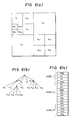
- Figs. 6(a), (b) and (c) are explanatory views each being useful for explaining the data structure.
- the data that are encoded as shown in Fig. 6(a) can be expressed by a quadtree such as shown in Fig.6(b).
- This quadtree is stored by a data structure such as shown in Fig. 6(c).
- Each data is divided into four data blocks, each of which corresponds to one block on the image.
- the image blocks are sequentially stored from the upper order levels, and symbol ESC represents an escape mark (which represents that reduction to its level is not yet made and reference to a lower order level is further necessary).
- symbol ESC represents an escape mark (which represents that reduction to its level is not yet made and reference to a lower order level is further necessary).
- the block arrangement is (ESC, X2, X3, ESC), and the first and fourth blocks of the first level require the reference to a lower order level while the second and third blocks can assume the brightness values of X2 and X3, respectively.
- the block in which the ESC mark is stored is developed to the lower level which is lower by one stage and the ESC mark is stored in the subsequent data block. Namely, in the case of the example shown in Fig. 6(c), the data corresponding to the first ESC is stored in the second data block while the data corresponding to the second ESC is stored in the third data block, respectively. After this data structure is generated, it is possible to make variable length encoding including the ESC marks (Hafmann encoding).
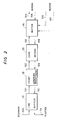
- Fig. 2 is a block diagram of a data encoding/decoding apparatus to which the present invention is applied.
- the apparatus consists of a line buffer 31, a counting/brightness generation circuit 32, a code/decode circuit 33 and a buffer 34.
- the image read by a scanner is stored in the line buffer 31 line by line, the pixels are counted by the count/brightness generation circuit 32 and the encoding processing shown in Fig. 1 is then effected by the code/decode circuit 33.
- the data in the form such as shown in Fig. 6(c) is stored in the buffer 34.
- the data When data transmission is made, the data is delivered to a transmission line after being modulated to a.c. signals through MODEM.
- a compression signal When a compression signal is received from the transmission line, the data received through MODEM is stored in the buffer 34 in the sequence of transmission in the form shown in Fig. 6(c).
- the data is transferred from the buffer 34 to the queue of FIFO and the later-appearing decoding processing shown in Fig. 8 is made in the code/decode circuit 33.
- the data After brightness is generated by the brightness generation circuit 32, the data is once stored in the line buffer 31 and is outputted as serial signals to the plotter for depicting the image.
- the queue of FIFO First In First Out is prepared as means for determining the lower order level development block from the ESC mark.
- Fig. 7 is an explanatory view useful for explaining the FIFO operation
- Fig. 8 is a flowchart of the decoding processing in one embodiment of the present invention.
- the decoding sequence is as follows.
- ⁇ is an integer sequence and ( ⁇ , m) is an integer sequence obtained by adding m to ⁇ . This procedure is repeated until all the data block is complete, and when all the data blocks are dealt with, the procedure is complete (step 27).
- Figs. 7(a), (b), (c) show the FIFO operation in the example shown in Fig. 6(c).
- the data is sequentially stored from the lower part to the upper part of the buffer, and the uppermost data is read out.
- Fig. 7(a) the data are stored in the sequence of 1, 4 and in Fig. 7(b), the data are stored in the sequence of 4, 1 3 after the first 1 is read out.
- Fig. 7(c) after 4 is read out, only 13 is shown stored.
- the coordinates (X, Y) of the pixels contained in the block (i1 ... i k ) are determined by the following formula and decoding at the pixel level can be made: where:
- the assumed lowermost level is called "K".
- the necessary bit number is given by the following formula: Accordingly, the compression ratio C ⁇ ,k is given as follows:
- Fig. 9 is a graph of the compression ratio evaluation, and shows the result of calculation of C ⁇ , k for some values of k and ⁇ .
- the S/N value is determined from the mean distortion: where M.S.E is the mean distortion. Since M.S.E. does not exceeds the allowable mean distortion, can be established. Whereas the conventional method can evaluate S/N only after encoding and decoding are made, the present invention can evaluate in advance S/N using the allowable distortion D as the parameter and the method of invention is easier to practise.
- Figs. 10(a), (b) are explanatory views useful for explaining the slope of brightness and an approximation method of brightness.
- Mean distortion is used as the reference of block division so that the mean distortion does not exceed the designated allowance value, as described already.
- index of distortion which is mostly used, there is a mean square difference as described with reference to Fig. 3 and this formula is given again below: where d: mean distortion, N2: number of pixels in block, X ij : brightness of pixel (i, j), ij : encoded/decoded brightness of pixel (i, j).
- a brightness slope approximate to the mean brightness inside each block is used to encode the block.
- the mean brightness is expressed by the following formula:
- ij of the formula (8) is expressed as follows by use of X , ⁇ and ⁇ :
- Fig. 11 reproduces Fig. 4 and is used for explaining the expression method of a non-equal size block.
- Blocks having sizes of 1x1, 2x2, ... , 2 n x2 n are considered.
- the 1x1 block is a pixel itself and the 2 n x2 n block is the image as a whole.
- the 2 n x2 n block is called "the uppermost order level (0th level)" while the 1x1 block is called “the lowermost order level ( n th level)”.
- 0 to 4 represent the blocks of the 0th to fourth levels, respectively.
- each block since four blocks each having a size of 2 n-1 x2 n-1 exist in the first level, they are called “1, 2, 3 and 4", respectively, in the order to the upper left, upper right, lower left and lower right.
- sixteen 2 n-2 x2 n-2 blocks exist and four of these blocks correspond to one block of the first level. Therefore, the four blocks of the second level contained in the same block of the first level are called “1, 2, 3 and 4", respectively, in the same way as in the first level.
- one block of a k th level can be expressed generally by (i1, i2, .... , i k ).
- the block 5 (the hatched block) can be expressed as (1, 1, 1, 4).
- the mean brightness and the approximate brightness slope of the block (i1, i2, .... i k ) expressed by the method described above will be hereby called “Xi1i2 .... i k " and " ⁇ i1i2 .... i k , ⁇ i1i2 .... i k ", respectively.
- the approximate value obtained by approximating the brightness of the pixels in the block in accordance with the formula (10) by use of Xi1 ... i k , ⁇ i1 .... i k , ⁇ i1 .... i k is expressed as di1 .... i k .
- Zi1 .... i n is the brightness of the pixel (i1i2 .... i n ).
- the suffix i1 .... i n moves respectively within the range of from 1 to 4.
- X, ⁇ , D and d can be calculated recurrently from X, ⁇ , ⁇ and d of the level lower than by one stage, and calculation can be made efficiently from the practical aspect, too.
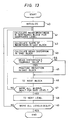
- Fig. 13 is a flowchart of the encoding sequence in another embodiment of the present invention.
- the lowermost level and the top block are set at step 40.
- Mean brightness X is determined in accordance with the formula (14) at step 41, and the slopes of brightness ⁇ , ⁇ are calculated in accordance with the formulas (15) and (16) in step 42.
- the mean distortion d is determined in accordance with the formula (17) at step 43.
- Judgement of the formula (13) is made at step 44, and if the formula (13) is found satisfied, reduction is executed at step 45. Processing of the next block is made at step 46, but when the next block has already become impossible for reduction, the flow skips.
- Step 47 judges whether or not the processing of all the blocks of the level that is being processed is completed.
- Figs. 14(a), (b) and (c) are data structural views of the encoded data.
- the encoded data can be expressed by the quadtree such as shown in Fig. 14(b), and are stored in the data structure such as shown in Fig. 14(c).
- the data is divided into four each data blocks, which correspond to one block on the image.
- the image blocks are sequentially stored from the upper order levels, and symbol ESC represents an escape mark (representing that reduction is not made to that level and reference to lower order levels is necessary).
- the data arrangement is (ESC, (X2, ⁇ 2, ⁇ 2), (X3, ⁇ 3, ⁇ 3), ESC).
- the first and fourth blocks of the first level need reference to the lower order level, while the second and third blocks are encoded to (X2, ⁇ 2, ⁇ 2), (X3, ⁇ 3, ⁇ 3), respectively.
- the block storing the ESC mark is further developed to the level which is lower by one stage, and is stored in the subsequent data block. Namely, in the example of Fig. 14(c), the data corresponding to the first ESC is stored in the second data block while the data corresponding to the second ESC is stored in the third data block. After such a data structure is generated, it is possible to make variable length encoding (Hafmann encoding) including the ESC mark, if there is any deviation of the data values.
- the queue of FIFO is prepared as means for determining the development block of lower order levels from the ESC mark.
- Fig. 15 is a decoding processing flowchart in another embodiment of the present invention.
- ⁇ represents an integer sequence and ( ⁇ , m) does integer sequence obtained by adding m to ⁇ .
- the brightness Xi1 .... i k and the brightness slope ⁇ i1 .... i k , ⁇ i1 .... i k of each block can be reproduced from the data line shown in Fig. 14(c).
- the coordinates of the pixels contained in this block are within the following range:
- the portions whose brightness slope is near constant can be compressed as one block.
- the compression ratio is determined by the allowable mean distortion D and the characteristics of the object image, but the compression ratio is evaluated on the basis of a simple model as described below.
- the lowermost level assumed is K.
- the necessary bit number is given by the following formula: Therefore, the compression ratio C ⁇ ,k is given as follows: Fig. 9 shows the results of calculation of C ⁇ , k for some K, ⁇ values. Incidentally, the evaluation of S/N is the same as already described.
- the present invention makes encoding while utilizing not only the local redundancy of the image but also its global redundancy, and can therefore make high data compression. Furthermore, since the inside of the block is encoded by use of the brightness slope, the portions having the brightness slope which is nearly constant can be compressed as one block.
Landscapes
- Engineering & Computer Science (AREA)
- Multimedia (AREA)
- Physics & Mathematics (AREA)
- General Physics & Mathematics (AREA)
- Theoretical Computer Science (AREA)
- Signal Processing (AREA)
- Image Processing (AREA)
- Compression Of Band Width Or Redundancy In Fax (AREA)
- Compression Or Coding Systems Of Tv Signals (AREA)
- Compression, Expansion, Code Conversion, And Decoders (AREA)
Claims (3)
- Verfahren zum Codieren von Bilddaten durch Unterteilen des Bildes in rechteckige Blöcke ungleicher Größe entsprechend Änderungen in Helligkeitswerten, dadurch gekennzeichnet,
daß das Unterteilen in Blöcke so durchgeführt wird, daß ein durch Näherung der Helligkeitswerte jedes Blocks bezüglich zweier zueinander senkrechter Richtungen des Bildes erzeugter Fehler einen vorgegebenen zulässigen Wert nicht überschreitet, und
daß die Helligkeitswerte des Blocks in einer Baumstruktur codiert werden. - Verfahren nach Anspruch 1, wobei der Fehler der mittlere quatratische Fehler der Helligkeit der Bildelemente in jedem Block ist.
- Verfahren nach Anspruch 1, wobei die Näherung unter Verwendung der mittleren Helligkeit und der Steigung der Helligkeit der Helligkeitswerte durchgeführt wird.
Applications Claiming Priority (2)
| Application Number | Priority Date | Filing Date | Title |
|---|---|---|---|
| JP60241218A JPH0824341B2 (ja) | 1985-10-28 | 1985-10-28 | 画像データ符号化方法 |
| JP241218/85 | 1985-10-28 |
Publications (3)
| Publication Number | Publication Date |
|---|---|
| EP0220706A2 EP0220706A2 (de) | 1987-05-06 |
| EP0220706A3 EP0220706A3 (en) | 1989-03-22 |
| EP0220706B1 true EP0220706B1 (de) | 1992-09-16 |
Family
ID=17070952
Family Applications (1)
| Application Number | Title | Priority Date | Filing Date |
|---|---|---|---|
| EP86114886A Expired - Lifetime EP0220706B1 (de) | 1985-10-28 | 1986-10-27 | Bilddatenkodierverfahren |
Country Status (4)
| Country | Link |
|---|---|
| US (1) | US4831659A (de) |
| EP (1) | EP0220706B1 (de) |
| JP (1) | JPH0824341B2 (de) |
| DE (1) | DE3686754T2 (de) |
Families Citing this family (65)
| Publication number | Priority date | Publication date | Assignee | Title |
|---|---|---|---|---|
| US5060280A (en) * | 1986-09-30 | 1991-10-22 | Canon Kabushiki Kaisha | Masking control for image processing systems |
| US4944023A (en) * | 1987-05-19 | 1990-07-24 | Ricoh Company, Ltd. | Method of describing image information |
| JP2749811B2 (ja) * | 1987-12-09 | 1998-05-13 | 株式会社リコー | 標準パターン作成方式 |
| US5163104A (en) * | 1988-02-24 | 1992-11-10 | Transtechnology Corporation | Digital image processing technique including improved gray scale compression |
| US4910608A (en) * | 1988-12-09 | 1990-03-20 | Harris Corporation | Imagery data compression mechanism employing adaptive vector quantizer |
| US5060285A (en) * | 1989-05-19 | 1991-10-22 | Gte Laboratories Incorporated | Hierarchical variable block size address-vector quantization using inter-block correlation |
| US5065447A (en) * | 1989-07-05 | 1991-11-12 | Iterated Systems, Inc. | Method and apparatus for processing digital data |
| US5226175A (en) * | 1989-07-21 | 1993-07-06 | Graphic Edge, Inc. | Technique for representing sampled images |
| EP0483279B1 (de) * | 1989-07-21 | 1996-04-10 | Graphic Edge | System zur darstellung abgetasteter bilder |
| US5241395A (en) * | 1989-08-07 | 1993-08-31 | Bell Communications Research, Inc. | Adaptive transform coding using variable block size |
| FR2653953A1 (fr) * | 1989-10-27 | 1991-05-03 | Philips Electronique Lab | Dispositif de codage comportant un codeur a mots de longueur variable et dispositif de decodage associe. |
| US5097518A (en) * | 1990-02-27 | 1992-03-17 | Eastman Kodak Company | Technique for performing digital image scaling by logically combining or replicating pixels in blocks of differing groupsizes |
| US5022091A (en) * | 1990-02-28 | 1991-06-04 | Hughes Aircraft Company | Image processing technique |
| GB9006080D0 (en) * | 1990-03-17 | 1990-05-16 | Int Computers Ltd | Progressive encoding |
| US5255105A (en) * | 1990-03-17 | 1993-10-19 | International Computers Limited | Encoding image data |
| US5144688A (en) * | 1990-03-23 | 1992-09-01 | Board Of Regents, The University Of Texas System | Method and apparatus for visual pattern image coding |
| US5109438A (en) * | 1990-04-25 | 1992-04-28 | Hughes Aircraft Company | Data compression system and method |
| US5247589A (en) * | 1990-09-26 | 1993-09-21 | Radius Inc. | Method for encoding color images |
| US5070532A (en) * | 1990-09-26 | 1991-12-03 | Radius Inc. | Method for encoding color images |
| US5220440A (en) * | 1990-10-10 | 1993-06-15 | Fuji Xerox Co., Ltd. | Data compression method having a fixed ratio of compression for image data, and image data compression device |
| JP2835187B2 (ja) * | 1991-01-07 | 1998-12-14 | 株式会社東芝 | 符号化/復号化器および符号化/復号化方法 |
| US5657399A (en) * | 1991-05-17 | 1997-08-12 | Canon Kabushiki Kaisha | Encoding/decoding apparatus using quantizing steps information |
| US5228098A (en) * | 1991-06-14 | 1993-07-13 | Tektronix, Inc. | Adaptive spatio-temporal compression/decompression of video image signals |
| US5274718A (en) * | 1991-09-30 | 1993-12-28 | At&T Bell Laboratories | Image representation using tree-like structures |
| US5315670A (en) * | 1991-11-12 | 1994-05-24 | General Electric Company | Digital data compression system including zerotree coefficient coding |
| US6400996B1 (en) | 1999-02-01 | 2002-06-04 | Steven M. Hoffberg | Adaptive pattern recognition based control system and method |
| US6418424B1 (en) | 1991-12-23 | 2002-07-09 | Steven M. Hoffberg | Ergonomic man-machine interface incorporating adaptive pattern recognition based control system |
| US5903454A (en) | 1991-12-23 | 1999-05-11 | Hoffberg; Linda Irene | Human-factored interface corporating adaptive pattern recognition based controller apparatus |
| US6850252B1 (en) | 1999-10-05 | 2005-02-01 | Steven M. Hoffberg | Intelligent electronic appliance system and method |
| US10361802B1 (en) | 1999-02-01 | 2019-07-23 | Blanding Hovenweep, Llc | Adaptive pattern recognition based control system and method |
| US7242988B1 (en) | 1991-12-23 | 2007-07-10 | Linda Irene Hoffberg | Adaptive pattern recognition based controller apparatus and method and human-factored interface therefore |
| US8352400B2 (en) | 1991-12-23 | 2013-01-08 | Hoffberg Steven M | Adaptive pattern recognition based controller apparatus and method and human-factored interface therefore |
| US5339164A (en) * | 1991-12-24 | 1994-08-16 | Massachusetts Institute Of Technology | Method and apparatus for encoding of data using both vector quantization and runlength encoding and using adaptive runlength encoding |
| FR2685796A1 (fr) * | 1991-12-26 | 1993-07-02 | Blanie Paul | Procede de codage visant l'organisation d'informations. |
| US5862262A (en) * | 1992-03-30 | 1999-01-19 | The United States Of America As Represented By The Secretary Of The Navy | Method of encoding a digital image using adaptive partitioning in an iterated transformation system |
| US5335088A (en) * | 1992-04-01 | 1994-08-02 | Xerox Corporation | Apparatus and method for encoding halftone images |
| US5828784A (en) * | 1992-07-13 | 1998-10-27 | Hitachi Denshi Kabushiki Kaisha | Data coding method and apparatus using a plurality of blocks of different length |
| US5329379A (en) * | 1992-10-22 | 1994-07-12 | International Business Machines Corporation | System and method of measuring fidelity of decompressed video signals and images |
| KR940017695A (ko) * | 1992-12-09 | 1994-07-27 | 정용문 | 블럭간의 유사성을 고려한 중간조 화상의 부호화 방법 |
| US5379071A (en) * | 1992-12-16 | 1995-01-03 | Ibm Corporation (International Business Machines Corporation) | Method of encoding a location of changes in a sequence of video images |
| EP0607484B1 (de) * | 1993-01-20 | 1998-09-09 | Samsung Electronics Co. Ltd. | Verfahren und Vorrichtung zur Codierung und Decodierung von Bilddaten |
| US5481651A (en) * | 1993-04-26 | 1996-01-02 | Motorola, Inc. | Method and apparatus for minimizing mean calculation rate for an active addressed display |
| US5930394A (en) * | 1993-08-30 | 1999-07-27 | Sony Corporation | Picture coding apparatus and method thereof |
| US5848198A (en) * | 1993-10-08 | 1998-12-08 | Penn; Alan Irvin | Method of and apparatus for analyzing images and deriving binary image representations |
| EP0729688A1 (de) * | 1993-11-15 | 1996-09-04 | National Semiconductor Corporation | Quadtree-strukturierte walshtransformationsbildkodierung |
| US5446806A (en) * | 1993-11-15 | 1995-08-29 | National Semiconductor Corporation | Quadtree-structured Walsh transform video/image coding |
| US5850475A (en) * | 1994-05-10 | 1998-12-15 | Fuji Xerox Co., Ltd. | Method and apparatus for dividing image area |
| US5754704A (en) * | 1995-03-10 | 1998-05-19 | Interated Systems, Inc. | Method and apparatus for compressing and decompressing three-dimensional digital data using fractal transform |
| US6101282A (en) * | 1995-06-22 | 2000-08-08 | Canon Kabushiki Kaisha | Apparatus and method for image data encoding |
| JPH10511532A (ja) * | 1995-10-18 | 1998-11-04 | フィリップス エレクトロニクス ネムローゼ フェンノートシャップ | ビデオ画像符号化方法 |
| US6009188A (en) | 1996-02-16 | 1999-12-28 | Microsoft Corporation | Method and system for digital plenoptic imaging |
| EP0850540B1 (de) * | 1996-07-11 | 2004-11-10 | Koninklijke Philips Electronics N.V. | Übertragung und empfang codierter videobilder |
| US5900953A (en) * | 1997-06-17 | 1999-05-04 | At&T Corp | Method and apparatus for extracting a foreground image and a background image from a color document image |
| US7966078B2 (en) | 1999-02-01 | 2011-06-21 | Steven Hoffberg | Network media appliance system and method |
| TW515192B (en) * | 2000-06-06 | 2002-12-21 | Noa Kk Off | Compression method of motion picture image data and system there for |
| US7085424B2 (en) | 2000-06-06 | 2006-08-01 | Kobushiki Kaisha Office Noa | Method and system for compressing motion image information |
| CA2436437A1 (en) * | 2001-01-30 | 2002-08-15 | Kabushiki Kaisha Office Noa | Moving picture information compressing method and its system |
| WO2003039163A1 (fr) * | 2001-11-01 | 2003-05-08 | Kabushiki Kaisha Office Noa | Procede de compression d'information d'images mobiles et systeme associe |
| CN101448162B (zh) * | 2001-12-17 | 2013-01-02 | 微软公司 | 处理视频图像的方法 |
| US10554985B2 (en) | 2003-07-18 | 2020-02-04 | Microsoft Technology Licensing, Llc | DC coefficient signaling at small quantization step sizes |
| JP4546174B2 (ja) * | 2004-07-15 | 2010-09-15 | キヤノン株式会社 | 撮影装置及びその制御方法、プログラム |
| JP4853199B2 (ja) * | 2006-09-25 | 2012-01-11 | 株式会社ニコン | 画像圧縮方法、装置、電子カメラ、およびプログラム |
| EP2509319A4 (de) * | 2009-12-01 | 2013-07-10 | Humax Co Ltd | Verfahren und vorrichtung zur kodierung/dekodierung von bildern mit hoher auflösung |
| FR2956789B1 (fr) * | 2010-02-19 | 2012-11-16 | Canon Kk | Procede et dispositif de traitement d'une sequence video |
| US9286643B2 (en) | 2011-03-01 | 2016-03-15 | Applaud, Llc | Personalized memory compilation for members of a group and collaborative method to build a memory compilation |
Family Cites Families (8)
| Publication number | Priority date | Publication date | Assignee | Title |
|---|---|---|---|---|
| FR2391610A1 (fr) * | 1977-05-16 | 1978-12-15 | Matra | Perfectionnements aux procedes et dispositifs de restitution et de reproduction d'images |
| US4205341A (en) * | 1978-01-24 | 1980-05-27 | Nippon Telegraph And Telephone Public Corporation | Picture signal coding apparatus |
| US4222076A (en) * | 1978-09-15 | 1980-09-09 | Bell Telephone Laboratories, Incorporated | Progressive image transmission |
| US4319267A (en) * | 1979-02-16 | 1982-03-09 | Nippon Telegraph And Telephone Public Corporation | Picture coding and/or decoding equipment |
| US4261018A (en) * | 1979-06-18 | 1981-04-07 | Bell Telephone Laboratories, Incorporated | Progressive image transmission |
| US4520506A (en) * | 1981-10-20 | 1985-05-28 | Harris Corporation | Method and system for compression and reconstruction of cultural data for use in a digital moving map display |
| JPS60176365A (ja) * | 1984-02-22 | 1985-09-10 | Dainippon Screen Mfg Co Ltd | 画像信号の圧縮方法 |
| DE3684047D1 (de) * | 1985-07-02 | 1992-04-09 | Matsushita Electric Industrial Co Ltd | Vorrichtung zur blockkodierung. |
-
1985
- 1985-10-28 JP JP60241218A patent/JPH0824341B2/ja not_active Expired - Lifetime
-
1986
- 1986-10-27 EP EP86114886A patent/EP0220706B1/de not_active Expired - Lifetime
- 1986-10-27 DE DE8686114886T patent/DE3686754T2/de not_active Expired - Fee Related
-
1988
- 1988-06-07 US US07/208,851 patent/US4831659A/en not_active Expired - Fee Related
Also Published As
| Publication number | Publication date |
|---|---|
| JPH0824341B2 (ja) | 1996-03-06 |
| JPS62101183A (ja) | 1987-05-11 |
| DE3686754T2 (de) | 1993-01-28 |
| US4831659A (en) | 1989-05-16 |
| DE3686754D1 (de) | 1992-10-22 |
| EP0220706A2 (de) | 1987-05-06 |
| EP0220706A3 (en) | 1989-03-22 |
Similar Documents
| Publication | Publication Date | Title |
|---|---|---|
| EP0220706B1 (de) | Bilddatenkodierverfahren | |
| EP0193185B1 (de) | Adaptive Zwischenbild-Vektorquantisier-Kodiereinrichtung | |
| EP0772364B1 (de) | Bildverarbeitungsvorrichtung und -verfahren | |
| JP3716931B2 (ja) | 連続画像の適応型復号装置 | |
| EP0426260A2 (de) | Adaptiver Zonenkodierer | |
| EP0470773A2 (de) | Vorrichtung zur orthogonalen Transformationskodierung | |
| EP0777386B1 (de) | Verfahren und Vorrichtung zur Kodierung und Dekodierung eines Bildes | |
| US6072909A (en) | Image coding devise and image decoding devise using with image disassembly | |
| US7026960B2 (en) | Method and apparatus for encoding and decoding key data | |
| EP0360502B1 (de) | System zur Kodierung eines Bildsignals | |
| US7277585B2 (en) | Image encoding method, image encoding apparatus and storage medium | |
| JPH07114499B2 (ja) | データ符号化方法 | |
| JP3033671B2 (ja) | 画像信号のアダマール変換符号化・復号化方法およびその装置 | |
| EP0297862B1 (de) | Vorhersage-Kodiersystem mit Geräuschverminderung | |
| JP4514169B2 (ja) | デジタル信号変換装置及び方法 | |
| EP0659023A2 (de) | Verfahren und Vorrichtung zur Bilddatenkodierung und -kompression | |
| JP2000217003A (ja) | 符号化装置および復号化装置 | |
| US5778101A (en) | Method and apparatus for processing an image signal having an object by using an extension-interpolation technique | |
| JP2862022B2 (ja) | 画像符号化方式 | |
| JP2808110B2 (ja) | デジタル画像データ圧縮方法 | |
| Jalumuri | A study of scanning paths for BWT-based image compression | |
| JP3359214B2 (ja) | 多値画像符号化装置 | |
| CA2161678A1 (en) | Differential coding and decoding method and related circuits | |
| JPH0310486A (ja) | 動画像符号化装置 | |
| JP2533631B2 (ja) | 画像符号化装置 |
Legal Events
| Date | Code | Title | Description |
|---|---|---|---|
| PUAI | Public reference made under article 153(3) epc to a published international application that has entered the european phase |
Free format text: ORIGINAL CODE: 0009012 |
|
| AK | Designated contracting states |
Kind code of ref document: A2 Designated state(s): DE FR GB |
|
| PUAL | Search report despatched |
Free format text: ORIGINAL CODE: 0009013 |
|
| AK | Designated contracting states |
Kind code of ref document: A3 Designated state(s): DE FR GB |
|
| 17P | Request for examination filed |
Effective date: 19890828 |
|
| 17Q | First examination report despatched |
Effective date: 19910510 |
|
| GRAA | (expected) grant |
Free format text: ORIGINAL CODE: 0009210 |
|
| AK | Designated contracting states |
Kind code of ref document: B1 Designated state(s): DE FR GB |
|
| REF | Corresponds to: |
Ref document number: 3686754 Country of ref document: DE Date of ref document: 19921022 |
|
| ET | Fr: translation filed | ||
| PLBE | No opposition filed within time limit |
Free format text: ORIGINAL CODE: 0009261 |
|
| STAA | Information on the status of an ep patent application or granted ep patent |
Free format text: STATUS: NO OPPOSITION FILED WITHIN TIME LIMIT |
|
| 26N | No opposition filed | ||
| REG | Reference to a national code |
Ref country code: GB Ref legal event code: IF02 |
|
| PGFP | Annual fee paid to national office [announced via postgrant information from national office to epo] |
Ref country code: FR Payment date: 20020923 Year of fee payment: 17 |
|
| PGFP | Annual fee paid to national office [announced via postgrant information from national office to epo] |
Ref country code: GB Payment date: 20020926 Year of fee payment: 17 |
|
| PGFP | Annual fee paid to national office [announced via postgrant information from national office to epo] |
Ref country code: DE Payment date: 20021205 Year of fee payment: 17 |
|
| PG25 | Lapsed in a contracting state [announced via postgrant information from national office to epo] |
Ref country code: GB Free format text: LAPSE BECAUSE OF NON-PAYMENT OF DUE FEES Effective date: 20031027 |
|
| PG25 | Lapsed in a contracting state [announced via postgrant information from national office to epo] |
Ref country code: DE Free format text: LAPSE BECAUSE OF NON-PAYMENT OF DUE FEES Effective date: 20040501 |
|
| GBPC | Gb: european patent ceased through non-payment of renewal fee |
Effective date: 20031027 |
|
| PG25 | Lapsed in a contracting state [announced via postgrant information from national office to epo] |
Ref country code: FR Free format text: LAPSE BECAUSE OF NON-PAYMENT OF DUE FEES Effective date: 20040630 |
|
| REG | Reference to a national code |
Ref country code: FR Ref legal event code: ST |