EP0222218A2 - Blechdose - Google Patents
Blechdose Download PDFInfo
- Publication number
- EP0222218A2 EP0222218A2 EP86114640A EP86114640A EP0222218A2 EP 0222218 A2 EP0222218 A2 EP 0222218A2 EP 86114640 A EP86114640 A EP 86114640A EP 86114640 A EP86114640 A EP 86114640A EP 0222218 A2 EP0222218 A2 EP 0222218A2
- Authority
- EP
- European Patent Office
- Prior art keywords
- tongue
- sheet metal
- tear strip
- scored
- weld seam
- Prior art date
- Legal status (The legal status is an assumption and is not a legal conclusion. Google has not performed a legal analysis and makes no representation as to the accuracy of the status listed.)
- Granted
Links
Images
Classifications
-
- B—PERFORMING OPERATIONS; TRANSPORTING
- B21—MECHANICAL METAL-WORKING WITHOUT ESSENTIALLY REMOVING MATERIAL; PUNCHING METAL
- B21D—WORKING OR PROCESSING OF SHEET METAL OR METAL TUBES, RODS OR PROFILES WITHOUT ESSENTIALLY REMOVING MATERIAL; PUNCHING METAL
- B21D51/00—Making hollow objects
- B21D51/16—Making hollow objects characterised by the use of the objects
- B21D51/38—Making inlet or outlet arrangements of cans, tins, baths, bottles, or other vessels; Making can ends; Making closures
- B21D51/383—Making inlet or outlet arrangements of cans, tins, baths, bottles, or other vessels; Making can ends; Making closures scoring lines, tear strips or pulling tabs
- B21D51/386—Making inlet or outlet arrangements of cans, tins, baths, bottles, or other vessels; Making can ends; Making closures scoring lines, tear strips or pulling tabs on the side-wall of containers
Definitions
- the present invention relates to a sheet metal blank for producing a sheet metal frame for a tin can, which sheet metal frame is formed by welding a side pinch or overlap seam, and which is provided with a circumferential tear strip formed between two pre-scored breaking lines which run essentially parallel to one another.
- a problem with tin cans which are produced starting from sheet metal frames of the type mentioned above, lies in the attachment of a tear strip which, despite the side weld seam, can be opened easily and securely by means of a key.
- the object of the present invention is now a To create sheet metal cutting with tear strips, which solves this problem in a simple manner satisfactorily with the same quality of the side weld seam.
- this solution consists in that the tongue, at least in the vicinity of the weld seam to be formed, is wider than the subsequent tear strip and that the two pre-scored breaking lines are extended into the tongue.
- the safe execution of the welding in the area of the tongue can be guaranteed with a suitable welding current program (increased current for a limited time, i.e. in the tongue area).
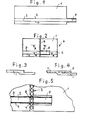
- FIG. 1 of the drawing shows a sheet metal blank 1 designed in accordance with the invention, in which two parallel predetermined breaking lines 3, 4 running across the entire width of the blank are pre-scored to form a later tear strip 2.
- Such cracks preferably have a V-shaped cross section and their greatest depth lies approximately in the middle of the sheet thickness (depending on the sheet thickness).
- the tear strip 2 formed between the predetermined breaking lines 3, 4 has, for the purpose of tearing open, a tongue 5 which is wider than the subsequent actual tear strip 2.
- the two pre-scored breaking lines 3, 4 are extended into the tongue 5.
- a sheet metal frame 6 (FIG. 2), formed by means of the blank 1 by welding, is used to manufacture a can (by attaching, after filling, a base and a lid).
- the can is by means of a key (not shown), which is attached to the tongue 5, opened by tearing open the pre-scored tear strip 2 in a manner known per se.
- FIG. 2 of the drawing shows a can frame 6 formed from the sheet metal blank 1 by welding a side pinch or overlap seam 7. Behind the continuous weld seam 7, the tongue 5 projects freely (it lies more or less close to the frame wall 1 underneath).
- FIGS. 3 and 4 show sections through the frame wall in the area of the weld seam 7, FIG. 3 showing the very homogeneous weld in the normal overlap sector, while FIG. 4 shows the seam 7 in the sector of the tongue 5.
- this sector there is a cold welding, since the larger resistance increases the transition resistance due to the tongue 5. Thanks to this cold welding, the can can be opened later without any problems.
- the safe execution of the cold welding is guaranteed with a suitable welding current program, thanks to which the welding current can be increased in the sector of the tongue 5.
- Figure 5 shows a detail of the frame 6 of Figure 2 on an enlarged scale. This shows how the weld seam 7 is broken or torn when the tongue 5 is raised for the purpose of opening the can.
- the corresponding possible tear lines (shown in broken lines), starting from the outer edge of the tongue 5, run inward through the weld seam 7 and end securely in the pre-scored predetermined breaking lines 3 and 4.
- Cans produced with sheet metal blanks designed according to the invention and having a cold welding point as an opening gap can be used in the field of technical packaging, possibly also in the food sector.
Landscapes
- Engineering & Computer Science (AREA)
- Mechanical Engineering (AREA)
- Rigid Containers With Two Or More Constituent Elements (AREA)
- Containers Opened By Tearing Frangible Portions (AREA)
- Transition And Organic Metals Composition Catalysts For Addition Polymerization (AREA)
- Superconductors And Manufacturing Methods Therefor (AREA)
- Laminated Bodies (AREA)
- Arc Welding In General (AREA)
- Mechanical Treatment Of Semiconductor (AREA)
- Paper (AREA)
- Manufacturing Of Electric Cables (AREA)
Abstract
Description
- Die vorliegende Erfindung betrifft einen Blechzuschnitt zur Herstellung einer durch Schweissen einer seitlichen Quetsch-oder Ueberlappnaht gebildeten Blechzarge für eine Blechdose, welche mit einem umlaufenden, zwischen zwei im wesentlichen parallel zueinander verlaufenden vorgeritzten Sollbruchlinien gebildeten Aufreissstreifen versehen ist.
- Ein Problem bei Blechdosen, welche ausgehend von Blechzargen der obengenannten Art hergestellt werden, liegt im Anbringen eines Aufreissstreifens, der trotz der seitlichen Schweissnaht mittels eines Schlüssels leicht und sicher zu öffnen ist.
- Bei den heute bekannten Ausführungsformen, bei denen die den Anfang des Aufreissstreifens bildende Zunge die gleiche Breite aufweist wie der zwischen den Ritzlinien verlaufende eigentliche Aufreissstreifen, zeigt sich nämlich immer wieder, dass nach Ueberwindung der Schweissnaht (durch deren mechanische Zerstörung) die Gefahr besteht, dass die tatsächliche Risslinie nicht entlang der Sollbruchlinien verläuft, sondern wenigstens eine der beiden Risslinien von der vorgeritzten Sollbruchlinie wegläuft. Solche ungewollten Risslinien laufen immer in einer Dreieckform nach innen, entweder zur zweiten Sollbruchlinie oder zur zweiten ungewollten Risslinie. Damit ist natürlich der Aufreissstreifen bereits vorzeitig zerstört und ein weiteres Oeffnen der Blechdose ohne Zusatzwerkzeug nicht mehr möglich.
- Aufgabe der vorliegenden Erfindung ist es nun, einen Blechzuschnitt mit Aufreissstreifen zu schaffen, welcher dieses Problem bei gleichbleibender Qualität der seitlichen Schweissnaht auf einfache Weise befriedigend löst.
- Diese Lösung besteht bei einem Blechzuschnitt der genannten Art erfindungsgemäss darin, dass die Zunge wenigstens in Nähe der zu bildenden Schweissnaht breiter ausgebildet ist als der anschliessende Aufreissstreifen und dass die beiden vorgeritzten Sollbruchlinien bis in die Zunge hinein verlängert sind.
- Dank dieser Ausgestaltung des Blechzuschnitts ist ausserhalb des Bereiches der Zunge bei der Bildung der Blechzarge mittels einer seitlichen Quetsch- oder Ueberlappnaht eine gute Schweissung bei hoher Homogenität des Schweissgutes erreichbar. Im Bereich der Zunge bzw. des Aufreissstreifens entsteht eine Kaltschweissung, da durch die vergrösserte Kontaktfläche an dieser Stelle der Uebergangswiderstand vergrössert wird. Das Entstehen dieser Kaltschweissung ermöglicht das problemlose Oeffnen der Dosen.
- Die sichere Ausführung der Schweissung im Bereich der Zunge kann mit einem passenden Schweissstrom-Programm (erhöhter Strom während begrenzter Zeit, d.h. im Zungenbereich) garantiert werden.
- Dank der bereits in der verbreiterten Zunge vorhandenen Sollbruchlinien, welche praktisch geradlinig durch die Schweissnaht verlaufen, laufen die tatsächlichen Risslinien zwar zuerst auch nach innen, enden jedoch schliesslich auf den vorgeritzten Sollbruchlinien.
- Die Erfindung wird nachstehend anhand eines in der Zeichnung dargestellten Ausführungsbeispiels noch etwas näher erläutert. Es zeigt:
- Fig. 1 eine Draufsicht auf einen erfindungsgemäss ausgebildeten Blechzuschnitt;
- Fig. 2 eine mit dem Blechzuschnitt nach Fig. 1 hergestellte Blechzarge;
- Fig. 3 einen Schnitt entlang der Linie A-A von Fig. 2;
- Fig. 4 einen Schnitt entlang der Linie B-B von Fig. 2, und
- Fig. 5 einen vergrösserten Ausschnitt aus Fig. 2.
- Figur 1 der Zeichnung zeigt einen erfindungsgemäss ausgebildeten Blechzuschnitt 1, bei welchem zur Bildung eines späteren Aufreissstreifens 2 zwei über die ganze Breite des Zuschnitts verlaufende parallele Sollbruchlinien 3, 4 vorgeritzt sind. Solche Ritzen haben vorzugsweise einen V-förmigen Querschnitt und deren grösste Tiefe liegt etwa in Mitte der Blechdicke (von der Blechdicke abhängig). Der zwischen den Sollbruchlinien 3, 4 gebildete Aufreissstreifen 2 hat zum Zweck des Aufreissens eine Zunge 5, welche breiter ausgebildet ist als der anschliessende, eigentliche Aufreissstreifen 2. Die beiden vorgeritzten Sollbruchlinien 3, 4 sind bis in die Zunge 5 hinein verlängert.
- Eine mittels des Zuschnitts 1 durch Schweissen gebildete Blechzarge 6 (Figur 2) dient zur Fertigung einer Dose (durch Anbringen, nach dem Füllen, eines Bodens und Deckels). Die Dose wird mittels eines Schlüssels (nicht dargestellt), welcher an der Zunge 5 angesetzt wird, durch Aufreissen des vorgeritzten Aufreissstreifens 2 in an sich bekannter Weise geöffnet.
- Figur 2 der Zeichnung zeigt eine aus dem Blechzuschnitt 1 durch Schweissen einer seitlichen Quetsch- oder Ueberlappnaht 7 gebildete Dosenzarge 6. Hinter der durchgehenden Schweissnaht 7 steht frei die Zunge 5 ab (sie liegt mehr oder weniger dicht an der darunterliegenden Zargenwand 1 an).
- Die Figuren 3 und 4 zeigen Schnitte durch die Zargenwand im Bereich der Schweissnaht 7, wobei Figur 3 die sehr homogene Schweissung im normalen Ueberlappungssektor darstellt, während Figur 4 die Naht 7 im Sektor der Zunge 5 zeigt. In diesem Sektor ergibt sich eine Kaltschweissung, da sich durch die grössere Fläche wegen der Zunge 5 der Uebergangswiderstand vergrössert. Dank dieser Kaltschweissung lässt sich später die Dose problemlos öffnen.
- Die sichere Ausführung der Kaltschweissung wird mit einem geeigneten Schweissstrom-Programm garantiert, dank welchem im Sektor der Zunge 5 der Schweissstrom erhöht werden kann.
- Figur 5 zeigt einen Ausschnitt aus der Zarge 6 nach Figur 2 in vergrössertem Massstab. Daraus geht hervor, wie bei einem Anheben der Zunge 5 zwecks Oeffnens der Dose die Schweissnaht 7 durchbrochen bzw. durchgerissen wird. Die entsprechenden möglichen Risslinien (gestrichelt dargestellt), vom äusseren Rand der Zunge 5 ausgehend, verlaufen durch die Schweissnaht 7 nach innen und enden sicher in den vorgeritzten Sollbruchlinien 3 bzw. 4.
- Mit erfindungsgemäss ausgebildeten Blechzuschnitten hergestellte Dosen mit Kaltschweissstelle als Oeffnungslücke, können im Bereich der technischen Verpackungen, ggf. auch im Nahrungsmittelbereich verwendet werden.
Claims (2)
Priority Applications (1)
| Application Number | Priority Date | Filing Date | Title |
|---|---|---|---|
| AT86114640T ATE59012T1 (de) | 1985-11-04 | 1986-10-22 | Blechdose. |
Applications Claiming Priority (2)
| Application Number | Priority Date | Filing Date | Title |
|---|---|---|---|
| CH4728/85 | 1985-11-04 | ||
| CH4728/85A CH667819A5 (de) | 1985-11-04 | 1985-11-04 | Blechzuschnitt zur herstellung von geschweissten blechzargen fuer blechdosen. |
Publications (3)
| Publication Number | Publication Date |
|---|---|
| EP0222218A2 true EP0222218A2 (de) | 1987-05-20 |
| EP0222218A3 EP0222218A3 (en) | 1988-12-14 |
| EP0222218B1 EP0222218B1 (de) | 1990-12-12 |
Family
ID=4281470
Family Applications (1)
| Application Number | Title | Priority Date | Filing Date |
|---|---|---|---|
| EP86114640A Expired - Lifetime EP0222218B1 (de) | 1985-11-04 | 1986-10-22 | Blechdose |
Country Status (6)
| Country | Link |
|---|---|
| EP (1) | EP0222218B1 (de) |
| JP (1) | JPS62182039A (de) |
| AT (1) | ATE59012T1 (de) |
| CH (1) | CH667819A5 (de) |
| DE (1) | DE3676165D1 (de) |
| ES (1) | ES2019867B3 (de) |
Family Cites Families (6)
| Publication number | Priority date | Publication date | Assignee | Title |
|---|---|---|---|---|
| DE99999C (de) * | ||||
| GB191302618A (en) * | 1913-01-31 | 1914-01-29 | Allen Gardiner Ingalls | Improvements in or relating to Cans or like Vessels. |
| US1568438A (en) * | 1924-02-02 | 1926-01-05 | Thermokept Corp | Can |
| US2348750A (en) * | 1941-10-07 | 1944-05-16 | American Can Co | Container |
| US3021805A (en) * | 1960-01-14 | 1962-02-20 | Continental Can Co | Method of making a tear strip can body |
| AT245342B (de) * | 1963-07-01 | 1966-02-25 | Papier Und Blechdruckindustrie | Vorrichtung zur Herstellung von Dosen |
-
1985
- 1985-11-04 CH CH4728/85A patent/CH667819A5/de not_active IP Right Cessation
-
1986
- 1986-10-22 DE DE8686114640T patent/DE3676165D1/de not_active Expired - Fee Related
- 1986-10-22 EP EP86114640A patent/EP0222218B1/de not_active Expired - Lifetime
- 1986-10-22 AT AT86114640T patent/ATE59012T1/de not_active IP Right Cessation
- 1986-10-22 ES ES86114640T patent/ES2019867B3/es not_active Expired - Lifetime
- 1986-10-31 JP JP61258713A patent/JPS62182039A/ja active Pending
Also Published As
| Publication number | Publication date |
|---|---|
| EP0222218A3 (en) | 1988-12-14 |
| ATE59012T1 (de) | 1990-12-15 |
| ES2019867B3 (es) | 1991-07-16 |
| CH667819A5 (de) | 1988-11-15 |
| EP0222218B1 (de) | 1990-12-12 |
| JPS62182039A (ja) | 1987-08-10 |
| DE3676165D1 (de) | 1991-01-24 |
Similar Documents
| Publication | Publication Date | Title |
|---|---|---|
| DE2265310C3 (de) | Statorkern für rotierende elektrische Maschinen | |
| DE3343786C2 (de) | ||
| DE8803229U1 (de) | Verpackung für Gegenstände, insbesondere von Quaderform | |
| AT394342B (de) | Behaelterzuschnitt aus faltbarem flachmaterial | |
| DE3516388C2 (de) | ||
| DE2364670C2 (de) | Verfahren bei der Herstellung von Blecherzeugnissen mit gestanzten Befestigungslappen | |
| EP0222218B1 (de) | Blechdose | |
| EP0176052B1 (de) | Aufreissbares Dosenteil sowie Verfahren und Vorrichtung zu dessen Herstellung | |
| EP0221447A2 (de) | Blechzuschnitt zur Herstellung von geschweissten Blechzargen für Blechdosen | |
| EP0416246B1 (de) | Dichtungsprofilleiste für Fensterrahmen und -flügel | |
| CH630309A5 (en) | Packaging container | |
| DE1814505A1 (de) | Platte oder Tafel mit Falzraendern | |
| DE2016708C3 (de) | Karosserieprofil, insbesondere für die Karosserie von Kraftfahrzeugen | |
| EP0167855B1 (de) | Aufreissbarer Dosenrumpf | |
| DE940442C (de) | Zackenfoermiges Messer, insbesondere zum Querschneiden von metallischen Folien | |
| DE2116343A1 (de) | Dosendeckel sowie Verfahren und Vorrichtung zu seiner Herstellung | |
| AT399189B (de) | Dachentwässerung | |
| DE340163C (de) | Verfahren zum Verbinden der sich kreuzenden durchgehenden T-foermigen Staebe von Fenster- o. dgl. Rahmen mittels die Kreuzungsstelle ueberdeckenden Knopfes | |
| DE2903123C2 (de) | Mehrkantiger Behälter, insbesondere zum Transport von Müll und Bauschutt, und Verfahren zu dessen Herstellung | |
| DE2059297C3 (de) | Rahmen aus Blech und Vorrichtung zu seiner Herstellung | |
| CH658034A5 (de) | Aufreissbares dosenteil. | |
| DE2523216A1 (de) | Verfahren zur herstellung einer schwaechungsritze in einem blechteil, werkzeug zur durchfuehrung dieses verfahrens und nach dem verfahren hergestellter blechteil | |
| DE727380C (de) | Verfahren zur Sicherung der Naehte von geloeteten Konservendosenzargen gegen Aufreissen an den Boerdelkanten | |
| DE3603741C2 (de) | ||
| DE1757001C3 (de) | Vollaufreißdeckel aus Metall für Dosen |
Legal Events
| Date | Code | Title | Description |
|---|---|---|---|
| PUAI | Public reference made under article 153(3) epc to a published international application that has entered the european phase |
Free format text: ORIGINAL CODE: 0009012 |
|
| AK | Designated contracting states |
Kind code of ref document: A2 Designated state(s): AT BE DE ES FR GB IT NL SE |
|
| PUAL | Search report despatched |
Free format text: ORIGINAL CODE: 0009013 |
|
| AK | Designated contracting states |
Kind code of ref document: A3 Designated state(s): AT BE DE ES FR GB IT NL SE |
|
| 17P | Request for examination filed |
Effective date: 19881117 |
|
| 17Q | First examination report despatched |
Effective date: 19891116 |
|
| GRAA | (expected) grant |
Free format text: ORIGINAL CODE: 0009210 |
|
| AK | Designated contracting states |
Kind code of ref document: B1 Designated state(s): AT BE DE ES FR GB IT NL SE |
|
| REF | Corresponds to: |
Ref document number: 59012 Country of ref document: AT Date of ref document: 19901215 Kind code of ref document: T |
|
| REF | Corresponds to: |
Ref document number: 3676165 Country of ref document: DE Date of ref document: 19910124 |
|
| ITF | It: translation for a ep patent filed | ||
| ET | Fr: translation filed | ||
| GBT | Gb: translation of ep patent filed (gb section 77(6)(a)/1977) | ||
| PLBE | No opposition filed within time limit |
Free format text: ORIGINAL CODE: 0009261 |
|
| STAA | Information on the status of an ep patent application or granted ep patent |
Free format text: STATUS: NO OPPOSITION FILED WITHIN TIME LIMIT |
|
| ITTA | It: last paid annual fee | ||
| 26N | No opposition filed | ||
| EAL | Se: european patent in force in sweden |
Ref document number: 86114640.5 |
|
| REG | Reference to a national code |
Ref country code: GB Ref legal event code: IF02 |
|
| PGFP | Annual fee paid to national office [announced via postgrant information from national office to epo] |
Ref country code: FR Payment date: 20041028 Year of fee payment: 19 |
|
| PGFP | Annual fee paid to national office [announced via postgrant information from national office to epo] |
Ref country code: NL Payment date: 20041031 Year of fee payment: 19 Ref country code: AT Payment date: 20041031 Year of fee payment: 19 |
|
| PGFP | Annual fee paid to national office [announced via postgrant information from national office to epo] |
Ref country code: GB Payment date: 20041102 Year of fee payment: 19 |
|
| PGFP | Annual fee paid to national office [announced via postgrant information from national office to epo] |
Ref country code: DE Payment date: 20041105 Year of fee payment: 19 |
|
| PGFP | Annual fee paid to national office [announced via postgrant information from national office to epo] |
Ref country code: SE Payment date: 20041109 Year of fee payment: 19 |
|
| PGFP | Annual fee paid to national office [announced via postgrant information from national office to epo] |
Ref country code: ES Payment date: 20041126 Year of fee payment: 19 |
|
| PGFP | Annual fee paid to national office [announced via postgrant information from national office to epo] |
Ref country code: BE Payment date: 20041201 Year of fee payment: 19 |
|
| PG25 | Lapsed in a contracting state [announced via postgrant information from national office to epo] |
Ref country code: IT Free format text: LAPSE BECAUSE OF NON-PAYMENT OF DUE FEES;WARNING: LAPSES OF ITALIAN PATENTS WITH EFFECTIVE DATE BEFORE 2007 MAY HAVE OCCURRED AT ANY TIME BEFORE 2007. THE CORRECT EFFECTIVE DATE MAY BE DIFFERENT FROM THE ONE RECORDED. Effective date: 20051022 Ref country code: GB Free format text: LAPSE BECAUSE OF NON-PAYMENT OF DUE FEES Effective date: 20051022 Ref country code: AT Free format text: LAPSE BECAUSE OF NON-PAYMENT OF DUE FEES Effective date: 20051022 |
|
| PG25 | Lapsed in a contracting state [announced via postgrant information from national office to epo] |
Ref country code: SE Free format text: LAPSE BECAUSE OF NON-PAYMENT OF DUE FEES Effective date: 20051023 |
|
| PG25 | Lapsed in a contracting state [announced via postgrant information from national office to epo] |
Ref country code: ES Free format text: LAPSE BECAUSE OF NON-PAYMENT OF DUE FEES Effective date: 20051024 |
|
| PG25 | Lapsed in a contracting state [announced via postgrant information from national office to epo] |
Ref country code: BE Free format text: LAPSE BECAUSE OF NON-PAYMENT OF DUE FEES Effective date: 20051031 |
|
| PG25 | Lapsed in a contracting state [announced via postgrant information from national office to epo] |
Ref country code: NL Free format text: LAPSE BECAUSE OF NON-PAYMENT OF DUE FEES Effective date: 20060501 |
|
| PG25 | Lapsed in a contracting state [announced via postgrant information from national office to epo] |
Ref country code: DE Free format text: LAPSE BECAUSE OF NON-PAYMENT OF DUE FEES Effective date: 20060503 |
|
| EUG | Se: european patent has lapsed | ||
| GBPC | Gb: european patent ceased through non-payment of renewal fee |
Effective date: 20051022 |
|
| PG25 | Lapsed in a contracting state [announced via postgrant information from national office to epo] |
Ref country code: FR Free format text: LAPSE BECAUSE OF NON-PAYMENT OF DUE FEES Effective date: 20060630 |
|
| NLV4 | Nl: lapsed or anulled due to non-payment of the annual fee |
Effective date: 20060501 |
|
| REG | Reference to a national code |
Ref country code: FR Ref legal event code: ST Effective date: 20060630 |
|
| REG | Reference to a national code |
Ref country code: ES Ref legal event code: FD2A Effective date: 20051024 |
|
| BERE | Be: lapsed |
Owner name: S.A. *FAEL Effective date: 20051031 |