EP0222411A2 - Herstellungsverfahren für Arzneimittel mit verzögerter Wirkstoffabgabe - Google Patents
Herstellungsverfahren für Arzneimittel mit verzögerter Wirkstoffabgabe Download PDFInfo
- Publication number
- EP0222411A2 EP0222411A2 EP86115829A EP86115829A EP0222411A2 EP 0222411 A2 EP0222411 A2 EP 0222411A2 EP 86115829 A EP86115829 A EP 86115829A EP 86115829 A EP86115829 A EP 86115829A EP 0222411 A2 EP0222411 A2 EP 0222411A2
- Authority
- EP
- European Patent Office
- Prior art keywords
- solid particles
- sustained
- pharmaceutical preparation
- solid material
- hydrophobic
- Prior art date
- Legal status (The legal status is an assumption and is not a legal conclusion. Google has not performed a legal analysis and makes no representation as to the accuracy of the status listed.)
- Granted
Links
Images



Classifications
-
- A—HUMAN NECESSITIES
- A61—MEDICAL OR VETERINARY SCIENCE; HYGIENE
- A61K—PREPARATIONS FOR MEDICAL, DENTAL OR TOILETRY PURPOSES
- A61K9/00—Medicinal preparations characterised by special physical form
- A61K9/48—Preparations in capsules, e.g. of gelatin, of chocolate
- A61K9/50—Microcapsules having a gas, liquid or semi-solid filling; Solid microparticles or pellets surrounded by a distinct coating layer, e.g. coated microspheres, coated drug crystals
- A61K9/5073—Microcapsules having a gas, liquid or semi-solid filling; Solid microparticles or pellets surrounded by a distinct coating layer, e.g. coated microspheres, coated drug crystals having two or more different coatings optionally including drug-containing subcoatings
- A61K9/5078—Microcapsules having a gas, liquid or semi-solid filling; Solid microparticles or pellets surrounded by a distinct coating layer, e.g. coated microspheres, coated drug crystals having two or more different coatings optionally including drug-containing subcoatings with drug-free core
Definitions
- This invention relates to a method of preparing a sustained-release pharmaceutical preparation, and more specifically, to a simple and efficient method of preparing a sustained-release pharmaceutical preparation by coating solid particles containing a drug with a hydrophobic solid material.
- Sustained-release pharmaceutical preparations in which the release of a drug is retarded have previously been known. They are generally obtained by coating the surface of drug-containing solid particles with a hydrophobic material, specifically, for example, by a method which comprises dissolving the hydrophobic solid substance in an organic solvent, spraying the resulting solution onto the surface of the drug-containing solid particles and then drying the particles, or a method which comprises spraying a heat-melted mass of the hydrophobic solid material directly onto the surface of the drug-containing solid particles without using an organic solvent.
- the first-mentioned method requires the use of organic solvents toxic to humans, for example halogenated hydrocarbons such as carbon tetrachloride and chloroform, hydrocarbons such as hexane and benzene, lower alcohols such as methanol and propanol, and ketones such as acetone, many facilities are needed in order to secure safety on the working personnel and prevent atmospheric pollution during the production of sustained-release pharmaceuticals. Furthermore, since such organic solvents are used in relatively large amounts, a long time, for example, 8 to 10 hours, is required in order to remove these solvents from the coated pharmaceutical preparations. Hence, the efficiency of pharmaceutical preparation is very low.
- organic solvents toxic to humans for example halogenated hydrocarbons such as carbon tetrachloride and chloroform
- hydrocarbons such as hexane and benzene
- lower alcohols such as methanol and propanol
- ketones such as acetone
- the latter method developed in-order to avoid these problems requires a melting pot for heat-melting the hydrophobic solid material and facilities for maintaining pipings or a spray nozzle at a high temperature to avoid solidification of the molten hydrophobic material in the pipings or spray nozzle.
- the molten hydrophobic material should be sprayed in a very fine form.
- a high-pressure device for spraying liquid droplets under high pressure from the nozzle is required.
- the cleaning operation after the coating operation is considerably time-consuming and reduces the overall working efficiency.
- a primary object of this invention is to provide a simple and easy method of preparing a sustained-release pharmaceutical preparation whose drug releasing is well sustained without using toxic organic solvents for dissolving the hydrophobic solid material and without the need for a melting pot for melting the hydrophobic substance, facilities for keeping pipings or nozzles warm, high pressure nozzles, etc.
- a method of preparing a sustained-release pharmaceutical preparation which comprises applying a solution of a binder in water or an alcohol and a fine powder of a hydrophobic solid material which does not easily dissolve within the stomach and intestines to the surface of solid particles containing a drug while the solid particles are being tumbled, thereby to coat the solid particles with the binder and the hydrophobic solid material.
- the drug-containing solid particles to which the sustained-release coating is applied in accordance with the method of this invention are produced by molding at least one drug (pharmacologically active substance) together with adjuvants customarily used in the production of solid pharmaceutical preparations, for example excipients such as corn starch, potato starch, lactose and mannitol, lubricants such as meta-silicate, magnesium aluminate, light anhydrous silicic acid and talc, disintegrants.such as carboxymethyl cellulose calcium, low substituted hydroxypropyl cellulose and microcrystalline cellulose, and binders such as hydroxypropyl cellulose, hydroxyropyl methyl cellulose and polyvinylpyrrolidone.
- excipients such as corn starch, potato starch, lactose and mannitol
- lubricants such as meta-silicate, magnesium aluminate, light anhydrous silicic acid and talc
- disintegrants such as carboxymethyl cellulose calcium,
- the solid particles may be in any desired form such as granules, mini-pellets and pills.
- the suitable size of the solid particles in terms of average particle diameters, is generally within the range of 250 to 3000 microns, preferably 500 to 1500 microns.
- These solid particles may also be crystals or other solid particles of the drug itself if they are in a similar form. There is no restriction on the drug which can be included in such solid particles if it is desired to be released slowly within the body of mammals.
- analgesic anti-inflammatory agents such as indomethacin, ibprofen and acetaminophen
- antihistaminics such as chlorophenyl- amine maleate
- agents for the circularoty system such as nifedipine, isosorbitol nitrate and propranolol
- antibiotics such as cephalexin
- iron preparations such as ferrous fumarate
- anti-asthema agents such as theophylline
- potassium preparations such as potassium chloride
- tranquilizers such as thioridazine hydrochloride
- muscle relaxants such as chlorphenesin carbamate and anti-mania agents such as lithium carbonate.
- the drug-containing solid particles may be prepared by using a known tumbling agglomeration method, for example by charging sugar crystals having a size of 40 to 50 mesh into a tumbling granulator, and spraying the binder solution onto the sugar crystals and simultaneously sprinkling the drug and the adjuvants.
- a known tumbling agglomeration method for example by charging sugar crystals having a size of 40 to 50 mesh into a tumbling granulator, and spraying the binder solution onto the sugar crystals and simultaneously sprinkling the drug and the adjuvants.
- the method of this invention is conveniently carried out in a suitable tumbling device by using the drug-containing solid particles prepared as above.
- the aqueous or alcohol solution of the binder and the fine powder of a hydrophobic solid material which does not easily dissolve within the stomach and intestines are applied to the drug-containing solid particles prepared as above while the drug-containing solid particles are being tumbled in a tumbling granulator.
- the binder solution is sprayed onto the solid particles being tumbled, and nearly simultaneously with the spraying, the fine powder of the hydrophobic solid material is sprinkled little by little; or immediately after a predetermined amount of the binder solution has been sprayed, the fine powder of the hydrophobic solid substance is sprinkled, and as required, this operation is repeated.
- the fine powder of the hydrophobic solid substance adheres to the surface of the solid particles wetted with the binder solution to cover the surface of the solid particles.
- the solid particles covered with the hydrophobic solid subatance are dried to remove the solvent used in the binder solution.
- the drying temperature is generally about 40 to 70°C, preferably about 60 to 70°C, depending upon the type of the solvent, and the drying time is usually about 0.5 to 1 hour.
- the binder used in the method of this invention includes pharmaceutically acceptable polymeric substances soluble in water or alcohol.
- pharmaceutically acceptable polymeric substances soluble in water or alcohol include pharmaceutically acceptable polymeric substances soluble in water or alcohol.
- cellulose derivatives such as methyl cellulose, ethyl cellulose, hydroxymethyl cellulose, hydroxyethyl cellulose, hydroxypropyl cellulose and hydroxypropylmethyl cellulose, and water-soluble synthetic polymeric substances such as polyvinylpyrrolidone and polyvinyl alcohol. They may be used singly or in combination. Methyl cellulose and ethyl cellulose are especially suitable.
- the solvent for dissolving the binder may be water or a nontoxic alcohol such as ethanol.
- the content of the binder in the solvent is not strictly restricted, and may be varied depending upon the type or form of the drug-containing solid particles, the type of the binder and the type of the hydropbobic solid material.
- the application of the binder solution to the drug-containing solid particles can be effected by, for example, spraying from a spray nozzle.
- the hydrophobic solid material used in the method of this invention does not easily dissolve within the stomach and intestines include normally solid materials which can permit slow release of the drug from the drug-containing solid particles through the coating formed of it and the binder.
- Pharmaceutical lipophilic organic solid materials having a melting point of 50 to 90°C are especially suitable.
- Such a hydrophobic solid material can be selected from, for example, higher alcohols, higher fatty acids, higher fatty acid glycerin esters, oils and fats, waxes, and higher hydrocarbons which are solid at room temperature.
- higher alcohols examples include cetyl alcohol, 14-methylhexadecanol-1, stearyl alcohol, 16-methyloctadecanol-1, eicosanol-1, 18-methylnonadecanol-l, 18-methyleicosanol-1, docosanol-1, 20-methylheneicosanol-l, 20-methyldocosanol-l, tetracosanol-1, 22-methyltricosanol-l, 22-methyltetracosanol-1,24-methylpentancosanol-1, 24-methylhexacosanol-l, octacosanol-1, nonacosanol-1, myricyl alcohol, and cholesterol.
- Preferred higher alcohols have 16 to 26 carbon atoms, and stearyl alcohol is especially preferred.
- higher fatty acids examples include myristic acid, palmitic acid, stearic acid, behenic acid and 12-hydroxystearic acid.
- Preferred higher fatty acids have 14 to 22 carbon atoms, and stearic acid is especially preferred.
- glycerin esters of higher fatty acids are monoglycerides, diglycerides and triglycerides of higher fatty acids.
- oils and fats are hardened soybean oil, hardened castor oil, Japan wax, hardened beef tallow, hardened lard. Hardened castor oil is especially preferred.
- waxes examples include carnauba wax, hard lanolin, candelila wax, and beeswax. Of these, carnauba wax is especially preferred.
- hydrocarbons having 16 to 70 carbon atoms such as paraffin, ceresin, and microcrystalline wax. Paraffin is especially preferred.
- the hydrophobic solid material is used in fine powder form. Its particle diameter should be sufficiently smaller than the particle diameter of the drug-containing solid particles. Desirably, the average particle diameter of the hydrophobic solid material is generally not more than 100 microns, preferably 10 to 30 microns. By properly selecting the particle diameter of the hydrophobic solid material and the amount of it adhering to the drug-containing solid particles, the release of the drug from the drug-containing solid particles can be controlled.
- the amounts of the binder and the fine hydrophobic solid material are not stricted limited, and may be varied depending upon the type of the drug, the form or size of the drug-containing solid particles, the type of the binder, and the type or particle diameter of the hydrophobic solid material.
- the binder is conveniently used in an amount of 1 to 30 parts by weight, preferably 5 to 15 parts by weight, per 100 parts by weight of the hydrophobic solid material.
- the hydrophobic solid material is used desirably in an amount of 5 to 60 parts by weight, preferaly 10 to 40 pars by weight, per 100 parts by weight of the drug-containing solid particles so that the surface of the drug-containing solid particles is uniformly coated with the fine powder of the hydrophobic solid material.
- the desired sustained-release pharmaceutical preparation can be obtained.
- the sustained-release coating composed of the binder and the hydrophobic solid material can be made denser by heat-treating the so prepared pharmaceutical preparation at a temperature above the melting point of the hydrophobic solid material and desirably up to 30°C plus the melting point.
- This heat-treatment can be carried out at temperatures within the aforesaid range, preferably 70 to 90°C, for a period of about 0.5 to 10 hours, preferably 1 to 3 hours.
- the heat-treatment may, for example, be carried out by using a fluidized bed dryer.
- a pharmaceutical preparation having excellent sustained drug release characteristics can be obtained economically, conveniently and easily without using any special device.
- a tumbling granulator having a diameter of 36 cm was rotated at a rate of 150 rpm, and 500 g of the caffeine-containing spherical granules obtained above were fed into the granulator. While the granules were tumbled, a solution of 8 g of ethyl cellulose as a binder in 198 g of ethanol was sprayed at a rate of 20 ml/min. and at the same time 100 g of hardened castor oil having an average particle diameter of 30 microns was gradually sprinkled to complete the coating.
- the coated granules were dried at 70°C for 1 hour to obtain a sustained-release pharmaceutical preparation (pharmaceutical peparation 1).
- a sustained-release pharmaceutical preparation (2) was obtained in the same way from 15 g of ethyl cellulose, 360 g of ethanol, 500 g of the same spherical granules (caffeine content 300 mg/g) as used in Example 1 and 200 g of hardened castor oil having an average particle diameter of 30 microns.
- a sustained-release pharmaceutical preparation (3) was obtained in the same way as in Example 1 from 22 g of ethyl cellulose, 528 g of ethanol, 500 g of the same spherical granules (caffeine content 300 mg/g) as used in Example 1 and 300 g of hardened castor oil having an average particle diametter of 30 microns.
- a sustained-release pharmaceutical preparation (4) was obtained in the same way as in Example 1 except that 100 g of carnauba wax having an average particle diameter of 15 microns was used instead of 100 g of the hardened castor oil.
- a sustained-release pharmaceutical preparation (5) was prepared in the same way as in Example 2 except that 200 g of carnauba wax having an average particle diameter of 15 microns was used instead of 200 g of the hardened castor oil.
- a sustained-release pharmaceutical preparation (6) was prepared in the same way as in Example 3 except that 300 g of carnauba wax having an average particle diameter of 15 microns was used instead of 300 g of the hardened castor oil.
- a sustained-release pharmaceutical preparation (7) was prepared in the same way as in Example 1 except that 100 g of stearic acid having an average particle diameter of 20 microns was used instead of 100 g of the hardened castor oil.
- a sustained-release pharmaceutical preparation (8) was prepared in the same way as in Example 2 except that 200 g of stearic acid having an average particle diameter of 20 microns was used instead of 200 g of the hardened castor oil.
- a sustained-release pharmaceutical preparation (9) was prepared in the same way as in Example 3 except that 300 g of stearic acid having an average particle diameter of 20 microns was used instead of 300 g of the hardened castor oil.
- a sustained-release pharmaceutical preparation (10) was prepared in the same way as in Example 1 except that 100 g of stearyl alcohol having an average particle diameter of 25 microns was used instead of 100 g of the hardened castor oil.
- a sustained-release pharmaceutical preparation (11) was prepared in the same way as in Example 2 except that 200 g of stearyl alcohol having an average particle diameter of 25 microns was used instead of 200 g of the hardened castor oil.
- a sustained-release pharmaceutical preparation (12) was prepared in the same way as in Example 3 except that 300 g of stearyl alcohol having an average particle diameter of 25 microns was used instead of 300 g of the hardened castor oil.
- a sustained-release pharmaceutical preparation (13) was prepared in the same way as in Example 1 except that 100 g of paraffin having an average particle diameter of 30 microns was used instead of 100 g of the hardened castor oil.
- a sustained-release pharmaceutical preparation (14) was prepared in the same way as in Example 2 except that 200 g of paraffin having an average particle diameter of 30 microns was used instead of 200 g of the hardened castor oil.
- a sustained-release pharmaceutical preparation (15) was prepared in the same way as in Example 3 except that 300 g of paraffin having an average particle diameter of 30 microns was used instead of 300 g of the hardened castor oil.
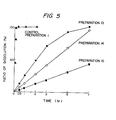
- Example 1 The dissolution of caffeine was examined using the spherical granules (caffeine content 300 mg/g) used in Example 1 as a control preparation 1, and pharmaceutical preparations 1 to 3 obtained in Example 1 to 3 in accordance with JPX dissolution test method, second method (purified water was used as a test liquid, and the amount of caffeine dissolved from the sample into the test liquid at an appropriate time was measured). The results are shown in Figure 1.
- Ethyl cellulose (8 g) was dissolved in 192 g of ethanol to prepare 200 g of a binder solution.
- a coating device 500 g of the same spherical granules having a size of 16 to 32 mesh (caffeine content 300 mg/g) as used in Example 1 were tumbled, and the binder solution was sprayed onto these granules. Simultaneously, 100 g of hardened castor oil having an average particle diameter of 30 microns was gradually sprinkled onto the surface of the spherical granules. The coated granules were dried at 60°C for 1 hour to obtain granules (A).
- a sustained-release pharmaceutical preparation (17) was obtained by heat-treating the granules (A) obtained in Example 16, (1) at 80°C for 3 hours as in accordance with Example 16, (2).
- a sustained-release pharmaceutical preparation (18) was obtained by heat-treating the granules (A) obtained in Example 16, (1) at 90 0 C for 1 hour as in accordance with Example 16, (2).
- a sustained-release pharmaceutical preparation (19) was obtained by heat-treating the granules (A) obtained in Example 16, (1) at 90°C for 3 hours as in accordance with Example 16, (2).
- Granules (B) were prepared as in Example 16, (1) except that 100 g of carnauba wax having an average particle diameter of 15 microns were used insead of 100 g of the hardened castor oil.
- a sustained-release pharmaceutical preparation (20) was obtained by heat-treating the granules (B) obtained in (1) above in accordance with Example 16, (2).
- a sustained-release pharmaceutical preparation (21) was obtained by heat-treating the granules (B) obtained in Example 20, (1) at 80°C for 3 hours in accordance with Example 20, (2).
- a sustained-release pharmaceutical preparation (22) was obtained by heat-treating the granules (B) obtained in Example 20, (1) at 90°C for 1 hour in accordance with Example 20, (2).
- a sustained-release pharmaceutical preparation (23) was obtained by heat-treating the granules (B) obtained in Example 20, (1) at 90°C for 3 hours in accordance with Example 20, (2).
Landscapes
- Engineering & Computer Science (AREA)
- Bioinformatics & Cheminformatics (AREA)
- Health & Medical Sciences (AREA)
- Epidemiology (AREA)
- Medicinal Chemistry (AREA)
- Pharmacology & Pharmacy (AREA)
- Chemical & Material Sciences (AREA)
- Life Sciences & Earth Sciences (AREA)
- Animal Behavior & Ethology (AREA)
- General Health & Medical Sciences (AREA)
- Public Health (AREA)
- Veterinary Medicine (AREA)
- Medicinal Preparation (AREA)
- Pharmaceuticals Containing Other Organic And Inorganic Compounds (AREA)
- Acyclic And Carbocyclic Compounds In Medicinal Compositions (AREA)
Priority Applications (1)
| Application Number | Priority Date | Filing Date | Title |
|---|---|---|---|
| AT86115829T ATE66144T1 (de) | 1985-11-15 | 1986-11-14 | Herstellungsverfahren fuer arzneimittel mit verzoegerter wirkstoffabgabe. |
Applications Claiming Priority (2)
| Application Number | Priority Date | Filing Date | Title |
|---|---|---|---|
| JP25730285 | 1985-11-15 | ||
| JP257302/85 | 1985-11-15 |
Publications (3)
| Publication Number | Publication Date |
|---|---|
| EP0222411A2 true EP0222411A2 (de) | 1987-05-20 |
| EP0222411A3 EP0222411A3 (en) | 1987-11-25 |
| EP0222411B1 EP0222411B1 (de) | 1991-08-14 |
Family
ID=17304474
Family Applications (1)
| Application Number | Title | Priority Date | Filing Date |
|---|---|---|---|
| EP86115829A Expired EP0222411B1 (de) | 1985-11-15 | 1986-11-14 | Herstellungsverfahren für Arzneimittel mit verzögerter Wirkstoffabgabe |
Country Status (5)
| Country | Link |
|---|---|
| US (1) | US4853249A (de) |
| EP (1) | EP0222411B1 (de) |
| AT (1) | ATE66144T1 (de) |
| DE (1) | DE3680866D1 (de) |
| ES (1) | ES2029789T3 (de) |
Cited By (5)
| Publication number | Priority date | Publication date | Assignee | Title |
|---|---|---|---|---|
| EP0306699A1 (de) * | 1987-08-11 | 1989-03-15 | Bayer Ag | Dihydropyridin-Retard-Zubereitung |
| EP0381220A3 (en) * | 1989-02-02 | 1990-12-05 | Warner-Lambert Company | Water dispersible gemfibrozil compositions |
| EP0508653A1 (de) * | 1991-04-08 | 1992-10-14 | Tanabe Seiyaku Co., Ltd. | Pharmazeutische Zubereitung mit verzögerter Wirkstoffreigabe und Verfahren zur Herstellung derselben |
| EP0716853A1 (de) * | 1994-12-16 | 1996-06-19 | Societe Des Produits Nestle S.A. | Koffeinzubereitung mit verzögerter Freisetzung |
| WO1999008661A1 (en) * | 1997-08-15 | 1999-02-25 | Fuisz Technologies Ltd. | Controlled release dosage forms containing water soluble drugs |
Families Citing this family (19)
| Publication number | Priority date | Publication date | Assignee | Title |
|---|---|---|---|---|
| US5271946A (en) * | 1988-04-20 | 1993-12-21 | Asta Pharma Aktiengesellschaft | Controlled release azelastine-containing pharmaceutical compositions |
| DE3827214A1 (de) * | 1988-08-11 | 1990-02-15 | Roehm Gmbh | Retardierte arzneiform und verfahren zu ihrer herstellung |
| US5252337A (en) * | 1991-06-25 | 1993-10-12 | Eurand America, Inc. | Controlled release calcium channel blocker microcapsules |
| US6764697B1 (en) * | 1991-06-27 | 2004-07-20 | Alza Corporation | System for delaying drug delivery up to seven hours |
| US5407686A (en) * | 1991-11-27 | 1995-04-18 | Sidmak Laboratories, Inc. | Sustained release composition for oral administration of active ingredient |
| GB9325445D0 (en) | 1993-12-13 | 1994-02-16 | Cortecs Ltd | Pharmaceutical formulations |
| US5891474A (en) | 1997-01-29 | 1999-04-06 | Poli Industria Chimica, S.P.A. | Time-specific controlled release dosage formulations and method of preparing same |
| US5788987A (en) * | 1997-01-29 | 1998-08-04 | Poli Industria Chimica Spa | Methods for treating early morning pathologies |
| CA2216215A1 (en) * | 1997-04-05 | 1998-10-05 | Isa Odidi | Controlled release formulations using intelligent polymers having opposing wettability characteristics of hydrophobicity and hydrophilicity |
| NZ527832A (en) * | 2001-03-13 | 2006-03-31 | Penwest Pharmaceuticals Co | Chronotherapeutic dosage forms |
| US20030070584A1 (en) | 2001-05-15 | 2003-04-17 | Cynthia Gulian | Dip coating compositions containing cellulose ethers |
| CA2461616A1 (en) | 2001-09-28 | 2003-04-03 | Mcneil-Ppc, Inc. | Composite dosage forms having an inlaid portion |
| US7838026B2 (en) | 2001-09-28 | 2010-11-23 | Mcneil-Ppc, Inc. | Burst-release polymer composition and dosage forms comprising the same |
| US7122143B2 (en) | 2001-09-28 | 2006-10-17 | Mcneil-Ppc, Inc. | Methods for manufacturing dosage forms |
| US8309118B2 (en) | 2001-09-28 | 2012-11-13 | Mcneil-Ppc, Inc. | Film forming compositions containing sucralose |
| US7429619B2 (en) | 2002-08-02 | 2008-09-30 | Mcneil Consumer Healthcare | Polyacrylic film forming compositions |
| US20040185170A1 (en) * | 2003-03-21 | 2004-09-23 | Shubha Chungi | Method for coating drug-containing particles and formulations and dosage units formed therefrom |
| AU2004273958A1 (en) * | 2003-09-19 | 2005-03-31 | Penwest Pharmaceuticals Co. | Chronotherapeutic dosage forms |
| EA200600598A1 (ru) * | 2003-09-19 | 2006-08-25 | Пенвест Фармасьютикалз Ко. | Лекарственные формы замедленного высвобождения |
Family Cites Families (5)
| Publication number | Priority date | Publication date | Assignee | Title |
|---|---|---|---|---|
| US2921883A (en) * | 1957-05-03 | 1960-01-19 | Smith Kline French Lab | Novel coating material for medicaments |
| US3115441A (en) * | 1962-06-06 | 1963-12-24 | Victor M Hermelin | Timed release pharmaceutical preparations and method of making the same |
| DK151608C (da) * | 1982-08-13 | 1988-06-20 | Benzon As Alfred | Fremgangsmaade til fremstilling af et farmaceutisk peroralt polydepotpraeparat med kontrolleret afgivelse |
| US4684516A (en) * | 1983-08-01 | 1987-08-04 | Alra Laboratories, Inc. | Sustained release tablets and method of making same |
| US4568560A (en) * | 1984-03-16 | 1986-02-04 | Warner-Lambert Company | Encapsulated fragrances and flavors and process therefor |
-
1986
- 1986-11-10 US US06/928,370 patent/US4853249A/en not_active Expired - Fee Related
- 1986-11-14 AT AT86115829T patent/ATE66144T1/de not_active IP Right Cessation
- 1986-11-14 DE DE8686115829T patent/DE3680866D1/de not_active Expired - Lifetime
- 1986-11-14 ES ES198686115829T patent/ES2029789T3/es not_active Expired - Lifetime
- 1986-11-14 EP EP86115829A patent/EP0222411B1/de not_active Expired
Cited By (12)
| Publication number | Priority date | Publication date | Assignee | Title |
|---|---|---|---|---|
| EP0306699A1 (de) * | 1987-08-11 | 1989-03-15 | Bayer Ag | Dihydropyridin-Retard-Zubereitung |
| US4933186A (en) * | 1987-08-11 | 1990-06-12 | Bayer Aktiengesellschaft | Dihydropyridine depot formulation |
| EP0381220A3 (en) * | 1989-02-02 | 1990-12-05 | Warner-Lambert Company | Water dispersible gemfibrozil compositions |
| EP0508653A1 (de) * | 1991-04-08 | 1992-10-14 | Tanabe Seiyaku Co., Ltd. | Pharmazeutische Zubereitung mit verzögerter Wirkstoffreigabe und Verfahren zur Herstellung derselben |
| US5389380A (en) * | 1991-04-08 | 1995-02-14 | Tanabe Seiyaku Co., Ltd. | Sustained release pharmaceutical preparation and process for preparing the same |
| EP0716853A1 (de) * | 1994-12-16 | 1996-06-19 | Societe Des Produits Nestle S.A. | Koffeinzubereitung mit verzögerter Freisetzung |
| WO1996018389A1 (en) * | 1994-12-16 | 1996-06-20 | Societe Des Produits Nestle Sa | Sustained release caffeine formulation |
| US5700484A (en) * | 1994-12-16 | 1997-12-23 | Nestec S.A. | Sustained release microparticulate caffeine formulation |
| US5744164A (en) * | 1994-12-16 | 1998-04-28 | Nestec S.A. | Sustained release microparticulate caffeine formulation |
| AU694810B2 (en) * | 1994-12-16 | 1998-07-30 | Societe Des Produits Nestle S.A. | Sustained release caffeine formulation |
| RU2144353C1 (ru) * | 1994-12-16 | 2000-01-20 | Сосьете Де Продюи Нестле С.А. | Кофеинсодержащие композиции продолжительного действия |
| WO1999008661A1 (en) * | 1997-08-15 | 1999-02-25 | Fuisz Technologies Ltd. | Controlled release dosage forms containing water soluble drugs |
Also Published As
| Publication number | Publication date |
|---|---|
| EP0222411B1 (de) | 1991-08-14 |
| ATE66144T1 (de) | 1991-08-15 |
| US4853249A (en) | 1989-08-01 |
| EP0222411A3 (en) | 1987-11-25 |
| DE3680866D1 (de) | 1991-09-19 |
| ES2029789T3 (es) | 1992-10-01 |
Similar Documents
| Publication | Publication Date | Title |
|---|---|---|
| EP0222411B1 (de) | Herstellungsverfahren für Arzneimittel mit verzögerter Wirkstoffabgabe | |
| KR100502938B1 (ko) | 구상체의 제제 공정 및 약제 조성물 | |
| JP2538134B2 (ja) | 徐放性製剤およびその製造法 | |
| AU651715B2 (en) | Pharmaceutical spheroid formulation | |
| US6890561B1 (en) | Microencapsulated and controlled-release formulations of isoflavone from enriched fractions of soy and other plants | |
| KR100227999B1 (ko) | 약물을 비들렛 형태로 제조하기 위한 방법 | |
| US6238704B1 (en) | Sustained-release preparation utilizing thermal change and process for the production thereof | |
| SE509029C2 (sv) | Långtidsverkande diklofenak-natriumpreparat | |
| HRP20010463A2 (en) | Controlled release galantamine composition | |
| NZ227631A (en) | Oral composition comprising a mixture of granulates having immediate release properties and sustained release properties | |
| NZ232030A (en) | Sustained release pharmaceutical pellet composition; theophylline compound core, coated to allow faster release rate in intestine | |
| EP0277042A2 (de) | Oral anwendbares pharmazeutisches Präparat mit verbesserter Geschmackscharakteristik | |
| EP1278514B1 (de) | Mikroverkapselte und mit gesteurter freigabe kräuter formulierungen | |
| US5498447A (en) | Coating method | |
| KR0133531B1 (ko) | 액체 약제 제형용 서방성 치료 시스템 | |
| CZ288028B6 (cs) | Způsob výroby lékové formy obsahující karbamazepin se zpožděným uvolňováním účinné látky | |
| JP2004339162A (ja) | 難溶性薬物を含む医薬用固形製剤とその製造方法 | |
| JP2892858B2 (ja) | 放出制御製剤およびその製造法 | |
| JPH0764726B2 (ja) | 持効性製剤の製造方法 | |
| JP2987813B2 (ja) | ワックス被覆製剤およびその製法 | |
| JP2700662B2 (ja) | 被覆製剤 | |
| Sakarkar et al. | Application of cow ghee as hot melt coating agent in the design of sustained release pellets | |
| JPH04321621A (ja) | 徐放性細粒剤およびその製法 | |
| JPH0667823B2 (ja) | 経口持効性製剤の製造方法 | |
| JPH0420889B2 (de) |
Legal Events
| Date | Code | Title | Description |
|---|---|---|---|
| PUAI | Public reference made under article 153(3) epc to a published international application that has entered the european phase |
Free format text: ORIGINAL CODE: 0009012 |
|
| AK | Designated contracting states |
Kind code of ref document: A2 Designated state(s): AT BE CH DE ES FR GB GR IT LI LU NL SE |
|
| PUAL | Search report despatched |
Free format text: ORIGINAL CODE: 0009013 |
|
| AK | Designated contracting states |
Kind code of ref document: A3 Designated state(s): AT BE CH DE ES FR GB GR IT LI LU NL SE |
|
| 17P | Request for examination filed |
Effective date: 19880304 |
|
| 17Q | First examination report despatched |
Effective date: 19890803 |
|
| GRAA | (expected) grant |
Free format text: ORIGINAL CODE: 0009210 |
|
| ITF | It: translation for a ep patent filed | ||
| AK | Designated contracting states |
Kind code of ref document: B1 Designated state(s): AT BE CH DE ES FR GB GR IT LI LU NL SE |
|
| PG25 | Lapsed in a contracting state [announced via postgrant information from national office to epo] |
Ref country code: GR Free format text: LAPSE BECAUSE OF FAILURE TO SUBMIT A TRANSLATION OF THE DESCRIPTION OR TO PAY THE FEE WITHIN THE PRESCRIBED TIME-LIMIT Effective date: 19910814 |
|
| REF | Corresponds to: |
Ref document number: 66144 Country of ref document: AT Date of ref document: 19910815 Kind code of ref document: T |
|
| REF | Corresponds to: |
Ref document number: 3680866 Country of ref document: DE Date of ref document: 19910919 |
|
| ET | Fr: translation filed | ||
| PLBE | No opposition filed within time limit |
Free format text: ORIGINAL CODE: 0009261 |
|
| STAA | Information on the status of an ep patent application or granted ep patent |
Free format text: STATUS: NO OPPOSITION FILED WITHIN TIME LIMIT |
|
| 26N | No opposition filed | ||
| REG | Reference to a national code |
Ref country code: ES Ref legal event code: FG2A Ref document number: 2029789 Country of ref document: ES Kind code of ref document: T3 |
|
| EPTA | Lu: last paid annual fee | ||
| EAL | Se: european patent in force in sweden |
Ref document number: 86115829.3 |
|
| PGFP | Annual fee paid to national office [announced via postgrant information from national office to epo] |
Ref country code: SE Payment date: 19981105 Year of fee payment: 13 |
|
| PGFP | Annual fee paid to national office [announced via postgrant information from national office to epo] |
Ref country code: FR Payment date: 19981110 Year of fee payment: 13 |
|
| PGFP | Annual fee paid to national office [announced via postgrant information from national office to epo] |
Ref country code: AT Payment date: 19981112 Year of fee payment: 13 |
|
| PGFP | Annual fee paid to national office [announced via postgrant information from national office to epo] |
Ref country code: GB Payment date: 19981120 Year of fee payment: 13 Ref country code: DE Payment date: 19981120 Year of fee payment: 13 Ref country code: CH Payment date: 19981120 Year of fee payment: 13 |
|
| PGFP | Annual fee paid to national office [announced via postgrant information from national office to epo] |
Ref country code: ES Payment date: 19981123 Year of fee payment: 13 |
|
| PGFP | Annual fee paid to national office [announced via postgrant information from national office to epo] |
Ref country code: NL Payment date: 19981126 Year of fee payment: 13 |
|
| PGFP | Annual fee paid to national office [announced via postgrant information from national office to epo] |
Ref country code: LU Payment date: 19981214 Year of fee payment: 13 |
|
| PGFP | Annual fee paid to national office [announced via postgrant information from national office to epo] |
Ref country code: BE Payment date: 19990119 Year of fee payment: 13 |
|
| PG25 | Lapsed in a contracting state [announced via postgrant information from national office to epo] |
Ref country code: LU Free format text: LAPSE BECAUSE OF NON-PAYMENT OF DUE FEES Effective date: 19991114 Ref country code: GB Free format text: LAPSE BECAUSE OF NON-PAYMENT OF DUE FEES Effective date: 19991114 Ref country code: AT Free format text: LAPSE BECAUSE OF NON-PAYMENT OF DUE FEES Effective date: 19991114 |
|
| PG25 | Lapsed in a contracting state [announced via postgrant information from national office to epo] |
Ref country code: SE Free format text: LAPSE BECAUSE OF NON-PAYMENT OF DUE FEES Effective date: 19991115 Ref country code: ES Free format text: LAPSE BECAUSE OF NON-PAYMENT OF DUE FEES Effective date: 19991115 |
|
| PG25 | Lapsed in a contracting state [announced via postgrant information from national office to epo] |
Ref country code: LI Free format text: LAPSE BECAUSE OF NON-PAYMENT OF DUE FEES Effective date: 19991130 Ref country code: CH Free format text: LAPSE BECAUSE OF NON-PAYMENT OF DUE FEES Effective date: 19991130 Ref country code: BE Free format text: LAPSE BECAUSE OF NON-PAYMENT OF DUE FEES Effective date: 19991130 |
|
| BERE | Be: lapsed |
Owner name: TAISHO PHARMACEUTICAL CO. LTD Effective date: 19991130 |
|
| PG25 | Lapsed in a contracting state [announced via postgrant information from national office to epo] |
Ref country code: NL Free format text: LAPSE BECAUSE OF NON-PAYMENT OF DUE FEES Effective date: 20000601 |
|
| GBPC | Gb: european patent ceased through non-payment of renewal fee |
Effective date: 19991114 |
|
| REG | Reference to a national code |
Ref country code: CH Ref legal event code: PL |
|
| EUG | Se: european patent has lapsed |
Ref document number: 86115829.3 |
|
| PG25 | Lapsed in a contracting state [announced via postgrant information from national office to epo] |
Ref country code: FR Free format text: LAPSE BECAUSE OF NON-PAYMENT OF DUE FEES Effective date: 20000731 |
|
| NLV4 | Nl: lapsed or anulled due to non-payment of the annual fee |
Effective date: 20000601 |
|
| PG25 | Lapsed in a contracting state [announced via postgrant information from national office to epo] |
Ref country code: DE Free format text: LAPSE BECAUSE OF NON-PAYMENT OF DUE FEES Effective date: 20000901 |
|
| REG | Reference to a national code |
Ref country code: FR Ref legal event code: ST |
|
| REG | Reference to a national code |
Ref country code: ES Ref legal event code: FD2A Effective date: 20001214 |
|
| PG25 | Lapsed in a contracting state [announced via postgrant information from national office to epo] |
Ref country code: IT Free format text: LAPSE BECAUSE OF NON-PAYMENT OF DUE FEES Effective date: 20051114 |