EP0222471B1 - Hitzebeständige Zusammensetzung und Verfahren zu deren Herstellung - Google Patents
Hitzebeständige Zusammensetzung und Verfahren zu deren Herstellung Download PDFInfo
- Publication number
- EP0222471B1 EP0222471B1 EP86306220A EP86306220A EP0222471B1 EP 0222471 B1 EP0222471 B1 EP 0222471B1 EP 86306220 A EP86306220 A EP 86306220A EP 86306220 A EP86306220 A EP 86306220A EP 0222471 B1 EP0222471 B1 EP 0222471B1
- Authority
- EP
- European Patent Office
- Prior art keywords
- alkoxide
- temperature
- specific surface
- surface area
- catalyst
- Prior art date
- Legal status (The legal status is an assumption and is not a legal conclusion. Google has not performed a legal analysis and makes no representation as to the accuracy of the status listed.)
- Expired
Links
- 238000000034 method Methods 0.000 title claims description 53
- 239000000203 mixture Substances 0.000 title claims description 52
- PNEYBMLMFCGWSK-UHFFFAOYSA-N aluminium oxide Inorganic materials [O-2].[O-2].[O-2].[Al+3].[Al+3] PNEYBMLMFCGWSK-UHFFFAOYSA-N 0.000 claims description 70
- 239000003054 catalyst Substances 0.000 claims description 67
- 150000004703 alkoxides Chemical class 0.000 claims description 40
- 238000010304 firing Methods 0.000 claims description 31
- XLYOFNOQVPJJNP-UHFFFAOYSA-N water Substances O XLYOFNOQVPJJNP-UHFFFAOYSA-N 0.000 claims description 28
- 229910052593 corundum Inorganic materials 0.000 claims description 23
- 229910001845 yogo sapphire Inorganic materials 0.000 claims description 23
- 229910052788 barium Inorganic materials 0.000 claims description 20
- 238000006460 hydrolysis reaction Methods 0.000 claims description 18
- 229910052782 aluminium Inorganic materials 0.000 claims description 16
- 229910052751 metal Inorganic materials 0.000 claims description 16
- 239000002184 metal Substances 0.000 claims description 16
- 230000032683 aging Effects 0.000 claims description 14
- DSAJWYNOEDNPEQ-UHFFFAOYSA-N barium atom Chemical group [Ba] DSAJWYNOEDNPEQ-UHFFFAOYSA-N 0.000 claims description 14
- 230000007062 hydrolysis Effects 0.000 claims description 14
- -1 aluminium alkoxide Chemical class 0.000 claims description 12
- 238000002156 mixing Methods 0.000 claims description 11
- 229910052791 calcium Inorganic materials 0.000 claims description 10
- 229910052712 strontium Inorganic materials 0.000 claims description 9
- 239000004411 aluminium Substances 0.000 claims description 8
- 230000001476 alcoholic effect Effects 0.000 claims description 7
- LFQSCWFLJHTTHZ-UHFFFAOYSA-N Ethanol Chemical compound CCO LFQSCWFLJHTTHZ-UHFFFAOYSA-N 0.000 claims description 6
- 238000001354 calcination Methods 0.000 claims description 4
- IJGRMHOSHXDMSA-UHFFFAOYSA-N Atomic nitrogen Chemical compound N#N IJGRMHOSHXDMSA-UHFFFAOYSA-N 0.000 claims description 3
- 230000005587 bubbling Effects 0.000 claims description 3
- 230000003197 catalytic effect Effects 0.000 claims description 3
- 229910001873 dinitrogen Inorganic materials 0.000 claims description 3
- 230000001747 exhibiting effect Effects 0.000 claims description 3
- 125000004432 carbon atom Chemical group C* 0.000 claims description 2
- 238000001035 drying Methods 0.000 claims description 2
- 238000005979 thermal decomposition reaction Methods 0.000 claims description 2
- QVQLCTNNEUAWMS-UHFFFAOYSA-N barium oxide Chemical compound [Ba]=O QVQLCTNNEUAWMS-UHFFFAOYSA-N 0.000 description 52
- 239000000969 carrier Substances 0.000 description 36
- 239000000843 powder Substances 0.000 description 29
- 230000000052 comparative effect Effects 0.000 description 22
- 239000000243 solution Substances 0.000 description 21
- 230000000694 effects Effects 0.000 description 18
- 230000008569 process Effects 0.000 description 13
- KFZMGEQAYNKOFK-UHFFFAOYSA-N Isopropanol Chemical compound CC(C)O KFZMGEQAYNKOFK-UHFFFAOYSA-N 0.000 description 10
- 238000007084 catalytic combustion reaction Methods 0.000 description 10
- 230000007423 decrease Effects 0.000 description 10
- 238000002441 X-ray diffraction Methods 0.000 description 8
- XAGFODPZIPBFFR-UHFFFAOYSA-N aluminium Chemical compound [Al] XAGFODPZIPBFFR-UHFFFAOYSA-N 0.000 description 6
- 230000015572 biosynthetic process Effects 0.000 description 6
- 239000011575 calcium Substances 0.000 description 6
- VNWKTOKETHGBQD-UHFFFAOYSA-N methane Chemical compound C VNWKTOKETHGBQD-UHFFFAOYSA-N 0.000 description 6
- 239000007787 solid Substances 0.000 description 6
- PXHVJJICTQNCMI-UHFFFAOYSA-N Nickel Chemical compound [Ni] PXHVJJICTQNCMI-UHFFFAOYSA-N 0.000 description 4
- VYPSYNLAJGMNEJ-UHFFFAOYSA-N Silicium dioxide Chemical compound O=[Si]=O VYPSYNLAJGMNEJ-UHFFFAOYSA-N 0.000 description 4
- SMZOGRDCAXLAAR-UHFFFAOYSA-N aluminium isopropoxide Chemical compound [Al+3].CC(C)[O-].CC(C)[O-].CC(C)[O-] SMZOGRDCAXLAAR-UHFFFAOYSA-N 0.000 description 4
- AYJRCSIUFZENHW-UHFFFAOYSA-L barium carbonate Chemical compound [Ba+2].[O-]C([O-])=O AYJRCSIUFZENHW-UHFFFAOYSA-L 0.000 description 4
- 238000006243 chemical reaction Methods 0.000 description 4
- TWNQGVIAIRXVLR-UHFFFAOYSA-N oxo(oxoalumanyloxy)alumane Chemical compound O=[Al]O[Al]=O TWNQGVIAIRXVLR-UHFFFAOYSA-N 0.000 description 4
- 239000007858 starting material Substances 0.000 description 4
- 230000007704 transition Effects 0.000 description 4
- 239000007864 aqueous solution Substances 0.000 description 3
- ODINCKMPIJJUCX-UHFFFAOYSA-N calcium oxide Inorganic materials [Ca]=O ODINCKMPIJJUCX-UHFFFAOYSA-N 0.000 description 3
- 238000002485 combustion reaction Methods 0.000 description 3
- 230000003247 decreasing effect Effects 0.000 description 3
- 239000007789 gas Substances 0.000 description 3
- 230000006872 improvement Effects 0.000 description 3
- 230000014759 maintenance of location Effects 0.000 description 3
- 238000004519 manufacturing process Methods 0.000 description 3
- 229910044991 metal oxide Inorganic materials 0.000 description 3
- 150000004706 metal oxides Chemical class 0.000 description 3
- 238000005245 sintering Methods 0.000 description 3
- IATRAKWUXMZMIY-UHFFFAOYSA-N strontium oxide Chemical compound [O-2].[Sr+2] IATRAKWUXMZMIY-UHFFFAOYSA-N 0.000 description 3
- 239000000725 suspension Substances 0.000 description 3
- BNGXYYYYKUGPPF-UHFFFAOYSA-M (3-methylphenyl)methyl-triphenylphosphanium;chloride Chemical compound [Cl-].CC1=CC=CC(C[P+](C=2C=CC=CC=2)(C=2C=CC=CC=2)C=2C=CC=CC=2)=C1 BNGXYYYYKUGPPF-UHFFFAOYSA-M 0.000 description 2
- OYPRJOBELJOOCE-UHFFFAOYSA-N Calcium Chemical compound [Ca] OYPRJOBELJOOCE-UHFFFAOYSA-N 0.000 description 2
- CURLTUGMZLYLDI-UHFFFAOYSA-N Carbon dioxide Chemical compound O=C=O CURLTUGMZLYLDI-UHFFFAOYSA-N 0.000 description 2
- FYYHWMGAXLPEAU-UHFFFAOYSA-N Magnesium Chemical compound [Mg] FYYHWMGAXLPEAU-UHFFFAOYSA-N 0.000 description 2
- CDBYLPFSWZWCQE-UHFFFAOYSA-L Sodium Carbonate Chemical compound [Na+].[Na+].[O-]C([O-])=O CDBYLPFSWZWCQE-UHFFFAOYSA-L 0.000 description 2
- 150000001298 alcohols Chemical class 0.000 description 2
- 229910052784 alkaline earth metal Inorganic materials 0.000 description 2
- 150000001342 alkaline earth metals Chemical class 0.000 description 2
- IWOUKMZUPDVPGQ-UHFFFAOYSA-N barium nitrate Chemical compound [Ba+2].[O-][N+]([O-])=O.[O-][N+]([O-])=O IWOUKMZUPDVPGQ-UHFFFAOYSA-N 0.000 description 2
- CPUJSIVIXCTVEI-UHFFFAOYSA-N barium(2+);propan-2-olate Chemical compound [Ba+2].CC(C)[O-].CC(C)[O-] CPUJSIVIXCTVEI-UHFFFAOYSA-N 0.000 description 2
- 239000000292 calcium oxide Substances 0.000 description 2
- 229910052799 carbon Inorganic materials 0.000 description 2
- 150000004649 carbonic acid derivatives Chemical class 0.000 description 2
- 238000005265 energy consumption Methods 0.000 description 2
- 239000000446 fuel Substances 0.000 description 2
- 229910052749 magnesium Inorganic materials 0.000 description 2
- 239000011777 magnesium Substances 0.000 description 2
- 239000000463 material Substances 0.000 description 2
- 239000012299 nitrogen atmosphere Substances 0.000 description 2
- 239000002245 particle Substances 0.000 description 2
- 238000002360 preparation method Methods 0.000 description 2
- OGHBATFHNDZKSO-UHFFFAOYSA-N propan-2-olate Chemical compound CC(C)[O-] OGHBATFHNDZKSO-UHFFFAOYSA-N 0.000 description 2
- 229910001404 rare earth metal oxide Inorganic materials 0.000 description 2
- 230000009467 reduction Effects 0.000 description 2
- 239000000377 silicon dioxide Substances 0.000 description 2
- 239000002904 solvent Substances 0.000 description 2
- VHUUQVKOLVNVRT-UHFFFAOYSA-N Ammonium hydroxide Chemical compound [NH4+].[OH-] VHUUQVKOLVNVRT-UHFFFAOYSA-N 0.000 description 1
- FIPWRIJSWJWJAI-UHFFFAOYSA-N Butyl carbitol 6-propylpiperonyl ether Chemical compound C1=C(CCC)C(COCCOCCOCCCC)=CC2=C1OCO2 FIPWRIJSWJWJAI-UHFFFAOYSA-N 0.000 description 1
- OKTJSMMVPCPJKN-UHFFFAOYSA-N Carbon Chemical compound [C] OKTJSMMVPCPJKN-UHFFFAOYSA-N 0.000 description 1
- VYZAMTAEIAYCRO-UHFFFAOYSA-N Chromium Chemical compound [Cr] VYZAMTAEIAYCRO-UHFFFAOYSA-N 0.000 description 1
- 229910002651 NO3 Inorganic materials 0.000 description 1
- NHNBFGGVMKEFGY-UHFFFAOYSA-N Nitrate Chemical compound [O-][N+]([O-])=O NHNBFGGVMKEFGY-UHFFFAOYSA-N 0.000 description 1
- 230000010718 Oxidation Activity Effects 0.000 description 1
- XUIMIQQOPSSXEZ-UHFFFAOYSA-N Silicon Chemical compound [Si] XUIMIQQOPSSXEZ-UHFFFAOYSA-N 0.000 description 1
- QCWXUUIWCKQGHC-UHFFFAOYSA-N Zirconium Chemical compound [Zr] QCWXUUIWCKQGHC-UHFFFAOYSA-N 0.000 description 1
- 238000013019 agitation Methods 0.000 description 1
- 229910052783 alkali metal Inorganic materials 0.000 description 1
- 229910000272 alkali metal oxide Inorganic materials 0.000 description 1
- 150000001340 alkali metals Chemical class 0.000 description 1
- 150000001341 alkaline earth metal compounds Chemical class 0.000 description 1
- 229910000287 alkaline earth metal oxide Inorganic materials 0.000 description 1
- AZDRQVAHHNSJOQ-UHFFFAOYSA-N alumane Chemical compound [AlH3] AZDRQVAHHNSJOQ-UHFFFAOYSA-N 0.000 description 1
- QGZKDVFQNNGYKY-UHFFFAOYSA-N ammonia Natural products N QGZKDVFQNNGYKY-UHFFFAOYSA-N 0.000 description 1
- QVGXLLKOCUKJST-UHFFFAOYSA-N atomic oxygen Chemical compound [O] QVGXLLKOCUKJST-UHFFFAOYSA-N 0.000 description 1
- AYJRCSIUFZENHW-DEQYMQKBSA-L barium(2+);oxomethanediolate Chemical compound [Ba+2].[O-][14C]([O-])=O AYJRCSIUFZENHW-DEQYMQKBSA-L 0.000 description 1
- CSSYLTMKCUORDA-UHFFFAOYSA-N barium(2+);oxygen(2-) Chemical class [O-2].[Ba+2] CSSYLTMKCUORDA-UHFFFAOYSA-N 0.000 description 1
- BRPQOXSCLDDYGP-UHFFFAOYSA-N calcium oxide Chemical compound [O-2].[Ca+2] BRPQOXSCLDDYGP-UHFFFAOYSA-N 0.000 description 1
- MMLSWLZTJDJYJH-UHFFFAOYSA-N calcium;propan-2-olate Chemical compound [Ca+2].CC(C)[O-].CC(C)[O-] MMLSWLZTJDJYJH-UHFFFAOYSA-N 0.000 description 1
- 239000001569 carbon dioxide Substances 0.000 description 1
- 229910002092 carbon dioxide Inorganic materials 0.000 description 1
- 238000006555 catalytic reaction Methods 0.000 description 1
- 230000008859 change Effects 0.000 description 1
- 239000003795 chemical substances by application Substances 0.000 description 1
- 229910052804 chromium Inorganic materials 0.000 description 1
- 239000011651 chromium Substances 0.000 description 1
- 238000000975 co-precipitation Methods 0.000 description 1
- 229940011182 cobalt acetate Drugs 0.000 description 1
- UFMZWBIQTDUYBN-UHFFFAOYSA-N cobalt dinitrate Chemical compound [Co+2].[O-][N+]([O-])=O.[O-][N+]([O-])=O UFMZWBIQTDUYBN-UHFFFAOYSA-N 0.000 description 1
- 229910001981 cobalt nitrate Inorganic materials 0.000 description 1
- 229910000428 cobalt oxide Inorganic materials 0.000 description 1
- QAHREYKOYSIQPH-UHFFFAOYSA-L cobalt(II) acetate Chemical compound [Co+2].CC([O-])=O.CC([O-])=O QAHREYKOYSIQPH-UHFFFAOYSA-L 0.000 description 1
- UBEWDCMIDFGDOO-UHFFFAOYSA-N cobalt(II,III) oxide Inorganic materials [O-2].[O-2].[O-2].[O-2].[Co+2].[Co+3].[Co+3] UBEWDCMIDFGDOO-UHFFFAOYSA-N 0.000 description 1
- IVMYJDGYRUAWML-UHFFFAOYSA-N cobalt(ii) oxide Chemical compound [Co]=O IVMYJDGYRUAWML-UHFFFAOYSA-N 0.000 description 1
- 150000001875 compounds Chemical class 0.000 description 1
- 239000013078 crystal Substances 0.000 description 1
- 238000000354 decomposition reaction Methods 0.000 description 1
- 230000018109 developmental process Effects 0.000 description 1
- 230000003292 diminished effect Effects 0.000 description 1
- HHFAWKCIHAUFRX-UHFFFAOYSA-N ethoxide Chemical compound CC[O-] HHFAWKCIHAUFRX-UHFFFAOYSA-N 0.000 description 1
- 238000001704 evaporation Methods 0.000 description 1
- 230000008020 evaporation Effects 0.000 description 1
- 238000001125 extrusion Methods 0.000 description 1
- 238000001914 filtration Methods 0.000 description 1
- 230000003301 hydrolyzing effect Effects 0.000 description 1
- 150000004679 hydroxides Chemical class 0.000 description 1
- 239000007788 liquid Substances 0.000 description 1
- 229940071125 manganese acetate Drugs 0.000 description 1
- UOGMEBQRZBEZQT-UHFFFAOYSA-L manganese(2+);diacetate Chemical compound [Mn+2].CC([O-])=O.CC([O-])=O UOGMEBQRZBEZQT-UHFFFAOYSA-L 0.000 description 1
- VUZPPFZMUPKLLV-UHFFFAOYSA-N methane;hydrate Chemical compound C.O VUZPPFZMUPKLLV-UHFFFAOYSA-N 0.000 description 1
- NBTOZLQBSIZIKS-UHFFFAOYSA-N methoxide Chemical compound [O-]C NBTOZLQBSIZIKS-UHFFFAOYSA-N 0.000 description 1
- 229910052759 nickel Inorganic materials 0.000 description 1
- 239000001301 oxygen Substances 0.000 description 1
- 229910052760 oxygen Inorganic materials 0.000 description 1
- 229960005235 piperonyl butoxide Drugs 0.000 description 1
- 229910052761 rare earth metal Inorganic materials 0.000 description 1
- 239000002994 raw material Substances 0.000 description 1
- 239000011819 refractory material Substances 0.000 description 1
- 229910052594 sapphire Inorganic materials 0.000 description 1
- 229910052710 silicon Inorganic materials 0.000 description 1
- 239000010703 silicon Substances 0.000 description 1
- 229910000029 sodium carbonate Inorganic materials 0.000 description 1
- 238000000629 steam reforming Methods 0.000 description 1
- CIOAGBVUUVVLOB-UHFFFAOYSA-N strontium atom Chemical compound [Sr] CIOAGBVUUVVLOB-UHFFFAOYSA-N 0.000 description 1
- OHULXNKDWPTSBI-UHFFFAOYSA-N strontium;propan-2-olate Chemical compound [Sr+2].CC(C)[O-].CC(C)[O-] OHULXNKDWPTSBI-UHFFFAOYSA-N 0.000 description 1
- 230000003313 weakening effect Effects 0.000 description 1
- 238000005303 weighing Methods 0.000 description 1
- 229910052726 zirconium Inorganic materials 0.000 description 1
Images



Classifications
-
- B—PERFORMING OPERATIONS; TRANSPORTING
- B01—PHYSICAL OR CHEMICAL PROCESSES OR APPARATUS IN GENERAL
- B01J—CHEMICAL OR PHYSICAL PROCESSES, e.g. CATALYSIS OR COLLOID CHEMISTRY; THEIR RELEVANT APPARATUS
- B01J23/00—Catalysts comprising metals or metal oxides or hydroxides, not provided for in group B01J21/00
- B01J23/02—Catalysts comprising metals or metal oxides or hydroxides, not provided for in group B01J21/00 of the alkali- or alkaline earth metals or beryllium
-
- C—CHEMISTRY; METALLURGY
- C04—CEMENTS; CONCRETE; ARTIFICIAL STONE; CERAMICS; REFRACTORIES
- C04B—LIME, MAGNESIA; SLAG; CEMENTS; COMPOSITIONS THEREOF, e.g. MORTARS, CONCRETE OR LIKE BUILDING MATERIALS; ARTIFICIAL STONE; CERAMICS; REFRACTORIES; TREATMENT OF NATURAL STONE
- C04B35/00—Shaped ceramic products characterised by their composition; Ceramics compositions; Processing powders of inorganic compounds preparatory to the manufacturing of ceramic products
- C04B35/01—Shaped ceramic products characterised by their composition; Ceramics compositions; Processing powders of inorganic compounds preparatory to the manufacturing of ceramic products based on oxide ceramics
- C04B35/10—Shaped ceramic products characterised by their composition; Ceramics compositions; Processing powders of inorganic compounds preparatory to the manufacturing of ceramic products based on oxide ceramics based on aluminium oxide
-
- C—CHEMISTRY; METALLURGY
- C04—CEMENTS; CONCRETE; ARTIFICIAL STONE; CERAMICS; REFRACTORIES
- C04B—LIME, MAGNESIA; SLAG; CEMENTS; COMPOSITIONS THEREOF, e.g. MORTARS, CONCRETE OR LIKE BUILDING MATERIALS; ARTIFICIAL STONE; CERAMICS; REFRACTORIES; TREATMENT OF NATURAL STONE
- C04B35/00—Shaped ceramic products characterised by their composition; Ceramics compositions; Processing powders of inorganic compounds preparatory to the manufacturing of ceramic products
- C04B35/01—Shaped ceramic products characterised by their composition; Ceramics compositions; Processing powders of inorganic compounds preparatory to the manufacturing of ceramic products based on oxide ceramics
- C04B35/44—Shaped ceramic products characterised by their composition; Ceramics compositions; Processing powders of inorganic compounds preparatory to the manufacturing of ceramic products based on oxide ceramics based on aluminates
Definitions
- the present invention relates to a heat resistant composition, and more particularly to catalysts and catalyst carriers for use in catalytic reactions such as catalytic combustion, etc., and a method of producing the same.
- Catalysts are commercially used at operating temperatures of, for example, 200-600°C in usual petrochemical processes, and at about 750°C in steam reforming process which uses the highest temperature for the catalysts.
- catalytic converters have been used for purifying exhaust gases from automobiles, and the temperature of the converters reaches to about 850°C at the maximum.
- catalysts have been of interest for use at high temperatures in methanation reaction and catalytic combustion reaction for gas turbines, boilers and jet engines, and are expected in some cases to keep their activity even at high temperatures exceeding 1000°C. Under these circumstances, development of catalysts or catalyst carriers of excellent heat resistant property, i.e., ability to keep its high specific surface area even at high temperatures as high as possible, has been earnestly desired.
- a catalytic combustion process in which a catalyst promotes reaction between fuel and oxygen has the following many advantages as compared with conventional non-catalytic combustion processes, so that it has attracted attentions.
- alumina is known to be most heat resistant.
- ⁇ -Alumina is a carrier which has a specific surface area of about 200 m2/g and keeps high specific surface area of more than about 50 m2/g even when used at about 1000°C.
- ⁇ -Alumina it undergoes transition to ⁇ -alumina and rapid sintering occurs to decrease its specific surface area to about 5 m2/g or less.
- the specific surface area of the used alumina becomes less than 1 m2/g which has no significance as a catalyst carrier.
- many attempts have been made to add a second component to alumina and to make complexes thereof.
- This especially preferable rate of 10-20 wt% of barium metal corresponds to Examples 3, 4 and 5 of the above Japanese publication, and the amounts of barium metal in Examples 3, 4 and 5 are respectively about 30 moles, 44.5 moles and 74 moles when calculated per 100 moles of alumina, so that they are very large.
- the purpose of adding the alkaline earth metal compound is not the improvement of its heat resistant property, but is clearly to exhibit an effect of a promoter to prevent formation of carbon on the catalyst surface.
- use temperature of the catalyst is limited to not over than 600°C, so that it is not directed to improvement of heat resistant property of catalyst at high temperatures of 1200°C or more as the present invention aims.
- catalyst carriers for catalytic combustion process etc. alumina carriers or other carriers of comparatively large specific surface area have been used, and studied.
- specific surface area of the carriers deteriorates rapidly, so that the carriers have a drawback of decreasing their activity, particularly when used again at low temperatures. Therefore, catalysts or catalyst carriers have been heretofore desired which have a property of retaining their specific surface area as high as possible and are not fragile even at high temperatures.
- good heat resistant property such property is called as "good heat resistant property”.
- an object of the present invention is to provide especially superior heat resistant composition consisting mainly of aluminum oxide and metal oxide MeO, which is usable especially as heat resistant catalysts or catalyst carriers, the Me being at least one metal selected from the group consisting of Ba, Ca and Sr.
- Another object of the present invention is to provide an especially superior heat resistant composition which is especially suitable as catalysts such as a catalyst for catalytic combustion process which exposes the catalyst at high temperatures exceeding 1100°C, or carriers for such catalysts.
- a further object of the present invention is to provide a method of producing a good heat resistant composition.
- the present invention provides a heat resistant composition consisting mainly of aluminium oxide Al2O3 and metal oxide MeO, which comprises from 5-20 moles of metal oxide MeO per 100 moles of aluminium oxide, the Me being at least one metal selected from Ba, Ca and Sr, the composition being produced according to the method of claims 1-8.
- the dissolving and mixing is carried out whilst bubbling dry nitrogen gas into the solution, the solution obtained thereby is dried under reduced pressure to obtain a gel which is then decomposed by heat, e.g. by precalcination in air at a temperature of from 200-800°C, and firing the precalcined product at not less than 1200°C to obtain the desired heat resistant composition.
- a heat resistant composition produced from a complexed alkoxide or mixed alkoxides of aluminum and the metal Me as raw materials is superior to that produced by the solids mixing method i.e. powders mixing method and the coprecipitation process in the aqueous solution, and is far superior to other usual processes used for production of catalysts or catalyst carriers.
- the heat resistant composition of the present invention can comprise a small amount of a third component selected from the group consisting of silica, rare earth metal oxides and alkali metal oxides.
- alkoxides of aluminum and barium can be used as starting materials for the aluminum oxide and the barium oxide.
- alkoxides alkoxide of 1-4 carbon atoms such as methoxide, ethoxide, isopropoxide and butoxide are preferable.
- Commercial alkoxides can be used, but those alkoxides produced by using aluminum and/or barium metal and alcohols can also be used.
- the content of barium oxide in the heat resistant composition is desirably within a range of about 3-25 moles, particularly about 5-20 moles, to 100 moles of aluminum oxide. Below this range, the influence of addition of barium oxide on heat resistant property is small, while addition of excess amount of barium oxide causes a decrease in the heat resistant property of the heat resistant composition.
- the heat resistant composition can be used in powder form, and in any shapes such as tablet, ring, sphere, extrusion, honeycomb or other shape general in catalysts and catalyst carriers.
- the heat resistant compositions are processed to the finished product through intermediate and/or final steps of drying, optimum precalcination and/or firing.
- the firing step may be effected when using the heat resistant composition in practical use temperature.
- the heat resistant composition is used as a catalyst or catalyst carrier, especially for catalytic combustion process, the firing is an important operation step for obtaining the heat resistant or thermally stabilized composition, and effected at a temperature close to the highest temperature of using the product heat resistant composition.
- the heat resistant composition is a catalyst carrier for high temperature catalytic combustion process, it is naturally expected that a catalyst using the carrier is exposed to a temperature higher than 1300°C during its usage in the process.
- the composition is preferably produced through firing at a temperature of 1300°C or exceeding 1300°C.
- alumina component in any compositions other than that of the present invention such as alumina in ⁇ -alumina carrier, silica-alumina carrier and alumina carriers containing rare earth element, alkali metal or other heat resistant property-improving agent, undergoes transition to ⁇ -alumina phase followed by unavoidable remarkable decrease of specific surface area and accompanying decrease of the activity, especially of low temperature activity, of the heat resistant composition.
- the firing is effected at a high temperature exceeding 1300°C, it is necessary to measure a correspondence relation between firing temperature and specific surface area beforehand, and select suitable firing conditions to obtain suitable range of specific surface area of the composition.
- the firing temperature is selected such that the specific surface area is not less than about 2 m2/g.
- the alkoxide method of this invention formation of the oxides of aluminum and barium from their alkoxides is effected through hydrolysis reactions, though other process such as thermal decomposition, are possible. It is not necessary that all of these oxides are prepared from the corresponding alkoxides.
- alumina, barium carbonate, etc. can be added to the product.
- the hydrolysis reaction is preferably effected at 50-100°C rather than at room temperature. Influence of pH of water added for hydrolysis reaction is not noticeable. But, influence of aging time after addition of water on the specific surface area of the heat resistant composition is quite large. The longer the aging time is, the higher the specific surface area is.
- aging time is preferably at least one hour, and more preferably as long as possible, such as 5-10 hours, within the economically permissible extent.
- the inventors have found out that specific surface area of the heat resistant composition is influenced by an amount of water used in the hydrolysis, and that unexpectedly large specific surface area can be obtained, even when the amount of water used in the hydrolysis is less than the amount of water necessary for hydrolyzing all the amount of existing complexed or mixed alkoxides into hydroxides and alcohols (hereinafter, abbreviated as "equivalent amount of water”).
- the amount of water can be less than the equivalent amount of water.
- less than about 0.5 equivalent amount of water is not preferable, because specific surface area of the produced heat resistant composition decreases rapidly.
- water amount is preferably equal to or less than about 10 equivalent amount of water from an economical view point. Therefore, generally amount of water to be used is about 0.5-10 equivalent amount of water. But, the amount of water is not exclusively limited to this range.
- the heat resistant composition of the present invention is produced by dissolving aluminum alkoxide and barium alkoxide in a mole ratio of 200 moles of aluminum alkoxide which corresponds to 100 moles of Al2O3 to 3-25 moles of barium alkoxide in alcohol to form an alcoholic solution, adding 0.5-10 equivalent amount of water to the alcoholic solution at a temperature of 50-100°C to hydrolyze the alkoxides, aging the hydrolyzed solution for 5-10 hours, removing the solvent by e.g.
- the precalcination step may be omitted, as the case may be.
- Increase of the specific surface area of the heat resistant composition by the addition of barium oxide to alumina is considered to be caused by the formation of BaO ⁇ 6Al2O3.
- BaO ⁇ Al2O3 appears in the mixed composition at a firing temperature of around 1100°C
- BaO ⁇ Al2O3 begins to change to BaO ⁇ 6Al2O3 in the mixed composition at a firing temperature of around 1200°C, and the composition transforms completely to a single phase of BaO ⁇ 6Al2O3 at 1450°C.
- the specific surface area decreases very little, even if the firing temperature rises.
- BaO ⁇ 6Al2O3 can be produced directly, without forming the intermediate BaO ⁇ Al2O3, at a relatively low temperature of about 1200°C, which can prevent alumina from sintering and afford good retention of specific surface area at temperatures higher than 1200°C.
- the various carriers produced in Referential Example 1 and Comparative Examples 1-8 are impregnated in a cobalt acetate or manganese acetate solution and fired at 1300°C for 10 hours to obtain 18 catalysts.
- the 18 catalysts are then used individually in a fixed bed flow type reactor of ambient pressure to measure their activities in methane combustion test.
- the gas used in the test consists of 1 vol% of methane and 99 vol% of air, and was fed to catalyst bed of the reactor at a space velocity of 48000 hr ⁇ 1.
- T conv 90% means a temperature at which 90% of methane conversion was achieved.
- catalysts using carriers of higher specific surface areas have higher activities expressed by T conv 90% (°C).
- the catalyst Co3O4 supported the carrier of Referential Example 1 consisting of the main component Al2O3 and sub component BaO exhibits extremely higher activity than those of the other catalysts using carriers of Comparative Examples 1-8.
- Catalyst carriers are produced in the same manner as in Referential Example 1, except that alumina and barium oxides are used as starting materials. Mole ratios of barium oxide to the sum of barium oxide and alumina in these carriers are, respectively, 0 mole% for Comparative Example 10, 5 mol% for Referential Example 2, 10 mole% for Referential Example 3, 14.3 mol% for Referential Example 4, 15 mole% for Referential Example 5, 20 mol% for Referential Example 6, and 50 mole% for Comparative Example 11.
- compositions and specific surface areas of these carriers are shown in the following Table 2 and attached Fig. 1.
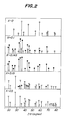
- X-ray diffraction patterns of the carriers containing 0, 10, 14.3, 15 and 50 mole% of barium oxide are measured. The results are shown in attached Fig. 2.
- the symbols o means ⁇ -Al2O3, ⁇ means BaO ⁇ 6Al2O3, and the symbol ⁇ means BaO ⁇ Al2O3.
- the carrier containing 14.3 mole% of BaO has the maximum specific surface area of 5.4 m2/g, and showed the sole pattern of BaO ⁇ 6Al2O3 by the X-ray diffraction.
- the carrier containing 14.3 mole% of BaO exhibiting the maximum specific surface area shows the structure of BaO ⁇ 6Al2O3 by X-ray diffraction, so that it is considered that the small reduction of the specific surface area of the carrier at high temperature is brought from the formation of the stable BaO ⁇ 6Al2O3 phase.
- Example 2 The same starting materials of Al2O3 and BaO as in Example 1 are pulverized and mixed as in Referential Example 1 to produce unfired mixtures of (Al2O3) 0.857 (BaO) 0.143 .
- the unfired mixtures and referential ⁇ -alumina not containing BaO are respectively fired at 1000°C, 1100°C, 1200°C, 1300°C, 1400°C and 1450°C for 5 hours to obtain carriers of Referential Examples 7-12 and Comparative Examples 12-16.
- BET specific surface area of the carriers are shown in the following Table 3 and attached Fig. 3.
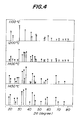
- Crystal structures of the carriers of Referential Examples 8, 9, 11 and 12 respectively fired at 1100°C, 1200°C, 1400°C and 1450°C are analyzed by X-ray diffraction thereof.
- the results are shown in attached Fig. 4.
- the symbols ⁇ and ⁇ means the same ones as in Fig. 2, i.e., BaO ⁇ 6Al2O3 and BaO ⁇ Al2O3, respectively.
- Fig. 4 it is considered that the firing of the unfired mixtures at a temperature of not less than 1200°C has produced high temperature resistant compositions comprising the formed BaO ⁇ 6Al2O3, so that sintering of the carrier has been suppressed or decreased to the minimum.
- Aluminum nitrate and barium nitrate are dissolved in water in an Al2O3:BaO mole ratio of 85.7:14.3 to prepare an aqueous solution, and sodium carbonate is added to the solution to adjust pH thereof to 8 to form coprecipitates.
- coprecipitates are washed, filtered, dried at 200°C for 2 hours, precalcined at 500°C for 2 hours, and thereafter fired at 1450°C for 5 hours to obtain a carrier of Example 13.
- BET specific surface area of the carrier was 5.5 m2/g.
- Aluminum nitrate and nitrate of Me (Me is Ba, Ca or Sr) are dissolved in water in a mole ratio of Al2O3:MeO of 85.7:14.3 to prepare an aqueous solution thereof.
- the solution has aqueous ammonia added dropwise to a pH of 8, and is evaporated to dryness to form products.
- the formed products are dried at 200°C for 2 hours, precalcined at 500°C for 2 hours, and then fired at 1450°C for 5 hours to obtain carriers of Referential Examples 14, 15 and 16.
- Barium isopropoxide and aluminum isopropoxide are dissolved in isopropyl alcohol in a mole ratio of 1:12 to prepare an alcoholic solution.
- the solution has water added dropwise to effect hydrolysis thereof.
- the hydrolysis of the isoproxides is carried out at a temperature of 80°C, in nitrogen atmosphere.
- suspension liquids are aged for 12 hours under agitation and then dried in reduced pressure to obtain unfired powders of Example 1.
- X-ray diffraction patterns of the fired powders of Example 1 are measured, and the results are shown in Fig. 5.
- the symbol ⁇ means BaO ⁇ 6Al2O3.
- the alkoxide method enables direct formation of aimed BaO ⁇ 6Al2O3 at temperatures of 1200°C or higher without forming the intermediate BaO ⁇ Al2O3.
- the directly formed BaO ⁇ 6Al2O3 appears to function to suppress the decrease of the specific surface area at 1200°C or temperatures higher than 1200°C.
- the alkoxide method allows treatment of complexed oxides at low temperatures, and this is considered as a reason of affording the more stabilized high specific surface area of the products obtained from alkoxides.
- Example 2-11 By using the same isopropoxides as in Example 1, various powders of Examples 2-11 are produced. Conditions for hydrolysis of isopropoxides and specific surface area of the powders after fired at 1300°C or 1450°C are shown in the following Table 6.
- aging time influences largely on the specific surface area.
- the aging time is preferably at least 1 hour, and more preferably at least 5 hours. Influence of pH of the water was not observed. In H2O/MOPr ratio range of 0.5-10, a tendency was observed that the products obtained from smaller H2O/MOPr ratios have higher specific surface areas when fired at 1300°C. But, this tendency was hardly seen on the products obtained by firing at 1450°C.
- Reduction rate of the specific surface areas after the durability test of firing at 1450°C for 50 hours are 23% for the product of Example 6 produced by alkoxide method, and 34% for the product of Referential Example 17 which has the same composition with that of Example 6 but produced by solids mixing method, so that the heat resistant property of the product produced from the alkoxide method was far superior to the product produced by the solids mixing method.
- Example 14 By repeating this procedure of Example 14, five catalyst carriers of Examples 15-19 are produced. However, in producing these five carriers, some of the preparation conditions, such as temperature for hydrolysis reaction, H2O/MOPr ratio, aging time, firing time, etc. were changed to study the influences thereof over the specific surface area.
- Aluminum isopropoxide and an isopropoxide of metal Me such as barium isopropoxide, calcium isopropoxide or strontium isopropoxide are mixed in an Al2O3:MeO mole ratio of 85.7:14.3 in isopropyl alcohol, and the same procedures as in Example 20 are repeated to prepare the fired powders of Examples 22-24. BET specific surface areas of these fired powders are measured. The results are shown in the following Table 11. Table 11 Example Composition Specific surface area (m2/g) 22 BaO ⁇ 6Al2O3 13.8 23 CaO ⁇ 6Al2O3 12.5 24 SrO ⁇ 6Al2O3 12.3
- Aluminum isopropoxide and metal barium in an Al2O3:BaO mol ratio of 85.7:14.3 are dissolved in ethanol, and reacted at about 70°C for 5 hours, while bubbling the solution with dry nitrogen gas.
- the resultant solution is dried under reduced pressure to obtain white transparent gel.
- the gel is precalcined in air at 800°C for 5 hours, and fired at 1300°C for 5 hours to obtain the fired powders of Example 25.
- Specific surface area of the fired powders of Example 25 is 17.0 m2/g. From this, it is understood that a heat resistant composition of a high specific surface area which is substantially the same with those obtained by the alkoxide method can be obtained also by heat decomposition of the alkoxide.
- the present invention As described in detail in the foregoing, according to the present invention, remarkably heat resistant composition of always higher specific surface area than that of conventionally most superior alumina at high temperatures can be obtained, which is exceedingly suited to catalysts and catalyst carriers. Therefore, the present invention is eminently useful for industries.
Landscapes
- Chemical & Material Sciences (AREA)
- Engineering & Computer Science (AREA)
- Ceramic Engineering (AREA)
- Materials Engineering (AREA)
- Organic Chemistry (AREA)
- Manufacturing & Machinery (AREA)
- Structural Engineering (AREA)
- Chemical Kinetics & Catalysis (AREA)
- Catalysts (AREA)
Claims (10)
- Verfahren zur Herstellung einer hitzebeständigen Zusammensetzung, umfassend
das Auflösen und Vermischen eines Aluminiumalkoxids und eines Metalls Me in Form eines Alkoxids und/oder von metallischem Me in einem Stoffmengen-Verhältnis ("Mol-Verhältnis") von 200 mol Aluminiumalkoxid, entsprechend 100 mol Al₂O₃, zu 5 bis 20 mol des Alkoxids des Metalls Me in einem Alkohol zur Bildung einer alkoholischen Lösung, worin das Metall Me wenigstens eines von Ba, Ca und Sr ist,
das Hinzufügen von 0,5 bis 10 Äquivalenten Wasser zu der alkoholischen Lösung bei einer Temperatur von 50 °C bis 100 °C, um die Alkoxide zu hydrolysieren,
das Altern der hydrolysierten Lösung für die Dauer von wenigstens einer Stunde,
das Abtrennen des Hydrolyseprodukt aus der Lösung, gegebenenfalls das Vorkalzinieren des Produkts bei einer Temperatur von 200 °C bis 800 °C, und
das Brennen des Produkts bei einer Temperatur von nicht weniger als 1200 °C für die Dauer von 5 bis 30 Sunden. - Verfahren nach Anspruch 1, worin das Aluminiumalkoxid und das Metallalkoxid komplexierte und/oder gemischte Alkoxide sind.
- Verfahren nach Anspruch 1 oder Anspruch 2, worin das Alkoxid 1 bis 4 Kohlenstoff-Atome besitzt.
- Verfahren nach irgendeinem der Ansprüche 1 bis 3, worin das Altern über eine Zeitspanne von 5 bis 10 Stunden nach dem Hinzufügen des Wassers zur Hydrolyse vorgenommen wird.
- Verfahren nach irgendeinem der vorhergehenden Ansprüche, worin das Metall Barium ist.
- Verfahren zur Herstellung einer hitzebeständigen Zusammensetzung, umfassend
das Auflösen und Vermischen eines Aluminiumalkoxids und eines Metalls Me in Form eines Alkoxids und/oder von metallischem Me in einem Stoffmengen-Verhältnis ("Mol-Verhältnis") von 200 mol Aluminiumalkoxid, entsprechend 100 mol Al₂O₃, zu 5 bis 20 mol des Alkoxids des Metalls Me in einem Alkohol, während man trockenes Stickstoff-Gas durch die Lösung hindurchperlen läßt, wobei das Metall Me wenigstens eines von Ba, Ca und Sr ist,
das Trocknen der erhaltenen Lösung unter vermindertem Druck, um ein Gel zu erhalten,
das Vorkalzinieren des Gels in Luft bei einer Temperatur von 200 °C bis 800 °C, und
das Brennen des vorkalzinierten Produkts bei einer Temperatur von nicht weniger als 1200 °C für die Dauer von 5 bis 30 Sunden. - Verfahren nach Anspruch 6, worin das Stoffmengen-Verhältnis des Aluminiumalkoxids zu dem Alkoxid des Metalls Me 12 : 1 beträgt, das Vorkalzinieren 5 h bei 800 °C vorgenommen wird und das Brennen 5 h bei 1300 °C erfolgt.
- Katalysator oder Katalysator-Träger, umfassend eine Zusammensetzung, die mittels eines Verfahrens nach irgendeinem der vorhergehenden Ansprüche erhältlich ist.
- Katalysator oder Katalysator-Träger, im wesentlichen bestehend aus MeO · 6 Al₂O₃, worin Me Ba, Ca oder Sr ist, und mit einer spezifischen BET-Oberfläche von mehr als 4,5 m²/g nach dem Kalzinieren bei einer Temperatur von 1200 °C bis 1450 °C.
- Katalysator oder Katalysator-Träger, umfassend
MeO · 6 Al₂O₃, worin Me Ba, Ca oder Sr ist, der durch Hydrolyse oder thermische Zersetzung eines Alkoxids erhältlich ist und bei einer Temperatur von 1200 °C bis 1600 °C eine BET-Oberfläche von mehr als 4,5 m²/g aufweist.
Applications Claiming Priority (4)
| Application Number | Priority Date | Filing Date | Title |
|---|---|---|---|
| JP18996785 | 1985-08-30 | ||
| JP189967/85 | 1985-08-30 | ||
| JP140287/86 | 1986-06-18 | ||
| JP61140287A JPS62153158A (ja) | 1985-08-30 | 1986-06-18 | 耐熱性触媒又は触媒担体及びその製造方法 |
Publications (2)
| Publication Number | Publication Date |
|---|---|
| EP0222471A1 EP0222471A1 (de) | 1987-05-20 |
| EP0222471B1 true EP0222471B1 (de) | 1992-07-29 |
Family
ID=26472855
Family Applications (1)
| Application Number | Title | Priority Date | Filing Date |
|---|---|---|---|
| EP86306220A Expired EP0222471B1 (de) | 1985-08-30 | 1986-08-12 | Hitzebeständige Zusammensetzung und Verfahren zu deren Herstellung |
Country Status (3)
| Country | Link |
|---|---|
| US (1) | US4771028A (de) |
| EP (1) | EP0222471B1 (de) |
| DE (1) | DE3686235T2 (de) |
Cited By (4)
| Publication number | Priority date | Publication date | Assignee | Title |
|---|---|---|---|---|
| EP0337730A1 (de) * | 1988-04-13 | 1989-10-18 | Catalysts and Chemicals Inc, Far East | Hitzebeständiger Edelmetallkatalysator und Verfahren zu seiner Herstellung |
| EP0355231A1 (de) * | 1988-08-17 | 1990-02-28 | Toa Nenryo Kogyo Kabushiki Kaisha | Hitzebeständige Katalysatorträgerformstücke und Verbrennungskatalysatoren |
| FR2697831A1 (fr) * | 1992-11-12 | 1994-05-13 | Rhone Poulenc Chimie | Alumine stabilisée par du baryum et son procédé de préparation. |
| EP0689870A1 (de) | 1994-07-01 | 1996-01-03 | Institut Francais Du Petrole | Hohe Temperatur beständiger Oxydationskatalysator seine Herstellung und Anwendung für Verbrennungsverfahren |
Families Citing this family (10)
| Publication number | Priority date | Publication date | Assignee | Title |
|---|---|---|---|---|
| US5212130A (en) * | 1992-03-09 | 1993-05-18 | Corning Incorporated | High surface area washcoated substrate and method for producing same |
| US5593654A (en) * | 1992-03-12 | 1997-01-14 | Condea Vista Company | Preparation of stabilized alumina having enhanced resistance to loss of surface area at high temperatures |
| US5837634A (en) * | 1992-11-12 | 1998-11-17 | Condea Vista Company | Process for producing stabilized alumina having enhanced resistance to loss of surface area at high temperatures |
| US5389589A (en) * | 1992-12-22 | 1995-02-14 | Allied-Signal Inc. | Barium-containing alumina |
| US5403807A (en) * | 1993-02-08 | 1995-04-04 | Ford Motor Company | Single phase metal-alumina sol-gel process and material |
| DE4445680A1 (de) * | 1994-12-21 | 1996-06-27 | Huels Chemische Werke Ag | Katalysator und Verfahren zur Isomerisierung von aliphatischen C¶4¶-C¶1¶¶0¶-Monoolefinen |
| JP3861303B2 (ja) * | 1995-10-31 | 2006-12-20 | トヨタ自動車株式会社 | 排ガス浄化用触媒 |
| US5753192A (en) * | 1996-11-29 | 1998-05-19 | Ford Global Technologies, Inc. | Zirconia and sulfate in NOx traps to improved trapping and sulfur tolerance |
| DE102005062926A1 (de) * | 2005-12-29 | 2007-07-05 | Süd-Chemie AG | Brennstoffzellenanordnung mit edelmetallfreiem Abgasbrenner |
| KR102344231B1 (ko) | 2016-07-29 | 2021-12-28 | 스미또모 가가꾸 가부시끼가이샤 | 알루미나 및 그것을 사용한 자동차 촉매의 제조 방법 |
Family Cites Families (11)
| Publication number | Priority date | Publication date | Assignee | Title |
|---|---|---|---|---|
| US2422172A (en) * | 1942-07-28 | 1947-06-10 | Shell Dev | Thermostable catalysts for the dehydrogenation of hydrocarbons |
| US2886513A (en) * | 1954-10-05 | 1959-05-12 | Exxon Research Engineering Co | Titanium dioxide-calcium oxide catalyst for cracking hydrocarbons |
| US3291564A (en) * | 1962-08-31 | 1966-12-13 | Exxon Research Engineering Co | Method of treating exhaust gases of internal combustion engines utilizing a stabilized alumina catalyst support |
| DE2143608C3 (de) * | 1970-09-04 | 1979-10-11 | Toyo Engineering Corp., Tokio | Verfahren zur Herstellung wasserstoffreicher Gasgemische |
| FR2192162B1 (de) * | 1972-07-07 | 1974-12-27 | Rhone Progil | |
| DE2431983C2 (de) * | 1974-07-03 | 1986-03-06 | Fujimi Kenmazai Kogyo Co. Ltd., Aichi | Feuerfestes Calciumaluminat enthaltender Katalysator und dessen Verwendung zum Dampfreformieren von Kohlenwasserstoffen |
| US4156614A (en) * | 1977-10-06 | 1979-05-29 | General Electric Company | Alumina-based ceramics for core materials |
| US4375571A (en) * | 1981-07-06 | 1983-03-01 | Shell Oil Company | Process for the preparation of ethylbenzene from 4-vinylcyclohexene-1 |
| US4357427A (en) * | 1981-10-19 | 1982-11-02 | Westinghouse Electric Corp. | Economic preparation of alumina suitable for isostatic pressing and sintering |
| US4438219A (en) * | 1981-10-28 | 1984-03-20 | Texaco Inc. | Alumina catalyst stable at high temperatures |
| US4535187A (en) * | 1983-12-21 | 1985-08-13 | Union Carbide Corporation | Preparation of isophorone and mesityl oxide from acetone |
-
1986
- 1986-08-11 US US06/895,189 patent/US4771028A/en not_active Expired - Lifetime
- 1986-08-12 EP EP86306220A patent/EP0222471B1/de not_active Expired
- 1986-08-12 DE DE8686306220T patent/DE3686235T2/de not_active Expired - Fee Related
Cited By (5)
| Publication number | Priority date | Publication date | Assignee | Title |
|---|---|---|---|---|
| EP0337730A1 (de) * | 1988-04-13 | 1989-10-18 | Catalysts and Chemicals Inc, Far East | Hitzebeständiger Edelmetallkatalysator und Verfahren zu seiner Herstellung |
| US4959339A (en) * | 1988-04-13 | 1990-09-25 | Catalysts And Chemicals Inc. | Heat-resistant noble metal catalyst and method of producing the same |
| EP0355231A1 (de) * | 1988-08-17 | 1990-02-28 | Toa Nenryo Kogyo Kabushiki Kaisha | Hitzebeständige Katalysatorträgerformstücke und Verbrennungskatalysatoren |
| FR2697831A1 (fr) * | 1992-11-12 | 1994-05-13 | Rhone Poulenc Chimie | Alumine stabilisée par du baryum et son procédé de préparation. |
| EP0689870A1 (de) | 1994-07-01 | 1996-01-03 | Institut Francais Du Petrole | Hohe Temperatur beständiger Oxydationskatalysator seine Herstellung und Anwendung für Verbrennungsverfahren |
Also Published As
| Publication number | Publication date |
|---|---|
| US4771028A (en) | 1988-09-13 |
| DE3686235D1 (de) | 1992-09-03 |
| EP0222471A1 (de) | 1987-05-20 |
| DE3686235T2 (de) | 1993-02-11 |
Similar Documents
| Publication | Publication Date | Title |
|---|---|---|
| US4959339A (en) | Heat-resistant noble metal catalyst and method of producing the same | |
| US4988661A (en) | Steam reforming catalyst for hydrocarbons and method of producing the catalyst | |
| US4788174A (en) | Heat resistant catalyst and method of producing the same | |
| KR100351381B1 (ko) | 지르코늄-세륨계 복합산화물 및 그 제조법, 및 배기가스 정화용 조촉매 | |
| EP0234745B1 (de) | Katalysatoren | |
| US4771028A (en) | Heat resistant composition and method of producing the same | |
| KR100431919B1 (ko) | 산화지르코늄 및 산화세륨기재조성물, 그의 제조방법 및 그의 용도 | |
| JP2023527419A (ja) | アンモニア分解触媒、並びにこれを用いたアンモニア分解及び水素生産方法 | |
| US4857296A (en) | CeO catalytic desulfurization of industrial gases | |
| JPH0852352A (ja) | 高温に耐える酸化用触媒、その調製方法およびそのような触媒を用いる燃焼方法 | |
| JPH01168343A (ja) | 排気ガス用浄化触媒 | |
| KR102573127B1 (ko) | 메탄의 수증기 개질용 니켈계 촉매 및 이를 이용한 메탄의 수증기 개질 반응 | |
| US6204219B1 (en) | Thermally stable support material and method for making the same | |
| JPH074526B2 (ja) | 硫黄化合物を含有する産業排ガスを処理するための触媒 | |
| CA1265119A (en) | Catalyst for combustion and process for producing same | |
| KR20080067688A (ko) | 촉매 지지체로서의 안정화된 플래시 하소 깁사이트 | |
| KR970001520B1 (ko) | 촉매를 위한 캐리어물질과 그의 제조방법 | |
| JP2559715B2 (ja) | 触媒燃焼反応用耐熱性触媒及びその製造方法 | |
| JPH0417910B2 (de) | ||
| JPH0445452B2 (de) | ||
| JP2559718B2 (ja) | 触媒燃焼反応用耐熱性触媒とその製造方法 | |
| JPS60257837A (ja) | メタノ−ル分解/改質用触媒およびその調製方法 | |
| EP0540228A1 (de) | Aluminium enthaltender Katalysator, Verfahren zu dessen Herstellung und Katalysator enthaltende Abgasanlage für Brennkraftmaschinen | |
| EP0808800A2 (de) | Binäre Praseodymium-Zirkonium-Oxide für Katalysator und Überzug | |
| JP2574285B2 (ja) | 耐熱性触媒並びにその製造方法 |
Legal Events
| Date | Code | Title | Description |
|---|---|---|---|
| PUAI | Public reference made under article 153(3) epc to a published international application that has entered the european phase |
Free format text: ORIGINAL CODE: 0009012 |
|
| AK | Designated contracting states |
Kind code of ref document: A1 Designated state(s): DE FR GB |
|
| 17P | Request for examination filed |
Effective date: 19871111 |
|
| 17Q | First examination report despatched |
Effective date: 19891005 |
|
| GRAA | (expected) grant |
Free format text: ORIGINAL CODE: 0009210 |
|
| RAP1 | Party data changed (applicant data changed or rights of an application transferred) |
Owner name: KABUSHIKI KAISHA TOSHIBA Owner name: CATALYSTS AND CHEMICALS INC, FAR EAST |
|
| AK | Designated contracting states |
Kind code of ref document: B1 Designated state(s): DE FR GB |
|
| ET | Fr: translation filed | ||
| REF | Corresponds to: |
Ref document number: 3686235 Country of ref document: DE Date of ref document: 19920903 |
|
| PLBE | No opposition filed within time limit |
Free format text: ORIGINAL CODE: 0009261 |
|
| STAA | Information on the status of an ep patent application or granted ep patent |
Free format text: STATUS: NO OPPOSITION FILED WITHIN TIME LIMIT |
|
| 26N | No opposition filed | ||
| PGFP | Annual fee paid to national office [announced via postgrant information from national office to epo] |
Ref country code: GB Payment date: 19990806 Year of fee payment: 14 |
|
| PGFP | Annual fee paid to national office [announced via postgrant information from national office to epo] |
Ref country code: FR Payment date: 19990820 Year of fee payment: 14 |
|
| PGFP | Annual fee paid to national office [announced via postgrant information from national office to epo] |
Ref country code: DE Payment date: 19990921 Year of fee payment: 14 |
|
| PG25 | Lapsed in a contracting state [announced via postgrant information from national office to epo] |
Ref country code: GB Free format text: LAPSE BECAUSE OF NON-PAYMENT OF DUE FEES Effective date: 20000812 |
|
| GBPC | Gb: european patent ceased through non-payment of renewal fee |
Effective date: 20000812 |
|
| PG25 | Lapsed in a contracting state [announced via postgrant information from national office to epo] |
Ref country code: FR Free format text: LAPSE BECAUSE OF NON-PAYMENT OF DUE FEES Effective date: 20010430 |
|
| PG25 | Lapsed in a contracting state [announced via postgrant information from national office to epo] |
Ref country code: DE Free format text: LAPSE BECAUSE OF NON-PAYMENT OF DUE FEES Effective date: 20010501 |
|
| REG | Reference to a national code |
Ref country code: FR Ref legal event code: ST |