EP0222497A2 - Procédé pour l'oxydation simultanée du monoxyde de carbone et de carburant non brûlé dans un dispositif d'échappement d'un véhicule à méthanol - Google Patents
Procédé pour l'oxydation simultanée du monoxyde de carbone et de carburant non brûlé dans un dispositif d'échappement d'un véhicule à méthanol Download PDFInfo
- Publication number
- EP0222497A2 EP0222497A2 EP86307648A EP86307648A EP0222497A2 EP 0222497 A2 EP0222497 A2 EP 0222497A2 EP 86307648 A EP86307648 A EP 86307648A EP 86307648 A EP86307648 A EP 86307648A EP 0222497 A2 EP0222497 A2 EP 0222497A2
- Authority
- EP
- European Patent Office
- Prior art keywords
- palladium
- silver
- methanol
- carbon monoxide
- catalyst
- Prior art date
- Legal status (The legal status is an assumption and is not a legal conclusion. Google has not performed a legal analysis and makes no representation as to the accuracy of the status listed.)
- Granted
Links
Images

Classifications
-
- B—PERFORMING OPERATIONS; TRANSPORTING
- B01—PHYSICAL OR CHEMICAL PROCESSES OR APPARATUS IN GENERAL
- B01J—CHEMICAL OR PHYSICAL PROCESSES, e.g. CATALYSIS OR COLLOID CHEMISTRY; THEIR RELEVANT APPARATUS
- B01J23/00—Catalysts comprising metals or metal oxides or hydroxides, not provided for in group B01J21/00
- B01J23/38—Catalysts comprising metals or metal oxides or hydroxides, not provided for in group B01J21/00 of noble metals
- B01J23/48—Silver or gold
- B01J23/50—Silver
-
- B—PERFORMING OPERATIONS; TRANSPORTING
- B01—PHYSICAL OR CHEMICAL PROCESSES OR APPARATUS IN GENERAL
- B01D—SEPARATION
- B01D53/00—Separation of gases or vapours; Recovering vapours of volatile solvents from gases; Chemical or biological purification of waste gases, e.g. engine exhaust gases, smoke, fumes, flue gases, aerosols
- B01D53/34—Chemical or biological purification of waste gases
- B01D53/74—General processes for purification of waste gases; Apparatus or devices specially adapted therefor
- B01D53/86—Catalytic processes
- B01D53/8668—Removing organic compounds not provided for in B01D53/8603 - B01D53/8665
-
- B—PERFORMING OPERATIONS; TRANSPORTING
- B01—PHYSICAL OR CHEMICAL PROCESSES OR APPARATUS IN GENERAL
- B01D—SEPARATION
- B01D53/00—Separation of gases or vapours; Recovering vapours of volatile solvents from gases; Chemical or biological purification of waste gases, e.g. engine exhaust gases, smoke, fumes, flue gases, aerosols
- B01D53/34—Chemical or biological purification of waste gases
- B01D53/92—Chemical or biological purification of waste gases of engine exhaust gases
- B01D53/94—Chemical or biological purification of waste gases of engine exhaust gases by catalytic processes
- B01D53/944—Simultaneously removing carbon monoxide, hydrocarbons or carbon making use of oxidation catalysts
-
- Y—GENERAL TAGGING OF NEW TECHNOLOGICAL DEVELOPMENTS; GENERAL TAGGING OF CROSS-SECTIONAL TECHNOLOGIES SPANNING OVER SEVERAL SECTIONS OF THE IPC; TECHNICAL SUBJECTS COVERED BY FORMER USPC CROSS-REFERENCE ART COLLECTIONS [XRACs] AND DIGESTS
- Y02—TECHNOLOGIES OR APPLICATIONS FOR MITIGATION OR ADAPTATION AGAINST CLIMATE CHANGE
- Y02A—TECHNOLOGIES FOR ADAPTATION TO CLIMATE CHANGE
- Y02A50/00—TECHNOLOGIES FOR ADAPTATION TO CLIMATE CHANGE in human health protection, e.g. against extreme weather
- Y02A50/20—Air quality improvement or preservation, e.g. vehicle emission control or emission reduction by using catalytic converters
Definitions
- the present invention generally relates to a method of treating exhaust gases from an internal combustion engine burning methanol fuel by simultaneously oxidizing the unburned methanol and carbon monoxide into carbon dioxide and water and, more particularly, is concerned with a method of treating exhaust gases from an internal combustion engine burning methanol fuel by simultaneously oxidizing the unburned methanol and carbon monoxide by passing the exhaust gases over a suitable catalyst.
- US-A-4,304,761 discloses a method of oxidizing unburned methanol by passing the exhaust gases over a silver catalyst.
- US-A-4,304,761 discloses that silver has a relatively low reaction temperature for a high percentage conversion of methanol to carbon dioxide (C0 2 ) while producing no significant amount of undesirable byproducts such as formaldehyde.
- US-A-4,304,761 also discloses that, while platinum and palladium are active at low temperatures for converting unburned methanol, both platinum and palladium have an affinity for producing aldehydes.
- the object of the present invention is to simultaneously oxidize unburned methanol and carbon monoxide contained in methanol-fueled vehicle exhaust. It is known in catalysis that difficulties are frequently encountered when simultaneous chemical reactions are desired since the presence of certain chemical compounds can inhibit the reactions of other compounds. In an application such as automotive exhaust catalysis, a number of simultaneous chemical reactions must be accomplished at the same time, e.g., the oxidation of hydrocarbons, the oxidation of carbon monoxide, and the reduction of nitric oxides. Therefore, the inhibiting effects of the various chemical species on the reactions of other chemical species must be taken into consideration in such complex reactions.
- the present invention is a method of treating exhaust gases from an internal combustion engine burning methanol fuel by simultaneously oxidizing the unburned methanol and carbon monoxide by passing the exhaust gases over a bimetallic catalyst system consisting essentially of silver and palladium.
- the novel catalyst system contains palladium and silver atoms finely dispersed on a porous gamma alumina support.
- a noble metal such as palladium is most active in converting methanol.
- a palladium catalyst converts most of the feed methanol when the feed is flowed over the catalyst at room temperature.
- undesirable byproducts of methanol partial oxidation such as formaldehyde and methyl formate are produced.
- the methanol-oxidation activity of a silver/gamma alumina catalyst is virtually unaffected by the presence of carbon monoxide in the feed.
- the silver catalyst is less active for methanol oxidation than the palladium catalyst in the absence of carbon monoxide, it is more active for methanol oxidation in the presence of carbon monoxide.
- formaldehyde is formed during methanol oxidation over the silver catalyst.
- silver catalysts have poor carbon monoxide oxidation activity, the initial results obtained by the inventors indicate that a palladium/silver bimetallic catalyst system may be ideal for the simultaneous oxidation of carbon monoxide and methanol. In such a bimetallic system, palladium will be combined with silver to produce a catalyst with superior carbon monoxide and methanol oxidation activities to those demonstrated by either silver or palladium alone.
- bimetallic catalyst system containing silver and palladium Another benefit of the bimetallic catalyst system containing silver and palladium is that better carbon monoxide oxidation activity than either silver catalyst or palladium catalyst alone may be obtained. Even though the exact reaction mechanism is not known, it is believed that the carbon monoxide oxidation activities of the noble metal catalyst are suppressed at low temperatures by the carbon monoxide inhibition of oxygen adsorption. Silver, however, can readily adsorb oxygen even in the presence of carbon monoxide. Therefore, in a bimetallic catalyst system containing highly dispersed palladium atoms in intimate contact with silver atoms, the noble metal would function to adsorb carbon monoxide and the silver would function to dissociatively adsorb oxygen. This result of enhanced carbon monoxide oxidation activity is achieved through the carbon monoxide adsorption on palladium which is then reacted rapidly with oxygen atoms adsorbed on silver located in close proximity.
- the inventors have therefore concluded that, in order to simultaneously oxidize unburned methanol and carbon monoxide contained in a methanol-fueled vehicle exhaust, two requirements must be satisfied.
- the atomic ratio between silver and palladium must be sufficiently high, i.e., larger than 100:1.
- a suitable ratio of silver:palladium to be used is 500:1.
- the second requirement is that, in order to simultaneously oxidize methanol and carbon monoxide, the palladium atoms must be finely dispersed in silver atoms resulting in a close proximity to the silver atoms.
- Low density high surface area gamma-alumina pellets are used as the dispersing support. Suitable gamma-alumina pellets to be used are supplied by W. R. Grace Company. These pellets have an average diameter of 3.18 mm (1/8 inch) and an average surface area of 110 metre 2 /gram.
- the catalyst is prepared by sequential impregnation of first an aqueous solution of silver nitrate (A G NO 3 ), then followed by an aqueous solution of a palladium tetrammine salt. The incipient wetness impregnation technique is used wherein minimum amounts of aqueous salt solution are used to cover the alumina pellets.
- the alumina pellets are first impregnated with the silver nitrate solution, and then dried and calcined in forced hot air. The same procedure of impregnation, drying, and calcining is followed for the palladium tetrammine solution.
- the silver undergoes two calcination steps and the palladium undergoes one calcination step prior to obtaining the finished catalyst.
- the silver nitrate used was A CS certified crystal supplied by Fisher Chemical.
- the palladium tetrammine salt used was a palladium tetrammine dinitrate (Pd(NH 3 ) 4 (N0 3 ) 2 ) with a 95-99% purity, commercially available from K and K Fine Chemicals.
- the preparation of the novel catalyst system in a 350 gm batch (700 cm 3 in volume) of 0.01 wt% Pd - 5 wt% Ag/gamma A1 2 0 3 can be carried out by the following steps:
- the success of the bimetallic catalyst system of the present invention derives from the fact that palladium atoms are highly dispersed and in intimate contact with silver atoms. Aggregated palladium particles must be avoided since the behavior characteristic of large palladium particles in producing undesirable byproducts of formaldehyde and methyl formate would be observed. Therefore, the silver-to-palladium atomic ratio must be very high and palladium must be uniformly impregnated throughout the alumina support. To achieve these objectives a silver-to-palladium atomic ratio of 500 to 1 is used and palladium tetrammine dinitrate is used as the precursor.
- palladium tetrammine dinitrate does not interact as strongly with alumina as do other palladium salts, e.g., palladium chloride salt. This in turn leads to a more uniform palladium distribution throughout the surface layers of the pellets.
- the bimetallic catalyst is more effective for the simultaneous oxidation of carbon monoxide and unburned methanol to'carbon dioxide and water than either palladium catalyst alone or silver catalyst alone.
- oxidation data obtained in feed gases containing carbon monoxide alone, methanol alone, and mixtures of methanol and carbon monoxide have been compared. All three different feed gases were tested over the three catalyst systems, i.e., 0.01 wt% palladium/gamma alumina, 5 wt% silver/gamma alumina, and 0.01 wt% palladium - 5 wt% silver/gamma alumina catalysts.
- the silver catalyst when compared to the palladium catalyst, shows better low-temperture activity but worse high-temperature activity, with a cross-over occurring near 460 degrees Kelvin.
- the palladium/silver catalyst system retains the superior low-temperature activity of silver and part of the superior high-temperature activity of palladium.
- the feed gas used in these tests contains 0.2% carbon monoxide and 1% oxygen with the balance being helium gas.
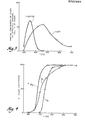
- FIG 2 is a graph showing comparative methanol oxidation activities over the three catalyst systems in the absence of carbon monoxide.
- the feed gas used in these tests contains 0.2% methanol, 1% oxygen, with the balance being helium gas. It is seen that palladium is much more active at low temperatures than silver, with the palladium/silver catalyst falling in between. Significantly, much of the low temperature activity of palladium is associated with the partial oxidation of methanol to methyl formate (CH30CHO) and formaldehyde (H 2 CO). It is seen in FIG 3 that as much as 12% methyl formate and 11% formaldehyde of the total volume of the feed methanol gas are formed over the palladium/gamma alumina catalyst. The formation of these byproducts is undesirable since they contribute to hydrocarbon emission measurements. Particularly, the formation of formaldehyde is of concern for health and environmental reasons.
- a palladium/silver bimetallic catalyst according to the present invention is superior to the use of silver alone or palladium alone because the activity of the bimetallic catalyst is greater than that of silver alone, while its selectivity for complete oxidation of methanol to carbon dioxide and water is as good or better than silver alone.
- combining a small amount of palladium with silver increases the activity of silver catalyst without introducing the partial oxidation characteristics of palladium catalysts.
- the superiority of the palladium/silver bimetallic catalyst system of the present invention over palladium or silver alone is best demonstrated in the graphs contained in FIG 4 where the methanol oxidation activity in the presence of added carbon monoxide by the three catalysts is shown.
- the superiority of the palladium/silver catalyst of the present invention can be seen both in terms of temperatures required to reach a specific conversion level and also in the conversions obtained at particular temperatures.
- the feed gas used in these tests contained 0.2% methanol, 0.2% carbon monoxide, 1% oxygen with the balance being helium gas. This is the situation that is most representative of a methanol-fueled vehicle exhaust, i.e., unburned methanol will always be present with carbon monoxide.
- the palladium/silver bimetallic catalyst reaches the 50% methanol conversion level at 380 degrees Kelvin, 25° below the temperature at which the silver catalyst produces 50% methanol conversion (405 degrees Kelvin), and 60 degrees below the temperature at which the palladium catalyst produces 50% methanol conversion (440 degrees Kelvin). This is achieved while maintaining the yields of methyl formate and formaldehyde over the palladium/silver bimetallic catalyst below the limits of detection, i.e., smaller than 0.05 volume percent of the feed methanol gas.
- the superiority of the palladium/silver bimetallic catalyst of the present invention is even more pronounced at the 90% conversion level which is attained at 420 degrees Kelvin (FIG 4) versus 490 degrees Kelvin for the palladium catalyst alone and 532 degrees Kelvin for the silver catalyst alone.
- the excellent low temperature activity of the palladium/silver catalyst is particularly beneficial in methanol-fueled vehicle exhaust emission control. This is because methanol-fueled vehicles are characterized by high emission rates of unburned fuel and carbon monoxide during the warm-up period of the engine and the catalytic converter. For instance, in a typical methanol-fueled passenger vehicle, nearly half of the total hydrocarbon emissions are generated during the cold-start portion (cycles 1-5) of the U. S.
- FTP Federal Emissions Test Procedure
- the unique properties of simultaneously treating unburned methanol and carbon monoxide by the present invention are obtained only when a proper palladium to silver proportion is used and a special preparation method is followed. It is known that unique catalytic properties can be imparted to metals by dispersing them in a finely divided state, i.e., particle diameters of 10 nanometres or less, on high surface area metal oxide supports such as gamma alumina. A very different catalytic behavior for metals in their bulk state than those highly dispersed on high surface area metal oxide supports is observed. It is believed that several factors can account for the unique catalytic behavior of such highly dispersed catalyst systems.
- Methanol is oxidized over this bimetallic catalyst system nearly exclusively to carbon dioxide and water without any appreciable amount of formaldehyde produced.
- bulk palladium/silver alloy catalysts are known to produce significant amounts of formaldehyde during methanol oxidation.
- Currently existing literature describing palladium/silver catalysts deals almost exclusively with bulk palladium/silver alloys.
- the inventors have demonstrated that, although silver is not as active as palladium for methanol oxidation in the absence of carbon monoxide, silver is more active for methanol oxidation in the presence of carbon monoxide. On the other hand, silver is not as active for carbon monoxide oxidation as palladium, particularly at high temperatures. Combining palladium with silver leads to interactions that result in carbon monoxide and methanol oxidation activity that is superior to the activity of palladium or silver catalysts alone. Additionally, selectivity of the bimetallic catalyst for complete methanol oxidation to carbon dioxide and water is superior to that of palladium catalysts and as good or better than that of silver catalysts.
Landscapes
- Chemical & Material Sciences (AREA)
- Engineering & Computer Science (AREA)
- Environmental & Geological Engineering (AREA)
- Chemical Kinetics & Catalysis (AREA)
- Health & Medical Sciences (AREA)
- Biomedical Technology (AREA)
- Analytical Chemistry (AREA)
- General Chemical & Material Sciences (AREA)
- Oil, Petroleum & Natural Gas (AREA)
- Combustion & Propulsion (AREA)
- Materials Engineering (AREA)
- Organic Chemistry (AREA)
- Catalysts (AREA)
- Incineration Of Waste (AREA)
- Exhaust Gas Treatment By Means Of Catalyst (AREA)
Applications Claiming Priority (2)
| Application Number | Priority Date | Filing Date | Title |
|---|---|---|---|
| US06/796,107 US4673556A (en) | 1985-11-08 | 1985-11-08 | Method of simultaneous oxidation of carbon monoxide and unburned fuel in methanol vehicle exhaust |
| US796107 | 1985-11-08 |
Publications (3)
| Publication Number | Publication Date |
|---|---|
| EP0222497A2 true EP0222497A2 (fr) | 1987-05-20 |
| EP0222497A3 EP0222497A3 (en) | 1989-02-15 |
| EP0222497B1 EP0222497B1 (fr) | 1991-08-07 |
Family
ID=25167318
Family Applications (1)
| Application Number | Title | Priority Date | Filing Date |
|---|---|---|---|
| EP86307648A Expired - Lifetime EP0222497B1 (fr) | 1985-11-08 | 1986-10-03 | Procédé pour l'oxydation simultanée du monoxyde de carbone et de carburant non brûlé dans un dispositif d'échappement d'un véhicule à méthanol |
Country Status (6)
| Country | Link |
|---|---|
| US (1) | US4673556A (fr) |
| EP (1) | EP0222497B1 (fr) |
| JP (1) | JPS62129129A (fr) |
| AU (1) | AU582908B2 (fr) |
| CA (1) | CA1252607A (fr) |
| DE (1) | DE3680751D1 (fr) |
Cited By (7)
| Publication number | Priority date | Publication date | Assignee | Title |
|---|---|---|---|---|
| EP0267711A3 (en) * | 1986-11-06 | 1989-02-15 | Ford Motor Company Limited | Method of catalytically oxidizing alcohol vapor |
| EP0612689A1 (fr) * | 1993-02-22 | 1994-08-31 | Leuna-Werke Gmbh | Procédé et catalyseur pour la purification de dioxyde de carbone |
| FR2707526A1 (fr) * | 1993-07-12 | 1995-01-20 | Cee | Catalyseur supporté et procédé de préparation. |
| FR2729583A1 (fr) * | 1995-01-25 | 1996-07-26 | Air Liquide | Procede pour l'elimination d'impuretes contenues dans un compose gazeux |
| FR2729582A1 (fr) * | 1995-01-25 | 1996-07-26 | Air Liquide | Procede pour l'elimination d'une impurete contenue dans un compose gazeux |
| US5693302A (en) * | 1995-01-25 | 1997-12-02 | L'air Liquide, Societe Anonyme Pour L'etude Et L'exploitation Des Procedes Georges Claude | Process for the removal of an impurity contained in a composite gas |
| EP2659968A4 (fr) * | 2010-12-27 | 2014-06-25 | Mitsui Mining & Smelting Co | Catalyseur de combustion particulaire, procédé de production de celui-ci, filtre particulaire et procédé de production de celui-ci |
Families Citing this family (24)
| Publication number | Priority date | Publication date | Assignee | Title |
|---|---|---|---|---|
| US4919903A (en) * | 1986-10-20 | 1990-04-24 | Ford Motor Company | Method of catalytically oxidizing methanol vapor accompanied by little or no excess oxygen |
| US4859435A (en) * | 1988-06-10 | 1989-08-22 | Air Products And Chemicals, Inc. | Deoxygenation of inert gas streams with methanol |
| US4859434A (en) * | 1988-06-10 | 1989-08-22 | Air Products And Chemicals, Inc. | Production of endothermic gases with methanol |
| JPH0639280A (ja) * | 1992-07-24 | 1994-02-15 | Nissan Motor Co Ltd | アルデヒド浄化用触媒 |
| JP3440290B2 (ja) * | 1993-08-26 | 2003-08-25 | 独立行政法人産業技術総合研究所 | 排ガス浄化方法 |
| RU2159666C1 (ru) | 1999-11-24 | 2000-11-27 | Дыкман Аркадий Самуилович | Способ очистки промышленных газовых выбросов |
| US6620539B2 (en) * | 2000-03-13 | 2003-09-16 | Energy Conversion Devices, Inc. | Fuel cell cathodes and their fuel cells |
| DE60236089D1 (de) | 2001-07-02 | 2010-06-02 | Sekisui Medical Co Ltd | Latex-trägerpartikel für ein testreagenz, und testreagenz |
| US7743772B2 (en) * | 2004-06-16 | 2010-06-29 | Philip Morris Usa Inc. | Silver and silver oxide catalysts for the oxidation of carbon monoxide in cigarette smoke |
| JP4883162B2 (ja) * | 2009-10-02 | 2012-02-22 | トヨタ自動車株式会社 | Co又はhc浄化用の排ガス浄化触媒 |
| CN102059046B (zh) * | 2010-11-30 | 2013-05-01 | 复旦大学 | 一种催化甲醇完全氧化分解成co2和h2o的方法 |
| US9216408B2 (en) | 2013-04-04 | 2015-12-22 | Clean Diesel Technologies, Inc. | System and method for two and three way mixed metal oxide ZPGM catalyst |
| US9511350B2 (en) | 2013-05-10 | 2016-12-06 | Clean Diesel Technologies, Inc. (Cdti) | ZPGM Diesel Oxidation Catalysts and methods of making and using same |
| US8858903B2 (en) | 2013-03-15 | 2014-10-14 | Clean Diesel Technology Inc | Methods for oxidation and two-way and three-way ZPGM catalyst systems and apparatus comprising same |
| US9227177B2 (en) | 2013-03-15 | 2016-01-05 | Clean Diesel Technologies, Inc. | Coating process of Zero-PGM catalysts and methods thereof |
| US9216383B2 (en) | 2013-03-15 | 2015-12-22 | Clean Diesel Technologies, Inc. | System and method for two and three way ZPGM catalyst |
| US9259716B2 (en) | 2013-03-15 | 2016-02-16 | Clean Diesel Technologies, Inc. | Oxidation catalyst systems compositions and methods thereof |
| US9511355B2 (en) | 2013-11-26 | 2016-12-06 | Clean Diesel Technologies, Inc. (Cdti) | System and methods for using synergized PGM as a three-way catalyst |
| US9511353B2 (en) | 2013-03-15 | 2016-12-06 | Clean Diesel Technologies, Inc. (Cdti) | Firing (calcination) process and method related to metallic substrates coated with ZPGM catalyst |
| US9545626B2 (en) | 2013-07-12 | 2017-01-17 | Clean Diesel Technologies, Inc. | Optimization of Zero-PGM washcoat and overcoat loadings on metallic substrate |
| US8853121B1 (en) | 2013-10-16 | 2014-10-07 | Clean Diesel Technology Inc. | Thermally stable compositions of OSM free of rare earth metals |
| US9511358B2 (en) | 2013-11-26 | 2016-12-06 | Clean Diesel Technologies, Inc. | Spinel compositions and applications thereof |
| US20150151281A1 (en) * | 2013-12-02 | 2015-06-04 | King Abdullah University Of Science And Technology | Multi-metallic nanomaterials from ni, ag, pd with pt's catalytic activity |
| EP3150553A1 (fr) | 2015-09-30 | 2017-04-05 | Casale SA | Procédé de purification d'un flux de co2 |
Family Cites Families (9)
| Publication number | Priority date | Publication date | Assignee | Title |
|---|---|---|---|---|
| US3053612A (en) * | 1960-02-29 | 1962-09-11 | Universal Oil Prod Co | Protection of catalysts in the conversion of lead-contaminated waste products |
| DE1442743C3 (de) * | 1963-08-20 | 1973-01-04 | Kali-Chemie Ag, 3000 Hannover | Verfahren zur Herstellung eines Katalysators zur Verbrennung von Autoabgasen |
| DE2628229A1 (de) * | 1975-06-24 | 1977-01-20 | Torres Silvestre Sanchez | Katalytischer nachbrenner fuer die umwandlung von luftverunreinigenden gasen in nichtluftverunreinigende gase |
| MX4509E (es) * | 1975-08-27 | 1982-06-02 | Engelhard Min & Chem | Composicion catalitica mejorada para oxidar en forma simultanea hidrocarburos gascosos y monoxido de carbono y reducir oxidos de nitrogeno |
| GB1573878A (en) * | 1977-03-18 | 1980-08-28 | Matsushita Electric Industrial Co Ltd | Method for the purification of air containing carbon monoxide |
| US4304761A (en) * | 1980-11-28 | 1981-12-08 | Ford Motor Company | Method of treating exhaust gases from a methanol fueled internal combustion engine |
| AT371372B (de) * | 1981-07-01 | 1983-06-27 | Kanzler Walter | Verfahren zur reinigung von abgasen aus formaldehydanlagen |
| GB8321255D0 (en) * | 1983-08-06 | 1983-09-07 | British Petroleum Co Plc | Methanol conversion process |
| US4510265A (en) * | 1984-05-04 | 1985-04-09 | Engelhard Corporation | Platinum/silver vanadate catalyzed diesel exhaust particulate filter |
-
1985
- 1985-11-08 US US06/796,107 patent/US4673556A/en not_active Expired - Lifetime
-
1986
- 1986-10-03 DE DE8686307648T patent/DE3680751D1/de not_active Expired - Lifetime
- 1986-10-03 EP EP86307648A patent/EP0222497B1/fr not_active Expired - Lifetime
- 1986-10-10 AU AU63692/86A patent/AU582908B2/en not_active Ceased
- 1986-10-27 CA CA000521450A patent/CA1252607A/fr not_active Expired
- 1986-11-07 JP JP61264123A patent/JPS62129129A/ja active Granted
Cited By (13)
| Publication number | Priority date | Publication date | Assignee | Title |
|---|---|---|---|---|
| EP0267711A3 (en) * | 1986-11-06 | 1989-02-15 | Ford Motor Company Limited | Method of catalytically oxidizing alcohol vapor |
| EP0612689A1 (fr) * | 1993-02-22 | 1994-08-31 | Leuna-Werke Gmbh | Procédé et catalyseur pour la purification de dioxyde de carbone |
| FR2707526A1 (fr) * | 1993-07-12 | 1995-01-20 | Cee | Catalyseur supporté et procédé de préparation. |
| WO1995002453A1 (fr) * | 1993-07-12 | 1995-01-26 | Ide Ingenierie | Catalyseur supporte et procede de preparation |
| FR2729583A1 (fr) * | 1995-01-25 | 1996-07-26 | Air Liquide | Procede pour l'elimination d'impuretes contenues dans un compose gazeux |
| FR2729582A1 (fr) * | 1995-01-25 | 1996-07-26 | Air Liquide | Procede pour l'elimination d'une impurete contenue dans un compose gazeux |
| EP0723931A1 (fr) * | 1995-01-25 | 1996-07-31 | L'air Liquide, Societe Anonyme Pour L'etude Et L'exploitation Des Procedes Georges Claude | Procédé pour l'élimination d'une impureté contenue dans un composé gazeux |
| US5662873A (en) * | 1995-01-25 | 1997-09-02 | L'air Liquide, Societe Anonyme Pour L'etude Et L'exploitation Des Procedes Georges Claude | Process for the elimination of impurities contained in a gaseous compound |
| EP0807599A1 (fr) * | 1995-01-25 | 1997-11-19 | L'air Liquide, Societe Anonyme Pour L'etude Et L'exploitation Des Procedes Georges Claude | Procédé pour l'élimination d'impuretés contenues dans un composé gazeux |
| WO1997043212A1 (fr) * | 1995-01-25 | 1997-11-20 | L'air Liquide, Societe Anonyme Pour L'etude Et L'exploitation Des Procedes Georges Claude | Procede pour l'elimination d'impuretes contenues dans un compose gazeux |
| US5693302A (en) * | 1995-01-25 | 1997-12-02 | L'air Liquide, Societe Anonyme Pour L'etude Et L'exploitation Des Procedes Georges Claude | Process for the removal of an impurity contained in a composite gas |
| CN1047146C (zh) * | 1995-01-25 | 1999-12-08 | 乔治·克劳德方法的研究开发空气股份有限公司 | 除去混合气中杂质的方法 |
| EP2659968A4 (fr) * | 2010-12-27 | 2014-06-25 | Mitsui Mining & Smelting Co | Catalyseur de combustion particulaire, procédé de production de celui-ci, filtre particulaire et procédé de production de celui-ci |
Also Published As
| Publication number | Publication date |
|---|---|
| JPS6365369B2 (fr) | 1988-12-15 |
| EP0222497A3 (en) | 1989-02-15 |
| CA1252607A (fr) | 1989-04-18 |
| AU6369286A (en) | 1987-05-14 |
| US4673556A (en) | 1987-06-16 |
| AU582908B2 (en) | 1989-04-13 |
| JPS62129129A (ja) | 1987-06-11 |
| EP0222497B1 (fr) | 1991-08-07 |
| DE3680751D1 (de) | 1991-09-12 |
Similar Documents
| Publication | Publication Date | Title |
|---|---|---|
| EP0222497B1 (fr) | Procédé pour l'oxydation simultanée du monoxyde de carbone et de carburant non brûlé dans un dispositif d'échappement d'un véhicule à méthanol | |
| US5977012A (en) | Alloyed metal catalysts for the reduction of NOx in the exhaust gases from internal combustion engines containing excess oxygen | |
| EP0266875B1 (fr) | Méthode de combustion catalytique utilisant un catalyseur résistant à la chaleur | |
| US4006103A (en) | Catalyst for treating exhaust gas from internal combustion engine | |
| US4012485A (en) | Process for treating exhaust gas from internal combustion engine over catalyst comprising nickel, rhodium, and monolithic ceramic support | |
| KR970009558B1 (ko) | 산화구리 및 세리아 촉매 | |
| US3483138A (en) | Neodymium oxide catalyst compositions | |
| US3809743A (en) | Process for treating automotive exhaust | |
| JPH01228546A (ja) | 内燃機関の排気ガス浄化用触媒、その製法及び排気ガス浄化法 | |
| JPS63100919A (ja) | 排ガス浄化方法及び触媒 | |
| JPH0622676B2 (ja) | 周期運転条件下での窒素酸化物分解および一酸化炭素酸化の同時触媒 | |
| US4818745A (en) | Catalyst for oxidation of carbon monoxide and process for preparing the catalyst | |
| JPS6313729B2 (fr) | ||
| US5759949A (en) | Supported cold-complex oxidation catalyst | |
| US4183829A (en) | Catalysts for purification of exhaust gases from internal combustion engines | |
| US3676370A (en) | Neodymium oxide-barium oxide catalyst composition | |
| JP4429950B2 (ja) | 燃焼排ガス中のメタンの酸化除去用触媒及び排ガス浄化方法 | |
| US4233188A (en) | Catalyst for treating exhaust gas from an internal combustion engine | |
| JPH06378A (ja) | 排ガス浄化用触媒 | |
| JP2005503253A (ja) | リーンNOxトラップ/転化触媒 | |
| JP2001058130A (ja) | 窒素酸化物分解用触媒 | |
| US4192779A (en) | Catalyst system and method for increasing the selectivity of a catalyst | |
| JP4512691B2 (ja) | 一酸化炭素による窒素酸化物の選択的還元触媒およびその調製法 | |
| JP4697506B2 (ja) | 排ガス浄化用触媒及びその製造方法 | |
| JP2007175654A (ja) | 窒素酸化物の選択的還元触媒 |
Legal Events
| Date | Code | Title | Description |
|---|---|---|---|
| PUAI | Public reference made under article 153(3) epc to a published international application that has entered the european phase |
Free format text: ORIGINAL CODE: 0009012 |
|
| 17P | Request for examination filed |
Effective date: 19861016 |
|
| AK | Designated contracting states |
Kind code of ref document: A2 Designated state(s): DE FR GB IT |
|
| PUAL | Search report despatched |
Free format text: ORIGINAL CODE: 0009013 |
|
| AK | Designated contracting states |
Kind code of ref document: A3 Designated state(s): DE FR GB IT |
|
| 17Q | First examination report despatched |
Effective date: 19900119 |
|
| ITF | It: translation for a ep patent filed | ||
| GRAA | (expected) grant |
Free format text: ORIGINAL CODE: 0009210 |
|
| AK | Designated contracting states |
Kind code of ref document: B1 Designated state(s): DE FR GB IT |
|
| REF | Corresponds to: |
Ref document number: 3680751 Country of ref document: DE Date of ref document: 19910912 |
|
| ET | Fr: translation filed | ||
| PLBE | No opposition filed within time limit |
Free format text: ORIGINAL CODE: 0009261 |
|
| STAA | Information on the status of an ep patent application or granted ep patent |
Free format text: STATUS: NO OPPOSITION FILED WITHIN TIME LIMIT |
|
| 26N | No opposition filed | ||
| REG | Reference to a national code |
Ref country code: GB Ref legal event code: IF02 |
|
| PGFP | Annual fee paid to national office [announced via postgrant information from national office to epo] |
Ref country code: GB Payment date: 20050928 Year of fee payment: 20 |
|
| PG25 | Lapsed in a contracting state [announced via postgrant information from national office to epo] |
Ref country code: IT Free format text: LAPSE BECAUSE OF NON-PAYMENT OF DUE FEES Effective date: 20051003 |
|
| PGFP | Annual fee paid to national office [announced via postgrant information from national office to epo] |
Ref country code: FR Payment date: 20051017 Year of fee payment: 20 |
|
| PGFP | Annual fee paid to national office [announced via postgrant information from national office to epo] |
Ref country code: DE Payment date: 20051130 Year of fee payment: 20 |
|
| PG25 | Lapsed in a contracting state [announced via postgrant information from national office to epo] |
Ref country code: GB Free format text: LAPSE BECAUSE OF EXPIRATION OF PROTECTION Effective date: 20061002 |
|
| REG | Reference to a national code |
Ref country code: GB Ref legal event code: PE20 |