EP0222500A1 - Reinigung von roher Terephthalsäure - Google Patents
Reinigung von roher Terephthalsäure Download PDFInfo
- Publication number
- EP0222500A1 EP0222500A1 EP86307680A EP86307680A EP0222500A1 EP 0222500 A1 EP0222500 A1 EP 0222500A1 EP 86307680 A EP86307680 A EP 86307680A EP 86307680 A EP86307680 A EP 86307680A EP 0222500 A1 EP0222500 A1 EP 0222500A1
- Authority
- EP
- European Patent Office
- Prior art keywords
- catalyst
- catalyst bed
- catalyst layer
- bed
- layer
- Prior art date
- Legal status (The legal status is an assumption and is not a legal conclusion. Google has not performed a legal analysis and makes no representation as to the accuracy of the status listed.)
- Granted
Links
- KKEYFWRCBNTPAC-UHFFFAOYSA-N Terephthalic acid Chemical compound OC(=O)C1=CC=C(C(O)=O)C=C1 KKEYFWRCBNTPAC-UHFFFAOYSA-N 0.000 title claims abstract description 224
- 238000000746 purification Methods 0.000 title claims description 26
- 239000003054 catalyst Substances 0.000 claims abstract description 251
- KDLHZDBZIXYQEI-UHFFFAOYSA-N Palladium Chemical compound [Pd] KDLHZDBZIXYQEI-UHFFFAOYSA-N 0.000 claims abstract description 123
- GOUHYARYYWKXHS-UHFFFAOYSA-N 4-formylbenzoic acid Chemical compound OC(=O)C1=CC=C(C=O)C=C1 GOUHYARYYWKXHS-UHFFFAOYSA-N 0.000 claims abstract description 94
- MHOVAHRLVXNVSD-UHFFFAOYSA-N rhodium atom Chemical compound [Rh] MHOVAHRLVXNVSD-UHFFFAOYSA-N 0.000 claims abstract description 53
- 239000000243 solution Substances 0.000 claims abstract description 47
- 229910052799 carbon Inorganic materials 0.000 claims abstract description 34
- 239000007864 aqueous solution Substances 0.000 claims abstract description 22
- 238000005984 hydrogenation reaction Methods 0.000 claims abstract description 22
- BASFCYQUMIYNBI-UHFFFAOYSA-N platinum Chemical compound [Pt] BASFCYQUMIYNBI-UHFFFAOYSA-N 0.000 claims abstract description 11
- 230000007423 decrease Effects 0.000 claims abstract description 7
- 239000001257 hydrogen Substances 0.000 claims description 48
- 229910052739 hydrogen Inorganic materials 0.000 claims description 48
- UFHFLCQGNIYNRP-UHFFFAOYSA-N Hydrogen Chemical compound [H][H] UFHFLCQGNIYNRP-UHFFFAOYSA-N 0.000 claims description 46
- 229910052751 metal Inorganic materials 0.000 claims description 36
- 239000002184 metal Substances 0.000 claims description 36
- OKTJSMMVPCPJKN-UHFFFAOYSA-N Carbon Chemical compound [C] OKTJSMMVPCPJKN-UHFFFAOYSA-N 0.000 claims description 31
- 239000005711 Benzoic acid Substances 0.000 claims description 30
- 238000000034 method Methods 0.000 claims description 27
- 239000010948 rhodium Substances 0.000 claims description 27
- UGFAIRIUMAVXCW-UHFFFAOYSA-N Carbon monoxide Chemical compound [O+]#[C-] UGFAIRIUMAVXCW-UHFFFAOYSA-N 0.000 claims description 26
- 229910002091 carbon monoxide Inorganic materials 0.000 claims description 26
- 229910052703 rhodium Inorganic materials 0.000 claims description 23
- 229910052763 palladium Inorganic materials 0.000 claims description 21
- 230000000694 effects Effects 0.000 claims description 18
- 239000007791 liquid phase Substances 0.000 claims description 14
- 239000007788 liquid Substances 0.000 claims description 10
- 230000000737 periodic effect Effects 0.000 claims description 9
- 230000005283 ground state Effects 0.000 claims description 8
- 238000000926 separation method Methods 0.000 claims description 6
- KJTLSVCANCCWHF-UHFFFAOYSA-N Ruthenium Chemical compound [Ru] KJTLSVCANCCWHF-UHFFFAOYSA-N 0.000 claims description 5
- 238000002425 crystallisation Methods 0.000 claims description 5
- 230000008025 crystallization Effects 0.000 claims description 5
- 229910052697 platinum Inorganic materials 0.000 claims description 5
- 229910052707 ruthenium Inorganic materials 0.000 claims description 5
- 238000001816 cooling Methods 0.000 claims 3
- 230000002301 combined effect Effects 0.000 claims 1
- 125000001183 hydrocarbyl group Chemical group 0.000 claims 1
- 229910000510 noble metal Inorganic materials 0.000 abstract description 6
- LPNBBFKOUUSUDB-UHFFFAOYSA-N p-toluic acid Chemical compound CC1=CC=C(C(O)=O)C=C1 LPNBBFKOUUSUDB-UHFFFAOYSA-N 0.000 description 48
- WPYMKLBDIGXBTP-UHFFFAOYSA-N benzoic acid Chemical compound OC(=O)C1=CC=CC=C1 WPYMKLBDIGXBTP-UHFFFAOYSA-N 0.000 description 46
- 238000006243 chemical reaction Methods 0.000 description 29
- 229940105305 carbon monoxide Drugs 0.000 description 24
- 235000010233 benzoic acid Nutrition 0.000 description 23
- 230000003647 oxidation Effects 0.000 description 21
- 238000007254 oxidation reaction Methods 0.000 description 21
- 239000002904 solvent Substances 0.000 description 21
- GDTBXPJZTBHREO-UHFFFAOYSA-N bromine Chemical compound BrBr GDTBXPJZTBHREO-UHFFFAOYSA-N 0.000 description 20
- VNWKTOKETHGBQD-UHFFFAOYSA-N methane Chemical compound C VNWKTOKETHGBQD-UHFFFAOYSA-N 0.000 description 19
- 239000010941 cobalt Substances 0.000 description 17
- 229910017052 cobalt Inorganic materials 0.000 description 16
- GUTLYIVDDKVIGB-UHFFFAOYSA-N cobalt atom Chemical compound [Co] GUTLYIVDDKVIGB-UHFFFAOYSA-N 0.000 description 16
- XLYOFNOQVPJJNP-UHFFFAOYSA-N water Substances O XLYOFNOQVPJJNP-UHFFFAOYSA-N 0.000 description 14
- 230000036961 partial effect Effects 0.000 description 13
- 239000012535 impurity Substances 0.000 description 12
- 239000002245 particle Substances 0.000 description 11
- 239000000047 product Substances 0.000 description 11
- PWHULOQIROXLJO-UHFFFAOYSA-N Manganese Chemical compound [Mn] PWHULOQIROXLJO-UHFFFAOYSA-N 0.000 description 10
- URLKBWYHVLBVBO-UHFFFAOYSA-N Para-Xylene Chemical group CC1=CC=C(C)C=C1 URLKBWYHVLBVBO-UHFFFAOYSA-N 0.000 description 10
- 239000007789 gas Substances 0.000 description 10
- 229910052748 manganese Inorganic materials 0.000 description 10
- 239000011572 manganese Substances 0.000 description 10
- 229910052794 bromium Inorganic materials 0.000 description 9
- 239000000203 mixture Substances 0.000 description 9
- QTBSBXVTEAMEQO-UHFFFAOYSA-N Acetic acid Chemical compound CC(O)=O QTBSBXVTEAMEQO-UHFFFAOYSA-N 0.000 description 8
- 239000012527 feed solution Substances 0.000 description 8
- 150000002430 hydrocarbons Chemical group 0.000 description 8
- QVGXLLKOCUKJST-UHFFFAOYSA-N atomic oxygen Chemical compound [O] QVGXLLKOCUKJST-UHFFFAOYSA-N 0.000 description 6
- 230000006324 decarbonylation Effects 0.000 description 6
- 238000006606 decarbonylation reaction Methods 0.000 description 6
- 239000011261 inert gas Substances 0.000 description 6
- 230000003287 optical effect Effects 0.000 description 6
- 239000001301 oxygen Substances 0.000 description 6
- 229910052760 oxygen Inorganic materials 0.000 description 6
- WWYFPDXEIFBNKE-UHFFFAOYSA-N 4-(hydroxymethyl)benzoic acid Chemical compound OCC1=CC=C(C(O)=O)C=C1 WWYFPDXEIFBNKE-UHFFFAOYSA-N 0.000 description 5
- 238000004519 manufacturing process Methods 0.000 description 5
- 230000008569 process Effects 0.000 description 5
- IJGRMHOSHXDMSA-UHFFFAOYSA-N Atomic nitrogen Chemical compound N#N IJGRMHOSHXDMSA-UHFFFAOYSA-N 0.000 description 4
- CPELXLSAUQHCOX-UHFFFAOYSA-M Bromide Chemical compound [Br-] CPELXLSAUQHCOX-UHFFFAOYSA-M 0.000 description 4
- MYMOFIZGZYHOMD-UHFFFAOYSA-N Dioxygen Chemical compound O=O MYMOFIZGZYHOMD-UHFFFAOYSA-N 0.000 description 4
- 125000004429 atom Chemical group 0.000 description 4
- 229910001882 dioxygen Inorganic materials 0.000 description 4
- 238000011068 loading method Methods 0.000 description 4
- 229960003903 oxygen Drugs 0.000 description 4
- -1 polyethylene terephthalate Polymers 0.000 description 4
- 239000004215 Carbon black (E152) Substances 0.000 description 3
- CPELXLSAUQHCOX-UHFFFAOYSA-N Hydrogen bromide Chemical compound Br CPELXLSAUQHCOX-UHFFFAOYSA-N 0.000 description 3
- HEMHJVSKTPXQMS-UHFFFAOYSA-M Sodium hydroxide Chemical compound [OH-].[Na+] HEMHJVSKTPXQMS-UHFFFAOYSA-M 0.000 description 3
- RTAQQCXQSZGOHL-UHFFFAOYSA-N Titanium Chemical compound [Ti] RTAQQCXQSZGOHL-UHFFFAOYSA-N 0.000 description 3
- 230000003197 catalytic effect Effects 0.000 description 3
- 230000005284 excitation Effects 0.000 description 3
- 229930195733 hydrocarbon Natural products 0.000 description 3
- 150000002739 metals Chemical class 0.000 description 3
- 239000002798 polar solvent Substances 0.000 description 3
- 229920000139 polyethylene terephthalate Polymers 0.000 description 3
- 239000005020 polyethylene terephthalate Substances 0.000 description 3
- 229920000642 polymer Polymers 0.000 description 3
- 238000006722 reduction reaction Methods 0.000 description 3
- 239000010936 titanium Substances 0.000 description 3
- 229910052719 titanium Inorganic materials 0.000 description 3
- RVHSTXJKKZWWDQ-UHFFFAOYSA-N 1,1,1,2-tetrabromoethane Chemical compound BrCC(Br)(Br)Br RVHSTXJKKZWWDQ-UHFFFAOYSA-N 0.000 description 2
- FERIUCNNQQJTOY-UHFFFAOYSA-N Butyric acid Chemical compound CCCC(O)=O FERIUCNNQQJTOY-UHFFFAOYSA-N 0.000 description 2
- CURLTUGMZLYLDI-UHFFFAOYSA-N Carbon dioxide Chemical compound O=C=O CURLTUGMZLYLDI-UHFFFAOYSA-N 0.000 description 2
- OTMSDBZUPAUEDD-UHFFFAOYSA-N Ethane Chemical compound CC OTMSDBZUPAUEDD-UHFFFAOYSA-N 0.000 description 2
- 208000036366 Sensation of pressure Diseases 0.000 description 2
- 230000002411 adverse Effects 0.000 description 2
- 238000004458 analytical method Methods 0.000 description 2
- 230000015572 biosynthetic process Effects 0.000 description 2
- 229940040544 bromides Drugs 0.000 description 2
- 150000001649 bromium compounds Chemical class 0.000 description 2
- 239000006227 byproduct Substances 0.000 description 2
- XBDQKXXYIPTUBI-UHFFFAOYSA-N dimethylselenoniopropionate Natural products CCC(O)=O XBDQKXXYIPTUBI-UHFFFAOYSA-N 0.000 description 2
- 239000008187 granular material Substances 0.000 description 2
- FUZZWVXGSFPDMH-UHFFFAOYSA-N hexanoic acid Chemical compound CCCCCC(O)=O FUZZWVXGSFPDMH-UHFFFAOYSA-N 0.000 description 2
- 230000006872 improvement Effects 0.000 description 2
- KQNPFQTWMSNSAP-UHFFFAOYSA-N isobutyric acid Chemical compound CC(C)C(O)=O KQNPFQTWMSNSAP-UHFFFAOYSA-N 0.000 description 2
- WPBNNNQJVZRUHP-UHFFFAOYSA-L manganese(2+);methyl n-[[2-(methoxycarbonylcarbamothioylamino)phenyl]carbamothioyl]carbamate;n-[2-(sulfidocarbothioylamino)ethyl]carbamodithioate Chemical compound [Mn+2].[S-]C(=S)NCCNC([S-])=S.COC(=O)NC(=S)NC1=CC=CC=C1NC(=S)NC(=O)OC WPBNNNQJVZRUHP-UHFFFAOYSA-L 0.000 description 2
- 238000005259 measurement Methods 0.000 description 2
- 229910052757 nitrogen Inorganic materials 0.000 description 2
- 239000008188 pellet Substances 0.000 description 2
- 238000004886 process control Methods 0.000 description 2
- 230000009467 reduction Effects 0.000 description 2
- 230000002829 reductive effect Effects 0.000 description 2
- JHJLBTNAGRQEKS-UHFFFAOYSA-M sodium bromide Chemical compound [Na+].[Br-] JHJLBTNAGRQEKS-UHFFFAOYSA-M 0.000 description 2
- 239000007787 solid Substances 0.000 description 2
- NQPDZGIKBAWPEJ-UHFFFAOYSA-N valeric acid Chemical compound CCCCC(O)=O NQPDZGIKBAWPEJ-UHFFFAOYSA-N 0.000 description 2
- 238000009834 vaporization Methods 0.000 description 2
- 230000008016 vaporization Effects 0.000 description 2
- 230000000007 visual effect Effects 0.000 description 2
- LSTRKXWIZZZYAS-UHFFFAOYSA-N 2-bromoacetyl bromide Chemical compound BrCC(Br)=O LSTRKXWIZZZYAS-UHFFFAOYSA-N 0.000 description 1
- 206010001497 Agitation Diseases 0.000 description 1
- VHUUQVKOLVNVRT-UHFFFAOYSA-N Ammonium hydroxide Chemical compound [NH4+].[OH-] VHUUQVKOLVNVRT-UHFFFAOYSA-N 0.000 description 1
- 238000004438 BET method Methods 0.000 description 1
- 241000196324 Embryophyta Species 0.000 description 1
- 206010056740 Genital discharge Diseases 0.000 description 1
- 241000322338 Loeseliastrum Species 0.000 description 1
- 238000002835 absorbance Methods 0.000 description 1
- 125000000218 acetic acid group Chemical group C(C)(=O)* 0.000 description 1
- DJTZIDSZSYWGKR-UHFFFAOYSA-N acetic acid tetrahydrate Chemical compound O.O.O.O.CC(O)=O DJTZIDSZSYWGKR-UHFFFAOYSA-N 0.000 description 1
- PQLVXDKIJBQVDF-UHFFFAOYSA-N acetic acid;hydrate Chemical group O.CC(O)=O PQLVXDKIJBQVDF-UHFFFAOYSA-N 0.000 description 1
- 239000002253 acid Substances 0.000 description 1
- 125000001931 aliphatic group Chemical group 0.000 description 1
- SWLVFNYSXGMGBS-UHFFFAOYSA-N ammonium bromide Chemical compound [NH4+].[Br-] SWLVFNYSXGMGBS-UHFFFAOYSA-N 0.000 description 1
- 239000000908 ammonium hydroxide Substances 0.000 description 1
- 239000003125 aqueous solvent Substances 0.000 description 1
- 239000003637 basic solution Substances 0.000 description 1
- 150000001558 benzoic acid derivatives Chemical class 0.000 description 1
- 125000003236 benzoyl group Chemical group [H]C1=C([H])C([H])=C(C([H])=C1[H])C(*)=O 0.000 description 1
- AGEZXYOZHKGVCM-UHFFFAOYSA-N benzyl bromide Chemical compound BrCC1=CC=CC=C1 AGEZXYOZHKGVCM-UHFFFAOYSA-N 0.000 description 1
- IISBACLAFKSPIT-UHFFFAOYSA-N bisphenol A Chemical group C=1C=C(O)C=CC=1C(C)(C)C1=CC=C(O)C=C1 IISBACLAFKSPIT-UHFFFAOYSA-N 0.000 description 1
- 238000009835 boiling Methods 0.000 description 1
- 150000004768 bromobenzenes Chemical class 0.000 description 1
- 239000001569 carbon dioxide Substances 0.000 description 1
- 229910002092 carbon dioxide Inorganic materials 0.000 description 1
- 239000000969 carrier Substances 0.000 description 1
- 230000008859 change Effects 0.000 description 1
- 230000005465 channeling Effects 0.000 description 1
- 239000007795 chemical reaction product Substances 0.000 description 1
- 239000003638 chemical reducing agent Substances 0.000 description 1
- 229910021446 cobalt carbonate Inorganic materials 0.000 description 1
- 239000003086 colorant Substances 0.000 description 1
- 238000004040 coloring Methods 0.000 description 1
- 150000001875 compounds Chemical class 0.000 description 1
- 238000011109 contamination Methods 0.000 description 1
- 230000002596 correlated effect Effects 0.000 description 1
- 230000000875 corresponding effect Effects 0.000 description 1
- 239000013078 crystal Substances 0.000 description 1
- 238000000354 decomposition reaction Methods 0.000 description 1
- 230000003247 decreasing effect Effects 0.000 description 1
- 230000002939 deleterious effect Effects 0.000 description 1
- SIEILFNCEFEENQ-UHFFFAOYSA-N dibromoacetic acid Chemical compound OC(=O)C(Br)Br SIEILFNCEFEENQ-UHFFFAOYSA-N 0.000 description 1
- 239000000975 dye Substances 0.000 description 1
- GCFVRZICQMJVAZ-UHFFFAOYSA-N ethene;dihydrobromide Chemical compound Br.Br.C=C GCFVRZICQMJVAZ-UHFFFAOYSA-N 0.000 description 1
- 239000002360 explosive Substances 0.000 description 1
- 239000000835 fiber Substances 0.000 description 1
- 235000019249 food preservative Nutrition 0.000 description 1
- 239000005452 food preservative Substances 0.000 description 1
- 235000013350 formula milk Nutrition 0.000 description 1
- 150000002431 hydrogen Chemical class 0.000 description 1
- 239000000543 intermediate Substances 0.000 description 1
- 230000000670 limiting effect Effects 0.000 description 1
- 238000004811 liquid chromatography Methods 0.000 description 1
- 239000011656 manganese carbonate Substances 0.000 description 1
- 229940093474 manganese carbonate Drugs 0.000 description 1
- 235000006748 manganese carbonate Nutrition 0.000 description 1
- 229910000016 manganese(II) carbonate Inorganic materials 0.000 description 1
- XMWCXZJXESXBBY-UHFFFAOYSA-L manganese(ii) carbonate Chemical compound [Mn+2].[O-]C([O-])=O XMWCXZJXESXBBY-UHFFFAOYSA-L 0.000 description 1
- 125000002496 methyl group Chemical group [H]C([H])([H])* 0.000 description 1
- 150000002762 monocarboxylic acid derivatives Chemical class 0.000 description 1
- 239000012452 mother liquor Substances 0.000 description 1
- 238000013386 optimize process Methods 0.000 description 1
- IUGYQRQAERSCNH-UHFFFAOYSA-N pivalic acid Chemical compound CC(C)(C)C(O)=O IUGYQRQAERSCNH-UHFFFAOYSA-N 0.000 description 1
- 239000002574 poison Substances 0.000 description 1
- 231100000614 poison Toxicity 0.000 description 1
- 231100000572 poisoning Toxicity 0.000 description 1
- 230000000607 poisoning effect Effects 0.000 description 1
- 229920000728 polyester Polymers 0.000 description 1
- 229920006267 polyester film Polymers 0.000 description 1
- 229920001225 polyester resin Polymers 0.000 description 1
- 238000006116 polymerization reaction Methods 0.000 description 1
- IOLCXVTUBQKXJR-UHFFFAOYSA-M potassium bromide Chemical compound [K+].[Br-] IOLCXVTUBQKXJR-UHFFFAOYSA-M 0.000 description 1
- 239000002243 precursor Substances 0.000 description 1
- 235000019260 propionic acid Nutrition 0.000 description 1
- 238000005086 pumping Methods 0.000 description 1
- 238000010926 purge Methods 0.000 description 1
- IUVKMZGDUIUOCP-BTNSXGMBSA-N quinbolone Chemical compound O([C@H]1CC[C@H]2[C@H]3[C@@H]([C@]4(C=CC(=O)C=C4CC3)C)CC[C@@]21C)C1=CCCC1 IUVKMZGDUIUOCP-BTNSXGMBSA-N 0.000 description 1
- 239000012429 reaction media Substances 0.000 description 1
- 239000011347 resin Substances 0.000 description 1
- 230000004044 response Effects 0.000 description 1
- VXNYVYJABGOSBX-UHFFFAOYSA-N rhodium(3+);trinitrate Chemical compound [Rh+3].[O-][N+]([O-])=O.[O-][N+]([O-])=O.[O-][N+]([O-])=O VXNYVYJABGOSBX-UHFFFAOYSA-N 0.000 description 1
- 239000002002 slurry Substances 0.000 description 1
- 238000001228 spectrum Methods 0.000 description 1
- 239000007858 starting material Substances 0.000 description 1
- 239000000126 substance Substances 0.000 description 1
- 239000000758 substrate Substances 0.000 description 1
- 150000003504 terephthalic acids Chemical class 0.000 description 1
- 229910052727 yttrium Inorganic materials 0.000 description 1
Images

Classifications
-
- C—CHEMISTRY; METALLURGY
- C07—ORGANIC CHEMISTRY
- C07C—ACYCLIC OR CARBOCYCLIC COMPOUNDS
- C07C63/00—Compounds having carboxyl groups bound to a carbon atoms of six-membered aromatic rings
- C07C63/14—Monocyclic dicarboxylic acids
- C07C63/15—Monocyclic dicarboxylic acids all carboxyl groups bound to carbon atoms of the six-membered aromatic ring
-
- B—PERFORMING OPERATIONS; TRANSPORTING
- B82—NANOTECHNOLOGY
- B82Y—SPECIFIC USES OR APPLICATIONS OF NANOSTRUCTURES; MEASUREMENT OR ANALYSIS OF NANOSTRUCTURES; MANUFACTURE OR TREATMENT OF NANOSTRUCTURES
- B82Y10/00—Nanotechnology for information processing, storage or transmission, e.g. quantum computing or single electron logic
-
- C—CHEMISTRY; METALLURGY
- C07—ORGANIC CHEMISTRY
- C07C—ACYCLIC OR CARBOCYCLIC COMPOUNDS
- C07C51/00—Preparation of carboxylic acids or their salts, halides or anhydrides
- C07C51/42—Separation; Purification; Stabilisation; Use of additives
- C07C51/487—Separation; Purification; Stabilisation; Use of additives by treatment giving rise to chemical modification
-
- C—CHEMISTRY; METALLURGY
- C07—ORGANIC CHEMISTRY
- C07C—ACYCLIC OR CARBOCYCLIC COMPOUNDS
- C07C63/00—Compounds having carboxyl groups bound to a carbon atoms of six-membered aromatic rings
- C07C63/14—Monocyclic dicarboxylic acids
- C07C63/15—Monocyclic dicarboxylic acids all carboxyl groups bound to carbon atoms of the six-membered aromatic ring
- C07C63/26—1,4 - Benzenedicarboxylic acid
Definitions
- This invention relates generally to a method for the catalytic purification of crude terephthalic acid and to the catalyst system employed therein, and more particularly concerns a layered catalyst bed and its use in such purification.
- Polymer grade or "purified" terephthalic acid is the starting material for polyethylene terephthalate, which is the principal polymer for use in the manufacture of polyester fibers, polyester films, and resins for bottles and like containers.
- Purified terephthalic acid is derived from relatively less pure, technical grade or "crude” terephthalic acid by purification of the latter utilizing hydrogen and a noble metal catalyst as described in Meyer, U.S. Patent No. 3,584,039 or Stech et al., U.S. Patent No. 4,405,809.
- the crude terephthalic acid is dissolved in water at an elevated temperature, and the resulting solution is hydrogenated, preferably in the presence of a hydrogenation catalyst containing a noble metal, typically palladium, on a carbon support, as described in Pohlmann, U.S. Patent No. 3,726,915.
- This hydrogenation step converts the various color bodies present in the crude terephthalic acid to colorless products.
- the purified terephthalic acid product contains color bodies. It is highly desirable to reduce the concentration of such color bodies that remain in purified terephthalic acid.
- the color level of purified terephthalic acid product is generally measured directly either by measuring the optical density of solutions of purified terephthalic acid or the b*-value of the solid purified terephthalic acid itself.
- the optical density of purified terephthalic acid is measured as the absorbance of light at 340 nanometers in its basic solution in a solvent such as sodium hydroxide or ammonium hydroxide.
- the b*-value of purified terephthalic acid can be determined using, for example, a Diano Match Scan Spectrophotometer as follows. Purified terephthalic acid is pressed into a pellet having a thickness of about 0.25 inch and a diameter of about 1 inch. The pellet is then irradiated with white light that has been UV-filtered. The spectrum of the visible light reflected from the sample is determined and tristimulus values (X, Y, and Z) are computed using the CIE Standard Observer functions.
- tristimulus values are obtained from the following equations: where R ⁇ is the percent reflectance of the object at wavelength ⁇ and ⁇ , ⁇ , and ⁇ are the Standard Observer functions at wavelength ⁇ for CIE Illuminant D65.
- the tristimulus values, X, Y and Z identify the color of the object in terms of the mixture of the primary lights that match it visually. Tristimulus values, however, are of limited use as color specifications, because they do not correlate with visually meaningful attributes of color appearance and are not uniform in the spacing of colors as related to visual differences. As a result, "Uniform Color Scales" (UCS) have been adopted which use simple equations to approximate visual response.
- UCS Uniform Color Scales
- the UCS scale used by the Diano instrument is the CIE 1976 L*a*b* formula which converts tristimulus values to L*, a*, and b* values as shown below:
- L* 25(100Y/Y0 1/3 - 16
- a* 500[(X/X0) 1/3 - (Y/Y0) 1/3 ]
- b* 200[(Y/Y0) 1/3 - (Z/Z0) 1/3 ]
- the L*-value is strictly a function of the tristimulus Y-value.
- the b*-value is a measure of the yellowness-blueness attribute where positive b*-values represent yellow appearance and negative b*-values represent blue appearance.
- the b*-value is a function of both tristimulus values Y and Z.
- the purified terephthalic acid product often contains impurities which fluoresce at wavelengths of 390-400 nanometers upon excitation at wavelengths of 260-320 nanometers. Further reduction of such fluorescence of the purified terephthalic acid product is highly desirable. Since the concentration of such impurities in purified terephthalic acid can vary significantly, specifications are often established for the amount of such fluorescence which can be permitted for the purified terephthalic acid product.
- U.S. Patent Nos. 4,394,299 and 4,467,110 disclose the use of a combination noble metal catalyst, for example, a palladium/rhodium catalyst on a porous carbonaceous surface, for purification of aqueous terephthalic acid solutions.
- a combination noble metal catalyst for example, a palladium/rhodium catalyst on a porous carbonaceous surface
- These two patents also show the use of a rhodium-on-carbon catalyst under reducing conditions and review various heretofore known methods of preparing a Group VIII metal catalyst having activity and selectivity suitable for the purification of terephthalic acid by hydrogenating its principal impurity, 4-carboxybenzaldehyde, to p-toluic acid.
- p-toluic acid is also an impurity that must be removed from the hydrogenated aqueous terephthalic solution. While such removal can be achieved to a large extent owing to the greater solubility of p-toluic acid as compared to terephthalic acid, in water nevertheless substantial amounts of p-toluic acid are trapped within purified terephthalic acid crystals as the hydrogenated terephthalic acid solution is crystallized to recover purified terephthalic acid.
- Such method of using the aforesaid catalyst system does not promote the hydrogenation of 4-carboxybenzaldehyde to p-toluic acid but instead promotes the decarbonylation of 4-carboxybenzaldehyde to benzoic acid, which is more soluble than p-toluic acid in water and thus is more readily separable than p-toluic acid from terephthalic acid upon crystallization of the terephthalic acid.
- This permits a feed solution having a relatively higher 4-carboxybenzaldehyde content to be processed economically.
- such benefits are attained without the aforesaid deleterious effects on the catalyst system caused by the generated carbon monoxide.
- the present invention contemplates the purification of relatively impure aqueous solutions of crude terephthalic acid by hydrogenation in the presence of plural noble metal catalysts in separate layers.
- Substantial conversion of 4-carboxybenzaldehyde to benzoic acid is obtained concurrently with a Fischer-Tropsch type of reaction in the same reaction vessel that converts generated carbon monoxide to a hydrocarbon moiety such as methane, ethane, or the like.
- Terephthalic acid of relatively high purity and having relatively reduced contents of color bodies and fluorescent impurities can be produced in this manner. If desired, the produced benzoic acid can be recovered as a commercially valuable by-product.
- a relatively impure aqueous terephthalic acid solution preferably containing up to about 10,000 parts of 4-carboxybenzaldehyde per million parts of terephthalic acid, by weight, is hydrogenated in a liquid-filled, layered particulate catalyst bed that contains plural layers of different hydrogenation catalysts.
- a first catalyst layer is present that includes as a metal catalyst supported on an active carbon carrier, a metal of Group VIII of the Periodic Table of Elements having a single electron in its outermost orbital when in ground state. These metals are ruthenium, rhodium, and platinum.
- a second catalyst layer is also present in the catalyst bed, downstream from the first layer, and includes palladium supported on an active carbon carrier.
- the hydrogenation is carried out at a temperature of about 100°C to about 350°C and at a present sufficient to maintain the solution in liquid phase, usually about 200 psig to about 1,500 psig, with attendant carbon monoxide generation.
- the aqueous terephthalic acid solution to be purified is first passed through the first catalyst layer and thereafter through the second catalyst layer, both under reducing conditions, i.e., while in the presence of hydrogen.
- the generated carbon monoxide is converted within the reactor to a hydrocarbon such as methane, ethane, or the like.
- the carbon monoxide conversion also requires hydrogen, thus the amount of hydrogen present in the liquid-filled particulate bed preferably is at least equal to that stoichiometrically required to effect a predetermined decrease in the 4-carboxybenzaldehyde content of the aqueous solution and to convert at least a portion, preferably a major portion, of the generated carbon monoxide to a hydrocarbon moiety.
- the hydrogenated aqueous solution i.e., the liquid effluent from the catalyst bed, is thereafter cooled to effect separation of the resulting purified terephthalic acid from the solution by crystallization.
- the method of this invention is particularly suitable for use in the purification of crude terephthalic acid prepared by the continuous catalytic, liquid-phase oxidation of p-xylene in a solvent.
- Suitable solvents for use in the catalytic, liquid-phase oxidation of p-xylene include any aliphatic C2-C6 monocarboxylic acid such as acetic acid, propionic acid, n-butyric acid, isobutyric acid, n-valeric acid, trimethylacetic acid, and caproic acid, and water and mixtures thereof.
- the solvent is a mixture of acetic acid and water, which more preferably contains from 1 to 20 weight percent of water, as introduced into the oxidation reactor.
- the source of molecular oxygen employed in the oxidation step of the method for producing purified terephthalic acid can vary in molecular oxygen content from that of air to oxygen gas. Air is the preferred source of molecular oxygen.
- the oxygen-containing gas fed to the reactor should provide an exhaust gas-vapor mixture containing from 0.5 to 8 volume percent oxygen (measured on a solvent-free basis). For example, a feed rate of the oxygen-containing gas sufficient to provide oxygen in the amount of from 1.5 to 2.8 moles per methyl group will provide such 0.5 to 8 volume percent of oxygen (measured on a solvent-free basis) in the gas vapor mixture in the condenser.
- the catalyst employed in the oxidation step of the method for producing crude terephthalic acid comprises cobalt, manganese, and bromine components, and can additionally comprise accelerators known in the art.
- the weight ratio of cobalt (calculated as elemental cobalt) in the cobalt component of the catalyst-to-p-xylene in the liquid-phase oxidation is in the range of from about 0.2 to about 10 milligram atoms (mga) per gram mole of p-xylene.
- the weight ratio of manganese (calculated as elemental manganese) in the manganese component of the catalyst-to-cobalt (calculated as elemental cobalt) in the cobalt component of the catalyst in the liquid-phase oxidation is in the range of from about 0.2 to about 10 mga per mga of cobalt.
- the weight ratio of bromine (calculated as elemental bromine) in the bromine component of the catalyst-to-total cobalt and manganese (calculated as elemental cobalt and elemental manganese) in the cobalt and manganese components of the catalyst in the liquid-phase oxidation is in the range of from about 0.2 to about 1.5 mga per mga of total cobalt and manganese.
- Each of the cobalt and manganese components can be provided in any of its known ionic or combined forms that provide soluble forms of cobalt, manganese, and bromine in the solvent in the reactor.
- the solvent is an acetic acid medium
- cobalt and/or manganese carbonate, acetate tetrahydrate, and/or bromine can be employed.
- the 0.2:1.0 to 1.5:1.0 bromine-to-total cobalt and manganese milligram atom ratio is provided by a suitable source of bromine.
- bromine sources include elemental bromine (Br2), or ionic bromide (for example, HBr, NaBr, KBr, NH4Br, etc.), or organic bromides which are known to provide bromide ions at the operating temperature of the oxidation (e.g., bromobenzenes, benzylbromide, mono- and di-bromoacetic acid, bromoacetyl bromide, tetrabromoethane, ethylene-di-bromide, etc.).
- bromobenzenes benzylbromide
- mono- and di-bromoacetic acid bromoacetyl bromide
- bromoacetyl bromide tetrabromoethane
- ethylene-di-bromide etc.
- the total bromine in molecular bromine and ionic bromide is used to determine satisfaction of the elemental bromine-to-total cobalt and manganese milligram atom ratio of 0.2:1.0 to 1.5:1.0.
- the bromine ion released from the organic bromides at the oxidation operating conditions can be readily determined by known analytical means. Tetrabromoethane, for example, at operating temperatures of 170°C to 225°C has been found to yield about 3 effective gram atoms of bromine per gram mole.
- the minimum pressure at which the oxidation reactor is maintained is that pressure which will maintain a substantial liquid phase of the p-xylene and at least 70 percent of the solvent.
- the p-xylene and solvent not in the liquid phase because of vaporization are removed from the oxidation reactor as a vapor-gas mixture, condensed, and then returned to the oxidation reactor.
- suitable reaction gauge pressures in the oxidation reactor are in the range of from about 0 kg/cm2 to about 35 kg/cm2, and typically are in the range of from about 10 kg/cm2 to about 30 kg/cm2.
- the temperature range within the oxidation reactor is generally from about 120°C, preferably from about 150°C, to about 240°C, preferably to about 230°C.
- the solvent residence time in the oxidation reactor is generally from about 20 to about 150 minutes and preferably from about 30 to about 120 minutes.
- the resulting product is an aqueous solution or relatively impure or crude terephthalic acid that includes relatively large amounts of impurities such as 4-carboxybenzaldehyde which can be present in amounts up to about 10,000 parts per million parts of terephthalic acid, by weight.
- impurities such as 4-carboxybenzaldehyde which can be present in amounts up to about 10,000 parts per million parts of terephthalic acid, by weight.
- the process embodying the present invention is conducted at an elevated temperature and pressure in a fixed catalyst bed that is layered. Both down-flow and up-flow reactors can be used.
- the crude terephthalic acid to be purified is dissolved in water or a like polar solvent. Water is the preferred solvent; however, other suitable polar solvents are the relatively lower molecular weight alkyl carboxylic acids, alone or admixed with water.
- temperatures during purification can be in the range of about 100°C (about 212°F) to about 350°C (about 660°F).
- the temperatures are in the range of about 275°C (about 530°F) to about 300°C (about 572°F).
- Reactor pressure conditions primarily depend upon the temperature at which the purification process is carried out. Inasmuch as the temperatures at which practical amounts of the impure terephthalic acid may be dissolved are substantially above the normal boiling point of the polar solvent, the process pressures are necessarily considerably above atmospheric pressure to maintain the aqueous solution in liquid phase. If the reactor is hydraulically full, the reactor pressure can be controlled by the feed pumping rate. If the reactor has a head space, the reactor pressure can be maintained by gaseous hydrogen alone or in admixture with an inert gas such as water vapor and/or nitrogen in the head space.
- an inert gas in admixture with hydrogen also can provide an advantageous means for modulating the reactor hydrogen partial pressure, especially at relatively low hydrogen partial pressure.
- the inert gas preferably is admixed with hydrogen prior to introduction into the reactor.
- the reactor pressure during hydrogenation can be in the range of about 200 to about 1500 pounds per square inch gauge (psig), and usually is in the range of from 900 psig to about 1,200 psig.
- the hydrogenation reactor can be operated in several modes. For example, a predetermined liquid level can be maintained in the reactor and hydrogen can be fed in, for any given reactor pressure, at a rate sufficient to maintain the predetermined liquid level.
- the difference between the actual reactor pressure and the vapor pressure of the terephthalic acid solution present is the hydrogen partial pressure in the reactor vapor space.
- an inert gas such as nitrogen
- the difference between the actual reactor pressure and the vapor pressure of the terephthalic acid solution present is the combined partial pressure of hydrogen and the inert gas admixed therewith.
- the hydrogen partial pressure can be calculated from the known relative amounts of hydrogen and inert gas present in the admixture.
- the reactor can be filled with the terephthalic acid solution so as to provide no reactor vapor space. That is, the reactor can be operated as a hydraulically full system with dissolved hydrogen being fed to the reactor by flow control. In such an instance, the solution hydrogen concentration can be modulated by adjusting the hydrogen flow rate to the reactor. If desired, a pseudo-hydrogen partial pressure value can be calculated from the solution hydrogen concentration which, in turn, can be correlated with the hydrogen flow rate to the reactor.
- the hydrogen partial pressure in the reactor preferably is in the range of about 10 psi to about 200 psi, or higher, depending upon the service pressure rating of the reactor, the degree of contamination of the impure terephthalic acid, the activity and age of the particular catalyst employed, and like processing considerations.
- HMBA p-hydroxymethyl-benzoic acid
- TOL p-toluic acid
- BA benzoic acid
- the present process avoids this problem by effecting in the reactor a conversion of at least a substantial portion of the generated carbon monoxide to a hydrocarbon moiety, e.g., methane, by what is believed to be a Fischer-Tropsch type of reaction.
- a major portion of the generated carbon monoxide is converted to a hydrocarbon moiety.
- the produced hydrocarbon by-products are inert with respect to the purified terephthalic acid and can be readily separated from the resulting reaction product admixture by purging or in any other convenient manner.
- the catalyst for the decarbonylation and the carbon monoxide conversion is a carrier-supported metal of Group VIII of the Periodic Table of Elements having a single electron in its outermost orbital when in the ground state.
- the pertinent Periodic Table of Elements can be found on the inside of the front cover of Handbook of Chemistry and Physics , 54th edition, Chemical Rubber Company, Cleveland, Ohio (1973). Rhodium is the preferred catalyst; however, ruthenium and platinum are also suitable. Such catalysts are commercially available.
- a suitable palladium-on-carbon catalyst can be obtained, for example, from Engelhard Corporation, Newark, New Jersey, under the designation "Palladium on Activated Carbon Granules (Carbon Code CG-5).”
- suitable rhodium-on-carbon catalysts can be obtained from Engelhard Corporation, under the designations "Rhodium on Activated Carbon Granules (Carbon Code CG-5)” and “Rhodium on Activated Carbon Granules (Carbon Code CG-21).”
- Both of these rhodium-on-carbon catalysts have a N2 BET surface area of about 1,000 m2/gram and have a particle size of 4 x 8 mesh, U.S. Sieve Series.
- Other suitable rhodium-on-carbon catalysts of similar size and surface area are available from Johnson Matthey Inc., Seabrook, New Hampshire, under the designation "11766 Rhodium, 1% on Steam Activated Carbon Granules, Anhydrous.”
- the catalyst carrier is active carbon, usually that derived from coconut charcoal in the form of granules having a surface area of at least about 600m2/g (N2; BET Method), preferably about 800m2/g to about 1,500 m2/g.
- active carbon usually that derived from coconut charcoal in the form of granules having a surface area of at least about 600m2/g (N2; BET Method), preferably about 800m2/g to about 1,500 m2/g.
- N2 BET Method
- other porous carbonaceous supports or substrates can be used as long as the surface area requirements can be met.
- activated carbon derived from other plant or from animal sources can be utilized.
- Ruthenium, rhodium or platinum loading on the carrier can be in the range of about 0.01 weight percent to about 2 weight percent, based on the total weight of the catalyst, i.e., metal plus active carbon carrier, and calculated as elemental metal.
- the catalyst metal loading is about 0.5 weight percent.
- Hydrogenation of 4-carboxybenzaldehyde to p-toluic acid is the principal reaction that occurs in the second layer of the layered fixed catalyst bed.
- This second layer is constituted by a conventional palladium-on-active carbon (Pd/C) particulate catalyst.
- Pd/C palladium-on-active carbon
- a typical palladium-on-carbon catalyst comprises about 0.01 to about 2 weight percent of palladium, based on the total weight of the catalyst and calculated as elemental metal.
- the support or carrier for the palladium is porous and inert, and preferably is active carbon having a surface area of about 600 m2/g to about 1500 m2/gram. Suitable supports for palladium-on-carbon hydrogenation catalysts are well known and are described, inter alia , in U.S. Patent No. 3,584,039 to Meyer.
- the relative thickness of the particulate catalyst layers in the hydrogenation bed can vary; however, the first catalyst layer preferably constitutes a minor portion of the fixed bed and the second catalyst layer constitutes a major portion of the catalyst bed.
- the first catalyst layer at all times is thick enough to avoid substantial channeling within the catalyst layer as the aqueous crude terephthalic acid feed solution is passed therethrough. To that end, and as a practical matter, whatever the catalyst bed diameter, the first catalyst thick.
- the first catalyst layer preferivelyably is about one-tenth the volume of the second, palladium-on-carbon catalyst layer; however, the volumetric ratio of the first catalyst layer to the second catalyst layer can be in the range of about 0.001 to about 1.
- the relative amount of catalyst metal in the first catalyst layer and in the second catalyst layer can vary.
- the desired Group VIII metal, as defined above, for the first layer and palladium for the second layer are present in the mol ratio of about 1:1 to about 1:1000, preferably in a mol ratio of about 1:10.
- the amount of hydrogen supplied under reaction conditions is, of course, sufficient to effect the desired conversion of the generated carbon monoxide to a hydrocarbon and the desired degree of hydrogenation of 4-carboxybenzaldehyde to p-toluic acid.
- the stoichiometric hydrogen requirement is two mols of hydrogen for each mol of 4-carboxybenzaldehyde so converted.
- the stoichiometric hydrogen requirement is due to the generated carbon monoxide.
- the amount of hydrogen supplied to the catalyst bed is about twice that stoichiometrically required for the foregoing principal reactions that are taking place in the catalyst bed.
- crude terephthalic acid feed to the catalyst bed in the reactor is supplied at a rate sufficient to maintain a p-toluic acid (TOL)-to-benzoic acid (BA) weight ratio of less than about 2.5 in the liquid effluent from the catalyst bed. More preferably, the p-toluic acid-to-benzoic acid weight ratio in the effluent is maintained in a range of about 1.5 to about 0.5.
- Space velocity (lbs terephthalic acid solution/lb catalyst/hr) of the aqueous crude terephthalic acid solution through the catalyst bed is about 5 hours ⁇ 1 to about 25 hours ⁇ 1, preferably about 10 hours ⁇ 1 to about 15 hours ⁇ 1.
- the residence time of the terephthalic acid solution in the catalyst bed varies, depending upon the activity of the catalysts present. In general, however, the residence time of the aqueous terephthalic acid solution in the first catalyst layer is about 1/2 to about 1/100 of the total residence time of the aqueous terephthalic acid solution in the catalyst bed.
- the four principal factors that affect the degree of 4-carboxybenzaldehyde conversion in the catalyst bed are catalyst metal loadings in the catalyst bed, catalyst activity, total layer and bed thicknesses, and feed throughput rate.
- the 4-carboxybenzaldehyde content of the aqueous liquid effluent from the catalyst bed is nevertheless about 25 to about 50 parts per million parts of terephthalic acid, on a weight basis. While for some end uses of purified TA such a 4-carboxybenzaldehyde content is acceptable, in other instances it is desirable to reduce the 4-carboxybenzaldehyde content of the liquid effluent even further.
- the catalyst bed can be provided with an additional, third catalyst layer of particulate rhodium-on-carbon (Rh/C) catalyst downstream of the aforedescribed second catalyst layer.
- Rh/C particulate rhodium-on-carbon
- the particulate rhodium-on-carbon catalyst layer constitutes the last layer through which the feed solution passes before exiting the reactor.
- This third catalyst layer of the fixed catalyst bed contains about 0.01 to about 2 weight percent of rhodium, based on total weight of the particulate catalyst present in the third layer and calculated as elemental metal.
- a third catalyst layer containing rhodium-on-carbon catalyst is present, that catalyst layer is at least about 50 millimeters thick. That is, the minimum thickness of the third catalyst layer is about twice the minimum thickness of the first catalyst layer in the catalyst bed.
- the maximum thickness of the third layer can vary depending upon the activity of the particular rhodium-on-carbon catalyst employed, the reactor throughput rate, the thickness of the first catalyst layer, the 4-carboxybenzaldehyde content of the incoming feed solution, and like considerations. However, at all times the third catalyst layer constitutes less than one-half of the total catalyst bed thickness, i.e., it constitutes a minor portion of the total catalyst bed thickness.
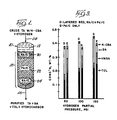
- FIGURE 1 A layered catalyst bed suitable for hydrogenation of a relatively impure aqueous solution of terephthalic acid containing 4-carboxybenzaldehyde is shown in FIGURE 1.
- Down-flow reactor 10 is shown hydraulically full with crude aqueous terephthalic acid solution 12 that is to be purified. This feed solution enters reactor 10 via conduit 14, and purified aqueous terephthalic acid solution having a relatively lower 4-carboxybenzaldehyde content exits reactor 10 at the bottom as an effluent via conduit 16.
- Fixed particulate catalyst bed 18 is constituted by first catalyst layer 20, second catalyst layer 22, and optional, third catalyst layer 24.
- First catalyst layer 20 is constituted by a particulate carrier, such as active carbon, containing a metal of Group VIII of the Periodic Table of Elements having a single electron in its outermost orbital when in ground state.
- a particulate carrier such as active carbon
- the metals contemplated for this purpose are ruthenium, rhodium, and platinum.
- the preferred metal is rhodium,
- the metal loadings of the active carbon carrier are the same as those discussed hereinabove in connection with the method aspects of this invention.
- the second catalyst layer 22 is also constituted by a particulate carrier, such as active carbon, and contains palladium in the same amounts as those discussed hereinabove in connection with the method aspects of this invention.
- the optional third catalyst layer 24 is constituted by a particulate carrier, e.g., active carbon and rhodium, the latter being present in an amount of about 0.01 to about 2 weight percent, based on the total weight of the catalyst and calculated as elemental metal, preferably in an amount of about 0.5 weight percent, as mentioned hereinabove.
- a particulate carrier e.g., active carbon and rhodium
- the present invention in a further aspect thereof, can also be utilized for production of benzoic acid, a commercially significant compound useful, inter alia, as a food preservative, as a mordant in calico printing, and as an intermediate for the manufacture of benzoates, benzoyl compounds, dyes and the like.
- benzoic acid a commercially significant compound useful, inter alia, as a food preservative, as a mordant in calico printing, and as an intermediate for the manufacture of benzoates, benzoyl compounds, dyes and the like.
- aqueous solution of 4-carboxybenzaldehyde is contacted in a pressure vessel, and in the presence of hydrogen, with a particulate catalyst containing one of the aforementioned Group VIII metals having a single electron in its outermost orbital.
- the reaction conditions for this purpose are the same as those described hereinabove for the purification of aqueous terephthalic acid solutions
- carbon monoxide is generated concurrently with the decarbonylation of 4-carboxybenzaldehyde to benzoic acid.
- the carbon monoxide is separated from the resulting aqueous solution and benzoic acid is recovered therefrom in any convenient manner.
- a pilot plant reactor of the down-flow type and equipped with a fixed catalyst bed one inch in diameter and 6.5 inches in length was used.
- the catalyst bed was constituted by a particulate commercial palladium-on-carbon catalyst (40 grams; 0.5 weight percent Pd; Engelhard) alone or by an upper particulate layer of rhodium-on-carbon catalyst (4 grams; 0.5 weight percent Rh) and a lower particulate layer of the same commercial palladium-on-carbon catalyst (40 grams).
- the rhodium-on- carbon catalyst was prepared from rhodium nitrate as a precursor, at a pH value of 2 in water, and using North American active carbon G-201 as support.
- a bed of commercial palladium-on-carbon catalyst (10 grams; 0.5 weight percent Pd; Engelhard) and a bed constituted by an upper layer of rhodium-on-carbon catalyst (5 grams, 0.5 weight percent Rh) and a lower layer of palladium-on-carbon catalyst (5 grams; 0.5 weight percent palladium-on-carbon; Engelhard) were used to hydrogenate a crude terephthalic acid aqueous solution in a down-flow pilot plant reactor.
- the feed solution to the reactor contained about 12 weight percent terephthalic acid and about 2,700 ppm 4-carboxybenzaldehyde.
- the reactor conditions were as follows: Temperature: 280°C (535°F) Pressure: 975 psig, 1025 psig & 1075 psig H2 Partial Press.: 50 psi, 100 psi & 150 psi Residence Time: 0.63 minutes
- the amounts of 4-carboxybenzaldehyde, benzoic acid, p-hydroxymethylbenzoic acid and p-toluic acid in the reactor effluent were monitored. The observed amounts are presented graphically in FIGURE 3.
- the calculated p-toluic acid-to-benzoic acid (TOL/BA) weight ratios are presented in Table III below.
- Example 3 In a manner similar to Example 3, above, a down-flow pilot plant reactor was used to compare the performance of a 55-gram catalyst bed containing only a commercial palladium-on-carbon catalyst (0.5 weight percent Pd; Engelhard) with a catalyst bed containing two layers containing an upper layer of 5 grams of rhodium-on-carbon catalyst (0.5 weight percent Rh) and a lower layer of 50 grams of a commercial palladium-on-carbon catalyst (0.5 weight percent Pd; Engelhard). All catalysts were aged in a titanium autoclave for 72 hours in the presence of terephthalic acid and hydrogen.
- a commercial palladium-on-carbon catalyst 0.5 weight percent Pd; Engelhard
- the reactor feed solution contained about 12 weight percent terephthalic acid, and about 2,700 ppm 4-carboxybenzaldehyde.
- the reactor conditions were as follows: Temperature: 280°C (530°F) Pressure: 975 psig, 1025 psig & 1075 psig H2 Partial Press.: 50 psi, 100 psi & 150 psi Residence Time: 3.5 minutes
- the amounts of benzoic acid, p-hydroxymethylbenzoic acid, and p-toluic acid were monitored in the reactor effluent. The observed results are compiled in FIGURE 2. Each bar shown in FIGURE 2 represents the average of four samples taken one-half hour apart and analyzed three times each.
- Both catalysts were first aged for 72 hours in a one gallon titanium autoclave in the presence of terephthalic acid and hydrogen. Thereafter, aliquots of the respective catalysts (4 grams) were contacted for four hours in the autoclave maintained at about 277°C. (about 530°F.) with an aqueous terephthalic acid solution (290 grams of crude terephthalic acid; 1160 grams of water). A mixture of hydrogen and carbon monoxide (100 psi H2 and 20 psi CO) at reaction temperature was also present in the autoclave.
- Example 6 involves 24-hour per day operations in a commercial unit for the continuous purification of crude terephthalic acid, which had been formed by the continuous liquid-phase oxidation of p-xylene with an oxygen-containing gas in a solvent at an elevated temperature and pressure and in the presence of an oxidation catalyst in a commercial unit.
- the specific solvent, oxygen-containing gas, catalyst, temperature, pressure and solvent residence time, which had been employed in the oxidation, are all within the classes and ranges described therefor hereinabove. Furthermore, each of the aforesaid gas, solvent, catalyst, temperature, pressure, and solvent residence time was essentially the same in each run.
- Example 6 also involves two sets of runs.
- the aqueous solvent, temperature, pressure and overall space velocity (weight of crude terephthalic acid per weight of total catalyst per hour) employed in the purification reaction are all within the classes and ranges described therefor generally hereinabove. Further additionally, each of the aforesaid solvent temperature, pressure and overall space velocity was essentially the same in each run.
- the bed of catalyst particles contained only palladium-on-carbon catalyst particles containing 0.5 weight percent of palladium calculated as elemental palladium and having a total surface area of about 1000 m2/gm and having a particle size of 4 to 8 mesh.
- each of Sets A and B an aqueous solution of crude terephthalic acid was introduced into the top portion of the purification reactor and flowed downward from the top to the bottom of the catalyst bed.
- each of Sets A and B involved at least 4 consecutive days of 24-hour per day operation.
- the data illustrates that for Set A the resulting purified terephthalic acid had an average optical density of 0.09, and average b*value of 1.18, and an average fluorescence index of 0.95.
- the resulting purified terephthalic acid had an average optical density of 0.08, an average b*value of 0.81, and an average fluorescence index of 0.79, indicting a substantial improvement of the optical and fluorescence properties of the purified terephthalic acid from Set B relative to that from Set A.
Landscapes
- Chemical & Material Sciences (AREA)
- Organic Chemistry (AREA)
- Engineering & Computer Science (AREA)
- Nanotechnology (AREA)
- Chemical Kinetics & Catalysis (AREA)
- General Chemical & Material Sciences (AREA)
- Oil, Petroleum & Natural Gas (AREA)
- Physics & Mathematics (AREA)
- Mathematical Physics (AREA)
- Theoretical Computer Science (AREA)
- Crystallography & Structural Chemistry (AREA)
- Organic Low-Molecular-Weight Compounds And Preparation Thereof (AREA)
Priority Applications (1)
| Application Number | Priority Date | Filing Date | Title |
|---|---|---|---|
| AT86307680T ATE49194T1 (de) | 1985-10-07 | 1986-10-03 | Reinigung von roher terephthalsaeure. |
Applications Claiming Priority (4)
| Application Number | Priority Date | Filing Date | Title |
|---|---|---|---|
| US78532285A | 1985-10-07 | 1985-10-07 | |
| US785322 | 1985-10-07 | ||
| US90576686A | 1986-09-10 | 1986-09-10 | |
| US905766 | 1986-09-10 |
Publications (2)
| Publication Number | Publication Date |
|---|---|
| EP0222500A1 true EP0222500A1 (de) | 1987-05-20 |
| EP0222500B1 EP0222500B1 (de) | 1990-01-03 |
Family
ID=27120389
Family Applications (1)
| Application Number | Title | Priority Date | Filing Date |
|---|---|---|---|
| EP86307680A Expired - Lifetime EP0222500B1 (de) | 1985-10-07 | 1986-10-03 | Reinigung von roher Terephthalsäure |
Country Status (5)
| Country | Link |
|---|---|
| EP (1) | EP0222500B1 (de) |
| KR (1) | KR900006440B1 (de) |
| CN (1) | CN1020894C (de) |
| DE (1) | DE3667969D1 (de) |
| ES (1) | ES2013246B3 (de) |
Cited By (4)
| Publication number | Priority date | Publication date | Assignee | Title |
|---|---|---|---|---|
| EP0370083A4 (en) * | 1988-03-25 | 1990-09-26 | Amoco Corporation | Seal for rotatable shaft |
| WO2001008798A1 (en) * | 1999-07-29 | 2001-02-08 | Institut Kataliza Imeni G.K.Boreskova Sibirskogo Otdeleniya Rossiiskoi Akademii Nauk | Catalytic composition, method for manufacturing thereof and method for the purification of terephthalic acid |
| KR20020046902A (ko) * | 2000-12-14 | 2002-06-21 | 유현식 | 수소화 정제용촉매 및 정제방법 |
| CN101450308B (zh) * | 2007-11-28 | 2012-05-09 | 中国石油化工股份有限公司 | 一种炭负载型贵金属催化剂及其制备方法 |
Families Citing this family (3)
| Publication number | Priority date | Publication date | Assignee | Title |
|---|---|---|---|---|
| EP1671938B1 (de) * | 2004-12-15 | 2006-12-13 | Saudi Basic Industries Corporation | Verfahren zur Herstellung gereinigter Terephtalsäure |
| US20120178964A1 (en) * | 2009-09-30 | 2012-07-12 | Bp Corporation North America Inc | Catalyst, Use Thereof and Process of Hydrogenating Aryl Aldehydes |
| CN103467279A (zh) * | 2013-08-30 | 2013-12-25 | 中国石油化工股份有限公司 | 一种精对苯二甲酸的制备方法 |
Citations (2)
| Publication number | Priority date | Publication date | Assignee | Title |
|---|---|---|---|---|
| DE2709525A1 (de) * | 1977-03-02 | 1977-09-08 | Johnson Matthey Co Ltd | Verbessertes katalytisches verfahren |
| US4467110A (en) * | 1981-10-29 | 1984-08-21 | Standard Oil Company (Indiana) | Process for purification of crude terephthalic acid |
-
1986
- 1986-10-03 DE DE8686307680T patent/DE3667969D1/de not_active Expired - Fee Related
- 1986-10-03 ES ES86307680T patent/ES2013246B3/es not_active Expired - Lifetime
- 1986-10-03 EP EP86307680A patent/EP0222500B1/de not_active Expired - Lifetime
- 1986-10-07 CN CN86106971A patent/CN1020894C/zh not_active Expired - Fee Related
- 1986-10-07 KR KR1019860008397A patent/KR900006440B1/ko not_active Expired
Patent Citations (2)
| Publication number | Priority date | Publication date | Assignee | Title |
|---|---|---|---|---|
| DE2709525A1 (de) * | 1977-03-02 | 1977-09-08 | Johnson Matthey Co Ltd | Verbessertes katalytisches verfahren |
| US4467110A (en) * | 1981-10-29 | 1984-08-21 | Standard Oil Company (Indiana) | Process for purification of crude terephthalic acid |
Cited By (5)
| Publication number | Priority date | Publication date | Assignee | Title |
|---|---|---|---|---|
| EP0370083A4 (en) * | 1988-03-25 | 1990-09-26 | Amoco Corporation | Seal for rotatable shaft |
| WO2001008798A1 (en) * | 1999-07-29 | 2001-02-08 | Institut Kataliza Imeni G.K.Boreskova Sibirskogo Otdeleniya Rossiiskoi Akademii Nauk | Catalytic composition, method for manufacturing thereof and method for the purification of terephthalic acid |
| US6753290B1 (en) | 1999-07-29 | 2004-06-22 | Institut Kataliza Imeni G.K. Boreskova Sibirskogo Otdelenia Rossiiskoi Akademii Nauk | Catalytic composition, method for manufacturing thereof and method for the purification of terephthalic acid |
| KR20020046902A (ko) * | 2000-12-14 | 2002-06-21 | 유현식 | 수소화 정제용촉매 및 정제방법 |
| CN101450308B (zh) * | 2007-11-28 | 2012-05-09 | 中国石油化工股份有限公司 | 一种炭负载型贵金属催化剂及其制备方法 |
Also Published As
| Publication number | Publication date |
|---|---|
| CN1020894C (zh) | 1993-05-26 |
| EP0222500B1 (de) | 1990-01-03 |
| ES2013246B3 (es) | 1990-05-01 |
| DE3667969D1 (de) | 1990-02-08 |
| KR870003964A (ko) | 1987-05-06 |
| CN86106971A (zh) | 1987-04-08 |
| KR900006440B1 (ko) | 1990-08-31 |
Similar Documents
| Publication | Publication Date | Title |
|---|---|---|
| US4892972A (en) | Purification of crude terephthalic acid | |
| US5756833A (en) | Catalytic purification and recovery of dicarboxylic aromatic acids | |
| US5616792A (en) | Catalytic purification of dicarboxylic aromatic acid | |
| EP0222499B1 (de) | Reinigung von Terephthalsäure zu einem relativ niedrigen Gehalt an 4-Carboxybenzaldehyd und Katalysator hierfür | |
| CA2480597C (en) | Method of removing iron contaminants from liquid streams during the manufacture and/or purification of aromatic acids | |
| US5362908A (en) | Catalyst and method for purifying crude terephthalic acid, isophthalic acid or naphthalene dicarboxylic acid | |
| US4782181A (en) | Process for removal of high molecular weight impurities in the manufacture of purified terephthalic acid | |
| GB2301586A (en) | Process for producing terephthalic acid | |
| US6265608B1 (en) | Method of purifying aromatic dicarboxylic acids | |
| EP0445446B1 (de) | Reinigung von roher Isophthalsäure | |
| US4933491A (en) | Method for purifying a crude naphthalene dicarboxylic acid | |
| US5110984A (en) | Process for increasing the yield of purified isophthalic acid and reducing waste-water treatment a | |
| EP0206715A2 (de) | Reinigung von Terephthalsäure | |
| EP0222500A1 (de) | Reinigung von roher Terephthalsäure | |
| US4937378A (en) | Purification of crude isophthalic acid | |
| EP0335501A1 (de) | Methode zum Reaktivieren eines Gruppe-VIII-Edelmetallkatalysators zur Verwendung bei der Reinigung roher Terephthalsäure | |
| EP0655051B1 (de) | Verfahren zur herstellung von phenylterephthalsäure | |
| KR0149502B1 (ko) | 조 이소프탈산의 정제방법 | |
| EP1456164B1 (de) | Aufreinigung einer rohen säuremischung | |
| JP2879925B2 (ja) | 粗製イソフタル酸の精製法 | |
| JPS62129248A (ja) | 粗製テレフタル酸の精製 | |
| CA2011269A1 (en) | Purification of crude isophthalic acid |
Legal Events
| Date | Code | Title | Description |
|---|---|---|---|
| PUAI | Public reference made under article 153(3) epc to a published international application that has entered the european phase |
Free format text: ORIGINAL CODE: 0009012 |
|
| AK | Designated contracting states |
Kind code of ref document: A1 Designated state(s): AT BE CH DE ES FR GB IT LI LU NL SE |
|
| 17P | Request for examination filed |
Effective date: 19871027 |
|
| 17Q | First examination report despatched |
Effective date: 19880811 |
|
| ITF | It: translation for a ep patent filed | ||
| GRAA | (expected) grant |
Free format text: ORIGINAL CODE: 0009210 |
|
| AK | Designated contracting states |
Kind code of ref document: B1 Designated state(s): AT BE CH DE ES FR GB IT LI LU NL SE |
|
| REF | Corresponds to: |
Ref document number: 49194 Country of ref document: AT Date of ref document: 19900115 Kind code of ref document: T |
|
| REF | Corresponds to: |
Ref document number: 3667969 Country of ref document: DE Date of ref document: 19900208 |
|
| ET | Fr: translation filed | ||
| PLBE | No opposition filed within time limit |
Free format text: ORIGINAL CODE: 0009261 |
|
| STAA | Information on the status of an ep patent application or granted ep patent |
Free format text: STATUS: NO OPPOSITION FILED WITHIN TIME LIMIT |
|
| 26N | No opposition filed | ||
| ITTA | It: last paid annual fee | ||
| PGFP | Annual fee paid to national office [announced via postgrant information from national office to epo] |
Ref country code: FR Payment date: 19920918 Year of fee payment: 7 |
|
| PGFP | Annual fee paid to national office [announced via postgrant information from national office to epo] |
Ref country code: GB Payment date: 19920923 Year of fee payment: 7 |
|
| PGFP | Annual fee paid to national office [announced via postgrant information from national office to epo] |
Ref country code: SE Payment date: 19920924 Year of fee payment: 7 |
|
| PGFP | Annual fee paid to national office [announced via postgrant information from national office to epo] |
Ref country code: AT Payment date: 19921001 Year of fee payment: 7 |
|
| PGFP | Annual fee paid to national office [announced via postgrant information from national office to epo] |
Ref country code: BE Payment date: 19921012 Year of fee payment: 7 |
|
| PGFP | Annual fee paid to national office [announced via postgrant information from national office to epo] |
Ref country code: ES Payment date: 19921013 Year of fee payment: 7 |
|
| PGFP | Annual fee paid to national office [announced via postgrant information from national office to epo] |
Ref country code: LU Payment date: 19921022 Year of fee payment: 7 |
|
| PGFP | Annual fee paid to national office [announced via postgrant information from national office to epo] |
Ref country code: NL Payment date: 19921031 Year of fee payment: 7 |
|
| PGFP | Annual fee paid to national office [announced via postgrant information from national office to epo] |
Ref country code: CH Payment date: 19921215 Year of fee payment: 7 |
|
| PGFP | Annual fee paid to national office [announced via postgrant information from national office to epo] |
Ref country code: DE Payment date: 19921231 Year of fee payment: 7 |
|
| EPTA | Lu: last paid annual fee | ||
| PG25 | Lapsed in a contracting state [announced via postgrant information from national office to epo] |
Ref country code: LU Free format text: LAPSE BECAUSE OF NON-PAYMENT OF DUE FEES Effective date: 19931003 Ref country code: GB Effective date: 19931003 Ref country code: AT Effective date: 19931003 |
|
| PG25 | Lapsed in a contracting state [announced via postgrant information from national office to epo] |
Ref country code: SE Effective date: 19931004 Ref country code: ES Free format text: LAPSE BECAUSE OF EXPIRATION OF PROTECTION Effective date: 19931004 |
|
| PG25 | Lapsed in a contracting state [announced via postgrant information from national office to epo] |
Ref country code: LI Effective date: 19931031 Ref country code: CH Effective date: 19931031 Ref country code: BE Effective date: 19931031 |
|
| BERE | Be: lapsed |
Owner name: AMOCO CORP. Effective date: 19931031 |
|
| PG25 | Lapsed in a contracting state [announced via postgrant information from national office to epo] |
Ref country code: NL Effective date: 19940501 |
|
| GBPC | Gb: european patent ceased through non-payment of renewal fee |
Effective date: 19931003 |
|
| NLV4 | Nl: lapsed or anulled due to non-payment of the annual fee | ||
| PG25 | Lapsed in a contracting state [announced via postgrant information from national office to epo] |
Ref country code: FR Effective date: 19940630 |
|
| REG | Reference to a national code |
Ref country code: CH Ref legal event code: PL |
|
| PG25 | Lapsed in a contracting state [announced via postgrant information from national office to epo] |
Ref country code: DE Effective date: 19940701 |
|
| REG | Reference to a national code |
Ref country code: FR Ref legal event code: ST |
|
| EUG | Se: european patent has lapsed |
Ref document number: 86307680.8 Effective date: 19940510 |
|
| REG | Reference to a national code |
Ref country code: ES Ref legal event code: FD2A Effective date: 19991007 |
|
| PG25 | Lapsed in a contracting state [announced via postgrant information from national office to epo] |
Ref country code: IT Free format text: LAPSE BECAUSE OF NON-PAYMENT OF DUE FEES;WARNING: LAPSES OF ITALIAN PATENTS WITH EFFECTIVE DATE BEFORE 2007 MAY HAVE OCCURRED AT ANY TIME BEFORE 2007. THE CORRECT EFFECTIVE DATE MAY BE DIFFERENT FROM THE ONE RECORDED. Effective date: 20051003 |