EP0224086A2 - Substituierte Benzylether - Google Patents
Substituierte Benzylether Download PDFInfo
- Publication number
- EP0224086A2 EP0224086A2 EP86115358A EP86115358A EP0224086A2 EP 0224086 A2 EP0224086 A2 EP 0224086A2 EP 86115358 A EP86115358 A EP 86115358A EP 86115358 A EP86115358 A EP 86115358A EP 0224086 A2 EP0224086 A2 EP 0224086A2
- Authority
- EP
- European Patent Office
- Prior art keywords
- alkyl
- stands
- formula
- hydrogen
- group
- Prior art date
- Legal status (The legal status is an assumption and is not a legal conclusion. Google has not performed a legal analysis and makes no representation as to the accuracy of the status listed.)
- Granted
Links
- 0 C*1C=CC(BC2/C=C/C(C*C(C)(*)C3)=C3*(*)/C=C2)=CC=C1 Chemical compound C*1C=CC(BC2/C=C/C(C*C(C)(*)C3)=C3*(*)/C=C2)=CC=C1 0.000 description 9
- MBSNCPQPYSBYSJ-UHFFFAOYSA-N CCC(COC1=CC(COC2=CCCC(CCC3=O)=C2C3=N)CC=C1)O Chemical compound CCC(COC1=CC(COC2=CCCC(CCC3=O)=C2C3=N)CC=C1)O MBSNCPQPYSBYSJ-UHFFFAOYSA-N 0.000 description 1
- BQWMCGVKZICNCF-UHFFFAOYSA-N CCC(COC1C(C)C=CCC1)O Chemical compound CCC(COC1C(C)C=CCC1)O BQWMCGVKZICNCF-UHFFFAOYSA-N 0.000 description 1
- WFSAGYWOKSYILH-UHFFFAOYSA-N CCC(COC1C(C)C=CCC1)OC(C)=O Chemical compound CCC(COC1C(C)C=CCC1)OC(C)=O WFSAGYWOKSYILH-UHFFFAOYSA-N 0.000 description 1
- MRCKFZZDQXFDGR-UHFFFAOYSA-N CCCCC(C1=CC=CC(COC2C=CC=C3C(C)CC=C(C4)C4C23)C1)O Chemical compound CCCCC(C1=CC=CC(COC2C=CC=C3C(C)CC=C(C4)C4C23)C1)O MRCKFZZDQXFDGR-UHFFFAOYSA-N 0.000 description 1
- ODUVUVQNPYTOSN-UHFFFAOYSA-N CCCCC(COC1CC=CC(C)C1)OC(C)=O Chemical compound CCCCC(COC1CC=CC(C)C1)OC(C)=O ODUVUVQNPYTOSN-UHFFFAOYSA-N 0.000 description 1
- IQALRBDABJEMGH-UHFFFAOYSA-N CCCCCCC(C1C(C)C=CCC1)O Chemical compound CCCCCCC(C1C(C)C=CCC1)O IQALRBDABJEMGH-UHFFFAOYSA-N 0.000 description 1
Classifications
-
- C—CHEMISTRY; METALLURGY
- C07—ORGANIC CHEMISTRY
- C07D—HETEROCYCLIC COMPOUNDS
- C07D215/00—Heterocyclic compounds containing quinoline or hydrogenated quinoline ring systems
- C07D215/02—Heterocyclic compounds containing quinoline or hydrogenated quinoline ring systems having no bond between the ring nitrogen atom and a non-ring member or having only hydrogen atoms or carbon atoms directly attached to the ring nitrogen atom
- C07D215/16—Heterocyclic compounds containing quinoline or hydrogenated quinoline ring systems having no bond between the ring nitrogen atom and a non-ring member or having only hydrogen atoms or carbon atoms directly attached to the ring nitrogen atom with hetero atoms or with carbon atoms having three bonds to hetero atoms with at the most one bond to halogen, e.g. ester or nitrile radicals, directly attached to ring carbon atoms
- C07D215/20—Oxygen atoms
-
- C—CHEMISTRY; METALLURGY
- C07—ORGANIC CHEMISTRY
- C07D—HETEROCYCLIC COMPOUNDS
- C07D277/00—Heterocyclic compounds containing 1,3-thiazole or hydrogenated 1,3-thiazole rings
- C07D277/60—Heterocyclic compounds containing 1,3-thiazole or hydrogenated 1,3-thiazole rings condensed with carbocyclic rings or ring systems
- C07D277/62—Benzothiazoles
- C07D277/68—Benzothiazoles with hetero atoms or with carbon atoms having three bonds to hetero atoms with at the most one bond to halogen, e.g. ester or nitrile radicals, directly attached in position 2
- C07D277/70—Sulfur atoms
- C07D277/76—Sulfur atoms attached to a second hetero atom
-
- C—CHEMISTRY; METALLURGY
- C07—ORGANIC CHEMISTRY
- C07D—HETEROCYCLIC COMPOUNDS
- C07D215/00—Heterocyclic compounds containing quinoline or hydrogenated quinoline ring systems
- C07D215/02—Heterocyclic compounds containing quinoline or hydrogenated quinoline ring systems having no bond between the ring nitrogen atom and a non-ring member or having only hydrogen atoms or carbon atoms directly attached to the ring nitrogen atom
- C07D215/16—Heterocyclic compounds containing quinoline or hydrogenated quinoline ring systems having no bond between the ring nitrogen atom and a non-ring member or having only hydrogen atoms or carbon atoms directly attached to the ring nitrogen atom with hetero atoms or with carbon atoms having three bonds to hetero atoms with at the most one bond to halogen, e.g. ester or nitrile radicals, directly attached to ring carbon atoms
- C07D215/20—Oxygen atoms
- C07D215/24—Oxygen atoms attached in position 8
- C07D215/26—Alcohols; Ethers thereof
-
- C—CHEMISTRY; METALLURGY
- C07—ORGANIC CHEMISTRY
- C07D—HETEROCYCLIC COMPOUNDS
- C07D215/00—Heterocyclic compounds containing quinoline or hydrogenated quinoline ring systems
- C07D215/02—Heterocyclic compounds containing quinoline or hydrogenated quinoline ring systems having no bond between the ring nitrogen atom and a non-ring member or having only hydrogen atoms or carbon atoms directly attached to the ring nitrogen atom
- C07D215/16—Heterocyclic compounds containing quinoline or hydrogenated quinoline ring systems having no bond between the ring nitrogen atom and a non-ring member or having only hydrogen atoms or carbon atoms directly attached to the ring nitrogen atom with hetero atoms or with carbon atoms having three bonds to hetero atoms with at the most one bond to halogen, e.g. ester or nitrile radicals, directly attached to ring carbon atoms
- C07D215/20—Oxygen atoms
- C07D215/24—Oxygen atoms attached in position 8
- C07D215/26—Alcohols; Ethers thereof
- C07D215/28—Alcohols; Ethers thereof with halogen atoms or nitro radicals in positions 5, 6 or 7
-
- C—CHEMISTRY; METALLURGY
- C07—ORGANIC CHEMISTRY
- C07D—HETEROCYCLIC COMPOUNDS
- C07D215/00—Heterocyclic compounds containing quinoline or hydrogenated quinoline ring systems
- C07D215/02—Heterocyclic compounds containing quinoline or hydrogenated quinoline ring systems having no bond between the ring nitrogen atom and a non-ring member or having only hydrogen atoms or carbon atoms directly attached to the ring nitrogen atom
- C07D215/16—Heterocyclic compounds containing quinoline or hydrogenated quinoline ring systems having no bond between the ring nitrogen atom and a non-ring member or having only hydrogen atoms or carbon atoms directly attached to the ring nitrogen atom with hetero atoms or with carbon atoms having three bonds to hetero atoms with at the most one bond to halogen, e.g. ester or nitrile radicals, directly attached to ring carbon atoms
- C07D215/36—Sulfur atoms
-
- C—CHEMISTRY; METALLURGY
- C07—ORGANIC CHEMISTRY
- C07D—HETEROCYCLIC COMPOUNDS
- C07D215/00—Heterocyclic compounds containing quinoline or hydrogenated quinoline ring systems
- C07D215/02—Heterocyclic compounds containing quinoline or hydrogenated quinoline ring systems having no bond between the ring nitrogen atom and a non-ring member or having only hydrogen atoms or carbon atoms directly attached to the ring nitrogen atom
- C07D215/16—Heterocyclic compounds containing quinoline or hydrogenated quinoline ring systems having no bond between the ring nitrogen atom and a non-ring member or having only hydrogen atoms or carbon atoms directly attached to the ring nitrogen atom with hetero atoms or with carbon atoms having three bonds to hetero atoms with at the most one bond to halogen, e.g. ester or nitrile radicals, directly attached to ring carbon atoms
- C07D215/38—Nitrogen atoms
- C07D215/40—Nitrogen atoms attached in position 8
-
- C—CHEMISTRY; METALLURGY
- C07—ORGANIC CHEMISTRY
- C07D—HETEROCYCLIC COMPOUNDS
- C07D215/00—Heterocyclic compounds containing quinoline or hydrogenated quinoline ring systems
- C07D215/58—Heterocyclic compounds containing quinoline or hydrogenated quinoline ring systems with hetero atoms directly attached to the ring nitrogen atom
- C07D215/60—N-oxides
-
- C—CHEMISTRY; METALLURGY
- C07—ORGANIC CHEMISTRY
- C07D—HETEROCYCLIC COMPOUNDS
- C07D217/00—Heterocyclic compounds containing isoquinoline or hydrogenated isoquinoline ring systems
- C07D217/02—Heterocyclic compounds containing isoquinoline or hydrogenated isoquinoline ring systems with only hydrogen atoms or radicals containing only carbon and hydrogen atoms, directly attached to carbon atoms of the nitrogen-containing ring; Alkylene-bis-isoquinolines
-
- C—CHEMISTRY; METALLURGY
- C07—ORGANIC CHEMISTRY
- C07D—HETEROCYCLIC COMPOUNDS
- C07D277/00—Heterocyclic compounds containing 1,3-thiazole or hydrogenated 1,3-thiazole rings
- C07D277/60—Heterocyclic compounds containing 1,3-thiazole or hydrogenated 1,3-thiazole rings condensed with carbocyclic rings or ring systems
- C07D277/62—Benzothiazoles
- C07D277/64—Benzothiazoles with only hydrocarbon or substituted hydrocarbon radicals attached in position 2
Definitions
- the invention relates to new substituted benzyl ethers, thioethers and amines, processes for their preparation and their use in medicaments.
- the substituted benzyl ethers according to the invention surprisingly have a higher pharmacological effect.
- Alkyl generally represents a straight-chain or branched hydrocarbon radical having 1 to 12 carbon atoms. Lower alkyl having 1 to about 8 carbon atoms is preferred. Examples include methyl, ethyl, propyl, isopropyl, butyl, isobutyl, pentyl, isopentyl, hexyl, isohexyl, heptyl, isoheptyl, octyl and isooctyl.
- Alkenyl generally represents a straight-chain or branched hydrocarbon radical with 2 to 12 carbon atoms and one or more, preferably with one or two, double bonds.
- the lower alkenyl radical having 2 to about 6 carbon atoms and one is preferred Double bond.
- An alkenyl radical having 2 to 4 carbon atoms and a double bond is particularly preferred. Examples include vinyl, allyl, propenyl, isopropenyl, butenyl, isobutenyl, pentenyl, isopentenyl, hexenyl, isohexenyl, heptenyl, isoheptenyl, octenyl and isooctenyl.
- Cycloalkyl generally represents a cyclic hydrocarbon radical having 5 to 8 carbon atoms.
- the cyclopentyl and cyclohexyl radicals are preferred. Examples include cyclopentyl, cyclohexyl and cycloheptyl.
- Alkoxy generally represents a straight-chain or branched hydrocarbon radical having 1 to 12 carbon atoms which is bonded via an oxygen atom. Lower alkoxy having 1 to about 6 carbon atoms is preferred. An alkoxy radical having 1 to 4 carbon atoms is particularly preferred. Examples include methoxy, ethoxy, propoxy, isopropoxy, butoxy, isobutoxy, pentoxy, isopentoxy, hexoxy, isohexoxy, heptoxy, isoheptoxy, octoxy or isooctoxy.
- Alkylthio generally represents a straight-chain or branched hydrocarbon radical having 1 to 12 carbon atoms which is bonded via a sulfur atom. Lower alkylthio having 1 to about 6 carbon atoms is preferred. An alkylthio radical having 1 to 4 carbon atoms is particularly preferred. Examples include methylthio, ethylthio, propylthio, isopropylthio, butylthio, isobutylthio, pentylthio, isopentylthio, hexylthio, isohexylthio, heptylthio, isoheptylthio, octylthio and isooctylthio.
- Haloalkyl generally represents straight-chain or branched lower alkyl having 1 to about 6 carbon atoms and one or more halogen atoms, preferably having one or more fluorine, chlorine and / or bromine atoms. Alkyl having 1 to 4 carbon atoms and having one or more fluorine and / or chlorine atoms is preferred. Alkyl with 1 to 2 carbon atoms and with up to five fluorine atoms or with up to three chlorine atoms is particularly preferred.
- Examples include: fluoromethyl, chloromethyl, bromomethyl, fluoroethyl, chloroethyl, bromethyl, fluoropropyl, chloropropyl, bromopropyl, fluorobutyl, chlorobutyl, bromobutyl, fluoroisopropyl, chloroisopropyl, bromoisopropyl, difluoromethyl, trifluoromethyl, dichloromethyl, trichloromethyl, dichloromethyl, dichloromethyl, dichloromethyl, dichloromethyl, dichloro Pentafluoroethyl, trichloroethyl, trifluoropropyl. Trifluoromethyl, difluoromethyl, fluoromethyl, chloromethyl and trifluoroethyl are very particularly preferred.
- Sulfonylalkyl generally represents a straight-chain or branched hydrocarbon radical having 1 to 12 carbon atoms, which is bonded via a sulfonyl group. Sulfonyl lower alkyl having 1 to about 6 carbon atoms is preferred. A sulfonylalkyl radical having 1 to 4 carbon atoms is particularly preferred.
- Haloalkoxy generally stands for a straight-chain or branched lower alkyl radical bonded via an oxygen atom and having 1 to about 6 carbon atoms and one or more halogen atoms, preferably with one or more fluorine, chlorine and / or bromine atoms. Halogenalkoxy having 1 to 4 carbon atoms and is preferred with one or more fluorine and / or chlorine atoms. Halogenalkoxy with 1 to 2 carbon atoms and with up to 5 fluorine atoms or with up to 3 chlorine atoms is particularly preferred.
- Examples include: fluoromethoxy, chloromethoxy, bromomethoxy, fluoroethoxy, chloroethoxy, bromethoxy, fluoropropoxy, chloropropoxy, bromopropoxy, fluorobutoxy, chlorobutoxy, bromobutoxy, fluoroisopropoxy, chloroisopropoxy, bromoisopropoxy, difluoromethoxy, trifluoromethoxy, trifluoromethoxy, dichloromethoroxy, dichloromethoxy, dichloromethoxy, dichloromethoxy, dichloromethoxy, dichloromethoxy, dichloromethoxy, dichloromethoxy, dichloromethoxy, dichloromethoxy, dichloromethoxy, dichloromethoxy, dichloromethoxoxy Trichloroethoxy, trifluoropropoxy. Trifluoromethoxy, difluoromethoxy, fluoromethoxy, chloromethoxy and trifluoroethoxy are very particularly preferred.
- Haloalkylthio generally represents a straight-chain or branched lower alkyl radical which is bonded via a sulfur atom and has 1 to about 6 carbon atoms and one or more halogen atoms, preferably with one or more fluorine, chlorine and / or bromine atoms. Haloalkylthio having 1 to 4 carbon atoms and having one or more fluorine or chlorine atoms is preferred. Haloalkylthio with 1 to 2 carbon atoms and with up to five fluorine atoms or with up to 3 chlorine atoms is particularly preferred.
- Examples include: fluoromethylthio, chloromethylthio, bromomethylthio, fluoroethylthio, chloroethylthio, bromoethylthio, fluoropropylthio, chloropropylthio, bromopropylthio, Fluorbutylthio, Brombutylthio, chlorobutylthio, Fluorisopropylthio, Chlorisopropylthio, Bromisopropylthio, difluoromethylthio, trifluoromethylthio, dichloromethylthio, trichloromethylthio, difluoroethylthio, trifluoroethylthio, tetrafluoroethylthio, pentafluoroethylthio, Trichloroethylthio, trifluoropropylthio, pentafluoroethylthio, Trichloroethy
- Aryl generally represents an aromatic radical having 6 to about 12 carbon atoms.
- Preferred aryl radicals are phenyl, naphthyl and biphenyl.
- Aralkyl generally represents an aryl radical having 7 to 14 carbon atoms bonded via an alkylene chain.
- Aralkyl radicals having 1 to 6 carbon atoms in the aliphatic part and 6 to 12 carbon atoms in the aromatic part are preferred.
- the following aralkyl radicals may be mentioned, for example: benzyl, naphthylmethyl, phenethyl and phenylpropyl.
- Aralkoxy generally represents an aralkyl radical having 7 to 14 carbon atoms, the alkylene chain being bonded via an oxygen atom.
- Aralkoxy radicals having 1 to 6 carbon atoms in the aliphatic part and 6 to 12 carbon atoms in the aromatic part are preferred.
- the following aralkoxy radicals may be mentioned, for example: benzyloxy, naphthylmethoxy, phenethoxy and phenylpropoxy.
- Aralkylthio generally represents an aralkyl radical having 7 to 14 carbon atoms, the alkyl chain being bonded via a sulfur atom.
- Aralkylthio radicals having 1 to 6 carbon atoms in the aliphatic part and 6 to 12 carbon atoms in the aromatic part are preferred. Examples include the following aralkylthio radicals: benzylthio, naphthylmethylthio, phenethylthio and phenylpropylthio.
- Acyl generally represents phenyl or straight-chain or branched lower alkyl having 1 to about 6 carbon atoms which are bonded via a carbonyl group. Phenyl and alkyl radicals having up to 4 carbon atoms are preferred. Examples include: benzoyl, acetyl, ethylcarbonyl, propylcarbonyl, isopropylcarbonyl, butylcarbonyl and isobutylcarbonyl.
- Halogen generally represents fluorine, chlorine, bromine or iodine, preferably fluorine, chlorine or bromine. Halogen is particularly preferably fluorine or chlorine.
- the benzo-condensed heterocyclic system generally represents a phenyl radical to which a 5 to 7-membered heterocycle with 1 to 3 nitrogen, sulfur and / or oxygen atoms is fused. 5 to 6-membered heterocyclic systems with 1 to 2 nitrogen, oxygen and / or sulfur atoms are preferred.
- Examples include: quinoline, isoquinoline, cinnoline, quinazoline, quinoxaline, phthalazine, quinoline-N-oxide, isoquinoline-N-oxide, quinazoline-N-oxide, quinoxalinone, quinoxalinedione, phthalazinedione, chroman, chromium, chromon, thiochroman, thiochromes, Thiochromone, indole, indolone, isatin, isoindole, isoindolone, benzofuran, benzothiophene, benzimidazole, benzimidazolone, benzoxazole, benzothiazole, benzisoxazole, benzisothiazole, benzthiadiazole, benzoxadiazole, indazole, indoxyl.
- Solvents for the process according to the invention can be inert organic solvents which do not change under the reaction conditions. These preferably include alcohols such as methanol, ethanol, propanol or isopropanol, ethers such as dioxane, tetrahydrofuran or diethyl ether, hydrogen halides such as dichloromethane, trichloromethane, tetrachloromethane, 1,2-dichloroethane or trichlorethylene, hydrocarbons such as benzene, xylene, toluene, hexane, cyclohexane or petroleum fractions, nitromethane, dimethylformamide, acetonitrile, acetone or hexamethylphosphoric triamide. It is also possible to use mixtures of the solvents.
- alcohols such as methanol, ethanol, propanol or isopropanol
- ethers such as dioxane, tetrahydro
- Inorganic or organic bases can be used as bases for the process according to the invention.
- bases preferably include alkali hydroxides such as, for example Sodium hydroxide or potassium hydroxide, alkaline earth metal hydroxides such as barium hydroxide, alkali carbonates such as sodium carbonate or potassium carbonate, alkaline earth carbonates such as calcium carbonate or organic amines (trialkyl (C 1 -C 6 ) amines) such as triethylamine and heterocycles such as pyridine, methylpiperidine, piperidine or morpholine.
- alkali hydroxides such as, for example Sodium hydroxide or potassium hydroxide
- alkaline earth metal hydroxides such as barium hydroxide
- alkali carbonates such as sodium carbonate or potassium carbonate
- alkaline earth carbonates such as calcium carbonate or organic amines (trialkyl (C 1 -C 6 ) amines) such as triethylamine and heterocycles such as pyridine
- alkali metals such as sodium
- their hydrides such as sodium hydride
- the compounds according to the invention are generally prepared in a temperature range from 0 ° C. to 150 ° C., preferably from 10 ° C. to 100 ° C.
- the process according to the invention is generally carried out at normal pressure. However, it is also possible to carry out the process under reduced pressure or excess pressure (e.g. in a range from 0.5 to 5 bar).
- halide based on 1 mol of the reactant
- the base is generally used in an amount of 0.5 to 5 mol, preferably 1 to 3 mol, based on the halide.
- the acyl group can be split off, for example, by adding bases.
- bases which may be mentioned are sodium hydroxide, potassium hydroxide, barium hydroxide, sodium carbonate or potassium carbonate.
- the alkylation of the hydroxy compounds is generally carried out in inert solvents, if appropriate in the presence of a base, with customary alkylating agents such as alkyl halides, for example C I -C 4 alkyl chlorides, bromides or iodides, dialkyl sulfates, for example Dimethyl sulfate, or diazoalkanes, for example diazomethane, diazoethane or diazopropane.
- alkyl halides for example C I -C 4 alkyl chlorides, bromides or iodides
- dialkyl sulfates for example Dimethyl sulfate
- diazoalkanes for example diazomethane, diazoethane or diazopropane.
- Suitable solvents are, depending on the type of alkylating agent, all inert organic solvents. These preferably include ethers such as diethyl ether, dioxane or tetrahydrofuran, or hydrocarbons such as benzene, toluene or xylene, or dimethylformamide or hexamethylphosphoric triamide, or mixtures of the solvents mentioned.
- ethers such as diethyl ether, dioxane or tetrahydrofuran
- hydrocarbons such as benzene, toluene or xylene, or dimethylformamide or hexamethylphosphoric triamide, or mixtures of the solvents mentioned.
- Suitable bases are the usual basic compounds. These preferably include alkali hydrides such as sodium hydride, alkali amides such as sodium amide or lithium diisopropylamide, alkali alcoholates such as sodium methoxide, sodium ethoxide, potassium methoxide, potassium ethoxide or potassium tert-butoxide, or organic amines such as trialkylamines e.g. Triethylamine, or organolithium compounds such as butyllithium or phenyllithium.
- alkali hydrides such as sodium hydride
- alkali amides such as sodium amide or lithium diisopropylamide
- alkali alcoholates such as sodium methoxide, sodium ethoxide, potassium methoxide, potassium ethoxide or potassium tert-butoxide
- organic amines such as trialkylamines e.g. Triethylamine, or organolithium compounds such as butyllithium or phen
- the starting compounds of the general formula (III) are known or can be prepared by known methods (A.R. Katritzky, C.W. Reeds, Comprehensive Heterocyclic Chemistry Volumes 1-8, Pergamon Press).
- the starting compounds of the general formula IV are known or can be prepared by known methods (EP-OS 13 411).
- the starting compounds of the general formula V are known or can be prepared by known methods (EP-OS 110 405).
- halogenated hydrocarbons such as dichloromethane, trichloromethane or carbon tetrachloride, hydrocarbons such as benzene, toluene, xylene, or glacial acetic acid.
- the generally customary halogenating agents can be used as halogenating agents. Chlorine, bromine, N-chlorosuccinimide (NCS) or N-bromosuccinimide (NBS) are preferred, optionally in the presence of radical formers such as azobisisobutyronitrile (AIBN), benzoyl peroxide or light. Bromination with NBS and AIBN in carbon tetrachloride is particularly preferred.
- reaction temperatures can generally be varied within a wide range. It is preferred to work in a range from -10 ° C to 100 ° C, particularly preferably from 0 ° C to 80 ° C.
- the reaction can be carried out at normal pressure, but also at elevated or reduced pressure. Generally one works at normal pressure.
- the ratio of the reactants is generally arbitrary. However, it is preferred to work with an amount of 1 to 5 mol, particularly preferably with 1 mol of the halogenating agent, based on 1 mol of the tolyl compounds.
- the tolylaldehydes and cresols used as starting materials are known: Beilstein's Handbuch der organic Chemistry, 7, 295-297, and 6, 349, 373 and 389.
- the benzyl compounds according to the invention can be used as active ingredients in pharmaceuticals.
- the substances act as inhibitors (stimulators) of enzymatic reactions in the context of arachidonic acid metabolism, in particular lipoxygenase.
- the new active compounds can be converted into the customary formulations, such as tablets, capsules, dragees, pills, granules, aerosols, syrups, emulsions, suspensions and solutions, in a manner known per se using inert non-toxic, pharmaceutically suitable excipients or solvents.
- the therapeutically active compound should be present in the total mixture in a concentration of about 0.5 to 90% by weight, preferably 10 to 70% by weight, i.e. in amounts sufficient to achieve the dosage range indicated.
- the formulations are prepared, for example, by stretching the active ingredients with solvents and / or carriers, optionally using emulsifiers and / or dispersants, e.g. if water is used as the diluent, organic solvents can optionally be used as auxiliary solvents.
- auxiliaries include: water, non-toxic organic solvents such as paraffins (e.g. petroleum fractions), vegetable oils (e.g. peanut / sesame oil), alcohols (e.g. ethyl alcohol, glycerol), glycols (e.g. propylene glycol, polyethylene glycol), solid carriers such as natural rock powder (e.g. kaolins, clays, talc, chalk), synthetic rock flour (e.g. highly disperse silicic acid, silicates), sugar (e.g. cane, milk and dextrose), emulsifiers (e.g.
- paraffins e.g. petroleum fractions
- vegetable oils e.g. peanut / sesame oil
- alcohols e.g. ethyl alcohol, glycerol
- glycols e.g. propylene glycol, polyethylene glycol
- solid carriers such as natural rock powder (e.g. kaolins, clays, talc, chalk), synthetic
- polyoxyethylene fatty acid esters polyoxyethylene fatty alcohol ethers, alkyl sulfonates and aryl sulfonates
- Dispersants eg lignin sulfite liquor, methyl cellulose, starch and polyvinylpyrrolidone
- lubricants eg magnesium stearate, talc, stearic acid and sodium lauryl sulfate.
- tablets can of course also contain additives such as sodium citrate, calcium carbonate and dicalcium phosphate together with various additives such as starch, preferably potato starch, gelatin and the like, in addition to the carrier substances mentioned.
- Lubricants such as magnesium stearate, sodium lauryl sulfate and talc can also be used for tableting.
- the active ingredients can be mixed with various flavor enhancers or colorants in addition to the abovementioned auxiliaries.
- solutions of the active ingredients can be used using suitable liquid carrier materials.
- the dosage is generally about 0.01 to 20 mg / kg, preferably 0.1 to 10 mg / kg body weight.
- the substituted benzyl ethers according to the invention can be used both in human medicine and in veterinary medicine.
- Table 1 shows an example of the values of some compounds according to the invention determined according to these tests:
Landscapes
- Chemical & Material Sciences (AREA)
- Organic Chemistry (AREA)
- Pharmaceuticals Containing Other Organic And Inorganic Compounds (AREA)
- Plural Heterocyclic Compounds (AREA)
- Indole Compounds (AREA)
Abstract
Description
- Die Erfindung betrifft neue substituierte Benzylether, -thioether und -amine, Verfahren zu ihrer Herstellung und ihre Verwendung in Arzneimitteln.
- Aus EP-OS 110 405 ist bekannt, daß Benzyl-2-(1-hydroxyalkyl)phenylether sowie Benzyl-3-(1-hydroxyalkyl)phenyl- ether antiallergische Wirkung besitzen.
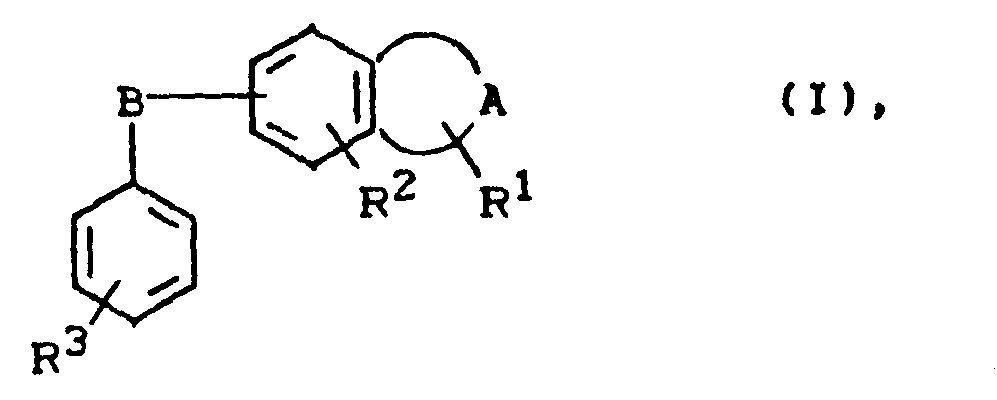
- Die vorliegende Erfindung betrifft neue substituierte Benzylverbindungen der allgemeinen Formel (1)

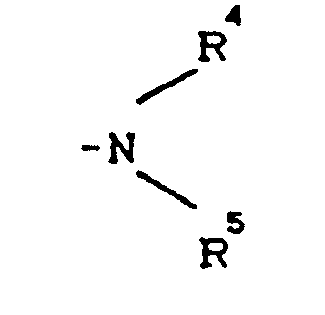
- R1, R2 gleich oder verschieden sind und für Wasserstoff, Alkyl, Alkenyl, Cycloalkyl, Alkoxy, Alkylthio, Halogenalkyl, Sulfonylalkyl, Halogenalkoxy, Halogenalkylthio, Aralkoxy, Aralkylthio, Halogen, Nitro, Cyano, Hydroxy oder für eine Gruppe der Formel

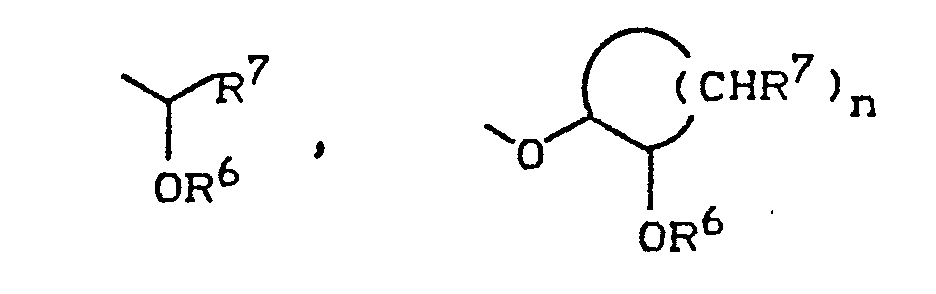
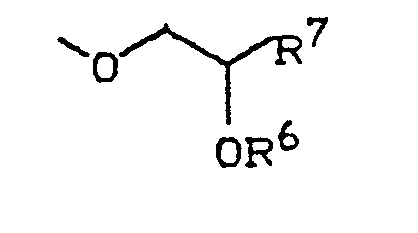
- R4, R5 gleich oder verschieden sind und für Wasserstoff, Alkyl, Alkenyl, Cycloalkyl, Aralkyl, Aryl oder Acyl stehen, für eine Gruppe der Formel


- R6 für Wasserstoff, Alkyl oder Acyl steht,
- R 7 für Wasserstoff oder Alkyl steht und
- n für eine Zahl von 3 bis 10 steht,
- B für -CH2-X- oder -X-CH2- steht, wobei
- X für 0, S oder NR7 steht und wobei
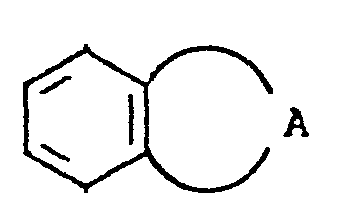
- R7 die oben angegebene Bedeutung hat, und die Gruppe
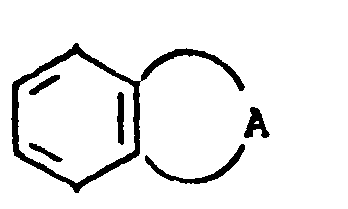
- Im Vergleich zu den bekannten Benzylethern haben die erfindungsgemäßen substituierten Benzylether überraschenderweise eine höhere pharmakologische Wirkung.
- Alkyl steht im allgemeinen für einen geradkettigen oder verzweigten Kohlenwasserstoffrest mit 1 bis 12 Kohlenstoffatomen. Bevorzugt wird Niedrigalkyl mit 1 bis etwa 8 Kohlenstoffatomen. Genannt seien beispielsweise Methyl, Ethyl, Propyl, Isopropyl, Butyl, Isobutyl, Pentyl, Isopentyl, Hexyl, Isohexyl, Heptyl, Isoheptyl, Octyl und Isooctyl.
- Alkenyl steht im allgemeinen für einen geradkettigen oder verzweigten Kohlenwasserstoffrest mit 2 bis 12 Kohlenstoffatomen und einer oder mehreren, bevorzugt mit einer oder zwei Doppelbindungen. Bevorzugt ist der Niederalkenylrest mit 2 bis etwa 6 Kohlenstoffatomen und einer Doppelbindung. Besonders bevorzugt ist ein Alkenylrest mit 2 bis 4 Kohlenstoffatomen und einer Doppelbindung. Beispielsweise seien Vinyl, Allyl, Propenyl, Isopropenyl, Butenyl, Isobutenyl, Pentenyl, Isopentenyl, Hexenyl, Isohexenyl, Heptenyl, Isoheptenyl, Octenyl, Isooctenyl genannt.
- Cycloalkyl steht im allgemeinen für einen cyclischen Kohlenwasserstoffrest mit 5 bis 8 Kohlenstoffatomen. Bevorzugt ist der Cyclopentyl- und der Cyclohexylrest. Beispielhaft seien Cyclopentyl, Cyclohexyl und Cycloheptyl genannt.
- Alkoxy steht im allgemeinen für einen über ein Sauerstoffatom gebundenen, geradkettigen oder verzweigten Kohlenwasserstoffrest mit 1 bis 12 Kohlenstoffatomen. Bevorzugt ist Niederalkoxy mit 1 bis etwa 6 Kohlenstoffatomen. Besonders bevorzugt ist ein Alkoxyrest mit 1 bis 4 Kohlenstoffatomen. Beispielsweise seien Methoxy, Ethoxy, Propoxy, Isopropoxy, Butoxy, Isobutoxy, Pentoxy, Isopentoxy, Hexoxy, Isohexoxy, Heptoxy, Isoheptoxy, Octoxy oder Isooctoxy genannt.
- Alkylthio steht im allgemeinen für einen über ein Schwefelatom gebundenen, geradkettigen oder verzweigten Kohlenwasserstoffrest mit 1 bis 12 Kohlenstoffatomen. Bevorzugt ist Niederalkylthio mit 1 bis etwa 6 Kohlenstoffatomen. Besonders bevorzugt ist ein Alkylthiorest mit 1 bis 4 Kohlenstoffatomen. Beispielsweise seien Methylthio, Ethylthio, Propylthio, Isopropylthio, Butylthio, Isobutylthio, Pentylthio, Isopentylthio, Hexylthio, Isohexylthio, Heptylthio, Isoheptylthio, Octylthio und Isooctylthio genannt.
- Halogenalkyl steht im allgemeinen für geradkettiges oder verzweigtes Niedrigalkyl mit 1 bis etwa 6 Kohlenstoffatomen und einem oder mehreren Halogenatomen, bevorzugt mit einem oder mehreren Fluor-, Chlor- undloder Bromatomen. Bevorzugt ist Alkyl mit 1 bis 4 Kohlenstoffatomen und mit einem oder mehreren Fluor- undloder Chloratomen. Besonders bevorzugt ist Alkyl mit 1 bis 2 Kohlenstoffatomen und mit bis zu fünf Fluoratomen oder mit bis zu drei Chloratomen. Beispielhaft seien genannt: Fluormethyl, Chlormethyl, Brommethyl, Fluorethyl, Chlorethyl, Bromethyl, Fluorpropyl, Chlorpropyl, Brompropyl, Fluorbutyl, Chlorbutyl, Brombutyl, Fluorisopropyl, Chlorisopropyl, Bromisopropyl, Difluormethyl, Trifluormethyl, Dichlormethyl, Trichlormethyl, Difluorethyl, Dichlorethyl, Trifluorethyl, Tetrafluorethyl, Pentafluorethyl, Trichlorethyl, Trifluorpropyl. Ganz besonders bevorzugt sind Trifluormethyl, Difluormethyl, Fluormethyl, Chlormethyl und Trifluorethyl.
- Sulfonylalkyl steht im allgemeinen für einen geradkettigen oder verzweigten Kohlenwasserstoffrest mit 1 bis 12 Kohlenstoffatomen, der über eine Sulfonylgruppe gebunden ist. Bevorzugt ist Sulfonyl-Niederalkyl mit 1 bis etwa 6 Kohlenstoffatomen. Insbesondere bevorzugt ist ein Sulfonylalkylrest mit 1 bis 4 Kohlenstoffatomen.
- Halogenalkoxy steht im allgemeinen für einen über ein Sauerstoffatom gebundenen geradkettigen oder verzweigten Niedrigalkylrest mit 1 bis etwa 6 Kohlenstoffatomen und einem oder mehreren Halogenatomen, bevorzugt mit einem oder mehreren Fluor-, Chlor- undloder Bromatomen. Bevorzugt ist Halogenalkoxy mit 1 bis 4 Kohlenstoffatomen und mit einem oder mehreren Fluor undloder Chloratomen. Besonders bevorzugt ist Halogenalkoxy mit 1 bis 2 Kohlenstoffatomen und mit bis zu 5 Fluoratomen oder mit bis zu 3 Chloratomen. Beispielsweise seien genannt: Fluormethoxy, Chlormethoxy, Brommethoxy, Fluorethoxy, Chlorethoxy, Bromethoxy, Fluorpropoxy, Chlorpropoxy, Brompropoxy, Fluorbutoxy, Chlorbutoxy, Brombutoxy, Fluorisopropoxy, Chlorisopropoxy, Bromisopropoxy, Difluormethoxy, Trifluormethoxy, Dichlormethoxy, Trichlormethoxy, Difluorethoxy, Trifluorethoxy, Tetrafluorethoxy, Pentafluorethoxy, Trichlorethoxy, Trifluorpropoxy. Ganz besonders bevorzugt sind Trifluormethoxy, Difluormethoxy, Fluormethoxy, Chlormethoxy und Trifluorethoxy.
- Halogenalkylthio steht im allgemeinen für ein über einen Schwefelatom gebundenen, geradkettigen oder verzweigten Niedrigalkylrest mit 1 bis etwa 6 Kohlenstoffatomen und einem oder mehreren Halogenatomen, bevorzugt mit einem oder mehreren Fluor-, Chlor- undloder Bromatomen. Bevorzugt ist Halogenalkylthio mit 1 bis 4 Kohlenstoffatomen und mit einem oder mehreren Fluor- oder Chloratomen. Besonders bevorzugt ist Halogenalkylthio mit 1 bis 2 Kohlenstoffatomen und mit bis zu fünf Fluoratomen oder mit bis zu 3 Chloratomen. Beispielsweise seien genannt: Fluormethylthio, Chlormethylthio, Brommethylthio, Fluorethylthio, Chlorethylthio, Bromethylthio, Fluorpropylthio, Chlorpropylthio, Brompropylthio, Fluorbutylthio, Brombutylthio, Chlorbutylthio, Fluorisopropylthio, Chlorisopropylthio, Bromisopropylthio, Difluormethylthio, Trifluormethylthio, Dichlormethylthio, Trichlormethylthio, Difluorethylthio, Trifluorethylthio, Tetrafluorethylthio, Pentafluorethylthio, Trichlorethylthio, Trifluorpropylthio, Pentafluorethylthio, Trichlorethylthio, Trifluorpropylthio. Ganz besonders bevorzugt sind Trifluormethylthio, Difluormethylthio, Fluormethylthio, Chlormethylthio und Trifluorethylthio.
- Aryl steht im allgemeinen für einen aromatischen Rest mit 6 bis etwa 12 Kohlenstoffatomen. Bevorzugte Arylreste sind Phenyl, Naphthyl und Biphenyl.
- Aralkyl steht im allgemeinen für einen über eine Alkylenkette gebundenen Arylrest mit 7 bis 14 Kohlenstoffatomen. Bevorzugt werden Aralkylreste mit 1 bis 6 Kohlenstoffatomen im aliphatischen Teil und 6 bis 12 Kohlenstoffatomen im aromatischen Teil. Beispielsweise seien folgende Aralkylreste genannt: Benzyl, Naphthylmethyl, Phenethyl und Phenylpropyl.
- Aralkoxy steht im allgemeinen für einen Aralkylrest mit 7 bis 14 Kohlenstoffatomen, wobei die Alkylenkette über ein Sauerstoffatom gebunden ist. Bevorzugt werden Aralkoxyreste mit 1 bis 6 Kohlenstoffatomen im aliphatischen Teil und 6 bis 12 Kohlenstoffatomen im aromatischen Teil. Beispielsweise seien folgende Aralkoxyreste genannt: Benzyloxy, Naphthylmethoxy, Phenethoxy und Phenylpropoxy.
- Aralkylthio steht im allgemeinen für einen Aralkylrest mit 7 bis 14 Kohlenstoffatomen, wobei die Alkylkette über ein Schwefelatom gebunden ist. Bevorzugt werden Aralkylthioreste mit 1 bis 6 Kohlenstoffatomen im aliphatischen Teil und 6 bis 12 Kohlenstoffatomen im aromatischen Teil. Beispielsweise seien folgende Aralkylthioreste genannt: Benzylthio, Naphthylmethylthio, Phenethylthio und Phenylpropylthio.
- Acyl steht im allgemeinen für Phenyl oder geradkettiges oder verzweigtes Niedrigalkyl mit 1 bis etwa 6 Kohlenstoffatomen, die über eine Carbonylgruppe gebunden sind. Bevorzugt sind Phenyl und Alkylreste mit bis zu 4 Kohlenstoffatomen. Beispielsweise seien genannt: Benzoyl, Acetyl, Ethylcarbonyl, Propylcarbonyl, Isopropylcarbonyl, Butylcarbonyl und Isobutylcarbonyl.
- Halogen steht im allgemeinen für Fluor, Chlor, Brom oder lod, bevorzugt für Fluor, Chlor oder Brom. Besonders bevorzugt steht Halogen für Fluor oder Chlor.
- Das benzokondensierte heterocyclische System steht im allgemeinen für einen Phenylrest, an den ein 5 bis 7- gliedriger Heterocyclus mit 1 bis 3 Stickstoff-, Schwefel-und/oder Sauerstoffatomen ankondensiert ist. Bevorzugt sind 5 bis 6 gliedrige heterocyclische Systeme mit 1 bis 2 Stickstoff-, Sauerstoff- und/oder Schwefelatomen. Beispielhaft seien genannt: Chinolin, Isochinolin, Cinnolin, Chinazolin, Chinoxalin, Phthalazin, Chinolin-N-oxid, Isochinolin-N-oxid, Chinazolin-N-oxid, Chinoxalinon, Chinoxalindion, Phthalazindion, Chroman, Chromen, Chromon, Thiochroman, Thiochromen, Thiochromon, Indol, Indolon, Isatin, Isoindol, Isoindolon, Benzofuran, Benzothiophen, Benzimidazol, Benzimidazolon, Benzoxazol, Benzothiazol, Benzisoxazol, Benzisothiazol, Benzthiadiazol, Benzoxadiazol, Indazol, Indoxyl.
- Es werden Verbindungen der allgemeinen Formel (I) bevorzugt, in denen
- R1, R2 gleich oder verschieden sind und für Wasserstoff, Niedrigalkyl, Niedrigalkenyl, Cyclopentyl, Cyclohexyl, Niedrigalkoxy, Niedrigalkylthio, Halogenniedrigalkyl, Sulfonylniedrigalkyl, Halogenniedrigalkoxy, Halogenniedrigalkylthio, Benzyloxy, Benzylthio, Fluor, Chlor, Brom, Nitro, Cyano, Hydroxy oder für eine Gruppe der Formel

- R4, R5 gleich oder verschieden sind und für Wasserstoff, Niedrigalkyl, Niedrigalkenyl, Cyclopentyl, Cyclohexyl, Benzyl, Phenyl, Benzoyl oder Acetyl stehen,
- R 3 für eine Gruppe der Formel


- R6 für Wasserstoff, Niedrigalkyl, Benzoyl oder Niedrigalkanoyl steht,
- R7 für Wasserstoff oder Niedrigalkyl steht und
- n für eine Zahl von 3 bis 8 steht,
- B für -CH2-X- steht, wobei
- X für 0, S oder NR7 steht und wobei
- R 7 die oben angegebene Bedeutung hat und die Gruppe

- Besonders bevorzugte Verbindungen der allgemeinen Formel (I), sind solche, in denen
- R1, R 2 gleich oder verschieden sind und für Wasserstoff, Methyl, Ethyl, Propyl, Isopropyl, Allyl, Methoxy, Ethoxy, Methylthio, Ethylthio, Trifluormethoxy, Trifluormethylthio, Fluor, Chlor, Brom, Nitro, Cyano, Ethylsulfonyl, Hydroxy oder für eine Gruppe der Formel

- R4, R5 gleich oder verschieden sind und für Wasserstoff, Methyl, Ethyl, Propyl, Isopropyl, Allyl, Benzyl, Phenyl oder Acetyl stehen,
- R3 für einen Rest der Formel


- R6 für Wasserstoff, Methyl, Ethyl, Propyl, Isopropyl Benzoyl, Acetyl, Ethylcarbonyl oder oder Propylcarbonyl steht,
- R7 für Wasserstoff oder für eine gerade oder verzweigte Alkylkette mit bis zu 8 C-Atomen steht und
- n für eine Zahl von 3 bis 4 steht,
- B für -CH2-X- steht, wobei
- X für 0, S, NR7 steht und wobei
- R7 die angegebene Bedeutung hat, und die Gruppe der Formel

- für Chinolin, Chinolin-N-oxid, Isochinolin, Isochinolin-N-oxid, Cinnolin, Chinazolin, Chinoxalin, Phthalazin, Chinolon, Isochinolon, Indol, Indolon, Isoindol, Benzofuran, Benzothiophen, Benzimidazol, Benzothiazol, Benzoxazol oder Indazol steht.
- Beispielsweise seien folgende Wirkstoffe im einzelnen genannt:
- Essigsäure-1-[3-(chinolin-8-yloxymethyl)phenyl]pentyl- ester
- Essigsäure-1-[3-(chinolin-8-yloxymethyl)phenyl]hexylester EssigsBure-1-[3-(chinolin-8-yloxymethyl)phenyl]heptyl- ester
- Essigsäure-1-13-(5,7-dichlorchinolin-8-yloxymethyl)phenyl]-heptylester
- Essigsäure-1-[2-(5,7-dichlorchinolin-8-yloxymethyl)phenyl]-pentylester
- Essigsäure-2-[3-(chinolin-8-yloxymethyl)phenoxy]cyclohexylester
- Essigsäure-1-[2-(2-(1H)-chinolon-8-yloxymethyl)phenoxy- methyllpropylester
- Essigsgure-2-[3-(2-(1H)-chinolon-8-yloxymethyl)phenoxyl- cyclohexylester (trans-Form)
- Essigsäure-1-[3-(2-(1H)-chinolon-8-yloxymethyl)phenyl]-hexylester
- Essigsäure-1-[3-(2-(1H)-chinolin-8-yloxymethyl)phenyl]-heptylester
- Essigsäure-1-[3-(2-(1H)-chinolon-8-yloxymethyl)phenoxymethyl)propylester
- Essigsäure-1-[2-(2-(1H)-chinolon-8-yloxymethyl)phenyl]-hexylester
- Essigsäure-1-[2-(2-chinolin-8-yloxymethyl)phenyl]-heptylester
- Essigsäure-1-[2-(chinolin-N-oxid-8-yloxymethyl)phenyl]-hexylester
- Essigsäure-1-[3-(chinolin-8-yloxymethyl)phenyl]hexylester Essigsäure-1-[4-(chinolin-8-yloxymethyl)phenyl]pentyl- ester
- Essigsäure-1-[3-(isochinolin-5-yloxymethyl)phenyl]pentyl- ester
- Essigsäure-1-[3-(chinolin-8-ylaminomethyl)phenyl]pentyl- ester
- Essigsäure-1-[3-(chinolin-8-ylthiomethyl)phenyl]pentyl- ester
- Essigsäure-1-[3-(chinolin-8-yloxymethyl)phenoxymethyl]-pentylester
- Essigsäure-l-[3-(chinolin-8-yloxymethyl)phenoxymethyl]-propylester
- Essigsäure-1-[2-(chinolin-8-yloxymethyl)phenoxymethyl]-propylester
- Essigsäure-1-[3-(chinolin-8-yloxymethyl)phenoxymethyl]-2,2-dimethyl-propylester
- Essigsäure-1-[3-(5,7-dichlorchinolin-8-yloxymethyl)phenyl]-pentylester
- 1-[3-(Chinolin-8-yloxymethyl)phenoxymethyl]-2,2-dimethyl- propanol
- 1-[3-(Chinolin-8-yloxymethyl)phenoxymethyl]pentanol
- 1-[3-(Isochinalin-5-yloxymethyl)phenyl]pentanol
- 1-[3-(Chinolin-8-ylaminomethyl)phenyl]pentanol
- 1-[3-(2-Methylchinolin-8-yloxymethyl)phenyl]hexanol
- 1-[2-(1-Oxochinolin-8-yloxymethyl)phenyl]hexanol
- 1-[2-(Chinolin-8-yloxymethyl)phenoxymethyllpropanal
- 1-[3-(Chinolin-8-yloxymethyl)phenoxymethyl]propanol
- 1-E3-(Chinolin-8-ylthiomethyl)phenyllpentanol
- 1-[3-(Chinolin-8-yloxymethyl)phenyl]heptanol
- 1-[3-(Chinolin-8-yloxymethyl)phenyl]0hexanol
- 1-[3-(2-Chinolin-8-yloxymethyl)phenyl]heptanol
- 1-[3-(2-Chinolin-8-yloxymethyl)phenyl]hexanol
- 2-[3-(2-(1H)-Chinoloh-8-yloxymethyl)phenoxyl]cyclohexanol (trans-Form)
- 1-[2-(Chinolin-8-yloxymethyl)phenyllpentanol 1-[3-C5,7-Dichlorchinolin-8-yloxymelhyl)phenyl]heplanol 1-(3-(2-(1H)-Chinolon-8-yloxymethyl)phenoxymethyl]-propanol
- 1-[2-(Chinolin-8-yloxymethyl)phenyl]hexanol 1-[3-(Chinolin-8-yloxymethyl)phenyl]pentanol 1-[2-(2-(1H)-Chinolon-8-yloxymethyl)phenyl]hexanol 1-[2-(2-(1H)-Chinolon-8-yloxymethyl)phenoxymelhyl]-propanol
- 1-[2-(2-(1H)-Chinolon-8-yloxymelhyl)phenyl]heplanol
- Essigsäure-1-[3-(chinolin-8-yloxymethyl)phenyl]-3-methyl- butylester
- Propionsäure-1-[3-(chinolin-8-yloxymethyl)phenyl]-hexylester
- Essigsäure-1-[3-(4-methylchinolin-8-yloxymethyl)phenyl]-pentylester
- Essigsäure-1-[3-(4-chlorchinolin-8-yloxymethyl)phenyll- pentylester
- Essigsäure-1-[3-(6-methylchinolin-8-yloxymethyl)phenyl]-pentylester
- Essigsäure-1-[3-(6-nitrochinolin-8-yloxymethyl)phenyll- pentylester
- Essigsäure-1-[3-(2-ethylsulfonylbenzothiazol-7-yl-aminomethyl)phenyl]hexylester
- 1-[4-(Chinolin-8-yloxymethyl)phenyl]pentanol 1-[3-(Chinolin-8-yloxymethyl)phenyl]-3-methylbutanol 1-[3-(2-Ethylsulfonylbenzothiazol-7-yloxymethyl)phenyl]-hexanol
- 1-[3-(4-Chlorchinolin-8-yloxymethyl)phenyl]pentanol 1-[3-(4-Methylchinolin-8-yloxymethyl)phenyl]pentanol 1-[3-(6-Methylchinolin-8-yloxymethyl)phenyl]pentanol 8-[4-(1-Methoxypentyl)benzyl]oxychinolin Benzoesäure-1-[3-(chinolin-8-yloxymethyl)phenyl]-pentylester
- Es wurde weiterhin ein Verfahren zur Herstellung von substituierten Benzylethern der Formel

- R1, R2 gleich oder verschieden sind und für Wasserstoff, Alkyl, Alkenyl, Cycloalkyl, Alkoxy, Alkylthio, Sulfonylalkyl, Halogenalkyl, Halogenalkoxy, Halogenalkylthio, Aralkoxy, Aralkylthio, Halogen, Nitro, Cyano, Hydroxy oder für eine Gruppe der Formel

- R4, R5 gleich oder verschieden sind und für Wasserstoff, Alkyl, Alkenyl, Cycloalkyl, Aralkyl, Aryl oder Acyl stehen,
- R 3 für eine Gruppe der Formel
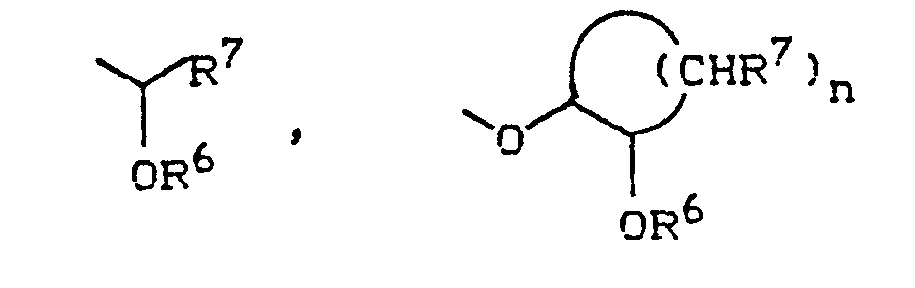

- R 6 für Wasserstoff, Alkyl oder Acyl steht,
- R7 für Wasserstoff oder Alkyl steht und
- n für eine Zahl von 3 bis 10 steht,
- B für -CH2-X- oder -X-CH2- steht, wobei
- X für 0, S oder NR7 steht und
- wobei R7 die oben genannte Bedeutung hat, und die Gruppe tes

- a) bei der Herstellung von Benzylethern mit B gleich -CH2-X-
Halogenide der allgemeinen Formel (II)
- R 3 für eine Gruppe der Formel
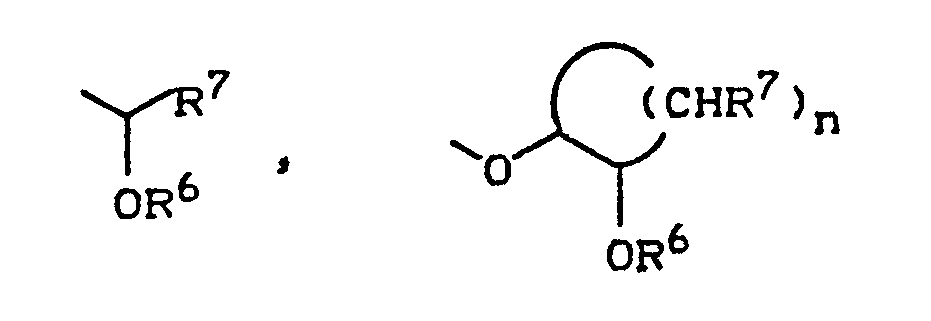

- R6 für Acyl steht und
- R7 für Wasserstoff oder Alkyl steht und
- n für eine Zahl von 3 bis 10 steht, und
Hal für Chlor, Brom oder Iod steht,
mit Verbindungen der allgemeinen Formel (III),
- R1, R2 gleich oder verschieden sind und für Wasserstoff, Alkyl, Alkenyl, Cycloalkyl, Alkoxy, Alkylthio, Sulfonylalkyl, Halogenalkyl, Halogenalkoxy, Halogenalkylthio, Aralkoxy, Aralkylthio, Halogen, Nitro, Cyano, Hydroxy oder für eine Gruppe der Formel

- R 4, R5 gleich oder verschieden sind und für Wasserstoff, Alkyl, Alkenyl, Cycloalkyl, Aralkyl, Aryl oder Acyl stehen,
- X für 0, S oder NR7 steht
- wobei R7 die oben genannte Bedeutung hat und die Gruppe

- R 3 für eine Gruppe der Formel
- b) bei der Herstellung von Benzylethern mit B gleich -X-CH 2 -
Halogenverbindungen der Formel IV
- R1, R2 - gleich oder verschieden sind und für Wasserstoff, Alkyl, Alkenyl, Cycloalkyl, Alkoxy, Alkylthio, Sulfonylalkyl, Halogenalkyl, Halogenalkoxy, Halogenalkylthio, Aralkoxy, Aralkylthio, Halogen, Nitro, Cyano, Hydroxy oder für eine Gruppe der Formel

- R4, R5 - gleich oder verschieden sind und für Wasserstoff, Alkyl, Alkenyl, Cycloalkyl, Aralkyl, Aryl oder Acyl stehen,
- X - für 0, S, NR7 steht, wobei
- R7 die oben angegebene Bedeutung hat, die Gruppe

Hal - für Chlor, Brom oder Jod steht,
mit Verbindungen der allgemeinen Formel V
- R 3 - für eine Gruppe der Formel


- wobei
- R 6 für Acyl steht und
- R7 für Wasserstoff oder Alkyl steht und
- n für eine Zahl von 3 bis 10 steht, und
- X für 0, S oder NR7 steht, wobei
- R7 die oben angegebene Bedeutung hat,
in inerten organischen Lösungsmitteln gegebenenfalls in Anwesenheit einer Base umsetzt, dann gegebenenfalls vorhandene Acylgruppen abspaltet, und dann gegebenenfalls die Hydroxyverbindungen alkyliert. - R1, R2 - gleich oder verschieden sind und für Wasserstoff, Alkyl, Alkenyl, Cycloalkyl, Alkoxy, Alkylthio, Sulfonylalkyl, Halogenalkyl, Halogenalkoxy, Halogenalkylthio, Aralkoxy, Aralkylthio, Halogen, Nitro, Cyano, Hydroxy oder für eine Gruppe der Formel
- Das erfindungsgemäße Verfahren kann beispielsweise durch das folgende Formelschema a) erläutert werden:


- Lösungsmittel für das erfindungsgemäße Verfahren können inerte organische Lösungsmittel sein, die sich unter den Reaktionsbedingungen nicht verändern. Hierzu gehören vorzugsweise Alkohole wie beispielsweise Methanol, Ethanol, Propanol oder Isopropanol, Ether wie beispielsweise Dioxan, Tetrahydrofuran oder Diethylether, Halogenwasserstoffe wie Dichlormethan, Trichlormethan, Tetrachlormethan, 1,2-Dichlorethan oder Trichlorethylen, Kohlenwasserstoffe wie Benzol, Xylol, Toluol, Hexan, Cyclohexan oder Erdölfraktionen, Nitromethan, Dimethylformamid, Acetonitril, Aceton oder Hexamethylphosphorsäuretriamid. Ebenso ist es möglich, Gemische der Lösungsmittel einzusetzen.
- Als Basen für das erfindungsgemäße Verfahren können anorganische oder organische Basen eingesetzt werden. Hierzu gehören vorzugsweise Alkalihydroxide wie zum Beispiel Natriumhydroxid oder Kaliumhydroxid, Erdalkalihydroxide wie zum Beispiel Bariumhydroxid, Alkalicarbonate wie Natriumcarbonat oder Kaliumcarbonat, Erdalkalicarbonate wie Calciumcarbonat oder organische Amine (Trialkyl(C1-C6)amine) wie Triethylamin und Heterocyclen wie Pyridin, Methylpiperidin, Piperidin oder Morpholin.
- Es ist auch möglich als Basen Alkalimetalle, wie Natrium, und deren Hydride, wie Natriumhydrid, einzusetzen.
- Die Herstellung der erfindungsgemäßen Verbindungen erfolgt im allgemeinen in einem Temperaturbereich von 0°C bis 150°C, bevorzugt von 10°C bis 100°C.
- Das erfindungsgemäße Vefahren wird im allgemeinen bei Normaldruck durchgeführt. Es ist aber auch möglich, das Verfahren bei Unterdruck oder Überdruck durchzuführen (z.B. in einem Bereich von 0,5 bis 5 bar).
- Im allgemeinen setzt man 0,5 bis 5, bevorzugt 1 bis 2 mol Halogenid, bezogen auf 1 mol des Reaktionspartners ein. Die Base wird im allgemeinen in einer Menge von 0,5 bis 5 mol, bevorzugt von 1 bis 3 mol bezogen auf das Halogenid eingesetzt.
- Die Acylgruppe kann beispielsweise durch Zusatz von Basen abgespaltet werden. Als Basen seien beispielsweise Natriumhydroxid, Kaliumhydroxid, Bariumhydroxid, Natriumcarbonat oder Kaliumcarbonat genannt.
- Man setzt im allgemeinen 1 bis 5 mol, bevorzugt 2 bis 4 mol der Base bezogen auf 1 mol Acylverbindung ein.
- Die Alkylierung der Hydroxyverbindungen (Formel I mit R6=H) erfolgt im allgemeinen in inerten Lösungsmitteln, gegebenenfalls in Anwesenheit einer Base, mit üblichen Alkylierungsmitteln wie Alkylhalogeniden, z.B. CI-C4-Alkylchloride, -bromide oder -iodide, Dialkylsulfaten, z.B. Dimethylsulfat, oder Diazoalkanen, z.B. Diazomethan, Diazoethan oder Diazopropan.
- Als Lösungsmittel eignen sich hierbei, je nach Art des Alkylierungsmittels alle inerten organischen Lösungsmittel. Hierzu gehören bevorzugt Ether wie Diethylether, Dioxan oder Tetrahydrofuran, oder Kohlenwasserstoffe wie Benzol, Toluol oder Xylol, oder Dimethylformamid oder Hexamethylphosphorsäuretriamid, oder Gemische der genannten Lösungsmittel.
- Als Basen eignen sich die üblichen basischen Verbindungen, Hierzu gehören bevorzugt Alkalihydride wie Natriumhydrid, Alkaliamide wie Natriumamid oder Lithiumdiisopropylamid, Alkalialkoholate wie Natriummethanolat, Natriumethanolat, Kaliummethanolat, Kaliumethanolat oder Kalium-tert-butylat, oder organische Amine wie Trialkylamine z.B. Triethylamin, oder lithiumorganische Verbindungen wie Butyllithium oder Phenyllithium.
- Das erfindungsgemäße Verfahren kann beispielsweise wie folgt durchgeführt werden:
- Die OH-, SH- oder NH-acide-Ausgangsverbindung, ein Verdünnungsmittel und gegebenenfalls eine Base werden gemischt und mit dem Halogenid gegebenenfalls in einem Verdünnungsmittel versetzt. Die Mischung kann gegebenenfalls erwärmt werden. Die Aufarbeitung erfolgt in an sich bekannter Weise.
- Die Ausgangsverbindungen der allgemeinen Formel (III) sind bekannt oder können nach bekannten Methoden hergestellt werden (A. R. Katritzky, C. W. Reeds, Comprehensive Heterocyclic Chemistry Band 1 - 8, Pergamon Press).
- 4 Die Ausgangsverbindungen der allgemeinen Formel IV sind bekannt oder können nach bekannten Methoden hergestellt werden (EP-OS 13 411). Die Ausgangsverbindungen der allgemeinen Formel V sind bekannt oder können nach bekannten Methoden hergestellt werden (EP-OS 110 405).
- Die als Ausgangsverbindungen verwendeten Benzylhalogenide der Formel (II) sind neu. Sie können hergestellt werden indem man Tolylverbindungen der allgemeinen Formel (VI)

- R3 für eine Gruppe der Formel


- R 6 für Acyl steht,
- R7 für Wasserstoff oder Alkyl steht und
- n eine Zahl von 3 bis 10 bedeutet,
- Die Reaktion läßt sich durch folgendes Schema verdeutlichen:

- Als Lösungsmittel eigenen sich alle inerten organischen Lösungsmittel, die sich unter den Reaktionsbedingungen nicht verändern.
- Hierzu gehören bevorzugt Halogenkohlenwasserstoffe wie zum Beispiel Dichlormethan, Trichlormethan oder Tetrachlormethan, Kohlenwasserstoffe wie Benzol, Toluol, Xylol, oder Eisessig.
- Als Halogenierungsmittel können die allgemein üblichen Halogenierungsmittel verwendet werden. Bevorzugt sind Chlor, Brom, N-Chlorsuccinimid (NCS) oder N-Bromsuccinimid (NBS), gegebenenfalls in Anwesenheit von Radikalbildnern wie Azobisisobuttersäurenitril (AIBN), Benzoylperoxid oder Licht. Besoners bevorzugt ist die Bromierung mit NBS und AIBN in Tetrachlormethan.
- Die Reaktionstemperaturen können im allgemeinen in einem großen Bereich variiert werden. Bevorzugt arbeitet man in einem Bereich von -10°C bis 100°C, besonders bevorzugt von 0°C bis 80°C.
- Die Umsetzung kann bei Normaldruck, aber auch bei erhöhtem oder erniedrigtem Druck durchgeführt werden. Im allgemeinen arbeitet man bei normalem Druck.
- Das Mengenverhältnis der Reaktanden ist im allgemeinen beliebig. Bevorzugt arbeitet man jedoch mit einer Menge von 1 bis 5 mol, besonders bevorzugt mit 1 mol des Halogenierungsmittels bezogen auf 1 mol der Tolylverbindungen.
- Die als Ausgangsverbindung verwendeten Tolylverbindungen sind bekannt oder können nach bekannten Methoden gemäß folgendem allgemeinen Schema hergestellt werden:
- a. für


- b.


- Die als Ausgangsstoffe verwendeten Tolylaldehyde und Kresole sind bekannt: Beilstein's Handbuch der organischen Chemie, 7, 295-297, und 6, 349, 373 und 389.
- Die erfindungsgemäßen Benzylverbindungen können als Wirkstoffe in Arzneimitteln eingesetzt werden. Die Stoffe wirken als Hemmer (Stimulatoren) von enzymatischen Reaktionen im Rahmen des Arachidonsäurestoffwechsels, insbesondere der Lipoxygenase.
- Sie sind somit bevorzugt zur Behandlung und Verhütung von Erkrankungen der Atemwege wie Allergien/Asthma, Bronchitis, Emphysen, Schocklunge, pulmonaler Hypertonie, Entzündungen/Rheuma und Ödemen, Thrombosen und Thromboembolien, Ischämien (periphere, cardiale, cerebrale Durchblutungsstörungen), Herz- und Hirninfarkten, Herzrhythmusstörungen, Angina pectoris, Arteriosklerose, bei Gewebstransplantationen, Dermatosen wie Psoriasis, Metastasen und zur Cytoprotection im Gastrointestinaltrakt geeignet.
- Die neuen Wirkstoffe können in an sich bekannter Weise unter Verwendung inerter nichttoxischer, pharmazeutischer geeigneter Trägerstoffe oder Lösungsmittel in die üblichen Formulierungen überführt werden, wie Tabletten, Kapseln, Dragees, Pillen, Granulate, Aerosole, Sirupe, Emulsionen, Suspensionen und Lösungen. Hierbei soll die therapeutisch wirksame Verbindung jeweils in einer Konzentration von etwa 0,5 bis 90 Gew.-%, bevorzugt von 10 bis 70 Gew.-%, in der Gesamtmischung vorhanden sein, d.h. in Mengen, die ausreichend sind, um den angegebenen Dosierungsspielraum zu erreichen.
- Die Formulierungen werden beispielsweise hergestellt durch Verstrecken der Wirkstoffe mit Lösungsmitteln undloder Trägerstoffen, gegebenenfalls unter Verwendung von Emulgiermitteln und/oder Dispergiermitteln, wobei z.B. im Fall der Benutzung von Wasser als Verdünnungsmittel gegebenenfalls organische Lösungsmittel als Hilfslösungsmittel verwendet werden können.
- Als Hilfsstoffe seien beispielsweise aufgeführt: Wasser, nichttoxische organische Lösungsmittel wie Paraffine (z.B. Erdölfraktionen), pflanzliche Öle (z.B. Erdnuß-/Sesamöl), Alkohole (z.B. Ethylalkohol, Glycerin), Glykole (z.B. Propylenglykol, Polyethylenglykol), feste Trägerstoffe, wie natürliche Gesteinsmehle (z.B. Kaoline, Tonerden, Talkum, Kreide), synthetische Gesteinsmehle (z.B. hochdisperse Kieselsäure, Silikate), Zucker (z.B. Rohr-, Milch- und Traubenzucker), Emulgiermittel (z.B. Polyoxyethylen-Fettsäureester, Polyoxyethylen-Fettalkohole-Ether, Alkylsulfonate und Arylsulfonate), Dispergiermittel (z.B. Lignin-Sulfitablaugen, Methylcellulose, Stärke und Polyvinylpyrrolidon) und Gleitmittel (z.B. Magnesiumstearat, Talkum, Stearinsäure und Natriumlaurylsulfat).
- Die Applikation kann in üblicher Weise erfolgen, vorzugsweise oral oder parenteral, insbesondere perlingual oder intravenös. Im Falle der oralen Anwendung können Tabletten selbstverständlich außer den genannten Trägerstoffen auch Zusätze wie Natriumcitrat, Calciumcarbonat und Dicalciumphosphat zusammen mit verschiedenen Zuschlagstoffen, wie Stärke, vorzugsweise Kartoffelstärke, Gelatine und dergleichen enthalten. Weiterhin können Gleitmittel, wie Magnesiumstearat, Natriumlaurylsulfat und Talkum zum Tablettieren mitverwendet werden. Im Falle wäßriger Suspensionen und/oder Elixieren, die für orale Anwendungen gedacht sind, können die Wirkstoffe außer den obengannten Hilfsstoffen mit verschiedenen Geschmacksaufbesserern oder Farbstoffen versetzt werden.
- Für den Fall der parenteralen Anwendung können Lösungen der Wirkstoffe unter Verwendung geeigneter flüssiger Trägermaterialien eingesetzt werden.
- Im allgemeinen hat es sich als vorteilhaft erwiesen, bei intravenöser Applikation Mengen von etwa 0,001 bis 1 mg/kg, vorzugsweise etwa 0,01 bis 0,5 mg/kg Körpergewicht zur Erzielung wirksamer Ergebnisse zu verabreichen. Bei oraler Applikation beträgt die Dosierung im allgemeinen etwa 0,01 bis 20 mg/kg, vorzugsweise 0,1 bis 10 mg/kg Körpergewicht.
- Trotzdem kann es gegebenenfalls erforderlich sein, von den genannten Mengen abzuweichen, und zwar in Abhängigkeit vom Körpergewicht bzw. der Art des Applikationsweges, vom individuellen Verhalten gegenüber dem Medikament, der Art von dessen Formulierung und dem Zeitpunkt bzw. Intervall, zu welchem die Verabreichung erfolgt. So kann es in einigen Fällen ausreichend sein, mit weniger als der vorgenannten Mindestmenge auszukommen, während in anderen Fällen die genannte obere Grenze überschritten werden muß. Im Fall der Applikation größerer Mengen kann es empfehlenswert sein, diese in mehreren Einzelgaben über den Tag zu verteilen.
- Die erfindungsgemäßen substituierten Benzylether können sowohl in der Humanmedizin als auch in der Veterinärmedizin angewendet werden.
- Die Retentionszeiten Rf (min) werden mit einem HPLC-Gerät (Fa. Knauer) an Hibar-Säulen (Fa. Merck) ermittelt.
- System a: RP-8,5 µm,
Durchfluß: 1,5 ml/min,
Eluens: Acetonitril/Wasser=70:30
(v/v) - System b: RP-8,7 µm,
Durchfluß: 2,0 ml/min,
Eluens: Acetonitril/Wasser=70:30
(v/v) - 1-(3-Methylphenyl)pentanol
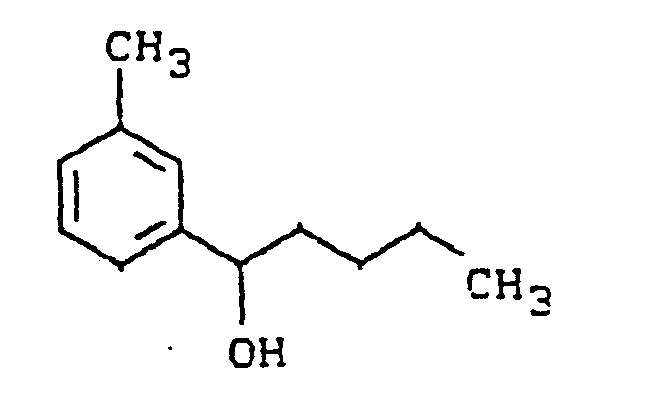
- Unter Stickstoff werden 13.4 g Magnesium in 200 ml absolutem Ether vorgelegt. 75.4 g n-Butylbromid, in 300 ml absolutem Ether gelöst, werden so zugetropft, daß die Reaktionslösung siedet.
- Danach wird 1 h im Rückfluß erhitzt und anschließend auf 0°C abgekühlt. 60 g 3-Methylbenzaldehyd gelöst in 250 ml absolutem Ether werden bei 0°C zugetropft. Man läßt die Reaktionslösung über Nacht stehen und gießt dann auf 1 1 Eiswasser. Das Reaktionsgemisch wird mit 2 n Salzsäure angesäuert. Die organische Phase wird abgetrennt, die wässrige Phase 2 mal mit je 300 ml Essigester extrahiert und die vereinigten organischen Phasen werden 2 mal mit je 200 ml Wasser gewaschen, über MgS04 getrocknet und in Vakuum einrotiert. Der Rückstand wird bei 64 - 66°C/ 0,02 mm destilliert.
- Ausbeute: 93 % der Theorie.
- Analog Beispiel 1 wurden folgende Beispiele hergestellt:
- 1-(2-Methylphenyl)pentanol

- Ausbeute: 84,5 % der Theorie
- Siedepunkt: 110°C/0.1 mm (Kugelrohr)
- 1-(2-Methylphenyl)heptanol

- Ausbeute: 95 % der Theorie
- Siedepunkt: 115°C/0.1 mm (Kugelrohr)
- 1-(3-Methylphenyl)heptanol

- Ausbeute: 91 % der Theorie
- Siedepunkt: 80 - 82°C/0.1 mm
- 1-(2-Methylphenyl)hexanol
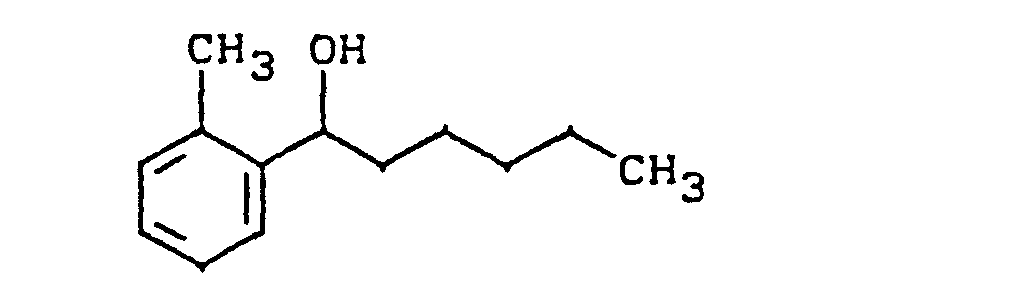
- Ausbeute: 94 % der Theorie
- Siedepunkt: 88°C/0.06 mm
- 1-(3-Methylphenyl)hexanol

- Ausbeute: 88 % der Theorie
- Siedepunkt: 85 - 90°C/0.06 mm
- 1-(4-Methylphenyl)pentanol

- Ausbeute: 71 % der Theorie
- Siedepunkt: 60-64°C/0.08 mm
- 3,3-Dimethyl-1-(3-methylphenoxy)-2-butanol

- 108 g 3-Hydroxytoluol und 101 g Triethylamin werden auf 120°C erwärmt. Bei dieser Temperatur werden innerhalb von 2.5 h 100.2 g 3,3-Dimethyl-1,2-butenoxid zugetropft und 15 h bei 120°C gerührt. Nach Abkühlen werden 500 ml Dichlormethan zugegeben und man wäscht 3 mal mit jeweils 500 ml 2 n HC1, 1 mal mit 200 ml gesättigter Natriumhydrogencarbonat-Lösung, 2 mal mit 200 ml Wasser. Die organische Phase wird über Na2S04 getrocknet, im Vakuum eingeengt und der Rückstand bei 96°C/0.15 mm destilliert. Ausbeute: 76 % der Theorie
- Analog Beispiel 8 wurden hergestellt:
- 1-(2-Methylphenoxy)-2-butanol

- Ausbeute: 93 % der Theorie
- Siedepunkt: 69 - 73°C/0.03 mm
- 1-(3-Methylphenoxy)-2-butanol

- Ausbeute: 91 % der Theorie
- Siedepunkt: 69 - 75°C/0.015 mm
- 2-(3-Methylphenoxy)cyclohexanol (trans-Form)

- Ausbeute: 47 % der Theorie
- Siedepunkt: 130 - 132°C/0,5 mm
- 1-(3-methylphenoxy)-2-hexanol

- Ausbeute: 59 % der Theorie
- Siedepunkt: 120 - 124°C/0.9 mm
- Essigsäure-1-(3-methylphenyl)pentylester

- 65.4 g 3-(1-Hydroxypentyl)toluol werden bei 0°C in 500 ml absolutem Dichlormethan gelöst und nacheinander mit 104 ml Acetanhydrid, 89 ml Pyridin und 1 g Dimethylaminopyridin versetzt. Die Reaktionslösung wird 1 h bei 0°C, 2 h bei 25°C gerührt und dann auf 1 1 Eiswasser gegossen. Nach Abtrennen der organischen Phase wird 3 mal mit je 200 ml Dichlormethan extrahiert. Die organischen Phasen werden 3 mal mit je 200 ml 2 n HC1, 3 mal mit je 200 ml gesättigter NaHCO3, 2 mal mit je 200 ml Wasser gewaschen, über Magnesiumsulfat getrocknet und im Vakuum eingeengt. Der Rückstand wird bei 95°C/0.1 mm (Kugelrohr) destilliert.
- Ausbeute: 95 % der Theorie
- Siedepunkt: 95°C/0.1 mm (Kugelrohr)
- Analog Beispiel 13 wurden hergestellt:
- Essigsäure-1-(2-methylphenyl)pentylester

- Ausbeute: 93 % der Theorie
- Siedepunkt: 90°C/0.1 mm (Kugelrohr)
- Essigsäure-1-(2-methylphenyl)heptylester

- Ausbeute: 94 X der Theorie
- Siedepunkt: 80-83°C/0.1 mm
- Essigsäure-1-(3-methylphenyl)heptylester

- Ausbeute: 96 % der Theorie
- Siedepunkt: 83-86°C/0.07 mm
- Essigsäure-1-(2-methylphenyl)hexylester

- Ausbeute: 87 % der Theorie
- Siedepunkt: 73 -78°C/0.005 mm
- Essigsäure-1-(3-methylphenyl)hexylester

- Ausbeute: 86 % der Theorie
- Siedepunkt: 75 - 78°C/0.005 mm
- Essigsäure-1-[(2-methylphenoxy)methyl]propylester

Ausbeute : 85% der Theorie
Siedepunkt : 72 -74° C/0.015 mm
Beispiel 20
Essigsäure-1-((3-methylphenoxy)methyl) propylester
- Ausbeute: 90 % der Theorie
- Siedepunkt: 75 - 80°C/0.015 mm
- Essigsäure-2-(3-methylphenoxy)cyclohexylester (trans-Form)

- Ausbeute: 86 % der Theorie
- Siedepunkt: 102-106°C/0.2 mm
- Essigsäure-2,2-dimethyl-1-[(3-methylphenoxy)methyl]propyl- ester

- Ausbeute: 91 % der Theorie
- Siedepunkt: 102°C/0.2 mm
- Essigsäure-1-[(3-methylphenoxy)methyl]pentylester

- Ausbeute: 89 % der Theorie
- Siedepunkt: 106-107°C/0.2 mm
- Essigsäure-1-(4-methylphenyl)pentylester

- Ausbeute: 83 % der Theorie
- Siedepunkt: 61-64°C/0.03 mm
- Essigsäure-1-(3-brommethylphenyl)pentylester

- 11 g 3-(1-Acetoxy-pentyl)toluol werden in 100 ml absolutem Tetrachlorkohlenstoff gelöst. Nach Zugabe von 8.9 g N-Bromsuccinimid und 200 mg Azobisisobutyronitril wird langsam bis zum Rückfluß erwärmt. Nach Beendigung der Reaktion wird noch 1 h im Rückfluß erhitzt, danach auf 0°C abgekühlt und vom Succinimid abfiltriert. Nach Einengen im Vakuum wird der Rückstand bei 97 - 102°C/0.08 mm destilliert.
- Ausbeute: 73 % der Theorie
- Analog Beispiel 25 wurden hergestellt:
- Essigsäure-1-(2-brommethylphenyl)pentylester

- Ausbeute: 72 % der Theorie
- Siedepunkt: 165°C/0.1 mm (Kugelrohr)
- Essigsäure-1-(2-brommethylphenyl)heptylester

- Ausbeute: 83 % der Theorie
- Siedepunkt: 120°C/0.05 mm
- Essigsäure-1-(3-brommethylphenyl)heptylester

- Ausbeute: 75 % der Theorie
- Siedepunkt: 122°C/0.05 mm
- Essigsäure-1-(2-brommethylphenyl)hexylester
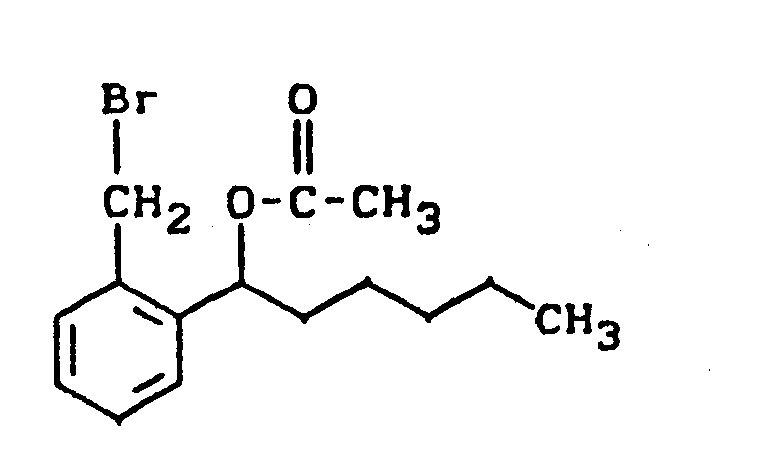
- Ausbeute: 75 % der Theorie
- Siedepunkt: 105°C/0.01 mm
- Essigsäure-1-(3-brommethylphenyl)hexylester
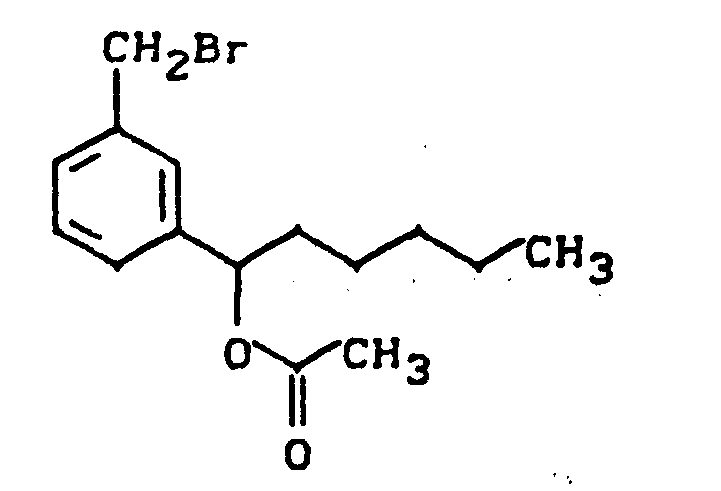
- Ausbeute: 84 % der Theorie
- Siedepunkt: 128°C/0.03 mm
- Essigsäure-1-[(2-brommethylphenoxy)methyl]propylester
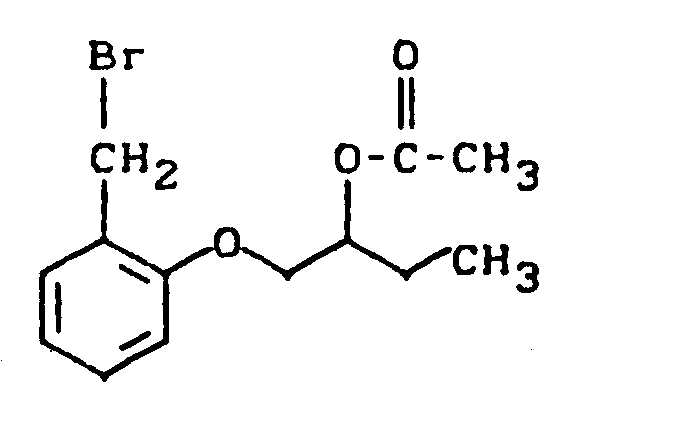
- Ausbeute: 82 % der Theorie
- Siedepunkt: 119 - 123°C/0.03 mm
- Essigsäure-1-[(3-brommethylphenoxy)methyl)propylester

- Ausbeute: 70 % der Theorie
- Siedepunkt: 85 - 89°C/0.05 mm
- Essigsäure-2-(3-brommethylphenoxy)cyclohexylester (trans-Form)

- Ausbeute: 65 % der Theorie
- Siedepunkt: 150-157°C/0.2 mm
- Essigsäure-1-[(3-brommethylphenoxy)methyl]-2,2-dimethyl- propylester

- Ausbeute: 58 % der Theorie
- Siedepunkt: 158-160°C/0.2 mm
- Essigsäure-1-[(3-brommethylphenoxy)methyl]pentylester

- Ausbeute: 57 % der Theorie
- Siedepunkt: 146 - 156°C/0.2 mm
- Essigsäure-1-(4-brommethylphenyl)pentylester

- Ausbeute: 46 % der Theorie
- Siedepunkt: 112°C/0.005 mm
- Essigsäure-1-[3-(chinolin-8-yloxymethyl)phenyl]-pentylester

- 1,45 g 8-Hydroxychinolin und 1.38 g gemahlenes, wasserfreies Kaliumcarbonat werden in 20 ml Dimethylformamid 2 h bei 25°C gerührt. Dann werden 2.99 g Essigsäure-1-(3-brommethylphenyl)pentylester, gelöst in 10 ml Dimethylformamid, zugetropft und die Reaktionsmischung über Nacht gerührt. Das Lösungsmittel wird im Vakuum abdestilliert, der Rückstand zwischen Wasser/Essigester verteilt, die organische Phase über Na2S04 getrocknet und anschließend im Vakuum eingeengt. Der Rückstand wird über Kieselgel 60 (Merck 9385) mit CH2Cl2/Methanol 100:5 chromatographiert (Rf = 0.45). Man erhält ein Öl in einer Ausbeute von 94 % der Theorie.
- Rf = 3,17 (System a)
- Analog Beispiel 37 wurden hergestellt:
- Essigsäure-1-[3-(chinolin-8-yloxymethyl)phenyl]hexylester

- Ausbeute: 68 % der Theorie
- Rf = 3,28 (System b)
- Essigsäure-1-[3-(chinolin-8-yloxymethyl)phenyl]heptyl- ester

- Ausbeute: 62 % der Theorie
- Rf = 3,89 (System b)
- Essigsäure-1-[3-(5,7-dichlorchinolin-8-yloxymethyl)phenyl]heptylester

- Ausbeute: 69 % der Theorie
- Rf = 7,88 (System a)
- Essigsäure-1-[2-(chinolin-8-yloxymethyl)phenyl]pentyl- ester

- Ausbeute: 83 % der Theorie
- Schmelzpunkt: 80 - 82°C (Cyclohexan)
- Rf = 3,29 (System a)
- Essigsäure-1-[2-(chinolin-8-yloxymethyl)phenyl]hexylester

- Ausbeute: 66 % der Theorie
- Schmelzpunkt: 79 - 81°C (Cyclohexan)
- Rf = 3,86 (System a)
- Essigsäure-1-[2-(5,7-dichlorchinolin-8-yloxymethyl)phenyl]pentylester

- Ausbeute: 77 % der Theorie
- Rf = 6,19 (System a)
- Essigsäure-1-[3-(chinaldin-8-yloxymethyl)phenyl]hexylester

- Ausbeute: 67 % der Theorie
- Rf = 3,71 (System b)
- Essigsäure-1-[3-(5,7-dichlorchinolin-8-yloxymethyl)phenyl]pentylester

- Ausbeute: 50 % der Theorie
- Rf = 5,52 (System a)
- Essigsäure-2-[3-(chinolin-8-yloxymethyl)phenoxy]cyclohexylester (trans-Form)

- Ausbeute: 77 % der Theorie
- Rf = 2,47 (System b)
- Essigsäure-1-[3-(chinolin-8-ylaminomethyl)phenyl]-pentylester

- Ausbeute: 63 % der Theorie
- Essigsäure-1-[3-(isochinolin-5-yloxymethyl)phenyl7-pentylester

- Ausbeute: 46 % der Theorie
- Rf = 4,08 (System b)
- Essigsäure-1-[4-(chinolin-8-yloxymethyl)phenyl]pentyi- ester

- Ausbeute: 75 % der Theorie
- Rf = 3,06 (System b)
- Essigsäure-1-[3-(chinolin-8-ylthiomethyl)phenyl]pentyl- ester
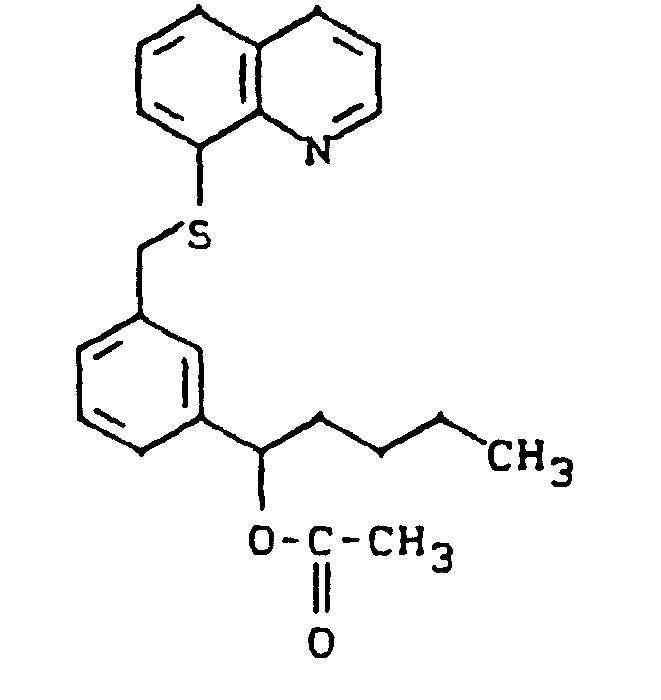
- Ausbeute: 95 % der Theorie
- Rf = 3,26 (System b)
- Essigsäure-1-[3-(chinolin-8-yloxymethyl)phenoxymethyl]-2,2-dimethyl-propylester

- Ausbeute: 93 % der Theorie
- Rf = 2,74 (System b)
- Essigsäure-1-[3-(chinolin-8-yloxymethyl)phenoxymethyl]pentylester

- Ausbeute: 70 % der Theorie
- Schmelzpunkt: 85 - 86°C (Essigester/Cyclohexan)
- Rf = 2,97 (System b)
- Essigsäure-1-[3-(chinolin-8-yloxymethyl)phenoxymethyl]-propylester

- Ausbeute: 61 % der Theorie
- Schmelzpunkt: 77 - 79°C (Essigester/Cyclohexan)
- Rf = 2,33 (System b)
- Essigsäure-1-[2-(chinolin-8-yloxymethyl)phenoxymethyl]propylester

- Ausbeute: 84 % der Theorie
- Rf = 2,38 (System b)
- 1-[3-(Chinolin-8-yloxymethyl)phenyl]pentanol

- 3,63 g Essigsäure-1-[3-(8-chinoyloxymethyl)phenyl]pentyl- ester werden in 50 ml Methanol gelöst. Nach Zugabe von 10 ml 2 n NaOH wird 15 h bei 25°C gerührt, das organische Lösungsmittel in Vakuum abrotiert und die wässrige Phase 3 mal mit je 20 ml Ether extrahiert. Die organischen Phasen werden 2 mal mit je 30 ml Wasser gewaschen, über Na2SO4 getrocknet und im Vakuum eingeengt. Der Rückstand wird über Kieselgel 60 (Merck 9385) chromatographiert Rf = 2,53 (System a)
- Ausbeute: 91 % der Theorie
- Schmelzpunkt: 72 bis 73°C (Diisopropylether)
- Analog Beispiel 55 wurden hergestellt:
- 1-[3-(Chinolin-8-yloxymethyl)phenyl]hexanol

- Ausbeute: 78 % der Theorie
- Rf = 2,33 (System b)
- 1-[3-(Chinolin-8-yloxymethyl)phenyl]heptanol

- Ausbeute: 77 % der Theorie
- Rf = 2,75 (System b)
- 1-[3-(5,7-Dichlorchinolin-8-yloxymethyl)phenyl]-heptanol

- Ausbeute: 86 %
- Rf = 5,16 (System a)
- 1-[2-(Chinolin-8-yloxymethyl)phenyl]pentanol

- Ausbeute: 80 % der Theorie
- Rf = 2,90 (System a)
- 1-[2-(Chinolin-8-yloxymethyl)phenyl]hexanol

- Ausbeute: 81 % der Theorie
- Rf = 2,71 (System b)
- 1-[3-(2-Methylchinolin-8-yloxymethyl)phenyl]hexanol

- Ausbeute: 86 % der Theorie
- Rf = 2,54 (System b)
- 1-[3-(Isochinolin-5-yloxymethyl)phenyl]pentanol

- Ausbeute: 16 % der Theorie
- Rf = 0.3 (CH2Cl2:CH3OH = 100 : 2)
- 1-[3-(Chinolin-8-ylthiomethyl)phenyl]pentanol

- Ausbeute: 63 % der Theorie
- Rf = 2,29 (System b)
- 1-[3-(Chinolin-8-ylaminomethyl)phenyllpentanol

- Ausbeute: 51 % der Theorie
- 2-[3-(Chinolin-8-yloxymethyl)phenoxy]cyclohexanol (trans-Form)

- Ausbeute: 65 % der Theorie
- Schmelzpunkt: 109 - 110°C (Essigester/Cyclohexan)
- Rf = 1,90 (System b)
- 1-[2-(Chinolin-8-yloxymethyl)phenoxymethyl]propanol

- Ausbeute: 83 % der Theorie
- Rf = 1,87 (System b)
- 1-[3-(Chinolin-8-yloxymethyl)phenoxymethyl]propanol

- Ausbeute: 98 % der Theorie
- Rf = 1,75 (System b)
- 1-[3-(Chinolin-8-yloxymethyl)phenoxymethyl]pentanol

- Ausbeute: 98 % der Theorie
- Rf = 2,10 (System b)
- 1-[3-(Chinolin-8-yloxymethyl)phenoxymethyl]-2,2-dimethyl- propanol

- Ausbeute: 95 %
- Schmelzpunkt: 103 - 105°C
- Rf = 2,07 (System b)
- Essigsäure-1-[2-(chinolin-N-oxid-8-yloxymethyl)phenyl]-hexylester

- 1.4 g Essigsäure-1-[2-(chinolin-8-yloxymethyl)phenyl]-hexylester werden in 20 ml Chloroform gelöst. Bei 0°C werden 0.64 g m-Chlorperbenzoesäure (80Xig) in 10 ml Chloroform gelöst, in 30 min. zugetropft. Es wird 15 h bei 25°C gerührt, das Lösungsmittel abgedampft und der Rückstand über Kieselgel 60 (Merck 7734) mit Essigester chromatographiert. Man erhält ein Öl.
- Ausbeute: 69 % der Theorie
- Rf = 2,89 (System b)
- 1-[2-(Chinolin-N-oxid-8-yloxymethyl)phenyl]hexanol

- 2.2 g 1-[2-(Chinolin-8-yloxymethyl)phenyl]hexanol werden in 20 ml Chloroform gelöst. Bei 0°C werden 0.64 g m-Chlorperbenzoesäure, in 15 ml Chloroform gelöst, in 30 min zugetropft. Es wird 15 h bei 25°C gerührt, das Lösungsmittel abgedampft und der Rückstand über Kieselgel 60 (Merck 7734) mit Methylenchlorid/Methanol = 100 : 5 chromatographiert. Das Produkt kristallisiert aus.
- Ausbeute: 26 % der Theorie.
- Schmelzpunkt: 99 - 101°C
- Rf = 2,32 (System b)
- Essigsäure-1-[2-(2(1H)-chinolon-8-yloxymethyl)phenyl]-heptylester

- Ausbeute: 74 % der Theorie
- Schmelzpunkt: 113 - 115°C
- Rf = 3,32 (System b)
- Analog Beispiel 72 wurden hergestellt:
- Essigsäure-1-[2-(2(1H)-chinolon-8-yloxymethyl)phenyl)-hexylester

- Ausbeute: 43 % der Theorie
- Schmelzpunkt: 92 - 95°C (Cyclohexan)
- Rf = 2,86 (System b)
- Essigsäure-1-[3-(2(1H)-chinolon-8-yloxymethyl)phenyl]-heptylester

- Ausbeute: 50 % Theorie
- Rf = 3,20 (System b)
- Essigsäure-1-[3-(2(1H)-chinolon-8-yloxymethyl)phenyl]-hexylester
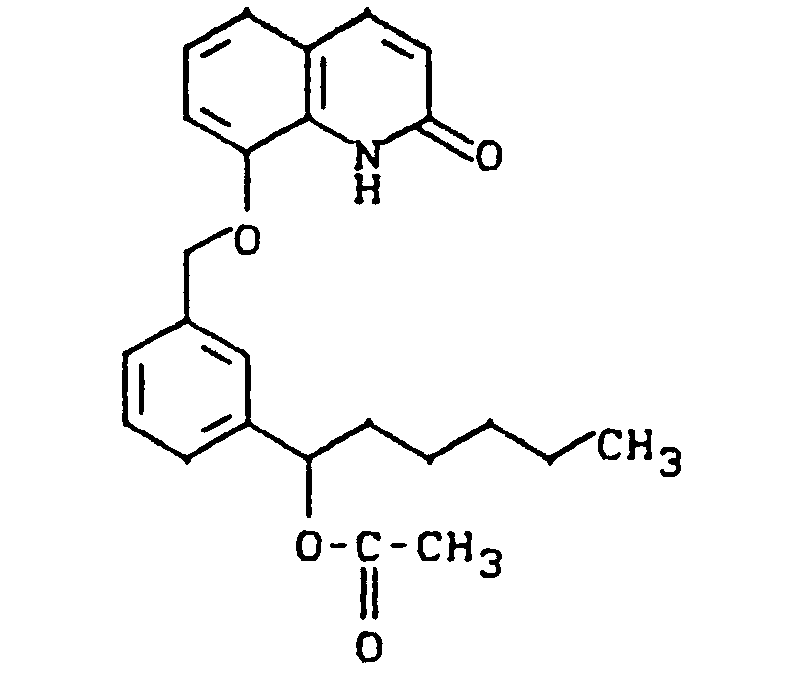
- Ausbeute: 48 % der Theorie
- Rf = 2,73 (System b)
- Essigsäure-2-[3-(2(1H)-chinolon-8-yloxymethyl)phenoxy]-cyclohexylester (trans-Form)

- Ausbeute: 67 % der Theorie
- Rf = 2,12 (System b)
- Essigsäure-1-[2-(2(1H)-chinolon-8-yloxymethyl)phenoxymethyl]propylester

- Ausbeute: 48 % der Theorie
- Schmelzpunkt: 112 - 114°C (Essigester/Cyclohexan)
- Rf = 2,07 (System b)
- Essigsäure-1-[3-(2(1H)-Chinolon-8-yloxymethyl)phenoxymethyl]propylester

- Ausbeute: 65 % der Theorie
- Schmelzpunkt: 81 - 84°C (Essigester/Cyclohexan)
- Rf = 2,01 (System b)
- 1-[2-(2(1H)-Chinolon-8-yloxymethyl)phenyl]heptanol

- 6.0 g Essigsäure-1-[2-(2(1H)-chinolin-8-yloxymethyl)-phenyl]-heptylester werden in 150 ml Methanol gelöst und mit 60 ml 1 n NaOH versetzt. Es wird 15 h refluxiert. Nach Abkühlen werden 60 ml ln HC1 zugegeben, vom ausgefallenen Produkt abgesaugt und aus Isopropanol umkristallisiert.
- Ausbeute: 50 % der Theorie
- Schmelzpunkt: 195 - 197°C (Isopropanol)
- Rf = 2,33 (System b)
- Analog Beispiel 58 wurden hergestellt:
- 1-[2-(2(1H)-Chinolon-8-yloxymethyl)phenyl]hexanol

- Ausbeute: 74 % der Theorie
- Schmelzpunkt: 201 - 202°C (Isopropanol)
- Rf = 2,06 (System b)
- 1-[3-(2(1H)-Chinolon-8-yloxymethyl)phenyl]heptanol

- Ausbeute: 85 % der Theorie
- Rf = 2,24 (System b)
- 1-[3-(2(1H)-Chinolon-8-yloxymethyl)phenyl]hexanol

- Ausbeute: 90 % der Theorie
- Schmelzpunkt: 97 - 99°C
- Rf = 1,94 (System b)
- 1-[3-(2(1H)-Chinolon-8-yloxymethyl)phenoxymethyl]propanol

- Ausbeute: 54 % der Theorie
- Rf = 1,56 (System b)
- 2-[3-(2(1H)-Chinolon-8-yloxymethyl)phenoxy]cyclohexanol (trans-Form)

- Ausbeute: 89 % der Theorie
- Rf = 1,62 (System b)
- 1-[2-(2(1H)-Chinolon-8-yloxymethyl)phenoxymethyl]propanol

- Ausbeute: 89 % der Theorie
- Schmelzpunkt: 114 - 116°C
- Rf = 1,66 (System b)
- Analog Beispiel 1 wurden hergestellt:
- 3-Methyl-1-(3-Methylphenyl)butanol
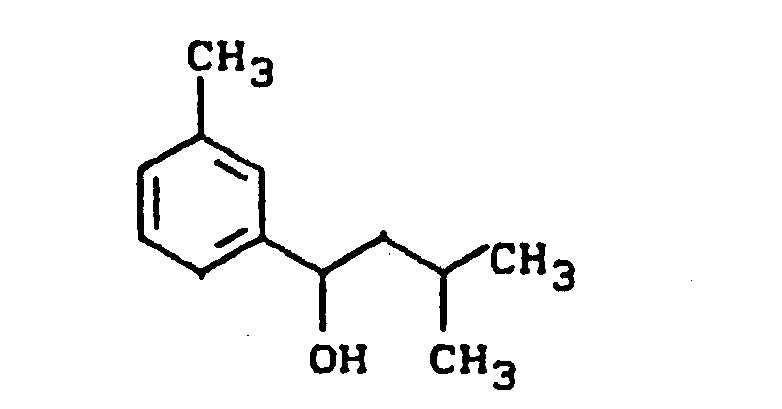
- Ausbeute: 35 X der Theorie
- Siedepunkt: 72-76°C / 0,008 mm
- Analog Beispiel 23 wurden hergestellt:
- Essigsäure-[3-methyl-1-(3-methylphenyl)]butylester

- Ausbeute 71 % der Theorie
- Siedepunkt: 54-56°C / 0,005 mm
- Propionsäure-1-(3-methylphenyl)hexylester

- Ausbeute: 75 % der Theorie
- Siedepunkt: 78-80°C / 0,005 mm
- Analog Beispiel 25 wurden hergestellt:
- Essigsäure-[1-(3-brommethylphenyl)-3-methyl]butylester

- Ausbeute: 52 %
- Siedepunkt: 93°C / 0,025 mm
- Propionsäure-[1-(3-brommethylphenyl)]hexylester

- Ausbeute: 56 % der Theorie
- Siedepunkt: 111°C / 0,02 mm
- Analog Beispiel 37 wurden hergestellt:
- Essiasäure-1-[3-(chinolin-8-yloxymethyl)phenyl]-3-methyl- butylester

- Ausbeute: 88 % der Theorie
- Rf = 3,31 (System b)
- Propionsäure-1-[3-(chinolin-8-yloxymethyl)phenyl]hexylester

- Ausbeute: 83 % der Theorie
- Rf = 4,11 (System b)
- Essigsäure-1-[3-(4-methylchinolin-8-yloxymethyl)-phenyl]-pentylester

- Ausbeute: 59 % der Theorie
- Schmelzpunkt: 67-70°C
- Rf = 2,95 (System b)
- Essigsäure-1-[3-(4-chlorchinolin-8-yloxymethyl)phenyl]-pentylester

- Ausbeute: 60 % der Theorie
- Rf = 3,60 (System b)
- Essigsäure-1-[3-(6-methylchinolin-8-yloxymethyl)-phenyl]-pentylester

- Ausbeute: 51 % der Theorie
- Rf = 3,29 (System b)
- Essigsäure-1-[3-(6-nitrochinolin-8-yloxymethyl)phenyl]-pentylester

- Ausbeute: 45 % der Theorie
- Schmelzpunkt: 72-74°C (Isopropanol)
- Rf = 2,74 (System b)
- Essigsäure-1-[3-(2-ethylsulfonylbenzothiazol-7-yl-aminomethyl)phenyl]hexylester

- Ausbeute: 34 % der Theorie
- Rf = 2.90 (System b)
- Analog Beispiel 55 wurden hergestellt:
- 1-[4-(Chinolin-8-yloxymethyl)phenyl]pentanol

- Ausbeute: 86 % der Theorie
- Rf = 2,04 (System b)
- 1-[3-(Chinolin-8-yloxymethyl)phenyl]-3-methyl-butanol

- Ausbeute: 68 % der Theorie
- Rf = 2,12 (System b)
- 1-[3-(2-Methylbenzothiazol-7-yloxymethyl)phenyl]pentanol

- Ausbeute: 61 % der Theorie
- Rf = 2,31 (System b)
- 1-[3-(2-Ethylsulfonylbenzothiazol-7-yloxymethyl)-phenyl]-hexanol

- Ausbeute: 30 % der Theorie
- Rf = 2,95 (System b)
- 1-[3-(4-Chlorchinolin-8-yloxymethyl)phenyl]pentanol

- Ausbeute: 91 % der Theorie
- Rf = 2,35 (System b)
- 1-[3-(4-Methylchinolin-8-yloxymethyl)phenyl]pentanol

- Ausbeute: 74 % der Theorie
- Schmelzpunkt: 94-96°C
- Rf = 2,21 (System b)
- 1-[3-(6-Methylchinolin-8-yloxymethyl)phenyllpentanol

- Ausbeute: 96 X der Theorie
- Rf = 2,22 (System b)
- 8-[3-(1-Methoxypentyl)benzyl]oxychinolin

- Zu einer Suspension von 0,13 g (5,5 mmol) Natriumhydrid in 10 ml Tetrahydrofuran wird eine Lösung von 1,6 g (5,0 mmol) 1-[3-(Chinolin-8-yloxymethyl)phenyl]-pentanol in 20 ml Tetrahydrofuran unter Schutzgas innerhalb von 30 min bei 25°C zugetropft. Anschließend werden 0,35 ml Methyliodid zugetropft und 15 h bei 25°C gerührt. Nach Zugabe von 5 ml Methanol wird eingedampft, der Rückstand in Ether aufgenommen, mit Wasser gewaschen, über Natriumsulfat getrocknet und wieder eingedampft. Der Rückstand wird über Kieselgel 60 chromatographiert.
- (Laufmittel Dichlormethan 1 Methanol 100:2)
- Ausbeute: 54 % der Theorie
- Rf = 3,48 (System a)
- Benzoesäure-1-[3-(chinolin-8-yloxymethyl)phenyl]pentyl- ester
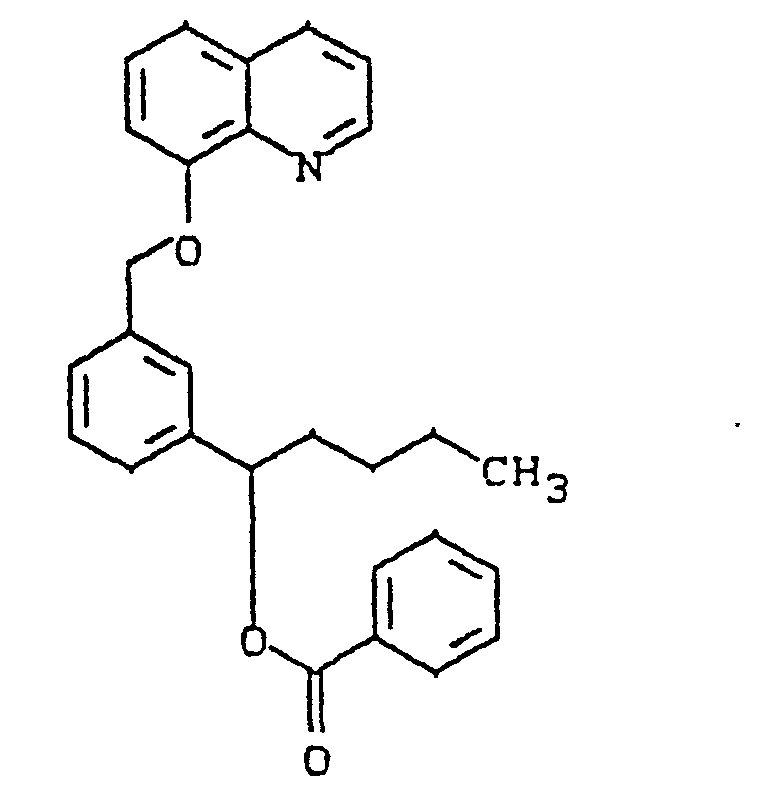
- Ausbeute: 45 % der Theorie
- Rf = 4,22 (System b)
- Die pharmakologische Wirkung der erfindungsgemäßen Substanzen wurde durch folgende Methode bestimmt:
- Als Maß für eine Lipoxygenase-Hemmung wurde die Freisetzung von Leukotrien B4 (LTB4) an polymorphkernigen Rattenleukozyten (PMN) nach Zugabe von Substanzen und Calonophor mittels reverse phase HPLC nach Borgeat, P. et al., Proc. Nat. Acad. Sci., 76, 2148-2152 (1979) bestimmt. Die in vivo-Aktivität der Verbindungen wurde mit dem Mäuseohr-Entzündungsmodell nach Young, J.M. et al., J. of InvestigativeDermatology, 82, 367-371 (1984) nachgewiesen.
- In Tabelle 1 sind beispielhaft die nach diesen Tests ermittelten Werte einiger erfindungsgemäßer Verbindungen aufgeführt:

gefunden, das dadurch gekennzeichnet ist, daß man
in geeigneten Lösungsmitteln mit Halogenierungsmitteln, gegebenenfalls in Anwesenheit von Radikalbildnern, umsetzt.
Claims (13)




und


Hal für Chlor, Brom oder Iod steht, mit Verbindungen der allgemeinen Formel (III),


oder


wobei

Hal für Chlor, Brom oder Iod steht, mit Verbindungen der allgemeinen Formel V


und
wobei
in inerten organischen Lösungsmitteln gegebenenfalls in Anwesenheit einer Base umsetzt, dann gegebenenfalls vorhandene Acylgruppen abspaltet und dann gegebenenfalls die Hydroxyverbindungen alkyliert.


und
Hal für Chlor, Brom oder Jod steht.


in geeigneten Lösungsmitteln mit Halogenierungsmitteln, gegebenenfalls in Anwesenheit von Radikalbildnern, umsetzt.




Priority Applications (1)
| Application Number | Priority Date | Filing Date | Title |
|---|---|---|---|
| AT86115358T ATE57688T1 (de) | 1985-11-16 | 1986-11-05 | Substituierte benzylether. |
Applications Claiming Priority (4)
| Application Number | Priority Date | Filing Date | Title |
|---|---|---|---|
| DE3540743 | 1985-11-16 | ||
| DE3540743 | 1985-11-16 | ||
| DE3617183 | 1986-05-22 | ||
| DE19863617183 DE3617183A1 (de) | 1985-11-16 | 1986-05-22 | Substituierte benzylether |
Publications (3)
| Publication Number | Publication Date |
|---|---|
| EP0224086A2 true EP0224086A2 (de) | 1987-06-03 |
| EP0224086A3 EP0224086A3 (en) | 1988-10-19 |
| EP0224086B1 EP0224086B1 (de) | 1990-10-24 |
Family
ID=25837950
Family Applications (1)
| Application Number | Title | Priority Date | Filing Date |
|---|---|---|---|
| EP86115358A Expired - Lifetime EP0224086B1 (de) | 1985-11-16 | 1986-11-05 | Substituierte Benzylether |
Country Status (10)
| Country | Link |
|---|---|
| US (1) | US5006534A (de) |
| EP (1) | EP0224086B1 (de) |
| KR (1) | KR870004961A (de) |
| AU (1) | AU590024B2 (de) |
| DE (2) | DE3617183A1 (de) |
| DK (1) | DK546186A (de) |
| ES (1) | ES2020919B3 (de) |
| FI (1) | FI864620L (de) |
| HU (1) | HU196757B (de) |
| IL (1) | IL80624A (de) |
Cited By (5)
| Publication number | Priority date | Publication date | Assignee | Title |
|---|---|---|---|---|
| EP0385663A3 (de) * | 1989-02-28 | 1991-11-21 | Zeneca Limited | Heterozyklische Zykloalkane mit hemmender Wirkung auf 5-Lipoxygenase |
| WO1994022846A1 (en) * | 1993-03-30 | 1994-10-13 | Pfizer Inc. | Compounds enhancing antitumor activity of other cytotoxic agents |
| WO1996013485A1 (en) * | 1994-10-27 | 1996-05-09 | Fujisawa Pharmaceutical Co., Ltd. | Pyridopyrimidones, quinolines and fused n-heretocycles as bradykinin antagonists |
| WO1997041104A1 (en) * | 1996-04-29 | 1997-11-06 | Fujisawa Pharmaceutical Co., Ltd. | Quinoline derivatives, processes for their preparation, and their use as medicaments |
| US6130217A (en) * | 1995-09-20 | 2000-10-10 | Pfizer Inc | Compounds enhancing antitumor activity of other cytotoxic agents |
Families Citing this family (18)
| Publication number | Priority date | Publication date | Assignee | Title |
|---|---|---|---|---|
| US5078906A (en) * | 1989-01-27 | 1992-01-07 | Mine Safety Appliances Company | Strong base reagent |
| US5202326A (en) * | 1989-02-28 | 1993-04-13 | Imperial Chemical Industries Plc | Heterocyclic ethers |
| US5217977A (en) * | 1989-02-28 | 1993-06-08 | Imperial Chemical Industries Plc | Heterocyclic cycloalkanes |
| US5140047A (en) * | 1991-05-03 | 1992-08-18 | Smithkline Beecham Corporation | Lipoxygenase inhibitors |
| US5334600A (en) * | 1991-07-30 | 1994-08-02 | Ciba-Geigy Corporation | Isoquinolyl substituted hydroxylamine derivatives |
| US5260316A (en) * | 1991-07-30 | 1993-11-09 | Ciba-Geigy Corporation | Isoquinolyl substituted hydroxylamine derivatives |
| US5350761A (en) * | 1991-07-30 | 1994-09-27 | Ciba-Geigy Corporation | Indolyl substituted hydroxylamine derivatives |
| EP0555067A1 (de) * | 1992-02-07 | 1993-08-11 | Zeneca Limited | Hydroxylaminderivate als 5-Lipoxygenasehemmer |
| GB9300894D0 (en) * | 1992-02-07 | 1993-03-10 | Zeneca Ltd | Oxime derivatives |
| FR2689889B1 (fr) * | 1992-04-10 | 1994-06-10 | Rhone Poulenc Rorer Sa | Nouveaux derives de perhydroisoindole, et leur preparation. |
| CA2094465A1 (en) * | 1992-04-23 | 1993-10-24 | Pierre Andre Raymond Bruneau | Cycloalkane derivatives |
| CA2095006A1 (en) * | 1992-05-12 | 1993-11-13 | Philip Neil Edwards | Oxime derivatives |
| CA2095005A1 (en) * | 1992-05-12 | 1993-11-13 | Philip Neil Edwards | Hydroxylamine derivatives |
| AU680870B2 (en) * | 1993-04-28 | 1997-08-14 | Astellas Pharma Inc. | New heterocyclic compounds |
| US5410054A (en) * | 1993-07-20 | 1995-04-25 | Merck Frosst Canada, Inc. | Heteroaryl quinolines as inhibitors of leukotriene biosynthesis |
| FR2751650B1 (fr) * | 1996-07-24 | 1998-10-09 | Fournier Ind & Sante | Nouveaux composes de n-benzenesulfonyl-l-proline, procede de preparation et utilisation en therapeutique |
| FR2756562B1 (fr) * | 1996-12-04 | 1999-01-08 | Fournier Ind & Sante | Nouveaux composes de n-benzenesulfonyl-l-proline, procede de preparation et utilisation en therapeutique |
| FR2790260B1 (fr) | 1999-02-26 | 2001-05-04 | Fournier Ind & Sante | Nouveaux composes de n-(benzenesulfonamide), procede de preparation et utilisation en therapeutique |
Family Cites Families (12)
| Publication number | Priority date | Publication date | Assignee | Title |
|---|---|---|---|---|
| DE2455858A1 (de) * | 1973-12-06 | 1975-06-12 | Sandoz Ag | Neue acyl-substituierte benzyl- und dibenzylaether und verfahren zu deren herstellung |
| AU541697B2 (en) * | 1979-11-19 | 1985-01-17 | Ici Australia Limited | Quinoline derivatives |
| US4360700A (en) * | 1981-11-02 | 1982-11-23 | Pfizer Inc. | Intermediates for making 1-(3-benzyloxyphenyl)-1,1-dimethylheptane |
| IE56702B1 (en) * | 1982-12-01 | 1991-11-06 | Usv Pharma Corp | Antiinflammatory antiallergic compounds |
| US4794188A (en) * | 1982-12-01 | 1988-12-27 | Usv Pharmaceutical Corporation | Certain unsymmetrical quinolinyl ethers having anti-inflammatory and anti-allergic activity |
| HU186654B (en) * | 1982-12-28 | 1985-09-30 | Richter Gedeon Vegyeszet | Process for producing new pyridine derivatives, acid additional salts and quaternary salts and pharmaceutical compositions containing them |
| JPS59210021A (ja) * | 1983-05-12 | 1984-11-28 | Kyowa Hakko Kogyo Co Ltd | リポキシゲナ−ゼ代謝産物に起因する疾患の予防治療剤 |
| DE3337044A1 (de) * | 1983-10-12 | 1985-04-25 | Basf Ag, 6700 Ludwigshafen | Phenoxyfettsaeurederivate, verfahren zu ihrer herstellung und ihre verwendung zur bekaempfung unerwuenschten pflanzenwachstums |
| NO174506B (no) * | 1984-10-30 | 1994-02-07 | Usv Pharma Corp | Analogifremgangsmaate ved fremstilling av terapeutisk aktive forbindelser |
| US4625034A (en) * | 1985-02-04 | 1986-11-25 | Usv Pharmaceutical Corp. | 1,2-Dihydro; 1,2,3,4-tetrahydro; 5,8 dihydro; and 5,6,7,8-tetrahydroquinoline derivatives |
| US4631287A (en) * | 1985-04-16 | 1986-12-23 | Usv Pharmaceutical Corp. | Aryl and heteroaryl ethers as agents for the treatment of hypersensitive ailments |
| US4661499A (en) * | 1985-06-18 | 1987-04-28 | Merck Frosst Canada, Inc. | 2-[(substituted)-phenoxymethyl]quinolines |
-
1986
- 1986-05-22 DE DE19863617183 patent/DE3617183A1/de not_active Withdrawn
- 1986-11-05 EP EP86115358A patent/EP0224086B1/de not_active Expired - Lifetime
- 1986-11-05 ES ES86115358T patent/ES2020919B3/es not_active Expired - Lifetime
- 1986-11-05 DE DE8686115358T patent/DE3675161D1/de not_active Expired - Lifetime
- 1986-11-13 FI FI864620A patent/FI864620L/fi not_active Application Discontinuation
- 1986-11-13 IL IL80624A patent/IL80624A/xx unknown
- 1986-11-14 HU HU864699A patent/HU196757B/hu not_active IP Right Cessation
- 1986-11-14 DK DK546186A patent/DK546186A/da not_active Application Discontinuation
- 1986-11-15 KR KR860009670A patent/KR870004961A/ko not_active Withdrawn
- 1986-11-17 AU AU65375/86A patent/AU590024B2/en not_active Ceased
-
1989
- 1989-01-30 US US07/304,895 patent/US5006534A/en not_active Expired - Fee Related
Cited By (6)
| Publication number | Priority date | Publication date | Assignee | Title |
|---|---|---|---|---|
| EP0385663A3 (de) * | 1989-02-28 | 1991-11-21 | Zeneca Limited | Heterozyklische Zykloalkane mit hemmender Wirkung auf 5-Lipoxygenase |
| WO1994022846A1 (en) * | 1993-03-30 | 1994-10-13 | Pfizer Inc. | Compounds enhancing antitumor activity of other cytotoxic agents |
| WO1996013485A1 (en) * | 1994-10-27 | 1996-05-09 | Fujisawa Pharmaceutical Co., Ltd. | Pyridopyrimidones, quinolines and fused n-heretocycles as bradykinin antagonists |
| US5994368A (en) * | 1994-10-27 | 1999-11-30 | Fujisawa Pharmaceutical Co., Ltd. | Pyridopyrimidones, quinolines and fused N-heterocycles as bradykinin antagonists |
| US6130217A (en) * | 1995-09-20 | 2000-10-10 | Pfizer Inc | Compounds enhancing antitumor activity of other cytotoxic agents |
| WO1997041104A1 (en) * | 1996-04-29 | 1997-11-06 | Fujisawa Pharmaceutical Co., Ltd. | Quinoline derivatives, processes for their preparation, and their use as medicaments |
Also Published As
| Publication number | Publication date |
|---|---|
| EP0224086B1 (de) | 1990-10-24 |
| FI864620A7 (fi) | 1987-05-17 |
| IL80624A (en) | 1990-12-23 |
| IL80624A0 (en) | 1987-02-27 |
| HUT44512A (en) | 1988-03-28 |
| HU196757B (en) | 1989-01-30 |
| FI864620L (fi) | 1987-05-17 |
| ES2020919B3 (es) | 1991-10-16 |
| US5006534A (en) | 1991-04-09 |
| DE3617183A1 (de) | 1987-05-27 |
| DK546186D0 (da) | 1986-11-14 |
| KR870004961A (ko) | 1987-06-02 |
| DE3675161D1 (de) | 1990-11-29 |
| FI864620A0 (fi) | 1986-11-13 |
| AU590024B2 (en) | 1989-10-26 |
| AU6537586A (en) | 1987-05-21 |
| DK546186A (da) | 1987-05-17 |
| EP0224086A3 (en) | 1988-10-19 |
Similar Documents
| Publication | Publication Date | Title |
|---|---|---|
| EP0224086B1 (de) | Substituierte Benzylether | |
| EP0261539B1 (de) | Substituierte Phenylsulfonamide | |
| EP1017692B1 (de) | 4-heteroaryl-tetrahydrochinoline und ihre verwendung als inhibitoren des cholesterin-ester-transfer-proteins (ctep) | |
| EP0344519B1 (de) | Substituierte 4-(Chinolin-2-yl-methoxy)phenyl-essigsäure-Derivate | |
| EP0339416B1 (de) | Gegebenenfalls alpha-substituierte 4-(Chinolin-2-yl-methoxy)phenylessigsäuren und -ester | |
| DE69118388T2 (de) | Substituierte bizyklische arylderivate mit selektiver leukotrien b4 antagonistischer wirkung | |
| EP0399291B1 (de) | Substituierte (Chinolin-2-yl-methoxy)phenyl-acyl-sulfonamide und -cyanamide, Verfahren zu ihrer Herstellung und ihre Verwendung in Arzneimitteln | |
| EP0499926B1 (de) | 2-Substituierte Chinoline, Verfahren zu ihrer Herstellung sowie ihre Verwendung in Arzneimitteln | |
| EP0414078B1 (de) | Disubstituierte (Chinolin-2-yl-methoxy) phenylessigsäure-Derivate | |
| EP0414076B1 (de) | Cyclisch substituierte (Chinolin-2-yl-methoxy)phenyl-essigsäure-Derivate | |
| DE3830060A1 (de) | 2-phenylbenzimidazole - verfahren zu ihrer herstellung sowie diese verbindungen enthaltende arzneimittel | |
| EP0716082A1 (de) | Heterocyclisch substituierte Oxy-phenyl-(phenyl) glycinolamide mit antiatherosklerotischer Wirkung | |
| CH650783A5 (de) | Carbostyrilderivate, verfahren zu deren herstellung und arzneimittel, welche diese enthalten. | |
| WO1998034895A1 (de) | 5-hydroxy-alkyl substituierte phenyle und deren verwendung in arzneimitteln zur behandlung von arteriosklerose und hyperlipoproteinemie | |
| DE3049959C2 (de) | ||
| EP0530639B1 (de) | Heterocyclisch substituierte Chinolylmethoxy-Phenylacetamide als Lipoxygenasehemmer | |
| EP0549879A2 (de) | Thiazolyl-substituierte Chinolylmethoxyphenylessigsäurederivate | |
| EP0582908B1 (de) | 2-Substituierte Chinolylmethoxy-phenylessigsäure- und -benzylacyl Derivate, Verfahren zu ihrer Herstellung und ihre Verwendung als Leukotriensynthese Hemmer | |
| EP0387610A2 (de) | Substituierte (Chinolin-2-yl-methoxy)phenyl-N,N'-sulfonyl-harnstoffe, Verfahren zu ihrer Herstellung und ihre Verwendung in Arzneimitteln | |
| DE3804346A1 (de) | Tert.-butylphenyl-pyridyl-amide - verfahren zu ihrer herstellung sowie diese verbindungen enthaltende arzneimittel | |
| DD259401A5 (de) | Verfahren zur herstellung von 2-alkylbenzimidazol-derivaten | |
| EP0545170A1 (de) | Chinolylmethoxyphenyl-essigsäureamide | |
| EP0424722B1 (de) | Substituierte (Chinolin-2-yl-methoxy)phenyl-thioharnstoffe | |
| EP0582916A1 (de) | N-Methansulfonyl-2- 3-isobutyl-3-(chinolin-2-yl-methoxy)phenyl -2-cycloalkylessigsäureamide, Verfahren zu ihrer Herstellung und ihre Verwendung in Arzneimitteln | |
| DE3935491A1 (de) | Substituierte (chinolin-2-yl-methoxy)phenyl-carbonylharnstoffe |
Legal Events
| Date | Code | Title | Description |
|---|---|---|---|
| PUAI | Public reference made under article 153(3) epc to a published international application that has entered the european phase |
Free format text: ORIGINAL CODE: 0009012 |
|
| 17P | Request for examination filed |
Effective date: 19861105 |
|
| AK | Designated contracting states |
Kind code of ref document: A2 Designated state(s): AT BE CH DE ES FR GB IT LI NL SE |
|
| PUAL | Search report despatched |
Free format text: ORIGINAL CODE: 0009013 |
|
| AK | Designated contracting states |
Kind code of ref document: A3 Designated state(s): AT BE CH DE ES FR GB IT LI NL SE |
|
| 17Q | First examination report despatched |
Effective date: 19890612 |
|
| GRAA | (expected) grant |
Free format text: ORIGINAL CODE: 0009210 |
|
| AK | Designated contracting states |
Kind code of ref document: B1 Designated state(s): AT BE CH DE ES FR GB IT LI NL SE |
|
| REF | Corresponds to: |
Ref document number: 57688 Country of ref document: AT Date of ref document: 19901115 Kind code of ref document: T |
|
| ET | Fr: translation filed | ||
| REF | Corresponds to: |
Ref document number: 3675161 Country of ref document: DE Date of ref document: 19901129 |
|
| GBT | Gb: translation of ep patent filed (gb section 77(6)(a)/1977) | ||
| ITF | It: translation for a ep patent filed | ||
| PLBE | No opposition filed within time limit |
Free format text: ORIGINAL CODE: 0009261 |
|
| STAA | Information on the status of an ep patent application or granted ep patent |
Free format text: STATUS: NO OPPOSITION FILED WITHIN TIME LIMIT |
|
| 26N | No opposition filed | ||
| PGFP | Annual fee paid to national office [announced via postgrant information from national office to epo] |
Ref country code: AT Payment date: 19911024 Year of fee payment: 6 |
|
| PGFP | Annual fee paid to national office [announced via postgrant information from national office to epo] |
Ref country code: SE Payment date: 19911111 Year of fee payment: 6 |
|
| PGFP | Annual fee paid to national office [announced via postgrant information from national office to epo] |
Ref country code: ES Payment date: 19911113 Year of fee payment: 6 |
|
| PGFP | Annual fee paid to national office [announced via postgrant information from national office to epo] |
Ref country code: BE Payment date: 19911127 Year of fee payment: 6 |
|
| PGFP | Annual fee paid to national office [announced via postgrant information from national office to epo] |
Ref country code: NL Payment date: 19911130 Year of fee payment: 6 |
|
| PG25 | Lapsed in a contracting state [announced via postgrant information from national office to epo] |
Ref country code: AT Effective date: 19921105 |
|
| PG25 | Lapsed in a contracting state [announced via postgrant information from national office to epo] |
Ref country code: SE Effective date: 19921106 Ref country code: ES Free format text: LAPSE BECAUSE OF THE APPLICANT RENOUNCES Effective date: 19921106 |
|
| PG25 | Lapsed in a contracting state [announced via postgrant information from national office to epo] |
Ref country code: BE Effective date: 19921130 |
|
| BERE | Be: lapsed |
Owner name: BAYER A.G. Effective date: 19921130 |
|
| PG25 | Lapsed in a contracting state [announced via postgrant information from national office to epo] |
Ref country code: NL Effective date: 19930601 |
|
| NLV4 | Nl: lapsed or anulled due to non-payment of the annual fee | ||
| PGFP | Annual fee paid to national office [announced via postgrant information from national office to epo] |
Ref country code: GB Payment date: 19931027 Year of fee payment: 8 |
|
| PGFP | Annual fee paid to national office [announced via postgrant information from national office to epo] |
Ref country code: FR Payment date: 19931117 Year of fee payment: 8 |
|
| ITTA | It: last paid annual fee | ||
| PGFP | Annual fee paid to national office [announced via postgrant information from national office to epo] |
Ref country code: CH Payment date: 19931130 Year of fee payment: 8 |
|
| PG25 | Lapsed in a contracting state [announced via postgrant information from national office to epo] |
Ref country code: GB Effective date: 19941105 |
|
| PG25 | Lapsed in a contracting state [announced via postgrant information from national office to epo] |
Ref country code: LI Effective date: 19941130 Ref country code: CH Effective date: 19941130 |
|
| EUG | Se: european patent has lapsed |
Ref document number: 86115358.3 Effective date: 19930610 |
|
| GBPC | Gb: european patent ceased through non-payment of renewal fee |
Effective date: 19941105 |
|
| PG25 | Lapsed in a contracting state [announced via postgrant information from national office to epo] |
Ref country code: FR Effective date: 19950731 |
|
| REG | Reference to a national code |
Ref country code: CH Ref legal event code: PL |
|
| REG | Reference to a national code |
Ref country code: FR Ref legal event code: ST |
|
| REG | Reference to a national code |
Ref country code: ES Ref legal event code: FD2A Effective date: 20010402 |
|
| PG25 | Lapsed in a contracting state [announced via postgrant information from national office to epo] |
Ref country code: IT Free format text: LAPSE BECAUSE OF NON-PAYMENT OF DUE FEES;WARNING: LAPSES OF ITALIAN PATENTS WITH EFFECTIVE DATE BEFORE 2007 MAY HAVE OCCURRED AT ANY TIME BEFORE 2007. THE CORRECT EFFECTIVE DATE MAY BE DIFFERENT FROM THE ONE RECORDED. Effective date: 20051105 |
|
| PGFP | Annual fee paid to national office [announced via postgrant information from national office to epo] |
Ref country code: DE Payment date: 20051216 Year of fee payment: 20 |