EP0414078B1 - Disubstituierte (Chinolin-2-yl-methoxy) phenylessigsäure-Derivate - Google Patents
Disubstituierte (Chinolin-2-yl-methoxy) phenylessigsäure-Derivate Download PDFInfo
- Publication number
- EP0414078B1 EP0414078B1 EP90115444A EP90115444A EP0414078B1 EP 0414078 B1 EP0414078 B1 EP 0414078B1 EP 90115444 A EP90115444 A EP 90115444A EP 90115444 A EP90115444 A EP 90115444A EP 0414078 B1 EP0414078 B1 EP 0414078B1
- Authority
- EP
- European Patent Office
- Prior art keywords
- carbon atoms
- chain
- straight
- branched alkyl
- quinolin
- Prior art date
- Legal status (The legal status is an assumption and is not a legal conclusion. Google has not performed a legal analysis and makes no representation as to the accuracy of the status listed.)
- Expired - Lifetime
Links
- OTAGHZZKFIMSMC-UHFFFAOYSA-N 2-phenyl-2-(quinolin-2-ylmethoxy)acetic acid Chemical class C=1C=C2C=CC=CC2=NC=1COC(C(=O)O)C1=CC=CC=C1 OTAGHZZKFIMSMC-UHFFFAOYSA-N 0.000 title claims abstract description 16
- 150000001875 compounds Chemical class 0.000 claims abstract description 21
- 239000003814 drug Substances 0.000 claims abstract description 9
- 238000002360 preparation method Methods 0.000 claims abstract description 8
- 150000003573 thiols Chemical class 0.000 claims abstract 2
- 125000000217 alkyl group Chemical group 0.000 claims description 51
- 125000004432 carbon atom Chemical group C* 0.000 claims description 48
- 229910052739 hydrogen Inorganic materials 0.000 claims description 20
- 239000001257 hydrogen Substances 0.000 claims description 20
- 238000000034 method Methods 0.000 claims description 18
- ZAMOUSCENKQFHK-UHFFFAOYSA-N Chlorine atom Chemical compound [Cl] ZAMOUSCENKQFHK-UHFFFAOYSA-N 0.000 claims description 17
- 229910052736 halogen Inorganic materials 0.000 claims description 17
- 150000002367 halogens Chemical class 0.000 claims description 17
- UFHFLCQGNIYNRP-UHFFFAOYSA-N Hydrogen Chemical compound [H][H] UFHFLCQGNIYNRP-UHFFFAOYSA-N 0.000 claims description 16
- 229910052731 fluorine Inorganic materials 0.000 claims description 16
- 239000011737 fluorine Substances 0.000 claims description 16
- 125000003545 alkoxy group Chemical group 0.000 claims description 15
- 150000002431 hydrogen Chemical class 0.000 claims description 15
- 239000000460 chlorine Substances 0.000 claims description 14
- 229910052801 chlorine Inorganic materials 0.000 claims description 14
- 125000001997 phenyl group Chemical group [H]C1=C([H])C([H])=C(*)C([H])=C1[H] 0.000 claims description 14
- PXGOKWXKJXAPGV-UHFFFAOYSA-N Fluorine Chemical compound FF PXGOKWXKJXAPGV-UHFFFAOYSA-N 0.000 claims description 13
- 125000001995 cyclobutyl group Chemical group [H]C1([H])C([H])([H])C([H])(*)C1([H])[H] 0.000 claims description 12
- 125000000582 cycloheptyl group Chemical group [H]C1([H])C([H])([H])C([H])([H])C([H])([H])C([H])(*)C([H])([H])C1([H])[H] 0.000 claims description 12
- 125000000113 cyclohexyl group Chemical group [H]C1([H])C([H])([H])C([H])([H])C([H])(*)C([H])([H])C1([H])[H] 0.000 claims description 12
- 125000001511 cyclopentyl group Chemical group [H]C1([H])C([H])([H])C([H])([H])C([H])(*)C1([H])[H] 0.000 claims description 12
- 150000003839 salts Chemical class 0.000 claims description 12
- 125000001559 cyclopropyl group Chemical group [H]C1([H])C([H])([H])C1([H])* 0.000 claims description 11
- 125000001153 fluoro group Chemical group F* 0.000 claims description 10
- WKBOTKDWSSQWDR-UHFFFAOYSA-N Bromine atom Chemical group [Br] WKBOTKDWSSQWDR-UHFFFAOYSA-N 0.000 claims description 9
- NINIDFKCEFEMDL-UHFFFAOYSA-N Sulfur Chemical compound [S] NINIDFKCEFEMDL-UHFFFAOYSA-N 0.000 claims description 9
- 125000003118 aryl group Chemical group 0.000 claims description 9
- 125000002887 hydroxy group Chemical group [H]O* 0.000 claims description 9
- 229910052760 oxygen Inorganic materials 0.000 claims description 9
- 239000001301 oxygen Substances 0.000 claims description 9
- GDTBXPJZTBHREO-UHFFFAOYSA-N bromine Chemical group BrBr GDTBXPJZTBHREO-UHFFFAOYSA-N 0.000 claims description 8
- 229910052794 bromium Chemical group 0.000 claims description 8
- 239000011777 magnesium Substances 0.000 claims description 7
- 229910052749 magnesium Inorganic materials 0.000 claims description 7
- FYYHWMGAXLPEAU-UHFFFAOYSA-N Magnesium Chemical compound [Mg] FYYHWMGAXLPEAU-UHFFFAOYSA-N 0.000 claims description 6
- HCHKCACWOHOZIP-UHFFFAOYSA-N Zinc Chemical compound [Zn] HCHKCACWOHOZIP-UHFFFAOYSA-N 0.000 claims description 6
- 125000004453 alkoxycarbonyl group Chemical group 0.000 claims description 6
- QVGXLLKOCUKJST-UHFFFAOYSA-N atomic oxygen Chemical compound [O] QVGXLLKOCUKJST-UHFFFAOYSA-N 0.000 claims description 6
- 229910052793 cadmium Inorganic materials 0.000 claims description 6
- BDOSMKKIYDKNTQ-UHFFFAOYSA-N cadmium atom Chemical compound [Cd] BDOSMKKIYDKNTQ-UHFFFAOYSA-N 0.000 claims description 6
- 125000003178 carboxy group Chemical group [H]OC(*)=O 0.000 claims description 6
- 125000004093 cyano group Chemical group *C#N 0.000 claims description 6
- 125000000753 cycloalkyl group Chemical group 0.000 claims description 6
- 239000012442 inert solvent Substances 0.000 claims description 6
- 125000000876 trifluoromethoxy group Chemical group FC(F)(F)O* 0.000 claims description 6
- DGAQECJNVWCQMB-PUAWFVPOSA-M Ilexoside XXIX Chemical compound C[C@@H]1CC[C@@]2(CC[C@@]3(C(=CC[C@H]4[C@]3(CC[C@@H]5[C@@]4(CC[C@@H](C5(C)C)OS(=O)(=O)[O-])C)C)[C@@H]2[C@]1(C)O)C)C(=O)O[C@H]6[C@@H]([C@H]([C@@H]([C@H](O6)CO)O)O)O.[Na+] DGAQECJNVWCQMB-PUAWFVPOSA-M 0.000 claims description 5
- 150000002148 esters Chemical class 0.000 claims description 5
- 125000000449 nitro group Chemical group [O-][N+](*)=O 0.000 claims description 4
- 239000011734 sodium Substances 0.000 claims description 4
- 229910052708 sodium Inorganic materials 0.000 claims description 4
- 229910052725 zinc Inorganic materials 0.000 claims description 4
- 239000011701 zinc Substances 0.000 claims description 4
- WHXSMMKQMYFTQS-UHFFFAOYSA-N Lithium Chemical compound [Li] WHXSMMKQMYFTQS-UHFFFAOYSA-N 0.000 claims description 3
- 239000002253 acid Substances 0.000 claims description 3
- 150000007513 acids Chemical class 0.000 claims description 3
- 229910052782 aluminium Inorganic materials 0.000 claims description 3
- XAGFODPZIPBFFR-UHFFFAOYSA-N aluminium Chemical compound [Al] XAGFODPZIPBFFR-UHFFFAOYSA-N 0.000 claims description 3
- PNDPGZBMCMUPRI-UHFFFAOYSA-N iodine Chemical compound II PNDPGZBMCMUPRI-UHFFFAOYSA-N 0.000 claims description 3
- 125000000468 ketone group Chemical group 0.000 claims description 3
- 229910052744 lithium Inorganic materials 0.000 claims description 3
- 150000002902 organometallic compounds Chemical class 0.000 claims description 3
- 125000002023 trifluoromethyl group Chemical group FC(F)(F)* 0.000 claims description 3
- 239000004411 aluminium Substances 0.000 claims description 2
- 208000037265 diseases, disorders, signs and symptoms Diseases 0.000 claims description 2
- 239000000546 pharmaceutical excipient Substances 0.000 claims description 2
- 239000005864 Sulphur Substances 0.000 claims 3
- 239000000867 Lipoxygenase Inhibitor Substances 0.000 claims 1
- 238000005904 alkaline hydrolysis reaction Methods 0.000 claims 1
- 201000010099 disease Diseases 0.000 claims 1
- 238000006243 chemical reaction Methods 0.000 abstract description 4
- 239000013543 active substance Substances 0.000 abstract 1
- 150000004795 grignard reagents Chemical class 0.000 abstract 1
- 125000000446 sulfanediyl group Chemical group *S* 0.000 abstract 1
- LFQSCWFLJHTTHZ-UHFFFAOYSA-N Ethanol Chemical compound CCO LFQSCWFLJHTTHZ-UHFFFAOYSA-N 0.000 description 23
- OKKJLVBELUTLKV-UHFFFAOYSA-N Methanol Chemical compound OC OKKJLVBELUTLKV-UHFFFAOYSA-N 0.000 description 18
- HEMHJVSKTPXQMS-UHFFFAOYSA-M Sodium hydroxide Chemical compound [OH-].[Na+] HEMHJVSKTPXQMS-UHFFFAOYSA-M 0.000 description 14
- RTZKZFJDLAIYFH-UHFFFAOYSA-N Diethyl ether Chemical compound CCOCC RTZKZFJDLAIYFH-UHFFFAOYSA-N 0.000 description 12
- ZMXDDKWLCZADIW-UHFFFAOYSA-N N,N-Dimethylformamide Chemical compound CN(C)C=O ZMXDDKWLCZADIW-UHFFFAOYSA-N 0.000 description 12
- 235000019441 ethanol Nutrition 0.000 description 11
- -1 Chlor, Brom, Cyclopropyl Chemical group 0.000 description 10
- WYURNTSHIVDZCO-UHFFFAOYSA-N Tetrahydrofuran Chemical compound C1CCOC1 WYURNTSHIVDZCO-UHFFFAOYSA-N 0.000 description 10
- 239000000203 mixture Substances 0.000 description 10
- XEKOWRVHYACXOJ-UHFFFAOYSA-N Ethyl acetate Chemical compound CCOC(C)=O XEKOWRVHYACXOJ-UHFFFAOYSA-N 0.000 description 9
- KWYUFKZDYYNOTN-UHFFFAOYSA-M Potassium hydroxide Chemical compound [OH-].[K+] KWYUFKZDYYNOTN-UHFFFAOYSA-M 0.000 description 9
- 239000002585 base Substances 0.000 description 9
- 239000002904 solvent Substances 0.000 description 9
- UHOVQNZJYSORNB-UHFFFAOYSA-N Benzene Chemical compound C1=CC=CC=C1 UHOVQNZJYSORNB-UHFFFAOYSA-N 0.000 description 6
- YXFVVABEGXRONW-UHFFFAOYSA-N Toluene Chemical compound CC1=CC=CC=C1 YXFVVABEGXRONW-UHFFFAOYSA-N 0.000 description 6
- VLKZOEOYAKHREP-UHFFFAOYSA-N n-Hexane Chemical compound CCCCCC VLKZOEOYAKHREP-UHFFFAOYSA-N 0.000 description 6
- 239000003960 organic solvent Substances 0.000 description 6
- BWHMMNNQKKPAPP-UHFFFAOYSA-L potassium carbonate Chemical compound [K+].[K+].[O-]C([O-])=O BWHMMNNQKKPAPP-UHFFFAOYSA-L 0.000 description 6
- 238000007127 saponification reaction Methods 0.000 description 6
- QTBSBXVTEAMEQO-UHFFFAOYSA-N Acetic acid Chemical compound CC(O)=O QTBSBXVTEAMEQO-UHFFFAOYSA-N 0.000 description 5
- 238000006266 etherification reaction Methods 0.000 description 5
- 235000011121 sodium hydroxide Nutrition 0.000 description 5
- 239000000126 substance Substances 0.000 description 5
- 238000003786 synthesis reaction Methods 0.000 description 5
- YLQBMQCUIZJEEH-UHFFFAOYSA-N tetrahydrofuran Natural products C=1C=COC=1 YLQBMQCUIZJEEH-UHFFFAOYSA-N 0.000 description 5
- XLYOFNOQVPJJNP-UHFFFAOYSA-N water Substances O XLYOFNOQVPJJNP-UHFFFAOYSA-N 0.000 description 5
- CSCPPACGZOOCGX-UHFFFAOYSA-N Acetone Chemical compound CC(C)=O CSCPPACGZOOCGX-UHFFFAOYSA-N 0.000 description 4
- NLXLAEXVIDQMFP-UHFFFAOYSA-N Ammonia chloride Chemical compound [NH4+].[Cl-] NLXLAEXVIDQMFP-UHFFFAOYSA-N 0.000 description 4
- VTYYLEPIZMXCLO-UHFFFAOYSA-L Calcium carbonate Chemical compound [Ca+2].[O-]C([O-])=O VTYYLEPIZMXCLO-UHFFFAOYSA-L 0.000 description 4
- VEXZGXHMUGYJMC-UHFFFAOYSA-N Hydrochloric acid Chemical compound Cl VEXZGXHMUGYJMC-UHFFFAOYSA-N 0.000 description 4
- KFZMGEQAYNKOFK-UHFFFAOYSA-N Isopropanol Chemical compound CC(C)O KFZMGEQAYNKOFK-UHFFFAOYSA-N 0.000 description 4
- 239000004480 active ingredient Substances 0.000 description 4
- 230000015572 biosynthetic process Effects 0.000 description 4
- 150000002170 ethers Chemical class 0.000 description 4
- HQKMJHAJHXVSDF-UHFFFAOYSA-L magnesium stearate Chemical compound [Mg+2].CCCCCCCCCCCCCCCCCC([O-])=O.CCCCCCCCCCCCCCCCCC([O-])=O HQKMJHAJHXVSDF-UHFFFAOYSA-L 0.000 description 4
- 125000006239 protecting group Chemical group 0.000 description 4
- 235000015424 sodium Nutrition 0.000 description 4
- RYHBNJHYFVUHQT-UHFFFAOYSA-N 1,4-Dioxane Chemical compound C1COCCO1 RYHBNJHYFVUHQT-UHFFFAOYSA-N 0.000 description 3
- WEVYAHXRMPXWCK-UHFFFAOYSA-N Acetonitrile Chemical compound CC#N WEVYAHXRMPXWCK-UHFFFAOYSA-N 0.000 description 3
- XDTMQSROBMDMFD-UHFFFAOYSA-N Cyclohexane Chemical compound C1CCCCC1 XDTMQSROBMDMFD-UHFFFAOYSA-N 0.000 description 3
- YMWUJEATGCHHMB-UHFFFAOYSA-N Dichloromethane Chemical compound ClCCl YMWUJEATGCHHMB-UHFFFAOYSA-N 0.000 description 3
- MYMOFIZGZYHOMD-UHFFFAOYSA-N Dioxygen Chemical compound O=O MYMOFIZGZYHOMD-UHFFFAOYSA-N 0.000 description 3
- DNIAPMSPPWPWGF-UHFFFAOYSA-N Propylene glycol Chemical compound CC(O)CO DNIAPMSPPWPWGF-UHFFFAOYSA-N 0.000 description 3
- CDBYLPFSWZWCQE-UHFFFAOYSA-L Sodium Carbonate Chemical compound [Na+].[Na+].[O-]C([O-])=O CDBYLPFSWZWCQE-UHFFFAOYSA-L 0.000 description 3
- ZMANZCXQSJIPKH-UHFFFAOYSA-N Triethylamine Chemical compound CCN(CC)CC ZMANZCXQSJIPKH-UHFFFAOYSA-N 0.000 description 3
- 150000001298 alcohols Chemical class 0.000 description 3
- 230000037396 body weight Effects 0.000 description 3
- KRKNYBCHXYNGOX-UHFFFAOYSA-N citric acid Chemical compound OC(=O)CC(O)(C(O)=O)CC(O)=O KRKNYBCHXYNGOX-UHFFFAOYSA-N 0.000 description 3
- 230000000694 effects Effects 0.000 description 3
- 238000009472 formulation Methods 0.000 description 3
- 125000002496 methyl group Chemical group [H]C([H])([H])* 0.000 description 3
- 239000003208 petroleum Substances 0.000 description 3
- 229910000027 potassium carbonate Inorganic materials 0.000 description 3
- 239000000376 reactant Substances 0.000 description 3
- 229910052717 sulfur Inorganic materials 0.000 description 3
- 239000011593 sulfur Substances 0.000 description 3
- 239000000454 talc Substances 0.000 description 3
- 235000012222 talc Nutrition 0.000 description 3
- 229910052623 talc Inorganic materials 0.000 description 3
- 125000003396 thiol group Chemical class [H]S* 0.000 description 3
- PUBDYKKBSHFGIV-UHFFFAOYSA-N 2-cyclopentyl-2-hydroxy-2-[4-(quinolin-2-ylmethoxy)phenyl]acetic acid Chemical compound C=1C=C(OCC=2N=C3C=CC=CC3=CC=2)C=CC=1C(O)(C(=O)O)C1CCCC1 PUBDYKKBSHFGIV-UHFFFAOYSA-N 0.000 description 2
- 102000001381 Arachidonate 5-Lipoxygenase Human genes 0.000 description 2
- 108010093579 Arachidonate 5-lipoxygenase Proteins 0.000 description 2
- IAZDPXIOMUYVGZ-UHFFFAOYSA-N Dimethylsulphoxide Chemical compound CS(C)=O IAZDPXIOMUYVGZ-UHFFFAOYSA-N 0.000 description 2
- VZCYOOQTPOCHFL-OWOJBTEDSA-N Fumaric acid Chemical compound OC(=O)\C=C\C(O)=O VZCYOOQTPOCHFL-OWOJBTEDSA-N 0.000 description 2
- PEDCQBHIVMGVHV-UHFFFAOYSA-N Glycerine Chemical compound OCC(O)CO PEDCQBHIVMGVHV-UHFFFAOYSA-N 0.000 description 2
- 238000003747 Grignard reaction Methods 0.000 description 2
- AFVFQIVMOAPDHO-UHFFFAOYSA-N Methanesulfonic acid Chemical compound CS(O)(=O)=O AFVFQIVMOAPDHO-UHFFFAOYSA-N 0.000 description 2
- YNAVUWVOSKDBBP-UHFFFAOYSA-N Morpholine Chemical compound C1COCCN1 YNAVUWVOSKDBBP-UHFFFAOYSA-N 0.000 description 2
- LRHPLDYGYMQRHN-UHFFFAOYSA-N N-Butanol Chemical compound CCCCO LRHPLDYGYMQRHN-UHFFFAOYSA-N 0.000 description 2
- JCXJVPUVTGWSNB-UHFFFAOYSA-N Nitrogen dioxide Chemical class O=[N]=O JCXJVPUVTGWSNB-UHFFFAOYSA-N 0.000 description 2
- CTQNGGLPUBDAKN-UHFFFAOYSA-N O-Xylene Chemical compound CC1=CC=CC=C1C CTQNGGLPUBDAKN-UHFFFAOYSA-N 0.000 description 2
- NBIIXXVUZAFLBC-UHFFFAOYSA-N Phosphoric acid Chemical compound OP(O)(O)=O NBIIXXVUZAFLBC-UHFFFAOYSA-N 0.000 description 2
- 229920003171 Poly (ethylene oxide) Polymers 0.000 description 2
- JUJWROOIHBZHMG-UHFFFAOYSA-N Pyridine Chemical compound C1=CC=NC=C1 JUJWROOIHBZHMG-UHFFFAOYSA-N 0.000 description 2
- VYPSYNLAJGMNEJ-UHFFFAOYSA-N Silicium dioxide Chemical compound O=[Si]=O VYPSYNLAJGMNEJ-UHFFFAOYSA-N 0.000 description 2
- KEAYESYHFKHZAL-UHFFFAOYSA-N Sodium Chemical compound [Na] KEAYESYHFKHZAL-UHFFFAOYSA-N 0.000 description 2
- PMZURENOXWZQFD-UHFFFAOYSA-L Sodium Sulfate Chemical compound [Na+].[Na+].[O-]S([O-])(=O)=O PMZURENOXWZQFD-UHFFFAOYSA-L 0.000 description 2
- UIIMBOGNXHQVGW-UHFFFAOYSA-M Sodium bicarbonate Chemical compound [Na+].OC([O-])=O UIIMBOGNXHQVGW-UHFFFAOYSA-M 0.000 description 2
- DBMJMQXJHONAFJ-UHFFFAOYSA-M Sodium laurylsulphate Chemical compound [Na+].CCCCCCCCCCCCOS([O-])(=O)=O DBMJMQXJHONAFJ-UHFFFAOYSA-M 0.000 description 2
- 229920002472 Starch Polymers 0.000 description 2
- QAOWNCQODCNURD-UHFFFAOYSA-N Sulfuric acid Chemical compound OS(O)(=O)=O QAOWNCQODCNURD-UHFFFAOYSA-N 0.000 description 2
- 235000011054 acetic acid Nutrition 0.000 description 2
- 239000000654 additive Substances 0.000 description 2
- 229910052783 alkali metal Inorganic materials 0.000 description 2
- 229910000288 alkali metal carbonate Inorganic materials 0.000 description 2
- 150000008041 alkali metal carbonates Chemical class 0.000 description 2
- 150000008044 alkali metal hydroxides Chemical class 0.000 description 2
- 150000001340 alkali metals Chemical class 0.000 description 2
- 229910001860 alkaline earth metal hydroxide Inorganic materials 0.000 description 2
- 150000001412 amines Chemical class 0.000 description 2
- 235000019270 ammonium chloride Nutrition 0.000 description 2
- 150000003863 ammonium salts Chemical class 0.000 description 2
- YZXBAPSDXZZRGB-DOFZRALJSA-N arachidonic acid Chemical compound CCCCC\C=C/C\C=C/C\C=C/C\C=C/CCCC(O)=O YZXBAPSDXZZRGB-DOFZRALJSA-N 0.000 description 2
- RQPZNWPYLFFXCP-UHFFFAOYSA-L barium dihydroxide Chemical compound [OH-].[OH-].[Ba+2] RQPZNWPYLFFXCP-UHFFFAOYSA-L 0.000 description 2
- 229910001863 barium hydroxide Inorganic materials 0.000 description 2
- WPYMKLBDIGXBTP-UHFFFAOYSA-N benzoic acid Chemical compound OC(=O)C1=CC=CC=C1 WPYMKLBDIGXBTP-UHFFFAOYSA-N 0.000 description 2
- 125000001797 benzyl group Chemical group [H]C1=C([H])C([H])=C(C([H])=C1[H])C([H])([H])* 0.000 description 2
- 125000000484 butyl group Chemical group [H]C([*])([H])C([H])([H])C([H])([H])C([H])([H])[H] 0.000 description 2
- 229910000019 calcium carbonate Inorganic materials 0.000 description 2
- 239000000969 carrier Substances 0.000 description 2
- XBDQKXXYIPTUBI-UHFFFAOYSA-N dimethylselenoniopropionate Natural products CCC(O)=O XBDQKXXYIPTUBI-UHFFFAOYSA-N 0.000 description 2
- 239000002270 dispersing agent Substances 0.000 description 2
- 239000003995 emulsifying agent Substances 0.000 description 2
- 239000007789 gas Substances 0.000 description 2
- 150000004820 halides Chemical class 0.000 description 2
- 238000000338 in vitro Methods 0.000 description 2
- 238000001727 in vivo Methods 0.000 description 2
- 239000003112 inhibitor Substances 0.000 description 2
- 150000007529 inorganic bases Chemical class 0.000 description 2
- JVTAAEKCZFNVCJ-UHFFFAOYSA-N lactic acid Chemical compound CC(O)C(O)=O JVTAAEKCZFNVCJ-UHFFFAOYSA-N 0.000 description 2
- 239000000314 lubricant Substances 0.000 description 2
- 235000019359 magnesium stearate Nutrition 0.000 description 2
- FONOLISTZOYVEM-UHFFFAOYSA-N methyl 2-oxo-2-[4-(quinolin-2-ylmethoxy)phenyl]acetate Chemical compound C1=CC(C(=O)C(=O)OC)=CC=C1OCC1=CC=C(C=CC=C2)C2=N1 FONOLISTZOYVEM-UHFFFAOYSA-N 0.000 description 2
- 150000004702 methyl esters Chemical class 0.000 description 2
- 231100000252 nontoxic Toxicity 0.000 description 2
- 230000003000 nontoxic effect Effects 0.000 description 2
- BDERNNFJNOPAEC-UHFFFAOYSA-N propan-1-ol Chemical compound CCCO BDERNNFJNOPAEC-UHFFFAOYSA-N 0.000 description 2
- 230000001681 protective effect Effects 0.000 description 2
- 239000011435 rock Substances 0.000 description 2
- 208000017520 skin disease Diseases 0.000 description 2
- 229910000029 sodium carbonate Inorganic materials 0.000 description 2
- 235000019333 sodium laurylsulphate Nutrition 0.000 description 2
- 229910052938 sodium sulfate Inorganic materials 0.000 description 2
- 235000011152 sodium sulphate Nutrition 0.000 description 2
- 239000008107 starch Substances 0.000 description 2
- 235000019698 starch Nutrition 0.000 description 2
- 239000003826 tablet Substances 0.000 description 2
- VZGDMQKNWNREIO-UHFFFAOYSA-N tetrachloromethane Chemical compound ClC(Cl)(Cl)Cl VZGDMQKNWNREIO-UHFFFAOYSA-N 0.000 description 2
- VZCYOOQTPOCHFL-UHFFFAOYSA-N trans-butenedioic acid Natural products OC(=O)C=CC(O)=O VZCYOOQTPOCHFL-UHFFFAOYSA-N 0.000 description 2
- 239000008096 xylene Substances 0.000 description 2
- WSLDOOZREJYCGB-UHFFFAOYSA-N 1,2-Dichloroethane Chemical compound ClCCCl WSLDOOZREJYCGB-UHFFFAOYSA-N 0.000 description 1
- PAMIQIKDUOTOBW-UHFFFAOYSA-N 1-methylpiperidine Chemical compound CN1CCCCC1 PAMIQIKDUOTOBW-UHFFFAOYSA-N 0.000 description 1
- WDETYCRYUBGKCE-UHFFFAOYSA-N 2-(chloromethyl)quinolin-1-ium;chloride Chemical compound Cl.C1=CC=CC2=NC(CCl)=CC=C21 WDETYCRYUBGKCE-UHFFFAOYSA-N 0.000 description 1
- LBLYYCQCTBFVLH-UHFFFAOYSA-N 2-Methylbenzenesulfonic acid Chemical compound CC1=CC=CC=C1S(O)(=O)=O LBLYYCQCTBFVLH-UHFFFAOYSA-N 0.000 description 1
- VTTJDSVAGYOMKY-UHFFFAOYSA-N 2-[3-(quinolin-2-ylmethoxy)phenyl]acetic acid Chemical compound OC(=O)CC1=CC=CC(OCC=2N=C3C=CC=CC3=CC=2)=C1 VTTJDSVAGYOMKY-UHFFFAOYSA-N 0.000 description 1
- QIBBBPGSNVMXNH-UHFFFAOYSA-N 2-[3-(quinolin-2-ylmethoxy)phenyl]propanoic acid Chemical compound OC(=O)C(C)C1=CC=CC(OCC=2N=C3C=CC=CC3=CC=2)=C1 QIBBBPGSNVMXNH-UHFFFAOYSA-N 0.000 description 1
- MZVXHNRAJDHSRW-UHFFFAOYSA-N 2-cycloheptyl-2-hydroxy-2-[4-(quinolin-2-ylmethoxy)phenyl]acetic acid Chemical compound C=1C=C(OCC=2N=C3C=CC=CC3=CC=2)C=CC=1C(O)(C(=O)O)C1CCCCCC1 MZVXHNRAJDHSRW-UHFFFAOYSA-N 0.000 description 1
- YLMIMIBKBASIRV-UHFFFAOYSA-N 2-cyclohexyl-2-hydroxy-2-[4-(quinolin-2-ylmethoxy)phenyl]acetic acid Chemical compound C=1C=C(OCC=2N=C3C=CC=CC3=CC=2)C=CC=1C(O)(C(=O)O)C1CCCCC1 YLMIMIBKBASIRV-UHFFFAOYSA-N 0.000 description 1
- HLBOAQSKBNNHMW-UHFFFAOYSA-N 3-(3-methoxyphenyl)pyridine Chemical compound COC1=CC=CC(C=2C=NC=CC=2)=C1 HLBOAQSKBNNHMW-UHFFFAOYSA-N 0.000 description 1
- BMYNFMYTOJXKLE-UHFFFAOYSA-N 3-azaniumyl-2-hydroxypropanoate Chemical compound NCC(O)C(O)=O BMYNFMYTOJXKLE-UHFFFAOYSA-N 0.000 description 1
- 206010001052 Acute respiratory distress syndrome Diseases 0.000 description 1
- 240000002470 Amphicarpaea bracteata Species 0.000 description 1
- 206010002383 Angina Pectoris Diseases 0.000 description 1
- 206010003210 Arteriosclerosis Diseases 0.000 description 1
- 241000894006 Bacteria Species 0.000 description 1
- 239000005711 Benzoic acid Substances 0.000 description 1
- 0 CC(C=CCNC)=C* Chemical compound CC(C=CCNC)=C* 0.000 description 1
- HEDRZPFGACZZDS-UHFFFAOYSA-N Chloroform Chemical compound ClC(Cl)Cl HEDRZPFGACZZDS-UHFFFAOYSA-N 0.000 description 1
- 201000004624 Dermatitis Diseases 0.000 description 1
- 208000007163 Dermatomycoses Diseases 0.000 description 1
- FEWJPZIEWOKRBE-JCYAYHJZSA-N Dextrotartaric acid Chemical compound OC(=O)[C@H](O)[C@@H](O)C(O)=O FEWJPZIEWOKRBE-JCYAYHJZSA-N 0.000 description 1
- 235000019739 Dicalciumphosphate Nutrition 0.000 description 1
- ZAFNJMIOTHYJRJ-UHFFFAOYSA-N Diisopropyl ether Chemical compound CC(C)OC(C)C ZAFNJMIOTHYJRJ-UHFFFAOYSA-N 0.000 description 1
- XTHFKEDIFFGKHM-UHFFFAOYSA-N Dimethoxyethane Chemical compound COCCOC XTHFKEDIFFGKHM-UHFFFAOYSA-N 0.000 description 1
- 239000004097 EU approved flavor enhancer Substances 0.000 description 1
- 208000005189 Embolism Diseases 0.000 description 1
- 206010014561 Emphysema Diseases 0.000 description 1
- 108010010803 Gelatin Proteins 0.000 description 1
- WQZGKKKJIJFFOK-GASJEMHNSA-N Glucose Chemical compound OC[C@H]1OC(O)[C@H](O)[C@@H](O)[C@@H]1O WQZGKKKJIJFFOK-GASJEMHNSA-N 0.000 description 1
- 206010020751 Hypersensitivity Diseases 0.000 description 1
- 206010061218 Inflammation Diseases 0.000 description 1
- GUBGYTABKSRVRQ-QKKXKWKRSA-N Lactose Chemical compound OC[C@H]1O[C@@H](O[C@H]2[C@H](O)[C@@H](O)C(O)O[C@@H]2CO)[C@H](O)[C@@H](O)[C@H]1O GUBGYTABKSRVRQ-QKKXKWKRSA-N 0.000 description 1
- 206010027476 Metastases Diseases 0.000 description 1
- 240000001307 Myosotis scorpioides Species 0.000 description 1
- FAPVBPRVMURJKM-UHFFFAOYSA-N O[Cl]F Chemical compound O[Cl]F FAPVBPRVMURJKM-UHFFFAOYSA-N 0.000 description 1
- 206010030113 Oedema Diseases 0.000 description 1
- 208000005141 Otitis Diseases 0.000 description 1
- 239000002202 Polyethylene glycol Substances 0.000 description 1
- ZLMJMSJWJFRBEC-UHFFFAOYSA-N Potassium Chemical compound [K] ZLMJMSJWJFRBEC-UHFFFAOYSA-N 0.000 description 1
- OFOBLEOULBTSOW-UHFFFAOYSA-N Propanedioic acid Natural products OC(=O)CC(O)=O OFOBLEOULBTSOW-UHFFFAOYSA-N 0.000 description 1
- 201000004681 Psoriasis Diseases 0.000 description 1
- 208000013616 Respiratory Distress Syndrome Diseases 0.000 description 1
- 235000021355 Stearic acid Nutrition 0.000 description 1
- LSNNMFCWUKXFEE-UHFFFAOYSA-N Sulfurous acid Chemical compound OS(O)=O LSNNMFCWUKXFEE-UHFFFAOYSA-N 0.000 description 1
- FEWJPZIEWOKRBE-UHFFFAOYSA-N Tartaric acid Natural products [H+].[H+].[O-]C(=O)C(O)C(O)C([O-])=O FEWJPZIEWOKRBE-UHFFFAOYSA-N 0.000 description 1
- 208000001435 Thromboembolism Diseases 0.000 description 1
- 208000007536 Thrombosis Diseases 0.000 description 1
- XSTXAVWGXDQKEL-UHFFFAOYSA-N Trichloroethylene Chemical group ClC=C(Cl)Cl XSTXAVWGXDQKEL-UHFFFAOYSA-N 0.000 description 1
- 238000006959 Williamson synthesis reaction Methods 0.000 description 1
- KMAQJJKRGAFLBH-UHFFFAOYSA-M [Br-].[Mg+]C1CCCCCC1 Chemical compound [Br-].[Mg+]C1CCCCCC1 KMAQJJKRGAFLBH-UHFFFAOYSA-M 0.000 description 1
- 201000000028 adult respiratory distress syndrome Diseases 0.000 description 1
- 239000000443 aerosol Substances 0.000 description 1
- 229910052784 alkaline earth metal Inorganic materials 0.000 description 1
- 150000008055 alkyl aryl sulfonates Chemical class 0.000 description 1
- 229940045714 alkyl sulfonate alkylating agent Drugs 0.000 description 1
- 150000008052 alkyl sulfonates Chemical class 0.000 description 1
- 230000007815 allergy Effects 0.000 description 1
- 229910000147 aluminium phosphate Inorganic materials 0.000 description 1
- 235000012211 aluminium silicate Nutrition 0.000 description 1
- 230000003266 anti-allergic effect Effects 0.000 description 1
- 230000003110 anti-inflammatory effect Effects 0.000 description 1
- 239000007900 aqueous suspension Substances 0.000 description 1
- 229940114079 arachidonic acid Drugs 0.000 description 1
- 235000021342 arachidonic acid Nutrition 0.000 description 1
- 206010003119 arrhythmia Diseases 0.000 description 1
- 208000011775 arteriosclerosis disease Diseases 0.000 description 1
- 208000006673 asthma Diseases 0.000 description 1
- 208000010668 atopic eczema Diseases 0.000 description 1
- SRSXLGNVWSONIS-UHFFFAOYSA-N benzenesulfonic acid Chemical compound OS(=O)(=O)C1=CC=CC=C1 SRSXLGNVWSONIS-UHFFFAOYSA-N 0.000 description 1
- 229940092714 benzenesulfonic acid Drugs 0.000 description 1
- 235000010233 benzoic acid Nutrition 0.000 description 1
- 201000008247 brain infarction Diseases 0.000 description 1
- CODNYICXDISAEA-UHFFFAOYSA-N bromine monochloride Chemical compound BrCl CODNYICXDISAEA-UHFFFAOYSA-N 0.000 description 1
- BRTFVKHPEHKBQF-UHFFFAOYSA-N bromocyclopentane Chemical compound BrC1CCCC1 BRTFVKHPEHKBQF-UHFFFAOYSA-N 0.000 description 1
- 206010006451 bronchitis Diseases 0.000 description 1
- 239000011575 calcium Substances 0.000 description 1
- 239000001506 calcium phosphate Substances 0.000 description 1
- 239000002775 capsule Substances 0.000 description 1
- 150000001733 carboxylic acid esters Chemical class 0.000 description 1
- 150000001735 carboxylic acids Chemical class 0.000 description 1
- 230000000747 cardiac effect Effects 0.000 description 1
- 239000012876 carrier material Substances 0.000 description 1
- 239000003054 catalyst Substances 0.000 description 1
- 230000002490 cerebral effect Effects 0.000 description 1
- 229960001701 chloroform Drugs 0.000 description 1
- 235000015165 citric acid Nutrition 0.000 description 1
- 238000003776 cleavage reaction Methods 0.000 description 1
- 239000003086 colorant Substances 0.000 description 1
- 238000001816 cooling Methods 0.000 description 1
- 239000012043 crude product Substances 0.000 description 1
- MHDVGSVTJDSBDK-UHFFFAOYSA-N dibenzyl ether Chemical class C=1C=CC=CC=1COCC1=CC=CC=C1 MHDVGSVTJDSBDK-UHFFFAOYSA-N 0.000 description 1
- NEFBYIFKOOEVPA-UHFFFAOYSA-K dicalcium phosphate Chemical compound [Ca+2].[Ca+2].[O-]P([O-])([O-])=O NEFBYIFKOOEVPA-UHFFFAOYSA-K 0.000 description 1
- 229940038472 dicalcium phosphate Drugs 0.000 description 1
- 229910000390 dicalcium phosphate Inorganic materials 0.000 description 1
- 235000014113 dietary fatty acids Nutrition 0.000 description 1
- IJKVHSBPTUYDLN-UHFFFAOYSA-N dihydroxy(oxo)silane Chemical compound O[Si](O)=O IJKVHSBPTUYDLN-UHFFFAOYSA-N 0.000 description 1
- 239000003085 diluting agent Substances 0.000 description 1
- 230000006806 disease prevention Effects 0.000 description 1
- 208000035475 disorder Diseases 0.000 description 1
- 239000008298 dragée Substances 0.000 description 1
- 229940079593 drug Drugs 0.000 description 1
- 238000001035 drying Methods 0.000 description 1
- 230000008030 elimination Effects 0.000 description 1
- 238000003379 elimination reaction Methods 0.000 description 1
- 239000000839 emulsion Substances 0.000 description 1
- 238000006911 enzymatic reaction Methods 0.000 description 1
- CCIVGXIOQKPBKL-UHFFFAOYSA-M ethanesulfonate Chemical compound CCS([O-])(=O)=O CCIVGXIOQKPBKL-UHFFFAOYSA-M 0.000 description 1
- 125000004494 ethyl ester group Chemical group 0.000 description 1
- 239000000194 fatty acid Substances 0.000 description 1
- 229930195729 fatty acid Natural products 0.000 description 1
- 235000013312 flour Nutrition 0.000 description 1
- 235000019264 food flavour enhancer Nutrition 0.000 description 1
- 239000001530 fumaric acid Substances 0.000 description 1
- 235000011087 fumaric acid Nutrition 0.000 description 1
- 210000001035 gastrointestinal tract Anatomy 0.000 description 1
- 239000008273 gelatin Substances 0.000 description 1
- 229920000159 gelatin Polymers 0.000 description 1
- 235000019322 gelatine Nutrition 0.000 description 1
- 235000011852 gelatine desserts Nutrition 0.000 description 1
- 229940052308 general anesthetics halogenated hydrocarbons Drugs 0.000 description 1
- 244000243234 giant cane Species 0.000 description 1
- 235000011187 glycerol Nutrition 0.000 description 1
- 150000002334 glycols Chemical class 0.000 description 1
- 239000008187 granular material Substances 0.000 description 1
- 150000008282 halocarbons Chemical class 0.000 description 1
- 125000000623 heterocyclic group Chemical group 0.000 description 1
- 150000004678 hydrides Chemical class 0.000 description 1
- 229930195733 hydrocarbon Natural products 0.000 description 1
- 150000002430 hydrocarbons Chemical class 0.000 description 1
- 239000005457 ice water Substances 0.000 description 1
- 230000002757 inflammatory effect Effects 0.000 description 1
- 230000004054 inflammatory process Effects 0.000 description 1
- 230000005764 inhibitory process Effects 0.000 description 1
- 229910052500 inorganic mineral Inorganic materials 0.000 description 1
- 229910052740 iodine Inorganic materials 0.000 description 1
- 239000002555 ionophore Substances 0.000 description 1
- 230000000236 ionophoric effect Effects 0.000 description 1
- 208000028867 ischemia Diseases 0.000 description 1
- 239000004310 lactic acid Substances 0.000 description 1
- 235000014655 lactic acid Nutrition 0.000 description 1
- 210000000265 leukocyte Anatomy 0.000 description 1
- VNYSSYRCGWBHLG-AMOLWHMGSA-N leukotriene B4 Chemical compound CCCCC\C=C/C[C@@H](O)\C=C\C=C\C=C/[C@@H](O)CCCC(O)=O VNYSSYRCGWBHLG-AMOLWHMGSA-N 0.000 description 1
- 150000002617 leukotrienes Chemical class 0.000 description 1
- 229920005610 lignin Polymers 0.000 description 1
- 239000007788 liquid Substances 0.000 description 1
- GFTXWCQFWLOXAT-UHFFFAOYSA-M magnesium;cyclohexane;bromide Chemical compound [Mg+2].[Br-].C1CC[CH-]CC1 GFTXWCQFWLOXAT-UHFFFAOYSA-M 0.000 description 1
- VZCYOOQTPOCHFL-UPHRSURJSA-N maleic acid Chemical compound OC(=O)\C=C/C(O)=O VZCYOOQTPOCHFL-UPHRSURJSA-N 0.000 description 1
- 239000011976 maleic acid Substances 0.000 description 1
- 238000004519 manufacturing process Methods 0.000 description 1
- 230000004060 metabolic process Effects 0.000 description 1
- 229910052751 metal Inorganic materials 0.000 description 1
- 239000002184 metal Substances 0.000 description 1
- 150000002739 metals Chemical class 0.000 description 1
- 229940098779 methanesulfonic acid Drugs 0.000 description 1
- ACOFACMTVIGUGM-UHFFFAOYSA-N methyl 2-(4-hydroxyphenyl)-2-oxoacetate Chemical compound COC(=O)C(=O)C1=CC=C(O)C=C1 ACOFACMTVIGUGM-UHFFFAOYSA-N 0.000 description 1
- GHJULCISSOLIEN-UHFFFAOYSA-N methyl 2-cyclohexyl-2-hydroxy-2-[4-(quinolin-2-ylmethoxy)phenyl]acetate Chemical compound C=1C=C(OCC=2N=C3C=CC=CC3=CC=2)C=CC=1C(O)(C(=O)OC)C1CCCCC1 GHJULCISSOLIEN-UHFFFAOYSA-N 0.000 description 1
- 229920000609 methyl cellulose Polymers 0.000 description 1
- 239000001923 methylcellulose Substances 0.000 description 1
- 235000010981 methylcellulose Nutrition 0.000 description 1
- 235000013336 milk Nutrition 0.000 description 1
- 239000008267 milk Substances 0.000 description 1
- 210000004080 milk Anatomy 0.000 description 1
- 235000010755 mineral Nutrition 0.000 description 1
- 239000011707 mineral Substances 0.000 description 1
- ROLDJWUVXBRJKC-UHFFFAOYSA-N n-[bis(dimethylamino)phosphoryl]-n-methylmethanamine;n,n-dimethylformamide Chemical compound CN(C)C=O.CN(C)P(=O)(N(C)C)N(C)C ROLDJWUVXBRJKC-UHFFFAOYSA-N 0.000 description 1
- YZMHQCWXYHARLS-UHFFFAOYSA-N naphthalene-1,2-disulfonic acid Chemical compound C1=CC=CC2=C(S(O)(=O)=O)C(S(=O)(=O)O)=CC=C21 YZMHQCWXYHARLS-UHFFFAOYSA-N 0.000 description 1
- QIQXTHQIDYTFRH-UHFFFAOYSA-N octadecanoic acid Chemical compound CCCCCCCCCCCCCCCCCC(O)=O QIQXTHQIDYTFRH-UHFFFAOYSA-N 0.000 description 1
- OQCDKBAXFALNLD-UHFFFAOYSA-N octadecanoic acid Natural products CCCCCCCC(C)CCCCCCCCC(O)=O OQCDKBAXFALNLD-UHFFFAOYSA-N 0.000 description 1
- 150000007530 organic bases Chemical class 0.000 description 1
- 239000012074 organic phase Substances 0.000 description 1
- 230000002093 peripheral effect Effects 0.000 description 1
- 230000000144 pharmacologic effect Effects 0.000 description 1
- 239000012071 phase Substances 0.000 description 1
- 239000006187 pill Substances 0.000 description 1
- 229920001223 polyethylene glycol Polymers 0.000 description 1
- 239000001267 polyvinylpyrrolidone Substances 0.000 description 1
- 235000013855 polyvinylpyrrolidone Nutrition 0.000 description 1
- 229920000036 polyvinylpyrrolidone Polymers 0.000 description 1
- 239000011591 potassium Substances 0.000 description 1
- 229910052700 potassium Inorganic materials 0.000 description 1
- 235000011181 potassium carbonates Nutrition 0.000 description 1
- 229920001592 potato starch Polymers 0.000 description 1
- 239000000843 powder Substances 0.000 description 1
- 239000000047 product Substances 0.000 description 1
- 235000019260 propionic acid Nutrition 0.000 description 1
- 208000002815 pulmonary hypertension Diseases 0.000 description 1
- UMJSCPRVCHMLSP-UHFFFAOYSA-N pyridine Natural products COC1=CC=CN=C1 UMJSCPRVCHMLSP-UHFFFAOYSA-N 0.000 description 1
- IUVKMZGDUIUOCP-BTNSXGMBSA-N quinbolone Chemical compound O([C@H]1CC[C@H]2[C@H]3[C@@H]([C@]4(C=CC(=O)C=C4CC3)C)CC[C@@]21C)C1=CCCC1 IUVKMZGDUIUOCP-BTNSXGMBSA-N 0.000 description 1
- 239000011541 reaction mixture Substances 0.000 description 1
- 238000010992 reflux Methods 0.000 description 1
- 210000002345 respiratory system Anatomy 0.000 description 1
- 238000004007 reversed phase HPLC Methods 0.000 description 1
- 230000007017 scission Effects 0.000 description 1
- 239000008159 sesame oil Substances 0.000 description 1
- 235000011803 sesame oil Nutrition 0.000 description 1
- 150000004760 silicates Chemical class 0.000 description 1
- 239000000377 silicon dioxide Substances 0.000 description 1
- 206010040872 skin infection Diseases 0.000 description 1
- 229910000030 sodium bicarbonate Inorganic materials 0.000 description 1
- 235000017557 sodium bicarbonate Nutrition 0.000 description 1
- 239000001509 sodium citrate Substances 0.000 description 1
- NLJMYIDDQXHKNR-UHFFFAOYSA-K sodium citrate Chemical compound O.O.[Na+].[Na+].[Na+].[O-]C(=O)CC(O)(CC([O-])=O)C([O-])=O NLJMYIDDQXHKNR-UHFFFAOYSA-K 0.000 description 1
- 239000012312 sodium hydride Substances 0.000 description 1
- 229910000104 sodium hydride Inorganic materials 0.000 description 1
- 239000007787 solid Substances 0.000 description 1
- 239000000243 solution Substances 0.000 description 1
- 239000008117 stearic acid Substances 0.000 description 1
- 150000003460 sulfonic acids Chemical class 0.000 description 1
- 239000000725 suspension Substances 0.000 description 1
- 239000006188 syrup Substances 0.000 description 1
- 235000020357 syrup Nutrition 0.000 description 1
- 239000011975 tartaric acid Substances 0.000 description 1
- 235000002906 tartaric acid Nutrition 0.000 description 1
- 238000006276 transfer reaction Methods 0.000 description 1
- 238000002054 transplantation Methods 0.000 description 1
- 235000015112 vegetable and seed oil Nutrition 0.000 description 1
- 239000008158 vegetable oil Substances 0.000 description 1
- 238000010792 warming Methods 0.000 description 1
Classifications
-
- C—CHEMISTRY; METALLURGY
- C07—ORGANIC CHEMISTRY
- C07D—HETEROCYCLIC COMPOUNDS
- C07D215/00—Heterocyclic compounds containing quinoline or hydrogenated quinoline ring systems
- C07D215/02—Heterocyclic compounds containing quinoline or hydrogenated quinoline ring systems having no bond between the ring nitrogen atom and a non-ring member or having only hydrogen atoms or carbon atoms directly attached to the ring nitrogen atom
- C07D215/12—Heterocyclic compounds containing quinoline or hydrogenated quinoline ring systems having no bond between the ring nitrogen atom and a non-ring member or having only hydrogen atoms or carbon atoms directly attached to the ring nitrogen atom with substituted hydrocarbon radicals attached to ring carbon atoms
- C07D215/14—Radicals substituted by oxygen atoms
-
- A—HUMAN NECESSITIES
- A61—MEDICAL OR VETERINARY SCIENCE; HYGIENE
- A61P—SPECIFIC THERAPEUTIC ACTIVITY OF CHEMICAL COMPOUNDS OR MEDICINAL PREPARATIONS
- A61P29/00—Non-central analgesic, antipyretic or antiinflammatory agents, e.g. antirheumatic agents; Non-steroidal antiinflammatory drugs [NSAID]
-
- A—HUMAN NECESSITIES
- A61—MEDICAL OR VETERINARY SCIENCE; HYGIENE
- A61P—SPECIFIC THERAPEUTIC ACTIVITY OF CHEMICAL COMPOUNDS OR MEDICINAL PREPARATIONS
- A61P37/00—Drugs for immunological or allergic disorders
- A61P37/08—Antiallergic agents
-
- A—HUMAN NECESSITIES
- A61—MEDICAL OR VETERINARY SCIENCE; HYGIENE
- A61P—SPECIFIC THERAPEUTIC ACTIVITY OF CHEMICAL COMPOUNDS OR MEDICINAL PREPARATIONS
- A61P43/00—Drugs for specific purposes, not provided for in groups A61P1/00-A61P41/00
Definitions
- the invention relates to disubstituted (quinolin-2-yl-methoxy) phenylacetic acid derivatives, processes for their preparation and their use in medicaments.
- Physiologically acceptable salts are preferred in the context of the present invention.
- Physiologically acceptable salts of the disubstituted (quinolin-2-yl-methoxy) phenylacetic acid derivatives can be salts of the substances according to the invention with mineral acids, carboxylic acids or sulfonic acids.
- Salts in the context of the present invention are also salts of monovalent metals such as alkali metals and the ammonium salts. Sodium, potassium and ammonium salts are preferred.
- the procedure can be explained using the following formula:
- the usual organic solvents which do not change under the reaction conditions are suitable as solvents for the reduction. These preferably include ethers such as diethyl ether, dioxane, tetrahydrofuran, glycol dimethyl ether, or carbons such as benzene, toluene, xylene, hexane, cyclohexane, or petroleum fractions or dimethylformamide. It is also possible to use mixtures of the solvents mentioned. Tetrahydrofuran and diethyl ether are preferred.
- the reduction is generally carried out in a temperature range from -80 ° C. to + 30 ° C., preferably at -40 ° C. to + 25 ° C.
- the reduction is generally carried out at normal pressure. However, it is also possible to carry out the process under overpressure or under underpressure (e.g. in a range from 0.5 to 5 bar).
- the group Y is split off by the usual method for Grignard reactions with aqueous ammonium chloride solution [cf. J. March, Advanced Organic Chemistry, Second Edition p. 836].
- the compounds of the general formulas (III) and (IIIa) are known per se or can be prepared by a customary method [cf. K. Nutzel, Houben-Weyl, Methods of Organic Chemistry, 4th ed. Vol. 13 / 2a, 53 ff. (Thieme Verlag, Stuttgart) 1973; M.S. Kharash, O. Reinmuth, Grignard Reactions of Nonmetallic Compounds, Prentice Hall, New York, 1974; Uhlman XII, 370; Houben-Weyl XIII / 2a, 289-302; R.I. Trust, R.E. Ireland, Org. Synth. 53, 116, (1973); O. Grummitt, E.I. Becker, Org. Synth. Coll. Vol. IV, 771 (1963); H. Adkins, W. Zartman, Org. Synth. Coll. Vol. II, 606 (1943)].
- a thiolo or mercapto group is introduced in a manner known per se (Williamson synthesis) in one of the inert solvents listed above, and preferably in a phase transfer reaction [cf. Synthesis 447, (1975); J. Am. Chem. Soc. 97: 2345 (1975); J. Am. Chem. Soc. 71, 84 (1949); J. Chem. Soc. 1694 (1962); Synthesis 818 (1974); Synthesis 430 (1974)].
- the thiols of the general formula (IV) are known per se or can be prepared by a customary method [Beilstein 6, 8; 6 (3), 1810, 6, 2, 4].
- the protective groups are cleaved off from the corresponding ethers by the customary method, for example by hydrogenolytic cleavage of the benzyl ethers in the inert solvents listed above in the presence of a catalyst with hydrogen gas [cf. Furthermore Th. Greene: "Protective Groups in Organic Synthesis", J. Wiley & Sons, 1981, New York].
- the etherification can be carried out in inert organic solvents, if appropriate in the presence of a base.
- Solvents for etherification can be inert organic solvents which do not change under the reaction conditions. These preferably include ethers such as, for example, dioxane, tetrahydrofuran or diethyl ether, halogenated hydrocarbons such as dichloromethane, trichloromethane, carbon tetrachloride, 1,2-dichloroethane or trichlorethylene, hydrocarbons such as benzene, xylene, toluene, hexane, cyclohexane or petroleum fractions, nitrometheton or acetonitrile, dimethylformamide, dimethyl formaldehyde, dimethyl formaldehyde or dimethyl formamide Hexamethylphosphoric triamide. It is also possible to use mixtures of the solvents.
- ethers such as, for example, dioxane, tetrahydrofuran or diethyl ether, halogenated hydrocarbons such as dichloromethane
- Inorganic or organic bases can be used as bases for the etherification.
- bases preferably include alkali metal hydroxides such as sodium hydroxide or potassium hydroxide, alkaline earth metal hydroxides such as barium hydroxide, alkali metal carbonates such as sodium carbonate or potassium carbonate, alkaline earth metal carbonates such as calcium carbonate, or organic amines (trialkyl (C1-C6) amines) such as triethylamine, or heterocycles such as pyridine, methylpiperidine or morpholine.
- alkali metal hydroxides such as sodium hydroxide or potassium hydroxide
- alkaline earth metal hydroxides such as barium hydroxide
- alkali metal carbonates such as sodium carbonate or potassium carbonate
- alkaline earth metal carbonates such as calcium carbonate
- organic amines such as triethylamine
- heterocycles such as pyridine, methylpiperidine or morpholine.
- alkali metals such as sodium and their hydrides, such as sodium hydride, as bases.
- the etherification generally takes place in a temperature range from 0 ° C. to + 150 ° C., preferably from + 10 ° C. to + 100 ° C.
- the etherification is generally carried out at normal pressure. However, it is also possible to carry out the process under reduced pressure or excess pressure (e.g. in a range from 0.5 to 5 bar).
- halide In general, 0.5 to 5, preferably 1 to 2, moles of halide are used, based on 1 mole of the reactant.
- the base is generally used in an amount of 0.5 to 5 mol, preferably 1 to 3 mol, based on the halide.
- the compounds of the general formula (VI) are also known or can be prepared by a customary method [cf. Chem. Ber. 120 , 649 (1987)].
- the carboxylic acid esters are saponified by customary methods, by treating the esters with customary bases in inert solvents.
- the usual inorganic bases are suitable as bases for the saponification. These preferably include alkali metal hydroxides or alkaline earth metal hydroxides such as sodium hydroxide, potassium hydroxide or barium hydroxide, or alkali metal carbonates such as sodium or potassium carbonate or sodium hydrogen carbonate. Sodium hydroxide or potassium hydroxide are particularly preferably used.
- Suitable solvents for the saponification are water or the organic solvents customary for saponification. These preferably include alcohols such as methanol, ethanol, propanol, isopropanol or butanol, or ethers such as tetrahydrofuran or dioxane, or dimethylformamide or dimethyl sulfoxide. Alcohols such as methanol, ethanol, propanol or isopropanol are particularly preferably used. It is also possible to use mixtures of the solvents mentioned.
- the saponification is generally carried out in a temperature range from 0 ° C. to + 100 ° C., preferably from + 20 ° C. to + 80 ° C.
- the saponification is generally carried out at normal pressure. But it is also possible to work under negative pressure or overpressure (e.g. from 0.5 to 5 bar).
- the base When carrying out the saponification, the base is generally preferred in an amount of 1 to 3 mol from 1 to 1.5 mol based on 1 mol of the ester used. Molar amounts of the reactants are particularly preferably used.
- the compounds of the general formula (I) surprisingly show a high in vitro activity as leukotriene synthesis inhibitors and a strong in vivo effect after oral administration.
- the disubstituted (quinolin-2-yl-methoxy) phenylacetic acid derivatives according to the invention can be used as active ingredients in pharmaceuticals.
- the substances can act as inhibitors of enzymatic reactions in the context of arachidonic acid metabolism, in particular 5-lipoxygenase.
- the disubstituted (quinolin-2-yl-methoxy) phenylacetic acid derivatives according to the invention can be used both in human medicine and in veterinary medicine.
- the pharmacological activity data of the substances according to the invention are determined by the following method: As a measure of 5-lipoxygenase inhibition in vitro, the release of leukotriene B4 (LTB4) on polymorphonuclear rat leukocytes (PMN) after addition of substances and Ca ionophore by means of reverse phase HPLC according to Borgeat, P. et al., Proc. Nat. Acad. Sci. 76 : 2148-2152 (1979). The in vivo activity of the compounds was demonstrated using the mouse ear inflammation model according to Young, JM et al., J. of Investigative Dermatology 82 , 367-371, (1984).
- the new active compounds can be converted into the customary formulations, such as tablets, capsules, dragees, pills, granules, aerosols, syrups, emulsions, suspensions and solutions, in a manner known per se using inert non-toxic, pharmaceutically suitable excipients or solvents.
- the therapeutically active compound should in each case be present in the preparation in a concentration of about 0.5 to 90% by weight, preferably 10 to 70% by weight, i.e. in amounts sufficient to achieve the dosage range indicated.
- the formulations are prepared, for example, by stretching the active ingredients with solvents and / or carriers, optionally using emulsifiers and / or dispersants, e.g. in the case of the use of water as a diluent, organic solvents can optionally be used as auxiliary solvents.
- auxiliaries include: water, non-toxic organic solvents such as paraffins (e.g. petroleum fractions), vegetable oils (e.g. peanut / sesame oil), alcohols (e.g. ethyl alcohol, glycerin), glycols (e.g. propylene glycol, polyethylene glycol), solid carriers such as natural rock powder ( e.g. kaolins, clays, talc, chalk), synthetic rock flours (e.g. highly disperse silica, silicates), sugar (e.g. cane, milk and grape sugar), emulsifiers (e.g.
- paraffins e.g. petroleum fractions
- vegetable oils e.g. peanut / sesame oil
- alcohols e.g. ethyl alcohol, glycerin
- glycols e.g. propylene glycol, polyethylene glycol
- solid carriers such as natural rock powder (e.g. kaolins, clays, talc, chalk), synthetic rock
- polyoxyethylene fatty acid esters polyoxyethylene fatty alcohol ethers, alkyl sulfonates and aryl sulfonates
- Dispersing agents e.g. lignin, sulfite lye, methyl cellulose, starch and polyvinylpyrrolidone
- lubricants e.g. magnesium stearate, talc, stearic acid and sodium lauryl sulfate.
- tablets can of course also contain additives such as sodium citrate, calcium carbonate and dicalcium phosphate together with various additives, such as starch, preferably potato starch, gelatin and the like, in addition to the carrier substances mentioned.
- Lubricants such as magnesium stearate, sodium lauryl sulfate and talc can also be used for tableting.
- the active ingredients can be mixed with various flavor enhancers or colorants in addition to the abovementioned auxiliaries.
- solutions of the active ingredients can be used using suitable liquid carrier materials.
- the dosage is in the generally about 0.1 to 200 mg / kg, preferably 1 to 100 mg / kg body weight.
Landscapes
- Chemical & Material Sciences (AREA)
- Organic Chemistry (AREA)
- Health & Medical Sciences (AREA)
- General Health & Medical Sciences (AREA)
- Veterinary Medicine (AREA)
- General Chemical & Material Sciences (AREA)
- Medicinal Chemistry (AREA)
- Nuclear Medicine, Radiotherapy & Molecular Imaging (AREA)
- Chemical Kinetics & Catalysis (AREA)
- Pharmacology & Pharmacy (AREA)
- Life Sciences & Earth Sciences (AREA)
- Animal Behavior & Ethology (AREA)
- Public Health (AREA)
- Engineering & Computer Science (AREA)
- Bioinformatics & Cheminformatics (AREA)
- Pulmonology (AREA)
- Immunology (AREA)
- Pain & Pain Management (AREA)
- Rheumatology (AREA)
- Pharmaceuticals Containing Other Organic And Inorganic Compounds (AREA)
- Organic Low-Molecular-Weight Compounds And Preparation Thereof (AREA)
- Quinoline Compounds (AREA)
- Acyclic And Carbocyclic Compounds In Medicinal Compositions (AREA)
- Plural Heterocyclic Compounds (AREA)
- Photoreceptors In Electrophotography (AREA)
- Detergent Compositions (AREA)
- Non-Silver Salt Photosensitive Materials And Non-Silver Salt Photography (AREA)
Description
- Die Erfindung betrifft disubstituierte (Chinolin-2-yl-methoxy)phenylessigsäure-Derivate, Verfahren zu ihrer Herstellung und ihre Verwendung in Arzneimitteln.
- Es ist bekannt, daß 3-(Chinolin-2-yl-methoxy)phenylessigsäure und 2-[3-(Chinolin-2-yl-methoxy)phenyl]propionsäure und deren Methyl- und Ethylester eine antiinflammatorische und antiallergische Wirkung besitzen [vgl. EP-A 181 568].
- Es wurden nun disubstituierte (Chinolin-2-yl-methoxy)phenylessigsäure-Derivate der allgemeinen Formel (I)

in welcher - A, B, D, E, G, K und M
- gleich oder verschieden sind und
- für Wasserstoff, Hydroxy, Halogen, Trifluormethyl, Trifluormethoxy oder Carboxy stehen,
- für geradkettiges oder verzweigtes Alkyl mit bis zu 10 Kohlenstoffatomen stehen, das gegebenenfalls durch Hydroxy oder Halogen substituiert ist,
- für geradkettiges oder verzweigtes Alkoxy oder Alkoxycarbonyl mit bis zu 10 Kohlenstoffatomen stehen, oder
- für Aryl mit 6 bis 10 Kohlenstoffatomen stehen, das gegebenenfalls durch Halogen, Nitro, Cyano oder durch geradkettiges oder verzweigtes Alkyl oder Alkoxy mit bis zu 8 Kohlenstoffatomen substituiert ist,
- R¹
-
- für geradkettiges oder verzweigtes Alkyl mit bis zu 10 Kohlenstoffatomen steht, das gegebenenfalls durch Halogen oder durch Cycloalkyl mit 3 bis 8 Kohlenstoffatomen substituiert ist, oder
- für Cycloalkyl mit 3 bis 8 Kohlenstoffatomen steht, das gegebenenfalls durch Halogen oder geradkettiges oder verzweigtes Alkyl mit bis zu 8 Kohlenstoffatomen substituiert ist,
- R²
-
- für Wasserstoff, geradkettiges oder verzweigtes Alkyl mit bis zu 10 Kohlenstoffatomen oder für Aryl mit 6 bis 10 Kohlenstoffatomen steht,
- R³
-
- für Wasserstoff, geradkettiges oder verzweigtes Alkyl mit bis zu 10 Kohlenstoffatomen oder für Aryl mit 6 bis 10 Kohlenstoffatomen steht,
- X
-
- für Sauerstoff oder Schwefel steht,
- Im Rahmen der vorliegenden Erfindung werden physiologisch unbedenkliche Salze bevorzugt. Physiologisch unbedenkliche Salze der disubstituierten (Chinolin-2-yl-methoxy)phenylessigsäure-Derivate können Salze der erfindungsgemäßen Stoffe mit Mineralsäuren, Carbonsäuren oder Sulfonsäuren sein. Besonders bevorzugt sind z.B. Salze mit Chlorwasserstoffsäure, Bromwasserstoffsäure, Schwefelsäure, Phosphorsäure, Methansulfonsäure, Ethansulfonsäure, Toluolsulfonsäure, Benzolsulfonsäure, Naphthalindisulfonsäure, Essigsäure, Propionsäure, Milchsäure, Weinsäure, Zitronensäure, Fumarsäure, Maleinsäure oder Benzoesäure.
- Salze im Rahmen der vorliegenden Erfindung sind außerdem Salze der einwertigen Metalle wie Alkalimetalle und die Ammoniumsalze. Bevorzugt werden Natrium-, Kalium- und Ammoniumsalze.
- Bevorzugt sind Verbindungen der allgemeinen Formel (I),
in welcher - A, B, D, E, G, K und M
- gleich oder verschieden sind und
- für Wasserstoff, Fluor, Chlor, Trifluormethoxy oder Carboxy stehen,
- für geradkettiges oder verzweigtes Alkyl mit bis zu 8 Kohlenstoffatomen stehen, das gegebenenfalls durch Hydroxy, Fluor, Chlor oder Brom substituiert ist,
- für geradkettiges oder verzweigtes Alkoxy oder Alkoxycarbonyl mit bis zu 8 Kohlenstoffatomen stehen, oder
- für Phenyl stehen, das gegebenenfalls durch Fluor, Chlor, Brom, Nitro, Cyano oder durch geradkettiges oder verzweigtes Alkyl oder Alkoxy mit bis zu 6 Kohlenstoffatomen substituiert ist,
- R¹
-
- für geradkettiges oder verzweigtes Alkyl mit bis zu 8 Kohlenstoffatomen steht, das gegebenenfalls durch Fluor, Chlor, Brom, Cyclopropyl, Cyclobutyl, Cyclopentyl, Cyclohexyl oder Cycloheptyl substituiert ist, oder
- für Cyclopropyl, Cyclobutyl, Cyclopentyl, Cyclohexyl oder Cycloheptyl steht, das gegebenenfalls durch Fluor, Chlor oder geradkettiges oder verzweigtes Alkyl mit bis zu 6 Kohlenstoffatomen substituiert ist,
- R²
-
- für Wasserstoff, geradkettiges oder verzweigtes Alkyl mit bis zu 8 Kohlenstoffatomen oder für Phenyl steht,
- R³
-
- für Wasserstoff, geradkettiges oder verzweigtes Alkyl mit bis zu 8 Kohlenstoffatomen oder Phenyl steht,
- X
-
- für Sauerstoff oder Schwefel steht
- Besonders bevorzugt sind Verbindungen der allgemeinen Formel (I),
in welcher - A, B, D, E, G, K und M
- gleich oder verschieden sind und
- für Wasserstoff, Fluor, Chlor, geradkettiges oder verzweigtes Alkyl oder Alkoxy mit bis zu 6 Kohlenstoffatomen stehen,
- R¹
-
- für geradkettiges oder verzweigtes Alkyl mit bis zu 6 Kohlenstoffatomen steht, das gegebenenfalls durch Fluor, Cyclopropyl, Cyclobutyl, Cyclopentyl, Cyclohexyl oder Cycloheptyl substituiert ist, oder
- für Cyclopropyl, Cyclobutyl, Cyclopentyl, Cyclohexyl oder Cycloheptyl steht, das gegebenenfalls durch Fluor oder durch geradkettiges oder verzweigtes Alkyl mit bis zu 4 Kohlenstoffatomen substituiert ist,
- R²
-
- für Wasserstoff oder für geradkettiges oder verzweigtes Alkyl mit bis zu 6 Kohlenstoffatomen oder für Phenyl steht,
- R³
-
- für Wasserstoff oder für geradkettiges oder verweigtes Alkyl mit bis zu 6 Kohlenstoffatomen steht,
- X
-
- für Sauerstoff steht
- Ganz besonders bevorzugt sind Verbindungen der allgemeinen Formel (I), in denen die Chinolylmethoxygruppierung am Phenyl in 4-Stellung zum substitutierten Essigsäurerest steht.
- Außerdem wurde ein Verfahren zur Herstellung der erfindungsgemäßen Verbindungen der allgemeinen Formel (I),

in welcher - A, B, D, E, G, K, M, R¹, R², R³ und X
- die oben angegebene Bedeutung haben
- A, B, D, E, G, K und M
- die oben angegegebene Bedeutung haben,
- R⁴
- - die oben angegebene Bedeutung von R³ hat, aber nicht für Wasserstoff steht,
- R¹
- die oben angegebene Bedeutung hat
- n
- die Zahl 2 oder 3 bedeutet,
- Y
-
- für den typischen Grignardrest Z-W steht, worin
Z - Magnesium, Cadmium oder Zink bedeutet
und
W - Chlor, Brom oder Jod bedeutet,
oder - für Lithium, Natrium, Magnesium, Aluminium, Cadmium oder Zink steht,
- für den typischen Grignardrest Z-W steht, worin
- A, B, D, E, G, K, M, R¹, R² und R⁴
- die oben angegebene Bedeutung haben,
- R²
- die oben angegebene Bedeutung hat,
- Das Verfahren kann durch folgendes Formelschema erläutert werden:


Als Lösemittel für die Reduktion eignen sich die üblichen oragnischen Lösemittel, die sich unter den Reaktionsbedingungen nicht verändern. Hierzu gehören bevorzugt Ether wie Diethylether, Dioxan, Tetrahydrofuran, Glykoldimethylether, oder Kohlenstoffe wie Benzol, Toluol, Xylol, Hexan, Cyclohexan, oder Erdölfraktionen oder Dimethylformamid. Ebenso ist es möglich, Gemische der genannten Lösemittel zu verwenden. Bevorzugt sind Tetrahydrofuran und Diethylether. - Die Reduktion wird im allgemeinen in einem Temperaturbereich von -80°C bis +30°C, bevorzugt bei -40°C bis +25°C durchgeführt.
- Die Reduktion wird im allgemeinen bei Normaldruck durchgeführt. Es ist aber auch möglich, das Verfahren bei Überdruck oder bei Unterdruck durchzuführen (z.B. in einem Bereich von 0,5 bis 5 bar).
- Die Abspaltung der Gruppe Y erfolgt nach der für Grignard-Reaktionen üblichen Methode mit wäßriger Ammoniumchloridlösung [vgl. J. March, Advanced Organic Chemistry, Second Edition S. 836].
- Die Verbindungen der allgemeinen Formeln (III) und (IIIa) sind an sich bekannt oder können nach üblicher Methode hergestellt werden [vgl. K. Nützel, Houben-Weyl, Methoden der organischen Chemie, 4. Aufl. Bd. 13/2a, 53 ff. (Thieme Verlag, Stuttgart) 1973; M.S. Kharash, O. Reinmuth, Grignard Reactions of Nonmetallic Compounds, Prentice Hall, New York, 1974; Uhlman XII, 370; Houben-Weyl XIII/2a, 289-302; R.I. Trust, R.E. Ireland, Org. Synth. 53, 116, (1973); O. Grummitt, E.I. Becker, Org. Synth. Coll. Vol. IV, 771 (1963); H. Adkins, W. Zartman, Org. Synth. Coll. Vol. II, 606 (1943)].
- Im allgemeinen setzt man 1 bis 3 Mol, bevorzugt 1,1 Mol der Grignard Verbindungen bzw. der metallorganischen Verbindungen der allgemeinen Formeln (III) und (IIIa) bezogen auf 1 Mol Reaktionspartner ein.
- Die Einführung einer Thiolo- oder Mercaptogruppe erfolgt in an sich bekannter Weise (Williamson-Synthese) in einem der oben aufgeführten inerten Lösemittel und vorzugsweise in einer Phasentransferreaktion [vgl. Synthesis 447, (1975); J. Am. Chem. Soc. 97, 2345 (1975); J. Am. Chem. Soc. 71, 84 (1949); J. Chem. Soc. 1694 (1962); Synthesis 818 (1974); Synthesis 430 (1974)].
- Die Thiole der allgemeinen Formel (IV) sind an sich bekannt oder können nach üblicher Methode hergestellt werden [Beilstein 6, 8; 6(3), 1810, 6, 2, 4].
- Die Ketoester der allgemeinen Formel (II) sind neu und können hergestellt werden, indem man
Verbindungen der allgemeinen Formel (V)
in welcher - R⁴ und M
- die oben angegebene Bedeutung haben
- T
-
- für eine typische Hydroxyschutzgruppe, wie beispielsweise Benzyl oder tert.Butyl steht,
- A, B, D, E, G und K
- die oben angegebene Bedeutung haben
- V
-
- für Halogen steht,
- Die Abspaltung der Schutzgruppen aus den entsprechenden Ethern erfolgt nach üblicher Methode, beispielsweise durch hydrogenolytische Spaltung der Benzylether in den oben aufgeführten inerten Lösemitteln in Anwesenheit eines Katalysators mit Wasserstoff-Gas [vgl. außerdem Th. Greene: "Protective Groups in Organic Synthesis", J. Wiley & Sons, 1981, New York].
- Die Veretherung kann in inerten organischen Lösemitteln gegebenenfalls in Anwesenheit einer Base durchgeführt werden.
- Lösemittel für die Veretherung können inerte organische Lösemittel sein, die sich unter den Reaktionsbedingungen nicht verändern. Hierzu gehören vorzugsweise Ether wie beispielsweise Dioxan, Tetrahydrofuran oder Diethylether, Halogenkohlenwasserstoffe wie Dichlormethan, Trichlormethan, Tetrachlormethan, 1,2-Dichlorethan oder Trichlorethylen, Kohlenwasserstoffe wie Benzol, Xylol, Toluol, Hexan, Cyclohexan oder Erdölfraktionen, Nitromethan, Dimethylformamid, Acetonitril, Aceton oder Hexamethylphosphorsäuretriamid. Ebenso ist es möglich, Gemische der Lösemittel einzusetzen.
- Als Basen für die Veretherung können anorganische oder organische Basen eingesetzt werden. Hierzu gehören vorzugsweise Alkalihydroxide wie zum Beispiel Natriumhydroxid oder Kaliumhydroxid, Erdalkalihydroxide wie zum Beispiel Bariumhydroxid, Alkalicarbonate wie Natriumcarbonat oder Kaliumcarbonat, Erdalkalicarbonate wie Calciumcarbonat, oder organische Amine (Trialkyl(C₁-C₆)amine) wie Triethylamin, oder Heterocyclen wie Pyridin, Methylpiperidin, Piperidin oder Morpholin.
- Es ist auch möglich, als Basen Alkalimetalle wie Natrium und deren Hydride, wie Natriumhdyrid, einzusetzen.
- Die Veretherung erfolgt im allgemeinen in einem Temperaturbereich von 0°C bis +150°C, bevorzugt von +10°C bis +100°C.
- Die Veretherung wird im allgemeinen bei Normaldruck durchgeführt. Es ist aber auch möglich, das Verfahren bei Unterdruck oder Überdruck durchzuführen (z.B. in einem Bereich von 0,5 bis 5 bar).
- Im allgemeinen setzt man 0,5 bis 5, bevorzugt 1 bis 2 Mol Halogenid, bezogen auf 1 Mol des Reaktionspartners ein. Die Base wird im allgemeinen in einer Menge von 0,5 bis 5 Mol, bevorzugt von 1 bis 3 Mol bezogen auf das Halogenid eingesetzt.
- Die Verbindungen der allgemeinen Formel (V) sind bekannt oder können nach üblicher Methode hergestellt werden [vgl. Chem. Commun. 1972, (11), 668].
- Die Verbindungen der allgemeinen Formel (VI) sind ebenfalls bekannt oder können nach üblicher Methode hergestellt werden [vgl. Chem. Ber. 120, 649 (1987)].
- Die Verseifung der Carbonsäureester erfolgt nach üblichen Methoden, indem man die Ester in inerten Lösemitteln mit üblichen Basen behandelt.
- Als Basen eignen sich für die Verseifung die üblichen anorganischen Basen. Hierzu gehören bevorzugt Alkalihydroxide oder Erdalkalihydroxide wie beispielsweise Natriumhydroxid, Kaliumhydroxid oder Bariumhydroxid, oder Alkalicarbonate wie Natrium- oder Kaliumcarbonat oder Natriumhydrogencarbonat. Besonders bevorzugt werden Natriumhydroxid oder Kaliumhydroxid eingesetzt.
- Als Lösemittel eignen sich für die Verseifung Wasser oder die für eine Verseifung üblichen organischen Lösemittel. Hierzu gehören bevorzugt Alkohole wie Methanol, Ethanol, Propanol, Isopropanol oder Butanol, oder Ether wie Tetrahydrofuran oder Dioxan, oder Dimethylformamid oder Dimethylsulfoxid. Besonders bevorzugt werden Alkohole wie Methanol, Ethanol, Propanol oder Isopropanol verwendet. Ebenso ist es möglich, Gemische der genannten Lösemittel einzusetzen.
- Die Verseifung wird im allgemeinen in einem Temperaturbereich von 0°C bis +100°C, bevorzugt von +20°C is +80°C durchgeführt.
- Im allgemeinen wird die Verseifung bei Normaldruck durchgeführt. Es ist aber auch möglich, bei Unterdruck oder bei Überdruck zu arbeiten (z.B. von 0,5 bis 5 bar).
- Bei der Durchführung der Verseifung wird die Base im allgemeinen in einer Menge von 1 bis 3 Mol, bevorzugt von 1 bis 1,5 Mol bezogen auf 1 Mol des Esters eingesetzt. Besonders bevorzugt verwendet man molare Mengen der Reaktanden.
- Die Verbindungen der allgemeinen Formel (I) zeigen überraschenderweise eine hohe in vitro Aktivität als Leukotriensynthesehemmer und eine starke in vivo Wirkung nach oraler Applikation.
- Die erfindungsgemäßen disubstituierten (Chinolin-2-yl-methoxy)phenylessigsäure-Derivate können als Wirkstoffe in Arzneimitteln eingesetzt werden. Die Stoffe können als Hemmer von enzymatischen Reaktionen im Rahmen des Arachidonsäurestoffwechsels, insbesondere der 5-Lipoxygenase, wirken.
- Sie sind somit bevorzugt zur Behandlung und Verhütung von Erkrankungen der Atemwege wie Allergien/Asthma, Bronchitis, Emphysema, Schocklunge, pulmonaler Hypertonie, Entzündungen/Rheuma und Ödemen, Thrombosen und Thromboembolien, Ischämien (periphere, cardiale, cerebrale Durchblutungsstörungen), Herz- und Hirninfarkten, Herzrhythmusstörungen, Angina pectoris, Arteriosklerose, bei Gewebstransplantationen, Dermatosen wie Psoriasis, entzündliche Dermatosen, z.B. Ekzem, Dermatophyteninfektion, Infektionen der Haut durch Bakterien, Metastasen und zur Cytoprotection im Gastrointestinaltrakt geeignet.
- Die erfindungsgemäßen disubstituierten (Chinolin-2-yl-methoxy)phenylessigsäure-Derivate können sowohl in der Humanmedizin als auch in der Veterinärmedizin angewendet werden.
- Die pharmakologischen Wirkdaten der erfindungsgemäßen Substanzen werden durch folgende Methode bestimmt:
Als Maß für die 5-Lipoxygenase-Hemmung in vitro wurde die Freisetzung von Leukotrien B₄ (LTB₄) an polymorphkernigen Rattenleukozyten (PMN) nach Zugabe von Substanzen und Ca-Ionophor mittels reverse phase HPLC nach Borgeat, P. et al., Proc. Nat. Acad. Sci. 76, 2148-2152 (1979), bestimmt. Die in vivo-Aktivität der Verbindungen wurde mit dem Mäuseohr-Entzündungsmodell nach Young, J.M. et al., J. of Investigative Dermatology 82, 367-371, (1984) nachgewiesen. - Die neuen Wirkstoffe können in an sich bekannter Weise unter Verwendung inerter nichttoxischer, pharmazeutisch geeigneter Trägerstoffe oder Lösungsmittel in die üblichen Formulierungen überführt werden, wie Tabletten, Kapseln, Dragees, Pillen, Granulate, Aerosole, Sirupe, Emulsionen, Suspensionen und Lösungen. Hierbei soll die therapeutisch wirksame Verbindung jeweils in einer Konzentration von etwa 0,5 bis 90 Gew.-%, bevorzugt von 10 bis 70 Gew.-%, in der Zubereitung vorhanden sein, d.h. in Mengen, die ausreichend sind, um den angegebenen Dosierungsspielraum zu erreichen.
- Die Formulierungen werden beispielsweise hergestellt durch Verstrecken der Wirkstoffe mit Lösungsmitteln und/oder Trägerstoffen, gegebenenfalls unter Verwendung von Emulgiermitteln und/oder Dispergiermitteln, wobei z.B. im Fall der Benutzung von Wasser als Verdünnungsmittel gegebenenfalls organische Lösungsmittel als Hilfslösungsmittel verwendet werden können.
- Als Hilfsstoffe seien beispielsweise aufgeführt: Wasser, nichttoxische organische Lösungsmittel wie Paraffine (z.B. Erdölfraktionen), pflanzliche Öle (z.B. Erdnuß/Sesamöl), Alkohole (z.B. Ethylalkohol, Glycerin), Glykole (z.B. Propylenglykol, Polyethylenglykol), feste Trägerstoffe, wie natürliche Gesteinsmehle (z.B. Kaoline, Tonerden, Talkum, Kreide), synthetische Gesteinsmehle (z.B. hochdisperse Kieselsäure, Silikate), Zucker (z.B. Rohr-, Milch- und Traubenzucker), Emulgiermittel (z.B. Polyoxyethylen-Fettsäureester, Polyoxyethylen-Fettalkohole-Ether, Alkylsulfonate und Arylsulfonate), Dispergiermittel (z.B. Lignin, Sulfitablaugen, Methylcellulose, Stärke und Polyvinylpyrrolidon) und Gleitmittel (z.B. Magnesiumstearat, Talkum, Stearinsäure und Natriumlaurylsulfat).
- Die Applikation kann in üblicher Weise erfolgen, vorzugsweise oral oder parenteral, insbesondere perlingual oder intravenös. Im Falle der oralen Anwendung können Tabletten selbstverständlich außer den genannten Trägerstoffen auch Zusätze wie Natriumcitrat, Calciumcarbonat und Dicalciumphosphat zusammen mit verschiedenen Zuschlagstoffen, wie Stärke, vorzugsweise Kartoffelstärke, Gelatine und dergleichen enthalten. Weiterhin können Gleitmittel, wie Magnesiumstearat, Natriumlaurylsulfat und Talkum zum Tablettieren mitverwendet werden. Im Falle wäßriger Suspensionen und/oder Elixieren, die für orale Anwendungen gedacht sind, können die Wirkstoffe außer den obengannten Hilfsstoffen mit verschiedenen Geschmacksaufbesserern oder Farbstoffen versetzt werden.
- Für den Fall der parenteralen Anwendung können Lösungen der Wirkstoffe unter Verwendung geeigneter flüssiger Trägermaterialien eingesetzt werden.
- Im allgemeinen hat es sich als vorteilhaft erwiesen, bei intravenöser Applikation Mengen von etwa 0,01 bis 10 mg/kg, vorzugsweise etwa 0,01 bis 5 mg/kg Körpergewicht, zur Erzielung wirksamer Ergebnisse zu verabreichen. Bei oraler Applikation beträgt die Dosierung im allgemeinen etwa 0,1 bis 200 mg/kg, vorzugsweise 1 bis 100 mg/kg Körpergewicht.
- Trotzdem kann es gegebenenfalls erforderlich sein, von den genannten Mengen abzuweichen, und zwar in Abhängigkeit vom Körpergewicht bzw. der Art des Applikationsweges, vom individuellen Verhalten gegenüber dem Medikament, der Art von dessen Formulierung und zu dem Zeitpunkt bzw. Intervall, zu welchem die Verabreichung erfolgt. So kann es in einigen Fällen ausreichend sein, mit weniger als der vorgenannten Mindestmenge auszukommen, während in anderen Fällen die genannte obere Grenze überschritten werden muß. Im Fall der Applikation größerer Mengen kann es empfehlenswert sein, diese in mehreren Einzelgaben über den Tag zu verteilen.
-

- 35 g (194 mmol) 4-Hydroxyphenylglyoxylsäuremethylester (Reg.-Nr. 38 250-16-7), 34,5 g (194 mmol) Chlormethylchinolin-Hydrochlorid (Aldrich) und 53,7 g (388 mmol) Kaliumcarbonat werden 20 h bei 50°C in 150 ml Dimethylformamid gerührt. Nach Abkühlen auf 25°C werden 250 ml Wasser zugegeben, das Produkt wird abgesaugt, getrocknet und aus Methanol umkristallisiert.
Ausbeute: 45 g (72% der Theorie)
Fp.: 105-108° C (Methanol) -

- a) Grignard-Lösung
Zu 0,8 g (33 mmol) Magnesium-Spänen in 50 ml Diethylether werden unter Schutzgas 4,9 g (33 mmol) Cyclopentylbromid so zugetropft, daß die Reaktionslösung siedet. Anschließend wird 1 h unter Rückfluß erwärmt. - b) 9,6 g (30 mmol) 4-(Chinolin-2-yl-methoxy)phenylglyoxylsäuremethylester werden unter Schutzgas in 50 ml Tetrahydrofuran gelöst und die Lösung auf 0°C gekühlt. Die bereitete Cyclopentylmagnesiumbromid-Lösung wird bei 0°C zugetropft. Nach Erwärmen auf 25°C wird 15 h gerührt. Das Reaktionsgemisch wird auf Eiswasser gegossen, mit Ammoniumchlorid angesäuert und mit Essigester extrahiert. Die organische Phase wird mit Natriumsulfat getrocknet, einrotiert und das Rohprodukt an Kieselgel 60 mit Cyclohexan/Essigester (3:1) chromatographiert.
Ausbeute: 3 g (25,5% der Theorie)
Festpunkt: 75-77°C (Ethanol) -

- 1,1 g (2,8 mmol) der Verbindung aus Beispiel 1 werden in 30 ml Methanol und 10 ml 2 normale Natronlauge bei 25°C gerührt. Nach Zugabe von 10 ml 2 normaler Salzsäure wird eingeengt, der Rückstand in Wasser aufgenommen und mit Essigester extrahiert. Nach Trocknen über Natriumsulfat wird eingeengt und der Rückstand mit Diisopropylether verrieben.
Ausbeute: 750 mg (71% der Theorie)
Fp.: 173-175°C (Methanol) -

- 16,1 g (50 mmol) 4-(Chinolin-2-yl-methoxy)phenylglyoxalsäuremethylester werden mit 100 mmol Cyclohexylmagnesiumbromid wie in Beispiel 1 beschrieben umgesetzt.
Festpunkt: 126-128°C (Ethanol)
Ausbeute: 9,6 9 (47 % der Theorie) -

- 16,1 g (50 mmol) 4-(Chinolin-2-yl-methoxy)phenylglyoxalsäuremethylester werden mit 100 mmol Cycloheptylmagnesiumbromid wie in Beispiel 1 beschrieben umgesetzt.
Festpunkt: 102-103°C (Ethanol)
Ausbeute: 9,7 g (46 % der Theorie) -

- 4,05 g (10 mmol) 2-[4-(Chinolin-2-yl-methoxy)phenyl]-2-cyclohexyl-hydroxyessigsäuremethylester werden analog Beispiel 2 verseift.
Festpunkt: 192-193°C (Ethanol)
Ausbeute: 2,6 g (70 % der Theorie) -

- 3 g (7,1 mmol) 2-[4-(Chinolin-2-yl-methoxy)-phenyl-2-cycloheptyl-hydroxyessigsäuremethylester werden analog Beispiel 2 verseift.
Festpunkt: 187-188°C (Ethanol)
Ausbeute: 2 g (69,5 % der Theorie)
Ketoester der allgemeinen Formel (II)

in welcher
R¹-Y (III)
(R¹)n-Y (III)
in welcher

in welcher
und im Fall, daß X für Schwefel steht, die Verbindungen der Formel (Ia) nach üblicher Methode mit Thiolen der allgemeinen Formel (IV)
HS-R² (IV)
in welcher
und im Fall der Säuren in einem letzten Schritt die Ester alkalisch verseift.

in welcher
Claims (9)
- Disubstituierte (Chinolin-2-yl-methoxy)phenylessigsäure-Derivate der allgemeinen Formel
 A, B, D, E, G, K und M gleich oder verschieden sind und- für Wasserstoff, Hydroxy, Halogen, Trifluormethyl, Trifluormethoxy oder Carboxy stehen,- für geradkettiges oder verzweigtes Alkyl mit bis zu 10 Kohlenstoffatomen stehen, das gegebenenfalls durch Hydroxy oder Halogen substituiert ist,- für geradkettiges oder verzweigtes Alkoxy oder Alkoxycarbonyl mit bis zu 10 Kohlenstoffatomen stehen, oder- für Aryl mit 6 bis 10 Kohlenstoffatomen stehen, das gegebenenfalls durch Halogen, Nitro, Cyano oder durch geradkettiges oder verzweigtes Alkyl oder Alkoxy mit bis zu 8 Kohlenstoffatomen substituiert ist,R¹- für geradkettiges oder verzweigtes Alkyl mit bis zu 10 Kohlenstoffatomen steht, das gegebenenfalls durch Halogen oder durch Cycloalkyl mit 3 bis 8 Kohlenstoffatomen substituiert ist, oder- für Cycloalkyl mit 3 bis 8 Kohlenstoffatomen steht, das gegebenenfalls durch Halogen oder geradkettiges oder verzweigtes Alkyl mit bis zu 8 Kohlenstoffatomen substituiert ist,R²- für Wasserstoff, geradkettiges oder verzweigtes Alkyl mit bis zu 10 Kohlenstoffatomen oder für Aryl mit 6 bis 10 Kohlenstoffatomen steht,R³- für Wasserstoff, geradkettiges oder verzweigtes Alkyl mit bis zu 10 Kohlenstoffatomen oder für Aryl mit 6 bis 10 Kohlenstoffatomen steht,Xund deren Salze.- für Sauerstoff oder Schwefel steht,
 - Disubstituierte (Chinolin-2-yl-methoxy)phenylessigsäure-Derivate der Formel nach Anspruch 1
worinA, B, D, E, G, K und M gleich oder verschieden sind und- für Wasserstoff, Fluor, Chlor, Trifluormethoxy oder Carboxy stehen,- für geradkettiges oder verzweigtes Alkyl mit bis zu 8 Kohlenstoffatomen stehen, das gegebenenfalls durch Hydroxy, Fluor, Chlor oder Brom substituiert ist,- für geradkettiges oder verzweigtes Alkoxy oder Alkoxycarbonyl mit bis zu 8 Kohlenstoffatomen stehen, oder- für Phenyl stehen, das gegebenenfalls durch Fluor, Chlor, Brom, Nitro, Cyano oder durch geradkettiges oder verzweigtes Alkyl oder Alkoxy mit bis zu 6 Kohlenstoffatomen substituiert ist,R¹- für geradkettiges oder verzweigtes Alkyl mit bis zu 8 Kohlenstoffatomen steht, das gegebenenfalls durch Fluor, Chlor, Brom, Cyclopropyl, Cyclobutyl, Cyclopentyl, Cyclohexyl oder Cycloheptyl substituiert ist, oder- für Cyclopropyl, Cyclobutyl, Cyclopentyl, Cyclohexyl oder Cycloheptyl steht, das gegebenenfalls durch Fluor, Chlor oder geradkettiges oder verzweigtes Alkyl mit bis zu 6 Kohlenstoffatomen substituiert ist,R²- für Wasserstoff, geradkettiges oder verzweigtes Alkyl mit bis zu 8 Kohlenstoffatomen oder für Phenyl steht,R³- für Wasserstoff, geradkettiges oder verzweigtes Alkyl mit bis zu 8 Kohlenstoffatomen oder Phenyl steht,Xund deren Salze.- für Sauerstoff oder Schwefel steht - Disubstituierte (Chinolin-2-yl-methoxy)-phenylessigsäure-Derivate der Formel nach Anspruch 1
worinA, B, D, E, G, K und M gleich oder verschieden sind und- für Wasserstoff, Fluor, Chlor, geradkettiges oder verzweigtes Alkyl oder Alkoxy mit bis zu 6 Kohlenstoffatomen stehen,R¹- für geradkettiges oder verzweigtes Alkyl mit bis zu 6 Kohlenstoffatomen steht, das gegebenenfalls durch Fluor, Cyclopropyl, Cyclobutyl, Cyclopentyl, Cyclohexyl oder Cycloheptyl substituiert ist, oder- für Cyclopropyl, Cyclobutyl, Cyclopentyl, Cyclohexyl oder Cycloheptyl steht, das gegebenenfalls durch Fluor oder durch geradkettiges oder verzweigtes Alkyl mit bis zu 4 Kohlenstoffatomen substituiert ist,R²- für Wasserstoff oder für geradkettiges oder verzweigtes Alkyl mit bis zu 6 Kohlenstoffatomen oder für Phenyl steht,R³- für Wasserstoff oder für geradkettiges oder verweigtes Alkyl mit bis zu 6 Kohlenstoffatomen steht,Xund deren Salze.- für Sauerstoff steht - Disubstituierte (Chinolin-2-yl-methoxy)phenylessigsäure-Derivate nach Anspruch 1 bis 3 zur Bekämpfung von Krankheiten.
- Verfahren zur Herstellung von disubstituierten (Chinolin-2-yl-methoxy)phenylessigsäure-Derivaten nach Anspruch 1 bis 3 dadurch gekennzeichnet, daß man Ketoester der allgemeinen Formel (II)
 A, B, D, E, G, K und M die oben angegegebene Bedeutung haben,undR⁴ - die oben angegebene Bedeutung von R³ hat, aber nicht für Wasserstoff steht,zunächst mit Grignard- oder metallorganischen Verbindungen der allgemeinen Formeln (III) und (IIIa)
R¹-Y (III)
(R¹)n-Y (III)
in welcherR¹ die oben angegebene Bedeutung hatn die Zahl 2 oder 3 bedeutet,undYin inerten Lösemitteln reduziert und unter anschließender Abspaltung der Gruppe Y zu Verbindungen der allgemeinen Formel (Ia)- für den typischen Grignardrest Z-W steht,
worin
Z - Magnesium, Cadmium oder Zink bedeutet
und
W - Chlor, Brom oder Jod bedeutet,
oder
- für Lithium, Natrium, Magnesium, Aluminium, Cadmium oder Zink steht,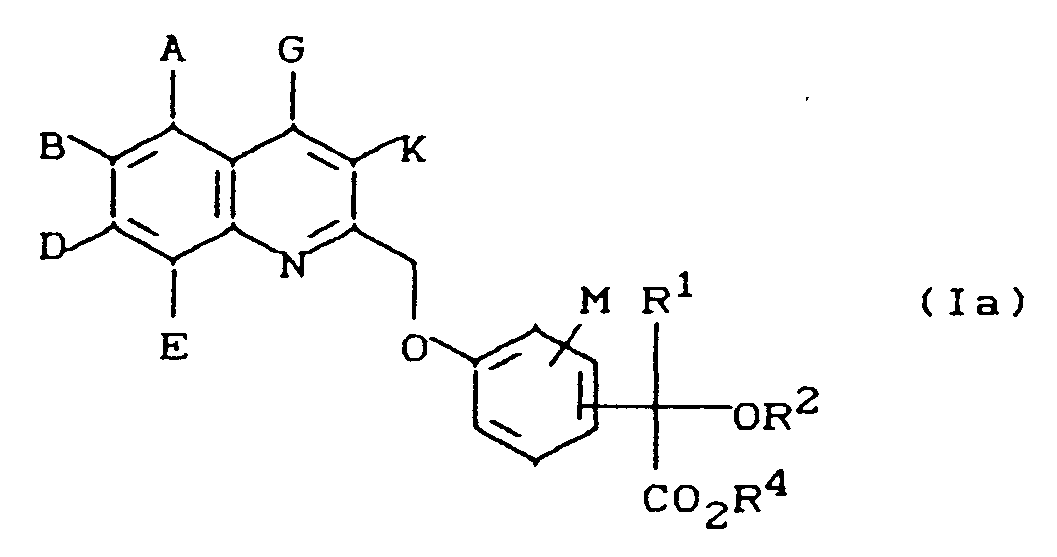 A, B, D, E, G, K, M, R¹, R² und R⁴ die oben angegebene Bedeutung haben,umsetzt,
und im Fall, daß X für Schwefel steht, die Verbindungen der Formel (Ia) nach üblicher Methode mit Thiolen der allgemeinen Formel (IV)
HS-R² (IV)
in welcherR² die oben angegebene Bedeutung hat,umsetzt,
und im Fall der Säuren in einem letzten Schritt die Ester alkalisch verseift. - Arzneimittel enthaltend disubstituierte (Chinolin-2-yl-methoxy)phenylessigsäure-Derivate nach Anspruch 1 bis 3.
- Verfahren zur Herstellung eines Arzneimittels nach Anspruch 6, dadurch gekennzeichnet, daß man disubstituierte (Chinolin-2-yl-methoxy)phenylessigsäureDerivate nach Anspruch 1, gegebenenfalls mit Hilfe von üblichen Hilfs- und Trägerstoffen in eine geeignete Applikationsform bringt.
- Verwendung von disubstituierten (Chinolin-2-yl-methoxy)phenylessigsäure-Derivaten nach Anspruch 1-3 zur Herstellung von Arzneimitteln.
- Verwendung von disubstituierten (Chinolin-2-yl-methoxy)phenylessigsäure-Derivaten nach Anspruch 1-3 zur Herstellung von Lipoxygenasehemmern.
Applications Claiming Priority (2)
| Application Number | Priority Date | Filing Date | Title |
|---|---|---|---|
| DE3927931 | 1989-08-24 | ||
| DE3927931A DE3927931A1 (de) | 1989-08-24 | 1989-08-24 | Disubstituierte (chinolin-2-yl-methoxy)phenylessigsaeure-derivate |
Publications (3)
| Publication Number | Publication Date |
|---|---|
| EP0414078A2 EP0414078A2 (de) | 1991-02-27 |
| EP0414078A3 EP0414078A3 (en) | 1992-03-11 |
| EP0414078B1 true EP0414078B1 (de) | 1994-06-01 |
Family
ID=6387762
Family Applications (1)
| Application Number | Title | Priority Date | Filing Date |
|---|---|---|---|
| EP90115444A Expired - Lifetime EP0414078B1 (de) | 1989-08-24 | 1990-08-11 | Disubstituierte (Chinolin-2-yl-methoxy) phenylessigsäure-Derivate |
Country Status (20)
| Country | Link |
|---|---|
| US (1) | US5126354A (de) |
| EP (1) | EP0414078B1 (de) |
| JP (1) | JPH0390063A (de) |
| KR (1) | KR910004570A (de) |
| CN (1) | CN1049657A (de) |
| AT (1) | ATE106395T1 (de) |
| AU (1) | AU632845B2 (de) |
| CA (1) | CA2023776A1 (de) |
| DD (1) | DD298921A5 (de) |
| DE (2) | DE3927931A1 (de) |
| DK (1) | DK0414078T3 (de) |
| ES (1) | ES2054177T3 (de) |
| FI (1) | FI904158A7 (de) |
| HU (1) | HU208960B (de) |
| IE (1) | IE903072A1 (de) |
| IL (1) | IL95443A (de) |
| NZ (1) | NZ234995A (de) |
| PH (1) | PH27287A (de) |
| PT (1) | PT95071A (de) |
| ZA (1) | ZA906706B (de) |
Families Citing this family (16)
| Publication number | Priority date | Publication date | Assignee | Title |
|---|---|---|---|---|
| US5204358A (en) * | 1987-11-25 | 1993-04-20 | Merck Frosst Canada, Inc. | Hetaryl styryl quinolines as leukotriene inhibitors |
| DE3900261A1 (de) * | 1988-05-31 | 1989-12-07 | Bayer Ag | Substituierte 4-(chinolin-2-yl-methoxy) phenyl-essigsaeure-derivate |
| DE3916663A1 (de) * | 1989-05-23 | 1990-11-29 | Bayer Ag | Substituierte (chinolin-2-yl-methoxy)phenyl-acyl-sulfonamide und -cyanamide, verfahren zu ihrer herstellung und ihre verwendung in arzneimitteln |
| DE3927930A1 (de) * | 1989-08-24 | 1991-02-28 | Bayer Ag | Cyclisch substituierte (chinolin-2-yl-methoxy)phenyl-essig-saeure-derivate |
| US5021576A (en) * | 1989-10-27 | 1991-06-04 | American Home Products Corporation | 2-Anilino phenylacetic acid derivatives |
| DE4105551A1 (de) * | 1991-02-22 | 1992-08-27 | Bayer Ag | 2-substituierte chinoline, verfahren zu ihrer herstellung sowie ihre verwendung in arzneimitteln |
| US5304563A (en) * | 1991-02-22 | 1994-04-19 | Bayer Aktiengesellschaft | 2-substituted quinolines, and their use in medicaments |
| DE4128681A1 (de) * | 1991-08-29 | 1993-03-04 | Bayer Ag | Substituierte mandelsaeurederivate, verfahren zu ihrer herstellung sowie ihre verwendung in arzneimitteln |
| CA2092152A1 (en) * | 1992-03-23 | 1993-09-24 | Azuma Igarashi | Phenoxyacetic acid compounds and medical preparations containing them |
| DE4219765A1 (de) * | 1992-06-17 | 1993-12-23 | Bayer Ag | Substituierte (Benzothiazolyl- und Chinoxalyl-methoxy)phenylessigsäurederivate |
| DE4226519A1 (de) * | 1992-08-11 | 1994-02-17 | Bayer Ag | 3-Substituierte Chinolylmethoxy-phenylessigsäurederivate |
| DE4443891A1 (de) * | 1994-12-09 | 1996-06-13 | Bayer Ag | Heterocyclisch substituierte Oxy-phenyl-(phenyl)glycinolamide |
| DE4443892A1 (de) * | 1994-12-09 | 1996-06-13 | Bayer Ag | 4-(Chinolin-2-yl-methoxy)-phenyl-essigsäurederivate |
| PE20050676A1 (es) | 2003-12-12 | 2005-11-02 | Wyeth Corp | Quinolinas referidas a enfermedades cardiovasculares |
| JP2010511632A (ja) | 2006-11-30 | 2010-04-15 | アミラ ファーマシューティカルス,インコーポレーテッド | 5−リポキシゲナーゼ活性化タンパク質インヒビターおよび一酸化窒素モジュレーターを含んでいる組成物および治療法 |
| WO2015120038A1 (en) | 2014-02-04 | 2015-08-13 | Bioscience Pharma Partners, Llc | Use of flap inhibitors to reduce neuroinflammation mediated injury in the central nervous system |
Family Cites Families (8)
| Publication number | Priority date | Publication date | Assignee | Title |
|---|---|---|---|---|
| GB2046979B (en) * | 1979-04-17 | 1983-05-18 | Burroughs Corp | Recording and replay apparatus employing rotary media |
| NO174506B (no) * | 1984-10-30 | 1994-02-07 | Usv Pharma Corp | Analogifremgangsmaate ved fremstilling av terapeutisk aktive forbindelser |
| US4661499A (en) * | 1985-06-18 | 1987-04-28 | Merck Frosst Canada, Inc. | 2-[(substituted)-phenoxymethyl]quinolines |
| DE3814504A1 (de) * | 1988-04-29 | 1989-11-09 | Bayer Ag | (alpha)-substituierte 4-(chinolin-2-yl-methoxy)phenylessigsaeuren und -ester, verfahren zu ihrer herstellung und ihre verwendung in arzneimitteln |
| DE3900261A1 (de) * | 1988-05-31 | 1989-12-07 | Bayer Ag | Substituierte 4-(chinolin-2-yl-methoxy) phenyl-essigsaeure-derivate |
| EP0349062A1 (de) * | 1988-06-27 | 1990-01-03 | Merck Frosst Canada Inc. | Chinolinetheralkansäuren |
| DE3927369A1 (de) * | 1989-08-19 | 1991-02-21 | Bayer Ag | Substituierte n-(chinolin-2-yl-methoxy)benzyl-sulfonyl-harnstoffe |
| DE3927930A1 (de) * | 1989-08-24 | 1991-02-28 | Bayer Ag | Cyclisch substituierte (chinolin-2-yl-methoxy)phenyl-essig-saeure-derivate |
-
1989
- 1989-08-24 DE DE3927931A patent/DE3927931A1/de not_active Withdrawn
-
1990
- 1990-08-01 US US07/561,036 patent/US5126354A/en not_active Expired - Fee Related
- 1990-08-11 ES ES90115444T patent/ES2054177T3/es not_active Expired - Lifetime
- 1990-08-11 DK DK90115444.3T patent/DK0414078T3/da active
- 1990-08-11 DE DE59005899T patent/DE59005899D1/de not_active Expired - Fee Related
- 1990-08-11 AT AT90115444T patent/ATE106395T1/de active
- 1990-08-11 EP EP90115444A patent/EP0414078B1/de not_active Expired - Lifetime
- 1990-08-17 AU AU61085/90A patent/AU632845B2/en not_active Ceased
- 1990-08-21 IL IL9544390A patent/IL95443A/en not_active IP Right Cessation
- 1990-08-21 JP JP2218261A patent/JPH0390063A/ja active Pending
- 1990-08-21 NZ NZ234995A patent/NZ234995A/en unknown
- 1990-08-22 FI FI904158A patent/FI904158A7/fi not_active Application Discontinuation
- 1990-08-22 PT PT95071A patent/PT95071A/pt not_active Application Discontinuation
- 1990-08-22 CA CA002023776A patent/CA2023776A1/en not_active Abandoned
- 1990-08-22 DD DD90343580A patent/DD298921A5/de not_active IP Right Cessation
- 1990-08-23 KR KR1019900013021A patent/KR910004570A/ko not_active Withdrawn
- 1990-08-23 HU HU905304A patent/HU208960B/hu not_active IP Right Cessation
- 1990-08-23 IE IE307290A patent/IE903072A1/en unknown
- 1990-08-23 ZA ZA906706A patent/ZA906706B/xx unknown
- 1990-08-23 PH PH41073A patent/PH27287A/en unknown
- 1990-08-24 CN CN90107133A patent/CN1049657A/zh active Pending
Non-Patent Citations (3)
| Title |
|---|
| CHEMICAL ABSTRACTS, Band 106, Nr. 25, 22. Juni 1987, Seite 44, Zusammenfassung-Nr. 207457g, Columbus, Ohio, US; C.M. TENNANT et al.: "Effects of a 5-lipoxygenase inhibitor, REV-5901, on leukotriene and histamine release from human lung tissue in vitro" * |
| CHEMISCHE BERICHTE, Band 120, Nr. 4, April 1987, Seiten 649-651; G.E. JEROMIN et al.: "Seitenkettenchlorierungen von N-Heterocyclen mit Trichlorisocyanursäure" * |
| JOURNAL OF THE CHEMICAL SOCIETY/CHEMICAL COMMUNICATIONS, 7. Juni 1972, Seite 668; T. INOUE et al.: "A new photo-fries rearrangement of methyl aryl oxalates" * |
Also Published As
| Publication number | Publication date |
|---|---|
| DE59005899D1 (de) | 1994-07-07 |
| IL95443A (en) | 1994-06-24 |
| DE3927931A1 (de) | 1991-02-28 |
| DD298921A5 (de) | 1992-03-19 |
| EP0414078A2 (de) | 1991-02-27 |
| NZ234995A (en) | 1991-12-23 |
| HUT54989A (en) | 1991-04-29 |
| IL95443A0 (en) | 1991-06-30 |
| HU905304D0 (en) | 1991-02-28 |
| AU632845B2 (en) | 1993-01-14 |
| US5126354A (en) | 1992-06-30 |
| KR910004570A (ko) | 1991-03-28 |
| HU208960B (en) | 1994-02-28 |
| JPH0390063A (ja) | 1991-04-16 |
| ATE106395T1 (de) | 1994-06-15 |
| ZA906706B (en) | 1991-06-26 |
| DK0414078T3 (da) | 1994-08-15 |
| AU6108590A (en) | 1991-02-28 |
| PT95071A (pt) | 1991-04-18 |
| EP0414078A3 (en) | 1992-03-11 |
| FI904158A7 (fi) | 1991-02-25 |
| FI904158A0 (fi) | 1990-08-22 |
| IE903072A1 (en) | 1991-02-27 |
| PH27287A (en) | 1993-05-04 |
| CN1049657A (zh) | 1991-03-06 |
| CA2023776A1 (en) | 1991-02-25 |
| ES2054177T3 (es) | 1994-08-01 |
Similar Documents
| Publication | Publication Date | Title |
|---|---|---|
| EP0339416B1 (de) | Gegebenenfalls alpha-substituierte 4-(Chinolin-2-yl-methoxy)phenylessigsäuren und -ester | |
| EP0344519B1 (de) | Substituierte 4-(Chinolin-2-yl-methoxy)phenyl-essigsäure-Derivate | |
| EP0399291B1 (de) | Substituierte (Chinolin-2-yl-methoxy)phenyl-acyl-sulfonamide und -cyanamide, Verfahren zu ihrer Herstellung und ihre Verwendung in Arzneimitteln | |
| EP0414078A2 (de) | Disubstituierte (Chinolin-2-yl-methoxy) phenylessigsäure-Derivate | |
| EP0224086A2 (de) | Substituierte Benzylether | |
| EP0414019B1 (de) | Substituierte N-(Chinolin-2-yl-methoxy)benzylsulfonylharnstoffe | |
| EP0414076B1 (de) | Cyclisch substituierte (Chinolin-2-yl-methoxy)phenyl-essigsäure-Derivate | |
| EP0499926A1 (de) | 2-Substituierte Chinoline, Verfahren zu ihrer Herstellung sowie ihre Verwendung in Arzneimitteln | |
| EP0409027A1 (de) | Neue Indolderivate, Verfahren zu deren Herstellung und deren Verwendung in Arzneimitteln | |
| EP0529450B1 (de) | Substituierte Mandelsäurederivate, als 5-Lipoxygenasehemmer | |
| DE4139751A1 (de) | Thiazolyl substituierte chinolylmethoxyphenylessigsaeurederivate | |
| EP0582908B1 (de) | 2-Substituierte Chinolylmethoxy-phenylessigsäure- und -benzylacyl Derivate, Verfahren zu ihrer Herstellung und ihre Verwendung als Leukotriensynthese Hemmer | |
| EP0387610A2 (de) | Substituierte (Chinolin-2-yl-methoxy)phenyl-N,N'-sulfonyl-harnstoffe, Verfahren zu ihrer Herstellung und ihre Verwendung in Arzneimitteln | |
| EP0428860B1 (de) | Substituierte (Chinolin-2-yl-methoxy)phenyl-carbonyl-harnstoffe | |
| EP0574774A1 (de) | Substituierte (Benzothiazolyl- und Chinoxalyl-methoxy)phenyl-essigsäurederivate | |
| EP0424722B1 (de) | Substituierte (Chinolin-2-yl-methoxy)phenyl-thioharnstoffe | |
| EP0545170A1 (de) | Chinolylmethoxyphenyl-essigsäureamide | |
| EP0582916A1 (de) | N-Methansulfonyl-2- 3-isobutyl-3-(chinolin-2-yl-methoxy)phenyl -2-cycloalkylessigsäureamide, Verfahren zu ihrer Herstellung und ihre Verwendung in Arzneimitteln | |
| DE3905908A1 (de) | Substituierte chinoline, verfahren zu ihrer herstellung und ihre verwendung in arzneimitteln | |
| EP0416383A2 (de) | Substituierte Amino-Pyridine | |
| DD283812A5 (de) | Messschaltung fuer schwache medienstroeme | |
| DE3813776A1 (de) | N-substituierte n-amino-pyrrole |
Legal Events
| Date | Code | Title | Description |
|---|---|---|---|
| PUAI | Public reference made under article 153(3) epc to a published international application that has entered the european phase |
Free format text: ORIGINAL CODE: 0009012 |
|
| 17P | Request for examination filed |
Effective date: 19900816 |
|
| AK | Designated contracting states |
Kind code of ref document: A2 Designated state(s): AT BE CH DE DK ES FR GB GR IT LI LU NL SE |
|
| PUAL | Search report despatched |
Free format text: ORIGINAL CODE: 0009013 |
|
| AK | Designated contracting states |
Kind code of ref document: A3 Designated state(s): AT BE CH DE DK ES FR GB GR IT LI LU NL SE |
|
| 17Q | First examination report despatched |
Effective date: 19930929 |
|
| GRAA | (expected) grant |
Free format text: ORIGINAL CODE: 0009210 |
|
| AK | Designated contracting states |
Kind code of ref document: B1 Designated state(s): AT BE CH DE DK ES FR GB GR IT LI LU NL SE |
|
| REF | Corresponds to: |
Ref document number: 106395 Country of ref document: AT Date of ref document: 19940615 Kind code of ref document: T |
|
| REF | Corresponds to: |
Ref document number: 59005899 Country of ref document: DE Date of ref document: 19940707 |
|
| GBT | Gb: translation of ep patent filed (gb section 77(6)(a)/1977) |
Effective date: 19940610 |
|
| PGFP | Annual fee paid to national office [announced via postgrant information from national office to epo] |
Ref country code: GR Payment date: 19940726 Year of fee payment: 5 |
|
| PGFP | Annual fee paid to national office [announced via postgrant information from national office to epo] |
Ref country code: LU Payment date: 19940801 Year of fee payment: 5 |
|
| REG | Reference to a national code |
Ref country code: ES Ref legal event code: FG2A Ref document number: 2054177 Country of ref document: ES Kind code of ref document: T3 |
|
| PGFP | Annual fee paid to national office [announced via postgrant information from national office to epo] |
Ref country code: ES Payment date: 19940810 Year of fee payment: 5 |
|
| ITF | It: translation for a ep patent filed | ||
| PGFP | Annual fee paid to national office [announced via postgrant information from national office to epo] |
Ref country code: AT Payment date: 19940812 Year of fee payment: 5 |
|
| REG | Reference to a national code |
Ref country code: DK Ref legal event code: T3 |
|
| PGFP | Annual fee paid to national office [announced via postgrant information from national office to epo] |
Ref country code: BE Payment date: 19940824 Year of fee payment: 5 |
|
| PGFP | Annual fee paid to national office [announced via postgrant information from national office to epo] |
Ref country code: NL Payment date: 19940831 Year of fee payment: 5 |
|
| ET | Fr: translation filed | ||
| REG | Reference to a national code |
Ref country code: GR Ref legal event code: FG4A Free format text: 3013055 |
|
| EAL | Se: european patent in force in sweden |
Ref document number: 90115444.3 |
|
| PLBE | No opposition filed within time limit |
Free format text: ORIGINAL CODE: 0009261 |
|
| STAA | Information on the status of an ep patent application or granted ep patent |
Free format text: STATUS: NO OPPOSITION FILED WITHIN TIME LIMIT |
|
| 26N | No opposition filed | ||
| PG25 | Lapsed in a contracting state [announced via postgrant information from national office to epo] |
Ref country code: LU Free format text: LAPSE BECAUSE OF NON-PAYMENT OF DUE FEES Effective date: 19950811 Ref country code: AT Effective date: 19950811 |
|
| PG25 | Lapsed in a contracting state [announced via postgrant information from national office to epo] |
Ref country code: ES Free format text: LAPSE BECAUSE OF THE APPLICANT RENOUNCES Effective date: 19950812 |
|
| ITTA | It: last paid annual fee | ||
| PG25 | Lapsed in a contracting state [announced via postgrant information from national office to epo] |
Ref country code: BE Effective date: 19950831 |
|
| PG25 | Lapsed in a contracting state [announced via postgrant information from national office to epo] |
Ref country code: GR Free format text: THE PATENT HAS BEEN ANNULLED BY A DECISION OF A NATIONAL AUTHORITY Effective date: 19960228 |
|
| BERE | Be: lapsed |
Owner name: BAYER A.G. Effective date: 19950831 |
|
| PG25 | Lapsed in a contracting state [announced via postgrant information from national office to epo] |
Ref country code: NL Effective date: 19960301 |
|
| REG | Reference to a national code |
Ref country code: GR Ref legal event code: MM2A Free format text: 3013055 |
|
| NLV4 | Nl: lapsed or anulled due to non-payment of the annual fee |
Effective date: 19960301 |
|
| PGFP | Annual fee paid to national office [announced via postgrant information from national office to epo] |
Ref country code: DE Payment date: 19980713 Year of fee payment: 9 |
|
| PGFP | Annual fee paid to national office [announced via postgrant information from national office to epo] |
Ref country code: SE Payment date: 19980727 Year of fee payment: 9 |
|
| PGFP | Annual fee paid to national office [announced via postgrant information from national office to epo] |
Ref country code: GB Payment date: 19980803 Year of fee payment: 9 |
|
| PGFP | Annual fee paid to national office [announced via postgrant information from national office to epo] |
Ref country code: CH Payment date: 19980810 Year of fee payment: 9 |
|
| PGFP | Annual fee paid to national office [announced via postgrant information from national office to epo] |
Ref country code: FR Payment date: 19980821 Year of fee payment: 9 |
|
| PGFP | Annual fee paid to national office [announced via postgrant information from national office to epo] |
Ref country code: DK Payment date: 19980826 Year of fee payment: 9 |
|
| PG25 | Lapsed in a contracting state [announced via postgrant information from national office to epo] |
Ref country code: GB Free format text: LAPSE BECAUSE OF NON-PAYMENT OF DUE FEES Effective date: 19990811 |
|
| PG25 | Lapsed in a contracting state [announced via postgrant information from national office to epo] |
Ref country code: SE Free format text: THE PATENT HAS BEEN ANNULLED BY A DECISION OF A NATIONAL AUTHORITY Effective date: 19990812 |
|
| PG25 | Lapsed in a contracting state [announced via postgrant information from national office to epo] |
Ref country code: LI Free format text: LAPSE BECAUSE OF NON-PAYMENT OF DUE FEES Effective date: 19990831 Ref country code: DK Free format text: LAPSE BECAUSE OF NON-PAYMENT OF DUE FEES Effective date: 19990831 Ref country code: CH Free format text: LAPSE BECAUSE OF NON-PAYMENT OF DUE FEES Effective date: 19990831 |
|
| REG | Reference to a national code |
Ref country code: ES Ref legal event code: FD2A Effective date: 19991007 |
|
| GBPC | Gb: european patent ceased through non-payment of renewal fee |
Effective date: 19990811 |
|
| REG | Reference to a national code |
Ref country code: CH Ref legal event code: PL |
|
| REG | Reference to a national code |
Ref country code: DK Ref legal event code: EBP |
|
| PG25 | Lapsed in a contracting state [announced via postgrant information from national office to epo] |
Ref country code: FR Free format text: LAPSE BECAUSE OF NON-PAYMENT OF DUE FEES Effective date: 20000428 |
|
| EUG | Se: european patent has lapsed |
Ref document number: 90115444.3 |
|
| PG25 | Lapsed in a contracting state [announced via postgrant information from national office to epo] |
Ref country code: DE Free format text: LAPSE BECAUSE OF NON-PAYMENT OF DUE FEES Effective date: 20000601 |
|
| REG | Reference to a national code |
Ref country code: FR Ref legal event code: ST |
|
| PG25 | Lapsed in a contracting state [announced via postgrant information from national office to epo] |
Ref country code: IT Free format text: LAPSE BECAUSE OF NON-PAYMENT OF DUE FEES;WARNING: LAPSES OF ITALIAN PATENTS WITH EFFECTIVE DATE BEFORE 2007 MAY HAVE OCCURRED AT ANY TIME BEFORE 2007. THE CORRECT EFFECTIVE DATE MAY BE DIFFERENT FROM THE ONE RECORDED. Effective date: 20050811 |