EP0224158B1 - Härtbare Mischung auf Basis von olefinisch ungesättigten Verbindungen und wasserstoffaktiven Verbindungen. - Google Patents
Härtbare Mischung auf Basis von olefinisch ungesättigten Verbindungen und wasserstoffaktiven Verbindungen. Download PDFInfo
- Publication number
- EP0224158B1 EP0224158B1 EP86115895A EP86115895A EP0224158B1 EP 0224158 B1 EP0224158 B1 EP 0224158B1 EP 86115895 A EP86115895 A EP 86115895A EP 86115895 A EP86115895 A EP 86115895A EP 0224158 B1 EP0224158 B1 EP 0224158B1
- Authority
- EP
- European Patent Office
- Prior art keywords
- curable composition
- groups
- compounds
- contained
- radical
- Prior art date
- Legal status (The legal status is an assumption and is not a legal conclusion. Google has not performed a legal analysis and makes no representation as to the accuracy of the status listed.)
- Expired - Lifetime
Links
Classifications
-
- C—CHEMISTRY; METALLURGY
- C08—ORGANIC MACROMOLECULAR COMPOUNDS; THEIR PREPARATION OR CHEMICAL WORKING-UP; COMPOSITIONS BASED THEREON
- C08G—MACROMOLECULAR COMPOUNDS OBTAINED OTHERWISE THAN BY REACTIONS ONLY INVOLVING UNSATURATED CARBON-TO-CARBON BONDS
- C08G73/00—Macromolecular compounds obtained by reactions forming a linkage containing nitrogen with or without oxygen or carbon in the main chain of the macromolecule, not provided for in groups C08G12/00 - C08G71/00
-
- C—CHEMISTRY; METALLURGY
- C08—ORGANIC MACROMOLECULAR COMPOUNDS; THEIR PREPARATION OR CHEMICAL WORKING-UP; COMPOSITIONS BASED THEREON
- C08G—MACROMOLECULAR COMPOUNDS OBTAINED OTHERWISE THAN BY REACTIONS ONLY INVOLVING UNSATURATED CARBON-TO-CARBON BONDS
- C08G18/00—Polymeric products of isocyanates or isothiocyanates
- C08G18/06—Polymeric products of isocyanates or isothiocyanates with compounds having active hydrogen
- C08G18/83—Chemically modified polymers
- C08G18/833—Chemically modified polymers by nitrogen containing compounds
-
- C—CHEMISTRY; METALLURGY
- C08—ORGANIC MACROMOLECULAR COMPOUNDS; THEIR PREPARATION OR CHEMICAL WORKING-UP; COMPOSITIONS BASED THEREON
- C08G—MACROMOLECULAR COMPOUNDS OBTAINED OTHERWISE THAN BY REACTIONS ONLY INVOLVING UNSATURATED CARBON-TO-CARBON BONDS
- C08G18/00—Polymeric products of isocyanates or isothiocyanates
- C08G18/06—Polymeric products of isocyanates or isothiocyanates with compounds having active hydrogen
- C08G18/70—Polymeric products of isocyanates or isothiocyanates with compounds having active hydrogen characterised by the isocyanates or isothiocyanates used
- C08G18/72—Polyisocyanates or polyisothiocyanates
- C08G18/80—Masked polyisocyanates
- C08G18/8061—Masked polyisocyanates masked with compounds having only one group containing active hydrogen
- C08G18/8093—Compounds containing active methylene groups
-
- C—CHEMISTRY; METALLURGY
- C08—ORGANIC MACROMOLECULAR COMPOUNDS; THEIR PREPARATION OR CHEMICAL WORKING-UP; COMPOSITIONS BASED THEREON
- C08G—MACROMOLECULAR COMPOUNDS OBTAINED OTHERWISE THAN BY REACTIONS ONLY INVOLVING UNSATURATED CARBON-TO-CARBON BONDS
- C08G61/00—Macromolecular compounds obtained by reactions forming a carbon-to-carbon link in the main chain of the macromolecule
- C08G61/12—Macromolecular compounds containing atoms other than carbon in the main chain of the macromolecule
-
- C—CHEMISTRY; METALLURGY
- C08—ORGANIC MACROMOLECULAR COMPOUNDS; THEIR PREPARATION OR CHEMICAL WORKING-UP; COMPOSITIONS BASED THEREON
- C08J—WORKING-UP; GENERAL PROCESSES OF COMPOUNDING; AFTER-TREATMENT NOT COVERED BY SUBCLASSES C08B, C08C, C08F, C08G or C08H
- C08J3/00—Processes of treating or compounding macromolecular substances
-
- C—CHEMISTRY; METALLURGY
- C08—ORGANIC MACROMOLECULAR COMPOUNDS; THEIR PREPARATION OR CHEMICAL WORKING-UP; COMPOSITIONS BASED THEREON
- C08J—WORKING-UP; GENERAL PROCESSES OF COMPOUNDING; AFTER-TREATMENT NOT COVERED BY SUBCLASSES C08B, C08C, C08F, C08G or C08H
- C08J3/00—Processes of treating or compounding macromolecular substances
- C08J3/24—Crosslinking, e.g. vulcanising, of macromolecules
Definitions
- a two-component system which reacts without isocyanate is also known. This consists of an epoxy group containing acrylic resin which is curable with another acrylic resin containing tertiary amino groups. In the case of the product produced by this process, however, the insufficient degree of crosslinking leads to insufficient chemical resistance, so that the coatings produced with this system are only suitable for a limited area of application.
- DE-A-2 631 949 describes binders composed of polyepoxides, acrylic acid esters and blocked isocyanates. These binders contain photoinitiators and are hardened by radiation. These binders are fixed to the substrate by thermal post-treatment.
- EP-A-0 160 824 describes curable systems based on Michael donor and Michael acceptor. However, the Michael donors used there lack the carbamide group.
- the invention is therefore based on the object of developing a networking principle which does not have the disadvantages set out above.
- R1 and optionally also R2 and R3 represent a hydrocarbon radical
- this hydrocarbon radical can be, for example, a branched or unbranched alkyl radical, which may also contain heteroatoms such as O or NH.
- this hydrocarbon radical can be a substituted or unsubstituted cycloalkyl radical with 6 to 10 C atoms or a preferably unsubstituted aromatic radical with 6 to 10 C atoms, such as phenyl, benzyl or naphthyl.
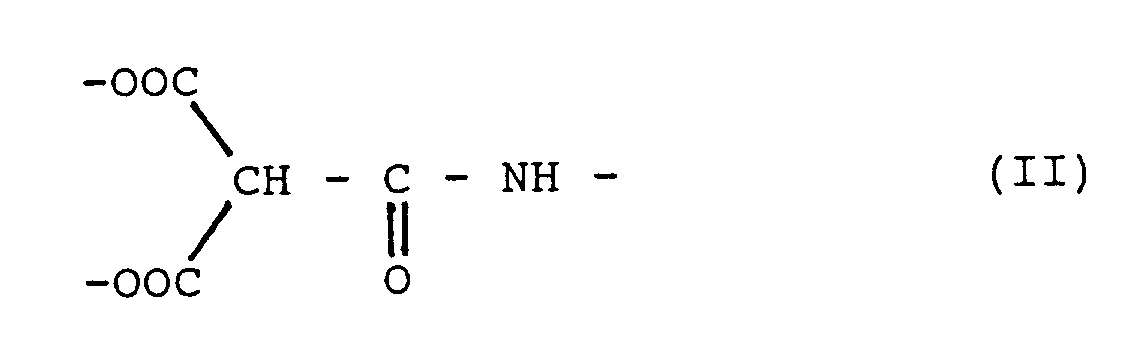
- the grouping in formula (II) is derived from a reaction product of a mono- or polyisocyanate with a malonic acid derivative. This has the advantage that components are used which contain no toxic components and which can therefore be used without special precautionary measures.
- An example of an indirect link here is a hydrocarbon residue, but preferably the residue of a polyhydric alcohol or a polyhydric amine. This indirect linkage can also be part of the chain of an oligomer and / or polymer, i.e. the groups (I) can be present in the side chains of the main chain of the oligomer or polymer or form these side chains.
- residues are generally bound in the form of an ester or amide. They can be bound to the remainder of a polyhydric alcohol, a compound with NH groups such as a polyamine, polyamide or polyiminoamide of a polyhydric phenol, for example bisphenol A, resorcinol, hydroquinone, preferably an oligomer and / or polymer.
- a polyhydric alcohol a compound with NH groups such as a polyamine, polyamide or polyiminoamide of a polyhydric phenol, for example bisphenol A, resorcinol, hydroquinone, preferably an oligomer and / or polymer.
- compound A) can be derived from saturated and / or unsaturated, OH-containing polyethers or polyesters, for example those based on maleic acid, phthalic acid and diols; copolymers containing OH groups which have been prepared by copolymerizing hydroxyalkyl compounds of acrylic or methacrylic acid having 1 to 10 carbon atoms in the alkyl group with phenylaromatic compounds and, if appropriate, further copolymerizable monomers are also suitable for this purpose.
- the resins generally have OH numbers of 40 to 250, preferably 60 to 200.
- Hydroxyalkyl compounds are, for example, hydroxyethyl (meth) acrylate, the corresponding various propyl, butyl, hexyl compounds or the 2-hydroxyalkyl esters obtained by reacting epoxy compounds with acrylic or methacrylic acid.
- ⁇ -Methylstyrene, vinylstyrene, vinyltoluene, but preferably styrene, can be used as phenyl-aromatic compounds.
- Further copolymerizable monomers are, for example, alkyl esters with 1 to 10 carbon atoms in the alkyl group ⁇ , ⁇ -ethylenically unsaturated mono- or dicarboxylic acids such as acrylic acid, methacrylic acid, maleic acid, fumaric acid, itaconic acid or the amides and nitriles of the acids mentioned.
- the starting compounds for the compound A) are also aliphatic or aromatic, optionally containing OH groups, epoxy resins, for example copolymers containing epoxy groups, which co-polymerize the above-mentioned monomers Glycidyl (meth) acrylate have been obtained and generally have 1 to 10, preferably 2 to 7% epoxy oxygen, furthermore epoxy resins based on diphenylolpropane and / or methane, hydantoin and / or also amine resins.
- the radical (I) bound in the manner of an ester may have arisen, for example, from the addition of acrylic or methacrylic acid to the epoxy group.
- Polyhydric alcohols which are mentioned as starting substances for component A) are, for example, alkanediols and triols, such as ethanediol, the various propane, butane, pentane, hexane, octanediols or their homologues, the corresponding oligomeric ethers, and also glycerol , Trimethylolethane or propane, hexanetriol, pentaerythritol, dipentaerythritol, sorbitol, polyvinyl alcohol.
- alkanediols and triols such as ethanediol, the various propane, butane, pentane, hexane, octanediols or their homologues, the corresponding oligomeric ethers, and also glycerol , Trimethylolethane or propane, hexanetriol, pentaerythritol
- Starting compounds containing NH groups for the compounds A) include, for example, alkylenediamines and their oligomers, such as ethylenediamine, propylenediamine, butylenediamine, diethylenetriamine, tetramines and higher homologs of these amines, and also amino alcohols, such as diethanolamine.
- Amine carboxylic acid esters of polyhydric alcohols are also suitable as amines.
- Compounds with NH groups are, for example, acrylic or methacrylic acid polyamides, furthermore polyurethanes, for example polyisocyanates, which are blocked in the form of polyurethane groups, such as those which are obtained by reacting hydroxyethyl acrylate with polyisocyanates, amine resins such as methylolmelamines, preferably hexamethylolmelamine, urea resins, where the rest (I) with the grouping -CO- is bound to the amine groups of these compounds as the amide. If these amine compounds have OH groups or alkylol groups, it is also possible for the radical (I) to be bound to these resins directly via an ester group or indirectly via an ether group. For the ether linkage of the radical (I), one can use a hydroxyalkyl ester or a hydroxyalkyl amide of an unsaturated acid such as acrylic acid. The same applies to a corresponding bond to polyhydroxy compounds.
- polyurethanes for example
- compound B) there are at least two groups with active H atoms of the type contain, which are derived in whole or in part from methane tricarboxylic acid monoamide units of the formula (II).
- Suitable compounds B) are, for example, reaction products of malonic diesters such as dimethyl malonate, diethyl, dibutyl, dipentyl ester with mono- or polyisocyanates.
- those which contain heteroatoms in the radical linking the isocyanate groups are also suitable.
- examples include carbodimide groups, allophonate groups, isocyanurate groups, urethane groups, acylated urea groups and polyisocyanates containing biuret groups.
- the known polyisocyanates which are mainly used in the production of lacquers, e.g. Modification products of the abovementioned simple polyisocyanates, which contain biuret, isocyanurate or urethane groups, in particular tris (6-isocyanatohexyl) biuret or low molecular weight, polyisocyanates containing urethane groups, as obtained by reacting excess IPDI with simple polyhydric alcohols in the molecular weight range 62- 300, in particular with trimethylolpropane can be obtained.
- any mixtures of the polyisocyanates mentioned can also be used to produce the products according to the invention.
- Suitable polyisocyanates are also the known prepolymers containing terminal isocyanate groups, such as are accessible in particular by reacting the simple polyisocyanates mentioned above, especially diisocyanates with inadequate amounts of organic compounds having at least two groups which are reactive toward isocyanate groups.
- the corresponding polyhydroxyl compounds e.g. the hydroxypolyesters, hydroxypolyethers and / or hydroxyl-containing acrylate resins known per se in polyurethane chemistry are used.
- the ratio of isocyanate groups to hydrogen atoms reactive towards NCO corresponds to 1.05 to 10: 1, preferably 1.1 to 3: 1, the hydrogen atoms preferably originating from hydroxyl groups.
- the type and proportions of the starting materials used in the preparation of the NCO prepolymers are preferably chosen so that the NCO prepolymers a) have an average NCO functionality of 2 to 4, preferably 2 to 3 and b) an average molecular weight of 500-10,000, preferably 800 to 4000.
- reaction products of esters and partial esters of polyhydric alcohols of malonic acid with monoisocyanates are also suitable as compound B).
- Polyhydric alcohols are e.g. two to pentavalent alcohols such as ethanediol, the various propane, butane, pentane and hexanediols, polyethylene and polypropylene diols, glycerol, trimethylolethane and propane, pentaerythritol, hexanetriol and sorbitol.
- the compound B) can also be mixed with malonic esters of OH-containing acrylic resins, polyesters, polyethers, polyester amides and imides and / or reaction products of malonic acid semiesters such as malonic acid monoethyl ester with aliphatic and aromatic epoxy resins, e.g. epoxy group-containing acrylate resins, glycidyl ethers of polyols such as hexanediol, neopentyl glycol, diphenylolpropane and methane and glycidyl group-containing hydantoins can be used.
- malonic acid semiesters such as malonic acid monoethyl ester with aliphatic and aromatic epoxy resins, e.g. epoxy group-containing acrylate resins, glycidyl ethers of polyols such as hexanediol, neopentyl glycol, diphenylolpropane and methane and
- groups (II) are contained in an oligomer or polymer, ie compound B) is an oligomer or polymer, the amount of groups (II) is generally so large that the CH equivalent weight is between 200 and 2000, preferably between 400 and 1800.
- Also described is a process for the preparation of hardening products based on A) compounds having at least two R 1 R 2 C CR 3 X groups (I) and B) compounds with methane tricarboxamide units of the formula (II), these compounds B) at least two groups with active H atoms of the type contain, in which the reaction of components A) and B) takes place with the formation of an oligomeric and / or polymeric reaction product in the presence of a catalyst.
- oligomeric and / or polymeric compounds A) and B oligomeric and / or polymeric crosslinked reaction products are also obtained.
- the curing reaction is generally carried out at -10 to 180 ° C, preferably 0 to 100, in particular 20 to 80 ° C.
- products with good hardness are obtained after 2 to 24 hours at room temperature or after 10 to 40 minutes at 60 ° C.
- the catalysts known for the Michael addition in particular Lewis bases and Brönstedt bases, are suitable as catalysts for the process.
- Lewis bases include amides, amidines, guanidines, such as N, N, N, N-tetramethylguanidine, 1,8-diazabicyclo- [5.4.0] -undec-7-ene, 1,5-diaza-bicyclo- [4.3.0] -non-5-ene, 1,4-diazabicyclo- [2.2.2] octane (DABCO), as well as phosphanes (formerly known as phosphines) and halides, especially fluorides of quaternary ammonium compounds, such as alkyl, Aryl and / or benzylammonium fluoride in question.
- amides amidines
- guanidines such as N, N, N, N-tetramethylguanidine
- 1,8-diazabicyclo- [5.4.0] -undec-7-ene 1,5-diaza-bicyclo- [4.3.0] -non-5-ene
- halides can optionally be used in combination with alkyl silicate esters to improve the activity of the catalyst.
- alkylbenzyldimethylammonium fluoride examples include alkylbenzyldimethylammonium fluoride, benzyltrimethylammonium fluoride and tetrabutylammonium fluoride.
- phosphanes in particular tertiary phosphines of the general formula P (CH2-Y) 3 are suitable, in which Y is the same or different and the radical is -OH, -CH2CN or -N (Z) 2, where Z is an alkyl radical with 1 is to 5 carbon atoms, such as tris-2-cyanoethylphosphan, trisdiethylaminomethylphosphan, preferably trishydroxymethylphosphan and trisdimethylaminomethylphosphan.
- tertiary phosphines of the general formula P (R4, R5, R6), in which the radicals R4, R5 and R6 are an alkyl radical having 1 to 12 carbon atoms or a phenyl radical, unsubstituted or substituted by at least one alkyl, alkoxy - Or dialkylamino group each having 1 to 4 carbon atoms, R4, R5 and R6 are the same or different, but at least one of the radicals represents a phenyl radical.
- Examples include triphenylphosphine, tris-p-tolylphosphine, tris-o-anisylphosphine, tris-p-dimethylaminophenylphosphine, phenyl-di-p-anisylphosphine, phenyl-di-o-anisylphosphine, diphenyl-p-anisylphosphine, diphenyl-o-anane , Diphenyl-p-dimethylaminophenylphosphane, methyl-diphenylphosphine, methyl-di-tolylphosphane, ethyl-di-p-anisylphosphine, (diethylaminomethyl) -di-phenylphosphine, preferably tris-p-anisylphosphine, methyl-diphenylphosphine and methyl-di-p- anisylphos
- Examples include ⁇ , ⁇ -dimethylbenzylimino-tris- (dimethylamino -) - phosphorane, ⁇ , ⁇ -Dimethylbenzyliminomethyldiphenyl-phosphorane, t-Butylimino-tri-phenyl-phosphorane and preferably ⁇ , ⁇ -Dimethylbenzylimino-tri-butyl-phosphorane.
- Brönstedt bases which can be used as catalysts for the process include, for example, alcoholates, in particular alkali metal alcoholates such as lithium butylate, sodium or potassium methylate, and quaternary ammonium compounds such as alkyl, aryl and / or benzylammonium hydroxides and carbonates.
- alcoholates in particular alkali metal alcoholates such as lithium butylate, sodium or potassium methylate
- quaternary ammonium compounds such as alkyl, aryl and / or benzylammonium hydroxides and carbonates.
- the catalysts or catalyst mixtures mentioned can be used in the presence of tertiary aliphatic amines which are not effective per se at room temperature, such as, for example, triethylamine, N-methyldiethanolamine, N-methyldiisopropanolamine or N-butyldiethanolamine.
- auxiliary substances can be present in an amount of 0.1-5% by weight, preferably 0.1-1% by weight.
- the amount of the catalyst is generally from 0.01 to 5, preferably 0.02 to 2,% by weight, based on the total solids content of the starting product. It can be varied depending on the reactivity of the compounds A) and B) and the intended procedure.
- the process can be carried out in one step, for example by working with equivalent proportions of the components.
- the pot life and properties of the product therefore depend on the process conditions, ie on the type and amount of the starting materials, the dosage of the catalyst and the temperature control.
- the elasticity of the crosslinked product can thus be controlled within a tolerance range, for example by the chain length of the oligomers and / or polymers used for A) or B).
- Suitable solvents are e.g. aromatic and aliphatic hydrocarbons such as toluene, the various xylenes, mixtures of aliphatic and / or aromatic hydrocarbons, higher-boiling mineral oil fractions, esters, ethers, alcohols.
- reaction components can be used individually or in a mixture, provided they are compatible with one another.
- reaction components A) and B) depends on the number of unsaturated groups (I) of compound A) and the sum of the active H atoms in compound B) (hereinafter briefly with “active double bonds: active H atoms "denotes).
- active double bonds: active H atoms denotes.
- the ratio of active double bonds: active H atoms is 2: 1 to 1: 2, in particular (0.8 to 1.2): 1 to 1: (0.8 to 1.2).
- the reaction mixture is a two-component system which shows pot lives which, depending on the selection of the compounds A) and B) and on the type and amount of the catalyst or the catalyst combination between 5 min. and fluctuate about 12 hours. This ensures high processing security. Due to this advantageous property of the product in connection with its quick and perfect hardening at room temperature or elevated temperature and its chemical resistance, it is excellently suitable as a binder for coatings.
- the two-component systems are suitable for the production of moldings or can be applied as coatings on a variety of substrates, e.g. organic or inorganic in nature such as wood, wood pulp e.g. as wood sealing, textiles of natural or synthetic origin, plastics, glass, ceramics, building materials such as concrete, fiberboard, artificial stones, but especially on metal.
- substrates e.g. organic or inorganic in nature such as wood, wood pulp e.g. as wood sealing, textiles of natural or synthetic origin, plastics, glass, ceramics, building materials such as concrete, fiberboard, artificial stones, but especially on metal.
- the covers can also be used for household items and equipment, e.g. Refrigerators, washing machines, electrical appliances, windows, doors, furniture. It can be applied by brushing, spraying, dipping or electrostatically.
- Coatings preferably automotive paints and especially automotive refinish paints, can also be made.
- Of particular interest here is the resistance to xylene and, at the same time, good resistance to super gasoline. Since the two-component system can harden itself in a relatively short time at room temperature without releasing environmentally harmful substances, use as a car refinish is of considerable practical importance.
- the two-component systems can also contain the usual additives such as dyes, pigments, fillers, plasticizers, stabilizers, leveling agents, neutralizing substances such as tertiary amines and catalysts that can be used in the usual amounts. These substances can be added to the individual components and / or the overall mixture.
- dyes or pigments which may be inorganic or organic are: titanium dioxide, graphite, carbon black, zinc chromate, strontium chromate, barium chromate, lead chromate, lead cyanamide, lead silicate chromate, calcium molybdate, manganese phosphate, zinc oxide, cadmium sulfide, nickel oxide, zinc oxide, zinc sulfide Chromium titanium yellow, iron oxide red, iron oxide black, ultramarine blue, phthalocyanine complexes, naphthol red.
- Suitable fillers are e.g. Talc, mica, kaolin, chalk, quartz flour, asbestos flour, slate flour, barium sulfate, various silicas, silicates.
- the customary solvents are used for the fillers, for example aliphatic and aromatic hydrocarbons, ethers, esters, glycol ethers and their esters, ketones, chlorinated hydrocarbons, terpene derivatives, toluene, xylene, ethyl and butyl acetate, ethylene glycol monoethyl or butyl ether acetate, ethylene glycol diethyl ethylene cycloethylene ether, cyclodimethyl ether, cyclodiethyl ether, Methyl ethyl ketone, acetone, isophorone or mixtures thereof.
- aliphatic and aromatic hydrocarbons for example aliphatic and aromatic hydrocarbons, ethers, esters, glycol ethers and their esters, ketones, chlorinated hydrocarbons, terpene derivatives, toluene, xylene, ethyl and butyl acetate, ethylene glycol monoethyl or
Landscapes
- Chemical & Material Sciences (AREA)
- Organic Chemistry (AREA)
- Chemical Kinetics & Catalysis (AREA)
- Medicinal Chemistry (AREA)
- Polymers & Plastics (AREA)
- Health & Medical Sciences (AREA)
- General Chemical & Material Sciences (AREA)
- Paints Or Removers (AREA)
- Polyurethanes Or Polyureas (AREA)
- Epoxy Resins (AREA)
- Organic Low-Molecular-Weight Compounds And Preparation Thereof (AREA)
- Processes Of Treating Macromolecular Substances (AREA)
- Compositions Of Macromolecular Compounds (AREA)
- Macromolecular Compounds Obtained By Forming Nitrogen-Containing Linkages In General (AREA)
- Macromonomer-Based Addition Polymer (AREA)
Description
- Es ist bekannt, ungesättigte Verbindungen, wie Zimtsäureester, mit H-aktiven Verbindungen, z.B. Malonsäureester oder Acetessigester, durch Michael-Addition unter Bildung von substituierten Verbindungen, z.B. substituierten Malonsäureestern, umzusetzen (Krauch-Kunz "Namensreaktionen der organischen Chemie" 5. Auflage 1976, Seite 42).
- Ferner ist es bekannt, ein OH-Gruppen enthaltendes Acrylatharz bzw. ein mit ε-Caprolacton modifiziertes Acrylatharz im Gemisch mit Polyisocyanaten als Zweikomponentenlack zu verwenden (DE-Patentschriften 3 005 945, 3 027 776 und 3 148 022). Eine weitere Druckschrift beschreibt die Umsetzung von Epoxidgruppen enthaltenden Acrylatcopolymerisaten mit einem teilblockierten Isocyanat und die Verwendung des Reaktionsproduktes als Lackbindemittel (DE-Offenlegungsschrift 3 130 545).
- Die bekannten Produkte haben sich zum Teil gut bewährt. Es wurde jedoch schon versucht, umweltfreundlichere Produkte herzustellen, indem man von Systemen ohne freies Isocyanat ausgeht.
- So ist in einer anderen Druckschrift ein Oxazolidin enthaltendes Acrylatharz beschrieben, das Wasser oder Luftfeuchtigkeit als Härter nutzt (EP-A-34 720). Dieses System hat den Nachteil, daß die gehärtete Oberfläche einem tieferen Eindringen von Wasser in die unteren Schichten des Überzugs entgegenwirkt und so eine vollständige Härtung durch die ganze Schichtdicke verhindert.
- Es ist auch ein ohne Isocyanat reagierendes Zweikomponenten-System bekannt. Dieses besteht aus einem Epoxidgruppen enthaltenden Acrylharz, das mit einem anderen Acrylharz, das tertiäre Aminogruppen enthält, härtbar ist. Bei dem nach diesem Verfahren hergestellten Produkt führt der zu geringe Vernetzungsgrad jedoch zu einer ungenügenden chemischen Beständigkeit, so daß die mit diesem System hergestellten Überzüge nur für ein beschränktes Anwendungsgebiet geeignet sind.
- DE-A-2 631 949 beschreibt Bindemittel aus Polyepoxiden, Acrylsäureestern und verkappten Isocyanaten. Diese Bindemittel enthalten Photoinitiatoren und werden durch Strahlen gehärtet. Durch eine thermische Nachbehandlung werden diese Bindemittel auf den Untergrund fixiert.
- Im EP-A-0 160 824 werden härtbare Systeme auf der Basis Michael-Donor und Michael-Acceptor beschrieben. Den dort benutzten Michael-Donatoren fehlt jedoch die Carbamid-Gruppe.
- Der Erfindung liegt daher die Aufgabe zugrunde, ein Vernetzungsprinzip zu entwickeln, das die vorstehend dargelegten Nachteile nicht aufweist.
- Gegenstand der Erfindung ist eine härtbare Mischung enthaltend
- A) Verbindungen mit mindestens zwei R¹R²C=CR³-X-Gruppen (I) und
- B) Verbindungen mit Methan-tricarbonsäureamid-Einheiten der Formel
- X
- -CO- bedeutet,
- R¹
- Wasserstoff oder ein Kohlenwasserstoff-Rest, vorzugsweise ein Alkylrest, mit 1 bis 10, vorzugsweise mit 1 bis 4 C-Atomen ist,
- R²
- Wasserstoff, einen Kohlenwasserstoff-Rest, vorzugsweise einen Alkylrest, mit 1 bis 10, vorzugsweise 1 bis 4 C-Atomen, eine Estergruppe mit dem Rest R⁴ eines einwertigen Alkohols mit bis zu 12 C-Atomen, -CN, -NO₂, eine CO-NHR¹- oder eine CO-R¹-Gruppe darstellt, und
- R³
- dieselbe Bedeutung wie R² hat und hiermit gleich oder verschieden ist, wobei das Mengenverhältnis von A) zu B) so gewählt wird, daß das Verhältnis der aktiven Doppelbindungen zu den aktiven H-Atomen 2 : 1 bis 1 : 2 beträgt,
- Falls R¹ sowie gegebenenfalls auch R² und R³ einen Kohlenwasserstoffrest darstellen, so kann dieser beispielsweise ein verzweigter oder unverzweigter Alkylrest sein, der gegebenenfalls auch Heteroatome wie O oder NH enthalten kann. Alternativ kann dieser Kohlenwasserstoffrest ein substituierter oder unsubstituierter Cycloalkylrest mit 6 bis 10 C-Atomen oder ein vorzugsweise unsubstituierter aromatischer Rest mit 6 bis 10 C-Atomen, wie Phenyl-, Benzyl- oder Naphthyl- sein.
- Die Gruppierung

in Formel (II) ist von einem Umsetzungsprodukt eines Mono- oder Polyisocyanates mit einem Malonsäurederivat abgeleitet. Dies hat den Vorteil, daß Komponenten eingesetzt werden, die keine toxischen Bestandteile enthalten und die daher ohne besondere Vorsichtsmaßnahmen angewendet werden können. - Obwohl bei der Reaktion von Verbindungen A) mit jeweils zwei Gruppen der Formel (I) mit Verbindungen B) mit zwei Einheiten der Formel (II), auch wenn diese jeweils nur ein acides H-Atom enthalten, aufgrund der beiderseitigen Bifunktionalität zu erwarten ist, daß hierbei ausschließlich eine Kettenverlängerung eintritt, erhält man überraschenderweise gehärtete Produkte. Die wirksamen Gruppen der Verbindungen A) und B) können auch in einem einzigen Molekül enthalten sein, so daß Systeme vorliegen, die durch intermolekulare Vernetzung härtbar und selbstvernetzend sind.
- Wenn eine höhere Reaktivität und damit stärkere Vernetzung des Produktes angestrebt wird, kann man mit Vorteil so vorgehen, daß in mindestens einer der Verbindungen A) oder B) drei oder mehr Gruppen des Typs (I) und/oder Einheiten des Typs (II) vorhanden sind.
- Die erfindungsgemäß eingesetzten Verbindungen A)enthalten mindestens zwei R¹R²C=CR³-X-Gruppen, die indirekt miteinander verbunden sind. Als indirekte Verknüpfung kommt hier beispielsweise ein Kohlenwasserstoffrest, vorzugsweise jedoch der Rest eines mehrwertigen Alkohole oder eines mehrwertigen Amine in Frage. Diese indirekte Verknüpfung kann dabei auch ein Teil der Kette eines Oligomeren und/oder Polymeren sein, d.h. die Gruppen (I) können in den Seitenketten der Hauptkette des Oligomeren bzw. Polymeren vorhanden sein oder diese Seitenketten bilden. Falls die Gruppen (I) in einem Oligomeren bzw. Polymeren enthalten sind, die Verbindung A) also ein Oligomeres oder Polymeres darstellt, ist die Menge an Gruppen (I) im allgemeinen so groß, daß das C=C-Äquivalentgewicht zwischen 50 und 1800, vorzugsweise zwischen 200 und 1200 liegt.
- Nach einer Ausführungsform der Erfindung kann der Rest R¹R²C=CR³-X (I), in der R¹, R² und R³ jeweils die oben genannte Bedeutung haben, von einer ein- oder mehrfach ungesättigten, höchstens zwei-basischen Carbonsäure, z.B. Mono- und/oder Dicarbonsäure, mit 2 bis 10, vorzugsweise 3 bis 6 C-Atomen, wie Zimtsäure, Crotonsäure, Citraconsäure oder deren Anhydrid, Mesaconsäure, Fumarsäure, Dehydrolävulinsäure, Sorbinsäure, vorzugsweise jedoch Acrylsäure, Methacrylsäure und/oder Maleinsäure oder deren Anhydrid abgeleitet sein, ferner auch von ungesättigten Ketonen, wie Divinylketon, Dibenzalaceton; ferner von ungesättigten Nitrilen, wie Maleinsäuremononitril-monoestern mehrwertiger Alkohole, von Cyanacrylsäureestern der Formel H₂C=C(CN)-COOR, von Nitriten der Formel ROOC-R³C-CH-NO₂, von Alkylidenmalonsäureestern der Formel ROOC-C(COOR⁴)=CR¹R² (R⁴ siehe vorstehend) Alkylidenacetessigestern der Formel ROOC-C(CO-CH₃)=CR¹R² bzw. den entsprechenden Nitrilen, wobei in vorstehenden Formeln R der Rest eines mehrwertigen Alkohols, R¹ und R² vorzugsweise Wasserstoff oder Alkyl mit 1 bis 4 C-Atomen ist. Diese Reste liegen im allgemeinen in Form eines Esters oder Amids gebunden vor. Sie können an den Rest eines mehrwertigen Alkohols, einer Verbindung mit NH-Gruppen wie eines Polyamins, Polyamids oder Polyiminoamids eines mehrwertigen Phenols, z.B. Bisphenol A, Resorcin, Hydrochinon, vorzugsweise eines Oligomeren und/oder Polymeren gebunden sein. So kann sich die Verbindung A) beispielsweise ableiten von gesättigten und/oder ungesättigten, OH-Gruppen enthaltenden Polyäthern oder Polyestern, z.B. solchen auf der Basis von Maleinsäure, Phthalsäure und Diolen; weiterhin kommen hierfür OH-Gruppen enthaltende Copolymerisate, die durch Copolymerisation von Hydroxyalkylverbindungen der Acryl- oder Methacrylsäure mit 1 bis 10 C-Atomen in der Alkylgruppe mit phenylaromatischen Verbindungen und gegebenenfalls weiteren copolymerisbaren Monomeren hergestellt wurden, in Frage. Die Harze weisen im allgemeinen OH-Zahlen von 40 bis 250, vorzugsweise 60 bis 200 auf. Hydroxyalkylverbindungen sind z.B. Hydroxyethyl-(meth)-acrylat, die entsprechenden verschiedenen Propyl-, Butyl-, Hexylverbindungen oder die durch Umsetzung von Epoxidverbindungen mit Acryl- oder Methacrylsäure erhaltenen 2-Hydroxyalkylester. Als phenyl-aromatische Verbindungen können α-Methylstyrol, Vinylstyrol, Vinyltoluol, vorzugsweise aber Styrol eingesetzt werden. Weitere copolymerisierbare Monomere sind z.B. Alkylester mit 1 bis 10 C-Atomen in der Alkylgruppe α,β-ethylenisch ungesättigter Mono- oder Dicarbonsäuren wie Acrylsäure, Methacrylsäure, Maleinsäure, Fumarsäure, Itaconsäure oder die Amide und Nitrile der genannten Säuren. Als Ausgangsverbindungen für die Verbindung A) kommen auch aliphatische oder aromatische, gegebenenfalls OH-Gruppen enthaltende Epoxidharze, z.B. epoxidgruppenhaltige Copolymerisate, die durch Copolymerisation von den vorstehend genannten Monomeren mit Glycidyl-(meth)-acrylat erhalten worden sind und im allgemeinen 1 bis 10, vorzugsweise 2 bis 7 % Epoxidsauerstoff besitzen, ferner Epoxidharze auf Basis von Diphenylolpropan und/oder -methan, Hydantoin und/oder auch Aminharze. Im Falle der Epoxidharze kann der esterartig gebundene Rest (I) z.B. durch Anlagerung von Acryl- oder Methacrylsäure an die Epoxidgruppe entstanden sein.
- Mehrwertige Alkohole,die als Ausgangssubstanzen für die Komponente A) genannt sind, sind beispielsweise Alkandiole und -triole, wie Ethandiol, die verschiedenen Propan-, Butan-, Pentan-, Hexan-, Octandiole oder deren Homologe, die entsprechenden oligomeren Ether, ferner Glycerin, Trimethylolethan oder -propan, Hexantriol, Pentaerythrit, Dipentaerythrit, Sorbit, Polyvinylalkohol.
- Als NH-Gruppen enthaltende Ausgangsverbindungen für die Verbindungen A) werden z.B. genannt Alkylendiamine und deren Oligomere, wie Ethylendiamin, Propylendiamin, Butylendiamin, Diethylentriamin, Tetramine und höhere Homologe dieser Amine, ferner Aminoalkohole, wie Diethanolamin. Als Amine kommen z.B. auch Aminocarbonsäureester mehrwertiger Alkohole in Frage. Verbindungen mit NH-Gruppen sind z.B. Acryl- oder Methacrylsäure-polyamide, ferner Polyurethane, z.B. Polyisocyanate, die in Form von Polyurethangruppen verkappt sind wie solche, die durch Umsetzung von Hydroxyäthylacrylat mit Polyisocyanaten erhalten werden, Aminharze wie Methylolmelamine, vorzugsweise Hexamethylolmelamin, Harnstoffharze, wobei der Rest (I) mit der Gruppierung -CO- an die Amingruppen dieser Verbindungen als Amid gebunden ist. Falls diese Aminverbindungen über OH-Gruppen bzw. Alkylolgruppen verfügen, ist es auch möglich, daß der Rest (I) unmittelbar über eine Estergruppe oder indirekt über eine Äthergruppe an diese Harze gebunden ist. Für die Ätherbindung des Restes (I) kann man also von einem Hydroxyalkylester oder einem Hydroxyalkylamid einer ungesättigten Säure, wie Acrylsäure, ausgehen. Dasselbe gilt für eine entsprechende Bindung an Polyhydroxyverbindungen.
- In der Verbindung B) sind mindestens zwei Gruppen mit aktiven H-Atomen vom Typ

enthalten, die sich ganz oder teilweise von Methantricarbonsäuremonoamideinheiten der Formel (II) ableiten. - Geeignete Verbindungen B) sind beispielsweise Umsetzungsprodukte von Malonsäurediester wie Malonsäuredimethyl-, diethyl-, dibutyl-, dipentylester mit Mono- oder Polyisocyanaten.
- Beispiele für derartige, erfindungsgemäß einsetzbaren Isocyanate sind aliphatische Isocyanate wie n-Butylisocyanat, Octadecylisocyanat, cycloaliphatische Isocyanate wie Cyclohexylisocyanat, araliphatische Isocyanate wie Benzylisocyanat oder aromatische Isocyanate wie Phenylisocyanat, Polyisocyanate wie Tetramethylendiisocyanat, Hexamethylendiisocyanat 2.2.4-Trimethylhexamethylendiisocyanat, 1,12-Dodecandiisocyanat, Cyclohexan-1,3- und 1,4-diisocyanat, 1-Isocyanato-3,3,5-trimethyl-5-isocyanatomethylcyclohexan (=Isophorondiisocyanat, IPDI), Perhydro-2,4'- und/oder -4,4'-diphenylmethandiisocyanat, 1,3- und 1,4-Phenylendiisocyanat, 2,4- und 2,6-Toluylendiisocyanat, Diphenylmethan-2,4'- und/oder -4,4'-diisocyanat, 3,2'- und/oder 3,4-Diisocyanato-4-methyl-diphenylmethan, Naphthylen-1,5-diisocyanat, Triphenylmethan-4,4'-4''-triisocyanat oder Gemische dieser Verbindungen.
- Neben diesen einfachen Isocyanaten sind auch solche geeignet, die Heteroatome in dem die Isocyanatgruppen verknüpfenden Rest enthalten. Beispiele hierfür sind Carbodimidgruppen, Allophonatgruppen, Isocyanuratgruppen, Urethangruppen, acylierte Harnstoffgruppen und Biuretgruppen aufweisende Polyisocyanate.
- Besonders gut für das erfindungsgemäße Verfahren geeignet sind die bekannten Polyisocyanate, die hauptsächlich bei der Herstellung von Lacken eingesetzt werden, z.B. Biuret-, Isocyanurat- oder Urethangruppen-aufweisende Modifizierungsprodukte der obengenannten einfachen Polyisocyanate, insbesondere Tris-(6-Isocyanatohexyl)-biuret oder niedermolekulare, Urethangruppen-aufweisende Polyisocyanate, wie sie durch Umsetzung von im Überschuß eingesetztem IPDI mit einfachen mehrwertigen Alkoholen des Molekulargewichtsbereiches 62-300, Insbesondere mit Trimethylolpropan erhalten werden können. Selbstverständlich können auch beliebige Gemische der genannten Polyisocyanate zur Herstellung der erfindungsgemäßen Produkte eingesetzt werden.
- Geeignete Polyisocyanate sind ferner die bekannten, endständigen Isocyanatgruppen aufweisende Präpolymere, wie sie insbesondere durch Umsetzung der obengenannten einfachen Polyisocyanate, vor allem Diisocyanate mit unterschüssigen Mengen an organischen Verbindungen mit mindestens zwei gegenüber Isocyanatgruppen reaktionsfähigen Gruppen zugänglich sind. Als solche kommen insbesondere insgesamt mindestens zwei Aminogruppen und/oder Hydroxylgruppen aufweisende Verbindungen des Molekulargewichtsbereiches 300 bis 10 000, vorzugsweise 400 bis 6000 zur Anwendung. Bevorzugt werden die entsprechenden Polyhydroxylverbindungen, z.B. die in der Polyurethanchemie an sich bekannten Hydroxypolyester, Hydroxypolyether und/oder hydroxylgruppenhaltige Acrylatharze verwendet.
- In diesen bekannten Präpolymeren entspricht das Verhältnis von Isocyanatgruppen zu gegenüber NCO reaktiven Wasserstoffatomen 1,05 bis 10:1, vorzugsweise 1,1 bis 3:1, wobei die Wasserstoffatome vorzugsweise aus Hydroxylgruppen stammen.
- Die Art und Mengenverhältnisse der bei der Herstellung der NCO-Präpolymeren eingesetzten Ausgangsmaterialien werden im übrigen vorzugsweise so gewählt, daß die NCO-Präpolymeren a) eine mittlere NCO-Funktionalität von 2 bis 4, vorzugsweise von 2 bis 3 und b) ein mittleres Molekulargewicht von 500 - 10 000, vorzugsweise von 800 bis 4000 aufweisen.
- Als Verbindung B) eignen sich aber auch Umsetzungsprodukte von Estern und Teilestern mehrwertiger Alkohole der Malonsäure mit Monoisocyanaten. Mehrwertige Alkohole sind z.B. zwei bis fünfwertige Alkohole wie Ethandiol, die verschiedenen Propan-, Butan-, Pentan- und Hexandiole, Polyethylen- und Polypropylendiole, Glycerin, Trimethylolethan und -propan, Pentaerythrit, Hexantriol und Sorbit.
- Die Verbindung B) kann erfindungsgemäß auch in Mischung mit Malonestern von OH-Gruppen enthaltenden Acrylharzen, Polyestern, Polyethern, Polyesteramiden und -imiden und/oder Umsetzungsprodukten von Malonsäurehalbestern wie Malonsäuremonoethylester mit aliphatischen und aromatischen Epoxidharzen, z.B. epoxidgruppenhaltigen Acrylatharzen, Glycidylethern von Polyolen wie Hexandiol, Neopentylglykol, Diphenylolpropan und -methan und Glycidylgruppen enthaltenden Hydantoinen eingesetzt werden.
- Für den Fall, daß die Gruppen (II) in einem Oligomeren bzw. Polymeren enthalten sind, die Verbindung B) also ein Oligomeres oder Polymeres darstellt, ist die Menge an Gruppen (II) im allgemeinen so groß, daß das CH-Äquivalentgewicht zwischen 200 und 2000, vorzugsweise zwischen 400 und 1800 liegt.
- Auch beschrieben ist ein Verfahren zur Herstellung von Härtungsprodukten auf Basis von A) Verbindungen mit mindestens zwei R¹R²C=CR³-X-Gruppen (I) und B) Verbindungen mit Methantricarbonsäureamideinheiten der Formel (II), wobei diese Verbindungen B) mindestens zwei Gruppen mit aktiven H-Atomen des Typs

enthalten, bei dem die Umsetzung der Komponenten A) und B) unter Bildung eines oligomeren und/oder polymeren Reaktionsproduktes in Gegenwart eines Katalysators erfolgt. - Dieses Verfahren kann problemlos durchgeführt werden. Da vorzugsweise von oligomeren und/oder polymeren Verbindungen A) und B) ausgegangen wird, erhält man auch oligomere und/oder polymere vernetzte Reaktionsprodukte. Die Härtungsreaktion erfolgt im allgemeinen bei -10 bis 180°C, vorzugsweise 0 bis 100, insbesondere 20 bis 80°C. Zum Beispiel erhält man bei Raumtemperatur nach 2 bis 24 Stunden oder bei 60°C nach 10 bis 40 Minuten Produkte mit guter Härte.
- Als Katalysatoren für das Verfahren sind die für die Michael-Addition bekannten Katalysatoren, insbesondere Lewis-Basen und Brönstedt-Basen geeignet.
- Als Lewis-Basen kommen beispielsweise Amide, Amidine, Guanidine, wie N,N,N,N-Tetramethylguanidin, weiterhin 1,8-Diazabicyclo-[5.4.0]-undec-7-en, 1,5-Diaza-bicyclo-[4.3.0]-non-5-en, 1,4-Diazabicyclo-[2.2.2]-octan (DABCO), sowie Phosphane (früher als Phosphine bezeichnet) und Halogenide, insbesondere Fluoride von quartären Ammoniumverbindungen, wie Alkyl-, Aryl- und/oder Benzylammoniumfluoride in Frage. Diese Halogenide können dabei gegebenenfalls in Kombination mit Kieselsäurealkylestern eingesetzt werden, um die Aktivität des Katalysators noch zu verbessern. Im einzelnen seien z.B. Alkylbenzyldimethylammoniumfluoride, Benzyltrimethylammonium-fluorid und Tetrabutylammoniumfluorid genannt.
- Bei den Phosphanen kommen insbesondere tertiäre Phosphane der allgemeinen Formel P(CH₂-Y)₃ in Betracht, in der Y gleich oder verschieden ist und den Rest -OH, -CH₂CN oder -N(Z)₂ bedeutet, wobei Z ein Alkylrest mit 1 bis 5 C-Atomen ist, wie Tris-2-cyanoethylphosphan, Trisdiethylaminomethylphosphan, vorzugsweise Trishydroxymethylphosphan und Trisdimethylaminomethylphosphan. Weiterhin sind auch tertiäre Phosphane der allgemeinen Formel P(R⁴,R⁵,R⁶) geeignet, in der die Reste R⁴, R⁵ und R⁶ einen Alkylrest mit 1 bis 12 C-Atomen oder einen Phenylrest, unsubstituiert oder substituiert mit mindestens einer Alkyl-, Alkoxy- oder Dialkylaminogruppe mit jeweils 1 bis 4 C-Atomen bedeuten, R⁴, R⁵ und R⁶ gleich oder verschieden sind, wobei jedoch mindestens einer der Reste einen Phenylrest darstellt. Beispiele hierfür sind Triphenylphosphan, Tris-p-tolylphosphan, Tris-o-anisylphosphan, Tris-p-dimethylaminophenylphosphan, Phenyl-di-p-anisylphosphan, Phenyl-di-o-anisylphosphan, Diphenyl-p-anisylphosphan, Diphenyl-o-anisylphosphan, Diphenyl-p-dimethylaminophenylphosphan, Methyl-diphenylphosphan, Methyl-di-tolylphosphan, Ethyl-di-p-anisylphosphan, (Diethylaminomethyl)-di-phenylphosphan, vorzugsweise Tris-p-anisylphosphan, Methyl-diphenylphosphan und Methyl-di-p-anisylphosphan.
- Unter Phosphanen seien hier weiterhin auch die Iminophosphorane der allgemeinen Formel (R⁷, R⁸, R⁹) P=N-C (R¹⁰, R¹¹, R¹²) verstanden, in der R⁷, R⁸, R⁹ gleich oder verschieden sind und einen Alkylrest mit 1 bis 12 C-Atomen oder eine Alkyl-, Alkoxy- oder Dialkylaminogruppe mit jeweils 1 bis 4 C-Atomen im Alkylrest bedeuten und R¹⁰, R¹¹, R¹² gleich oder verschieden sind und einen Alkylrest mit 1 - 5 C-Atomen oder einen Phenylrest darstellen. Beispiele hierfür sind α,α-Dimethylbenzylimino-tris-(dimethylamino-)-phosphoran, α,α-Dimethylbenzyliminomethyldiphenyl-phosphoran, t-Butylimino-tri-phenyl-phosphoran und vorzugsweise α,α-Dimethylbenzylimino-tri-butyl-phosphoran.
- Als Brönstedt-Basen, die für das Verfahren als Katalysatoren eingesetzt werden können, seien hier beispielsweise Alkoholate, insbesondere Alkalialkoholate wie Lithiumbutylat, Natrium-, Kaliummethylat sowie quartäre Ammoniumverbindungen, wie Alkyl-, Aryl- und/oder Benzylammoniumhydroxide und -carbonate erwähnt. Spezielle Vertreter für quartäre Ammoniumverbindungen sind hierbei Alkylbenzyldimethylammoniumhydroxyd (Alkyl=C₁₆-C₂₂), Benzyltrimethylammoniumhydroxyd und Tetrabutylammoniumhydroxyd. Die genannten Katalysatoren oder Katalysatorengemische können in Gegenwart von an sich bei Raumtemperatur nicht wirksamen tertiären aliphatischen Aminen, wie beispielsweise Triethylamin, N-Methyldiethanolamin, N-Metyl-diisopropanolamin oder N-Butyldiethanolamin verwendet werden. Diese Hilfsstoffe können zu 0,1 - 5, vorzugsweise 0,1 - 1 Gew.-%, anwesend sein.
- Die Menge des Katalysators beträgt im allgemeinen 0,01 bis 5, vorzugsweise 0,02 bis 2 Gew.-%, bezogen auf den Gesamtfeststoffgehalt des Ausgangsproduktes. Sie kann je nach der Reaktivität der Verbindungen A) und B) und der beabsichtigten Verfahrensführung variiert werden.
- Das Verfahren läßt sich in einer Stufe durchführen, indem man beispielsweise mit äquivalenten Anteilen der Komponenten arbeitet. Die Topfzeit und Eigenschaften des Produktes hängen daher von den Verfahrensbedingungen, d.h. von der Art und der Menge der Ausgangsstoffe, der Dosierung des Katalysators und der Temperaturführung ab. So läßt sich die Elastizität des vernetzten Produktes innerhalb eines Toleranzbereiches z.B. durch die Kettenlänge der für A) oder B) eingesetzten Oligomeren und/oder Polymeren steuern.
- Obwohl das Verfahren in der Regel diskontinuierlich betrieben wird, liegt es auch im Rahmen der Erfindung, das Vermischen der Komponenten und den Reaktionsverlauf kontinuierlich durchzuführen, beispielsweise mittels einer automatischen Lackiervorrichtung.
- Das Verfahren kann in Gegenwart oder Abwesenheit von organischen Lösungsmitteln durchgeführt werden, die gegebenenfalls auch einen Einfluß auf die Aktivität der Katalysatoren ausüben. Geeignete Lösungsmittel sind z.B. aromatische und aliphatische Kohlenwasserstoffe wie Toluol, die verschiedenen Xylole, Gemische aliphatischer und/oder aromatischer Kohlenwasserstoffe, höhersiedende Mineralölfraktionen, Ester, Äther, Alkohole.
- Alle Reaktionskomponenten können einzeln oder im Gemisch, sofern sie miteinander verträglich sind, eingesetzt werden.
- Obwohl das Verfahren gewöhnlich unter Normaldruck abläuft, kann es in einzelnen Fällen erwünscht sein, auch unter erhöhtem Druck zu arbeiten, um die Härtungsgeschwindigkeit zu erhöhen.
- Das gegenseitige Mengenverhältnis der Reaktionskomponenten A) und B), hängt von der Anzahl der ungesättigten Gruppen (I) der Verbindung A) und der Summe der aktiven H-Atome in Verbindung B) (im folgenden kurz mit "aktive Doppelbindungen : aktive H-Atome" bezeichnet) ab. Zur Herstellung des vernetzen Endproduktes beträgt das genannte Verhältnis aktive Doppelbindungen : aktive H-Atome 2:1 bis 1:2, insbesondere (0,8 bis 1,2):1 bis 1:(0,8 bis 1,2).
- Das Umsetzungsgemisch ist ein Zwei-Komponenten-System, das Topfzeiten zeigt, die je nach Auswahl der Verbindung A) und B) sowie nach Art und Menge des Katalysators bzw. der Katalysatorkombination zwischen 5 min. und etwa 12 Stunden schwanken. Dadurch ist eine hohe Verarbeitungssicherheit gewährleistet. Aufgrund dieser vorteilhaften Eigenschaft des Produktes im Zusammenhang mit seiner raschen und einwandfreien Hartung bei Raumtemperatur oder erhöhter Temperatur und seiner chemischen Beständigkeit ist es hervorragend als Bindemittel für Überzüge geeignet.
- Die Zwei-Komponenten-Systeme eignen sich zur Herstellung von Formkörpern oder lassen sich als Überzüge auf vielerlei Substrate aufbringen, z.B. auf solche organischer oder anorganischer Natur, wie Holz, Holzfaserstoffe, z.B. als Holzversiegelung, Textilien natürlicher oder synthetischer Herkunft, Kunststoffe, Glas, Keramik, Baustoffe, wie Beton, Faserplatten, Kunststeine, insbesondere jedoch auf Metall. Die Überzüge können auch für Gegenstände und Geräte im Haushalt und Gewerbe eingesetzt werden, z.B. Kühlgeräte, Waschmaschinen, Elektrogeräte, Fenster, Türen, Möbel. Das Aufbringen kann durch Streichen, Sprühen, Tauchen erfolgen oder elektrostatisch durchgeführt werden.
- Überzügen, vorzugsweise Kraftfahrzeuglacken und insbesondere Autoreparaturlacken können auch hergestellt werden. Hierbei ist die Xylolbeständigkeit und damit gleichzeitig eine gute Beständigkeit gegenüber Superbenzin vor allem von Interesse. Da das 2-Komponenten-System in verhältnismäßig kurzer Zeit bei Raumtemperatur selbst härten kann, ohne daß umweltbelastende Substanzen frei werden, ist eine Verwendung als Autoreparaturlack von erheblicher praktischer Bedeutung.
- Selbstverständlich können die Zwei-Komponenten-Systeme noch die üblichen Zusatzstoffe enthalten wie Farbstoffe, Pigmente, Füllstoffe, Weichmacher, Stabilisatoren, Verlaufmittel, neutralisierende Stoffe wie tertiäre Amine und Katalysatoren, die in den üblichen Mengen verwendet werden können. Diese Substanzen können den Einzelkomponenten und/oder der Gesamtmischung zugesetzt werden.
- Als Farbstoffe bzw. Pigmente, die anorganischer oder organischer Natur sein können, werden beispielsweise genannt: Titandioxyd, Graphit, Ruß, Zinkchromat, Strontiumchromat, Bariumchromat, Bleichromat, Bleicyanamid, Bleisilikochromat, Calciummolybdat, Manganphosphat, Zinkoxyd, Cadmiumsulfid, Chromoxyd, Zinksulfid, Nickeltitangelb, Chromtitangelb, Eisenoxydrot, Eisenoxydscharz, Ultramarinblau, Phthalocyaninkomplexe, Naptholrot.
- Geeignete Füllstoffe sind z.B. Talkum, Glimmer, Kaolin, Kreide, Quarzmehl, Asbestmehl, Schiefermehl, Bariumsulfat, verschiedene Kieselsäuren, Silikate.
- Für die Füller werden die üblichen Lösungsmittel verwendet beispielsweise aliphatische und aromatische Kohlenwasserstoffe, Äther, Ester, Glykoläther sowie deren Ester, Ketone, Chlorkohlenwasserstoffe, Terpenderivate, Toluol, Xylol, Äthyl- und Butylacetat, Äthylenglykolmonoäthyl- oder -butylätheracetat, Äthylenglykoldimethyläther, Diäthylenglykoldimethyläther, Cyclohexanon, Methyläthylketon, Aceton, Isophoron oder Mischungen davon.
- In den nachstehenden Vorschriften und Beispielen bedeuten % jeweils Gew.-% und T jeweils Gew.-Teile. Unter vermindertem Druck wird jeweils der Druck der Wasserstrahlpumpe verstanden.
-
- A 1) 1000 T eines glycidylgruppenhaltigen Acrylatharzes, hergestellt aus Styrol, Glycidylmethacrylat und Dimethylmaleinat (Epoxidäquivalentgewicht 510) wurden in 680 T Xylol bei 70°C gelöst und anschließend 127 T Acrylsäure und 1 T Tetraethylammoniumbromid zugesetzt. Unter Durchleiten von Luft wurde bei 80°C bis zu einer Säurezahl 1 nachgerührt. Die hellgelbe Lösung hatte einen Festkörpergehalt von 62,5 %; C=C-Äquivalentgewicht 1022.
- A 2) 570 T der Harzlösung aus Beispiel A 1) wurden mit 0,1 T Dibutylzinndilaurat und 50 T n-Butylisocyanat versetzt. Es wurde bei 60°C 4 Stunden nachgerührt (NCO-Wert 0,2 %). Festkörpergehalt 65 %; C=C-Äquivalentgewicht 1112.
- A 3) In einem Dreihalskolben, versehen mit Rührer, Thermometer sowie Destillier-Kolonne mit absteigendem Kühler, wurden 657 T eines Melaminharzes vom Typ Hexamethoxymethylmelamin (Molekulargewicht 399), 1053 T 2-Hydroxyethylacrylat, 3,3 T Hydrochinonmonomethyläther und 1,65 T Schwefelsäure vorgelegt. Unter vermindertem Druck wurde auf 75°C erwärmt und innerhalb von 4 Stunden auf 95°C erhitzt. Nach Abkühlung auf Zimmertemperatur wurde mit 10 T einer 10 %igen methanolischen Kalilauge neutralisiert und filtriert. Man erhielt 1410 T eines niedrigviskosen klaren Harzes C=C-Äquivalentgewicht 175.
- A 4) 500 T Isophorondiisocyanat wurden in 190 T Xylol gelöst, auf 40°C erhitzt und nach Zugabe von 0,8 T Zinkacetylacetonates und 3,8 T Hydrochinonmonomethylethers innerhalb von 2 Stunden mit 261 T 2-Hydroxyethylacrylat versetzt. Nach Erreichen des theoretischen Isocyanatgehaltes wurde auf 60°C erhitzt und portionsweise mit 101 T Trimethylolpropan versetzt und bis zu einem N=C=O-Gehalt 0,3 % nachgerührt. Anschließend wurde mit Xylol auf einen Feststoffgehalt von 60 % verdünnt. Ausbeute 1045 T. C=C-Äquivalentgewicht: 640.
-
- B 1) Zu einer Mischung aus 132 T Malonsäuredimethylester, 59 T Xylol und 0,5 T Natriummethylat wurden bei Raumtemperatur innerhalb von 90 Minuten 103 T 2.2.4-Trimethylhexamethylendiisocyanat 1,6 dosiert. Nach Beendigung der Zugabe wurden bei 60°C bis zu einem Gehalt an freien N=C=O-Gruppen von 0,5 % nachgerührt und nach Filtration 285 T einer klaren hellgelben Harzlösung erhalten. Feststoffgehalt 80 %. C-H-Äquivalentgewicht: 290.
- B 2) Zu einer Mischung aus 160 T Malonsäurediethylester und 0,7 T Natriummethylat wurden bei Raumtemperatur 190 T eines durch Timerisierung von Hexamethylendiisocyanat erhaltenen Isocyanurat-Polyisocyanates (N=C=O-Gehalt 21 %) tropfenweise zugefügt. Nach Beendigung des Zutropfens wurde bei 60°C bis zu einem Gehalt an freien N=C=O-Gruppen von 0,5 % nachgerührt. Das Harz wurde in 88 T Diglykoldimethylether aufgelöst und filtriert. Ausbeute 420 T, Festkörpergehalt 80 %, C-H-Äquivalentgewicht: 420.
- B 3) 216 T Malonsäuredibutylester und 1 T Natriummethylat wurden bei 60°C mit 190 T eines durch Trimerisierung von Hexamethylendiisocyanat erhaltenen Isocyanurat-polyisocyanates (N=C=O-Gehalt: 21 %) versetzt. Nach Erreichen eines Gehaltes an freien N=C=O-Gruppen von 0,5 % wurden 174 T Xylol zugefügt und filtriert. Ausbeute 570 T, Festkörpergehalt 70 %. C-H-Äquivalentgewicht: 555,
- B 4) 40.2 T Trimethylolpropan und 288 T Malonsäurediethylester wurden in einer mit Rührer, Thermometer und absteigendem Kühler bestückten Apparatur unter Stickstoff als Schutzgas auf 170°C erhitzt. Innerhalb 5 Stunden wurden bei 160 - 170°C 31 T Äthanol abdestilliert und nach Abkühlung auf 120°C niedrigsiedende Anteile des Reaktionsgemisches unter einem verminderten Druck von 4 hPa entfernt. Die Temperatur der Reaktionsmischung wurde weiter auf 80°C gesenkt, 1,5 T Natriummethylat und innerhalb einer Stunde 100 T Cyclohexylisocyanat hinzugefügt und der Ansatz bei dieser Temperatur bis zu einem Isocyanatgehalt von 0,4 % nachgerührt, wobei 300 T einer hellgelben viskosen Flüssigkeit erhalten wurden. C-H-Äquivalentgewicht: 240.
- B 5) In einer gleichen Apparatur wie in B 4 wurden 335 T Trimethylolpropan und 2400 T Malonsäurediäthylester auf 150 bis 170°C erhitzt. Nach beendeter Abdestillation des Äthanols wurde der überschüssige Malonsäurediäthylester unter vermindertem Druck bei 150 bis 160°C abdestilliert.
- Es verblieben als Rückstand 1201 T einer farblosen Flüssigkeit. C-H-Äquivalentgewicht 79.
- Die in nachstehend er Tabelle 1 angegebenen Gewichtsmengen der Komponenten A) und B) wurden in äquimolaren Mengen gemischt. Als Vergleichssubstanz diente ein aus 31 T Glycidylmethacrylat, 15 T Dimethylmaleinat und 54 T Styrol hergestelles Copolymerisat, wobei als Härter für dieses System Diäthylentriamin eingesetzt wurde. Das erhaltene Beschichtungsmaterial wurde nach Zumischung des angegebenen Katalysators mittels eines Aufziehrakels in einer Naßfilmstärke von 100 µm auf Glasplatten aufgebracht und bei Raumtemperatur bzw. bei 80°C (30 min) gehärtet.
- Die in den nachstehenden Tabellen benutzten Abkürzungen bedeuten:
- HH
- : Heißhärtung = 30 min bei 80°C
- RT
- : Raumtemperatur
- TMPTA
- : Trimethylolpropantrisacrylat
- MDPP
- : Methyl-diphenylphosphan
- MDTP
- : Methyl-di-p-tolylphosphan
- MDPAP
- : Methyl-di-p-anisylphosphan
- DBU
- : 1,8-Diazabicyclo-[5,4,0]-undec-7-en
- DBN
- : 1,5-Diazabicyclo-[4,3,0]-non-5-en
- TMG
- : N,N,N',N'-Tetramethylguanidin
- DABCO
- : 1,4-Diazabicyclo-[2,2,2]-octan
- i.o.
- : keine Verletzung des Lackfilmes erkennbar
- DETA
- : Diäthylentriamin

enthalten, und wobei in der Formel (I)

Claims (14)
- Härtbare Mischung enthaltendA) Verbindungen mit mindestens zwei R¹R²C=CR³-X-Gruppen (I) undB) Verbindungen mit Methan-tricarbonsäureamid-Einheiten der Formelwobei diese Verbindungen B) mindestens zwei Gruppen mit aktiven H-Atomen des Typs

 X -CO- bedeutet,R¹ Wasserstoff oder ein Kohlenwasserstoff-Rest mit 1 bis 10 C-Atomen ist,R² Wasserstoff, einen Kohlenwasserstoff-Rest mit 1 bis 10 C-Atomen, eine Estergruppe mit dem Rest R⁴ eines einwertigen Alkohols mit bis zu 12 C-Atomen, -CN, -NO₂, eine CO-NHR¹- oder eine CO-R¹-Gruppe darstellt, undR³ dieselbe Bedeutung wie R² hat und hiermit gleich oder verschieden ist, wobei das Mengenverhältnis von A) zu B) so gewählt wird, daß das Verhältnis der aktiven Doppelbindungen zu den aktiven H-Atomen 2 : 1 bis 1 : 2 beträgt,sowie 0,01 bis 5 Gew.-%, bezogen auf den Gesamtfeststoffgehalt, eines für die Michael-Reaktion bekannten Katalysators, wobei diese härtbare Mischung frei von Photoinitiatoren ist.
 - Härtbare Mischung nach Anspruch 1, dadurch gekennzeichnet, daß sie als Katalysatoren Lewis-Basen oder Brönstedt-Basen enthält.
- Härtbare Mischung nach Anspruch 1 und/oder 2, dadurch gekennzeichnet, daß sie als Katalysatoren mindestens eine Verbindung aus der Gruppe der Amide, Guanidine, Amidine, Phosphane, quartären Ammoniumfluoride oder -hydroxide sowie Alkalialkoholate enthält.
- Härtbare Mischung nach mindestens einem der Ansprüche 1 bis 3, dadurch gekennzeichnet, daß sie als Katalysatoren N,N,N,N-Tetramethylguanidin, 1,5-Diazabicyclo[4,3,0]-non-5-en, 1,8-Diazabicyclo[5,4,0]-undec-7-en oder 1,4-Diazabicyclo[2,2,2]-octan enthält.
- Härtbare Mischung nach mindestens einem der Ansprüche 1 bis 3, dadurch gekennzeichnet, daß sie als Katalysatoren Trishydroxymethylphosphan, Trisdimethylaminomethylphosphan, Trisphenylphosphan, Methyl-di-p-tolylphosphan, Tris-p-anisylphosphan, Methyldiphenylphosphan, Methyl-d-p-anisylphosphan oder α, α-Dimethylbenzyliminotributylphosphoran enthält.
- Härtbare Mischung nach mindestens einem der Ansprüche 1 bis 5, dadurch gekennzeichnet, daß sie 0,02 bis 2 Gew.-% Katalysator, bezogen auf den Gesamtfeststoffgehalt des Ausgangsproduktes, enthält.
- Härtbare Mischung nach mindestens einem der Ansprüche 1 bis 6, dadurch gekennzeichnet, daß sie die Verbindungen A) und B) in solchen Mengen enthält, daß das Verhältnis von aktiven Doppelbindungen zu aktiven H-Atomen im Bereich von (0,8 bis 1,2) : 1 bis 1 : (0,8 bis 1,2) liegt.
- Härtbare Mischung nach mindestens einem der Ansprüche 1 bis 7, dadurch gekennzeichnet, daß sie eine Verbindung A) enthält, worin R¹ sowie gegebenenfalls R² und R³ in der Formel (I) einen Kohlenwasserstoffrest mit 1 bis 4 C-Atomen bedeuten.
- Härtbare Mischung nach mindestens einem der Ansprüche 1 bis 8, dadurch gekennzeichnet, daß sie eine Verbindung A) enthält, worin der Rest R¹R²C=CR³-X (I) von einer ein- oder mehrfach ungesättigten, höchstens zweibasischen Carbonsäure mit 2 bis 10 C-Atomen abgeleitet ist.
- Härtbare Mischung nach Anspruch 9, dadurch gekennzeichnet, daß es sich bei der Carbonsäure um Acrylsäure, Methacrylsäure und/oder Maleinsäure handelt.
- Härtbare Mischung nach mindestens einem der Ansprüche 1 bis 9, dadurch gekennzeichnet, daß sie eine Verbindung A) enthält, worin die Gruppen (I) an den Rest eines Polyols oder Polyamins gebunden sind.
- Härtbare Mischung nach mindestens einem der Ansprüche 1 bis 11, dadurch gekennzeichnet, daß sie eine Verbindung A) enthält, die von einem OH-Gruppen enthaltenden Polyester, OH-Gruppen enthaltenden Copolymerisat, epoxidgruppenhaltigen Copolymerisat, Epoxidharz und/oder Aminharz abgeleitet ist.
- Härtbare Mischung nach Anspruch 12, dadurch gekennzeichnet, daß das OH-Gruppen enthaltende Copolymerisat OH-Zahlen von 40-250 aufweist.
- Härtbare Mischung nach Anspruch 12, dadurch gekennzeichnet, daß das epoxidgruppenhaltige Copolymerisat 1 bis 10 % Epoxidsauerstoff enthält.
Priority Applications (1)
| Application Number | Priority Date | Filing Date | Title |
|---|---|---|---|
| AT86115895T ATE98965T1 (de) | 1985-11-21 | 1986-11-15 | Haertbare mischung auf basis von olefinisch ungesaettigten verbindungen und wasserstoffaktiven verbindungen. |
Applications Claiming Priority (2)
| Application Number | Priority Date | Filing Date | Title |
|---|---|---|---|
| DE19853541140 DE3541140A1 (de) | 1985-11-21 | 1985-11-21 | Haertungsprodukt auf basis von olefinisch ungesaettigten verbindungen und wasserstoffaktiven verbindungen, verfahren zu dessen herstellung und darauf basierende zwei-komponentenlacke |
| DE3541140 | 1985-11-21 |
Publications (3)
| Publication Number | Publication Date |
|---|---|
| EP0224158A2 EP0224158A2 (de) | 1987-06-03 |
| EP0224158A3 EP0224158A3 (en) | 1989-01-04 |
| EP0224158B1 true EP0224158B1 (de) | 1993-12-22 |
Family
ID=6286451
Family Applications (1)
| Application Number | Title | Priority Date | Filing Date |
|---|---|---|---|
| EP86115895A Expired - Lifetime EP0224158B1 (de) | 1985-11-21 | 1986-11-15 | Härtbare Mischung auf Basis von olefinisch ungesättigten Verbindungen und wasserstoffaktiven Verbindungen. |
Country Status (22)
| Country | Link |
|---|---|
| US (1) | US5159024A (de) |
| EP (1) | EP0224158B1 (de) |
| JP (1) | JPH0816152B2 (de) |
| KR (1) | KR950007997B1 (de) |
| CN (1) | CN1013117B (de) |
| AR (1) | AR245157A1 (de) |
| AT (1) | ATE98965T1 (de) |
| AU (1) | AU588399B2 (de) |
| BR (1) | BR8605727A (de) |
| CA (1) | CA1282536C (de) |
| CS (1) | CS274283B2 (de) |
| DD (1) | DD260072A5 (de) |
| DE (2) | DE3541140A1 (de) |
| DK (1) | DK555586A (de) |
| ES (1) | ES2061437T3 (de) |
| FI (1) | FI89930C (de) |
| IE (1) | IE62801B1 (de) |
| MX (1) | MX4392B (de) |
| NO (1) | NO169549C (de) |
| PL (1) | PL149347B1 (de) |
| PT (1) | PT83783B (de) |
| ZA (1) | ZA868795B (de) |
Cited By (1)
| Publication number | Priority date | Publication date | Assignee | Title |
|---|---|---|---|---|
| EP3286272B1 (de) | 2015-04-20 | 2021-03-10 | Mankiewicz Gebr. & Co. GmbH & Co. KG | Beschichtungssysteme, deren verwendung zur beschichtung von bauteilen sowie damit beschichtete bauteile für land- und baumaschinen |
Families Citing this family (29)
| Publication number | Priority date | Publication date | Assignee | Title |
|---|---|---|---|---|
| DE3733552A1 (de) * | 1987-10-03 | 1989-04-13 | Herberts Gmbh | Kathodisch abscheidbares waessriges elektrotauchlack-ueberzugsmittel und dessen verwendung |
| DE3734916A1 (de) * | 1987-10-15 | 1989-04-27 | Hoechst Ag | Haertungskomponente fuer kunstharze, diese enthaltende haertbare mischungen sowie deren verwendung |
| DE3932517A1 (de) * | 1989-09-29 | 1991-04-11 | Herberts Gmbh | Bindemittelzusammensetzung und deren verwendung in ueberzugsmitteln |
| DE4133704A1 (de) * | 1991-10-11 | 1993-04-15 | Herberts Gmbh | Katalysatorfreies einkomponenten-ueberzugsmittel und dessen verwendung zur herstellung von saeurebestaendigen lackierungen |
| DE4213671A1 (de) * | 1992-04-25 | 1993-10-28 | Herberts Gmbh | Verfahren zur Rückgewinnung des Oversprays von wäßrigen Überzugsmitteln beim Spritzauftrag in Spritzkabinen |
| BE1005775A3 (nl) * | 1992-04-29 | 1994-01-25 | Dsm Nv | Bindmiddelsamenstelling voor oplosmiddel- of watergebaseerde coatings. |
| DE4225105C1 (de) * | 1992-07-30 | 1993-12-09 | Herberts Gmbh | Überzugsmittel und dessen Verwendung bei der Herstellung von Überzügen mit rasch bearbeitbarer Oberfläche |
| DE4225104C1 (de) * | 1992-07-30 | 1993-12-09 | Herberts Gmbh | Überzugsmittel und dessen Verwendung bei der Herstellung von Überzügen mit rasch bearbeitbarer Oberfläche |
| DE4237490A1 (de) * | 1992-11-06 | 1994-05-11 | Herberts Gmbh | Überzugsmittel und dessen Verwendung zur Herstellung von säurebeständigen Lackierungen |
| DE4237492A1 (de) * | 1992-11-06 | 1994-05-11 | Herberts Gmbh | Wäßrige Bindemittelzusammensetzung, diese enthaltende Überzugsmittel und deren Verwendung |
| EP0672072B1 (de) * | 1993-09-22 | 1998-08-05 | Ashland Oil, Inc. | Polyurethan-reaktionssystem mit blockierter katalysatorkombination |
| CA2164994A1 (en) * | 1994-12-24 | 1996-06-25 | Heinz Dietholf Becker | Binder composition, coating agents containing it, and use thereof |
| JPH08283627A (ja) * | 1995-04-12 | 1996-10-29 | Nippon Paint Co Ltd | 塗料用一液熱硬化性樹脂組成物 |
| DE19528878A1 (de) * | 1995-08-05 | 1997-02-06 | Herberts Gmbh | Wäßrige Überzugsmittel unter Verwendung von Polyalkylenglykoldialkylethern und Verfahren zur Mehrschichtlackierung |
| CA2219480C (en) * | 1996-10-30 | 2006-06-13 | Ems - Inventa Ag | Heat-curable coating composition |
| GB2323599A (en) * | 1997-03-18 | 1998-09-30 | Courtaulds Plc | Compositions curable by a Michael reaction |
| US6906147B2 (en) | 2002-03-20 | 2005-06-14 | Cyclics Corporation | Catalytic systems |
| US7256241B2 (en) | 2000-01-21 | 2007-08-14 | Cyclics Corporation | Methods for polymerizing macrocyclic polyester oligomers using catalyst promoters |
| DE60114160D1 (de) * | 2000-03-13 | 2006-03-02 | Akzo Nobel Coatings Int Bv | Zusammensetzung enthaltend eine isocyanat-funktionelle verbindung, eine isocyanat-reaktive verbindung und einen cokatalysator |
| AU2001288663A1 (en) | 2000-09-01 | 2002-03-13 | Cyclics Corporation | Methods for converting linear polyesters to macrocyclic oligoester compositions and macrocyclic oligoesters |
| US7750109B2 (en) | 2000-09-01 | 2010-07-06 | Cyclics Corporation | Use of a residual oligomer recyclate in the production of macrocyclic polyester oligomer |
| US7767781B2 (en) * | 2000-09-01 | 2010-08-03 | Cyclics Corporation | Preparation of low-acid polyalkylene terephthalate and preparation of macrocyclic polyester oligomer therefrom |
| US7304123B2 (en) | 2001-06-27 | 2007-12-04 | Cyclics Corporation | Processes for shaping macrocyclic oligoesters |
| US7071291B2 (en) | 2001-06-27 | 2006-07-04 | Cyclics Corporation | Isolation, formulation and shaping of macrocyclic oligoesters |
| US6787632B2 (en) | 2001-10-09 | 2004-09-07 | Cyclics Corporation | Organo-titanate catalysts for preparing pure macrocyclic oligoesters |
| KR20030053018A (ko) * | 2001-12-21 | 2003-06-27 | 다이니혼 잉키 가가쿠 고교 가부시키가이샤 | 경화성 수지 조성물 및 아크릴로일기, 치환된메타크릴레이트기 및 β-디카르보닐기를 갖는 올리고머또는 폴리머의 제조 방법 |
| US8013068B2 (en) * | 2003-01-02 | 2011-09-06 | Rohm And Haas Company | Michael addition compositions |
| CN113437438A (zh) * | 2020-03-06 | 2021-09-24 | 厦门大学 | 一种环氧树脂改性陶瓷隔膜及其制备方法和应用 |
| TWI907737B (zh) * | 2022-10-03 | 2025-12-11 | 奇美實業股份有限公司 | 液晶配向劑、液晶配向膜及液晶顯示元件 |
Citations (1)
| Publication number | Priority date | Publication date | Assignee | Title |
|---|---|---|---|---|
| EP0160824A1 (de) * | 1984-04-04 | 1985-11-13 | Hoechst Aktiengesellschaft | Umsetzungsprodukt von olefinisch ungesättigten Verbindungen mit wasserstoffaktiven Verbindungen, Verfahren zu dessen Herstellung und darauf basierende 2-Komponentenlacke |
Family Cites Families (5)
| Publication number | Priority date | Publication date | Assignee | Title |
|---|---|---|---|---|
| JPS4928653B1 (de) * | 1970-04-21 | 1974-07-29 | ||
| DE2612783C3 (de) * | 1976-03-25 | 1981-11-05 | Hoechst Ag, 6000 Frankfurt | Biurete, Verfahren zu ihrer Herstellung und deren Verwendung |
| DE2631949A1 (de) * | 1976-07-15 | 1978-01-19 | Bayer Ag | Strahlen-haertende bindemittel |
| DE2639491B1 (de) * | 1976-09-02 | 1978-02-02 | Hoechst Ag | Einbrennlacke auf der Grundlage von freie Hydroxylgruppen enthaltenden Polyester- und/oder Alkydharzen und blockierten Polyisocyanaten |
| DE3046409A1 (de) * | 1980-12-10 | 1982-07-15 | Bayer Ag, 5090 Leverkusen | Beschichtungsmittel und ein verfahren zur herstellung von ueberzuegen |
-
1985
- 1985-11-21 DE DE19853541140 patent/DE3541140A1/de not_active Withdrawn
-
1986
- 1986-11-15 EP EP86115895A patent/EP0224158B1/de not_active Expired - Lifetime
- 1986-11-15 AT AT86115895T patent/ATE98965T1/de not_active IP Right Cessation
- 1986-11-15 DE DE86115895T patent/DE3689441D1/de not_active Expired - Fee Related
- 1986-11-15 ES ES86115895T patent/ES2061437T3/es not_active Expired - Lifetime
- 1986-11-18 DD DD86296387A patent/DD260072A5/de not_active IP Right Cessation
- 1986-11-19 KR KR1019860009771A patent/KR950007997B1/ko not_active Expired - Fee Related
- 1986-11-19 US US06/932,635 patent/US5159024A/en not_active Expired - Fee Related
- 1986-11-19 FI FI864719A patent/FI89930C/fi not_active IP Right Cessation
- 1986-11-19 AR AR86305949A patent/AR245157A1/es active
- 1986-11-19 CS CS839886A patent/CS274283B2/cs unknown
- 1986-11-19 MX MX4392A patent/MX4392B/es unknown
- 1986-11-20 PT PT83783A patent/PT83783B/pt not_active IP Right Cessation
- 1986-11-20 DK DK555586A patent/DK555586A/da not_active Application Discontinuation
- 1986-11-20 PL PL1986262500A patent/PL149347B1/pl unknown
- 1986-11-20 CN CN86107731A patent/CN1013117B/zh not_active Expired
- 1986-11-20 CA CA000523406A patent/CA1282536C/en not_active Expired - Fee Related
- 1986-11-20 BR BR8605727A patent/BR8605727A/pt not_active IP Right Cessation
- 1986-11-20 NO NO864643A patent/NO169549C/no unknown
- 1986-11-20 AU AU65536/86A patent/AU588399B2/en not_active Ceased
- 1986-11-20 IE IE306786A patent/IE62801B1/en not_active IP Right Cessation
- 1986-11-20 ZA ZA868795A patent/ZA868795B/xx unknown
- 1986-11-20 JP JP61275473A patent/JPH0816152B2/ja not_active Expired - Lifetime
Patent Citations (1)
| Publication number | Priority date | Publication date | Assignee | Title |
|---|---|---|---|---|
| EP0160824A1 (de) * | 1984-04-04 | 1985-11-13 | Hoechst Aktiengesellschaft | Umsetzungsprodukt von olefinisch ungesättigten Verbindungen mit wasserstoffaktiven Verbindungen, Verfahren zu dessen Herstellung und darauf basierende 2-Komponentenlacke |
Cited By (1)
| Publication number | Priority date | Publication date | Assignee | Title |
|---|---|---|---|---|
| EP3286272B1 (de) | 2015-04-20 | 2021-03-10 | Mankiewicz Gebr. & Co. GmbH & Co. KG | Beschichtungssysteme, deren verwendung zur beschichtung von bauteilen sowie damit beschichtete bauteile für land- und baumaschinen |
Also Published As
Similar Documents
| Publication | Publication Date | Title |
|---|---|---|
| EP0224158A2 (de) | Härtbare Mischung auf Basis von olefinisch ungesättigten Verbindungen und wasserstoffaktiven Verbindungen. | |
| EP0160824B2 (de) | Umsetzungsprodukt von olefinisch ungesättigten Verbindungen mit wasserstoffaktiven Verbindungen, Verfahren zu dessen Herstellung und darauf basierende 2-Komponentenlacke | |
| DE60004202T2 (de) | Zusammensetzungen auf der basis von merkapto-funktionellen verbindungen | |
| DE3046409C2 (de) | ||
| DE60206074T2 (de) | Hydroxyl- und carbamat-funktionelle harze | |
| EP2262865B1 (de) | Elektrotauchlacke enthaltend polymethylenharnstoff | |
| EP0452786B1 (de) | Verfahren zur Herstellung von Mehrschichtüberzügen | |
| DE3733552A1 (de) | Kathodisch abscheidbares waessriges elektrotauchlack-ueberzugsmittel und dessen verwendung | |
| DE2312391A1 (de) | Pulverfoermige, vernetzbare ueberzugsmittel | |
| DE4237492A1 (de) | Wäßrige Bindemittelzusammensetzung, diese enthaltende Überzugsmittel und deren Verwendung | |
| DE69531847T2 (de) | Aldimin und Isocyanat enthaltende Beschichtungszusammensetzungen sowie Verfahren zu deren Herstellung | |
| EP0296507A2 (de) | Härtbare Mischungen und deren Verwendung | |
| DE69935679T2 (de) | Herstellungsverfahren für allophanate und zusammensetzungen, die solche verbindungen enthalten | |
| DE2612783B2 (de) | Biurete, Verfahren zu ihrer Herstellung und deren Verwendung | |
| EP0582187B1 (de) | Überzugsmittel und dessen Verwendung bei der Herstellung von Überzügen mit rasch bearbeitbarer Oberfläche | |
| DE69907269T2 (de) | Beschichtungszusammensetzung | |
| DE69918180T2 (de) | Kathodische elektrotauchlackzusammensetzung | |
| EP0310011B1 (de) | Härtungskomponente und deren Verwendung | |
| DE69923349T2 (de) | Kathodische tauchlack-zusammensetzung | |
| DE3508399C2 (de) | 2-Komponentenlacke und deren Verwendung | |
| JPH0211669A (ja) | カチオン電着塗料組成物 | |
| EP0582188A1 (de) | Überzugsmittel und dessen Verwendung bei der Herstellung von Überzügen mit rasch bearbeitbarer Oberfläche | |
| DE1570590C3 (de) | Verfahren zur Herstellung von hochmolekularen vernetzten Polyurethan-Kunststoffen | |
| EP1190119A1 (de) | Verfahren zur elektrotauchlackierung von kanten aufweisenden substraten | |
| EP0442336A2 (de) | Antiabsetzmittel für flüssige, härtbare Mischungen |
Legal Events
| Date | Code | Title | Description |
|---|---|---|---|
| PUAI | Public reference made under article 153(3) epc to a published international application that has entered the european phase |
Free format text: ORIGINAL CODE: 0009012 |
|
| AK | Designated contracting states |
Kind code of ref document: A2 Designated state(s): AT BE CH DE ES FR GB IT LI NL SE |
|
| PUAL | Search report despatched |
Free format text: ORIGINAL CODE: 0009013 |
|
| AK | Designated contracting states |
Kind code of ref document: A3 Designated state(s): AT BE CH DE ES FR GB IT LI NL SE |
|
| 17P | Request for examination filed |
Effective date: 19890308 |
|
| 17Q | First examination report despatched |
Effective date: 19901109 |
|
| GRAA | (expected) grant |
Free format text: ORIGINAL CODE: 0009210 |
|
| AK | Designated contracting states |
Kind code of ref document: B1 Designated state(s): AT BE CH DE ES FR GB IT LI NL SE |
|
| REF | Corresponds to: |
Ref document number: 98965 Country of ref document: AT Date of ref document: 19940115 Kind code of ref document: T |
|
| ITF | It: translation for a ep patent filed | ||
| REF | Corresponds to: |
Ref document number: 3689441 Country of ref document: DE Date of ref document: 19940203 |
|
| GBT | Gb: translation of ep patent filed (gb section 77(6)(a)/1977) |
Effective date: 19940321 |
|
| ET | Fr: translation filed | ||
| PLBE | No opposition filed within time limit |
Free format text: ORIGINAL CODE: 0009261 |
|
| STAA | Information on the status of an ep patent application or granted ep patent |
Free format text: STATUS: NO OPPOSITION FILED WITHIN TIME LIMIT |
|
| 26N | No opposition filed | ||
| REG | Reference to a national code |
Ref country code: ES Ref legal event code: FG2A Ref document number: 2061437 Country of ref document: ES Kind code of ref document: T3 |
|
| EAL | Se: european patent in force in sweden |
Ref document number: 86115895.4 |
|
| PGFP | Annual fee paid to national office [announced via postgrant information from national office to epo] |
Ref country code: CH Payment date: 19951107 Year of fee payment: 10 |
|
| PG25 | Lapsed in a contracting state [announced via postgrant information from national office to epo] |
Ref country code: LI Effective date: 19961130 Ref country code: CH Effective date: 19961130 |
|
| REG | Reference to a national code |
Ref country code: CH Ref legal event code: PL |
|
| PGFP | Annual fee paid to national office [announced via postgrant information from national office to epo] |
Ref country code: FR Payment date: 19971015 Year of fee payment: 12 |
|
| PGFP | Annual fee paid to national office [announced via postgrant information from national office to epo] |
Ref country code: NL Payment date: 19971031 Year of fee payment: 12 |
|
| PGFP | Annual fee paid to national office [announced via postgrant information from national office to epo] |
Ref country code: ES Payment date: 19971103 Year of fee payment: 12 |
|
| PGFP | Annual fee paid to national office [announced via postgrant information from national office to epo] |
Ref country code: SE Payment date: 19971104 Year of fee payment: 12 |
|
| PGFP | Annual fee paid to national office [announced via postgrant information from national office to epo] |
Ref country code: GB Payment date: 19971105 Year of fee payment: 12 |
|
| PGFP | Annual fee paid to national office [announced via postgrant information from national office to epo] |
Ref country code: BE Payment date: 19971125 Year of fee payment: 12 |
|
| PGFP | Annual fee paid to national office [announced via postgrant information from national office to epo] |
Ref country code: AT Payment date: 19981016 Year of fee payment: 13 |
|
| PG25 | Lapsed in a contracting state [announced via postgrant information from national office to epo] |
Ref country code: GB Free format text: LAPSE BECAUSE OF NON-PAYMENT OF DUE FEES Effective date: 19981115 |
|
| PG25 | Lapsed in a contracting state [announced via postgrant information from national office to epo] |
Ref country code: SE Free format text: LAPSE BECAUSE OF NON-PAYMENT OF DUE FEES Effective date: 19981116 Ref country code: ES Free format text: LAPSE BECAUSE OF NON-PAYMENT OF DUE FEES Effective date: 19981116 |
|
| PG25 | Lapsed in a contracting state [announced via postgrant information from national office to epo] |
Ref country code: BE Free format text: LAPSE BECAUSE OF NON-PAYMENT OF DUE FEES Effective date: 19981130 |
|
| PGFP | Annual fee paid to national office [announced via postgrant information from national office to epo] |
Ref country code: DE Payment date: 19981210 Year of fee payment: 13 |
|
| BERE | Be: lapsed |
Owner name: HOECHST A.G. Effective date: 19981130 |
|
| PG25 | Lapsed in a contracting state [announced via postgrant information from national office to epo] |
Ref country code: NL Free format text: LAPSE BECAUSE OF NON-PAYMENT OF DUE FEES Effective date: 19990601 |
|
| GBPC | Gb: european patent ceased through non-payment of renewal fee |
Effective date: 19981115 |
|
| PG25 | Lapsed in a contracting state [announced via postgrant information from national office to epo] |
Ref country code: FR Free format text: LAPSE BECAUSE OF NON-PAYMENT OF DUE FEES Effective date: 19990730 |
|
| EUG | Se: european patent has lapsed |
Ref document number: 86115895.4 |
|
| NLV4 | Nl: lapsed or anulled due to non-payment of the annual fee |
Effective date: 19990601 |
|
| REG | Reference to a national code |
Ref country code: FR Ref legal event code: ST |
|
| PG25 | Lapsed in a contracting state [announced via postgrant information from national office to epo] |
Ref country code: AT Free format text: LAPSE BECAUSE OF NON-PAYMENT OF DUE FEES Effective date: 19991115 |
|
| PG25 | Lapsed in a contracting state [announced via postgrant information from national office to epo] |
Ref country code: DE Free format text: LAPSE BECAUSE OF NON-PAYMENT OF DUE FEES Effective date: 20000901 |
|
| REG | Reference to a national code |
Ref country code: ES Ref legal event code: FD2A Effective date: 19991214 |
|
| PG25 | Lapsed in a contracting state [announced via postgrant information from national office to epo] |
Ref country code: IT Free format text: LAPSE BECAUSE OF NON-PAYMENT OF DUE FEES;WARNING: LAPSES OF ITALIAN PATENTS WITH EFFECTIVE DATE BEFORE 2007 MAY HAVE OCCURRED AT ANY TIME BEFORE 2007. THE CORRECT EFFECTIVE DATE MAY BE DIFFERENT FROM THE ONE RECORDED. Effective date: 20051115 |