EP0224687B1 - Metallkomplexpigmente - Google Patents
Metallkomplexpigmente Download PDFInfo
- Publication number
- EP0224687B1 EP0224687B1 EP86114125A EP86114125A EP0224687B1 EP 0224687 B1 EP0224687 B1 EP 0224687B1 EP 86114125 A EP86114125 A EP 86114125A EP 86114125 A EP86114125 A EP 86114125A EP 0224687 B1 EP0224687 B1 EP 0224687B1
- Authority
- EP
- European Patent Office
- Prior art keywords
- formula
- pigments
- pigment
- alkyl
- chlorophenyl
- Prior art date
- Legal status (The legal status is an assumption and is not a legal conclusion. Google has not performed a legal analysis and makes no representation as to the accuracy of the status listed.)
- Expired
Links
- 239000000049 pigment Substances 0.000 title claims description 36
- 150000004696 coordination complex Chemical class 0.000 title description 3
- -1 benzthiazol-2-yl Chemical group 0.000 claims description 30
- 239000003973 paint Substances 0.000 claims description 8
- 125000003118 aryl group Chemical group 0.000 claims description 7
- 125000001997 phenyl group Chemical group [H]C1=C([H])C([H])=C(*)C([H])=C1[H] 0.000 claims description 7
- 238000000034 method Methods 0.000 claims description 6
- 125000000753 cycloalkyl group Chemical group 0.000 claims description 5
- 239000000126 substance Substances 0.000 claims description 5
- 125000000217 alkyl group Chemical group 0.000 claims description 4
- 125000003710 aryl alkyl group Chemical group 0.000 claims description 4
- 229910052802 copper Inorganic materials 0.000 claims description 4
- 125000001072 heteroaryl group Chemical group 0.000 claims description 4
- 229910052725 zinc Inorganic materials 0.000 claims description 4
- 150000003254 radicals Chemical class 0.000 claims description 3
- 125000004174 2-benzimidazolyl group Chemical group [H]N1C(*)=NC2=C([H])C([H])=C([H])C([H])=C12 0.000 claims description 2
- 125000004204 2-methoxyphenyl group Chemical group [H]C1=C([H])C(*)=C(OC([H])([H])[H])C([H])=C1[H] 0.000 claims description 2
- 229910052794 bromium Inorganic materials 0.000 claims description 2
- 229910052801 chlorine Inorganic materials 0.000 claims description 2
- 229910052731 fluorine Inorganic materials 0.000 claims description 2
- 229910052736 halogen Inorganic materials 0.000 claims description 2
- 125000001624 naphthyl group Chemical group 0.000 claims description 2
- 125000003261 o-tolyl group Chemical group [H]C1=C([H])C(*)=C(C([H])=C1[H])C([H])([H])[H] 0.000 claims description 2
- 125000003854 p-chlorophenyl group Chemical group [H]C1=C([H])C(*)=C([H])C([H])=C1Cl 0.000 claims description 2
- 125000001037 p-tolyl group Chemical group [H]C1=C([H])C(=C([H])C([H])=C1*)C([H])([H])[H] 0.000 claims description 2
- 125000003107 substituted aryl group Chemical group 0.000 claims description 2
- 230000019612 pigmentation Effects 0.000 claims 2
- 125000004178 (C1-C4) alkyl group Chemical group 0.000 claims 1
- 125000000229 (C1-C4)alkoxy group Chemical group 0.000 claims 1
- 150000005840 aryl radicals Chemical class 0.000 claims 1
- 125000003917 carbamoyl group Chemical group [H]N([H])C(*)=O 0.000 claims 1
- 125000004093 cyano group Chemical group *C#N 0.000 claims 1
- 125000005843 halogen group Chemical group 0.000 claims 1
- 229910052740 iodine Inorganic materials 0.000 claims 1
- 125000000449 nitro group Chemical group [O-][N+](*)=O 0.000 claims 1
- 125000002023 trifluoromethyl group Chemical group FC(F)(F)* 0.000 claims 1
- LRHPLDYGYMQRHN-UHFFFAOYSA-N N-Butanol Chemical compound CCCCO LRHPLDYGYMQRHN-UHFFFAOYSA-N 0.000 description 10
- 239000004922 lacquer Substances 0.000 description 10
- ZMXDDKWLCZADIW-UHFFFAOYSA-N N,N-Dimethylformamide Chemical compound CN(C)C=O ZMXDDKWLCZADIW-UHFFFAOYSA-N 0.000 description 9
- 0 CC(C1O[*+])C(C=CC=C2)C2=CC1*=C Chemical compound CC(C1O[*+])C(C=CC=C2)C2=CC1*=C 0.000 description 6
- OKKJLVBELUTLKV-UHFFFAOYSA-N Methanol Chemical compound OC OKKJLVBELUTLKV-UHFFFAOYSA-N 0.000 description 6
- CTQNGGLPUBDAKN-UHFFFAOYSA-N O-Xylene Chemical compound CC1=CC=CC=C1C CTQNGGLPUBDAKN-UHFFFAOYSA-N 0.000 description 6
- 239000000203 mixture Substances 0.000 description 5
- 239000008096 xylene Substances 0.000 description 5
- DKPFZGUDAPQIHT-UHFFFAOYSA-N Butyl acetate Natural products CCCCOC(C)=O DKPFZGUDAPQIHT-UHFFFAOYSA-N 0.000 description 4
- 229920000877 Melamine resin Polymers 0.000 description 4
- 238000001035 drying Methods 0.000 description 4
- FUZZWVXGSFPDMH-UHFFFAOYSA-N hexanoic acid Chemical compound CCCCCC(O)=O FUZZWVXGSFPDMH-UHFFFAOYSA-N 0.000 description 4
- PXHVJJICTQNCMI-UHFFFAOYSA-N nickel Substances [Ni] PXHVJJICTQNCMI-UHFFFAOYSA-N 0.000 description 4
- 239000004640 Melamine resin Substances 0.000 description 3
- GWEVSGVZZGPLCZ-UHFFFAOYSA-N Titan oxide Chemical compound O=[Ti]=O GWEVSGVZZGPLCZ-UHFFFAOYSA-N 0.000 description 3
- MQRWBMAEBQOWAF-UHFFFAOYSA-N acetic acid;nickel Chemical compound [Ni].CC(O)=O.CC(O)=O MQRWBMAEBQOWAF-UHFFFAOYSA-N 0.000 description 3
- 238000006243 chemical reaction Methods 0.000 description 3
- 229940078494 nickel acetate Drugs 0.000 description 3
- 239000000123 paper Substances 0.000 description 3
- 239000004033 plastic Substances 0.000 description 3
- 229920003023 plastic Polymers 0.000 description 3
- XNWFRZJHXBZDAG-UHFFFAOYSA-N 2-METHOXYETHANOL Chemical compound COCCO XNWFRZJHXBZDAG-UHFFFAOYSA-N 0.000 description 2
- QTBSBXVTEAMEQO-UHFFFAOYSA-M Acetate Chemical group CC([O-])=O QTBSBXVTEAMEQO-UHFFFAOYSA-M 0.000 description 2
- KAKZBPTYRLMSJV-UHFFFAOYSA-N Butadiene Chemical compound C=CC=C KAKZBPTYRLMSJV-UHFFFAOYSA-N 0.000 description 2
- 239000004952 Polyamide Substances 0.000 description 2
- PPBRXRYQALVLMV-UHFFFAOYSA-N Styrene Chemical compound C=CC1=CC=CC=C1 PPBRXRYQALVLMV-UHFFFAOYSA-N 0.000 description 2
- 229920000180 alkyd Polymers 0.000 description 2
- 235000019438 castor oil Nutrition 0.000 description 2
- 239000004359 castor oil Substances 0.000 description 2
- 229920002678 cellulose Polymers 0.000 description 2
- 239000001913 cellulose Substances 0.000 description 2
- 239000006185 dispersion Substances 0.000 description 2
- 239000011521 glass Substances 0.000 description 2
- ZEMPKEQAKRGZGQ-XOQCFJPHSA-N glycerol triricinoleate Natural products CCCCCC[C@@H](O)CC=CCCCCCCCC(=O)OC[C@@H](COC(=O)CCCCCCCC=CC[C@@H](O)CCCCCC)OC(=O)CCCCCCCC=CC[C@H](O)CCCCCC ZEMPKEQAKRGZGQ-XOQCFJPHSA-N 0.000 description 2
- 239000000976 ink Substances 0.000 description 2
- 229920002521 macromolecule Polymers 0.000 description 2
- 229910052751 metal Inorganic materials 0.000 description 2
- 239000002184 metal Substances 0.000 description 2
- 239000003960 organic solvent Substances 0.000 description 2
- 229920002647 polyamide Polymers 0.000 description 2
- 229920000642 polymer Polymers 0.000 description 2
- 239000004800 polyvinyl chloride Substances 0.000 description 2
- 229920000915 polyvinyl chloride Polymers 0.000 description 2
- 238000002360 preparation method Methods 0.000 description 2
- VHMICKWLTGFITH-UHFFFAOYSA-N 2H-isoindole Chemical compound C1=CC=CC2=CNC=C21 VHMICKWLTGFITH-UHFFFAOYSA-N 0.000 description 1
- ALKYHXVLJMQRLQ-UHFFFAOYSA-N 3-Hydroxy-2-naphthoate Chemical class C1=CC=C2C=C(O)C(C(=O)O)=CC2=C1 ALKYHXVLJMQRLQ-UHFFFAOYSA-N 0.000 description 1
- SIXWIUJQBBANGK-UHFFFAOYSA-N 4-(4-fluorophenyl)-1h-pyrazol-5-amine Chemical compound N1N=CC(C=2C=CC(F)=CC=2)=C1N SIXWIUJQBBANGK-UHFFFAOYSA-N 0.000 description 1
- HRPVXLWXLXDGHG-UHFFFAOYSA-N Acrylamide Chemical compound NC(=O)C=C HRPVXLWXLXDGHG-UHFFFAOYSA-N 0.000 description 1
- NIXOWILDQLNWCW-UHFFFAOYSA-M Acrylate Chemical compound [O-]C(=O)C=C NIXOWILDQLNWCW-UHFFFAOYSA-M 0.000 description 1
- 239000004925 Acrylic resin Substances 0.000 description 1
- NLHHRLWOUZZQLW-UHFFFAOYSA-N Acrylonitrile Chemical compound C=CC#N NLHHRLWOUZZQLW-UHFFFAOYSA-N 0.000 description 1
- 241001070941 Castanea Species 0.000 description 1
- 235000014036 Castanea Nutrition 0.000 description 1
- 241001561902 Chaetodon citrinellus Species 0.000 description 1
- VEXZGXHMUGYJMC-UHFFFAOYSA-M Chloride anion Chemical compound [Cl-] VEXZGXHMUGYJMC-UHFFFAOYSA-M 0.000 description 1
- BDAGIHXWWSANSR-UHFFFAOYSA-M Formate Chemical compound [O-]C=O BDAGIHXWWSANSR-UHFFFAOYSA-M 0.000 description 1
- 125000000520 N-substituted aminocarbonyl group Chemical group [*]NC(=O)* 0.000 description 1
- 239000004698 Polyethylene Substances 0.000 description 1
- XBDQKXXYIPTUBI-UHFFFAOYSA-M Propionate Chemical compound CCC([O-])=O XBDQKXXYIPTUBI-UHFFFAOYSA-M 0.000 description 1
- 229920000297 Rayon Polymers 0.000 description 1
- QAOWNCQODCNURD-UHFFFAOYSA-L Sulfate Chemical compound [O-]S([O-])(=O)=O QAOWNCQODCNURD-UHFFFAOYSA-L 0.000 description 1
- ATJFFYVFTNAWJD-UHFFFAOYSA-N Tin Chemical compound [Sn] ATJFFYVFTNAWJD-UHFFFAOYSA-N 0.000 description 1
- 229920001807 Urea-formaldehyde Polymers 0.000 description 1
- SMEGJBVQLJJKKX-HOTMZDKISA-N [(2R,3S,4S,5R,6R)-5-acetyloxy-3,4,6-trihydroxyoxan-2-yl]methyl acetate Chemical compound CC(=O)OC[C@@H]1[C@H]([C@@H]([C@H]([C@@H](O1)O)OC(=O)C)O)O SMEGJBVQLJJKKX-HOTMZDKISA-N 0.000 description 1
- 239000006096 absorbing agent Substances 0.000 description 1
- 125000000738 acetamido group Chemical group [H]C([H])([H])C(=O)N([H])[*] 0.000 description 1
- 229940081735 acetylcellulose Drugs 0.000 description 1
- NIXOWILDQLNWCW-UHFFFAOYSA-N acrylic acid group Chemical group C(C=C)(=O)O NIXOWILDQLNWCW-UHFFFAOYSA-N 0.000 description 1
- 229910052782 aluminium Inorganic materials 0.000 description 1
- XAGFODPZIPBFFR-UHFFFAOYSA-N aluminium Chemical compound [Al] XAGFODPZIPBFFR-UHFFFAOYSA-N 0.000 description 1
- 125000002490 anilino group Chemical group [H]N(*)C1=C([H])C([H])=C([H])C([H])=C1[H] 0.000 description 1
- 125000001797 benzyl group Chemical group [H]C1=C([H])C([H])=C(C([H])=C1[H])C([H])([H])* 0.000 description 1
- 230000015572 biosynthetic process Effects 0.000 description 1
- 229920002301 cellulose acetate Polymers 0.000 description 1
- 229920001727 cellulose butyrate Polymers 0.000 description 1
- 238000007385 chemical modification Methods 0.000 description 1
- 238000000576 coating method Methods 0.000 description 1
- 239000003240 coconut oil Substances 0.000 description 1
- 235000019864 coconut oil Nutrition 0.000 description 1
- 150000001875 compounds Chemical class 0.000 description 1
- 229920001577 copolymer Polymers 0.000 description 1
- 125000000113 cyclohexyl group Chemical group [H]C1([H])C([H])([H])C([H])([H])C([H])(*)C([H])([H])C1([H])[H] 0.000 description 1
- 125000001511 cyclopentyl group Chemical group [H]C1([H])C([H])([H])C([H])([H])C([H])(*)C1([H])[H] 0.000 description 1
- 235000014113 dietary fatty acids Nutrition 0.000 description 1
- 229920001971 elastomer Polymers 0.000 description 1
- 239000000839 emulsion Substances 0.000 description 1
- 125000001495 ethyl group Chemical group [H]C([H])([H])C([H])([H])* 0.000 description 1
- 229930195729 fatty acid Natural products 0.000 description 1
- 239000000194 fatty acid Substances 0.000 description 1
- 150000004665 fatty acids Chemical class 0.000 description 1
- 239000011888 foil Substances 0.000 description 1
- 125000002485 formyl group Chemical class [H]C(*)=O 0.000 description 1
- 239000003292 glue Substances 0.000 description 1
- 150000002367 halogens Chemical class 0.000 description 1
- 150000007857 hydrazones Chemical class 0.000 description 1
- 238000002955 isolation Methods 0.000 description 1
- 239000003446 ligand Substances 0.000 description 1
- 239000000944 linseed oil Substances 0.000 description 1
- 235000021388 linseed oil Nutrition 0.000 description 1
- 239000007788 liquid Substances 0.000 description 1
- 238000004519 manufacturing process Methods 0.000 description 1
- 238000001465 metallisation Methods 0.000 description 1
- 125000005395 methacrylic acid group Chemical group 0.000 description 1
- 125000000956 methoxy group Chemical group [H]C([H])([H])O* 0.000 description 1
- 125000002496 methyl group Chemical group [H]C([H])([H])* 0.000 description 1
- 230000005012 migration Effects 0.000 description 1
- 238000013508 migration Methods 0.000 description 1
- 238000002156 mixing Methods 0.000 description 1
- 230000004048 modification Effects 0.000 description 1
- 238000012986 modification Methods 0.000 description 1
- 229910052759 nickel Inorganic materials 0.000 description 1
- 230000000485 pigmenting effect Effects 0.000 description 1
- 229920000515 polycarbonate Polymers 0.000 description 1
- 239000004417 polycarbonate Substances 0.000 description 1
- 229920001225 polyester resin Polymers 0.000 description 1
- 239000004645 polyester resin Substances 0.000 description 1
- 229920000573 polyethylene Polymers 0.000 description 1
- 229920000098 polyolefin Polymers 0.000 description 1
- 229920002635 polyurethane Polymers 0.000 description 1
- 239000004814 polyurethane Substances 0.000 description 1
- 239000011118 polyvinyl acetate Substances 0.000 description 1
- 229920002689 polyvinyl acetate Polymers 0.000 description 1
- 239000003755 preservative agent Substances 0.000 description 1
- 239000001054 red pigment Substances 0.000 description 1
- 229920006395 saturated elastomer Polymers 0.000 description 1
- 238000005496 tempering Methods 0.000 description 1
- 239000004753 textile Substances 0.000 description 1
- 239000011135 tin Substances 0.000 description 1
- 239000004408 titanium dioxide Substances 0.000 description 1
- 235000013311 vegetables Nutrition 0.000 description 1
- 229920002554 vinyl polymer Polymers 0.000 description 1
- 238000004073 vulcanization Methods 0.000 description 1
Classifications
-
- C—CHEMISTRY; METALLURGY
- C09—DYES; PAINTS; POLISHES; NATURAL RESINS; ADHESIVES; COMPOSITIONS NOT OTHERWISE PROVIDED FOR; APPLICATIONS OF MATERIALS NOT OTHERWISE PROVIDED FOR
- C09B—ORGANIC DYES OR CLOSELY-RELATED COMPOUNDS FOR PRODUCING DYES, e.g. PIGMENTS; MORDANTS; LAKES
- C09B57/00—Other synthetic dyes of known constitution
- C09B57/04—Isoindoline dyes
Definitions
- ⁇ -A-2 243 metal complex pigments are known which are derived from a 1-oxoisoindolenine substituted in the 3-position by an azomething group.
- DE-A-2 504 321 describes azomethine pigments which differ from the pigments of the formula I according to the invention given below in that they have at most one N-substituted aminocarbonyl group.
- Alkyl (R) is preferably C 1 -C 6 alkyl, e.g. B. -CH 3 , -C 2 H 5 , -C 3 H 7 , -C 4 Hg.
- Cycloalkyl (R) preferably represents C 3 -C 7 cycloalkyl, e.g. B. cyclopentyl and cyclohexyl.
- Aralkyl (R) is preferably phenyl and naphthyl-C 1 -C 4 alkyl, e.g. B. Benzyl.
- Aryl (R, Ar) preferably represents phenyl and naphthyl.
- Hetaryl (R) preferably represents benzimidazol-2-yl and benzthiazol-2-yl and 4-quinazolon-2-yl.
- aryl and aralkyl radicals in the aryl part
- halogen such as Cl, Br, F, -NO 2 , -CN, -CF 3 , C, -C 4 alkyl, especially methyl and ethyl, C, -C 4 alkoxy, especially methoxy and ethoxy, carbamoyl, Mono- and di-C 1 -C 4 alkyl carbamoyl, C 1 -C 4 alkylamino, especially ace
- Preferred radicals Ar are: phenyl, a-naphthyl, 2-methylphenyl, 4-methylphenyl, 3-nitrophenyl, 2,5-dimethoxy-4-chlorophenyl, 2,5-dimethoxyphenyl, 4-chlorophenyl, 2,4-dimethoxy -5-chlorophenyl, 2-methyl-5-chlorophenyl, 2-methoxyphenyl, 2,4-dimethylphenyl, 2-ethoxyphenyl, 2-methyl-4-chlorophenyl, 4-acetylaminophenyl.
- reaction of II with 111 can be carried out in the presence of MeX 2 , in which case the pigments I are obtained directly.
- the pigments I z. B. by reacting the isoindole in which T stands for O, NH, NZ, where Z denotes optionally substituted phenyl and R has the meaning given for formula I with the hydrazone in Ar has the meaning given for formula I accessible with subsequent or simultaneous metallization.
- the reactions take place in organic solvents, e.g. B. dimethylformamide, n-butanol, glycol monomethyl ether, preferably at temperatures between 50 and 150 ° C.
- organic solvents e.g. B. dimethylformamide, n-butanol, glycol monomethyl ether, preferably at temperatures between 50 and 150 ° C.
- the pigments I occur in several modifications, which can be obtained by subsequent tempering at higher temperatures or by formation processes.
- the pigments of the formula I are suitable for a wide variety of pigment applications. So they can be used for the production of very real pigmented systems, such as mixtures with other substances, preparations, paints, printing inks, colored paper and colored macromolecular substances. Mixtures with other substances can e.g. B. those with inorganic white pigments such as titanium dioxide (rutile) can be understood. Preparations are e.g. B. Flunpaste with organic liquids and optionally preservatives.
- paint is used for. B. for physically or oxidatively drying lacquers, stoving lacquers, reaction lacquers, two-component lacquers, emulsion paints for weatherproof coatings and glue paints. Printing inks are to be understood as those for paper, textile and tin printing.
- the new pigments are particularly suitable for pigmenting macromolecular organic substances.
- the macromolecular substances can be of natural origin such as rubber, can be obtained by chemical modification such as acetyl cellulose, cellulose butyrate or viscose or can be produced synthetically such as polymers, polyadducts and polycondensates.
- Plastic masses such as polyvinyl chloride, polyvinyl acetate, polyvinyl propionate, polyolefins, e.g. B. polyethylene or polyamides, super polyamides, polymers and copolymers of acrylic esters or methacrylic esters, acrylonitrile, acrylamide, butadiene, styrene and polyurethanes and polycarbonates.
- the substances pigmented with the claimed pigment can be in any form. Because of their high transparency and fastness to weathering, the pigments of the formula are particularly suitable for use in automotive paints, especially for metallic paints.
- the pigments of Formula 1 are excellent in waterfastness, oil-fast, acid-fast, lime-fast, alkaline-fast, solvent-fast, over-lacquer-fast, over-spray-fast, sublimation-fast, heat-resistant, resistant to vulcanization, very economical, easy to distribute in plastic masses and especially excellent light-fast and migration-fast.
- Example 1 If the procedure of Example 1 is followed and the nickel acetate is replaced by an appropriate amount of a metal acetate listed in the table below, pigments are obtained with the color shades specified there.
- Example 1 If the procedure of Example 1 is followed and substituted aldehydes of .beta.-oxynaphthoic acid anilide are used in appropriate amounts, the pigments listed in the following table are obtained with the specified shades.
- Products based on synthetic and vegetable fatty acids such as coconut oil, castor oil, castor oil, linseed oil etc. come as alkyd resin. in question.
- melamine resins instead of melamine resins, urea resins can be used.
- the pigmented lacquer is applied to paper, glass, plastic or metal foils and baked for 30 minutes at 130 ° C., giving a brilliant marron-colored lacquer.
- 6 parts of pigment according to Example 1 are in 12 parts of xylene, 4.1 parts of butyl acetate and 0.7 part of n-butanol with 22.5 parts of a 20% strength solution of cellulose acetobutyrate in butyl acetate / xylene (2: 1) for 30 minutes dispersed in the Red Devil with 2 - 3 mm glass balls.
- a dispersion of aluminum paste (60%) in an organic solvent (approx. 1: 2) is added to this lacquer in such an amount that the pigment: Al ratio is between 80:20 and 1:99.
- This lacquer is spread and after drying with a clear lacquer based on acrylate / melamine resin, the other aids such. B. can contain UV absorber, coated and baked.
- a marron-colored metallic paint is obtained with a brilliant color and excellent weather fastness.
- 0.2 g of the pigment obtained according to Example 1 are dispersed at 160 ° C. on a mixing roll mill in 65 g of stabilized PVC and 35 g of diisooctyl phthalate and rolled out at 160 ° C. A marron-colored film with very good light and migration fastness is obtained.
Landscapes
- Chemical & Material Sciences (AREA)
- Organic Chemistry (AREA)
- Paints Or Removers (AREA)
- Compositions Of Macromolecular Compounds (AREA)
- Inks, Pencil-Leads, Or Crayons (AREA)
Description
- Aus der FR-A-2 243 235 sind Metallkomplexpigmente bekannt, die sich von einem in 3-Stellung durch eine Azomethingruppe substituierten 1-Oxoisoindolenin ableiten. Die DE-A-2 504 321 beschreibt Azomethinpigmente, die sich von den unten angegebenen erfindungsgemäßen Pigmenten der Formel I dadurch unterscheiden, daß sie maximal eine N-substituierte Aminocarbonylgruppe aufweisen.
- Die Erfindung betrifft Metallkomplexpigmente der Formel

- Me = Zn, Cu, Co, bevorzugt Ni,
- R = Alkyl, Cycloalkyl, Aralkyl, Aryl, Hetaryl, wobei die genannten Reste substituiert sein können,
- Ar = gegebenenfalls substituiertes Aryl.
- Alkyl (R) steht bevorzugt für C1-C6-Alkyl, z. B. -CH3, -C2H5, -C3H7, -C4Hg.
- Cycloalkyl (R) steht bevorzugt für C3-C7-Cycloalkyl, z. B. Cyclopentyl und Cyclohexyl.
- Aralkyl (R) steht bevorzugt für Phenyl- und Naphthyl-C1-C4-alkyl, z. B. Benzyl.
- Aryl (R, Ar) steht bevorzugt für Phenyl und Naphthyl.
- Hetaryl (R) steht bevorzugt für Benzimidazol-2-yl und Benzthiazol-2-yl und 4-Chinazolon-2-yl.
- Die vorstehend genannten Aryl- und Aralkylreste (im Arylteil) können z. B. durch Halogen wie Cl, Br, F, -NO2, -CN, -CF3, C,-C4-Alkyl, insbesondere Methyl und Ethyl, C,-C4-Alkoxy, insbesondere Methoxy und Ethoxy, Carbamoyl, Mono- und Di-C1-C4-alkyl-carbamoyl, C1-C4-Alkylamino, insbesondere Acetylamino, substituiert sein.
- Bevorzugte Reste Ar sind: Phenyl, a-Naphthyl, 2-Methylphenyl, 4-Methylphenyl, 3-Nitrophenyl, 2,5-Dime- thoxy-4-chlorphenyl, 2,5-Dimethoxyphenyl, 4-Chlorphenyl, 2,4-Dimethoxy-5-chlorphenyl, 2-Methyl-5-chlorphenyl, 2-Methoxyphenyl, 2,4-Dimethylphenyl, 2-Ethoxyphenyl, 2-Methyl-4-chlorphenyl, 4-Acetylaminophenyl.
- Die Herstellung der erfindungsgemäßen Pigmente erfolgt z. B. durch Umsetzung von Isoindolhydrazonen der Formel


zum Liganden der Formel
- Alternativ kann die Umsetzung von II mit 111 in Gegenwart von MeX2 durchgeführt werden, wobei dann direkt die Pigmente I anfallen.
- Weiterhin sind die Pigmente I z. B. durch Umsetzung des Isoindols


- Die Umsetzungen erfolgen in organischen Lösungsmitteln, z. B. Dimethylformamid, n-Butanol, Glykolmonomethylether, vorzugsweise bei Temperaturen zwischen 50 und 150°C.
- Die Pigmente I treten zum Teil in mehreren Modifikationen auf, die durch anschließendes Tempern bei höheren Temperaturen oder durch Formierungsprozesse erhalten werden können.
- Die Pigmente der Formel I eignen sich aufgrund ihrer guten Pigmenteigenschaften für die verschiedensten Pigmentapplikationen. So können sie zur Herstellung von sehr echt pigmentierten Systemen, wie Mischungen mit anderen Stoffen, Zubereitungen, Anstrichmitteln, Druckfarben, gefärbtem Papier und gefärbten makromolekularen Stoffen verwendet werden. Unter Mischungen mit anderen Stoffen können z. B. solche mit anorganischem Weißpigmenten wie Titandioxid (Rutil) verstanden werden. Zubereitungen sind z. B. Flunpasten mit organischen Flüssigkeiten und gegebenenfalls Konservierungsmitteln. Die Bezeichnung Anstrichmittel steht z. B. für physikalisch oder oxidativ trocknende Lacke, Einbrennlacke, Reaktionslacke, Zweikomponentenlacke, Dispersionsfarben für wetterfeste Überzüge und Leimfarben. Unter Druckfarben sind solche für den Papier-, Textil- und Blechdruck zu verstehen. Insbesondere eignen sich die neuen Pigmente zum Pigmentieren von makromolekularen organischen Stoffen.
- Die makromolekularen Stoffe können natürlichen Ursprungs sein wie Kautschuk, durch chemische Modifikation erhalten werden wie Acetylcellulose, Cellulosebutyrat oder Viskose oder synthetisch erzeugt werden wie Polymerisate, Polyadditionsprodukte und Polykondensate. Genannt seien plastische Massen wie Polyvinylchlorid, Polyvinylacetat, Polyvinylpropionat, Polyolefine, z. B. Polyethylen oder Polyamide, Superpolyamide, Polymerisate und Mischpolymerisate aus Acrylestern oder Methacrylestern, Acrylnitril, Acrylamid, Butadien, Styrol sowie Polyurethane und Polycarbonate. Die mit dem beanspruchten Pigmenten pigmentierten Stoffe können in beliebiger Form vorliegen. Wegen ihrer hohen Transparenz und Wetterechtheit eignen sich die Pigmente der Formel besonders zum Einsatz in Automobillacken, insbesondere für Metalliclackierungen.
- Die Pigmente der Formel 1 sind ausgezeichnet wasserecht, ölecht, säureecht, kalkecht, alkaliecht, lösungsmittelecht, überlackierecht, überspritzecht, sublimierecht, hitzebeständig, vulkanisierbeständig, sehr ergiebig, in plastischen Massen gut verteilbar und insbesondere ausgezeichnet lichtecht und migrationsecht.
- 26,2 g 1-(Cyano-phenylcarbamoyl-methylen)-3-hydrazonoisoindolenin und 26,5 g 2-Hydroxy-3-N-phenylcar- bamoylnapthalin-1-aldehyd werden in 280 ml Dimethylformamid 1 Stunde bei 100°C gerührt und dann mit 22,6 g Nickelacetat - 4 H20 versetzt. Man rührt 3 Stunden bei 120°C nach, saugt das ausgeschiedene Pigment bei 80' C ab und wäscht mit Methanol. Nach dem Trocknen werden 49,8 g (91 % d.Th.) des Marron-Pigmentes der Formel

C35H22N6O3Ni (633.1)
- Verfährt man nach Beispiel 1 und ersetzt das Nickelacetat durch eine entsprechende Menge eines in der folgenden Tabelle aufgeführten Metallacetate, erhält man Pigmente mit den dort angegebenen Farbtönen.


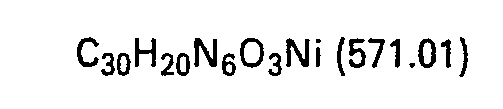
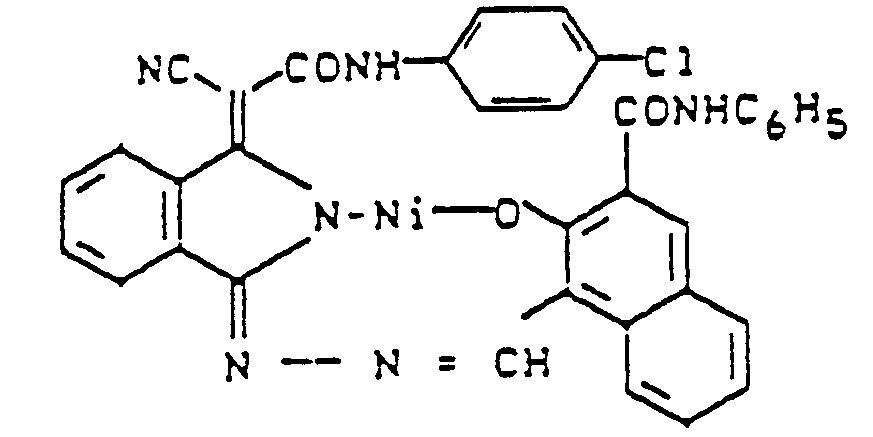
- 22,6 g 1-(Cyano-methylcarbamoyl-methylen)-3-iminoisoindolenin und 28,9 g 2-Hydroxy-3-N-phenylcar- bamoylnaphthalin-1-aldehydhydrazon werden in 300 ml Dimethylformamid 1 Stunde bei 100°C verrührt und dann innerhalb 15 Minuten mit 25,0 g Nickelacetat . 4H20 versetzt. Man rührt 3 Stunden bei 120°C nach, saugt das abgeschiedene Pigment bei 80° C ab und wäscht mit Methanol. Nach dem Trocknen werden so 48,5 g (85 0'0 d.Th.) des Rotpigmentes der Formel


- Nach dem in Beispiel 5 genannten Verfahren erhält man bei Einsatz entsprechend variierter 3-lmino-isolenine die in der folgenden Tabelle aufgeführten Pigmente mit den angegebenen Farbtönen.


- Verfährt man nach den Angaben von Beispiel 1 und verwendet in entsprechenden Mengen substituierte Aldehyde des ß-Oxynaphthoesäureanilids, erhält man die in der folgenden Tabelle aufgeführten Pigmente mit den angegebenen Farbtönen.


- 4 g feingemahlenes Pigment gemäß Beispiel 1 werden in 92 g eines Einbrennlackes folgender Zusammensetzung dispergiert:
- 33 % Alkydharz
- 15 % Melaminharz
- 5 % Glykolmonomethylether
- 34 % Xylol
- 13 % Butanol
- Als Alkydharz kommen Produkte auf Basis synthetischer und pflanzlicher Fettsäuren wie Kokosöl, Rizinusöl, Ricinenöl, Leinöl u.a. in Frage. Anstelle von Melaminharzen können Harnstoffharze verwendet werden.
- Nach erfolgter Dispergierung wird der pigmentierte Lack auf Papier-, Glas-, Kunststoff- oder Metall-Folien aufgetragen und 30 Minuten bei 130°C eingebrannt, wobei man eine brillante marronfarbene Lackierung erhält.
- 6 Teile Pigment nach Beispiel 1 werden in 12 Teilen Xylol, 4,1 Teilen Butylacetat und 0,7 Teilen n-Butanol mit 22,5 Teilen einer 20-%-igen Lösung von Celluloseacetobutyrat in Butylacetat/Xylol (2 : 1) 30 Minuten im Red Devil mit 2 - 3 mm Glaskugeln dispergiert. Nach Auffetten durch Zusatz von 10 Teilen eines gesättigten Polyesterharzes (Dynapol H 700) 7,3 Teilen Melaminharz, 8,7 Teilen einer 20-%-igen Lösung von Celluloseacetobutyrat in Butylacetat/Xylol (2 : 1), 18 Teilen Butylacetat, 1,6-Teilen n-Butanol und 9,7 Teilen Xylol wird nochmals 5 Minuten dispergiert.
- Zu diesem Lack setzt man eine Dispersion von Aluminiumpaste (60 %) in einem organischen Lösungsmittel (ca. 1 : 2) in der Menge zu, daß das Verhältnis Pigment : AI zwischen 80 : 20 und 1 : 99 zu liegen kommt.
- Dieser Lack wird aufgestrichen und nach dem Trocknen mit einem Klarlack auf Basis Acrylat/Melaminharz, der weitere Hilfsmittel wie z. B. UV-Absorber enthalten kann, überzogen und eingebrannt.
- Man erhält eine marronfarbene Metalliclackierung mit brillanten Farbton und ausgezeichneter Wetterechtheit.
- 0,2 g des nach Beispiel 1 erhaltenen Pigmentes werden bei 160°C auf einem Mischwalzwerk in 65 g stabilisiertem PVC und 35 g Diisooctylphthalat dispergiert und bei 160°C ausgewalzt. Man erhält eine marronfarbene Folie von sehr guter Licht- und Migrationsechtheit.
Claims (9)




Applications Claiming Priority (2)
| Application Number | Priority Date | Filing Date | Title |
|---|---|---|---|
| DE19853537625 DE3537625A1 (de) | 1985-10-23 | 1985-10-23 | Metallkomplexpigmente |
| DE3537625 | 1985-10-23 |
Publications (2)
| Publication Number | Publication Date |
|---|---|
| EP0224687A1 EP0224687A1 (de) | 1987-06-10 |
| EP0224687B1 true EP0224687B1 (de) | 1989-08-02 |
Family
ID=6284216
Family Applications (1)
| Application Number | Title | Priority Date | Filing Date |
|---|---|---|---|
| EP86114125A Expired EP0224687B1 (de) | 1985-10-23 | 1986-10-13 | Metallkomplexpigmente |
Country Status (4)
| Country | Link |
|---|---|
| US (1) | US4721745A (de) |
| EP (1) | EP0224687B1 (de) |
| JP (1) | JPS62101661A (de) |
| DE (2) | DE3537625A1 (de) |
Families Citing this family (6)
| Publication number | Priority date | Publication date | Assignee | Title |
|---|---|---|---|---|
| DE3642856A1 (de) * | 1986-12-16 | 1988-06-30 | Basf Ag | Isoindolin-metallkomplexe |
| GB2219000B (en) * | 1988-05-24 | 1991-11-27 | Ciba Geigy | Novel modification of an azine pigment |
| KR960016597B1 (ko) * | 1993-06-09 | 1996-12-16 | 주식회사 에스·케이·씨 | 개선된 폴리에스테르 필름 및 그 제조방법 |
| US5981124A (en) * | 1994-06-23 | 1999-11-09 | Ricoh Company, Ltd. | Electrophotographic photoconductor, azo compounds for use in the same, and intermediates for producing the azo compounds |
| US7066857B1 (en) * | 2003-11-04 | 2006-06-27 | Derosa Umberto | Rear derailleur guard |
| JP4714532B2 (ja) * | 2005-09-02 | 2011-06-29 | 東洋インキScホールディングス株式会社 | カラーフィルタ用着色組成物およびカラーフィルタ |
Family Cites Families (6)
| Publication number | Priority date | Publication date | Assignee | Title |
|---|---|---|---|---|
| CH581683A5 (de) * | 1973-09-07 | 1976-11-15 | Ciba Geigy Ag | |
| CH597324A5 (de) * | 1974-02-06 | 1978-03-31 | Ciba Geigy Ag | |
| DE2936748A1 (de) * | 1979-09-12 | 1981-04-02 | Basf Ag, 6700 Ludwigshafen | Neue hydrazone und ihre metallkomplexe |
| US4349671A (en) * | 1980-03-13 | 1982-09-14 | Ciba-Geigy Corporation | Process for the production of metal complexes of isoindoline azines |
| DE3338622A1 (de) * | 1983-10-25 | 1985-05-02 | Bayer Ag, 5090 Leverkusen | Rotes azinpigment |
| DE3430800A1 (de) * | 1984-08-22 | 1986-03-06 | Bayer Ag, 5090 Leverkusen | Anzinpigmente |
-
1985
- 1985-10-23 DE DE19853537625 patent/DE3537625A1/de not_active Withdrawn
-
1986
- 1986-10-13 EP EP86114125A patent/EP0224687B1/de not_active Expired
- 1986-10-13 DE DE8686114125T patent/DE3664781D1/de not_active Expired
- 1986-10-15 US US06/919,092 patent/US4721745A/en not_active Expired - Fee Related
- 1986-10-22 JP JP61249775A patent/JPS62101661A/ja active Pending
Also Published As
| Publication number | Publication date |
|---|---|
| EP0224687A1 (de) | 1987-06-10 |
| DE3664781D1 (en) | 1989-09-07 |
| JPS62101661A (ja) | 1987-05-12 |
| US4721745A (en) | 1988-01-26 |
| DE3537625A1 (de) | 1987-04-23 |
Similar Documents
| Publication | Publication Date | Title |
|---|---|---|
| EP0225553B1 (de) | Azofarblacke | |
| EP0254681B1 (de) | Neue Stoffzusammensetzungen auf der Basis von Indanthronblau-Pigmenten | |
| DE3931237A1 (de) | Wasserverduennbarer nagellack | |
| EP0427993A2 (de) | Heterocyclische Verbindungen und deren Verwendung als Pigmente und Farbstoffe | |
| EP0052224B1 (de) | Pigmentpasten und deren Verwendung | |
| DE2308594A1 (de) | Bisazomethinpigment und verfahren zu seiner herstellung | |
| EP0224687B1 (de) | Metallkomplexpigmente | |
| EP0361431B1 (de) | Monoazopigment, Verfahren zu seiner Herstellung und seine Verwendung | |
| EP0088729B1 (de) | Verwendung von Metallkomplexen von Hydrazonen als Pigmente | |
| EP0489421B1 (de) | Pigmentzubereitungen | |
| EP0151393A2 (de) | Azinpigmente, Verfahren zu ihrer Herstellung sowie ihre Verwendung | |
| DE69737004T2 (de) | Kristallwachstumsmodifikatoren für Perylenpigmente | |
| EP0190692B1 (de) | Bis-isoindolinpigmente und ihre Verwendung | |
| EP0141325A2 (de) | Rotes Azinpigment | |
| EP0172512B1 (de) | Azinpigmente | |
| EP0656402B1 (de) | Pigmentzusammensetzung aus modifiziertem Diketopyrrolopyrrol und Aminoalkylacrylatharz | |
| EP0612747B1 (de) | Nitroxylgruppen enthaltende Diketopyrrolopyrrole | |
| EP0638617A1 (de) | Pigmentsalze | |
| EP0024261A1 (de) | Azopigmente und Verfahren zu deren Herstellung und Verwendung | |
| DE3444886A1 (de) | Dioxazinpigmente | |
| EP2370523B1 (de) | Flockungsstabile diketopyrrolopyrrol-pigmentzubereitungen | |
| EP0427048A2 (de) | Metallkomplexverbindungen | |
| EP0428013A2 (de) | Heterocyclische Verbindungen und daraus erhältliche Porphyrin-Verbindungen | |
| EP0074924A1 (de) | Nickelkomplexpigmente von Azinen | |
| EP0183193A2 (de) | Neue Isoindolinverbindungen, deren Metallkomplexe und deren Verwendung |
Legal Events
| Date | Code | Title | Description |
|---|---|---|---|
| PUAI | Public reference made under article 153(3) epc to a published international application that has entered the european phase |
Free format text: ORIGINAL CODE: 0009012 |
|
| 17P | Request for examination filed |
Effective date: 19861013 |
|
| AK | Designated contracting states |
Kind code of ref document: A1 Designated state(s): CH DE FR GB IT LI |
|
| 17Q | First examination report despatched |
Effective date: 19880415 |
|
| GRAA | (expected) grant |
Free format text: ORIGINAL CODE: 0009210 |
|
| ITF | It: translation for a ep patent filed | ||
| AK | Designated contracting states |
Kind code of ref document: B1 Designated state(s): CH DE FR GB IT LI |
|
| REF | Corresponds to: |
Ref document number: 3664781 Country of ref document: DE Date of ref document: 19890907 |
|
| GBT | Gb: translation of ep patent filed (gb section 77(6)(a)/1977) | ||
| ET | Fr: translation filed | ||
| PLBE | No opposition filed within time limit |
Free format text: ORIGINAL CODE: 0009261 |
|
| STAA | Information on the status of an ep patent application or granted ep patent |
Free format text: STATUS: NO OPPOSITION FILED WITHIN TIME LIMIT |
|
| 26N | No opposition filed | ||
| ITTA | It: last paid annual fee | ||
| PGFP | Annual fee paid to national office [announced via postgrant information from national office to epo] |
Ref country code: FR Payment date: 19911007 Year of fee payment: 6 |
|
| PG25 | Lapsed in a contracting state [announced via postgrant information from national office to epo] |
Ref country code: FR Effective date: 19930630 |
|
| REG | Reference to a national code |
Ref country code: FR Ref legal event code: ST |
|
| PGFP | Annual fee paid to national office [announced via postgrant information from national office to epo] |
Ref country code: DE Payment date: 19930913 Year of fee payment: 8 |
|
| PGFP | Annual fee paid to national office [announced via postgrant information from national office to epo] |
Ref country code: GB Payment date: 19931005 Year of fee payment: 8 |
|
| PGFP | Annual fee paid to national office [announced via postgrant information from national office to epo] |
Ref country code: CH Payment date: 19931028 Year of fee payment: 8 |
|
| PG25 | Lapsed in a contracting state [announced via postgrant information from national office to epo] |
Ref country code: GB Effective date: 19941013 |
|
| PG25 | Lapsed in a contracting state [announced via postgrant information from national office to epo] |
Ref country code: LI Effective date: 19941031 Ref country code: CH Effective date: 19941031 |
|
| GBPC | Gb: european patent ceased through non-payment of renewal fee |
Effective date: 19941013 |
|
| REG | Reference to a national code |
Ref country code: CH Ref legal event code: PL |
|
| PG25 | Lapsed in a contracting state [announced via postgrant information from national office to epo] |
Ref country code: DE Effective date: 19950701 |
|
| PG25 | Lapsed in a contracting state [announced via postgrant information from national office to epo] |
Ref country code: IT Free format text: LAPSE BECAUSE OF NON-PAYMENT OF DUE FEES;WARNING: LAPSES OF ITALIAN PATENTS WITH EFFECTIVE DATE BEFORE 2007 MAY HAVE OCCURRED AT ANY TIME BEFORE 2007. THE CORRECT EFFECTIVE DATE MAY BE DIFFERENT FROM THE ONE RECORDED. Effective date: 20051013 |