EP0225077A2 - Superabschleifende Schleifmaschine mit veränderlicher Schleifdauer und veränderlichen Abrichtabständen - Google Patents
Superabschleifende Schleifmaschine mit veränderlicher Schleifdauer und veränderlichen Abrichtabständen Download PDFInfo
- Publication number
- EP0225077A2 EP0225077A2 EP86308728A EP86308728A EP0225077A2 EP 0225077 A2 EP0225077 A2 EP 0225077A2 EP 86308728 A EP86308728 A EP 86308728A EP 86308728 A EP86308728 A EP 86308728A EP 0225077 A2 EP0225077 A2 EP 0225077A2
- Authority
- EP
- European Patent Office
- Prior art keywords
- wheel
- grinding
- spark
- stage
- workpart
- Prior art date
- Legal status (The legal status is an assumption and is not a legal conclusion. Google has not performed a legal analysis and makes no representation as to the accuracy of the status listed.)
- Withdrawn
Links
Images

Classifications
-
- B—PERFORMING OPERATIONS; TRANSPORTING
- B24—GRINDING; POLISHING
- B24B—MACHINES, DEVICES, OR PROCESSES FOR GRINDING OR POLISHING; DRESSING OR CONDITIONING OF ABRADING SURFACES; FEEDING OF GRINDING, POLISHING, OR LAPPING AGENTS
- B24B49/00—Measuring or gauging equipment for controlling the feed movement of the grinding tool or work; Arrangements of indicating or measuring equipment, e.g. for indicating the start of the grinding operation
- B24B49/18—Measuring or gauging equipment for controlling the feed movement of the grinding tool or work; Arrangements of indicating or measuring equipment, e.g. for indicating the start of the grinding operation taking regard of the presence of dressing tools
Definitions
- the invention relates to grinding processes especially those using superabrasive grinding wheels.
- a so-called timed spark-out stage followed the rough grind stage and the finish grind stage during which the infeed rate of the wheel is zero relative to the workpart and is maintained until a selected threshold grinding force is reached where no substantive grinding occurs.
- the rough spark-out stage and finish spark-out stage were timed from the standpoint that an arbitrary time duration was programmed into the machine CNC control unit for each of these stages with no consideration given of the possible different conditions of the wheel that might exist after the rough and finish grind stages from one workpart to the next during a grinding run involving multiple workparts.
- Retruing or dressing of the superabrasive grinding wheel was also set or timed to occur at an arbitrary preselected interval, typically after a certain selected number of workparts had been ground, e.g. one truing pass over the wheel for every ten workparts ground. In some applications, this truing procedure does not maintain the condition of the grinding wheel at or near its optimum as a result of variations in the wheel structure, the workpiece structure, or stock removal rate from the wheel or workpiece.
- U.S. Patent 3,344,560 issued October 3, 1967, illustrates controlling wheel feed rate by sensing deflection of the grinding wheel spindle and U.S. Patent 3,555,741 discloses controlling grinding force in response to signals from a proximity gage.
- a noncontact type of sensing device for spindle deflection controls the length of rough, finish and spark-out periods of the grind cycle.
- An object of the invention is to provide a grinding method using a superabrasive wheel wherein the arbitrary timed spark-out stage after the rough grind stage is eliminated in favor of a variable duration spark-out stage dependent on the actual condition of the grinding wheel at that point.
- Another object of the invention is to provide such a grinding method wherein the selected set interval for wheel truing or dressing is eliminated in favor of a variable truing or dressing interval dependent on the wheel condition at the rough or finish spark-out stages as evidenced by certain sensed parameters existing during the rough spark-out stage.
- the spark-out stage after the rough grind stage is of variable duration from workpart to workpart determined by the time necessary for workpart material removal at zero wheel infeed rate to cause the grinding wheel drive motor power consumption to drop from the high level selected for rough grinding to the low level for finish grinding.
- the duration of the rough spark-out stage will depend on the condition of the grinding wheel, being shorter as the sharpness of the wheel increases during successive workpart grinding, and thus the duration of the rough spark-out stage is an indication of the condition of the wheel.
- the CNC control unit of the grinding machine places the machine in the wheel truing or dressing mode and this interval between truing or dressing is variable depending on the condition of the wheel itself, and is not fixed or set to occur after a selected number of workparts has been ground.
- a watts transducer senses grinding wheel drive motor power consumption over the selected short time interval and if the power consumption drops to that level for the low finish grind level within the short period, a memory circuit in the control unit is activated to store the fact that the machine needs to be placed in the truing or dressing mode.
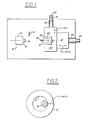
- Fig. 1 illustrates schematically an internal grinding machine with a workhead 10, wheelhead 12 and wheel dresser 14 for use in practicing the method of the invention.
- the workhead 10, wheelhead 12 and dresser 14 are of conventional construction, a grinding machine having such components being available as model B or under the trademark LECTRALINE grinding machine from Bryant Grinder Corporation, Springfield, Vermont.
- the workpart W is chucked in chuck 16 of the workhead and is rotated by the workhead spindle 17 during grinding but at a lesser speed of revolution than the grinding wheel 18 is rotated by spindle 20 of the wheelhead motor 25.
- the grinding wheel is of the superabrasive type; e.g. cubic boron nitride or diamond, which sharpens during grinding eventually to the extent that the abrasive working component (cubic boron nitride or diamond) is excessively exposed from the bonding matrix of the wheel and results in excessive loss thereof from the wheel with concomitant adverse effect on wheel performance and ground workpart quality.
- Dressing or truing of the grinding wheel 18 with dresser 14 returns the wheel to a less sharp state that is optimum for high tolerance grinding.
- the grinding wheel 18 is reciprocated axially inside the bore 6 of the chucked workpart W while being radially fed (fed in the X-axis direction, Fig. 2) against the bore wall 6 in grinding relation at appropriate radial or X-axis infeed rates for rough grinding and finish grinding described below.
- Reciprocating movement of the grinding wheel in the workpart bore is effected by a Z-axis slide 21 which moves back and forth in the Z direction
- radial or X-axis infeeding of the wheel against the bore wall is effected by an X-axis slide 23 movable in the Z-direction, all as is well known, e.g. as shown in the Reda et al U.S. Patent 4,419,612 issued December 6, 1983, the teachings of which are incorporated herein by reference.
- Internal grinding of bore wall 6 is effected in a successive rough grind stage, rough spark-out stage, finish grind stage and finish spark-out stage.
- the wheel radial infeed rate against the bore wall is relatively high; e.g. .001 inch/second while during finish grind the radial infeed rate of the wheel is relatively low; e.g. .00025 inch/second.
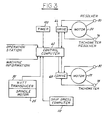
- These infeed rates are of course provided by movement of the X-axis slide 23 under suitable servo loop control using a ball screw drive controlled by the CNC control unit 62 of the machine, Fig. 3, e.g. as described in the aforementioned Reda et al U.S. Patent 4,419,612 and hereinafter.
- both rough and finish spark-out also referred to in the art as dwell or tarry
- the grinding wheel is maintained by the X-axis slide 23 in contact with the bore wall 6 with an essentially zero radial infeed rate of the wheel until grinding force decreases to or near the so-called threshold level below which no further grinding of the workpart occurs as is well known. Spark-out is then terminated.
- the workpart is unloaded after finish grinding when the finish spark-out phase is terminated or when an optional end position (of wheel feed) or gage size (of bore 6) is reached.
- a watts transducer 30 or other device functioning as a watt meter to monitor power consumption of spindle motor 25 during grinding and to provide in closed servo-loop manner signals representative of motor power consumption to a control computer 62 which is programmed to control all machine functions and interlocks which may include lubrication status, safety interlocks, motor watt consumption status and operation control station information.
- the watts transducer 30 is shown adjacent spindle motor 25 for convenience purposes; in practice, the watts transducer is located in a control cabinet adjacent the grinding machine.
- the control computer 62 may be any suitable digital computer or microprocessor.
- the control computer has stored the positions and rates for all the axis moves for the various operational sequences which include but are not limited to a rough grind, rough spark-out, finish grind and finish spark-out constituting a grind cycle, wheel dressing or truing cycle and so forth.
- the control computer 62 sends servo-drive signals to the servo-drive means 66,68 for controlling the servo-motors 20,22 with respect to the X-axis and Z-axis slides to cause the grinding wheel to move.
- the servo-drive means 66,68 take feedback from tachometers 76,78, respectively.
- the numerals 80,82 designate either resolvers, encoders, or "INDUCTOSYN" transducers and they provide feedback signals to the drive means 66,68, respectively, in closed servo-loop manner with the tachometers.
- a suitable control computer 62 is available from Intel Corp., Santa Clara, California 95054 and sold as an 86/05 Single Board Computer.
- the servo-drive means 66,68 may be any suitable servo-drive means as, for example, a SPR/X-1152 servo-drive available on the market from Inland Motor Division, Kollmorgen Corporation, 201 Rock Road, Rodford, Virginia 24141.
- the servo-motors 20,22 may be any suitable D.C. or A.C. servo-motor. Suitable D.C. servo-motors are available from Torque Systems Inc., 225 Crescent St., Waltham, MA 02154 under the trademark "SNAPPER".
- the tachometers 76,78 are part of the respective D.C. servo-motors.
- the resolvers, encoders or INDUCTOSYN transducers 80,82 are commercially available items and may be any suitable conventional position feed back device on the market for example as described in the aforementioned Reda et al U.S. Patent 4,419,612.
- the watts transducer 30 likewise is commercially available from A.F. Green Co., 15 Kelley Road, Salem, MA. 01970.
- each workpart in a grinding run or sequence is subjected to the rough grind, rough spark-out, finish grind and optional finish spark-out stages with the duration of the rough spark-out stage being variable dependent upon the actual condition of the grinding wheel and with the interval for truing or dressing of the grinding wheel also being variable during a run involving grinding multiple workparts in succession or from run to run dependent on the actual condition of the grinding wheel, not for an arbitrary selected duration and interval, respectively, as employed heretofore in the art.
- the grinding wheel 18 is first trued or dressed to proper dimension and sharpness by dresser 40 which may be a rotary dresser or other known dresser construction for superabrasive grinding wheels.
- dresser 40 which may be a rotary dresser or other known dresser construction for superabrasive grinding wheels.
- the workpart is ground by reciprocating the grinding wheel inside the workpart bore in the Z-direction and radially infeeding the wheel in the X-direction at a selected rough infeed rate; e.g. .001 inch/second, until the desired workpart bore ID (inner diameter) dimension is obtained as evidenced by wheel feed having reached a preset rough endpoint feed position (in the X-direction).
- the watts transducer 30 inputs wheel drive motor power consumption signals to the control computer 62 which, in turn, outputs necessary signals for controlling and varying the rough cycle infeed rate so as to maintain the power consumed by the drive motor substantially constant.
- the wheel is maintained in position to provide a substantially zero infeed rate constituting the rough spark-out stage.
- the grinding wheel removes some material from the workpart bore and results in a reduction in drive motor power consumption from the high level associated with rough grinding to a low level associated with finish grinding.
- the length of time required for the power level to drop to the finish grind level depends on the condition of the grinding wheel and decreases as the wheel sharpens during grinding of workparts, eventually reaching an unwanted condition of high sharpness where the abrasive component of the wheel, e.g.
- the cubic boron nitride or diamond held in a bond matrix are excessively exposed and prone to excessive dislodgement and loss from the matrix.
- the wheel exhibits a gradual progressive tendency to sharpen as a result of increased exposure of the abrasive component from the matrix.
- the duration of the spark-out stage is variable in time and decreases from one workpart to the next as they are successively ground according to the invention. A variable time spark-out stage is thus provided and is dependent in duration on the condition of the grinding wheel.
- a timer control 100 on a conventional Model Bor LECTRALINE grinding machine referred to above and previously used by prior art workers to set or fix arbitrarily the duration of the rough spark-out stage is set to establish a minimum reference time interval, e.g. 2 seconds, which is stored in control computer 62 and which is indicative of a wheel in need of truing or dressing if the drive motor power consumption drops to the finish level in that time.
- the watts transducer 30 likewise interfaces with the control computer 62 and inputs drive motor power consumption signals thereto.
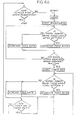
- the control computer during the rough spark-out stage for each workpart is programmed to determine whether the drive motor power consumption level drops from the high level associated with rough grinding to the low level associated with finish grinding within the reference time interval. If the drive motor power consumption does not drop to the lower level within the reference time interval, the control computer directs the finish grinding of that workpart and regulates the finish feed rate (using increase feed rate and decease feed rate boxes of Fig. 4) and then directs the start of grinding of another successive workpart.
- control computer 62 stores that fact for future reference, directs the finish grinding of that workpart, then outputs appropriate signals to the slide motor drives 66 and 68 and dresser 14 to retrue the wheel, and then outputs appropriate signals for start of grinding additional workparts. The process continues until the duration of the rough spark-out stage for a particular workpart is again shorter than the reference time interval. The wheel is then retrued as described and the sequence repeated for additional workparts throughout the grinding run or from run to run.
- the advantageous feature of this method is that wheel retruing or dressing is conducted on an interval (after certain number of workparts) which is dependent on the condition of the grinding wheel as evidenced by the duration of the rough spark-out stage, and not some arbitrary set interval.
- the minimum reference time interval is determined empirically based on observations as to when a wheel in fact is in need of truing or dressing.
- the grinding wheel is trued or dressed when warranted by the condition of the wheel as evidenced by its sharpness during the rough spark-out stage.
- a conventional skip dress counter 110 is provided to count workparts unloaded after finish grinding to assure that retruing occurs at least after a selected number of workparts have been ground regardless of the sharpness of the grinding wheel as indicated by the duration of the rough spark-out stage.
- the skip dress counter assures retention of wheel straightness despite possibly uneven wear of the wheel.
- each workpart is subjected to a finish grind at a relatively low infeed rate; e.g. .00025 inch/second which may optionally be terminated by an in-process gage which measures workpart size, followed by no spark-out or a timed (fixed time) finish spark-out stage, or a spark-out which is terminated by an in-process gage, to grind to the final high tolerance bore ID desired in accordance with prior art practice.
- a finish grind at a relatively low infeed rate; e.g. .00025 inch/second which may optionally be terminated by an in-process gage which measures workpart size, followed by no spark-out or a timed (fixed time) finish spark-out stage, or a spark-out which is terminated by an in-process gage, to grind to the final high tolerance bore ID desired in accordance with prior art practice.
- Subsequent workparts are then subjected to the rough grind, rough spark-out, finish grind and optional finish spark-out stages of the grinding cycle until the wheel
- Fig. 4 illustrates schematically the flow chart for the inventive method described hereinabove.
Landscapes
- Engineering & Computer Science (AREA)
- Mechanical Engineering (AREA)
- Grinding-Machine Dressing And Accessory Apparatuses (AREA)
- Constituent Portions Of Griding Lathes, Driving, Sensing And Control (AREA)
Applications Claiming Priority (2)
| Application Number | Priority Date | Filing Date | Title |
|---|---|---|---|
| US06/800,001 US4653235A (en) | 1985-11-20 | 1985-11-20 | Superabrasive grinding with variable spark-out and wheel dressing intervals |
| US800001 | 1997-02-13 |
Publications (2)
| Publication Number | Publication Date |
|---|---|
| EP0225077A2 true EP0225077A2 (de) | 1987-06-10 |
| EP0225077A3 EP0225077A3 (de) | 1988-12-14 |
Family
ID=25177264
Family Applications (1)
| Application Number | Title | Priority Date | Filing Date |
|---|---|---|---|
| EP86308728A Withdrawn EP0225077A3 (de) | 1985-11-20 | 1986-11-10 | Superabschleifende Schleifmaschine mit veränderlicher Schleifdauer und veränderlichen Abrichtabständen |
Country Status (3)
| Country | Link |
|---|---|
| US (1) | US4653235A (de) |
| EP (1) | EP0225077A3 (de) |
| JP (1) | JPS62176758A (de) |
Cited By (4)
| Publication number | Priority date | Publication date | Assignee | Title |
|---|---|---|---|---|
| WO1993024274A1 (fr) * | 1992-05-26 | 1993-12-09 | Essilor International | Procede de ravivage de meules, disque et machine pour sa mise en ×uvre |
| EP0566853A3 (de) * | 1992-03-26 | 1994-03-30 | Toyoda Machine Works Ltd | |
| CN104476398A (zh) * | 2014-11-04 | 2015-04-01 | 桂林新全数控有限公司 | 数控卧轴平面磨床砂轮磨损动态补偿方法 |
| CN104858734A (zh) * | 2015-05-22 | 2015-08-26 | 南通中远船务工程有限公司 | 一种桩腿定位销孔打磨小车及其打磨方法 |
Families Citing this family (16)
| Publication number | Priority date | Publication date | Assignee | Title |
|---|---|---|---|---|
| US4790545A (en) * | 1988-01-11 | 1988-12-13 | Bryant Grinder Corporation | Workpart centering mechanism for a chuck |
| US4926337A (en) * | 1988-07-13 | 1990-05-15 | Bryant Grinder Corporation | Automatic workpart centering mechanism for a chuck |
| US5044125A (en) * | 1988-09-02 | 1991-09-03 | Cincinnati Milacron-Heald Corp. | Method and apparatus for controlling grinding processes |
| US5025594A (en) * | 1988-09-02 | 1991-06-25 | Cincinnati Milacron-Heald Corp. | Method and apparatus for controlling grinding processes |
| US5042206A (en) * | 1988-09-02 | 1991-08-27 | Cincinnati Milacron-Heald Corp. | Method and apparatus for controlling grinding processes |
| EP0512956B1 (de) * | 1991-05-07 | 1994-09-07 | Voumard Machines Co. S.A. | Numerisch gesteuerte Schleifmaschine |
| US5293717A (en) * | 1992-07-28 | 1994-03-15 | United Technologies Corporation | Method for removal of abradable material from gas turbine engine airseals |
| US5718617A (en) * | 1994-09-02 | 1998-02-17 | Bryant Grinder Corporation | Grinding force measurement system for computer controlled grinding operations |
| JP4940547B2 (ja) * | 2004-12-16 | 2012-05-30 | 株式会社ジェイテクト | 研削方法および研削盤 |
| US20060205321A1 (en) * | 2005-03-11 | 2006-09-14 | United Technologies Corporation | Super-abrasive machining tool and method of use |
| WO2011029079A1 (en) * | 2009-09-05 | 2011-03-10 | M4 Sciences, Llc | Control systems and methods for machining operations |
| JP5906898B2 (ja) * | 2012-03-30 | 2016-04-20 | 株式会社Ihi | 機械加工方法及び機械加工システム |
| US10245652B2 (en) | 2012-11-05 | 2019-04-02 | M4 Sciences Llc | Rotating tool holder assembly for modulation assisted machining |
| CN104858735B (zh) * | 2015-05-22 | 2017-06-06 | 南通中远船务工程有限公司 | 一种圆形桩腿定位孔自动打磨装置及方法 |
| US10875138B1 (en) | 2016-08-09 | 2020-12-29 | M4 Sciences Llc | Tool holder assembly for machining system |
| JP7316816B2 (ja) * | 2019-03-26 | 2023-07-28 | 株式会社日本総合研究所 | 情報処理装置及びプログラム |
Family Cites Families (8)
| Publication number | Priority date | Publication date | Assignee | Title |
|---|---|---|---|---|
| US3344560A (en) * | 1965-08-04 | 1967-10-03 | Bryant Grinder Corp | Control device |
| US3535828A (en) * | 1967-09-11 | 1970-10-27 | Heald Machine Co | Grinding machine |
| FR1586196A (de) * | 1967-09-11 | 1970-02-13 | ||
| US3555741A (en) * | 1968-03-04 | 1971-01-19 | Heald Machine Co | Grinding machine |
| US4123878A (en) * | 1975-12-08 | 1978-11-07 | Cincinnati Milacron-Heald Corp. | Grinding machine |
| US4045920A (en) * | 1976-02-06 | 1977-09-06 | Toyota Jidosha Kogyo Kabushiki Kaisha | Cam-controlled grinding machine |
| US4074467A (en) * | 1977-03-14 | 1978-02-21 | Cincinnati Milacron-Heald Corporation | Grinding machine control |
| US4419612A (en) * | 1980-05-22 | 1983-12-06 | Ex-Cell-O Corporation | Single workhead electro-mechanical internal grinding machine with grinding spindle directly on cross slide |
-
1985
- 1985-11-20 US US06/800,001 patent/US4653235A/en not_active Expired - Fee Related
-
1986
- 1986-11-10 EP EP86308728A patent/EP0225077A3/de not_active Withdrawn
- 1986-11-19 JP JP61274214A patent/JPS62176758A/ja active Pending
Cited By (7)
| Publication number | Priority date | Publication date | Assignee | Title |
|---|---|---|---|---|
| EP0566853A3 (de) * | 1992-03-26 | 1994-03-30 | Toyoda Machine Works Ltd | |
| WO1993024274A1 (fr) * | 1992-05-26 | 1993-12-09 | Essilor International | Procede de ravivage de meules, disque et machine pour sa mise en ×uvre |
| US5643052A (en) * | 1992-05-26 | 1997-07-01 | Essilor International | Method for renewing grinding wheel surfaces and disk and machine for carrying out said method |
| CN104476398A (zh) * | 2014-11-04 | 2015-04-01 | 桂林新全数控有限公司 | 数控卧轴平面磨床砂轮磨损动态补偿方法 |
| CN104476398B (zh) * | 2014-11-04 | 2018-07-31 | 桂林新全数控有限公司 | 数控卧轴平面磨床砂轮磨损动态补偿方法 |
| CN104858734A (zh) * | 2015-05-22 | 2015-08-26 | 南通中远船务工程有限公司 | 一种桩腿定位销孔打磨小车及其打磨方法 |
| CN104858734B (zh) * | 2015-05-22 | 2017-06-06 | 南通中远船务工程有限公司 | 一种桩腿定位销孔打磨小车及其打磨方法 |
Also Published As
| Publication number | Publication date |
|---|---|
| US4653235A (en) | 1987-03-31 |
| EP0225077A3 (de) | 1988-12-14 |
| JPS62176758A (ja) | 1987-08-03 |
Similar Documents
| Publication | Publication Date | Title |
|---|---|---|
| US4653235A (en) | Superabrasive grinding with variable spark-out and wheel dressing intervals | |
| US4053289A (en) | Grinding method and apparatus with metal removal rate control | |
| US5315789A (en) | Numerically controlled machine tool and method of controlling grinding operation thereof | |
| US4557078A (en) | Method of dressing and finishing grinding wheels | |
| US5044125A (en) | Method and apparatus for controlling grinding processes | |
| US4590573A (en) | Computer-controlled grinding machine | |
| US5209020A (en) | Method of and apparatus for profiling grinding wheels | |
| US4628643A (en) | Grinding wheel infeed control method | |
| US5025594A (en) | Method and apparatus for controlling grinding processes | |
| GB2179880A (en) | Method and apparatus for initiating an operation for dressing a grinding wheel depending on its degree of bluntness | |
| JP2000263437A (ja) | 円筒研削盤 | |
| US3344560A (en) | Control device | |
| EP0356663A2 (de) | Schleifmaschine sowie Verfahren und Vorrichtung zum Steuern eines Schleifvorgangs | |
| CA1276470C (en) | Optimization method and apparatus for dressing a grinding wheel | |
| JPS6351826B2 (de) | ||
| CA1217056A (en) | Automatic dual compensation grinding wheel conditioner | |
| US4539778A (en) | Automatic dual compensation grinding wheel conditioner | |
| JPH05277934A (ja) | 研削砥石のドレッシング制御装置 | |
| Lindsay et al. | Relationship between wheel characteristics and operating problems in high-production precision grinding | |
| JPS61252065A (ja) | 研削制御装置 | |
| JPH0525812Y2 (de) | ||
| JP2000052246A (ja) | 導電性砥石のツルーイング方法および研削装置 | |
| JPH0683958B2 (ja) | クランクシヤフト端面研削装置 | |
| JP3407532B2 (ja) | 砥石修正装置 | |
| JPS62203759A (ja) | 超砥粒砥石車のツル−イング方法 |
Legal Events
| Date | Code | Title | Description |
|---|---|---|---|
| PUAI | Public reference made under article 153(3) epc to a published international application that has entered the european phase |
Free format text: ORIGINAL CODE: 0009012 |
|
| AK | Designated contracting states |
Kind code of ref document: A2 Designated state(s): CH DE IT LI SE |
|
| PUAL | Search report despatched |
Free format text: ORIGINAL CODE: 0009013 |
|
| RHK1 | Main classification (correction) |
Ipc: G05B 19/18 |
|
| AK | Designated contracting states |
Kind code of ref document: A3 Designated state(s): CH DE IT LI SE |
|
| 17P | Request for examination filed |
Effective date: 19890510 |
|
| 17Q | First examination report despatched |
Effective date: 19910207 |
|
| STAA | Information on the status of an ep patent application or granted ep patent |
Free format text: STATUS: THE APPLICATION IS DEEMED TO BE WITHDRAWN |
|
| 18D | Application deemed to be withdrawn |
Effective date: 19910618 |
|
| RIN1 | Information on inventor provided before grant (corrected) |
Inventor name: FARMER, STEVEN P. |