EP0225641A2 - Gerät zur Analog-Digitalumwandlung - Google Patents
Gerät zur Analog-Digitalumwandlung Download PDFInfo
- Publication number
- EP0225641A2 EP0225641A2 EP86117203A EP86117203A EP0225641A2 EP 0225641 A2 EP0225641 A2 EP 0225641A2 EP 86117203 A EP86117203 A EP 86117203A EP 86117203 A EP86117203 A EP 86117203A EP 0225641 A2 EP0225641 A2 EP 0225641A2
- Authority
- EP
- European Patent Office
- Prior art keywords
- analog
- digital
- converting
- random noise
- output
- Prior art date
- Legal status (The legal status is an assumption and is not a legal conclusion. Google has not performed a legal analysis and makes no representation as to the accuracy of the status listed.)
- Granted
Links
Images



Classifications
-
- H—ELECTRICITY
- H03—ELECTRONIC CIRCUITRY
- H03M—CODING; DECODING; CODE CONVERSION IN GENERAL
- H03M1/00—Analogue/digital conversion; Digital/analogue conversion
- H03M1/06—Continuously compensating for, or preventing, undesired influence of physical parameters
- H03M1/0617—Continuously compensating for, or preventing, undesired influence of physical parameters characterised by the use of methods or means not specific to a particular type of detrimental influence
- H03M1/0634—Continuously compensating for, or preventing, undesired influence of physical parameters characterised by the use of methods or means not specific to a particular type of detrimental influence by averaging out the errors, e.g. using sliding scale
- H03M1/0636—Continuously compensating for, or preventing, undesired influence of physical parameters characterised by the use of methods or means not specific to a particular type of detrimental influence by averaging out the errors, e.g. using sliding scale in the amplitude domain
- H03M1/0639—Continuously compensating for, or preventing, undesired influence of physical parameters characterised by the use of methods or means not specific to a particular type of detrimental influence by averaging out the errors, e.g. using sliding scale in the amplitude domain using dither, e.g. using triangular or sawtooth waveforms
-
- H—ELECTRICITY
- H03—ELECTRONIC CIRCUITRY
- H03M—CODING; DECODING; CODE CONVERSION IN GENERAL
- H03M1/00—Analogue/digital conversion; Digital/analogue conversion
- H03M1/06—Continuously compensating for, or preventing, undesired influence of physical parameters
- H03M1/0617—Continuously compensating for, or preventing, undesired influence of physical parameters characterised by the use of methods or means not specific to a particular type of detrimental influence
- H03M1/0634—Continuously compensating for, or preventing, undesired influence of physical parameters characterised by the use of methods or means not specific to a particular type of detrimental influence by averaging out the errors, e.g. using sliding scale
- H03M1/0636—Continuously compensating for, or preventing, undesired influence of physical parameters characterised by the use of methods or means not specific to a particular type of detrimental influence by averaging out the errors, e.g. using sliding scale in the amplitude domain
- H03M1/0639—Continuously compensating for, or preventing, undesired influence of physical parameters characterised by the use of methods or means not specific to a particular type of detrimental influence by averaging out the errors, e.g. using sliding scale in the amplitude domain using dither, e.g. using triangular or sawtooth waveforms
- H03M1/0641—Continuously compensating for, or preventing, undesired influence of physical parameters characterised by the use of methods or means not specific to a particular type of detrimental influence by averaging out the errors, e.g. using sliding scale in the amplitude domain using dither, e.g. using triangular or sawtooth waveforms the dither being a random signal
Definitions
- the present invention relates to an AD converting device which is employed for converting an audio signal, musical signal, image signal, or like analog signal into a digital signal which may be subjected to, for instance, an analysis in the frequency domain and/or time domain.
- a quantization error is incidental to an AD conversion because an AD converter has a limited number of quantization steps. Many attempts have been made to average maldistributed quantization errors through application of a dither to an original analog signal by using a random noise, as set forth in, for example, B. A. Blesser, "Digitization of Audio: A Comprehensive Examination of Theory, Implementation, and Current Practice", Journal of Audio Enginnering Society, Oct. 1978, Vol. 26, No. 10.
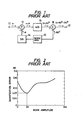
- Fig. 1 shows a prior art example.
- An analog signal X for conversion into a digital signal is applied to an analog adder 12 from an input terminal 11.
- a random pulse generator 13 is provided, which is an M-sequence pulse generator comprising a shift register. Random pulses generated in digital form by the random pulse generator 13 are converted by a DA converter 14 into an analog random noise signal N. which is supplied to the analog adder 12 for addition to the analog signal X.
- the adder output (X + N) is provided to an AD converter 15, whereby it is converted, at intervals of a fixed period Ts, into a digital signal of a predetermined number of bits.
- the converted output (X + N) Q (where Q indicates that the output is a digital signal) from the AD converter 15 is applied, as required, to a digital subtractor 16, wherein a random noise value (N) supplied from the random pulse generator 13 is digitally subtracted from the converted output (X + N) Q , providing an output (X + N) Q - (N) Q at an output terminal 17.
- the random noise N may preferably be large in amplitude.
- the digital subtractor 16 in Fig. 1 can be left out. Furthermore, when the output at the output terminal 17 is subjected to a digital fast Fourier transform (FFT) or digital discrete Fourier transform (DFT) for a frequency analysis, if the random noise N is small, the resultant signal component appearing on the observation screen may have high peaks above the low random noise levels distributed in the analyzing frequency range; and so the random noise is not obstructive to the observation of the signal component. Accordingly, the digital subtractor 16 can be dispensed with in this case, too.
- FFT digital fast Fourier transform
- DFT digital discrete Fourier transform
- the random pulses from the random pulse generator 13 are converted by the DA converter 14 into an analog signal.
- the amplitude of the random pulses (noise) is large, the nonlinearlity of the DA converter 14 cannot be ignored in the DA conversion and there arises the necessity of employing an expensive DA converter of a large dynamic range of conversion.
- the nonlinearity of the DA converter 14 prevents complete elimination of the random noise in spite of its subtraction by the digital subtractor 16.
- Fig. 2 variations in a quantization error produced when the amplitude of the random noise N was varied in the conventional AD converting device depicted in Fig. 1.
- the random noise amplitude on the horizontal axis in Fig. 2 is expressed in normalized form with the qunatization step size A .
- an increase in the amplitude of the random noise N causes a decrease in the quantization error, but in this example, the error reaches a minimum value at a noise amplitude of 2A and thereafter it is rather on the increase.
- Another object of the present invention is to provide an AD converting device which dispenses with a digital subtraction of the random noise from the AD converter output.
- Yet another object of the present invention is to provide an AD converting device which is capable of lessening the influences of non-uniformity of quantization steps and the nonlinearity of conversion characteristics of the AD converter even if a random noise of a relatively small amplitude is employed.
- an analog random noise is added by analog adding means to an analog signal to be converted to a digital signal, and further, an analog offset voltage of a relatively largely alternating level, which is created by offset voltage generating means, is also added by the analog means to the analog signal to be converted.
- the analog signal thus added with the analog random noise and the analog offset voltage is converted by an AD converter into digital form.
- the alternation level of the analog offset voltage is selected larger than the amplitude of the random noise, in general, about one to seven times the quantization step size A of the AD converter, preferably three to six times, in particular, around four times the quantization step size.
- the period of variation of the analog offset voltage needs only to satisfy the condition that its frequency spectrum stays outside the frequency band (i.e. the observation frequency region) of the object signal.
- the analog offset voltage takes the form of a square wave
- its period of variation is selected to be equal to or sufficiently longer than the conversion period of so-called sampling period Ts of the AD converter, for instance, 256 Ts, and its variation need not be synchronized with sampling by the AD converter.
- its period is set to be equal to or less than the sampling period Ts; in general, it is selected appreciably higher than the sampling frequency.
- the amplitude of the analog random noise is set to 6A or less, preferably in the range of A/2 to 4A or so, or it may be less than A/2 in some cases. With a noise amplitude exceeding 10A, the nonlinearity of the DA converter for converting the digital random noise into an analog noise poses a problem and a costly DA converter is required in prior art system.
- the analog offset voltage is superimposed on the analog signal to be converted, the influence of nonuniformity of the quantization steps and the nonlinearity of the conversion characteristics on the AD conversion can be lessened even if the amplitude of the analog random noise is reduced.
- the spectrum of the analog offset voltage is placed outside the observation frequency range and the amplitude of the analog random noise is small, neither the offset voltage nor the random noise needs to be subtracted digitally from the AD converter output. Of course, the subtraction may also be conducted.
- a low-cost DA converter with a small number of bits can be employed for producing the analog random noise because its amplitude is small, and a DA converter of excellent conversion linearity is easily available.
- the freedom in designing the AD converting device is increased accordingly.
- Fig. 3 illustrates in block form an embodiment of the present invention, in which the parts corresponding to those in Fig. 1 are identified by the same reference numerals.
- the present invention employs offset generating means 21, which comprises, for instance, offset value generating means 22 for generating an offset voltage value and a DA converter 23 for converting the offset voltage value into an analog voltage.
- the offset voltage 0 from the offset generating means 21 is applied to the analog adder 12 in addition to the application of the noise signal N.
- the offset voltage 0 is varied more greatly than the quantization step size A; namely, it is varied to, for example, +4 ⁇ , 0, -4 ⁇ , 0, +4 ⁇ , ..., as shown in Fig. 4.
- the variation period To of the offset voltage 0 is set to, for instance, m times longer than the sampling period Ts in the AD converter 15.
- the period To need not necessarily be held constant and synchronized with the sampling period Ts.
- the AD converter 15 provides a digital output (X + N + 0) Q converted from the analog adder output (X + N + 0).
- the digital value (0) Q of the offset voltage 0 is also subtracted, by the digital subtractor 16, from the output digital signal (X + N + 0) Q of the AD converter 15, providing a digital signal (X + N + O) Q - (N + 0) Q at the output terminal 17.
- the signal thus obtained at the output terminal 17 of the AD converting device is supplied to, for example, a digital fast Fourier transform unit 24, wherein the signal in the time domain is converted to a signal in the frequency domain, for analysis.
- the analog signal X to be converted into digital form is a repetitive signal
- the above-mentioned conversion to the frequency domain is conducted upon each repetition of the input signal X and the corresponding frequency components in the respective conversion results are averaged; this also averages quantization errors.
- Fig. 5 illustrates another embodiment of the present invention.
- respective values (sample values) of a random noise waveform are prestored in a random noise waveform memory 25, clock pulses of a frequency Ts from a clock terminal 26 are counted by a ring counter 27, and its count value is used as an address for reading out the memory 25.
- Each sample value of the random noise waveform read out of the memory 25 is latched in a latch circuit 28, the output of which is converted by the DA converter 14 to an analog signal. Consequently, an analog random noise is obtained from the DA converter 14.
- each sample value of an offset waveform is prestored in an offset waveform memory 29, the clock pulses from the terminal 26 are frequency divided by a frequency divider 31 down to 1/m of the clock pulses, and the frequency-divided outputs are counted by a ring counter 32.
- the count value of the ring counter 32 is used as an address for reading out the offset waveform memory 29.
- the sample values of the offset waveform thus read out of the memory 29 are latched in a latch circuit 33 by the output of the frequency divider 31.
- the latch output is converted by the DA converter 23 to analog form, in consequence of which analog offset voltage is obtained from the DA converter 23.
- the AD converter 15 performs one converting operation upon each application thereto of the clock pulse from the terminal 26.
- the digital subtractor 16 is supplied with the outputs from the latch circuits 28 and 33. In the embodiment of Fig. 5, it is necessary, in practice, to provide delay circuits for timing the operations of the respective parts, but no description will be given thereof for the sake of brevity.
- Fig. 6 shows a modified form of the embodiement of Fig. 5, in which the random noise and the offset voltage are generated by a common means.
- respective sample values of the random noise waveform and the offset waveform superimposed on each other are prestored in a waveform memory 34, which is read out using the count value of the counter 27, and the read-out output is latched in the latch circuit 28, the output of which is supplied to the DA converter 14.
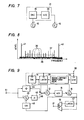
- Fig. 7 illustrates a modification of the offset generating means 21, in which an analog offset voltage is produced directly by a square or sine-wave oscillator 35 and is applied not only to the analog adder 12 but also to an AD converter 36,whereinit is converted to a digital signal for input to the digital subtractor 16.
- the analog offset voltage is not limited specifically to the square or sine wave but may take other waveforms as well.
- the output digital signal at the output terminal 17 is converted to a signal of the frequency domain through use of, for example, the FFT unit 24 in Fig. 3.
- the frequency region (band) for observation is such as indicated by the broken line 37 in Fig. 8
- the frequency spectrum of the analog random noise N is substantially flat in at least the observation region, as indicated by 38, and the noise occurs at random.
- the frequency spectrum 38 of the analog random noise N is sufficiently lower in level than signal components 39 to be observed, as shown, it is not obstructive to the observation of the signal components 39.
- the digital subtractor 16 can be dispensed with in these cases. If the levels of the signal components 39 are sufficiently higher than the level of the offset volotage component 41 or 42, the digital subtractor 16 can be omitted also in the case of reproducing the AD converted output at the terminal 17 into an audio signal.
- the level of the analog signal is returned to the original analog level, and the output of the DA converter 48 is applied to the analog subtractor 45, wherein the high-level portion of the original input analog signal at the input terminal 11 is subtracted by the DA converter output.
- the level of the remaining low-level portion from the analog subtractor 45 is raised by a multiplier 49, the output of which is provided via the switch 46 to the analog adder 12.
- the dividing number of the divider 44 and the multiplying number of the multiplier 49 are selected such that the full range of the AD converter 15 is utilized most effectively.
- the output of the multiplier 49 is also applied via the analog adder 12 to the AD converter 15 for conversion into a digital signal.
- the digital subtractor 16 the noise component and the offset component are removed from the converted output, and the subtractor output is supplied to an adder 51, wherein it is combined with the high-level portion previously converted and held in the latch circuit 47, into a composite signal, which is provided to the output terminal 17.
- the present inventor conducted the following experiment. As shown in Fig. 10, the output side of an analog subtractor 53 was connected to the input terminal 11 of the AD converting device, and the analog subtractor 53 was connected at one input to the output of a square wave generator 54 and at the other input to the output of a sine wave oscillator 55 via a switch 56. A sine wave of the same frequency and amplitude as those of the fundamental wave of the output square wave of the square wave generator 54 was produced by the sine wave oscillator 55. Incidentally, the digital subtractor 16 was left out.
- the switch 56 was turned ON and the outputs of the both DA converters 13 and 23 were set to zero. Consequently, the fundamental wave component of the output from the square wave generator 54 was cancelled by the sine wave from the oscillator 55 and only high-frequency components of the square wave were provided via the analog adder 12 to the AD converter 15.
- the AD converted output was transformed by the means 24 into a signal of the frequency domain, and the level of each high-frequency component was regarded as a true value.
- the switch 56 was turned OFF, the output of the DA converter 23 was held at zero, and the output of the square wave generator 54 was supplied to the analog adder 12 so as to measure, first, the quantization error according to the prior art device.
- the output of the DA converter 14 was provided to the analog adder 12, and the amplitude of the output of the DA converter 14, that is, the amplitude of the analog random noise was gradually increased, and then the quantization error of the converted output by the AD converter 15 was measured.
- the measured results are shown in Fig. 2 as referred to previously.
- the quantization error is defined as the sum of the differences between the frequency components of the output from the means 24 and the afore-said true values.
- the amplitude of the output from the DA converter 14, that is, the amplitude of the analog offset voltage was gradually increased, starting with zero, while maintaining the amplitude of random noise at 2A where the quantization error was minimum as seen in Fig. 2.
- the measured results of the quantization error with respect to the increase in the offset voltage are such as shown in Fig. 11.
- an increase in the amplitude of the offset voltage causes a decrease in the quantization error, and when the alternating amplitude of the offset voltage is ⁇ 4 ⁇ about zero, the quantization error is minimum.
- the amplitude variations in the range of ⁇ ( ⁇ to 7A) are also effective compared to Fig. 2 for reducing the quantization error and variations in the range of t(3 to 6A) are also appreciably effective.
- the amplitude of a random noise superimposed on an analog signal to be converted can be decreased even by superimposing on the latter an offset voltage of alternating levels; so that the digital subtractor 16 need not always be provided at the output side of the AD converter 15, as mentioned previously.
- a DA converter which is small in the number of bits, small-sized, low-cost, excellent in linearity and high in precision. This ensures correct compensation for cancellation by the digital subtractor 16 if employed.
- the use of the offset voltage not only permits uniform distribution of the quantization error but also suppresses the influences of variations in the quantization step size and the nonlinearity of conversion characteristics of the AD converter.
- a DA converter with a small number of bits can be used as the DA converter 23 for generating the offset voltage, too. Moreover, since the quantization error is reduced through utilization of both the random noise and the offset voltage, a suitable selection of their amplitudes provides for increased freedom in designing the AD converting device.
Landscapes
- Engineering & Computer Science (AREA)
- Theoretical Computer Science (AREA)
- Analogue/Digital Conversion (AREA)
Applications Claiming Priority (2)
| Application Number | Priority Date | Filing Date | Title |
|---|---|---|---|
| JP280652/85 | 1985-12-13 | ||
| JP60280652A JPS62140518A (ja) | 1985-12-13 | 1985-12-13 | Ad変換装置 |
Publications (3)
| Publication Number | Publication Date |
|---|---|
| EP0225641A2 true EP0225641A2 (de) | 1987-06-16 |
| EP0225641A3 EP0225641A3 (en) | 1988-12-07 |
| EP0225641B1 EP0225641B1 (de) | 1993-04-14 |
Family
ID=17628039
Family Applications (1)
| Application Number | Title | Priority Date | Filing Date |
|---|---|---|---|
| EP86117203A Expired - Lifetime EP0225641B1 (de) | 1985-12-13 | 1986-12-10 | Gerät zur Analog-Digitalumwandlung |
Country Status (4)
| Country | Link |
|---|---|
| US (1) | US4761634A (de) |
| EP (1) | EP0225641B1 (de) |
| JP (1) | JPS62140518A (de) |
| DE (1) | DE3688279T2 (de) |
Cited By (6)
| Publication number | Priority date | Publication date | Assignee | Title |
|---|---|---|---|---|
| EP0316958A1 (de) * | 1987-11-20 | 1989-05-24 | Advantest Corporation | Einrichtung und Verfahren zur Messung von Übertragungsfunktionen |
| GB2227896A (en) * | 1989-02-03 | 1990-08-08 | Standard Telephones Cables Ltd | Analog-to-digital converter |
| EP0613256A1 (de) * | 1993-02-26 | 1994-08-31 | Schlumberger Industries S.A. | AD-Wandler mit moduliertem Zittersignal |
| FR2783374A1 (fr) * | 1998-09-11 | 2000-03-17 | Thomson Csf | Procede et dispositif de generation d'un signal aleatoire et systemes de conversion numerique-analogique utilisant un tel signal aleatoire |
| US6064328A (en) * | 1997-05-16 | 2000-05-16 | Rohde & Schwarz Gmbh & Co. Kg | Analog/digital converter with small crest factor dither signal superposed at an input side |
| EP2278715A1 (de) * | 2009-07-14 | 2011-01-26 | Honeywell International Inc. | Günstige Verbesserung der Auflösung und Reduzierung des Rauschens von rauscharmen Signalen |
Families Citing this family (24)
| Publication number | Priority date | Publication date | Assignee | Title |
|---|---|---|---|---|
| JPS63244486A (ja) * | 1987-03-31 | 1988-10-11 | Toshiba Corp | 半導体装置 |
| JP2573850B2 (ja) * | 1987-09-14 | 1997-01-22 | ティアツク株式会社 | アナログ−デイジタル変換装置 |
| EP0308982B1 (de) * | 1987-09-25 | 1995-09-06 | Nec Corporation | AD-Wandler mit ausgezeichnetem Störabstand für kleine Signale |
| JPH0228713A (ja) * | 1988-04-26 | 1990-01-30 | Mitsubishi Electric Corp | 信号取得装置及び方法 |
| JP3012887B2 (ja) * | 1989-03-13 | 2000-02-28 | 日本テキサス・インスツルメンツ株式会社 | 信号変換装置 |
| JPH02301327A (ja) * | 1989-05-16 | 1990-12-13 | Pioneer Electron Corp | ディジタル・アナログ変換回路 |
| US5144308A (en) * | 1991-05-21 | 1992-09-01 | At&T Bell Laboratories | Idle channel tone and periodic noise suppression for sigma-delta modulators using high-level dither |
| US5113189A (en) * | 1991-06-21 | 1992-05-12 | Motorola, Inc. | Frequency translating coherent analog to digital conversion system for modulated signals |
| US5250948A (en) * | 1991-12-19 | 1993-10-05 | Eastman Kodak Company | High level resolution enhancement for dual-range A/D conversion |
| JPH0554077U (ja) * | 1991-12-20 | 1993-07-20 | 宮島 泰重 | ドリンクホルダ― |
| US5189418A (en) * | 1992-04-16 | 1993-02-23 | Hewlett-Packard Company | Dither error correction |
| EP0571075B1 (de) * | 1992-04-30 | 1999-07-21 | Hewlett-Packard Company | Analog-/Digitalwandler mit automatischer Offsetsbereichregelung |
| US5351084A (en) * | 1992-07-02 | 1994-09-27 | Global Telecommunications Industries, Inc. | Compressed video bit rate reduction system |
| US5406495A (en) * | 1993-02-01 | 1995-04-11 | Systems Analysis And Integration, Inc. | Substation load distribution monitor system |
| US5629703A (en) * | 1995-08-09 | 1997-05-13 | Tektronix, Inc. | Method for reducing harmonic distortion in an analog-to-digital converter system |
| SE509408C2 (sv) * | 1997-05-27 | 1999-01-25 | Ericsson Telefon Ab L M | Anordning och förfarande för reducering av periodiskt brus i en sigma-delta modulator |
| US6028543A (en) * | 1997-10-03 | 2000-02-22 | Eg&G Instruments, Inc. | Apparatus for improvement of the speed of convergence to sub-least-significant-bit accuracy and precision in a digital signal averager and method of use |
| US6433723B1 (en) | 1998-07-30 | 2002-08-13 | Siemens Power Transmission & Distribution, Inc. | Analog-to-digital conversion with reduced error |
| US6469792B1 (en) * | 2000-03-01 | 2002-10-22 | Raytheon Company | Method for processing the output of a fiber optic gyroscope to reduce the effects of vibration therefrom |
| US7315277B2 (en) * | 2002-04-30 | 2008-01-01 | The Johns Hopkins University | Bit depth reduction for analog to digital conversion in global positioning system |
| DE102004025577B4 (de) * | 2004-05-25 | 2010-05-06 | Infineon Technologies Ag | Unterdrückung von geraden harmonischen Verzerrungen in einem nicht-linearen Element |
| JP3971414B2 (ja) * | 2004-07-16 | 2007-09-05 | ローム株式会社 | A/d変換装置、およびこれを用いた通信機器 |
| US7649481B2 (en) * | 2005-09-23 | 2010-01-19 | University Of Rochester | Blue-noise-modulated sigma-delta analog-to-digital converter |
| US10193585B2 (en) * | 2017-02-17 | 2019-01-29 | SiTune Corporation | Tone removal for digital circuits |
Family Cites Families (6)
| Publication number | Priority date | Publication date | Assignee | Title |
|---|---|---|---|---|
| US2669608A (en) * | 1950-10-27 | 1954-02-16 | Bell Telephone Labor Inc | Noise reduction in quantized pulse transmission systems with large quanta |
| US3877022A (en) * | 1973-05-14 | 1975-04-08 | Weston Instruments Inc | Enhancing resolution in analog-to-digital conversion by adding statistically controlled noise to the analog input signal |
| JPS5639576B2 (de) * | 1973-10-17 | 1981-09-14 | ||
| US4327419A (en) * | 1980-02-22 | 1982-04-27 | Kawai Musical Instrument Mfg. Co., Ltd. | Digital noise generator for electronic musical instruments |
| JPS56136027A (en) * | 1980-03-27 | 1981-10-23 | Victor Co Of Japan Ltd | Signal processor having quantization distortion reduced |
| US4550309A (en) * | 1984-02-16 | 1985-10-29 | Hewlett Packard Company | Analog to digital converter |
-
1985
- 1985-12-13 JP JP60280652A patent/JPS62140518A/ja active Pending
-
1986
- 1986-12-10 EP EP86117203A patent/EP0225641B1/de not_active Expired - Lifetime
- 1986-12-10 US US06/940,058 patent/US4761634A/en not_active Expired - Fee Related
- 1986-12-10 DE DE86117203T patent/DE3688279T2/de not_active Expired - Fee Related
Cited By (13)
| Publication number | Priority date | Publication date | Assignee | Title |
|---|---|---|---|---|
| EP0316958A1 (de) * | 1987-11-20 | 1989-05-24 | Advantest Corporation | Einrichtung und Verfahren zur Messung von Übertragungsfunktionen |
| GB2227896A (en) * | 1989-02-03 | 1990-08-08 | Standard Telephones Cables Ltd | Analog-to-digital converter |
| AU623462B2 (en) * | 1989-02-03 | 1992-05-14 | Alcatel Australia Limited | Digital converter |
| GB2227896B (en) * | 1989-02-03 | 1993-01-13 | Standard Telephones Cables Ltd | Digital converters and methods of reducing conversion errors therein |
| CN1036751C (zh) * | 1993-02-26 | 1997-12-17 | 施卢默格工业公司 | 经调制的颤抖信号 |
| US5451947A (en) * | 1993-02-26 | 1995-09-19 | Schlumberger Industries S. A. | Modulated dither signal |
| EP0613256A1 (de) * | 1993-02-26 | 1994-08-31 | Schlumberger Industries S.A. | AD-Wandler mit moduliertem Zittersignal |
| US6064328A (en) * | 1997-05-16 | 2000-05-16 | Rohde & Schwarz Gmbh & Co. Kg | Analog/digital converter with small crest factor dither signal superposed at an input side |
| FR2783374A1 (fr) * | 1998-09-11 | 2000-03-17 | Thomson Csf | Procede et dispositif de generation d'un signal aleatoire et systemes de conversion numerique-analogique utilisant un tel signal aleatoire |
| WO2000016181A1 (fr) | 1998-09-11 | 2000-03-23 | Thomson-Csf | Procede et dispositif de generation d'un signal aleatoire et systemes de conversion numerique-analogique utilisant un tel signal aleatoire |
| US6337643B1 (en) | 1998-09-11 | 2002-01-08 | Thomson-Csf | Method and device for generating a random signal and digital-to-analog converting systems using same |
| EP2278715A1 (de) * | 2009-07-14 | 2011-01-26 | Honeywell International Inc. | Günstige Verbesserung der Auflösung und Reduzierung des Rauschens von rauscharmen Signalen |
| US8174418B2 (en) | 2009-07-14 | 2012-05-08 | Honeywell International Inc. | Inexpensively improving resolution and reducing noise of low-noise signals |
Also Published As
| Publication number | Publication date |
|---|---|
| JPS62140518A (ja) | 1987-06-24 |
| DE3688279T2 (de) | 1993-11-18 |
| EP0225641B1 (de) | 1993-04-14 |
| US4761634A (en) | 1988-08-02 |
| EP0225641A3 (en) | 1988-12-07 |
| DE3688279D1 (de) | 1993-05-19 |
Similar Documents
| Publication | Publication Date | Title |
|---|---|---|
| US4761634A (en) | AD converting device | |
| KR100787369B1 (ko) | 아날로그-디지털 변환을 위한 캐리어-의존 디더링 | |
| US4992743A (en) | Dual-tone direct digital synthesizer | |
| EP0383689A2 (de) | Digital-Analogwandler | |
| Dallet et al. | Dynamic characterisation of analogue-to-digital converters | |
| US7015851B1 (en) | Linearizing ADCs using single-bit dither | |
| EP0419680A1 (de) | Frequenzmodulator | |
| US4503453A (en) | Digital method and device for correcting the phase error of a sampled signal as applicable to the correction of television signals | |
| US20240137034A1 (en) | Time-interleaved adc skew correction | |
| US5818372A (en) | D/A converter circuit having offset voltage application device | |
| Tilden et al. | Overview of IEEE-STD-1241" standard for terminology and test methods for analog-to-digital converters" | |
| US6377195B1 (en) | Offset compensation in parallel analogue-digital converters | |
| US4845498A (en) | Wide dynamic range digital to analog conversion method and systems | |
| JPH04229703A (ja) | 位相相関波形の発生方法 | |
| Belcher | ADC standard IEC 60748-4-3: Precision measurement of alternative ENOB without a sine wave | |
| US4758781A (en) | DA converter testing system | |
| JP2872275B2 (ja) | MR検査用rf信号発生回路配置 | |
| US4191921A (en) | Corona discharge detection apparatus which eliminates periodic noise | |
| US5424738A (en) | Analog-digital encoding circuit with automatic compensation for the zero offset | |
| JPS60107932A (ja) | アナログ・デイジタル変換装置 | |
| US6359577B1 (en) | Multiple digital-to-analog system with analog interpolation | |
| Riley et al. | Dynamic compensation of digital to analog converters | |
| Calbaza et al. | Jitter model of direct digital synthesis clock generators | |
| Krause | Effective quantization by averaging and dithering | |
| JP2025141599A (ja) | Adc校正装置およびadc校正方法 |
Legal Events
| Date | Code | Title | Description |
|---|---|---|---|
| PUAI | Public reference made under article 153(3) epc to a published international application that has entered the european phase |
Free format text: ORIGINAL CODE: 0009012 |
|
| AK | Designated contracting states |
Kind code of ref document: A2 Designated state(s): DE GB NL |
|
| PUAL | Search report despatched |
Free format text: ORIGINAL CODE: 0009013 |
|
| AK | Designated contracting states |
Kind code of ref document: A3 Designated state(s): DE GB NL |
|
| 17P | Request for examination filed |
Effective date: 19890519 |
|
| 17Q | First examination report despatched |
Effective date: 19900926 |
|
| GRAA | (expected) grant |
Free format text: ORIGINAL CODE: 0009210 |
|
| AK | Designated contracting states |
Kind code of ref document: B1 Designated state(s): DE GB NL |
|
| REF | Corresponds to: |
Ref document number: 3688279 Country of ref document: DE Date of ref document: 19930519 |
|
| PGFP | Annual fee paid to national office [announced via postgrant information from national office to epo] |
Ref country code: GB Payment date: 19931130 Year of fee payment: 8 |
|
| PGFP | Annual fee paid to national office [announced via postgrant information from national office to epo] |
Ref country code: DE Payment date: 19931220 Year of fee payment: 8 |
|
| PGFP | Annual fee paid to national office [announced via postgrant information from national office to epo] |
Ref country code: NL Payment date: 19931231 Year of fee payment: 8 |
|
| PLBE | No opposition filed within time limit |
Free format text: ORIGINAL CODE: 0009261 |
|
| STAA | Information on the status of an ep patent application or granted ep patent |
Free format text: STATUS: NO OPPOSITION FILED WITHIN TIME LIMIT |
|
| 26N | No opposition filed | ||
| PG25 | Lapsed in a contracting state [announced via postgrant information from national office to epo] |
Ref country code: GB Effective date: 19941210 |
|
| PG25 | Lapsed in a contracting state [announced via postgrant information from national office to epo] |
Ref country code: NL Effective date: 19950701 |
|
| GBPC | Gb: european patent ceased through non-payment of renewal fee |
Effective date: 19941210 |
|
| NLV4 | Nl: lapsed or anulled due to non-payment of the annual fee |
Effective date: 19950701 |
|
| PG25 | Lapsed in a contracting state [announced via postgrant information from national office to epo] |
Ref country code: DE Effective date: 19950901 |